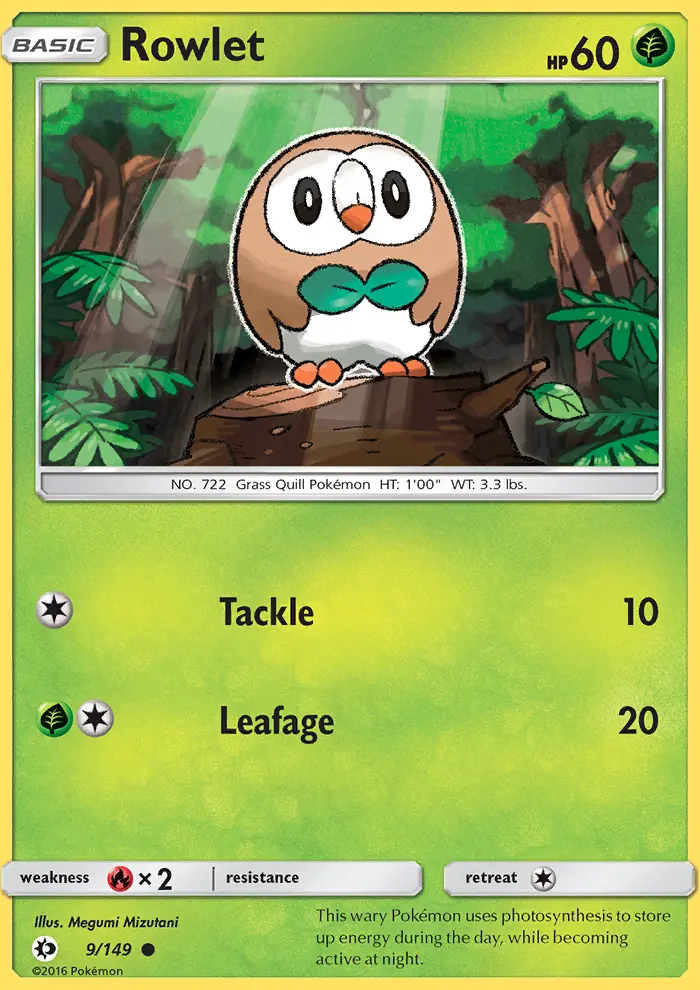
Rowlet
Generation VII · #0722 — Grass Quill Pokémon
Trainers who write off Rowlet on looks alone are missing that its HP of 50 is genuinely one of the higher marks among grass/flying-type Pokémon. At 0.3 m and 1.5 kg, its build reflects a specialist role rather than a generalist one. This diminutive owl-like creature stands at a mere 0.3 meters tall and weighs only 1.5 kilograms, making it one of the smallest starter Pokémon in the franchise. Despite its modest stature, Rowlet combines nocturnal hunting efficiency with daytime photosynthetic energy storage, representing a unique ecological balance that sets it apart from other first partner Pokémon. With a total stat allocation of 320 and a medium-slow growth rate, Rowlet is designed to gradually develop into a formidable Grass/Ghost hybrid upon reaching its final evolutionary form, Decidueye.
Editor's Take
Rowlet is the only starter whose final evolution changes secondary type entirely, and Decidueye's Ghost typing makes it the most mechanically distinctive Grass starter Game Freak has shipped.
Base Stats
Height
0.3m
Weight
1.5kg
Category
Grass Quill Pokémon
Gender
Male 87.5% / Female 12.5%
Color
brown
Shape
wings
Abilities
Strengthens grass moves to inflict 1.5× damage at 1/3 max HP or less.
This Pokémon's moves do not make contact.

Rowlet Biology & Physical Characteristics
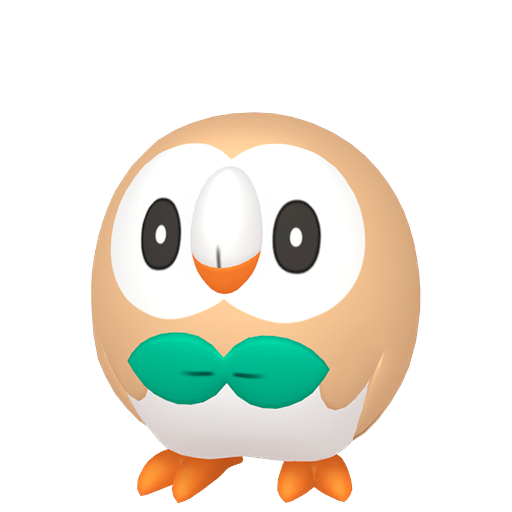
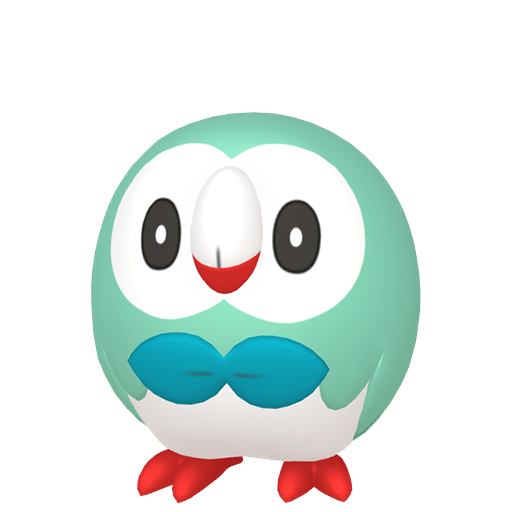
Rowlet is a small, avian Pokémon with striking features that immediately evoke the image of a young owl in its earliest stages of development. Its plumage is primarily beige with a white underside and a distinctive white facial disc shaped like two overlapping circles, complemented by large, expressive black eyes and a stubby beak featuring a white upper half and orange-brown lower half that matches its foot coloration. The most characteristic biological features are the two leaves sprouting from its chest in a bowtie arrangement, additional leaves forming its tail, and leaf-like formations lining the undersides of its wings, seamlessly integrating its Grass-type nature into its physical anatomy. Its feet possess two forward-facing toes and one backward-facing toe, providing the stability needed for a creature that hunts silently through the night sky. With a capture rate of 45 and a base happiness of 70, Rowlet demonstrates a moderate willingness to bond with trainers, though it requires patience and understanding of its nocturnal tendencies.
Pokedex Numbers
Training
Breeding
Rowlet Breeding, Gender Ratio & Egg Groups
Rowlet displays a pronounced sexual dimorphism in population distribution, with approximately 87.5% of wild Rowlet being male and only 12.5% being female, making female specimens notably rarer and more sought-after by competitive breeders and collectors. This gender ratio aligns with real-world owl populations, where certain species demonstrate similar sex ratios due to evolutionary pressures and survival advantages, lending ecological realism to the game mechanics. The species belongs to the Flying egg group, allowing it to breed with a diverse range of Pokémon that share this classification, including various bird-type Pokémon and some unexpected creatures that share the flying designation through game mechanics. Eggs require 15 cycles to hatch, translating to approximately 3,599 to 3,855 steps depending on breeding mechanics and whether the player possesses a Pokémon with the flame body or similar egg-hatching abilities. The base friendship value of 70 (or 50 in some game generations) suggests that Rowlet hatchlings bond moderately well with their trainers from the outset, though consistent interaction and positive experiences are necessary to maximize the emotional connection that Rowlet's entries suggest is important to its wellbeing. Breeding strategies often focus on preserving Rowlet's ability to inherit egg moves from compatible parents, particularly moves that complement its grass and flying-type movepool.
Sprites




TMs & HMs
tm01
ultra sun ultra moon
tm01
sun moon
tm03
yellow
tm03
crystal
tm03
gold silver
tm03
red blue
tm03
lets go pikachu lets go eevee
tm03
blue japan
tm03
red green japan
tm05
lets go pikachu lets go eevee
tm06
yellow
tm06
gold silver
tm06
red blue
tm06
crystal
tm06
emerald
tm06
firered leafgreen
tm06
diamond pearl
tm06
platinum
tm06
ruby sapphire
tm06
colosseum
+520 more TMs/HMs
Rowlet's Evolution Chain


Rowlet Evolution, Mega Evolution & Special Forms
Rowlet begins its evolutionary journey at level 17, transforming into Dartrix, a more sophisticated and angular Grass/Flying form that retains the species' aerial and Grass-type characteristics while enhancing its combat capabilities. The evolution from Dartrix to Decidueye occurs at level 34, marking a dramatic transformation where Rowlet's avian nature culminates in a regal, archer-themed final form that gains the Ghost type in standard games, fundamentally shifting its type matchups and available movepool. In Pokémon Legends: Arceus, the Hisuian region introduced a regional variant of Decidueye with Grass/Fighting typing, evolving at level 36 and representing a more martial, samurai-inspired interpretation of the evolutionary line's archery themes. This evolutionary arc is particularly notable because it demonstrates one of the most dramatic type changes in the entire franchise, as Rowlet's Grass/Flying combination gives way to either Grass/Ghost or Grass/Fighting, completely altering the strategic depth and defensive profile of the line. The staggered evolution levels allow trainers to maintain Rowlet's unique nocturnal characteristics and compact size for extended periods if desired, or rapidly progress through the line for increased competitive viability.
Where to Find
Iki Town
alola
Alola Route 1
alola
Rowlet Behaviour and Natural Habitat
Rowlet exhibits remarkably specialized behavioral patterns that make it a fascinating subject of study for both trainers and researchers. As described in multiple Pokédex entries, this wary Pokémon utilizes photosynthesis during daylight hours to store energy reserves, entering an active nocturnal phase once darkness falls. The Pokédex entry from Moon reveals that Rowlet "silently glides, drawing near its targets" before unleashing "vicious kicks" before opponents even realize they're under attack, demonstrating a hunting strategy built entirely around stealth and surprise. Its remarkable ability to rotate its head nearly 180 degrees from front to back allows it to survey its environment with exceptional awareness, a trait particularly useful during nighttime hunts. The Legends: Arceus Pokédex entry notes that Rowlet "flies noiselessly on delicate wings" and has "mastered the art of deftly launching dagger-sharp feathers," emphasizing its aerial combat proficiency. Interestingly, the Ultra Moon entry reveals a surprisingly domesticated side to this species—Rowlet feels so relaxed in tight, dark spaces that it has been known to nest inside its Trainer's pocket or bag, suggesting an endearing behavioral quirk that endears the species to those who understand its preferences.
Pokedex Entries
This wary Pokémon uses photosynthesis to store up energy during the day, while becoming active at night.
It sends its feathers, which are as sharp as blades, flying in attack. Its legs are strong, so its kicks are also formidable.
Silently it glides, drawing near its targets. Before they even notice it, it begins to pelt them with vicious kicks.
It feels relaxed in tight, dark places and has been known to use its Trainer’s pocket or bag as a nest.
At a distance, it launches its sharp feathers while flying about. If the enemy gets too close, Rowlet switches tactics and delivers vicious kicks.
During the day, it builds up energy via photosynthesis. At night, it flies silently through the sky, on the prowl for prey.
Flies noiselessly on delicate wings. It has mastered the art of deftly launching dagger-sharp feathers from those same wings.
Rowlet Name Origin & Design Inspiration
Rowlet's name traces back to a combination of "rowan" (referring to the tree and its berries) and "owlet" (a young owl), perfectly encapsulating the creature's dual nature as both a tree-connected Grass Pokémon and a juvenile avian. The Japanese name "Mokuroh" (モクロー) combines "mokuzai" (木材, wood/timber) with the owl sound "hou," similarly emphasizing the fusion of botanical and avian themes central to the design. Visually, Rowlet's design draws heavy inspiration from barn owls and other small owlet species, with its round body, large facial disc, and relatively short wingspan all characteristic of juvenile raptors in their first plumage. The bowtie arrangement of leaves on its chest serves as a visual bridge between its Grass typing and owl-like appearance, while the razor-sharp leaves forming its feathers and tail represent a clever design solution that makes its attack methods—both physical kicks and leaf-based projectiles—feel organic to its anatomy. The color palette of beige, white, orange-brown, and green creates a warm, approachable aesthetic that makes Rowlet appealing to younger players while maintaining the sophisticated details that satisfy more experienced Pokémon fans, including the subtle gradient work on its facial disc and the precise detailing of its feather formations.
Learnable Moves
Rowlet can learn 76 moves:
Move | Type | Cat. | Power | Acc. | PP |
|---|---|---|---|---|---|
| aerial ace | flying | Physical | 60 | — | 20 |
| air cutter | flying | Special | 60 | 95 | 25 |
| air slash | flying | Special | 75 | 95 | 15 |
| astonish | ghost | Physical | 30 | 100 | 15 |
| attract | normal | Status | — | 100 | 15 |
| baton pass | normal | Status | — | — | 40 |
| brave bird | flying | Physical | 120 | 100 | 15 |
| bullet seed | grass | Physical | 25 | 100 | 30 |
| confide | normal | Status | — | — | 20 |
| confuse ray | ghost | Status | — | 100 | 10 |
| covet | normal | Physical | 60 | 100 | 25 |
| curse | ghost | Status | — | — | 10 |
| defog | flying | Status | — | — | 15 |
| double team | normal | Status | — | — | 15 |
| dual wingbeat | flying | Physical | 40 | 90 | 10 |
| echoed voice | normal | Special | 40 | 100 | 15 |
| endure | normal | Status | — | — | 10 |
| energy ball | grass | Special | 90 | 100 | 10 |
| facade | normal | Physical | 70 | 100 | 20 |
| false swipe | normal | Physical | 40 | 100 | 40 |
| feather dance | flying | Status | — | 100 | 15 |
| foresight | normal | Status | — | — | 40 |
| frustration | normal | Physical | — | 100 | 20 |
| fury attack | normal | Physical | 15 | 85 | 20 |
| giga drain | grass | Special | 75 | 100 | 10 |
| grass knot | grass | Special | — | 100 | 20 |
| grass pledge | grass | Special | 80 | 100 | 10 |
| grassy glide | grass | Physical | 55 | 100 | 20 |
| grassy terrain | grass | Status | — | — | 10 |
| growl | normal | Status | — | 100 | 40 |
| gust | flying | Special | 40 | 100 | 35 |
| haze | ice | Status | — | — | 30 |
| helping hand | normal | Status | — | — | 20 |
| hidden power | normal | Special | 60 | 100 | 15 |
| knock off | dark | Physical | 65 | 100 | 20 |
| leaf blade | grass | Physical | 90 | 100 | 15 |
| leaf storm | grass | Special | 130 | 90 | 5 |
| leafage | grass | Physical | 40 | 100 | 40 |
| light screen | psychic | Status | — | — | 30 |
| magical leaf | grass | Special | 60 | — | 20 |
| nasty plot | dark | Status | — | — | 20 |
| nature power | normal | Status | — | — | 20 |
| night shade | ghost | Special | — | 100 | 15 |
| ominous wind | ghost | Special | 60 | 100 | 5 |
| peck | flying | Physical | 35 | 100 | 35 |
| pluck | flying | Physical | 60 | 100 | 20 |
| protect | normal | Status | — | — | 10 |
| rain dance | water | Status | — | — | 5 |
| razor leaf | grass | Physical | 55 | 95 | 25 |
| rest | psychic | Status | — | — | 5 |
| return | normal | Physical | — | 100 | 20 |
| roost | flying | Status | — | — | 5 |
| round | normal | Special | 60 | 100 | 15 |
| safeguard | normal | Status | — | — | 25 |
| seed bomb | grass | Physical | 80 | 100 | 15 |
| shadow claw | ghost | Physical | 70 | 100 | 15 |
| shadow sneak | ghost | Physical | 40 | 100 | 30 |
| sky attack | flying | Physical | 140 | 90 | 5 |
| sleep talk | normal | Status | — | — | 10 |
| snore | normal | Special | 50 | 100 | 15 |
| solar beam | grass | Special | 120 | 100 | 10 |
| steel wing | steel | Physical | 70 | 90 | 25 |
| substitute | normal | Status | — | — | 10 |
| sucker punch | dark | Physical | 70 | 100 | 5 |
| sunny day | fire | Status | — | — | 5 |
| swagger | normal | Status | — | 85 | 15 |
| swift | normal | Special | 60 | — | 20 |
| swords dance | normal | Status | — | — | 20 |
| synthesis | grass | Status | — | — | 5 |
| tackle | normal | Physical | 40 | 100 | 35 |
| take down | normal | Physical | 90 | 85 | 20 |
| tera blast | normal | Special | 80 | 100 | 10 |
| toxic | poison | Status | — | 90 | 10 |
| trailblaze | grass | Physical | 50 | 100 | 20 |
| work up | normal | Status | — | — | 30 |
| worry seed | grass | Status | — | 100 | 10 |
Rowlet Competitive Battle Guide
Rowlet's competitively viable base stats total 320, with a modest HP of 68 and defensive stats of 55 in both defense and special defense, making it relatively fragile in its unevolved form but acceptable as a starter Pokémon for early-game gym challenges. Its attack stat of 55 and special attack of 42 indicate that Rowlet struggles with raw damage output, though this weakness is mitigated by access to type-effective moves through its natural moveset and tutors. The speed stat of 42 represents a significant competitive liability, as Rowlet moves slower than most other Pokémon it will encounter during casual play, necessitating a focus on defensive play or switch-based strategies rather than aggressive offensive approaches. However, Rowlet's true competitive value emerges through its dual-type coverage and access to its hidden ability, Long Reach, which allows its moves to inflict damage without making physical contact—an advantage in doubles formats and against abilities triggered by contact like Static or Rough Skin. The primary ability Overgrow provides a crucial defensive mechanism by amplifying grass-type moves to 1.5× damage when Rowlet's health drops to one-third or less, potentially enabling unexpected comebacks in tightly contested matches. Upon evolution to Dartrix and Decidueye, Rowlet's competitive viability increases substantially, with Decidueye particularly gaining respect in various metagames due to its superior stat distribution, expanded movepool, and the tactical advantages provided by its Ghost typing in the standard form or Fighting typing in its Hisuian variant.
Commonly Asked Questions About Rowlet
What type is Rowlet?
Rowlet is a grass and flying type Pokemon.
What does Rowlet evolve into?
Rowlet evolves into dartrix, then into decidueye.
What are Rowlet's weaknesses?
Rowlet is weak to flying, poison, rock, fire and ice type moves.
Does Rowlet evolve by trading?
No — Rowlet evolves entirely through leveling up, with no trade required at any stage.
Where can I find Rowlet?
Rowlet can be found in iki town (alola) and alola route 1 (alola).
Rowlet Cultural Impact & Franchise History
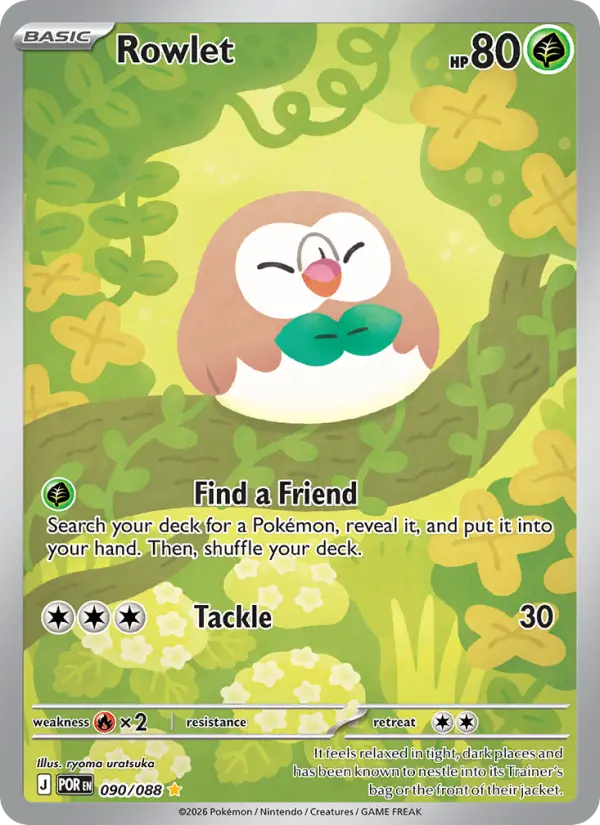
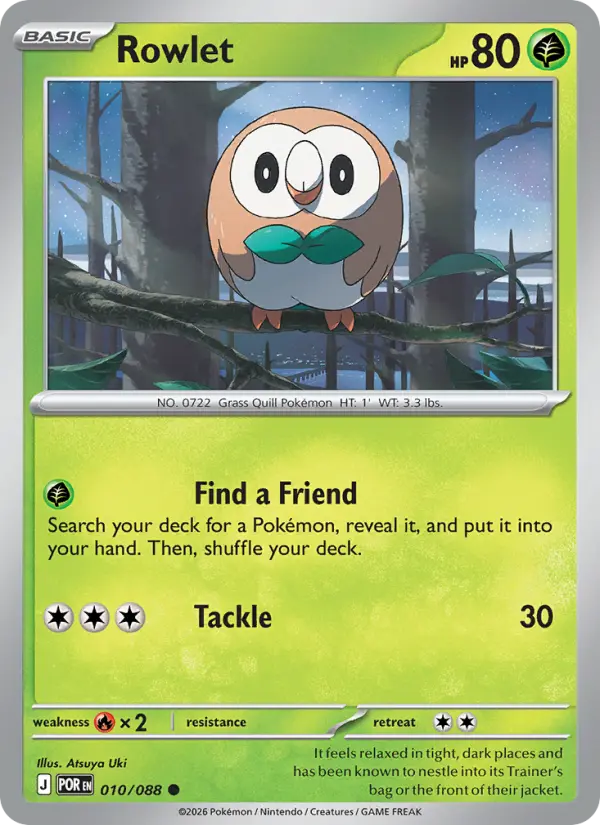
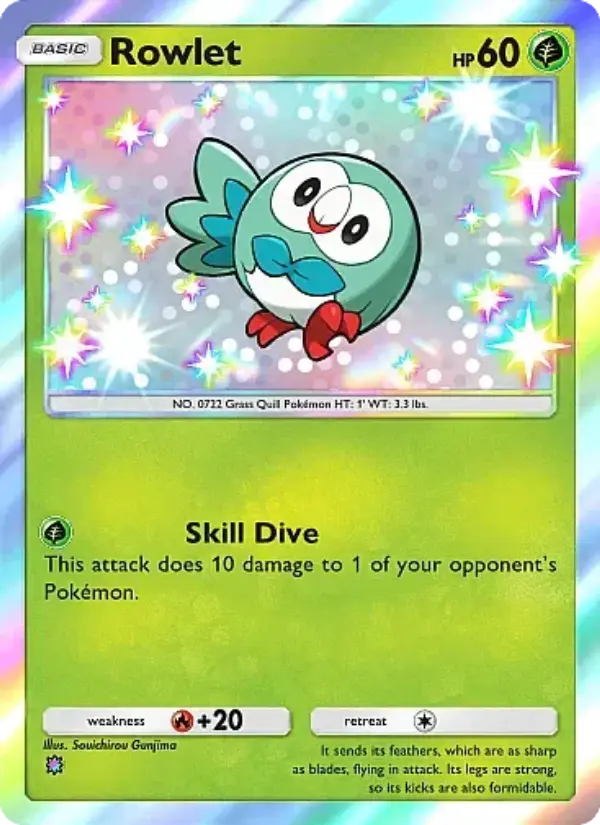
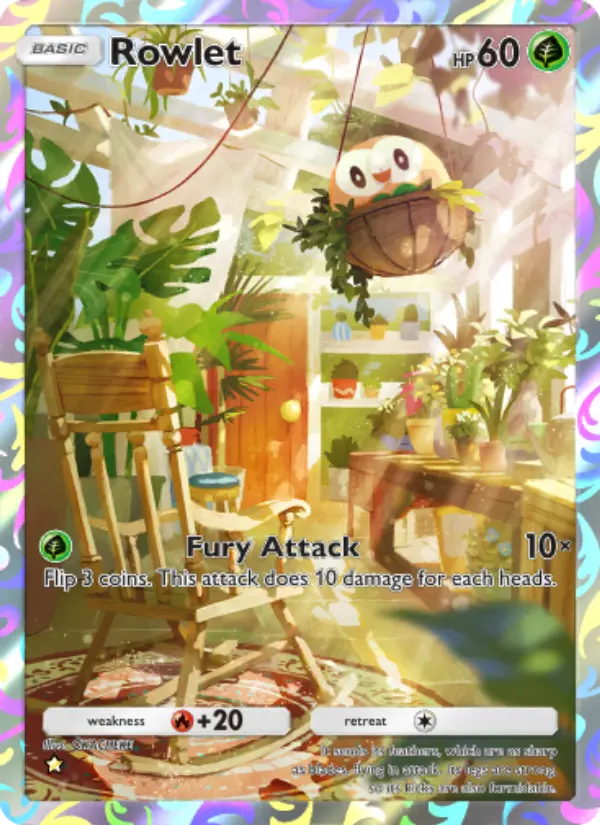
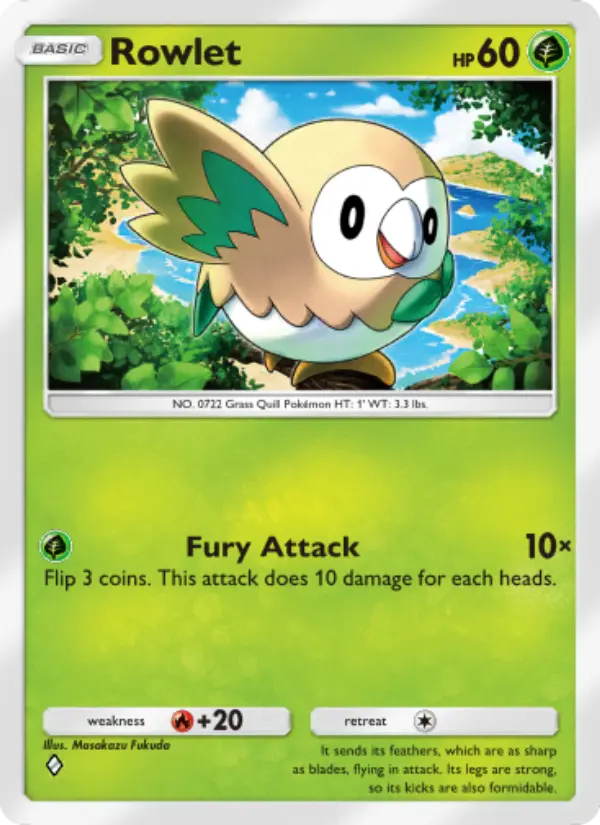
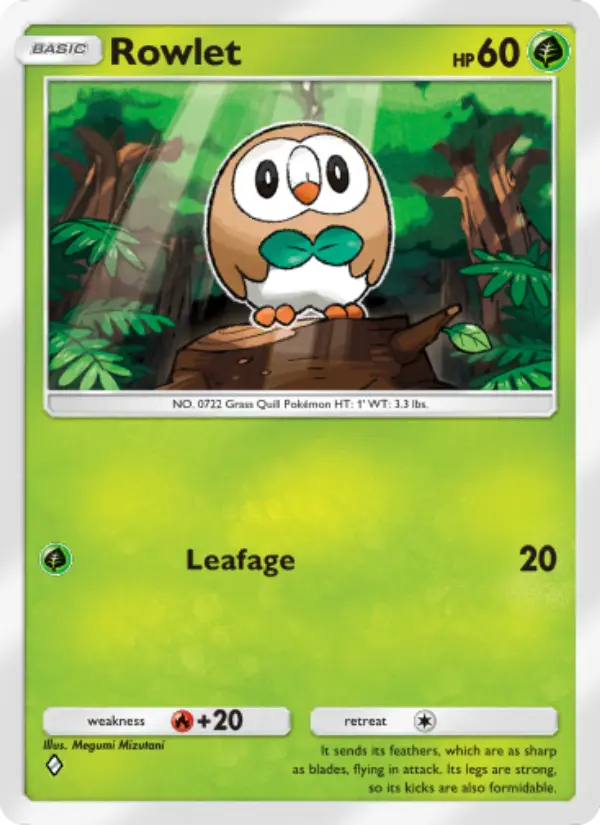
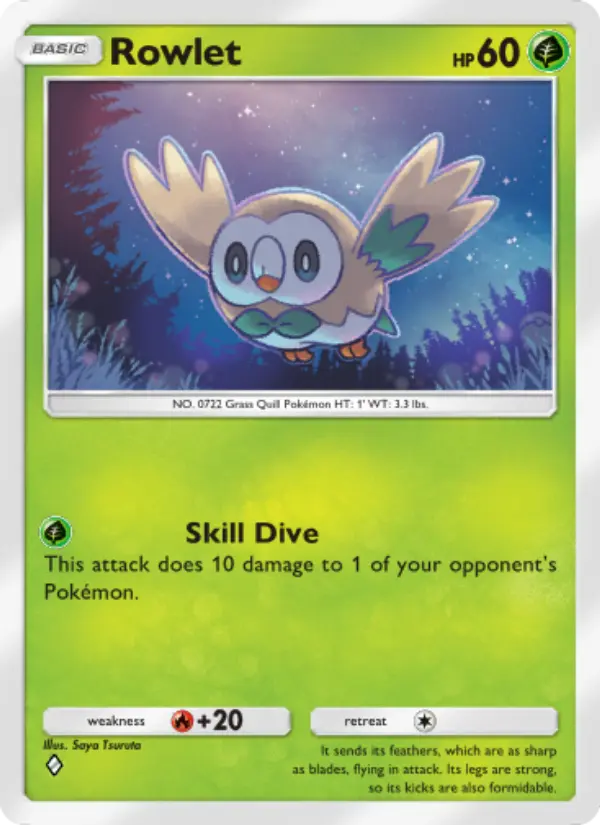
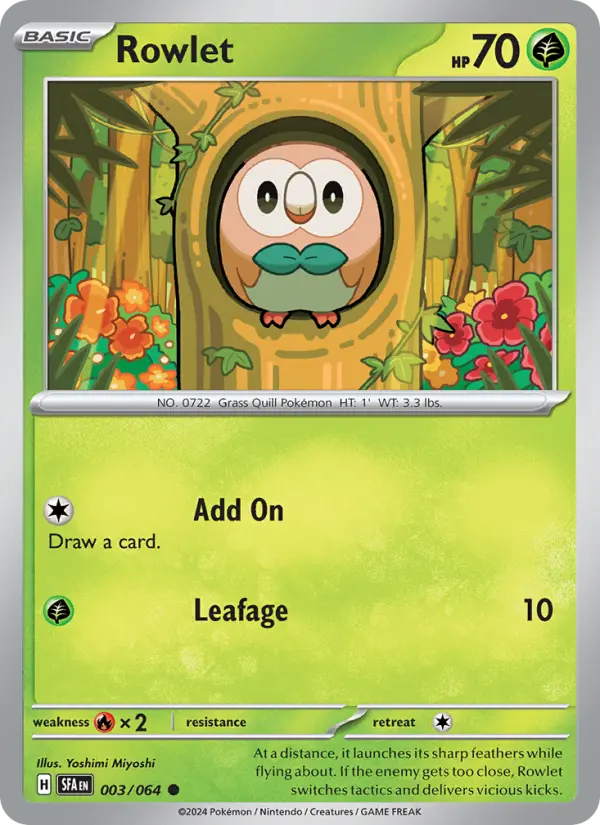
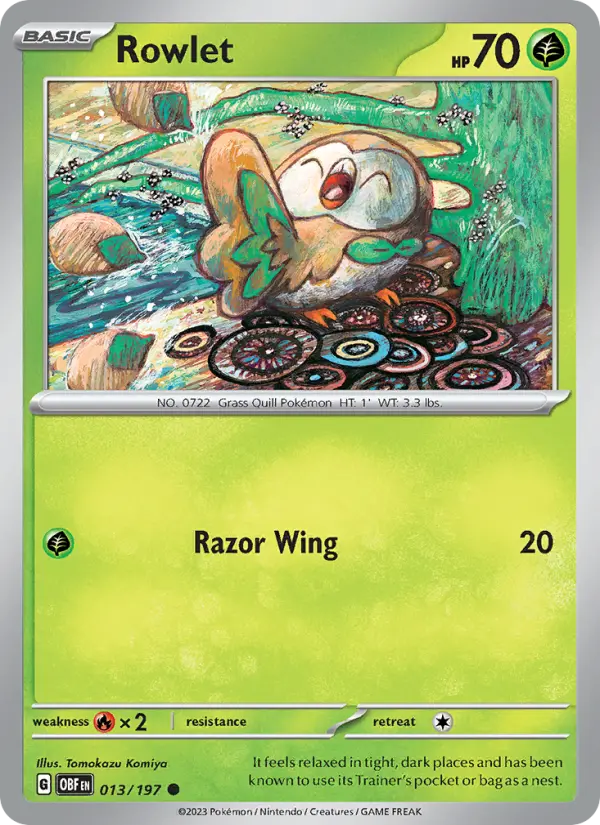
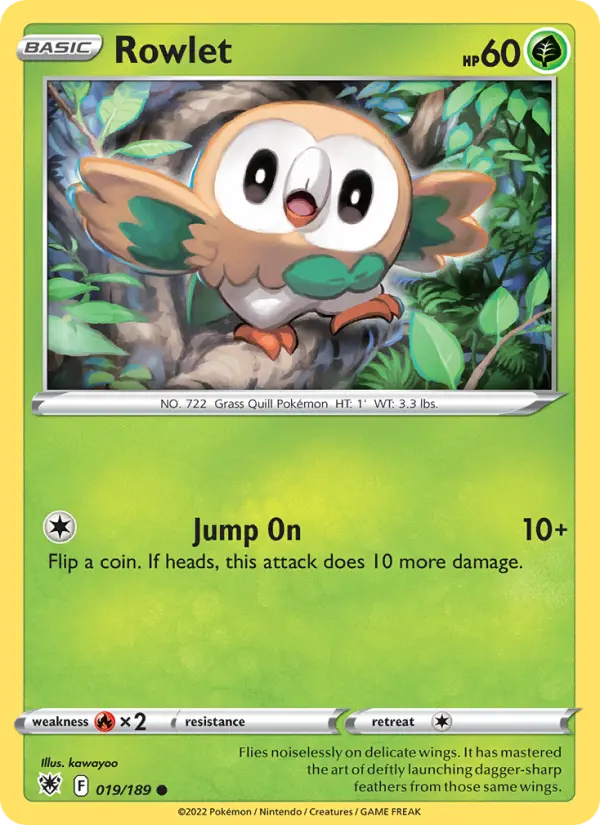
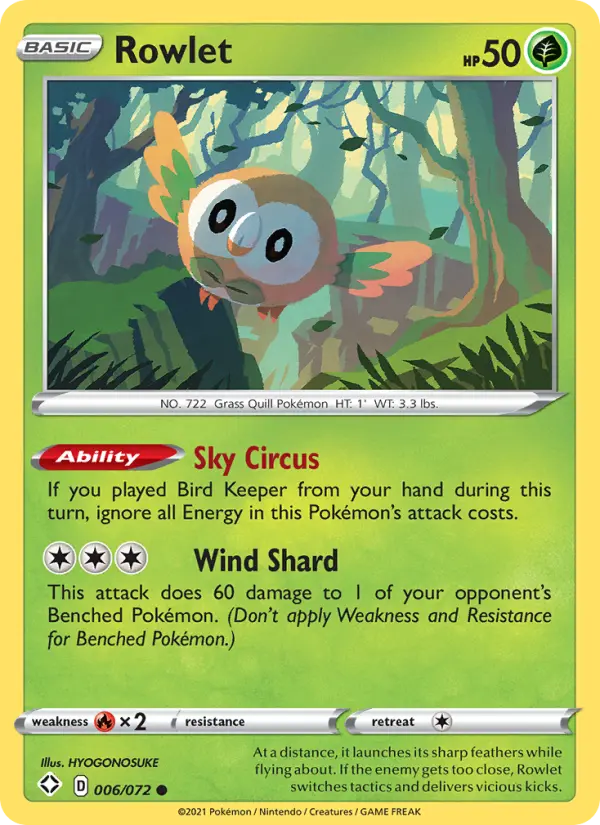
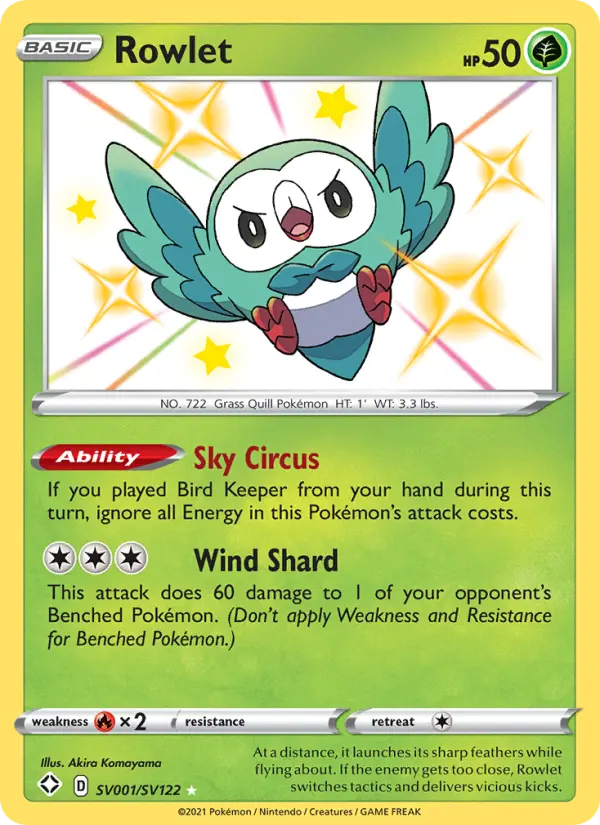
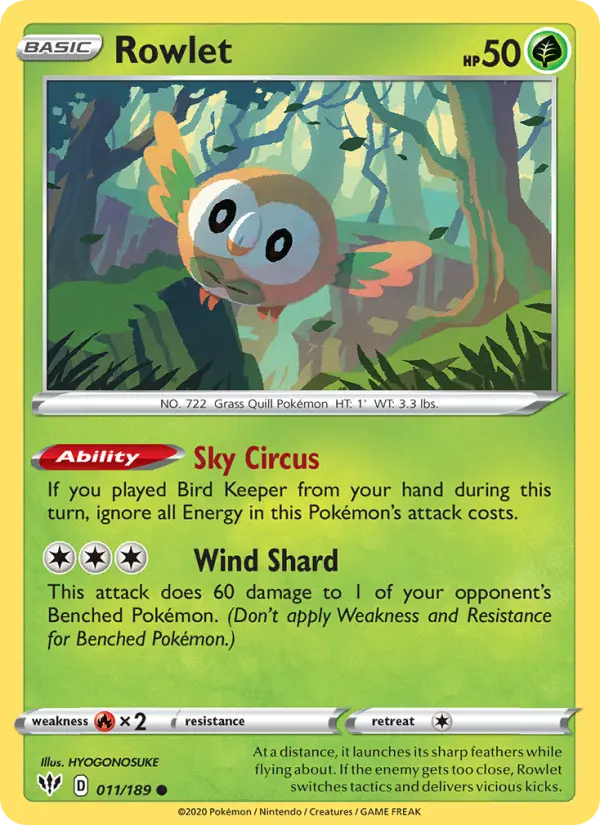
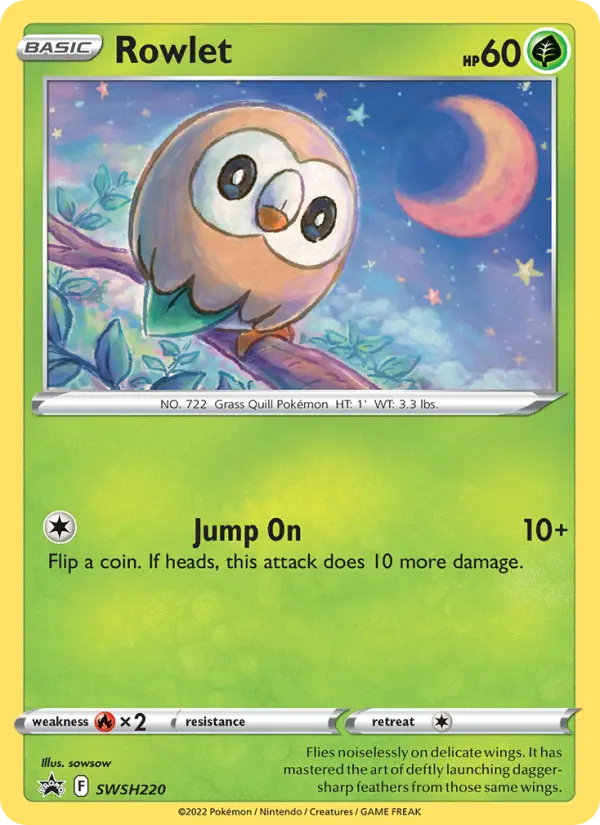
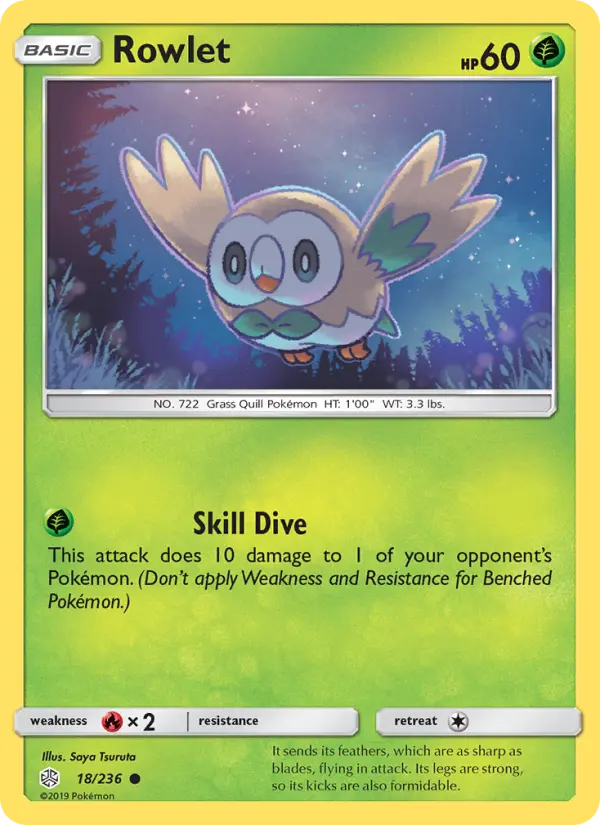
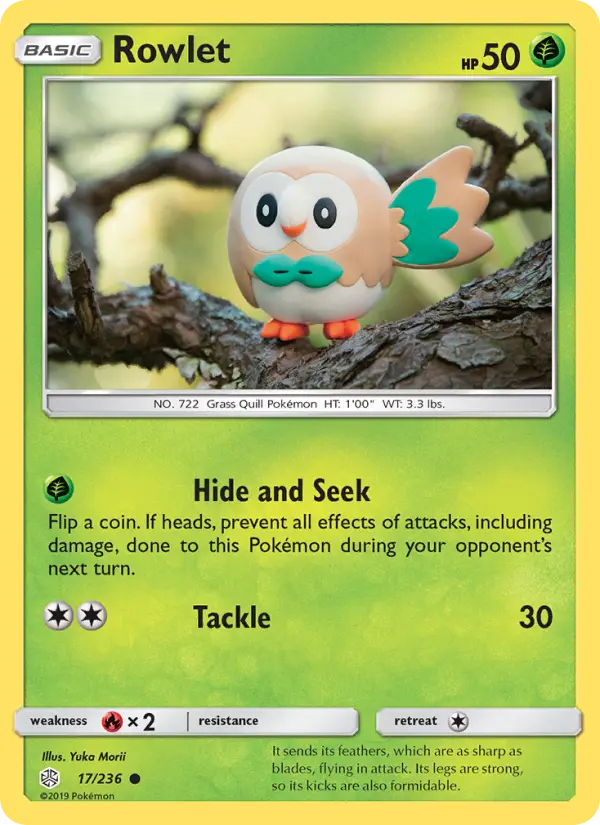
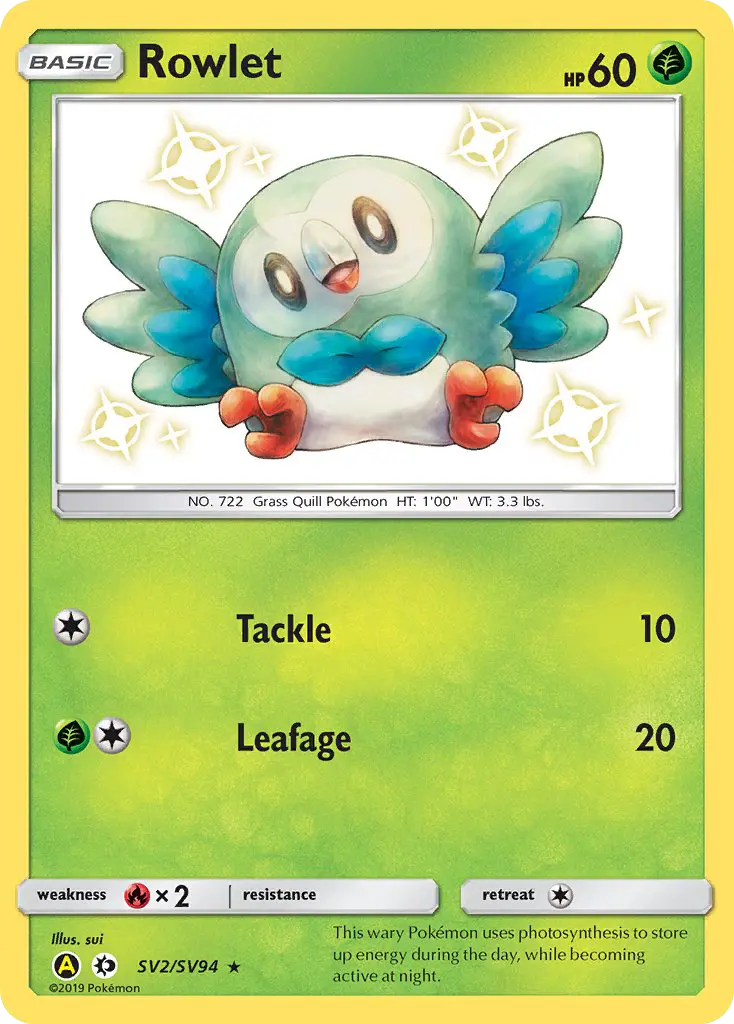
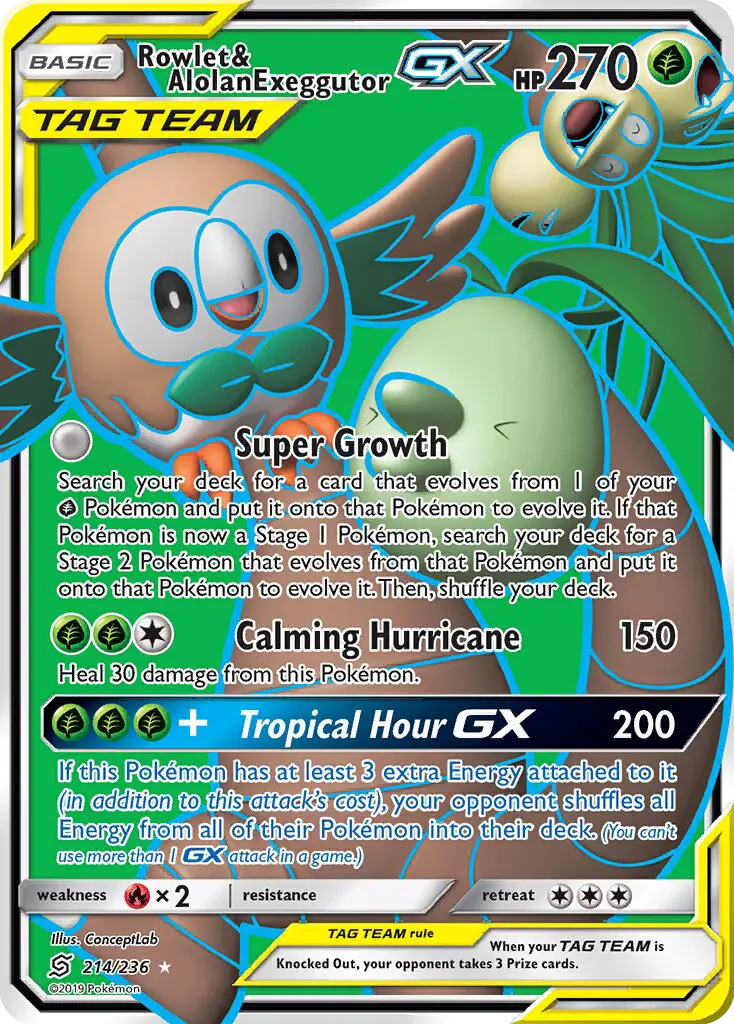
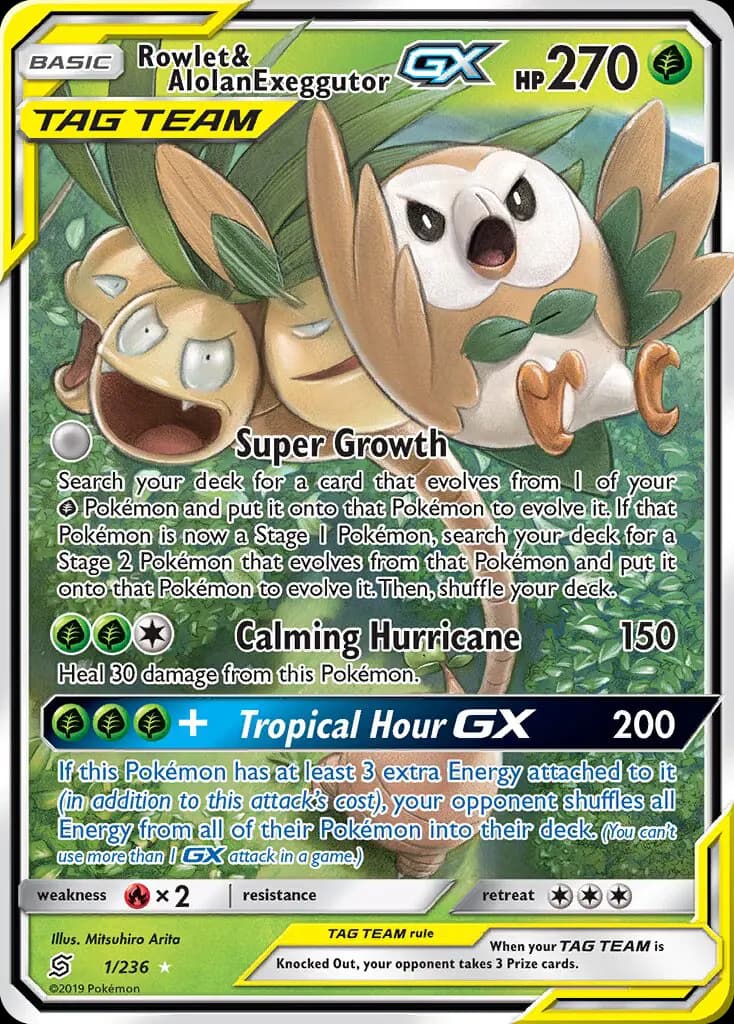
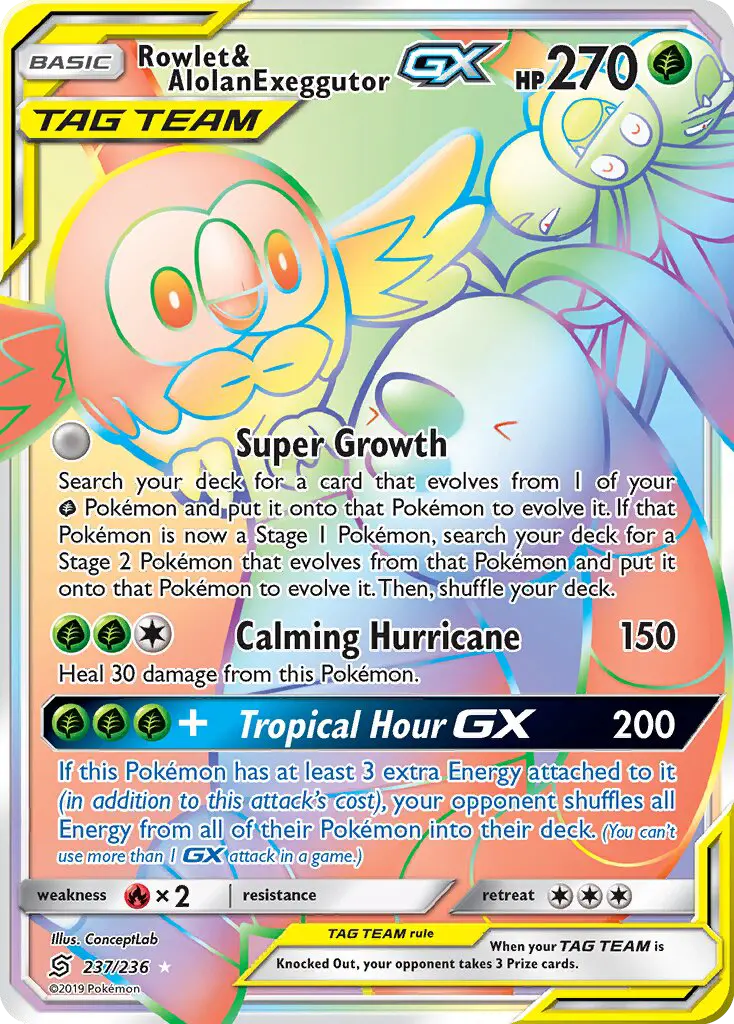
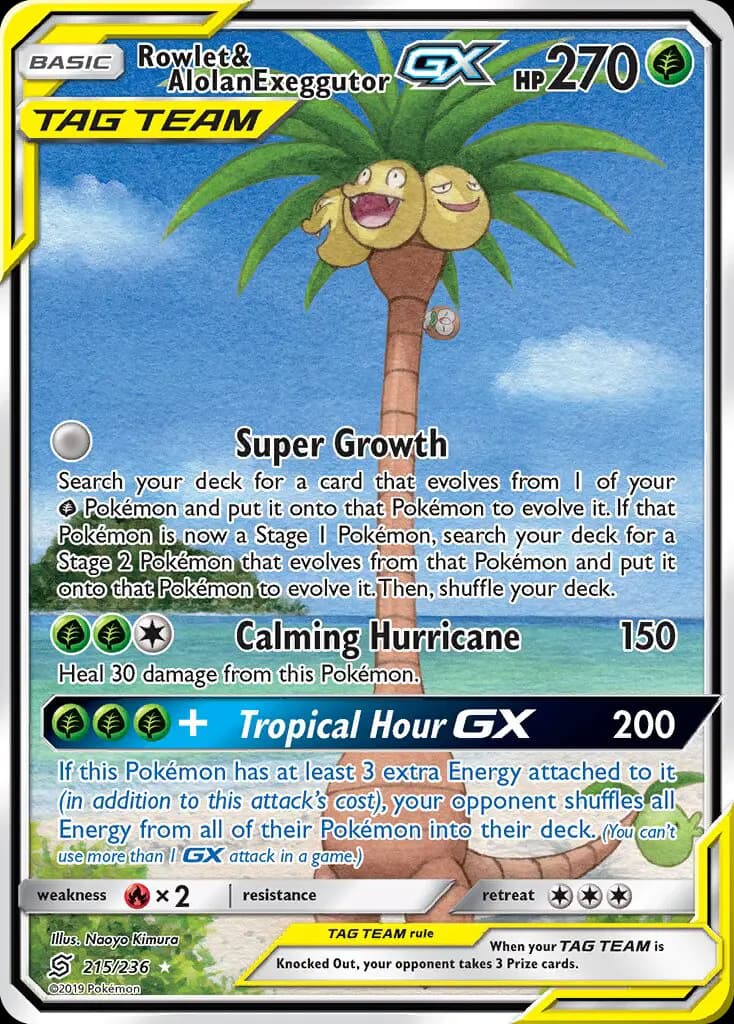
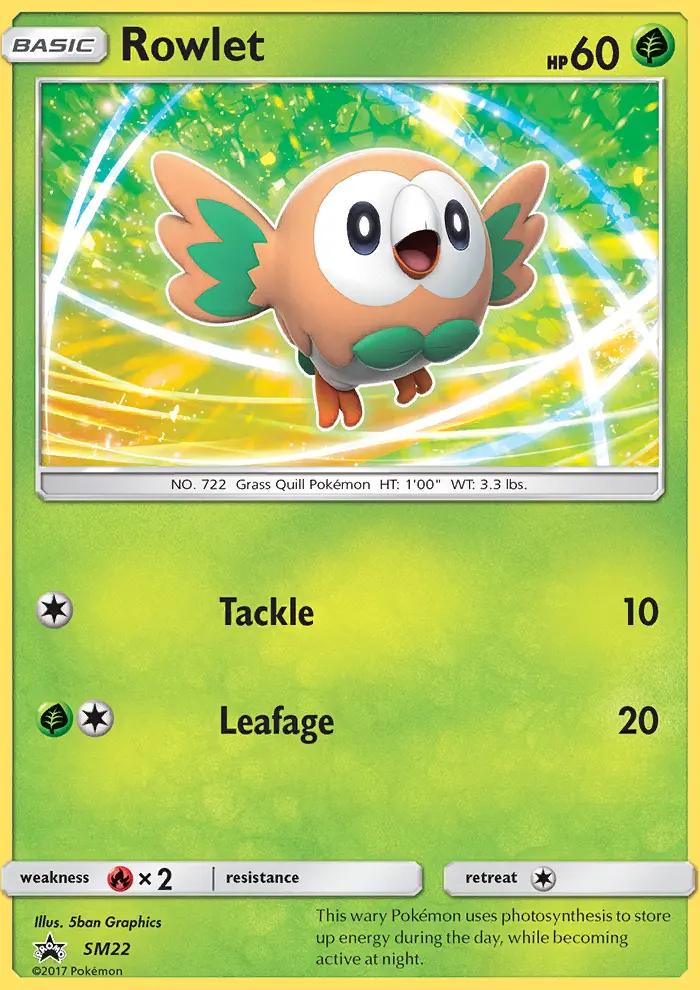
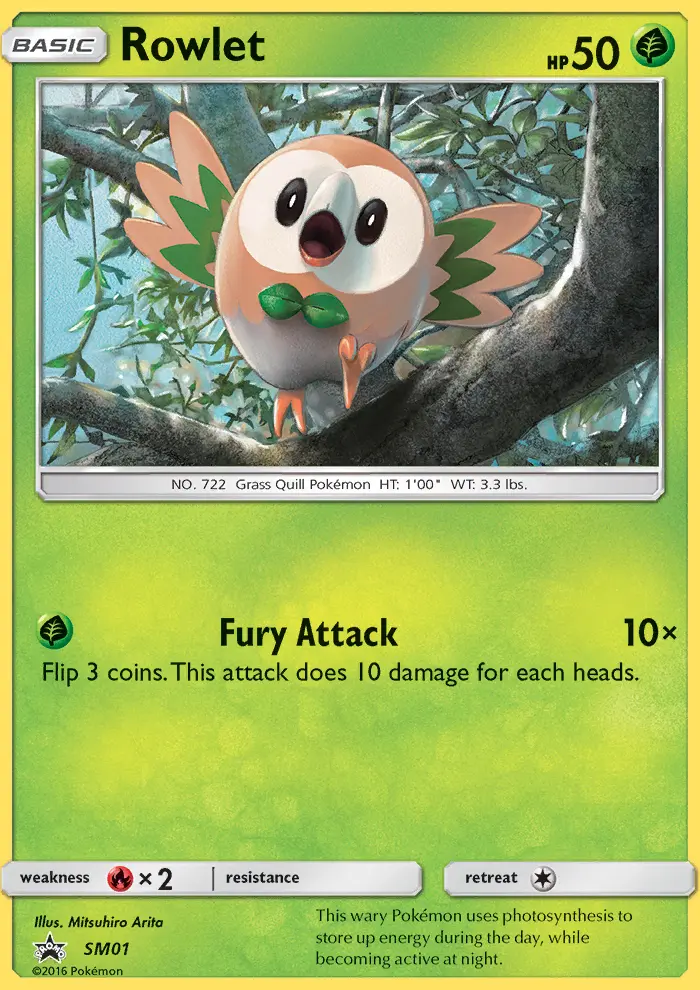
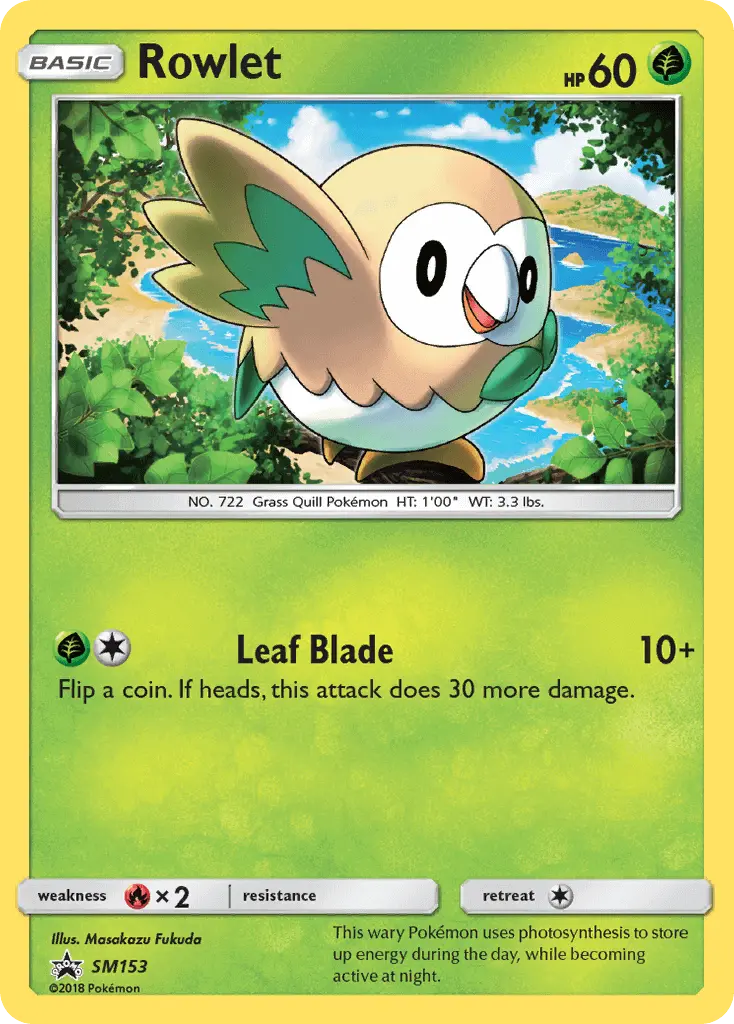
Rowlet has become one of the most recognizable and beloved Pokémon from Generation VII, achieving cultural prominence that extends well beyond the games themselves through its appearances in the anime, trading card game, and various merchandise categories. The species gained significant fan appreciation through its appearance in the Pokémon anime, where Ash's Rowlet became a memorable character arc, developing from a wild Pokémon with independent tendencies into a loyal team member that underwent evolution and contributed meaningfully to critical battles. The character's endearing habit of nesting in Ash's jacket became an iconic visual gag that resonated with viewers and helped establish Rowlet as a fan favorite despite the typical bias toward fully-evolved Pokémon in popular discourse. Rowlet's inclusion as a first partner Pokémon in Pokémon Legends: Arceus alongside the classic first partners Cyndaquil and Oshawott introduced the species to new audiences and reinforced its status as a significant member of the franchise's starter legacy. In competitive trading card game circles, Rowlet and its evolutionary line have appeared in numerous set releases, with artwork variations and collectible versions that appeal to both casual collectors and serious competitive players. The species' popularity is reflected in merchandise availability, fan art communities, and discussion forums, where Rowlet frequently ranks among the top-tier favorite Grass-type Pokémon across multiple demographic categories, competing successfully with iconic species like Bulbasaur and Celebi for affection among trainers worldwide.
Where to Find Rowlet in Every Pokémon Game
Rowlet is available as a starter Pokémon at the beginning of Pokémon Sun, Moon, Ultra Sun, and Ultra Moon, serving as the Grass-type option in the Alolan region and appearing as Pokédex #0001 in the regional Alola Pokédex for these games. In Pokémon Legends: Arceus, Rowlet returns as one of three available first partner Pokémon representing the Hisui region, maintaining its status as an accessible early-game Pokémon that can be selected at the start of the adventure. The species makes subsequent appearances in Pokémon Sword and Shield, where it can be obtained through various means though it does not serve as a starter option, and in Pokémon Scarlet and Violet through the Pokédex post-game content. Rowlet has also been featured in multiple in-game event distributions across various games and regions, allowing players who did not select it as a starter to obtain one through special events or in-game encounters. The Pokémon Home system enables players to transfer Rowlet across compatible games, facilitating collection completion and team building across multiple game generations. In terms of battle availability, wild Rowlet encounters are limited primarily to starter gifts and event distributions, as the species does not naturally appear in wild grass or similar habitats in most games, preserving its status as a special starter Pokémon rather than a commonly encountered species. Trading card game availability is extensive, with Rowlet appearing in numerous set releases from the Sun and Moon era forward, providing multiple collecting opportunities at various rarity and artwork variations.