Sandile
Generation V · #0551 — Desert Croc Pokémon
Sandile's profile is easy to undersell: 0.7 m, 15.2 kg, and a ground/dark typing that doesn't scream power — until you look at its Attack of 72. It measures 0.7 m and 15.2 kg, dimensions that pair with that stat lean in noticeable ways. Standing only 0.7 meters tall and weighing a modest 15.2 kilograms, Sandile is deceptively small despite its predatory nature. Its overall stat sum of 292 reflects its role as an early-game Pokémon, with Attack being its most developed stat at 72, followed by a respectable Speed stat of 65. The species maintains a balanced gender ratio of 50% male to 50% female, with a base friendship value of 70 and a medium-slow growth rate, making it accessible to trainers while still requiring dedication to fully develop.
Editor's Take
Sandile's line ends in Krookodile with Moxie and Intimidate, and Ground/Dark is one of the better offensive typings in the game.
Base Stats
Height
0.7m
Weight
15.2kg
Category
Desert Croc Pokémon
Gender
Male 50% / Female 50%
Color
brown
Shape
quadruped
Abilities
Lowers opponents' Attack one stage upon entering battle.
Raises Attack one stage upon KOing a Pokémon.
Raises Attack to the maximum of six stages upon receiving a critical hit.
Sandile Biology & Physical Characteristics
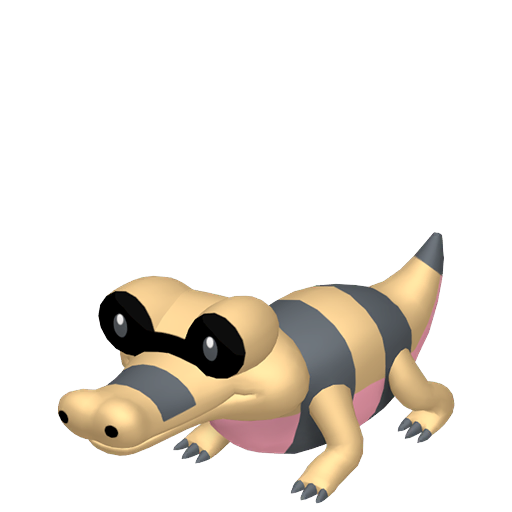
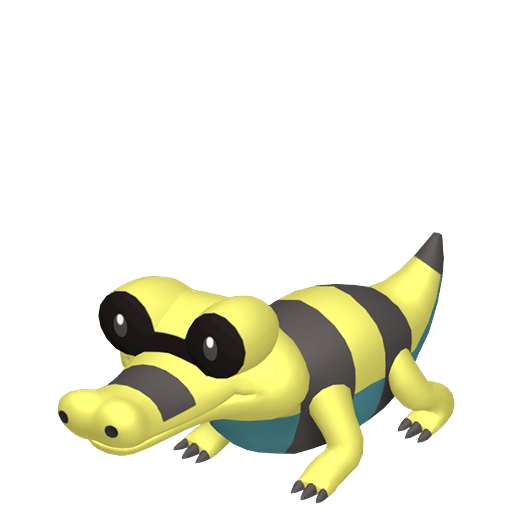
Sandile possesses a distinctly reptilian design centered around crocodilian features adapted for desert survival. Its body is predominantly light brown, accented by distinctive black stripes that cross over and under its legs, providing natural camouflage against sandy terrain. The Pokémon's most striking feature is its facial structure: a long snout tipped with two protruding nostrils forms the upper jaw, while its mouth comprises the bottom half. Most remarkably, Sandile's eyes are shrouded by a specialized dark membrane that extends around the front of each eye, functioning as both protection and visual enhancement in the harsh desert sun. This membrane prevents sand particles from reaching the delicate eye structures while simultaneously reducing glare, allowing Sandile to hunt effectively during peak daylight hours. Its pink underbelly contrasts sharply with its dorsal coloring, and its long tail terminates in a black tip. Sandile possesses three sharp, black claws on each foot attached to characteristically stubby legs, which belie the Pokémon's remarkable burrowing and movement capabilities.
Pokedex Numbers
Training
Breeding
Sandile Breeding, Gender Ratio & Egg Groups
Sandile follows standard Pokémon breeding mechanics with an equal 50% male to 50% female gender ratio, allowing trainers to breed populations with minimal gender-based complications. The species belongs to the Field Egg Group, a large and diverse group that includes many terrestrial and semi-aquatic Pokémon, providing flexibility in breeding strategies when introducing new moves or abilities. With a base friendship value of 70, Sandile demonstrates reasonable approachability—higher than truly feral species but lower than domesticated Pokémon, reflecting its wild nature despite its capability for companionship with trainers. The species requires 20 egg cycles to hatch, translating to approximately 4,884 to 5,140 steps, making it moderately accessible for players engaged in breeding programs. Sandile's breeding mechanics remain consistent across generations, with the Field Egg Group membership allowing it to produce offspring with move combinations not normally available through level-up alone. This breeding accessibility makes Sandile an attractive option for competitive players seeking to customize movesets, particularly when combined with its two standard abilities and rare hidden ability. The moderate friendship value means that players can develop strong bonds with Sandile through interaction and battles, though it won't become excessively attached as quickly as baby Pokémon or notably affectionate species would.
Sprites




Held Items
Black Glasses
type-enhancement
Held: Dark-Type moves from holder do 20% more damage.
Cost: 1000
Black Glasses
type-enhancement
Held: Dark-Type moves from holder do 20% more damage.
Cost: 1000
Black Glasses
type-enhancement
Held: Dark-Type moves from holder do 20% more damage.
Cost: 1000
Black Glasses
type-enhancement
Held: Dark-Type moves from holder do 20% more damage.
Cost: 1000
TMs & HMs
tm01
black white
tm01
black 2 white 2
tm01
omega ruby alpha sapphire
tm01
x y
tm02
lets go pikachu lets go eevee
tm03
crystal
tm03
gold silver
tm03
lets go pikachu lets go eevee
tm05
ruby sapphire
tm05
emerald
tm05
gold silver
tm05
crystal
tm05
diamond pearl
tm05
black white
tm05
platinum
tm05
heartgold soulsilver
tm05
firered leafgreen
tm05
black 2 white 2
tm05
omega ruby alpha sapphire
tm05
x y
+650 more TMs/HMs
Sandile's Evolution Chain


Sandile Evolution, Mega Evolution & Special Forms
Sandile is the first Pokémon in a straightforward three-stage evolutionary line that develops through level-based progression. At level 29, Sandile evolves into Krokorok, which retains the Ground/Dark typing while gaining improved physical stats and a more aggressive appearance. The evolution to Krokorok represents a significant developmental leap, with increased Attack, Defense, and Special Attack statistics that reflect the Pokémon's maturation into a more formidable predator. At level 40, Krokorok undergoes its final evolution into Krookodile, a powerful Pokémon that represents the apex of this evolutionary line. Krookodile gains substantial stat increases across the board, most notably in Attack and Speed, along with improved bulk in both defensive categories. The evolutionary progression also brings notable behavioral changes, with each stage becoming progressively more dangerous and efficient as a hunter. While Sandile itself does not have access to Mega Evolution, its final form Krookodile received a Mega Evolution in Generation VI that further enhances its offensive capabilities, making the Sandile line a worthwhile investment for trainers seeking a formidable ground-type presence in their team.
Where to Find
Relic Castle
unova
+23 more
Desert Resort
unova
+25 more
Unova Route 4
unova
+15 more
Kalos Route 9
kalos
+5 more
Haina Desert
alola
+1 more
Sandile Behaviour and Natural Habitat
Sandile is exclusively found in desert environments, where it has evolved a sophisticated lifestyle centered around thermoregulation and concealment. According to Pokédex entries, Sandile lives buried in the sands of the desert, with the sun-warmed sand serving as the primary mechanism for maintaining its body temperature—a critical adaptation for an ectothermic creature in an environment with extreme temperature fluctuations. The Pokémon typically moves along below the sand's surface, with only its nose and eyes visible above ground, allowing it to navigate its territory while remaining largely hidden from predators and prey alike. This movement pattern has been described as remarkably similar to swimming, suggesting that Sandile navigates through sand with the same fluidity a water-type Pokémon displays in liquid. When daylight wanes and the desert cools, Sandile burrows deep into the sand to sleep until sunrise, creating a daily cycle perfectly synchronized with desert conditions. In the Alola region, where warm weather persists year-round, Sandile occasionally appears outside traditional desert habitats, indicating its primary requirement is consistent warmth rather than sandy terrain exclusively. Recent Pokédex entries reveal that Sandile is still developing its hunting prowess, often feeding on creatures that have collapsed in the desert, earning it the nickname "the cleaner of the desert."
Pokedex Entries
They live buried in the sands of the desert. The sun-warmed sands prevent their body temperature from dropping.
They live hidden under hot desert sands in order to keep their body temperature from dropping.
It moves along below the sand’s surface, except for its nose and eyes. A dark membrane shields its eyes from the sun.
It moves along below the sand’s surface, except for its nose and eyes. A dark membrane shields its eyes from the sun.
They live buried in the sands of the desert. The sun-warmed sands prevent their body temperature from dropping.
It moves along below the sand’s surface, except for its nose and eyes. A dark membrane shields its eyes from the sun.
They live buried in the sands of the desert. The sun-warmed sands prevent their body temperature from dropping.
It submerges itself in sand and moves as if swimming. This wise behavior keeps its enemies from finding it and maintains its temperature.
Alola, where it’s warm all year round, is a comfortable environment for this Pokémon. Sometimes you’ll even see it outside of deserts.
It conceals itself in the sand and chomps down on the legs of any prey that unwarily walk over it. Its favorite food is Trapinch.
Sandile’s still not good at hunting, so it mostly eats things that have collapsed in the desert. It’s called “the cleaner of the desert.”
The desert gets cold at night, so when the sun sets, this Pokémon burrows deep into the sand and sleeps until sunrise.
Sandile is small, but its legs and lower body are powerful. Pushing sand aside as it goes, Sandile moves through the desert as if it’s swimming.
Sandile Name Origin & Design Inspiration
Sandile's design brilliantly synthesizes desert adaptation with crocodilian features, creating a creature that feels both biologically plausible and distinctly Pokémon-inspired. The name itself derives from the English words "sand" and "crocodile," a straightforward but effective combination that immediately communicates the Pokémon's habitat and evolutionary inspiration. In Japanese, Sandile is known as Meguroco (メグロコ), a combination of "meguro" (目黒, dark eye) and "crocodile," emphasizing the distinctive dark membrane surrounding its eyes. This etymological choice underscores the designers' focus on Sandile's most visually distinctive feature, which serves both aesthetic and functional purposes in its desert environment. The visual design draws inspiration from gharials and other long-snouted crocodilians, creatures adapted to specific ecological niches much like Sandile occupies the desert predator role. The light brown coloration with black accents mirrors actual desert reptiles, while the dark eye membrane represents an exaggerated evolution of nictitating membranes found in real crocodilians, adapted specifically for the harsh desert environment. The pink underbelly is a design choice common to many Pokémon, providing visual contrast and emphasizing vulnerability on the underside—a biological honesty that suggests Sandile's defenses are concentrated dorsally. Every element of Sandile's design thus serves the dual purpose of aesthetic appeal and environmental functionality, making it a paradigmatic example of Generation V's design philosophy.
Learnable Moves
Sandile can learn 80 moves:
Move | Type | Cat. | Power | Acc. | PP |
|---|---|---|---|---|---|
| aqua tail | water | Physical | 90 | 90 | 10 |
| assurance | dark | Physical | 60 | 100 | 10 |
| attract | normal | Status | — | 100 | 15 |
| beat up | dark | Physical | — | 100 | 10 |
| bite | dark | Physical | 60 | 100 | 25 |
| body slam | normal | Physical | 85 | 100 | 15 |
| brick break | fighting | Physical | 75 | 100 | 15 |
| bulldoze | ground | Physical | 60 | 100 | 20 |
| confide | normal | Status | — | — | 20 |
| counter | fighting | Physical | — | 100 | 20 |
| crunch | dark | Physical | 80 | 100 | 15 |
| curse | ghost | Status | — | — | 10 |
| cut | normal | Physical | 50 | 95 | 30 |
| dark pulse | dark | Special | 80 | 100 | 15 |
| dig | ground | Physical | 80 | 100 | 10 |
| double team | normal | Status | — | — | 15 |
| double edge | normal | Physical | 120 | 100 | 15 |
| earth power | ground | Special | 90 | 100 | 10 |
| earthquake | ground | Physical | 100 | 100 | 10 |
| embargo | dark | Status | — | 100 | 15 |
| endure | normal | Status | — | — | 10 |
| facade | normal | Physical | 70 | 100 | 20 |
| fire fang | fire | Physical | 65 | 95 | 15 |
| fling | dark | Physical | — | 100 | 10 |
| focus energy | normal | Status | — | — | 30 |
| foul play | dark | Physical | 95 | 100 | 15 |
| frustration | normal | Physical | — | 100 | 20 |
| grass knot | grass | Special | — | 100 | 20 |
| helping hand | normal | Status | — | — | 20 |
| hidden power | normal | Special | 60 | 100 | 15 |
| hone claws | dark | Status | — | — | 15 |
| incinerate | fire | Special | 60 | 100 | 15 |
| iron tail | steel | Physical | 100 | 75 | 15 |
| lash out | dark | Physical | 75 | 100 | 5 |
| leer | normal | Status | — | 100 | 30 |
| me first | normal | Status | — | — | 20 |
| mean look | normal | Status | — | — | 5 |
| mud shot | ground | Special | 55 | 95 | 15 |
| mud slap | ground | Special | 20 | 100 | 10 |
| payback | dark | Physical | 50 | 100 | 10 |
| power trip | dark | Physical | 20 | 100 | 10 |
| protect | normal | Status | — | — | 10 |
| pursuit | dark | Physical | 40 | 100 | 20 |
| rage | normal | Physical | 20 | 100 | 20 |
| rest | psychic | Status | — | — | 5 |
| retaliate | normal | Physical | 70 | 100 | 5 |
| return | normal | Physical | — | 100 | 20 |
| roar | normal | Status | — | — | 20 |
| rock climb | normal | Physical | 90 | 85 | 20 |
| rock slide | rock | Physical | 75 | 90 | 10 |
| rock tomb | rock | Physical | 60 | 95 | 15 |
| round | normal | Special | 60 | 100 | 15 |
| sand attack | ground | Status | — | 100 | 15 |
| sand tomb | ground | Physical | 35 | 85 | 15 |
| sandstorm | rock | Status | — | — | 10 |
| scary face | normal | Status | — | 100 | 10 |
| scorching sands | ground | Special | 70 | 100 | 10 |
| secret power | normal | Physical | 70 | 100 | 20 |
| shadow claw | ghost | Physical | 70 | 100 | 15 |
| skitter smack | bug | Physical | 70 | 90 | 10 |
| sleep talk | normal | Status | — | — | 10 |
| sludge bomb | poison | Special | 90 | 100 | 10 |
| snarl | dark | Special | 55 | 95 | 15 |
| snatch | dark | Status | — | — | 10 |
| snore | normal | Special | 50 | 100 | 15 |
| spite | ghost | Status | — | 100 | 10 |
| stealth rock | rock | Status | — | — | 20 |
| stomping tantrum | ground | Physical | 75 | 100 | 10 |
| stone edge | rock | Physical | 100 | 80 | 5 |
| substitute | normal | Status | — | — | 10 |
| swagger | normal | Status | — | 85 | 15 |
| take down | normal | Physical | 90 | 85 | 20 |
| taunt | dark | Status | — | 100 | 20 |
| tera blast | normal | Special | 80 | 100 | 10 |
| thief | dark | Physical | 60 | 100 | 25 |
| thrash | normal | Physical | 120 | 100 | 10 |
| thunder fang | electric | Physical | 65 | 95 | 15 |
| torment | dark | Status | — | 100 | 15 |
| toxic | poison | Status | — | 90 | 10 |
| uproar | normal | Special | 90 | 100 | 10 |
Sandile Competitive Battle Guide
Competitively, Sandile occupies a limited but specific niche as an early-game Pokémon that trainers quickly outgrow in favor of its superior evolved forms. With a overall stat sum of only 292, Sandile lacks the raw power necessary for competitive viability at higher levels, but its ability distribution provides interesting strategic possibilities at lower competitive tiers. Sandile's signature ability options dramatically alter its competitive approach: Intimidate functions as a powerful team support tool, reducing opponent Attack by one stage upon entry, making Sandile valuable as a lead or pivot Pokémon despite its limited offensive capability. Conversely, Moxie, though not providing immediate benefits, rewards aggressive play by raising Attack one stage with each knockout—a snowball effect that can become devastating if Sandile manages multiple eliminations. The hidden ability Anger Point represents a niche choice that transforms Sandile into an unpredictable threat by maximizing Attack upon receiving a critical hit, potentially creating unexpected sweeping scenarios in formats where critical hits occur. Sandile's Attack stat of 72 and Speed stat of 65 represent its primary offensive tools, allowing it to outspeed certain threats while lacking the power to eliminate most defensive opponents. Its movepool includes useful coverage moves and status moves, though its special statistics of 35 in both Sp.Atk and Sp.Def render special attacking builds entirely nonviable. In practical competitive contexts, Sandile sees usage primarily in Little Cup formats, where it can function as a respectable physical attacker with team support through Intimidate, though evolved forms completely supplant it in standard competitive metagames.
Commonly Asked Questions About Sandile
What type is Sandile?
Sandile is a ground and dark type Pokemon.
What does Sandile evolve into?
Sandile evolves into krokorok, then into krookodile.
What are Sandile's weaknesses?
Sandile is weak to fighting, bug, water, grass, ice and fairy type moves.
Does Sandile evolve by trading?
No — Sandile evolves entirely through leveling up, with no trade required at any stage.
Where can I find Sandile?
Sandile can be found in relic castle (unova), desert resort (unova) and unova route 4 (unova) and 2 other locations.
Sandile Cultural Impact & Franchise History
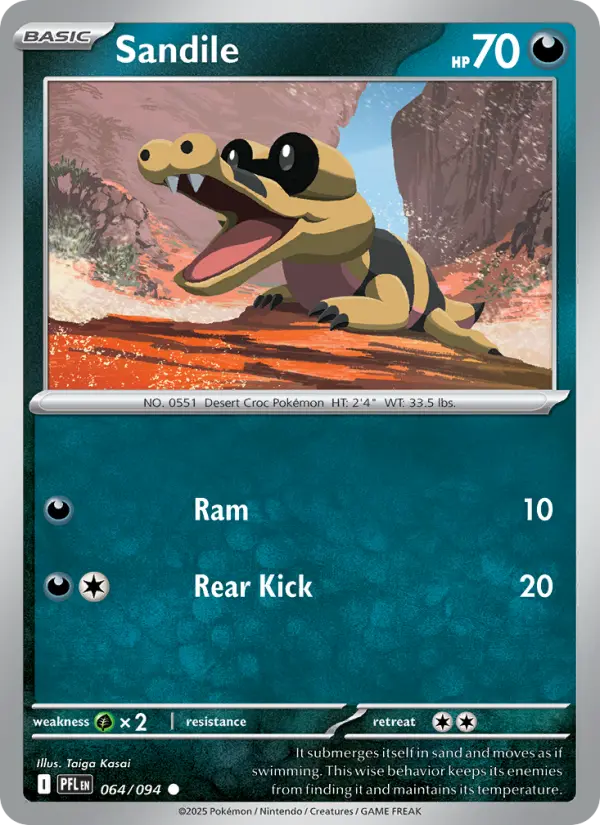
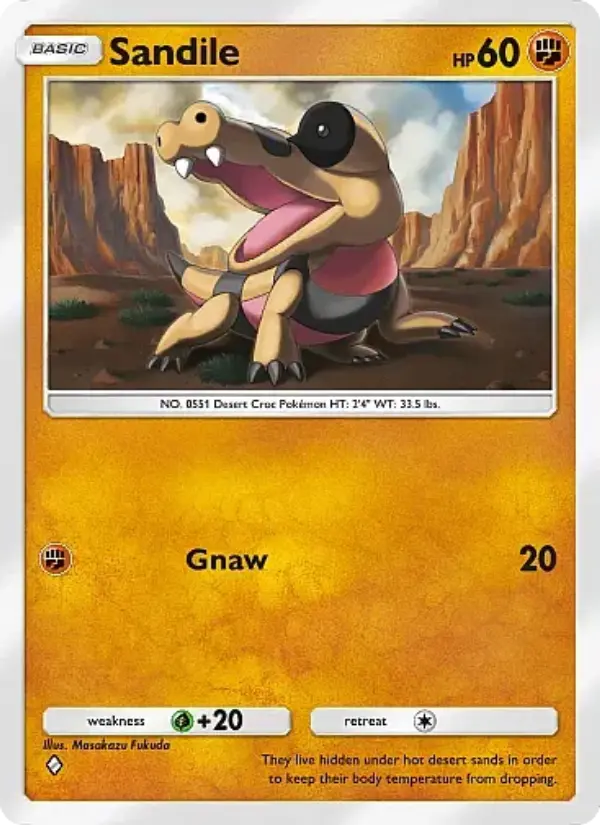
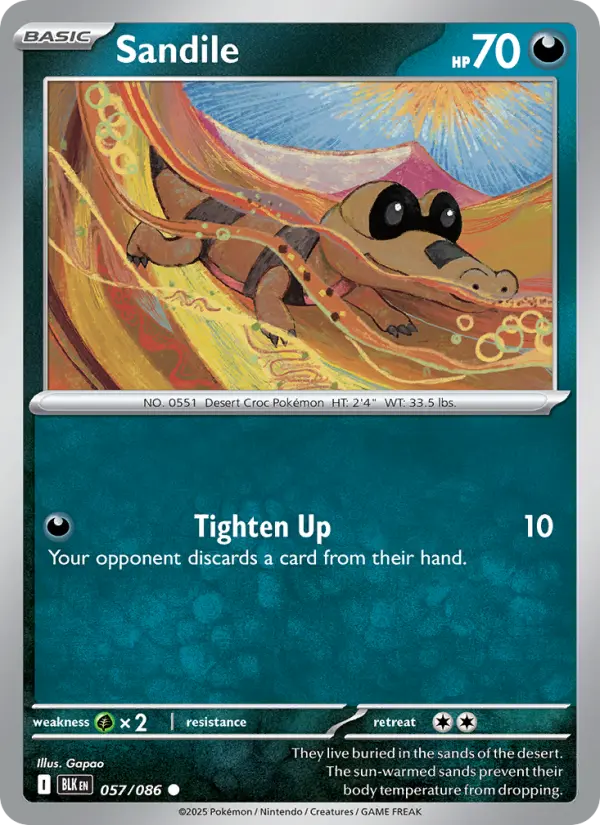
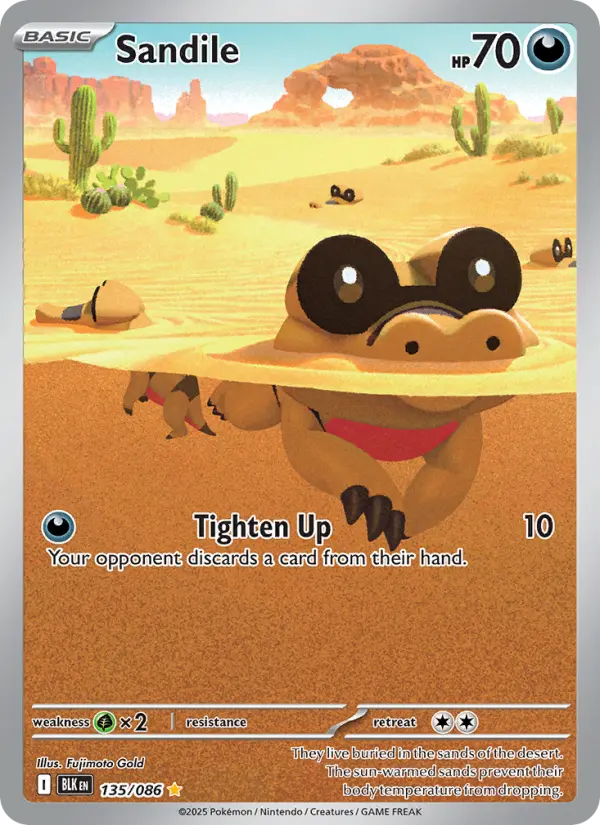
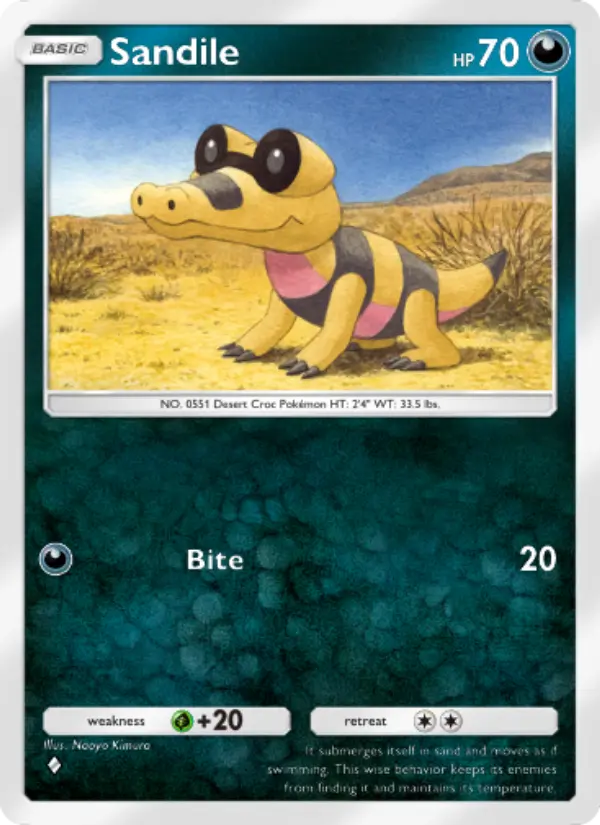
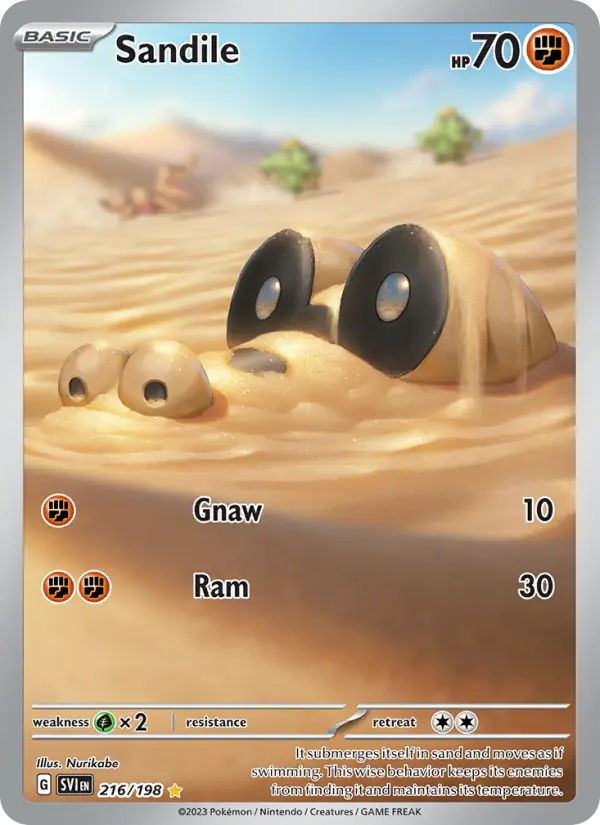
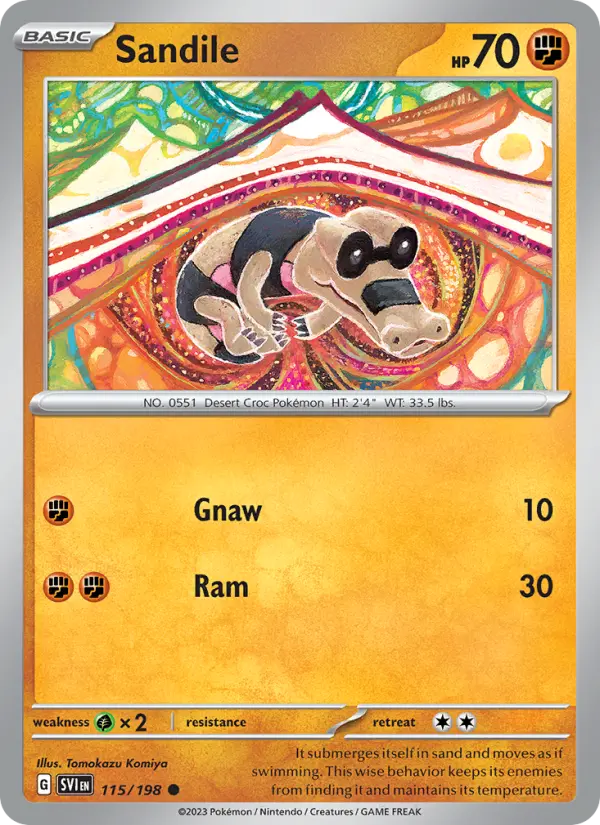
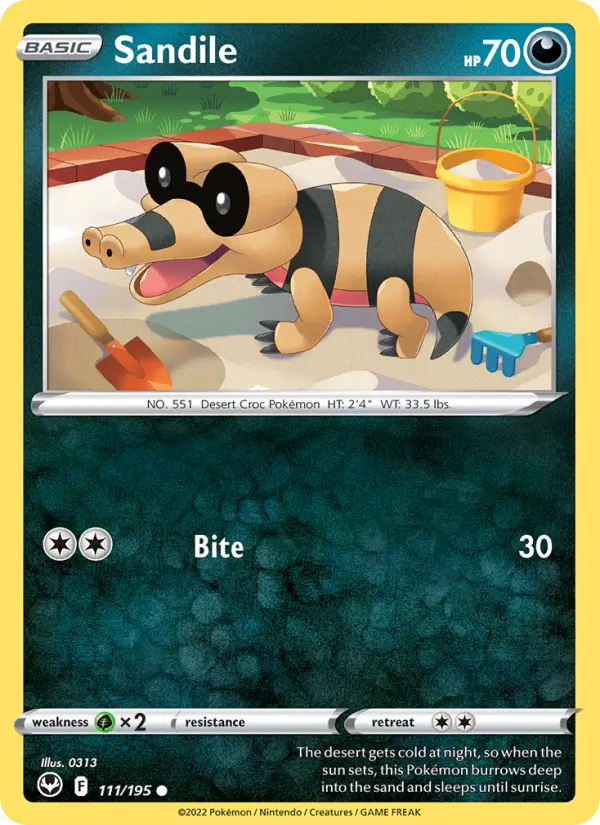
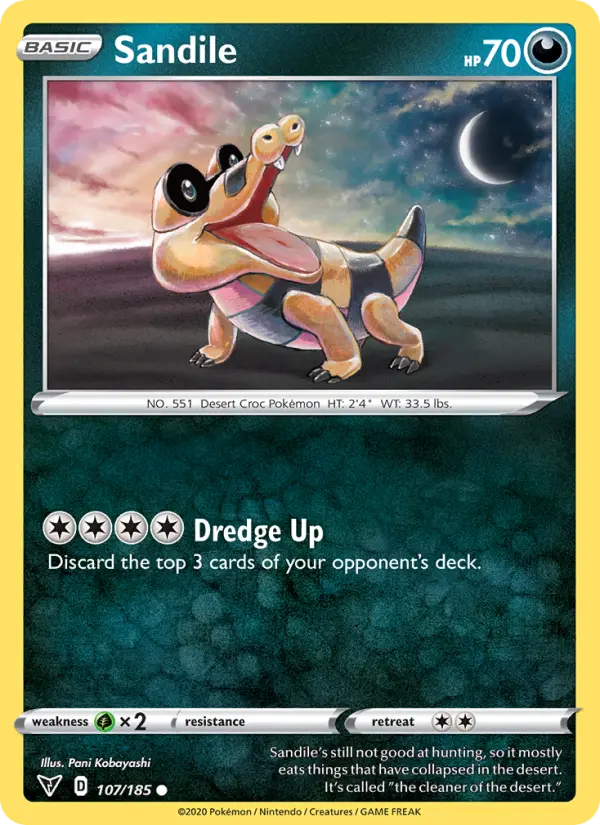
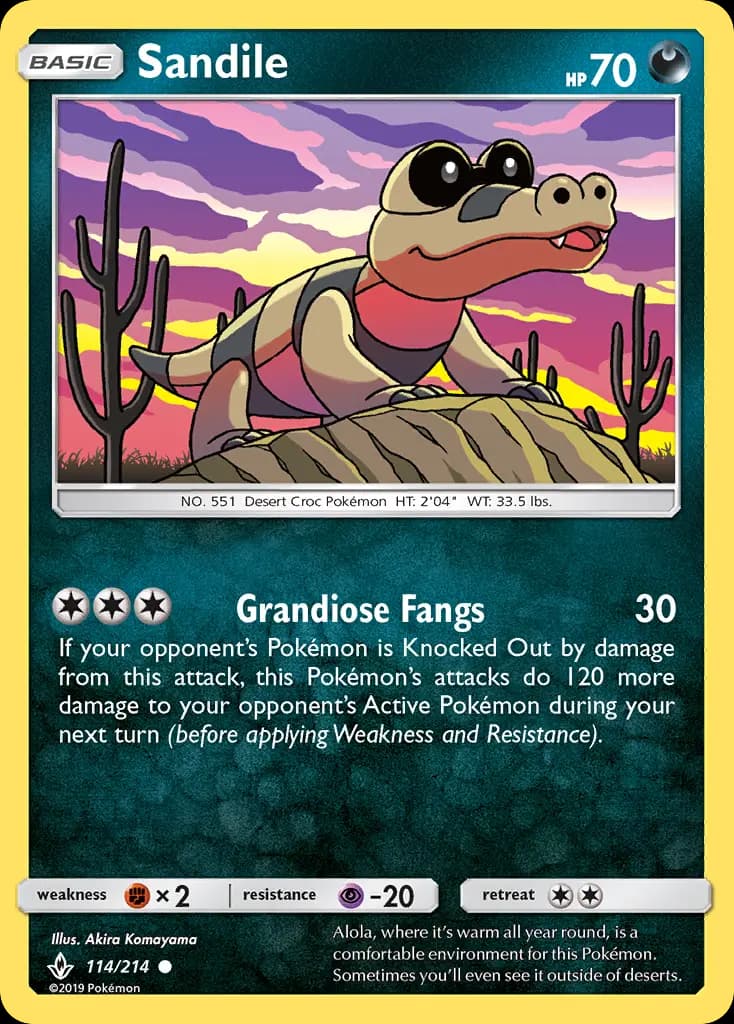
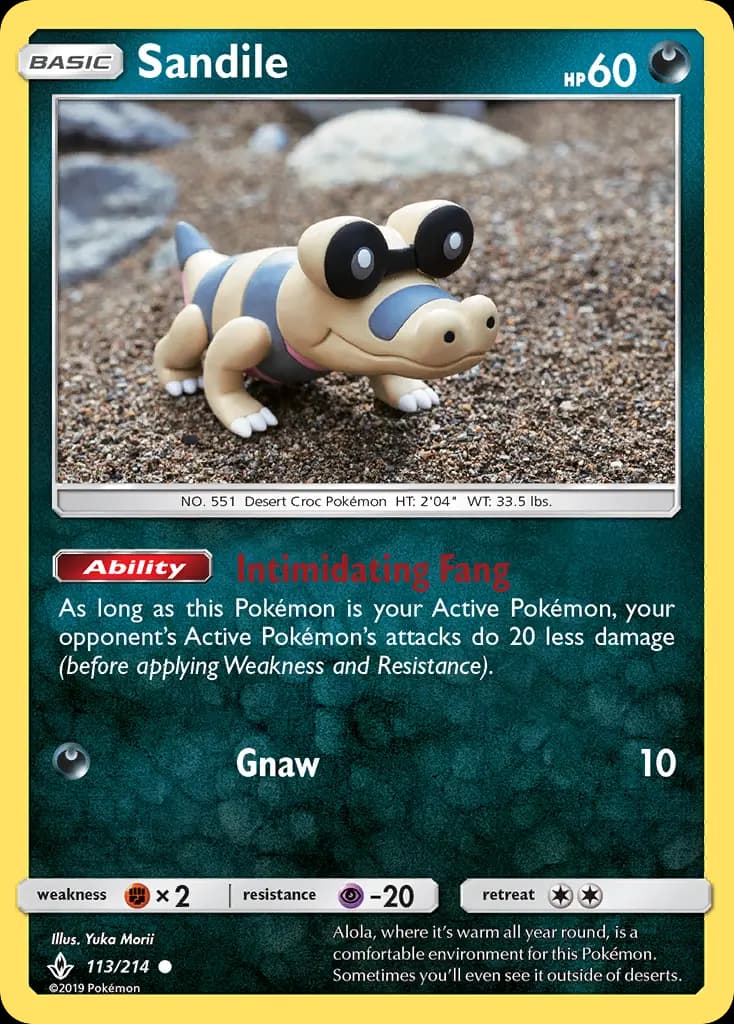
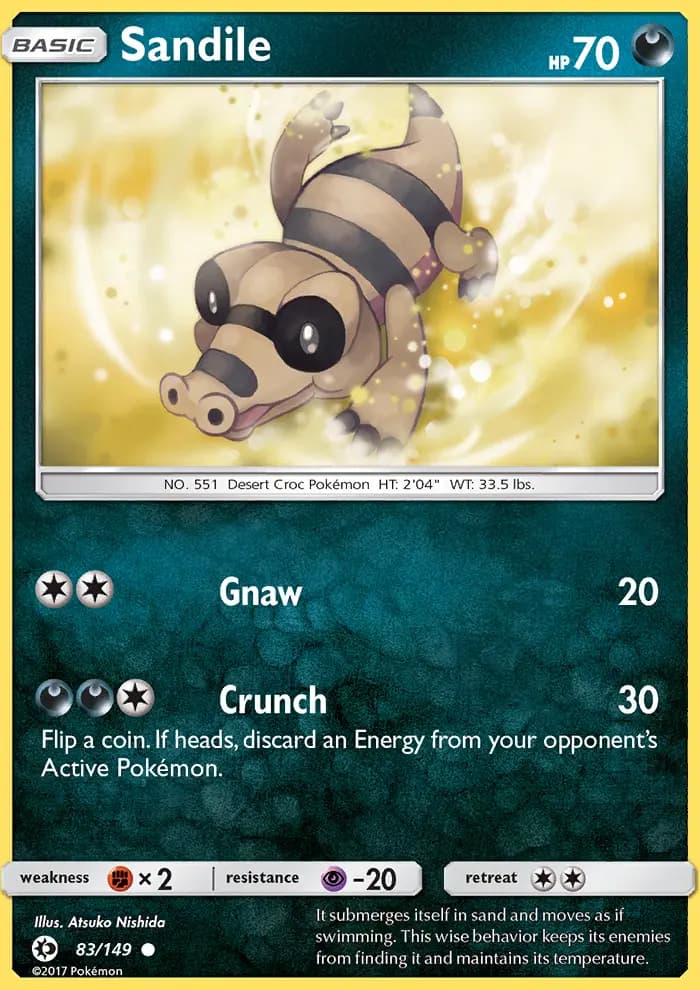
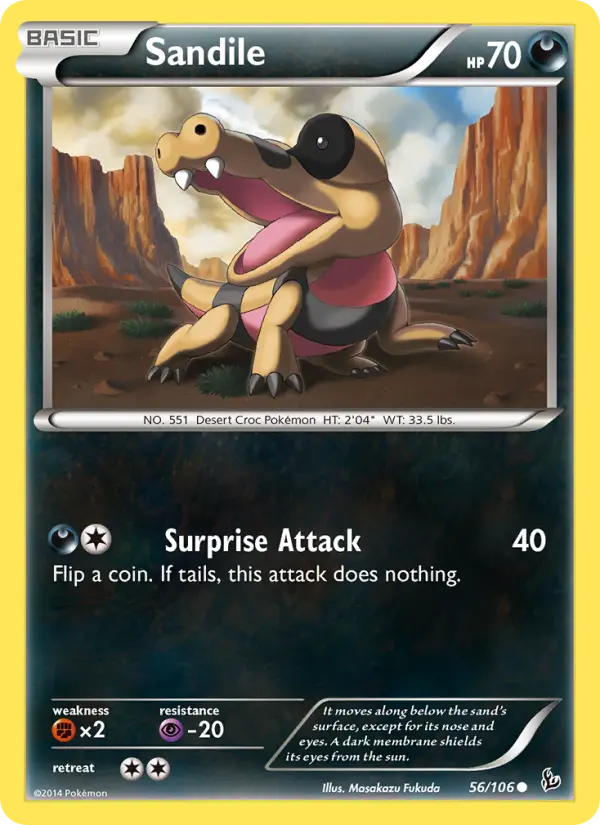
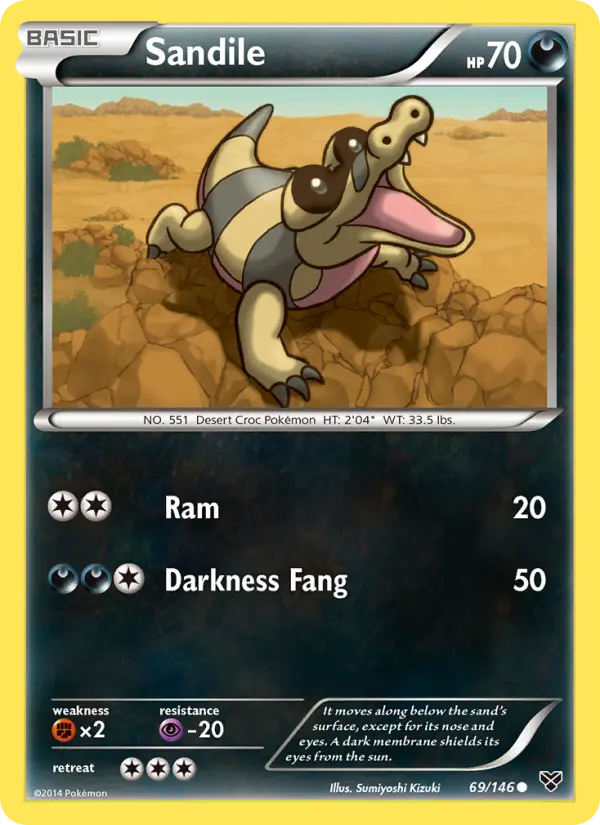
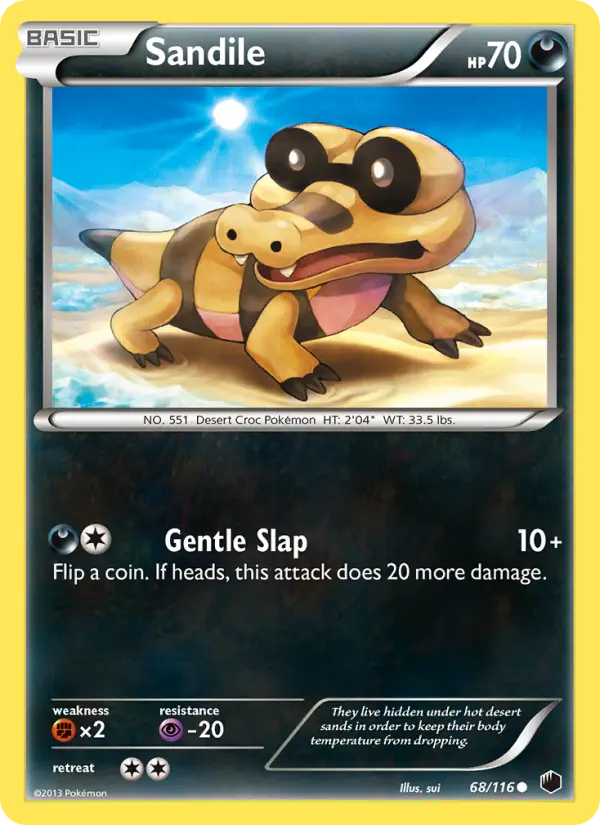
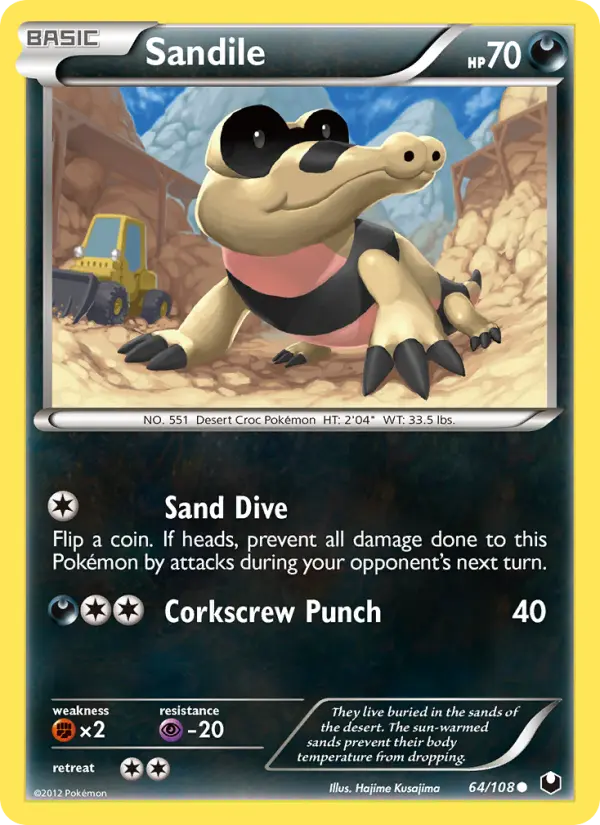
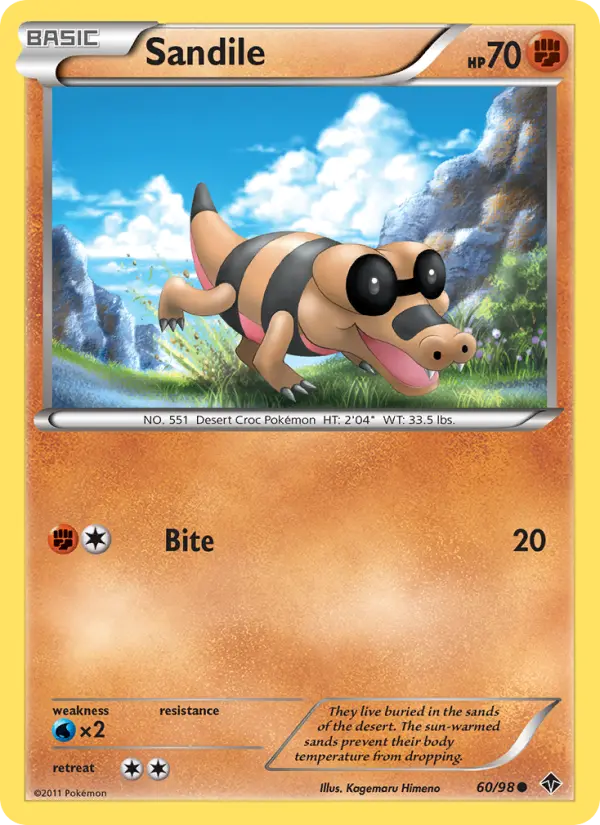
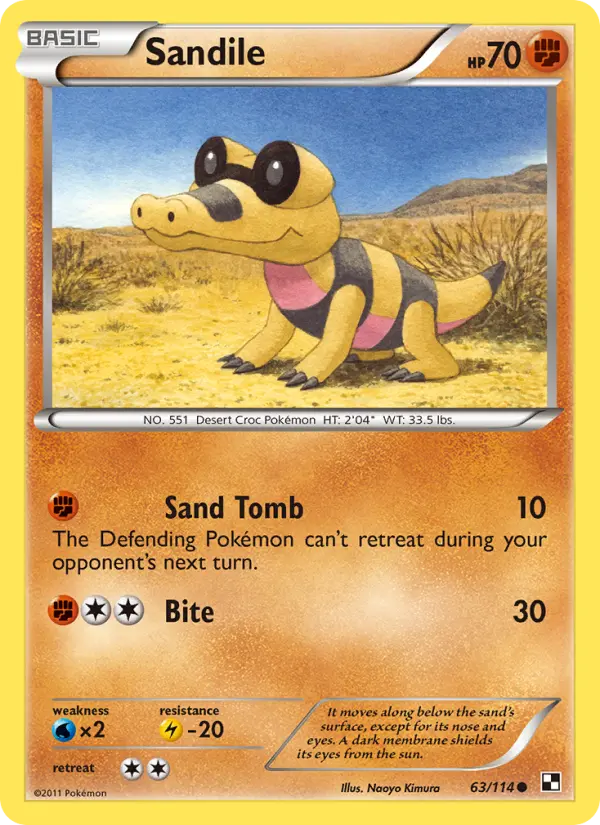
Sandile represents Generation V's commitment to expanding the desert ecosystem within the Pokémon world, filling a niche previously dominated by earlier-generation species like Sandshrew and Trapinch. The species gained particular prominence in the Pokémon anime through the character "Sunglasses Sandile," a mischievous individual that became a fan favorite recurring character, demonstrating the species' personality beyond its Pokédex descriptions. This anime representation humanized Sandile, showing trainers and audiences that the species possessed individuality and capability for meaningful bonds with humans despite its predatory nature. The Sandile evolutionary line became an accessible early-game option in Generation V games, introducing many players to the Ground/Dark typing and establishing it as a staple of Unova playthroughs. In the broader Pokémon trading card game, Sandile has received multiple card iterations across various sets, contributing to the competitive and collecting landscapes of the TCG community. The species' design has influenced subsequent desert-dwelling Pokémon in later generations, establishing aesthetic and thematic precedents for harsh-environment creatures. Fan communities have embraced Sandile for its distinctive appearance and the evolution line's significant power progression, making it a staple of fan art, fiction, and competitive discussion forums across the internet.
Where to Find Sandile in Every Pokémon Game
Sandile's availability has varied significantly across Pokémon generations and regional Pokédexes, reflecting both design intentions for regional progression and broader game design decisions. In Pokémon Black and White, the original Generation V games where Sandile debuted, the species received local Pokédex number 57, making it an early-game encounter accessible to trainers exploring the desert routes of Unova. In Pokémon Black 2 and White 2, Sandile retained accessibility with local Pokédex number 99, ensuring continued availability in the evolved Unova region. The species appeared in the Coastal Kalos region in Pokémon X and Y with local Pokédex number 43, though with slightly modified encounter rates reflecting its exotic status outside traditional desert settings. In Pokémon Sun and Moon set in the Alola region, Sandile received local Pokédex number 232, appearing in the Alola Pokédex despite the region's limited traditional desert environments—reflecting its adaptation to the warm, tropical climate. Pokémon Ultra Sun and Ultra Moon adjusted its local number to 301, continuing regional availability. In Pokémon Sword and Shield's Isle of Armor DLC, Sandile appeared with local Pokédex number 176, providing availability to players specifically engaged with the expansion content. The species continued availability in Pokémon Scarlet and Violet with local Pokédex number 267, maintaining its presence in modern competitive gameplay. Sandile's consistent availability across generations reflects its role as an accessible, early-game Pokémon intended to introduce players to the Ground/Dark typing and establish the Unova region's ecosystem effectively.