Seaking
Generation I · #0119 — Goldfish Pokémon
Seaking's profile is easy to undersell: 1.3 m, 39 kg, and a water typing that doesn't scream power — until you look at its Attack of 92. It measures 1.3 m and 39.0 kg, dimensions that pair with that stat lean in noticeable ways. With a aggregate stat total of 450, Seaking emphasizes physical attack with a respectable base 92 Attack stat, supported by solid HP and Special Defense values of 80 each. Its National Pokédex number is #119, placing it among the early Water-types discovered by researchers in the Kanto region. Seaking's design philosophy reflects the natural behaviors of salmon and other spawning fish, drawing inspiration from real biological phenomena that have fascinated humans for centuries. The species is notable for its three distinct abilities—Swift Swim, Water Veil, and the hidden ability Lightning Rod—each providing different tactical advantages depending on battle conditions and team composition.
Editor's Take
Seaking has Lightning Rod, which on a Water-type is a genuinely useful ability in doubles, and that is the entirety of the case for using one.
Base Stats
Height
1.3m
Weight
39.0kg
Category
Goldfish Pokémon
Gender
Male 50% / Female 50%
Color
red
Shape
fish
Habitat
waters-edge
Abilities
Doubles Speed during rain.
Prevents burns.
Redirects single-target electric moves to this Pokémon where possible. Absorbs Electric moves, raising Special Attack one stage.

Seaking Biology & Physical Characteristics
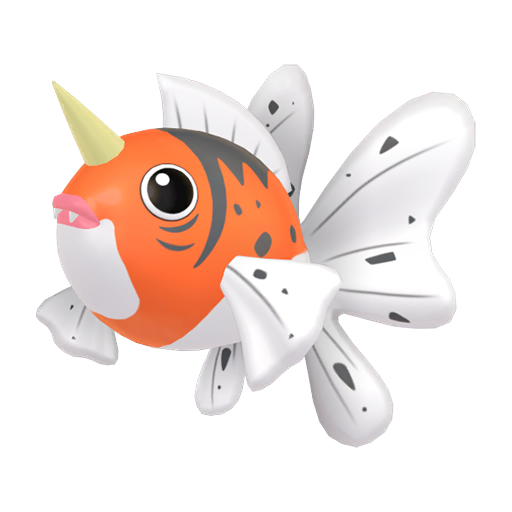
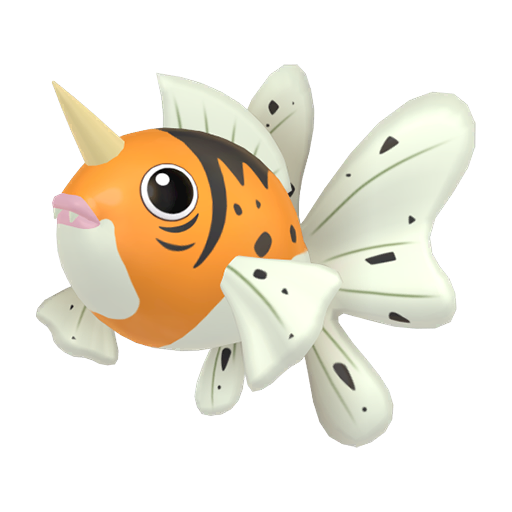
Seaking is a primarily orange-and-white piscine Pokémon displaying striking morphological features that distinguish it from its pre-evolution. The species possesses a prominent cream-colored horn projecting from its forehead, which is noticeably larger in males than females, serving both territorial and reproductive functions. Its body is predominantly orange with a cream-colored underside and white patch beneath its mouth, accented by distinctive black markings including thick lines beneath each eye, a large wavy patch along its back, and scattered speckles near its tail fin. The dorsal fin is rigid and pure white, while the pectoral fins and butterfly-shaped tail fins are white with black speckles, providing both camouflage in river environments and visual signals during courtship displays. Standing 1.3 meters tall and weighing 39.0 kilograms, Seaking is considerably more robust than Goldeen, reflecting its role as an aggressive spawner and territorial protector. Its physiology is optimized for powerful swimming, allowing it to navigate against strong river currents and ascend waterfalls with remarkable capability, making it one of the most formidable freshwater swimmers in the Pokémon world.
Pokedex Numbers
Training
Breeding
Seaking Breeding, Gender Ratio & Egg Groups
Seaking's population splits evenly by gender, 50% each way. Sexual dimorphism is clearly visible in this species, with males displaying a noticeably larger and more prominent horn than females, reflecting the male's role in nest construction and territorial defense during spawning season. This horn difference is not merely aesthetic; it correlates with the male's ability to excavate deeper and more elaborate nesting chambers in riverbed boulders, directly impacting reproductive success and offspring survival rates. Females, while possessing smaller horns, are equally important to the reproductive cycle and demonstrate comparable swimming prowess and territorial commitment once paired. Seaking belongs to the Water 2 egg group, allowing it to breed with various other Water-type Pokémon and some amphibious species, facilitating diverse genetic combinations for breeders seeking specific movesets or nature combinations. The species has a base happiness value of 70 (adjusted to 50 in later generations), indicating a moderately friendly disposition that responds well to proper trainer care and attention. With an egg hatch counter of 20 cycles, representing approximately 4,884 to 5,140 steps, Seaking eggs are relatively quick to incubate, making the species attractive for breeders looking for efficiency in their breeding programs.
Sprites




Held Items
Mystic Water
type-enhancement
Held: Water-Type moves from holder do 20% more damage.
Cost: 1000
Mystic Water
type-enhancement
Held: Water-Type moves from holder do 20% more damage.
Cost: 1000
Mystic Water
type-enhancement
Held: Water-Type moves from holder do 20% more damage.
Cost: 1000
Mystic Water
type-enhancement
Held: Water-Type moves from holder do 20% more damage.
Cost: 1000
Mystic Water
type-enhancement
Held: Water-Type moves from holder do 20% more damage.
Cost: 1000
Mystic Water
type-enhancement
Held: Water-Type moves from holder do 20% more damage.
Cost: 1000
Mystic Water
type-enhancement
Held: Water-Type moves from holder do 20% more damage.
Cost: 1000
Mystic Water
type-enhancement
Held: Water-Type moves from holder do 20% more damage.
Cost: 1000
Mystic Water
type-enhancement
Held: Water-Type moves from holder do 20% more damage.
Cost: 1000
Mystic Water
type-enhancement
Held: Water-Type moves from holder do 20% more damage.
Cost: 1000
Mystic Water
type-enhancement
Held: Water-Type moves from holder do 20% more damage.
Cost: 1000
Mystic Water
type-enhancement
Held: Water-Type moves from holder do 20% more damage.
Cost: 1000
TMs & HMs
tm01
lets go pikachu lets go eevee
tm02
crystal
tm02
gold silver
tm03
yellow
tm03
crystal
tm03
gold silver
tm03
ruby sapphire
tm03
red blue
tm03
platinum
tm03
firered leafgreen
tm03
heartgold soulsilver
tm03
diamond pearl
tm03
emerald
tm03
xd
tm03
colosseum
tm03
blue japan
tm03
red green japan
tm05
lets go pikachu lets go eevee
tm06
yellow
tm06
gold silver
+553 more TMs/HMs
Gender Differences
This Pokémon has visible differences between male and female forms.


Seaking Evolution, Mega Evolution & Special Forms
Seaking evolves from Goldeen when the latter reaches level 33, marking a significant transformation in both appearance and capability. This evolution represents a maturation process where Goldeen develops the physical and behavioral traits necessary for spawning migration and nest-building activities. The evolution is straightforward and does not branch into alternate forms, though individual Seaking may develop differently based on their gender, with males displaying noticeably larger and more prominent horns than females. Unlike many powerful Water-types in the Pokémon world, Seaking does not possess a Mega Evolution form or any further evolutionary stages, meaning that trainers who evolve their Goldeen have reached the final developmental stage of this evolutionary line. The lack of subsequent evolution does not diminish Seaking's utility in competitive play or its value as a team member, as its base stats of 450 provide a solid foundation for various battle strategies. The evolution from Goldeen to Seaking is one of the earliest Water-type evolutions available to trainers, making it a common sight in early-game water encounters and breeding programs throughout the series.
Where to Find
Kanto Route 23
kanto
+5 more
Fuchsia City
kanto
+3 more
Cerulean Cave
kanto
+19 more
Kanto Route 24
kanto
+12 more
Cerulean City
kanto
+13 more
Johto Route 42
johto
+11 more
Tohjo Falls
johto
+11 more
Kanto Route 25
kanto
+11 more
Mt Mortar
johto
+41 more
Kanto Route 10
kanto
+11 more
Kanto Route 9
kanto
+11 more
Union Cave
johto
+7 more
Slowpoke Well
johto
+7 more
Kanto Route 4
kanto
+8 more
Dark Cave
johto
+7 more
Mt Silver
johto
+47 more
Hoenn Safari Zone
hoenn
+15 more
Kanto Safari Zone
kanto
+5 more
Berry Forest
kanto
Lake Acuity
sinnoh
+8 more
+28 more locations in other games
Seaking Behaviour and Natural Habitat
Seaking exhibits complex and fascinating behavioral patterns deeply rooted in seasonal spawning cycles, particularly during autumn when populations undergo dramatic migrations upstream. During the spawning season, male Seaking engage in elaborate and graceful courtship dances in riverbeds to attract females, with successful dancers earning mating rights and the opportunity to establish nesting territories. Once paired, both male and female Seaking work cooperatively, with males using their powerful horns to bore holes into riverbed boulders, creating sheltered nests that protect eggs from destructive water currents. Throughout the nesting period, which lasts approximately one month, mated pairs take turns patrolling their territory with unwavering dedication, defending their offspring with fierce determination against any perceived threats. The Pokédex notes that during autumn, Seaking populations gather in such numbers that they color entire rivers brilliant red, creating one of nature's most spectacular phenomena. These Pokémon are exclusively freshwater inhabitants, preferring rivers and streams where they can demonstrate their exceptional swimming abilities. Males develop enhanced body coloration during spawning season, reaching their most visually vibrant state, while females tend to be slightly less flamboyant, though no less important to the reproductive cycle.
Pokedex Entries
In the autumn spawning season, they can be seen swimming power fully up rivers and creeks.
It is the male's job to make a nest by carving out boulders in a stream using the horn on its head.
During spawning season, SEAKING gather from all over, coloring the rivers a brilliant red.
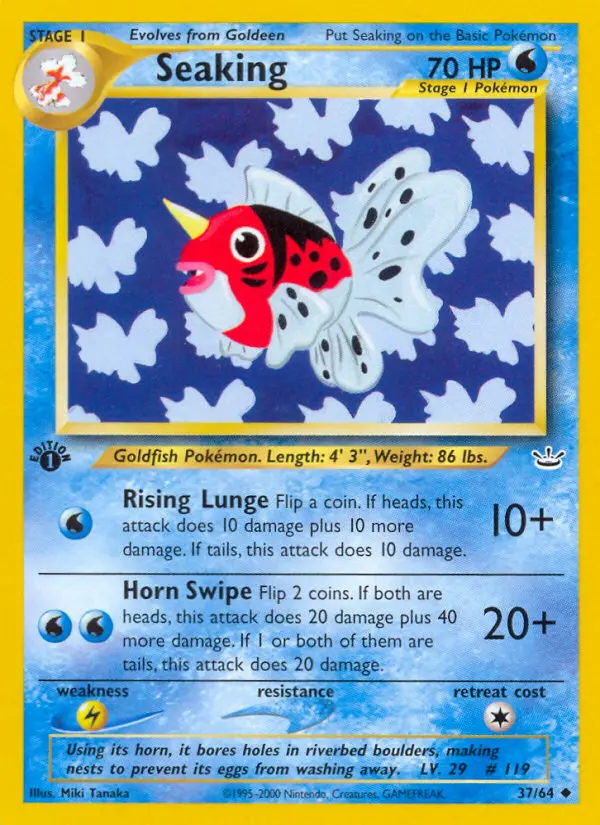
Using its horn, it bores holes in riverbed boulders, making nests to prevent its eggs from washing away.
When autumn comes, the males patrol the area around their nests in order to protect their offspring.
In the autumn, SEAKING males can be seen performing courtship dances in riverbeds to woo females. During this season, this POKéMON’s body coloration is at its most beautiful.
SEAKING is very protective of its eggs. The male and female will take turns patrolling around their nest and eggs. The guarding of eggs by these POKéMON goes on for over a month.
It punches holes in boulders on stream beds. This is a clever innovation that prevents its eggs from being attacked or washed away by the current.
The horn on its head is sharp like a drill. It bores a hole in a boulder to make its nest.
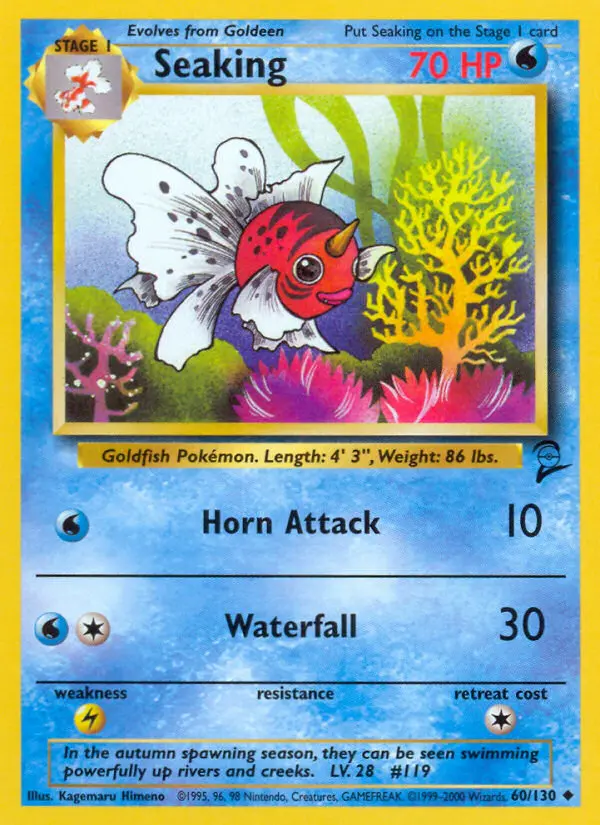
In the autumn spawning season, they can be seen swimming powerfully up rivers and creeks.
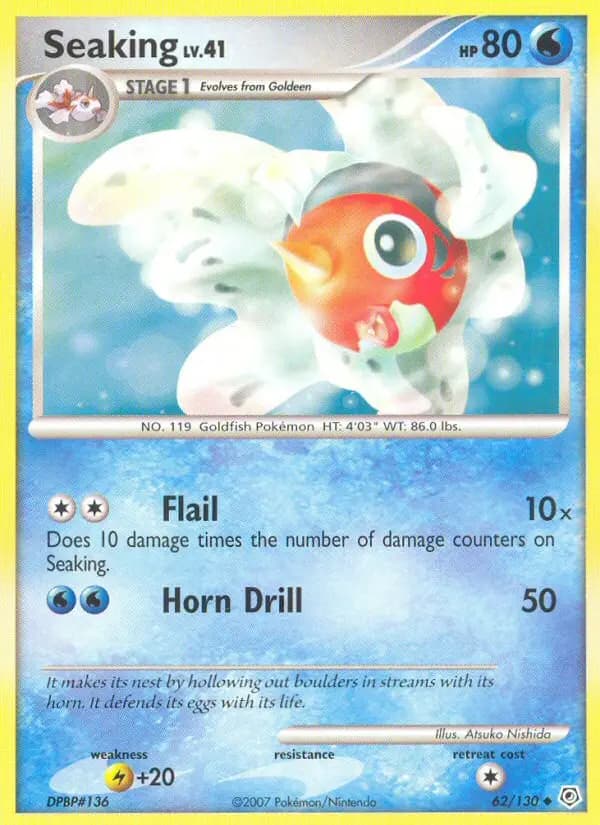
It makes its nest by hollowing out boulders in streams with its horn. It defends its eggs with its life.
To protect its family, it will fight with its drill-sharp horn. It lives in hollowed rocks in streams.
In autumn, its body becomes more fatty in preparing to propose to a mate. It takes on beautiful colors.
During spawning season, SEAKING gather from all over, causing rivers to appear a brilliant red.
Using its horn, it bores holes in riverbed boulders, making nests to prevent its eggs from washing away.
In autumn, its body becomes more fatty in preparing to propose to a mate. It takes on beautiful colors.
In autumn, its body becomes more fatty in preparing to propose to a mate. It takes on beautiful colors.
In the autumn spawning season, they can be seen swimming powerfully up rivers and creeks.
It makes its nest by hollowing out boulders in streams with its horn. It defends its eggs with its life.
In the autumn, Seaking males can be seen performing courtship dances in riverbeds to woo females. During this season, this Pokémon’s body coloration is at its most beautiful.
Seaking is very protective of its eggs. The male and female will take turns patrolling around their nest and eggs. The guarding of eggs by these Pokémon goes on for over a month.
When the weather grows cold, its whole body flushes a deep red. This sight serves as a poetic reminder that autumn has arrived.
Its horn spins like a drill to steadily hollow out rocks—even harder ones. The coloration of the male is more vivid.
Trainers who are crazy for Seaking are divided into horn enthusiasts and fin enthusiasts. The two groups do not get along well.
To attract females, males dance on the river’s floor. The females gather around the male that dances most gracefully.
It is the male’s job to make a nest by carving out boulders in a stream using the horn on its head.
In autumn, its body becomes more fatty in preparing to propose to a mate. It takes on beautiful colors.
Using its horn, it bores holes in riverbed boulders, making nests to prevent its eggs from washing away.
Seaking Name Origin & Design Inspiration
Seaking's name origin lies in a combination of 'sea' and 'king,' emphasizing its role as a dominant and regal presence in aquatic environments, particularly during its territorial spawning season. In Japanese, it is known as Azumao (アズマオウ), a name reflecting its connection to the Azuma region and suggesting kingship or leadership within water territories. The design draws heavily from real-world salmon and other anadromous fish species, which are famous for their upstream migrations and aggressive territorial behaviors during spawning seasons. The prominent horn serves as both a practical tool for excavating nest sites and a visual symbol of dominance and sexual maturity, much like antlers or horns in terrestrial animals. The coloration scheme of brilliant orange and white echoes the striking appearance of spawning salmon, whose bodies undergo dramatic color changes during their final life stages. The butterfly-shaped tail fins reference both the graceful movement required for courtship dances and the natural beauty of aquatic life, while the rigid dorsal fin suggests both power and the architectural complexity of the species' river habitats. This thoughtful design translates a specific moment in nature—the spawning season—into a singular Pokémon form that captures the intensity, beauty, and competitiveness of reproductive behavior in aquatic ecosystems.
Learnable Moves
Seaking can learn 74 moves:
Move | Type | Cat. | Power | Acc. | PP |
|---|---|---|---|---|---|
| agility | psychic | Status | — | — | 30 |
| aqua ring | water | Status | — | — | 20 |
| aqua tail | water | Physical | 90 | 90 | 10 |
| attract | normal | Status | — | 100 | 15 |
| bide | normal | Physical | — | — | 10 |
| blizzard | ice | Special | 110 | 70 | 5 |
| body slam | normal | Physical | 85 | 100 | 15 |
| bounce | flying | Physical | 85 | 85 | 5 |
| bubble beam | water | Special | 65 | 100 | 20 |
| captivate | normal | Status | — | 100 | 20 |
| confide | normal | Status | — | — | 20 |
| curse | ghost | Status | — | — | 10 |
| dive | water | Physical | 80 | 100 | 10 |
| double team | normal | Status | — | — | 15 |
| double edge | normal | Physical | 120 | 100 | 15 |
| drill run | ground | Physical | 80 | 95 | 10 |
| endure | normal | Status | — | — | 10 |
| facade | normal | Physical | 70 | 100 | 20 |
| flail | normal | Physical | — | 100 | 15 |
| flip turn | water | Physical | 60 | 100 | 20 |
| frustration | normal | Physical | — | 100 | 20 |
| fury attack | normal | Physical | 15 | 85 | 20 |
| fury cutter | bug | Physical | 40 | 95 | 20 |
| giga impact | normal | Physical | 150 | 90 | 5 |
| hail | ice | Status | — | — | 10 |
| headbutt | normal | Physical | 70 | 100 | 15 |
| hidden power | normal | Special | 60 | 100 | 15 |
| horn attack | normal | Physical | 65 | 100 | 25 |
| horn drill | normal | Physical | — | 30 | 5 |
| hydro pump | water | Special | 110 | 80 | 5 |
| hyper beam | normal | Special | 150 | 90 | 5 |
| ice beam | ice | Special | 90 | 100 | 10 |
| icy wind | ice | Special | 55 | 95 | 15 |
| knock off | dark | Physical | 65 | 100 | 20 |
| megahorn | bug | Physical | 120 | 85 | 10 |
| mimic | normal | Status | — | — | 10 |
| mud shot | ground | Special | 55 | 95 | 15 |
| mud slap | ground | Special | 20 | 100 | 10 |
| muddy water | water | Special | 90 | 85 | 10 |
| natural gift | normal | Physical | — | 100 | 15 |
| peck | flying | Physical | 35 | 100 | 35 |
| poison jab | poison | Physical | 80 | 100 | 20 |
| protect | normal | Status | — | — | 10 |
| psybeam | psychic | Special | 65 | 100 | 20 |
| quick attack | normal | Physical | 40 | 100 | 30 |
| rage | normal | Physical | 20 | 100 | 20 |
| rain dance | water | Status | — | — | 5 |
| rest | psychic | Status | — | — | 5 |
| return | normal | Physical | — | 100 | 20 |
| round | normal | Special | 60 | 100 | 15 |
| scald | water | Special | 80 | 100 | 15 |
| scale shot | dragon | Physical | 25 | 90 | 20 |
| secret power | normal | Physical | 70 | 100 | 20 |
| signal beam | bug | Special | 75 | 100 | 15 |
| skull bash | normal | Physical | 130 | 100 | 10 |
| sleep talk | normal | Status | — | — | 10 |
| smart strike | steel | Physical | 70 | — | 10 |
| snore | normal | Special | 50 | 100 | 15 |
| soak | water | Status | — | 100 | 20 |
| substitute | normal | Status | — | — | 10 |
| supersonic | normal | Status | — | 55 | 20 |
| surf | water | Special | 90 | 100 | 15 |
| swagger | normal | Status | — | 85 | 15 |
| swift | normal | Special | 60 | — | 20 |
| swords dance | normal | Status | — | — | 20 |
| tail whip | normal | Status | — | 100 | 30 |
| take down | normal | Physical | 90 | 85 | 20 |
| throat chop | dark | Physical | 80 | 100 | 15 |
| toxic | poison | Status | — | 90 | 10 |
| water gun | water | Special | 40 | 100 | 25 |
| water pulse | water | Special | 60 | 100 | 20 |
| water sport | water | Status | — | — | 15 |
| waterfall | water | Physical | 80 | 100 | 15 |
| whirlpool | water | Special | 35 | 85 | 15 |
Seaking Competitive Battle Guide
Competitively, Seaking occupies a niche role as a physical attacker with moderate offensive and defensive capabilities, making it a viable choice for casual play and lower-tier competitive environments. Its base 92 Attack stat provides a respectable foundation for physical movesets, supported by decent base 80 HP and Special Defense values that allow it to absorb hits while maintaining offensive pressure. Swift Swim is Seaking's most competitively relevant ability, doubling its Speed stat during rain weather conditions, transforming it from a moderately paced attacker into a viable rain-dependent sweeper. Water Veil provides utility in specific matchups by preventing burn status, protecting Seaking from physical damage reduction and ongoing damage that would otherwise cripple its physical attack-based strategy. The hidden ability Lightning Rod offers an interesting alternative for defensive teams, redirecting single-target Electric moves while simultaneously raising Special Attack by one stage, though this goes against Seaking's natural physical attack emphasis. Signature move Waterfall, inherited from its Generation I origins, provides Seaking with a reliable physical Water-type option boosted by its Attack stat, and the move's potential to cause flinching adds valuable utility. However, Seaking's modest Speed of 68 base and relatively average defenses limit its viability in higher-tier competitive play where faster, bulkier, or more offensively powerful Water-types dominate the metagame, relegating it primarily to casual, regional, or lower-tier competitive formats where its straightforward physical attacking style finds value.
Commonly Asked Questions About Seaking
What type is Seaking?
Seaking is a water type Pokemon.
What does Seaking evolve from?
Seaking evolved from goldeen.
What are Seaking's weaknesses?
Seaking is weak to grass and electric type moves.
Where can I find Seaking?
Seaking can be found in kanto route 23 (kanto), fuchsia city (kanto) and cerulean cave (kanto) and 45 other locations.
Seaking Cultural Impact & Franchise History
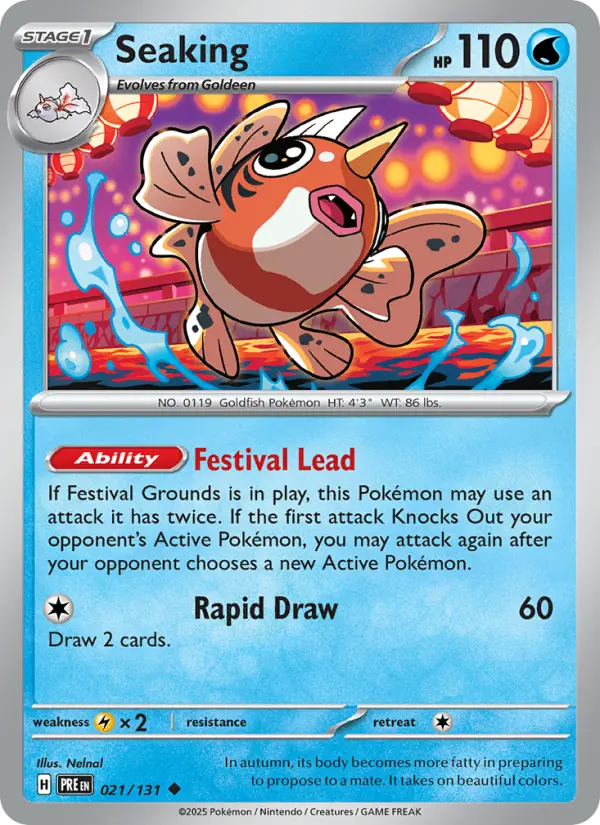
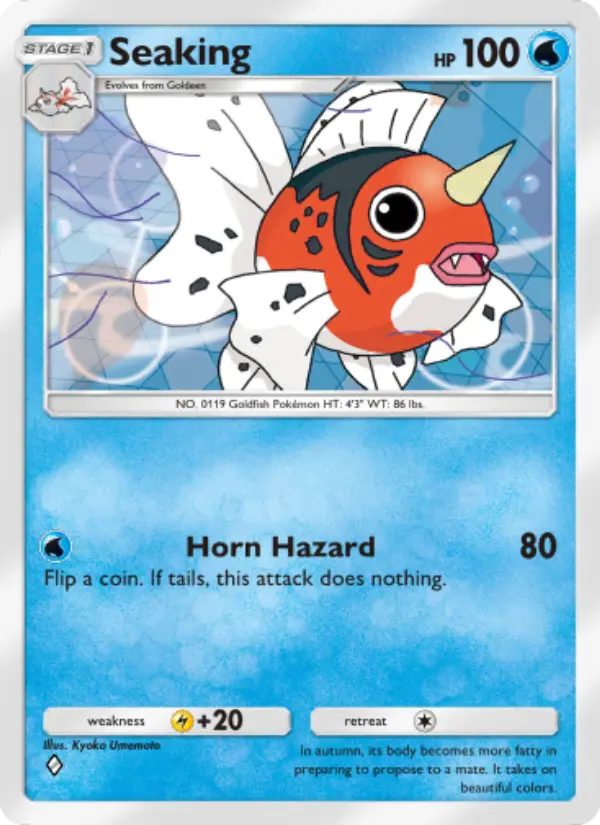
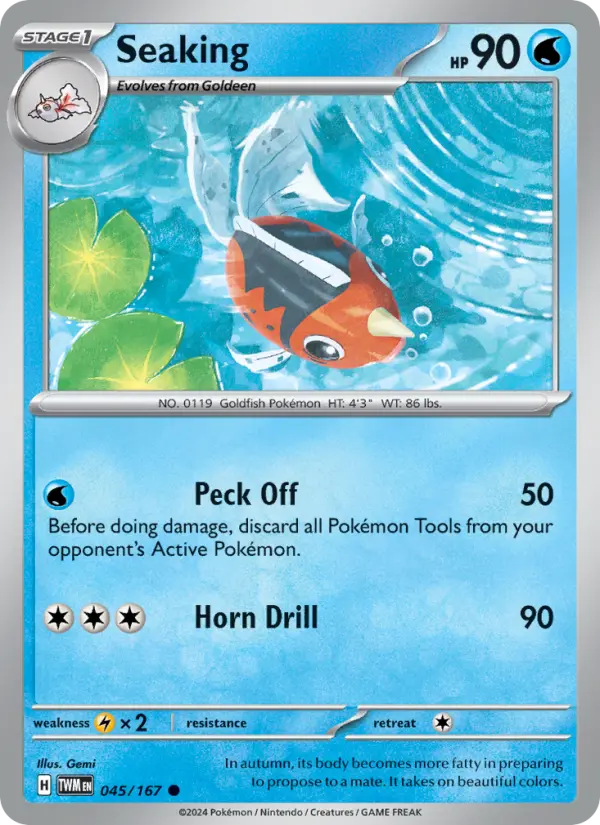
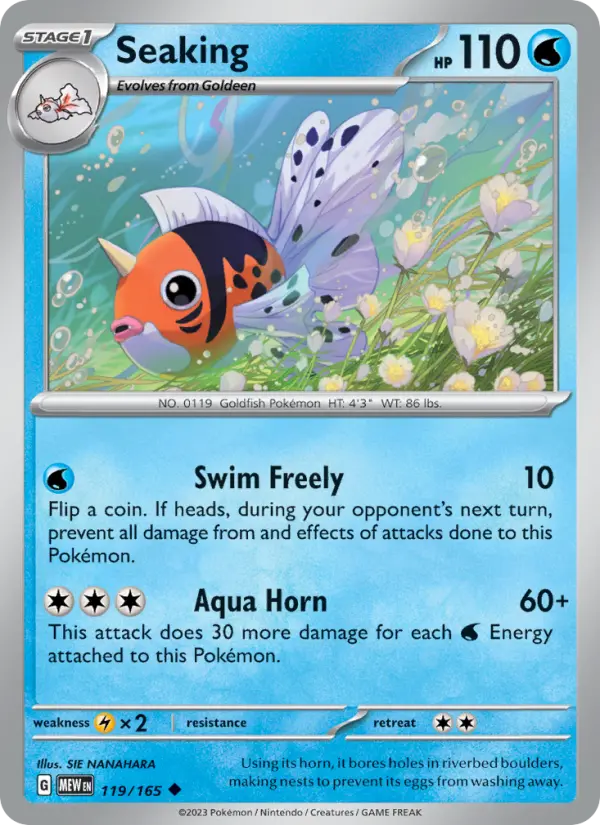
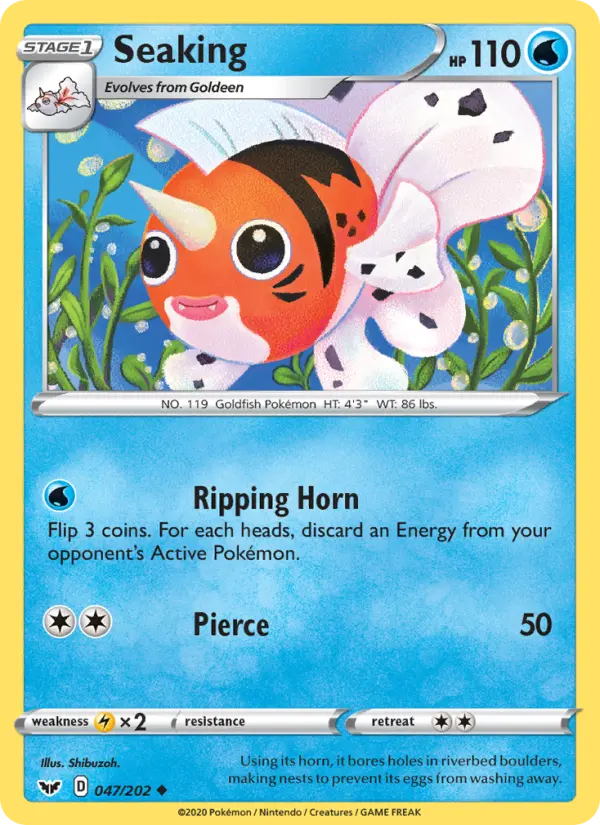
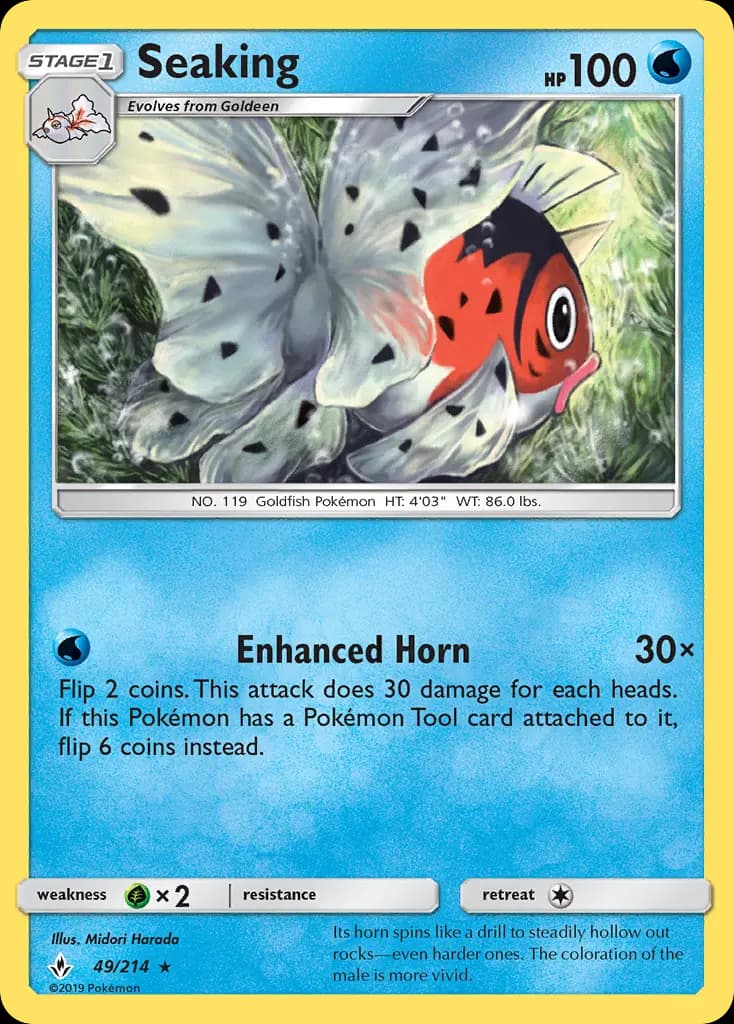
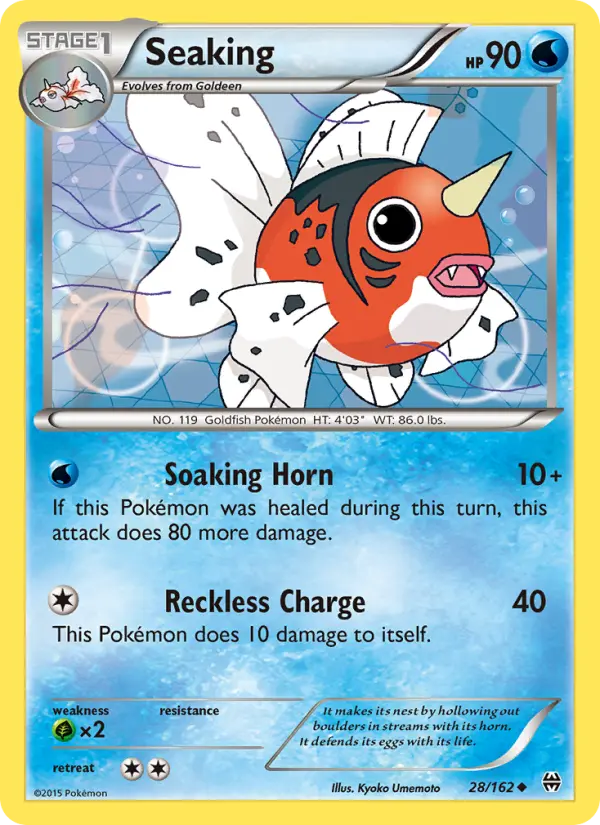
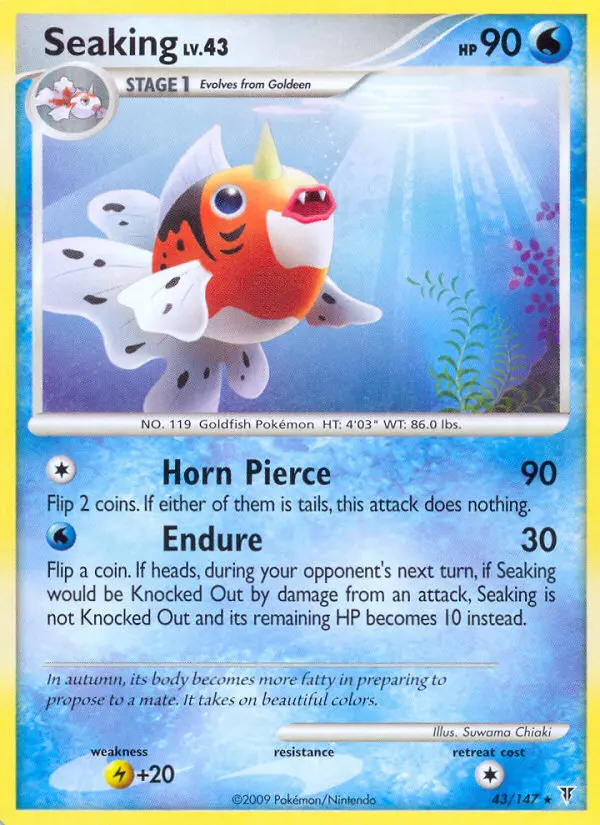
Seaking holds a special place in Pokémon culture as a beloved first-generation Water-type that captures the imagination with its dramatic spawning season behaviors and striking visual design. The species has inspired significant fan interest due to its unique ecological narrative, with many Pokémon enthusiasts appreciating the authenticity of its biological inspiration and the way it mirrors real-world salmon migrations. This cultural appreciation extends to breeding communities, where Seaking's visible sexual dimorphism and clear gender differences make it a subject of particular interest for players studying Pokémon genetics and evolution. In the anime, Seaking has appeared in various episodes showcasing its river-dwelling habitats and territorial behaviors, cementing its role as an iconic representation of freshwater Pokémon ecosystems. The species has generated ongoing fan communities dedicated to various aspects, including competitive strategies, shiny hunting, and detailed studies of its behavioral ecology. Notably, the Pokédex entries have inspired creative interpretations and discussions about hypothetical conflicts between trainers obsessed with Seaking's horns versus those fascinated by its dorsal fins, adding a layer of humor and world-building to the species' cultural footprint. Seaking's presence in trading card games, merchandise, and various Pokémon media has ensured its continued relevance across decades, making it a recognizable and cherished member of the franchise's iconic roster.
Where to Find Seaking in Every Pokémon Game
Seaking's availability varies significantly depending on the specific Pokémon game, with its distribution generally restricted to water-based environments and specific regional Pokédex listings. In the original Generation I games (Red, Blue, and Yellow), Seaking can be found in various water locations throughout Kanto, though trainers must first catch and raise Goldeen to level 33 to obtain it, or encounter wild Seaking in specific water tiles. In Generation II (Gold, Silver, Crystal), Seaking appears in Johto's water routes and is assigned local Pokédex number 0079, maintaining its presence in the regional Pokédex. Subsequent generations have seen fluctuating availability, with Seaking appearing in Hoenn (Pokédex #0051 in Ruby/Sapphire/Emerald), Sinnoh, Kalos, Alola, Galar, and other regions, though sometimes only through breeding or transferring from previous generations. The Let's Go Pikachu/Eevee remakes restored Seaking to full availability as part of the Kanto regional Pokédex with its original National number 0119. In modern games like Sword and Shield, Seaking requires specific game version or DLC access to obtain, sometimes appearing exclusively in the Isle of Armor expansion. The Pokédex entry indicates a capture rate of 60 with a base happiness of 70, making Seaking a moderately straightforward Pokémon to catch in water encounters. Breeding remains one of the most reliable methods to obtain Seaking across most games, as trainers can breed Goldeen with compatible Pokémon to produce eggs, eventually raising them to obtain evolved Seaking with desired natures, stats, and movesets through careful breeding programs.