Shellos
Generation IV · #0422 — Sea Slug Pokémon
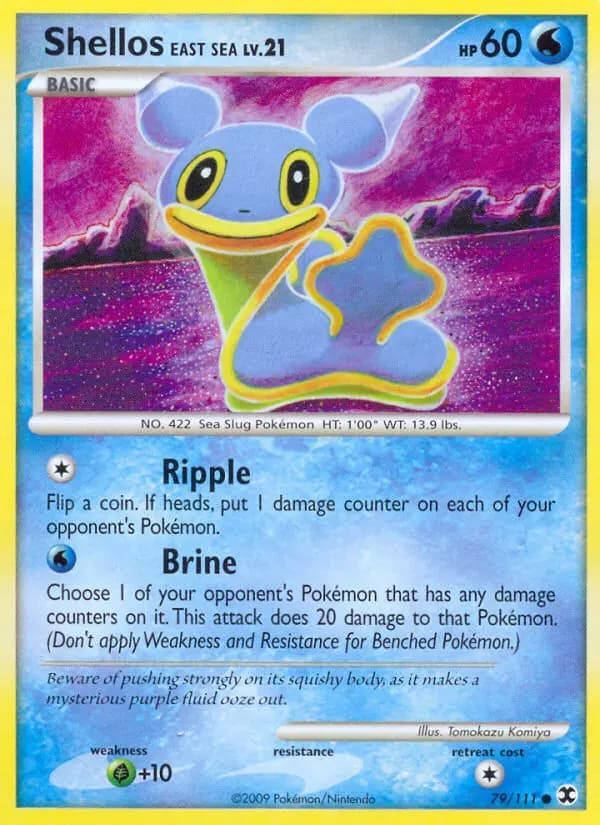
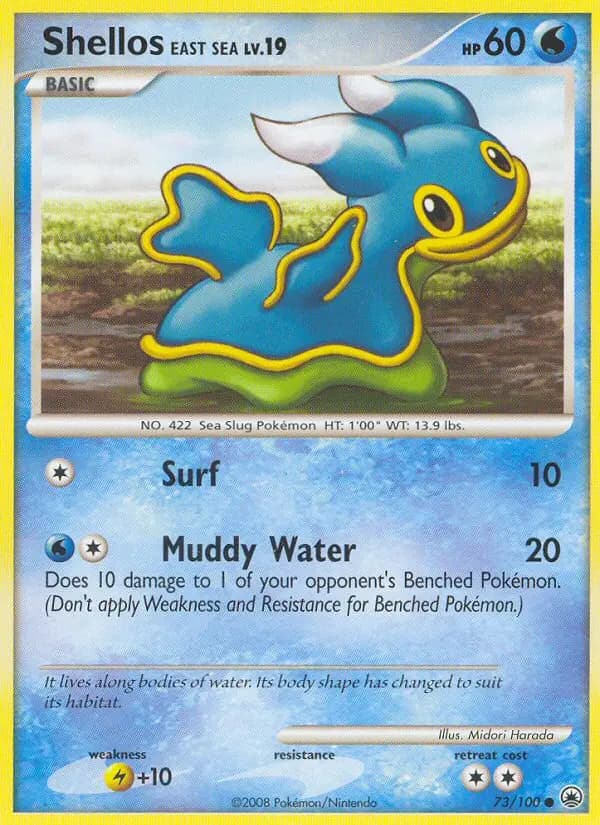
Shellos measures in at 0.3 m and 6.3 kg, a build that matches its sticky hold ability better than it matches raw offense or defense. At 0.3 m and 6.3 kg, its build reflects a specialist role rather than a generalist one. With a modest total stat allocation of 325, Shellos prioritizes defensive capabilities over raw power, boasting a respectable HP stat of 76 and Special Defense of 62, making it a surprisingly resilient choice for trainers seeking a bulky Water-type companion. The species demonstrates remarkable adaptability, with its appearance, coloration, and even physical structure diverging based on habitat, a phenomenon that sets it apart from most other Pokémon and reflects real-world principles of evolutionary adaptation in marine organisms.
Editor's Take
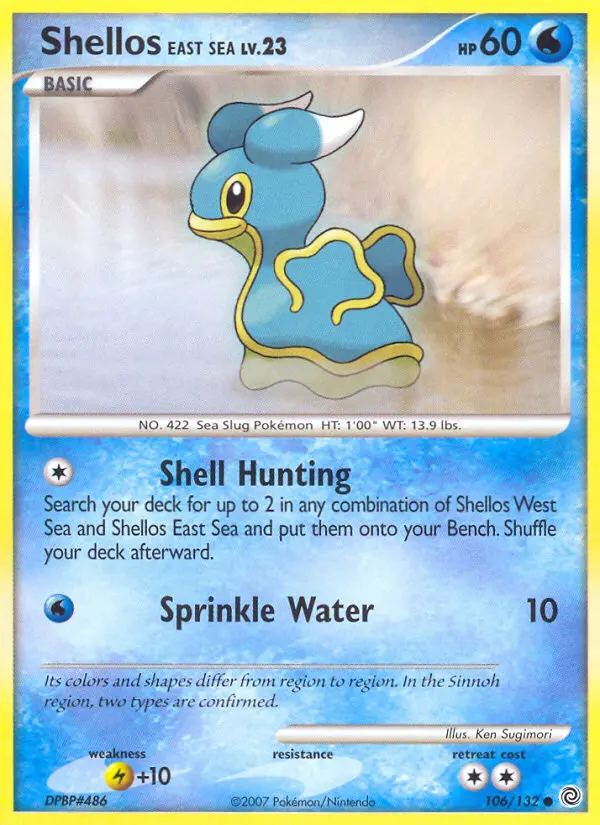
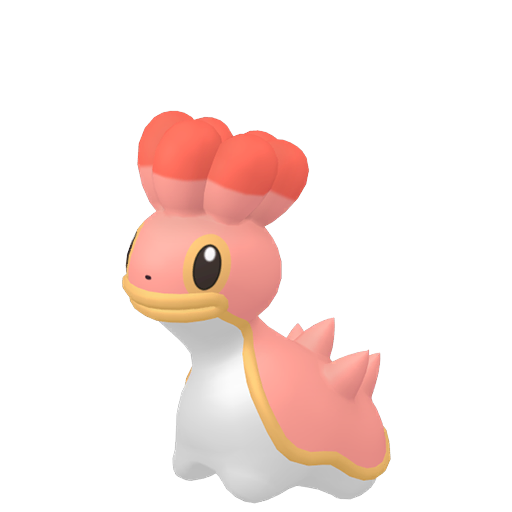
Shellos having two colour variants based on which half of Sinnoh you catch it in is purely cosmetic, and it is the earliest example of regional appearance without regional mechanics.
Base Stats
Height
0.3m
Weight
6.3kg
Category
Sea Slug Pokémon
Gender
Male 50% / Female 50%
Color
purple
Shape
squiggle
Abilities
Prevents a held item from being removed by other Pokémon.
Redirects single-target water moves to this Pokémon where possible. Absorbs Water moves, raising Special Attack one stage.
Strengthens rock, ground, and steel moves to 1.3× their power during a sandstorm. Protects against sandstorm damage.

Shellos Biology & Physical Characteristics
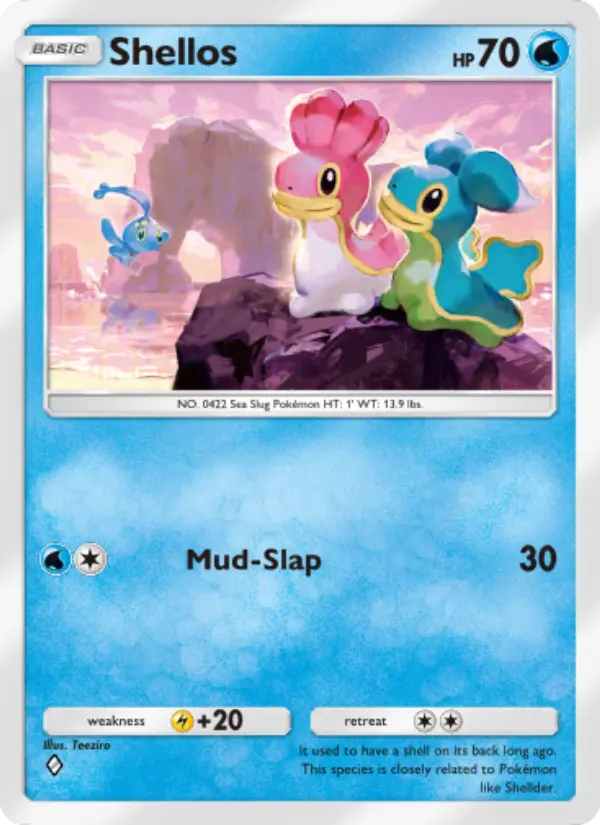
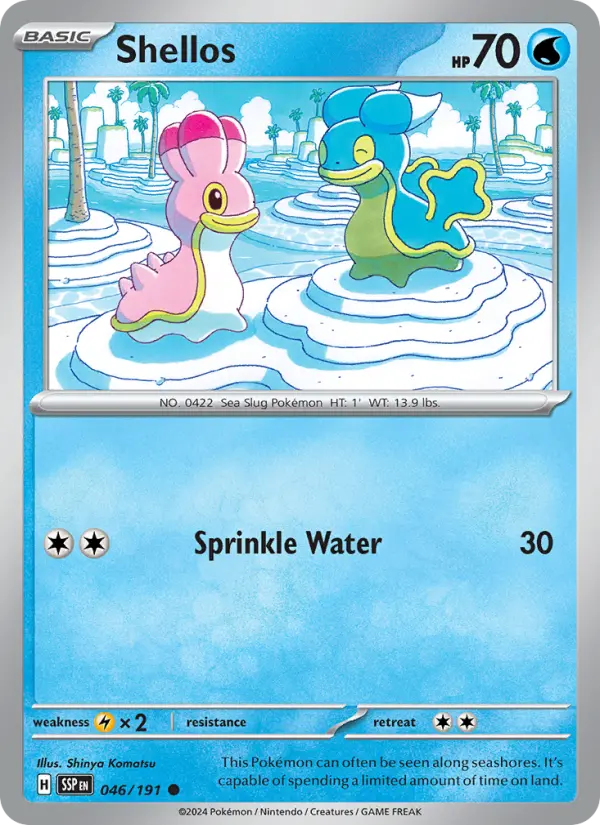
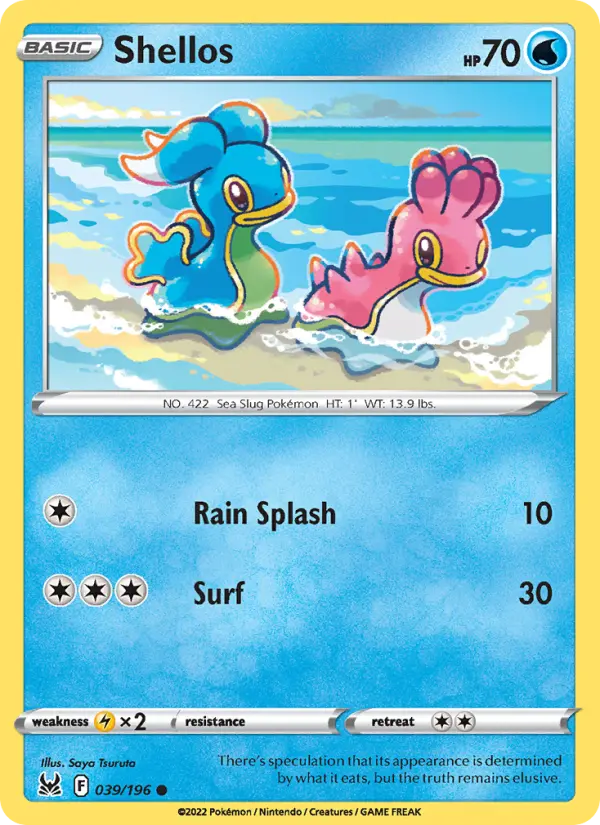
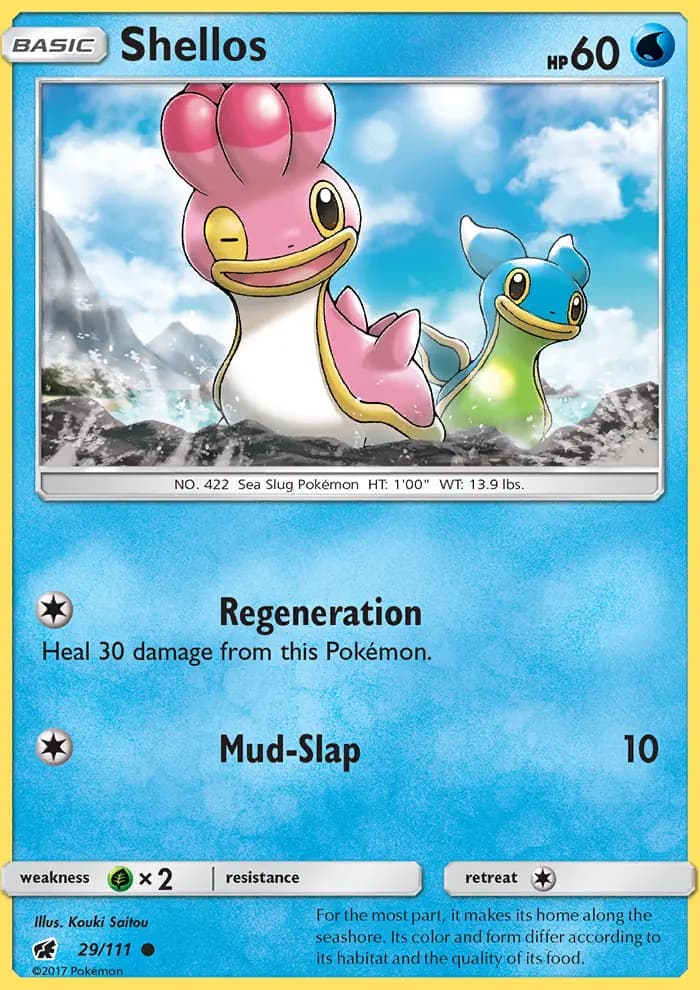
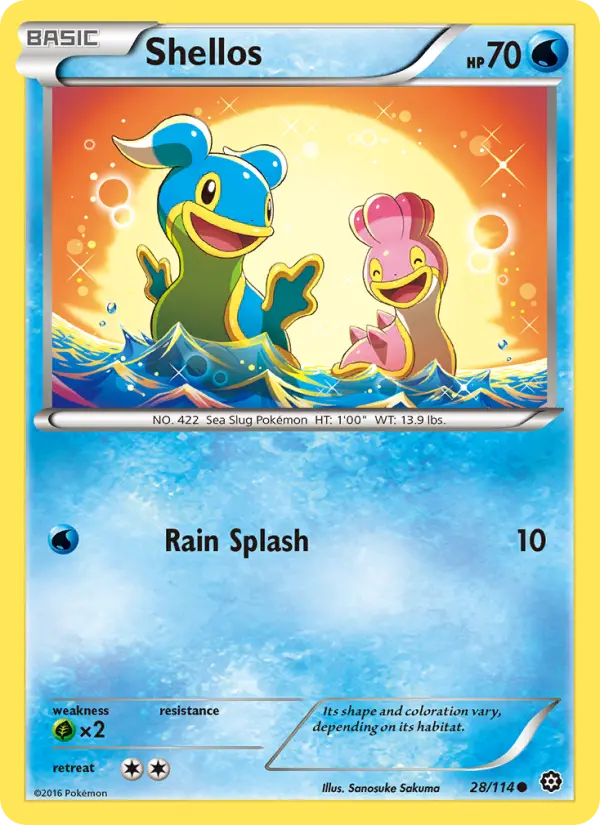
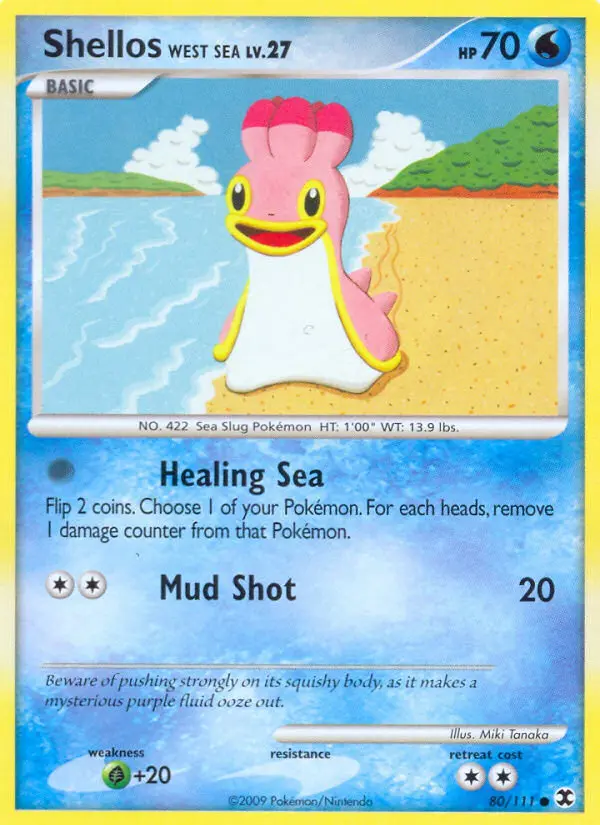
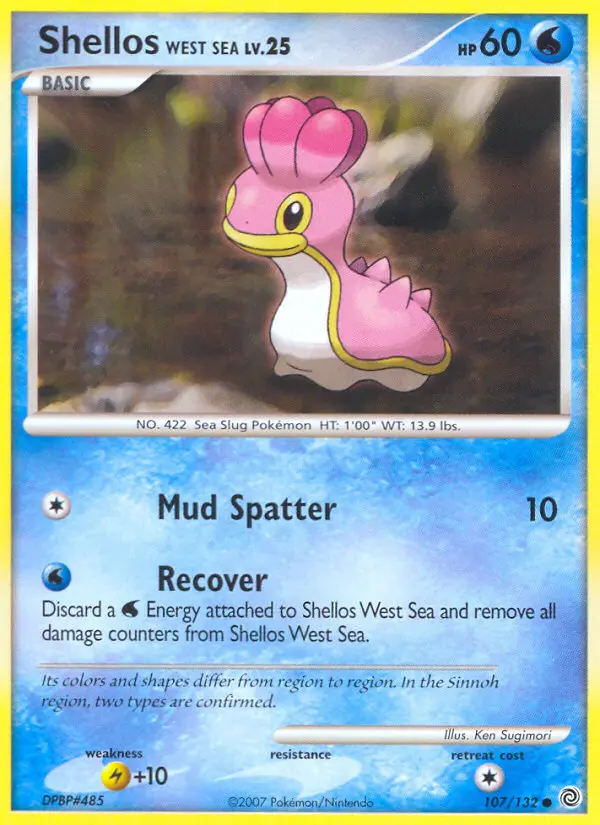
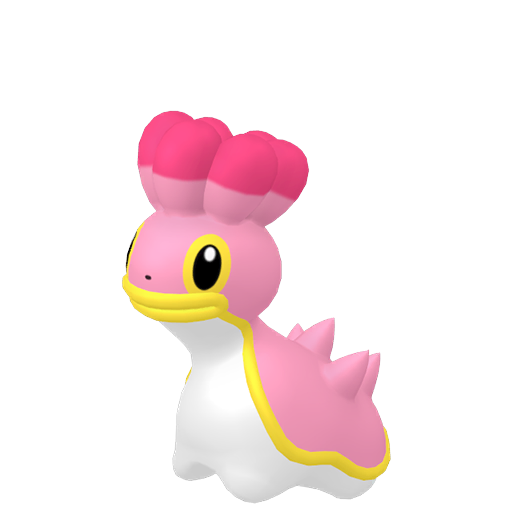
The West Sea form of Shellos presents a striking pink and white appearance, featuring a pale white underside contrasted by a vibrant pink mantle that covers its upper body. This form is characterized by several small spike-like protrusions running along its back and a distinctive ring of pink, fleshy knobs encircling its head that resemble the delicate gills found on real-world nudibranchs. Both Shellos forms share fundamental anatomical features including a bulbous head, four small feet for locomotion, large black oval-shaped eyes with yellow outlines, and wide yellow lips that give them an endearing appearance. Unlike true sea slugs, which typically possess a single muscular foot, Shellos has evolved four distinct appendages, representing an interesting departure from its biological inspirations. The West Sea form's appearance is theorized to have been influenced by exposure to warmer ocean waters, which may have contributed to the development of its gentler, more rounded physical characteristics and its warmer color palette compared to its East Sea counterpart.
Pokedex Numbers
Training
Breeding
Shellos Breeding, Gender Ratio & Egg Groups
There's no gender skew here: Shellos breeds at an even 50% male / 50% female rate, allowing for straightforward breeding in Pokémon games without any gender-specific complications or constraints. The species belongs to two egg groups—Water 1 and Indeterminate—making it compatible with a diverse range of breeding partners across multiple Pokémon families and enabling trainers to pass down moves and characteristics through careful breeding strategies. With a base friendship value of 70 across Generations IV through VII, Shellos demonstrates a naturally affectionate disposition toward its trainers, making it rewarding to bond with and level through experience rather than relying solely on experience candies or other artificial leveling methods. The species has a moderate hatch time of 20 egg cycles, translating to approximately 4,884 to 5,140 steps required to hatch a Shellos egg, making it neither particularly time-consuming nor instantaneous for players seeking to breed competitive specimens. The egg groups that Shellos belongs to provide flexibility for breeding projects, though trainers should note that the specific form of Shellos (West Sea or East Sea) inherited by offspring depends on the species and forms of the parents, maintaining the regional distinction across generations.
Sprites




TMs & HMs
tm01
lets go pikachu lets go eevee
tm02
crystal
tm02
gold silver
tm03
crystal
tm03
gold silver
tm03
ruby sapphire
tm03
platinum
tm03
firered leafgreen
tm03
heartgold soulsilver
tm03
diamond pearl
tm03
emerald
tm03
xd
tm03
colosseum
tm03
lets go pikachu lets go eevee
tm05
lets go pikachu lets go eevee
tm06
yellow
tm06
gold silver
tm06
red blue
tm06
crystal
tm06
emerald
+539 more TMs/HMs
Forms
westDefault east
eastShellos's Evolution Chain


Shellos Evolution, Mega Evolution & Special Forms
Shellos evolves into Gastrodon at level 30, transitioning from a small, slug-like creature into a significantly larger gastropod-inspired Pokémon. This evolution is a straightforward level-based progression without branching paths or special conditions, making it one of the more accessible evolutionary stages in the Water-type family. Upon evolution, Shellos gains a Ground-type addition to its Water typing, fundamentally altering its type matchups and available move pool while also receiving substantial stat boosts across the board. The evolved form, Gastrodon, retains the regional form distinction, with the West Sea Gastrodon maintaining the pink and white coloration while gaining a more robust, slug-like body structure. This evolution line represents a complete metamorphosis in both aesthetic presentation and mechanical function within competitive and casual gameplay, transforming Shellos from a defensive early-game Water-type into a more formidable opponent capable of handling a broader range of threats thanks to its Ground-type advantages.
Where to Find
Sinnoh Route 213
sinnoh
+15 more
Sinnoh Route 224
sinnoh
Sinnoh Route 205
sinnoh
+24 more
Valley Windworks
sinnoh
+21 more
Fuego Ironworks
sinnoh
Sinnoh Route 218
sinnoh
Sinnoh Route 221
sinnoh
Pastoria City
sinnoh
Sinnoh Route 212
sinnoh
+6 more
Canalave City
sinnoh
Seafolk Village
alola
Shellos Behaviour and Natural Habitat
Shellos inhabits the seashores and bodies of water throughout the Sinnoh region, with the West Sea form being particularly abundant along coastlines bordered by warmer waters, as documented in the Legends: Arceus Pokédex entry. These creatures are unexpectedly friendly and social, actively crawling toward people they encounter rather than fleeing, making them relatively approachable in their natural habitats. The Pokédex entries across multiple games emphasize that Shellos's body shape has evolved and adapted to suit its specific environment, suggesting that the species possesses remarkable physiological plasticity that extends beyond mere cosmetic differences. When threatened or subjected to physical pressure, Shellos can release a mysterious purple fluid as a defensive mechanism, a capability that trainers are specifically warned to be cautious about, as documented in the Platinum, Black, White, and Black 2 Pokédex entries. This defensive secretion likely serves as a deterrent to potential predators, allowing this slow-moving Pokémon (with a base Speed stat of only 34) to survive in competitive aquatic ecosystems despite its lack of offensive prowess.
Pokedex Entries
Its colors and shapes differ from region to region. In the Sinnoh region, two types are confirmed.
It lives along bodies of water. Its body shape has changed to suit its habitat.
Beware of pushing strongly on its squishy body, as it makes a mysterious purple fluid ooze out.
Its shape and coloration vary, depending on its habitat.
Beware of pushing strongly on its squishy body, as it makes a mysterious purple fluid ooze out.
Beware of pushing strongly on its squishy body, as it makes a mysterious purple fluid ooze out.
Beware of pushing strongly on its squishy body, as it makes a mysterious purple fluid ooze out.
Its shape and coloration vary, depending on its habitat.
Beware of pushing strongly on its squishy body, as it makes a mysterious purple fluid ooze out.
Its shape and coloration vary, depending on its habitat.
For the most part, it makes its home along the seashore. Its color and form differ according to its habitat and the quality of its food.
While they normally live in the sea, they can function on land, too, until their skin dries out.
Purple mucus sticks to the hands of anyone who touches it. Take care, as the substance is troublesome to wash off.
When it senses danger, a purple liquid oozes out of it. The liquid is thought to be something like greasy sweat.
This Pokémon’s habitat shapes its physique. According to some theories, life in warm ocean waters causes this variation to develop.
Subjecting this Pokémon to a strong force causes it to secrete a strange purple fluid. Though harmless, the fluid is awfully sticky.
Found in abundance on seashores bordering warm waters. Shellos are unexpectedly friendly and will crawl toward any person they see. Take care not to get coated in mucus!
Shellos Name Origin & Design Inspiration
The West Sea form of Shellos draws its inspiration directly from real-world nudibranchs and sea slugs, soft-bodied marine gastropods known for their vibrant colors and fascinating biological adaptations. The Japanese name, Karanakushi, combines elements suggesting a shell-like or armored creature, despite Shellos's complete lack of an actual shell structure. The species name 'Shellos' itself is a playful portmanteau of 'shell' and 'loss,' cleverly referencing the creature's shell-less nature while maintaining the aquatic aesthetic. The West Sea form's pink coloration and rounded, gentle appearance suggest exposure to warm, tropical waters and perhaps evolutionary pressures favoring a less aggressive appearance in warmer ocean environments. The design philosophy behind creating two forms for a single species was revolutionary for Generation IV and established a precedent for regional variants that would become increasingly common in later generations, with the West Sea Shellos serving as the canonical form for the Sinnoh region and representing an important step in Pokémon design evolution that prioritizes ecological and geographical specificity.
Learnable Moves
Shellos can learn 76 moves:
Move | Type | Cat. | Power | Acc. | PP |
|---|---|---|---|---|---|
| acid armor | poison | Status | — | — | 20 |
| amnesia | psychic | Status | — | — | 20 |
| ancient power | rock | Special | 60 | 100 | 5 |
| attract | normal | Status | — | 100 | 15 |
| blizzard | ice | Special | 110 | 70 | 5 |
| body slam | normal | Physical | 85 | 100 | 15 |
| brine | water | Special | 65 | 100 | 10 |
| bulldoze | ground | Physical | 60 | 100 | 20 |
| captivate | normal | Status | — | 100 | 20 |
| chilling water | water | Special | 50 | 100 | 20 |
| clear smog | poison | Special | 50 | — | 15 |
| confide | normal | Status | — | — | 20 |
| counter | fighting | Physical | — | 100 | 20 |
| curse | ghost | Status | — | — | 10 |
| dive | water | Physical | 80 | 100 | 10 |
| double team | normal | Status | — | — | 15 |
| earth power | ground | Special | 90 | 100 | 10 |
| endure | normal | Status | — | — | 10 |
| facade | normal | Physical | 70 | 100 | 20 |
| fissure | ground | Physical | — | 30 | 5 |
| frustration | normal | Physical | — | 100 | 20 |
| hail | ice | Status | — | — | 10 |
| harden | normal | Status | — | — | 30 |
| headbutt | normal | Physical | 70 | 100 | 15 |
| helping hand | normal | Status | — | — | 20 |
| hidden power | normal | Special | 60 | 100 | 15 |
| hydro pump | water | Special | 110 | 80 | 5 |
| ice beam | ice | Special | 90 | 100 | 10 |
| icy wind | ice | Special | 55 | 95 | 15 |
| infestation | bug | Special | 20 | 100 | 20 |
| liquidation | water | Physical | 85 | 100 | 10 |
| memento | dark | Status | — | 100 | 10 |
| mirror coat | psychic | Special | — | 100 | 20 |
| mist | ice | Status | — | — | 30 |
| mud bomb | ground | Special | 65 | 85 | 10 |
| mud shot | ground | Special | 55 | 95 | 15 |
| mud sport | ground | Status | — | — | 15 |
| mud slap | ground | Special | 20 | 100 | 10 |
| muddy water | water | Special | 90 | 85 | 10 |
| natural gift | normal | Physical | — | 100 | 15 |
| pain split | normal | Status | — | — | 20 |
| protect | normal | Status | — | — | 10 |
| rain dance | water | Status | — | — | 5 |
| recover | normal | Status | — | — | 5 |
| rest | psychic | Status | — | — | 5 |
| return | normal | Physical | — | 100 | 20 |
| rock slide | rock | Physical | 75 | 90 | 10 |
| rock tomb | rock | Physical | 60 | 95 | 15 |
| round | normal | Special | 60 | 100 | 15 |
| sandstorm | rock | Status | — | — | 10 |
| scald | water | Special | 80 | 100 | 15 |
| secret power | normal | Physical | 70 | 100 | 20 |
| skitter smack | bug | Physical | 70 | 90 | 10 |
| sleep talk | normal | Status | — | — | 10 |
| sludge | poison | Special | 65 | 100 | 20 |
| snore | normal | Special | 50 | 100 | 15 |
| snowscape | ice | Status | 0 | — | 10 |
| spit up | normal | Special | — | 100 | 10 |
| stealth rock | rock | Status | — | — | 20 |
| stockpile | normal | Status | — | — | 20 |
| stone edge | rock | Physical | 100 | 80 | 5 |
| string shot | bug | Status | — | 95 | 40 |
| substitute | normal | Status | — | — | 10 |
| surf | water | Special | 90 | 100 | 15 |
| swagger | normal | Status | — | 85 | 15 |
| swallow | normal | Status | — | — | 10 |
| tackle | normal | Physical | 40 | 100 | 35 |
| take down | normal | Physical | 90 | 85 | 20 |
| tera blast | normal | Special | 80 | 100 | 10 |
| toxic | poison | Status | — | 90 | 10 |
| trump card | normal | Special | — | — | 5 |
| water gun | water | Special | 40 | 100 | 25 |
| water pulse | water | Special | 60 | 100 | 20 |
| waterfall | water | Physical | 80 | 100 | 15 |
| whirlpool | water | Special | 35 | 85 | 15 |
| yawn | normal | Status | — | — | 10 |
Shellos Competitive Battle Guide
In tournament-level play, Shellos occupies a niche role primarily in lower-tier formats, with its base stat distribution of 325 total points heavily skewed toward defensive capabilities rather than offensive pressure. The species's most valuable stat is its HP at 76, which combines with its decent Special Defense of 62 to create a reasonable special wall, though its middling physical Defense of 48 leaves it vulnerable to physical attackers despite its bulk. Shellos's access to Storm Drain as its signature ability provides a valuable niche by redirecting single-target Water-type moves while simultaneously boosting its Special Attack stat by one stage, creating opportunities for momentum shifts in battles against Water-heavy teams. The limited offensive prowess—with an Attack stat of 48 and Special Attack of 57—makes Shellos unsuitable for offensive coverage roles, though its movepool includes utility options like Recover, Toxic, and Stealth Rock that allow it to function as a support Pokémon. The hidden ability Sand Force grants intriguing potential in sandstorm-based team compositions by strengthening Rock, Ground, and Steel-type moves by 1.3 times while protecting against sandstorm damage, though this niche role is typically outperformed by more specialized Pokémon. Trainers using Shellos in competitive play generally focus on exploiting its surprising durability and move coverage rather than expecting devastating offensive output, making it a serviceable choice for casual play and lower-tier competitive formats.
Commonly Asked Questions About Shellos
What type is Shellos?
Shellos is a water type Pokemon.
What does Shellos evolve into?
Shellos evolves into gastrodon.
What are Shellos's weaknesses?
Shellos is weak to grass and electric type moves.
Does Shellos evolve by trading?
No — Shellos evolves entirely through leveling up, with no trade required at any stage.
Where can I find Shellos?
Shellos can be found in sinnoh route 213 (sinnoh), sinnoh route 224 (sinnoh) and sinnoh route 205 (sinnoh) and 8 other locations.
Shellos Cultural Impact & Franchise History
Shellos achieved significant recognition through its prominent appearance in the Pokémon Diamond and Pearl anime series, where Zoey, one of Ash's traveling companions, captured and trained a West Sea form Shellos that became integral to her Pokémon Contest strategy and battling team. The character's attachment to her Shellos and its subsequent evolution into Gastrodon introduced many viewers to the species and demonstrated its unexpected charm and competence despite its unassuming appearance, helping to elevate Shellos from a mere regional water-type to a beloved character in the franchise. The innovative concept of regional forms that Shellos exemplified, with its West Sea and East Sea variants, became a blueprint for future generations and demonstrated Game Freak's commitment to biological realism and environmental storytelling within the Pokémon universe. Shellos's design as a shell-less sea slug captured the imagination of marine biology enthusiasts and contributed to the broader appeal of Generation IV's more naturalistic approach to Pokémon design, with its warm pink coloration and gentle demeanor making it particularly appealing to casual players and younger trainers. The species continues to appear in modern Pokémon games and media, maintaining relevance through its inclusion in recent titles like Pokémon Legends: Arceus and Pokémon Scarlet and Violet, ensuring that new generations of trainers continue to discover and appreciate this charming Water-type.
Where to Find Shellos in Every Pokémon Game
Shellos (West Sea form) can be caught in the Sinnoh region games—Diamond, Pearl, and Platinum—where it appears in specific coastal locations corresponding to its warm-water habitat preference. The species received a local Pokédex number of 0060 in these original Generation IV titles, marking its importance to the region's ecosystem despite being a relatively new addition to the franchise. In subsequent generations, Shellos has appeared in numerous games with varying availability; it received a local dex number in Alola in Sun and Moon games (0260) and appeared again in Sword and Shield with a local number of 0230. The most recent appearances in Pokémon Legends: Arceus and Pokémon Scarlet and Violet continue to feature the species, with the latter games assigning it a local Pokédex number of 0327, ensuring that the West Sea form remains accessible to trainers across modern gaming platforms. The species's inclusion in Brilliant Diamond and Shining Pearl, the Sinnoh remakes, allows contemporary players to experience the original Pokédex entries and habitat associations that defined Shellos's initial introduction to the franchise. With a catch rate of 190 (translating to approximately 24.8% success with a standard Poké Ball at full health), Shellos presents a reasonable capture challenge, requiring minimal effort to obtain once encountered, making it an accessible choice for trainers building their teams early in their Sinnoh region adventures.