Shieldon
Generation IV · #0410 — Shield Pokémon
Shieldon measures in at 0.5 m and 57 kg, a build that matches its sturdy ability better than it matches raw offense or defense. At 0.5 m and 57.0 kg, its build reflects a specialist role rather than a generalist one. Revived from an Armor Fossil, Shieldon represents a remarkable window into prehistoric life, having inhabited primeval jungles approximately 100 million years ago. Despite its ancient origins, Shieldon possesses a surprisingly gentle temperament, earning a base friendship value of 70 and displaying a mild-mannered, herbivorous nature that contradicts the aggressive armor-bearing reputation one might expect from such a heavily protected creature. Its dual typing provides a complex defensive profile that influences both its survival instincts and strategic applications in modern Pokémon battles.
Editor's Take
Shieldon's line is the defensive half of the Gen 4 fossil pair, and Bastiodon's Rock/Steel typing repeating Aggron's quad weaknesses is a mistake the series made twice.
Base Stats
Height
0.5m
Weight
57.0kg
Category
Shield Pokémon
Gender
Male 87.5% / Female 12.5%
Color
gray
Shape
quadruped
Abilities
Prevents being KOed from full HP, leaving 1 HP instead. Protects against the one-hit KO moves regardless of HP.
Protects against sound-based moves.

Shieldon Biology & Physical Characteristics
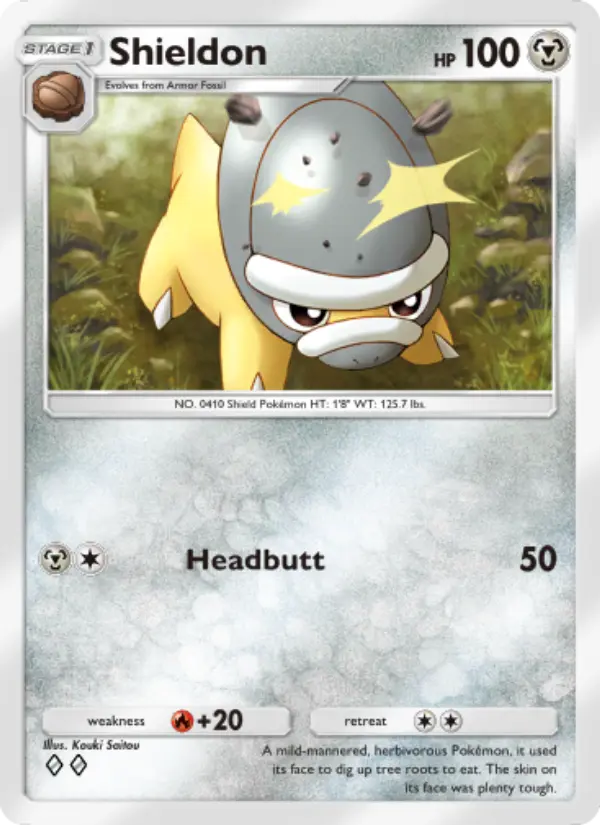
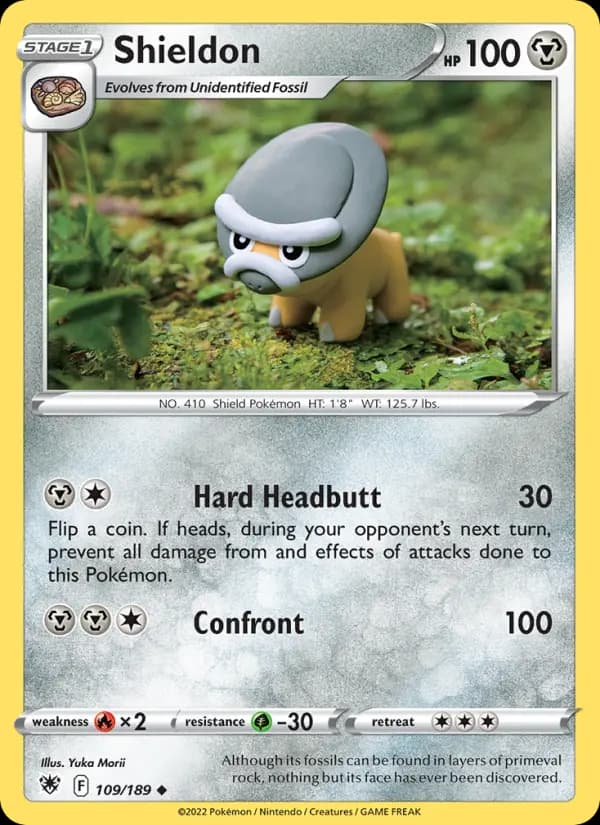
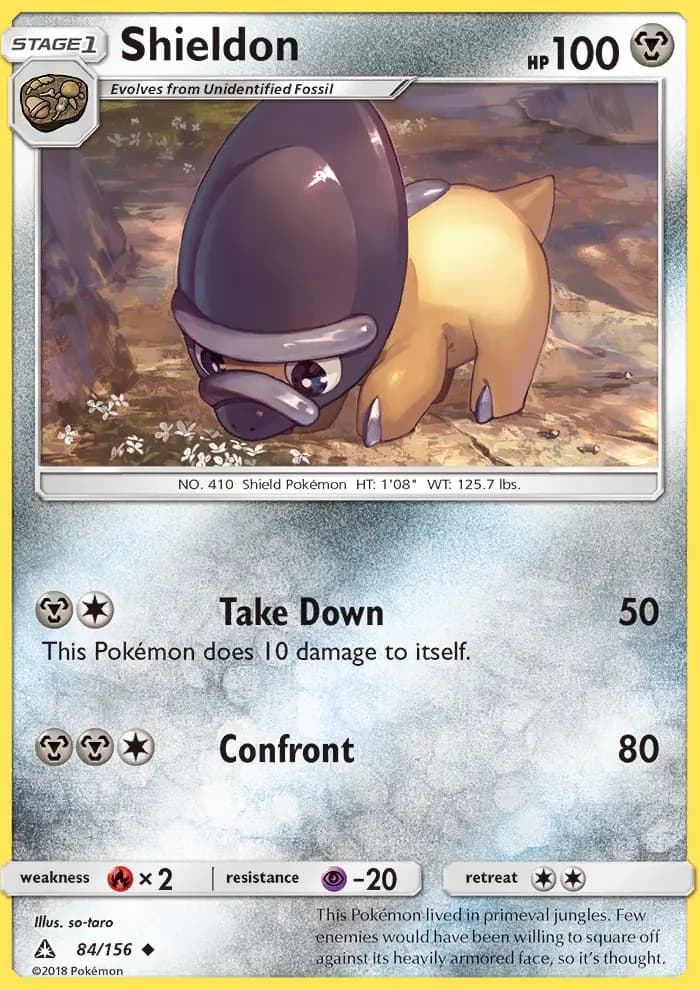
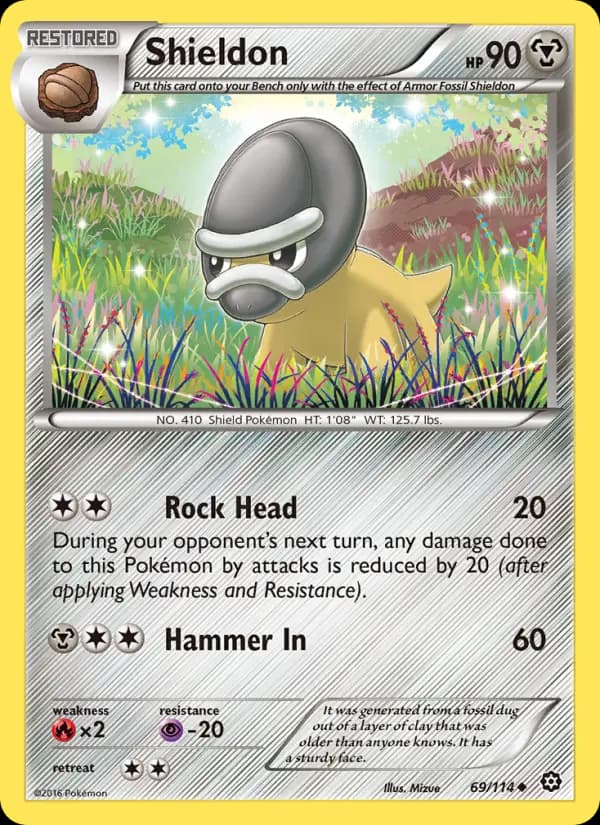
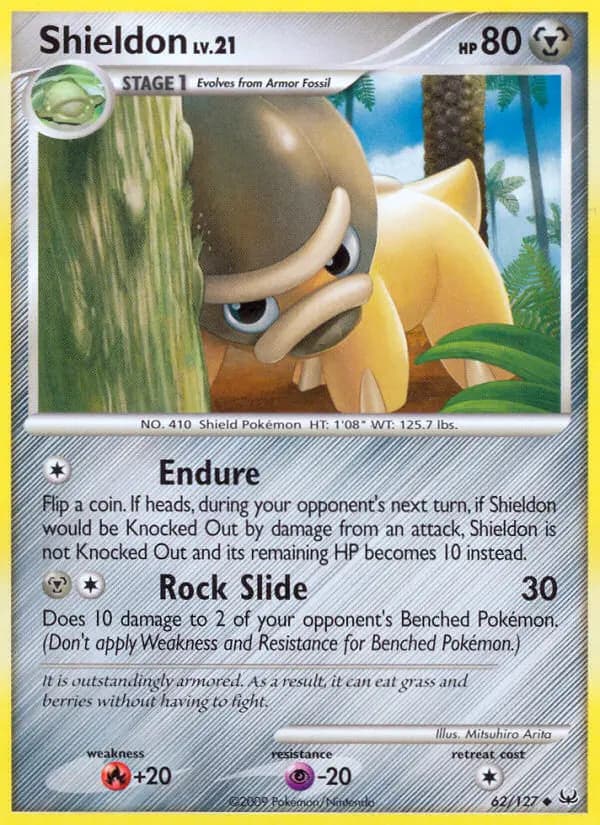
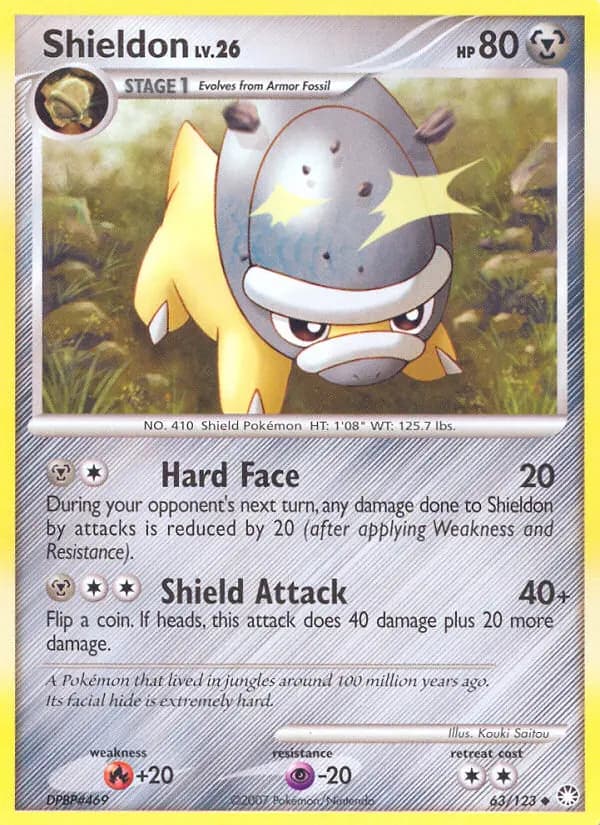
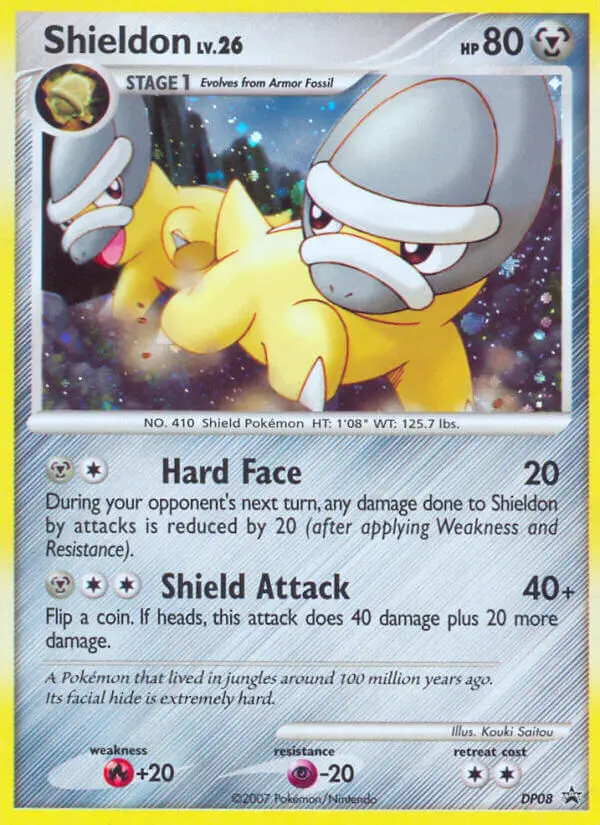
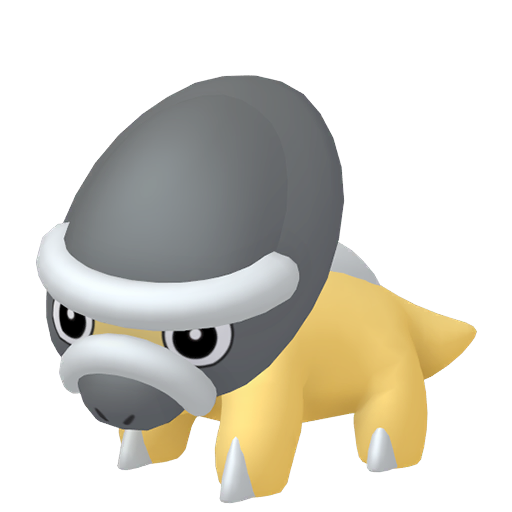
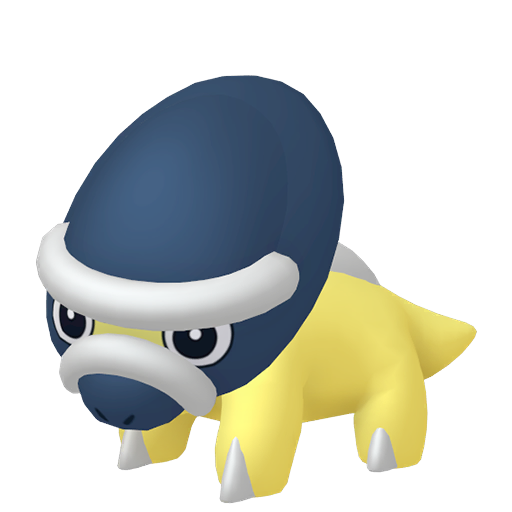
Shieldon presents a distinctive ceratopsian-like appearance, dominated by its most striking feature: an exceptionally hard, dark-gray elliptical facial structure adorned with a prominent white brow ridge and white rim encircling its black snout. The remainder of its body is covered in yellow scales, contrasting with white-tipped toes and a characteristic white bump protruding from its back. Its facial hide represents a biological marvel—so remarkably durable that the overwhelming majority of discovered Shieldon fossils exhibit absolutely no signs of damage to the face, a testament to the effectiveness of this evolutionary adaptation. However, this impressive frontal armor comes with a critical vulnerability: the Pokémon lacks comparable protection on its posterior, leaving it exposed to attacks from behind. The extremes in Shieldon's defensive anatomy reflect a specialized evolutionary strategy optimized for forward-facing confrontations while sacrificing omnidirectional protection.
Pokedex Numbers
Training
Breeding
Shieldon Breeding, Gender Ratio & Egg Groups
Shieldon exhibits a pronounced gender ratio of approximately 87.5% male to 12.5% female, demonstrating significant male preponderance within the species. Despite this sexual imbalance, both genders possess identical base statistics and capabilities, with no gender-specific morphological differences or attribute variations affecting gameplay functionality. The species belongs to the Monster egg group, requiring compatible breeding partners to reproduce in captivity. Shieldon requires thirty egg cycles to hatch, equivalent to approximately 7,454 to 7,710 steps, positioning it within the moderate incubation timeline for fossil-based Pokémon. The gender ratio, while skewed toward males, does not inhibit breeding efficiency when appropriate breeding pairs are arranged, though the scarcity of female specimens may present logistical challenges for trainers attempting to breed Shieldon competitively or for collection purposes.
Sprites




TMs & HMs
tm01
lets go pikachu lets go eevee
tm02
crystal
tm02
gold silver
tm02
lets go pikachu lets go eevee
tm03
crystal
tm03
gold silver
tm05
ruby sapphire
tm05
emerald
tm05
gold silver
tm05
crystal
tm05
diamond pearl
tm05
black white
tm05
platinum
tm05
heartgold soulsilver
tm05
firered leafgreen
tm05
black 2 white 2
tm05
omega ruby alpha sapphire
tm05
x y
tm05
xd
tm05
colosseum
+729 more TMs/HMs
Shieldon's Evolution Chain


Shieldon Evolution, Mega Evolution & Special Forms
Shieldon undergoes a singular evolutionary transformation into Bastiodon upon reaching level 30, progressing from the Shield Pokémon to its fully evolved form without alternative branching paths or Mega Evolution mechanics. This evolution represents a significant transformation, with Bastiodon achieving dramatically enhanced physical proportions while maintaining the Rock/Steel dual typing. The evolution process involves a substantial increase in defensive capabilities, with Bastiodon's defense stat rising considerably beyond Shieldon's already impressive 118 base defense, making it one of the most defensively oriented Pokémon available. Mechanically, this evolution occurs through standard leveling mechanics without requiring held items, special environmental conditions, or friendship thresholds, making it an accessible progression for trainers utilizing Shieldon in their teams. The transition from Shieldon to Bastiodon represents the complete development of this prehistoric lineage's protective specialization, culminating in one of the most formidable defensive platforms in competitive gameplay.
Where to Find
Alola Route 8
alola
+1 more
Shieldon Behaviour and Natural Habitat
Ancient Shieldon inhabited the dense forests and primeval jungles that dominated the landscape 100 million years ago, where it thrived as a herbivorous Pokémon sustaining itself on grass, tree roots, and berries. Remarkably, its outstanding natural armor eliminated the necessity for defensive combat, allowing Shieldon to subsist peacefully through vegetation consumption without engaging in territorial disputes or predatory encounters. The species exhibits a distinctive behavioral habit of habitually polishing its facial hide by rubbing it against tree trunks, possibly serving both functional purposes—such as maintaining the surface integrity of its armor—and behavioral self-maintenance rituals. Few enemies would have considered challenging Shieldon's heavily protected face during its prehistoric existence, yet its weak rear made it vulnerable to ambush attacks from behind. In modern times, Shieldon can be encountered in the Canyon Biome of the Terarium, where it has adapted to contemporary environments while maintaining its peaceful, herbivorous disposition.
Pokedex Entries
A Pokémon that lived in jungles around 100 million years ago. Its facial hide is extremely hard.
It habitually polishes its face by rubbing it against tree trunks. It is weak to attacks from behind.
It is outstandingly armored. As a result, it can eat grass and berries without having to fight.
It was generated from a fossil dug out of a layer of clay that was older than anyone knows. It has a sturdy face.
It is outstandingly armored. As a result, it can eat grass and berries without having to fight.
It is outstandingly armored. As a result, it can eat grass and berries without having to fight.
It habitually polishes its face by rubbing it against tree trunks. It is weak to attacks from behind.
It was generated from a fossil dug out of a layer of clay that was older than anyone knows. It has a sturdy face.
It habitually polishes its face by rubbing it against tree trunks. It is weak to attacks from behind.
It was generated from a fossil dug out of a layer of clay that was older than anyone knows. It has a sturdy face.
Many fossils of this Pokémon have been found, but almost none have shown signs of damage to the face.
A mild-mannered, herbivorous Pokémon, it used its face to dig up tree roots to eat. The skin on its face was plenty tough.
This Pokémon lived in primeval jungles. Few enemies would have been willing to square off against its heavily armored face, so it’s thought.
Although its fossils can be found in layers of primeval rock, nothing but its face has ever been discovered.
Much remains unknown about this Pokémon, as few have ever seen it. However, we know that it is calm and dislikes conflict, and it enjoys polishing its face against trees and rocks.
Shieldon Name Origin & Design Inspiration
Shieldon's name traces back to the obvious correlation between 'shield' and its function as a protected fossil Pokémon, combined with the suffix 'don,' a common convention in Pokémon naming for dinosaur-like creatures that references their paleontological classification. The Japanese designation 'Tatetops' similarly combines 'tate,' meaning 'shield' or 'to stand against,' with 'tops,' a reference to Triceratops and other ceratopsian dinosaurs, reflecting the Pokémon's protective specialization and prehistoric origins. The design itself draws substantial inspiration from ceratopsian dinosaurs, particularly Triceratops, though with a significant reinterpretation focusing on extreme facial armor rather than the iconic three-horn arrangement. Shieldon's visual aesthetic emphasizes defensive capability through exaggerated proportions of protective plating, particularly the oversized dark-gray facial structure that dominates its relatively diminutive body. The stark color contrast between the yellow body and gray face symbolizes the specialization of its evolutionary advantages, while the white brow and snout rim provide visual distinction and accentuate the facial features that constitute its primary evolutionary adaptation.
Learnable Moves
Shieldon can learn 77 moves:
Move | Type | Cat. | Power | Acc. | PP |
|---|---|---|---|---|---|
| ancient power | rock | Special | 60 | 100 | 5 |
| attract | normal | Status | — | 100 | 15 |
| blizzard | ice | Special | 110 | 70 | 5 |
| body slam | normal | Physical | 85 | 100 | 15 |
| bulldoze | ground | Physical | 60 | 100 | 20 |
| captivate | normal | Status | — | 100 | 20 |
| confide | normal | Status | — | — | 20 |
| counter | fighting | Physical | — | 100 | 20 |
| curse | ghost | Status | — | — | 10 |
| dig | ground | Physical | 80 | 100 | 10 |
| double team | normal | Status | — | — | 15 |
| double edge | normal | Physical | 120 | 100 | 15 |
| earth power | ground | Special | 90 | 100 | 10 |
| earthquake | ground | Physical | 100 | 100 | 10 |
| endure | normal | Status | — | — | 10 |
| facade | normal | Physical | 70 | 100 | 20 |
| fire blast | fire | Special | 110 | 85 | 5 |
| fissure | ground | Physical | — | 30 | 5 |
| flamethrower | fire | Special | 90 | 100 | 15 |
| flash cannon | steel | Special | 80 | 100 | 10 |
| focus energy | normal | Status | — | — | 30 |
| frustration | normal | Physical | — | 100 | 20 |
| guard split | psychic | Status | — | — | 10 |
| hard press | steel | Physical | 0 | 100 | 10 |
| headbutt | normal | Physical | 70 | 100 | 15 |
| heavy slam | steel | Physical | — | 100 | 10 |
| hidden power | normal | Special | 60 | 100 | 15 |
| ice beam | ice | Special | 90 | 100 | 10 |
| incinerate | fire | Special | 60 | 100 | 15 |
| iron defense | steel | Status | — | — | 15 |
| iron head | steel | Physical | 80 | 100 | 15 |
| iron tail | steel | Physical | 100 | 75 | 15 |
| magnet rise | electric | Status | — | — | 10 |
| metal burst | steel | Physical | — | 100 | 10 |
| metal sound | steel | Status | — | 85 | 40 |
| mud slap | ground | Special | 20 | 100 | 10 |
| natural gift | normal | Physical | — | 100 | 15 |
| power gem | rock | Special | 80 | 100 | 20 |
| protect | normal | Status | — | — | 10 |
| rain dance | water | Status | — | — | 5 |
| rest | psychic | Status | — | — | 5 |
| return | normal | Physical | — | 100 | 20 |
| roar | normal | Status | — | — | 20 |
| rock blast | rock | Physical | 25 | 90 | 10 |
| rock polish | rock | Status | — | — | 20 |
| rock slide | rock | Physical | 75 | 90 | 10 |
| rock smash | fighting | Physical | 40 | 100 | 15 |
| rock tomb | rock | Physical | 60 | 95 | 15 |
| round | normal | Special | 60 | 100 | 15 |
| sand tomb | ground | Physical | 35 | 85 | 15 |
| sandstorm | rock | Status | — | — | 10 |
| scary face | normal | Status | — | 100 | 10 |
| scorching sands | ground | Special | 70 | 100 | 10 |
| screech | normal | Status | — | 85 | 40 |
| secret power | normal | Physical | 70 | 100 | 20 |
| shock wave | electric | Special | 60 | — | 20 |
| sleep talk | normal | Status | — | — | 10 |
| smack down | rock | Physical | 50 | 100 | 15 |
| snore | normal | Special | 50 | 100 | 15 |
| stealth rock | rock | Status | — | — | 20 |
| steel beam | steel | Special | 140 | 95 | 5 |
| stomping tantrum | ground | Physical | 75 | 100 | 10 |
| stone edge | rock | Physical | 100 | 80 | 5 |
| strength | normal | Physical | 80 | 100 | 15 |
| substitute | normal | Status | — | — | 10 |
| sunny day | fire | Status | — | — | 5 |
| swagger | normal | Status | — | 85 | 15 |
| tackle | normal | Physical | 40 | 100 | 35 |
| take down | normal | Physical | 90 | 85 | 20 |
| taunt | dark | Status | — | 100 | 20 |
| tera blast | normal | Special | 80 | 100 | 10 |
| thunder | electric | Special | 110 | 70 | 10 |
| thunderbolt | electric | Special | 90 | 100 | 15 |
| torment | dark | Status | — | 100 | 15 |
| toxic | poison | Status | — | 90 | 10 |
| trailblaze | grass | Physical | 50 | 100 | 20 |
| wide guard | rock | Status | — | — | 10 |
Shieldon Competitive Battle Guide
Shieldon's competitive viability centers entirely upon its exceptional defensive specialization, boasting a base defense stat of 118—extraordinarily high for such an early-stage Pokémon—paired with respectable special defense of 88. These defensive attributes grant Shieldon surprising durability in team compositions designed around defensive pivoting and wall strategies, despite its diminutive unevolved status. The Sturdy ability provides critical defensive utility, preventing outright knockout from full health and negating one-hit knockout moves regardless of current HP, effectively supplementing its already robust defensive profile. The hidden ability Soundproof offers situational utility against specific sound-based move strategies, though it sees less frequent competitive application than Sturdy. However, Shieldon's abysmal offensive statistics—base 42 attack and special attack—severely restrict its offensive pressure, while its identical base 30 HP and speed create significant vulnerabilities that offensive threats readily exploit. The base experience yield of 99 and slow-then-very-fast growth rate further complicates Shieldon's competitive relevance, positioning it primarily as a transitional Pokémon intended for evolution into the substantially more formidable Bastiodon rather than as a standalone competitive option.
Commonly Asked Questions About Shieldon
What type is Shieldon?
Shieldon is a rock and steel type Pokemon.
What does Shieldon evolve into?
Shieldon evolves into bastiodon.
What are Shieldon's weaknesses?
Shieldon is weak to fighting, ground and water type moves.
Does Shieldon evolve by trading?
No — Shieldon evolves entirely through leveling up, with no trade required at any stage.
Where can I find Shieldon?
Shieldon can be found in alola route 8 (alola).
Shieldon Cultural Impact & Franchise History
Shieldon occupies a distinctive niche within Pokémon media as one of the franchise's fossil-based creatures, embodying the paleontological fascination that has permeated science fiction and gaming narratives. Its introduction in Generation IV coincided with expanded fossil mechanics and prehistoric-themed gameplay elements, contributing to the Sinnoh region's paleontological aesthetic and the broader integration of evolutionary biology concepts into Pokémon worldbuilding. While Shieldon itself receives relatively modest cultural recognition compared to more iconic fossil Pokémon, its design and concept have influenced interpretations of dinosaur-inspired creatures within the franchise, particularly regarding the emphasis on specialized defensive adaptations rather than generalized creature attributes. The mild-mannered herbivorous characterization distinguishes Shieldon from more aggressive prehistoric creature archetypes, presenting a philosophical alternative to the assumption that ancient fauna possessed inherently violent dispositions. Shieldon's prominence in the Pokémon Adventures manga, particularly within storylines focusing on Sinnoh region exploration and fossil resurrection mechanics, established its narrative relevance within extended Pokémon media, though television and broader cultural penetration remain limited.
Where to Find Shieldon in Every Pokémon Game
Shieldon's primary acquisition method involves resurrecting it from an Armor Fossil, which trainers discover through archaeological activities in various Pokémon games, particularly prominent in Diamond and Pearl where it serves as Pokédex #038 in the regional Sinnoh listing. In the original Generation IV games, Shieldon can be obtained by presenting the Armor Fossil to the fossil restoration facility, typically located in Oreburgh City or equivalent locations. Subsequent game generations have maintained Armor Fossil availability, though specific locations and acquisition methods vary across iterations, including Brilliant Diamond and Shining Pearl for Nintendo Switch platforms where it remains a fossil-dependent Pokémon. The species also appears in Legends: Arceus, where prehistoric Pokémon mechanics fundamentally restructure typical encounter paradigms. Shieldon's regional Pokédex classifications include listings in Alola dex entries for Sun, Moon, Ultra Sun, and Ultra Moon under specific numbering (#0190 and #0237), demonstrating its availability across multiple game generations and regions. Its catch rate of 45 places Shieldon in the moderate capture difficulty range when encountered, requiring standard Poké Balls and moderate patience for successful acquisition, though fossil-based mechanics eliminate random encounter complications and replace them with deterministic resurrection protocols.