Silicobra
Generation VIII · #0843 — Sand Snake Pokémon
Silicobra is built around HP first — 50 at base is the clearest signal of how it's meant to be used, more than its ground typing alone would suggest.
Editor's Take
Silicobra's line ends in Sandaconda, whose Sand Spit setting a sandstorm when hit is a genuinely reactive weather ability nothing else has.
Base Stats
Height
2.2m
Weight
7.6kg
Category
Sand Snake Pokémon
Gender
Male 50% / Female 50%
Color
green
Shape
squiggle
Abilities
Creates a sandstorm when hit by an attack.
Has a 33% chance of curing any major status ailment after each turn.
Increases evasion to 1.25× during a sandstorm. Protects against sandstorm damage.

Silicobra Biology & Physical Characteristics
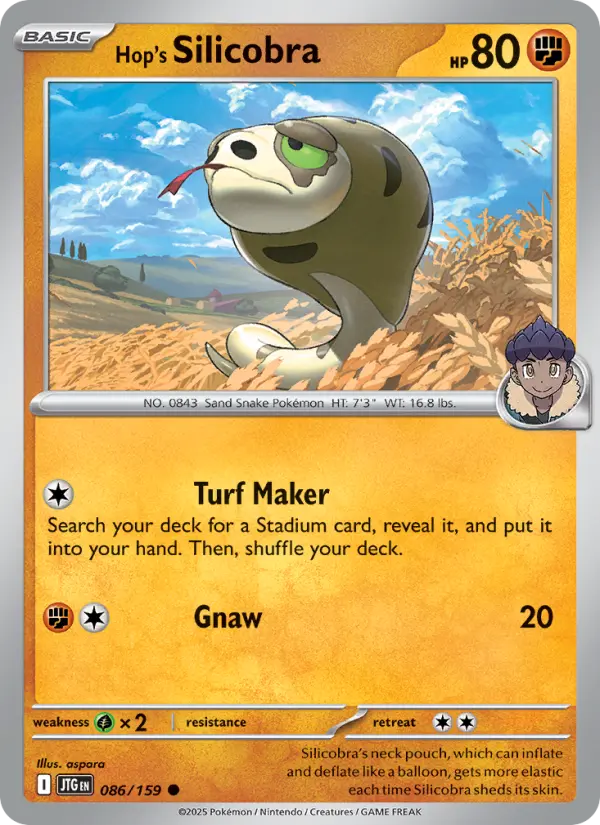
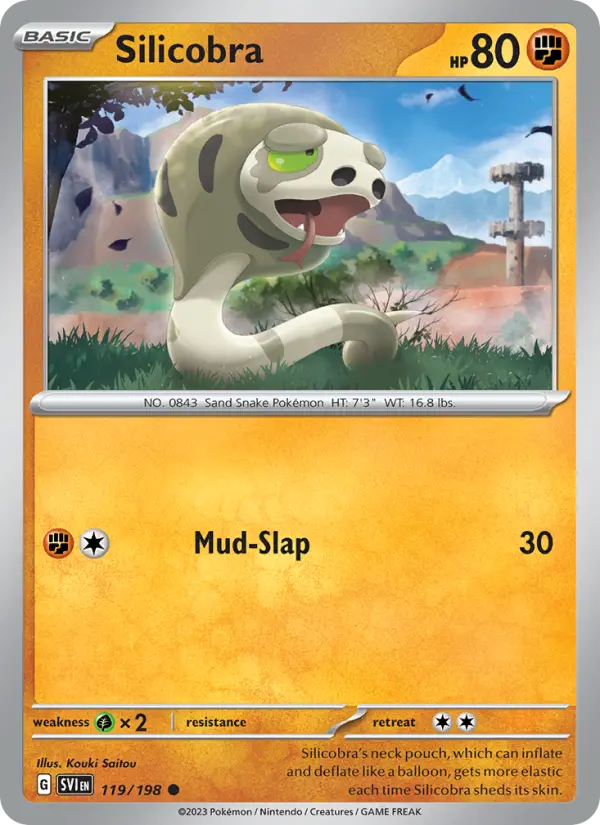
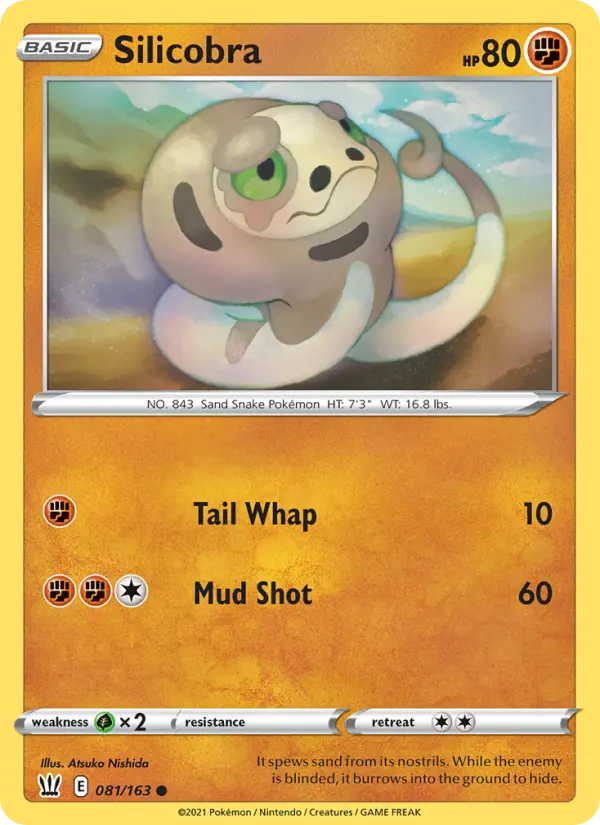
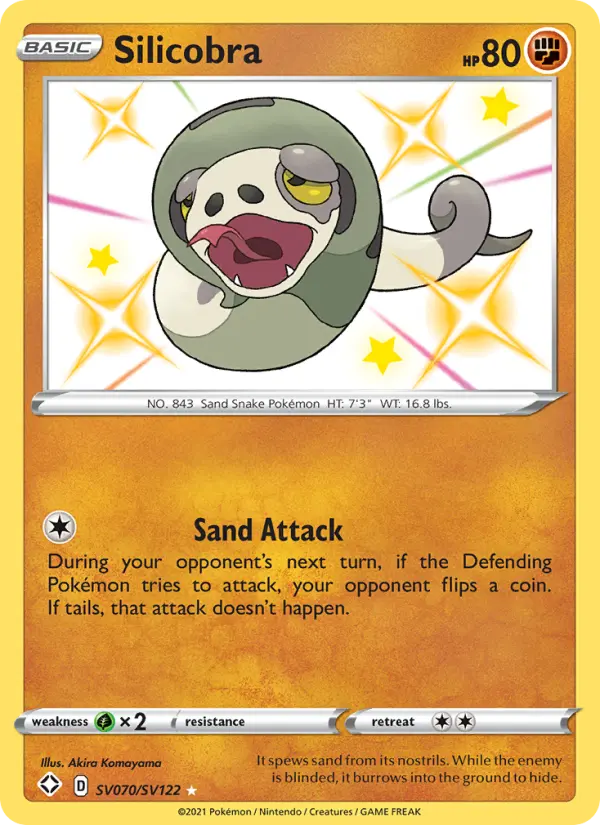
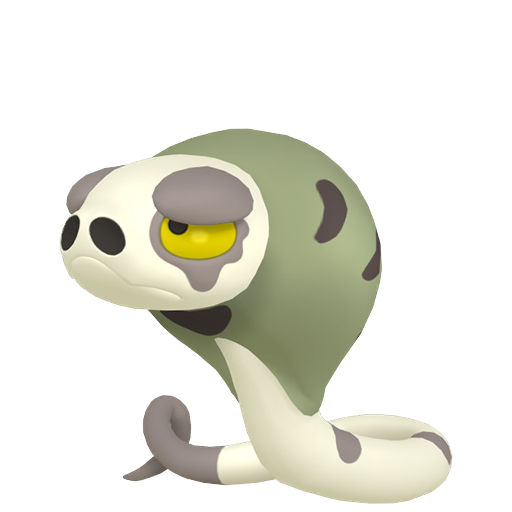
Silicobra exhibits a serpentine body structure with a predominantly brownish-white coloration accented by darker spots distributed along its length. Its most distinctive feature is the dark yellow pouch positioned around its neck, capable of storing more than 17 pounds of sand—a remarkable adaptation that becomes increasingly elastic with each shedding cycle. The Pokémon possesses large, prominent nostrils positioned to facilitate sand expulsion, oval green eyes with black pupils each surrounded by brown spots resembling sand stains, and a crooked downward mouth that gives it a perpetually frowning expression. Paired with a curled tail tip, this morphology creates an instantly recognizable silhouette. Its specialized nasal architecture, while perfect for launching sand projectiles with precision, has resulted in a significantly diminished sense of smell—a trade-off between offensive capability and olfactory sensitivity.
Pokedex Numbers
Training
Breeding
Silicobra Breeding, Gender Ratio & Egg Groups
Silicobra has one of the simplest gender ratios in the game — a flat 50/50, enabling straightforward breeding mechanics without specialized gender requirements. The species belongs to two distinct egg groups—Ground and Dragon—providing breeders with diverse compatibility options when pursuing specific move combinations or stat distributions through carefully planned breeding chains. With a base happiness value of 50 and a hatch counter of 20 cycles (equivalent to approximately 4,884 to 5,140 steps), Silicobra eggs require moderate effort to bring to term, making them neither particularly demanding nor exceptionally quick to hatch. The Medium Fast growth rate means that Silicobra reaches its evolution threshold at level 36 at a moderate pace, allowing trainers ample opportunity to train their specimen before the transformation into Sandaconda becomes imminent. Its dual egg group classification opens breeding possibilities with both ground-type and dragon-type Pokémon, potentially unlocking egg moves such as Dragon Rush, Poison Tail, and Belch through careful parentage selection.
Sprites





TMs & HMs
tm01
lets go pikachu lets go eevee
tm02
crystal
tm02
gold silver
tm05
lets go pikachu lets go eevee
tm07
lets go pikachu lets go eevee
tm08
red blue
tm08
yellow
tm08
lets go pikachu lets go eevee
tm09
yellow
tm08
red green japan
tm08
blue japan
tm09
red blue
tr76
sword shield
tm26
scarlet violet
tm35
scarlet violet
tm86
scarlet violet
tm116
scarlet violet
tr10
sword shield
tm28
scarlet violet
tr67
sword shield
+274 more TMs/HMs
Silicobra's Evolution Chain


Silicobra Evolution, Mega Evolution & Special Forms
Silicobra undergoes a straightforward linear evolution into Sandaconda upon reaching level 36, marking the transition from juvenile sand snake to fully mature form. This evolution represents a significant shift in the species' capabilities, with Sandaconda displaying dramatically improved offensive and defensive statistics that unlock its potential as a formidable combatant. The evolution process does not involve any branching paths or alternative evolutionary methods—only a simple level threshold triggers the transformation. Notably, both Silicobra and Sandaconda share the exclusive ability to access Sand Spit among all known Pokémon species, establishing an unbroken lineage of sand-manipulation specialists. The evolution enables Sandaconda to achieve a Gigantamax form in compatible games, further expanding the strategic possibilities available to trainers who develop their Silicobra through to its final stage.
Where to Find
Location data not available for this Pokémon in the database.
Silicobra Behaviour and Natural Habitat
Silicobra demonstrates hunting and defensive behaviors intricately tied to sand manipulation and burrowing. According to Pokédex records, the species employs a sophisticated ambush strategy by burying itself in sand to await unsuspecting prey, then striking with coordinated precision. When threatened, it expels sand violently from its nostrils to blind attackers, obscuring their vision long enough for Silicobra to burrow into the ground and escape danger. The Pokémon actively forages for sand, swallowing it wholesale and storing the material in its neck pouch for later use—this behavior suggests constant movement through sandy terrains in search of optimal hunting grounds. Silicobra thrives in desert and arid environments, with confirmed populations inhabiting the Galar region's Wild Area and expansion regions like the Isle of Armor and Crown Tundra. Its preference for sandy substrates shapes its entire ecology, making it ideally suited to environments where sand is abundant and opportunities for burrowing remain constant.
Pokedex Entries
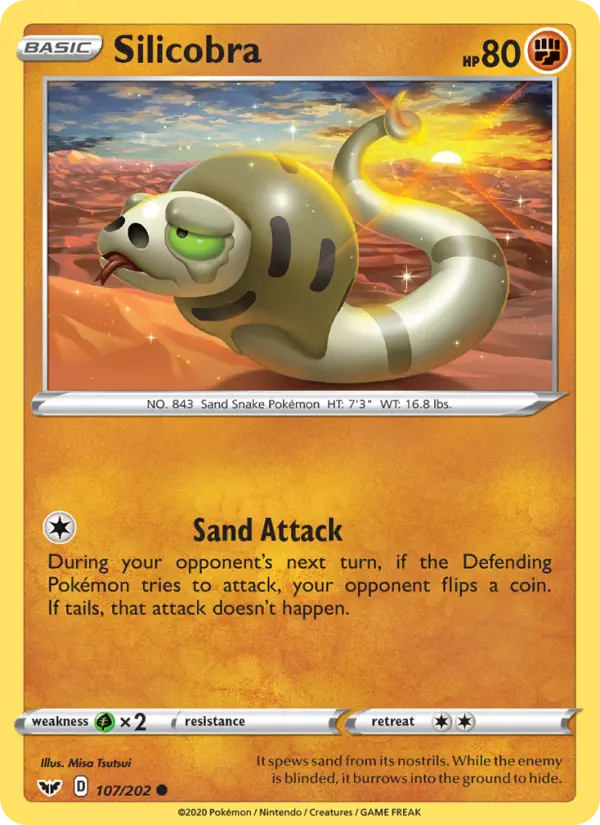
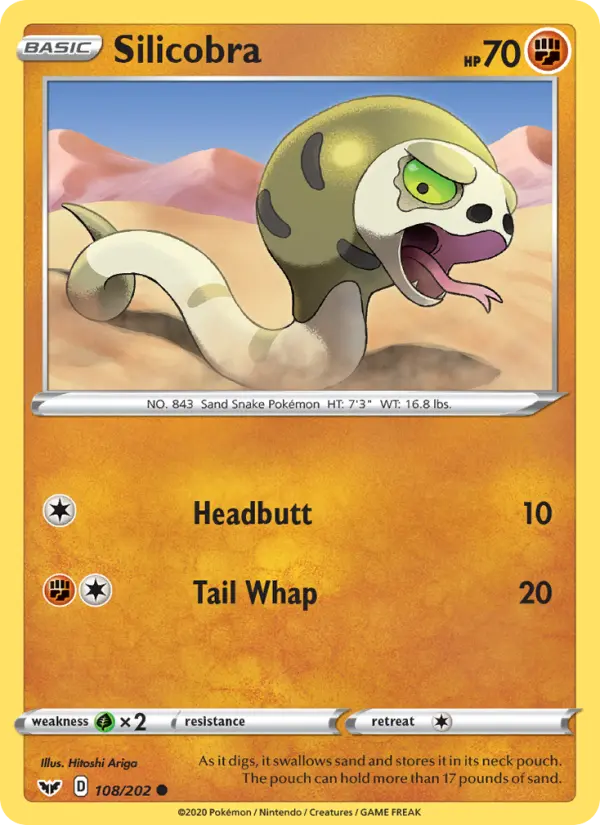
As it digs, it swallows sand and stores it in its neck pouch. The pouch can hold more than 17 pounds of sand.
It spews sand from its nostrils. While the enemy is blinded, it burrows into the ground to hide.
Silicobra Name Origin & Design Inspiration
Silicobra's name can be traced to a elegant portmanteau combining "silica" (silicon dioxide, the primary component of sand) with "cobra," referencing the serpentine form and venomous associations typical of cobra species. The Japanese name スナヘビ (Sunahebi) similarly combines "suna" (sand) with "hebi" (snake), creating a direct linguistic mirror of the English nomenclature. The design itself draws inspiration from real-world desert snakes, particularly cobra species adapted to arid environments, incorporating biological accuracy in its burrowing behaviors and sand-based defense mechanisms. The distinctive neck pouch represents a creative reinterpretation of real anatomical features seen in some snake species, exaggerated for gameplay purposes while remaining grounded in observable natural history. The visual presentation—with its muted earth tones, frowning expression, and coiled tail—conveys both the Pokémon's humble, non-threatening appearance and its capacity for dangerous sand-based attacks.
Learnable Moves
Silicobra can learn 43 moves:
Move | Type | Cat. | Power | Acc. | PP |
|---|---|---|---|---|---|
| attract | normal | Status | — | 100 | 15 |
| belch | poison | Special | 120 | 90 | 10 |
| body slam | normal | Physical | 85 | 100 | 15 |
| brutal swing | dark | Physical | 60 | 100 | 20 |
| bulldoze | ground | Physical | 60 | 100 | 20 |
| coil | poison | Status | — | — | 20 |
| dig | ground | Physical | 80 | 100 | 10 |
| dragon rush | dragon | Physical | 100 | 75 | 10 |
| drill run | ground | Physical | 80 | 95 | 10 |
| earth power | ground | Special | 90 | 100 | 10 |
| earthquake | ground | Physical | 100 | 100 | 10 |
| endure | normal | Status | — | — | 10 |
| facade | normal | Physical | 70 | 100 | 20 |
| glare | normal | Status | — | 100 | 30 |
| headbutt | normal | Physical | 70 | 100 | 15 |
| last resort | normal | Physical | 140 | 100 | 5 |
| minimize | normal | Status | — | — | 10 |
| mud shot | ground | Special | 55 | 95 | 15 |
| mud slap | ground | Special | 20 | 100 | 10 |
| poison tail | poison | Physical | 50 | 100 | 25 |
| protect | normal | Status | — | — | 10 |
| rest | psychic | Status | — | — | 5 |
| rock blast | rock | Physical | 25 | 90 | 10 |
| rock slide | rock | Physical | 75 | 90 | 10 |
| rock tomb | rock | Physical | 60 | 95 | 15 |
| round | normal | Special | 60 | 100 | 15 |
| sand attack | ground | Status | — | 100 | 15 |
| sand tomb | ground | Physical | 35 | 85 | 15 |
| sandstorm | rock | Status | — | — | 10 |
| scale shot | dragon | Physical | 25 | 90 | 20 |
| scary face | normal | Status | — | 100 | 10 |
| scorching sands | ground | Special | 70 | 100 | 10 |
| screech | normal | Status | — | 85 | 40 |
| skitter smack | bug | Physical | 70 | 90 | 10 |
| slam | normal | Physical | 80 | 75 | 20 |
| sleep talk | normal | Status | — | — | 10 |
| snore | normal | Special | 50 | 100 | 15 |
| stealth rock | rock | Status | — | — | 20 |
| stone edge | rock | Physical | 100 | 80 | 5 |
| substitute | normal | Status | — | — | 10 |
| take down | normal | Physical | 90 | 85 | 20 |
| tera blast | normal | Special | 80 | 100 | 10 |
| wrap | normal | Physical | 15 | 90 | 20 |
Silicobra Competitive Battle Guide
In competitive Pokémon environments, Silicobra operates primarily as a niche choice due to its modest cumulative stat total of 315, with particularly weak special attack (35) and speed (46) statistics that limit its direct offensive potential. However, its signature ability Sand Spit provides unique defensive utility, automatically triggering sandstorm weather effects whenever Silicobra absorbs any damaging attack—a mechanic that transforms it into an inadvertent weather controller without requiring dedicated team slots for weather setters. The hidden ability Sand Veil grants evasion boosts during sandstorm conditions while simultaneously protecting it from sandstorm damage, creating a specialized bulky wall archetype centered entirely on sand-based strategies. Its respectable defense stat of 75 allows Silicobra to absorb hits effectively, making it a functional physical wall when properly configured with defensive investment. Coverage moves like Bulldoze, Dig, and Sand Tomb provide legitimate offensive presence, while support options including Coil for stat boosting and Glare for speed control offer team support functionality. Most competitive applications focus on evolved Sandaconda, which benefits from significantly improved statistics and broader movepool access.
Commonly Asked Questions About Silicobra
What type is Silicobra?
Silicobra is a ground type Pokemon.
What does Silicobra evolve into?
Silicobra evolves into sandaconda.
What are Silicobra's weaknesses?
Silicobra is weak to water, grass and ice type moves.
Does Silicobra evolve by trading?
No — Silicobra evolves entirely through leveling up, with no trade required at any stage.
Silicobra Cultural Impact & Franchise History
Silicobra emerged during Generation VIII as part of the Pokémon Sword and Shield release, contributing to the expanded Galar regional Pokédex with its distinctive desert-dwelling aesthetic and novel sand-storage mechanics. The species represented a creative expansion of ground-type representation, offering a more serpentine alternative to traditional ground-type rodents and reptiles. Its introduction alongside the broader Crown Tundra expansion reinforced the Galar region's ecological diversity and environmental storytelling through Pokémon design. While not achieving mainstream cultural prominence comparable to iconic species, Silicobra garnered appreciation within competitive and breeding communities for its unique Sand Spit ability and breeding accessibility. The species appeared in various Pokémon media adaptations, contributing to the broader narrative of ground-type Pokémon inhabiting diverse ecological niches. Its design philosophy—emphasizing functional biological adaptation over visual spectacle—resonated with players who appreciate naturalistic Pokémon designs grounded in observable wildlife behavior.
Where to Find Silicobra in Every Pokémon Game
Silicobra's availability has expanded substantially across multiple game generations and regions following its initial introduction in Pokémon Sword and Shield. In Generation VIII titles, it appears in the Galar region with a local Pokédex number of 312, concentrated in desert and sandy terrain areas of the Wild Area. The Isle of Armor expansion pack assigned it local number 174, while the Crown Tundra expansion included additional encounter opportunities. The species achieved even broader availability in Generation IX with Pokémon Scarlet and Violet, receiving local Pokédex number 270 in the Paldea region. This expanded geographic distribution reflects its adaptation to diverse desert and arid environments, though it remains conspicuously absent from regions where sandy terrain proves scarce. A capture rate of 255 (43.9% success with a standard Poké Ball against a full-health specimen) ensures that trainers can readily secure Silicobra specimens without excessive difficulty, making it accessible to players at virtually any progression point. The species has not appeared in Pokémon Legends: Arceus, Brilliant Diamond, or Shining Pearl, suggesting its absence from ancient Sinnoh and its restriction to more recent regional entries.