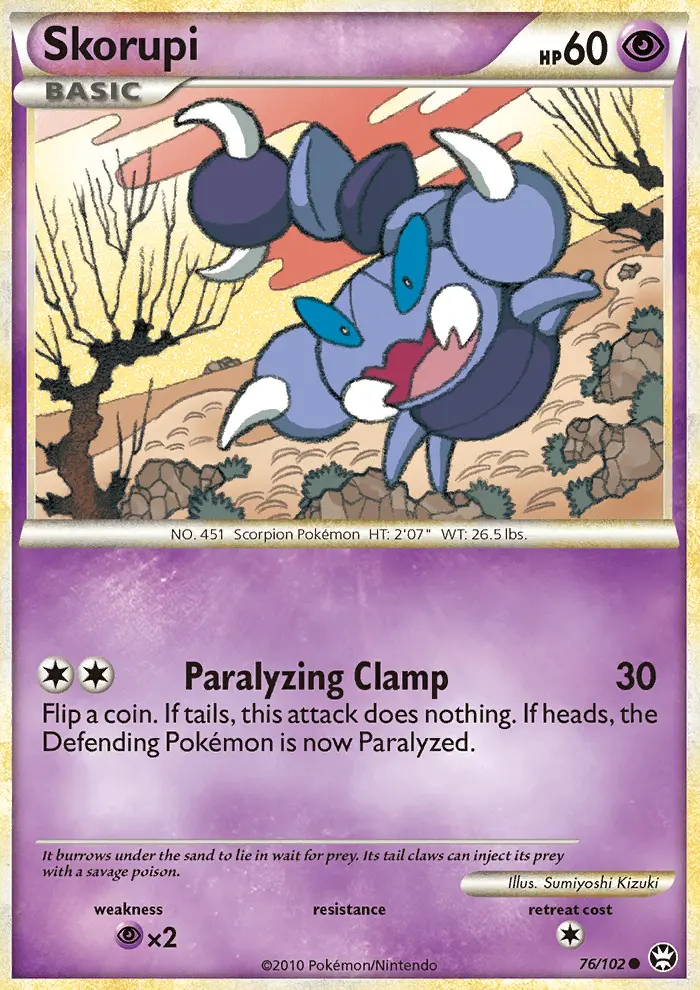
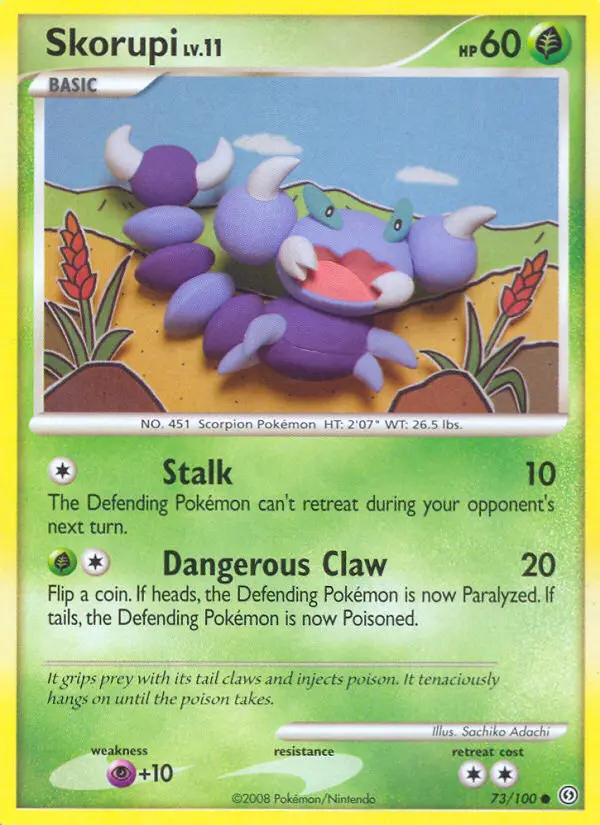
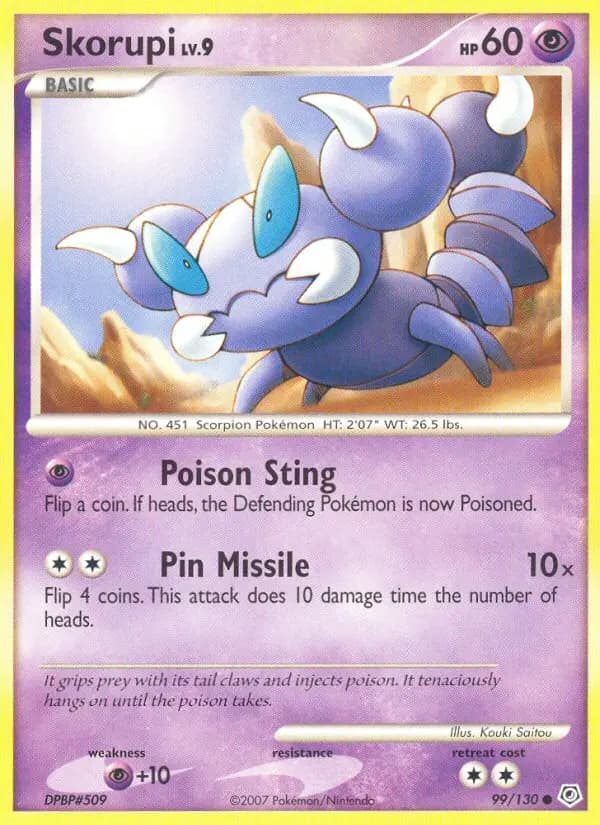
Skorupi
Generation IV · #0451 — Scorpion Pokémon
Since its Generation IV debut, Skorupi has carried a stat spread built around defense — 90 at base, its clearest strength. With a overall stat sum of 330, Skorupi is designed as a defensive pivot rather than an offensive powerhouse, making it an intriguing choice for trainers who appreciate unconventional team compositions. The species evolves into the fearsome Drapion when it reaches level 40, undergoing a dramatic transformation that shifts its secondary type from Bug to Dark while significantly boosting its overall combat prowess. Despite its relatively modest power level as an unevolved Pokémon, Skorupi has earned recognition for its unique ability to survive extended periods without sustenance and its potent venom, making it a memorable addition to the Sinnoh regional Pokédex.
Editor's Take
Skorupi's line ends in Drapion, whose Poison/Dark typing and Battle Armor make it a genuinely awkward Pokémon to plan around despite never being a top-tier threat.
Base Stats
Height
0.8m
Weight
12.0kg
Category
Scorpion Pokémon
Gender
Male 50% / Female 50%
Color
purple
Shape
armor
Abilities
Protects against critical hits.
Strengthens critical hits to inflict 3× damage rather than 2×.
Prevents accuracy from being lowered.

Skorupi Biology & Physical Characteristics
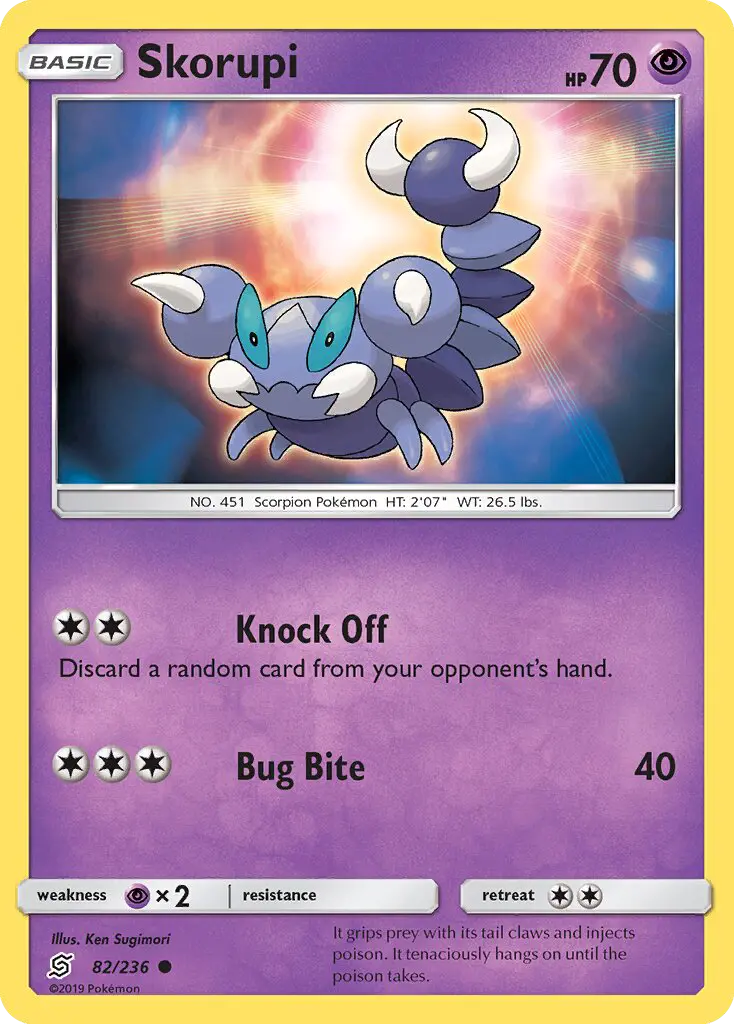
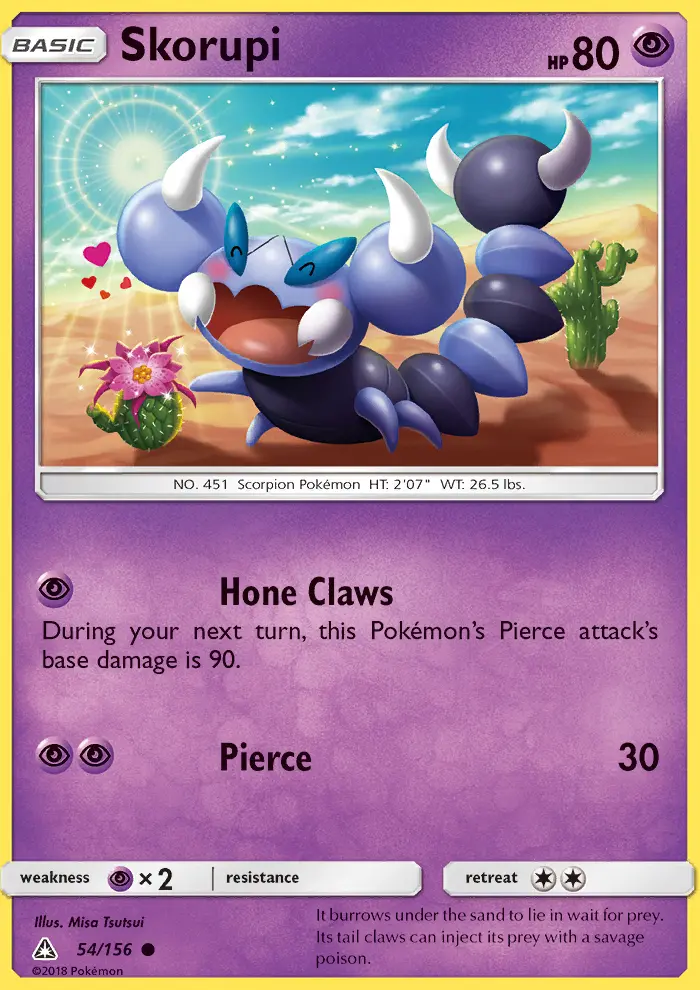
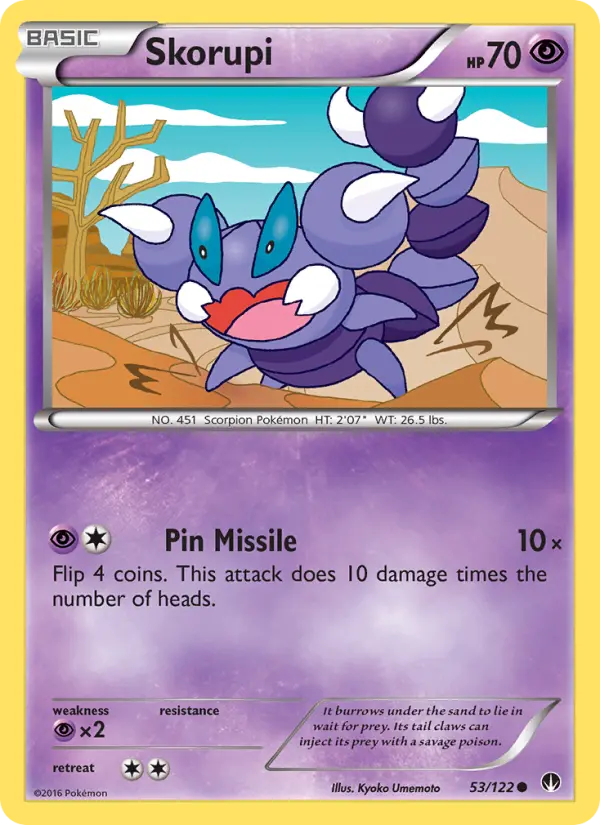
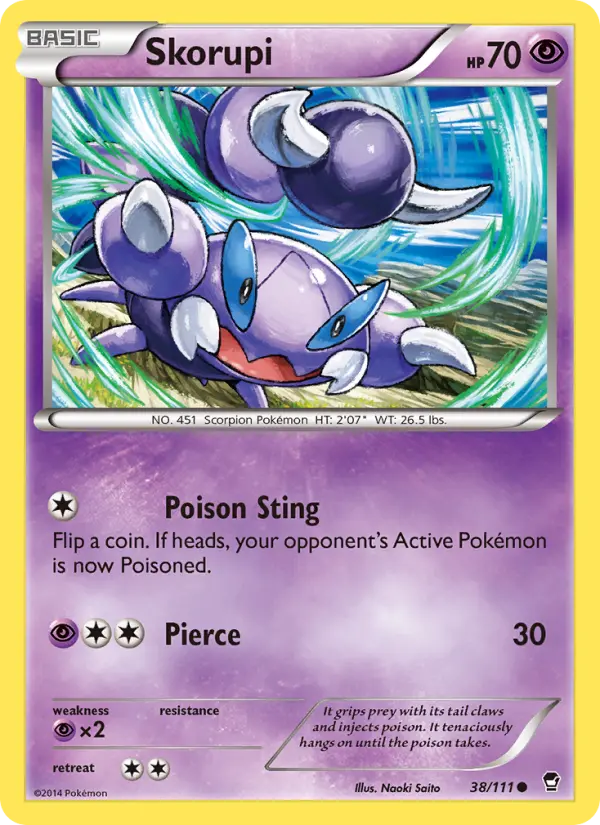
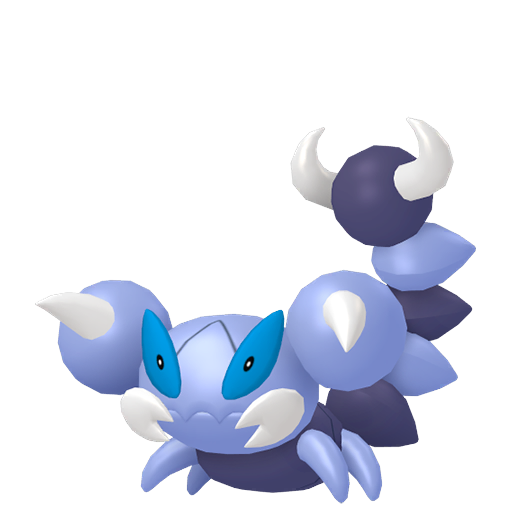
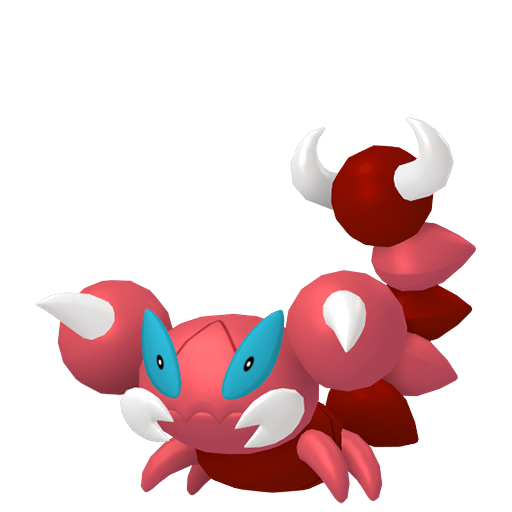
Skorupi is a distinctive Pokémon that bears a striking resemblance to a terrestrial scorpion, though with an unusual anatomical arrangement that sets it apart from its real-world inspiration. The Pokémon's coloration consists primarily of pale and dark purple hues, with its head, arms, legs, and tail segments featuring lighter shades of blue-purple. Its most defining characteristics are its reversed claw arrangement—while typical scorpions possess a single stinging tail, Skorupi sports twin stingers alongside a claw-like tail, creating a unique offensive weapon system. The creature possesses prominent teal-colored eyes with a distinctive pointed marking connecting them, and its miniature jaws, claws, and tail claws are distinctly white. Standing at just 0.8 meters tall and weighing 12.0 kilograms, Skorupi is a relatively diminutive creature, yet its compact size belies its dangerous nature. The remarkable biological adaptation that allows Skorupi to survive for an entire year without food demonstrates an incredibly efficient metabolism, suggesting that this Pokémon evolved in harsh, resource-scarce environments where such endurance became essential for survival.
Pokedex Numbers
Training
Breeding
Skorupi Breeding, Gender Ratio & Egg Groups
Skorupi exhibits a perfectly balanced gender ratio, with exactly 50 percent of the species being male and 50 percent female, ensuring that players have equal likelihood of encountering either sex in the wild or through breeding programs. The species is classified within the Bug and Water 3 egg groups, a combination that grants it compatibility with a diverse range of Pokémon for breeding purposes, potentially allowing players to pass down desirable moves and abilities to offspring. With a base happiness value of 70 and a notably slow growth rate, Skorupi requires patience and dedication from trainers who wish to witness its full potential. The species has a moderately high catch rate of 120, making it reasonably obtainable in the wild, which facilitates the establishment of breeding populations for those interested in competitive training or shiny hunting. Skorupi hatches from eggs after 20 cycles of care and travel, requiring approximately 4,884 to 5,140 steps of in-game movement for an egg to hatch into a freshly born Skorupi. For breeders interested in securing Skorupi with its hidden ability, Keen Eye, patience and careful selection are required, as the ability appears less frequently in wild-caught specimens and requires deliberate breeding strategies to reliably produce offspring with this beneficial trait.
Sprites




Held Items
Poison Barb
type-enhancement
Held: Poison-Type moves from holder do 20% more damage.
Cost: 1000
Poison Barb
type-enhancement
Held: Poison-Type moves from holder do 20% more damage.
Cost: 1000
Poison Barb
type-enhancement
Held: Poison-Type moves from holder do 20% more damage.
Cost: 1000
Poison Barb
type-enhancement
Held: Poison-Type moves from holder do 20% more damage.
Cost: 1000
Poison Barb
type-enhancement
Held: Poison-Type moves from holder do 20% more damage.
Cost: 1000
Poison Barb
type-enhancement
Held: Poison-Type moves from holder do 20% more damage.
Cost: 1000
Poison Barb
type-enhancement
Held: Poison-Type moves from holder do 20% more damage.
Cost: 1000
Poison Barb
type-enhancement
Held: Poison-Type moves from holder do 20% more damage.
Cost: 1000
Poison Barb
type-enhancement
Held: Poison-Type moves from holder do 20% more damage.
Cost: 1000
Poison Barb
type-enhancement
Held: Poison-Type moves from holder do 20% more damage.
Cost: 1000
Poison Barb
type-enhancement
Held: Poison-Type moves from holder do 20% more damage.
Cost: 1000
Poison Barb
type-enhancement
Held: Poison-Type moves from holder do 20% more damage.
Cost: 1000
Poison Barb
type-enhancement
Held: Poison-Type moves from holder do 20% more damage.
Cost: 1000
Poison Barb
type-enhancement
Held: Poison-Type moves from holder do 20% more damage.
Cost: 1000
Poison Barb
type-enhancement
Held: Poison-Type moves from holder do 20% more damage.
Cost: 1000
Poison Barb
type-enhancement
Held: Poison-Type moves from holder do 20% more damage.
Cost: 1000
Poison Barb
type-enhancement
Held: Poison-Type moves from holder do 20% more damage.
Cost: 1000
TMs & HMs
tm01
black white
tm01
black 2 white 2
tm01
lets go pikachu lets go eevee
tm01
omega ruby alpha sapphire
tm01
x y
tm02
crystal
tm02
gold silver
tm02
lets go pikachu lets go eevee
tm03
yellow
tm03
red blue
tm04
yellow
tm03
blue japan
tm04
red blue
tm03
red green japan
tm04
red green japan
tm04
blue japan
tm05
lets go pikachu lets go eevee
tm06
yellow
tm06
gold silver
tm06
red blue
+645 more TMs/HMs
Skorupi's Evolution Chain


Skorupi Evolution, Mega Evolution & Special Forms
Skorupi's evolution into Drapion at level 40 represents a dramatic transformation that fundamentally alters the Pokémon's combat capabilities and typing. While Skorupi maintains the Poison type as part of its dual-typing, Drapion loses the Bug classification and instead adopts the Dark type, a shift that dramatically expands its type coverage and defensive utility. The evolution results in a substantial increase to nearly every base stat—most notably gaining 60 additional points in both Attack and Special Attack, transforming Skorupi's modest offensive presence into something far more threatening. Drapion's Speed stat receives a respectable 35-point boost, climbing from Skorupi's 65 to a competitive 100, making the evolved form significantly faster in competitive play. The Defense stat, already Skorupi's strongest attribute, increases to a formidable 110, creating a Pokémon with exceptional physical durability. This evolution exemplifies a common Pokémon design philosophy where the pre-evolution form serves as a defensive stepping stone before the final evolution achieves both offensive and defensive balance. Trainers patient enough to raise Skorupi to level 40 are rewarded with a genuinely competitive Pokémon that can hold its own in both casual play and more serious competitive encounters.
Where to Find
Reversal Mountain
unova
+53 more
Kalos Route 14
kalos
+1 more
Kalos Route 15
kalos
+3 more
Kalos Route 16
kalos
+1 more
Skorupi Behaviour and Natural Habitat
Skorupi is primarily a denizen of arid desert regions and other dry climates, where it utilizes sophisticated hunting strategies to secure its meals. According to various Pokédex entries, the species exhibits a patient, ambush-based hunting methodology—it burrows beneath sand and remains perfectly still for extended periods, waiting for unsuspecting prey to wander within striking distance. Once prey ventures near its concealed position, Skorupi erupts from its sandy hideaway and grips its victim with its powerful tail claws, immediately injecting a potent poison through the needle-like tips that secrete venom as soon as the claws close around the target. The poison proves relentless, and Skorupi will maintain its grip with tenacious determination until the toxin takes full effect, ensuring a successful meal even if prey attempts to escape. Interestingly, Skorupi can also be found in marshy areas such as the Great Marsh despite its primary association with arid environments, suggesting some degree of environmental flexibility. The species has one notable weakness: it cannot tolerate cold temperatures and becomes noticeably weaker when exposed to frigid conditions, making it vulnerable in glacial or arctic biomes where its desert-adapted physiology cannot function optimally.
Pokedex Entries
It grips prey with its tail claws and injects poison. It tenaciously hangs on until the poison takes.
It lives in arid lands. It buries itself in sand and lies in wait for unsuspecting prey.
As soon as the tail claws close, its needle tips secrete poison. It can survive a year without food.
It burrows under the sand to lie in wait for prey. Its tail claws can inject its prey with a savage poison.
As soon as the tail claws close, its needle tips secrete poison. It can survive a year without food.
It lives in arid regions and can go without food for a year while waiting for prey.
It grips prey with its tail claws and injects poison. It tenaciously hangs on until the poison takes.
It burrows under the sand to lie in wait for prey. Its tail claws can inject its prey with a savage poison.
It grips prey with its tail claws and injects poison. It tenaciously hangs on until the poison takes.
It burrows under the sand to lie in wait for prey. Its tail claws can inject its prey with a savage poison.
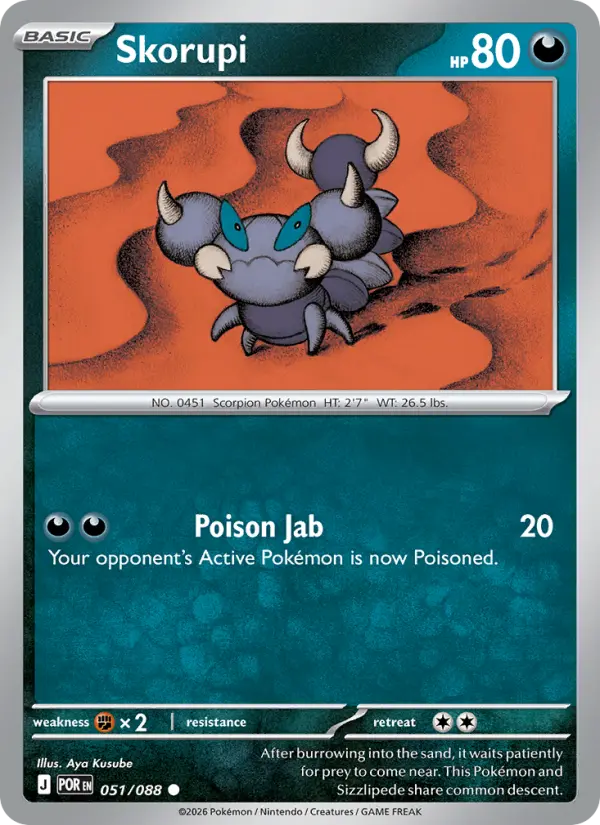
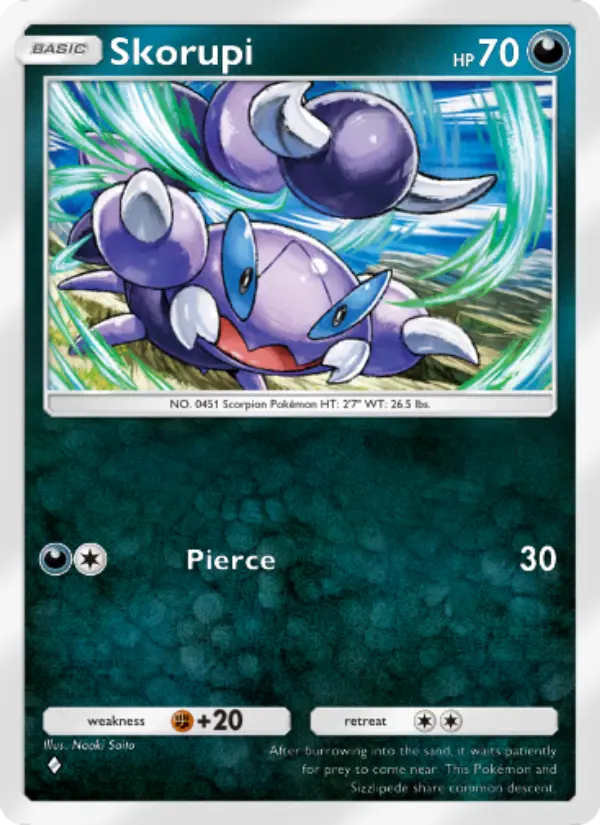
After burrowing into the sand, it waits patiently for prey to come near. This Pokémon and Sizzlipede share common descent.
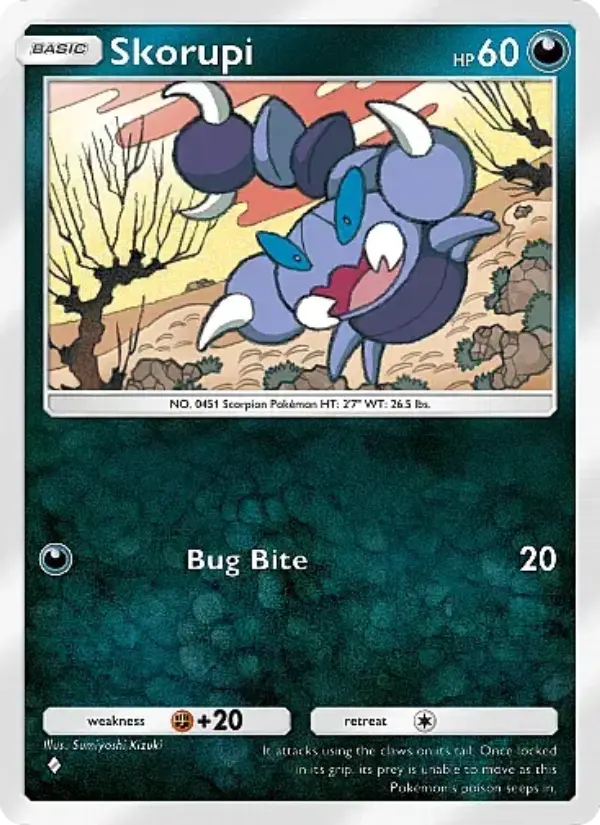
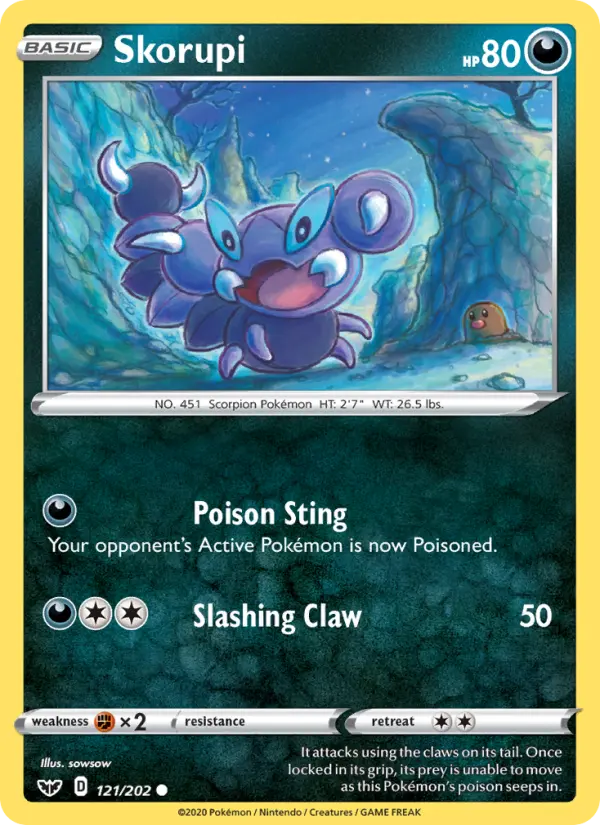
It attacks using the claws on its tail. Once locked in its grip, its prey is unable to move as this Pokémon’s poison seeps in.
Its claws are not only razor-sharp but poisonous, making Skorupi a highly dangerous Pokémon. It seems to be weakened by cold temperatures, however.
Skorupi Name Origin & Design Inspiration
Skorupi's name comes from a straightforward linguistic combination of 'scorpion' and 'unhappy' or 'sullen,' reflecting the creature's ominous appearance and dangerous nature. The Japanese designation, Scorupi (スコルピ), similarly references the scorpion family while maintaining the phonetic structure that makes it recognizable across language barriers. The design itself draws obvious inspiration from actual scorpions, creatures feared for their venomous stings and aggressive hunting behavior, yet Game Freak's designers chose to create an inventive twist by reversing the traditional scorpion anatomy. Rather than featuring a single stinging tail, Skorupi possesses a claw tail coupled with dual stinging appendages, creating a visually distinctive silhouette that prevents it from being a mere direct translation of a real animal. This design choice emphasizes the creature's role as an apex predator in desert ecosystems while creating a visually memorable Pokémon that stands apart from other Bug-type designs. The pale purple coloration suggests a nocturnal or burrowing lifestyle, colors that would aid camouflage in sandy environments while also evoking an air of toxicity and danger. The pointed marking connecting Skorupi's eyes adds an element of menace, while its relatively small stature compared to its evolutionary successor Drapion creates a satisfying visual progression that rewards players for investing in its development.
Learnable Moves
Skorupi can learn 77 moves:
Move | Type | Cat. | Power | Acc. | PP |
|---|---|---|---|---|---|
| acupressure | normal | Status | — | — | 30 |
| aerial ace | flying | Physical | 60 | — | 20 |
| agility | psychic | Status | — | — | 30 |
| aqua tail | water | Physical | 90 | 90 | 10 |
| assurance | dark | Physical | 60 | 100 | 10 |
| attract | normal | Status | — | 100 | 15 |
| bite | dark | Physical | 60 | 100 | 25 |
| brick break | fighting | Physical | 75 | 100 | 15 |
| bug bite | bug | Physical | 60 | 100 | 20 |
| bug buzz | bug | Special | 90 | 100 | 10 |
| captivate | normal | Status | — | 100 | 20 |
| confide | normal | Status | — | — | 20 |
| confuse ray | ghost | Status | — | 100 | 10 |
| cross poison | poison | Physical | 70 | 100 | 20 |
| crunch | dark | Physical | 80 | 100 | 15 |
| cut | normal | Physical | 50 | 95 | 30 |
| dark pulse | dark | Special | 80 | 100 | 15 |
| dig | ground | Physical | 80 | 100 | 10 |
| double team | normal | Status | — | — | 15 |
| endure | normal | Status | — | — | 10 |
| facade | normal | Physical | 70 | 100 | 20 |
| false swipe | normal | Physical | 40 | 100 | 40 |
| feint attack | dark | Physical | 60 | — | 20 |
| fell stinger | bug | Physical | 50 | 100 | 25 |
| flash | normal | Status | — | 100 | 20 |
| fling | dark | Physical | — | 100 | 10 |
| frustration | normal | Physical | — | 100 | 20 |
| fury cutter | bug | Physical | 40 | 95 | 20 |
| headbutt | normal | Physical | 70 | 100 | 15 |
| hidden power | normal | Special | 60 | 100 | 15 |
| hone claws | dark | Status | — | — | 15 |
| infestation | bug | Special | 20 | 100 | 20 |
| iron tail | steel | Physical | 100 | 75 | 15 |
| knock off | dark | Physical | 65 | 100 | 20 |
| leer | normal | Status | — | 100 | 30 |
| mud slap | ground | Special | 20 | 100 | 10 |
| natural gift | normal | Physical | — | 100 | 15 |
| night slash | dark | Physical | 70 | 100 | 15 |
| payback | dark | Physical | 50 | 100 | 10 |
| pin missile | bug | Physical | 25 | 95 | 20 |
| poison fang | poison | Physical | 50 | 100 | 15 |
| poison jab | poison | Physical | 80 | 100 | 20 |
| poison sting | poison | Physical | 15 | 100 | 35 |
| poison tail | poison | Physical | 50 | 100 | 25 |
| protect | normal | Status | — | — | 10 |
| pursuit | dark | Physical | 40 | 100 | 20 |
| rain dance | water | Status | — | — | 5 |
| rest | psychic | Status | — | — | 5 |
| return | normal | Physical | — | 100 | 20 |
| rock smash | fighting | Physical | 40 | 100 | 15 |
| rock tomb | rock | Physical | 60 | 95 | 15 |
| round | normal | Special | 60 | 100 | 15 |
| sand attack | ground | Status | — | 100 | 15 |
| scary face | normal | Status | — | 100 | 10 |
| screech | normal | Status | — | 85 | 40 |
| secret power | normal | Physical | 70 | 100 | 20 |
| shadow ball | ghost | Special | 80 | 100 | 15 |
| skitter smack | bug | Physical | 70 | 90 | 10 |
| slash | normal | Physical | 70 | 100 | 20 |
| sleep talk | normal | Status | — | — | 10 |
| sludge bomb | poison | Special | 90 | 100 | 10 |
| snore | normal | Special | 50 | 100 | 15 |
| strength | normal | Physical | 80 | 100 | 15 |
| struggle bug | bug | Special | 50 | 100 | 20 |
| substitute | normal | Status | — | — | 10 |
| sunny day | fire | Status | — | — | 5 |
| swagger | normal | Status | — | 85 | 15 |
| swords dance | normal | Status | — | — | 20 |
| taunt | dark | Status | — | 100 | 20 |
| thief | dark | Physical | 60 | 100 | 25 |
| torment | dark | Status | — | 100 | 15 |
| toxic | poison | Status | — | 90 | 10 |
| toxic spikes | poison | Status | — | — | 20 |
| twineedle | bug | Physical | 25 | 100 | 20 |
| venoshock | poison | Special | 65 | 100 | 10 |
| whirlwind | normal | Status | — | — | 20 |
| x scissor | bug | Physical | 80 | 100 | 15 |
Skorupi Competitive Battle Guide
Within competitive battling, Skorupi occupies an unusual niche as a defensive Bug-type with legitimate utility despite its modest overall stat sum of 330. The Pokémon's defining asset is its exceptional Defense stat of 90, which allows it to function as a physical wall capable of absorbing hits from neutral or resisted attacks. Its ability selection provides two distinct competitive paradigms: Battle Armor offers reliable protection against critical hits, ensuring that Skorupi's high Defense translates to consistent durability, while Sniper provides the opposite strategy, amplifying critical hits to deal three times normal damage rather than the standard two times. This dual-ability design allows players to construct Skorupi sets emphasizing either defensive resilience or opportunistic offensive bursts. However, Skorupi's slow 65 base Speed stat and underwhelming special stats limit its viability in faster-paced competitive formats, and its generally weak offensive stats of 50 Attack and 30 Special Attack mean that Skorupi cannot reliably threaten most opposing Pokémon without significant support or investment. Most serious competitive players view Skorupi as an early-game Pokédex entry rather than a tournament-viable choice, typically transitioning to Drapion once level 40 is achieved. For casual play or lower-tier competitive formats, Skorupi can function adequately as a defensive pivot, but its evolution represents a dramatic power upgrade that trainers should pursue as soon as possible.
Commonly Asked Questions About Skorupi
What type is Skorupi?
Skorupi is a poison and bug type Pokemon.
What does Skorupi evolve into?
Skorupi evolves into drapion.
What are Skorupi's weaknesses?
Skorupi is weak to flying, rock, fire and psychic type moves.
Does Skorupi evolve by trading?
No — Skorupi evolves entirely through leveling up, with no trade required at any stage.
Where can I find Skorupi?
Skorupi can be found in reversal mountain (unova), kalos route 14 (kalos) and kalos route 15 (kalos) and 1 other locations.
Skorupi Cultural Impact & Franchise History
While Skorupi lacks the iconic status of other Generation IV Pokémon like Garchomp or Crobat, the species has developed a modest but dedicated fan following within the broader Pokémon community. Its unique design—specifically the reversal of typical scorpion anatomy—generates regular discussion and appreciation among Pokémon design enthusiasts who recognize it as an example of creative interpretation rather than direct animal translation. The Pokédex entry revealing that Skorupi shares a common ancestor with Sizzlipede has sparked considerable interest in evolutionary biology within the Pokémon universe, encouraging fans to theorize about the divergent evolutionary paths that led to such different creatures despite their shared ancestry. In the Pokémon anime, Skorupi has made sporadic appearances, though it remains far less prominent than many other Pokémon from its generation. The species appeared memorably in Pokémon Mystery Dungeon: Explorers of Sky, where it served as a local bully character before being befriended, adding a redemptive character arc that resonated with players. The creature's extreme hardiness—surviving an entire year without food—has become a notable trivia point among fans who appreciate the ecological implications and survival strategies within the Pokémon world. Its eventual evolution into the much more powerful and visually imposing Drapion reinforces Skorupi's role as a bridge Pokémon that leads to greater things.
Where to Find Skorupi in Every Pokémon Game
Skorupi's availability has varied significantly across different game generations and regions, with its presence tied primarily to desert and volcanic locations throughout the Pokémon world. In the original Generation IV games—Pokémon Diamond, Pearl, and Platinum—Skorupi appeared in the Sinnoh region, with specific encounters in areas like Reversal Mountain where its arid preferences align with the game's environmental design. The species maintained presence in subsequent generations, appearing in Generation V's Black 2 and White 2 as part of the expanded post-game content. In later generations, Skorupi has been available in various locations corresponding to its desert habitat preference, including appearances in X and Y's Mountain Kalos region and consistent inclusion in Sword and Shield's Pokédex with encounters in appropriate biomes. Pokémon Brilliant Diamond and Shining Pearl, the Generation IV remakes, naturally included Skorupi as part of the core Sinnoh regional Pokédex. For players seeking Skorupi in modern games, availability often depends on the specific title, with Pokédex access being most reliable in games featuring arid or volcanic environments prominently. The species' relatively high catch rate of 120 means that once players locate it in their chosen game, capture should prove straightforward with standard Poké Balls. Additionally, Skorupi eggs can be obtained through breeding if a player acquires either sex, making the species perpetually available to those with access to any game containing its evolutionary line, ensuring long-term accessibility for completionists and collectors.