Spinarak
Generation II · #0167 — String Spit Pokémon
Trainers who write off Spinarak on looks alone are missing that its Attack of 60 is genuinely one of the higher marks among bug/poison-type Pokémon. It measures 0.5 m and 8.5 kg, dimensions that pair with that stat lean in noticeable ways. Despite its modest size and relatively low total stat allocation of 250, Spinarak possesses remarkable intelligence and cunning that compensates for its physical limitations. The String Spit Pokémon belongs to the Bug egg group and has a fast growth rate, allowing trainers to develop their Spinarak quickly through leveling. With a catch rate of 255, Spinarak is exceptionally common in the wild, making it an accessible choice for trainers beginning their bug-type collection. Its abilities—Swarm, Insomnia, and the hidden ability Sniper—provide diverse strategic options depending on a trainer's preferred battle style.
Editor's Take
Spinarak's line ends in Ariados, which gets Toxic Spikes and Sticky Web and is genuinely usable as a hazard lead — the least glamorous job in the game done competently.
Base Stats
Height
0.5m
Weight
8.5kg
Category
String Spit Pokémon
Gender
Male 50% / Female 50%
Color
green
Shape
armor
Habitat
forest
Abilities
Strengthens bug moves to inflict 1.5× damage at 1/3 max HP or less.
Prevents sleep.
Strengthens critical hits to inflict 3× damage rather than 2×.

Spinarak Biology & Physical Characteristics
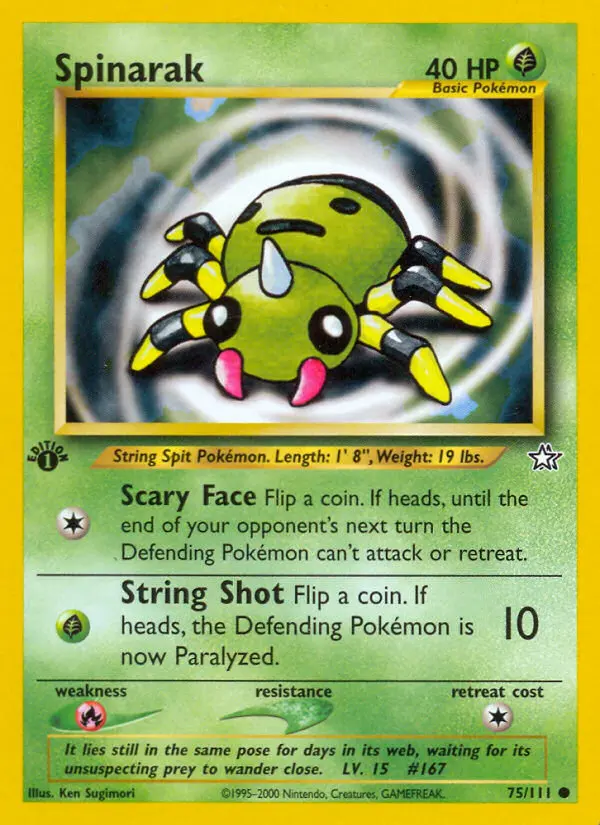
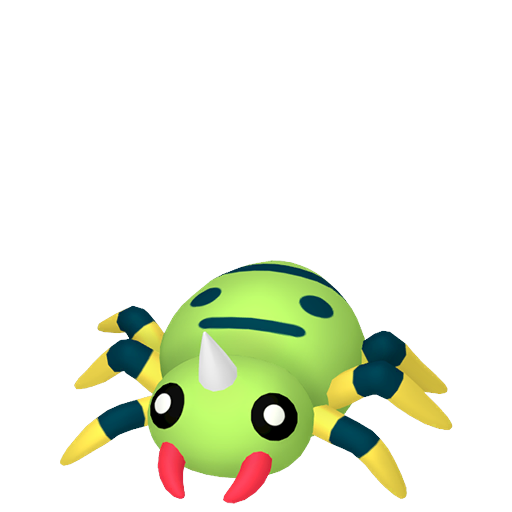
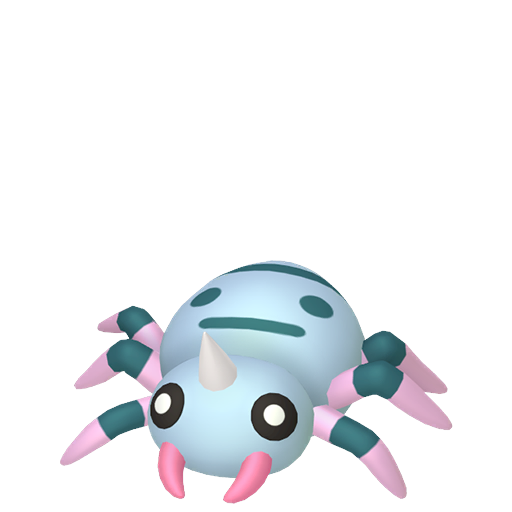
Spinarak presents a distinctly arachnid appearance, resembling a small green spider with black eyes featuring white pupils and a prominent white horn protruding from its forehead. Its most distinctive feature is the face-like marking on its abdomen, complete with two black dots and connecting lines that can change expression, giving the Pokémon an almost sentient quality despite its diminutive size. The creature possesses three pairs of yellow legs, each marked with a black band around the middle joint, providing excellent grip for traversing its web constructions. A line encircles the end of its abdomen, completing its segmented appearance. The red mandibles framing its mouth are used for both capturing prey and expelling the silk used in web construction. According to multiple Pokédex entries across generations, the web spun by Spinarak functions as its second nervous system, allowing it to perceive minute vibrations transmitted through the silk strands with remarkable precision. This biological adaptation enables the Pokémon to identify prey types simply through the distinct vibrational patterns they produce when ensnared.
Pokedex Numbers
Training
Breeding
Spinarak Breeding, Gender Ratio & Egg Groups
Spinarak exhibits a perfectly balanced 50/50 male-to-female gender ratio, allowing trainers equal opportunity to obtain specimens of either sex for breeding purposes. The species has a base friendship value of 70, indicating a naturally docile temperament that makes training and bonding with Spinarak relatively straightforward compared to more volatile Pokémon species. With an egg cycle count of 15, Spinarak eggs require 3,599 to 3,855 steps to hatch, a moderate timeframe that encourages natural breeding without becoming excessively burdensome. As a Bug-type Pokémon, Spinarak belongs exclusively to the Bug egg group, meaning it can only breed with other members of this group or compatible Ditto. The relatively quick hatch time combined with Spinarak's fast growth rate makes it an excellent choice for breeders seeking to produce competitive Bug-type teams or those interested in chaining for specific natures and individual values. The high base friendship value suggests that Spinarak bonds readily with trainers who treat it well, potentially encouraging faster evolution and improved move tutoring through affection-based mechanics in games that feature such systems.
Sprites




TMs & HMs
tm01
black white
tm01
black 2 white 2
tm01
omega ruby alpha sapphire
tm01
x y
tm03
crystal
tm03
gold silver
tm05
lets go pikachu lets go eevee
tm06
yellow
tm06
gold silver
tm06
red blue
tm06
crystal
tm06
emerald
tm06
firered leafgreen
tm06
diamond pearl
tm06
platinum
tm06
ruby sapphire
tm06
colosseum
tm06
black 2 white 2
tm06
xd
tm06
black white
+506 more TMs/HMs
Spinarak's Evolution Chain


Spinarak Evolution, Mega Evolution & Special Forms
Spinarak evolves into Ariados upon reaching level 22, a transformation that significantly enhances its capabilities across the board. The evolution represents a dramatic increase in base stats, particularly in Attack, Special Defense, and Speed, transforming the patient web-spinner into a more aggressive hunter. Ariados gains two additional legs upon evolution, changing from Spinarak's six to Ariados's eight, and develops a more menacing appearance befitting its role as an apex spider-type predator. The evolutionary line represents the progression from a stationary ambush predator to a more mobile and versatile hunter. Both Spinarak and Ariados share the exclusive ability to learn the move Toxic Thread, which was Spinarak's signature move prior to Generation V, allowing the string spit Pokémon to poison and slow opponents while dealing damage. The evolution occurs naturally through leveling without requiring any special items, stones, or trades, making it an accessible milestone for trainers who invest time in training their Spinarak.
Where to Find
Johto Route 37
johto
+10 more
Johto Route 31
johto
+3 more
Kanto Route 2
kanto
+7 more
Johto Route 30
johto
+3 more
Johto Route 29
johto
Johto Route 34
johto
Johto Route 35
johto
National Park
johto
Johto Route 36
johto
Johto Route 39
johto
Johto Route 38
johto
Hoenn Safari Zone
hoenn
Pattern Bush
kanto
+1 more
Alola Route 1
alola
+5 more
Spinarak Behaviour and Natural Habitat
Spinarak is a nocturnal Pokémon that thrives in temperate and tropical forests, where it constructs elaborate webs to trap unsuspecting prey. The most remarkable aspect of Spinarak's behavior is its extraordinary patience—it will remain motionless in the same pose for days, waiting with unwavering dedication for prey to become ensnared in its trap. Once prey is caught, Spinarak demonstrates remarkable restraint, remaining absolutely still until darkness falls before making its move, suggesting an innate understanding of how to best subdue its victims. Its preferred prey is Cutiefly, though it will consume various other insects that stumble into its carefully constructed snare. The silk produced by Spinarak is extraordinarily durable, capable of withstanding stones placed upon it, and has proven valuable enough to be utilized by humans for medicinal purposes including skin moisturizers and bandages, as documented in Pokémon research. While its poison is not exceptionally potent, it proves sufficient to weaken captured prey, making Spinarak an efficient predator within its ecological niche despite its small stature.
Pokedex Entries
It lies still in the same pose for days in its web, waiting for its unsuspecting prey to wander close.
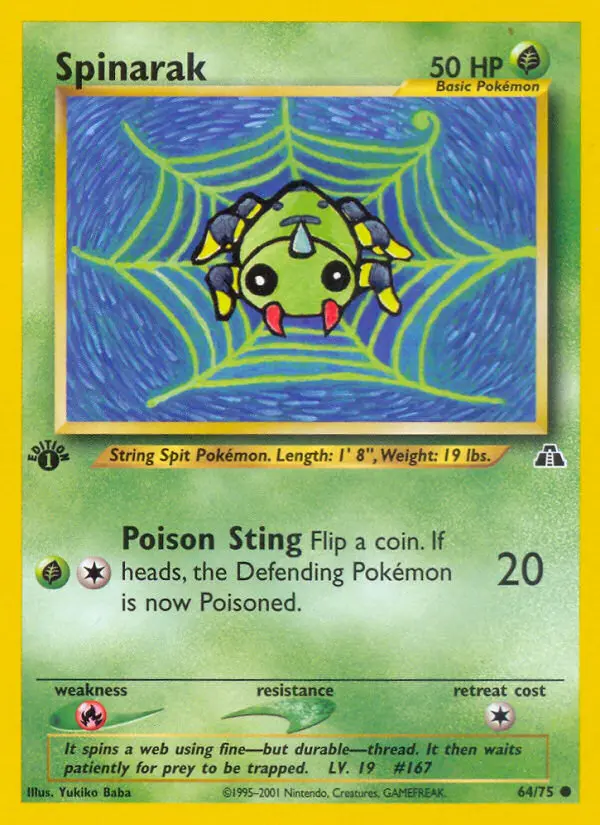
It spins a web using fine--but durable--thread. It then waits pa tiently for prey to be trapped.
If prey becomes ensnared in its nest of spun string, it waits motionlessly until it becomes dark.
The web spun by SPINARAK can be considered its second nervous system. It is said that this POKéMON can determine what kind of prey is touching its web just by the tiny vibrations it feels through the web’s strands.
The web it spins can be considered its second nervous system. It is said that a SPINARAK determines its prey by the tiny vibrations it feels through the web.
It spins a web using fine--but durable-- thread. It then waits patiently for prey to be trapped.
It lies still in the same pose for days in its web, waiting for its unsuspecting prey to wander close.
It sets a trap by spinning a web with thin but strong silk. It waits motionlessly for prey to arrive.
It lies still in the same pose for days in its web, waiting for its unsuspecting prey to wander close.
It spins a web using fine--but durable--thread. It then waits patiently for prey to be trapped.
It sets a trap by spinning a web with thin but strong silk. It waits motionlessly for prey to arrive.
It sets a trap by spinning a web with thin but strong silk. It waits motionlessly for prey to arrive.
It spins a web using fine--but durable--thread. It then waits patiently for prey to be trapped.
It lies still in the same pose for days in its web, waiting for its unsuspecting prey to wander close.
The web spun by Spinarak can be considered its second nervous system. It is said that this Pokémon can determine what kind of prey is touching its web just by the tiny vibrations it feels through the web’s strands.
It waits intently until its preferred prey, Cutiefly, gets caught in its web. In fact, it’s quite a patient Pokémon.
With threads from its mouth, it fashions sturdy webs that won’t break even if you set a rock on them.
Some fishermen weave its sturdy thread into nets to catch fish Pokémon.
Although the poison from its fangs isn’t that strong, it’s potent enough to weaken prey that gets caught in its web.
Spinarak Name Origin & Design Inspiration
Spinarak's name origin lies in two English words: "spine" and "arachnid," clearly referencing its spider-like nature and the sharp structures associated with arachnids. Its Japanese name, Itomaru, combines "ito" meaning thread or string and "maru" suggesting roundness, reflecting both the silk it produces and its compact, rotund body shape. The design philosophy behind Spinarak emphasizes cute arachnid characteristics—the enormous expressive eyes, the innocent face-like marking on its abdomen that can change expressions, and its small stature all serve to make the spider-type appealing despite typical human arachnophobia. The white horn on its forehead and red mandibles provide distinctive visual markers that make it immediately recognizable while preventing it from appearing purely naturalistic. The yellow and black banding on its legs echoes warning coloration found in nature, suggesting danger while maintaining the Pokémon's overall aesthetic balance. The design successfully bridges the gap between genuine spider biology and the approachable character design philosophy of the Pokémon franchise, making Spinarak both scientifically inspired and endearing to players.
Learnable Moves
Spinarak can learn 80 moves:
Move | Type | Cat. | Power | Acc. | PP |
|---|---|---|---|---|---|
| absorb | grass | Special | 20 | 100 | 25 |
| acid spray | poison | Special | 40 | 100 | 20 |
| agility | psychic | Status | — | — | 30 |
| attract | normal | Status | — | 100 | 15 |
| baton pass | normal | Status | — | — | 40 |
| body slam | normal | Physical | 85 | 100 | 15 |
| bounce | flying | Physical | 85 | 85 | 5 |
| bug bite | bug | Physical | 60 | 100 | 20 |
| bug buzz | bug | Special | 90 | 100 | 10 |
| captivate | normal | Status | — | 100 | 20 |
| confide | normal | Status | — | — | 20 |
| constrict | normal | Physical | 10 | 100 | 35 |
| cross poison | poison | Physical | 70 | 100 | 20 |
| curse | ghost | Status | — | — | 10 |
| dig | ground | Physical | 80 | 100 | 10 |
| disable | normal | Status | — | 100 | 20 |
| double team | normal | Status | — | — | 15 |
| double edge | normal | Physical | 120 | 100 | 15 |
| electroweb | electric | Special | 55 | 95 | 15 |
| endure | normal | Status | — | — | 10 |
| facade | normal | Physical | 70 | 100 | 20 |
| flash | normal | Status | — | 100 | 20 |
| foul play | dark | Physical | 95 | 100 | 15 |
| frustration | normal | Physical | — | 100 | 20 |
| fury swipes | normal | Physical | 18 | 80 | 15 |
| giga drain | grass | Special | 75 | 100 | 10 |
| hex | ghost | Special | 65 | 100 | 10 |
| hidden power | normal | Special | 60 | 100 | 15 |
| hone claws | dark | Status | — | — | 15 |
| infestation | bug | Special | 20 | 100 | 20 |
| knock off | dark | Physical | 65 | 100 | 20 |
| leech life | bug | Physical | 80 | 100 | 10 |
| lunge | bug | Physical | 80 | 100 | 15 |
| megahorn | bug | Physical | 120 | 85 | 10 |
| mimic | normal | Status | — | — | 10 |
| natural gift | normal | Physical | — | 100 | 15 |
| night shade | ghost | Special | — | 100 | 15 |
| night slash | dark | Physical | 70 | 100 | 15 |
| pin missile | bug | Physical | 25 | 95 | 20 |
| poison jab | poison | Physical | 80 | 100 | 20 |
| poison sting | poison | Physical | 15 | 100 | 35 |
| pounce | bug | Physical | 50 | 100 | 20 |
| protect | normal | Status | — | — | 10 |
| psybeam | psychic | Special | 65 | 100 | 20 |
| psychic | psychic | Special | 90 | 100 | 10 |
| pursuit | dark | Physical | 40 | 100 | 20 |
| rage powder | bug | Status | — | — | 20 |
| rest | psychic | Status | — | — | 5 |
| return | normal | Physical | — | 100 | 20 |
| round | normal | Special | 60 | 100 | 15 |
| scary face | normal | Status | — | 100 | 10 |
| screech | normal | Status | — | 85 | 40 |
| secret power | normal | Physical | 70 | 100 | 20 |
| shadow sneak | ghost | Physical | 40 | 100 | 30 |
| signal beam | bug | Special | 75 | 100 | 15 |
| skitter smack | bug | Physical | 70 | 90 | 10 |
| sleep talk | normal | Status | — | — | 10 |
| sludge bomb | poison | Special | 90 | 100 | 10 |
| sludge wave | poison | Special | 95 | 100 | 10 |
| snore | normal | Special | 50 | 100 | 15 |
| solar beam | grass | Special | 120 | 100 | 10 |
| sonic boom | normal | Special | — | 90 | 20 |
| spider web | bug | Status | — | — | 10 |
| spite | ghost | Status | — | 100 | 10 |
| sticky web | bug | Status | — | — | 20 |
| string shot | bug | Status | — | 95 | 40 |
| struggle bug | bug | Special | 50 | 100 | 20 |
| substitute | normal | Status | — | — | 10 |
| sucker punch | dark | Physical | 70 | 100 | 5 |
| sunny day | fire | Status | — | — | 5 |
| swagger | normal | Status | — | 85 | 15 |
| tera blast | normal | Special | 80 | 100 | 10 |
| thief | dark | Physical | 60 | 100 | 25 |
| toxic | poison | Status | — | 90 | 10 |
| toxic spikes | poison | Status | — | — | 20 |
| toxic thread | poison | Status | — | 100 | 20 |
| trailblaze | grass | Physical | 50 | 100 | 20 |
| twineedle | bug | Physical | 25 | 100 | 20 |
| venoshock | poison | Special | 65 | 100 | 10 |
| x scissor | bug | Physical | 80 | 100 | 15 |
Spinarak Competitive Battle Guide
Competitively, Spinarak occupies a challenging niche due to its modest total stat allocation of 250, with particularly low Speed at 30 and unspectacular defenses at 40 each. However, its ability to learn the move Toxic Thread provides strategic utility, allowing it to poison opponents while simultaneously lowering their Speed—a combination that can cripple faster threats even though Spinarak itself is slow. The Sniper hidden ability offers intriguing possibilities for a critical hit-focused strategy, tripling critical hit damage from the standard 2x multiplier to 3x, allowing Spinarak to potentially overwhelm threats through precision strikes. Moves like Cross Poison, X-Scissor, and Toxic Thread form its offensive arsenal, though Spinarak lacks the Special Attack investment to utilize special moves effectively, leaving it reliant on its modest 60 base Attack for physical coverage. The Swarm ability provides a slight defensive tool by boosting Bug-type moves when Spinarak reaches low health, potentially allowing last-stand scenarios, while Insomnia prevents sleep-induced incapacitation. Most competitive players view Spinarak as a Pokédex entry rather than a viable competitive option, preferring its evolved form Ariados or other bug-types with superior stat distributions. Nonetheless, in lower-tier competitive formats and casual play, Spinarak's unique movepool and ability options can surprise unprepared opponents.
Commonly Asked Questions About Spinarak
What type is Spinarak?
Spinarak is a bug and poison type Pokemon.
What does Spinarak evolve into?
Spinarak evolves into ariados.
What are Spinarak's weaknesses?
Spinarak is weak to flying, rock, fire and psychic type moves.
Does Spinarak evolve by trading?
No — Spinarak evolves entirely through leveling up, with no trade required at any stage.
Where can I find Spinarak?
Spinarak can be found in johto route 37 (johto), johto route 31 (johto) and kanto route 2 (kanto) and 11 other locations.
Spinarak Cultural Impact & Franchise History
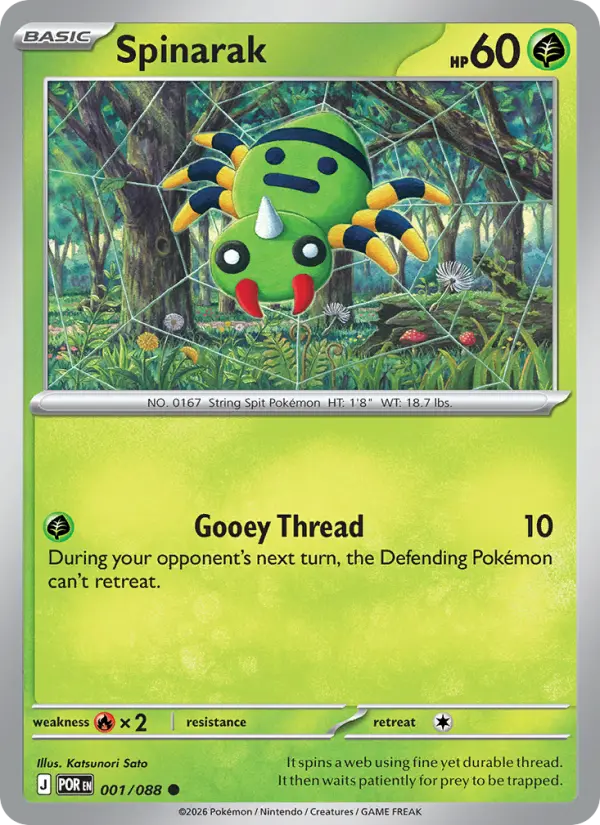
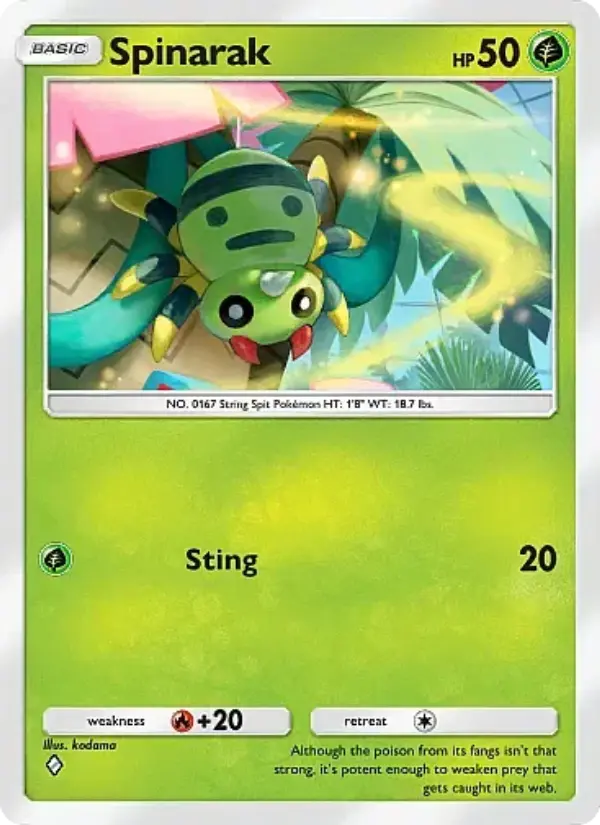
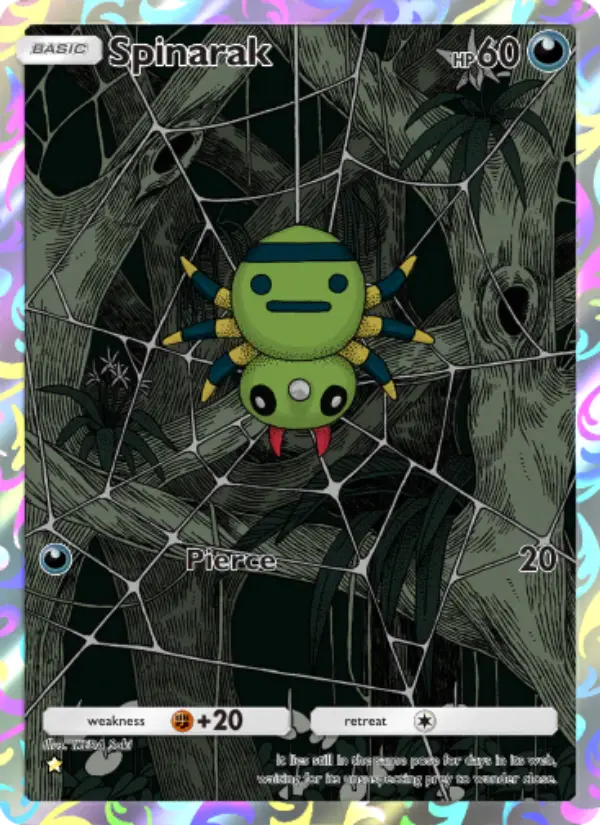
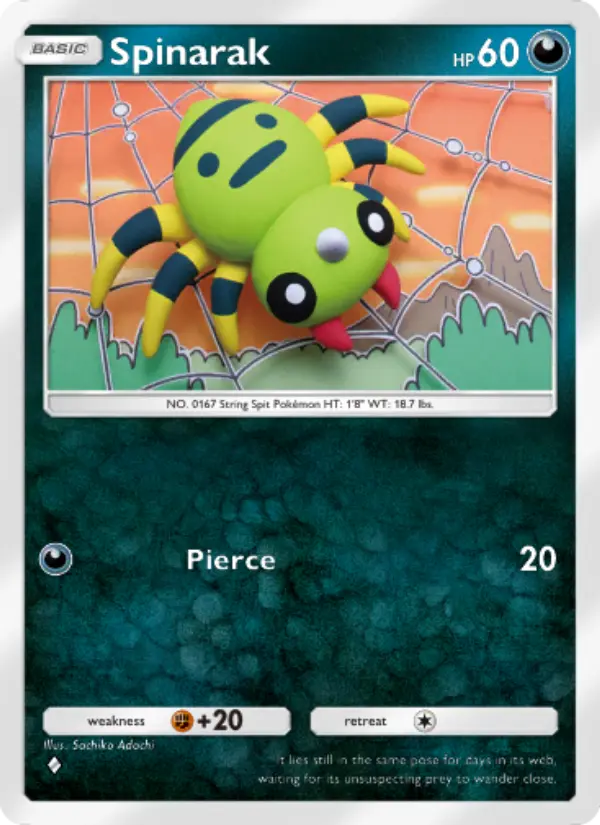
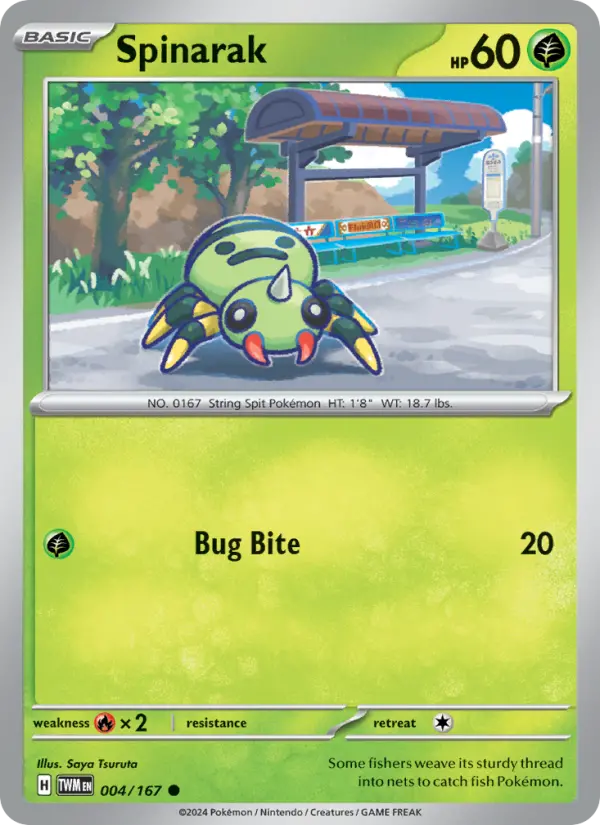
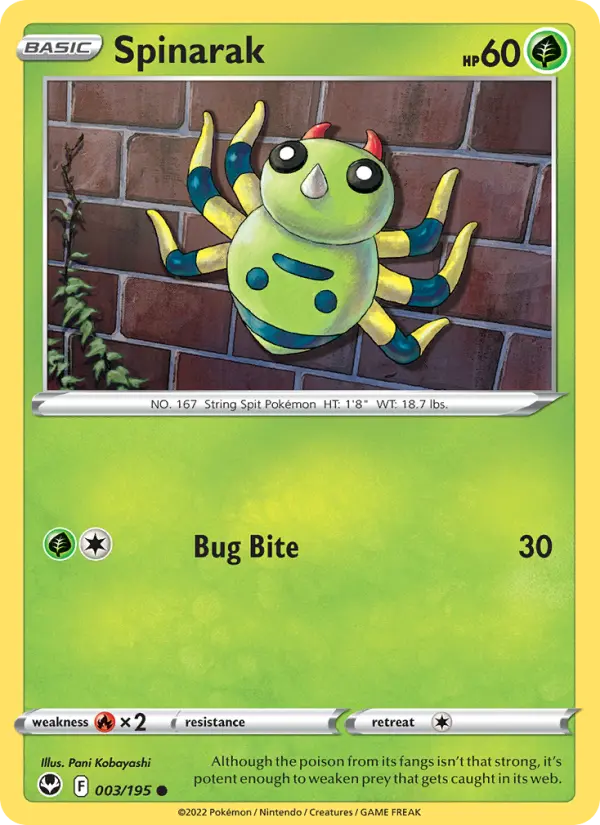
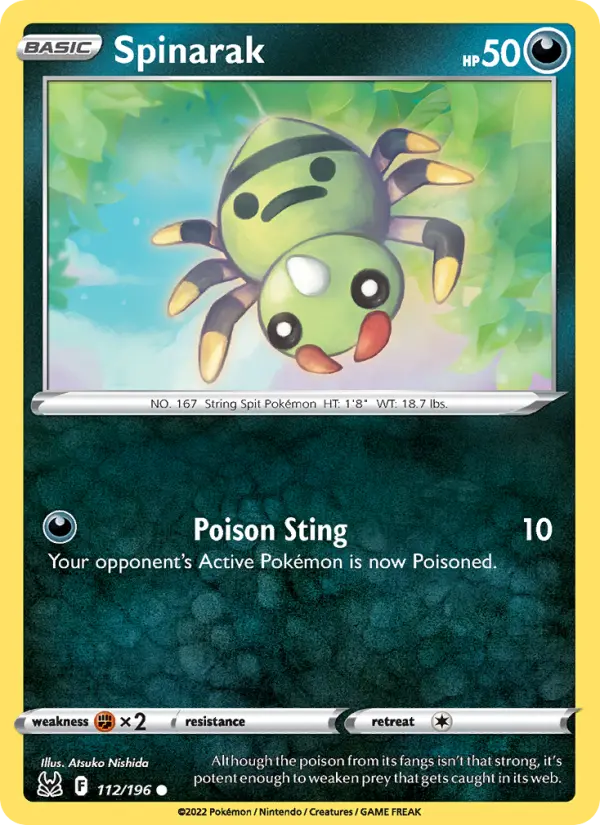
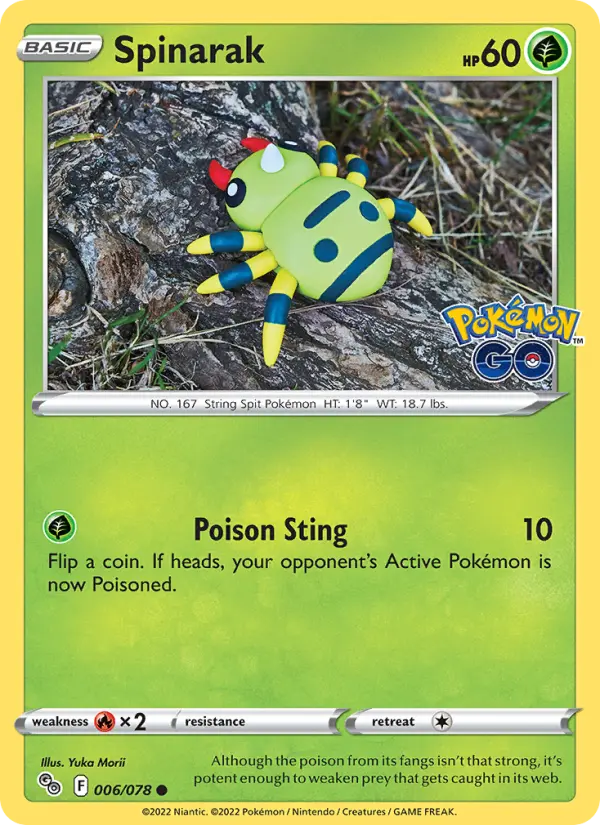
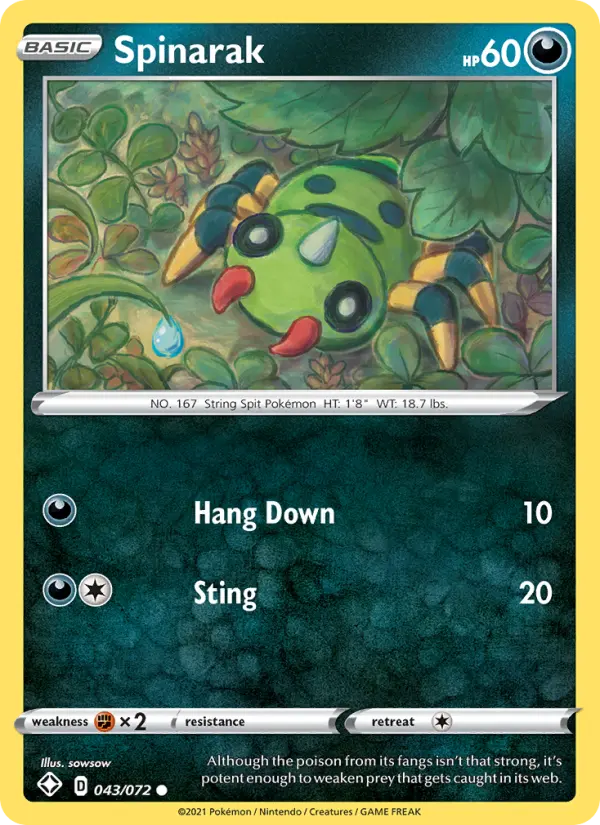
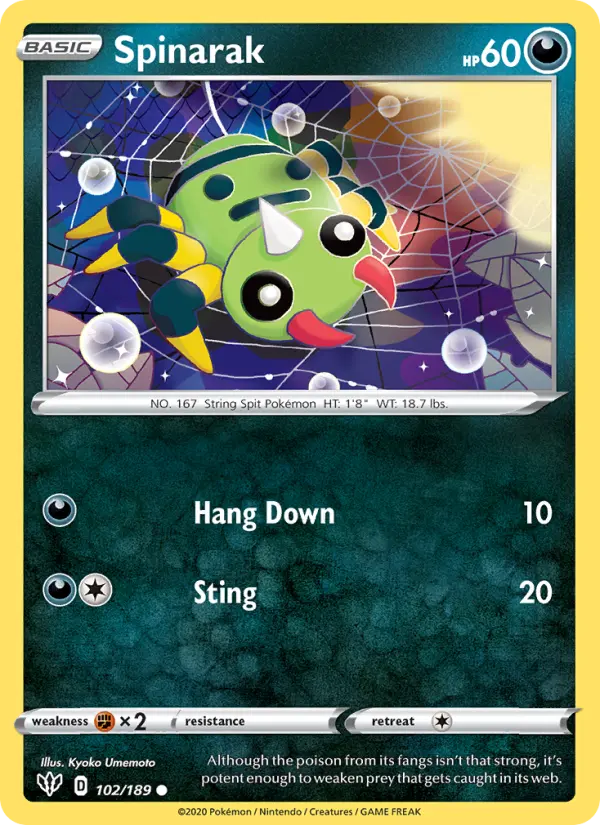
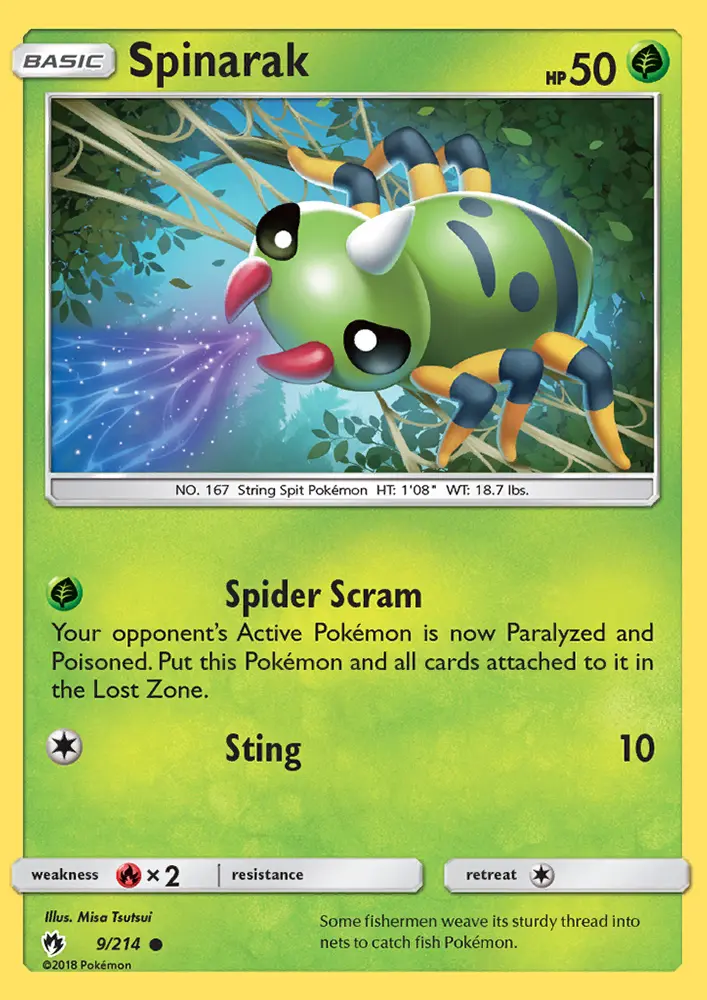
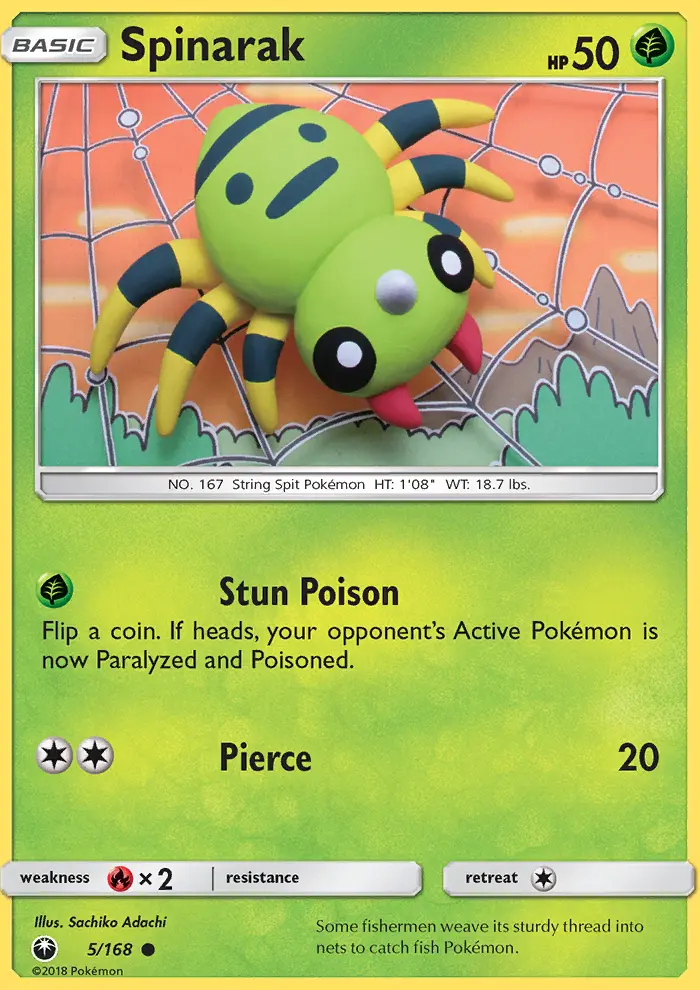
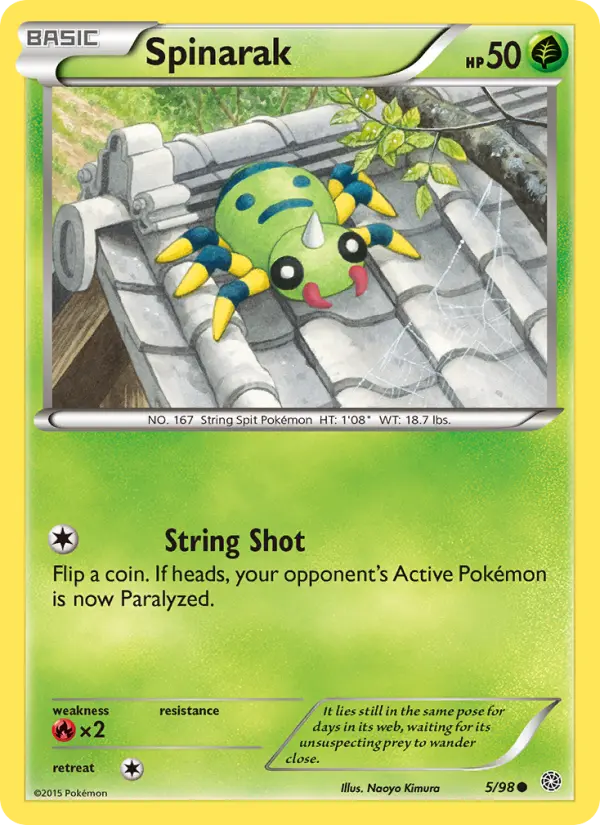
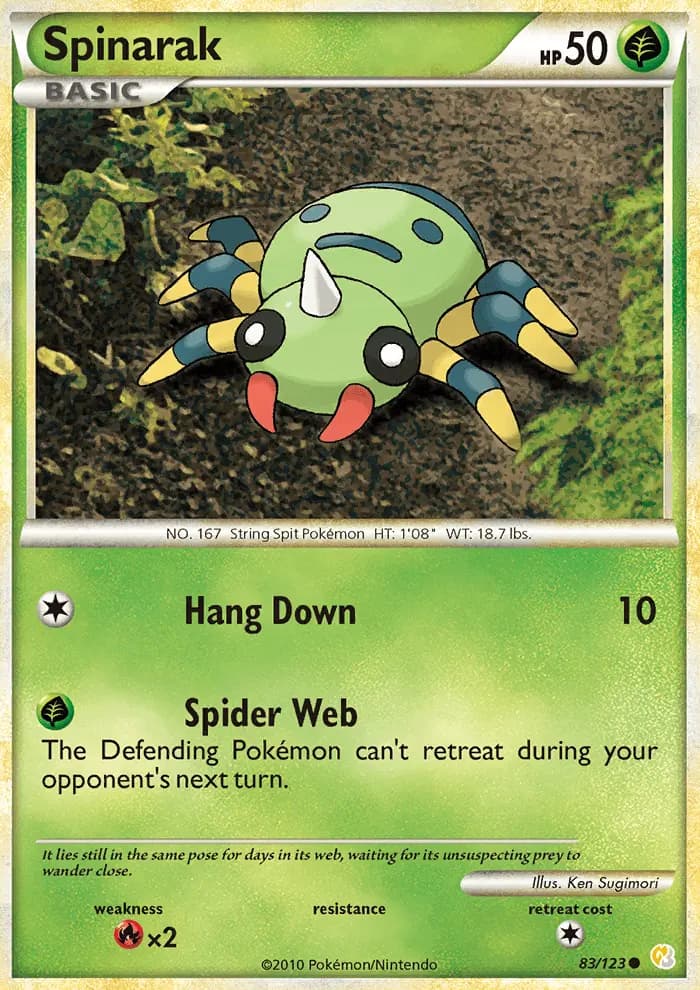
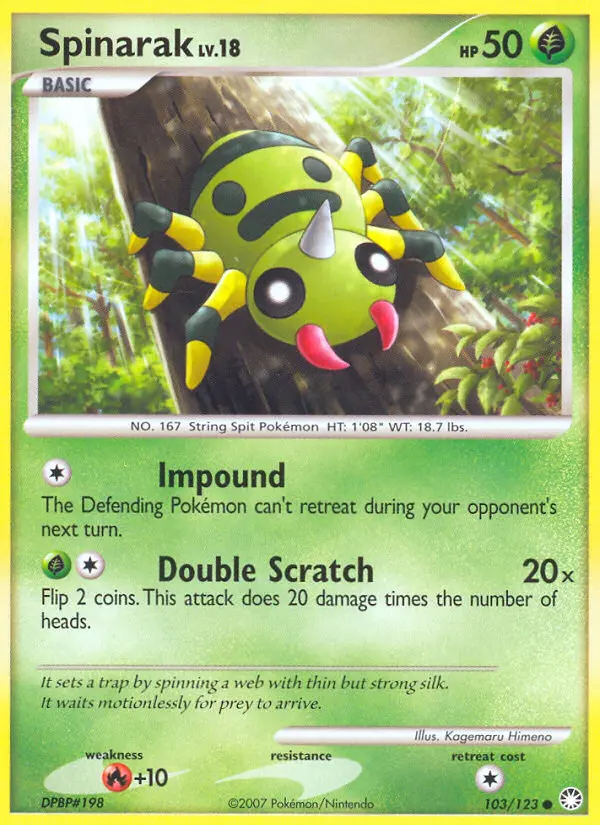
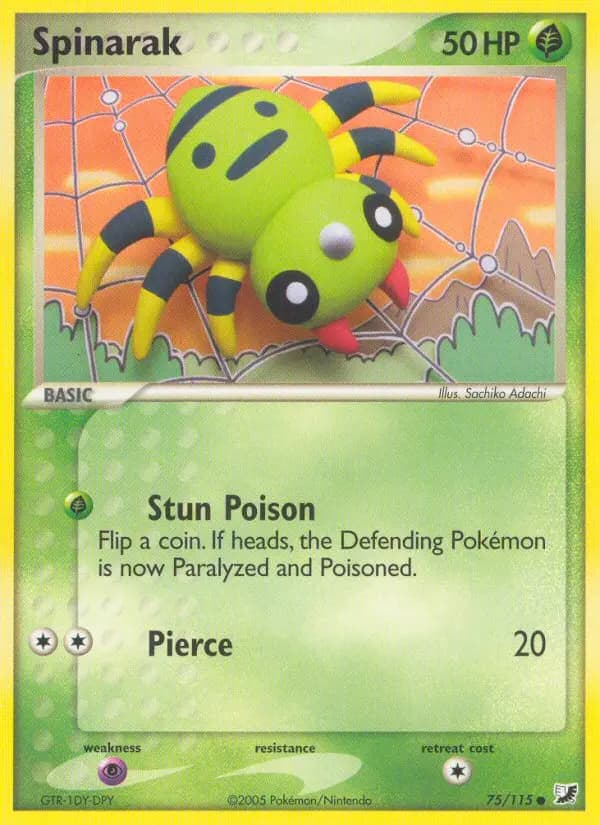
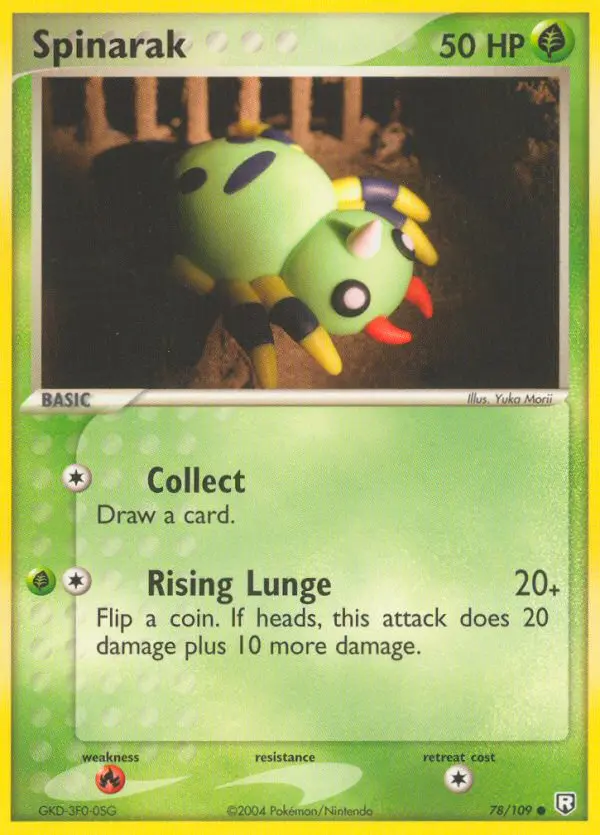
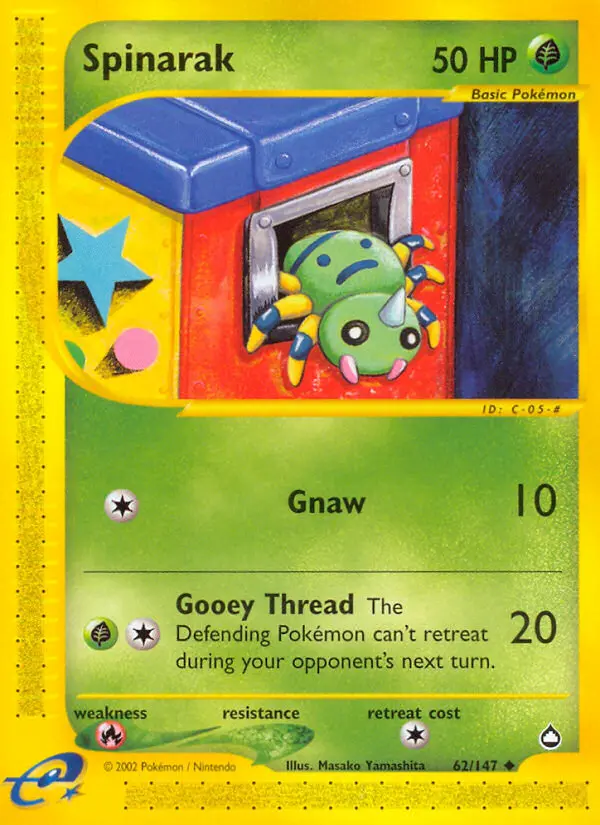
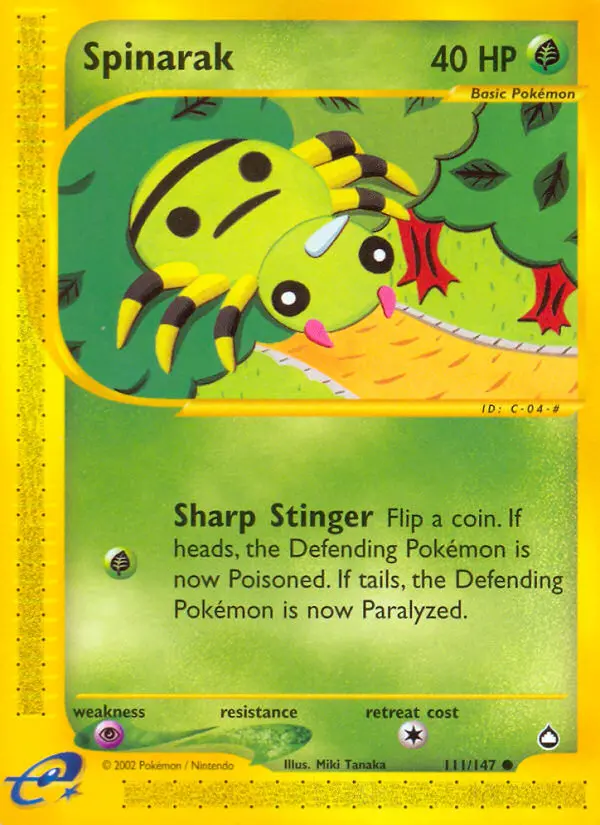
Spinarak maintains a notable presence in Pokémon media despite not achieving the popularity status of legendary or first-generation Pokémon. The character appears in multiple anime episodes, most notably "Hassle in the Castle" and "Ariados, Amigos," where its silk production capabilities are highlighted for their medicinal properties. These episodes demonstrate how Spinarak's abilities extend beyond simple predation, positioning the species as contributing members of both natural and human ecosystems. The Pokémon's distinctive aesthetic—the cute face-changing expression on its abdomen—has made it recognizable and somewhat endearing despite its predatory nature, allowing it to transcend typical spider-associated fears. Fan communities appreciate Spinarak for its underdog status and unique ecological role, often featuring it in discussions about underutilized bug-type Pokémon with untapped potential. The species represents Generation II's effort to expand the bug-type roster with creatures offering genuine biological inspiration combined with character design appeal. Trading card representations of Spinarak have been produced throughout the Pokémon Trading Card Game's history, with various iterations reflecting the Pokémon's evolution and abilities across different generations.
Where to Find Spinarak in Every Pokémon Game
Spinarak's availability has remained consistent throughout the Pokémon franchise due to its high catch rate of 255 and widespread geographic distribution. In its debut Generation II games (Gold, Silver, and Crystal versions), Spinarak appears as Pokédex number 32 in the Johto region, making it a readily available early-game catch. The species has maintained accessibility in subsequent generations, appearing in remakes and later games including HeartGold/SoulSilver where it retains Johto dex number 32, and X/Y where it appears as Pokédex number 107 in the Mountain Kalos region. In Sun and Moon, Spinarak received Alola dex number 22, indicating its continued availability in the newer Alola region games. The Pokémon appears as dex number 58 in Legends: Z-A and number 1 in The Teal Mask DLC, suggesting evolving importance in the series. Spinarak's presence in various side games and events throughout Pokémon's history ensures that trainers seeking this species have numerous avenues for acquisition. Its high catch rate means that even wild encounters yield successful captures frequently, requiring minimal specialized equipment or techniques. The species' consistent availability across generations reflects its role as a foundational bug-type option for players seeking diverse team compositions early in their adventures.