Tadbulb
Generation IX · #0938 — EleTadpole Pokémon
Among electric-type Pokémon, Tadbulb stands out for a stat line that pushes hardest into hp. The species has achieved moderate popularity within the Generation IX metagame and continues to attract interest from players who appreciate its unique biological characteristics and accessible evolutionary path.
Editor's Take
Tadbulb's line ends in Bellibolt, whose Electromorphosis charging a free Electric boost whenever it is hit is a genuinely clever ability on a bulky frame.
Base Stats
Height
0.3m
Weight
0.4kg
Category
EleTadpole Pokémon
Gender
Male 50% / Female 50%
Color
yellow
Shape
ball
Abilities
Prevents confusion.
Has a 30% chance of paralyzing attacking Pokémon on contact.
Prevents self destruct, explosion, and aftermath from working while the Pokémon is in battle.

Tadbulb Biology & Physical Characteristics
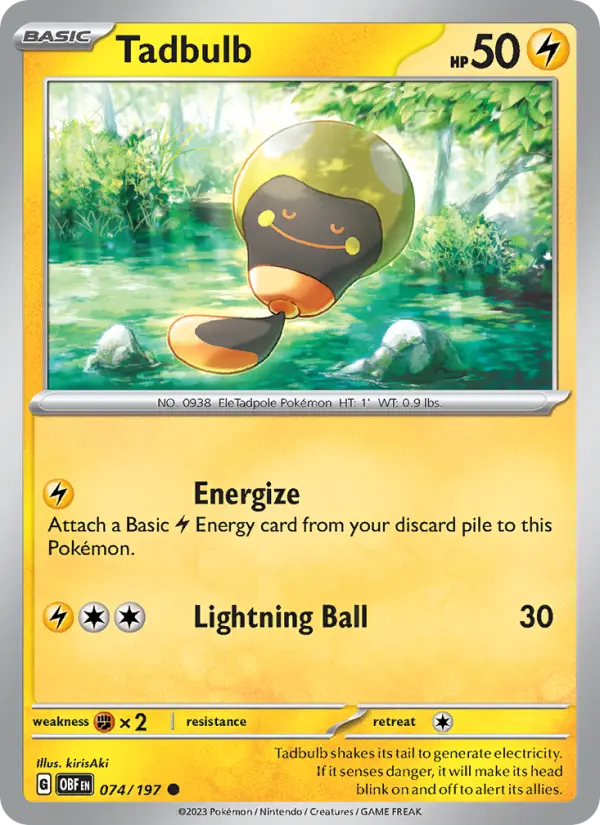
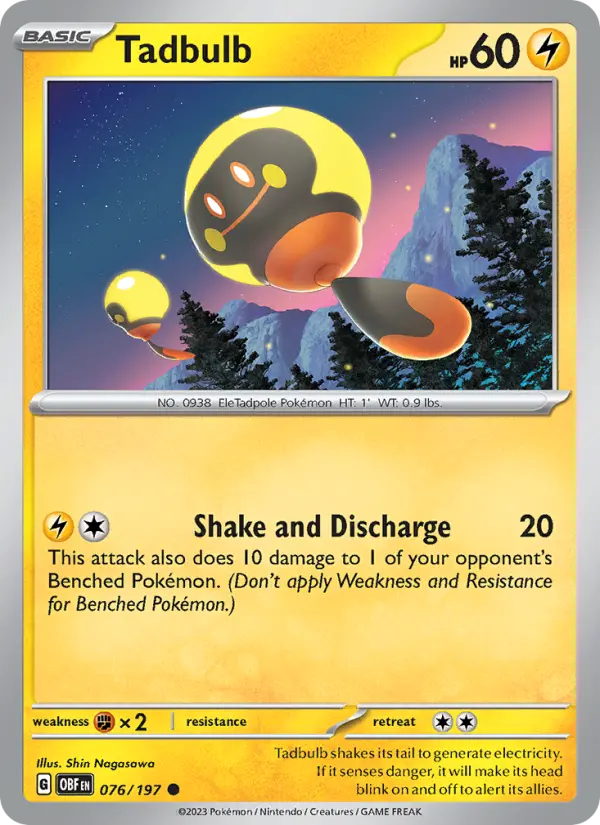
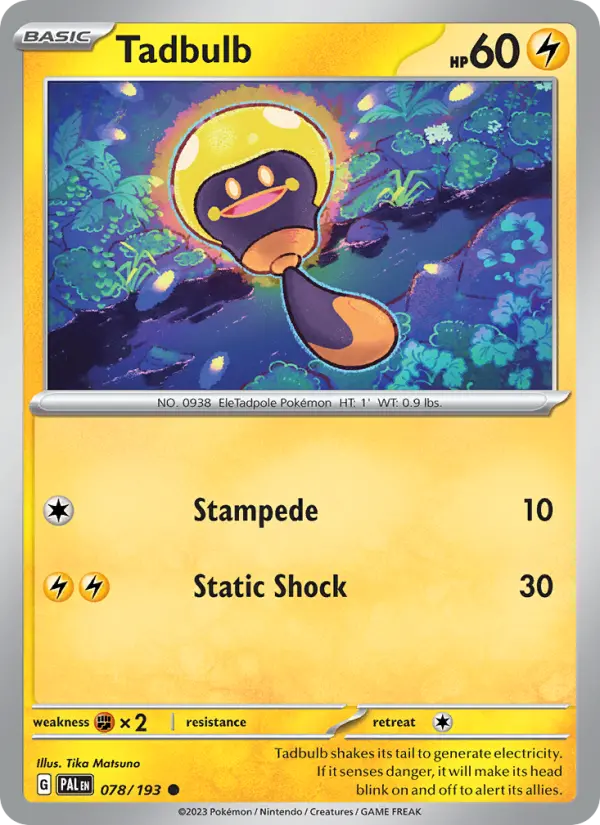
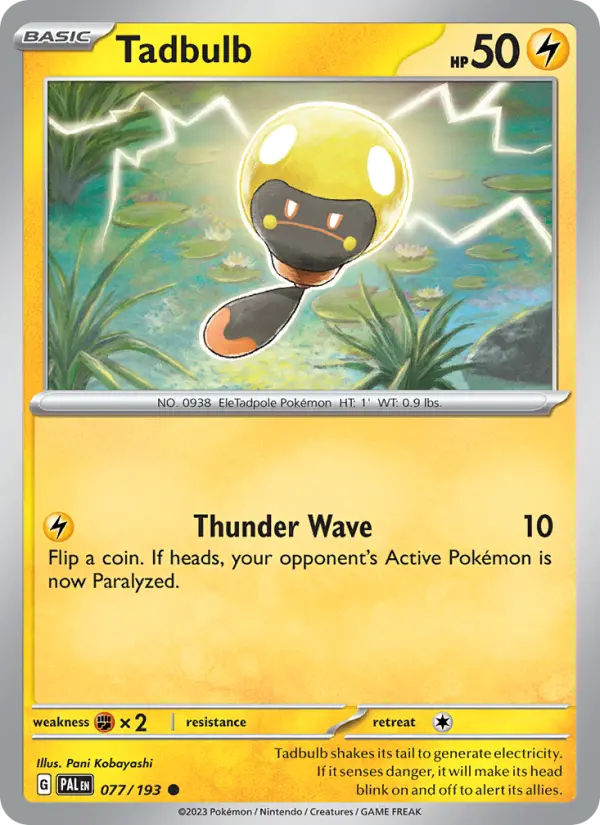
Tadbulb's most distinctive anatomical feature is its large, spherical yellow head that comprises the majority of its diminutive body. This bulbous head is crowned with two white spots that serve a critical communicative function—they emit light and can blink on and off to alert allies to potential danger. The lower portion of the head features a black face with characteristically beady yellow eyes, a simple mouth outlined in orange lips, and prominent yellow cheek circles. Separating the head from the body are distinctive copper-colored discs that serve as insulators for the electrical energy flowing through the Pokémon's form. The tail itself is predominantly black with a remarkable U-shaped copper-colored pattern at its tip, functioning as the primary mechanism through which Tadbulb generates electricity via vigorous shaking. The species demonstrates an exceptional capacity for electrical generation and storage, with documented cases showing Tadbulb collectively powering major metropolitan areas. Its electrical reserves enable a unique levitation ability; during stormy weather, when thunderclouds gather overhead, Tadbulb exhibits increased buoyancy and can float at considerably higher altitudes than normal, suggesting an electromagnetic interaction with atmospheric conditions.
Pokedex Numbers
Training
Breeding
Tadbulb Breeding, Gender Ratio & Egg Groups
Tadbulb exhibits a perfectly balanced sexual dimorphism ratio, with populations distributed evenly at 50% male and 50% female, following standard Pokémon breeding conventions. The species belongs exclusively to the Water 1 egg group, a classification shared with numerous aquatic and semi-aquatic Pokémon that reflects its amphibian nature and preferred habitats. This placement within the Water 1 egg group provides breeding compatibility with a diverse range of water-type and amphibian-themed Pokémon, opening multiple breeding pathways for trainers seeking specific move combinations or optimal offspring. The breeding cycle requires twenty egg cycles to complete gestation, translating to approximately 4,884 to 5,140 steps of gameplay before the egg hatches into a fresh Tadbulb. Through breeding, Tadbulb can access exclusive moves not available through standard leveling or TM instruction, including Muddy Water, Parabolic Charge, and Soak, enabling creative movepool customization for competitive preparation. The species' moderate base happiness of 50 provides a neutral baseline for breeding outcomes, meaning trainers must invest modest effort in happiness-boosting activities to optimize offspring potential. The breeding mechanics for Tadbulb are relatively accessible for players unfamiliar with advanced breeding strategies, making it an appropriate choice for those beginning their competitive team construction journey.
Sprites






TMs & HMs
tm03
ruby sapphire
tm03
platinum
tm03
firered leafgreen
tm03
heartgold soulsilver
tm03
diamond pearl
tm03
emerald
tm03
xd
tm03
colosseum
tm05
lets go pikachu lets go eevee
tm06
lets go pikachu lets go eevee
tm07
crystal
tm07
gold silver
tm07
lets go pikachu lets go eevee
tm08
lets go pikachu lets go eevee
tr42
sword shield
tr80
sword shield
tm13
scarlet violet
tm17
scarlet violet
tm35
scarlet violet
tm50
scarlet violet
+263 more TMs/HMs
Tadbulb's Evolution Chain


Tadbulb Evolution, Mega Evolution & Special Forms
Tadbulb occupies the crucial first position in a single-stage evolutionary line, transforming into Bellibolt through exposure to a Thunder Stone. This evolutionary method represents one of the classic item-based evolution mechanics in the Pokémon franchise, requiring trainers to actively seek out and apply a Thunder Stone to facilitate the transformation. Upon evolution, Tadbulb's modest base stats of 272 are substantially enhanced, with Bellibolt receiving significant increases across most statistical categories while maintaining the same Electric typing. The evolutionary transformation represents a dramatic increase in both physical presence and power, with Bellibolt becoming a considerably more formidable battler suitable for competitive play and challenging late-game encounters. The evolutionary relationship emphasizes the tadpole-to-bullfrog developmental pattern common in real-world amphibians, though transposed into an electrical Pokémon context. Trainers seeking to utilize Tadbulb's evolutionary potential should prepare accordingly by locating a Thunder Stone before reaching the stage where they require Bellibolt's enhanced capabilities, making this a strategic decision point in team composition and progression planning.
Where to Find
Location data not available for this Pokémon in the database.
Tadbulb Behaviour and Natural Habitat
Tadbulb exhibits behavioral patterns characteristic of aquatic and semi-aquatic creatures, preferring to inhabit wetlands and riverbank environments throughout the Paldea region. The species demonstrates notable intelligence in its communicative behaviors, particularly its warning system whereby the Pokémon blinks its luminescent head spots on and off when sensing danger—a mechanism that alerts nearby allies to potential threats and suggests a degree of social awareness and group coordination. When threatened, rather than fleeing, Tadbulb relies on its electrical capabilities as primary defensive mechanisms. The creature's affinity for water and electrical environments suggests it may be most active during damp weather conditions and electrical storms, during which it displays increased activity and elevation. Its base happiness rating of 50 indicates a neutral temperament that can be cultivated through proper training and care. Tadbulb tends to inhabit areas with abundant water sources, suggesting a reliance on aquatic or semi-aquatic prey organisms and a lifestyle that balances between aquatic and terrestrial environments.
Pokedex Entries
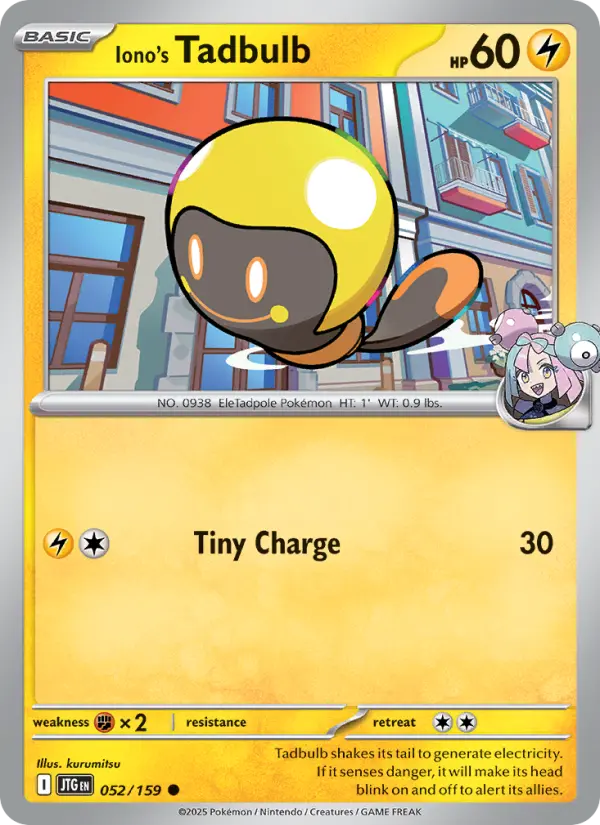
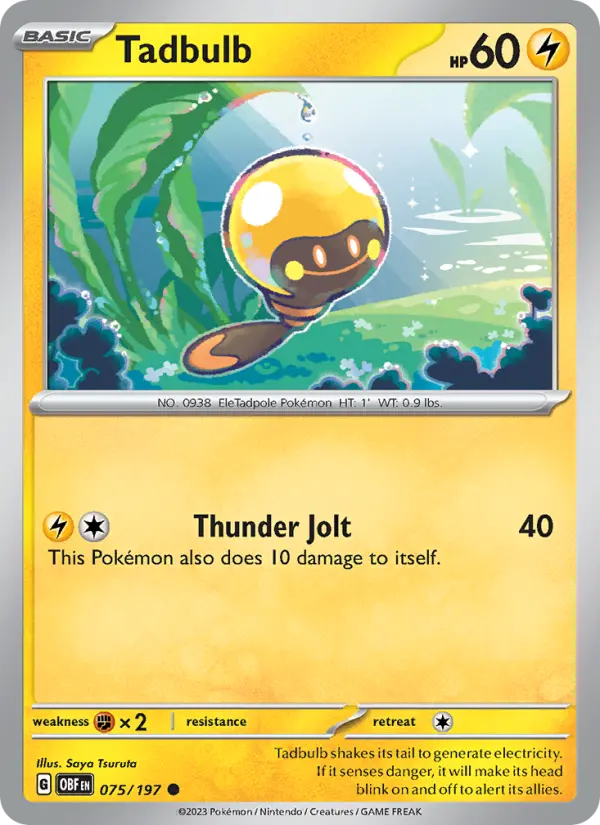
Tadbulb shakes its tail to generate electricity. If it senses danger, it will make its head blink on and off to alert its allies.
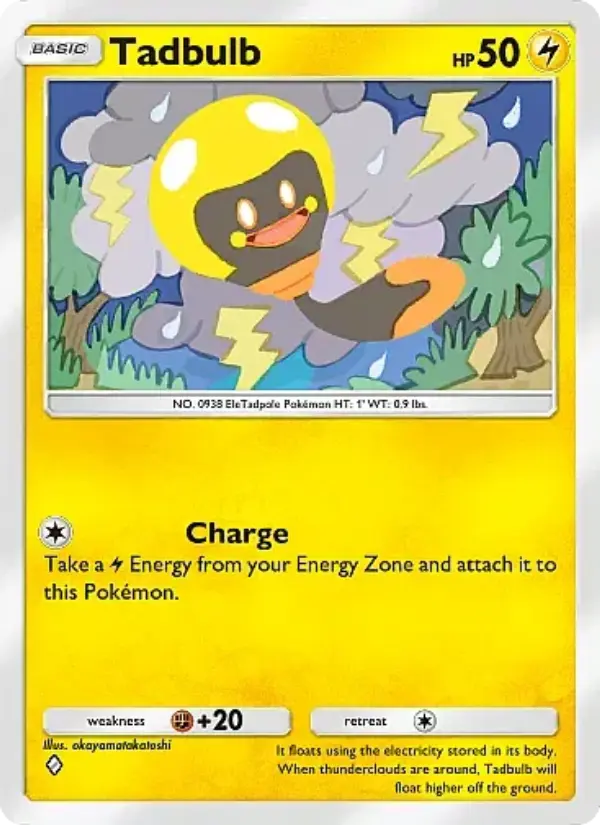
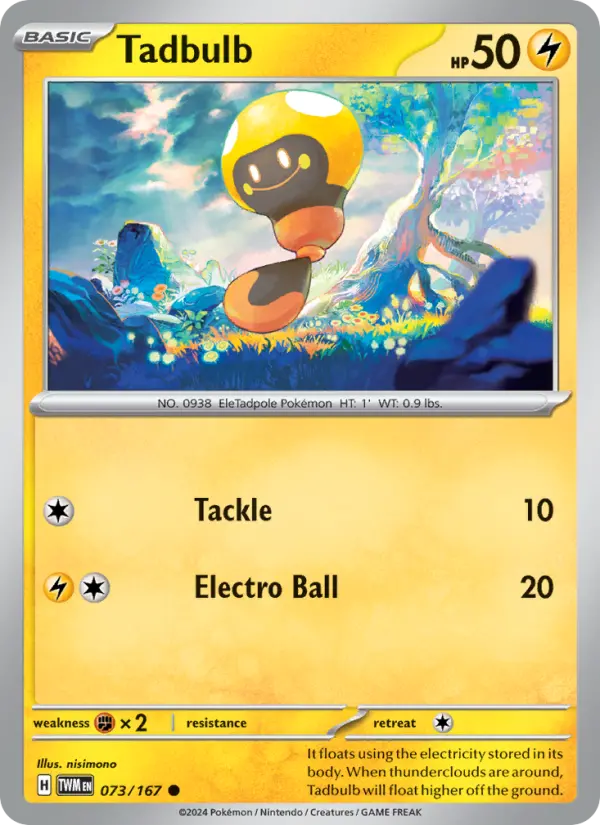
It floats using the electricity stored in its body. When thunderclouds are around, Tadbulb will float higher off the ground.
Tadbulb Name Origin & Design Inspiration
Tadbulb's name traces back to a straightforward portmanteau combining "tadpole" with "bulb," reflecting both the Pokémon's amphibian tadpole-like appearance and its electric nature characterized by its glowing, bulbous head. The Japanese name "Zupika" (ズピカ) similarly combines onomatopoeia suggesting electrical sounds with characteristics denoting its tadpole nature, creating a naming convention that clearly communicates the species' dual electric-amphibian identity. The design philosophy emphasizes simplicity and clarity; the oversized yellow head immediately communicates the electric typing through conventional color association, while the tadpole body structure and aquatic habitat establish its amphibian classification unambiguously. The copper-colored disc elements and U-shaped tail pattern serve both aesthetic and functional purposes, suggesting electrical conductivity and current flow through the organism's physiology. The two white spots on the head function as visual indicators of the Pokémon's warning light capability, creating a design that integrates form with established behavioral characteristics. This design approach—combining intuitive color coding, recognizable biological patterns, and thematic consistency—represents effective creature design that communicates essential information at a glance while maintaining visual appeal and distinctiveness within the broader Pokédex.
Learnable Moves
Tadbulb can learn 40 moves:
Move | Type | Cat. | Power | Acc. | PP |
|---|---|---|---|---|---|
| acid spray | poison | Special | 40 | 100 | 20 |
| charge | electric | Status | — | — | 20 |
| charge beam | electric | Special | 50 | 90 | 10 |
| chilling water | water | Special | 50 | 100 | 20 |
| confuse ray | ghost | Status | — | 100 | 10 |
| discharge | electric | Special | 80 | 100 | 15 |
| eerie impulse | electric | Status | — | 100 | 15 |
| electric terrain | electric | Status | — | — | 10 |
| electro ball | electric | Special | — | 100 | 10 |
| electroweb | electric | Special | 55 | 95 | 15 |
| endure | normal | Status | — | — | 10 |
| flail | normal | Physical | — | 100 | 15 |
| hyper voice | normal | Special | 90 | 100 | 10 |
| light screen | psychic | Status | — | — | 30 |
| mud shot | ground | Special | 55 | 95 | 15 |
| mud slap | ground | Special | 20 | 100 | 10 |
| muddy water | water | Special | 90 | 85 | 10 |
| parabolic charge | electric | Special | 65 | 100 | 20 |
| protect | normal | Status | — | — | 10 |
| rain dance | water | Status | — | — | 5 |
| reflect | psychic | Status | — | — | 20 |
| rest | psychic | Status | — | — | 5 |
| sleep talk | normal | Status | — | — | 10 |
| soak | water | Status | — | 100 | 20 |
| spark | electric | Physical | 65 | 100 | 20 |
| substitute | normal | Status | — | — | 10 |
| sucker punch | dark | Physical | 70 | 100 | 5 |
| swift | normal | Special | 60 | — | 20 |
| tackle | normal | Physical | 40 | 100 | 35 |
| tera blast | normal | Special | 80 | 100 | 10 |
| thunder | electric | Special | 110 | 70 | 10 |
| thunder shock | electric | Special | 40 | 100 | 30 |
| thunder wave | electric | Status | — | 90 | 20 |
| thunderbolt | electric | Special | 90 | 100 | 15 |
| volt switch | electric | Special | 70 | 100 | 20 |
| water gun | water | Special | 40 | 100 | 25 |
| water pulse | water | Special | 60 | 100 | 20 |
| weather ball | normal | Special | 50 | 100 | 10 |
| wild charge | electric | Physical | 90 | 100 | 15 |
| zap cannon | electric | Special | 120 | 50 | 5 |
Tadbulb Competitive Battle Guide
In competitive battling, Tadbulb occupies a limited niche due to its modest cumulative stat total of 272, which is substantially lower than most viable tournament competitors. However, its special attack base stat of 59 and speed of 45 provide some offensive capability once evolved into Bellibolt, suggesting that trainers should view Tadbulb primarily as a stepping stone rather than a standalone competitor. The species learns an impressive movepool through leveling, TMs, and breeding, with notable moves including Discharge (80 power), Zap Cannon (120 power), Electric Terrain, Thunder Shock, and various complementary coverage moves like Mud Shot and Water Gun. Its three ability options—Own Tempo, Static, and the hidden ability Damp—each provide different strategic advantages; Own Tempo prevents the confusion status that could compromise offensive momentum, Static threatens paralysis to physical attackers with a 30% activation rate, while Damp disables Self-Destruct and Explosion, providing utility against specific threat types. In Scarlet and Violet's competitive format, Tadbulb sees minimal usage in serious tournaments, with most competitive players preferring to invest resources directly into Bellibolt or other Electric-type alternatives with superior statistical foundations. Nevertheless, Tadbulb possesses legitimate potential in casual competitive play and lower-tier formats where its movepool diversity and ability options can exploit specific metagame weaknesses.
Commonly Asked Questions About Tadbulb
What type is Tadbulb?
Tadbulb is a electric type Pokemon.
What does Tadbulb evolve into?
Tadbulb evolves into bellibolt.
What are Tadbulb's weaknesses?
Tadbulb is weak to ground type moves.
Does Tadbulb evolve by trading?
No — Tadbulb evolves entirely through leveling up, with no trade required at any stage.
Tadbulb Cultural Impact & Franchise History
Since its introduction in Generation IX, Tadbulb has cultivated a modest but dedicated fanbase within the Pokémon community, appealing particularly to trainers who appreciate the aesthetic design of small electric creatures and amphibian-themed Pokémon. The species has generated fan art and community discussion centered on its luminescent warning system and unique levitation abilities during storms, with these biological features capturing imaginative interpretations about how such creatures function within the Pokémon world. Tadbulb's role as an early-game electric-type option in Pokémon Scarlet and Violet has made it accessible and familiar to many players encountering Generation IX content, establishing it as a recognizable entry in the broader Pokédex despite its competitive limitations. The creature's design simplicity and clear purpose have prevented it from achieving mainstream popularity comparable to iconic electric-types like Pikachu or Raichu, yet it maintains a respectable presence in community discussions about Paldea-specific Pokémon and amphibian-themed species. Educational content creators have utilized Tadbulb's design as an example of effective creature design that communicates type and habitat information through visual and thematic cohesion, making it valuable for discussions about Pokémon design philosophy.
Where to Find Tadbulb in Every Pokémon Game
Tadbulb is available exclusively in Pokémon Scarlet and Violet within the Generation IX games, with no presence in earlier generations or subsequent titles as of current information. Within the Paldea region, Tadbulb can be encountered across multiple areas in both the early game and mid-game stages, appearing in South Province Areas One through Five as well as East Province Areas One through Three, providing multiple opportunities for trainers to obtain the species at various points in their adventure. The capture rate of 190 indicates relatively easy catch probability, meaning standard Poké Balls prove sufficient for most encounters without requiring specialized status conditions or weakening procedures. Trainers seeking specific natures or individual values may benefit from the understanding that Tadbulb's base happiness of 50 provides neutral starting conditions for training and development. The species' availability across multiple regional sections suggests intentional pacing by Game Freak to ensure trainers have accessible electric-type options throughout their Paldea journey. While Tadbulb does not appear in spin-off titles or other Generation IX games beyond the core Scarlet and Violet entries, its introduction as a Generation IX exclusive ensures it remains categorically exclusive to the ninth generation, making it a chronologically and geographically specific Pokémon for trainers seeking generation-authentic team compositions.