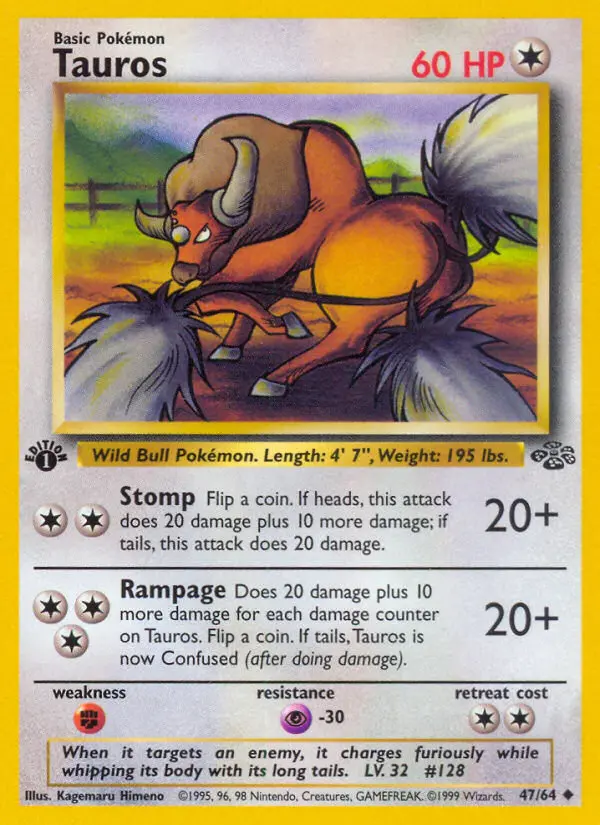
Tauros
Generation I · #0128 — Wild Bull Pokémon
Tauros is a normal-type Pokémon whose speed — 110 at base — does more to define its role than its overall spread does. The species remains one of the most recognizable quadrupedal Pokémon from the original 151, and its design has influenced countless bull-themed creatures across subsequent generations. In the Paldean region, Tauros has evolved into three distinct regional variants—Combat Breed, Blaze Breed, and Aqua Breed—each representing a unique ecological adaptation that has reinvigorated interest in this classic Pokémon.
Editor's Take
Tauros was the single best Pokémon in competitive Gen 1 by a wide margin, and almost nobody who did not play that format believes it — the Paldean variants are the first time it has been interesting since.
Base Stats
Height
1.4m
Weight
88.4kg
Category
Wild Bull Pokémon
Gender
100% Male
Color
brown
Shape
quadruped
Habitat
grassland
Abilities
Lowers opponents' Attack one stage upon entering battle.
Raises Attack to the maximum of six stages upon receiving a critical hit.
Strengthens moves with extra effects to 1.3× their power, but prevents their extra effects.

Tauros Biology & Physical Characteristics
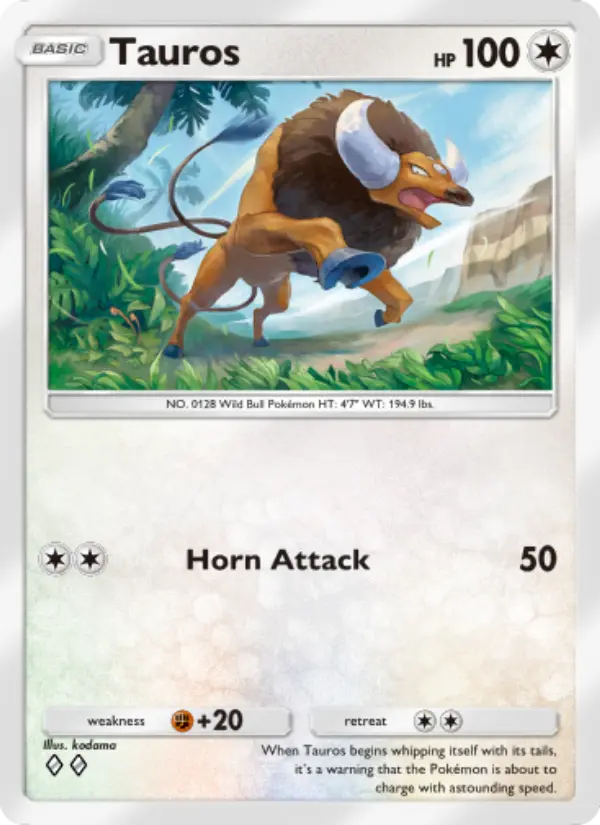
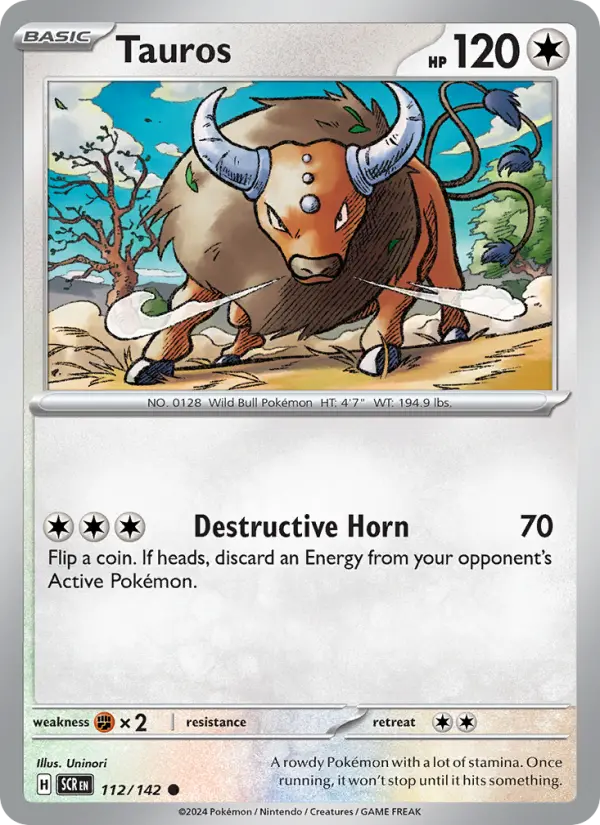
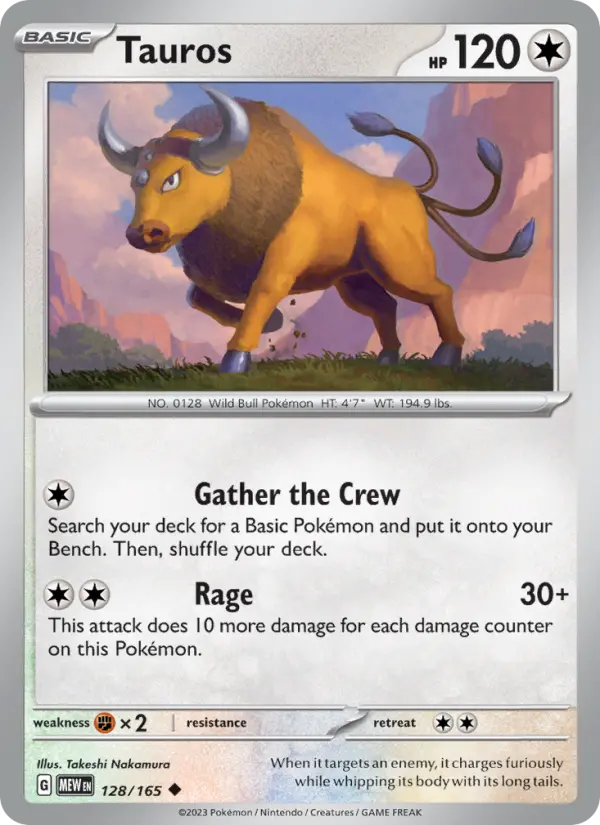
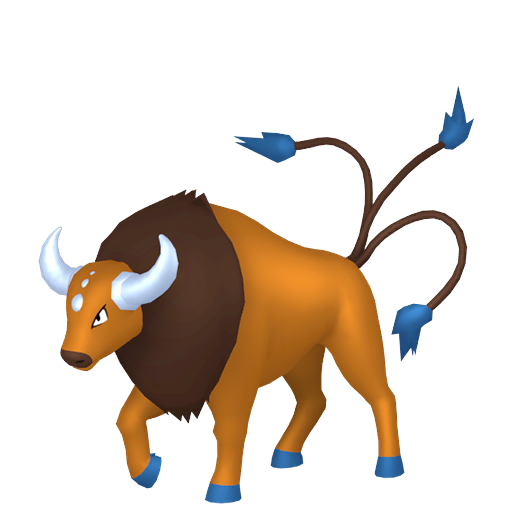
Tauros is a sturdy bovine Pokémon standing 1.4 meters tall and weighing approximately 88.4 kilograms, with a muscular build that speaks to its combative nature. The species is characterized by its iconic triple tails, which serve as both a weapon and a psychological tool, used to whip its own body to heighten its battle spirit as described in Pokédex entries. Its most distinctive features are its massive curved horns and aggressive facial expression, which communicate its perpetual state of readiness. The Pokédex reveals that Tauros possesses incredible stamina and an almost uncontrollable urge to engage in combat, describing it as a creature that is never satisfied unless it is rampaging. Its base Defense stat of 95 provides adequate protection, while its Special Attack of only 40 indicates that Tauros relies entirely on physical brute force rather than any mystical abilities. The species features primarily in the Ground egg group despite its quadrupedal bull appearance, suggesting deeper biological connections to the earth-based Pokémon lineage.
Pokedex Numbers
Training
Breeding
Tauros Breeding, Gender Ratio & Egg Groups
Tauros presents one of the most unusual breeding characteristics in the entire Pokémon franchise, as the species is composed entirely of males with a gender ratio of 100% male and 0% female. This absolute sexual dimorphism means that Tauros cannot breed with other Tauros under normal circumstances, instead requiring breeding with Ditto or with species in the compatible Field egg group to produce offspring. The existence of an all-male species has intriguing implications for Pokémon biology and ecology, suggesting either an extreme sexual dimorphism where females exist as an entirely different species (as is the case with Miltank, which is considered Tauros's counterpart), or a unique reproductive strategy unknown in conventional mammals. With a base happiness of 70 and moderate catch rate of 45, Tauros presents a moderate challenge for trainers to capture and befriend, though its naturally calm disposition toward friendly trainers suggests it is not inherently hostile outside of battle contexts. The species has a slow growth rate, requiring significant experience accumulation to reach higher levels, though its excellent base Attack and Speed stats make the investment worthwhile for trainers prioritizing physical offense. Eggs hatched from Tauros breeding require 20 cycles to develop, equating to approximately 4,884 to 5,140 steps before the offspring emerges.
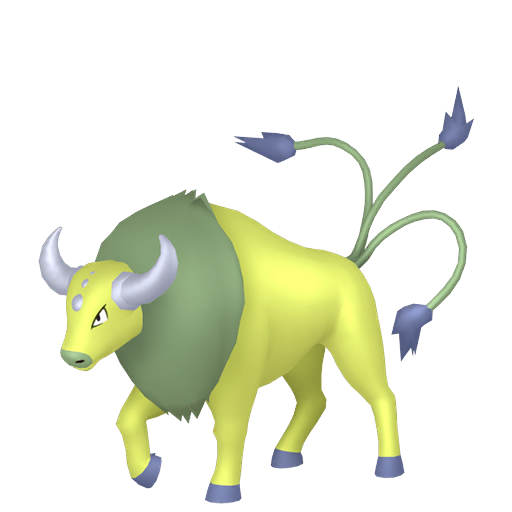
Sprites




TMs & HMs
tm01
lets go pikachu lets go eevee
tm02
crystal
tm02
gold silver
tm03
crystal
tm03
gold silver
tm03
ruby sapphire
tm03
platinum
tm03
firered leafgreen
tm03
heartgold soulsilver
tm03
diamond pearl
tm03
emerald
tm03
xd
tm03
colosseum
tm03
lets go pikachu lets go eevee
tm05
lets go pikachu lets go eevee
tm06
yellow
tm06
gold silver
tm06
red blue
tm06
crystal
tm06
emerald
+747 more TMs/HMs
Regional & Special Forms
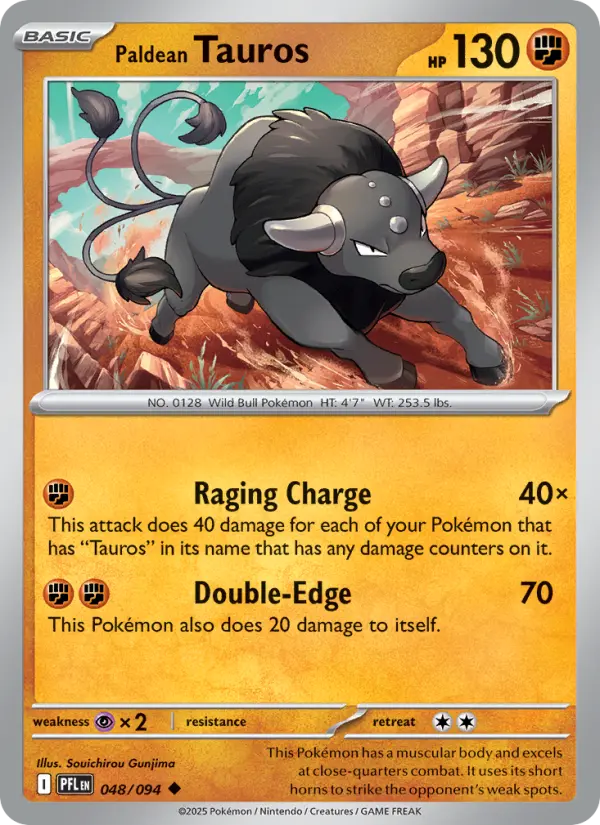
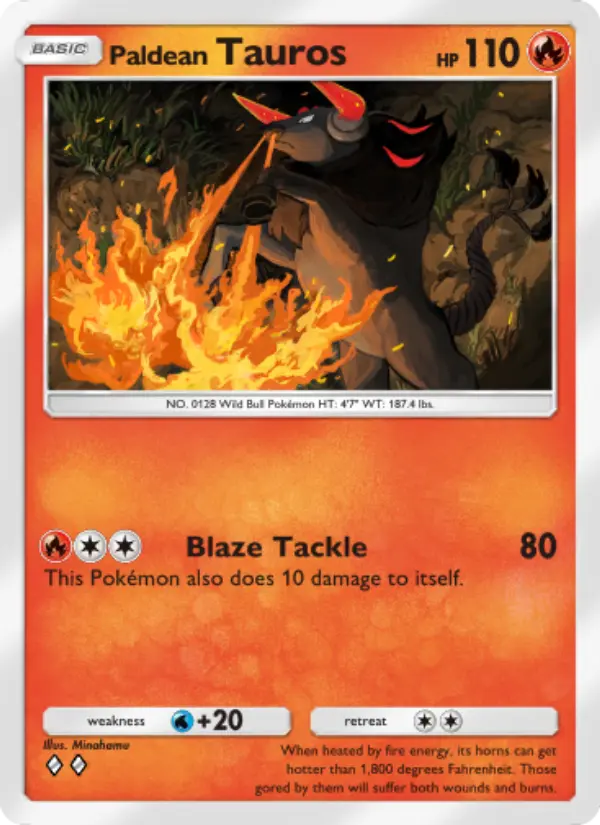
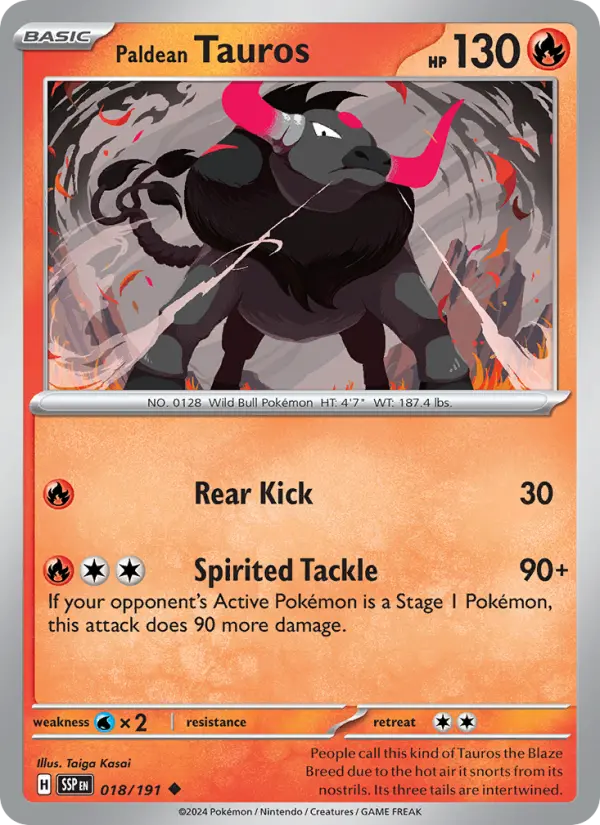
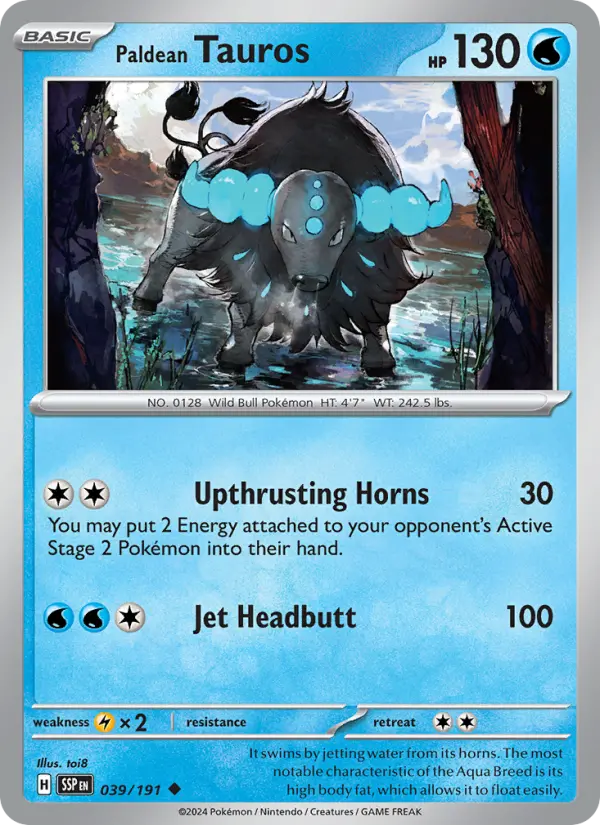
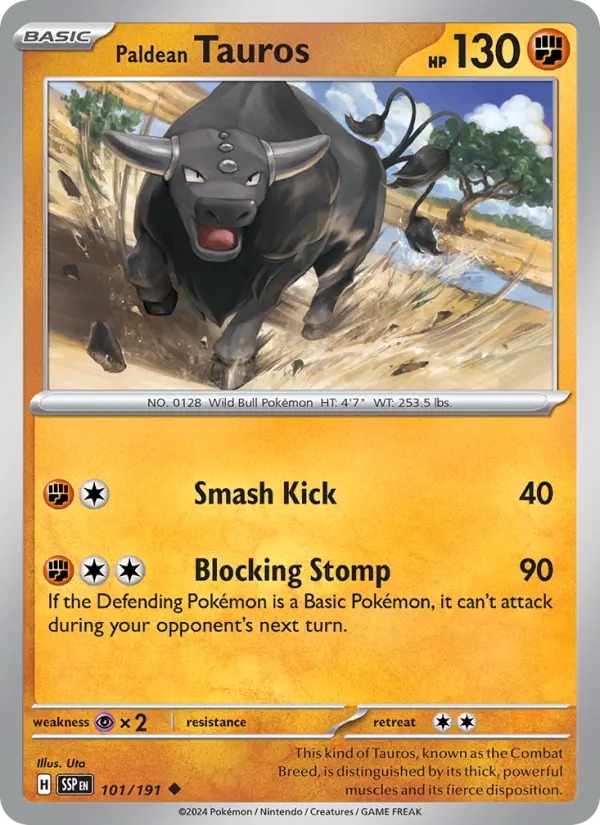
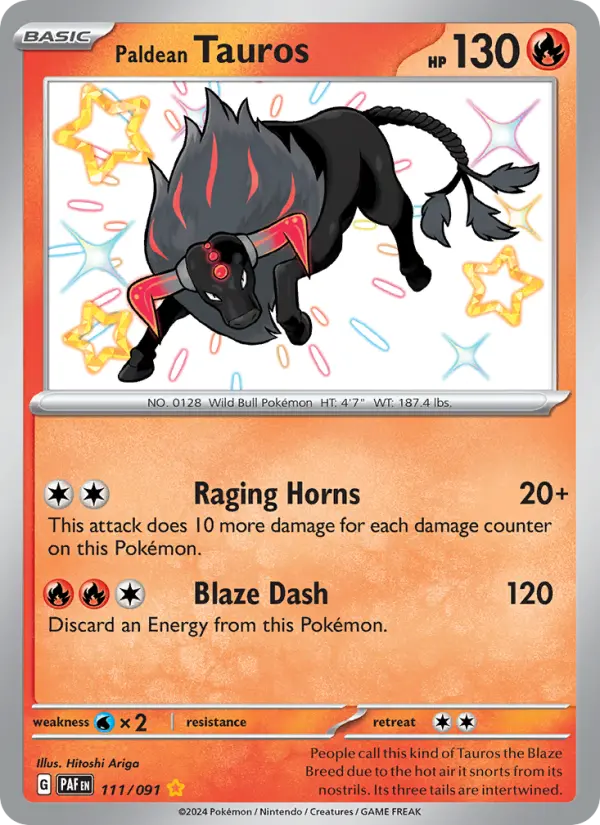
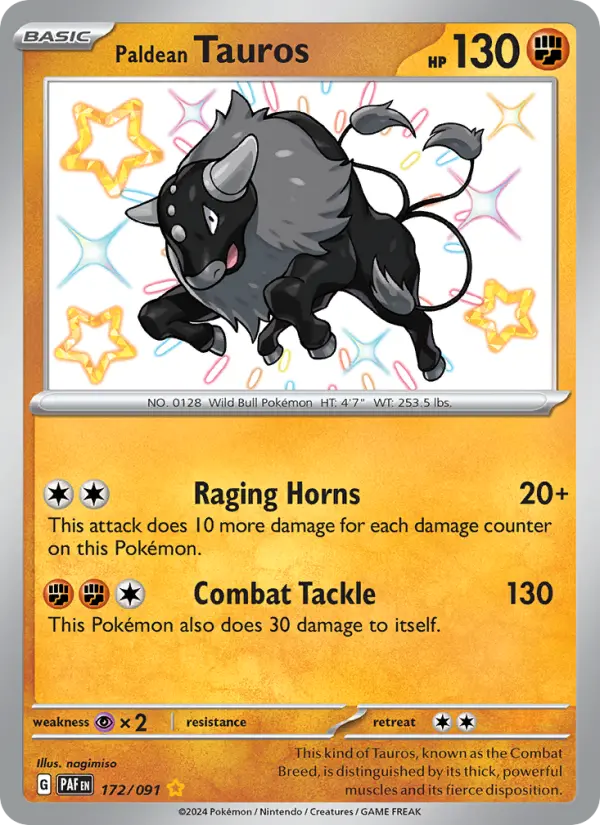
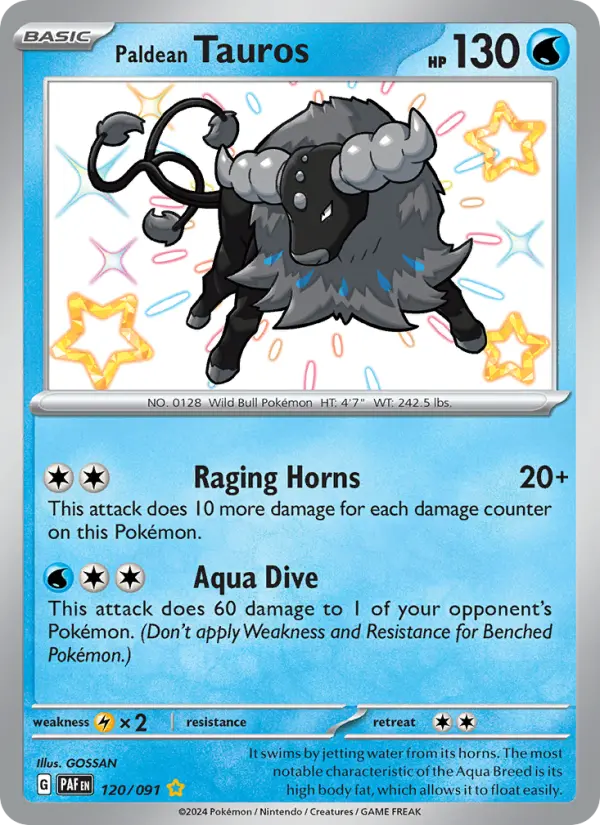
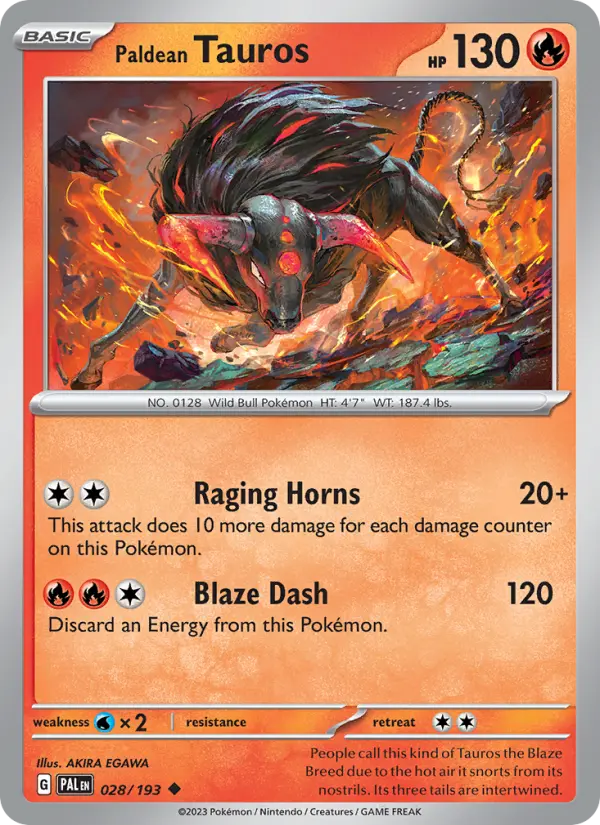
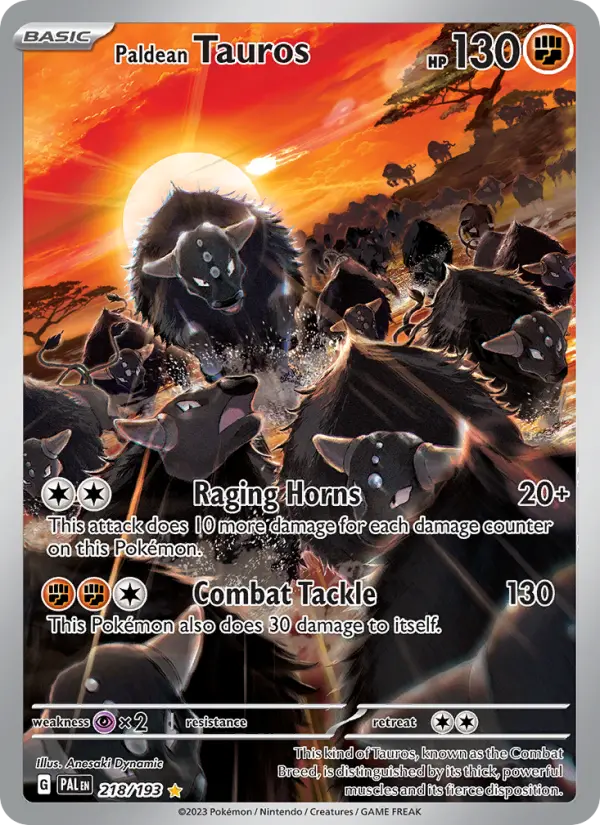
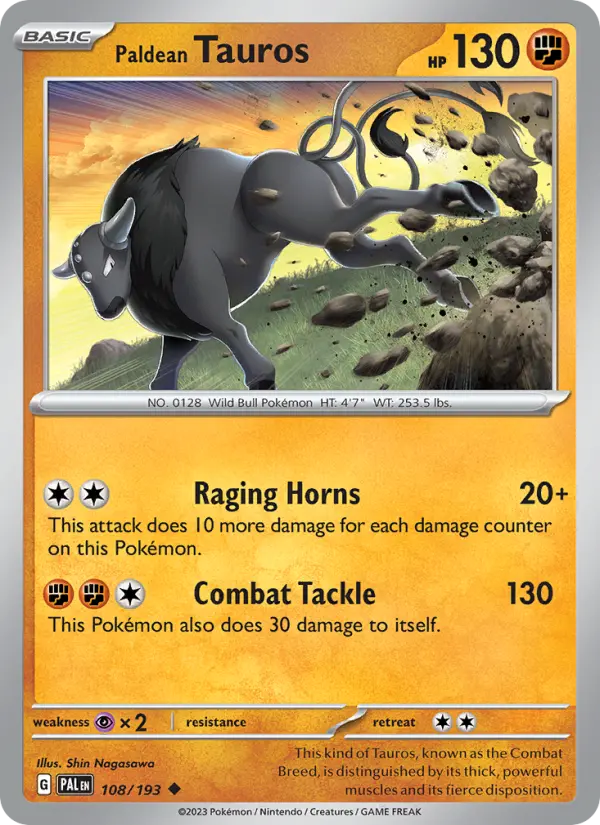
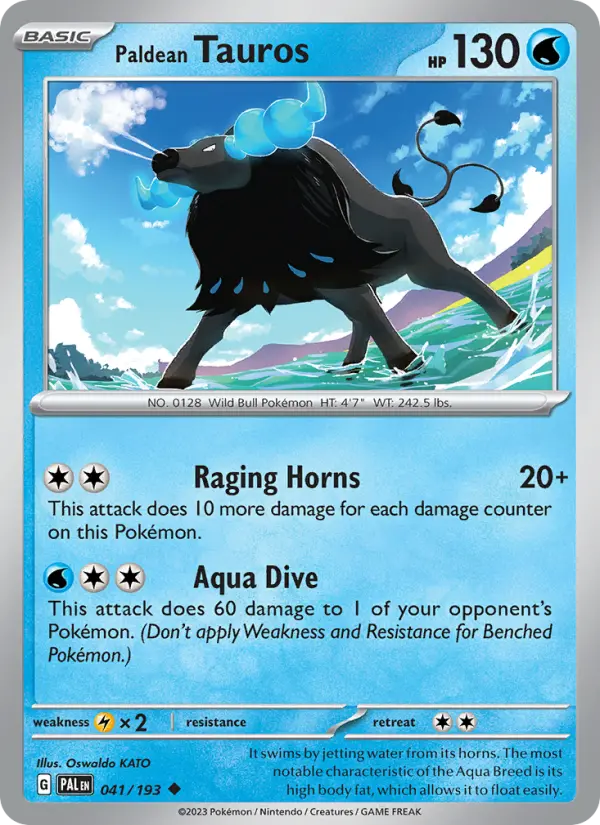
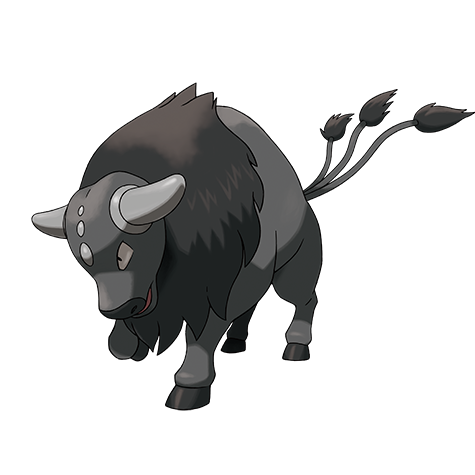
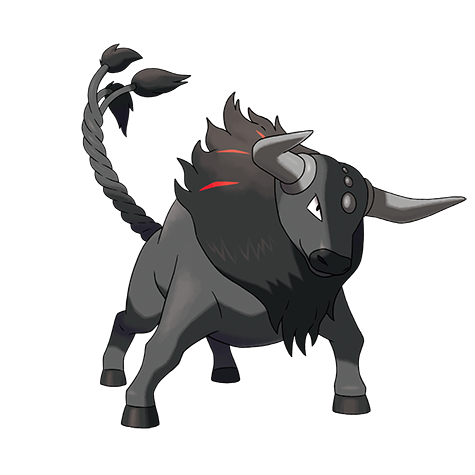
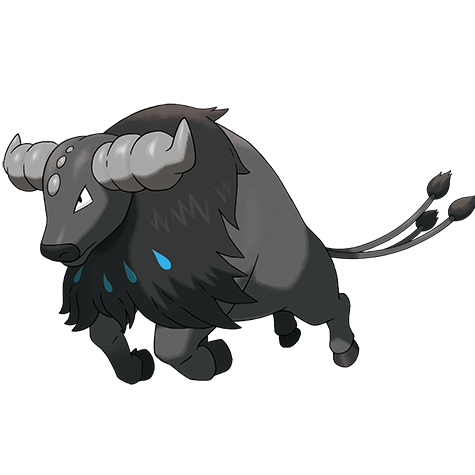
Tauros also has 3 related forms: Paldean Combat Breed Tauros, Paldean Blaze Breed Tauros and Paldean Aqua Breed Tauros.
Tauros Evolution, Mega Evolution & Special Forms
Tauros stands unique in the Pokémon franchise as a species with no evolutionary relatives—it does not evolve from any Pokémon nor evolve into any successor form in its base Kantonian state. This singular position in its evolutionary line has been a defining characteristic since its introduction in Generation I, setting it apart from the vast majority of Pokémon that feature branching or linear evolution chains. However, the introduction of regional variants in Pokémon Scarlet and Violet fundamentally altered this paradigm by introducing three distinct Paldean Tauros forms that represent dramatic typological and statistical divergences from the original. The Combat Breed abandons Normal typing entirely, becoming pure Fighting-type while increasing its Attack to 110 and Defense to 105, making it a more specialized physical attacker. The Blaze Breed adopts Fighting and Fire typing, reflecting environmental adaptation to warmer Paldean regions, while the Aqua Breed takes on Fighting and Water typing, presumably adapted to aquatic territories. Though technically not true evolutions in the traditional sense—Paldean Tauros remain distinct regional variants rather than evolutionary stages—these forms represent the closest thing to evolutionary development the species has experienced, allowing players to experience Tauros in fundamentally different battle contexts.
Where to Find
Kanto Safari Zone
kanto
+11 more
Johto Route 38
johto
+11 more
Johto Route 39
johto
+15 more
Sinnoh Route 210
sinnoh
+3 more
Sinnoh Route 209
sinnoh
+1 more
Johto Safari Zone
johto
+9 more
Johto Route 48
johto
+1 more
Kalos Route 12
kalos
+5 more
Poni Plains
alola
+29 more
Paniola Ranch
alola
+5 more
Poni Gauntlet
alola
Kanto Route 15
kanto
Kanto Route 14
kanto
Tauros Behaviour and Natural Habitat
Tauros exhibits a temperament that is as aggressive and uncompromising as its physical appearance suggests, driven by an almost primal need for constant conflict and exertion. According to Alpha Sapphire and Ruby Pokédex entries, if Tauros cannot find an opponent to battle, it will charge at and knock down thick trees to satisfy its overwhelming compulsion for rampaging, demonstrating that its aggression is not merely situational but an intrinsic aspect of its nature. These wild bulls inhabit herds where they establish dominance through violent confrontations with fellow herd members, with battle-scarred horns serving as badges of honor and proof of strength within the group hierarchy. The species thrives in open plains and grassland environments where it can freely charge at full speed, and its need for constant stimulation makes it unsuitable for confined spaces. Tauros is highly territorial and will not tolerate perceived challenges to its dominance, making encounters with this species potentially dangerous for trainers unfamiliar with its volatile behavior. The Yellow version Pokédex entry provides perhaps the most telling description: once a Tauros begins running, it will not stop until it hits something, an apt metaphor for its relentless pursuit of its goals.
Pokedex Entries
When it targets an enemy, it charges furiously while whipping its body with its long tails.
A rowdy POKéMON with a lot of stamina. Once running, it won't stop until it hits something.
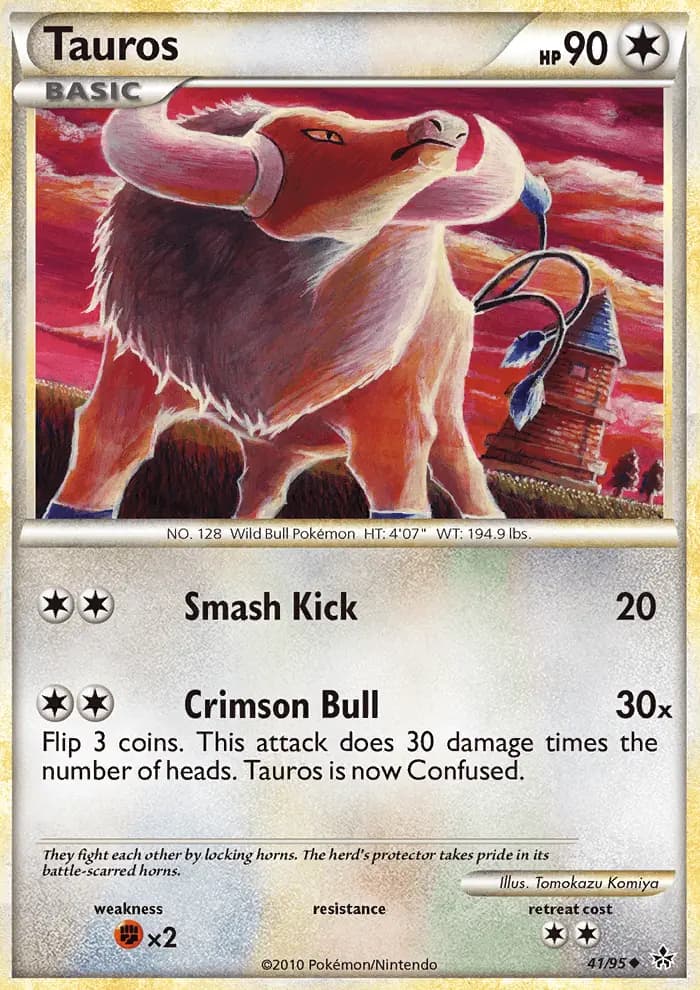
They fight each other by locking horns. The herd's protector takes pride in its bat tle-scarred horns.
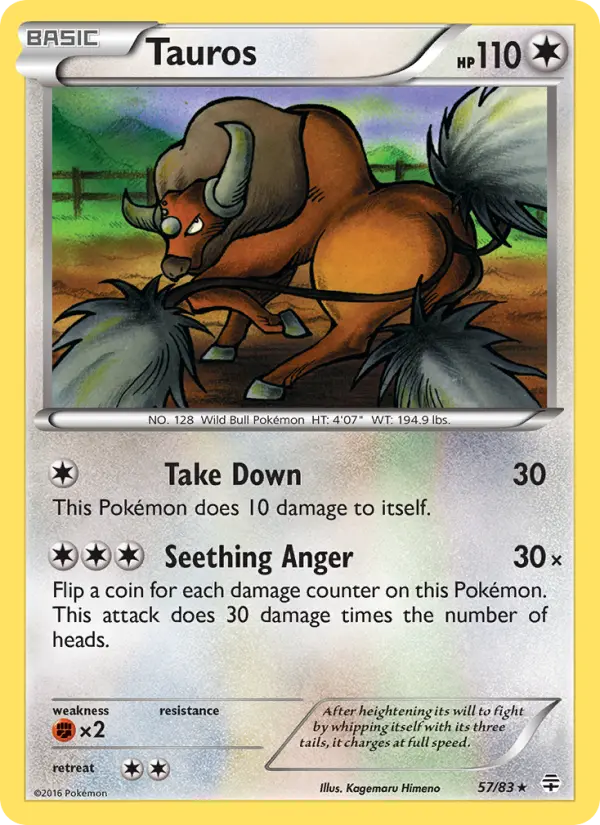
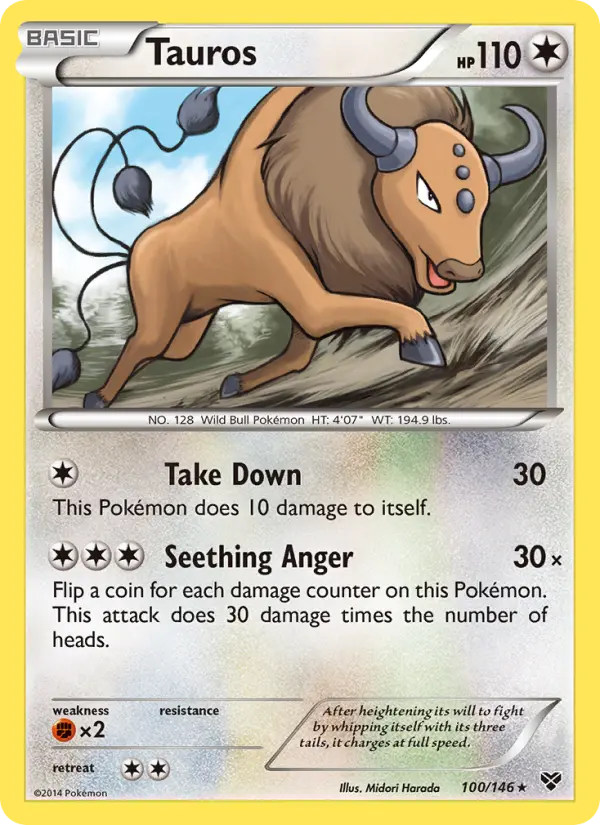
After heightening its will to fight by whipping itself with its three tails, it charges at full speed.
These violent POKéMON fight with other mem bers of their herd in order to prove their strength.
This POKéMON is not satisfied unless it is rampaging at all times. If there is no opponent for TAUROS to battle, it will charge at thick trees and knock them down to calm itself.
It is not satisfied unless it is rampaging at all times. If there is no opponent for TAUROS to battle, it will charge at thick trees and knock them down to calm itself.
When it is about to TACKLE, it whips its body repeatedly with its three long tails.
When it targets an enemy, it charges furiously while whipping its body with its long tails.
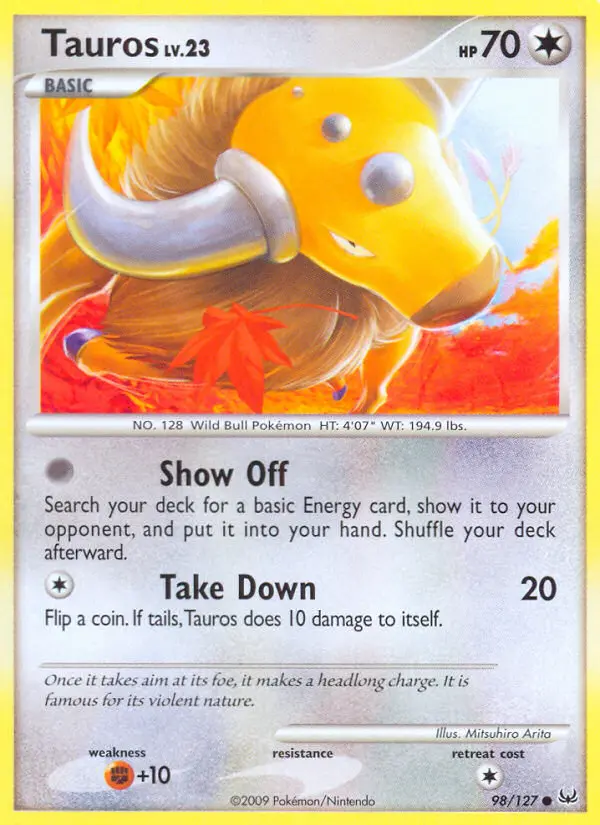
Once it takes aim at its foe, it makes a headlong charge. It is famous for its violent nature.
They fight each other by locking horns. The herd’s protector takes pride in its battle-scarred horns.
After heightening its will to fight by whipping itself with its three tails, it charges at full speed.
Once it takes aim at its foe, it makes a headlong charge. It is famous for its violent nature.
Once it takes aim at its foe, it makes a headlong charge. It is famous for its violent nature.
After heightening its will to fight by whipping itself with its three tails, it charges at full speed.
When it is about to tackle, it whips its body repeatedly with its three long tails.
This Pokémon is not satisfied unless it is rampaging at all times. If there is no opponent for Tauros to battle, it will charge at thick trees and knock them down to calm itself.
Historically, people in areas all over the world have ridden Tauros, but the practice is said to have started in Alola.
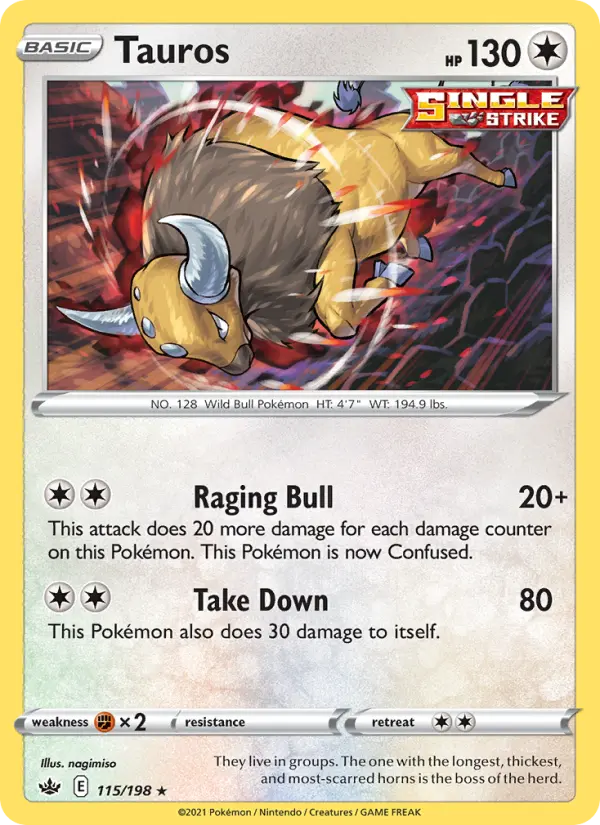
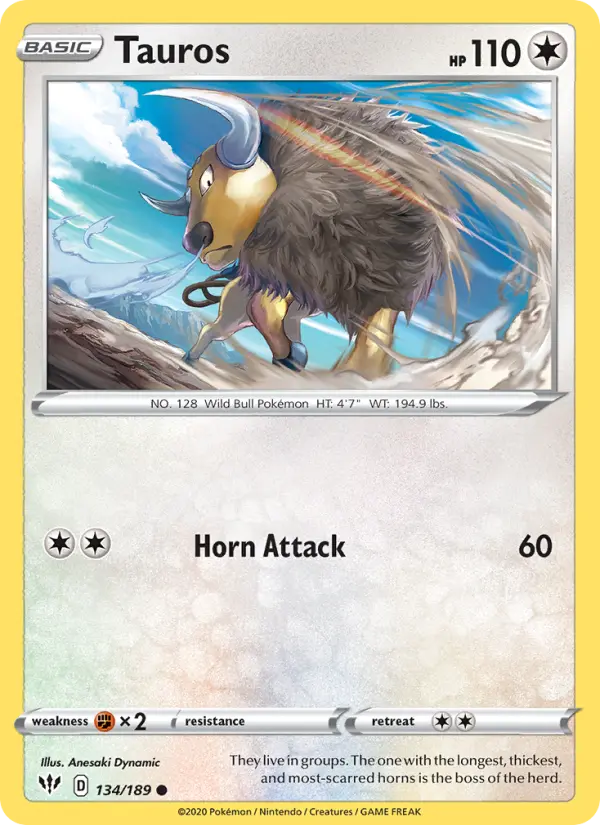
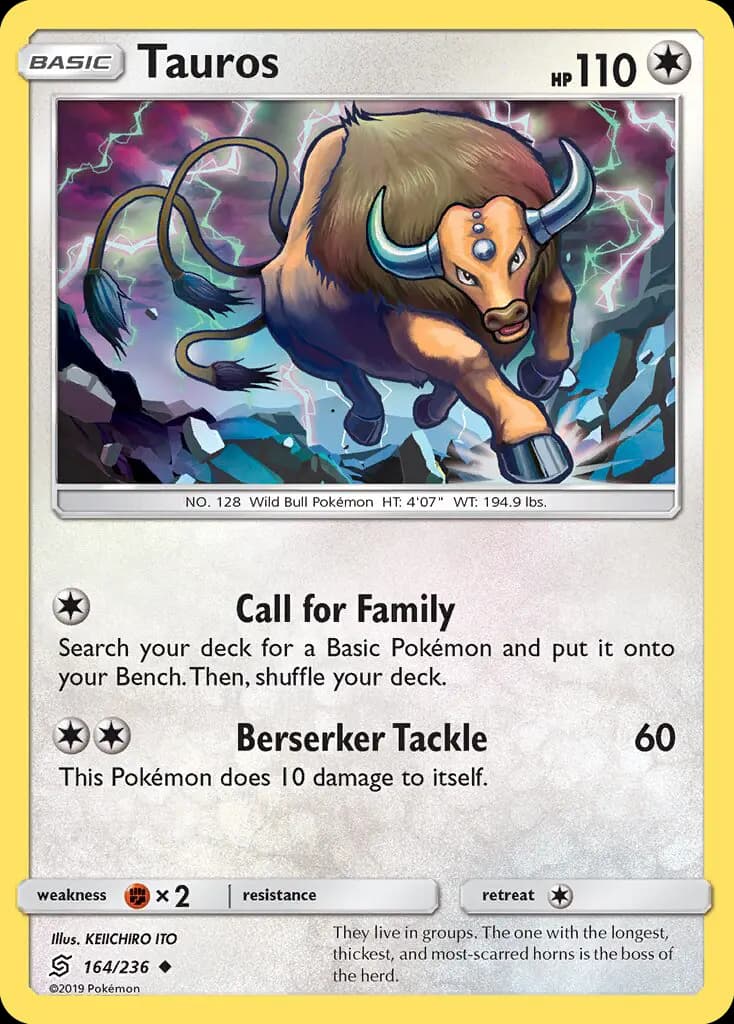
They live in groups. The one with the longest, thickest, and most-scarred horns is the boss of the herd.
Although it’s known to be a fierce Pokémon, Tauros in the Alola region are said to possess a measure of calmness.
The climate seems to be related to the reason Tauros in Alola are a little calmer than those in other regions.
A rowdy Pokémon with a lot of stamina. Once running, it won’t stop until it hits something.
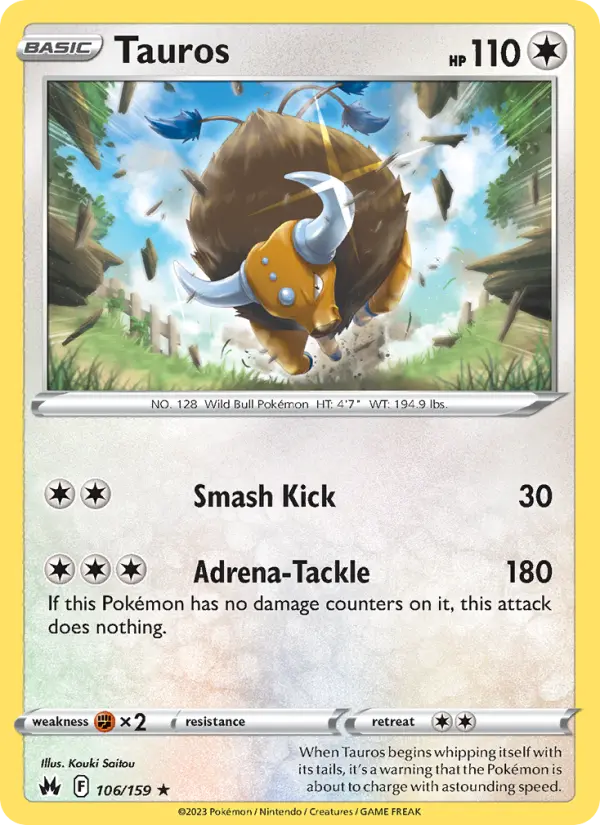
When Tauros begins whipping itself with its tails, it’s a warning that the Pokémon is about to charge with astounding speed.
The Tauros of the Galar region are volatile in nature, and they won’t allow people to ride on their backs.
Tauros Name Origin & Design Inspiration
The name Tauros derives directly from the Latin word 'taurus,' meaning bull, with the phonetic adaptation maintaining the classical reference while fitting Pokémon's characteristic naming conventions. The Japanese name Kentauros displays an even more explicit etymological connection, referencing the Centaur—the legendary half-human, half-horse creature from Greek mythology, though Tauros itself is purely equine in form without any humanoid aspects. The design itself is a straightforward interpretation of an aggressive, muscular bull accentuated by exaggerated features that emphasize its combative nature: the three tails are perhaps the most unconventional aspect, serving as a visual signature that differentiates it from typical bovine representations while providing narrative justification for its self-whipping behavior described in Pokédex entries. The pronounced curved horns and intense facial expression communicate an unwavering battle readiness that informs the viewer of the species' temperament before any interaction occurs. The color palette of brownish hides with darker manes reflects authentic bovine coloration, grounding the design in naturalistic aesthetics despite the fantastical elements. In the Paldean forms, the design philosophy evolves dramatically—the Combat Breed becomes more humanoid and martial arts-focused, the Blaze Breed incorporates fire-inspired coloration and design elements, and the Aqua Breed features more aquatic aesthetic choices, demonstrating how the same core concept can be reinterpreted across different environmental and cultural contexts.
Learnable Moves
Tauros can learn 76 moves:
Move | Type | Cat. | Power | Acc. | PP |
|---|---|---|---|---|---|
| assurance | dark | Physical | 60 | 100 | 10 |
| attract | normal | Status | — | 100 | 15 |
| bide | normal | Physical | — | — | 10 |
| blizzard | ice | Special | 110 | 70 | 5 |
| body slam | normal | Physical | 85 | 100 | 15 |
| close combat | fighting | Physical | 120 | 100 | 5 |
| curse | ghost | Status | — | — | 10 |
| dig | ground | Physical | 80 | 100 | 10 |
| double team | normal | Status | — | — | 15 |
| double edge | normal | Physical | 120 | 100 | 15 |
| earthquake | ground | Physical | 100 | 100 | 10 |
| endeavor | normal | Physical | — | 100 | 5 |
| endure | normal | Status | — | — | 10 |
| facade | normal | Physical | 70 | 100 | 20 |
| fire blast | fire | Special | 110 | 85 | 5 |
| fissure | ground | Physical | — | 30 | 5 |
| flamethrower | fire | Special | 90 | 100 | 15 |
| focus energy | normal | Status | — | — | 30 |
| frustration | normal | Physical | — | 100 | 20 |
| giga impact | normal | Physical | 150 | 90 | 5 |
| headbutt | normal | Physical | 70 | 100 | 15 |
| helping hand | normal | Status | — | — | 20 |
| hidden power | normal | Special | 60 | 100 | 15 |
| horn attack | normal | Physical | 65 | 100 | 25 |
| horn drill | normal | Physical | — | 30 | 5 |
| hyper beam | normal | Special | 150 | 90 | 5 |
| ice beam | ice | Special | 90 | 100 | 10 |
| icy wind | ice | Special | 55 | 95 | 15 |
| iron head | steel | Physical | 80 | 100 | 15 |
| iron tail | steel | Physical | 100 | 75 | 15 |
| leer | normal | Status | — | 100 | 30 |
| megahorn | bug | Physical | 120 | 85 | 10 |
| mimic | normal | Status | — | — | 10 |
| natural gift | normal | Physical | — | 100 | 15 |
| outrage | dragon | Physical | 120 | 100 | 10 |
| payback | dark | Physical | 50 | 100 | 10 |
| protect | normal | Status | — | — | 10 |
| pursuit | dark | Physical | 40 | 100 | 20 |
| rage | normal | Physical | 20 | 100 | 20 |
| rain dance | water | Status | — | — | 5 |
| rest | psychic | Status | — | — | 5 |
| return | normal | Physical | — | 100 | 20 |
| revenge | fighting | Physical | 60 | 100 | 10 |
| reversal | fighting | Physical | — | 100 | 15 |
| rock climb | normal | Physical | 90 | 85 | 20 |
| rock slide | rock | Physical | 75 | 90 | 10 |
| rock smash | fighting | Physical | 40 | 100 | 15 |
| role play | psychic | Status | — | — | 10 |
| sandstorm | rock | Status | — | — | 10 |
| scary face | normal | Status | — | 100 | 10 |
| shadow ball | ghost | Special | 80 | 100 | 15 |
| skull bash | normal | Physical | 130 | 100 | 10 |
| sleep talk | normal | Status | — | — | 10 |
| snore | normal | Special | 50 | 100 | 15 |
| solar beam | grass | Special | 120 | 100 | 10 |
| spite | ghost | Status | — | 100 | 10 |
| stomp | normal | Physical | 65 | 100 | 20 |
| stone edge | rock | Physical | 100 | 80 | 5 |
| strength | normal | Physical | 80 | 100 | 15 |
| substitute | normal | Status | — | — | 10 |
| sunny day | fire | Status | — | — | 5 |
| surf | water | Special | 90 | 100 | 15 |
| swagger | normal | Status | — | 85 | 15 |
| tackle | normal | Physical | 40 | 100 | 35 |
| tail whip | normal | Status | — | 100 | 30 |
| take down | normal | Physical | 90 | 85 | 20 |
| thief | dark | Physical | 60 | 100 | 25 |
| thrash | normal | Physical | 120 | 100 | 10 |
| thunder | electric | Special | 110 | 70 | 10 |
| thunderbolt | electric | Special | 90 | 100 | 15 |
| toxic | poison | Status | — | 90 | 10 |
| uproar | normal | Special | 90 | 100 | 10 |
| water pulse | water | Special | 60 | 100 | 20 |
| whirlpool | water | Special | 35 | 85 | 15 |
| zap cannon | electric | Special | 120 | 50 | 5 |
| zen headbutt | psychic | Physical | 80 | 90 | 15 |
Tauros Competitive Battle Guide
Looking at its competitive profile, Tauros has maintained relevance across multiple generations despite its relatively modest cumulative stat total of 490, primarily due to the synergy between its exceptional Attack and Speed statistics. With an Attack base stat of 100 and Speed of 110, Tauros functions as a fast physical attacker capable of striking before most opponents and delivering significant damage before potential retaliation. Its two standard abilities offer distinct strategic advantages: Intimidate reduces an opponent's Attack stat upon entry, which is particularly valuable against physical attackers and can shift the momentum of early-game exchanges; Anger Point, conversely, raises Attack to maximum when Tauros survives a critical hit, potentially creating a devastating sweeping scenario from what appeared to be an opponent's advantage. The hidden ability Sheer Force amplifies the power of moves with secondary effects to 1.3 times their normal damage while eliminating those effects, creating a specialized moveset around moves like Earthquake, Stone Edge, and Close Combat. Tauros's movepool access includes essential physical attacks like Close Combat, Earthquake, and Head Charge, supplemented by coverage moves that allow it to address various threats. However, its weaknesses are substantial—Normal-type Pokémon have no immunity and receive reduced damage only from Ghost types, meaning Tauros struggles against Ghost-type opponents and lacks any advantageous matchups beyond neutral coverage. The Paldean Combat Breed variant represents a significant competitive upgrade, gaining Fighting typing and marginally improved stats, making it a more viable option in modern competitive formats where the metagame has evolved to punish Pokémon with fundamental type disadvantages.
Commonly Asked Questions About Tauros
What type is Tauros?
Tauros is a normal type Pokemon.
What does Tauros evolve from?
Tauros does not evolve.
What are Tauros's weaknesses?
Tauros is weak to fighting type moves.
Where can I find Tauros?
Tauros can be found in kanto safari zone (kanto), johto route 38 (johto) and johto route 39 (johto) and 10 other locations.
Tauros Cultural Impact & Franchise History
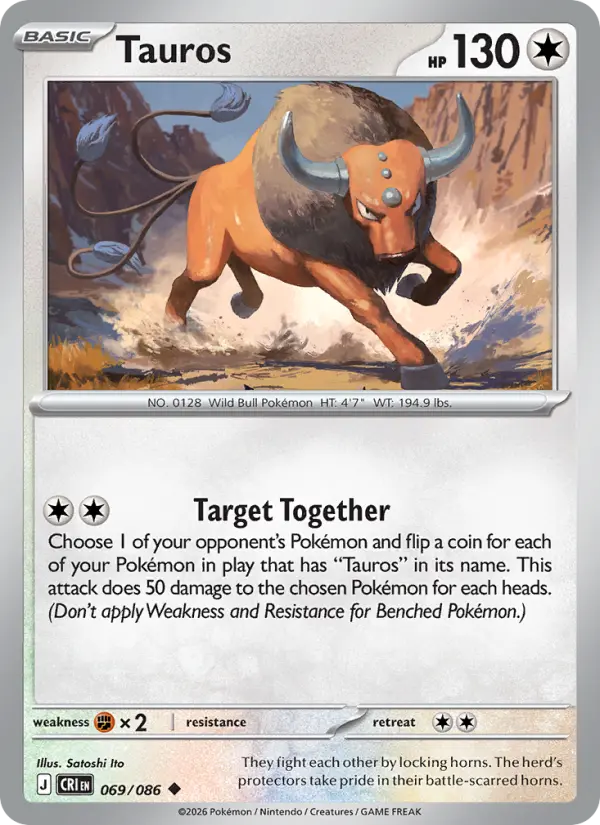
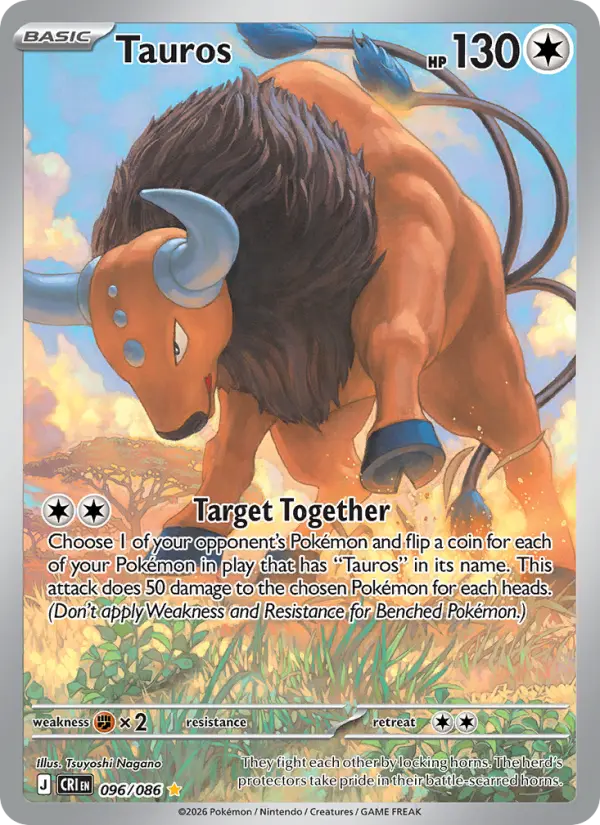
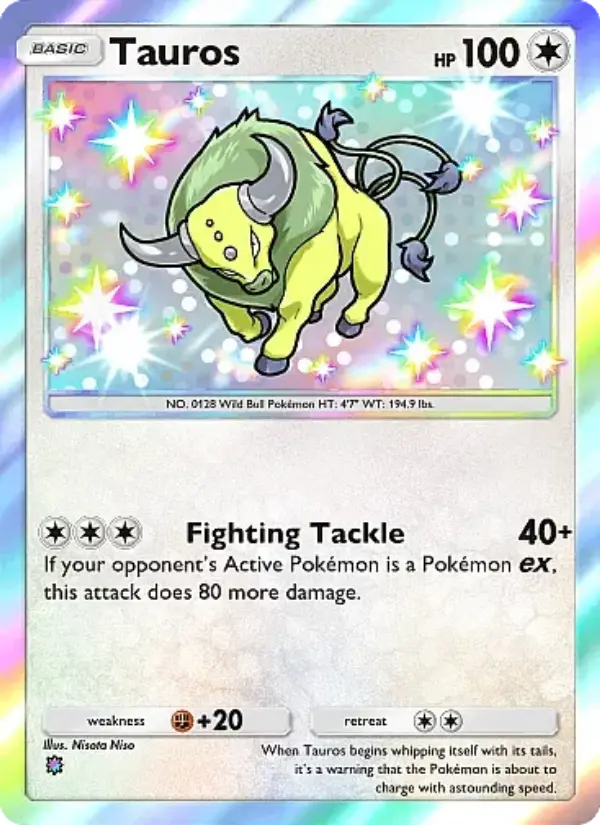
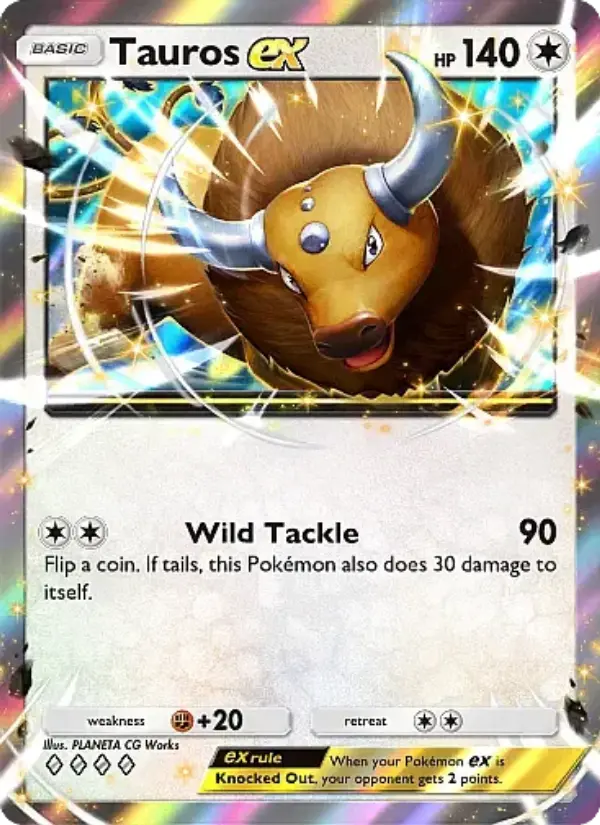
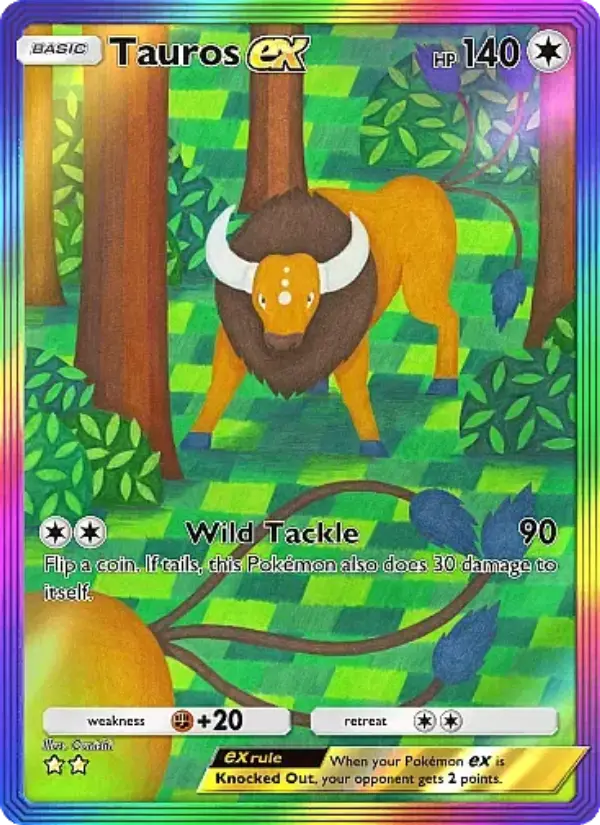
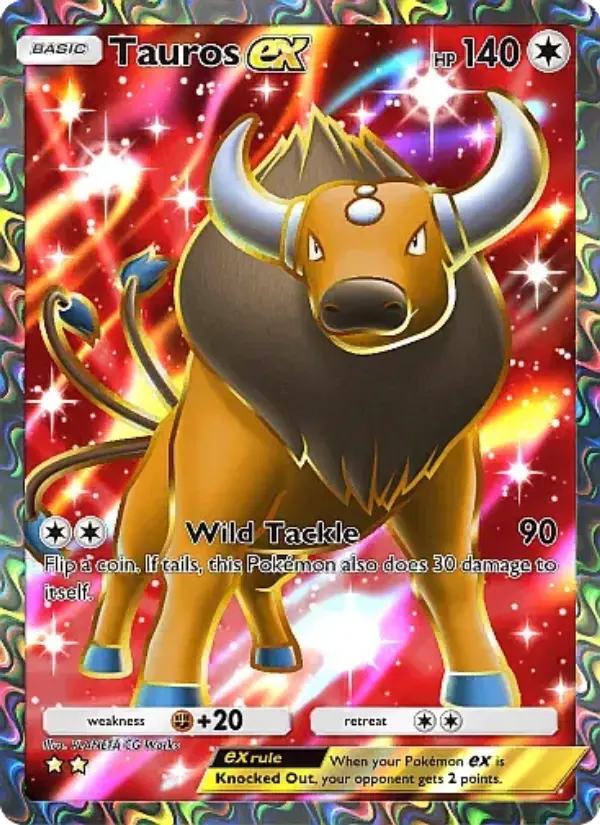
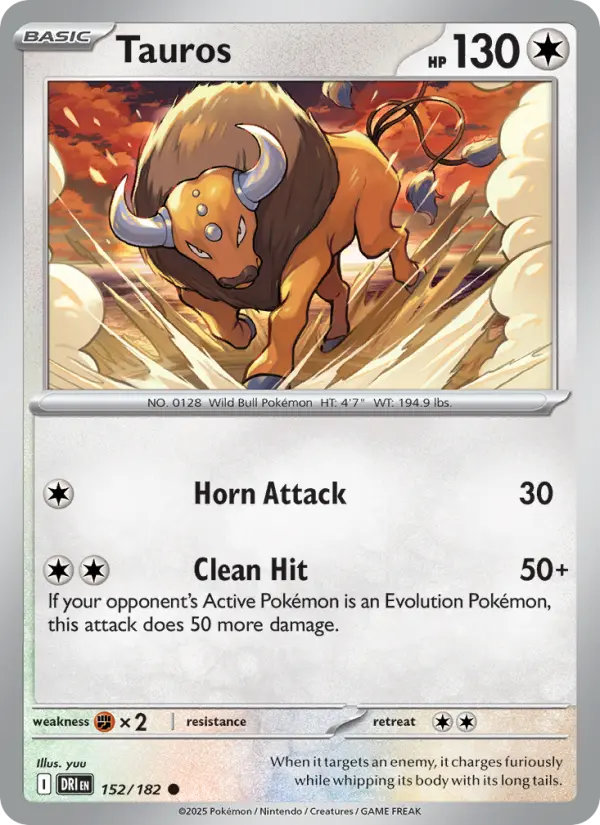
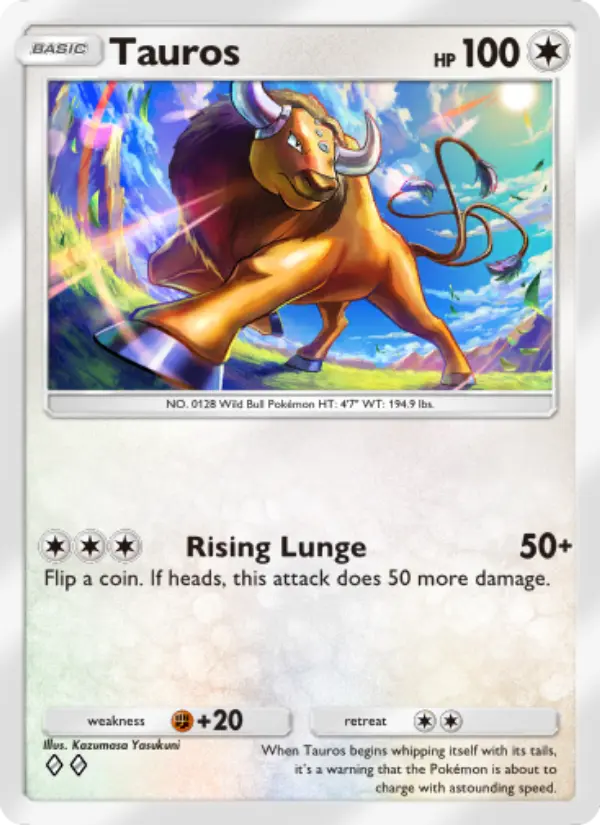
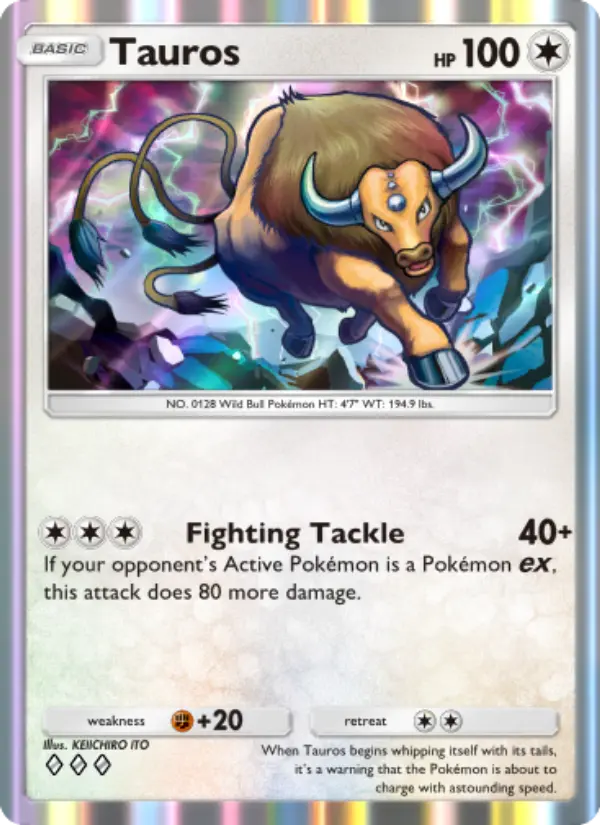
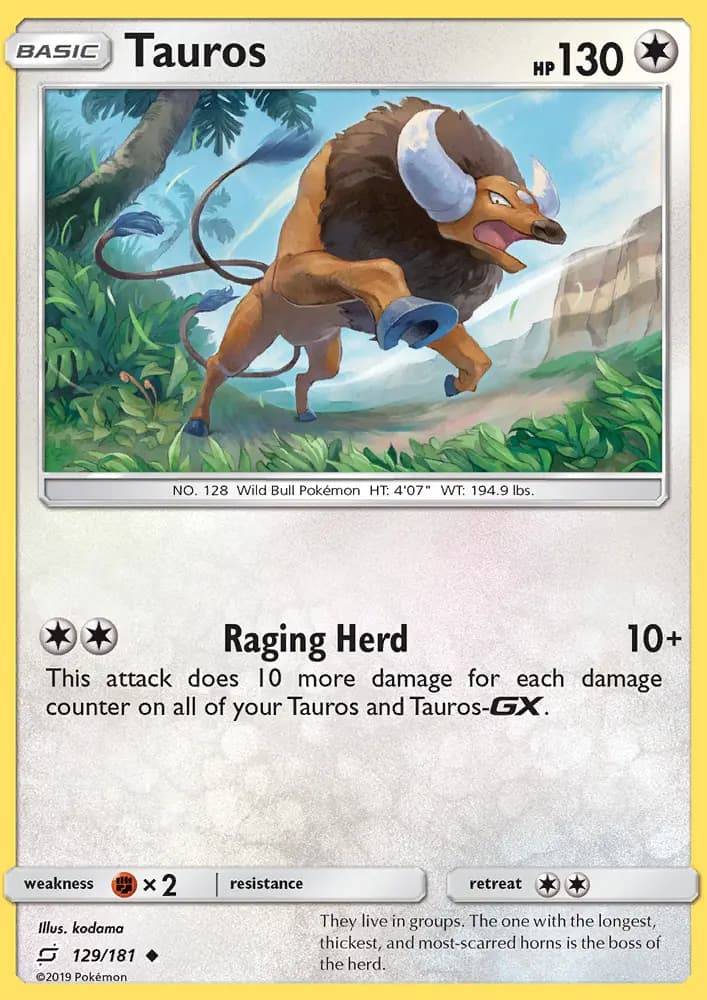
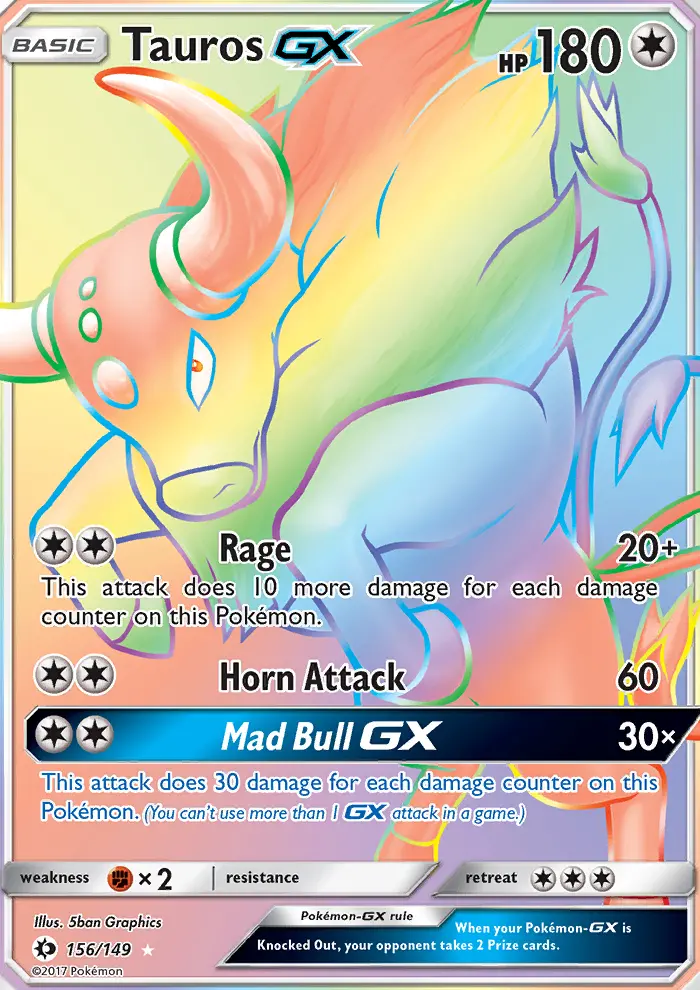
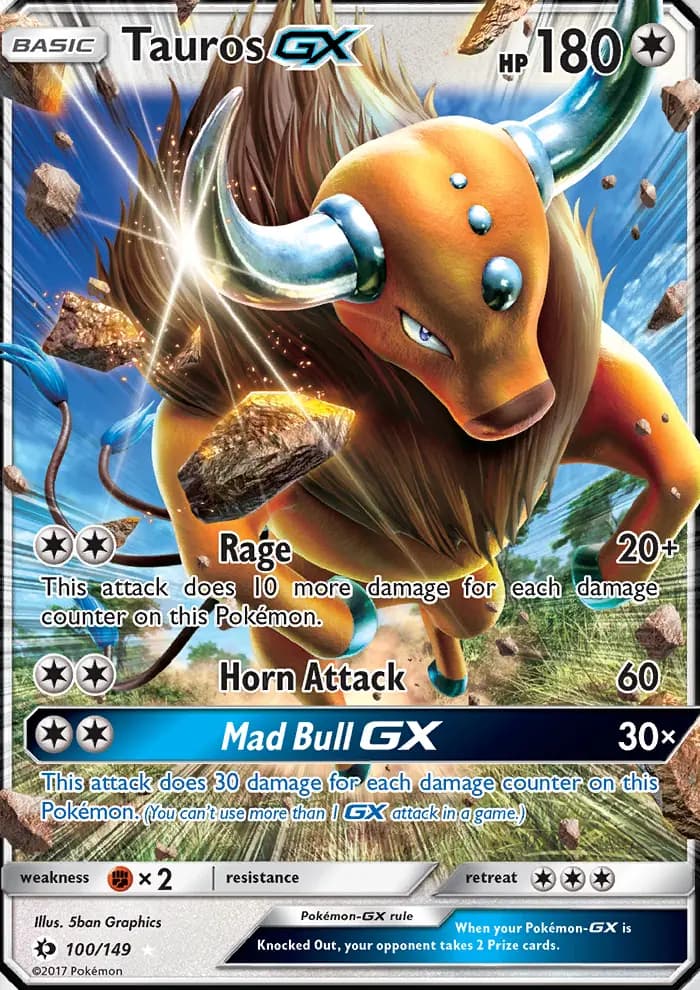
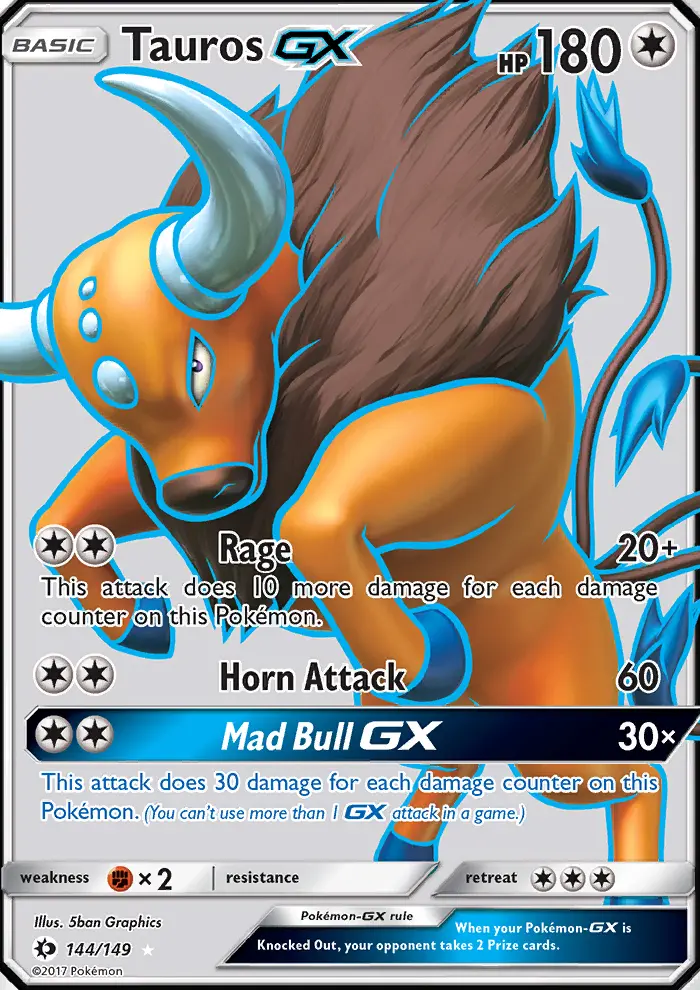
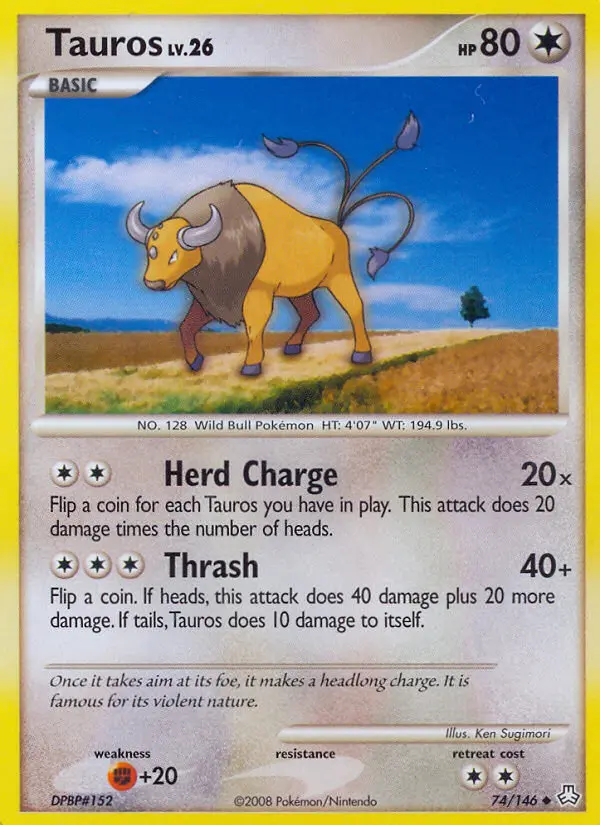
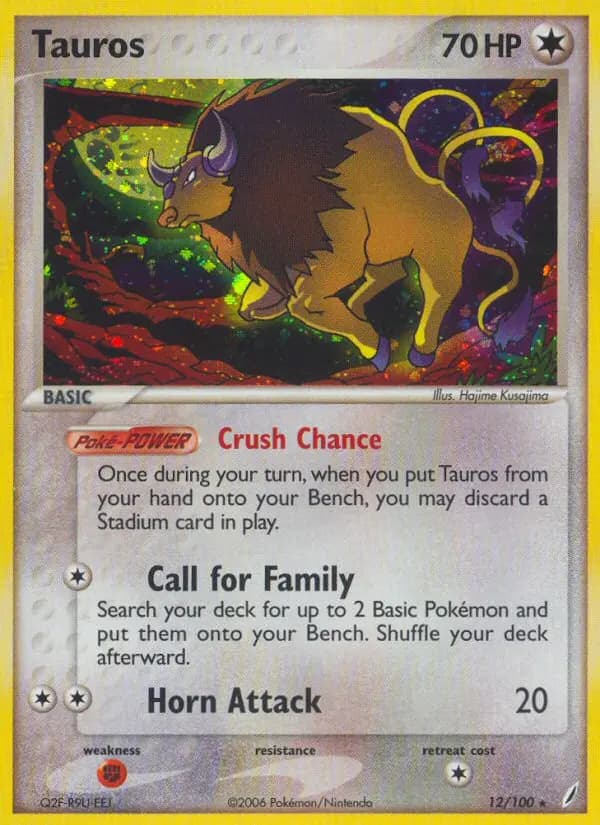
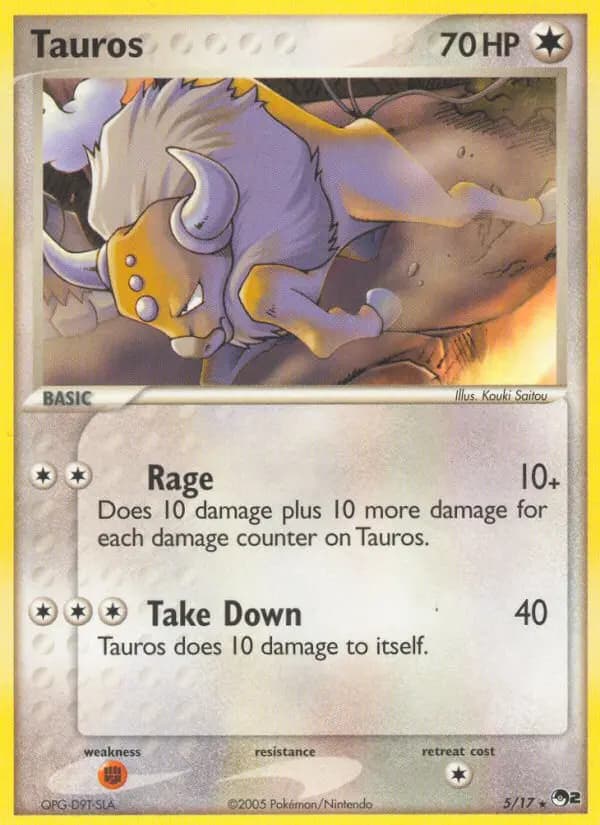
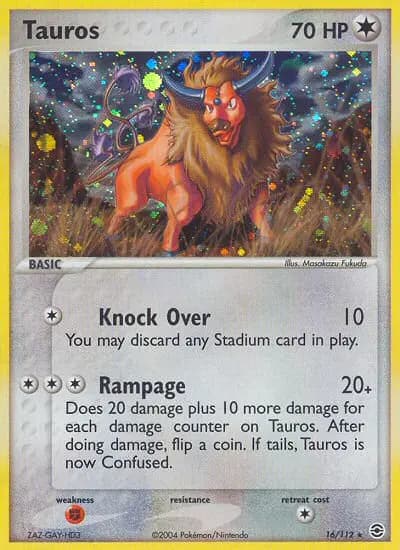
Tauros has maintained a consistent cultural presence since its introduction in Generation I, cementing itself as one of the franchise's most recognizable Pokémon despite not achieving the legendary status of creatures like Charizard or Dragonite. Its distinctive bull design and aggressive personality have made it a popular choice for trainers seeking a powerful physical attacker, and it has appeared prominently in the animated series, competitive tournaments, and numerous spin-off games throughout its three-decade existence. The species became particularly memorable in the anime when Ash's rival Gary Oak prominently featured Tauros as a powerful team member, establishing it as a prestigious Pokémon in the show's world. The all-male gender ratio, while potentially frustrating from a gameplay perspective, has become a quirky distinctive trait that fans recognize and appreciate as part of Tauros's identity—alongside its counterpart Miltank, an all-female species, the pair demonstrates the franchise's willingness to explore unconventional biological characteristics. The recent introduction of Paldean regional variants has reinvigorated Tauros's cultural relevance, introducing new players to the species while providing existing fans with fresh interpretations that honor the original design while expanding its competitive viability. Tauros merchandise, from plushies to trading cards, remains readily available and sought-after by collectors, testament to its enduring appeal across the franchise's demographic spectrum.
Where to Find Tauros in Every Pokémon Game
Tauros's availability has fluctuated significantly across the various Pokémon games, reflecting its status as a region-specific Pokémon rather than a universally common encounter. In the original Red and Blue versions, Tauros appears in the Kanto region as a moderately rare encounter, primarily found in Route 15 and grassland areas with a capture rate of 45, making it a challenging but achievable catch for most players. Throughout the subsequent generations, its availability has been regionally determined—it appeared in Gold and Silver's Johto region, was accessible in FireRed and LeafGreen's Kanto remake, and subsequently became available in various regions across subsequent generations. In Pokémon X and Y, it appears in Coastal Kalos, while Sun and Moon made it available in the expanded Alola Pokédex. The pivotal shift came with Pokémon Scarlet and Violet, where Tauros became available in the Paldea region at National Pokédex number 223, and crucially, the game introduced the three Paldean regional variants that can be encountered and caught throughout the region's open-world environments. Players searching for Tauros in contemporary games can find it through various methods—wild encounters in appropriate biomes, breeding with compatible species in the Field egg group, and trading with other players. The Isle of Armor DLC for Pokémon Sword and Shield and The Indigo Disk DLC similarly provide access, maintaining Tauros's availability for players across modern platforms. For those seeking the Paldean variants specifically, Scarlet and Violet offer the most direct encounter opportunities, though players can transfer Pokémon forward through Pokémon Home if engaging with multiple game versions.