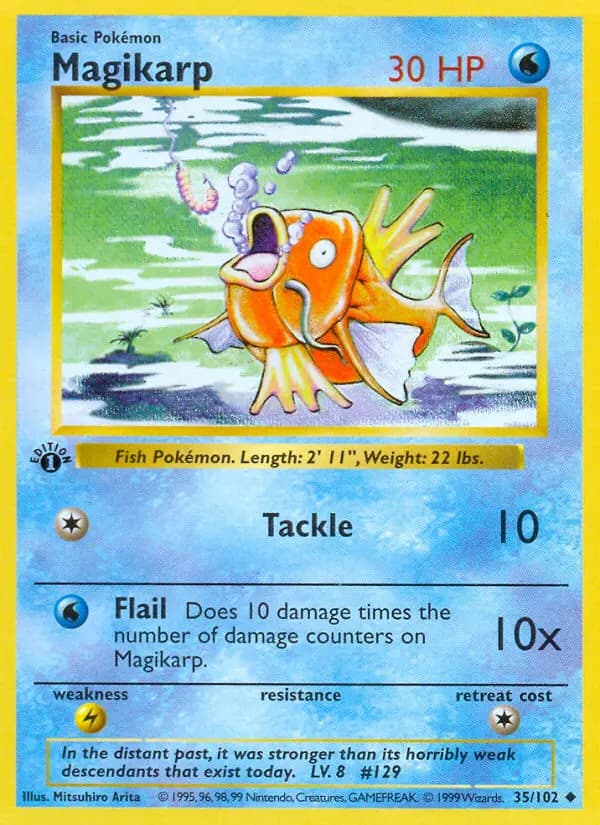
Magikarp
Generation I · #0129 — Fish Pokémon
Magikarp's profile is easy to undersell: 0.9 m, 10 kg, and a water typing that doesn't scream power — until you look at its Speed of 80. Despite its abysmal combat statistics and reputation, Magikarp carries profound significance within Pokémon lore and culture, embodying themes of perseverance and hidden potential. The species' most remarkable characteristic is its evolution into the formidable Gyarados at level 20, a transformation that mirrors ancient Chinese mythology and has made Magikarp a beloved symbol of transformation and growth among trainers worldwide.
Editor's Take
Magikarp's stats are a genuine joke in-game (one of the lowest total base stats of any Pokémon), but Gyarados on the other side of that evolution is a reminder that Game Freak has used 'objectively bad Pokémon' as a deliberate design tool more than once.
Base Stats
Height
0.9m
Weight
10.0kg
Category
Fish Pokémon
Gender
Male 50% / Female 50%
Color
red
Shape
fish
Habitat
waters-edge
Abilities
Doubles Speed during rain.
Raises Speed one stage upon being hit by a dark, ghost, or bug move.

Magikarp Biology & Physical Characteristics
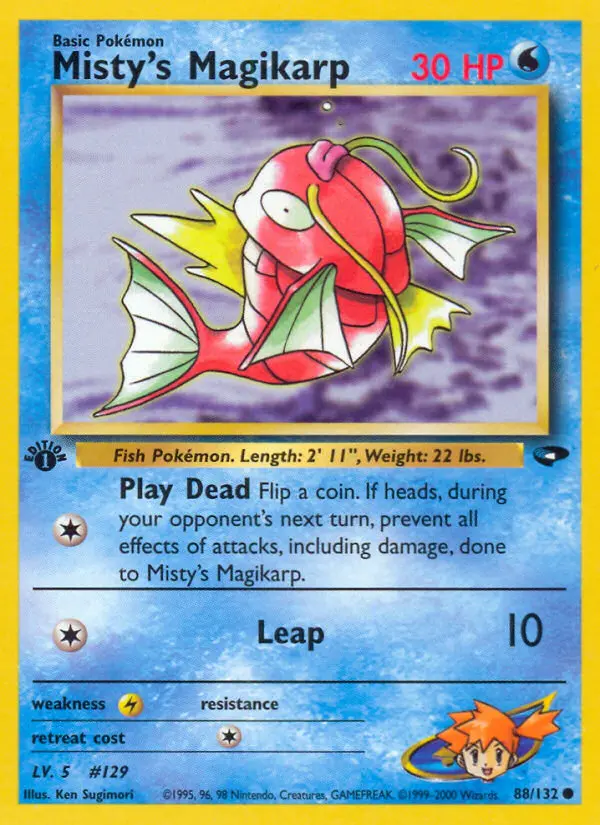
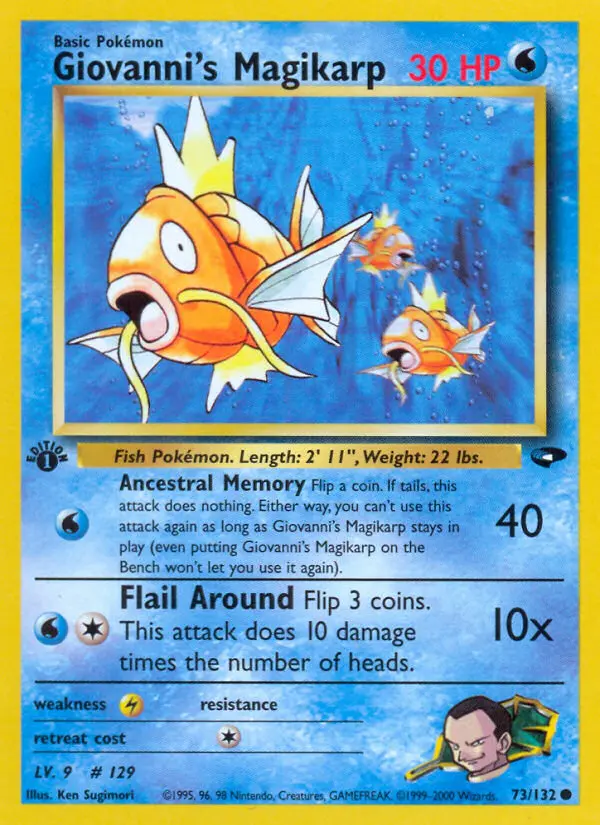
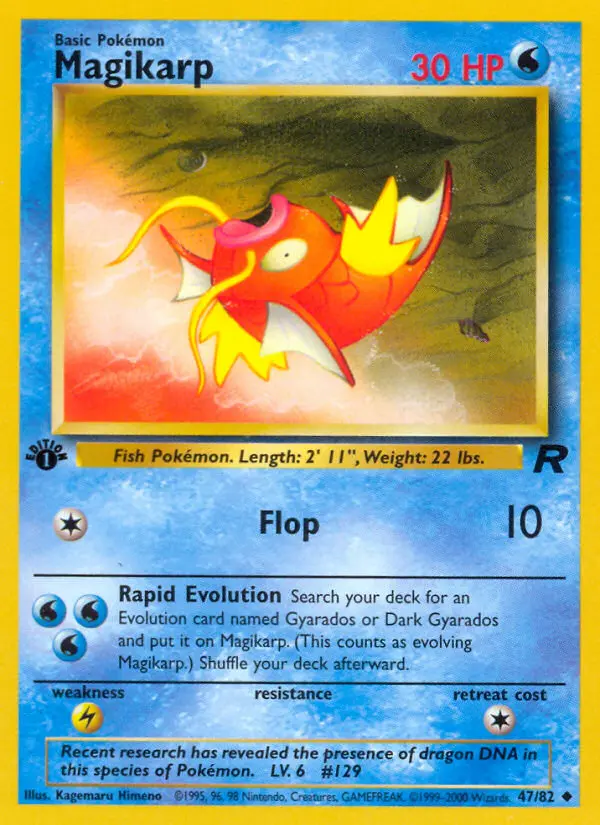
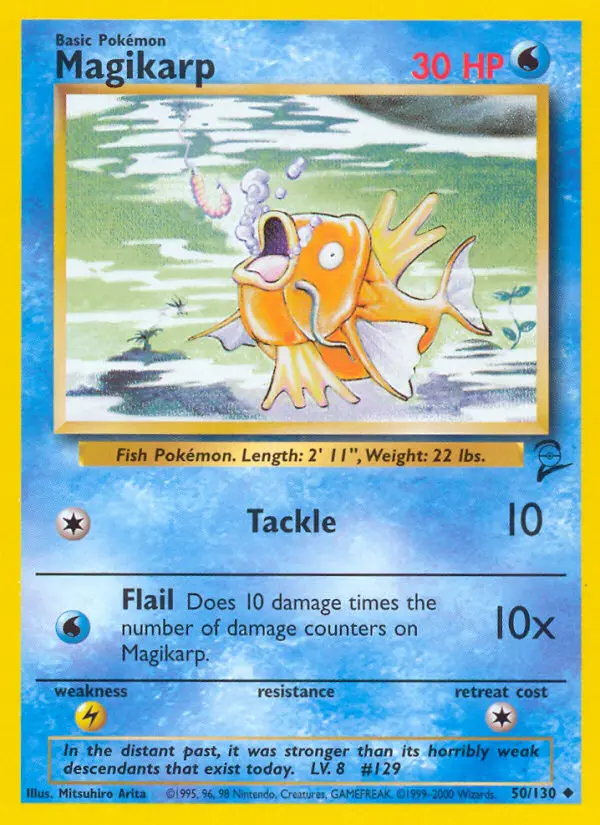
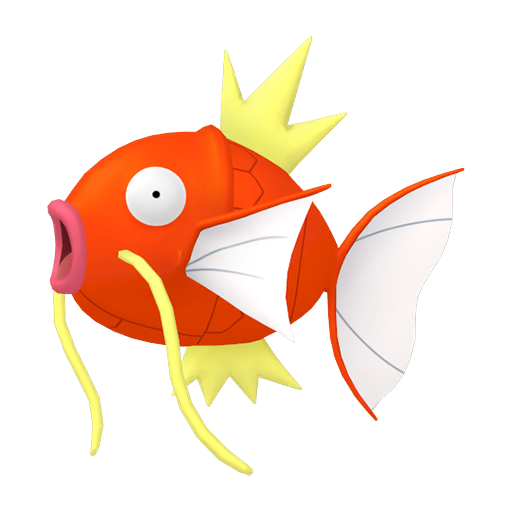
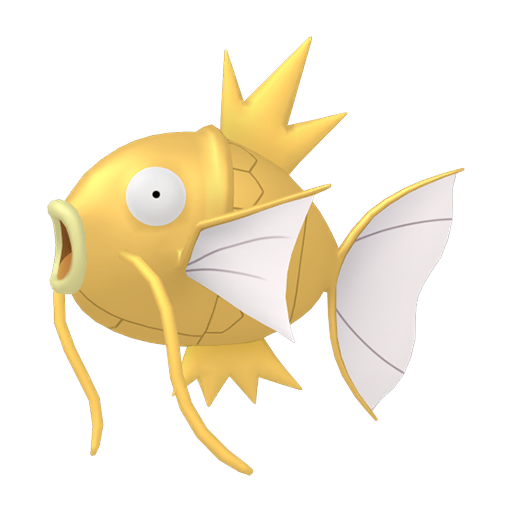
Magikarp is a small, piscine Pokémon measuring 0.9 meters in height and weighing approximately 10.0 kilograms, making it one of the tiniest creatures in aquatic ecosystems. Its body is primarily reddish-orange in coloration, covered in large, heavy scales that give it a somewhat ungainly appearance. The Pokémon features prominent yellow fins—a three-peaked dorsal fin resembling a crown on its back, an identical fin on its underside, and distinctive white pectoral fins. Perhaps most notably, Magikarp possesses long barbels extending from its face; these sensory appendages are white on females and pale yellow on males, serving as useful identifiers for distinguishing between genders. Despite its current frailty, scientific research suggests that Magikarp's ancestors possessed considerably greater strength than their modern descendants, implying a dramatic devolution over evolutionary time. Remarkably, long-lived Magikarp specimens develop the ability to harness immense splashing power, enabling them to leap high enough to scale mountains, while their hardy physiology allows them to survive in virtually any body of water, regardless of pollution levels.
Pokedex Numbers
Training
Breeding
Magikarp Breeding, Gender Ratio & Egg Groups
Magikarp has one of the simplest gender ratios in the game — a flat 50/50, ensuring that both genders appear with equal frequency in the wild and are equally viable for breeding purposes. Female Magikarp can be distinguished from males by examining their barbels, which are white, whereas male barbels display a pale yellow coloration. The species belongs to both the Water 2 and Dragon egg groups, a designation that reflects its connection to dragon-type Pokémon through its evolution into the draconic Gyarados. This dual egg group placement allows Magikarp to breed with a diverse array of compatible Pokémon, making it a versatile choice for breeding projects aimed at creating specific movesets or inheriting beneficial traits. The species has a base happiness value of 70, indicating a reasonable starting friendship level with newly caught or hatched specimens. Magikarp eggs require five cycles to hatch, translating to approximately 1,029 to 1,285 steps of travel, making breeding Magikarp a relatively efficient process compared to many other Pokémon species.
Sprites




TMs & HMs
tm142
scarlet violet
tr03
sword shield
tm142
the indigo disk
tm52
sword shield
Gender Differences
This Pokémon has visible differences between male and female forms.
Magikarp's Evolution Chain


Magikarp Evolution, Mega Evolution & Special Forms
Magikarp's evolution represents one of the most dramatic transformations in the entire Pokémon world, evolving into the powerful Water/Flying-type Gyarados upon reaching level 20. This metamorphosis is far from gradual; Magikarp undergoes a complete physiological restructuring that transforms it from a pathetic, floundering fish into a fearsome, serpentine dragon capable of devastating power. The evolution's symbolic significance draws deeply from ancient Chinese mythology, specifically the legend of the Dragon Gate, wherein a carp that successfully leaps over the mystical gate transforms into a mighty dragon. Gyarados embodies this mythological narrative perfectly, representing the culmination of Magikarp's hidden potential finally reaching its breaking point and unleashing the legendary power that lay dormant throughout its larval existence. This single evolution has made Magikarp one of the most sought-after Pokémon for trainers seeking to witness this spectacular transformation firsthand, turning the journey from weakness to strength into a rite of passage for countless Pokémon trainers. The contrast between Magikarp and Gyarados is so striking that many players find themselves emotionally invested in raising even a single Magikarp to experience this remarkable evolution.
Where to Find
Kanto Safari Zone
kanto
+20 more
Cerulean Cave
kanto
+3 more
Vermilion City
kanto
+20 more
Seafoam Islands
kanto
+3 more
Kanto Route 25
kanto
+12 more
Kanto Route 13
kanto
+14 more
Kanto Route 18
kanto
+2 more
Fuchsia City
kanto
+41 more
Kanto Route 23
kanto
Cinnabar Island
kanto
+9 more
Kanto Sea Route 19
kanto
+15 more
Kanto Route 10
kanto
+12 more
Kanto Route 12
kanto
+14 more
Viridian City
kanto
Kanto Route 4
kanto
Kanto Route 3
kanto
Cerulean City
kanto
+12 more
Celadon City
kanto
Pallet Town
kanto
+9 more
Kanto Route 6
kanto
+12 more
+71 more locations in other games
Magikarp Behaviour and Natural Habitat
Magikarp is famous throughout the Pokémon world for being extraordinarily unreliable and prone to seemingly purposeless behavior, jumping and splashing about in water bodies for no apparent reason. These erratic movements make the species particularly vulnerable to predators such as Pidgeotto, which easily catch Magikarp mid-jump. The Pokédex notes that this weak and pathetic Pokémon gets easily pushed along rivers when strong currents are present, highlighting its complete lack of aquatic mastery despite its aquatic nature. Magikarp can be found in virtually any freshwater or saltwater environment, swimming in seas, lakes, rivers, and even shallow puddles, demonstrating remarkable adaptability to diverse habitats. The species typically exhibits a placid demeanor punctuated by inexplicable bursts of activity, though these outbursts serve no discernible purpose in its survival or feeding patterns. In spite of its apparent incompetence, Magikarp's ability to persist in polluted waters and survive conditions that would exterminate other species suggests an underlying resilience that contradicts its weakling reputation.
Pokedex Entries
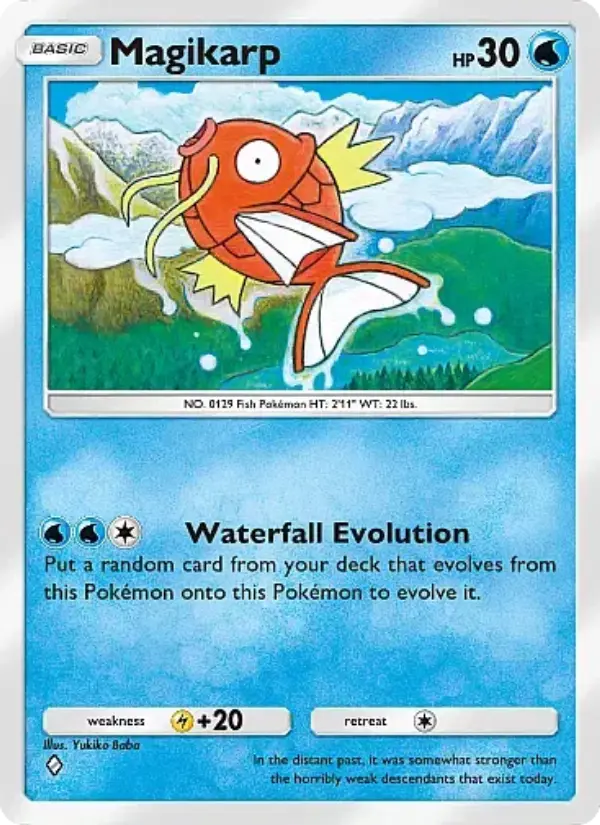
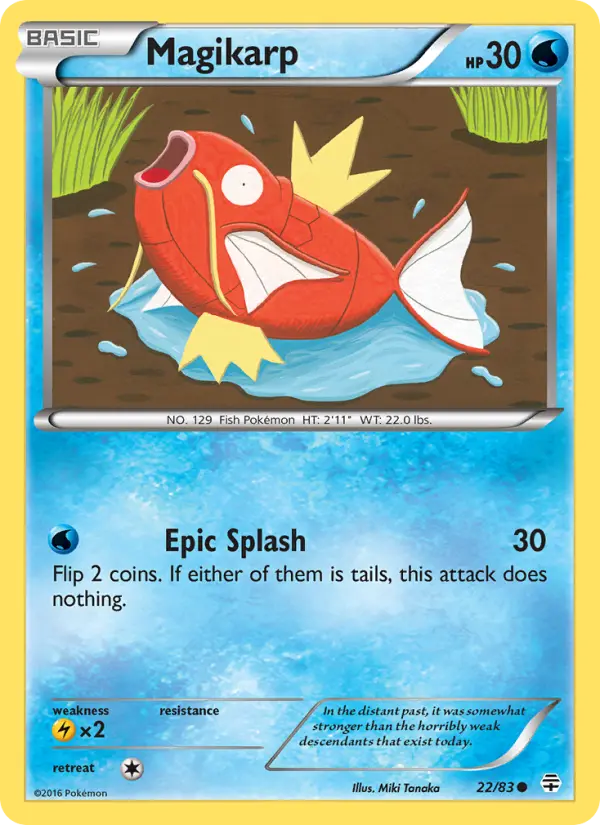
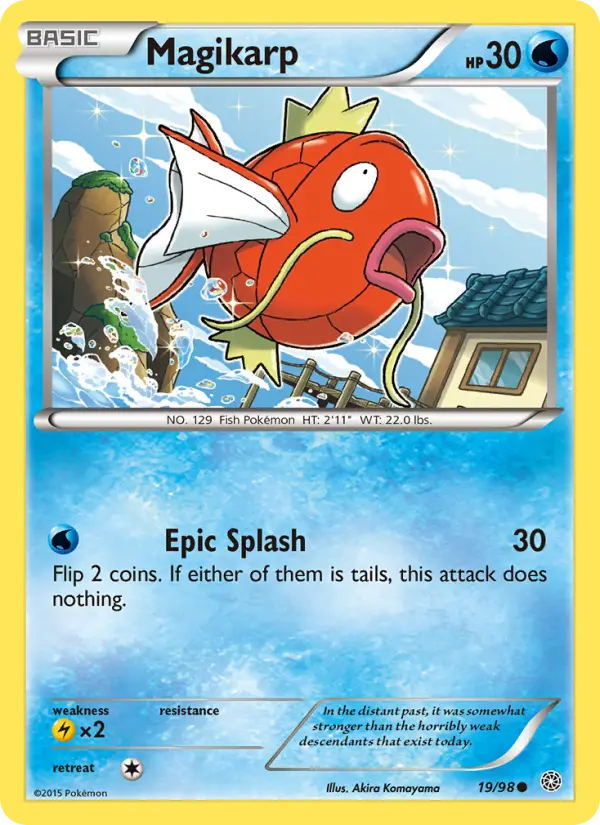
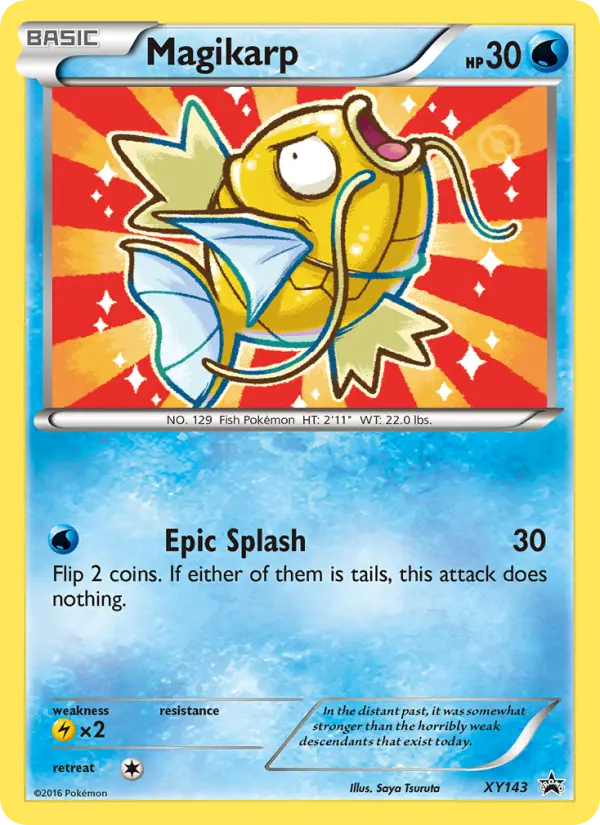
In the distant past, it was somewhat stronger than the horribly weak descendants that exist today.
Famous for being very unreliable. It can be found swimming in seas, lakes, rivers and shallow puddles.
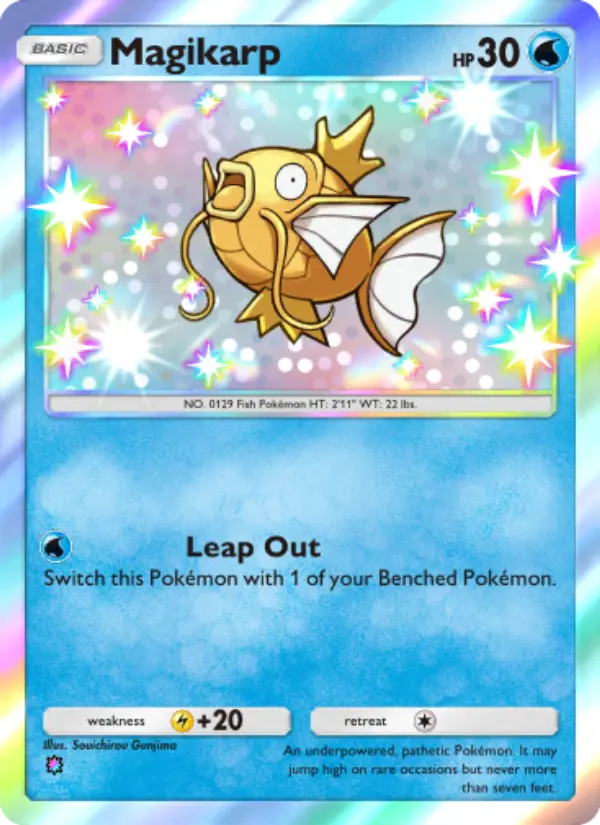
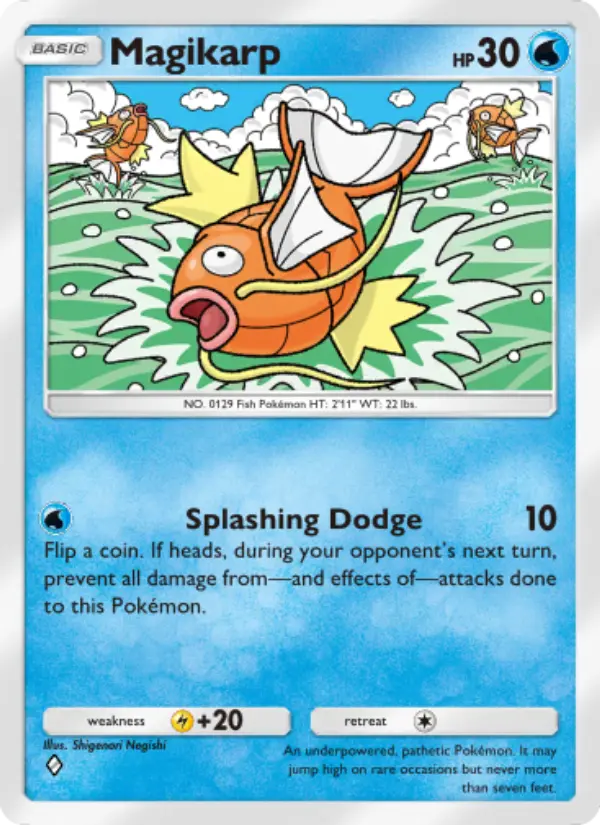
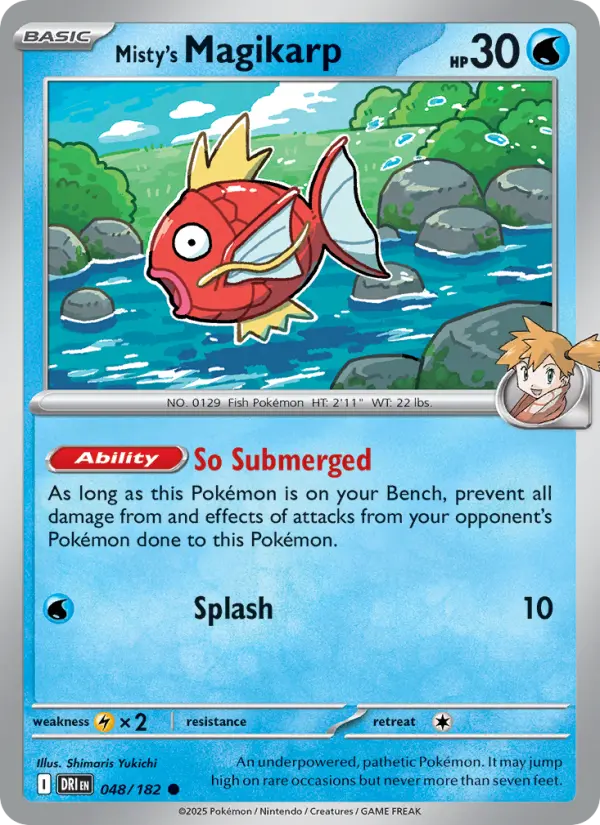
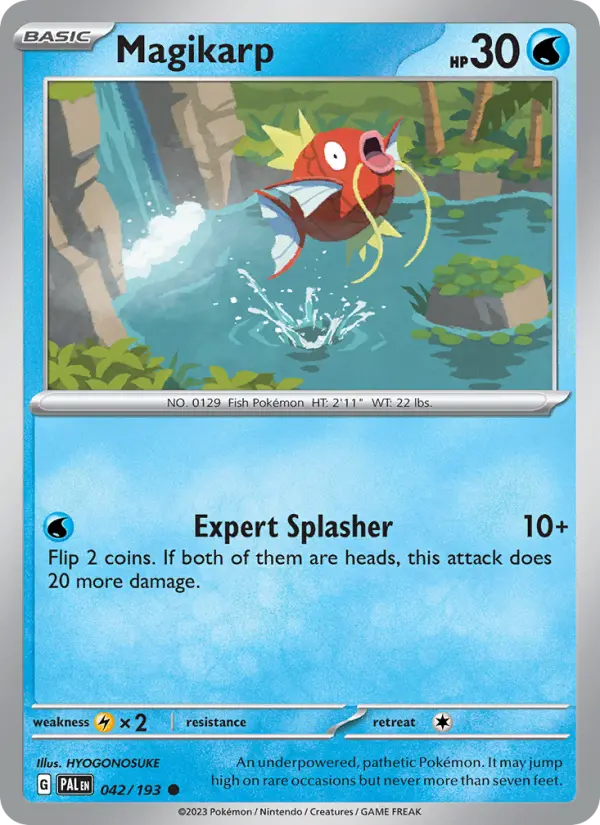
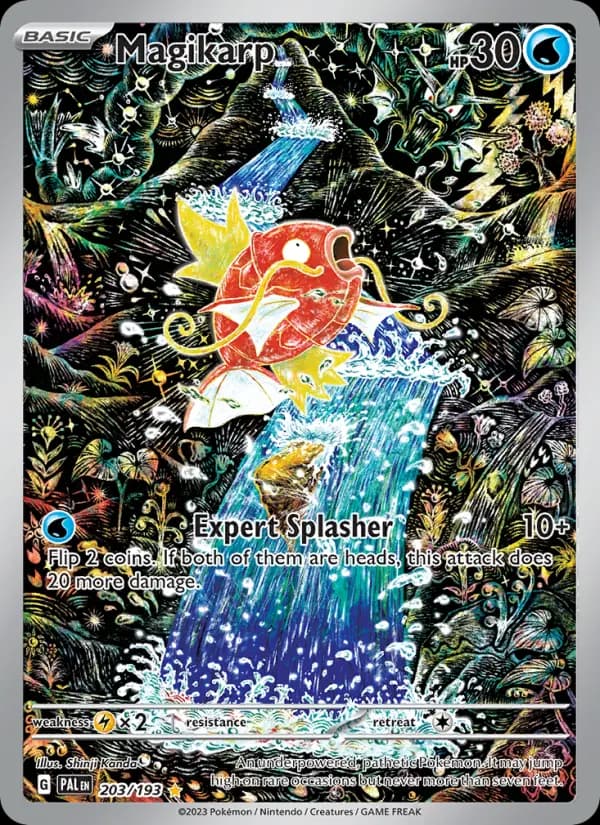
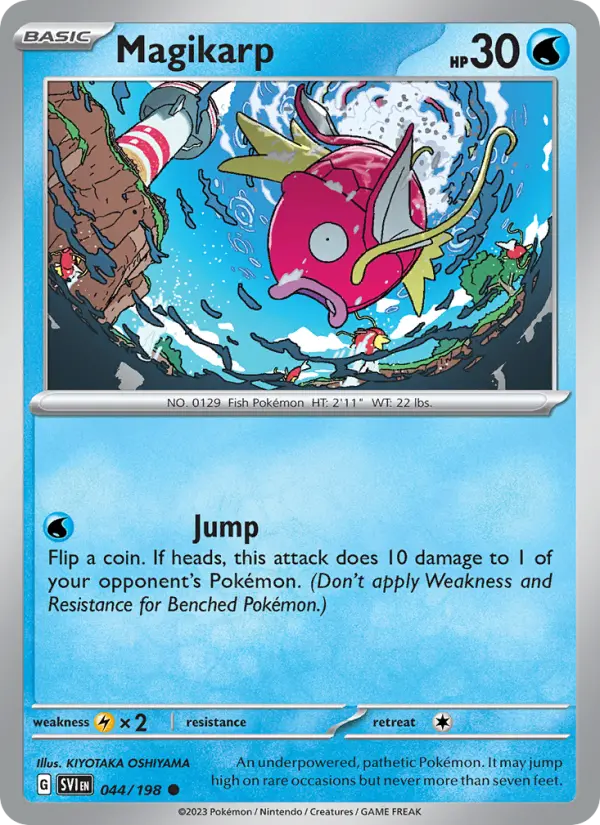
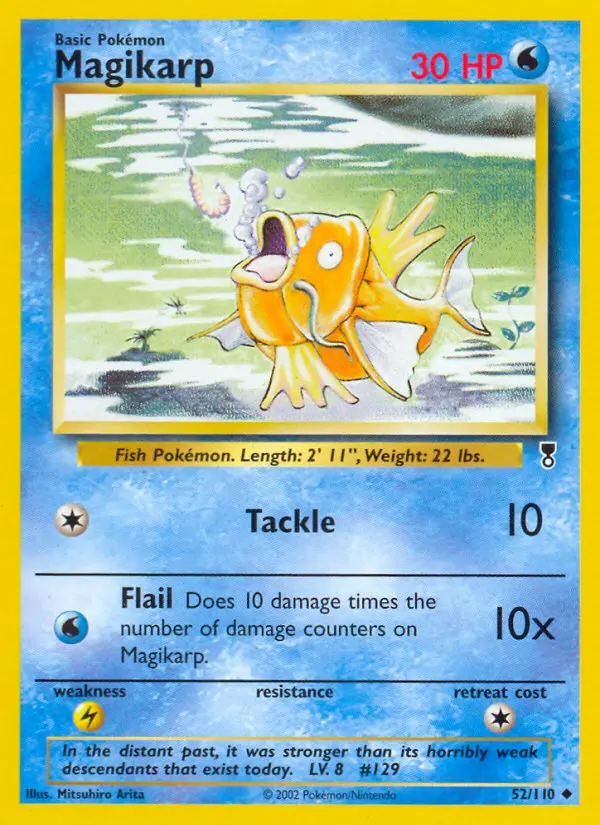
An underpowered, pathetic POKéMON. It may jump high on rare occasions, but never more than seven feet.
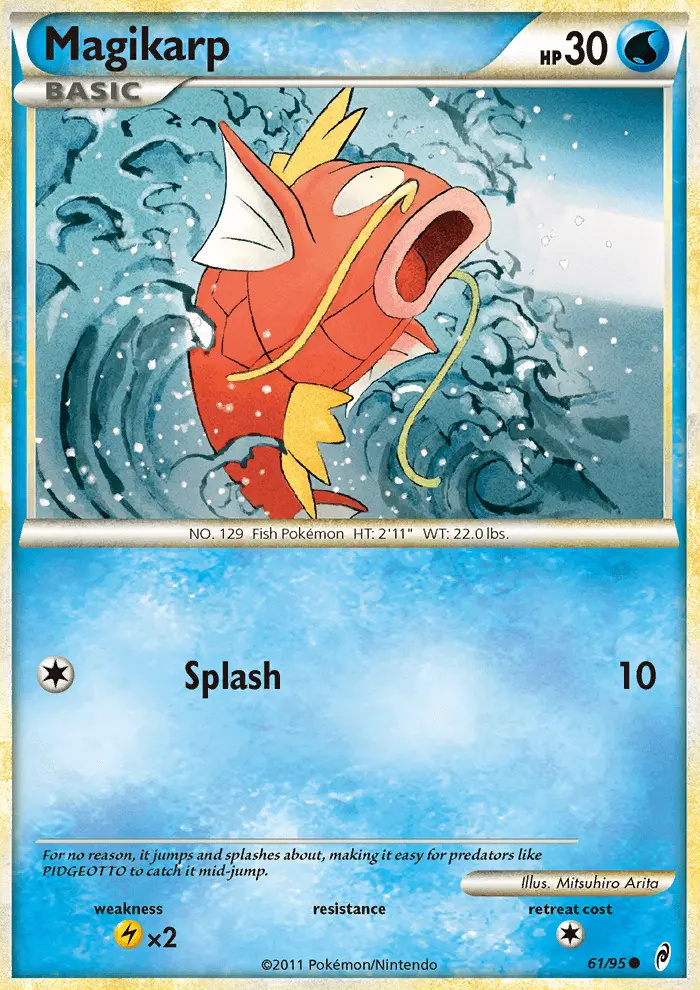
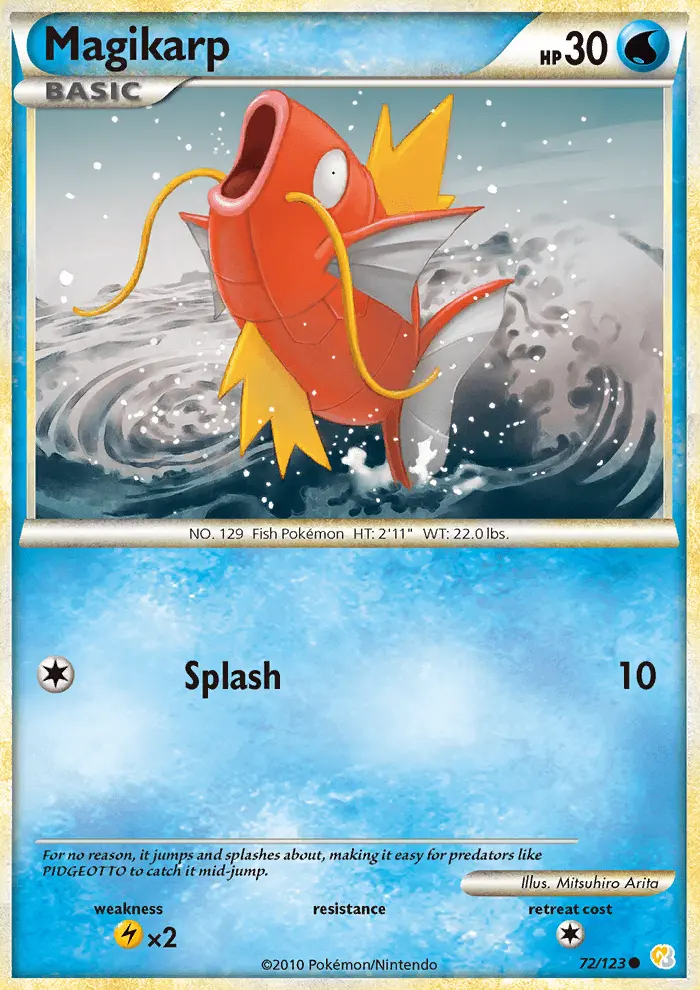
For no reason, it jumps and splashes about, making it easy for predators like PIDGEOTTO to catch it mid-jump.
This weak and pathetic POKéMON gets easily pushed along rivers when there are strong currents.
MAGIKARP is a pathetic excuse for a POKéMON that is only capable of flopping and splashing. This behavior prompted scientists to undertake research into it.
MAGIKARP is virtually useless in battle as it can only splash around. As a result, it is considered to be weak. However, it is actually a very hardy POKéMON that can survive in any body of water no matter how polluted it is.
Its swimming muscles are weak, so it is easily washed away by currents. In places where water pools, you can see many MAGIKARP deposited there by the flow.
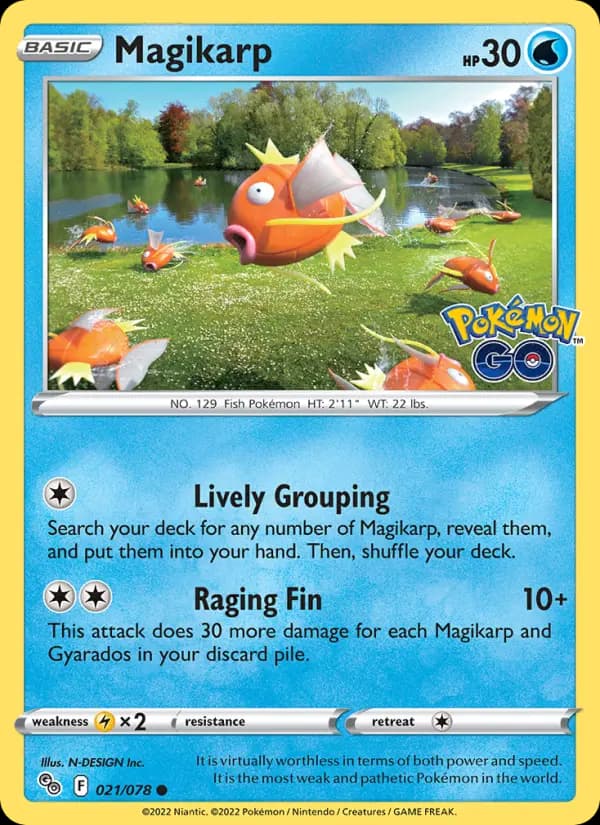
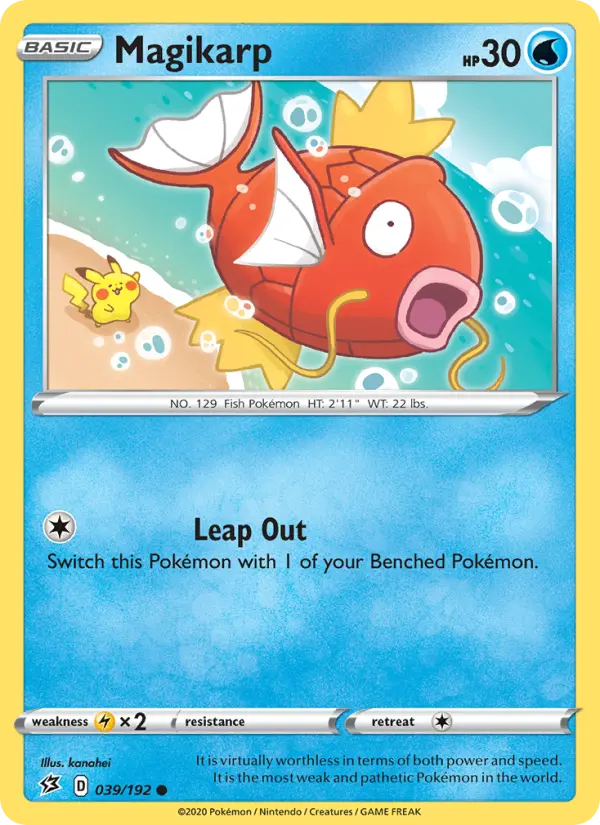
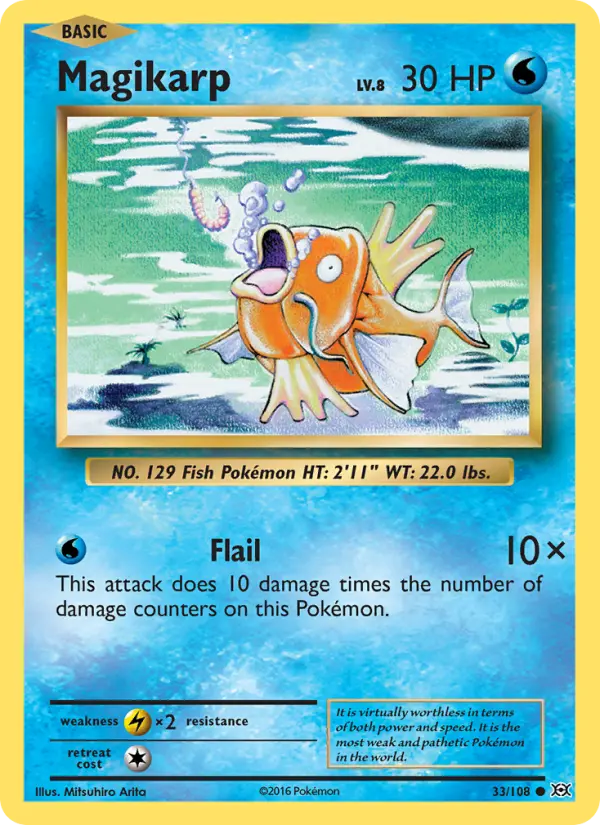
It is virtually worthless in terms of both power and speed. It is the most weak and pathetic POKéMON in the world.
In the distant past, it was somewhat stronger than the horribly weak descendants that exist today.
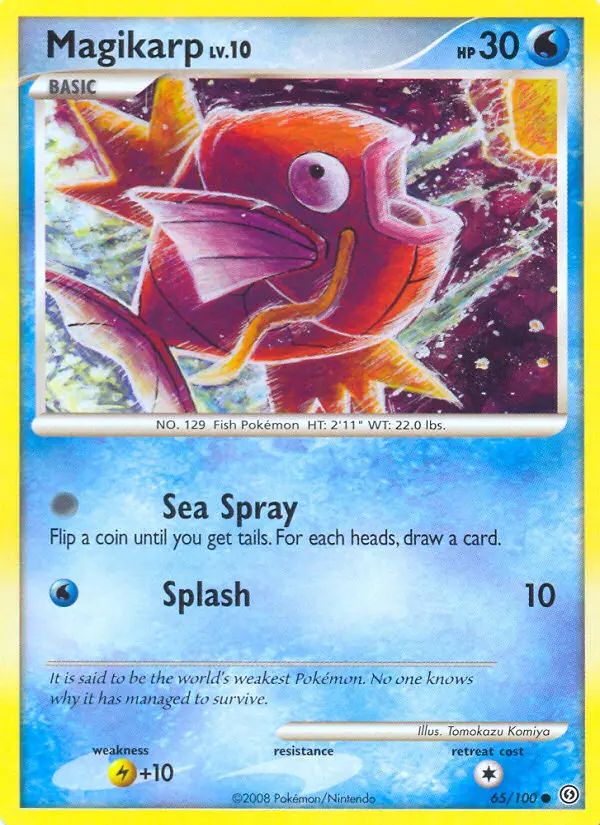
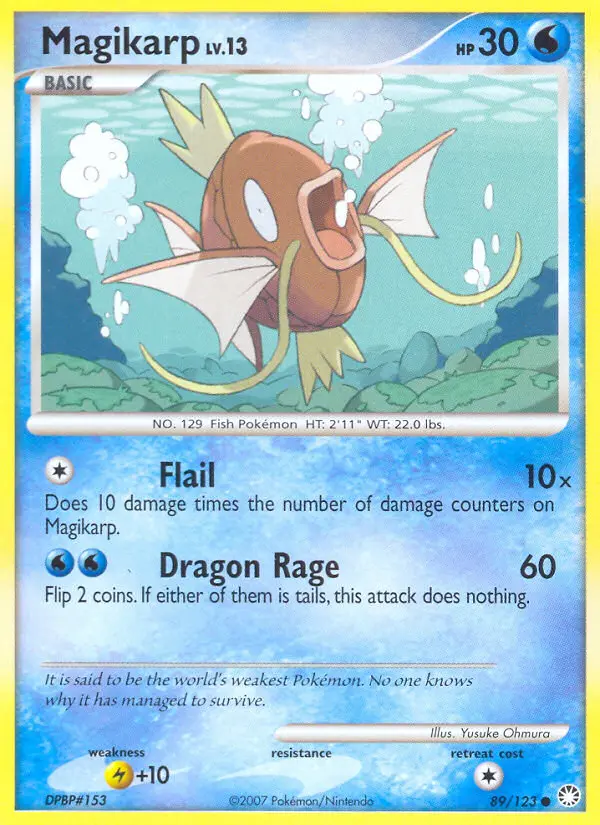
It is said to be the world’s weakest Pokémon. No one knows why it has managed to survive.
It is unable to swim against even slow-moving currents. It always splashes about for some reason.
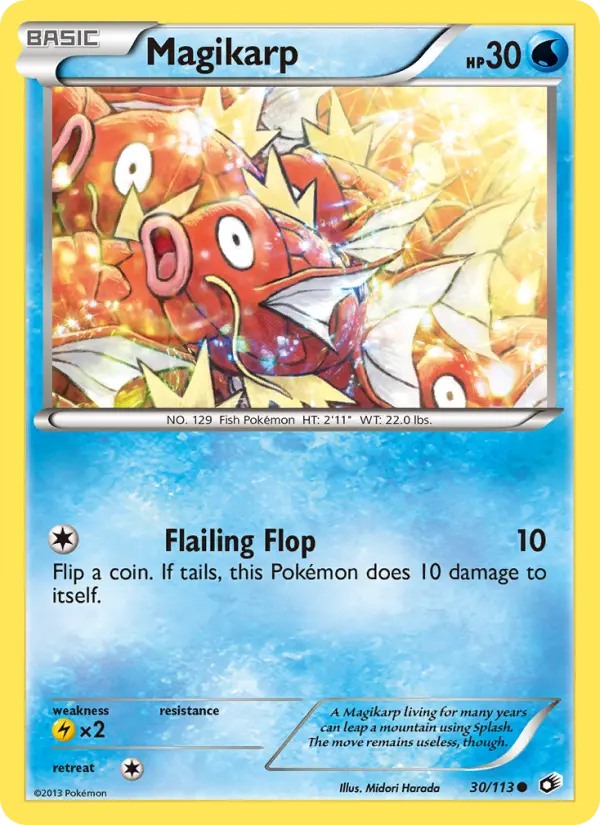
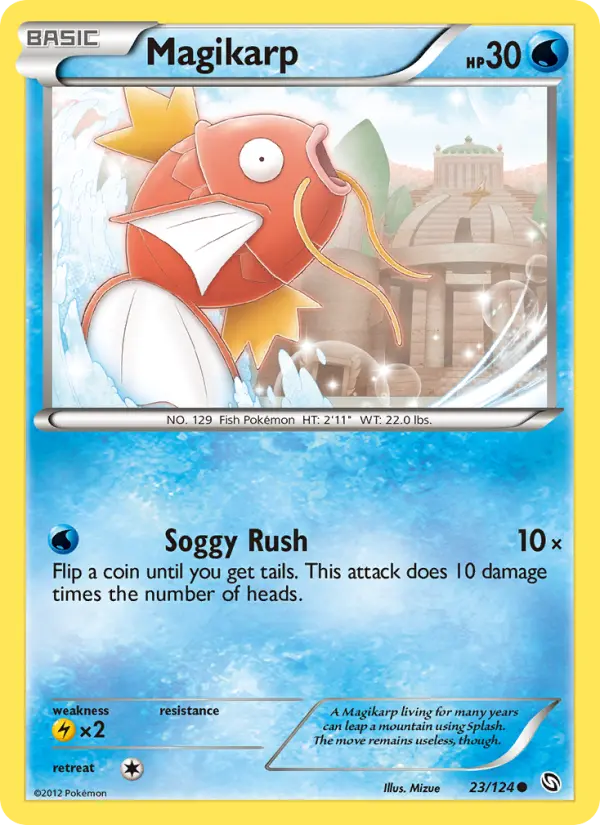
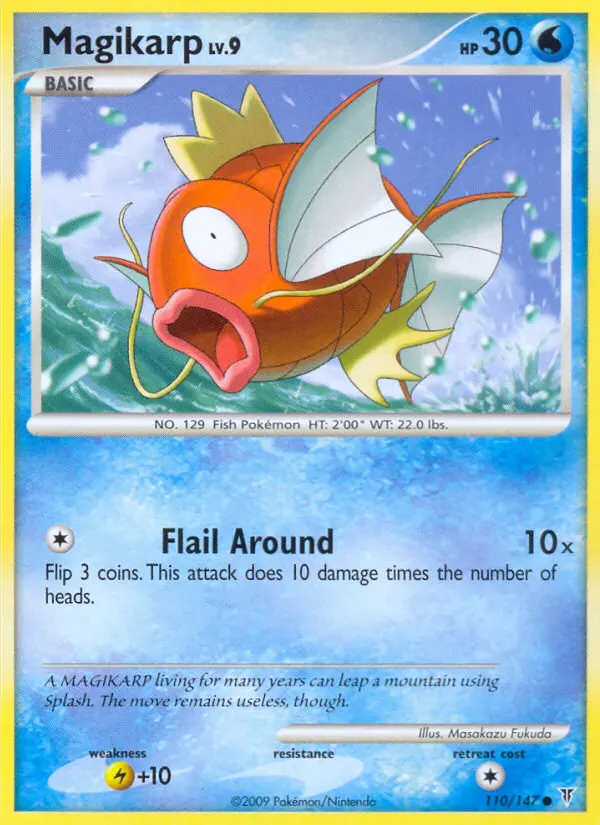
A MAGIKARP living for many years can leap a mountain using Splash. The move remains useless, though.
An underpowered, pathetic Pokémon. It may jump high on rare occasions, but usually not more than seven feet.
For no reason, it jumps and splashes about, making it easy for predators like PIDGEOTTO to catch it mid-jump.
A Magikarp living for many years can leap a mountain using Splash. The move remains useless, though.
A Magikarp living for many years can leap a mountain using Splash. The move remains useless, though.
It is virtually worthless in terms of both power and speed. It is the most weak and pathetic Pokémon in the world.
In the distant past, it was somewhat stronger than the horribly weak descendants that exist today.
Magikarp is a pathetic excuse for a Pokémon that is only capable of flopping and splashing. This behavior prompted scientists to undertake research into it.
Magikarp is virtually useless in battle as it can only splash around. As a result, it is considered to be weak. However, it is actually a very hardy Pokémon that can survive in any body of water no matter how polluted it is.
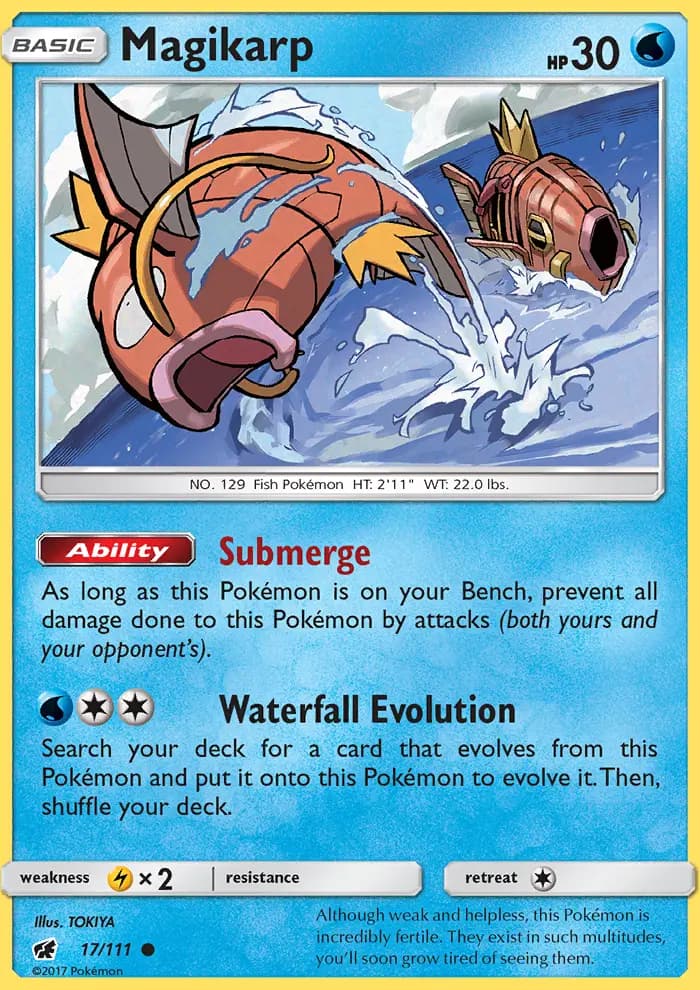
Although weak and helpless, this Pokémon is incredibly fertile. They exist in such multitudes, you’ll soon grow tired of seeing them.
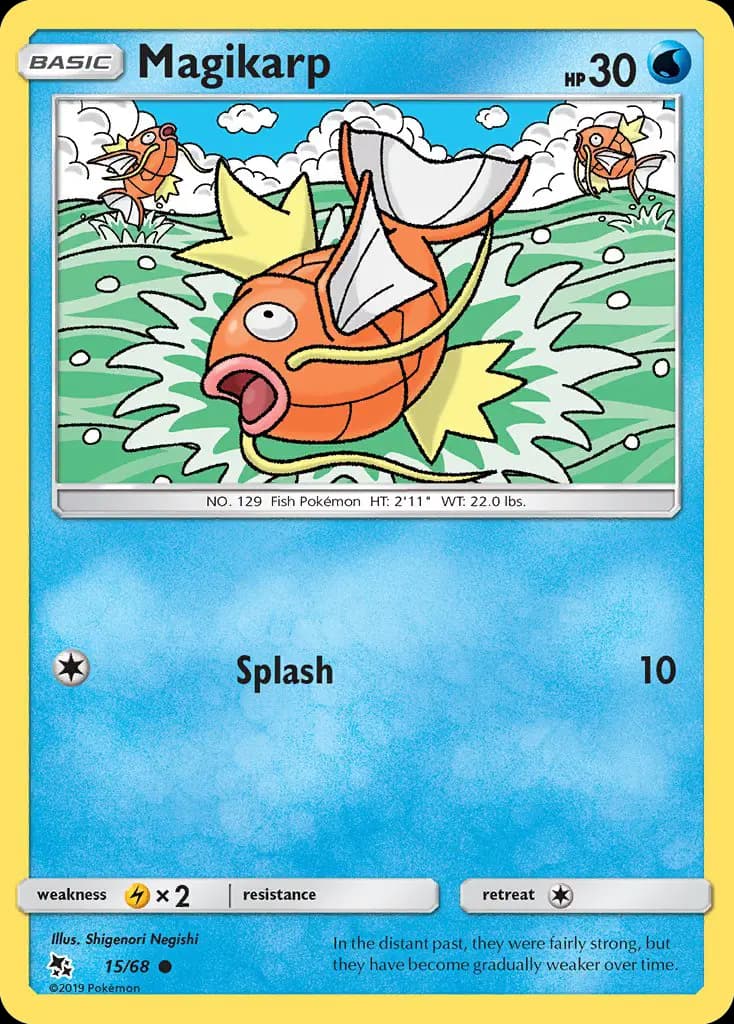
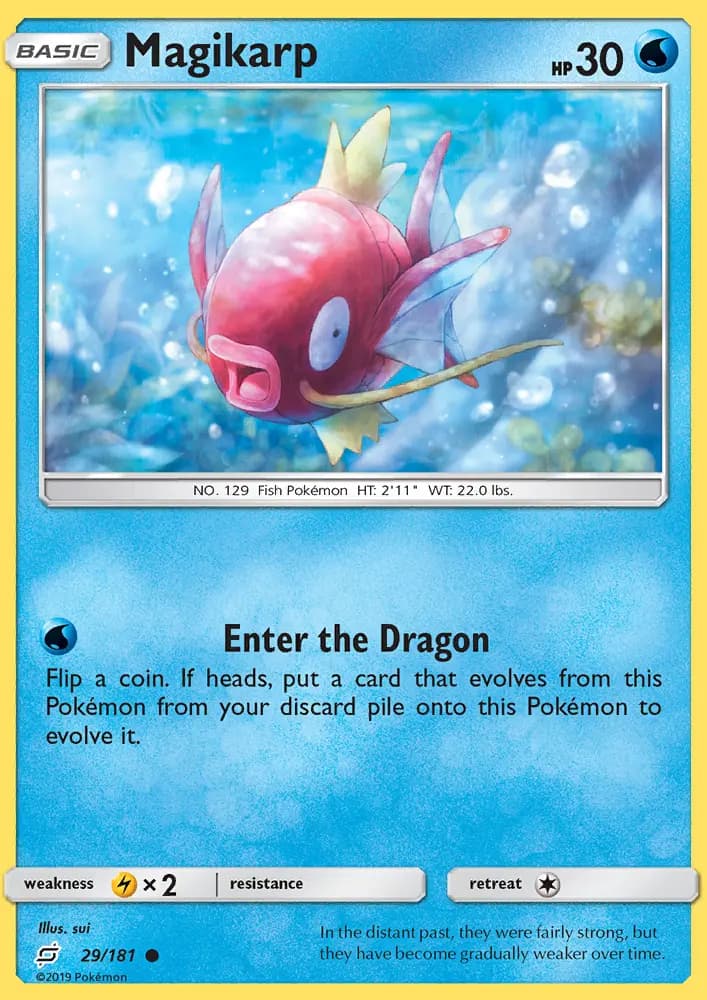
In the distant past, they were fairly strong, but they have become gradually weaker over time.
Its reckless leaps make it easy pickings for predators. On the bright side, many Pokémon enjoy longer life spans, thanks to Magikarp.
Thanks to their strong hold on life, dirty water doesn’t bother them at all. They live in waters all over the world!
Famous for being very unreliable. It can be found swimming in seas, lakes, rivers, and shallow puddles.
It is virtually worthless in terms of both power and speed. It is the most weak and pathetic Pokémon in the world.
This weak and pathetic Pokémon gets easily pushed along rivers when there are strong currents.
A feeble, pitiful imbecile of a Pokémon that is nonetheless very hardy. Unperturbed by turbid water, it can be found living in all sorts of places.
Magikarp Name Origin & Design Inspiration
Magikarp's design is deliberately based on the common carp, a freshwater fish known for its hardiness and ability to survive in diverse aquatic environments. The name 'Magikarp' itself cleverly combines 'magic' with 'carp,' reflecting the species' eventual magical-seeming transformation into Gyarados despite its current magical abilities being virtually nonexistent. In Japanese, it is known as コイキング (Koiking), where 'koi' refers to the ornamental carp and 'king' suggests a regal or dominant nature that starkly contrasts with its actual weakness. The design features the characteristic whisker-like barbels that distinguish real-world carp, alongside the distinctive crown-like dorsal fin that adds a touch of nobility to an otherwise pathetic creature. This juxtaposition of regal visual elements with comically poor battle capabilities creates a deliberate irony that defines Magikarp's appeal. The color palette of reddish-orange with yellow accents gives Magikarp a warm, almost endearing quality despite its uselessness, while its large, vacant eyes contribute to an expression of perpetual confusion that perfectly encapsulates its hapless nature.
Learnable Moves
Magikarp Competitive Battle Guide
Magikarp's competitive viability is essentially nonexistent due to its catastrophically poor base statistics, with a total of only 200 spread across its stat distribution in the most detrimental manner possible. The species boasts an abysmal Attack stat of 10 and Special Attack of 15, rendering it incapable of dealing any meaningful damage despite its offensive movepool. Its HP stat of 20 is dangerously low, leaving Magikarp vulnerable to being knocked out in a single hit from almost any opponent. The only redeeming quality in its statistical lineup is its Speed stat of 80, a surprisingly respectable value that allows Magikarp to move before most opponents, though it possesses no useful moves to employ during that turn. Magikarp's most iconic move is Splash, which famously does absolutely nothing in battle, making it a liability rather than an asset in any competitive scenario. The species' abilities offer marginal improvements: Swift Swim doubles its Speed during rain, while its hidden ability Rattled raises Speed by one stage when struck by Dark, Ghost, or Bug-type moves, yet even these enhancements cannot overcome Magikarp's fundamental inadequacy as a combatant. Consequently, competitive players universally agree that Magikarp should immediately be evolved into Gyarados the moment it reaches level 20.
Commonly Asked Questions About Magikarp
What type is Magikarp?
Magikarp is a water type Pokemon.
What does Magikarp evolve into?
Magikarp evolves into gyarados.
What are Magikarp's weaknesses?
Magikarp is weak to grass and electric type moves.
Does Magikarp evolve by trading?
No — Magikarp evolves entirely through leveling up, with no trade required at any stage.
Where can I find Magikarp?
Magikarp can be found in kanto safari zone (kanto), cerulean cave (kanto) and vermilion city (kanto) and 88 other locations.
Magikarp Cultural Impact & Franchise History
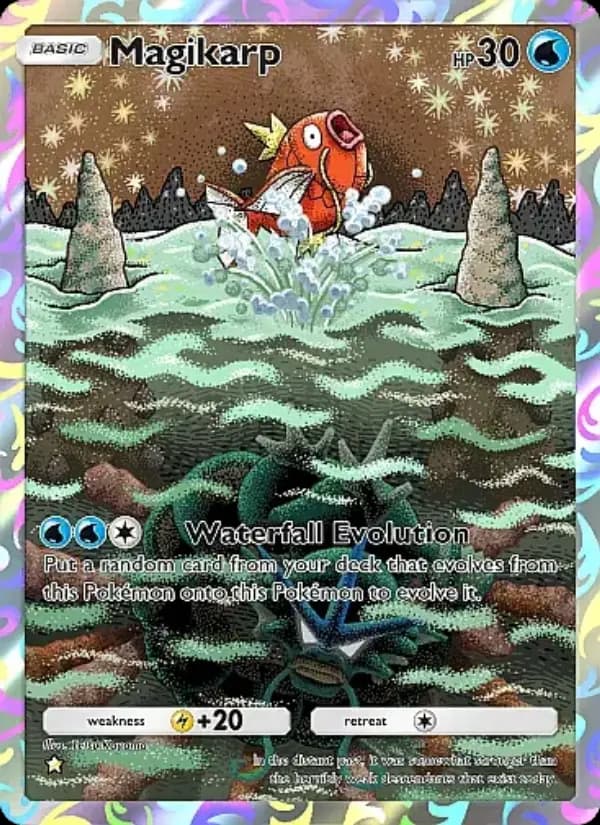
Magikarp has transcended its role as a mere Pokémon to become a cultural phenomenon representing weakness, perseverance, and the potential for transformation. The species' memorable appearance in the anime, particularly through James's beloved Magikarp, established it as a fan favorite despite its battlefield incompetence. The iconic salesman character who sold James his Magikarp became instantly recognizable for his over-the-top enthusiasm in marketing this spectacularly useless creature, creating one of the series' most memorable comedic moments. Magikarp's weak-to-strong narrative has resonated deeply with audiences, serving as a metaphor for personal growth and overcoming adversity that extends far beyond the Pokémon universe. The species has been featured in numerous spin-off games, trading card sets, merchandise lines, and official media, cementing its status as one of the franchise's most recognizable creatures. Internet culture has embraced Magikarp as a symbol of underdog success, with countless memes celebrating its transformation and weakness becoming a source of affection rather than ridicule. The Pokédex entries themselves have become culturally significant, with their scathing descriptions of Magikarp's inadequacy contributing to its charm and making it one of the most beloved Pokémon despite its obvious inferiority.
Where to Find Magikarp in Every Pokémon Game
Magikarp enjoys exceptional availability throughout the Pokémon world, appearing in virtually every generation and game since its introduction in Generation I. The species possesses the maximum capture rate of 255, meaning that any Poké Ball used against a wild Magikarp in full health has a 43.9% success rate, the highest possible capture probability in the franchise. This generous catch rate reflects the developers' intention to make Magikarp easily obtainable for trainers seeking to experience its evolution into Gyarados. Magikarp can be found swimming in seas, lakes, rivers, and even shallow puddles across numerous regions, from Kanto to Galar and beyond, making it one of the most geographically widespread Pokémon. The species' base experience yield is a modest 40, though later generations increased this to provide at least some incentive for training the otherwise useless creature. Magikarp eggs are relatively common and hatch in five cycles, making it straightforward for breeders to obtain specimens with desirable natures or inherited moves. Special distributions and events have periodically featured Magikarp with unique characteristics, including gigantamax forms in certain games and special colorations in events, further increasing its availability and collectibility. The species' combination of widespread distribution and easy capture has ensured that no trainer need struggle to obtain a Magikarp for their team.