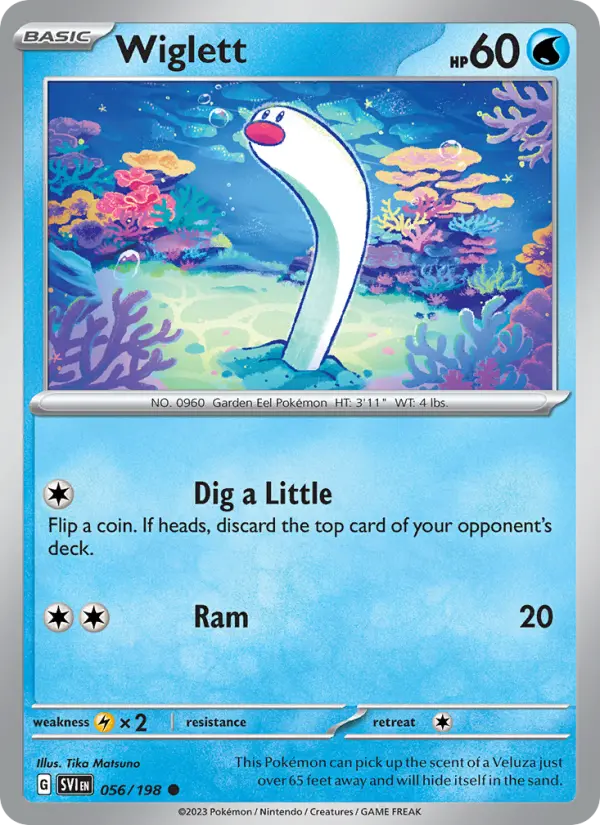
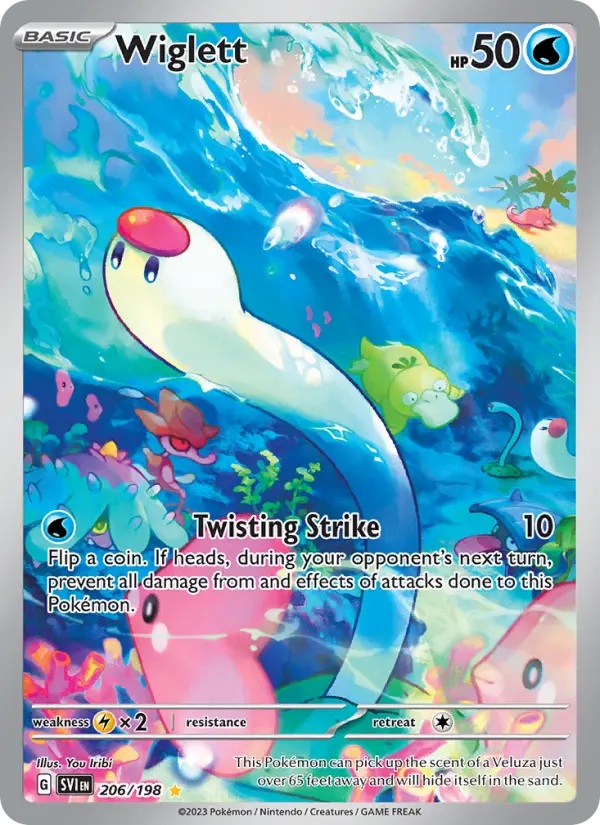
Wiglett
Generation IX · #0960 — Garden Eel Pokémon
Wiglett's profile is easy to undersell: 1.2 m, 1.8 kg, and a water typing that doesn't scream power — until you look at its Speed of 95.
Editor's Take
Wiglett looking exactly like Diglett while being a Water-type is Gen 9's best convergent-evolution joke, and it is entirely unrelated to Diglett in-universe.
Base Stats
Height
1.2m
Weight
1.8kg
Category
Garden Eel Pokémon
Gender
Male 50% / Female 50%
Color
white
Shape
blob
Abilities
Lowers attacking Pokémon's Speed by one stage on contact.
Raises Speed one stage upon being hit by a dark, ghost, or bug move.
Increases evasion to 1.25× during a sandstorm. Protects against sandstorm damage.

Wiglett Biology & Physical Characteristics
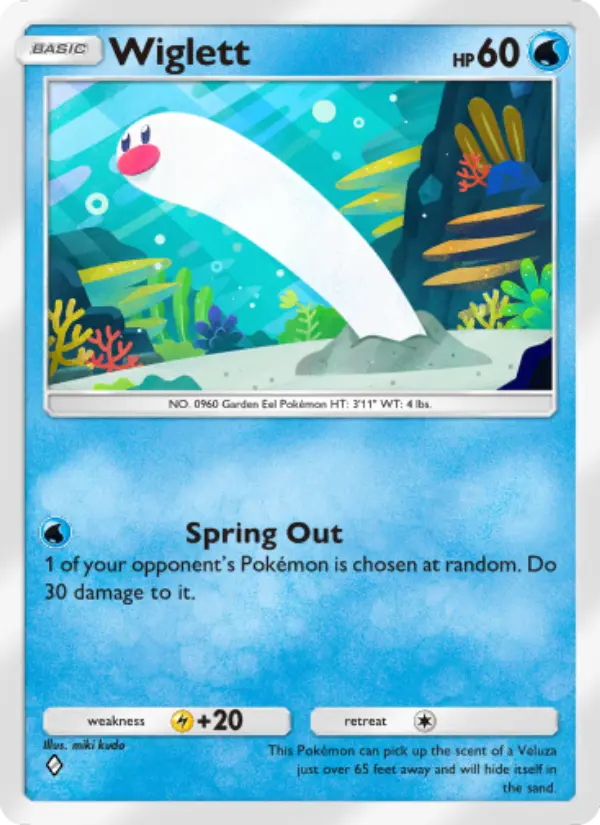
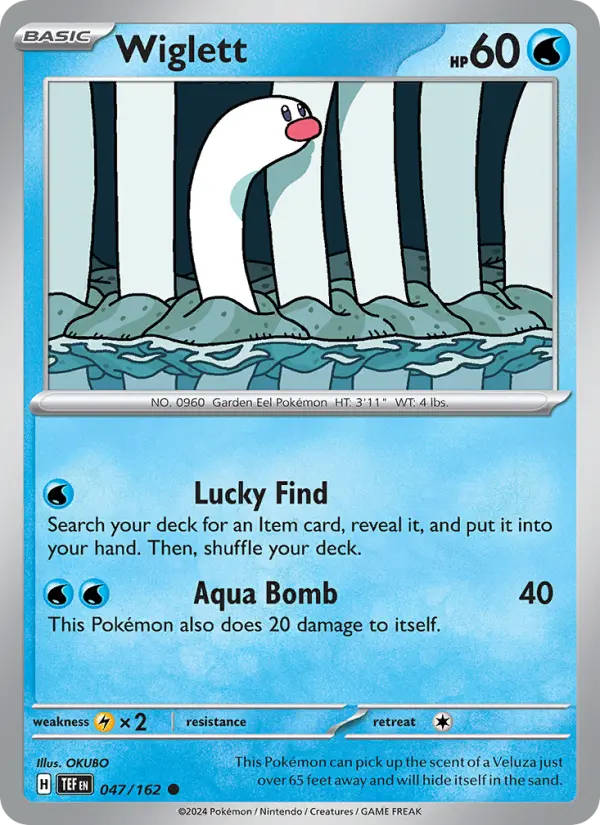
Wiglett is a long, slender Pokémon characterized by its primarily white coloration and perpetually submerged body structure. The creature's visible anatomy consists of a small rounded head featuring beady dark blue eyes and a distinctively large, round pink nose that protrudes prominently from its face. Although Wiglett's official height is recorded at 1.2 meters (approximately 3'11"), the true extent of its body remains mysterious, as most of its form remains buried within sand or soil, leaving only the head and upper portion visible to observers. The exact nature of Wiglett's complete body structure, including whether it possesses legs, fins, or other appendages beneath the sand, remains unknown to researchers. Wiglett's most remarkable biological feature is its exceptional olfactory system, capable of detecting scents from distances exceeding 65 feet (approximately 20 meters) away. This highly developed sense of smell serves as the Pokémon's primary sensory tool for navigating its environment and detecting potential threats or food sources. Despite its aquatic classification, Wiglett inhabits both beach and sea environments, where it actively burrows into sand and occasionally emerges to feed.
Pokedex Numbers
Training
Breeding
Wiglett Breeding, Gender Ratio & Egg Groups
Wiglett exhibits a perfectly balanced gender ratio, with exactly 50% of individuals born as male and 50% as female, allowing for consistent breeding in the field without gender-based complications. The species belongs to the Water 3 egg group, which includes various aquatic and semi-aquatic Pokémon species, enabling Wiglett to breed with compatible partners from this group. Wiglett requires 20 egg cycles to hatch from its egg state, translating to approximately 4,884 to 5,140 steps of active gameplay before a newly hatched Wiglett emerges. The species possesses a base friendship value of 50, classified as "normal" friendship, indicating that newly caught Wiglett specimens will require moderate effort and positive interactions to develop stronger bonds with their trainers compared to species with higher base friendship values. Upon hatching, Wiglett begins its journey with the ability to learn foundational moves such as Sand Attack and Water Gun at level one, providing new hatchlings with immediate combat capabilities. The breeding mechanics for Wiglett allow for inheritance of specific egg moves including Final Gambit and Memento, which can only be obtained through breeding and picnics rather than standard leveling or technical machines.
Sprites






TMs & HMs
tm01
lets go pikachu lets go eevee
tm02
crystal
tm02
gold silver
tm03
ruby sapphire
tm03
platinum
tm03
firered leafgreen
tm03
heartgold soulsilver
tm03
diamond pearl
tm03
emerald
tm03
xd
tm03
colosseum
tm03
lets go pikachu lets go eevee
tm05
lets go pikachu lets go eevee
tm07
lets go pikachu lets go eevee
tm08
lets go pikachu lets go eevee
tm09
yellow
tm09
red blue
hm03
ruby sapphire
hm03
platinum
hm03
omega ruby alpha sapphire
+282 more TMs/HMs


Wiglett Evolution, Mega Evolution & Special Forms
Wiglett undergoes a straightforward evolutionary transformation into Wugtrio upon reaching level 26, representing its only evolution and lacking any branching paths or conditional requirements. The evolution from Wiglett to Wugtrio is a natural progression in the species' life cycle, with Wugtrio retaining the Water-type classification while developing into a more robust and powerful form. Unlike Wiglett's extremely frail physical profile with its minuscule 10 HP base stat, Wugtrio develops more balanced offensive and defensive capabilities, making it substantially more viable in competitive scenarios. The evolutionary process likely correlates with Wiglett's maturation and growth, though the specific biological mechanisms driving this transformation remain undocumented in official Pokédex entries. No Mega Evolution or alternative evolutionary forms exist for either Wiglett or Wugtrio, making their evolution chain one of the simpler progressions introduced in Generation IX.
Where to Find
Location data not available for this Pokémon in the database.
Wiglett Behaviour and Natural Habitat
Wiglett is characterized as an extremely timid and cautious Pokémon with a naturally skittish disposition toward its surroundings. This defensive temperament is central to its survival strategy in the wild, as the Pokémon immediately burrows itself deep into sand whenever it detects the presence of other Pokémon through its keen sense of smell. Notably, Wiglett exhibits particular wariness toward Veluza, a predatory water-type Pokémon that actively hunts Garden Eels, and will immediately hide upon detecting this threat's scent from considerable distances. This behavior demonstrates the crucial role that Wiglett's superior olfactory capabilities play in its predator-avoidance strategy, providing early warning of dangers that might otherwise be imperceptible through other senses. The Pokémon inhabits sandy beaches and shallow coastal waters throughout the Paldea region, where it creates burrows in the substrate and spends much of its time hidden from view. Wiglett pokes portions of its body out of the sand while feeding, suggesting that it consumes small marine organisms and crustaceans available in its sandy habitat. The species exhibits a natural tendency toward solitary behavior, though Pokédex entries suggest that multiple individuals may inhabit the same beach areas.
Pokedex Entries
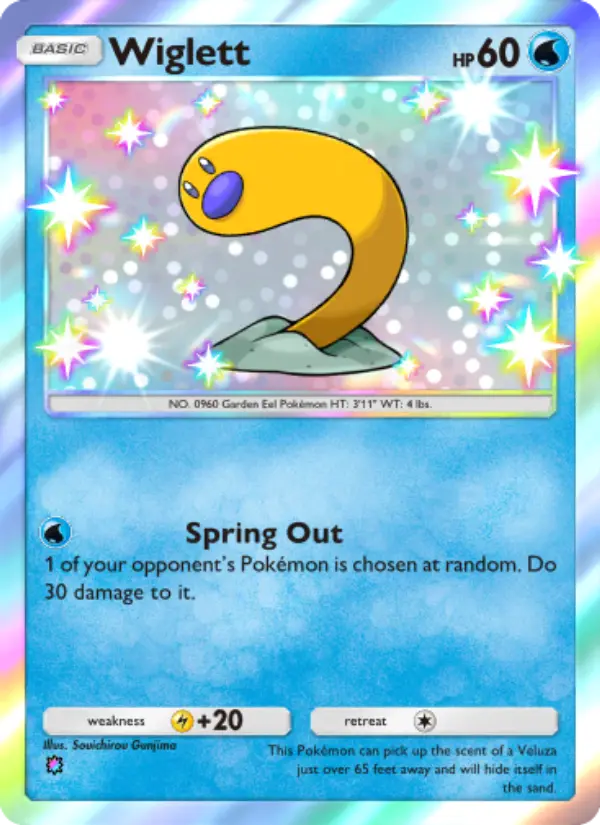
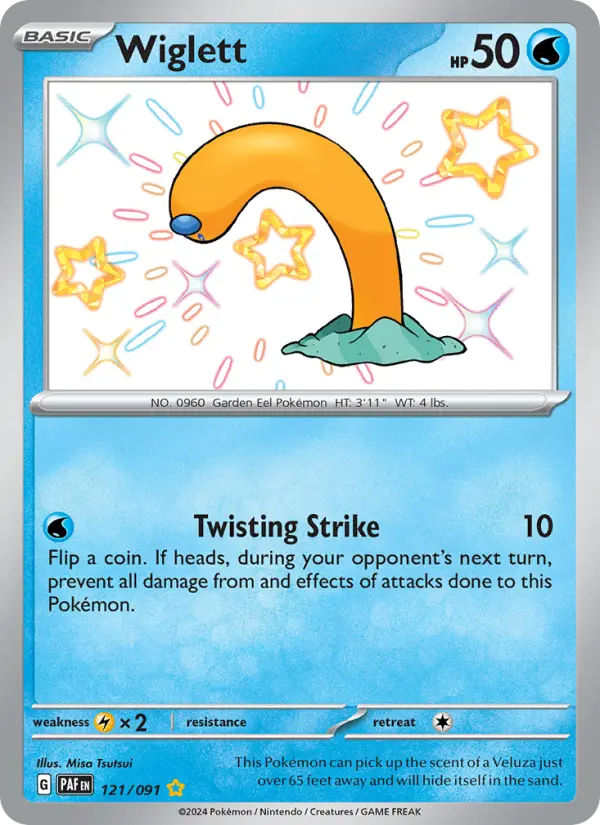
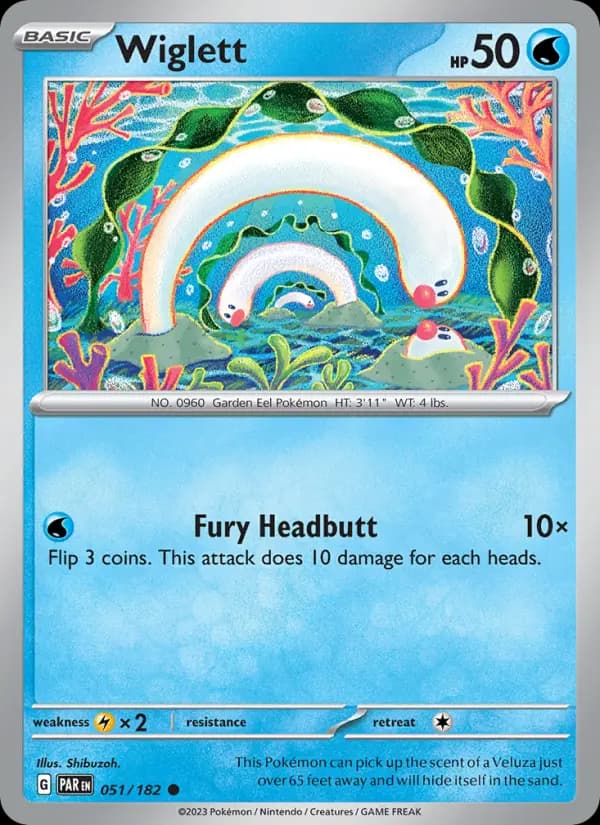
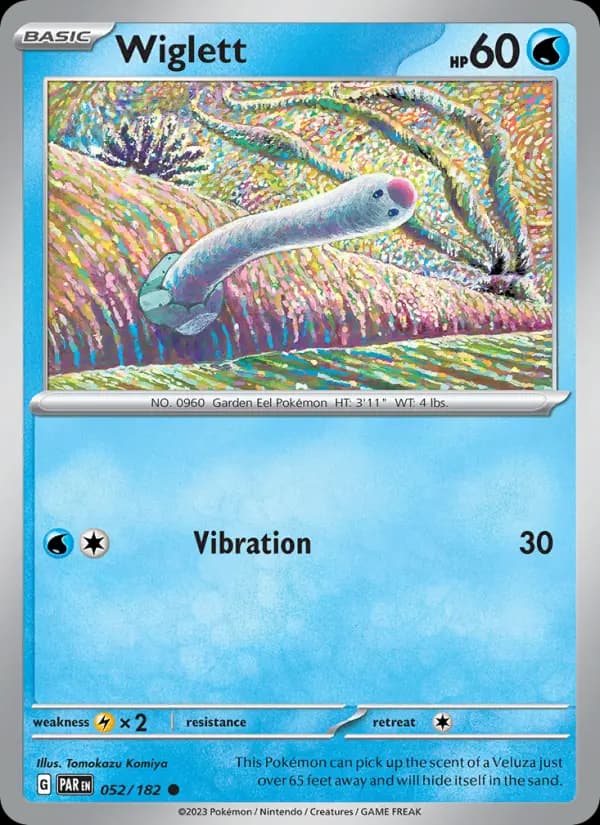
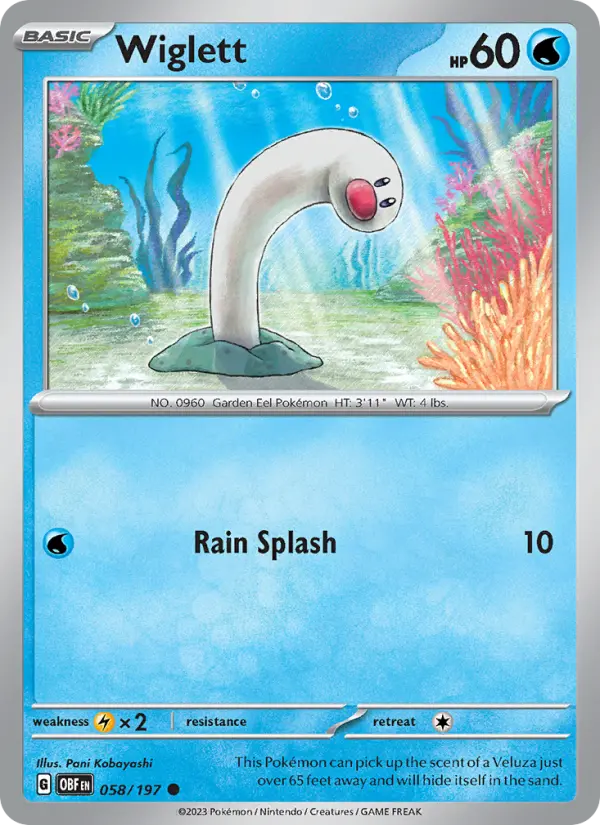
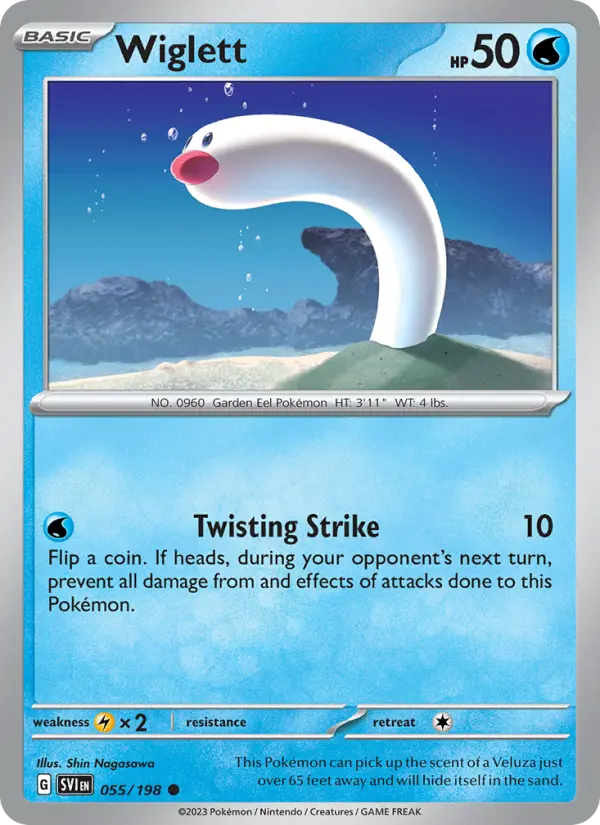
This Pokémon can pick up the scent of a Veluza just over 65 feet away and will hide itself in the sand.
Though it looks like Diglett, Wiglett is an entirely different species. The resemblance seems to be a coincidental result of environmental adaptation.
Wiglett Name Origin & Design Inspiration
Wiglett's name derives from a combination of "wiggle" and "eel," perfectly encapsulating the creature's biological classification as a Garden Eel Pokémon and its characteristic undulating movement patterns. The Japanese name "Umidigda" (ウミディグダ) combines "umi" (sea/ocean) with "digda," referencing the creature's aquatic nature while acknowledging its superficial resemblance to Diglett. This linguistic approach cleverly highlights the convergent evolution theme central to Wiglett's identity within the Pokémon universe. The Garden Eel classification reflects the actual biological inspiration for this Pokémon, as real-world garden eels are marine creatures that burrow into sandy ocean floors and emerge to feed while remaining partially concealed. Wiglett's visual design emphasizes its submerged existence, with only the head and minimal body portions visible above the sand, mimicking the authentic behavior of actual garden eels. The stark white coloration, dark blue eyes, and prominent pink nose create a distinctive silhouette immediately recognizable despite the creature's limited visible anatomy. The design intentionally parallels Diglett's appearance to support the narrative of environmental convergent evolution, yet maintaining unique visual elements such as the specific eye coloration and nose shape that distinguish it as a separate species.
Learnable Moves
Wiglett can learn 39 moves:
Move | Type | Cat. | Power | Acc. | PP |
|---|---|---|---|---|---|
| agility | psychic | Status | — | — | 30 |
| aqua jet | water | Physical | 40 | 100 | 20 |
| blizzard | ice | Special | 110 | 70 | 5 |
| bulldoze | ground | Physical | 60 | 100 | 20 |
| chilling water | water | Special | 50 | 100 | 20 |
| dig | ground | Physical | 80 | 100 | 10 |
| earth power | ground | Special | 90 | 100 | 10 |
| endure | normal | Status | — | — | 10 |
| facade | normal | Physical | 70 | 100 | 20 |
| final gambit | fighting | Special | — | 100 | 5 |
| foul play | dark | Physical | 95 | 100 | 15 |
| headbutt | normal | Physical | 70 | 100 | 15 |
| helping hand | normal | Status | — | — | 20 |
| hydro pump | water | Special | 110 | 80 | 5 |
| ice beam | ice | Special | 90 | 100 | 10 |
| liquidation | water | Physical | 85 | 100 | 10 |
| memento | dark | Status | — | 100 | 10 |
| mud shot | ground | Special | 55 | 95 | 15 |
| mud slap | ground | Special | 20 | 100 | 10 |
| muddy water | water | Special | 90 | 85 | 10 |
| protect | normal | Status | — | — | 10 |
| rain dance | water | Status | — | — | 5 |
| rest | psychic | Status | — | — | 5 |
| sand attack | ground | Status | — | 100 | 15 |
| sandstorm | rock | Status | — | — | 10 |
| slam | normal | Physical | 80 | 75 | 20 |
| sleep talk | normal | Status | — | — | 10 |
| stomping tantrum | ground | Physical | 75 | 100 | 10 |
| substitute | normal | Status | — | — | 10 |
| sucker punch | dark | Physical | 70 | 100 | 5 |
| surf | water | Special | 90 | 100 | 15 |
| swift | normal | Special | 60 | — | 20 |
| take down | normal | Physical | 90 | 85 | 20 |
| tera blast | normal | Special | 80 | 100 | 10 |
| throat chop | dark | Physical | 80 | 100 | 15 |
| water gun | water | Special | 40 | 100 | 25 |
| water pulse | water | Special | 60 | 100 | 20 |
| whirlpool | water | Special | 35 | 85 | 15 |
| wrap | normal | Physical | 15 | 90 | 20 |
Wiglett Competitive Battle Guide
Wiglett's competitive viability is severely compromised by its catastrophically low base HP stat of 10, making it potentially the frailest Pokémon capable of entering competitive battles. While the species boasts an impressive base Speed stat of 95, allowing it to move before most opponents, this advantage becomes almost irrelevant when any attack will result in guaranteed knockout given the creature's paper-thin durability. The attack-oriented stat distribution of Wiglett provides only a base 55 Attack and 35 Special Attack, neither of which generates sufficient offensive pressure to deter switch-ins or justify the risk of maintaining such a vulnerable Pokémon in active battle. However, Wiglett's ability pool offers some competitive interest through the Gooey ability, which reduces the Speed of any Pokémon making contact with Wiglett by one stage, potentially disrupting faster opponents' strategies before Wiglett inevitably faints. The hidden ability Sand Veil provides evasion benefits during sandstorm weather conditions while simultaneously granting protection from sandstorm damage, creating niche viability in sandstorm-based team constructions. Wiglett's movepool includes respectable offensive coverage options such as Aqua Jet for priority Water-type damage, Liquidation as a powerful late-game option, and utility moves like Dig for switching predictions. Most competitive players view Wiglett as a Pokédex entry and novelty rather than a genuine competitive threat, with its evolution Wugtrio providing substantially superior competitive potential through improved bulk and damage output.
Commonly Asked Questions About Wiglett
What type is Wiglett?
Wiglett is a water type Pokemon.
What does Wiglett evolve into?
Wiglett evolves into wugtrio.
What are Wiglett's weaknesses?
Wiglett is weak to grass and electric type moves.
Does Wiglett evolve by trading?
No — Wiglett evolves entirely through leveling up, with no trade required at any stage.
Wiglett Cultural Impact & Franchise History
Wiglett achieved immediate cultural prominence upon its introduction as part of Generation IX's Pokémon Scarlet and Violet releases, primarily due to the humorous and unconventional presentation method employed by the Pokémon Company. The spoof World Pokémon Ecological Society presentation that revealed Wiglett became a beloved moment within the broader Pokémon community, with fans appreciating the creative and comedic approach to introducing new species. The deliberate thematic connection to Diglett while establishing Wiglett as a completely separate species sparked widespread discussion within the community about evolutionary convergence and ecological adaptation, transforming what could have been a simple regional variant into a scientifically intriguing concept. Wiglett's extreme fragility, exemplified by its single-digit HP base stat, became an immediate source of affectionate humor among competitive players and content creators who recognized the creature's fundamental unsuitability for actual battle despite its respectable Speed. The visual distinctiveness of Wiglett, particularly its prominent pink nose and dark blue eyes contrasting against white coloration, has made it readily recognizable in fan art, merchandise, and community discussions. The Garden Eel classification and associated lore grounded the creature in real-world marine biology, appealing to players interested in the naturalistic elements of Pokémon world-building and ecological narratives.
Where to Find Wiglett in Every Pokémon Game
Wiglett is exclusively available within Generation IX games Pokémon Scarlet and Pokémon Violet, where it can be encountered throughout sandy beach areas and coastal regions of the Paldea region. In the Pokédex, Wiglett is cataloged as regional number 288 in Scarlet and Violet, making it relatively accessible early in a player's journey through careful exploration of appropriate habitats. The species possesses an exceptionally high capture rate of 255, the maximum possible value, meaning that Wiglett can be captured with nearly 100% success when using a Poké Ball against a healthy specimen, greatly facilitating its acquisition for players seeking to complete their Pokédex. Wiglett has not appeared in other main series Pokémon games beyond Scarlet and Violet, nor is it included in the upcoming Pokémon Legends: Z-A, which features no Pokédex entries for this species. For players in Pokémon GO and other spin-off titles, Wiglett availability varies by title and seasonal event rotations, though the species may not be present in all spin-off games. Trading with other players who have captured Wiglett in their Scarlet or Violet versions remains an alternative acquisition method for those unable to encounter wild specimens through standard gameplay.