Wingull
Generation III · #0278 — Seagull Pokémon
Wingull debuted in Generation III, and its water/flying typing has aged into one of its more defining traits, especially paired with keen eye. At 0.6 m and 9.5 kg, its build reflects a specialist role rather than a generalist one. Standing at just 0.6 meters tall and weighing a mere 9.5 kilograms, this lightweight flyer represents an early-stage evolutionary form with significant potential for growth. The species boasts a respectable cumulative stat total of 270, with its standout Speed stat of 85 allowing it to outpace many opponents despite its modest Attack and Defense statistics. Wingull's primary abilities—Keen Eye and Hydration—provide valuable tactical advantages in various battle scenarios, while its hidden ability, Rain Dish, offers specialized utility during weather-dependent strategies.
Editor's Take
Wingull's line ends in Pelipper, which became one of the most important Pokémon in competitive doubles the moment Drizzle was moved onto it in Gen 7.
Base Stats
Height
0.6m
Weight
9.5kg
Category
Seagull Pokémon
Gender
Male 50% / Female 50%
Color
white
Shape
wings
Habitat
sea
Abilities
Prevents accuracy from being lowered.
Cures any major status ailment after each turn during rain.
Heals for 1/16 max HP after each turn during rain.
Wingull Biology & Physical Characteristics
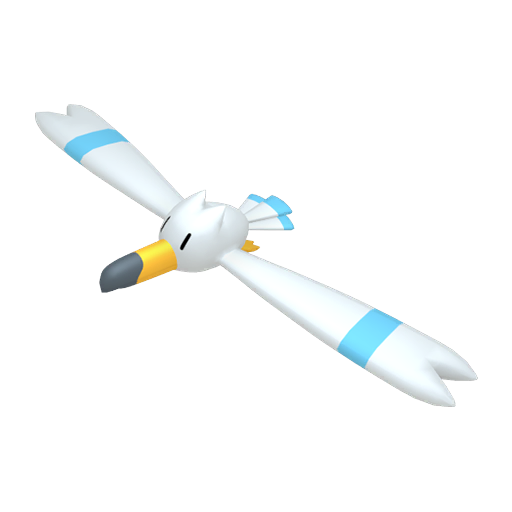
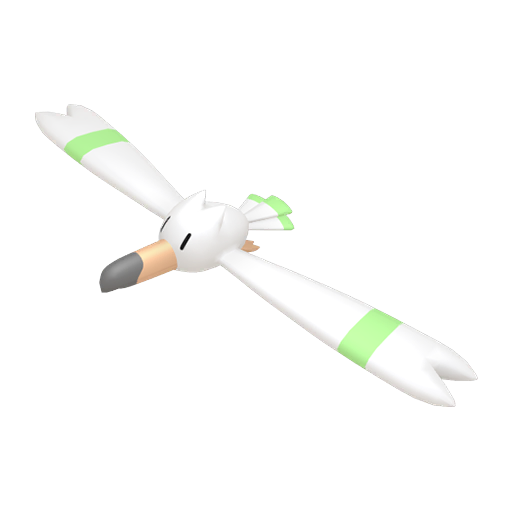
Wingull presents a striking appearance characterized by its predominantly white plumage and distinctly avian features that closely mirror real-world seagulls. Its large, oversized head appears to merge seamlessly with its compact body, creating an almost neckless silhouette that contributes to its adorable and approachable aesthetic. The Pokémon's facial features include small, triangular eyes positioned forward on its head and two distinctive triangular tufts that crown its skull, giving it an alert and inquisitive expression. Its most prominent feature is an orange, hook-tipped beak that serves as both a hunting tool and a means of carrying and hiding objects—a behavioral trait reflected consistently across multiple Pokédex entries. Long, flat wings with characteristic light blue striping near the tips enable Wingull's remarkable aerial capabilities, while small orange feet with two webbed toes provide aquatic and terrestrial mobility. The species possesses hollow bones throughout its skeletal structure, a remarkable biological adaptation that drastically reduces its overall body weight and permits the sustained gliding and updraft-riding behavior that defines its lifestyle.
Pokedex Numbers
Training
Breeding
Wingull Breeding, Gender Ratio & Egg Groups
Wingull maintains a perfectly balanced gender distribution with exactly 50% male and 50% female individuals occurring naturally throughout wild populations. The species belongs to two complementary egg groups—Water 1 and Flying—allowing for considerable breeding flexibility and cross-breeding compatibility with numerous other Pokémon species. These dual egg group assignments reflect Wingull's hybrid nature as both an aquatic and aerial creature, providing breeders with strategic advantages when developing competitive lineages or creating specific movepool combinations. The relatively high base friendship value of 70 indicates that Wingull naturally develops strong bonds with trainers, facilitating friendship-based evolution mechanics should any such conditions apply to its evolutionary line. With a hatch counter of 20 cycles, representing approximately 4,884 to 5,140 steps, Wingull eggs require moderate effort to incubate, positioning the species as neither particularly demanding nor immediately accessible for casual breeders.
Sprites




Held Items
Pretty Wing
loot
Sell for 100 Pokédollars.
Cost: 1000
Pretty Wing
loot
Sell for 100 Pokédollars.
Cost: 1000
Pretty Wing
loot
Sell for 100 Pokédollars.
Cost: 1000
Pretty Wing
loot
Sell for 100 Pokédollars.
Cost: 1000
Pretty Wing
loot
Sell for 100 Pokédollars.
Cost: 1000
Pretty Wing
loot
Sell for 100 Pokédollars.
Cost: 1000
TMs & HMs
tm03
ruby sapphire
tm03
platinum
tm03
firered leafgreen
tm03
heartgold soulsilver
tm03
diamond pearl
tm03
emerald
tm03
xd
tm03
colosseum
tm03
lets go pikachu lets go eevee
tm05
lets go pikachu lets go eevee
tm06
yellow
tm06
gold silver
tm06
red blue
tm06
crystal
tm06
emerald
tm06
firered leafgreen
tm06
diamond pearl
tm06
platinum
tm06
ruby sapphire
tm06
colosseum
+583 more TMs/HMs
Wingull's Evolution Chain


Wingull Evolution, Mega Evolution & Special Forms
Wingull follows a straightforward single-stage evolutionary progression within the Hoenn region's Pokédex structure. Upon reaching level 25, Wingull undergoes a transformation into Pelipper, a substantially larger Water/Flying-type that retains the evolutionary line's dual typing while gaining considerable physical presence and statistical improvements. The evolution represents a natural maturation process rather than a branching pathway, with Pelipper maintaining the core design elements established by Wingull while developing more robust proportions befitting an adult seabird. This evolution line lacks Mega Evolution forms or alternative evolutionary branches, representing a clean, linear progression that emphasizes gradual growth and development. The transition from Wingull to Pelipper at level 25 positions this evolution point relatively early in a trainer's journey, making it accessible even to novice players while still providing meaningful stat distribution shifts that enhance competitiveness.
Where to Find
Mossdeep City
hoenn
+3 more
Ever Grande City
hoenn
+3 more
Mt Pyre
hoenn
+9 more
Hoenn Route 103
hoenn
+16 more
Hoenn Route 105
hoenn
+3 more
Hoenn Route 118
hoenn
+18 more
Hoenn Route 130
hoenn
+3 more
Hoenn Route 131
hoenn
+3 more
Hoenn Route 129
hoenn
+3 more
Hoenn Route 132
hoenn
+3 more
Hoenn Route 133
hoenn
+3 more
Hoenn Route 128
hoenn
+3 more
Hoenn Route 134
hoenn
+3 more
Hoenn Route 127
hoenn
+3 more
Hoenn Route 126
hoenn
+3 more
Hoenn Route 125
hoenn
+3 more
Hoenn Route 124
hoenn
+3 more
Hoenn Route 123
hoenn
+12 more
Hoenn Route 122
hoenn
+3 more
Hoenn Route 121
hoenn
+12 more
+42 more locations in other games
Wingull Behaviour and Natural Habitat
Wingull demonstrates sophisticated behavioral patterns centered around coastal marine environments and cliff-side nesting sites. The Pokémon constructs its nests on steep, sheer cliffs positioned at the sea's edge, selecting locations that provide both protection and ready access to oceanic food sources. True to its seagull inspiration, Wingull exhibits the peculiar habit of collecting prey and valuable objects in its beak and deliberately hiding them in various locations throughout its territory, particularly intensifying this behavior during winter months when food becomes scarce. Rather than relying on constant wing flapping—a physiologically taxing activity—Wingull demonstrates remarkable aeronautical efficiency by riding ocean updrafts and thermals, essentially soaring across the sky as if skating upon invisible currents. Fishermen have long recognized the practical value of observing Wingull's movements, as the Pokémon circles predictably above areas teeming with its favorite foods: Wishiwashi and Finneon that breach the ocean surface. The species faces natural predation from formidable aerial and aquatic hunters, most notably Talonflame, whose powerful kicks pose a significant threat to airborne Wingull, and Barraskewda, which explosively leaps from the water to ambush Wingull flying too close to the surface.
Pokedex Entries
WINGULL has the habit of carrying prey and valuables in its beak and hiding them in all sorts of locations. This POKéMON rides the winds and flies as if it were skating across the sky.
WINGULL rides updrafts rising from the sea by extending its long and narrow wings to glide. This POKéMON’s long beak is useful for catching prey.
It makes its nest on a sheer cliff at the edge of the sea. It has trouble keeping its wings flapping in flight. Instead, it soars on updrafts.
It rides upon ocean winds as if it were a glider. In the winter, it hides food around its nest.
It makes its nest on steep sea cliffs. Riding updrafts, it soars to great heights.
Catching sea winds with its long wings, it soars as if it were a glider. It folds its wings to rest.
It soars high in the sky, riding on updrafts like a glider. It carries food tucked in its bill.
It soars on updrafts without flapping its wings. It makes a nest on sheer cliffs at the sea’s edge.
It soars high in the sky, riding on updrafts like a glider. It carries food tucked in its bill.
It makes its nest on sheer cliffs. Riding the sea breeze, it glides up into the expansive skies.
Catching sea winds with its long wings, it soars as if it were a glider. It folds its wings to rest.
It makes its nest on steep sea cliffs. Riding updrafts, it soars to great heights.
Wingull has the habit of carrying prey and valuables in its beak and hiding them in all sorts of locations. This Pokémon rides the winds and flies as if it were skating across the sky.
Wingull rides updrafts rising from the sea by extending its long and narrow wings to glide. This Pokémon’s long beak is useful for catching prey.
Its hollow bones enhance its lightness. It spreads its wings to the wind and soars away into the sky.
With its long, thin wings, it catches updrafts and flies like a glider high up into the sky.
Fishermen keep an eye out for Wingull in the sky, because wherever they’re circling, the ocean is sure to be teeming with fish Pokémon.
It builds nests in cliffs by the sea. It circles the skies above the ocean looking for its favorite food—Wishiwashi.
It makes its nest on sheer cliffs. Riding the sea breeze, it glides up into the expansive skies.
It soars on updrafts without flapping its wings. It makes a nest on sheer cliffs at the sea’s edge.
Wingull Name Origin & Design Inspiration
Wingull's name elegantly combines the English words 'wing' and 'gull,' directly referencing the Pokémon's dual nature as a winged creature based on the common seagull. The Japanese name, キャモメ (Kamome), derives directly from the Japanese word for seagull, maintaining linguistic clarity across cultural boundaries. Designer choices reflect a deliberate minimalist aesthetic that captures seagull characteristics through simplified yet expressive features—the orange beak with its characteristic hook, the white plumage, and the distinctive wing striping all serve as visual shorthand for 'seagull' that immediately communicates the Pokémon's identity. The design philosophy prioritizes accessibility and charm, making Wingull instantly recognizable to players familiar with real-world seagulls while remaining distinctly fantastical through its proportions and stylization. The hooked beak specifically references the predatory nature of gulls while serving gameplay and lore purposes as the primary tool through which Wingull collects and hides objects, reinforcing the connection between visual design and established behavioral characteristics.
Learnable Moves
Wingull can learn 78 moves:
Move | Type | Cat. | Power | Acc. | PP |
|---|---|---|---|---|---|
| acrobatics | flying | Physical | 55 | 100 | 15 |
| aerial ace | flying | Physical | 60 | — | 20 |
| agility | psychic | Status | — | — | 30 |
| air cutter | flying | Special | 60 | 95 | 25 |
| air slash | flying | Special | 75 | 95 | 15 |
| aqua ring | water | Status | — | — | 20 |
| attract | normal | Status | — | 100 | 15 |
| blizzard | ice | Special | 110 | 70 | 5 |
| brave bird | flying | Physical | 120 | 100 | 15 |
| brine | water | Special | 65 | 100 | 10 |
| captivate | normal | Status | — | 100 | 20 |
| chilling water | water | Special | 50 | 100 | 20 |
| confide | normal | Status | — | — | 20 |
| defog | flying | Status | — | — | 15 |
| double team | normal | Status | — | — | 15 |
| double edge | normal | Physical | 120 | 100 | 15 |
| dual wingbeat | flying | Physical | 40 | 90 | 10 |
| echoed voice | normal | Special | 40 | 100 | 15 |
| endure | normal | Status | — | — | 10 |
| facade | normal | Physical | 70 | 100 | 20 |
| feather dance | flying | Status | — | 100 | 15 |
| fly | flying | Physical | 90 | 95 | 15 |
| frustration | normal | Physical | — | 100 | 20 |
| growl | normal | Status | — | 100 | 40 |
| gust | flying | Special | 40 | 100 | 35 |
| hail | ice | Status | — | — | 10 |
| helping hand | normal | Status | — | — | 20 |
| hidden power | normal | Special | 60 | 100 | 15 |
| hurricane | flying | Special | 110 | 70 | 10 |
| hydro pump | water | Special | 110 | 80 | 5 |
| ice beam | ice | Special | 90 | 100 | 10 |
| icy wind | ice | Special | 55 | 95 | 15 |
| knock off | dark | Physical | 65 | 100 | 20 |
| liquidation | water | Physical | 85 | 100 | 10 |
| mimic | normal | Status | — | — | 10 |
| mist | ice | Status | — | — | 30 |
| mud slap | ground | Special | 20 | 100 | 10 |
| muddy water | water | Special | 90 | 85 | 10 |
| natural gift | normal | Physical | — | 100 | 15 |
| ominous wind | ghost | Special | 60 | 100 | 5 |
| pluck | flying | Physical | 60 | 100 | 20 |
| protect | normal | Status | — | — | 10 |
| pursuit | dark | Physical | 40 | 100 | 20 |
| quick attack | normal | Physical | 40 | 100 | 30 |
| rain dance | water | Status | — | — | 5 |
| rest | psychic | Status | — | — | 5 |
| return | normal | Physical | — | 100 | 20 |
| roost | flying | Status | — | — | 5 |
| round | normal | Special | 60 | 100 | 15 |
| scald | water | Special | 80 | 100 | 15 |
| secret power | normal | Physical | 70 | 100 | 20 |
| shock wave | electric | Special | 60 | — | 20 |
| sky attack | flying | Physical | 140 | 90 | 5 |
| sleep talk | normal | Status | — | — | 10 |
| snore | normal | Special | 50 | 100 | 15 |
| snowscape | ice | Status | 0 | — | 10 |
| soak | water | Status | — | 100 | 20 |
| steel wing | steel | Physical | 70 | 90 | 25 |
| substitute | normal | Status | — | — | 10 |
| supersonic | normal | Status | — | 55 | 20 |
| surf | water | Special | 90 | 100 | 15 |
| swagger | normal | Status | — | 85 | 15 |
| swift | normal | Special | 60 | — | 20 |
| tailwind | flying | Status | — | — | 15 |
| take down | normal | Physical | 90 | 85 | 20 |
| tera blast | normal | Special | 80 | 100 | 10 |
| thief | dark | Physical | 60 | 100 | 25 |
| toxic | poison | Status | — | 90 | 10 |
| twister | dragon | Special | 40 | 100 | 20 |
| u turn | bug | Physical | 70 | 100 | 20 |
| uproar | normal | Special | 90 | 100 | 10 |
| water gun | water | Special | 40 | 100 | 25 |
| water pulse | water | Special | 60 | 100 | 20 |
| water sport | water | Status | — | — | 15 |
| waterfall | water | Physical | 80 | 100 | 15 |
| whirlpool | water | Special | 35 | 85 | 15 |
| wide guard | rock | Status | — | — | 10 |
| wing attack | flying | Physical | 60 | 100 | 35 |
Wingull Competitive Battle Guide
Wingull's competitive viability operates within well-defined parameters established by its modest base stat distribution and typing. The species' most significant asset is its Speed stat of 85, which grants meaningful outspeeding potential against numerous common opponents before evolution into Pelipper. Its Special Attack base of 55 represents the highest offensive capability, supporting Water-type special moves that align with its typing and movepool. The dual Water/Flying typing provides useful resistances to Water, Fighting, and Bug-type moves while simultaneously creating notable weaknesses to Electric-type attacks—a critical consideration in team building. Wingull's Keen Eye ability provides valuable immunity to accuracy reduction effects, preventing opponents from utilizing moves like Sand Attack or tactics that manipulate accuracy statistics. The Hydration ability, available from Generation VII onwards, offers situational utility by curing major status conditions during rain, synergizing well with rain-based team strategies. Rain Dish, the hidden ability, provides passive healing during rain weather equal to one-sixteenth of maximum HP per turn, incentivizing weather-based competitive strategies. However, Wingull's low defenses (30 base Defense and Special Defense) and modest HP (40) render it vulnerable to sustained offensive pressure, limiting its longevity in competitive encounters. Most competitive applications involve using Wingull as an early-game momentum shifter rather than an endgame sweeper, with evolution into Pelipper typically preferred for sustained competitive viability.
Commonly Asked Questions About Wingull
What type is Wingull?
Wingull is a water and flying type Pokemon.
What does Wingull evolve into?
Wingull evolves into pelipper.
What are Wingull's weaknesses?
Wingull is weak to rock and electric type moves.
Does Wingull evolve by trading?
No — Wingull evolves entirely through leveling up, with no trade required at any stage.
Where can I find Wingull?
Wingull can be found in mossdeep city (hoenn), ever grande city (hoenn) and mt pyre (hoenn) and 59 other locations.
Wingull Cultural Impact & Franchise History
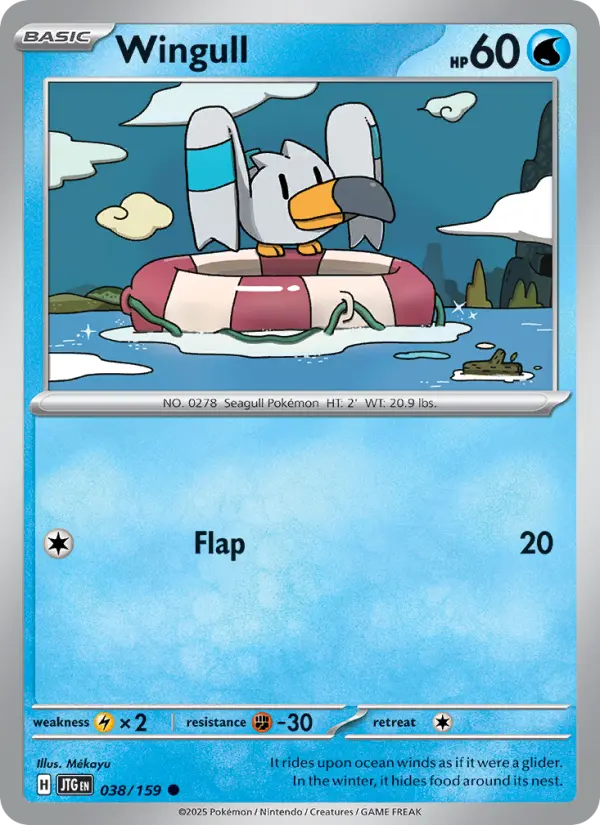
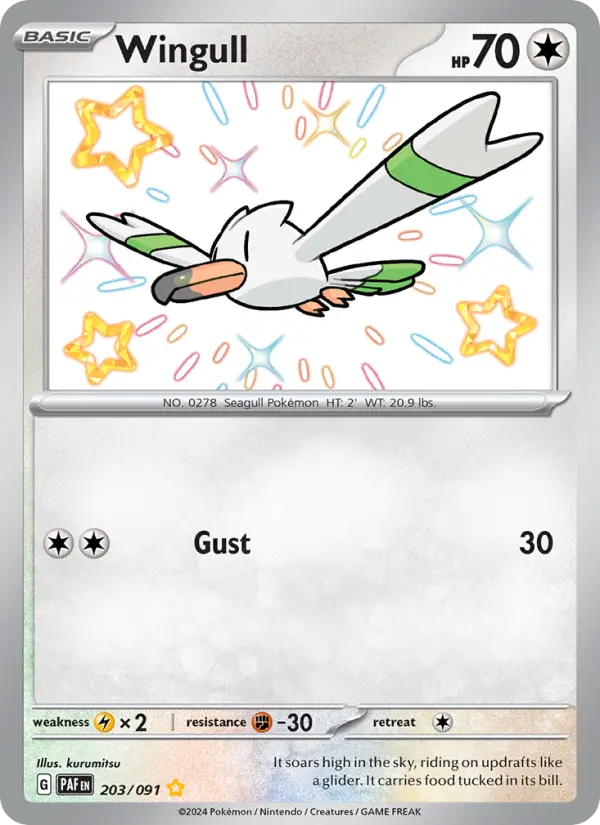
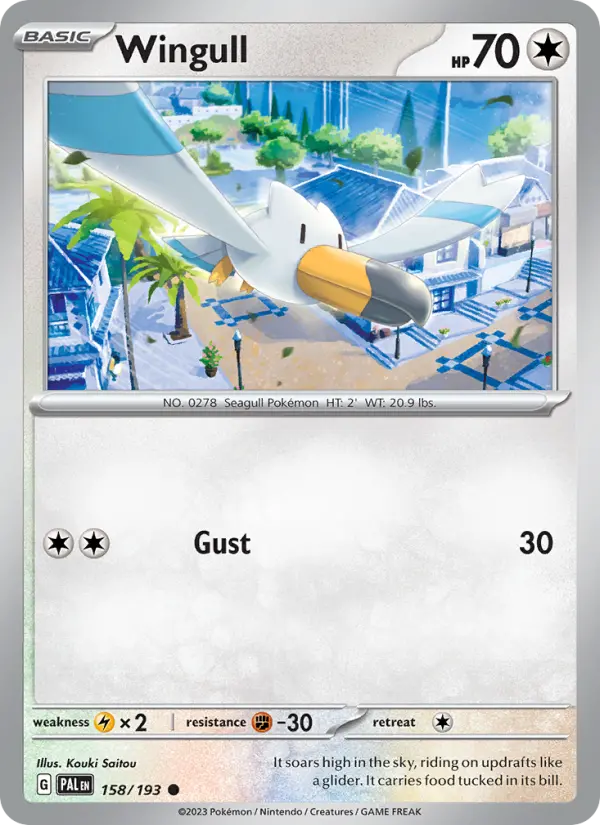
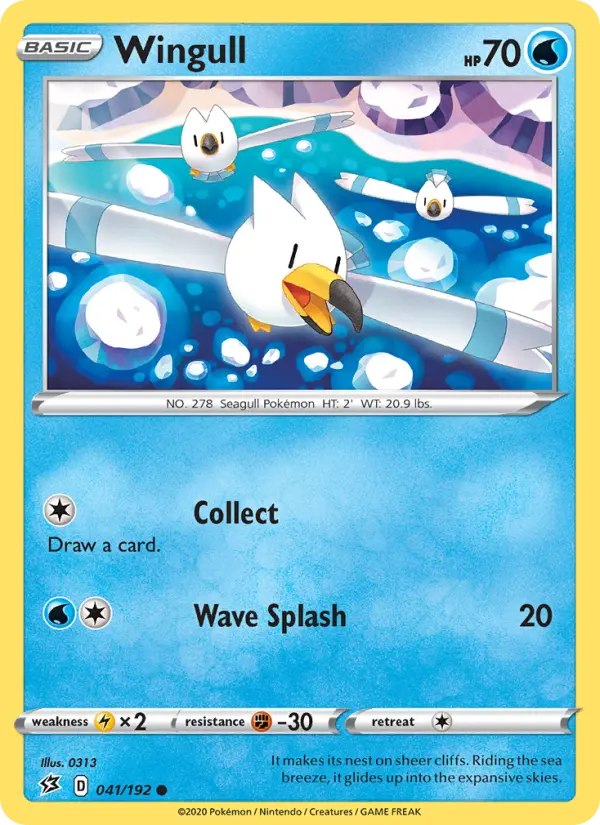
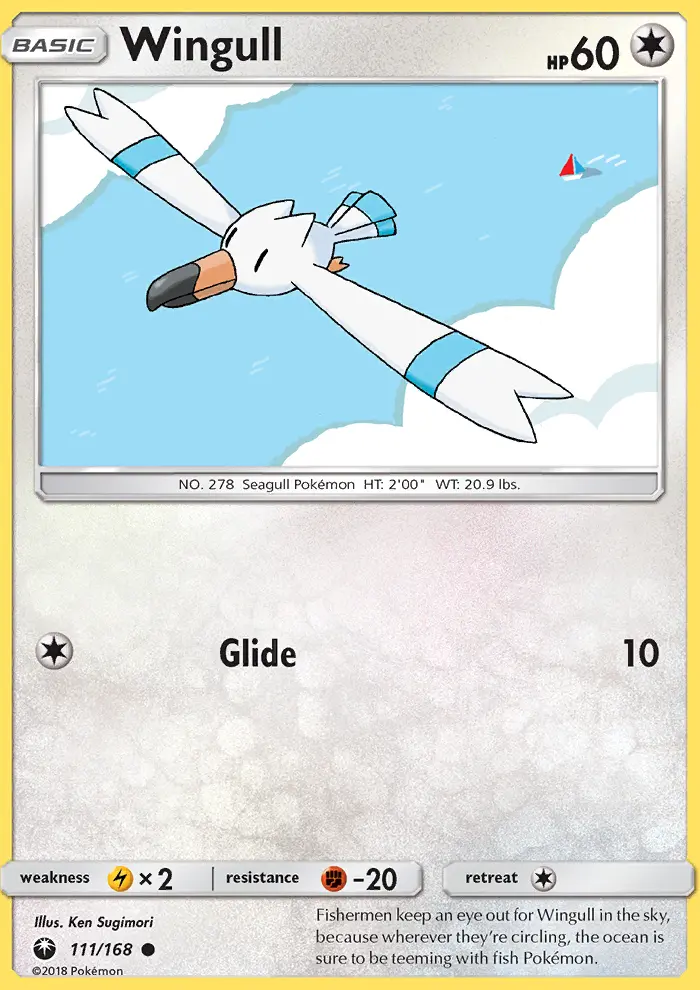
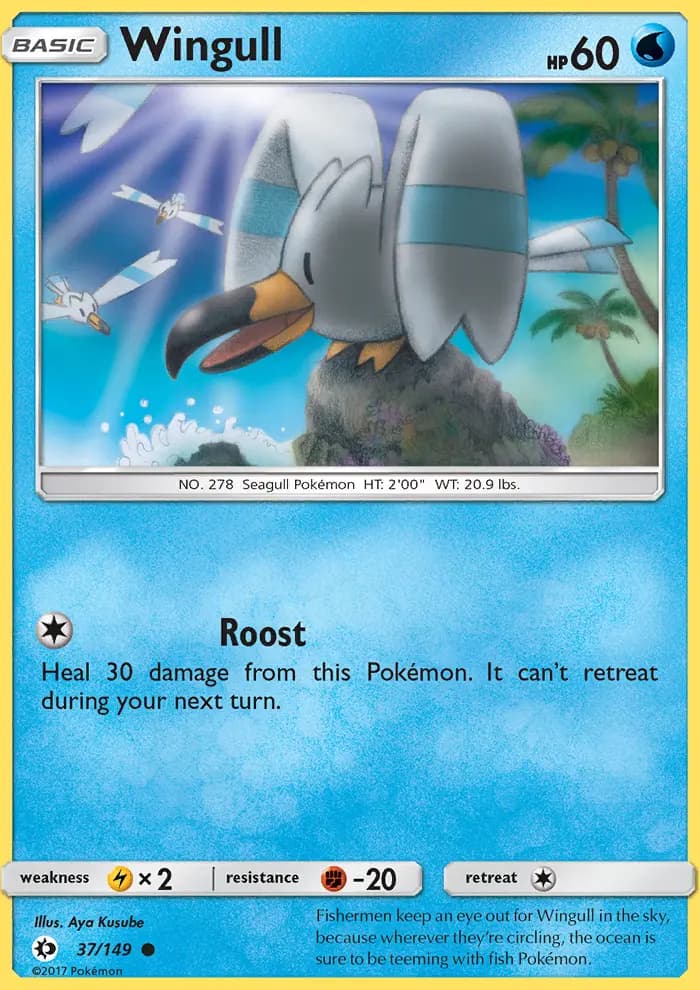
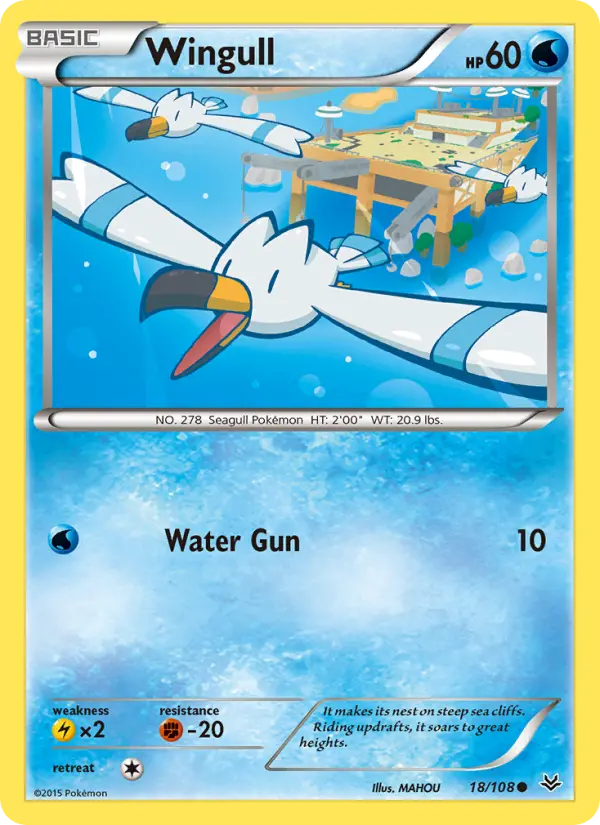
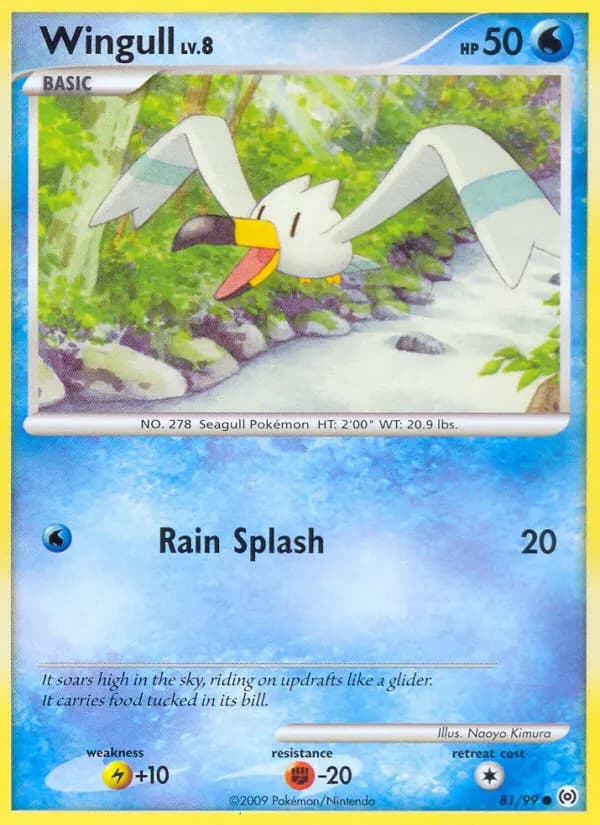
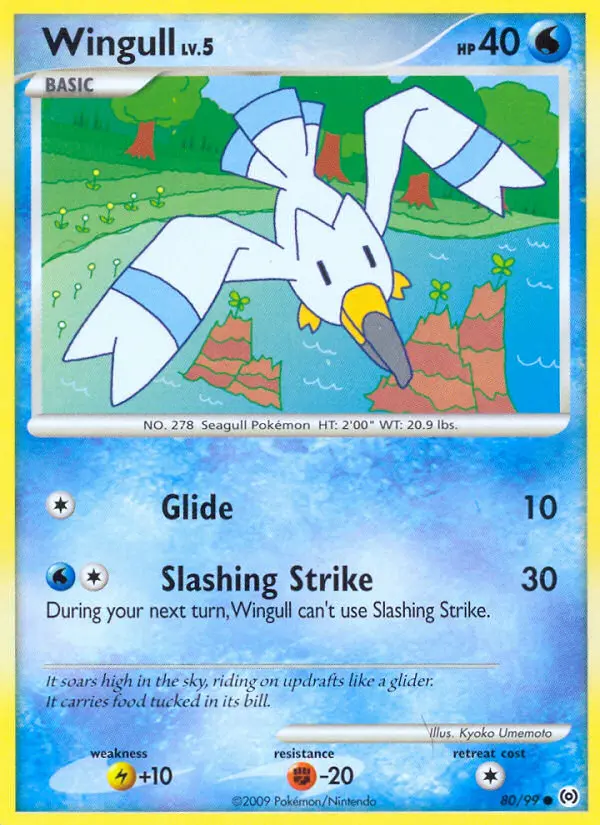
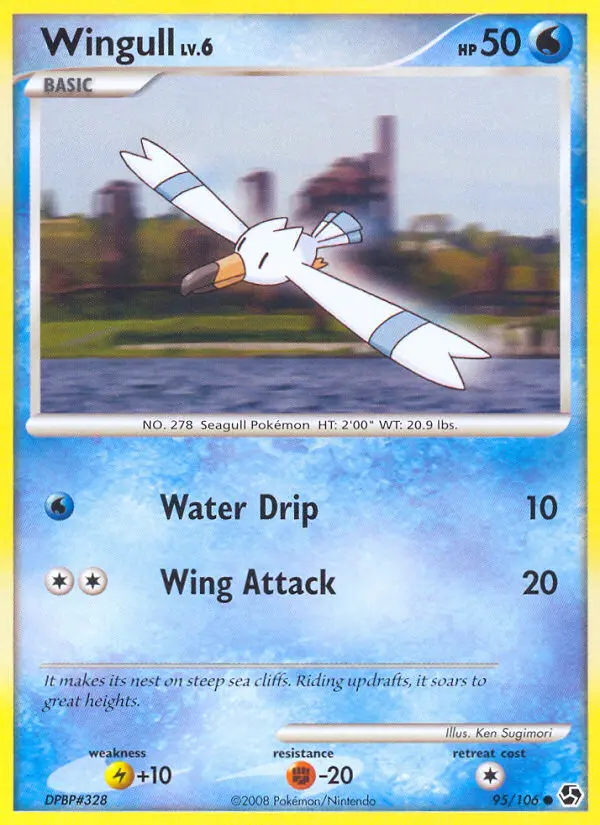
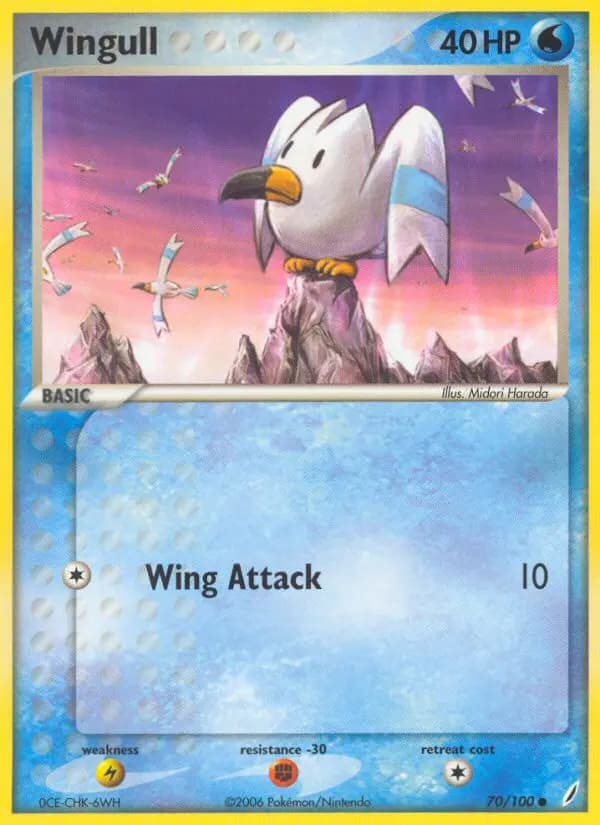
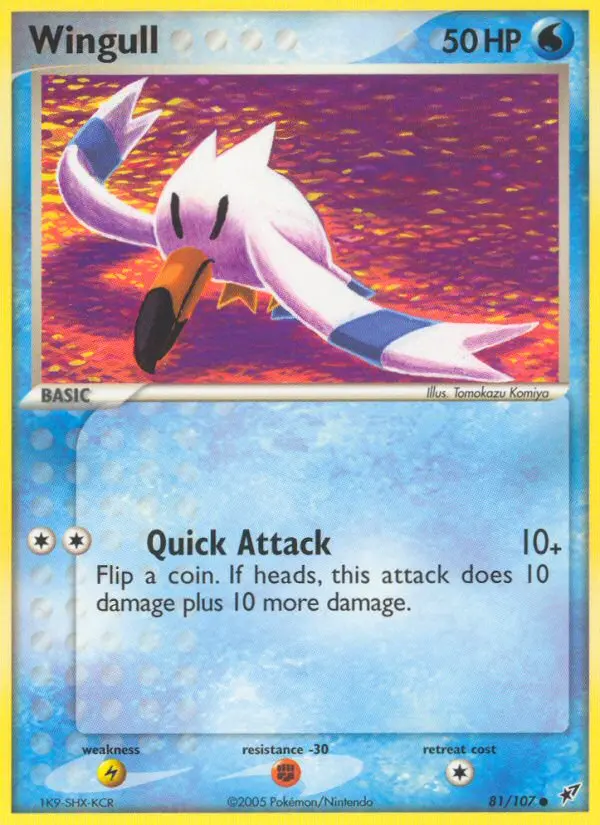
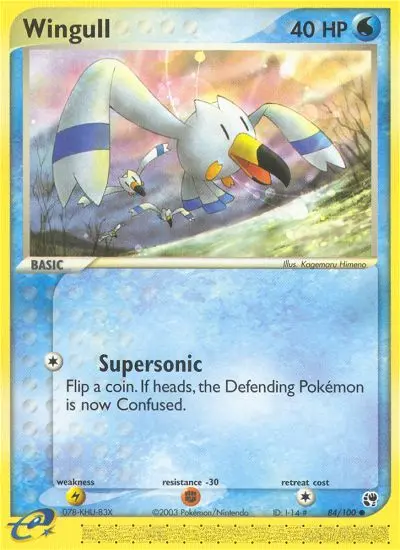
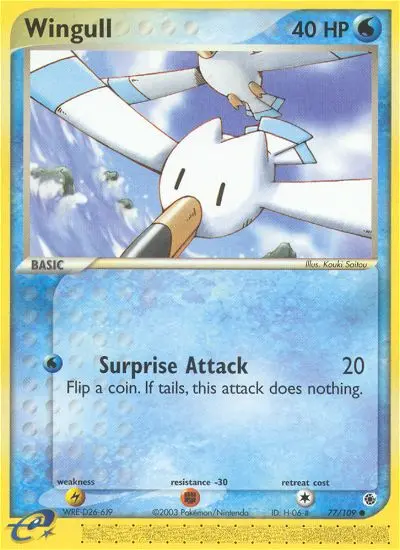
Wingull has established itself as a beloved and recognizable fixture within Pokémon media, particularly following its prominent role in the anime series. The species achieved significant cultural presence through Peeko, a notable Wingull character appearing in the Ruby and Sapphire animated adaptations, becoming a fan-favorite supporting character that demonstrated the species' capacity for companionship and emotional connection. Wingull's frequent appearances throughout multiple anime seasons, games, and supplementary media have solidified its status as an iconic coastal Pokémon that players consistently encounter during water-type focused narratives. The Pokémon's design has proven highly merchandisable, appearing on trading cards, plushies, and collectible figurines that appeal to both casual collectors and dedicated enthusiasts. In competitive TCG circles, Wingull has appeared in various card iterations representing different game generations, contributing to the expansive history of Water-type card representations. The species' role as a visual indicator of fish-rich waters—as established in multiple Pokédex entries describing its utility to fishermen—has positioned Wingull as a culturally relevant bridge between human activity and Pokémon ecosystems, appearing frequently in coastal-themed narratives and water-centric storylines throughout the franchise.
Where to Find Wingull in Every Pokémon Game
Wingull enjoys widespread availability across the vast majority of Pokémon games spanning multiple generations, particularly those featuring coastal and aquatic environments. The species achieved prominence in Generation III games (Ruby, Sapphire, and Emerald), where it served as a primary Water-type encounter in Hoenn's numerous oceanic routes. Subsequent generational releases in Sinnoh (Diamond, Pearl, and Platinum), Unova (Black 2 and White 2), Kalos (X and Y, particularly in Coastal Kalos), and Alola (Sun, Moon, Ultra Sun, and Ultra Moon) continued offering Wingull as a coastal encounter. The species maintains consistent availability throughout modern generations, appearing in Galar (Sword and Shield) with local Pokédex number 62 and in Paldea (Scarlet and Violet) with local number 132. Wingull's presence in The Isle of Armor DLC content further expands accessibility for players seeking the species. With a capture rate of 190, representing relatively high catchability, Wingull proves accessible even to trainers utilizing basic Poké Balls, though encounters typically require navigation to coastal routes, beaches, and seaside locations rather than appearing in inland or cave environments. The species' consistent regional availability across multiple game generations reflects its status as a franchise staple, ensuring that trainers across different play eras and game versions can readily incorporate Wingull into their teams during appropriate story progression points.