
School Wishiwashi
Generation VII · #10127 — Small Fry Pokémon
Wishiwashi, known as the Small Fry Pokémon, is a Water-type Pokémon introduced in Generation VII that possesses one of the most remarkable defensive mechanisms in the entire Pokédex. What makes Wishiwashi truly exceptional is its unique Schooling ability, which allows it to dramatically transform from a diminutive solo form into a massive school formation when its HP remains above 25%. This transformation represents a striking example of Pokémon adaptation, as a single Wishiwashi in its solo form is almost defenseless, but when joined by its companions in school form, it becomes a formidable force with base stats totaling 620. The contrast between its two states is so dramatic that many trainers in the Alola region initially underestimate this Pokémon, not realizing that what appears to be a single tiny fish is actually a coordinated collective intelligence ready to defend itself.
Editor's Take
School Form Wishiwashi has a base stat total of 620, higher than most pseudo-legendaries, and reverting the instant it drops below a quarter health makes it a genuine glass giant.
Base Stats
Height
8.2m
Weight
78.6kg
Category
Small Fry Pokémon
Gender
Male 50% / Female 50%
Color
blue
Shape
fish
Abilities
Wishiwashi becomes Schooling Form when its HP is 25% or higher.

School Wishiwashi Biology & Physical Characteristics
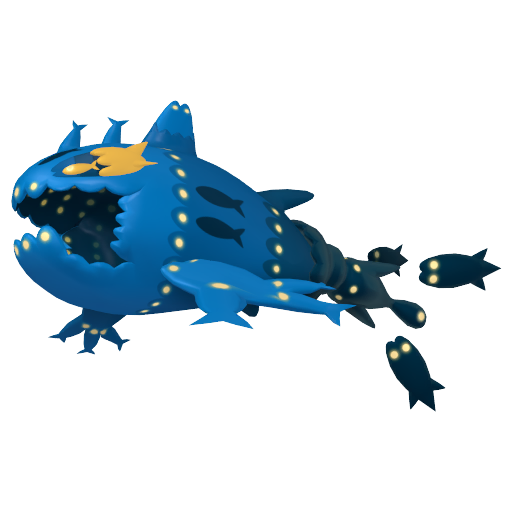
In its school form, Wishiwashi presents an entirely different biological structure compared to its solo counterpart. Standing at an impressive 8.2 meters in length and weighing 78.6 kilograms, the school form dwarfs its individual form's mere 0.2 meters and 0.3 kilograms. The school configuration appears to be a massive, coordinated amalgamation of individual Wishiwashi, creating a unified entity with balanced offensive and defensive capabilities. With base stats of 140 in both Attack and Special Attack, 130 in Defense, and 135 in Special Defense, the school form represents a complete inversion of the solo form's pathetic stat distribution. The biological mechanism underlying this transformation is still not fully understood, but Pokédex entries suggest that it involves a pheromone-based communication system where individual Wishiwashi coordinate their movements and positioning to create this larger formation. The remarkable aspect of this transformation is that it occurs instantaneously during battle conditions, suggesting either rapid muscular coordination or a form of collective consciousness that allows the school to function as a singular organism.
Pokedex Numbers
Training
Breeding
School Wishiwashi Breeding, Gender Ratio & Egg Groups
Wishiwashi maintains a perfectly balanced gender ratio of 50% male and 50% female, indicating no sexual dimorphism in its breeding patterns or appearance. The species belongs to the Water 2 egg group, meaning it can breed with other Water 2 Pokémon and compatible breeding partners. With a base happiness value of 70, Wishiwashi shows moderate friendliness toward its trainers and breeding partners, suggesting it responds well to proper care and affection but may require some effort to develop strong bonds. The egg hatching process for Wishiwashi requires 15 cycles, equivalent to approximately 3,599 to 3,855 steps, making it a relatively quick breeding investment compared to many other Pokémon species. Wishiwashi exhibits a fast growth rate, meaning it reaches higher levels more quickly than Pokémon with standard growth rates, making it an excellent choice for trainers seeking rapid team development. The balanced gender distribution ensures that trainers have equal opportunity to breed either sex, and the species' willingness to breed at a moderate base happiness level means that even newly caught wild Wishiwashi can be encouraged to produce eggs without excessive bonding time.
Sprites





TMs & HMs
tm03
ruby sapphire
tm03
platinum
tm03
firered leafgreen
tm03
heartgold soulsilver
tm03
diamond pearl
tm03
emerald
tm03
xd
tm03
colosseum
tm03
lets go pikachu lets go eevee
tm05
lets go pikachu lets go eevee
tm06
yellow
tm06
gold silver
tm06
red blue
tm06
crystal
tm06
emerald
tm06
firered leafgreen
tm06
diamond pearl
tm06
platinum
tm06
ruby sapphire
tm06
colosseum
+449 more TMs/HMs

School Wishiwashi Evolution, Mega Evolution & Special Forms
Wishiwashi does not evolve into any other Pokémon species, nor does it have a Mega Evolution form. However, the transformation between its solo and school forms represents a unique mechanic within the Pokémon franchise that is functionally similar to form changes. The Schooling ability governs this transformation, automatically converting a Wishiwashi to its school form whenever its HP remains at 25% or higher at the start of a turn or upon entering battle. This means that any Wishiwashi at level 20 or higher with the Schooling ability will immediately shift into school form when engaged in combat with adequate health, providing trainers with an exceptionally powerful ally. Conversely, if the Wishiwashi's HP drops below 25% during battle, it will revert to its solo form, losing access to its enhanced stats and becoming significantly more vulnerable. This mechanic creates a dynamic battle strategy where maintaining Wishiwashi's health becomes critically important, as the threshold between its powered and depowered states is relatively low, requiring careful health management and strategic healing.
Where to Find
Location data not available for this Pokémon in the database.
School Wishiwashi Behaviour and Natural Habitat
Wishiwashi exhibits highly social behavior, with individual Wishiwashi being notably weak, tasteless prey animals that have evolved an extraordinary cooperative strategy for survival. When alone, a Wishiwashi is vulnerable to numerous predators including Dewgong, Wailmer, Wailord, Wingull, and Pelipper, making solitary existence dangerous and potentially brief. However, when danger approaches, individual Wishiwashi possess a remarkable ability to signal distress through their eyes, which begin to moisten and shine with an intensity visible from almost 25 miles away according to Ultra Moon Pokédex entries. This visual SOS signal acts as a beacon, attracting other Wishiwashi in the vicinity to form their protective school formation. The Alola region's inhabitants view Wishiwashi with a respect bordering on fear, understanding that while any single individual is insignificant, a school of Wishiwashi is a dangerous opponent. Despite this cooperative tendency, Wishiwashi are occasionally found stranded or separated from their schools, suggesting that individual motivation and separation do occur, though such isolated Wishiwashi likely face significantly higher mortality rates.
Pokedex Entries
When it’s in trouble, its eyes moisten and begin to shine. The shining light attracts its comrades, and they stand together against their enemies.
They’re weak, so they move in schools. However, they can also often be seen all alone, having strayed from the school.
It’s awfully weak and notably tasty, so everyone is always out to get it. As it happens, anyone trying to bully it receives a painful lesson.
When it’s in a jam, its shining eyes attract others of its kind. The light from its eyes is visible almost 25 miles away.
Individually, they’re incredibly weak. It’s by gathering up into schools that they’re able to confront opponents.
When it senses danger, its eyes tear up. The sparkle of its tears signals other Wishiwashi to gather.
School Wishiwashi Name Origin & Design Inspiration
The name Wishiwashi derives from the Japanese name Yowashi, combining elements that suggest weakness and cooperation. In its solo form, Wishiwashi resembles a small, vulnerable fish with large, expressive light blue eyes rimmed with dark blue eyelids that resemble tear ducts, appropriate given its ability to cry for help. Its body features a white head and tail with a line of white teardrop shapes along each side, emphasizing its delicate, fragile appearance. The coloration is predominantly dark blue on the upper body with a gray lower half, giving it an unassuming appearance befitting a prey animal. The design philosophy contrasts dramatically with its school form, which appears to be a large, intimidating amalgamation where individual Wishiwashi fuse together into a cohesive unit. The school form's design suggests a collective entity rather than a mere grouping, with the combined mass and coordinated structure implying unified intelligence and purpose. This stark visual difference between forms is intentional game design, emphasizing the narrative of weakness in isolation versus strength in community, making Wishiwashi's design a powerful statement about the vulnerability of individuals and the power of collective action.
Learnable Moves
School Wishiwashi can learn 52 moves:
Move | Type | Cat. | Power | Acc. | PP |
|---|---|---|---|---|---|
| aqua ring | water | Status | — | — | 20 |
| aqua tail | water | Physical | 90 | 90 | 10 |
| attract | normal | Status | — | 100 | 15 |
| beat up | dark | Physical | — | 100 | 10 |
| brine | water | Special | 65 | 100 | 10 |
| bulldoze | ground | Physical | 60 | 100 | 20 |
| confide | normal | Status | — | — | 20 |
| covet | normal | Physical | 60 | 100 | 25 |
| dive | water | Physical | 80 | 100 | 10 |
| double team | normal | Status | — | — | 15 |
| double edge | normal | Physical | 120 | 100 | 15 |
| earthquake | ground | Physical | 100 | 100 | 10 |
| endeavor | normal | Physical | — | 100 | 5 |
| endure | normal | Status | — | — | 10 |
| facade | normal | Physical | 70 | 100 | 20 |
| feint attack | dark | Physical | 60 | — | 20 |
| flip turn | water | Physical | 60 | 100 | 20 |
| frustration | normal | Physical | — | 100 | 20 |
| growl | normal | Status | — | 100 | 40 |
| hail | ice | Status | — | — | 10 |
| helping hand | normal | Status | — | — | 20 |
| hidden power | normal | Special | 60 | 100 | 15 |
| hydro pump | water | Special | 110 | 80 | 5 |
| ice beam | ice | Special | 90 | 100 | 10 |
| iron tail | steel | Physical | 100 | 75 | 15 |
| liquidation | water | Physical | 85 | 100 | 10 |
| mist | ice | Status | — | — | 30 |
| mud shot | ground | Special | 55 | 95 | 15 |
| muddy water | water | Special | 90 | 85 | 10 |
| protect | normal | Status | — | — | 10 |
| rain dance | water | Status | — | — | 5 |
| rest | psychic | Status | — | — | 5 |
| return | normal | Physical | — | 100 | 20 |
| round | normal | Special | 60 | 100 | 15 |
| scald | water | Special | 80 | 100 | 15 |
| scale shot | dragon | Physical | 25 | 90 | 20 |
| sleep talk | normal | Status | — | — | 10 |
| snore | normal | Special | 50 | 100 | 15 |
| soak | water | Status | — | 100 | 20 |
| substitute | normal | Status | — | — | 10 |
| surf | water | Special | 90 | 100 | 15 |
| swagger | normal | Status | — | 85 | 15 |
| take down | normal | Physical | 90 | 85 | 20 |
| tearful look | normal | Status | — | — | 20 |
| toxic | poison | Status | — | 90 | 10 |
| u turn | bug | Physical | 70 | 100 | 20 |
| uproar | normal | Special | 90 | 100 | 10 |
| water gun | water | Special | 40 | 100 | 25 |
| water pulse | water | Special | 60 | 100 | 20 |
| water sport | water | Status | — | — | 15 |
| waterfall | water | Physical | 80 | 100 | 15 |
| whirlpool | water | Special | 35 | 85 | 15 |
School Wishiwashi Competitive Battle Guide
Competitively, Wishiwashi's school form represents a versatile and surprisingly powerful option, offering excellent balanced stats with 140 in both Attack and Special Attack, coupled with solid defensive stats of 130 Defense and 135 Special Defense. The school form's total base stat pool of 620 places it in the mid-tier competitive range, making it viable for casual and lower-tier competitive play, though its relatively low Speed stat of 30 can be problematic in faster-paced competitive environments. The reliance on the Schooling ability means that maintaining health above 25% is absolutely critical, creating a strategic vulnerability where aggressive opponents can potentially force a form change by dealing significant damage. Wishiwashi's movepool provides access to a variety of Water-type moves including powerful offensive and supportive options, allowing for strategic flexibility in team composition and individual set building. The Water-type classification grants Wishiwashi useful resistances to Fire, Water, Ice, and Steel-type moves, each resisting at half damage, though it faces problematic weaknesses to Electric and Grass-type attacks that deal super-effective damage. Despite these limitations, the dramatic stat jump provided by the Schooling ability and the psychological impact of facing a massive school form make Wishiwashi an interesting niche pick for trainers willing to build team strategies around health preservation and the unique mechanics of the Schooling transformation.
Commonly Asked Questions About School Wishiwashi
What type is School Wishiwashi?
School Wishiwashi is a water type Pokemon.
What does School Wishiwashi evolve into?
School Wishiwashi does not evolve.
What are School Wishiwashi's weaknesses?
School Wishiwashi is weak to grass and electric type moves.
School Wishiwashi Cultural Impact & Franchise History
Despite its humble appearance as a tiny, weak fish, Wishiwashi has captured significant cultural attention in the Alola region and among Pokémon trainers worldwide, primarily due to the shocking contrast between its unassuming solo form and its intimidating school configuration. The locals of Alola regard Wishiwashi with a level of respect and caution that seems disproportionate to its size, demonstrating that the region's inhabitants understand the devastating power of a coordinated school formation despite the individual Pokémon's fragility. Wishiwashi has become a symbol within Pokémon media of the principle that unity and cooperation can overcome individual limitations, making it particularly popular among trainers and fans who appreciate strategic gameplay that rewards clever team building and health management. The Pokédex entries frequently emphasize Wishiwashi's weakness and palatability as individual creatures, yet simultaneously highlight the danger posed by their coordinated schools, creating a narrative that has resonated with audiences and inspired discussions about collective power versus individual vulnerability. In competitive communities, Wishiwashi has developed a cult following among players who appreciate unconventional mechanics and are willing to embrace the challenge of managing a Pokémon whose power is contingent on maintaining precise health thresholds. The unique Schooling ability, exclusive to Wishiwashi, has made it a subject of significant study within the Pokémon competitive community, with players continuously exploring new strategies and move combinations to maximize its potential.
Where to Find School Wishiwashi in Every Pokémon Game
Wishiwashi can be encountered in the Alola region introduced in Pokémon Sun and Moon, where it occupies local Pokédex number 110, and continues to appear in subsequent Alola-based games Ultra Sun and Ultra Moon at local Pokédex number 133. The species made its way into other regions in later generations, appearing in Pokémon Sword and Shield with local Pokédex number 155 and returning in The Isle of Armor DLC at local Pokédex number 110. With a capture rate of 60, Wishiwashi is moderately difficult to catch compared to common water-type encounters, requiring standard Poké Balls and basic catching techniques without necessitating specialized equipment or rare items. The base experience yield for solo form is 61 with a moderate happiness value of 70, while school form grants significantly more experience at 217, creating an incentive to keep Wishiwashi in school form during training. Trainers seeking to obtain Wishiwashi should focus their efforts on water-based areas within these regions where Water-type Pokémon naturally congregate, and should be prepared to encounter them in schools where they may demonstrate their full power in their school form configuration. The species' appearance across multiple generations and regions since its introduction in Generation VII demonstrates its popularity and acceptance within the broader Pokémon game ecosystem.