Yungoos
Generation VII · #0734 — Loitering Pokémon
Trainers who write off Yungoos on looks alone are missing that its HP of 50 is genuinely one of the higher marks among normal-type Pokémon. The species is renowned for its insatiable appetite and aggressive nature, characteristics that define its role in both the natural world of Alola and in competitive Pokémon battles. As the unevolved form of Gumshoos, Yungoos serves as an entry point for trainers seeking a reliable Normal-type companion during their journey through the Alola region.
Editor's Take
Yungoos's line ends in Gumshoos, and Stakeout doubling damage against a Pokémon that just switched in is one of the most punishing abilities in the game against predictable play.
Base Stats
Height
0.4m
Weight
6.0kg
Category
Loitering Pokémon
Gender
Male 50% / Female 50%
Color
brown
Shape
quadruped
Abilities
This Pokémon's moves have double power against Pokémon that switched in this turn.
Strengthens biting moves to 1.5× their power.
Increases the same-type attack bonus from 1.5× to 2×.

Yungoos Biology & Physical Characteristics
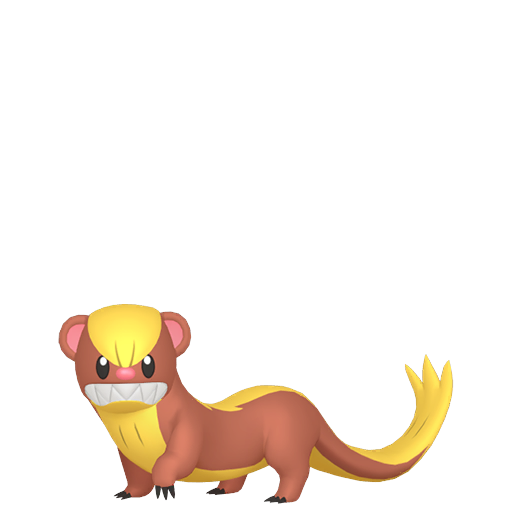
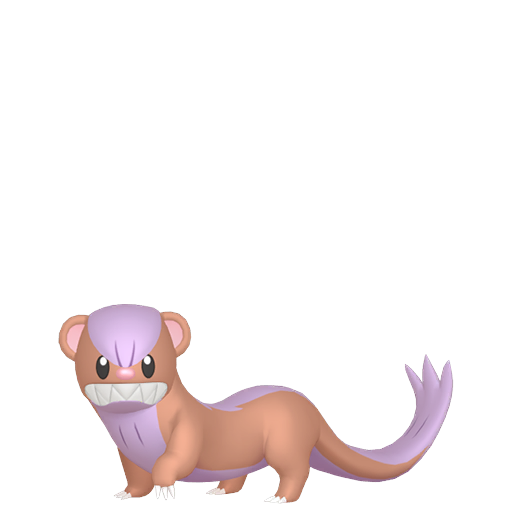
Yungoos exhibits a distinctly mongoose-like appearance with a long, slender body dominated by its enlarged stomach, which occupies the majority of its torso and reflects its voracious eating habits. Its body is covered in brown fur with characteristic yellow stripes running down its back and underside, creating a striking color pattern that distinguishes it from other rodent-like Pokémon. The creature possesses a relatively flat, wide tail with elongated fur on the tip, short rounded ears positioned on the sides of its head, and a short snout with a prominent pink nose. Perhaps most notably, Yungoos features a large mouth filled with pointed, razor-sharp teeth designed for crushing and consuming virtually any material, no matter how hard. Its feet are equipped with three black claws on each of its four short legs, providing grip and traction as it stalks its territory. The physiology of Yungoos is optimized for consumption and digestion; its stomach has an extraordinary capacity and its digestive system processes food with remarkable speed, explaining why the species is perpetually hungry and perpetually searching for its next meal.
Pokedex Numbers
Training
Breeding
Yungoos Breeding, Gender Ratio & Egg Groups
Yungoos maintains a perfectly balanced gender ratio of fifty percent male and fifty percent female, providing equal representation regardless of which individual trainers encounter in the wild or in breeding programs. The species belongs to the Field Egg Group, classifying it alongside various mammalian and beast-like Pokémon that share terrestrial breeding patterns. With a base friendship value of 70 in Generation VII games, Yungoos demonstrates moderate sociability toward trainers who capture and train it, suggesting that despite its aggressive feeding behaviors, the species can develop bonds with human companions. The breeding mechanics for Yungoos are relatively straightforward, as the species requires fifteen egg cycles to hatch from its egg form, translating to approximately 3,599 to 3,855 steps for trainers engaging in egg hatching mechanics. This moderate hatch time makes Yungoos accessible for trainers interested in breeding programs without requiring excessive time investment compared to other species. The species's reproductive capacity and Field Egg Group classification make it a practical choice for breeders seeking to develop strong individuals through selective breeding and IV optimization.
Sprites




Held Items
Pecha Berry
medicine
Held: Consumed when poisoned to cure poison.
Cost: 80
Pecha Berry
medicine
Held: Consumed when poisoned to cure poison.
Cost: 80
Pecha Berry
medicine
Held: Consumed when poisoned to cure poison.
Cost: 80
Pecha Berry
medicine
Held: Consumed when poisoned to cure poison.
Cost: 80
TMs & HMs
tm01
ultra sun ultra moon
tm01
sun moon
tm02
lets go pikachu lets go eevee
tm03
lets go pikachu lets go eevee
tm05
lets go pikachu lets go eevee
tm06
yellow
tm06
gold silver
tm06
red blue
tm06
crystal
tm06
emerald
tm06
firered leafgreen
tm06
diamond pearl
tm06
platinum
tm06
ruby sapphire
tm06
colosseum
tm06
black 2 white 2
tm06
xd
tm06
black white
tm06
heartgold soulsilver
tm06
omega ruby alpha sapphire
+507 more TMs/HMs


Yungoos Evolution, Mega Evolution & Special Forms
Yungoos evolves into Gumshoos, its final and only evolutionary form, through a specific condition that emphasizes the daily cycle of this species. The evolution occurs when Yungoos reaches level 20 during daytime hours, reflecting the species' active hunting behaviors and its connection to diurnal cycles. This daytime-specific evolution mechanic is unique among Alolan Pokémon and underscores the biological rhythm that defines Yungoos's behavior pattern. Upon evolution into Gumshoos, the Pokémon undergoes significant physical and statistical changes, developing into a more formidable hunter with enhanced combat capabilities. The evolution from Yungoos to Gumshoos represents a transformation from a relentless forager into an apex predator of small prey, with Gumshoos gaining considerably improved Attack, Defense, and Special Defense statistics. Trainers seeking to evolve their Yungoos must ensure they level their companion during daylight hours, making time-of-day awareness crucial for progression in games featuring this species.
Where to Find
Alola Route 3
alola
+1 more
Alola Route 2
alola
+9 more
Alola Route 8
alola
+1 more
Alola Route 6
alola
+5 more
Alola Route 1
alola
+11 more
Hauoli City
alola
Alola Route 4
alola
+1 more
Kalae Bay
alola
+1 more
Verdant Cavern
alola
Yungoos Behaviour and Natural Habitat
True to its classification as the Loitering Pokémon, Yungoos is defined by its ceaseless wandering in search of food, exhibiting behaviors that would exhaust most other creatures. According to Pokédex entries, this species follows a predictable daily cycle: it marches through streets and territories during daylight hours, hunting for fresh living prey with determined aggression, until dusk forces its collapse from sheer exhaustion. Upon reaching complete fatigue, Yungoos simply falls asleep wherever it happens to be, demonstrating remarkable territorial confidence—researchers theorize that the species selects its loitering grounds based on safety considerations, allowing it to rest without fear of predation. Although Yungoos will consume virtually anything edible, it shows a distinct preference for fresh, living prey, driving it to actively hunt rather than scavenge. The species did not naturally inhabit Alola but was imported to the region from another area, making it an invasive species with ecological consequences. Despite its non-native status, Yungoos has established itself as a common sight throughout Alola, particularly in urban and developed areas where food sources are abundant.
Pokedex Entries
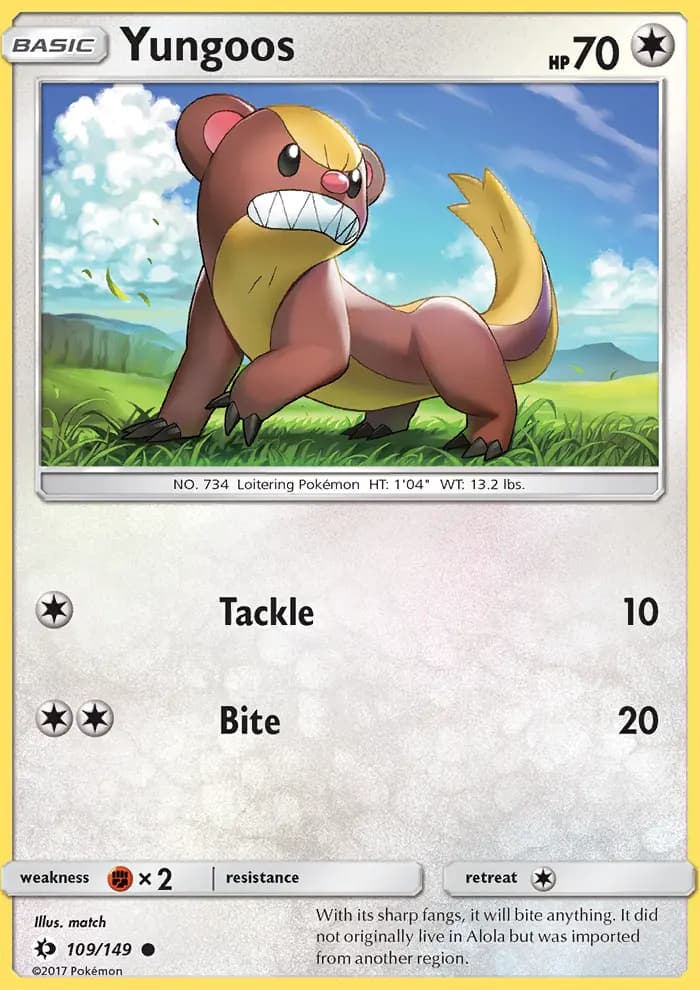
With its sharp fangs, it will bite anything. It did not originally live in Alola but was imported from another region.
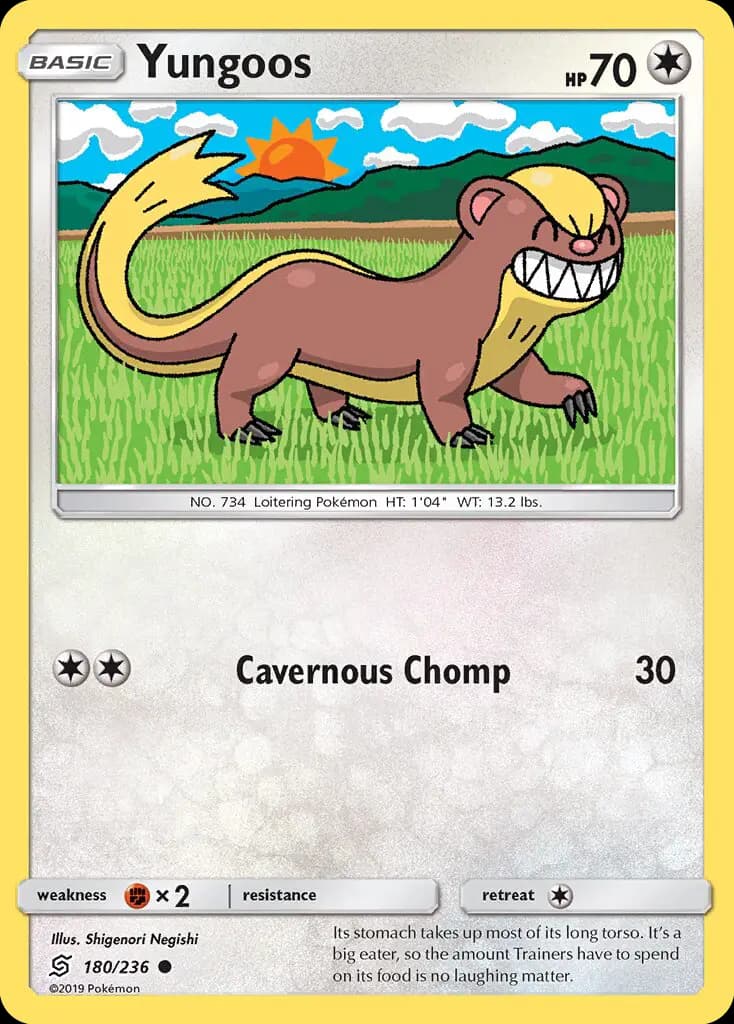
Its stomach takes up most of its long torso. It’s a big eater, so the amount Trainers have to spend on its food is no laughing matter.
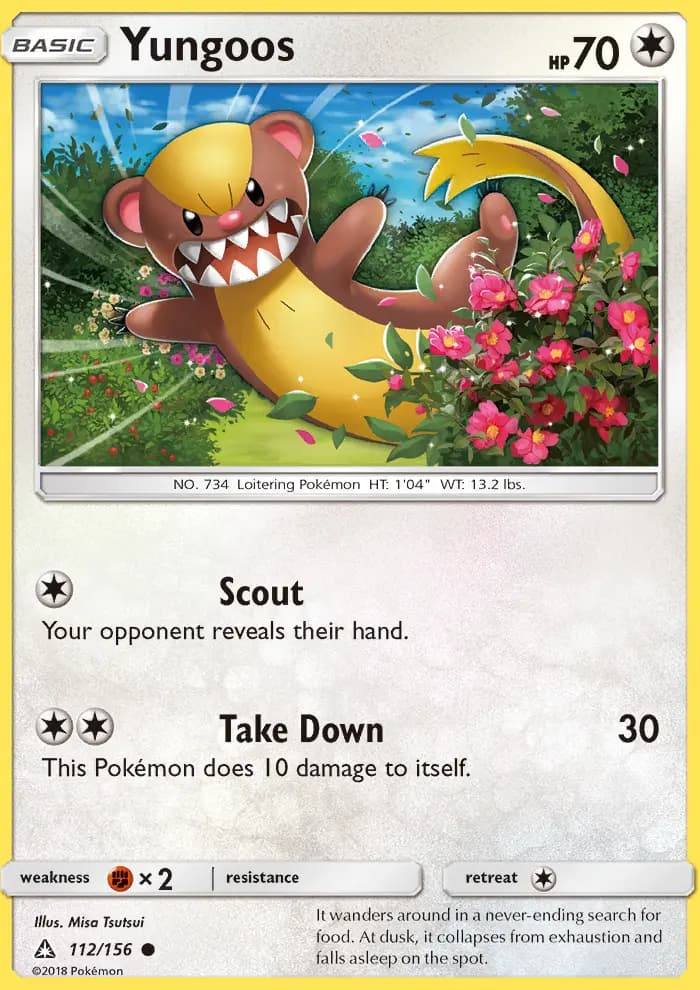
It wanders around in a never-ending search for food. At dusk, it collapses from exhaustion and falls asleep on the spot.
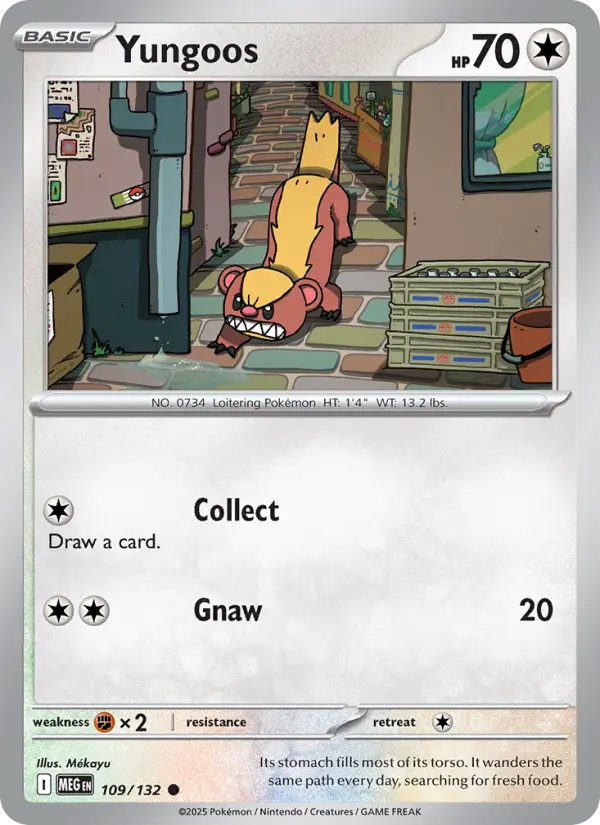
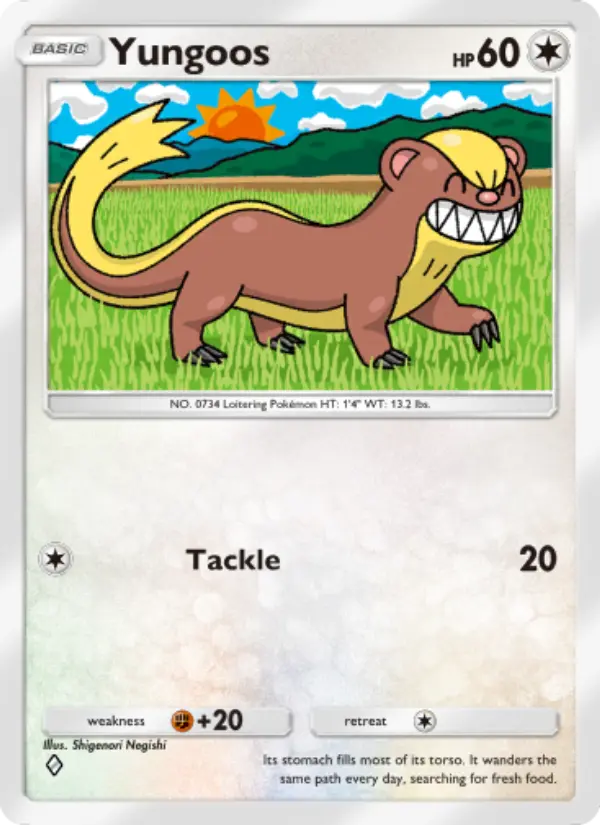
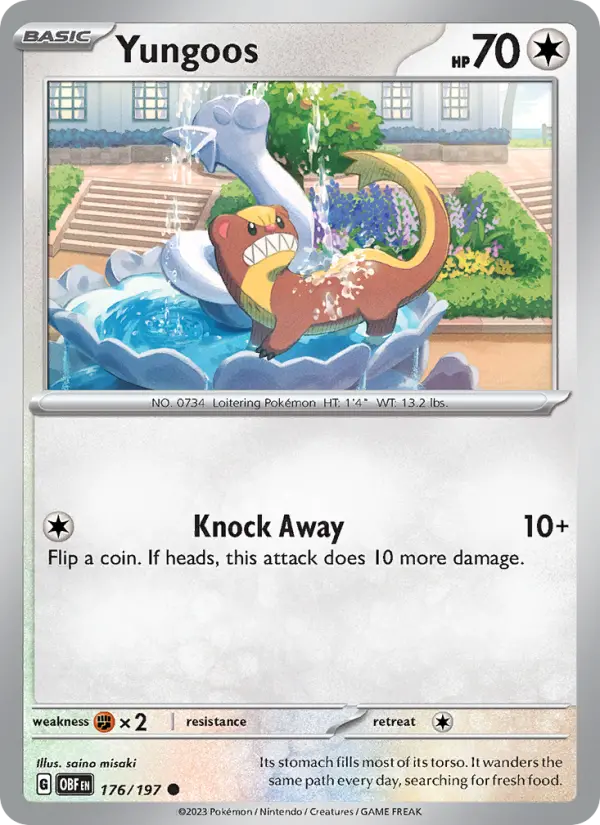
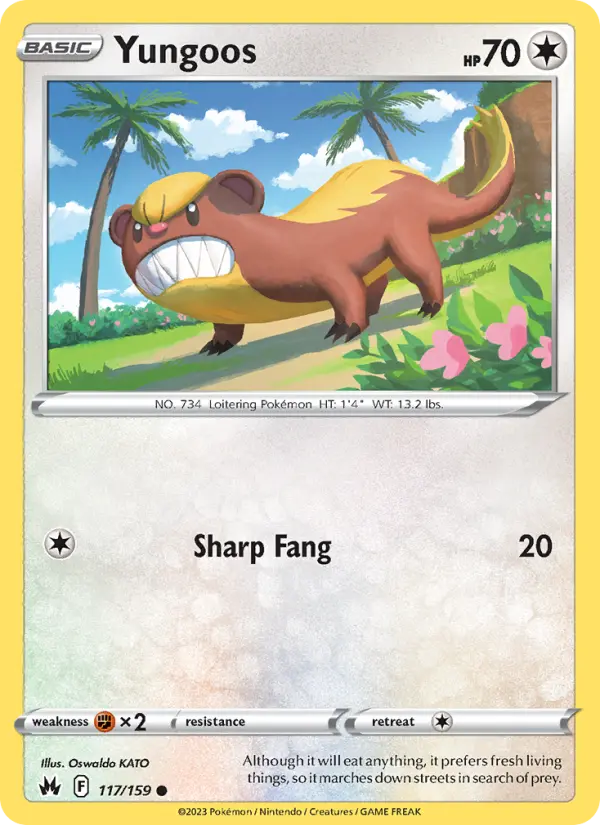
Although it will eat anything, it prefers fresh living things, so it marches down streets in search of prey.
Yungoos Name Origin & Design Inspiration
Yungoos's name traces back to 'young' and 'goose,' an unexpected combination that reflects the creature's juvenile characteristics despite its predatory nature and persistent hunger. The Japanese name Youngoose similarly blends 'young' with a goose reference, though the creature more closely resembles a mongoose in actual design and behavior. The mongoose inspiration is evident in Yungoos's elongated body, aggressive hunting patterns, and the prominent role of its sharp teeth in its predatory lifestyle—traits characteristic of real mongoose species known for their ferocity and appetite. The design philosophy emphasizes the contradiction between the creature's small, almost cute appearance and its voracious, aggressive nature, creating a creature that appears deceptively harmless but possesses formidable teeth and relentless determination. The yellow stripe down its back may reference the visual distinction often seen in real mongoose species, while its stocky build and enormous stomach exaggerate the physical consequences of its insatiable appetite, making the design both recognizable and distinctly Pokémon. The creative choice to classify it as a 'Loitering Pokémon' rather than a hunting or foraging Pokémon emphasizes its unique behavioral pattern of aimless wandering driven entirely by hunger.
Learnable Moves
Yungoos can learn 66 moves:
Move | Type | Cat. | Power | Acc. | PP |
|---|---|---|---|---|---|
| attract | normal | Status | — | 100 | 15 |
| bide | normal | Physical | — | — | 10 |
| bite | dark | Physical | 60 | 100 | 25 |
| bulldoze | ground | Physical | 60 | 100 | 20 |
| chilling water | water | Special | 50 | 100 | 20 |
| confide | normal | Status | — | — | 20 |
| crunch | dark | Physical | 80 | 100 | 15 |
| dig | ground | Physical | 80 | 100 | 10 |
| double team | normal | Status | — | — | 15 |
| double edge | normal | Physical | 120 | 100 | 15 |
| earthquake | ground | Physical | 100 | 100 | 10 |
| echoed voice | normal | Special | 40 | 100 | 15 |
| endeavor | normal | Physical | — | 100 | 5 |
| endure | normal | Status | — | — | 10 |
| facade | normal | Physical | 70 | 100 | 20 |
| fire fang | fire | Physical | 65 | 95 | 15 |
| frustration | normal | Physical | — | 100 | 20 |
| helping hand | normal | Status | — | — | 20 |
| hidden power | normal | Special | 60 | 100 | 15 |
| hyper fang | normal | Physical | 80 | 90 | 15 |
| ice fang | ice | Physical | 65 | 95 | 15 |
| iron tail | steel | Physical | 100 | 75 | 15 |
| last resort | normal | Physical | 140 | 100 | 5 |
| leer | normal | Status | — | 100 | 30 |
| mud shot | ground | Special | 55 | 95 | 15 |
| mud slap | ground | Special | 20 | 100 | 10 |
| odor sleuth | normal | Status | — | — | 40 |
| payback | dark | Physical | 50 | 100 | 10 |
| protect | normal | Status | — | — | 10 |
| psychic fangs | psychic | Physical | 85 | 100 | 10 |
| pursuit | dark | Physical | 40 | 100 | 20 |
| rain dance | water | Status | — | — | 5 |
| rest | psychic | Status | — | — | 5 |
| return | normal | Physical | — | 100 | 20 |
| revenge | fighting | Physical | 60 | 100 | 10 |
| reversal | fighting | Physical | — | 100 | 15 |
| rock tomb | rock | Physical | 60 | 95 | 15 |
| round | normal | Special | 60 | 100 | 15 |
| sand attack | ground | Status | — | 100 | 15 |
| sandstorm | rock | Status | — | — | 10 |
| scary face | normal | Status | — | 100 | 10 |
| seed bomb | grass | Physical | 80 | 100 | 15 |
| shock wave | electric | Special | 60 | — | 20 |
| sleep talk | normal | Status | — | — | 10 |
| snore | normal | Special | 50 | 100 | 15 |
| stomping tantrum | ground | Physical | 75 | 100 | 10 |
| substitute | normal | Status | — | — | 10 |
| sunny day | fire | Status | — | — | 5 |
| super fang | normal | Physical | — | 90 | 10 |
| swagger | normal | Status | — | 85 | 15 |
| tackle | normal | Physical | 40 | 100 | 35 |
| take down | normal | Physical | 90 | 85 | 20 |
| taunt | dark | Status | — | 100 | 20 |
| tera blast | normal | Special | 80 | 100 | 10 |
| thief | dark | Physical | 60 | 100 | 25 |
| thrash | normal | Physical | 120 | 100 | 10 |
| thunder fang | electric | Physical | 65 | 95 | 15 |
| torment | dark | Status | — | 100 | 15 |
| toxic | poison | Status | — | 90 | 10 |
| trailblaze | grass | Physical | 50 | 100 | 20 |
| u turn | bug | Physical | 70 | 100 | 20 |
| uproar | normal | Special | 90 | 100 | 10 |
| wild charge | electric | Physical | 90 | 100 | 15 |
| work up | normal | Status | — | — | 30 |
| yawn | normal | Status | — | — | 10 |
| zen headbutt | psychic | Physical | 80 | 90 | 15 |
Yungoos Competitive Battle Guide
In tournament-level play, Yungoos occupies a niche role as an early-game Normal-type with surprising bite potential through its distinctive ability Stakeout, which doubles the power of its moves against any Pokémon that switched into battle that turn. This ability transforms Yungoos from a merely adequate combatant into a threat against defensive switch-in strategies, rewarding aggressive play and punishing passive tactics. The alternative ability Strong Jaw increases the power of biting moves by a factor of 1.5, enhancing moves like Bite and Super Fang, though this comes at the cost of Stakeout's reactive advantage. Yungoos's attack stat of 70 provides respectable offensive pressure when combined with these ability bonuses, allowing it to deal significant damage to opponents at comparable level ranges. However, Yungoos's critical weakness lies in its abysmal defensive stats—Defense, Special Attack, and Special Defense all sit at a mere 30, making it extremely vulnerable to any attack it fails to avoid. The hidden ability Adaptability, which increases the same-type attack bonus from the standard 1.5x multiplier to 2x, theoretically offers impressive damage potential with Normal-type moves, but the lack of bulk prevents Yungoos from reliably utilizing this advantage in practice. Most competitive applications for Yungoos remain limited to early-format play, doubles strategies that exploit Stakeout against switching opponents, or novelty teams celebrating its unique mechanical identity.
Commonly Asked Questions About Yungoos
What type is Yungoos?
Yungoos is a normal type Pokemon.
What does Yungoos evolve into?
Yungoos evolves into gumshoos.
What are Yungoos's weaknesses?
Yungoos is weak to fighting type moves.
Does Yungoos evolve by trading?
No — Yungoos evolves entirely through leveling up, with no trade required at any stage.
Where can I find Yungoos?
Yungoos can be found in alola route 3 (alola), alola route 2 (alola) and alola route 8 (alola) and 6 other locations.
Yungoos Cultural Impact & Franchise History
Yungoos holds a unique position in Generation VII's narrative and thematic identity as a symbol of ecological disruption and invasive species dynamics within the Alola region. The Pokédex explicitly notes its non-native status, making Yungoos a living representation of how human activity introduces unintended consequences to balanced ecosystems, a mature ecological theme for a Pokémon game. Within the games' storyline, Yungoos appears as a pivotal plot element when Team Skull steals one from an Aether House, prompting players to rescue it and return it to a young Trainer, establishing Yungoos as an object of sympathy despite its aggressive nature. The species's design and aggressive personality led to mixed reception among trainers and competitive players, though its unique Stakeout ability has garnered respect from those studying Pokémon mechanics. The cultural representation of Yungoos as a disruptive invasive species adds depth to Pokémon's world-building, presenting natural ecosystems that respond to and are impacted by external influences rather than existing in perfect equilibrium. Fan communities have embraced Yungoos's identity as an underdog Pokémon, and it has appeared in various media, anime episodes, and merchandise celebrating Generation VII's distinctive roster of creatures.
Where to Find Yungoos in Every Pokémon Game
Yungoos is primarily available in the Alola region, where it serves as a common encounter in numerous locations throughout Pokémon Sun, Moon, Ultra Sun, and Ultra Moon. In these games, Yungoos appears early in the player's journey, often encountered on routes and in areas surrounding populated settlements, making it accessible to trainers seeking a Normal-type companion for their team. The species maintains this availability in later games set in Alola, ensuring consistent accessibility across multiple generations of titles. In Pokémon Scarlet and Violet, Yungoos appears with Pokédex number 0027 in the regional Pokédex, allowing modern trainers to catch this Alolan export in the Paldea region. The capture rate of 255—the maximum possible value—ensures that trainers can reliably catch Yungoos using standard Poké Balls regardless of circumstances, facilitating easy acquisition for players at all skill levels. The species's ubiquity and common encounter rate reflect its status as an invasive species that has thoroughly established itself throughout human-inhabited areas of Alola. For players seeking to complete their Pokédex or build a team featuring early-game Normal-types, Yungoos availability makes it an accessible choice that requires minimal effort to obtain.