Amoonguss
Generation V · #0591 — Mushroom Pokémon
As a Generation V grass/poison-type, Amoonguss leans on effect spore to cover what its raw numbers don't, particularly on the hp side. With a National Pokédex number of 591, this Mushroom Pokémon has garnered attention from trainers and researchers alike for its unusual hunting strategy and defensive capabilities. The species boasts a respectable overall stat sum of 464, with particularly notable HP of 114, making it surprisingly durable for a creature that relies on trickery and poison to survive.
Editor's Take
Amoonguss's Regenerator plus Spore has made it a VGC fixture for a decade, and it is the single most reliable Redirection and sleep support in the format.
Base Stats
Height
0.6m
Weight
10.5kg
Category
Mushroom Pokémon
Gender
Male 50% / Female 50%
Color
white
Shape
arms
Abilities
Has a 30% chance of inflcting either paralysis, poison, or sleep on attacking Pokémon on contact.
Heals for 1/3 max HP upon switching out.
Amoonguss Biology & Physical Characteristics
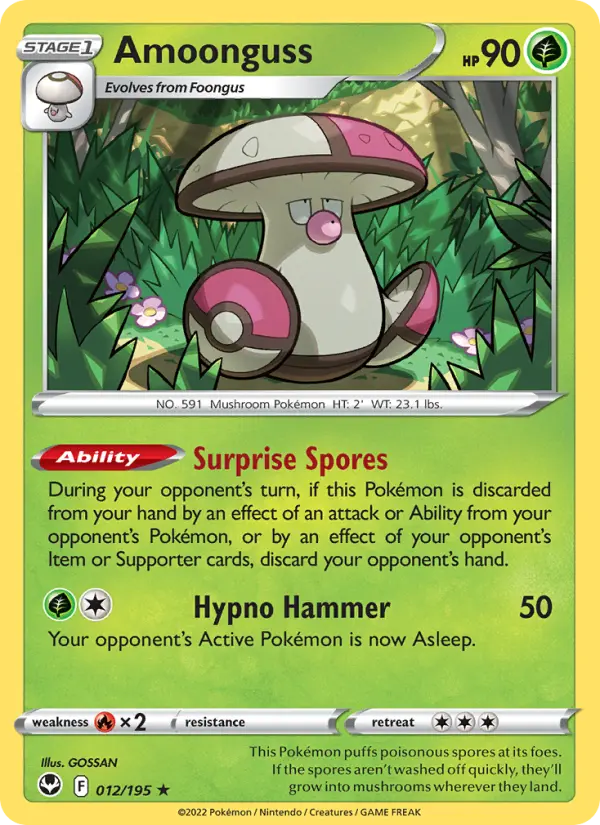
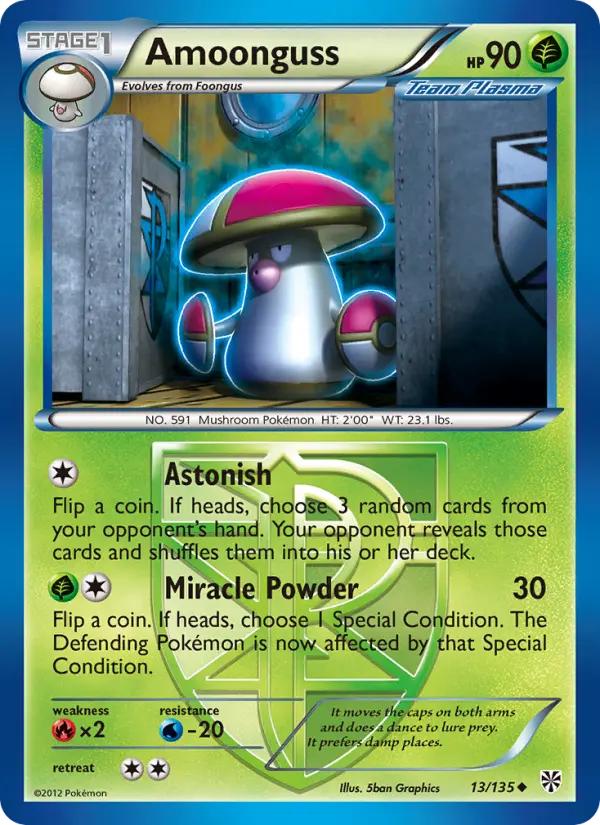
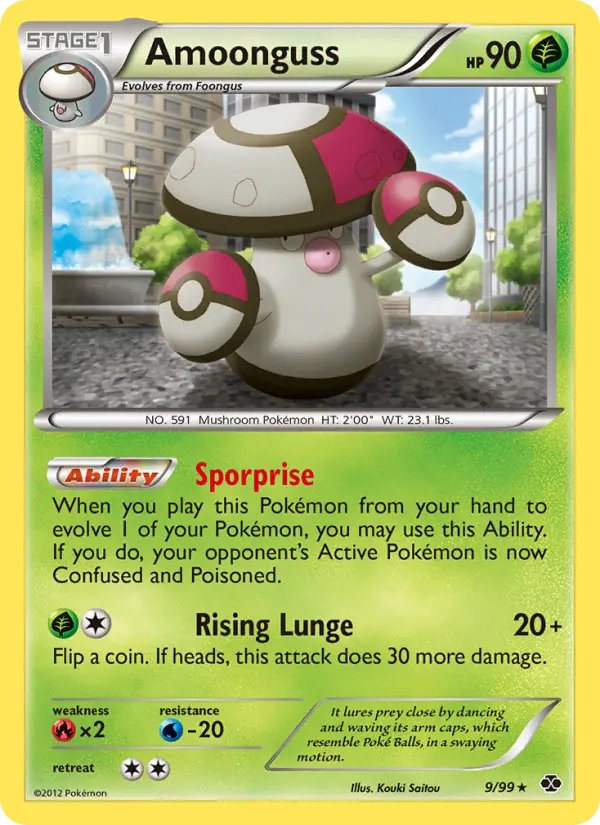
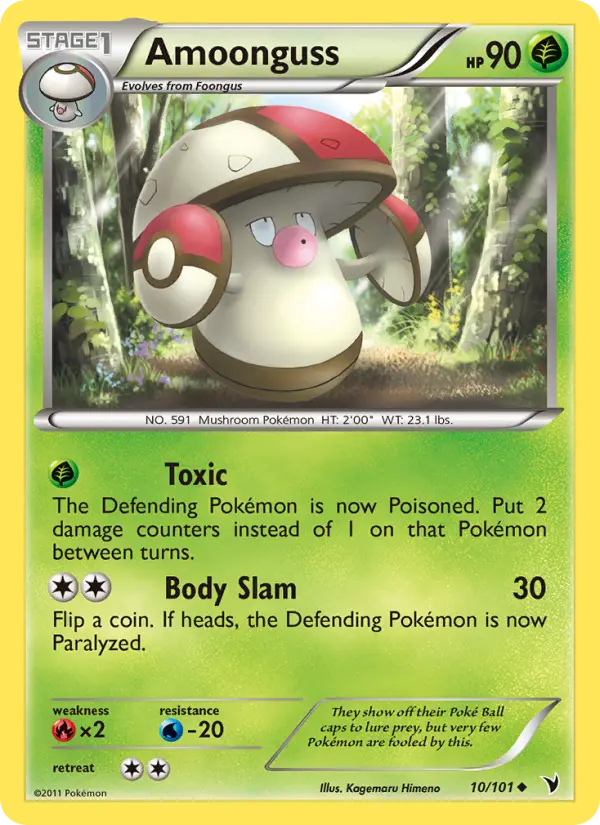
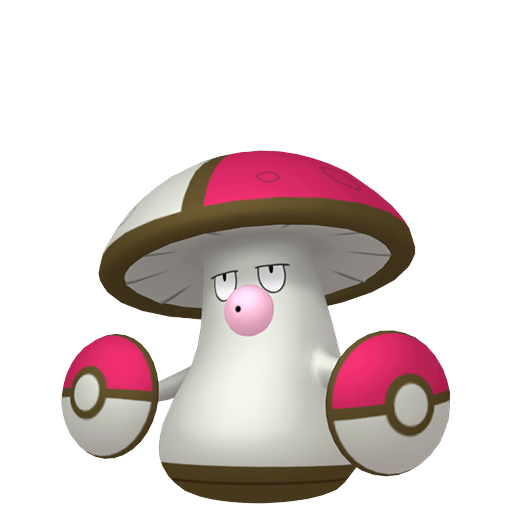
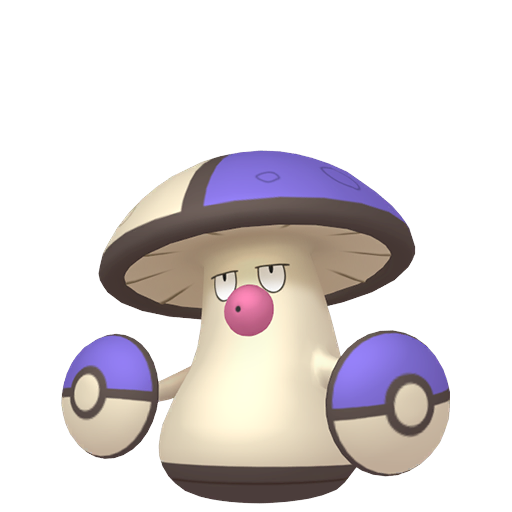
Amoonguss is a fungal creature with a distinctive appearance designed to deceive its prey. Its body consists of a large, gray, stem-like structure that serves as its main torso, topped with fierce-looking eyes and prominent pink lips around a small mouth. The most striking feature of Amoonguss is the pair of large caps adorning its head and arms that closely resemble Poké Balls—a visual mimicry that serves as its primary hunting mechanism. These caps feature the characteristic red-and-white coloration of actual Poké Balls, complete with small warts on the cap's surface that add to its fungal authenticity. As a carnivorous creature, Amoonguss produces poisonous spores that it deploys offensively; according to Pokédex entries, if these spores are not washed off quickly, they will germinate and grow into actual mushrooms wherever they land, making its poison doubly dangerous. Standing at only 0.6 meters tall and weighing a modest 10.5 kilograms, Amoonguss is a compact predator built for ambush tactics rather than direct confrontation.
Pokedex Numbers
Training
Breeding
Amoonguss Breeding, Gender Ratio & Egg Groups
Amoonguss has one of the simplest gender ratios in the game — a flat 50/50, allowing for straightforward breeding without gender-based complications. The species belongs to the Grass egg group, a classification it shares with numerous plant-based Pokémon, which determines its compatible breeding partners and the types of offspring it can produce. With a base happiness value that varied across generations—reaching 70 in Generations V through VII before adjustments in later iterations—Amoonguss shows moderate affection toward trainers who treat it well, encouraging stronger bonds between trainer and Pokémon. The species has a hatch counter of 20 cycles, translating to approximately 4,884 to 5,140 steps needed to hatch an Amoonguss egg, making it a moderately fast breeding option compared to some other Pokémon. The breeding mechanics for Amoonguss allow trainers to pass down move sets through egg breeding, with compatible Pokémon able to transmit moves that Amoonguss cannot normally learn through leveling or TM usage. A capture rate of 75 makes Amoonguss relatively easy to catch in the wild, suggesting that while it may be a clever predator, it does not possess the evasiveness or defensive traits that make rarer Pokémon difficult to obtain.
Sprites




Held Items
Tiny Mushroom
loot
Fire Red and Leaf Green: Trade two for prior Level-up moves. Sell for 250 Pokédollars, or to Hungry Maid for 500 Pokédollars.
Cost: 500
Tiny Mushroom
loot
Fire Red and Leaf Green: Trade two for prior Level-up moves. Sell for 250 Pokédollars, or to Hungry Maid for 500 Pokédollars.
Cost: 500
Tiny Mushroom
loot
Fire Red and Leaf Green: Trade two for prior Level-up moves. Sell for 250 Pokédollars, or to Hungry Maid for 500 Pokédollars.
Cost: 500
Tiny Mushroom
loot
Fire Red and Leaf Green: Trade two for prior Level-up moves. Sell for 250 Pokédollars, or to Hungry Maid for 500 Pokédollars.
Cost: 500
Tiny Mushroom
loot
Fire Red and Leaf Green: Trade two for prior Level-up moves. Sell for 250 Pokédollars, or to Hungry Maid for 500 Pokédollars.
Cost: 500
Tiny Mushroom
loot
Fire Red and Leaf Green: Trade two for prior Level-up moves. Sell for 250 Pokédollars, or to Hungry Maid for 500 Pokédollars.
Cost: 500
Tiny Mushroom
loot
Fire Red and Leaf Green: Trade two for prior Level-up moves. Sell for 250 Pokédollars, or to Hungry Maid for 500 Pokédollars.
Cost: 500
Tiny Mushroom
loot
Fire Red and Leaf Green: Trade two for prior Level-up moves. Sell for 250 Pokédollars, or to Hungry Maid for 500 Pokédollars.
Cost: 500
Tiny Mushroom
loot
Fire Red and Leaf Green: Trade two for prior Level-up moves. Sell for 250 Pokédollars, or to Hungry Maid for 500 Pokédollars.
Cost: 500
Tiny Mushroom
loot
Fire Red and Leaf Green: Trade two for prior Level-up moves. Sell for 250 Pokédollars, or to Hungry Maid for 500 Pokédollars.
Cost: 500
Tiny Mushroom
loot
Fire Red and Leaf Green: Trade two for prior Level-up moves. Sell for 250 Pokédollars, or to Hungry Maid for 500 Pokédollars.
Cost: 500
Tiny Mushroom
loot
Fire Red and Leaf Green: Trade two for prior Level-up moves. Sell for 250 Pokédollars, or to Hungry Maid for 500 Pokédollars.
Cost: 500
Big Mushroom
loot
Fire Red and Leaf Green: Trade for prior Level-up moves. Sell for 2500 Pokédollars, or to Hungry Maid for 5000 Pokédollars.
Cost: 5000
Big Mushroom
loot
Fire Red and Leaf Green: Trade for prior Level-up moves. Sell for 2500 Pokédollars, or to Hungry Maid for 5000 Pokédollars.
Cost: 5000
Big Mushroom
loot
Fire Red and Leaf Green: Trade for prior Level-up moves. Sell for 2500 Pokédollars, or to Hungry Maid for 5000 Pokédollars.
Cost: 5000
Big Mushroom
loot
Fire Red and Leaf Green: Trade for prior Level-up moves. Sell for 2500 Pokédollars, or to Hungry Maid for 5000 Pokédollars.
Cost: 5000
Big Mushroom
loot
Fire Red and Leaf Green: Trade for prior Level-up moves. Sell for 2500 Pokédollars, or to Hungry Maid for 5000 Pokédollars.
Cost: 5000
Big Mushroom
loot
Fire Red and Leaf Green: Trade for prior Level-up moves. Sell for 2500 Pokédollars, or to Hungry Maid for 5000 Pokédollars.
Cost: 5000
Big Mushroom
loot
Fire Red and Leaf Green: Trade for prior Level-up moves. Sell for 2500 Pokédollars, or to Hungry Maid for 5000 Pokédollars.
Cost: 5000
Big Mushroom
loot
Fire Red and Leaf Green: Trade for prior Level-up moves. Sell for 2500 Pokédollars, or to Hungry Maid for 5000 Pokédollars.
Cost: 5000
Big Mushroom
loot
Fire Red and Leaf Green: Trade for prior Level-up moves. Sell for 2500 Pokédollars, or to Hungry Maid for 5000 Pokédollars.
Cost: 5000
Big Mushroom
loot
Fire Red and Leaf Green: Trade for prior Level-up moves. Sell for 2500 Pokédollars, or to Hungry Maid for 5000 Pokédollars.
Cost: 5000
Big Mushroom
loot
Fire Red and Leaf Green: Trade for prior Level-up moves. Sell for 2500 Pokédollars, or to Hungry Maid for 5000 Pokédollars.
Cost: 5000
Big Mushroom
loot
Fire Red and Leaf Green: Trade for prior Level-up moves. Sell for 2500 Pokédollars, or to Hungry Maid for 5000 Pokédollars.
Cost: 5000
Balm Mushroom
loot
Sell to Hungry Maid for 25000 Pokédollars.
Cost: 15000
Balm Mushroom
loot
Sell to Hungry Maid for 25000 Pokédollars.
Cost: 15000
Balm Mushroom
loot
Sell to Hungry Maid for 25000 Pokédollars.
Cost: 15000
Balm Mushroom
loot
Sell to Hungry Maid for 25000 Pokédollars.
Cost: 15000
TMs & HMs
tm05
lets go pikachu lets go eevee
tm06
yellow
tm06
gold silver
tm06
red blue
tm06
crystal
tm06
emerald
tm06
firered leafgreen
tm06
diamond pearl
tm06
platinum
tm06
ruby sapphire
tm06
colosseum
tm06
black 2 white 2
tm06
xd
tm06
black white
tm06
heartgold soulsilver
tm06
omega ruby alpha sapphire
tm06
ultra sun ultra moon
tm06
sun moon
tm06
x y
tm06
red green japan
+463 more TMs/HMs
Amoonguss's Evolution Chain


Amoonguss Evolution, Mega Evolution & Special Forms
Amoonguss evolves from Foongus through a straightforward level-based evolution triggered at level 39, requiring no special items, locations, or conditions. This evolution represents a significant power increase, with Amoonguss gaining improved offensive and defensive capabilities compared to its pre-evolved form. The evolution from Foongus to Amoonguss transforms the smaller, less developed mushroom Pokémon into a more robust and potent version, with enhanced special attack and special defense stats that make it a considerably more threatening opponent. Interestingly, the Pokédex has documented a mysterious connection between Amoonguss and the Paradox Pokémon Brute Bonnet, discovered in Generation IX. Brute Bonnet bears a striking resemblance to Amoonguss, leading researchers to theorize that it may be either an ancient relative of the modern Amoonguss or possibly a version of the species from a parallel timeline, suggesting that Amoonguss's evolutionary lineage may extend further back in history or across dimensional boundaries than previously understood.
Where to Find
Unova Route 10
unova
+13 more
Unova Route 11
unova
+9 more
Unova Route 23
unova
+7 more
Unova Route 22
unova
+5 more
Kalos Route 20
kalos
+9 more
Pokemon Village
kalos
+5 more
Amoonguss Behaviour and Natural Habitat
Amoonguss exhibits a remarkably sedentary lifestyle, preferring to remain nearly motionless for extended periods rather than actively hunting. The creature typically positions itself near dropped Poké Balls and in damp environments with long grass, where it can hide its body while its distinctive mushroom caps remain visible above the vegetation. This behavioral pattern allows Amoonguss to exploit the association trainers have with Poké Balls, though modern Pokédex entries note with some irony that very few Pokémon are actually fooled by this mimicry anymore. When prey approaches, Amoonguss engages in a ritualistic dance, swaying and waving its arm caps in a mesmerizing pattern to complete its deception—a behavior that combines visual mimicry with movement-based persuasion. Its preference for damp, wet environments places it near water sources and marshy areas, where the humid conditions are ideal for its spore-producing capabilities. The species demonstrates minimal energy expenditure through movement, choosing instead to rely on patience and camouflage as cornerstones of its survival strategy.
Pokedex Entries
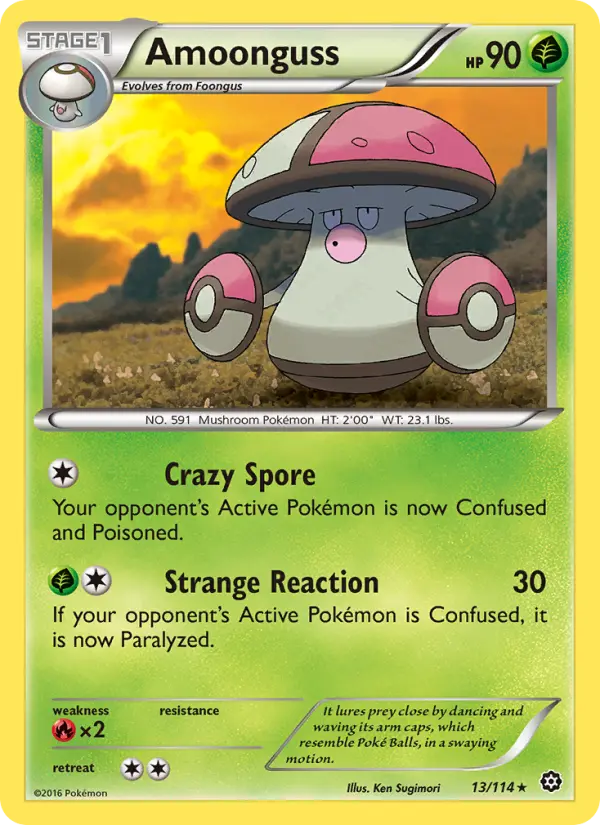
It lures prey close by dancing and waving its arm caps, which resemble Poké Balls, in a swaying motion.
It moves the caps on both arms and does a dance to lure prey. It prefers damp places.
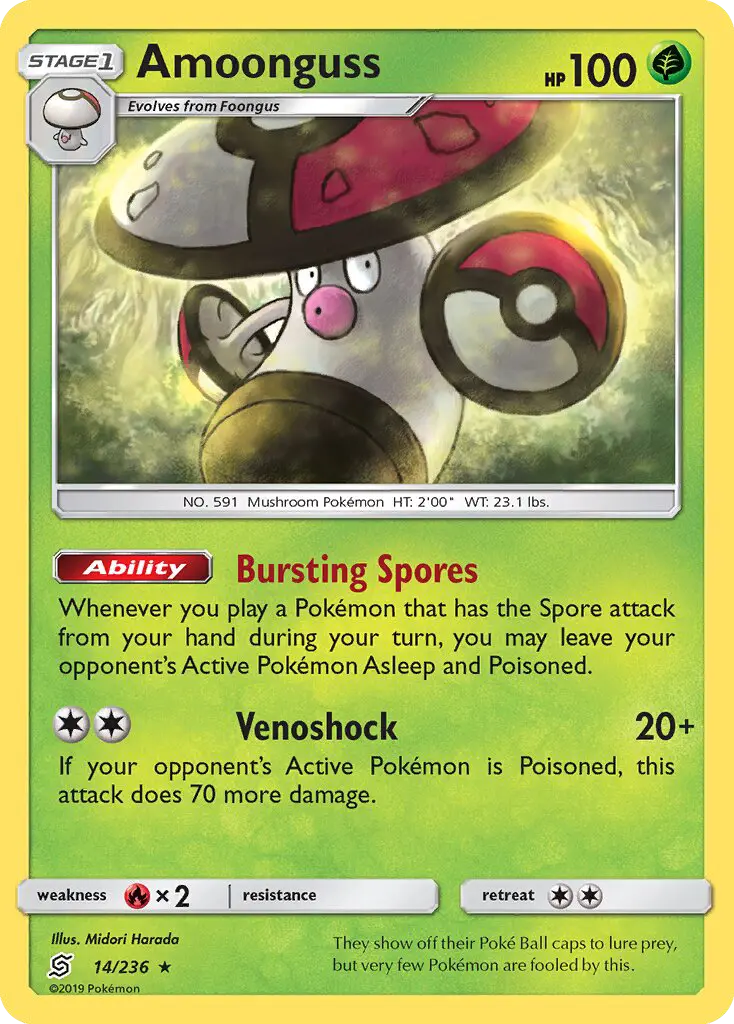
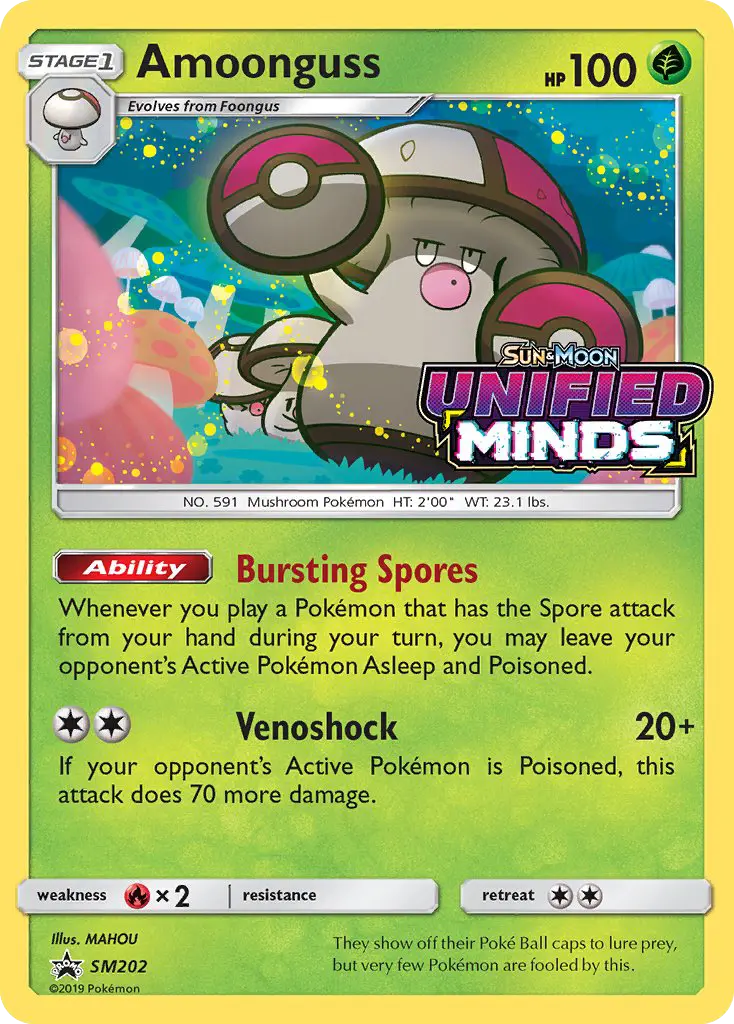
They show off their Poké Ball caps to lure prey, but very few Pokémon are fooled by this.
They show off their Poké Ball caps to lure prey, but very few Pokémon are fooled by this.
It lures prey close by dancing and waving its arm caps, which resemble Poké Balls, in a swaying motion.
They show off their Poké Ball caps to lure prey, but very few Pokémon are fooled by this.
It lures prey close by dancing and waving its arm caps, which resemble Poké Balls, in a swaying motion.
This Pokémon puffs poisonous spores at its foes. If the spores aren’t washed off quickly, they’ll grow into mushrooms wherever they land.
Amoonguss generally doesn’t move much. It tends to stand still near Poké Balls that have been dropped on the ground.
Amoonguss Name Origin & Design Inspiration
The name Amoonguss combines 'amoeba,' reflecting its gelatinous fungal composition, with 'amongst' and 'fungus,' creating a portmanteau that describes both its nature and its tendency to hide in vegetation. In Japanese, Morobareru appears to derive from 'moro' (麻呂/もろ) and potentially references its mushroom-like structure combined with deceptive properties. The design philosophy behind Amoonguss represents a clever inversion of player expectations—trainers are conditioned throughout the games to associate Poké Balls with the ability to capture Pokémon, yet Amoonguss weaponizes this familiar symbol as a predatory lure. The evolution from Foongus to Amoonguss involves a visual enhancement of its mushroom caps to make them more convincingly Poké Ball-like, with the caps becoming more defined and the coloration more vivid. This design choice serves both aesthetic and narrative purposes, as the increased sophistication of the mimicry parallels the Pokémon's increased evolutionary maturity and hunting prowess. The contrast between Amoonguss's relatively small, unassuming body and its prominent, recognizable caps creates an interesting visual balance that makes the species memorable and distinctive within the broader Pokédex.
Learnable Moves
Amoonguss can learn 58 moves:
Move | Type | Cat. | Power | Acc. | PP |
|---|---|---|---|---|---|
| absorb | grass | Special | 20 | 100 | 25 |
| after you | normal | Status | — | — | 15 |
| astonish | ghost | Physical | 30 | 100 | 15 |
| attract | normal | Status | — | 100 | 15 |
| bide | normal | Physical | — | — | 10 |
| body slam | normal | Physical | 85 | 100 | 15 |
| bullet seed | grass | Physical | 25 | 100 | 30 |
| clear smog | poison | Special | 50 | — | 15 |
| confide | normal | Status | — | — | 20 |
| double team | normal | Status | — | — | 15 |
| endure | normal | Status | — | — | 10 |
| energy ball | grass | Special | 90 | 100 | 10 |
| facade | normal | Physical | 70 | 100 | 20 |
| feint attack | dark | Physical | 60 | — | 20 |
| flash | normal | Status | — | 100 | 20 |
| foul play | dark | Physical | 95 | 100 | 15 |
| frustration | normal | Physical | — | 100 | 20 |
| gastro acid | poison | Status | — | 100 | 10 |
| giga drain | grass | Special | 75 | 100 | 10 |
| giga impact | normal | Physical | 150 | 90 | 5 |
| grass knot | grass | Special | — | 100 | 20 |
| grassy terrain | grass | Status | — | — | 10 |
| growth | normal | Status | — | — | 20 |
| hex | ghost | Special | 65 | 100 | 10 |
| hidden power | normal | Special | 60 | 100 | 15 |
| hyper beam | normal | Special | 150 | 90 | 5 |
| ingrain | grass | Status | — | — | 20 |
| leaf storm | grass | Special | 130 | 90 | 5 |
| magical leaf | grass | Special | 60 | — | 20 |
| mega drain | grass | Special | 40 | 100 | 15 |
| nature power | normal | Status | — | — | 20 |
| payback | dark | Physical | 50 | 100 | 10 |
| pollen puff | bug | Special | 90 | 100 | 15 |
| protect | normal | Status | — | — | 10 |
| rage powder | bug | Status | — | — | 20 |
| rain dance | water | Status | — | — | 5 |
| rest | psychic | Status | — | — | 5 |
| return | normal | Physical | — | 100 | 20 |
| round | normal | Special | 60 | 100 | 15 |
| scary face | normal | Status | — | 100 | 10 |
| secret power | normal | Physical | 70 | 100 | 20 |
| seed bomb | grass | Physical | 80 | 100 | 15 |
| sleep talk | normal | Status | — | — | 10 |
| sludge bomb | poison | Special | 90 | 100 | 10 |
| snore | normal | Special | 50 | 100 | 15 |
| solar beam | grass | Special | 120 | 100 | 10 |
| spore | grass | Status | — | 100 | 15 |
| stomping tantrum | ground | Physical | 75 | 100 | 10 |
| stun spore | grass | Status | — | 75 | 30 |
| substitute | normal | Status | — | — | 10 |
| sunny day | fire | Status | — | — | 5 |
| swagger | normal | Status | — | 85 | 15 |
| sweet scent | normal | Status | — | 100 | 20 |
| synthesis | grass | Status | — | — | 5 |
| tera blast | normal | Special | 80 | 100 | 10 |
| toxic | poison | Status | — | 90 | 10 |
| venoshock | poison | Special | 65 | 100 | 10 |
| worry seed | grass | Status | — | 100 | 10 |
Amoonguss Competitive Battle Guide
Competitively, Amoonguss has established itself as a solid mid-tier threat, particularly valued for its unique ability combination and respectable defensive stats. With a base HP of 114, Amoonguss can survive significant damage, and when coupled with its base Defense of 70 and Special Defense of 80, it functions reasonably well as a bulky special attacker. Its signature ability Effect Spore provides a passive defensive mechanism with a 30% chance to inflict paralysis, poison, or sleep on attacking Pokémon that make physical contact, creating a deterrent against aggressive physical attackers and adding an element of unpredictability to matches. The hidden ability Regenerator, which heals one-third of Amoonguss's maximum HP upon switching out, transforms it into a highly sustainable team member capable of weathering multiple battles without requiring healing items, making it invaluable for longer tournament formats. Offensively, Amoonguss's balanced Special Attack of 85 allows it to leverage Grass and Poison-type moves effectively, though its critically low Speed of 30 forces it into a defensive, reactive role rather than an offensive sweeper position. Competitive players often invest in Speed-reducing natures and moves like Trick Room to overcome this limitation, positioning Amoonguss as a potential tank that controls the battle pace through status conditions and sustained defensive presence rather than raw offensive power.
Commonly Asked Questions About Amoonguss
What type is Amoonguss?
Amoonguss is a grass and poison type Pokemon.
What does Amoonguss evolve from?
Amoonguss evolved from foongus.
What are Amoonguss's weaknesses?
Amoonguss is weak to flying, fire, psychic and ice type moves.
Where can I find Amoonguss?
Amoonguss can be found in unova route 10 (unova), unova route 11 (unova) and unova route 23 (unova) and 3 other locations.
Amoonguss Cultural Impact & Franchise History
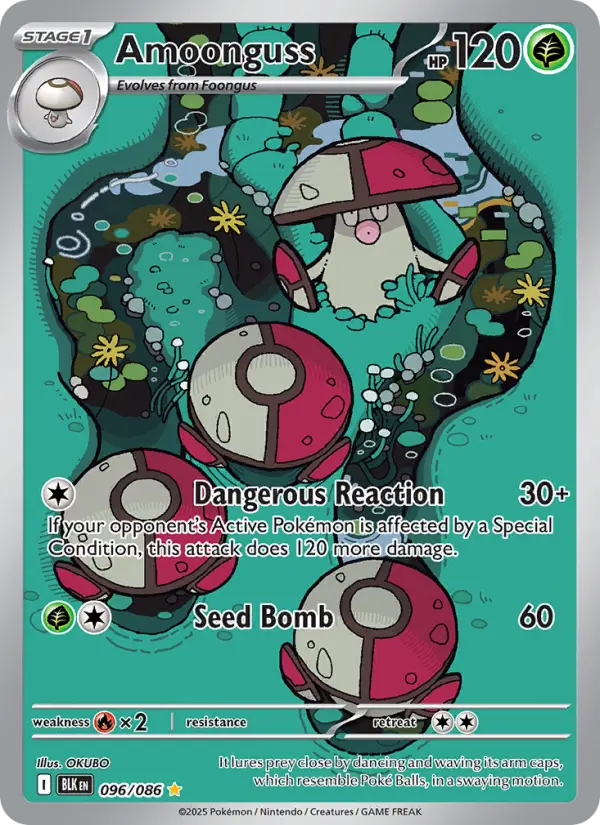
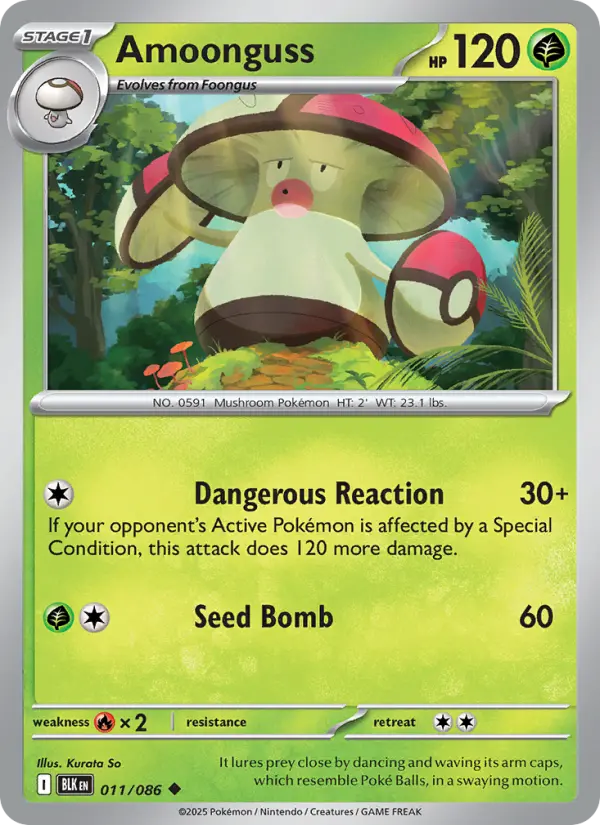
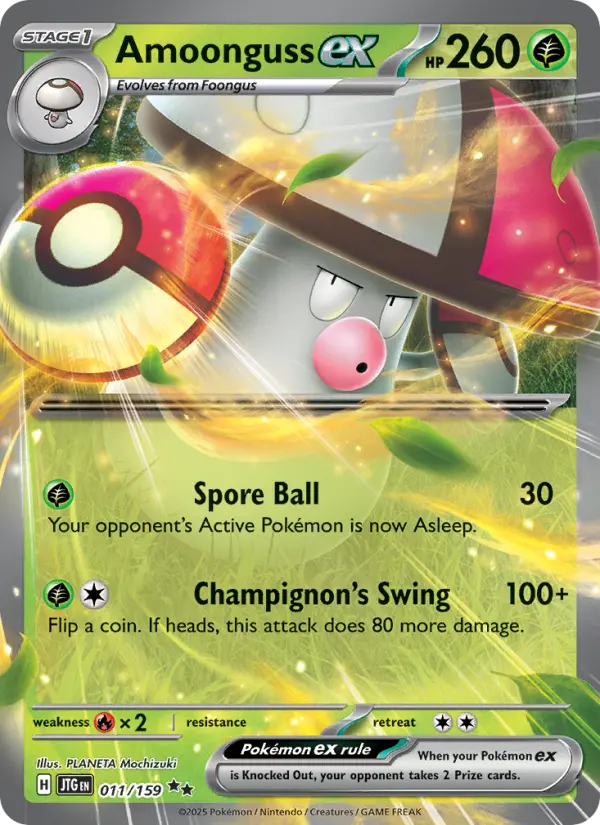
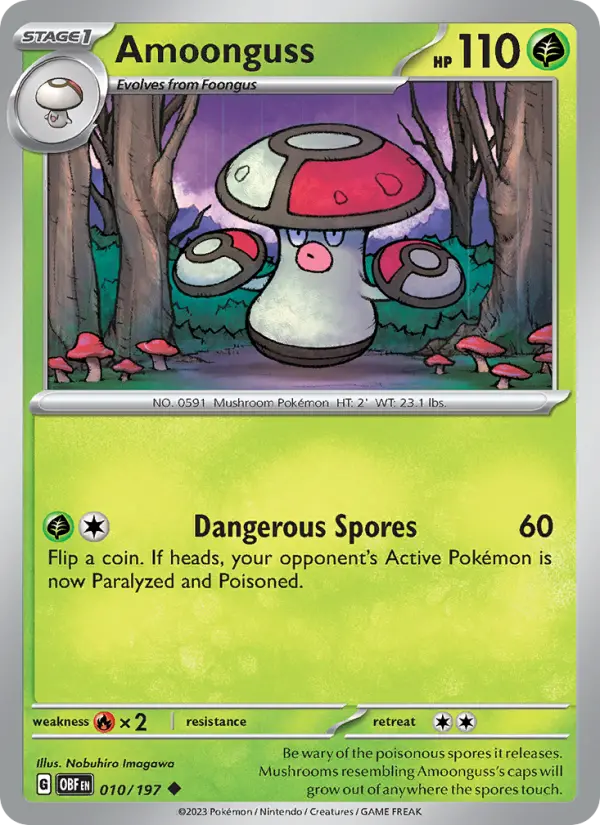
Amoonguss achieved notable cultural recognition through its prominent role in the Pokémon animated series, where James of Team Rocket famously caught and trained an Amoonguss that became one of his most recognizable team members. The Pokémon's deceptive nature aligned perfectly with Team Rocket's scheming personality, and its appearances in the show helped popularize the species among the anime-watching audience. The concept of Amoonguss—a creature that exploits human recognition and familiarity with Poké Balls to hunt its prey—resonated with fans as a clever commentary on the games' mechanics and trainer psychology. Beyond animation, Amoonguss has maintained steady presence in the trading card game across multiple generations, often depicted with artwork emphasizing its Poké Ball-mimicry and predatory nature. The species represents an interesting philosophical element within Pokémon design: the inversion of player expectations through biological adaptation, demonstrating how evolution in the Pokémon world can select for traits that exploit the behaviors and assumptions of other creatures, including humans. Fan communities have celebrated Amoonguss for its unusual design and strategic depth, and the species regularly appears in competitive discussions and team-building forums where players debate optimal movesets and ability choices.
Where to Find Amoonguss in Every Pokémon Game
Amoonguss has maintained consistent availability across most main-series Pokémon games since its introduction in Generation V. In Pokémon Black and White, it appears as Pokédex #097 in the regional Unova dex and can be caught as Foongus in areas with long grass, evolving at level 39. In subsequent games like Black 2 and White 2, its regional dex number shifted to #162 as the available species pool expanded. The species received increased accessibility in later generations, appearing in X and Y (#054 in Mountain Kalos), Omega Ruby and Alpha Sapphire, and Sun and Moon. Modern entries in the series including Sword and Shield, Scarlet and Violet, and the DLC expansions like The Isle of Armor (#0078) continue to feature Amoonguss, maintaining its status as a readily available mid-tier Pokémon. Pokémon Legends: Z-A is confirmed to include Amoonguss in its Pokédex, ensuring the species's continued presence in future titles. The relatively high capture rate of 75 means that wild Amoonguss can be caught with standard Poké Balls without excessive difficulty, making it accessible to players of various skill levels and progression stages. Additionally, Amoonguss's presence in various Pokémon spin-off games and its featured role in competitive formats ensure that trainers have multiple avenues through which to obtain and train this Mushroom Pokémon, from casual playthroughs to serious competitive preparation.