Foongus
Generation V · #0590 — Mushroom Pokémon
Since its Generation V debut, Foongus has carried a stat spread built around hp — 69 at base, its clearest strength. At 0.2 m and 1.0 kg, its build reflects a specialist role rather than a generalist one. Despite its small stature, Foongus possesses a remarkable defensive strategy centered around its distinctive appearance and toxic spore dispersal. With a combined stat total of 294, Foongus allocates its modest capabilities primarily toward Hit Points (69) while maintaining balanced special stats and notably poor Speed (15). The species evolves into the more formidable Amoonguss upon reaching level 39, and it is known for its hidden ability Regenerator, which restores one-third of its maximum HP upon switching out of battle, alongside its standard ability Effect Spore that grants a 30% chance of inflicting paralysis, poison, or sleep on contact with attacking opponents.
Editor's Take
Foongus disguising itself as a Poké Ball is one of the better environmental jokes in the series, and Effect Spore makes attacking it into a genuine risk.
Base Stats
Height
0.2m
Weight
1.0kg
Category
Mushroom Pokémon
Gender
Male 50% / Female 50%
Color
white
Shape
arms
Abilities
Has a 30% chance of inflcting either paralysis, poison, or sleep on attacking Pokémon on contact.
Heals for 1/3 max HP upon switching out.
Foongus Biology & Physical Characteristics
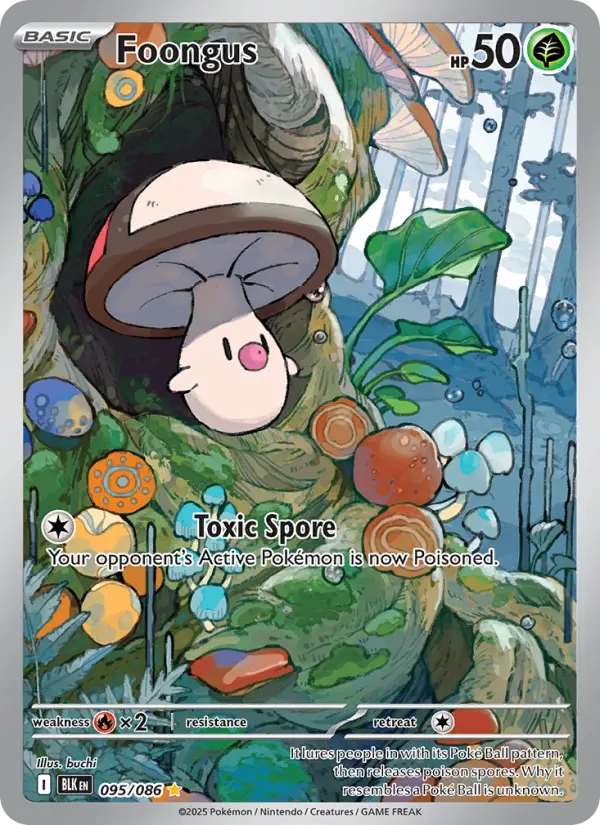
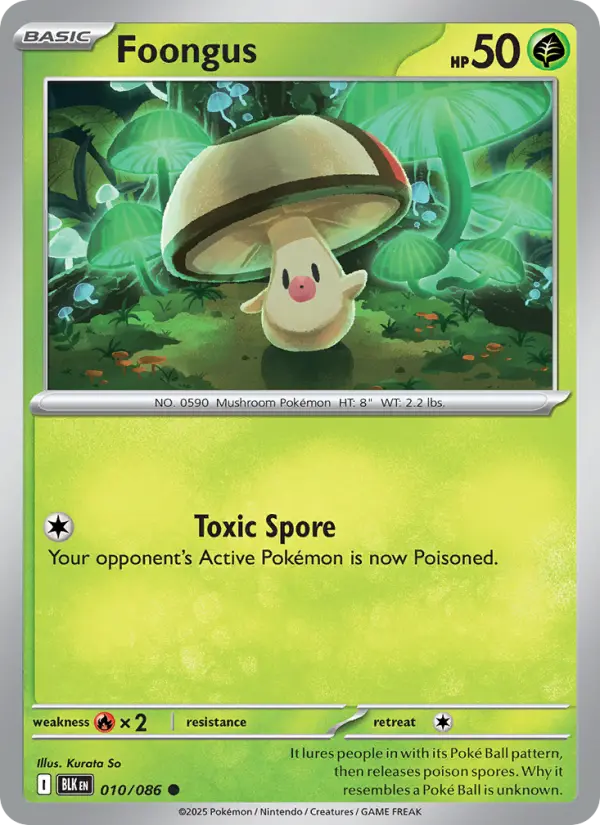
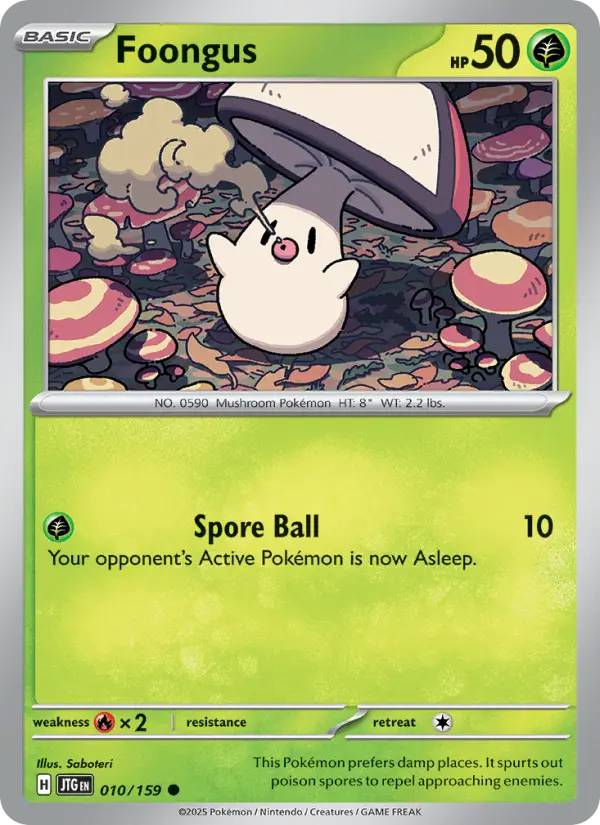
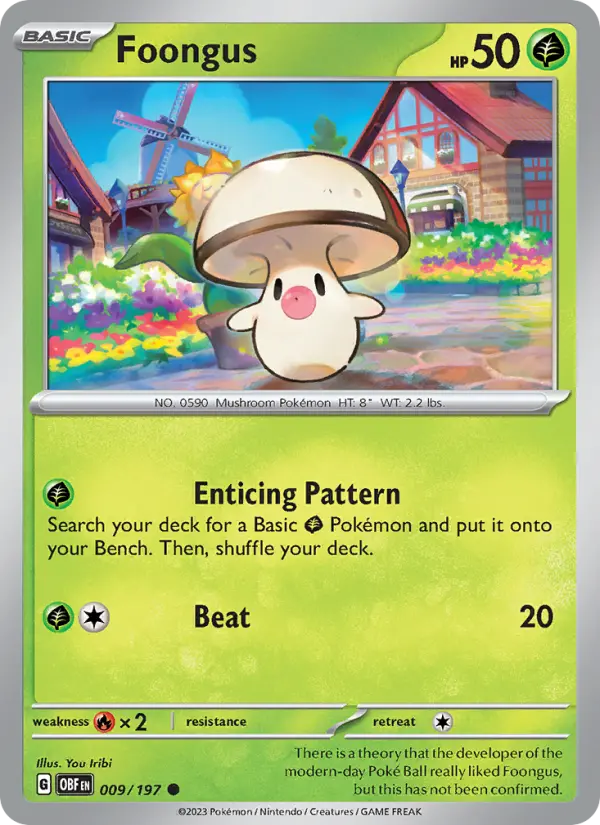
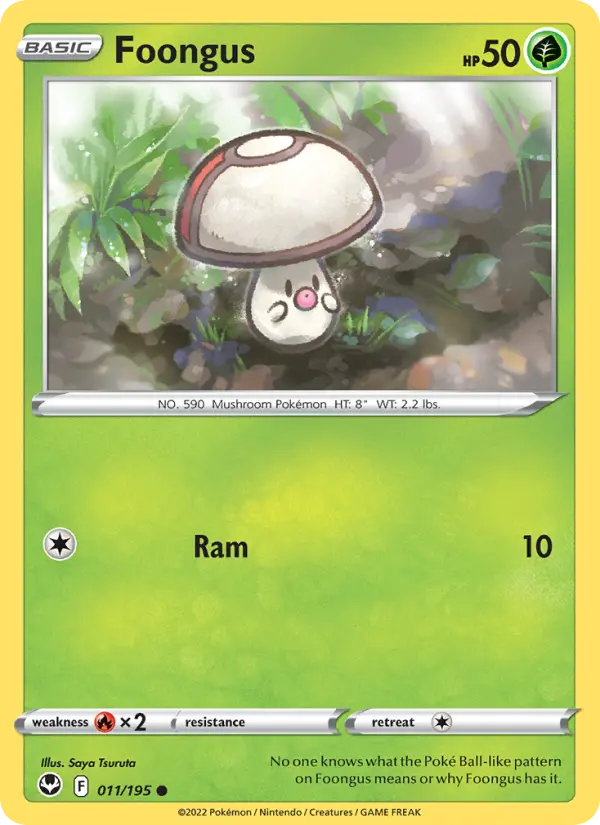
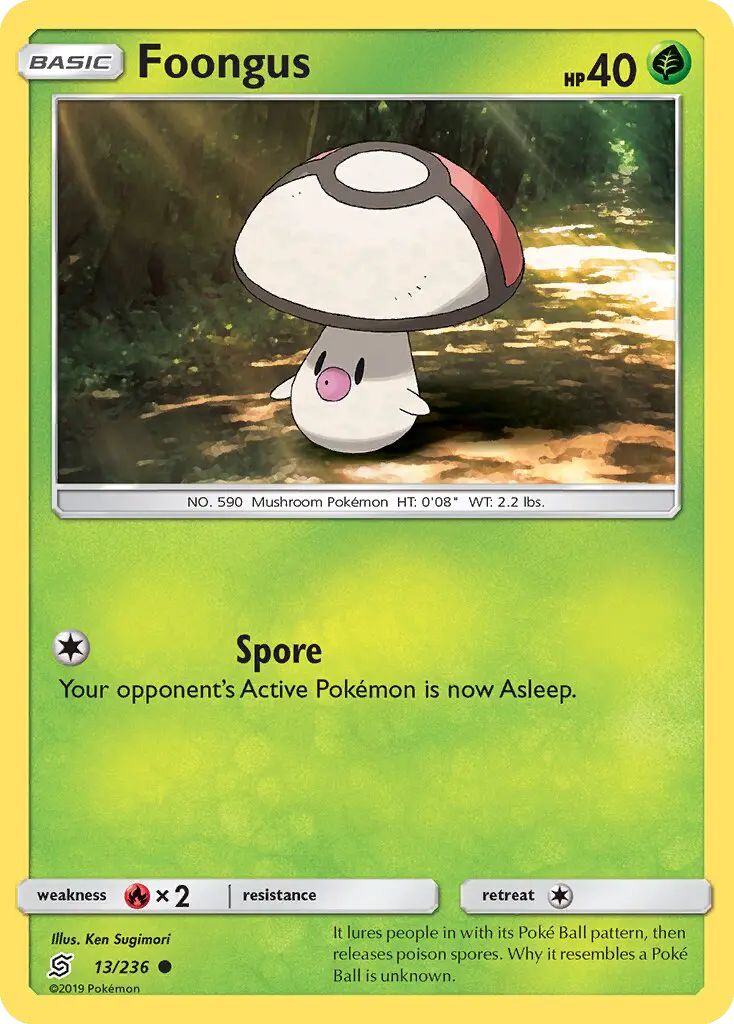
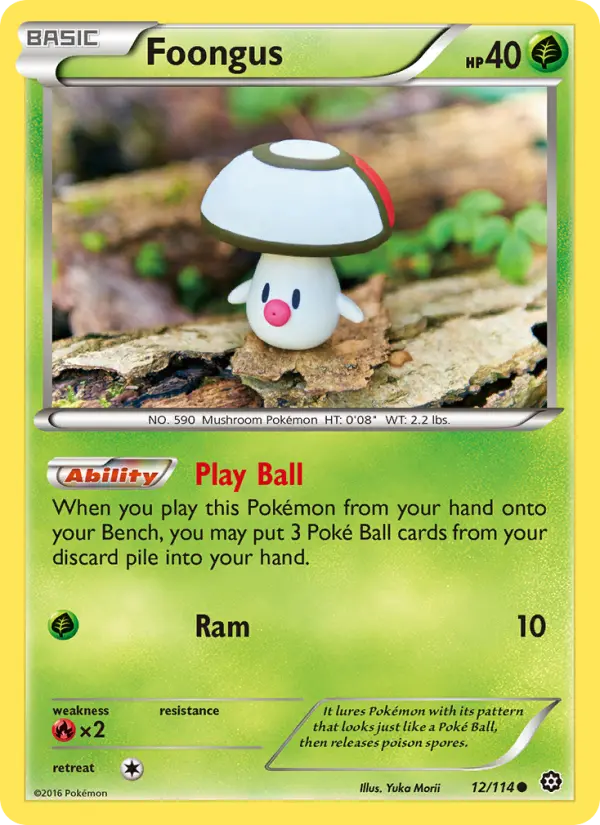
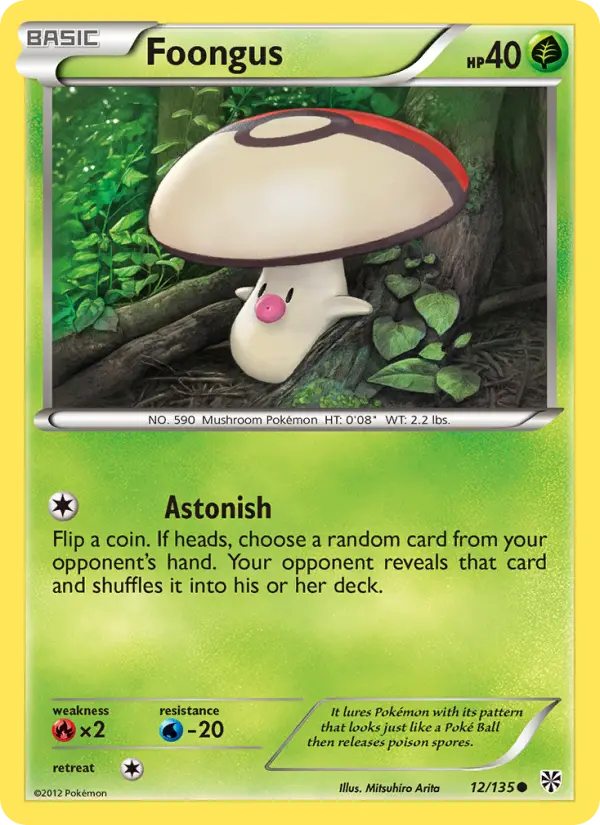
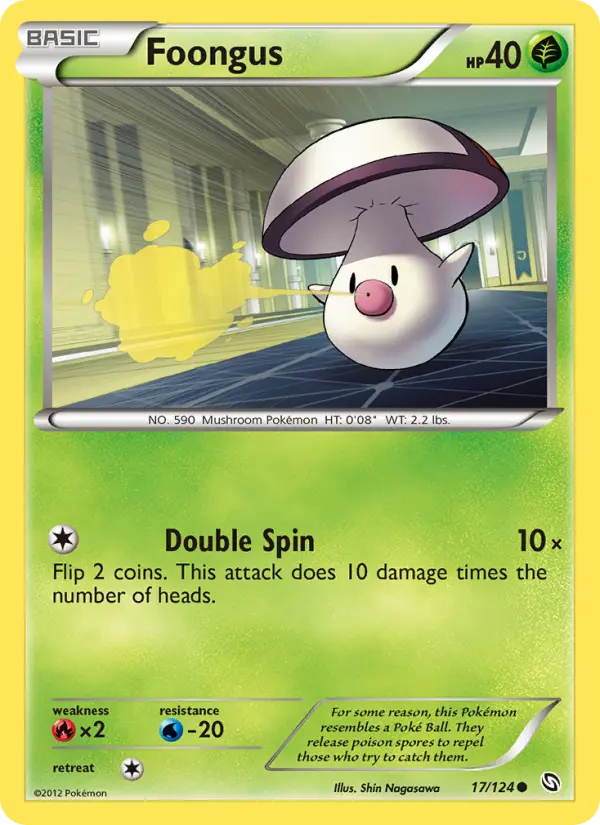
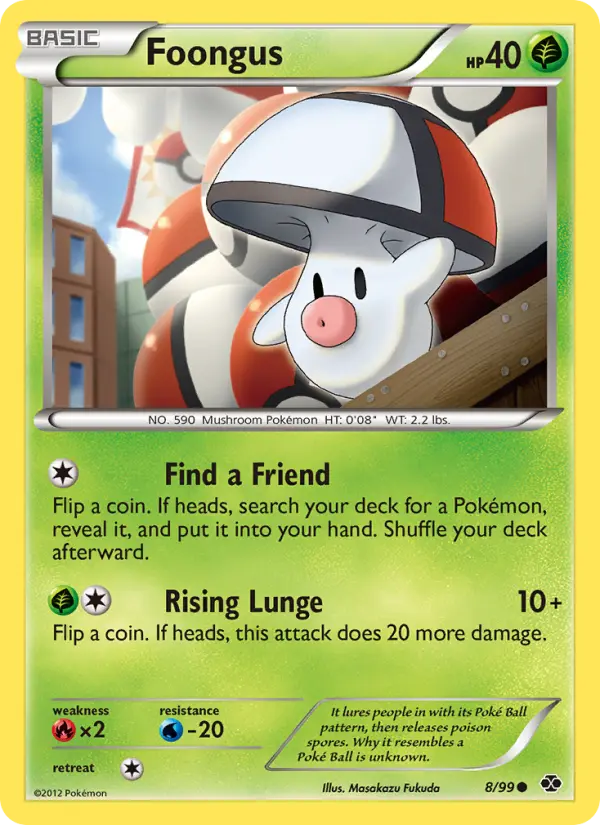
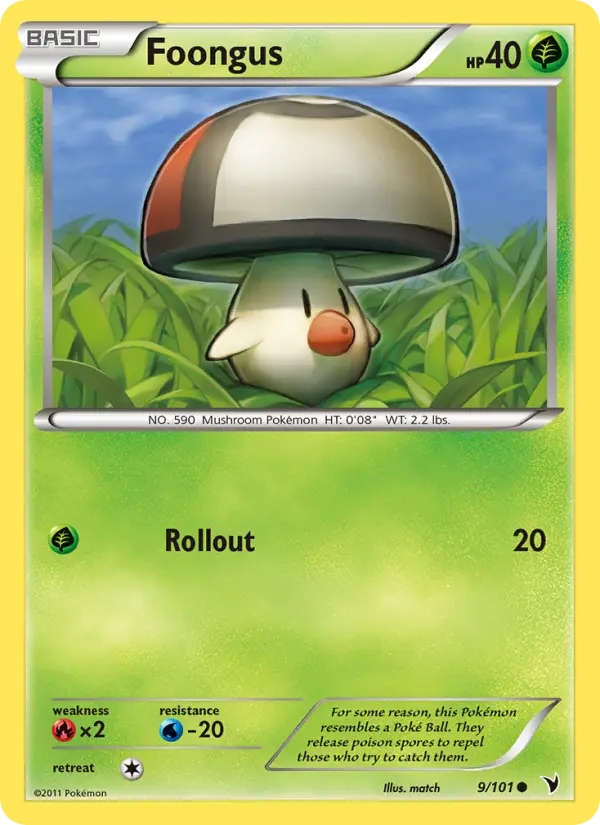
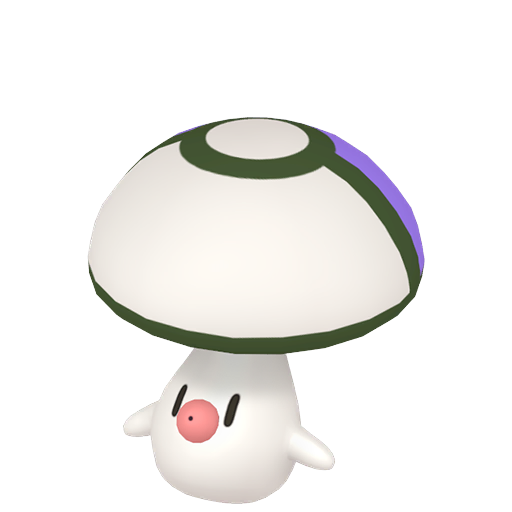
Foongus presents a striking biological design that centers on its remarkable resemblance to a Poké Ball, featuring a white, rounded mushroom-like body capped with a distinctive red and white pattern that mimics the iconic capture device. Its physical form includes stubby, digit-less arms, a tiny mouth with characteristically large pink lips, and small, dark pinprick-like eyes that give it an endearing appearance despite its toxic nature. The Pokédex notes an intriguing theory suggesting that the original developer of the modern Poké Ball actually modeled the device after observing Foongus's cap pattern, though this remains unconfirmed speculation. Foongus locomotes through either hopping movements or by turning on its side and rolling across its fungal cap, a peculiar method of traversal that complements its mushroom physiology. Most fascinatingly, the poisonous spores that Foongus releases as a defensive mechanism possess medicinal properties when thoroughly dried, transforming from a weapon into a remedy suitable for treating stomach ailments—a duality that reflects the complex nature of toxins in the natural world.
Pokedex Numbers
Training
Breeding
Foongus Breeding, Gender Ratio & Egg Groups
There's no gender skew here: Foongus breeds at an even 50% male / 50% female rate, allowing trainers equal opportunity to breed either variant without concerning themselves with genetic predisposition toward particular sexes. The species belongs to the Plant Egg Group, a classification shared with various grass-type and plant-like Pokémon, meaning it can breed with other members of this egg group to produce Foongus offspring. Breeding Foongus requires 20 egg cycles to hatch, translating approximately to 4,884–5,140 steps of gameplay before the egg produces a new Foongus, a relatively standard hatching duration that encourages player engagement without excessive grinding. The species maintains a base Happiness value of 70 in most generations (though this was reduced to 50 in later iterations), indicating moderate friendliness toward trainers who capture it in the wild, which gradually increases through positive interactions and care. Foongus does not have any notably gender-specific characteristics in appearance or battle capability, with males and females presenting identical visual designs and base statistics, making gender selection purely a matter of trainer preference or breeding strategy when pursuing particular movesets or abilities through egg moves and nature manipulation.
Sprites





Held Items
Tiny Mushroom
loot
Fire Red and Leaf Green: Trade two for prior Level-up moves. Sell for 250 Pokédollars, or to Hungry Maid for 500 Pokédollars.
Cost: 500
Tiny Mushroom
loot
Fire Red and Leaf Green: Trade two for prior Level-up moves. Sell for 250 Pokédollars, or to Hungry Maid for 500 Pokédollars.
Cost: 500
Tiny Mushroom
loot
Fire Red and Leaf Green: Trade two for prior Level-up moves. Sell for 250 Pokédollars, or to Hungry Maid for 500 Pokédollars.
Cost: 500
Tiny Mushroom
loot
Fire Red and Leaf Green: Trade two for prior Level-up moves. Sell for 250 Pokédollars, or to Hungry Maid for 500 Pokédollars.
Cost: 500
Tiny Mushroom
loot
Fire Red and Leaf Green: Trade two for prior Level-up moves. Sell for 250 Pokédollars, or to Hungry Maid for 500 Pokédollars.
Cost: 500
Tiny Mushroom
loot
Fire Red and Leaf Green: Trade two for prior Level-up moves. Sell for 250 Pokédollars, or to Hungry Maid for 500 Pokédollars.
Cost: 500
Tiny Mushroom
loot
Fire Red and Leaf Green: Trade two for prior Level-up moves. Sell for 250 Pokédollars, or to Hungry Maid for 500 Pokédollars.
Cost: 500
Tiny Mushroom
loot
Fire Red and Leaf Green: Trade two for prior Level-up moves. Sell for 250 Pokédollars, or to Hungry Maid for 500 Pokédollars.
Cost: 500
Tiny Mushroom
loot
Fire Red and Leaf Green: Trade two for prior Level-up moves. Sell for 250 Pokédollars, or to Hungry Maid for 500 Pokédollars.
Cost: 500
Tiny Mushroom
loot
Fire Red and Leaf Green: Trade two for prior Level-up moves. Sell for 250 Pokédollars, or to Hungry Maid for 500 Pokédollars.
Cost: 500
Tiny Mushroom
loot
Fire Red and Leaf Green: Trade two for prior Level-up moves. Sell for 250 Pokédollars, or to Hungry Maid for 500 Pokédollars.
Cost: 500
Tiny Mushroom
loot
Fire Red and Leaf Green: Trade two for prior Level-up moves. Sell for 250 Pokédollars, or to Hungry Maid for 500 Pokédollars.
Cost: 500
Big Mushroom
loot
Fire Red and Leaf Green: Trade for prior Level-up moves. Sell for 2500 Pokédollars, or to Hungry Maid for 5000 Pokédollars.
Cost: 5000
Big Mushroom
loot
Fire Red and Leaf Green: Trade for prior Level-up moves. Sell for 2500 Pokédollars, or to Hungry Maid for 5000 Pokédollars.
Cost: 5000
Big Mushroom
loot
Fire Red and Leaf Green: Trade for prior Level-up moves. Sell for 2500 Pokédollars, or to Hungry Maid for 5000 Pokédollars.
Cost: 5000
Big Mushroom
loot
Fire Red and Leaf Green: Trade for prior Level-up moves. Sell for 2500 Pokédollars, or to Hungry Maid for 5000 Pokédollars.
Cost: 5000
Big Mushroom
loot
Fire Red and Leaf Green: Trade for prior Level-up moves. Sell for 2500 Pokédollars, or to Hungry Maid for 5000 Pokédollars.
Cost: 5000
Big Mushroom
loot
Fire Red and Leaf Green: Trade for prior Level-up moves. Sell for 2500 Pokédollars, or to Hungry Maid for 5000 Pokédollars.
Cost: 5000
Big Mushroom
loot
Fire Red and Leaf Green: Trade for prior Level-up moves. Sell for 2500 Pokédollars, or to Hungry Maid for 5000 Pokédollars.
Cost: 5000
Big Mushroom
loot
Fire Red and Leaf Green: Trade for prior Level-up moves. Sell for 2500 Pokédollars, or to Hungry Maid for 5000 Pokédollars.
Cost: 5000
Big Mushroom
loot
Fire Red and Leaf Green: Trade for prior Level-up moves. Sell for 2500 Pokédollars, or to Hungry Maid for 5000 Pokédollars.
Cost: 5000
Big Mushroom
loot
Fire Red and Leaf Green: Trade for prior Level-up moves. Sell for 2500 Pokédollars, or to Hungry Maid for 5000 Pokédollars.
Cost: 5000
Big Mushroom
loot
Fire Red and Leaf Green: Trade for prior Level-up moves. Sell for 2500 Pokédollars, or to Hungry Maid for 5000 Pokédollars.
Cost: 5000
Big Mushroom
loot
Fire Red and Leaf Green: Trade for prior Level-up moves. Sell for 2500 Pokédollars, or to Hungry Maid for 5000 Pokédollars.
Cost: 5000
Balm Mushroom
loot
Sell to Hungry Maid for 25000 Pokédollars.
Cost: 15000
Balm Mushroom
loot
Sell to Hungry Maid for 25000 Pokédollars.
Cost: 15000
Balm Mushroom
loot
Sell to Hungry Maid for 25000 Pokédollars.
Cost: 15000
Balm Mushroom
loot
Sell to Hungry Maid for 25000 Pokédollars.
Cost: 15000
TMs & HMs
tm04
gold silver
tm04
crystal
tm05
lets go pikachu lets go eevee
tm06
yellow
tm06
gold silver
tm06
red blue
tm06
crystal
tm06
emerald
tm06
firered leafgreen
tm06
diamond pearl
tm06
platinum
tm06
ruby sapphire
tm06
colosseum
tm06
black 2 white 2
tm06
xd
tm06
black white
tm06
heartgold soulsilver
tm06
omega ruby alpha sapphire
tm06
ultra sun ultra moon
tm06
sun moon
+425 more TMs/HMs
Foongus's Evolution Chain


Foongus Evolution, Mega Evolution & Special Forms
Foongus undergoes a straightforward evolutionary transformation into Amoonguss upon reaching level 39, a developmental milestone that represents a natural progression in the Mushroom Pokémon's life cycle. The evolution dramatically enhances Foongus's capabilities, with Amoonguss receiving substantial increases across most statistical categories, particularly in Attack, Special Attack, Special Defense, and Speed, though HP actually decreases slightly. While Foongus maintains the same Grass/Poison typing, its evolved form gains greater offensive potential and improved survivability through enhanced defensive stats, making Amoonguss significantly more viable in competitive battling scenarios. The evolution retains both ability options—Effect Spore and the hidden ability Regenerator—ensuring that trainers who have invested in specific ability configurations can maintain their battle strategies post-evolution. Foongus does not possess any Mega Evolution, Gigantamax form, or Terastallization variant exclusive to this unevolved stage, though its evolution into Amoonguss provides the primary avenue for powering up this mushroom-based lineage.
Where to Find
Unova Route 6
unova
+23 more
Unova Route 10
unova
+13 more
Unova Route 7
unova
+21 more
Kalos Route 15
kalos
+5 more
Kalos Route 16
kalos
+5 more
Foongus Behaviour and Natural Habitat
Foongus exhibits a sophisticated predatory behavior pattern that exploits visual deception as its primary hunting and defense mechanism. By displaying its Poké Ball-patterned cap, it actively lures both people and other Pokémon into close proximity, a strategy that proves devastatingly effective given the iconic recognition of the Poké Ball in Pokémon culture. Once potential threats or prey approach within striking distance, Foongus releases clouds of poisonous spores designed to repel attackers and provide an escape opportunity. This aggressive defensive strategy reflects an otherwise docile creature that prefers to avoid direct confrontation, instead relying on chemical and visual deception. The species shows a marked preference for damp environments, particularly areas surrounding trees where moisture levels remain elevated and conditions favor fungal growth. Foongus inhabits grassy regions throughout various regions, with documented populations in locations ranging from the Unova region in Black and White versions to the diverse ecosystems of more recent generations, always favoring areas where humidity and vegetation provide ideal living conditions for this moisture-dependent organism.
Pokedex Entries
It lures people in with its Poké Ball pattern, then releases poison spores. Why it resembles a Poké Ball is unknown.
It lures Pokémon with its pattern that looks just like a Poké Ball then releases poison spores.
For some reason, this Pokémon resembles a Poké Ball. They release poison spores to repel those who try to catch them.
It lures people in with its Poké Ball pattern, then releases poison spores. Why it resembles a Poké Ball is unknown.
It lures Pokémon with its pattern that looks just like a Poké Ball, then releases poison spores.
It lures people in with its Poké Ball pattern, then releases poison spores. Why it resembles a Poké Ball is unknown.
It lures Pokémon with its pattern that looks just like a Poké Ball, then releases poison spores.
No one knows what the Poké Ball–like pattern on Foongus means or why Foongus has it.
The spores released from this Pokémon’s hands are highly poisonous, but when thoroughly dried, the spores can be used as stomach medicine.
Foongus Name Origin & Design Inspiration
Foongus's name traces back to a clever phonetic blend combining "fungus" with "foo," creating a whimsical nomenclature that perfectly encapsulates the creature's fungal nature while maintaining the distinctive sound profile characteristic of Generation V Pokémon naming conventions. The Japanese designation Tamagetake (タマゲタケ) literally translates to "ball mushroom" or "decoy mushroom," with "tama" meaning ball and "getake" referring to mushroom, a direct reference to both its spherical appearance and deceptive Poké Ball-mimicking coloration. The design itself draws obvious inspiration from real-world mushroom species, particularly those with distinctive red and white coloration patterns found in various fungal ecosystems, combined with the overlay of Poké Ball aesthetics that create an instantly recognizable visual identity. The evolutionary line's design philosophy emphasizes biological adaptation and evolutionary refinement, with Foongus representing the deceptive base strategy and Amoonguss embodying the perfected predatory organism. This naming and design philosophy creates a cohesive narrative where the smallest and most defensively-oriented stage of the mushroom evolution gradually becomes more aggressive and formidable, reflecting the Pokémon series' emphasis on growth and development through evolution.
Learnable Moves
Foongus can learn 56 moves:
Move | Type | Cat. | Power | Acc. | PP |
|---|---|---|---|---|---|
| absorb | grass | Special | 20 | 100 | 25 |
| after you | normal | Status | — | — | 15 |
| astonish | ghost | Physical | 30 | 100 | 15 |
| attract | normal | Status | — | 100 | 15 |
| bide | normal | Physical | — | — | 10 |
| body slam | normal | Physical | 85 | 100 | 15 |
| bullet seed | grass | Physical | 25 | 100 | 30 |
| clear smog | poison | Special | 50 | — | 15 |
| confide | normal | Status | — | — | 20 |
| defense curl | normal | Status | — | — | 40 |
| double team | normal | Status | — | — | 15 |
| endure | normal | Status | — | — | 10 |
| energy ball | grass | Special | 90 | 100 | 10 |
| facade | normal | Physical | 70 | 100 | 20 |
| feint attack | dark | Physical | 60 | — | 20 |
| flash | normal | Status | — | 100 | 20 |
| foul play | dark | Physical | 95 | 100 | 15 |
| frustration | normal | Physical | — | 100 | 20 |
| gastro acid | poison | Status | — | 100 | 10 |
| giga drain | grass | Special | 75 | 100 | 10 |
| grass knot | grass | Special | — | 100 | 20 |
| grassy terrain | grass | Status | — | — | 10 |
| growth | normal | Status | — | — | 20 |
| hidden power | normal | Special | 60 | 100 | 15 |
| ingrain | grass | Status | — | — | 20 |
| leaf storm | grass | Special | 130 | 90 | 5 |
| magical leaf | grass | Special | 60 | — | 20 |
| mega drain | grass | Special | 40 | 100 | 15 |
| nature power | normal | Status | — | — | 20 |
| payback | dark | Physical | 50 | 100 | 10 |
| poison powder | poison | Status | — | 75 | 35 |
| pollen puff | bug | Special | 90 | 100 | 15 |
| protect | normal | Status | — | — | 10 |
| rage powder | bug | Status | — | — | 20 |
| rain dance | water | Status | — | — | 5 |
| rest | psychic | Status | — | — | 5 |
| return | normal | Physical | — | 100 | 20 |
| rollout | rock | Physical | 30 | 90 | 20 |
| round | normal | Special | 60 | 100 | 15 |
| secret power | normal | Physical | 70 | 100 | 20 |
| seed bomb | grass | Physical | 80 | 100 | 15 |
| sleep talk | normal | Status | — | — | 10 |
| sludge bomb | poison | Special | 90 | 100 | 10 |
| snore | normal | Special | 50 | 100 | 15 |
| solar beam | grass | Special | 120 | 100 | 10 |
| spore | grass | Status | — | 100 | 15 |
| stun spore | grass | Status | — | 75 | 30 |
| substitute | normal | Status | — | — | 10 |
| sunny day | fire | Status | — | — | 5 |
| swagger | normal | Status | — | 85 | 15 |
| sweet scent | normal | Status | — | 100 | 20 |
| synthesis | grass | Status | — | — | 5 |
| tera blast | normal | Special | 80 | 100 | 10 |
| toxic | poison | Status | — | 90 | 10 |
| venoshock | poison | Special | 65 | 100 | 10 |
| worry seed | grass | Status | — | 100 | 10 |
Foongus Competitive Battle Guide
In tournament-level play, Foongus occupies an extremely niche position due to its exceptionally poor Speed stat of 15, which ranks among the slowest Pokémon in the entire National Pokédex, making it nearly unviable in conventional offensive strategies. However, its access to the hidden ability Regenerator provides substantial defensive utility, allowing Foongus to pivot in and out of battle while recovering one-third of its maximum health, a capability that grants it viability as a defensive pivot or support Pokémon in specific team compositions. The standard ability Effect Spore offers additional defensive value through its 30% chance to inflict paralysis, poison, or sleep on physical attackers, incentivizing opponents to avoid direct contact and potentially disrupting their team composition. Foongus's modest offensive statistics (both Attack and Special Attack at 55) severely limit its damage output, though it can learn supportive moves like Stun Spore, Spore, and various healing options that capitalize on its defensive profile rather than offensive potential. Most serious competitive players recommend evolving Foongus into Amoonguss as quickly as possible, since the evolution provides substantially improved statistics and effectiveness while maintaining access to the same abilities and strategic foundations, making the unevolved form primarily useful only in limited metagames or casual play where speed restrictions provide equalizing advantages.
Commonly Asked Questions About Foongus
What type is Foongus?
Foongus is a grass and poison type Pokemon.
What does Foongus evolve into?
Foongus evolves into amoonguss.
What are Foongus's weaknesses?
Foongus is weak to flying, fire, psychic and ice type moves.
Does Foongus evolve by trading?
No — Foongus evolves entirely through leveling up, with no trade required at any stage.
Where can I find Foongus?
Foongus can be found in unova route 6 (unova), unova route 10 (unova) and unova route 7 (unova) and 2 other locations.
Foongus Cultural Impact & Franchise History
Foongus represents a fascinating intersection point between Pokémon's internal world-building and real-world biology, introducing a creature that challenges conventional expectations by mimicking the very mechanism through which trainers capture Pokémon. This meta-textual design choice has resonated with the Pokémon community, spawning considerable discussion and fan theories about the intentional relationship between Foongus and the Poké Ball itself, particularly the Pokédex suggestion that the device's creator may have been inspired by observing this Mushroom Pokémon. The species gained particular prominence in discussions about Pokémon design philosophy and creative naming conventions, with the phonetic cleverness of "Foongus" becoming emblematic of Generation V's wordplay-heavy approach to nomenclature. In competitive and casual gaming circles, Foongus has maintained a modest following as a quirky option for players seeking unconventional team compositions, though it never achieved the mainstream popularity of more powerful or visually striking Pokémon. The creature's appearance in various animated adaptations and trading card game releases has provided consistent exposure, though primarily as a minor character rather than a featured protagonist, maintaining its identity as a specialized creature for dedicated trainers rather than a universal favorite.
Where to Find Foongus in Every Pokémon Game
Foongus was first introduced in Generation V and has enjoyed consistent availability across subsequent generations with varying regional Pokédex placement and encounter rates. In Black and White, Foongus appears as Pokédex entry #096 in the Unova region, while Black 2 and White 2 reassign it to entry #161, reflecting the expanded Pokédex structure of those sequels with slightly different encounter mechanics and availability patterns. The species remains accessible in X and Y as entry #0053 (Mountain Kalos), Omega Ruby and Alpha Sapphire with its standard availability, and subsequent generations including Sword and Shield, Scarlet and Violet, and Legends: Z-A. Foongus maintains a respectable capture rate of 190 (approximately 35.2% with a standard Poké Ball at full health), making it relatively straightforward to capture once encountered, with base experience yield of 59 providing modest training contributions. The species is compatible with all modern Pokémon transfer systems, allowing players to migrate Foongus from earlier generations into contemporary titles, ensuring that trainers interested in this diminutive fungal species can reliably acquire one regardless of which games comprise their collection, though its poor competitive viability and limited cultural prominence mean it is rarely a top priority for trainers seeking specific Pokémon.