Escavalier
Generation V · #0589 — Cavalry Pokémon
As a Generation V bug/steel-type, Escavalier leans on swarm to cover what its raw numbers don't, particularly on the attack side. The Pokémon's National Pokédex number is #589, and it holds a moderate catch rate of 75, making it reasonably obtainable in the wild. Escavalier's design draws inspiration from medieval knights and cavalry units, transforming the humble Karrablast into an armored warrior ready for battle. Its thematic representation of chivalry and mounted combat has made it a memorable addition to the Bug-type roster, offering players a genuinely unique perspective on insect-based Pokémon.
Editor's Take
Escavalier's Bug/Steel typing with 135 base Attack and Overcoat is genuinely strong, and 20 base Speed means it only works in Trick Room or as a slow pivot.
Base Stats
Height
1.0m
Weight
33.0kg
Category
Cavalry Pokémon
Gender
Male 50% / Female 50%
Color
gray
Shape
arms
Abilities
Strengthens bug moves to inflict 1.5× damage at 1/3 max HP or less.
Protects against critical hits.
Protects against damage from weather.

Escavalier Biology & Physical Characteristics
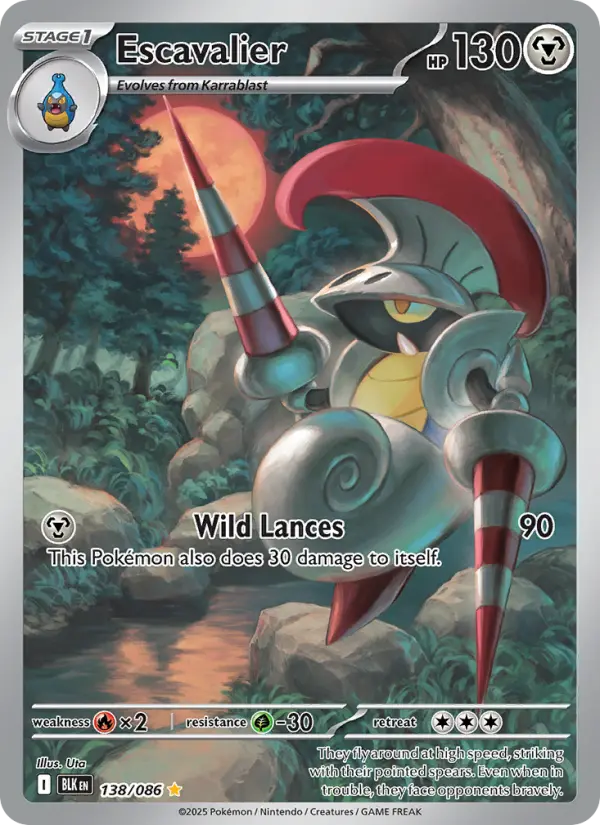
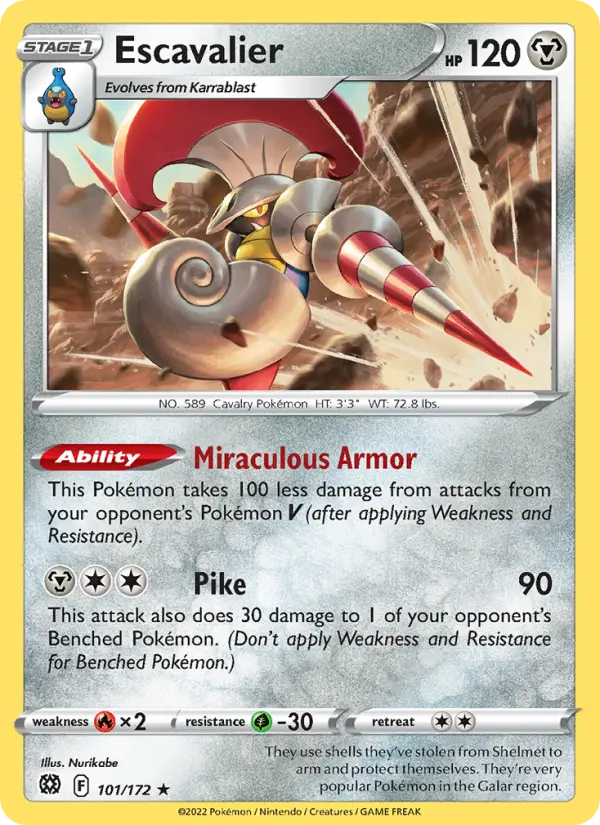
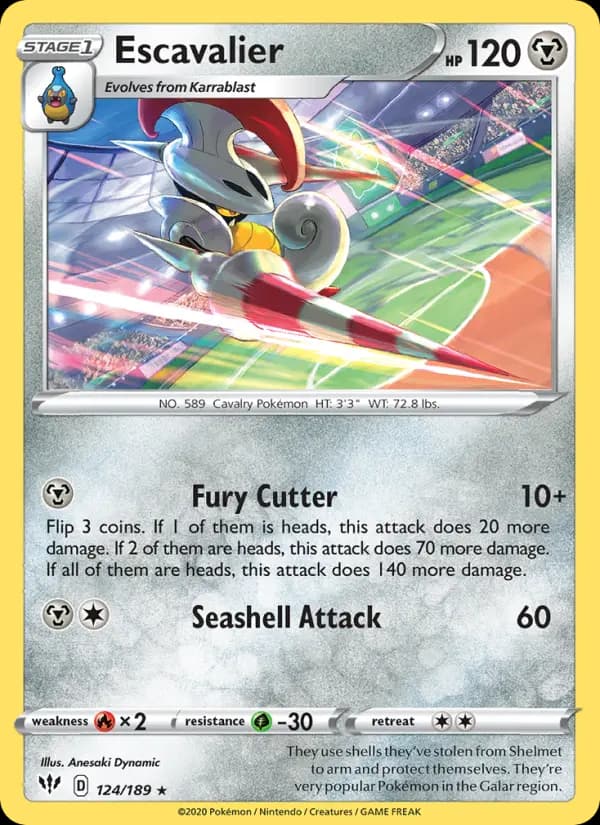
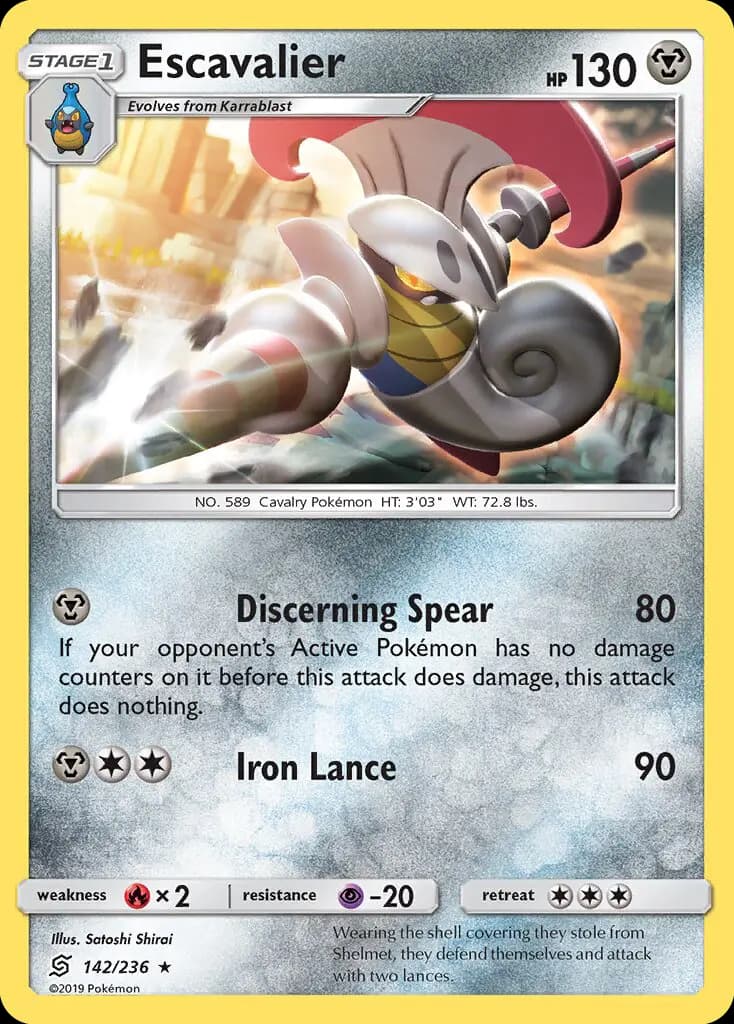
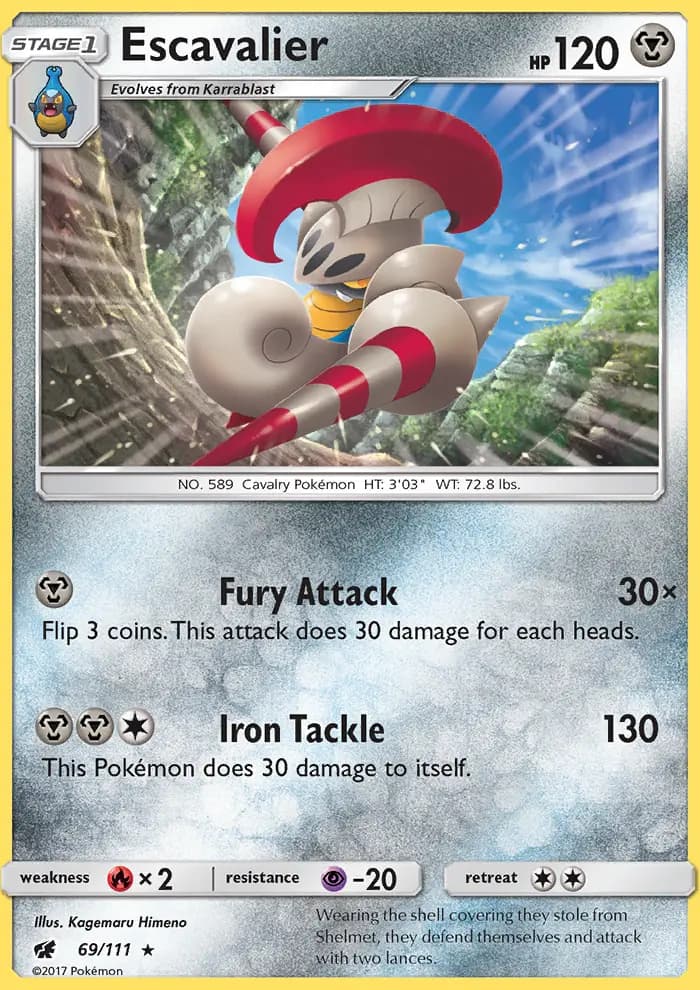
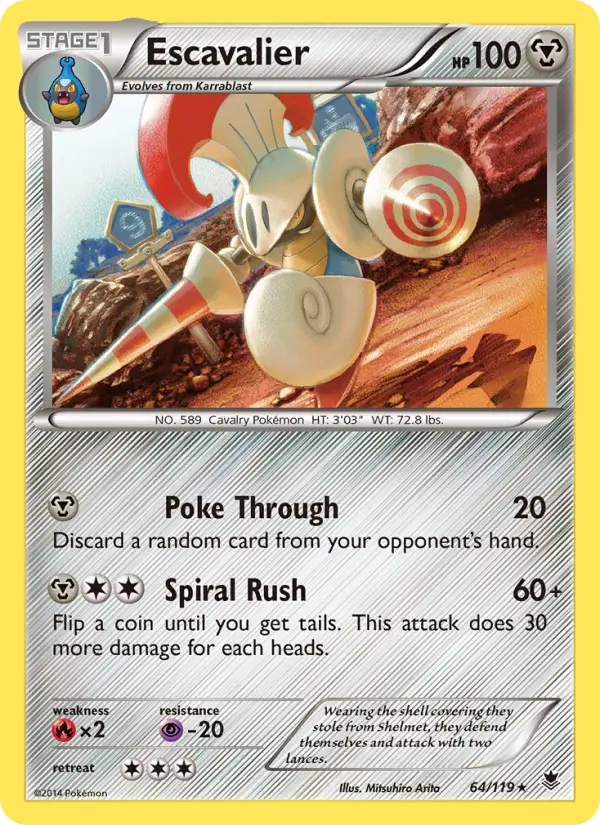
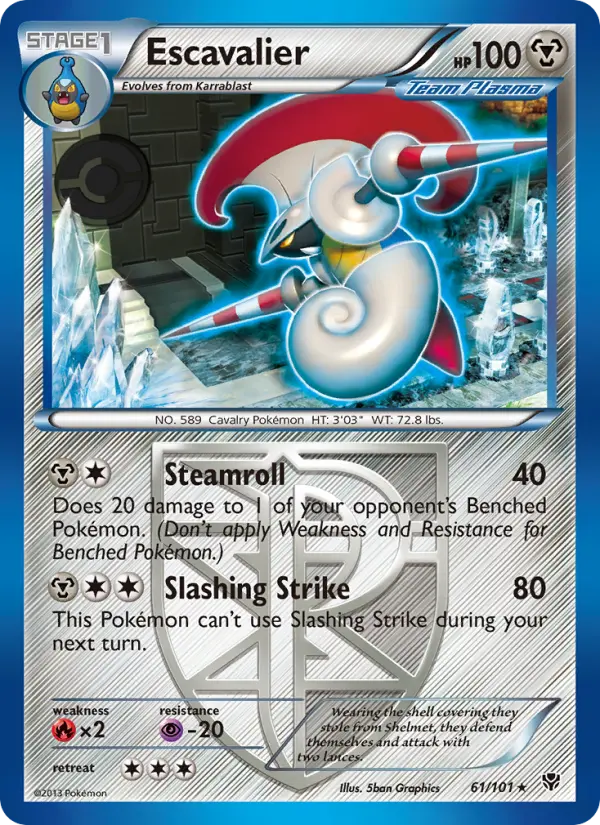
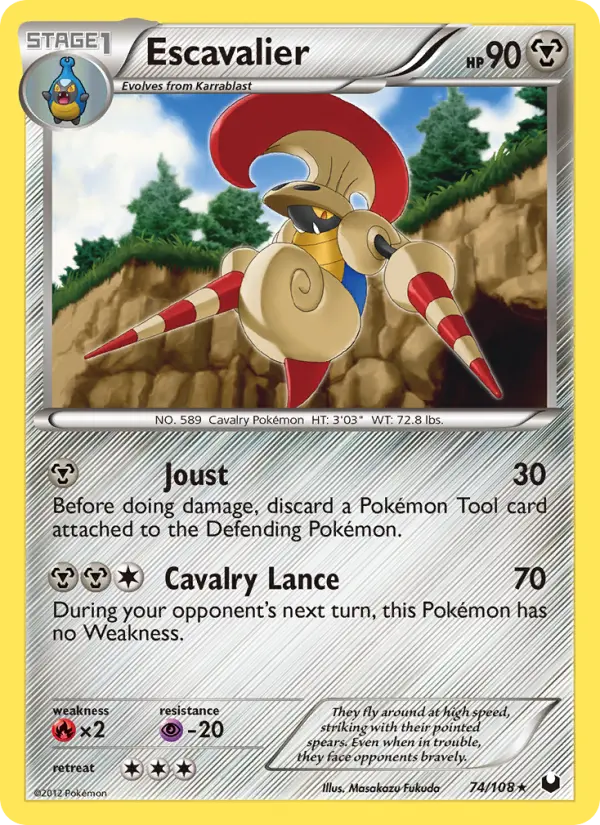
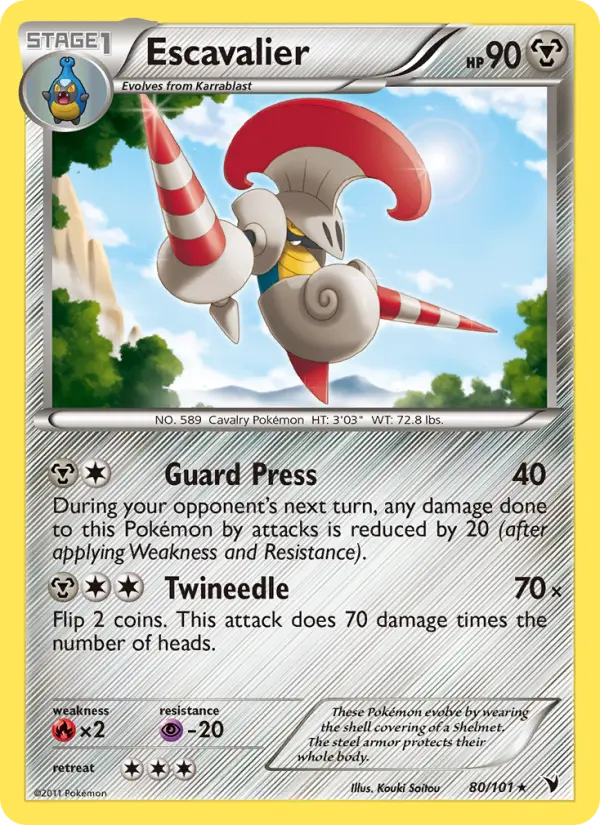
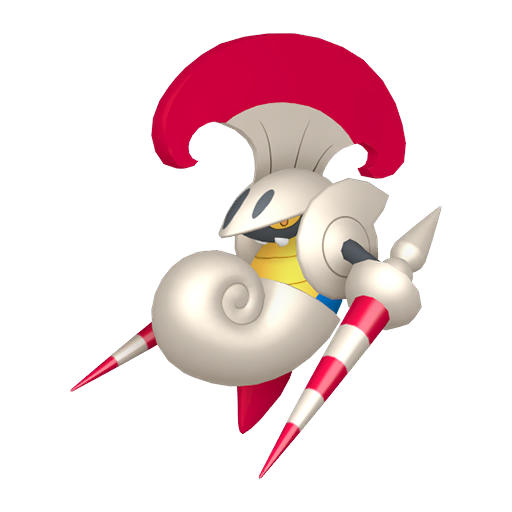
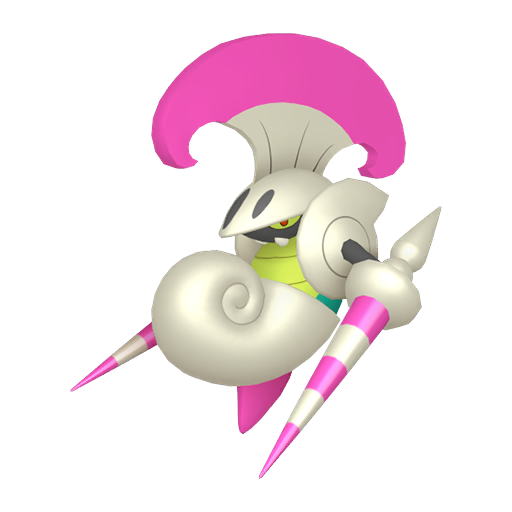
Escavalier presents one of the most distinctive appearances in the entire Bug-type family, featuring an insectoid body encased in stolen armor from its symbiotic partner, Shelmet. The Pokémon's head bears a striking resemblance to a medieval knight's helmet, complete with a crimson horsehair crest rising prominently from its crown and a protective visor beneath. Its shoulders are adorned with large, rounded metal ridges that serve both defensive and aesthetic purposes, with thin black arms extending from these shoulders and terminating in red-striped protrusions that resemble jousting lances used in medieval combat. The most distinctive feature is undoubtedly the swirled gray shell that conceals its lower body, a shell it actively steals from Shelmet during its evolution, with a solitary red spike protruding from the underside. While its face and upper torso remain exposed and unarmored, the overall composition creates a perfect balance between organic insect and metallic protection. The steel armor that comprises much of Escavalier's exterior provides exceptional defensive qualities, granting it base Defense and Special Defense stats of 105 each, ensuring it can withstand considerable punishment in battle despite its diminutive frame.
Pokedex Numbers
Training
Breeding
Escavalier Breeding, Gender Ratio & Egg Groups
Gender-wise, Escavalier is an even 50/50 split between males and females, meaning trainers have equal probability of encountering either sex when breeding or catching this Pokémon in the wild. The species belongs exclusively to the Bug egg group, which connects it biologically to other insectoid Pokémon and determines compatible breeding partners within the Pokémon breeding ecosystem. With a base friendship value of 70, Escavalier shows moderate trust toward its trainer by default, requiring moderate effort to reach maximum happiness for evolution-based friendship mechanics or maximum beauty contests. The hatch counter for Escavalier is set at 15 cycles, translating to approximately 3,599 to 3,855 steps required for an egg to hatch into a newly-born Karrablast, which must then be leveled or traded to become Escavalier. The moderate growth rate classification places Escavalier on an intermediate leveling pace, neither exceptionally fast nor particularly slow, requiring balanced investment of experience points to reach level 100 from its starting evolution point. Breeding Escavalier produces Karrablast offspring, as the pre-evolution form is the egg-producing generation, meaning players seeking to breed multiple Escavalier must account for the evolution requirement in their breeding strategies. The gender-neutral nature of its breeding mechanics means that either parent can be female or male, though the female must hold or have the appropriate item if breeding-based evolution conditions are involved.
Sprites



TMs & HMs
tm01
lets go pikachu lets go eevee
tm02
crystal
tm02
gold silver
tm02
lets go pikachu lets go eevee
tm03
yellow
tm03
red blue
tm03
blue japan
tm03
red green japan
tm05
lets go pikachu lets go eevee
tm06
yellow
tm06
gold silver
tm06
red blue
tm06
crystal
tm06
emerald
tm06
firered leafgreen
tm06
diamond pearl
tm06
platinum
tm06
ruby sapphire
tm06
colosseum
tm06
black 2 white 2
+498 more TMs/HMs
Escavalier's Evolution Chain


Escavalier Evolution, Mega Evolution & Special Forms
Escavalier's evolution from Karrablast represents one of the most fascinating and thematically cohesive evolution mechanics in the entire Pokémon franchise, involving a direct trade with another Pokémon species. When a Karrablast is traded to another player while holding or being in the presence of a Shelmet, both Pokémon undergo simultaneous evolution—Karrablast transforms into Escavalier while Shelmet evolves into Accelgor. This mechanic creates a symbiotic relationship mirrored in the games' trading system itself, as neither evolution can occur without the presence of the other species, emphasizing their interdependence. The evolution narrative suggests that Escavalier actively steals Shelmet's protective shell covering during the transformation process, using the stolen armor as both defensive plating and the source of its characteristic lances. This transformation dramatically increases Escavalier's Attack stat from Karrablast's 95 to an impressive 135, making it substantially more dangerous as a physical attacker, while also granting it the Steel typing that provides valuable defensive resistances. The evolution process fundamentally alters the Pokémon's tactical role, converting the speedy Bug-type Karrablast into a heavily armored, high-attack specialist. Notably, Escavalier has no further evolution forms, no Mega Evolution, and no regional variants, making its final form the culmination of its development journey.
Where to Find
Location data not available for this Pokémon in the database.
Escavalier Behaviour and Natural Habitat
According to Pokédex entries across multiple generations, Escavalier exhibits remarkable bravery and combative spirit, displaying these qualities through its characteristic flying behavior and confrontational nature. These Pokémon are documented to fly around at exceptionally high speeds, striking their opponents with pointed spears—their twin lances—with calculated precision and devastating force. Most notably, Escavalier demonstrates unwavering courage even when facing adversity or overwhelming opposition, refusing to back down from challenges regardless of the circumstances or odds stacked against them. This behavioral trait suggests a warrior's code deeply embedded in the species' nature, making them natural gladiators and competitors. The Pokémon's habitat preferences are not extensively documented, but their presence in various regions including Unova, Kalos, and particularly the Galar region indicates they are adaptable to diverse environments. In the Galar region specifically, Escavalier has achieved considerable popularity, with cultural significance so pronounced that a famous painting immortalizes an epic duel between an Escavalier and a Sirfetch'd, capturing the imagination of trainers and artists alike. Their preference for mounted-combat-style engagement suggests they favor open spaces where high-speed aerial maneuvers are possible.
Pokedex Entries
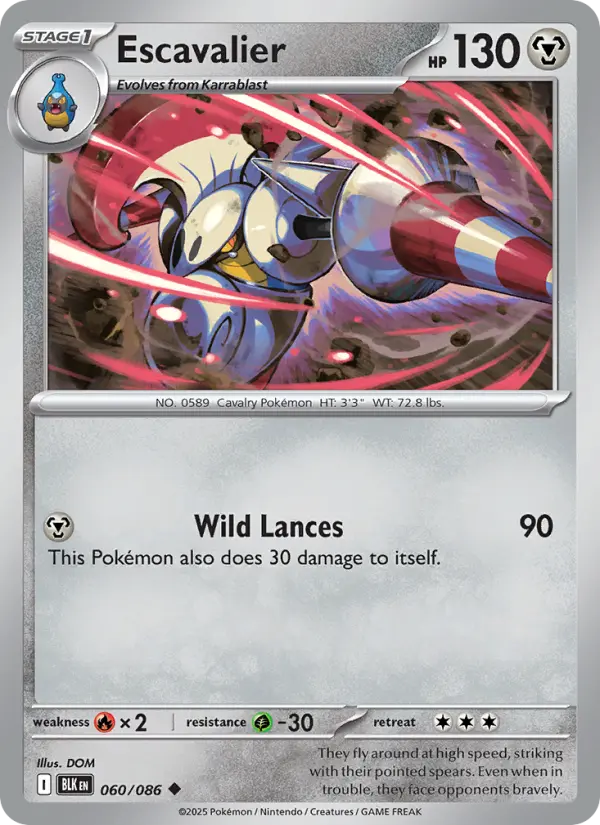
They fly around at high speed, striking with their pointed spears. Even when in trouble, they face opponents bravely.
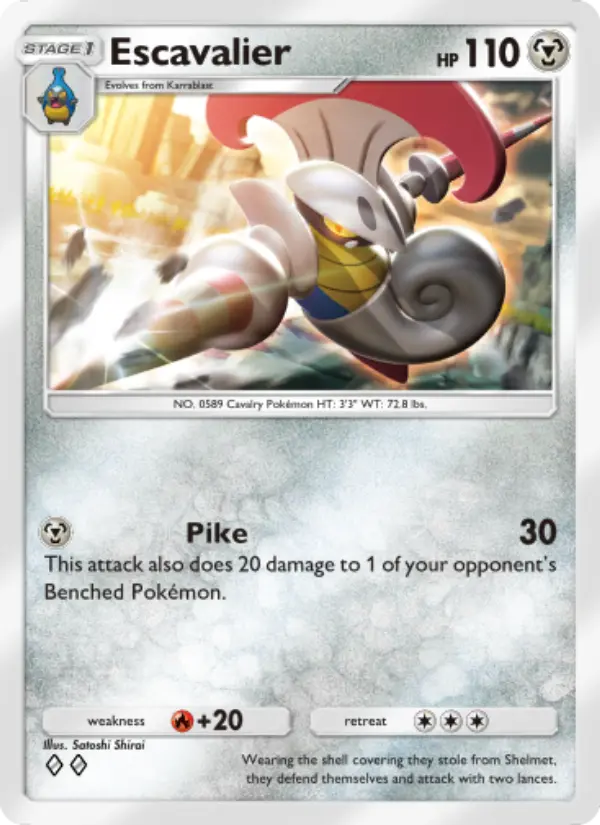
Wearing the shell covering they stole from Shelmet, they defend themselves and attack with two lances.
These Pokémon evolve by wearing the shell covering of a Shelmet. The steel armor protects their whole body.
Wearing the shell covering they stole from Shelmet, they defend themselves and attack with two lances.
These Pokémon evolve by wearing the shell covering of a Shelmet. The steel armor protects their whole body.
Wearing the shell covering they stole from Shelmet, they defend themselves and attack with two lances.
These Pokémon evolve by wearing the shell covering of a Shelmet. The steel armor protects their whole body.
They use shells they’ve stolen from Shelmet to arm and protect themselves. They’re very popular Pokémon in the Galar region.
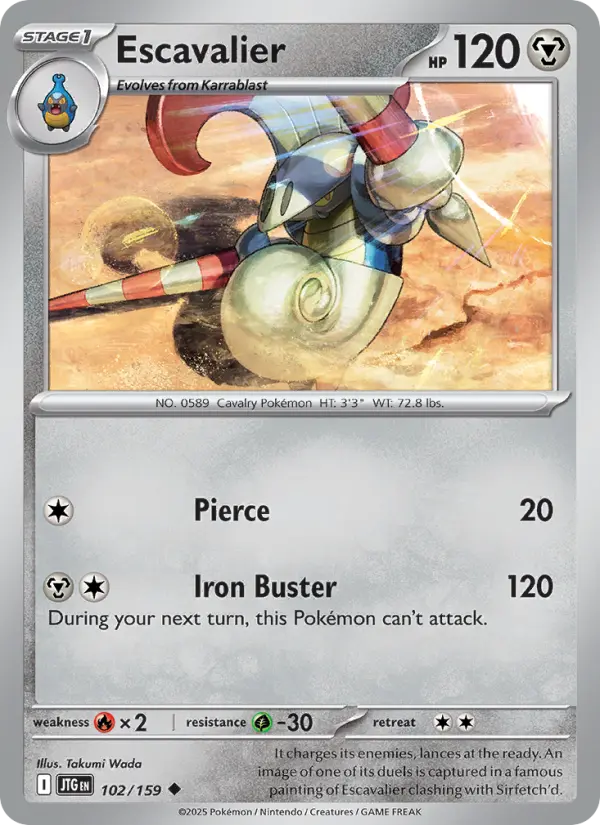
It charges its enemies, lances at the ready. An image of one of its duels is captured in a famous painting of Escavalier clashing with Sirfetch’d.
Escavalier Name Origin & Design Inspiration
The name Escavalier is a clever linguistic fusion combining 'Escargot' (French for snail, referencing Shelmet's gastropod inspiration) with 'Cavalier' (a knight or mounted warrior), perfectly encapsulating the Pokémon's unique dual nature as both a bug-type that relies on stolen gastropod armor and a chivalrous knight-themed combatant. The Japanese name Chevargo similarly blends 'Cheval' (French for horse) with 'Escargot,' emphasizing the cavalry and mounted combat aesthetic central to its design philosophy. Escavalier's visual design is unmistakably inspired by medieval heraldry and knightly traditions, with its horsehair-crested helmet evoking the distinctive plumage of historical knights' headgear, while its twin lances reference the classical weapons of mounted cavalrymen and jousting tournaments. The armor plating—particularly the large rounded shoulders and the elaborate shell-based lower body protection—draws heavily from full-plate medieval armor, creating a cohesive aesthetic that transforms an insect Pokémon into something resembling a tiny, chitinous knight. The design philosophy successfully bridges two disparate concepts: the biological reality of an insect and the historical romanticism of chivalric combat, creating a Pokémon that functions equally well within both contexts. Every visual element, from the red-striped lances to the swirled gray shell, contributes to this thematic unity, making Escavalier one of the most thematically consistent design choices in Generation V.
Learnable Moves
Escavalier can learn 67 moves:
Move | Type | Cat. | Power | Acc. | PP |
|---|---|---|---|---|---|
| acid spray | poison | Special | 40 | 100 | 20 |
| aerial ace | flying | Physical | 60 | — | 20 |
| agility | psychic | Status | — | — | 30 |
| attract | normal | Status | — | 100 | 15 |
| brutal swing | dark | Physical | 60 | 100 | 20 |
| bug bite | bug | Physical | 60 | 100 | 20 |
| bug buzz | bug | Special | 90 | 100 | 10 |
| close combat | fighting | Physical | 120 | 100 | 5 |
| confide | normal | Status | — | — | 20 |
| cut | normal | Physical | 50 | 95 | 30 |
| double team | normal | Status | — | — | 15 |
| double edge | normal | Physical | 120 | 100 | 15 |
| drill run | ground | Physical | 80 | 95 | 10 |
| encore | normal | Status | — | 100 | 5 |
| endure | normal | Status | — | — | 10 |
| energy ball | grass | Special | 90 | 100 | 10 |
| facade | normal | Physical | 70 | 100 | 20 |
| false swipe | normal | Physical | 40 | 100 | 40 |
| fell stinger | bug | Physical | 50 | 100 | 25 |
| flail | normal | Physical | — | 100 | 15 |
| focus blast | fighting | Special | 120 | 70 | 5 |
| frustration | normal | Physical | — | 100 | 20 |
| fury attack | normal | Physical | 15 | 85 | 20 |
| fury cutter | bug | Physical | 40 | 95 | 20 |
| giga drain | grass | Special | 75 | 100 | 10 |
| giga impact | normal | Physical | 150 | 90 | 5 |
| headbutt | normal | Physical | 70 | 100 | 15 |
| hidden power | normal | Special | 60 | 100 | 15 |
| hyper beam | normal | Special | 150 | 90 | 5 |
| infestation | bug | Special | 20 | 100 | 20 |
| iron defense | steel | Status | — | — | 15 |
| iron head | steel | Physical | 80 | 100 | 15 |
| knock off | dark | Physical | 65 | 100 | 20 |
| laser focus | normal | Status | — | — | 30 |
| leer | normal | Status | — | 100 | 30 |
| megahorn | bug | Physical | 120 | 85 | 10 |
| metal burst | steel | Physical | — | 100 | 10 |
| peck | flying | Physical | 35 | 100 | 35 |
| poison jab | poison | Physical | 80 | 100 | 20 |
| protect | normal | Status | — | — | 10 |
| quick guard | fighting | Status | — | — | 15 |
| rain dance | water | Status | — | — | 5 |
| razor shell | water | Physical | 75 | 95 | 10 |
| rest | psychic | Status | — | — | 5 |
| return | normal | Physical | — | 100 | 20 |
| revenge | fighting | Physical | 60 | 100 | 10 |
| reversal | fighting | Physical | — | 100 | 15 |
| rock smash | fighting | Physical | 40 | 100 | 15 |
| round | normal | Special | 60 | 100 | 15 |
| scary face | normal | Status | — | 100 | 10 |
| screech | normal | Status | — | 85 | 40 |
| secret power | normal | Physical | 70 | 100 | 20 |
| signal beam | bug | Special | 75 | 100 | 15 |
| slash | normal | Physical | 70 | 100 | 20 |
| sleep talk | normal | Status | — | — | 10 |
| smart strike | steel | Physical | 70 | — | 10 |
| snore | normal | Special | 50 | 100 | 15 |
| steel beam | steel | Special | 140 | 95 | 5 |
| struggle bug | bug | Special | 50 | 100 | 20 |
| substitute | normal | Status | — | — | 10 |
| swagger | normal | Status | — | 85 | 15 |
| swords dance | normal | Status | — | — | 20 |
| take down | normal | Physical | 90 | 85 | 20 |
| taunt | dark | Status | — | 100 | 20 |
| toxic | poison | Status | — | 90 | 10 |
| twineedle | bug | Physical | 25 | 100 | 20 |
| x scissor | bug | Physical | 80 | 100 | 15 |
Escavalier Competitive Battle Guide
Assessing its battle viability, Escavalier occupies a specialized niche as a physical Bug/Steel-type with exceptional Attack-focused credentials and solid bulk. Its attack stat of 135 places it among the genuinely threatening physical attackers, capable of dealing significant damage with appropriate move coverage and investment, though its abysmal Speed stat of only 20 necessitates careful team building and support strategies to function effectively in high-level competition. The movepool available to Escavalier provides solid physical coverage, with access to moves like Iron Head, X-Scissor, and Superpower that allow it to strike opposing Pokémon from multiple angles despite its low special attack stat of 60. Escavalier's ability choices significantly impact its competitive viability: Swarm increases Bug-type move power to 1.5x when health drops below one-third, creating potential sweep scenarios in desperate situations; Shell Armor prevents opponent critical hits, providing consistency and survivability; and the hidden ability Overcoat grants immunity to weather damage, which proves invaluable in weather-based competitive teams. The Bug/Steel typing grants useful resistances to Normal, Flying, Rock, Bug, Steel, Grass, Psychic, and Fairy moves while providing an immunity to Poison, though it carries concerning weaknesses to Fire, which severely limits its viability in competitive formats where Fire-type threats proliferate. Its defensive stats of 105/105 provide adequate bulk when combined with proper EV investment and a careful team composition, though it requires Trick Room or similar speed-manipulation strategies to function optimally given its pitiful speed tier.
Commonly Asked Questions About Escavalier
What type is Escavalier?
Escavalier is a bug and steel type Pokemon.
What does Escavalier evolve from?
Escavalier evolved from karrablast.
What are Escavalier's weaknesses?
Escavalier is weak to fire type moves.
Escavalier Cultural Impact & Franchise History
Escavalier has achieved notable cultural significance, particularly within the Galar region, where it is explicitly documented as a popular Pokémon cherished by local trainers and artists. The species inspired a famous painting within Pokémon lore depicting an epic duel between Escavalier and Sirfetch'd, two medieval-themed combatants locked in chivalrous combat, which has become a celebrated piece of cultural artwork capturing the imagination of both Pokémon trainers and art enthusiasts. This painting, referenced in the Pokémon Sword Pokédex entry, demonstrates how Escavalier has transcended mere gameplay mechanics to become a symbol of honorable battle and knightly virtue within the Pokémon world itself. The Pokémon's design resonates particularly strongly with players and fans who appreciate thematic coherence and creative evolutionary concepts, as the symbiotic evolution mechanic with Shelmet represents a mechanically and narratively sophisticated approach to Pokémon development rarely seen in earlier generations. Escavalier's popularity extends through various media appearances and merchandise, establishing it as one of Generation V's most memorable contributions to the Bug-type roster, often cited alongside Venomoth and Scizor as among the most stylistically impressive insect-based Pokémon. The character's embrace of medieval aesthetics taps into universal fantasy tropes while maintaining biological plausibility within the Pokémon universe, creating cross-generational appeal that sustains its relevance despite competitive limitations.
Where to Find Escavalier in Every Pokémon Game
Escavalier's availability varies significantly across different Pokémon games, reflecting its generation-specific introduction and varying regional presence. In its native Generation V games, Escavalier appears in both Pokémon Black and White (local dex #095) and Black 2/White 2 (local dex #156), where it can be obtained through the trade-evolution mechanic involving Karrablast and Shelmet. The species appears in subsequent generations including X/Y (Mountain Kalos), Omega Ruby/Alpha Sapphire, Sword/Shield (dex #274), with specific availability in the Isle of Armor DLC (#67) and Crown Tundra DLC (#96) for Sword/Shield. Notably, Escavalier was absent from Generation VI's Kalos regional dex initially, appearing only in the post-game content, and has maintained selective availability in later generations, never appearing in every game within a generation. The capture rate of 75 with a standard Poké Ball provides reasonable catch probability, though Escavalier cannot be caught as an Escavalier in most wild encounters; trainers must instead obtain Karrablast and arrange the requisite trade with a Shelmet-holding trainer or use Pokemon Home to transfer existing Escavalier from previous generations. This evolution requirement makes Escavalier dependent on either trading mechanics or possession of a pre-existing copy from earlier games, creating unique availability constraints compared to standard Pokémon. In Pokémon GO, Escavalier is available through specific encounters and events, though full movepool accessibility requires careful timing and preparation.