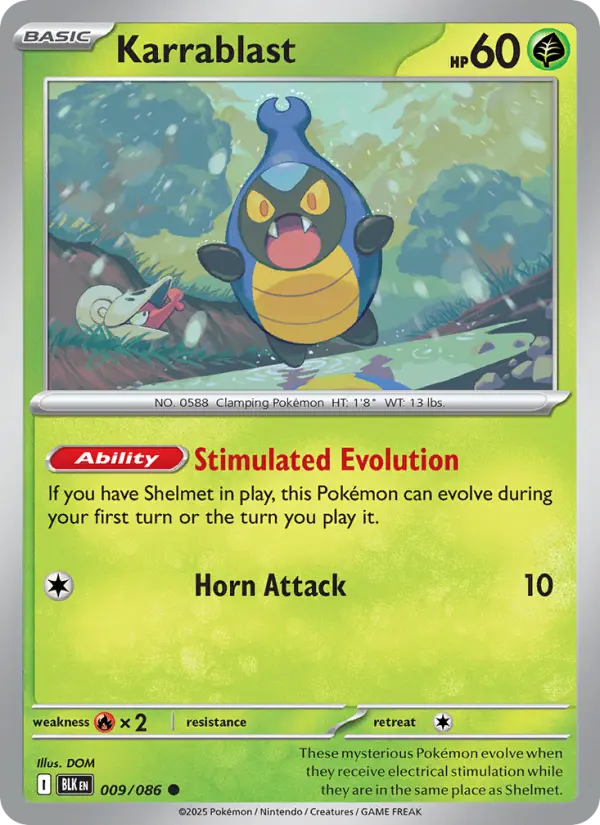
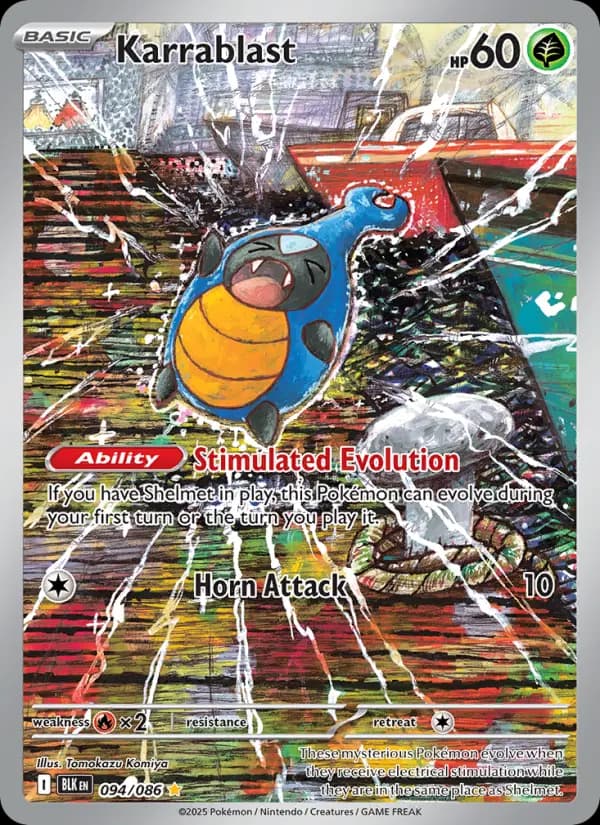
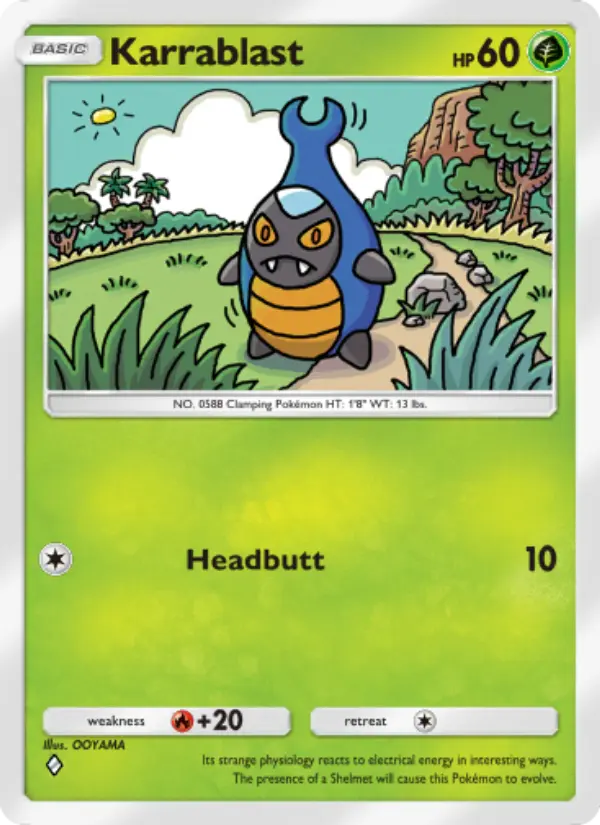
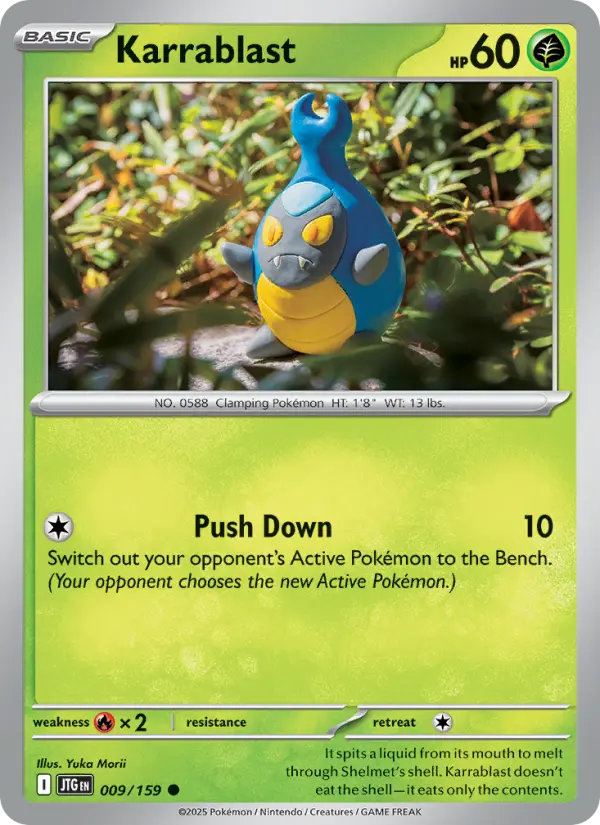
Karrablast
Generation V · #0588 — Clamping Pokémon
Since its Generation V debut, Karrablast has carried a stat spread built around attack — 75 at base, its clearest strength. The species is notable for its mysterious connection to Shelmet, with which it shares one of the franchise's most unique trade-based evolution mechanics. With a capture rate of 200 and base happiness of 70, Karrablast represents an accessible yet engaging addition to any Trainer's roster, offering moderate leveling progression through its medium-fast growth rate.
Editor's Take
Karrablast and Shelmet evolve only by trading them for each other, which is the most specific evolution condition in the series and effectively locks both out of solo play.
Base Stats
Height
0.5m
Weight
5.9kg
Category
Clamping Pokémon
Gender
Male 50% / Female 50%
Color
blue
Shape
humanoid
Abilities
Strengthens bug moves to inflict 1.5× damage at 1/3 max HP or less.
Has a 33% chance of curing any major status ailment after each turn.
Ensures all moves used by and against the Pokémon hit.

Karrablast Biology & Physical Characteristics
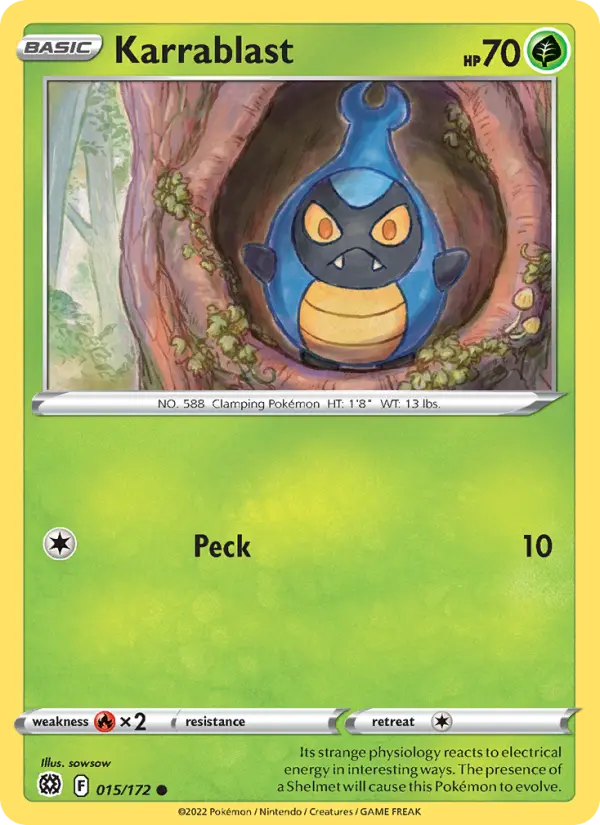
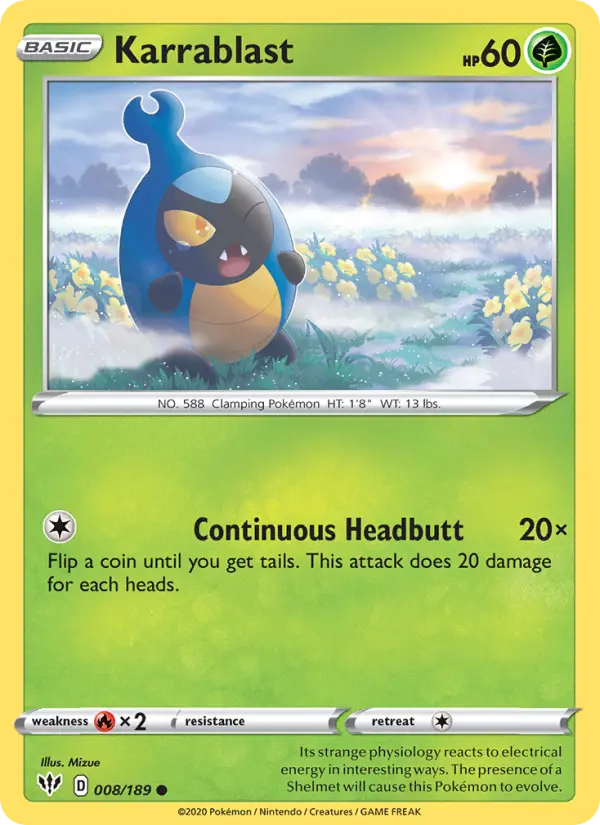
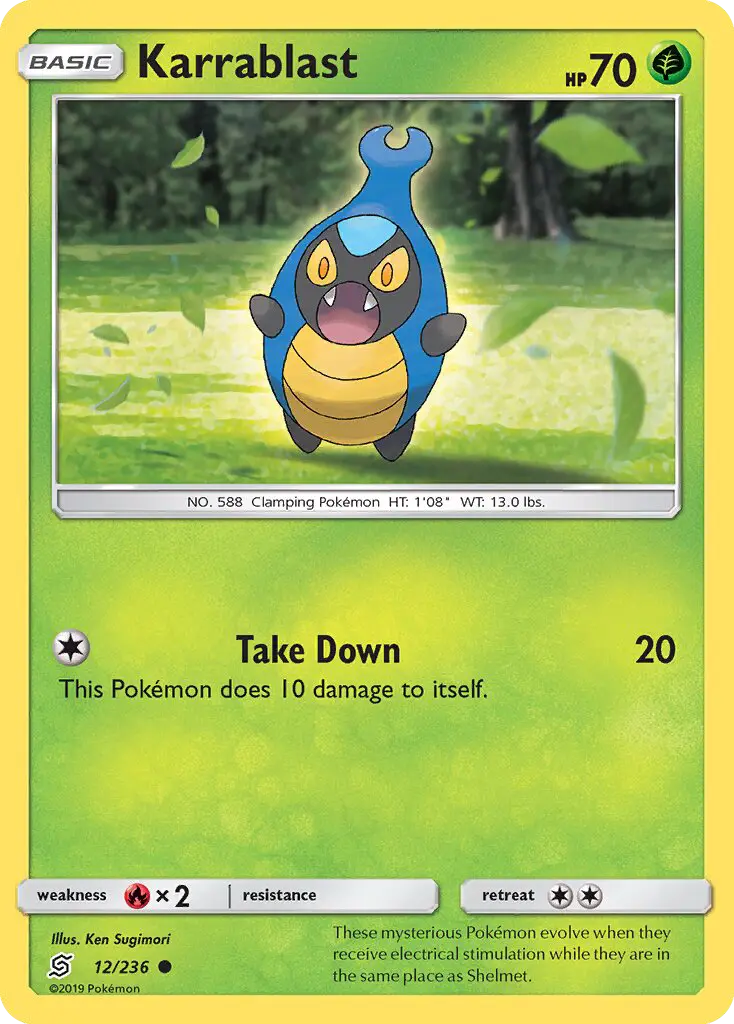
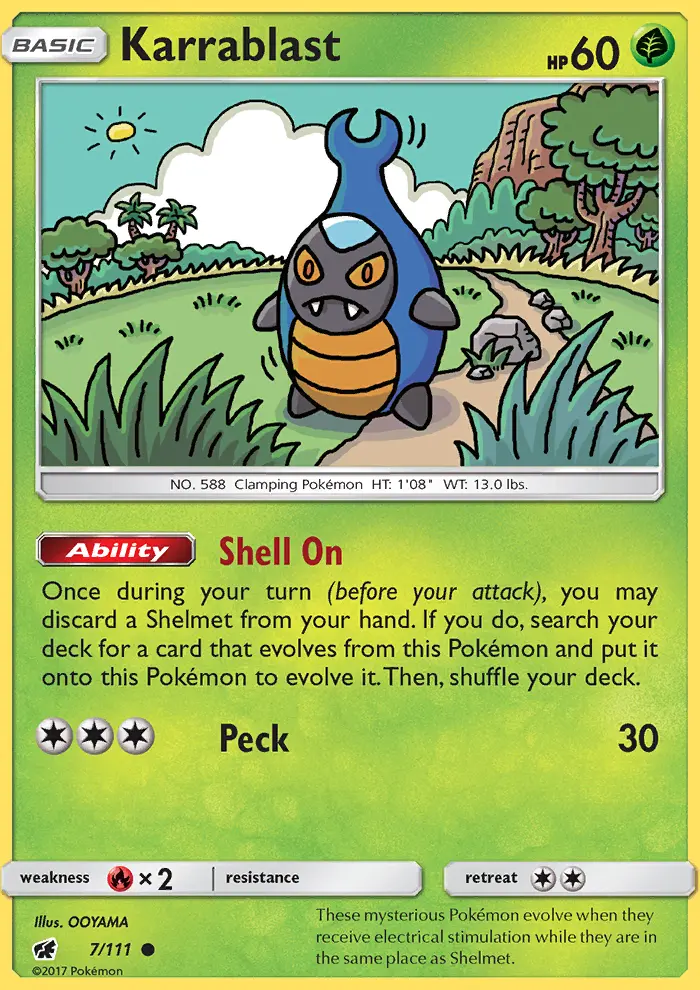
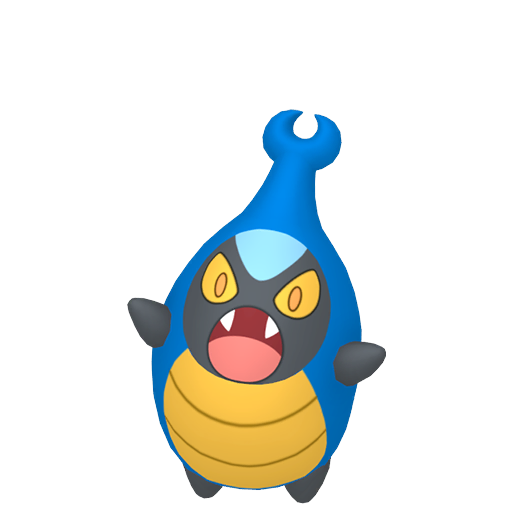
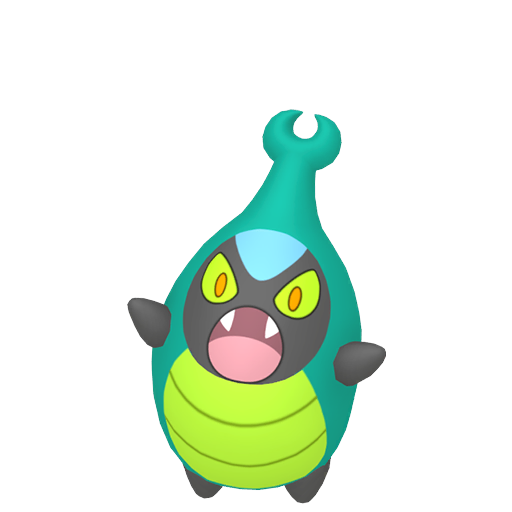
Karrablast presents a striking appearance with its predominantly blue carapace that forms a prominent horn-like protrusion at its apex, resembling a small armored beetle or larval insect. The creature's face is characterized by a distinctive black coloration featuring a teal patch on its forehead, menacing fanged mouth, and large eyes with orange pupils set against yellow sclera that give it a deceptively fierce expression. Its underbelly features a yellow ridged plastron, while stubby black appendages serve as both arms and legs, granting it a compact, rounded silhouette. The physiology of Karrablast is inherently reactive to electrical energy, a trait that plays a crucial role in its evolution. Most remarkably, Karrablast possesses a biological adaptation that allows it to secrete an acidic liquid from its mouth—a defensive mechanism it employs when sensing danger. This acidic secretion is potent enough to dissolve through Shelmet's hard shell, as Karrablast specifically targets this species as preferred prey, consuming only the soft contents inside rather than the shell itself. This predatory relationship forms the biological basis for their symbiotic evolutionary transformation.
Pokedex Numbers
Training
Breeding
Karrablast Breeding, Gender Ratio & Egg Groups
Karrablast maintains a perfectly balanced gender distribution with 50% male and 50% female individuals, allowing for equal breeding opportunities regardless of which gender a Trainer captures. The species belongs exclusively to the Bug egg group, meaning it can only breed with other Pokémon belonging to this egg group, including creatures like Scyther, Heracross, Volcarona, and other arthropod-based Pokémon. With a hatch counter of 15 cycles (equivalent to 3,599 to 3,855 steps), Karrablast eggs require a moderate amount of traversal time to develop, making them reasonably accessible for players interested in breeding strategies. The species is assigned a base happiness value that varied across generations—originally 70 in Generations V through VII before being adjusted to 50 in later games—affecting how quickly eggs hatch and the ease with which bred Karrablast become friendly with their trainers. The breeding mechanics for Karrablast allow players to pass down inherited moves to offspring, enabling the creation of Karrablast with movepools that differ from those learned naturally through leveling. This breeding flexibility provides competitive depth for players seeking to optimize Karrablast's or Escavalier's move coverage and strategic capabilities, though breeding is primarily valuable for those looking to create multiple competitive specimens rather than utilizing Karrablast itself in serious competitive play.
Sprites




TMs & HMs
tm01
lets go pikachu lets go eevee
tm02
crystal
tm02
gold silver
tm03
yellow
tm03
red blue
tm03
blue japan
tm03
red green japan
tm05
lets go pikachu lets go eevee
tm06
yellow
tm06
gold silver
tm06
red blue
tm06
crystal
tm06
emerald
tm06
firered leafgreen
tm06
diamond pearl
tm06
platinum
tm06
ruby sapphire
tm06
colosseum
tm06
black 2 white 2
tm06
xd
+401 more TMs/HMs
Karrablast's Evolution Chain


Karrablast Evolution, Mega Evolution & Special Forms
Karrablast's evolutionary path represents one of the most distinctive mechanics in Pokémon biology, as it does not evolve through conventional means such as leveling or items. Instead, Karrablast evolves into Escavalier through a mutual trade evolution with Shelmet, which simultaneously evolves into Accelgor. The peculiar requirement involves Karrablast receiving electrical stimulation while in proximity to Shelmet, and according to multiple Pokédex entries, the evolution specifically occurs when Karrablast is actively attacking its rival. The mechanics of this evolution are shrouded in mystery, with the Pokédex noting only that the electrical energy somehow triggers the transformation. Upon evolution, Karrablast gains the Steel-type alongside its existing Bug-type, resulting in a dual-type Escavalier with enhanced defensive capabilities and a dramatically different appearance—transforming from a small, round beetle into a mantis-like creature with a lance-like appendage. Neither Pokémon will evolve if one holds an Everstone during the trade, allowing Trainers to prevent the transformation if desired. This trade-dependent evolution underscores the social and cooperative aspects of Pokémon training, requiring players to engage with other Trainers to fully experience the evolutionary chain.
Where to Find
Unova Route 6
unova
+13 more
Unova Route 11
unova
+9 more
Icirrus City
unova
+6 more
Moor of Icirrus
unova
+6 more
Unova Route 8
unova
+6 more
Kalos Route 14
kalos
+1 more
Kalos Route 19
kalos
+3 more
Karrablast Behaviour and Natural Habitat
Karrablast exhibits predatory and territorial behaviors centered around its pursuit of Shelmet, a relationship that defines much of its behavioral ecology. When threatened, these Pokémon demonstrate their characteristic defensive response by spitting acidic liquid to drive attackers away, utilizing this chemical defense as their primary means of self-protection. The species resides predominantly in forests and grassy fields, environments that provide suitable cover and hunting grounds for locating their primary prey. When faced with danger, Karrablast demonstrates evasive tactics by hiding within trees or dense grass, relying on camouflage and concealment rather than direct confrontation. Their behavioral patterns are largely driven by the need to locate Shelmet, and upon finding one, they enter an aggressive attacking state that, when combined with electrical stimulation, triggers their remarkable evolutionary transformation. This predator-prey dynamic represents one of the Pokémon world's most intricate ecological relationships, where Karrablast's entire existence is intertwined with Shelmet's presence and the mysterious electrical conditions that facilitate their mutual evolution.
Pokedex Entries
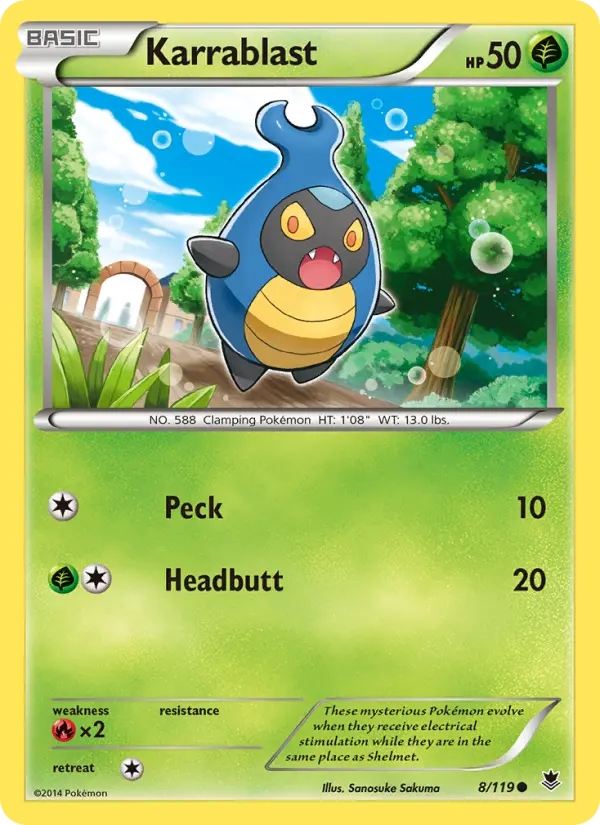
These mysterious Pokémon evolve when they receive electrical stimulation while they are in the same place as Shelmet.
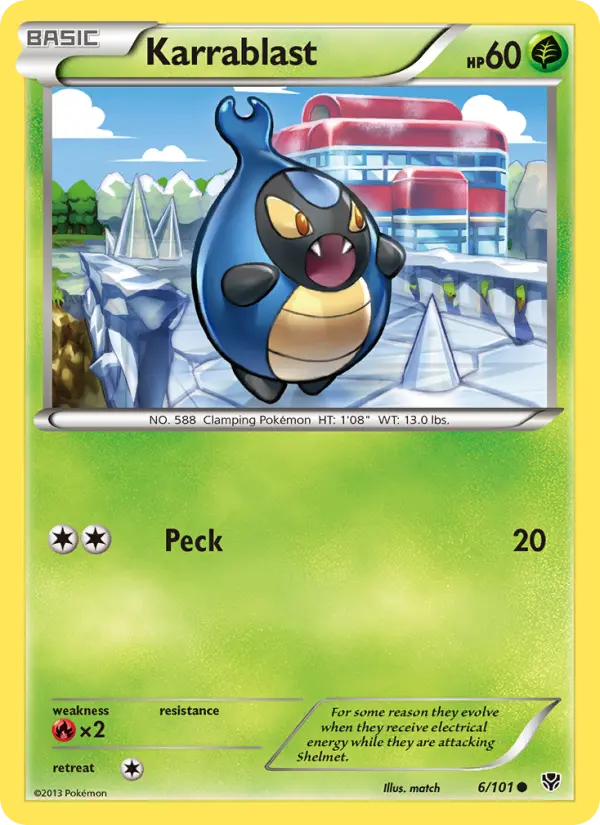
For some reason they evolve when they receive electrical energy while they are attacking Shelmet.
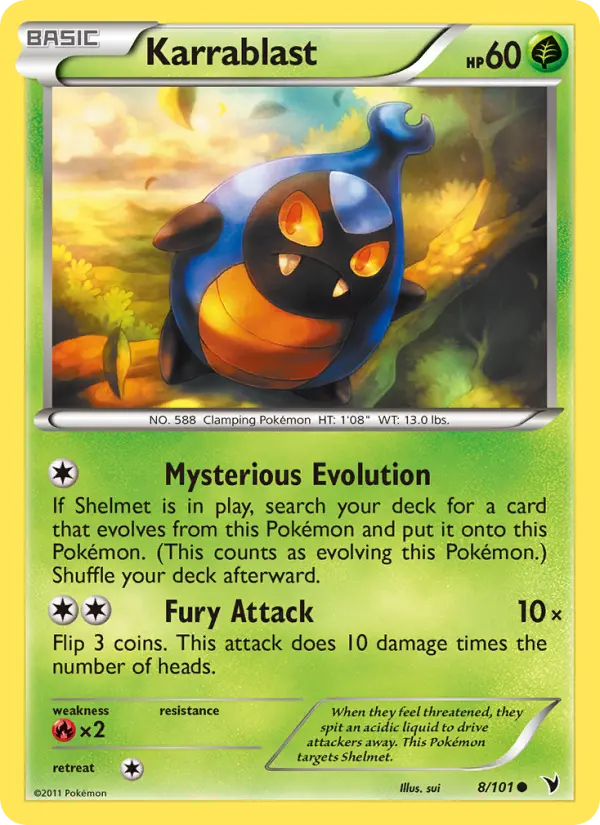
When they feel threatened, they spit an acidic liquid to drive attackers away. This Pokémon targets Shelmet.
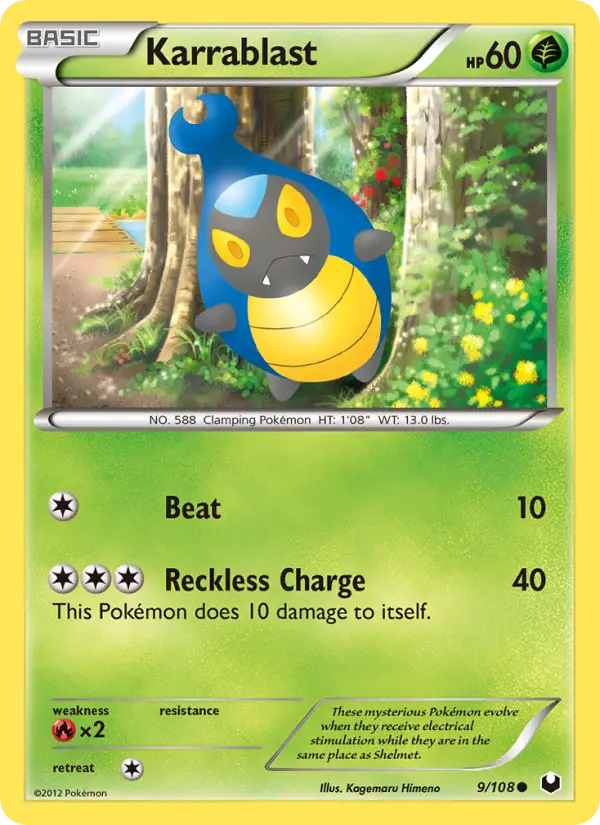
These mysterious Pokémon evolve when they receive electrical stimulation while they are in the same place as Shelmet.
For some reason they evolve when they receive electrical energy while they are attacking Shelmet.
These mysterious Pokémon evolve when they receive electrical stimulation while they are in the same place as Shelmet.
For some reason they evolve when they receive electrical energy while they are attacking Shelmet.
Its strange physiology reacts to electrical energy in interesting ways. The presence of a Shelmet will cause this Pokémon to evolve.
It spits a liquid from its mouth to melt through Shelmet’s shell. Karrablast doesn’t eat the shell— it eats only the contents.
Karrablast Name Origin & Design Inspiration
Karrablast's name derives from combining "carry" and "blast," likely referencing the creature's ability to carry or project acidic blasts from its mouth. In Japanese, it is known as Kaburumo (カブルモ), which combines "kabu" (meaning to wear or cover, referencing its shell-like carapace) with "rumo," creating a name that emphasizes its armored, protected appearance. The design itself draws inspiration from parasitic wasps and beetle larvae, particularly those species that prey upon other arthropods by boring into or dissolving their shells. The blue coloration with yellow underbelly creates a chromatic contrast that suggests a hardened exoskeleton with a softer underside, while the prominent horn evokes both a defensive spike and a digging tool. The creature's role as a shell-eating predator specifically mirrors real-world parasitoid insects, though exaggerated for dramatic effect. The design philosophy emphasizes Karrablast's role as a predator within its ecological niche, with features like the acidic spitting mouth and aggressive demeanor reinforcing its position as the hunter in its relationship with Shelmet. When evolved into Escavalier, the design transforms dramatically, with the creature adopting more humanoid proportions and an appearance resembling a knight with a lance, suggesting that the mysterious electrical energy induces a complete metamorphosis.
Learnable Moves
Karrablast can learn 53 moves:
Move | Type | Cat. | Power | Acc. | PP |
|---|---|---|---|---|---|
| acid spray | poison | Special | 40 | 100 | 20 |
| aerial ace | flying | Physical | 60 | — | 20 |
| attract | normal | Status | — | 100 | 15 |
| bug bite | bug | Physical | 60 | 100 | 20 |
| bug buzz | bug | Special | 90 | 100 | 10 |
| confide | normal | Status | — | — | 20 |
| counter | fighting | Physical | — | 100 | 20 |
| cut | normal | Physical | 50 | 95 | 30 |
| double team | normal | Status | — | — | 15 |
| double edge | normal | Physical | 120 | 100 | 15 |
| drill run | ground | Physical | 80 | 95 | 10 |
| encore | normal | Status | — | 100 | 5 |
| endure | normal | Status | — | — | 10 |
| energy ball | grass | Special | 90 | 100 | 10 |
| facade | normal | Physical | 70 | 100 | 20 |
| false swipe | normal | Physical | 40 | 100 | 40 |
| feint attack | dark | Physical | 60 | — | 20 |
| flail | normal | Physical | — | 100 | 15 |
| frustration | normal | Physical | — | 100 | 20 |
| fury attack | normal | Physical | 15 | 85 | 20 |
| fury cutter | bug | Physical | 40 | 95 | 20 |
| giga drain | grass | Special | 75 | 100 | 10 |
| headbutt | normal | Physical | 70 | 100 | 15 |
| hidden power | normal | Special | 60 | 100 | 15 |
| horn attack | normal | Physical | 65 | 100 | 25 |
| infestation | bug | Special | 20 | 100 | 20 |
| iron defense | steel | Status | — | — | 15 |
| knock off | dark | Physical | 65 | 100 | 20 |
| leer | normal | Status | — | 100 | 30 |
| megahorn | bug | Physical | 120 | 85 | 10 |
| night slash | dark | Physical | 70 | 100 | 15 |
| peck | flying | Physical | 35 | 100 | 35 |
| poison jab | poison | Physical | 80 | 100 | 20 |
| protect | normal | Status | — | — | 10 |
| pursuit | dark | Physical | 40 | 100 | 20 |
| rain dance | water | Status | — | — | 5 |
| rest | psychic | Status | — | — | 5 |
| return | normal | Physical | — | 100 | 20 |
| round | normal | Special | 60 | 100 | 15 |
| scary face | normal | Status | — | 100 | 10 |
| screech | normal | Status | — | 85 | 40 |
| secret power | normal | Physical | 70 | 100 | 20 |
| signal beam | bug | Special | 75 | 100 | 15 |
| slash | normal | Physical | 70 | 100 | 20 |
| sleep talk | normal | Status | — | — | 10 |
| snore | normal | Special | 50 | 100 | 15 |
| struggle bug | bug | Special | 50 | 100 | 20 |
| substitute | normal | Status | — | — | 10 |
| swagger | normal | Status | — | 85 | 15 |
| swords dance | normal | Status | — | — | 20 |
| take down | normal | Physical | 90 | 85 | 20 |
| toxic | poison | Status | — | 90 | 10 |
| x scissor | bug | Physical | 80 | 100 | 15 |
Karrablast Competitive Battle Guide
Karrablast's competitive viability is substantially limited by its cumulative stat total of 315, with particularly weak special attack (40), defense (45), and special defense (45) stats that leave it vulnerable to most competitive threats. Its attack stat of 75 is respectable for a Pokémon of its size, but insufficient to reliably damage most competitive threats, while its speed of 60 means it will frequently act second in combat. The primary competitive advantage lies in its three ability options: Swarm, which increases Bug-type move power to 1.5x damage when Karrablast's HP drops below one-third maximum; Shed Skin, which provides a 33% chance to cure any status ailment each turn, offering passive durability against status-dependent strategies; and its hidden ability No Guard, which ensures all moves used by and against Karrablast will hit regardless of accuracy or evasion modifiers. Karrablast's movepool, while functional, lacks the diversity needed for competitive success at higher levels, with access to moves like Leer, Peck, Fury Cutter, Acid Spray, Headbutt, and False Swipe. The overwhelming majority of Karrablast users focus instead on evolving it into Escavalier, which gains significantly superior stats, the Steel-type addition, and access to more powerful moves that make it genuinely competitive. Those seeking to use Karrablast competitively would be better served by recognizing it as a stepping stone to its evolution rather than a standalone threat, though its relatively low evolutionary requirements make obtaining a competitive Escavalier straightforward for dedicated players.
Commonly Asked Questions About Karrablast
What type is Karrablast?
Karrablast is a bug type Pokemon.
What does Karrablast evolve into?
Karrablast evolves into escavalier.
What are Karrablast's weaknesses?
Karrablast is weak to flying, rock and fire type moves.
Does Karrablast evolve by trading?
No — Karrablast evolves entirely through leveling up, with no trade required at any stage.
Where can I find Karrablast?
Karrablast can be found in unova route 6 (unova), unova route 11 (unova) and icirrus city (unova) and 4 other locations.
Karrablast Cultural Impact & Franchise History
Karrablast holds a unique position in Pokémon cultural discourse as the harbinger of one of Generation V's most intriguing evolutionary mechanics, representing a shift toward more complex and interactive evolution systems that require social engagement. The creature's parasitic hunter archetype resonated with players interested in ecological authenticity within the Pokémon world, as Karrablast's predatory relationship with Shelmet mirrors real biological parasitism. The species became particularly notable among competitive and lore-focused communities for the mystery surrounding its evolution, with players theorizing about the nature of the electrical stimulation required and the biomechanical processes underlying its transformation into the knight-like Escavalier. Karrablast appears in Pokémon media with moderate frequency, typically portrayed hunting Shelmet or demonstrating its acidic defenses, reinforcing its role as an aggressive, predatory Pokémon. The trade evolution mechanic itself has influenced subsequent generation design philosophy, encouraging Game Freak to create more interactive and socially-dependent evolutionary systems that promote trading and cooperation between players. While Karrablast itself rarely receives spotlight equal to more iconic Bug-types like Scyther or Heracross, its evolution into the visually striking and competitively viable Escavalier ensures sustained interest in the line. The creature has maintained steady presence in trading communities where players exchange Karrablast and Shelmet specifically to trigger their mutual evolution, making it a perpetual fixture in the social infrastructure of Pokémon gameplay.
Where to Find Karrablast in Every Pokémon Game
Karrablast was introduced in Generation V and has maintained consistent availability across subsequent generations with varying regional distribution. In its debut games, Black and White, Karrablast occupied Pokédex slot #094 in the Unova regional index, making it relatively accessible to players progressing through the Unova region. The species received updated positioning in Black 2 and White 2 as slot #155, indicating adjusted availability in those remakes. In Generation VI, Karrablast appeared in the Mountain Kalos region as slot #022, providing accessibility to players exploring that area in Pokémon X and Y. The species continues to appear in subsequent generations with varying frequency—in Generation VII, it remains available though not ubiquitously distributed; in Generation VIII, Karrablast appears in the Sword and Shield base game and received expanded availability through the Isle of Armor and Crown Tundra DLC expansions. Its high capture rate of 200 ensures that encountering and catching Karrablast requires minimal effort, even at low trainer levels, making it highly accessible to players at any skill level. The primary impediment to obtaining Karrablast is not availability in the wild, but rather obtaining the species to evolve it—players seeking Escavalier must specifically locate Shelmet, trade the two Pokémon, and manage the evolution timing, though this process remains straightforward compared to other multi-stage evolutions. The species' consistent presence across multiple generations and regions ensures that players can reliably obtain Karrablast for their teams regardless of which Pokémon game they are playing.