Beldum
Generation III · #0374 — Iron Ball Pokémon
Beldum's steel/psychic typing gets most of the attention, but clear body is doing just as much work in how it holds up in practice.
Editor's Take
Beldum can only use Take Down until level 20 and has no other moves at all, which makes raising one the most tedious pseudo-legendary grind in the series.
Base Stats
Height
0.6m
Weight
95.2kg
Category
Iron Ball Pokémon
Gender
Genderless
Color
blue
Shape
blob
Habitat
rough-terrain
Abilities
Prevents stats from being lowered by other Pokémon.
Halves the Pokémon's weight.

Beldum Biology & Physical Characteristics
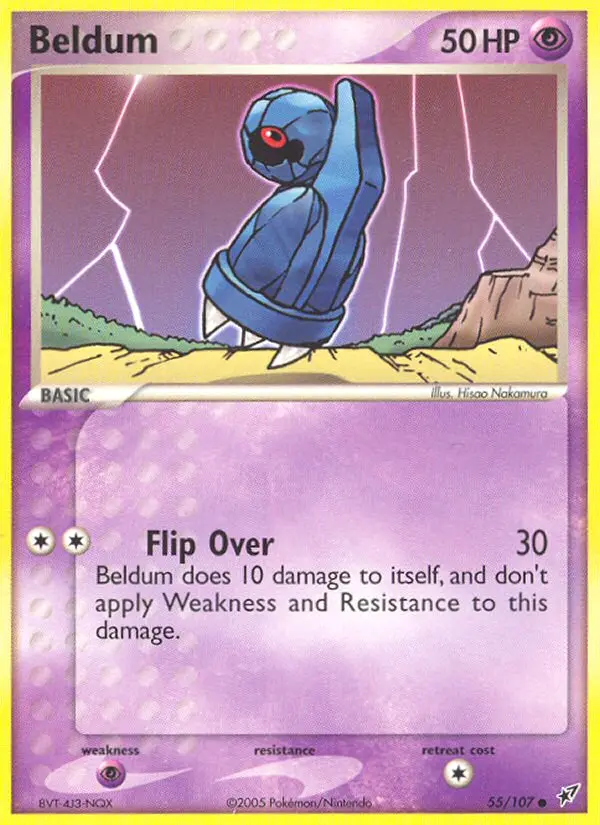
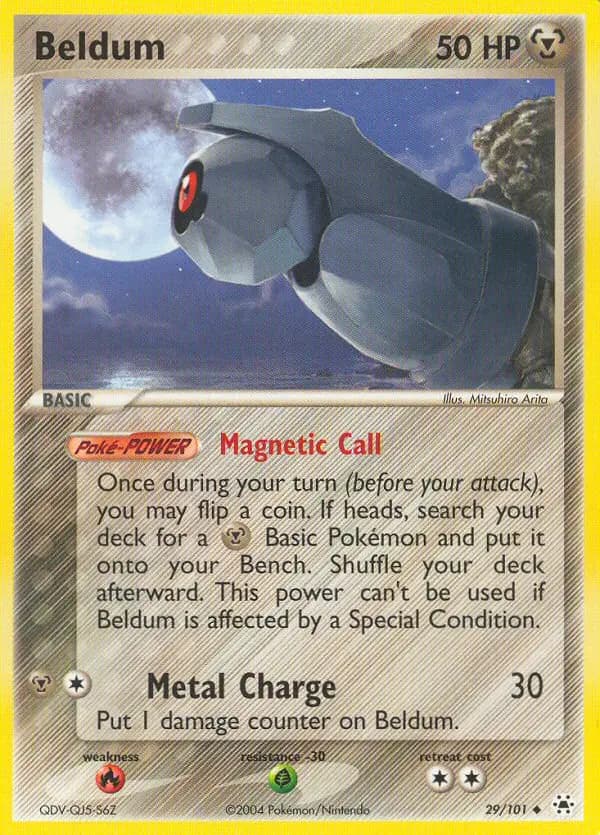
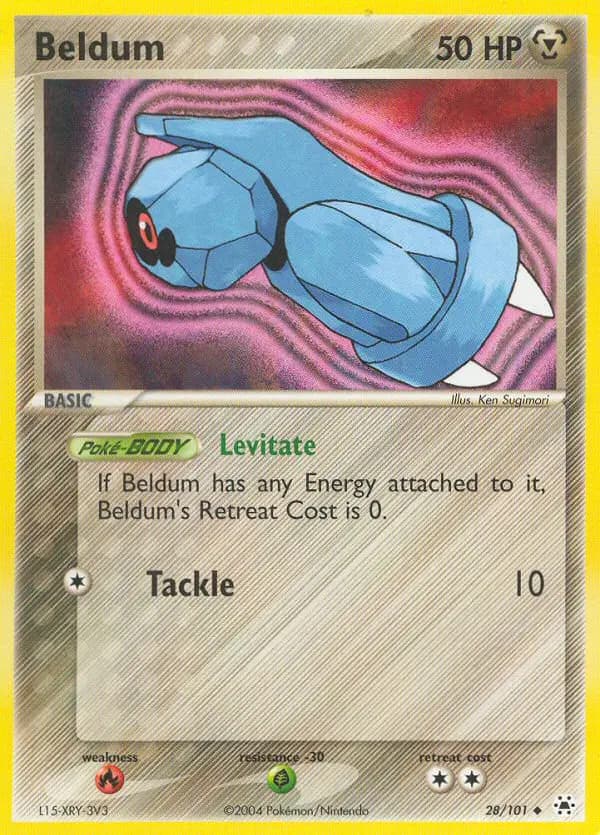
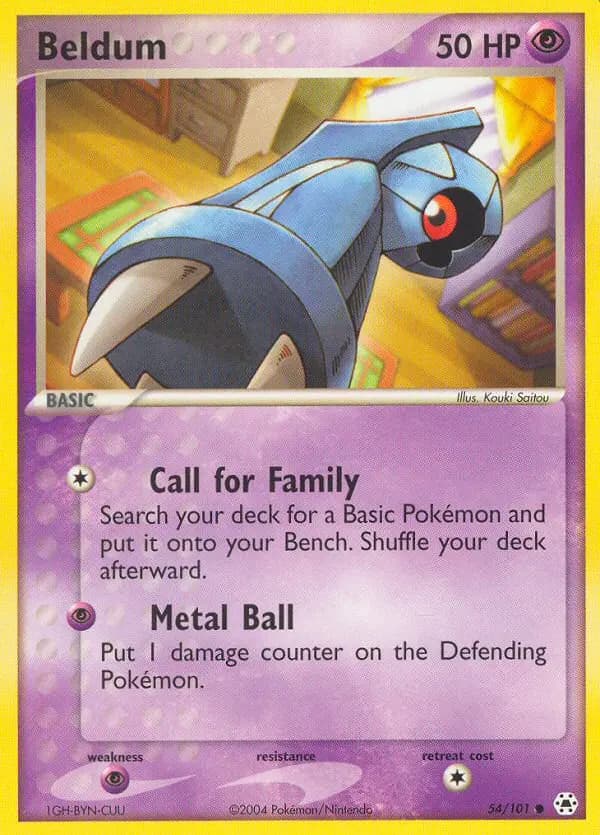
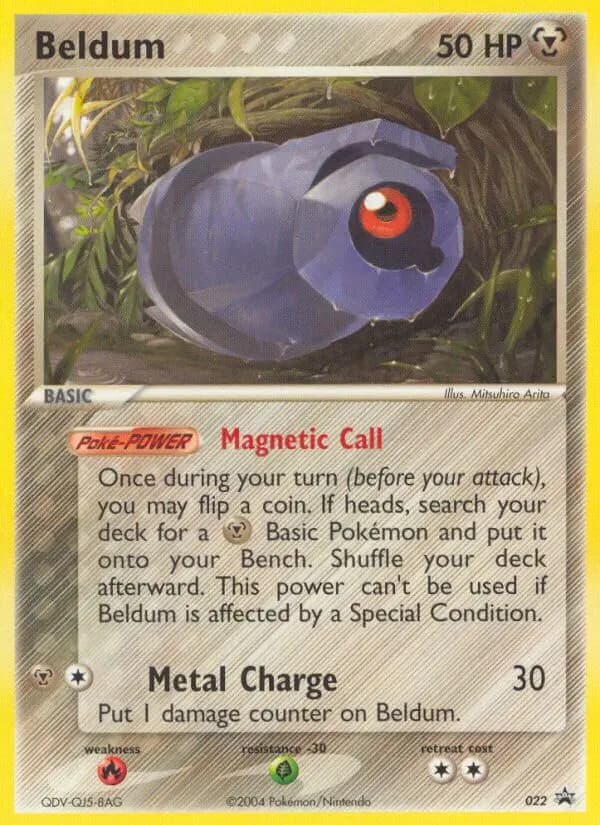
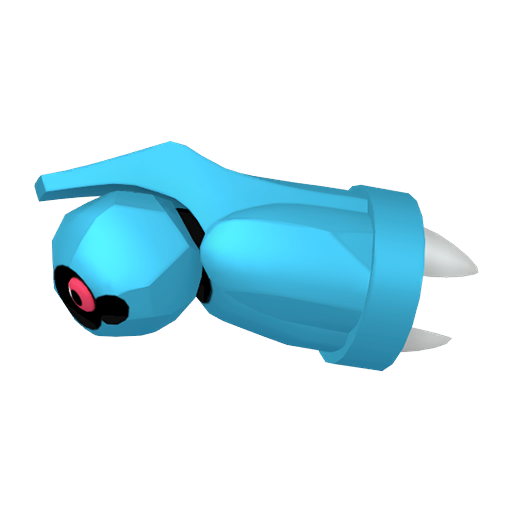
Beldum's physiology is revolutionary in the Pokémon universe, as its body entirely lacks blood and instead operates through a sophisticated magnetic force system that courses throughout its structure. Every cell within Beldum's body functions as a magnet, creating a unified electromagnetic organism that can control its movement, levitation, and communication without traditional biological systems. The Pokémon's physical form consists of a long body topped with a nearly spherical head featuring a single large, prominent red eye positioned centrally within a ball-and-socket joint. A distinctive short crest projects from its body and extends over its head, while its rear end is equipped with sharp, hook-like claws that serve multiple purposes. These rear hooks are specifically designed for anchoring the Pokémon to cliff faces while sleeping, as Beldum maintains its floating state through magnetic repulsion of the Earth's natural magnetism. The extreme density of Beldum's body is notable, with an individual specimen weighing 95.2 kilograms despite standing only 0.6 meters tall, reflecting the material density of its magnetic cellular structure.
Pokedex Numbers
Training
Breeding
Beldum Breeding, Gender Ratio & Egg Groups
Beldum is classified as a genderless Pokémon, a designation it shares with other steel and artificial-seeming creatures like Porygon and Magnemite. This genderless status reflects Beldum's fundamentally non-organic nature and magnetic cellular composition, which precludes the development of sexual dimorphism or reproductive differentiation found in biological organisms. Despite being genderless, Beldum can still participate in the breeding process when placed in the Pokémon Day Care with a Ditto, as the Day Care mechanics allow genderless species to produce eggs containing the genderless Pokémon of the parent species. When successfully bred, Beldum eggs require 40 cycles to hatch, equivalent to 10,024 to 10,280 steps depending on specific mechanics, making it a moderately lengthy hatching process compared to many early-generation Pokémon. The breeding process itself is scientifically ambiguous given Beldum's composition; Pokédex entries confirm that despite being magnetic constructs, Beldum possesses the biological capacity to reproduce naturally, suggesting that magnetism itself may serve as the reproductive medium or that Beldum possesses some organic components alongside their magnetic infrastructure. This unique reproductive capability despite genderlessness underscores the Pokémon's extraordinary nature as a lifeform that transcends conventional biological categories.
Sprites





Held Items
Metal Coat
type-enhancement
Held: Steel-Type moves from holder do 20% more damage.
Cost: 2000
Metal Coat
type-enhancement
Held: Steel-Type moves from holder do 20% more damage.
Cost: 2000
Metal Coat
type-enhancement
Held: Steel-Type moves from holder do 20% more damage.
Cost: 2000
Metal Coat
type-enhancement
Held: Steel-Type moves from holder do 20% more damage.
Cost: 2000
Metal Coat
type-enhancement
Held: Steel-Type moves from holder do 20% more damage.
Cost: 2000
Metal Coat
type-enhancement
Held: Steel-Type moves from holder do 20% more damage.
Cost: 2000
Metal Coat
type-enhancement
Held: Steel-Type moves from holder do 20% more damage.
Cost: 2000
Metal Coat
type-enhancement
Held: Steel-Type moves from holder do 20% more damage.
Cost: 2000
Metal Coat
type-enhancement
Held: Steel-Type moves from holder do 20% more damage.
Cost: 2000
Metal Coat
type-enhancement
Held: Steel-Type moves from holder do 20% more damage.
Cost: 2000
Metal Coat
type-enhancement
Held: Steel-Type moves from holder do 20% more damage.
Cost: 2000
Metal Coat
type-enhancement
Held: Steel-Type moves from holder do 20% more damage.
Cost: 2000
Metal Coat
type-enhancement
Held: Steel-Type moves from holder do 20% more damage.
Cost: 2000
Metal Coat
type-enhancement
Held: Steel-Type moves from holder do 20% more damage.
Cost: 2000
Metal Coat
type-enhancement
Held: Steel-Type moves from holder do 20% more damage.
Cost: 2000
Metal Coat
type-enhancement
Held: Steel-Type moves from holder do 20% more damage.
Cost: 2000
Metal Coat
type-enhancement
Held: Steel-Type moves from holder do 20% more damage.
Cost: 2000
Metal Coat
type-enhancement
Held: Steel-Type moves from holder do 20% more damage.
Cost: 2000
Metal Coat
type-enhancement
Held: Steel-Type moves from holder do 20% more damage.
Cost: 2000
Metal Coat
type-enhancement
Held: Steel-Type moves from holder do 20% more damage.
Cost: 2000
Metal Coat
type-enhancement
Held: Steel-Type moves from holder do 20% more damage.
Cost: 2000
Metal Coat
type-enhancement
Held: Steel-Type moves from holder do 20% more damage.
Cost: 2000
TMs & HMs
tm01
lets go pikachu lets go eevee
tm02
crystal
tm02
gold silver
tm09
yellow
tm09
red blue
tm170
scarlet violet
tr74
sword shield
tm104
scarlet violet
tm09
blue japan
tr69
sword shield
tm01
scarlet violet
tm99
scarlet violet
tm09
red green japan
tm59
scarlet violet
tr46
sword shield
tm171
scarlet violet
tm99
the indigo disk
tm170
the teal mask
tm171
the indigo disk
tm59
the indigo disk
+1 more TMs/HMs
Beldum's Evolution Chain


Beldum Evolution, Mega Evolution & Special Forms
Beldum occupies the first position in a three-stage evolutionary line that represents a classic progression from frail early-game form to formidable late-game powerhouse. At level 20, Beldum evolves into Metang, its intermediate form, which gains improved physical bulk and begins to develop offensive capabilities while maintaining the Steel/Psychic typing. The final evolution occurs at level 45 when Metang transforms into Metagross, one of the most competitively relevant Steel/Psychic-types in the entire Pokémon franchise. Metagross dramatically increases all of Beldum's base stats, transforming its base speed of 30 into a respectable 70, while its base attack increases from 55 to 135 and defense improves from 80 to 130. This evolutionary progression exemplifies intentional game design, as Beldum's initial weakness—characterized by poor offensive output with base Attack and Special Attack stats of 55 and 35 respectively—becomes completely irrelevant by the final evolution. Metagross also gains access to the powerful signature move Meteor Mash and receives a Mega Evolution form in later generations, further cementing the evolutionary line as a cornerstone of competitive Steel-type strategies. The slow growth rate shared across all three forms makes training Beldum a long-term investment that ultimately yields exceptional returns.
Where to Find
Mossdeep City
hoenn
+2 more
Sinnoh Route 228
sinnoh
+3 more
Mount Hokulani
alola
+3 more
Beldum Behaviour and Natural Habitat
Beldum is described as a scarce Pokémon in the wild, typically inhabiting areas characterized by rugged, mountainous terrain where it can anchor itself safely during rest periods. The species demonstrates remarkable cognitive abilities and social structures, as evidenced by its tendency to gather in organized swarms where individuals move in perfect unison as though functioning as a singular entity. When Beldum congregate, they communicate exclusively through controlled pulses of magnetism and telepathic brain waves rather than vocalizations, creating a sophisticated silent network of electromagnetic signals that coordinates group behavior. The Pokédex entries consistently emphasize that when one Beldum becomes enraged, its powerful magnetic field can cause nearby machines and electrical devices to malfunction or break entirely, suggesting that these creatures inadvertently generate hazardous electromagnetic disturbances when emotionally agitated. Individual specimens maintain lower-than-average base happiness at 35, indicating they are naturally more reserved and less immediately receptive to human bonding compared to other starter-form Pokémon, though this temperament gradually improves through the evolution line.
Pokedex Entries
Instead of blood, a powerful magnetic force courses throughout BELDUM’s body. This POKéMON communicates with others by sending controlled pulses of magnetism.
BELDUM keeps itself floating by generating a magnetic force that repels earth’s natural magnetism. When it sleeps, this POKéMON anchors itself to a cliff using the hooks on its rear.
When BELDUM gather in a swarm, they move in perfect unison as if they were but one POKéMON. They communicate with each other using brain waves.
It uses magnetic waves to converse with its kind. All the cells in its body are magnetic.
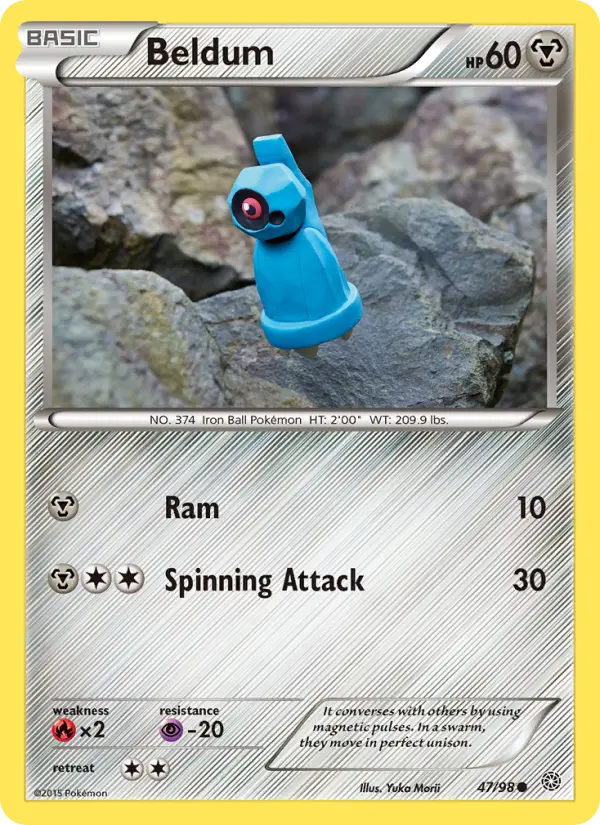
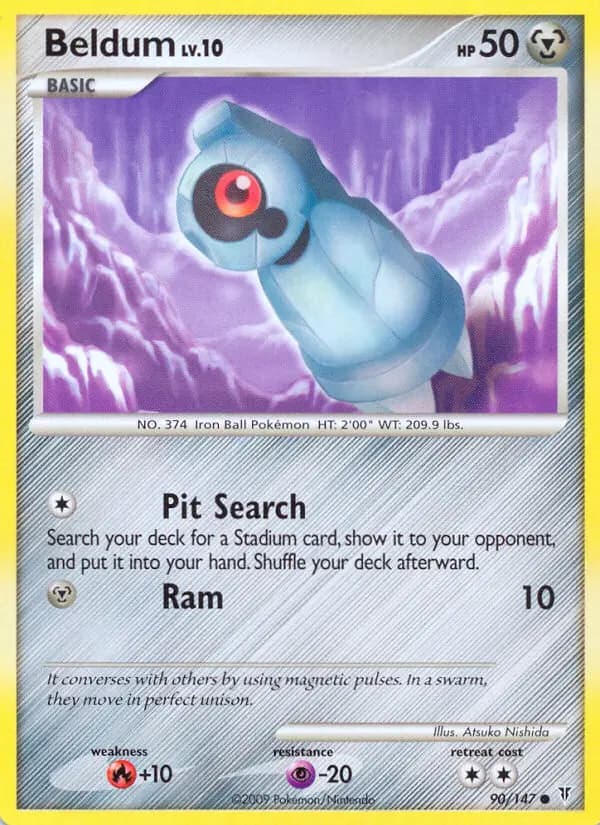
It converses with others by using magnetic pulses. In a swarm, they move in perfect unison.
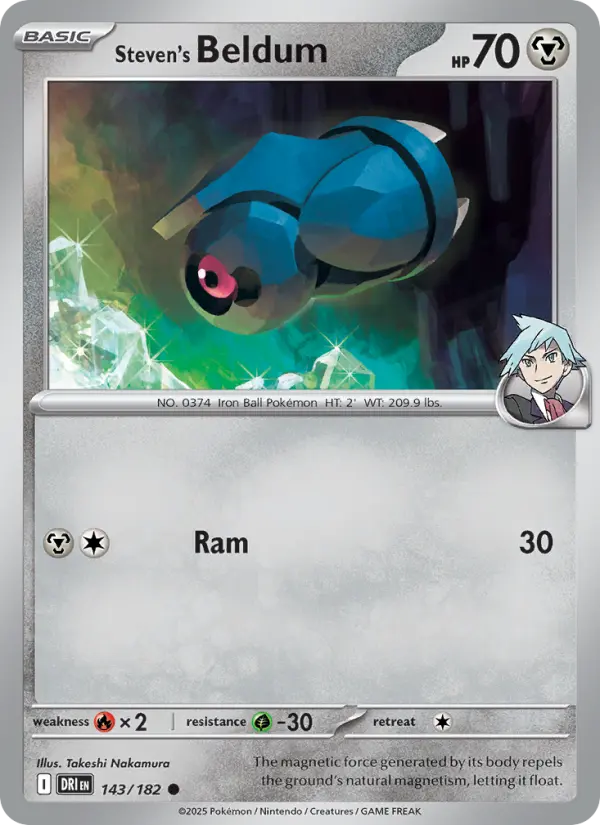
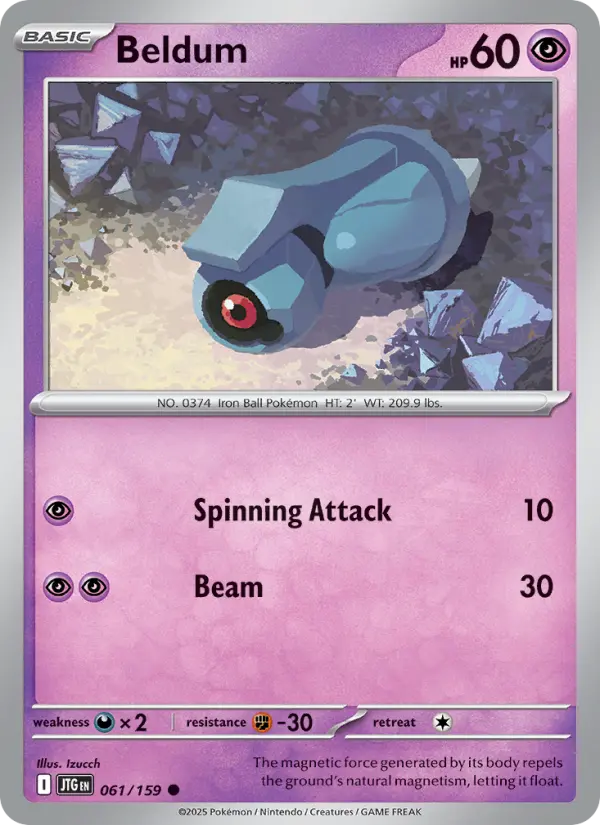
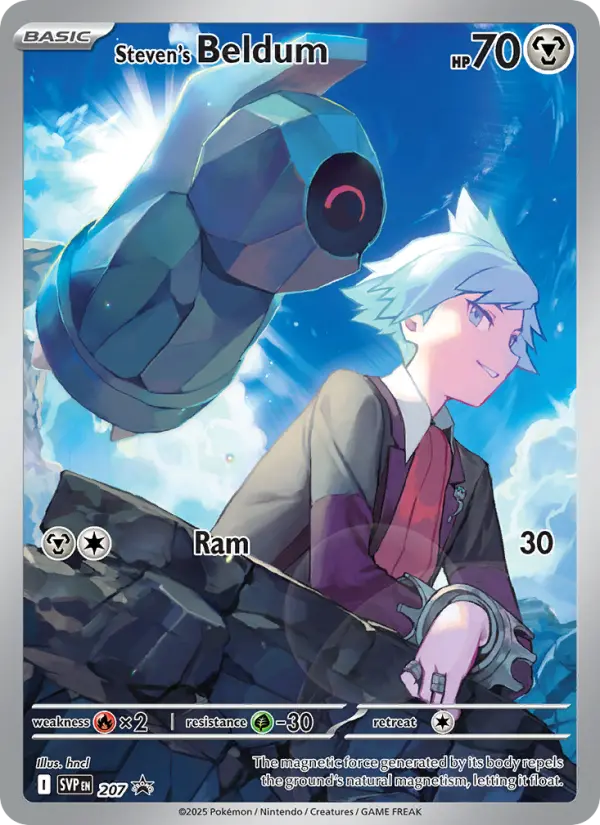
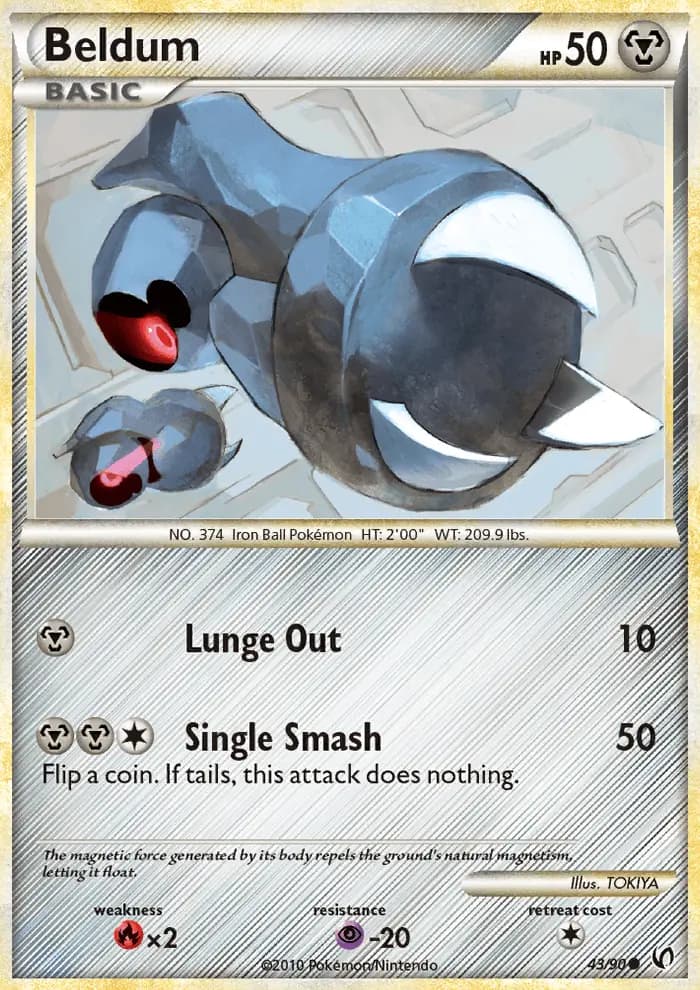
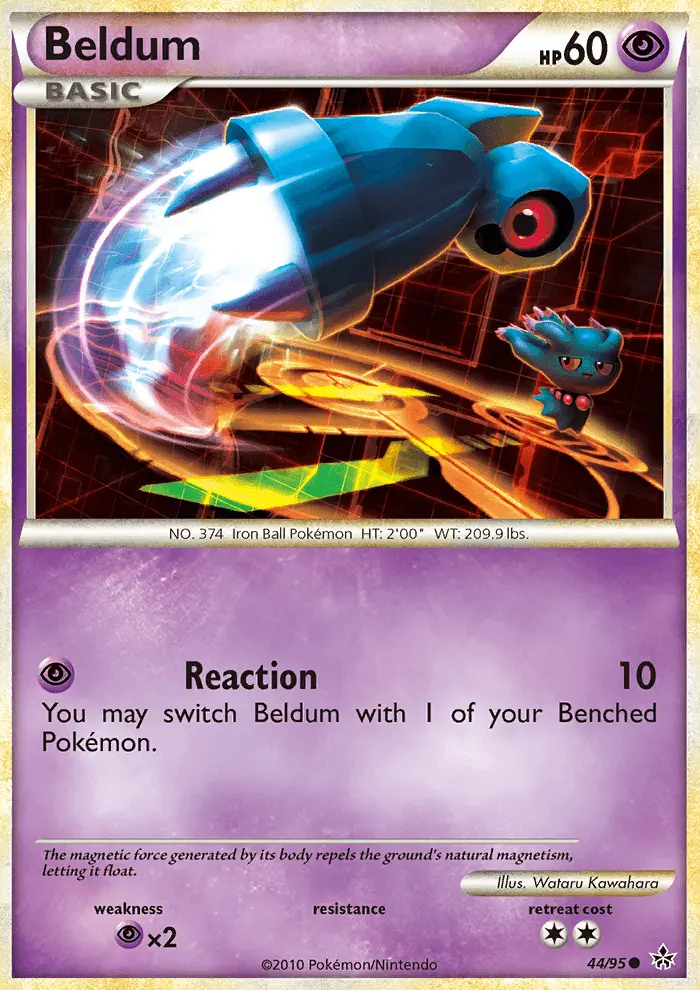
The magnetic force generated by its body repels the ground’s natural magnetism, letting it float.
It converses with others by using magnetic pulses. In a swarm, they move in perfect unison.
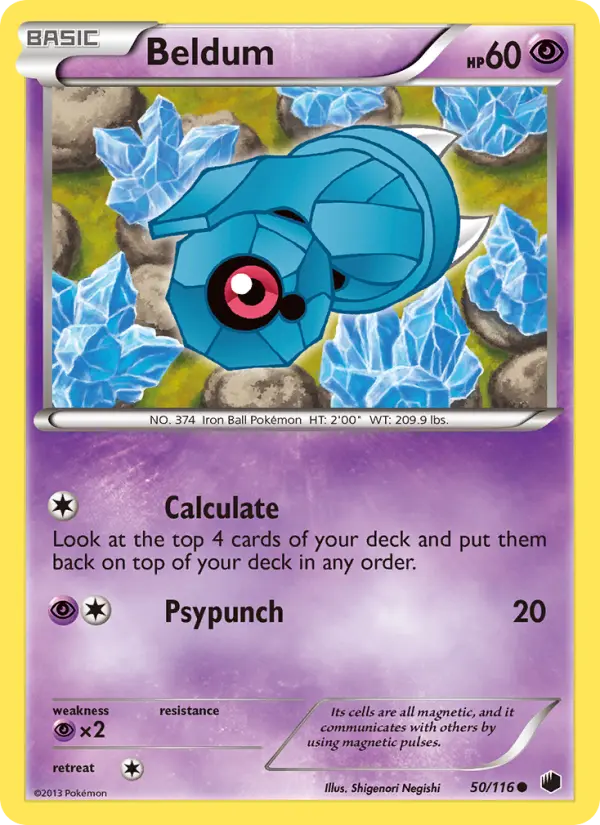
Its cells are all magnetic, and it communicates with others by using magnetic pulses.
The magnetic force generated by its body repels the ground’s natural magnetism, letting it float.
It converses with others by using magnetic pulses. In a swarm, they move in perfect unison.
Instead of blood, a powerful magnetic force courses throughout Beldum’s body. This Pokémon communicates with others by sending controlled pulses of magnetism.
Beldum keeps itself floating by generating a magnetic force that repels earth’s natural magnetism. When it sleeps, this Pokémon anchors itself to a cliff using the hooks on its rear.
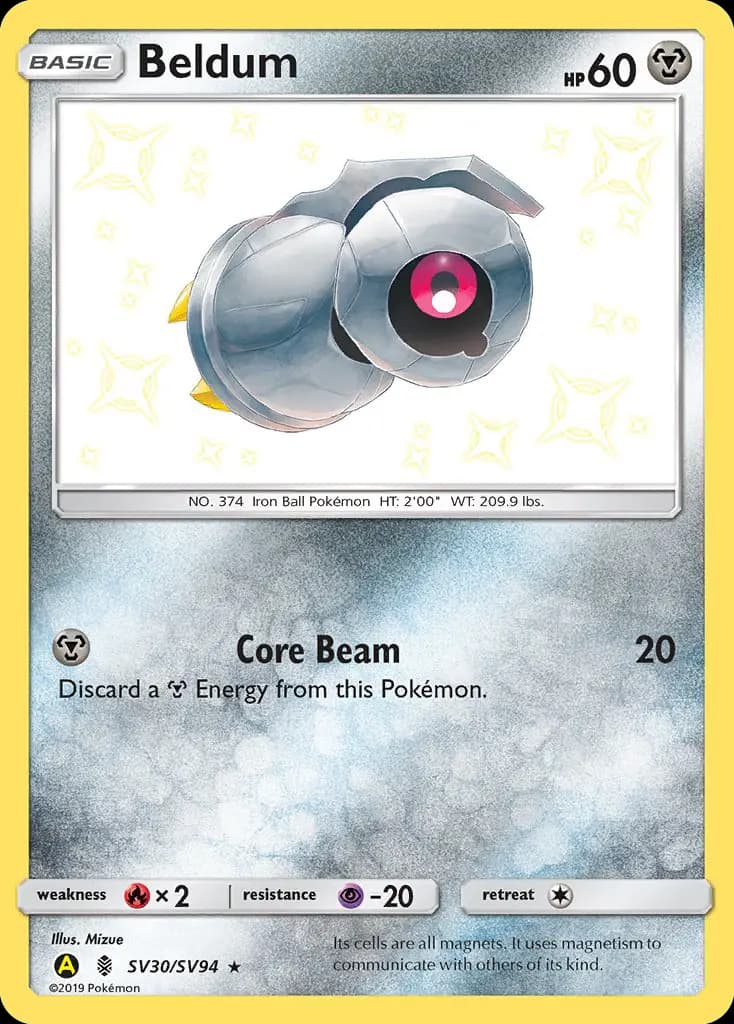
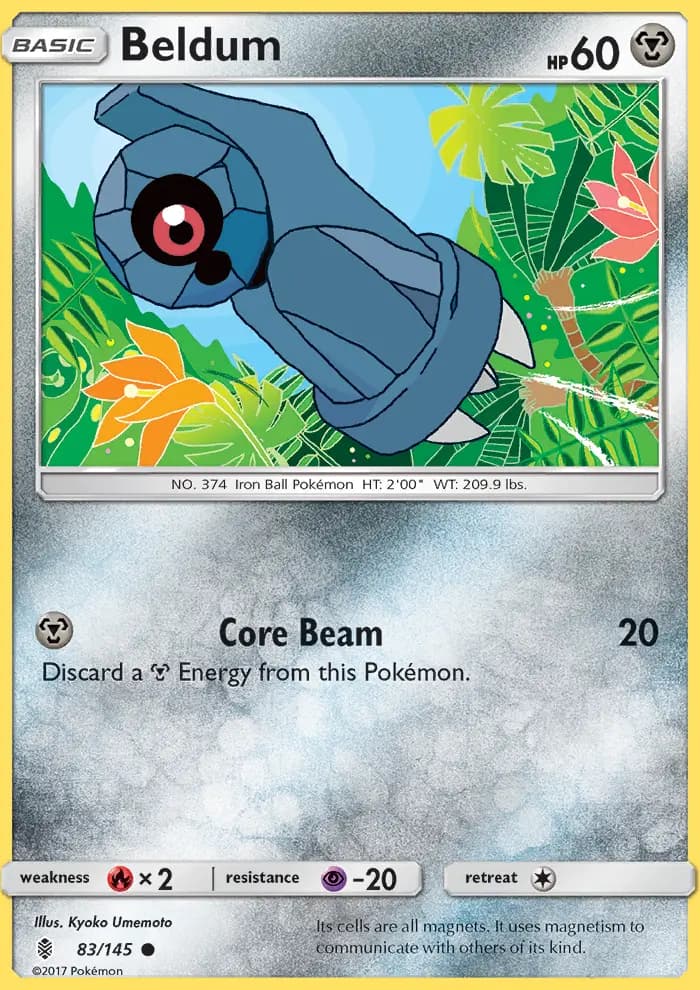
Its cells are all magnets. It uses magnetism to communicate with others of its kind.
Instead of blood, magnetism flows through its body. When it’s feeling bad, try giving it a magnet.
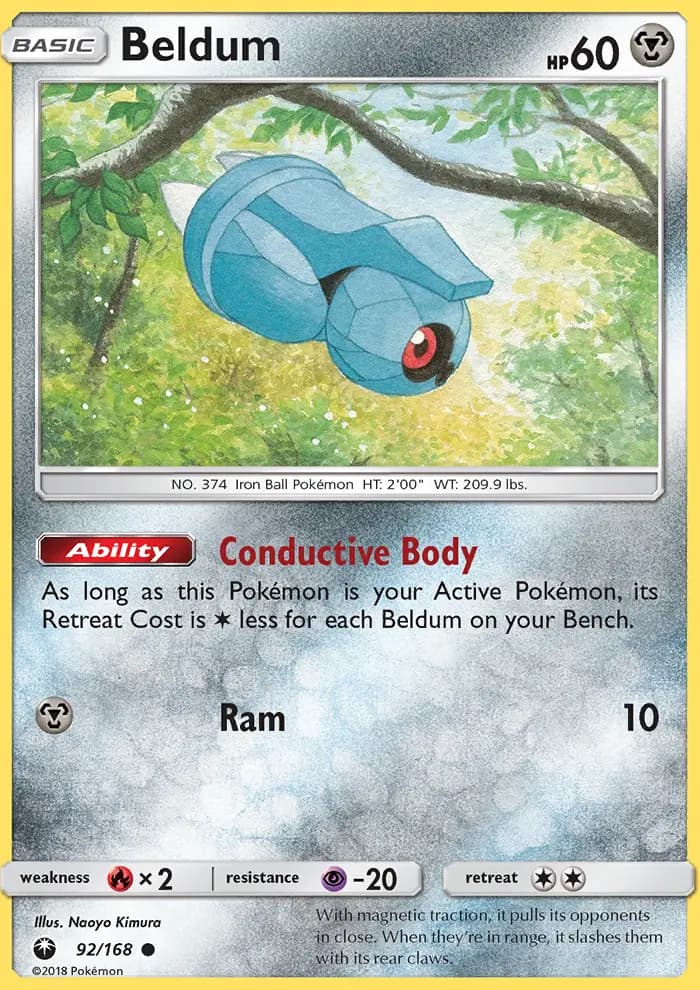
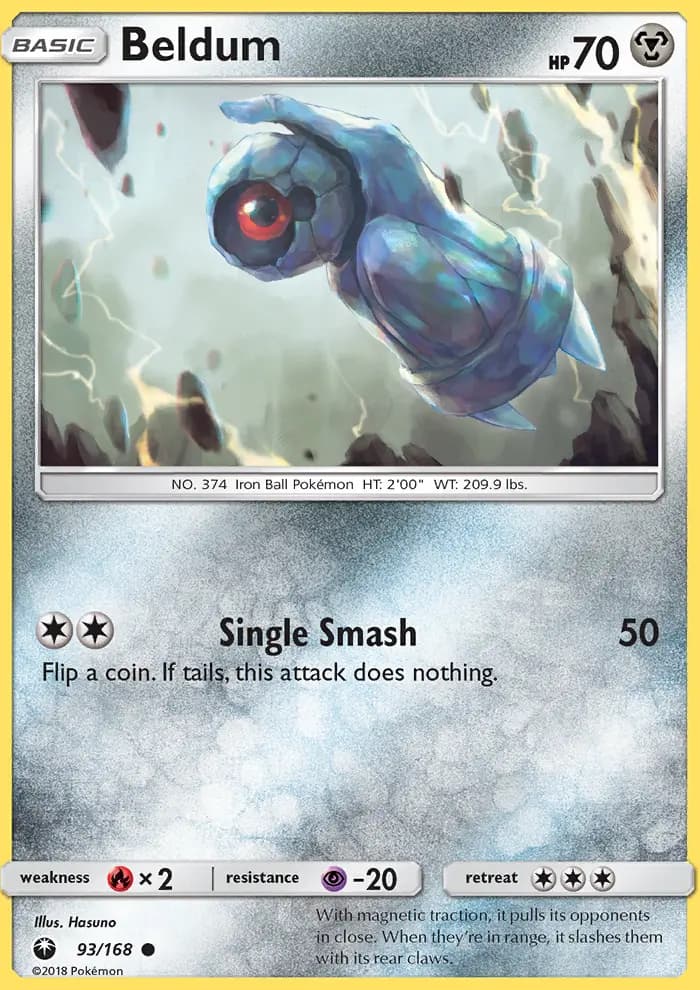
With magnetic traction, it pulls its opponents in close. When they’re in range, it slashes them with its rear claws.
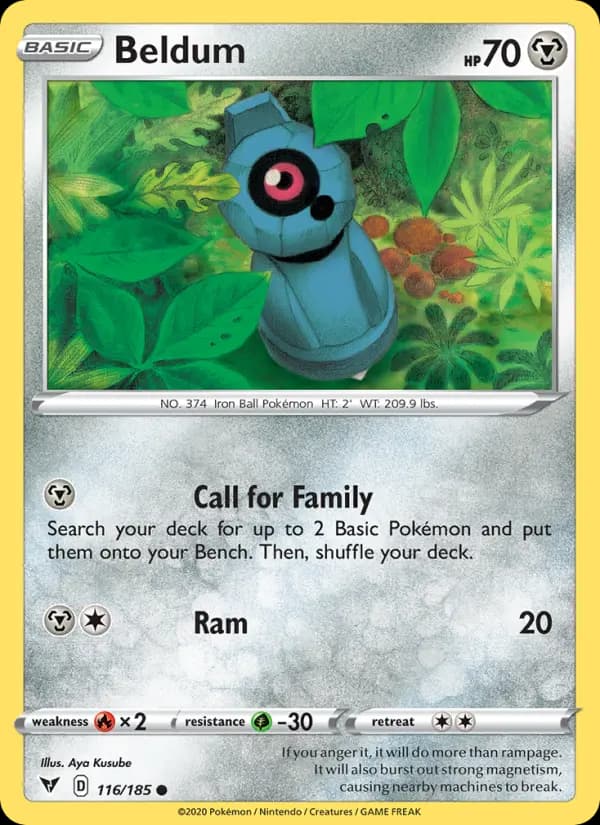
If you anger it, it will do more than rampage. It will also burst out strong magnetism, causing nearby machines to break.
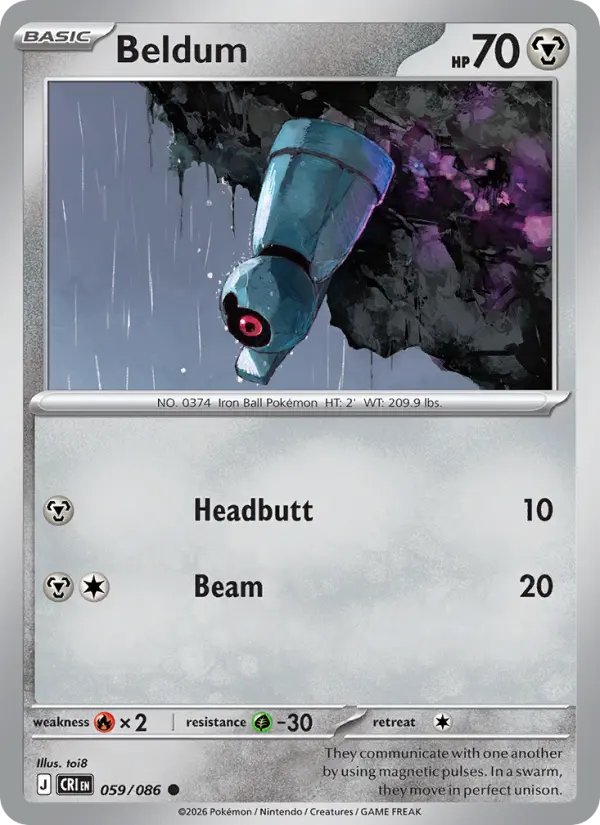
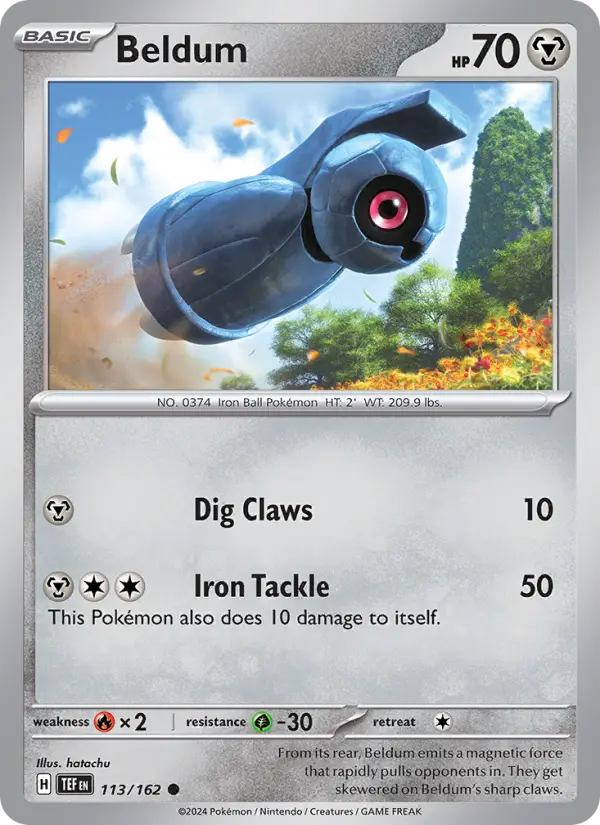
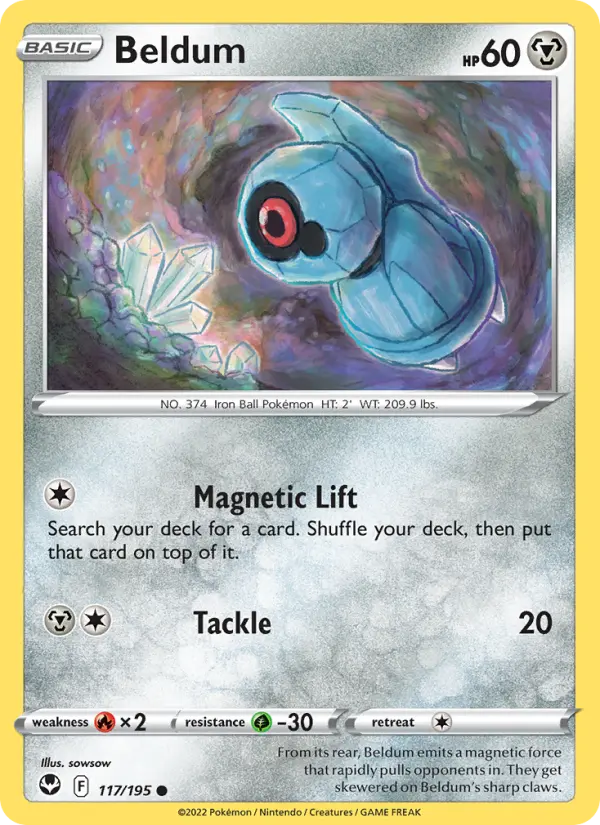
From its rear, Beldum emits a magnetic force that rapidly pulls opponents in. They get skewered on Beldum’s sharp claws.
The cells in this Pokémon’s body are composed of magnetic material. Instead of blood, magnetic forces flow through Beldum’s body.
Beldum Name Origin & Design Inspiration
Beldum's design brilliantly synthesizes mechanical and organic concepts into a singular creature that challenges conventional Pokémon categorization. The Iron Ball Pokémon classification directly references its spherical head structure and overall ball-like appearance, while its primary silhouette suggests a futuristic spacecraft or probe rather than a biological entity. The design language emphasizes its robotic nature through angular features, metallic coloration, and the singular red optical sensor that dominates its head, evoking comparisons to advanced technology and artificial intelligence. The rear hooks and floating posture suggest an anchoring mechanism and magnetic levitation system, reinforcing the technological aesthetic. The name Beldum itself derives from combining elements suggesting both bell-like sounds and dumbbells, the latter referencing the compact, heavy nature of this magnetic sphere. In its original Japanese designation as Dumbber, the linguistic choice emphasizes dumbness or silence, reflecting Beldum's inability to communicate through traditional vocalizations and its reliance on electromagnetic signals instead. This naming convention across regions cleverly encapsulates the essential characteristic that defines Beldum's biological existence: a being that communicates through magnetic pulses rather than conventional sound, making it fundamentally alien in its approach to interaction despite its ostensibly mechanical appearance.
Learnable Moves
Beldum Competitive Battle Guide
Beldum's competitive viability is nearly nonexistent in its base form due to its deliberately limited stat distribution and movepool designed to encourage evolution. With a total base stat of only 300, Beldum functions purely as a stepping stone within competitive strategy rather than as a functional team member itself. The Pokémon's offensive statistics are particularly problematic, featuring base Attack of 55 and Special Attack of 35, making it incapable of dealing meaningful damage to most opponents even with super-effective coverage moves. Its base speed of 30 ensures that Beldum will almost always move last in any encounter, leaving it vulnerable to being knocked out before executing its attacks. However, Beldum's defensive profile provides marginal utility, with base Defense of 80 and Special Defense of 60 offering slightly more durability than its offensive capacity would suggest. The Clear Body ability prevents stat reduction from opposing moves, which provides a minor strategic advantage in specific matchups, while the hidden ability Light Metal halves Beldum's weight, potentially affecting move efficacy of weight-dependent attacks. Competitive players universally treat Beldum as a pure evolution vehicle to be leveled rapidly toward Metang and ultimately Metagross, where the line's true competitive potential emerges. The experience yield of 60 base experience and slow growth rate further reinforce Beldum's role as an early-game investment that requires patience and dedication to fully appreciate.
Commonly Asked Questions About Beldum
What type is Beldum?
Beldum is a steel and psychic type Pokemon.
What does Beldum evolve into?
Beldum evolves into metang, then into metagross.
What are Beldum's weaknesses?
Beldum is weak to ground, ghost, fire and dark type moves.
Does Beldum evolve by trading?
No — Beldum evolves entirely through leveling up, with no trade required at any stage.
Where can I find Beldum?
Beldum can be found in mossdeep city (hoenn), sinnoh route 228 (sinnoh) and mount hokulani (alola).
Beldum Cultural Impact & Franchise History
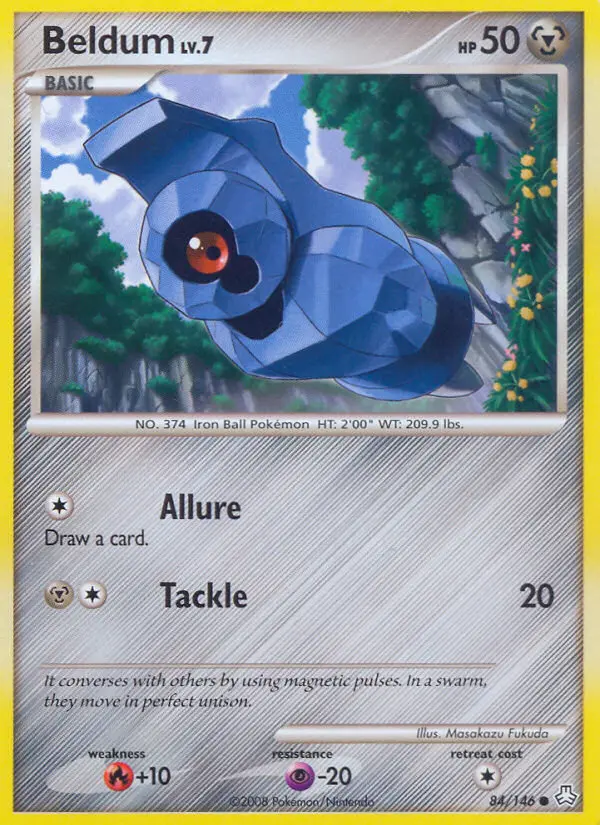
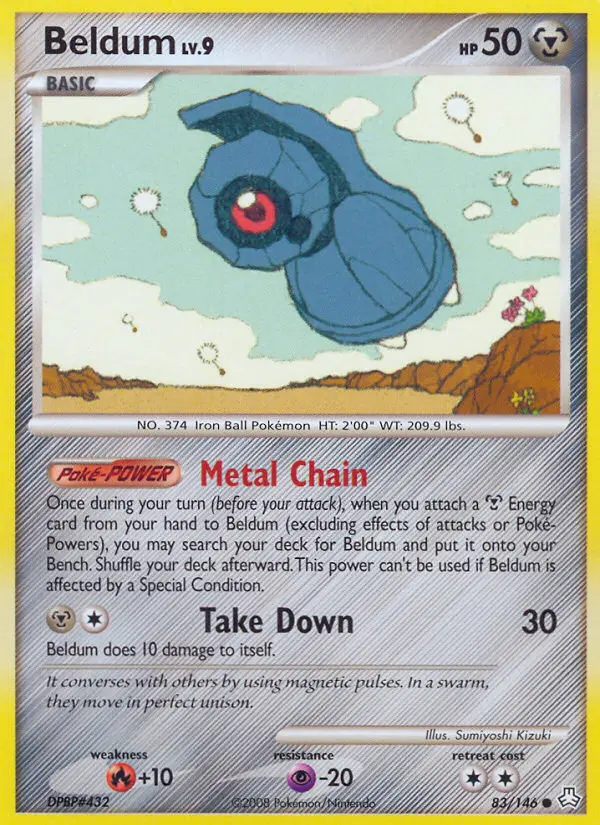
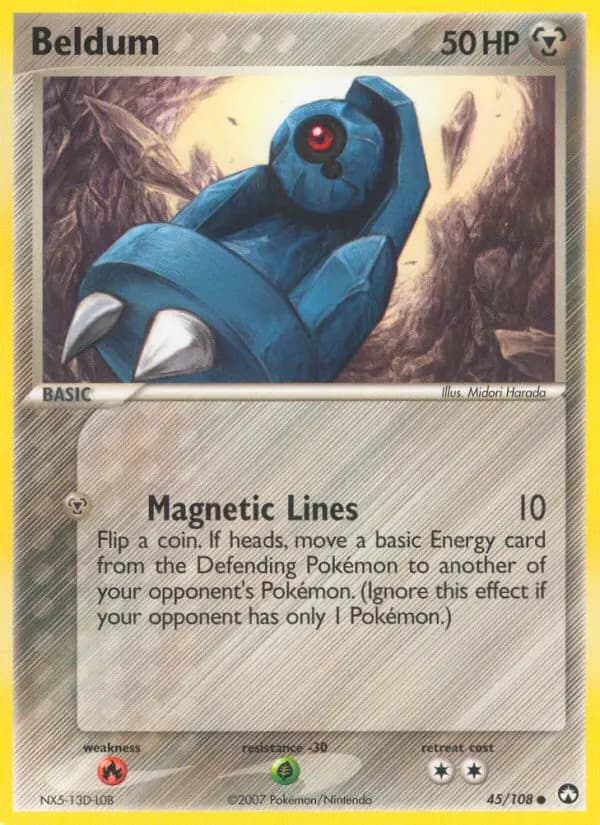
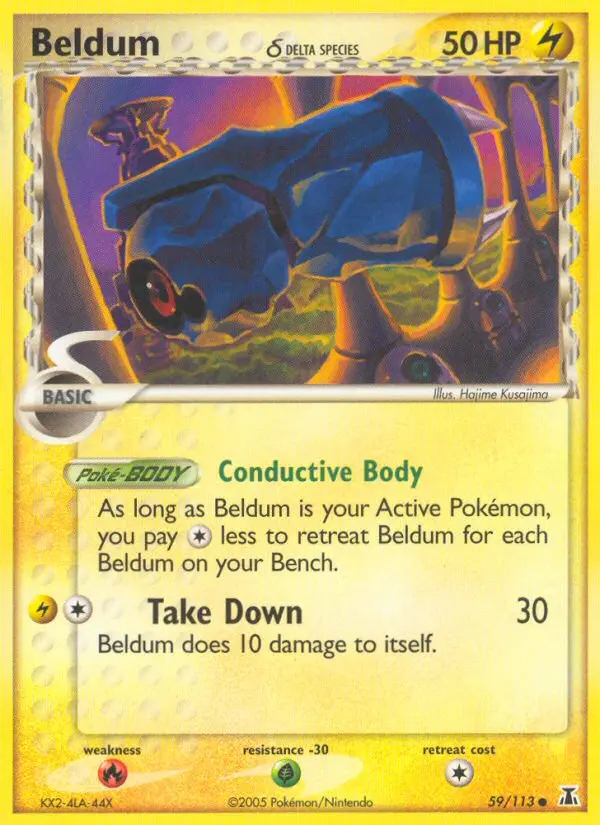
Beldum gained significant cultural prominence through the Pokémon anime series, particularly through the character Morrison, who utilizes Beldum as a central member of his competitive team in the Hoenn region arc. Morrison's Beldum became a fan-favorite character, demonstrating the species' potential and creating emotional attachment to a Pokémon that many players overlook in standard playthroughs. The visual design of Beldum proved iconic enough to secure merchandise representations across trading cards, action figures, and plushies, establishing it as a recognizable species despite its relative rarity in the wild. In competitive Pokémon communities, the evolutionary line of Beldum-Metang-Metagross achieved legendary status, particularly after Metagross gained a Mega Evolution form that positioned it among the absolute most dangerous Steel-type threats in tournament play. This competitive dominance translated into widespread cultural recognition, with Metagross becoming synonymous with Steel-type excellence and appearing in numerous prominent trainer teams throughout subsequent games and media. Beldum itself, while not matching Metagross's celebrity status, benefits from association with this prestigious evolutionary lineage and is instantly recognizable to fans of the franchise. The species appears across various Pokémon media including trading card sets, where it has been illustrated by numerous acclaimed artists, further cementing its position as an integral component of Pokémon's broader cultural landscape.
Where to Find Beldum in Every Pokémon Game
Beldum's availability varies dramatically across different Pokémon games, reflecting its designation as a comparatively scarce species. In the original Generation III games, Pokémon Ruby and Sapphire, Beldum can be encountered in the wild with a catch rate of only 3, making it exceptionally difficult to capture with standard Poké Balls when at full health—approximately 0.4% success rate. The Pokémon inhabits specific rugged terrain areas within the Hoenn region, typically mountainous locations where its magnetic nature and anchoring mechanisms are most useful. In later games, Beldum became available through various methods including breeding Metang or Metagross in the Day Care, receiving it as a gift from NPCs in specific storylines, or finding it in particular wild locations dependent on the generation. In Black 2 and White 2, Beldum appears in specific cave systems and rocky areas. Pokémon Omega Ruby and Alpha Sapphire, the remakes of Generation III, maintained Beldum's availability within the original Hoenn locations while potentially offering alternative acquisition methods through the modern game mechanics. More recent generations including Sun and Moon, Ultra Sun and Ultra Moon, and Sword and Shield distributed Beldum through various methods including wild encounters, trading, and event distributions. The Crown Tundra DLC for Sword and Shield and the Indigo Disk DLC for Scarlet and Violet included Beldum in their catchable Pokédex, ensuring the species remained accessible to contemporary players. Its consistently low catch rate across generations reflects the Pokémon's intended rarity and the design philosophy that obtaining a Beldum requires dedication or alternative acquisition methods rather than simple wild encounters.