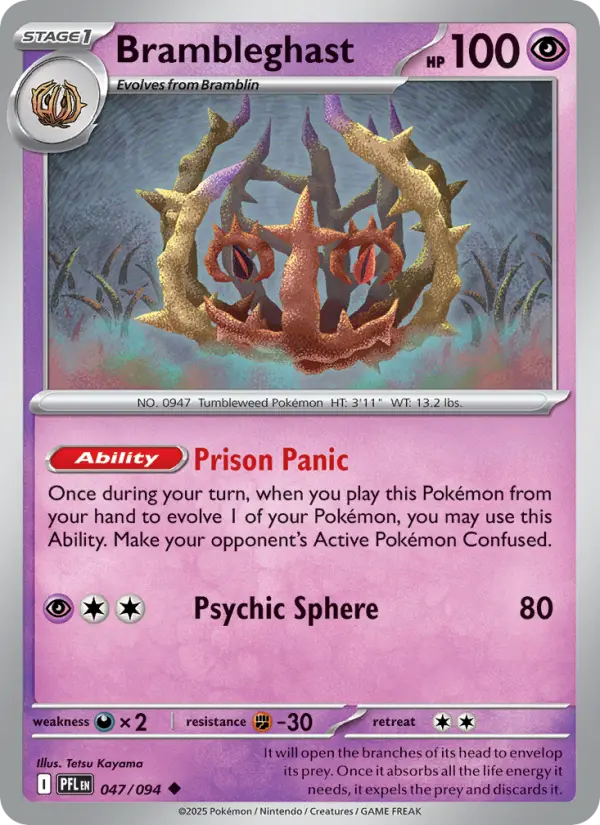
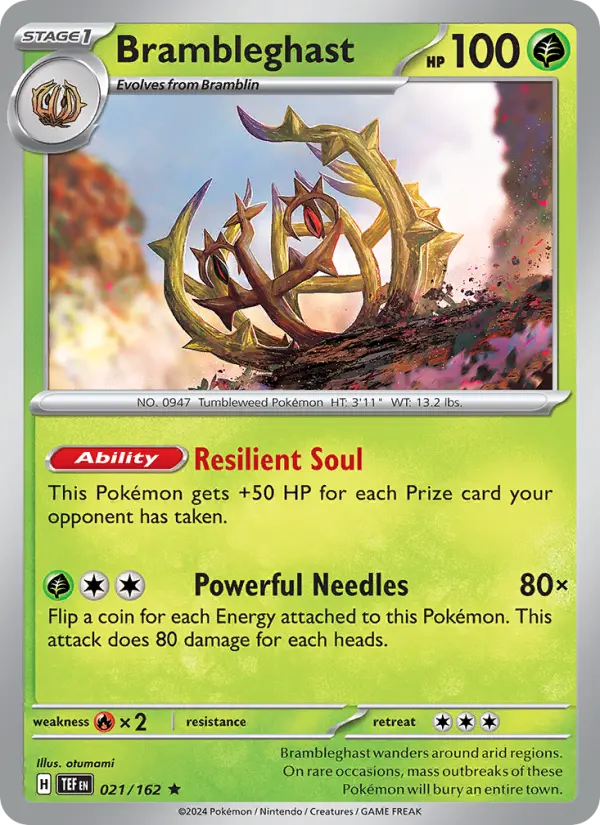
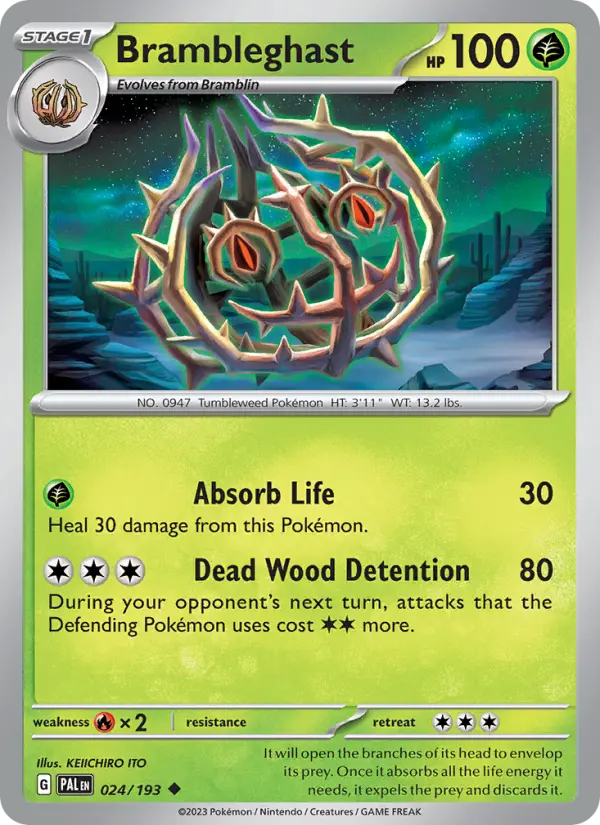
Brambleghast
Generation IX · #0947 — Tumbleweed Pokémon
Weighing 6 kg and standing 1.2 m, Brambleghast carries its grass/ghost typing into battle with a stat spread that leans hardest into Attack. The Pokémon evolves from Bramblin through a unique mechanic involving the Let's Go feature, requiring players to walk 1000 steps outside of its Poké Ball, symbolizing the transformation from a small, wandering bramble into a more substantial, spectral entity.
Editor's Take
Brambleghast's Wind Rider giving it an Attack boost whenever Tailwind is set makes it a genuinely good doubles partner, and Grass/Ghost has only one weakness that matters.
Base Stats
Height
1.2m
Weight
6.0kg
Category
Tumbleweed Pokémon
Gender
Male 50% / Female 50%
Color
brown
Shape
ball
Abilities
Gives immunity to wind moves, and causes the Pokémon's Attack to increase by one stage when hit by one.
Bypasses light screen, reflect, and safeguard.

Brambleghast Biology & Physical Characteristics
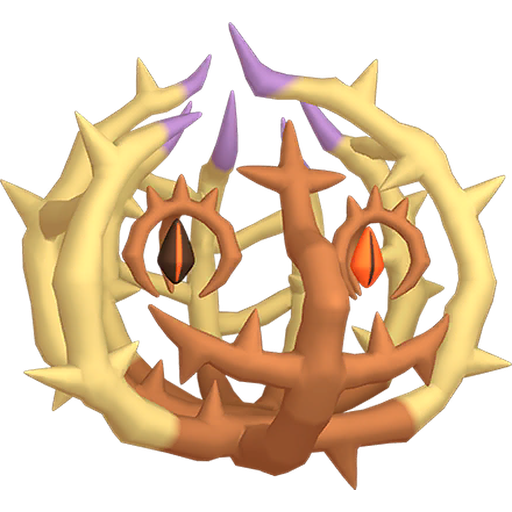
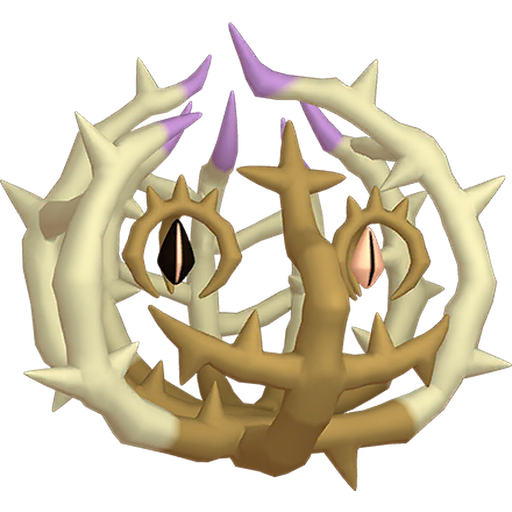
Brambleghast's composition is fundamentally similar to its pre-evolution Bramblin, yet substantially larger and far more elaborate in structure. The Pokémon's body consists of a loose, spherical arrangement of branches primarily colored in brownish-yellow with distinctive light purple tips, while its base and central front branch are rendered in deep brown. This central front branch serves as the focal point of Brambleghast's physiology, featuring two smaller branches near its base that, together with its unique eyes, construct an expressive face. The Pokémon possesses peculiar diamond-shaped, leaf-like eyes with inverted color schemes—the right eye displays black coloration with a thin red pupil, while the left eye reverses this pattern—and these eyes lack the ability to blink, instead rotating and flipping to convey emotional states. Surrounding each eye are minute tumbleweed formations composed of three stalks, adding to the Pokémon's otherworldly appearance. The smaller branches flanking the central protrusion function as moveable "lips," capable of forming various expressions ranging from menacing grins to subtle frowns, demonstrating sophisticated facial articulation for a plant-based creature.
Pokedex Numbers
Training
Breeding
Brambleghast Breeding, Gender Ratio & Egg Groups
Brambleghast's population splits evenly by gender, 50% each way, making reproduction equally probable regardless of individual specimen sex. As a member of the Grass egg group, Brambleghast demonstrates compatibility with other Pokémon within this breeding category, potentially facilitating the development of unique offspring with diverse movesets and genetic properties. The base friendship value for Brambleghast stands at 50, representing a neutral starting point that increases through positive trainer interactions and decreases through battling and neglect. The species exhibits a medium-fast growth rate, positioning it between slower-developing Pokémon and those that reach higher levels rapidly. Breeding cycles for Brambleghast require 20 cycles to complete, translating to approximately 4,884 to 5,140 steps before a newly hatched Bramblin emerges from its egg. Players seeking to breed Brambleghast should note its compatibility with various Grass-type Pokémon, allowing access to specialized egg moves such as Beat Up, Block, Leech Seed, Shadow Sneak, and Strength Sap, which provide competitive advantages in battle.
Sprites




TMs & HMs
tm03
crystal
tm03
gold silver
tm04
gold silver
tm04
crystal
tm05
lets go pikachu lets go eevee
tm07
lets go pikachu lets go eevee
tm08
lets go pikachu lets go eevee
tm08
sword shield
tm09
ruby sapphire
tm09
firered leafgreen
tm09
emerald
tm09
diamond pearl
tm09
xd
tm09
sword shield
tr65
sword shield
tm17
scarlet violet
tm159
scarlet violet
tm09
platinum
tr59
sword shield
tm81
scarlet violet
+271 more TMs/HMs
Brambleghast's Evolution Chain


Brambleghast Evolution, Mega Evolution & Special Forms
Brambleghast represents the final evolutionary stage of the Bramblin line, a transformation unique to Generation IX mechanics. The evolution occurs when a player levels up Bramblin while it remains outside of its Poké Ball after accumulating 1000 steps using the Let's Go feature introduced in Pokémon Scarlet and Violet. This innovative evolution method represents a departure from traditional leveling mechanics, instead rewarding player engagement and immersion in the game world through continued traversal and interaction. The transformation is visually and statistically significant, with Brambleghast gaining substantially in size and developing a more complex, thorned appearance compared to its smaller predecessor. This evolution method emphasizes the bond between trainer and Pokémon, suggesting that Bramblin's transformation into Brambleghast requires genuine companionship and shared experience rather than mere statistical thresholds.
Where to Find
Location data not available for this Pokémon in the database.
Brambleghast Behaviour and Natural Habitat
Brambleghast inhabits arid regions throughout the world, with a particular preference for desert environments where wind patterns facilitate its natural locomotion. The Pokémon's existence is fundamentally shaped by these harsh, dry climates, where it tumbles and rolls across barren landscapes in search of sustenance. According to Pokédex documentation, Brambleghast employs a distinctive hunting methodology: it opens the branches of its spherical head to completely envelop its prey in a suffocating embrace. Once prey is captured within this branch-cage, Brambleghast exhibits remarkable patience and ruthlessness, refusing to release its victim until every trace of life energy has been absorbed. The expended prey is subsequently expelled and discarded, leaving behind only an empty husk. The Pokédex entries reveal a more alarming aspect of Brambleghast's behavior: on rare occasions, these Pokémon experience massive population outbreaks within specific regions, creating swarms of sufficient magnitude to bury entire towns beneath their tumbling forms, suggesting a reproductive capacity or migration pattern that remains poorly understood by researchers.
Pokedex Entries
It will open the branches of its head to envelop its prey. Once it absorbs all the life energy it needs, it expels the prey and discards it.
Brambleghast wanders around arid regions. On rare occasions, mass outbreaks of these Pokémon will bury an entire town.
Brambleghast Name Origin & Design Inspiration
The name Brambleghast is a compelling portmanteau combining "bramble"—referring to the thorny, tangled vegetation that comprises the Pokémon's physical structure—and "ghast," derived from "aghast" or potentially referencing "ghost," reflecting its Ghost-type classification. This nomenclature perfectly encapsulates the Pokémon's dual nature as both a botanical organism and a spectral entity. The Japanese designation, Anohoragusa, appears to reference the appearance and behavior of tumbleweeds, those iconic desert plants that detach from their roots and roll across arid landscapes, propelled by wind currents. Brambleghast's design draws clear inspiration from real-world tumbleweeds, particularly the Russian thistle, which accumulates thorns and dried vegetation as it develops. The Pokémon's taxonomy as the "Tumbleweed Pokémon" directly acknowledges this ecological inspiration. The color palette of brownish-yellow branches with purple accents subtly evokes dried vegetation and decay, while the ghost-type coloration and ethereal quality of its design suggest a plant caught between life and death, wandering eternally through desolate lands.
Learnable Moves
Brambleghast can learn 47 moves:
Move | Type | Cat. | Power | Acc. | PP |
|---|---|---|---|---|---|
| absorb | grass | Special | 20 | 100 | 25 |
| astonish | ghost | Physical | 30 | 100 | 15 |
| beat up | dark | Physical | — | 100 | 10 |
| block | normal | Status | — | — | 5 |
| bullet seed | grass | Physical | 25 | 100 | 30 |
| confuse ray | ghost | Status | — | 100 | 10 |
| curse | ghost | Status | — | — | 10 |
| defense curl | normal | Status | — | — | 40 |
| disable | normal | Status | — | 100 | 20 |
| endure | normal | Status | — | — | 10 |
| energy ball | grass | Special | 90 | 100 | 10 |
| facade | normal | Physical | 70 | 100 | 20 |
| giga drain | grass | Special | 75 | 100 | 10 |
| giga impact | normal | Physical | 150 | 90 | 5 |
| grass knot | grass | Special | — | 100 | 20 |
| grassy glide | grass | Physical | 55 | 100 | 20 |
| grassy terrain | grass | Status | — | — | 10 |
| hex | ghost | Special | 65 | 100 | 10 |
| hyper beam | normal | Special | 150 | 90 | 5 |
| infestation | bug | Special | 20 | 100 | 20 |
| leaf storm | grass | Special | 130 | 90 | 5 |
| leech seed | grass | Status | — | 90 | 10 |
| mega drain | grass | Special | 40 | 100 | 15 |
| night shade | ghost | Special | — | 100 | 15 |
| pain split | normal | Status | — | — | 20 |
| phantom force | ghost | Physical | 90 | 100 | 10 |
| poltergeist | ghost | Physical | 110 | 90 | 5 |
| pounce | bug | Physical | 50 | 100 | 20 |
| power whip | grass | Physical | 120 | 85 | 10 |
| protect | normal | Status | — | — | 10 |
| rapid spin | normal | Physical | 50 | 100 | 40 |
| rest | psychic | Status | — | — | 5 |
| rollout | rock | Physical | 30 | 90 | 20 |
| scary face | normal | Status | — | 100 | 10 |
| seed bomb | grass | Physical | 80 | 100 | 15 |
| shadow ball | ghost | Special | 80 | 100 | 15 |
| shadow sneak | ghost | Physical | 40 | 100 | 30 |
| skitter smack | bug | Physical | 70 | 90 | 10 |
| sleep talk | normal | Status | — | — | 10 |
| solar beam | grass | Special | 120 | 100 | 10 |
| spikes | ground | Status | — | — | 20 |
| spite | ghost | Status | — | 100 | 10 |
| strength sap | grass | Status | — | 100 | 10 |
| substitute | normal | Status | — | — | 10 |
| tera blast | normal | Special | 80 | 100 | 10 |
| thief | dark | Physical | 60 | 100 | 25 |
| trailblaze | grass | Physical | 50 | 100 | 20 |
Brambleghast Competitive Battle Guide
In competitive Pokémon environments, Brambleghast functions as a specialized physical attacker with surprising resilience despite its lightweight frame. Its base Attack stat of 115 positions it prominently among Grass-type offensive threats, particularly when utilizing moves like Power Whip (120 power, 85 accuracy) and Giga Drain (75 power, 100 accuracy with health recovery). The Pokémon's base Speed stat of 90 grants sufficient velocity to outpace many common threats, allowing it to capitalize on its offensive capabilities before opponents respond. Brambleghast's signature ability, Wind Rider, provides the intriguing dual benefit of granting immunity to wind-based moves while simultaneously increasing Attack by one stage whenever the Pokémon is struck by wind-type moves, creating potential setup opportunities in doubles formats against opponents using moves like Tailwind or Hurricane. The hidden ability Infiltrator bypasses defensive screens such as Light Screen and Reflect, enabling Brambleghast to circumvent common defensive strategies. Defensively, the Grass/Ghost typing confers weaknesses to common offensive types including Fire, Flying, Dark, and Ice, while providing resistances to Poison, Bug, and Grass moves and complete immunities to Normal and Fighting-type attacks. Competitive movesets typically emphasize physical offensive capabilities while incorporating Phantom Force for reliable Ghost-type coverage and Rapid Spin for utility, though the somewhat modest Special Defense of 70 necessitates careful positioning in battle.
Commonly Asked Questions About Brambleghast
What type is Brambleghast?
Brambleghast is a grass and ghost type Pokemon.
What does Brambleghast evolve from?
Brambleghast evolved from bramblin.
What are Brambleghast's weaknesses?
Brambleghast is weak to flying, ghost, fire, ice and dark type moves.
Brambleghast Cultural Impact & Franchise History
As a Generation IX Pokémon, Brambleghast emerged during a period of significant expansion in the Pokémon franchise, introducing fresh mechanics and designs that resonated with both longtime enthusiasts and newer players engaging with Pokémon Scarlet and Violet. The Pokémon's unique evolution mechanic utilizing the Let's Go feature represented a novel approach to character development, emphasizing world exploration and trainer-Pokémon bonding over purely mechanical progression systems. Brambleghast's design aesthetic—combining the familiar imagery of tumbleweeds with ghostly qualities—appealed to players interested in thematically cohesive Pokémon that reflected natural phenomena through a fantastical lens. The specter of devastating mass outbreaks capable of burying entire towns, as mentioned in Pokédex entries, contributed to Brambleghast's mystique within fan communities, generating discussions about ecological implications and the potentially catastrophic consequences of uncontrolled Pokémon populations. Gaming communities and fan artists embraced the Pokémon's distinctive design, producing extensive fan content exploring its biology, behavior, and potential roles in competitive and casual gameplay.
Where to Find Brambleghast in Every Pokémon Game
Brambleghast is primarily available in Pokémon Scarlet and Violet, where it inhabits the Paldea region designated as location #243 in those games' local Pokédex listings. Players seeking to obtain Brambleghast must first capture its pre-evolution Bramblin, which appears in arid regions throughout Paldea, then evolve it through the exclusive Let's Go mechanic requiring 1000 steps of traversal outside its Poké Ball. The Pokémon's capture rate of 45 makes it moderately challenging to catch in the wild, with a base happiness of 50 indicating that newly caught specimens require training and positive interaction to develop strong bonds with their trainers. Once obtained, Brambleghast serves as a formidable addition to any trainer's roster, though its availability remains restricted to Generation IX titles at this time. The species has not appeared in Pokémon Legends: Z-A based on currently available information, nor has it featured prominently in side games beyond Pokémon Scarlet and Violet's initial release. Players interested in breeding multiple Brambleghast specimens or training optimized competitive examples should note that the species possesses a catch rate moderate enough to allow success through standard Poké Balls under typical circumstances, making acquisition feasible without requiring specialized capture equipment.