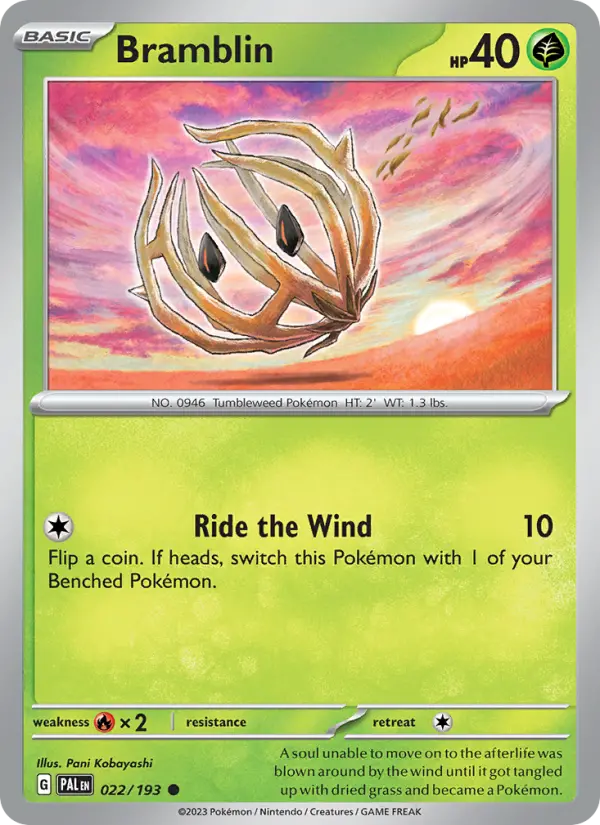
Bramblin
Generation IX · #0946 — Tumbleweed Pokémon
Among grass/ghost-type Pokémon, Bramblin stands out for a stat line that pushes hardest into attack. The creature's diminutive stature—measuring just 0.6 meters in height and weight—belies the existential mystery surrounding its creation and existence.
Editor's Take
Bramblin's line ends in Brambleghast, and Wind Rider granting a free Attack boost from Tailwind is one of the better doubles synergies Gen 9 added.
Base Stats
Height
0.6m
Weight
0.6kg
Category
Tumbleweed Pokémon
Gender
Male 50% / Female 50%
Color
brown
Shape
ball
Abilities
Gives immunity to wind moves, and causes the Pokémon's Attack to increase by one stage when hit by one.
Bypasses light screen, reflect, and safeguard.

Bramblin Biology & Physical Characteristics
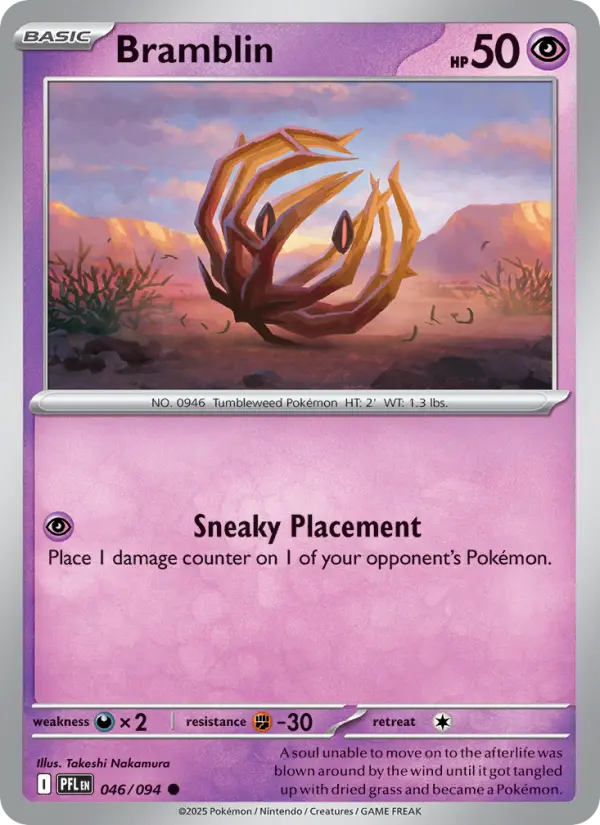
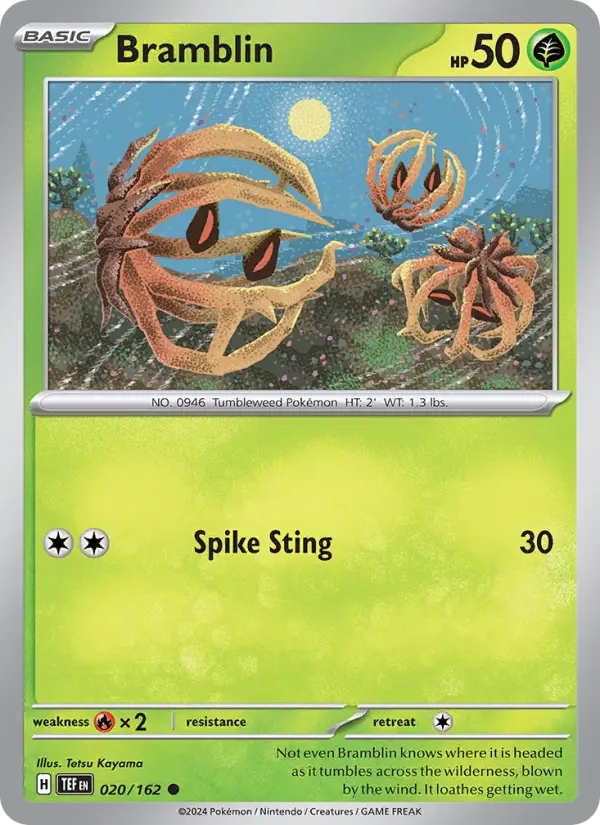
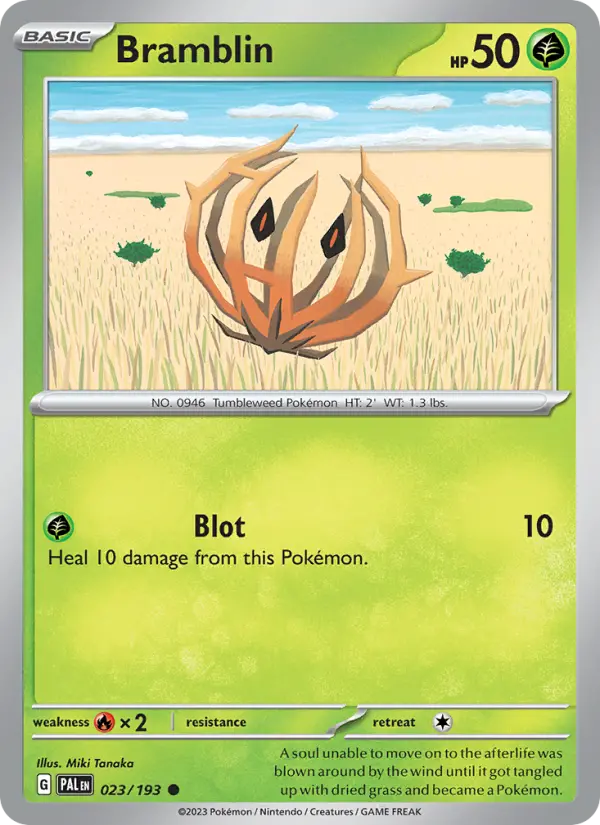
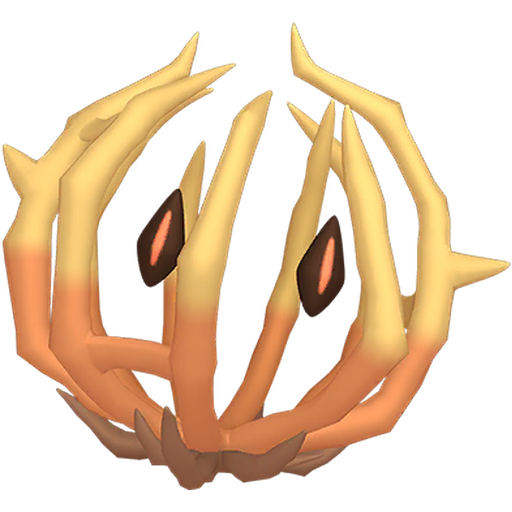
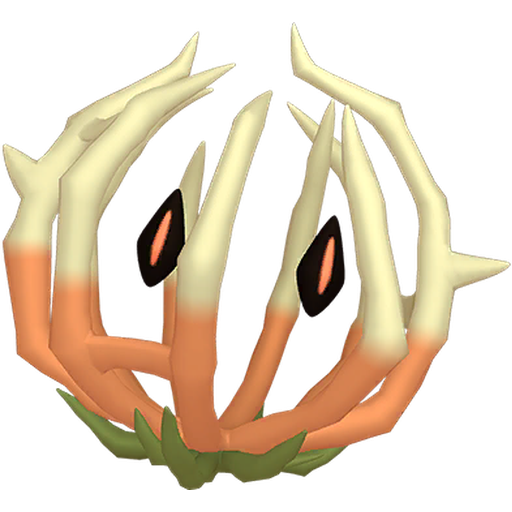
Bramblin resembles a spherical tumbleweed composed of brownish-yellow, jagged thorny plant stalks that curl slightly inward to maintain its distinctive round shape. Within this body float small, rhombic black leaf-like eyes with thin red pupils that don't blink but instead flip and rotate to express the Pokémon's emotions, giving it an unsettling yet oddly endearing quality. The stalks comprising Bramblin's form are held together by what appears to be remnants of root systems on its underside, suggesting a temporary coalescence of natural materials rather than a fully integrated organism. According to Pokédex lore, Bramblin originates from wandering souls unable to move on to the afterlife that become entangled with dried grass and plant matter, infusing these inanimate materials with spectral consciousness and creating this enigmatic life form.
Pokedex Numbers
Training
Breeding
Bramblin Breeding, Gender Ratio & Egg Groups
Bramblin exhibits a standard gender ratio of 50% male and 50% female, allowing for conventional breeding practices among trainers. The Pokémon belongs to the Grass Egg Group, meaning it can breed with other members of this group to produce Bramblin offspring. With a base happiness value of 50, Bramblin begins at neutral disposition toward its trainer, requiring consistent care, training, and positive interactions to increase its affection. The species has a hatch counter of 20 cycles, translating to approximately 4,884 to 5,140 steps before a Bramblin egg hatches, placing it in the moderate incubation timeframe. Breeding Bramblin can be accomplished through picnics in Pokémon Scarlet and Violet, during which it can learn egg moves such as Beat Up, Leech Seed, Shadow Sneak, and Strength Sap, providing offspring with moves unavailable through normal leveling or technical machines.
Sprites




TMs & HMs
tm03
crystal
tm03
gold silver
tm04
gold silver
tm04
crystal
tm05
lets go pikachu lets go eevee
tm07
lets go pikachu lets go eevee
tm08
lets go pikachu lets go eevee
tm09
ruby sapphire
tm09
firered leafgreen
tm09
emerald
tm09
diamond pearl
tm09
xd
tr65
sword shield
tm17
scarlet violet
tm159
scarlet violet
tm09
platinum
tr59
sword shield
tm81
scarlet violet
tm114
scarlet violet
tm09
colosseum
+234 more TMs/HMs
Bramblin's Evolution Chain


Bramblin Evolution, Mega Evolution & Special Forms
Bramblin evolves into Brambleghast, its final form, through a unique mechanic requiring the player to walk 1,000 steps using the Let's Go feature while the Pokémon is outside its Poké Ball. This evolution method emphasizes the connection between trainer and Pokémon, mirroring Bramblin's dependence on external forces like wind for movement—in this case, the shared journey between trainer and creature serves as the catalyst for transformation. The evolution represents a significant power spike, with Brambleghast boasting improved statistics and greater offensive and defensive capabilities. This progression underscores Bramblin's narrative as a restless, wandering spirit that gains purpose and stability through bonding with a trainer, transforming from an aimless tumbleweed into a more grounded and formidable Pokémon.
Where to Find
Location data not available for this Pokémon in the database.
Bramblin Behaviour and Natural Habitat
Bramblin's existence is defined almost entirely by its relationship with wind, which serves as its primary—and possibly only—means of locomotion, carrying the Pokémon to destinations unknown even to itself. The Pokédex notes that Bramblin doesn't even know where it is headed as it tumbles across the wilderness, suggesting a creature entirely at the mercy of external forces. This passivity extends to its environmental preferences: Bramblin makes its habitat in dry, rocky regions such as deserts where its primary vulnerability—moisture—is minimized. The creature has a notable aversion to water, loathing getting wet, which likely explains its restriction to arid environments and its behavioral patterns of seeking shelter during rainfall. Despite its aimless wandering, Bramblin appears to navigate these harsh landscapes with surprising resilience, suggesting that its spectral nature grants it some adaptation to the extreme conditions of desert life.
Pokedex Entries
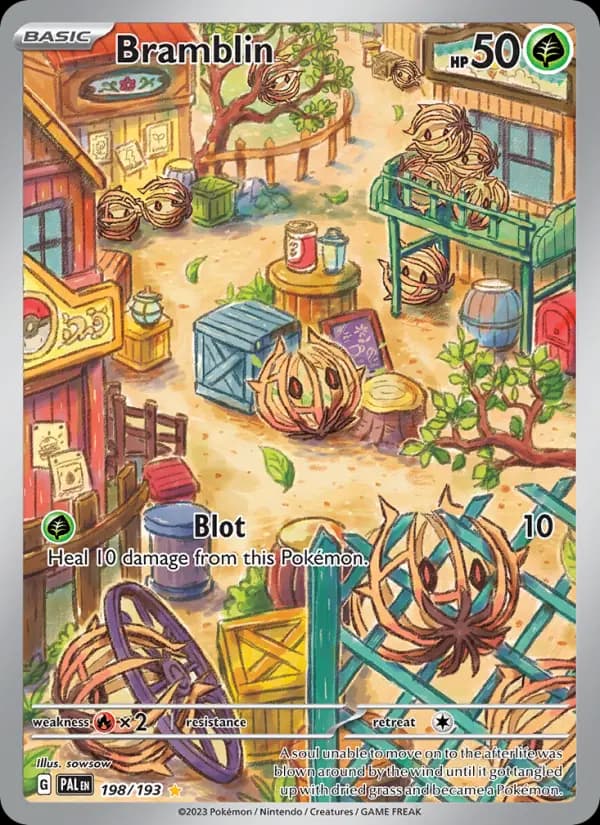
A soul unable to move on to the afterlife was blown around by the wind until it got tangled up with dried grass and became a Pokémon.
Not even Bramblin knows where it is headed as it tumbles across the wilderness, blown by the wind. It loathes getting wet.
Bramblin Name Origin & Design Inspiration
Bramblin's name traces to 'bramble,' referring to the spiky, thorny plant matter that comprises its physical form, combined with a suffix suggesting diminutive size or a diminished state. The Japanese name Anokusa (アノクサ) carries similar botanical connotations, with the design intentionally evoking the image of a tumbleweed, the iconic desert plant synonymous with desolate landscapes and aimless wandering. The Pokémon's spherical, spiky appearance reflects both its botanical origin and its status as an uncontrolled force rolling across landscapes. The floating, expressionless eyes represent the disembodied soul at the heart of its being, serving as the visual anchor that transforms simple dried grass into a conscious entity. This design philosophy seamlessly merges the naturalistic tumbleweed aesthetic with supernatural elements, creating a Pokémon that feels both grounded in real-world botany and genuinely otherworldly.
Learnable Moves
Bramblin can learn 44 moves:
Move | Type | Cat. | Power | Acc. | PP |
|---|---|---|---|---|---|
| absorb | grass | Special | 20 | 100 | 25 |
| astonish | ghost | Physical | 30 | 100 | 15 |
| beat up | dark | Physical | — | 100 | 10 |
| block | normal | Status | — | — | 5 |
| bullet seed | grass | Physical | 25 | 100 | 30 |
| confuse ray | ghost | Status | — | 100 | 10 |
| curse | ghost | Status | — | — | 10 |
| defense curl | normal | Status | — | — | 40 |
| disable | normal | Status | — | 100 | 20 |
| endure | normal | Status | — | — | 10 |
| energy ball | grass | Special | 90 | 100 | 10 |
| facade | normal | Physical | 70 | 100 | 20 |
| giga drain | grass | Special | 75 | 100 | 10 |
| grass knot | grass | Special | — | 100 | 20 |
| grassy glide | grass | Physical | 55 | 100 | 20 |
| grassy terrain | grass | Status | — | — | 10 |
| hex | ghost | Special | 65 | 100 | 10 |
| infestation | bug | Special | 20 | 100 | 20 |
| leaf storm | grass | Special | 130 | 90 | 5 |
| leech seed | grass | Status | — | 90 | 10 |
| mega drain | grass | Special | 40 | 100 | 15 |
| night shade | ghost | Special | — | 100 | 15 |
| pain split | normal | Status | — | — | 20 |
| phantom force | ghost | Physical | 90 | 100 | 10 |
| poltergeist | ghost | Physical | 110 | 90 | 5 |
| pounce | bug | Physical | 50 | 100 | 20 |
| power whip | grass | Physical | 120 | 85 | 10 |
| protect | normal | Status | — | — | 10 |
| rapid spin | normal | Physical | 50 | 100 | 40 |
| rest | psychic | Status | — | — | 5 |
| rollout | rock | Physical | 30 | 90 | 20 |
| scary face | normal | Status | — | 100 | 10 |
| seed bomb | grass | Physical | 80 | 100 | 15 |
| shadow ball | ghost | Special | 80 | 100 | 15 |
| shadow sneak | ghost | Physical | 40 | 100 | 30 |
| sleep talk | normal | Status | — | — | 10 |
| solar beam | grass | Special | 120 | 100 | 10 |
| spikes | ground | Status | — | — | 20 |
| spite | ghost | Status | — | 100 | 10 |
| strength sap | grass | Status | — | 100 | 10 |
| substitute | normal | Status | — | — | 10 |
| tera blast | normal | Special | 80 | 100 | 10 |
| thief | dark | Physical | 60 | 100 | 25 |
| trailblaze | grass | Physical | 50 | 100 | 20 |
Bramblin Competitive Battle Guide
Bramblin's competitive viability is severely limited by its modest overall stat sum of 275, with particularly weak defenses (30 Defense and 35 Special Defense) and limited offensive presence (65 Attack and 45 Special Attack). Its Speed stat of 60 is middling, making it neither particularly fast nor slow. However, Bramblin's primary competitive value lies in its Wind Rider ability, which grants immunity to wind-based moves while boosting Attack by one stage when struck by such moves—a niche but situationally powerful trait in competitive formats. Its hidden ability, Infiltrator, bypasses Light Screen, Reflect, and Safeguard, providing utility in team compositions designed to overwhelm defensive strategies. Bramblin's movepool includes useful options like Phantom Force for STAB Ghost-type coverage, Giga Drain for Grass-type offense, and utility moves like Confuse Ray and Trailblaze, though it generally functions better as an early-game Pokémon than as a competitive threat. Most competitive players view Bramblin as a stepping stone toward its evolution, Brambleghast, which receives significant stat improvements that make it genuinely viable in competitive play.
Commonly Asked Questions About Bramblin
What type is Bramblin?
Bramblin is a grass and ghost type Pokemon.
What does Bramblin evolve into?
Bramblin evolves into brambleghast.
What are Bramblin's weaknesses?
Bramblin is weak to flying, ghost, fire, ice and dark type moves.
Does Bramblin evolve by trading?
No — Bramblin evolves entirely through leveling up, with no trade required at any stage.
Bramblin Cultural Impact & Franchise History
As a Generation IX Pokémon, Bramblin represents Game Freak's continued exploration of creative, thematically cohesive designs that blend the mundane natural world with fantastical supernatural elements. The concept of a restless spirit trapped within plant matter resonates with various cultural folklore traditions surrounding spirits, ghosts, and nature spirits, giving Bramblin surprising narrative depth despite its simple design. Within Paldean culture and the broader Pokémon community, Bramblin has garnered appreciation for its unique dual typing and the poetic melancholy of its Pokédex entries, which emphasize themes of aimlessness, displacement, and the search for connection. The Pokémon has become emblematic of Generation IX's more experimental approach to creature design, demonstrating that even weakly-statted early-game Pokémon can achieve cultural resonance through compelling conceptual design and lore. Its popularity extends to fan communities, where artists and writers frequently explore the philosophical implications of a sentient, homeless spirit eternally blown by forces beyond its control.
Where to Find Bramblin in Every Pokémon Game
Bramblin was introduced exclusively in Generation IX and is available in Pokémon Scarlet and Violet as a naturally occurring Pokémon within the Paldea region, where it holds Pokédex number 242. The species has not appeared in any earlier generations and remains unavailable in most other Pokémon games, making it a contemporary addition to the franchise's roster. In Scarlet and Violet, Bramblin can be encountered in desert and arid regions throughout Paldea, consistent with its preference for dry habitats. The species was not made available in Legends: Z-A prior to that game's release, and its status in future generations remains undetermined. With a high capture rate of 190 (equivalent to approximately 24.8% success with a standard Poké Ball at full health), Bramblin is relatively easy to catch, making it accessible to players early in their Paldean journey. The species benefits from a medium-fast experience growth rate, meaning it levels up at a moderate pace that allows trainers to cultivate Bramblin into its evolved form of Brambleghast with reasonable effort.