Budew
BabyGeneration IV · #0406 — Bud Pokémon
Budew measures in at 0.2 m and 1.2 kg, a build that matches its natural cure ability better than it matches raw offense or defense. With a overall stat sum of 280, Budew's strength lies primarily in its Special Defense (70) and Special Attack (50), making it surprisingly resilient despite its baby classification. The species is classified as having no eggs, meaning it cannot breed, and possesses a notably high catch rate of 255, making it one of the easiest Pokémon to capture in the wild. Its availability across multiple generations and ease of capture have made Budew a beloved choice for new trainers seeking an early introduction to Grass and Poison-type Pokémon.
Editor's Take
Budew is a baby Pokémon requiring friendship in daylight to evolve, which is a lot of conditions for a stage that only exists because Gen 4 wanted more baby forms.
Base Stats
Height
0.2m
Weight
1.2kg
Category
Bud Pokémon
Gender
Male 50% / Female 50%
Color
green
Shape
humanoid
Abilities
Cures any major status ailment upon switching out.
Has a 30% chance of poisoning attacking Pokémon on contact.
Protects against major status ailments during strong sunlight.

Budew Biology & Physical Characteristics
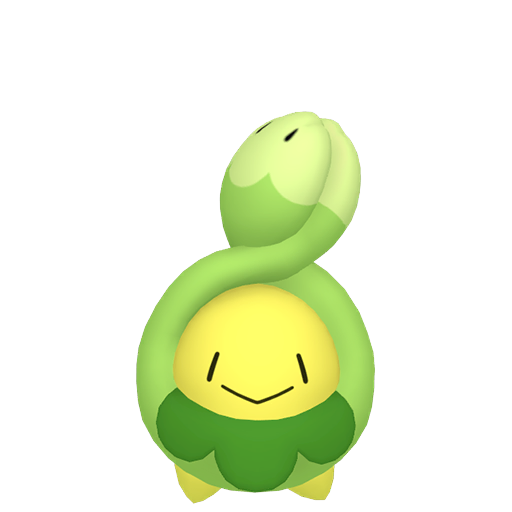
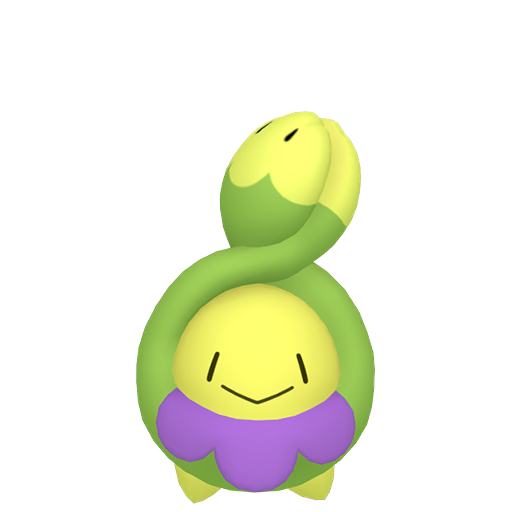
Budew is a bipedal, rosebud-like Pokémon with a distinctive and charming appearance that instantly conveys its botanical nature. Its body features a yellow face with small, slit-like eyes and what appears to be a green bib, while its feet are triangular and stubby, colored in a matching yellow hue. The most striking features of Budew's design are the two vine-like appendages extending from the top of its head, each topped with a prominent colored spot—one bearing a vibrant red spot while the other displays a deep blue spot. These colored spots become visible only when Budew opens its buds, revealing the Pokémon's readiness to release pollen. The Pokédex entries reveal that Budew maintains a complex relationship with temperature and seasons; during harsh winters, it closes its buds tightly to endure the freezing cold, while in warmer seasons it blooms and releases toxic pollen. The toxicity of its pollen is remarkably influenced by the quality of water it was raised with, suggesting that Budew absorbs and concentrates environmental factors into its biological processes.
Pokedex Numbers
Training
Breeding
Budew Breeding, Gender Ratio & Egg Groups
Budew maintains a perfectly balanced gender distribution with exactly 50% male and 50% female specimens, ensuring equal representation across populations without gender-based evolutionary differences. However, Budew's classification as a baby Pokémon with the 'Undiscovered' egg group means it cannot participate in breeding chains like standard Pokémon, a restriction common to all baby-form Pokémon in the franchise. This prevents trainers from obtaining Budew through breeding and necessitates catching wild specimens or receiving them through in-game events, which adds to its rarity and desirability among collectors. The base friendship value of Budew is set at 70, which is moderate compared to other baby Pokémon, requiring trainers to engage in relationship-building activities such as battling, using potions, or other care-based interactions to reach the high friendship threshold necessary for evolution. The gender balance means that players have no preference in seeking either male or female Budew individuals for team composition, though individual personality and nature traits become more relevant considerations when selecting a Budew to train. This design choice ensures that Budew's availability is purely dependent on wild encounters or specific distribution events, maintaining its status as a special Pokémon that cannot be mass-produced through breeding mechanics.
Sprites




Held Items
Poison Barb
type-enhancement
Held: Poison-Type moves from holder do 20% more damage.
Cost: 1000
Poison Barb
type-enhancement
Held: Poison-Type moves from holder do 20% more damage.
Cost: 1000
Poison Barb
type-enhancement
Held: Poison-Type moves from holder do 20% more damage.
Cost: 1000
Poison Barb
type-enhancement
Held: Poison-Type moves from holder do 20% more damage.
Cost: 1000
Poison Barb
type-enhancement
Held: Poison-Type moves from holder do 20% more damage.
Cost: 1000
Poison Barb
type-enhancement
Held: Poison-Type moves from holder do 20% more damage.
Cost: 1000
Poison Barb
type-enhancement
Held: Poison-Type moves from holder do 20% more damage.
Cost: 1000
Poison Barb
type-enhancement
Held: Poison-Type moves from holder do 20% more damage.
Cost: 1000
Poison Barb
type-enhancement
Held: Poison-Type moves from holder do 20% more damage.
Cost: 1000
Poison Barb
type-enhancement
Held: Poison-Type moves from holder do 20% more damage.
Cost: 1000
Poison Barb
type-enhancement
Held: Poison-Type moves from holder do 20% more damage.
Cost: 1000
Poison Barb
type-enhancement
Held: Poison-Type moves from holder do 20% more damage.
Cost: 1000
Poison Barb
type-enhancement
Held: Poison-Type moves from holder do 20% more damage.
Cost: 1000
Poison Barb
type-enhancement
Held: Poison-Type moves from holder do 20% more damage.
Cost: 1000
Poison Barb
type-enhancement
Held: Poison-Type moves from holder do 20% more damage.
Cost: 1000
Poison Barb
type-enhancement
Held: Poison-Type moves from holder do 20% more damage.
Cost: 1000
Poison Barb
type-enhancement
Held: Poison-Type moves from holder do 20% more damage.
Cost: 1000
TMs & HMs
tm03
yellow
tm03
red blue
tm03
blue japan
tm03
red green japan
tm05
lets go pikachu lets go eevee
tm06
yellow
tm06
gold silver
tm06
red blue
tm06
crystal
tm06
emerald
tm06
firered leafgreen
tm06
diamond pearl
tm06
platinum
tm06
ruby sapphire
tm06
colosseum
tm06
black 2 white 2
tm06
xd
tm06
black white
tm06
heartgold soulsilver
tm06
omega ruby alpha sapphire
+504 more TMs/HMs
Budew's Evolution Chain


Budew Evolution, Mega Evolution & Special Forms
Budew occupies a unique position as the first stage in a three-part evolution line that spans from Generation IV through evolved forms that maintain the Grass/Poison typing. The evolution from Budew to Roselia requires specific conditions that distinguish it from most baby Pokémon: the species must be leveled up while the trainer maintains high friendship with the Pokémon during daytime hours. This requirement emphasizes the bond between trainer and Pokémon, making the evolution a rewarding achievement for those who invest time in building their relationship with the tiny Bud Pokémon. Once evolved into Roselia, Budew gains significant stat improvements across the board, with Special Attack rising to 65 and Special Defense reaching 85, alongside increases in HP, Attack, and Defense. The final evolution stage, Roserade, becomes available when a Roselia is exposed to a Shiny Stone, transforming it into a more elegant and powerful Pokémon that gains the Flower Shield signature move and access to a wider movepool. This multi-stage evolution path encourages long-term team building and attachment, as trainers must nurture Budew through specific conditions before witnessing its final transformation.
Where to Find
Great Marsh
sinnoh
+21 more
Sinnoh Route 212
sinnoh
+1 more
Sinnoh Route 204
sinnoh
+19 more
Eterna Forest
sinnoh
+12 more
Sinnoh Route 205
sinnoh
+9 more
Sinnoh Route 208
sinnoh
Viridian Forest
kanto
+1 more
Ilex Forest
johto
+1 more
Kalos Route 4
kalos
+1 more
Budew Behaviour and Natural Habitat
Budew inhabits areas near clean pools and ponds, where it thrives in aquatic and semi-aquatic environments throughout temperate regions. The species is highly sensitive to temperature fluctuations, and in fact, the opening of Budew's bud is considered a natural herald of spring's arrival in many Pokémon communities. When exposed to the sun's warm touch, Budew responds by opening its buds to release pollen, creating a synchronized behavior with seasonal changes that makes it a reliable indicator of approaching warmer weather. The pollen that Budew scatters is notoriously potent, inducing harsh sneezing and runny noses in those exposed to it—an unfortunate side effect for nearby humans and Pokémon who may not appreciate such seasonal allergens. Despite this defensive mechanism, Budew appears to coexist peacefully alongside water ecosystems, suggesting a preference for environments where it can access both sunlight for photosynthesis and clean water for nourishment. This habitat specificity means that Budew populations tend to be concentrated in well-preserved natural areas, making them relatively uncommon in urban or heavily developed regions.
Pokedex Entries
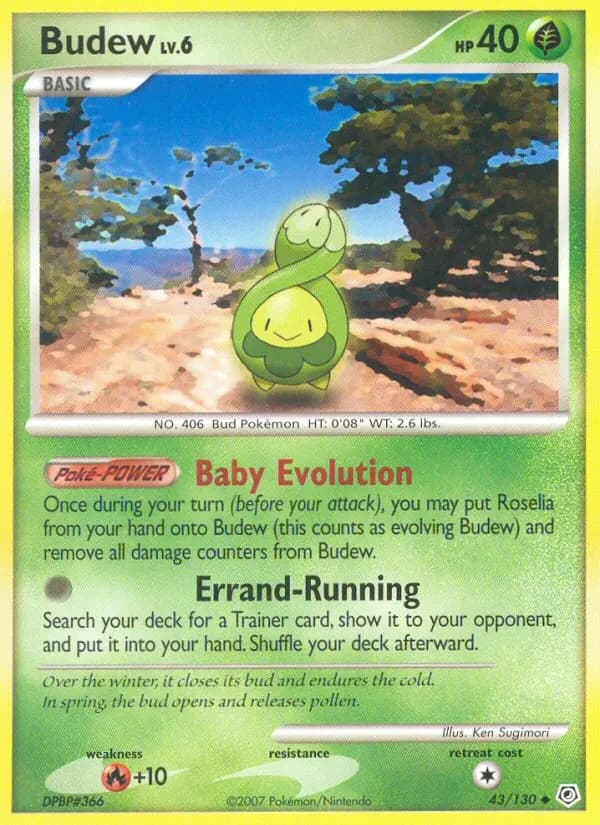
Over the winter, it closes its bud and endures the cold. In spring, the bud opens and releases pollen.
It lives alongside clear ponds. It scatters pollen that induces harsh sneezing and runny noses.
Sensitive to changing temperature, the bud is said to bloom when it feels the sun’s warm touch.
When it feels the sun’s warm touch, it opens its bud to release pollen. It lives alongside clear pools.
Sensitive to changing temperature, the bud is said to bloom when it feels the sun’s warm touch.
Sensitive to changing temperatures, the bud blooms when it’s warm, releasing toxic pollen.
When it feels the sun’s warm touch, it opens its bud to release pollen. It lives alongside clear pools.
Over the winter, it closes its bud and endures the cold. In spring, the bud opens and releases pollen.
When it feels the sun’s warm touch, it opens its bud to release pollen. It lives alongside clear pools.
Over the winter, it closes its bud and endures the cold. In spring, the bud opens and releases pollen.
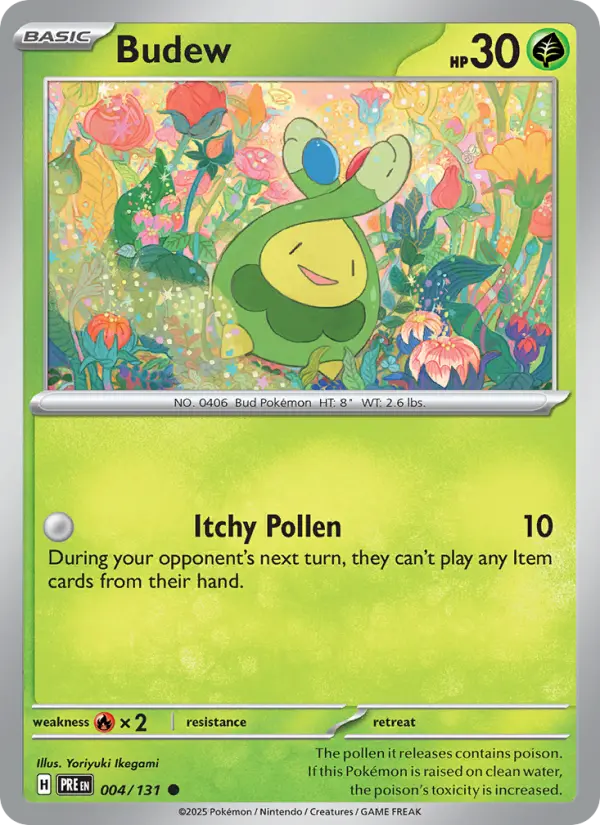
The pollen it releases contains poison. If this Pokémon is raised on clean water, the poison’s toxicity is increased.
This Pokémon is highly sensitive to temperature changes. When its bud starts to open, that means spring is right around the corner.
When the sun's light strengthens, the bud atop this Pokémon's head opens. This is a sign to the people that the harsh winter is over, and the season of budding has begun.
Budew Name Origin & Design Inspiration
The name Budew is a straightforward portmanteau derived from 'bud' and 'dew,' reflecting both its appearance as a budding flower and the moisture associated with morning dew found on plants near water sources. In Japanese, it is called Subomie (スボミー), a combination of 'subomi' (蕾, meaning bud) and the feminine suffix '-ie,' which underscores the feminine qualities often associated with flowers in Japanese naming conventions. The design philosophy behind Budew draws heavily from rose botany, particularly in the two vine-like stems topped with colored spots that evoke the sepals of a partially opened bud. The color scheme—with its yellow face, green bib-like structure, and the contrasting red and blue spots on its vines—creates a visually balanced and appealing design that appeals to both younger audiences and experienced trainers. The stubby yellow feet add an element of endearing vulnerability to the design, emphasizing Budew's status as a baby Pokémon that has yet to develop the gracefulness of its evolutions. The overall aesthetic successfully conveys the concept of a living flower caught at the moment of budding, bridging the gap between botanical accuracy and fantastical Pokémon design sensibilities.
Learnable Moves
Budew can learn 63 moves:
Move | Type | Cat. | Power | Acc. | PP |
|---|---|---|---|---|---|
| absorb | grass | Special | 20 | 100 | 25 |
| attract | normal | Status | — | 100 | 15 |
| bullet seed | grass | Physical | 25 | 100 | 30 |
| captivate | normal | Status | — | 100 | 20 |
| confide | normal | Status | — | — | 20 |
| cotton spore | grass | Status | — | 100 | 40 |
| covet | normal | Physical | 60 | 100 | 25 |
| cut | normal | Physical | 50 | 95 | 30 |
| dazzling gleam | fairy | Special | 80 | 100 | 10 |
| double team | normal | Status | — | — | 15 |
| endure | normal | Status | — | — | 10 |
| energy ball | grass | Special | 90 | 100 | 10 |
| extrasensory | psychic | Special | 80 | 100 | 20 |
| facade | normal | Physical | 70 | 100 | 20 |
| flash | normal | Status | — | 100 | 20 |
| frustration | normal | Physical | — | 100 | 20 |
| giga drain | grass | Special | 75 | 100 | 10 |
| grass knot | grass | Special | — | 100 | 20 |
| grass whistle | grass | Status | — | 55 | 15 |
| grassy glide | grass | Physical | 55 | 100 | 20 |
| growth | normal | Status | — | — | 20 |
| hidden power | normal | Special | 60 | 100 | 15 |
| leaf storm | grass | Special | 130 | 90 | 5 |
| life dew | water | Status | — | — | 10 |
| mega drain | grass | Special | 40 | 100 | 15 |
| mind reader | normal | Status | — | — | 5 |
| mud slap | ground | Special | 20 | 100 | 10 |
| natural gift | normal | Physical | — | 100 | 15 |
| nature power | normal | Status | — | — | 20 |
| petal dance | grass | Special | 120 | 100 | 10 |
| pin missile | bug | Physical | 25 | 95 | 20 |
| poison jab | poison | Physical | 80 | 100 | 20 |
| poison powder | poison | Status | — | 75 | 35 |
| poison sting | poison | Physical | 15 | 100 | 35 |
| protect | normal | Status | — | — | 10 |
| psych up | normal | Status | — | — | 10 |
| rain dance | water | Status | — | — | 5 |
| razor leaf | grass | Physical | 55 | 95 | 25 |
| rest | psychic | Status | — | — | 5 |
| return | normal | Physical | — | 100 | 20 |
| round | normal | Special | 60 | 100 | 15 |
| secret power | normal | Physical | 70 | 100 | 20 |
| seed bomb | grass | Physical | 80 | 100 | 15 |
| shadow ball | ghost | Special | 80 | 100 | 15 |
| sleep powder | grass | Status | — | 75 | 15 |
| sleep talk | normal | Status | — | — | 10 |
| sludge bomb | poison | Special | 90 | 100 | 10 |
| snore | normal | Special | 50 | 100 | 15 |
| solar beam | grass | Special | 120 | 100 | 10 |
| spikes | ground | Status | — | — | 20 |
| stun spore | grass | Status | — | 75 | 30 |
| substitute | normal | Status | — | — | 10 |
| sunny day | fire | Status | — | — | 5 |
| swagger | normal | Status | — | 85 | 15 |
| swift | normal | Special | 60 | — | 20 |
| swords dance | normal | Status | — | — | 20 |
| synthesis | grass | Status | — | — | 5 |
| toxic | poison | Status | — | 90 | 10 |
| uproar | normal | Special | 90 | 100 | 10 |
| venoshock | poison | Special | 65 | 100 | 10 |
| water sport | water | Status | — | — | 15 |
| weather ball | normal | Special | 50 | 100 | 10 |
| worry seed | grass | Status | — | 100 | 10 |
Budew Competitive Battle Guide
In competitive Pokémon play, Budew occupies a niche role typically limited to Little Cup formats where baby Pokémon are the focus, as its overall stat sum of 280 makes it severely underpowered against fully-evolved Pokémon in standard competitive environments. Within Little Cup specifically, Budew's distribution of stats—with emphasis on Special Defense (70) and Special Attack (50)—allows it to function as a specially defensive support Pokémon that can switch into special attacks and provide utility through moves like Synthesis, Growth, and Grass Whistle. Its dual Grass/Poison typing grants several valuable resistances, particularly to Water, Electric, Grass, and Fairy types, though it suffers from significant weaknesses to common offensive types like Fire, Flying, Psychic, and Ice. The ability Natural Cure provides utility by removing major status ailments upon switching out, making it valuable for teams needing status management, while Poison Point offers a 30% chance to poison attacking Pokémon on contact, creating a passive defensive pressure. However, Budew's extremely low Attack (30) and moderate Speed (55) mean it struggles to threaten opponents offensively, relegating it primarily to defensive and supportive roles. Its Hidden Ability Leaf Guard grants protection from major status ailments during sunny weather, enabling sun-based team strategies, though this competes with sun-dependent sweepers for limited weather turns.
Commonly Asked Questions About Budew
What type is Budew?
Budew is a grass and poison type Pokemon.
What does Budew evolve into?
Budew evolves into roselia, then into roserade.
What are Budew's weaknesses?
Budew is weak to flying, fire, psychic and ice type moves.
Does Budew evolve by trading?
No — Budew evolves entirely through leveling up, with no trade required at any stage.
Where can I find Budew?
Budew can be found in great marsh (sinnoh), sinnoh route 212 (sinnoh) and sinnoh route 204 (sinnoh) and 6 other locations.
Budew Cultural Impact & Franchise History
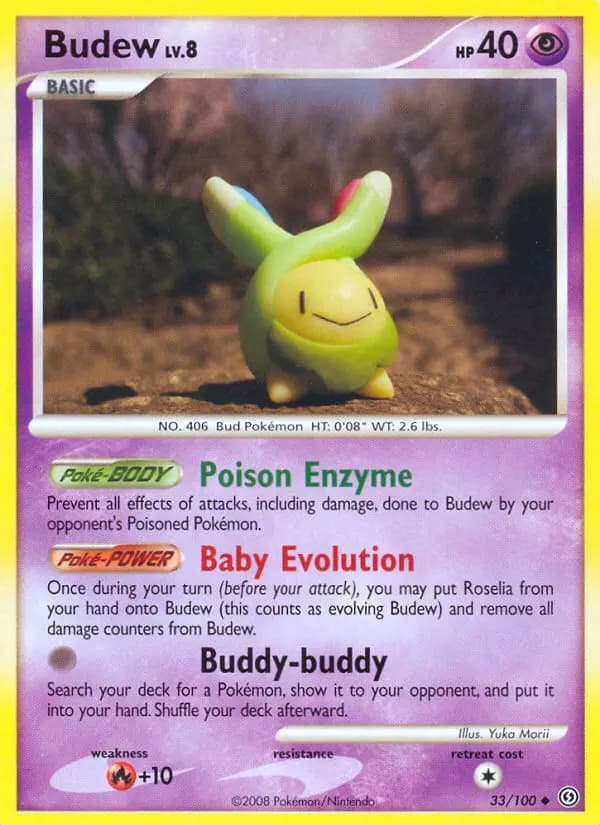
Budew has achieved notable cultural recognition as one of Generation IV's most appealing baby Pokémon, featured prominently in the Pokémon anime series through memorable appearances, most notably as a main team member of the Sinnoh coordinator Nando. The species' role as a herald of spring in Pokédex entries has resonated with players, making it thematically significant in seasonal events and promotional materials across multiple Pokémon games. In the trading card game, Budew has received numerous card illustrations that showcase its delicate flower design, with artists often emphasizing its cute aesthetic to appeal to collectors who favor baby Pokémon. The Pokédex entries describing how Budew's bud opening signals the arrival of spring have inspired fan art and creative interpretations that blend real-world botany with Pokémon lore, creating content that celebrates the intersection of nature and the franchise. Budew's inclusion in Pokédex photo mode experiences in recent games has made it a favorite subject for in-game photographers who appreciate its photogenic qualities and botanical charm. The evolution line from Budew to Roselia to Roserade has become iconic among Grass-type enthusiasts, with many trainers maintaining entire teams centered around this line due to its elegant design progression and solid competitive viability in its final form.
Where to Find Budew in Every Pokémon Game
Budew's availability has been consistent across numerous Pokémon games since its introduction in Generation IV, with the species appearing as a wild encounter in early-game areas of multiple regions. In the original Sinnoh region games (Diamond, Pearl, and Platinum), Budew can be encountered in specific locations such as the Valley Windworks and Floaroma Town area, making it accessible early in the player's adventure. The species maintains availability in subsequent generations including Black 2/White 2, X/Y (particularly in Central Kalos), Omega Ruby/Alpha Sapphire, Sword/Shield, Brilliant Diamond/Shining Pearl, and Legends: Arceus, ensuring that most players have opportunities to capture or obtain it. Its exceptionally high catch rate of 255 means trainers can reliably capture Budew with basic Poké Balls, even without applying status conditions or damage reduction, making it one of the most easily obtainable Pokémon in any game where it appears. Event distributions have occasionally featured Budew with special movesets or enhanced IVs, providing alternative acquisition methods for competitive players seeking optimal specimens. In Pokémon Go, Budew was introduced with limited availability, typically appearing during spring-themed events, allowing mobile players to experience this seasonal Pokémon within that platform. The consistent availability across games and platforms, combined with its high catch rate and early-game appearances, makes Budew one of the most accessible baby Pokémon for new players seeking to begin their journey with a Grass-type companion.