Burmy
Generation IV · #0412 — Bagworm Pokémon
Burmy measures in at 0.2 m and 3.4 kg, a build that matches its shed skin ability better than it matches raw offense or defense. This diminutive creature stands just 0.2 meters tall and weighs a mere 3.4 kilograms, making it one of the tiniest Pokémon in existence. Despite its small stature and modest total stat allocation of 224, Burmy serves as a fascinating example of how Pokémon evolution can branch in dramatically different directions, as it evolves into either the defensive Wormadam or the swift Mothim depending on its gender, with its current cloak form determining the permanent appearance of its female evolution.
Editor's Take
Burmy's cloak changing based on where it last battled, and that determining Wormadam's typing permanently, is one of the more genuinely inventive evolution mechanics in the series.
Base Stats
Height
0.2m
Weight
3.4kg
Category
Bagworm Pokémon
Gender
Male 50% / Female 50%
Color
green
Shape
blob
Abilities
Has a 33% chance of curing any major status ailment after each turn.
Protects against damage from weather.
Burmy Biology & Physical Characteristics
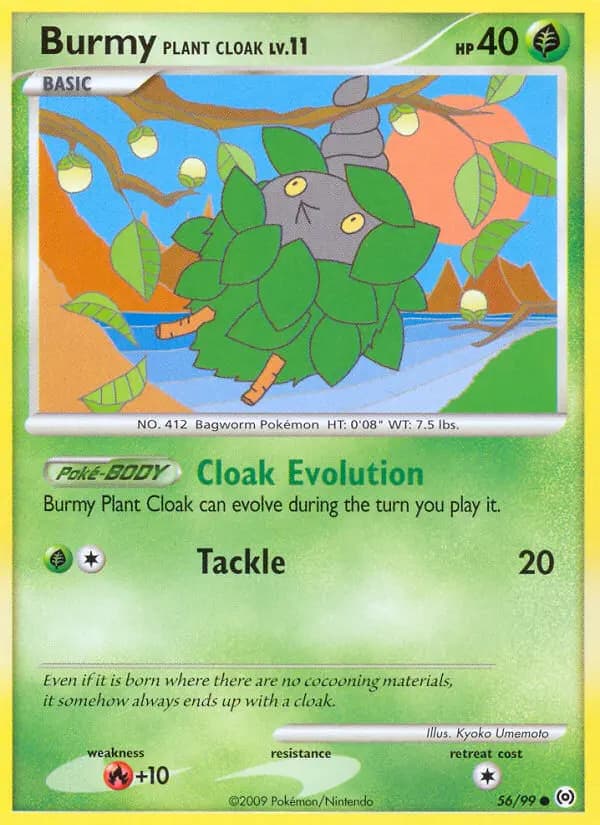
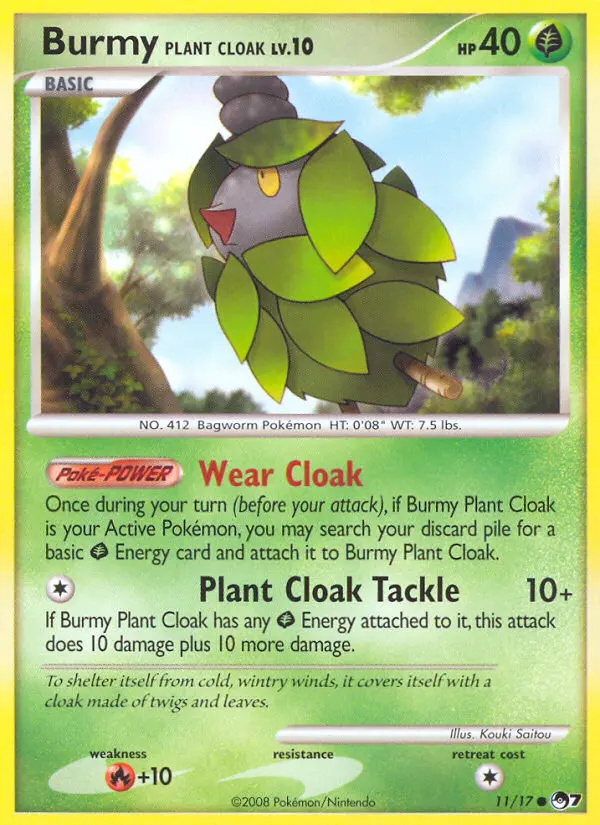
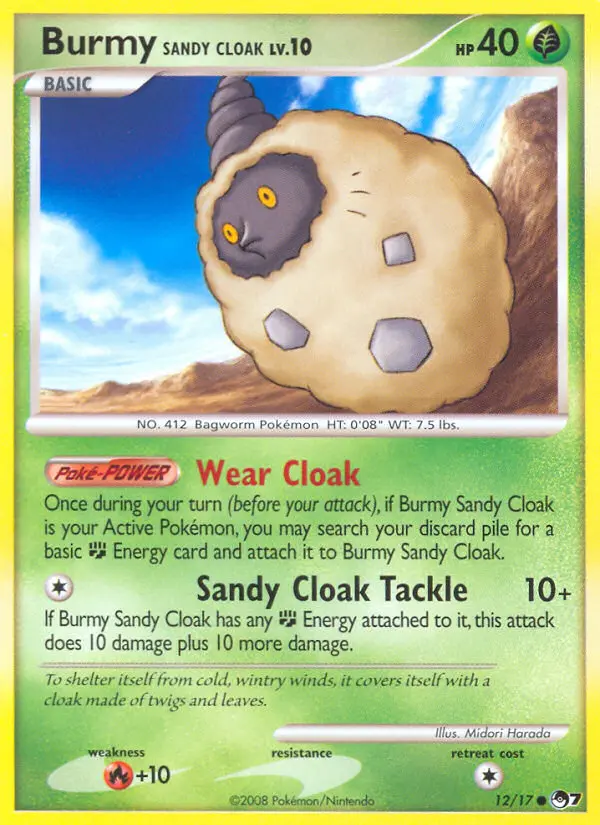
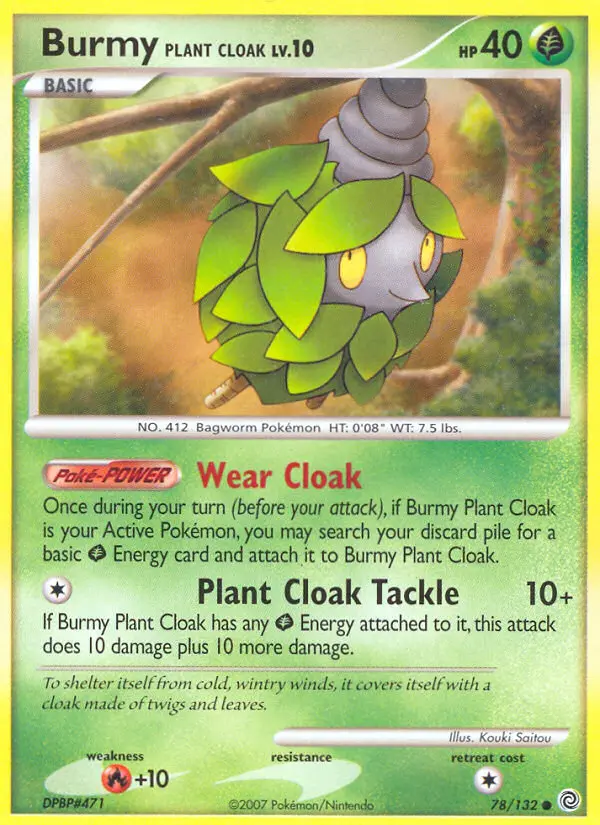
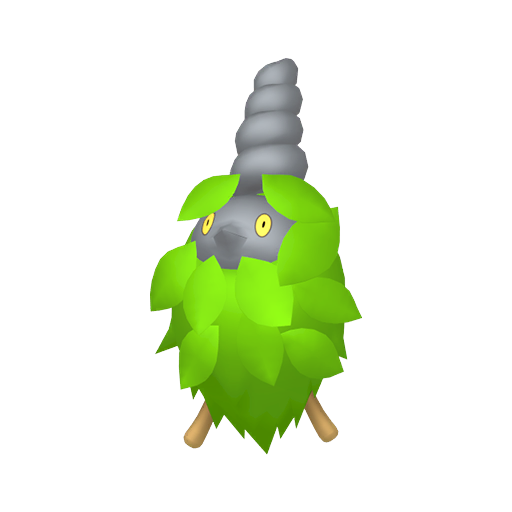
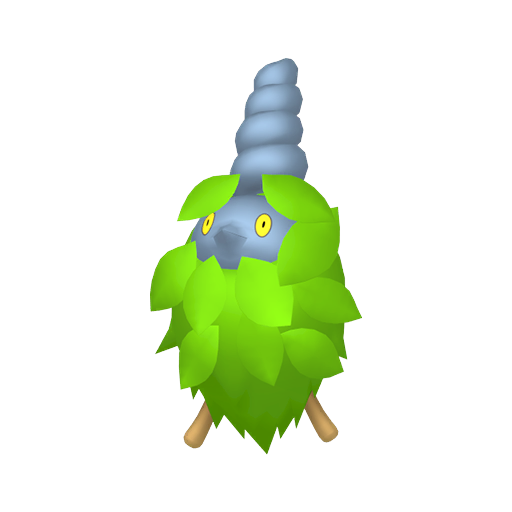
Burmy possesses a distinctive segmented body structure characteristic of larval Pokémon, featuring a black exoskeleton with a distinctive coiled antenna extending from its head. Beneath its protective cloak—which varies depending on environmental exposure—Burmy's body reveals six stubby legs: the first two pairs are black while the rear pair displays a yellow coloration, along with two white spots adorning its cheeks. The plant cloak form, which is the subject of this entry, consists of twigs and leaves woven together into an effective protective layer. Unlike its Sandy Cloak and Trash Cloak variants, the plant cloak form provides a naturalistic appearance that blends seamlessly with forest environments. The cloak itself is not merely decorative but serves critical thermoregulatory functions; Pokédex entries reveal that Burmy covers itself with its cloak to shelter from cold, wintry winds, and notably, when conditions become hot, the cloak becomes noticeably thinner to allow better heat dissipation. Remarkably, even if born in environments devoid of cocooning materials, Burmy somehow always manages to construct a cloak, suggesting an instinctive biological imperative.
Pokedex Numbers
Training
Breeding
Burmy Breeding, Gender Ratio & Egg Groups
Burmy exhibits a perfectly balanced gender ratio with 50% male and 50% female distribution, providing equal statistical probability for obtaining either gender during breeding or wild encounters. The gender difference carries profound gameplay implications: female Burmy that evolve into Wormadam become permanently locked into their current cloak form's corresponding Wormadam variant, while male Burmy evolve into Mothim regardless of cloak form, making the cloak choice irrelevant for males. This creates an interesting breeding dynamic where trainers seeking specific Wormadam forms must either breed multiple female Burmy in different environments or carefully plan their training routes to expose females to the desired habitat before level 20 evolution. The species belongs to the Bug egg group, meaning it can only breed with other Bug-type Pokémon or creatures in compatible egg groups, limiting breeding options somewhat. With a base friendship value of 70, Burmy demonstrates moderate natural affability that increases breeding happiness and egg-hatching speed, encouraging trainers to maintain good treatment of breeding specimens. The 15-egg cycle hatch counter translates to approximately 3,599 to 3,855 steps required to hatch Burmy from an egg, a reasonable timeframe that makes breeding economically viable for players seeking optimal individuals. Understanding these breeding mechanics is crucial for competitive trainers planning to obtain female Wormadam with specific cloak forms and optimal individual values.
Sprites




TMs & HMs
tm07
lets go pikachu lets go eevee
tm10
black white
tm10
colosseum
tm10
emerald
tm10
firered leafgreen
tm10
xd
tm10
gold silver
tm10
heartgold soulsilver
tm10
ruby sapphire
tm10
diamond pearl
tm182
scarlet violet
tm10
black 2 white 2
tm10
crystal
tm10
omega ruby alpha sapphire
tm10
sun moon
tm07
scarlet violet
tm10
platinum
tm10
x y
tm10
ultra sun ultra moon
tm13
gold silver
+29 more TMs/HMs
Forms
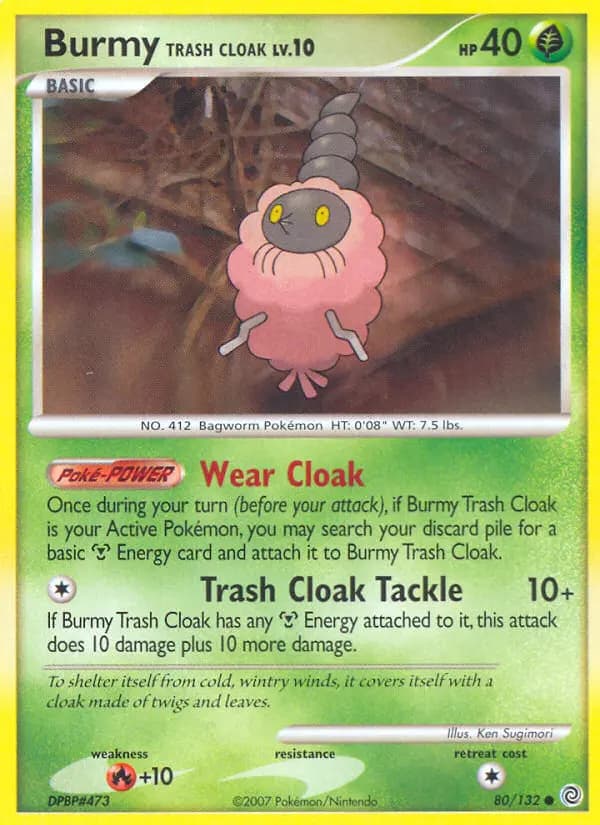
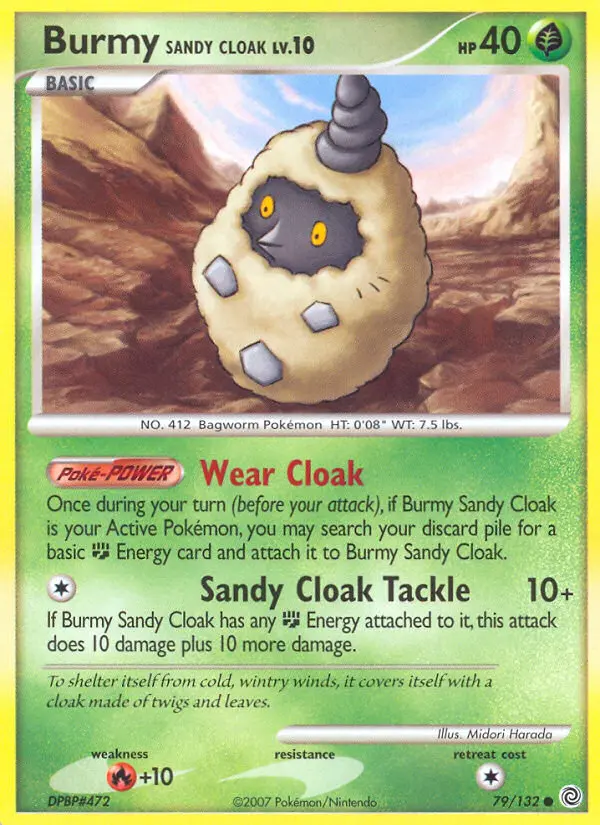
plantDefault sandy
sandy trash
trashBurmy's Evolution Chain


Burmy Evolution, Mega Evolution & Special Forms
Burmy's evolution at level 20 represents one of the most fascinating gender-based divergences in Pokémon evolution, creating a permanent split in developmental paths. Female Burmy evolve into Wormadam, with the current cloak form dictating the permanent form of the evolved Pokémon—a plant-cloaked Burmy becomes Plant Cloak Wormadam, fundamentally cementing the environmental exposure at the moment of evolution into the Pokémon's fixed appearance. Male Burmy, conversely, evolve into Mothim, a significantly different Pokémon that abandons the cloak entirely and transforms into a flying-type moth-like creature, representing a complete morphological restructuring. This evolutionary branching creates strategic depth, as trainers must carefully consider which gender Burmy they train and what environments they battle in before reaching level 20, since female Wormadam's form is permanently locked. The plant cloak form is particularly valued by trainers seeking a Wormadam with strong defensive capabilities in Special Defense, as this form specializes in that particular stat. The evolutionary chain demonstrates the remarkable diversity possible within a single Pokémon species, with the environmental responsive nature of Burmy creating multiple viable strategies depending on intended final form and competitive objectives.
Where to Find
Kalos Route 3
kalos
Burmy Behaviour and Natural Habitat
Burmy demonstrates remarkable behavioral plasticity in response to environmental conditions, constantly adapting its cloak composition based on the location of its most recent battle. This adaptive behavior reflects an evolutionary strategy focused on camouflage and environmental harmony rather than aggressive confrontation. The species is particularly adept at rapidly remaking its cloak when battle damage occurs, utilizing nearby materials to restore its protective covering. In the anime series, notably in the episode 'Some Enchanted Sweetening!', Burmy has demonstrated the ability to uncoil its head antenna and use it as a weapon against opponents, revealing capabilities beyond its defensive demeanor. The plant cloak variant specifically suggests a preference for forest and grassland habitats where twigs and leaves are abundantly available. Burmy's base happiness value of 70 indicates a naturally docile and relatively friendly disposition, making it suitable for trainers seeking Pokémon with cooperative temperaments. Despite its weak offensive capabilities, with base Attack and Special Attack both sitting at only 29, Burmy compensates through defensive resilience, with balanced Defense and Special Defense stats of 45 each, allowing it to endure attacks while relying on status protection rather than offense.
Pokedex Entries
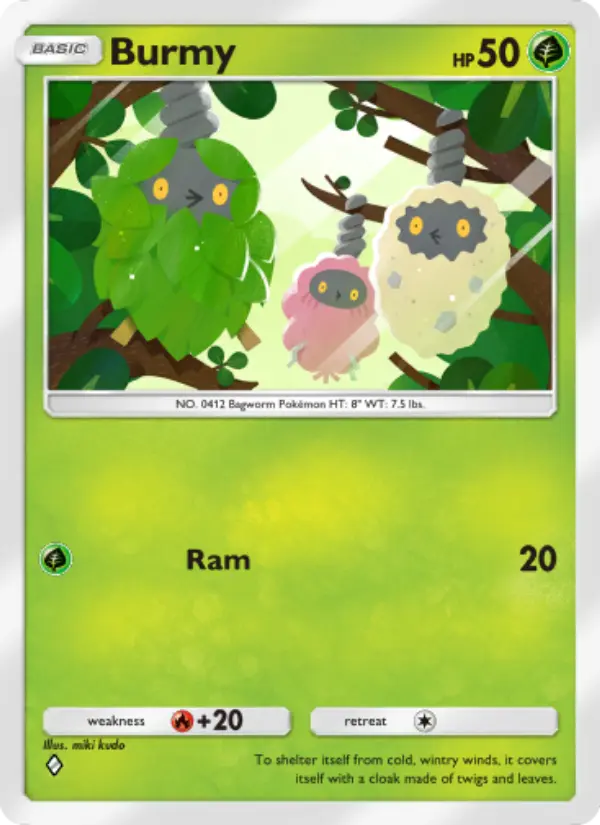
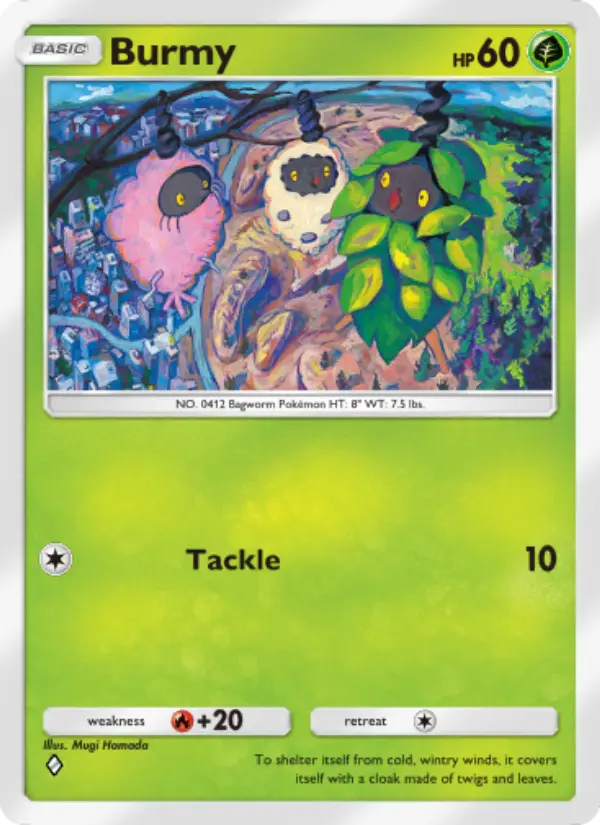
To shelter itself from cold, wintry winds, it covers itself with a cloak made of twigs and leaves.
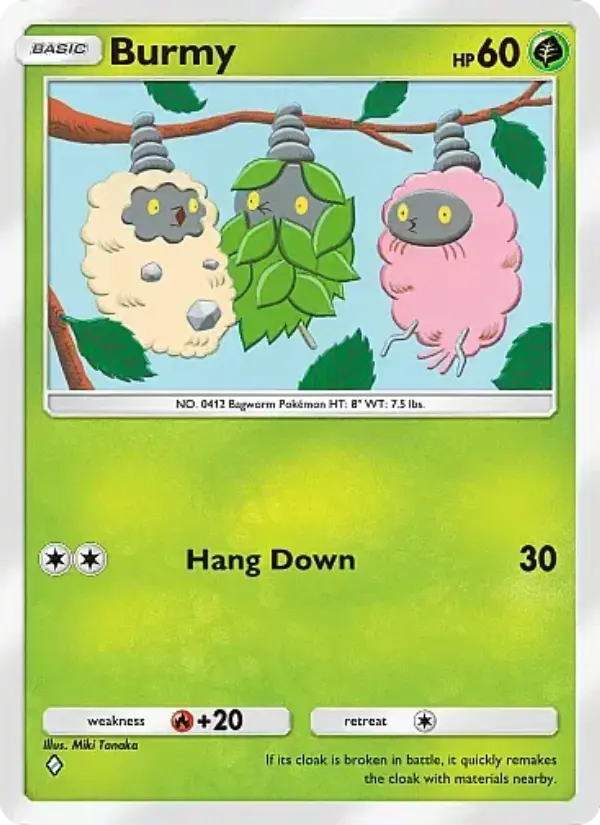
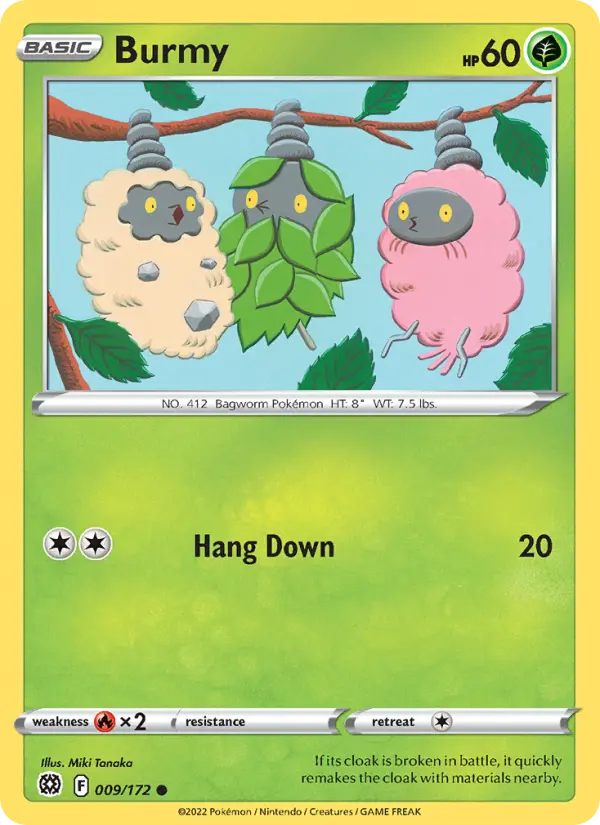
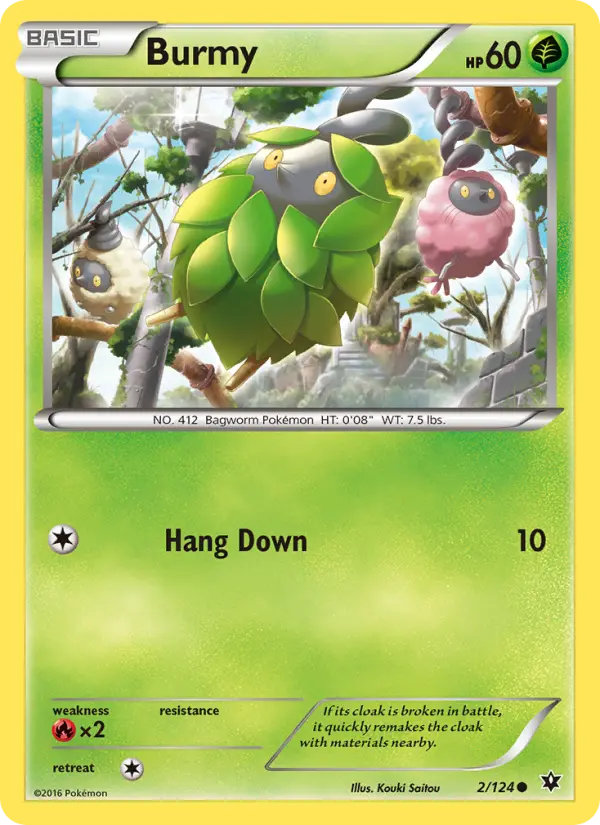
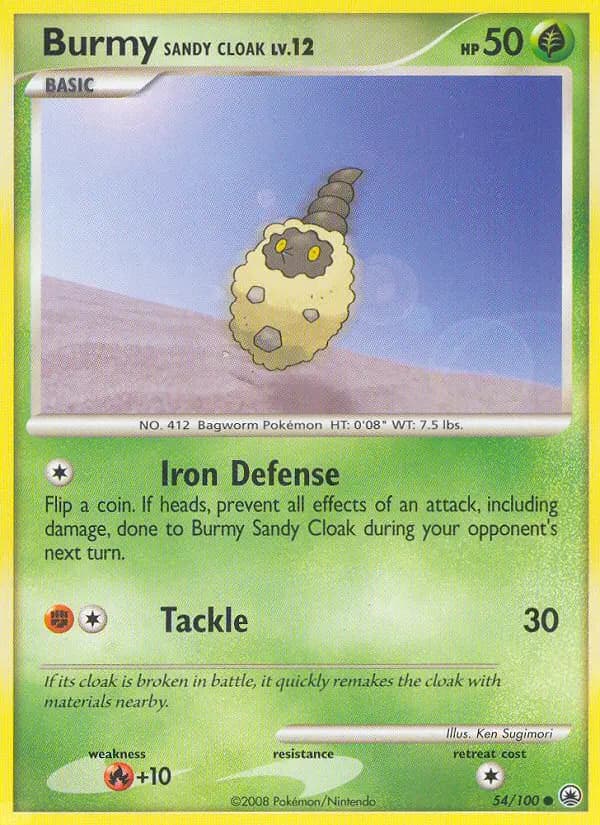
If its cloak is broken in battle, it quickly remakes the cloak with materials nearby.
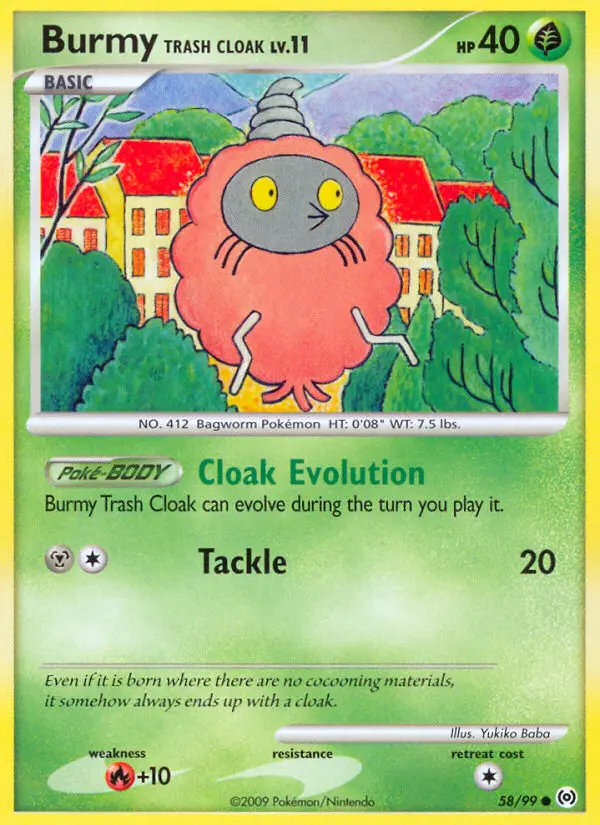
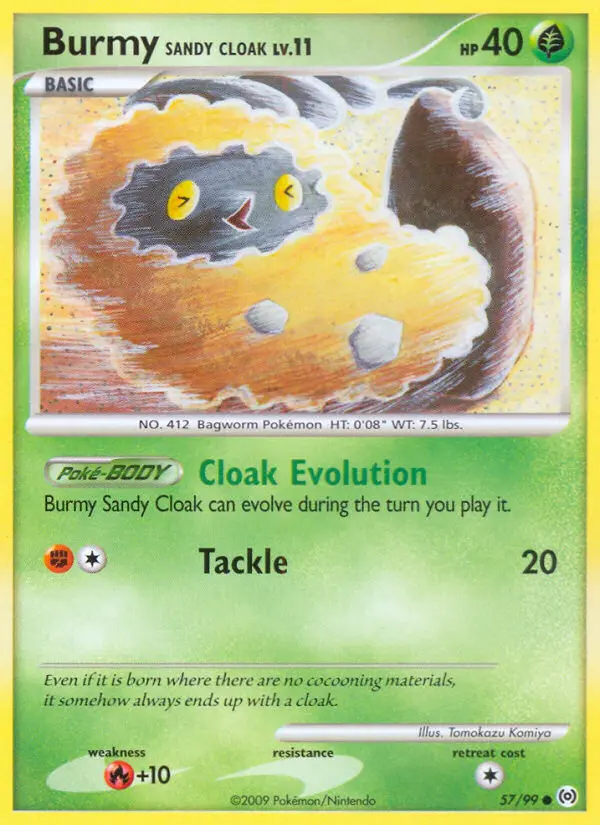
Even if it is born where there are no cocooning materials, it somehow always ends up with a cloak.
It covers itself with a cloak to shelter from the cold. When it’s hot, its cloak is thinner.
Even if it is born where there are no cocooning materials, it somehow always ends up with a cloak.
Even if it is born where there are no cocooning materials, it somehow always ends up with a cloak.
To shelter itself from cold, wintry winds, it covers itself with a cloak made of twigs and leaves.
If its cloak is broken in battle, it quickly remakes the cloak with materials nearby.
To shelter itself from cold, wintry winds, it covers itself with a cloak made of twigs and leaves.
If its cloak is broken in battle, it quickly remakes the cloak with materials nearby.
If its cloak is even slightly damaged, Burmy will immediately repair it with whatever is close at hand. The Pokémon within the cloak is scrawny and vulnerable to the cold.
Burmy Name Origin & Design Inspiration
Burmy's Japanese name, Minomucchi, derives from 'mino' meaning raincoat or cloak, combined with 'mucchi,' reflecting its characteristic cloak-wearing nature. The English designation 'Burmy' cleverly blends 'burrow' with the suffix 'my' or references the 'burlap' material concept, emphasizing its use of found materials for protection. The plant cloak variant draws inspiration from real-world bagworms, insects that construct protective cases from plant material, silk, and debris—a direct biological parallel that grounds Burmy's design in nature. The three distinct cloak forms represent a fascinating design choice that ties gameplay mechanics directly to biological realism; just as real bagworms use available environmental materials, Burmy's forms reflect its habitat exposure. The design philosophy emphasizes vulnerability and adaptation rather than predatory prowess, with the cloak serving as both visual identifier and mechanical representation of environmental interaction. The Bagworm Pokémon classification acknowledges this real-world parallel explicitly, establishing Burmy as a creature designed to embody the adaptability and resourcefulness of actual arthropods. The appearance of twigs and leaves in the plant form creates a visually appealing contrast between the organic materials and Burmy's shiny black segmented body, making it immediately recognizable and thematically cohesive with forest environments.
Learnable Moves
Burmy Competitive Battle Guide
From a competitive standpoint, Burmy occupies an extremely niche role as a pre-evolution that most competitive players skip entirely in favor of its evolutions, particularly Wormadam in defensive formats. However, Burmy's abilities deserve attention for strategic applications: Shed Skin provides a 33% chance to cure any major status ailment after each turn, offering unpredictable protection against strategies relying on burns, paralysis, poison, or sleep, while the hidden ability Overcoat provides consistent protection against weather-based damage from hail, sandstorm, and similar conditions. With only 224 base stat points distributed heavily toward defensive capabilities—Defense and Special Defense both at 45 compared to offensive stats of 29—Burmy functions purely as a defensive wall if employed competitively, though its low HP of 40 severely limits its practical bulkiness. The plant cloak form receives a modest Special Defense EV yield of 1, making it marginally superior for special wall applications compared to other forms. Burmy's movepool remains restricted, learning basic Bug-type moves like Tackle and String Shot early, with access to Protect through TM usage providing essential competitive utility for prediction plays. Realistically, competitive usage of Burmy is restricted to novelty teams, Little Cup formats where unevolved Pokémon compete on equal footing, or strategic surprise value, as trainers would almost universally evolve Burmy to Wormadam or Mothim for their substantially superior stat distributions and expanded movepool options.
Commonly Asked Questions About Burmy
What type is Burmy?
Burmy is a bug type Pokemon.
What does Burmy evolve into?
Burmy evolves into wormadam-plant, then into mothim.
What are Burmy's weaknesses?
Burmy is weak to flying, rock and fire type moves.
Does Burmy evolve by trading?
No — Burmy evolves entirely through leveling up, with no trade required at any stage.
Where can I find Burmy?
Burmy can be found in kalos route 3 (kalos).
Burmy Cultural Impact & Franchise History
Burmy achieved moderate cultural prominence through the Pokémon Diamond and Pearl animated series, featuring prominently in episodes like 'Some Enchanted Sweetening!' where the character Cheryl uses Burmy as a core team member. The species garnered attention for its unique cloak-changing mechanics, which impressed audiences and demonstrated the franchise's commitment to creative, environmentally-responsive design elements that went beyond simple stat differentiation. The bagworm inspiration resonated with players interested in Pokémon designs grounded in real biology, establishing Burmy as a gateway Pokémon for those fascinated by how real insects function. Among competitive and casual communities, Burmy became recognized as an excellent early-game capture option in Generation IV games, providing accessible Bug-type advantages during the early Sinnoh campaign. The existence of three distinct forms created collectibility appeal, as players sought to capture or breed Burmy in different environments to complete form variations, encouraging extended gameplay and environmental exploration. Burmy's design influenced subsequent Pokémon generations' approach to form variation, demonstrating that cosmetic differences could serve both biological and mechanical narrative purposes simultaneously. While Burmy itself never achieved the mainstream popularity of generational flagships, its evolutionary line—particularly the impressive Mothim—became beloved among players appreciating the dramatic transformation between genders.
Where to Find Burmy in Every Pokémon Game
Burmy's availability varies significantly across Pokémon generations and game versions, with primary encounters occurring in Pokémon Diamond, Pearl, and Platinum where it was introduced. In Diamond and Pearl, Burmy appears in several locations including Eterna Forest and Route 205, with encounter rates favoring areas with abundant vegetation for plant cloak acquisition. Players can capture Burmy with relative ease given its high catch rate of 120, requiring roughly 15-17% success rate with a standard Poké Ball when at full health. In Platinum, availability expands with additional route locations, providing more breeding opportunities for players seeking optimal individuals. The species appears in subsequent generation releases including HeartGold and SoulSilver, Black and White versions, and later games including X and Y where it occupies Central Kalos Pokédex position 44. Notably, Burmy appears in Pokémon Legends: Arceus, where it receives local Pokédex number 43, indicating maintained presence in more recent titles. Breeding remains a viable acquisition method across all generations, with Burmy eggs hatching in 15 cycles from compatible parents. The plant cloak form specifically becomes the default form when breeding, making it the most commonly encountered variant unless players specifically battle in sandy or trash-rich environments before capture. Regional availability differences mean that some players may have limited access to specific cloak variants depending on their game version, encouraging trading between players seeking form-specific Burmy for competitive or collection purposes.