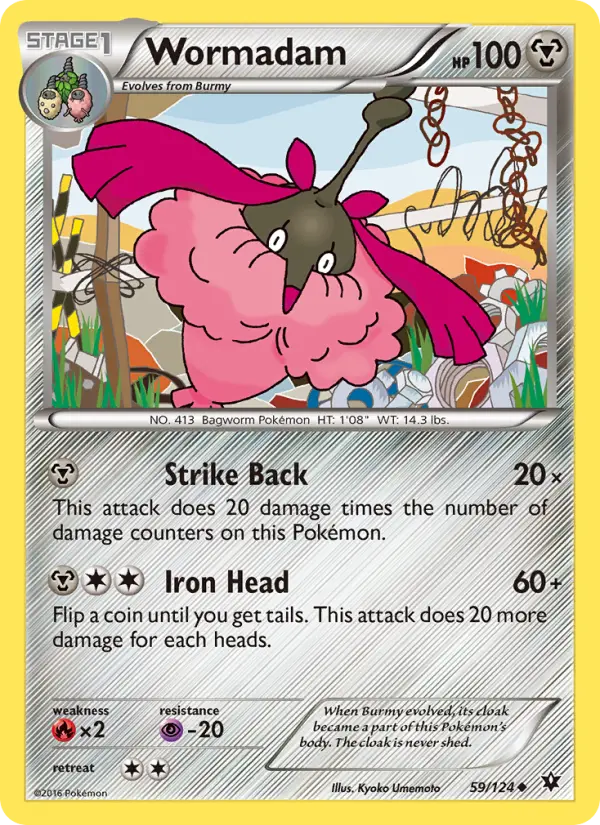
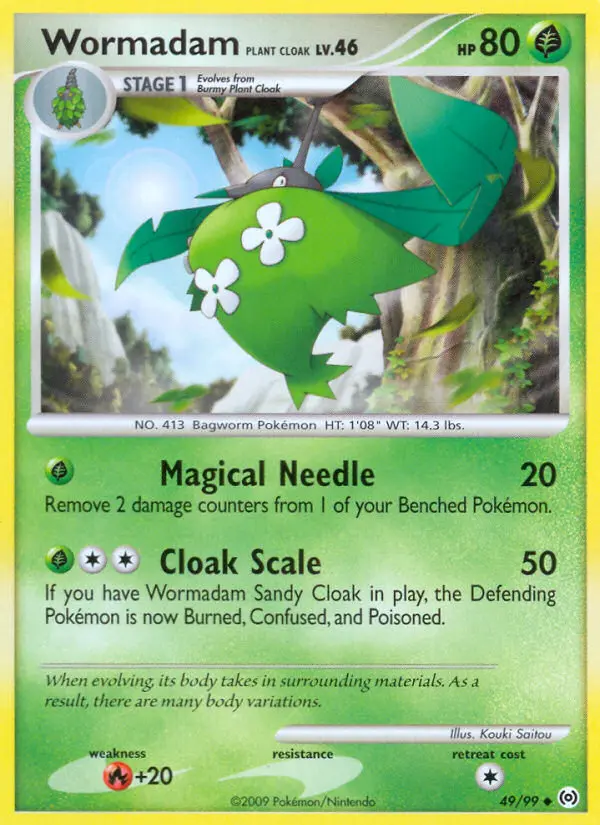
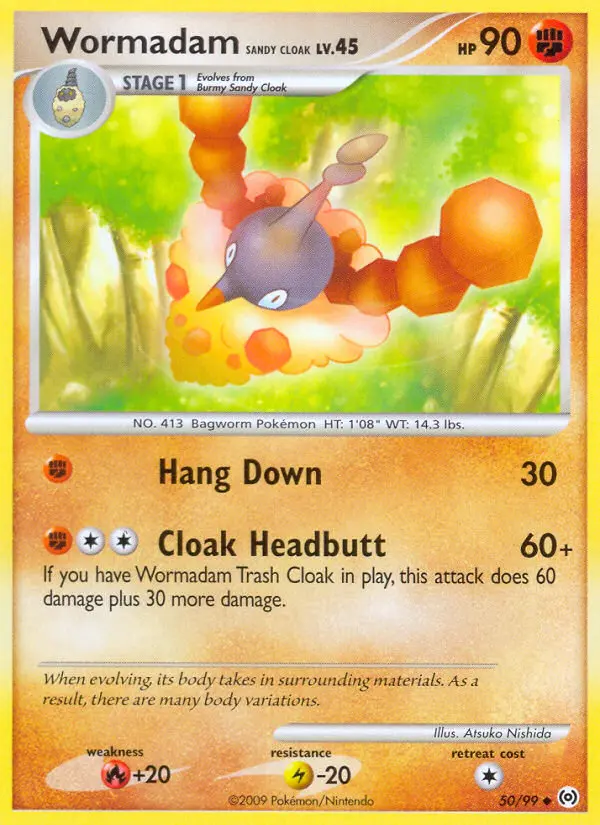
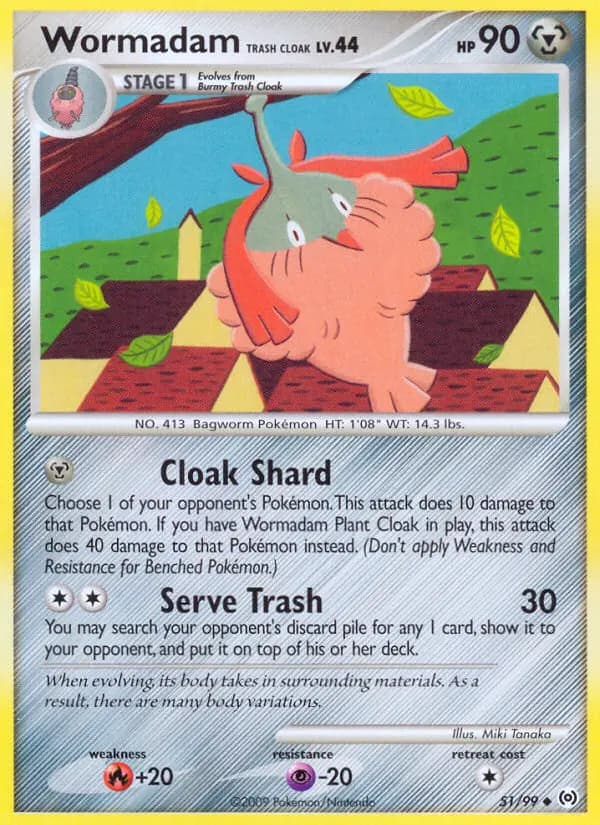
Plant Wormadam
Generation IV · #0413 — Bagworm Pokémon
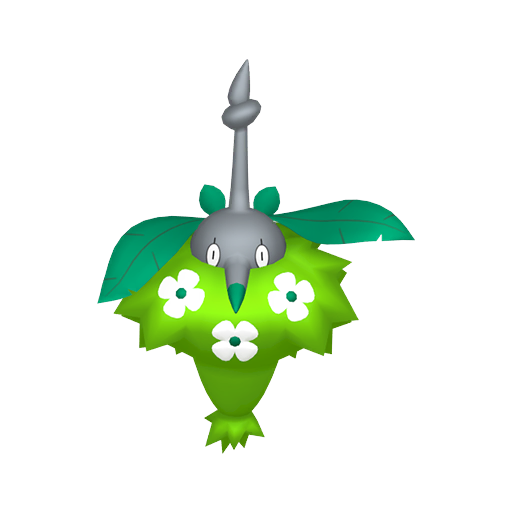
Wormadam-Plant's anticipation ability is the first thing worth knowing about it — everything else, from its bug/grass typing to its build, follows from how that ability gets used. It measures 0.5 m and 6.5 kg, dimensions that pair with that stat lean in noticeable ways. The Plant Cloak variant is the most verdant of Wormadam's three possible forms, characterized by its covering of white flowers and verdant plant matter that completely fuses with its body upon evolution. With a National Pokédex number of #413 and a total base stat of 424, this Bagworm Pokémon represents a specialized defensive tank with exceptional Special Defense (105) and solid Defense (85), though its Speed of 36 makes it one of the slowest bug-type Pokémon available. Its signature ability, Anticipation, provides crucial strategic information by alerting trainers to threatening moves in an opponent's arsenal, while its hidden ability Overcoat offers protection against weather effects.
Editor's Take
Plant Cloak Wormadam is Grass/Bug with 105 base Special Defense, and the fact the male half of this line evolves into a completely different Pokémon is a Gen 4 oddity worth knowing.
Base Stats
Height
0.5m
Weight
6.5kg
Category
Bagworm Pokémon
Gender
100% Female
Color
green
Shape
blob
Abilities
Notifies all trainers upon entering battle if an opponent has a super-effective move, self destruct, explosion, or a one-hit KO move.
Protects against damage from weather.

Plant Wormadam Biology & Physical Characteristics
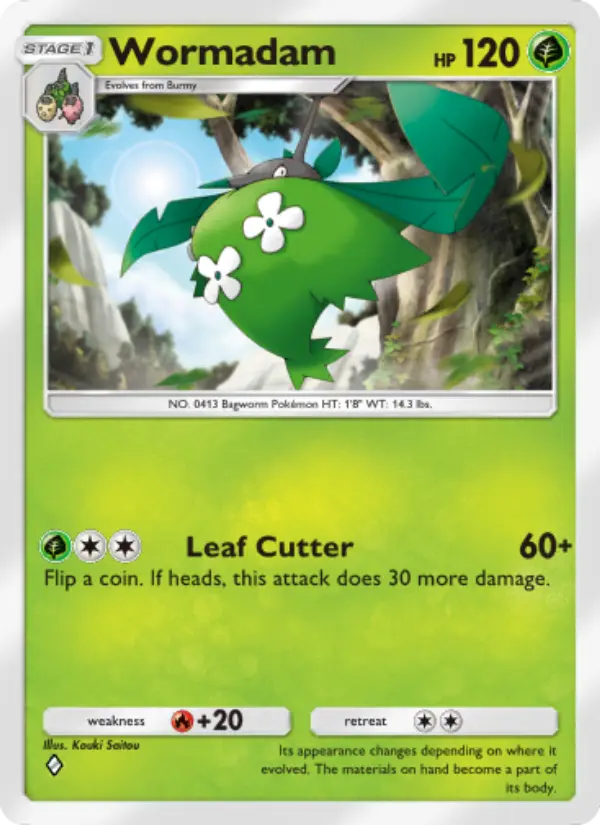
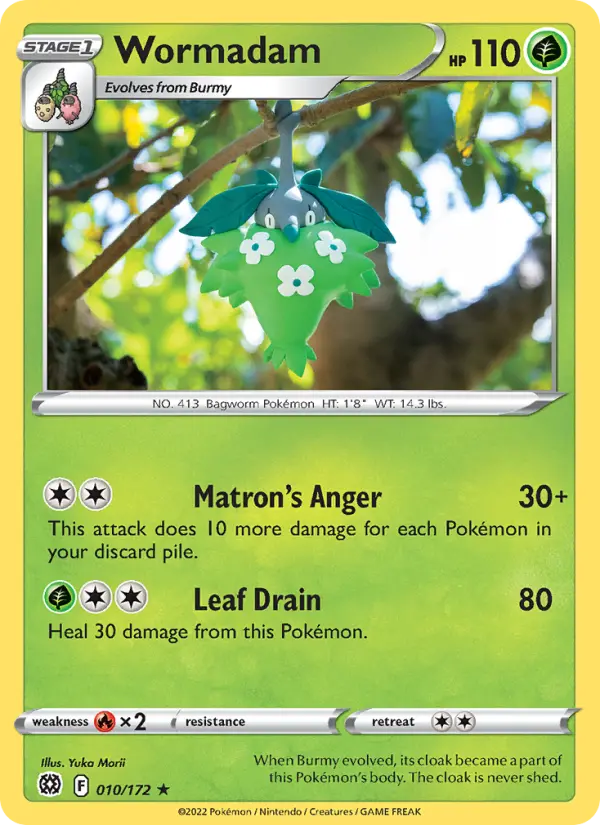
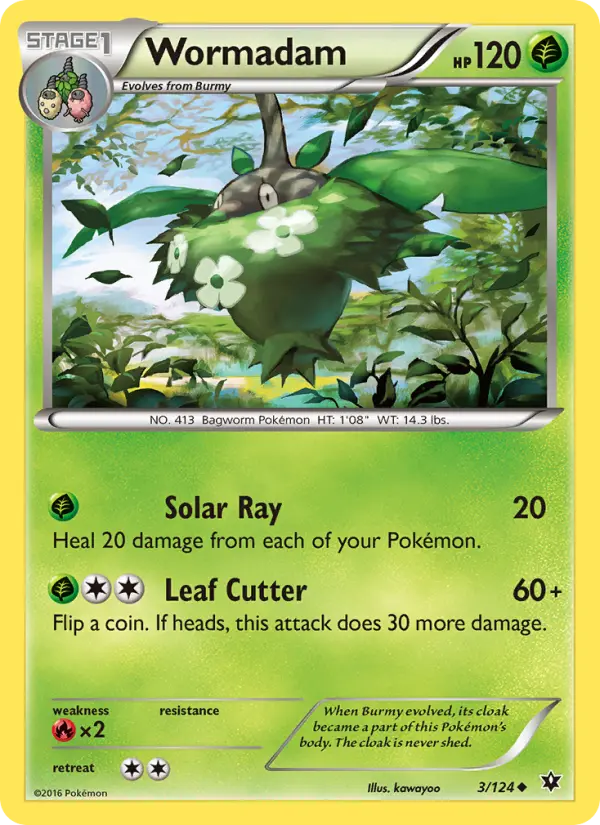
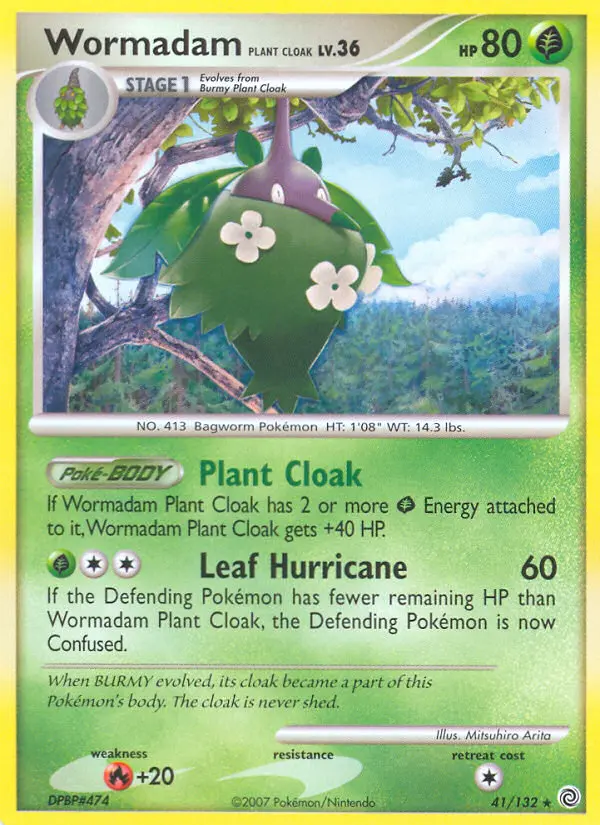
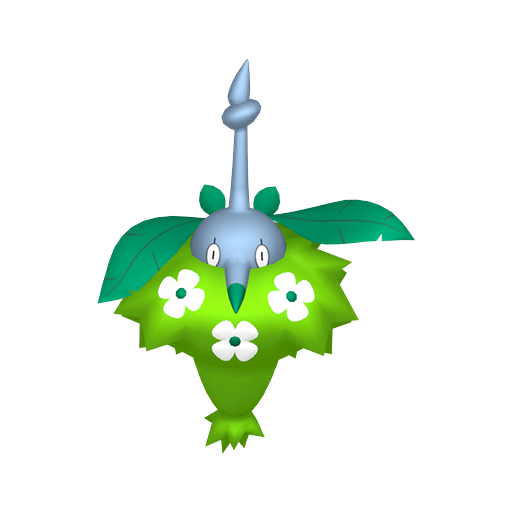
Wormadam (Plant Cloak) is a small, insect-like Pokémon measuring just 0.5 meters (1'08") in height and weighing a modest 6.5 kilograms. Its body structure reveals a black bagworm-like form as the base, upon which layers of flowering plants have become permanently integrated into its exoskeleton. The Plant Cloak form displays several white flowers blooming across its body, creating a striking botanical appearance that distinguishes it from its Sandy and Trash Cloak counterparts. Its design features an oval face with large, expressive eyes and a characteristic pointed beak tipped with coloration that varies depending on the specific cloak form. A long antenna with a distinctively coiled tip extends from its head, and the plant materials form arm-like appendages near the beak region, allowing for limited manipulation of its environment. Unlike its male counterpart Mothim, Wormadam is exclusively female, representing a genetic dimorphism rarely seen in Pokémon evolution lines. The fusion of organic plant matter with the Pokémon's chitinous body is complete and irreversible—Pokédex entries specifically note that the cloak becomes a permanent part of Wormadam's body and is never shed.
Pokedex Numbers
Training
Breeding
Plant Wormadam Breeding, Gender Ratio & Egg Groups
Wormadam (Plant Cloak) is exclusively female, with a 100% female gender ratio that makes it impossible to encounter or breed a male Wormadam under any circumstances. This stands in stark contrast to its pre-evolution Burmy, which has a normal 50/50 gender distribution, and to its male counterpart Mothim, which evolves exclusively from male Burmy. This gender exclusivity creates an interesting breeding dynamic: while Wormadam can be used as a breeding parent, it must be bred with a compatible male Pokémon from the Bug egg group to produce offspring. When Wormadam (Plant Cloak) is bred, the offspring will be Burmy regardless of the male parent's species, and the resulting Burmy will have a 50/50 chance of being male or female, meaning that breeding does not guarantee the production of another Wormadam. The base friendship value of 70 indicates that Wormadam has moderate loyalty and bond-building potential with trainers, making it suitable for affection-based evolutions and gameplay mechanics that reward trainer relationships. The moderate growth rate classified as Medium Fast means Wormadam reaches higher levels at a reasonable pace compared to slower-growing Pokémon, with a base experience yield of 148-159 points per battle depending on the generation, making it a respectable experience source for training other team members.
Sprites




Held Items
Silver Powder
type-enhancement
Held: Bug-Type moves from holder do 20% more damage.
Cost: 1000
Silver Powder
type-enhancement
Held: Bug-Type moves from holder do 20% more damage.
Cost: 1000
Silver Powder
type-enhancement
Held: Bug-Type moves from holder do 20% more damage.
Cost: 1000
Silver Powder
type-enhancement
Held: Bug-Type moves from holder do 20% more damage.
Cost: 1000
Silver Powder
type-enhancement
Held: Bug-Type moves from holder do 20% more damage.
Cost: 1000
Silver Powder
type-enhancement
Held: Bug-Type moves from holder do 20% more damage.
Cost: 1000
Silver Powder
type-enhancement
Held: Bug-Type moves from holder do 20% more damage.
Cost: 1000
Silver Powder
type-enhancement
Held: Bug-Type moves from holder do 20% more damage.
Cost: 1000
Silver Powder
type-enhancement
Held: Bug-Type moves from holder do 20% more damage.
Cost: 1000
Silver Powder
type-enhancement
Held: Bug-Type moves from holder do 20% more damage.
Cost: 1000
Silver Powder
type-enhancement
Held: Bug-Type moves from holder do 20% more damage.
Cost: 1000
Silver Powder
type-enhancement
Held: Bug-Type moves from holder do 20% more damage.
Cost: 1000
Silver Powder
type-enhancement
Held: Bug-Type moves from holder do 20% more damage.
Cost: 1000
Silver Powder
type-enhancement
Held: Bug-Type moves from holder do 20% more damage.
Cost: 1000
Silver Powder
type-enhancement
Held: Bug-Type moves from holder do 20% more damage.
Cost: 1000
Silver Powder
type-enhancement
Held: Bug-Type moves from holder do 20% more damage.
Cost: 1000
Silver Powder
type-enhancement
Held: Bug-Type moves from holder do 20% more damage.
Cost: 1000
TMs & HMs
tm05
lets go pikachu lets go eevee
tm06
yellow
tm06
gold silver
tm06
red blue
tm06
crystal
tm06
emerald
tm06
firered leafgreen
tm06
diamond pearl
tm06
platinum
tm06
ruby sapphire
tm06
colosseum
tm06
black 2 white 2
tm06
xd
tm06
black white
tm06
heartgold soulsilver
tm06
omega ruby alpha sapphire
tm06
ultra sun ultra moon
tm06
sun moon
tm06
x y
tm06
red green japan
+567 more TMs/HMs
Regional & Special Forms
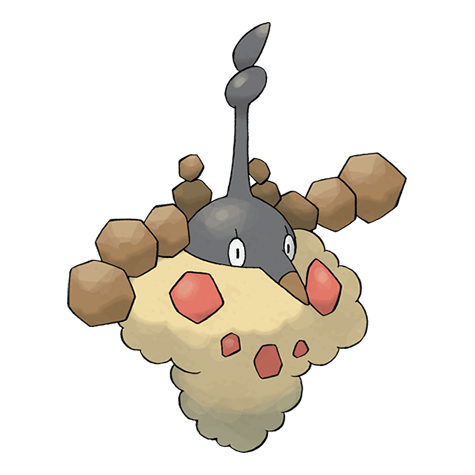
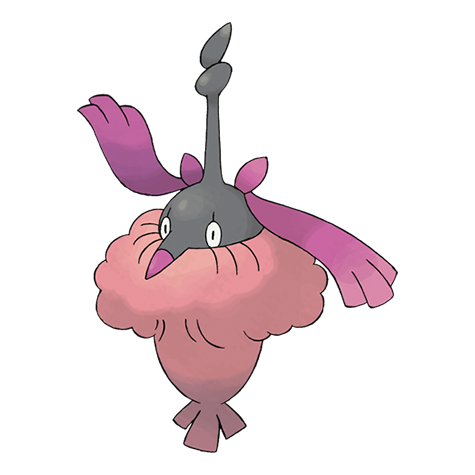
Plant Wormadam also has 2 related forms: Sandy Wormadam and Trash Wormadam.
Plant Wormadam's Evolution Chain


Plant Wormadam Evolution, Mega Evolution & Special Forms
Wormadam (Plant Cloak) evolves from Burmy exclusively when a female Burmy reaches level 20, with the Plant Cloak form being guaranteed if the female Burmy was wearing its Plant Cloak when the evolution was triggered. This represents one of the franchise's most innovative evolutionary mechanics, as the evolution does not change the Pokémon's cloak type—instead, the cloak becomes a permanent, integral part of the evolved Pokémon's biology. This mechanic was particularly revolutionary in Generation IV, introducing the concept of environmental-dependent evolution forms before such mechanics became more common in later generations. Once evolved into Wormadam, the Pokémon cannot change its cloak form, making the choice of where to evolve Burmy a permanent strategic decision for trainers. Unlike Burmy, which can evolve into either Wormadam (if female) or Mothim (if male), the Wormadam line has no further evolutions or Mega Evolution forms, representing a final evolutionary stage. The decision to lock trainers into a single form based on evolution location adds a layer of consequence to team-building, as many competitive and casual players must deliberately choose their evolution environment to obtain the desired Wormadam form.
Where to Find
Location data not available for this Pokémon in the database.
Plant Wormadam Behaviour and Natural Habitat
Wormadam (Plant Cloak) inhabits environments rich with vegetation, thriving in forests, gardens, and grasslands where its botanical covering allows it to blend seamlessly with its surroundings. The plant matter adorning its body is not merely decorative but serves ecological functions, with many entries suggesting that the Pokémon's behavior changes based on its environment and the materials it incorporated during evolution. When evolving on verdant terrain, a Wormadam naturally acquires the Plant Cloak, suggesting that the species actively selects materials from its immediate surroundings to reinforce its evolutionary transition. Behavioral studies suggest that Plant Cloak Wormadam exhibit a more herbivorous inclination than their Sandy and Trash Cloak variants, spending considerable time in photosynthetic activity and drawing nutrients both from the soil and atmospheric sources. The species is known to be relatively docile and cautious, rarely initiating conflict unless provoked, and often remaining stationary for extended periods to allow their plant coverings to photosynthesize. Their defensive nature and heavy reliance on special defense suggests they are ambush predators or passive foragers rather than active hunters, using their botanical camouflage to hide from larger predators while feeding on plant matter and small insects.
Pokedex Entries
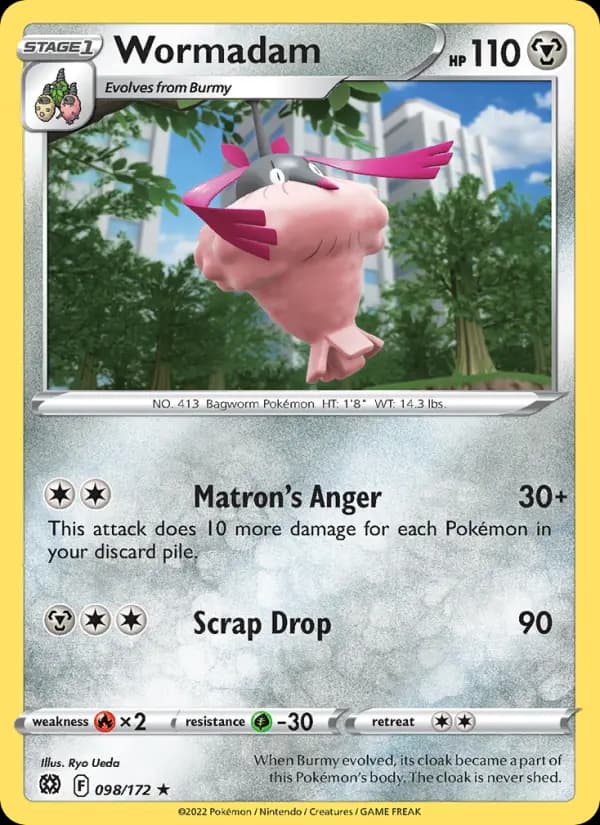
When BURMY evolved, its cloak became a part of this Pokémon’s body. The cloak is never shed.
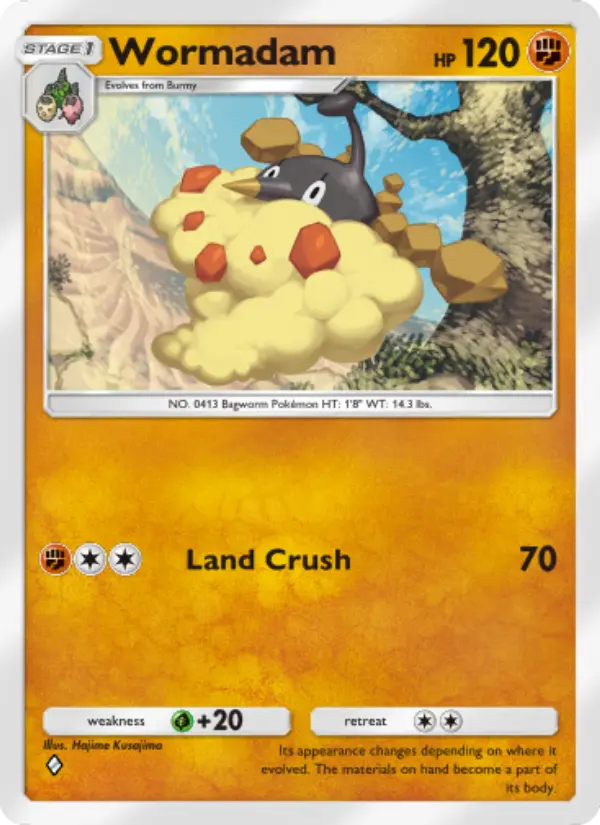
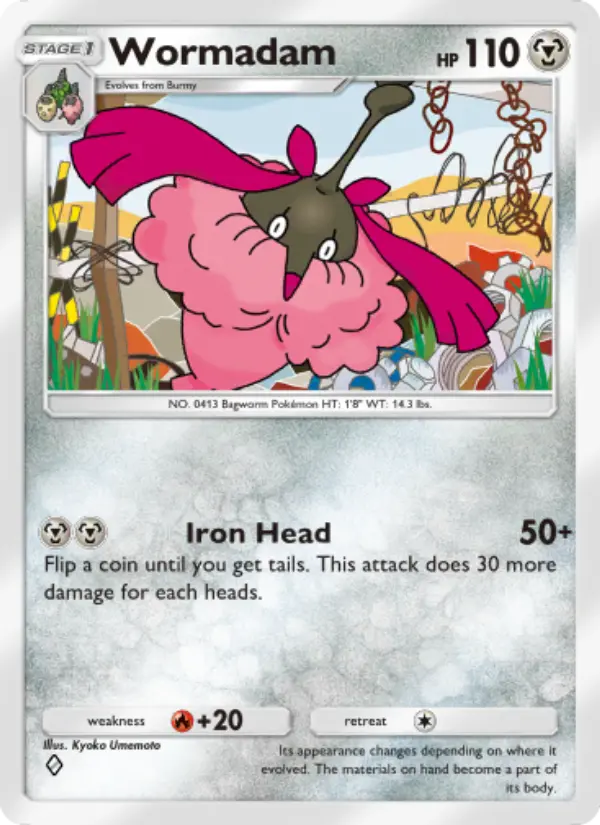
Its appearance changes depending on where it evolved. The materials on hand become a part of its body.
When evolving, its body takes in surrounding materials. As a result, there are many body variations.
It is said that a WORMADAM that evolves on a cold day will have a thicker cloak.
When evolving, its body takes in surrounding materials. As a result, there are many body variations.
When evolving, its body takes in surrounding materials. As a result, there are many body variations.
Its appearance changes depending on where it evolved. The materials on hand become a part of its body.
When Burmy evolved, its cloak became a part of this Pokémon’s body. The cloak is never shed.
Its appearance changes depending on where it evolved. The materials on hand become a part of its body.
When Burmy evolved, its cloak became a part of this Pokémon’s body. The cloak is never shed.
Plant Wormadam Name Origin & Design Inspiration
The name Wormadam is a portmanteau of "worm" and "madam," reflecting both the Pokémon's insectoid bagworm nature and its exclusively female gender. The Japanese name Minomadam similarly combines "mino" (referring to the traditional Japanese straw rain cloak called a mino, which bagworms naturally resemble) with "madam" or the feminine suffix. The Plant Cloak variant's design draws clear inspiration from real-world bagworm moths, particularly how they construct protective cases from surrounding materials—in nature, bagworm caterpillars famously create portable shelters from leaves, twigs, and other debris, a behavior that directly parallels Wormadam's lore of incorporating environmental materials into its body. The floral elements adorning the Plant Cloak form reference the biological phenomenon of plants forming symbiotic relationships with insects, suggesting a deep ecological integration between Wormadam and its botanical covering. The three distinct forms (Plant, Sandy, and Trash Cloak) elegantly represent different environmental niches and evolutionary pressures, allowing players to encounter the same species in vastly different ecological contexts. This design philosophy helped establish Generation IV's focus on environmental storytelling and ecological diversity, making Wormadam a symbol of how evolution responds to and reflects an organism's surroundings.
Learnable Moves
Plant Wormadam can learn 64 moves:
Move | Type | Cat. | Power | Acc. | PP |
|---|---|---|---|---|---|
| ally switch | psychic | Status | — | — | 15 |
| attract | normal | Status | — | 100 | 15 |
| bug bite | bug | Physical | 60 | 100 | 20 |
| bug buzz | bug | Special | 90 | 100 | 10 |
| bullet seed | grass | Physical | 25 | 100 | 30 |
| captivate | normal | Status | — | 100 | 20 |
| confide | normal | Status | — | — | 20 |
| confusion | psychic | Special | 50 | 100 | 25 |
| dig | ground | Physical | 80 | 100 | 10 |
| double team | normal | Status | — | — | 15 |
| dream eater | psychic | Special | 100 | 100 | 15 |
| electroweb | electric | Special | 55 | 95 | 15 |
| endeavor | normal | Physical | — | 100 | 5 |
| endure | normal | Status | — | — | 10 |
| energy ball | grass | Special | 90 | 100 | 10 |
| facade | normal | Physical | 70 | 100 | 20 |
| flail | normal | Physical | — | 100 | 15 |
| flash | normal | Status | — | 100 | 20 |
| frustration | normal | Physical | — | 100 | 20 |
| giga drain | grass | Special | 75 | 100 | 10 |
| giga impact | normal | Physical | 150 | 90 | 5 |
| grass knot | grass | Special | — | 100 | 20 |
| growth | normal | Status | — | — | 20 |
| gust | flying | Special | 40 | 100 | 35 |
| hidden power | normal | Special | 60 | 100 | 15 |
| hyper beam | normal | Special | 150 | 90 | 5 |
| infestation | bug | Special | 20 | 100 | 20 |
| leaf storm | grass | Special | 130 | 90 | 5 |
| magical leaf | grass | Special | 60 | — | 20 |
| natural gift | normal | Physical | — | 100 | 15 |
| protect | normal | Status | — | — | 10 |
| psybeam | psychic | Special | 65 | 100 | 20 |
| psych up | normal | Status | — | — | 10 |
| psychic | psychic | Special | 90 | 100 | 10 |
| quiver dance | bug | Status | — | — | 20 |
| rain dance | water | Status | — | — | 5 |
| razor leaf | grass | Physical | 55 | 95 | 25 |
| rest | psychic | Status | — | — | 5 |
| return | normal | Physical | — | 100 | 20 |
| round | normal | Special | 60 | 100 | 15 |
| safeguard | normal | Status | — | — | 25 |
| secret power | normal | Physical | 70 | 100 | 20 |
| seed bomb | grass | Physical | 80 | 100 | 15 |
| shadow ball | ghost | Special | 80 | 100 | 15 |
| signal beam | bug | Special | 75 | 100 | 15 |
| silver wind | bug | Special | 60 | 100 | 5 |
| skill swap | psychic | Status | — | — | 10 |
| sleep talk | normal | Status | — | — | 10 |
| snore | normal | Special | 50 | 100 | 15 |
| solar beam | grass | Special | 120 | 100 | 10 |
| string shot | bug | Status | — | 95 | 40 |
| struggle bug | bug | Special | 50 | 100 | 20 |
| substitute | normal | Status | — | — | 10 |
| sucker punch | dark | Physical | 70 | 100 | 5 |
| sunny day | fire | Status | — | — | 5 |
| swagger | normal | Status | — | 85 | 15 |
| synthesis | grass | Status | — | — | 5 |
| tackle | normal | Physical | 40 | 100 | 35 |
| telekinesis | psychic | Status | — | — | 15 |
| thief | dark | Physical | 60 | 100 | 25 |
| toxic | poison | Status | — | 90 | 10 |
| uproar | normal | Special | 90 | 100 | 10 |
| venoshock | poison | Special | 65 | 100 | 10 |
| worry seed | grass | Status | — | 100 | 10 |
Plant Wormadam Competitive Battle Guide
Wormadam (Plant Cloak) occupies a niche defensive role in competitive play, leveraging its exceptional Special Defense (105) and solid Defense (85) to wall special attackers and weathered conditions. Its typing as Bug/Grass provides useful resistances to Water, Grass, and Ground-type moves, with a 4x resistance to Grass-type attacks making it particularly valuable against grass-heavy teams, though its 4x weakness to Flying-type moves requires careful team construction and switch-in planning. The ability Anticipation serves as a valuable scouting tool, immediately alerting trainers to the presence of super-effective moves, self-destruct, explosion, or one-hit KO moves in an opponent's moveset, facilitating superior switch decisions and strategic planning. However, Wormadam's critical weakness lies in its abysmal Speed stat of 36, making it one of the slowest Pokémon available and virtually guaranteeing that it will move last in almost any matchup unless using priority moves or speed-control team support. Its Special Attack of 79 limits its offensive pressure despite reasonable coverage options, and its Attack of 59 makes physical attacking largely untenable, forcing reliance on special moves and utility moves for consistency. The hidden ability Overcoat provides an alternative strategy for weather-based teams, granting immunity to sandstorm, hail, and rain damage while supporting sand-based or weather-dependent team compositions. Despite these limitations, Wormadam has seen sporadic competitive use in lower tiers and casual formats where its defensive profile and type coverage allow it to function as a reliable special wall and weather-resistant team component.
Commonly Asked Questions About Plant Wormadam
What type is Plant Wormadam?
Plant Wormadam is a bug and grass type Pokemon.
What does Plant Wormadam evolve into?
Plant Wormadam evolves into mothim.
What are Plant Wormadam's weaknesses?
Plant Wormadam is weak to flying, poison, rock, bug, fire and ice type moves.
Does Plant Wormadam evolve by trading?
No — Plant Wormadam evolves entirely through leveling up, with no trade required at any stage.
Plant Wormadam Cultural Impact & Franchise History
Wormadam (Plant Cloak) has maintained a modest but consistent presence in Pokémon media and fan communities since its introduction in Generation IV, appreciated for its unique evolutionary concept and striking visual design. The Plant Cloak variant appears prominently in Pokémon Diamond and Pearl promotional material as one of the region's notable Sinnoh discoveries, and the species' innovative gender-locked, environment-dependent evolution system became a template for future generation designs. In the Pokémon anime, Wormadam appearances have been relatively limited but memorable, with its unusual morphology making it visually distinctive when featured. The concept of Wormadam's three forms generated significant fan discussion regarding environmental adaptation and the implications of permanent evolutionary changes, with many players experimenting with obtaining all three cloak variants for their teams or Pokédex completion. Fan communities have produced considerable artwork celebrating the species' botanical aesthetic, particularly the Plant Cloak's integration of flowers and vegetation, which appeals to players interested in nature-themed Pokémon teams. The species has also become notable in speedrunning and challenge run communities, where its specific stats and movepool present interesting deckbuilding constraints and team composition puzzles. Wormadam's relatively low cultural impact compared to more iconic Sinnoh Pokémon reflects its lower overall popularity, yet dedicated enthusiasts continue to champion the species for its innovative design philosophy and underdog competitive viability.
Where to Find Plant Wormadam in Every Pokémon Game
Wormadam (Plant Cloak) is primarily available in Sinnoh-region games (Diamond, Pearl, Platinum, Brilliant Diamond, and Shining Pearl), where it can be encountered as an evolution of Burmy found in grassy areas and forests throughout the region. To obtain a Plant Cloak Wormadam specifically, trainers must capture a female Burmy while it is wearing its Plant Cloak form and then evolve it by leveling to level 20 in a grassy or forest area, making the evolution location critical to obtaining this particular form. In Generation IV remakes Brilliant Diamond and Shining Pearl, Wormadam remains available through the same mechanic, with Plant Cloak variants obtainable in routes and areas with substantial vegetation. The species has appeared in later generations through Pokédex completionist methods and transfer mechanics, with Pokémon Home enabling individuals to move previously-captured Wormadam between compatible games. Wormadam was notably accessible in Pokémon Legends: Arceus as part of the Hisui region's Pokédex, where its evolutionary mechanics were preserved and integrated into the game's unique catching and evolution system. The Trash Cloak and Sandy Cloak forms present availability challenges, as they require evolution in specific environmental contexts—trash cloak requires evolution near buildings or in urban areas, while sandy cloak requires evolution in desert or sandy regions—making collectors often need to breed or train multiple Burmy in different locations to obtain all three variants for completion.