
Gigantamax Butterfree
Generation I · #10198 — Butterfly Pokémon
Gigantamax Butterfree represents the colossal transformation of the classic Bug/Flying-type Pokémon when exposed to Gigantamax energy. Standing at an impressive 17.0 meters in height and weighing 1000.0 kilograms, this gargantuan version of Butterfree towers over its standard form, which measures only 1.1 meters tall. This dramatic size increase manifests in Pokémon Sword and Shield, where trainers with a Butterfree carrying the Gigantamax Factor can unlock this spectacular transformation during battle. The transformation channels Butterfree's signature abilities into a more potent form, gaining access to the exclusive G-Max move G-Max Befuddle, which combines the Pokémon's natural affinity for status-inducing moves with devastating gigantamax power.
Editor's Take
Gigantamax Butterfree's G-Max Befuddle inflicting a random status on both opponents is one of the more genuinely useful G-Max effects, and it is attached to a Gen 1 Bug-type.
Base Stats
Height
17.0m
Weight
1000.0kg
Category
Butterfly Pokémon
Gender
Male 50% / Female 50%
Color
white
Shape
bug-wings
Habitat
forest
Abilities
Increases moves' accuracy to 1.3×.
Doubles damage inflicted with not-very-effective moves.

Gigantamax Butterfree Biology & Physical Characteristics
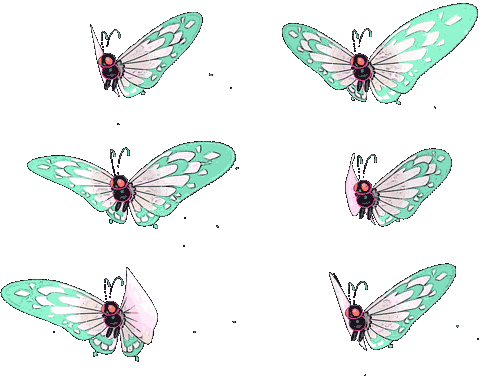
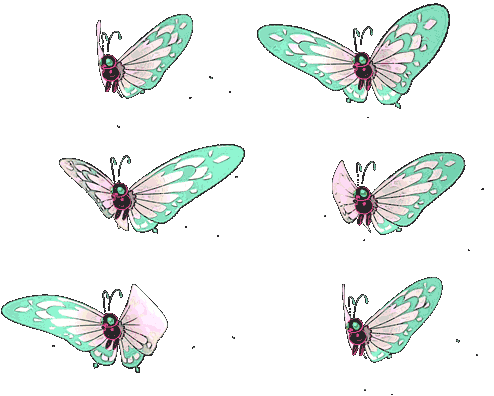
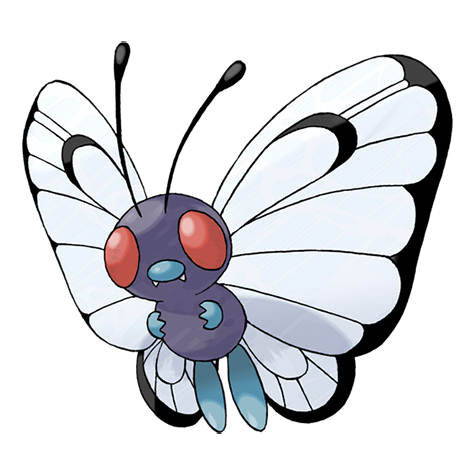
In its Gigantamax form, Butterfree undergoes a profound physical metamorphosis that amplifies its lepidopteran characteristics to kaiju-like proportions. The distinctive light blue wings that define standard Butterfree become massive, iridescent structures capable of generating enormous gusts of wind and dispersing its toxic powder across vast areas. Despite the astronomical increase in mass—from 32 kilograms to 1000 kilograms—the fundamental structure of Butterfree's body remains recognizable, maintaining its purple coloration and anthropomorphic proportions while achieving a scale that dwarfs most environments. The water-repellent dust coating its wings, documented in numerous Pokédex entries as enabling honey collection during heavy rains, becomes an environmental factor of significant consequence at this size. While Gigantamax Butterfree retains the same base stats as its standard form (totaling 395), the transformation itself provides the mechanical advantages inherent to all Gigantamax Pokémon, enhancing its combat effectiveness through the raw power output of its exclusive G-Max move.
Pokedex Numbers
Training
Breeding
Gigantamax Butterfree Breeding, Gender Ratio & Egg Groups
Butterfree maintains a balanced gender ratio of 50 percent male to 50 percent female across all populations and forms, including its gigantamax manifestation. This even distribution ensures reliable breeding prospects for trainers seeking to propagate Butterfree or its earlier evolutionary forms. As a member of the Bug egg group, Butterfree can breed only with other Pokémon within that classification, limiting breeding partners to insects and Bug-type species from across multiple generations. The species exhibits a base happiness value of 70 before considering friendship-affecting items, moves, or events, indicating a naturally friendly disposition toward trainers that facilitates bonding and cooperation. Eggs produced by Butterfree hatch after 15 cycles, equivalent to approximately 3,599 to 3,855 steps depending on the specific game mechanics and held items affecting hatch speed. The relatively modest capture rate of 45 means that wild Butterfree can be challenging to catch compared to common early-game species, though the species' availability in early routes of Kanto-based games provides ample opportunities for trainer acquisition during normal gameplay progression.
Sprites




Gender Differences
This Pokémon has visible differences between male and female forms.
Gigantamax Butterfree's Evolution Chain


Gigantamax Butterfree Evolution, Mega Evolution & Special Forms
Butterfree reaches its gigantamax form through a distinct transformation mechanism separate from traditional evolution, representing a temporary power enhancement rather than permanent evolutionary advancement. Standard Butterfree evolves from Metapod starting at level 10, completing the three-stage evolution line that begins with Caterpie, itself a Generation I Pokémon that has remained largely consistent across all subsequent generations. Gigantamax transformation requires that a Butterfree possess the Gigantamax Factor, a special condition that trainers can identify and utilize during battles in specific locations throughout Pokémon Sword and Shield. This transformation differs fundamentally from Mega Evolution or standard form changes, as Gigantamax forms are temporary battle states that revert once the battle concludes, preventing any permanent stat alterations or moveset changes. The Gigantamax state itself does not alter Butterfree's base stats—which remain 60 HP, 45 Attack, 50 Defense, 90 Special Attack, 80 Special Defense, and 70 Speed—but rather provides mechanical advantages through G-Max moves and the inherent durability benefits of increased size.
Where to Find
Location data not available for this Pokémon in the database.
Gigantamax Butterfree Behaviour and Natural Habitat
Gigantamax Butterfree exhibits the same fundamental behavioral patterns as its standard counterpart, though magnified to a scale that profoundly impacts its environment and those around it. The Pokédex describes ordinary Butterfree as possessing a superior ability to search for delicious honey from flowers blooming over six miles from its nest, flitting from flower to flower with remarkable navigational precision. At gigantamax scale, this honey-gathering instinct becomes an ecological force, with a single specimen capable of influencing local flora across entire regions through its pollination activities and powder dispersal. The toxic dust that Butterfree famously releases at high speed during battle becomes a meteorological phenomenon when produced by its gigantamax form, capable of affecting weather patterns and creating visible clouds visible from extraordinary distances. Despite its colossal size, Gigantamax Butterfree retains the graceful, purposeful flight patterns of standard Butterfree, demonstrating that transformation into a gigantamax form represents amplification rather than corruption of the species' natural behavior.
Pokedex Entries
In battle, it flaps its wings at high speed to release highly toxic dust into the air.
Its wings, covered with poisonous powders, repel water. This allows it to fly in the rain.
It collects honey every day. It rubs honey onto the hairs on its legs to carry it back to its nest.
Water-repellent powder on its wings enables it to collect honey, even in the heav iest of rains.
It flits from flower to flower, collecting honey. It can even identify distant flowers in bloom.
BUTTERFREE has a superior ability to search for delicious honey from flowers. It can even search out, extract, and carry honey from flowers that are blooming over six miles from its nest.
It has a superior ability to search for delicious honey from flowers. It can seek, extract, and carry honey from flowers blooming over six miles away.
The wings are protected by rain-repellent dust. As a result, this POKéMON can fly about even in rain.
In battle, it flaps its wings at great speed to release highly toxic dust into the air.
It loves the honey of flowers and can locate flower patches that have even tiny amounts of pollen.
It collects honey every day. It rubs honey onto the hairs on its legs to carry it back to its nest.
Water-repellent powder on its wings enables it to collect honey, even in the heaviest of rains.
It loves the honey of flowers and can locate flower patches that have even tiny amounts of pollen.
It loves the honey of flowers and can locate flower patches that have even tiny amounts of pollen.
It loves the honey of flowers and can locate flower patches that have even tiny amounts of pollen.
The wings are protected by rain-repellent dust. As a result, this Pokémon can fly about even in rain.
Butterfree has a superior ability to search for delicious honey from flowers. It can even search out, extract, and carry honey from flowers that are blooming over six miles from its nest.
Close examination of its large eyes reveals that each eye is composed of a myriad of tiny eyes.
Its wings are covered in toxic scales. If it finds bird Pokémon going after Caterpie, Butterfree sprinkles its scales on them to drive them off.
When attacked by other Pokémon, it defends itself by scattering its poisonous scales and fluttering its wings.
Nectar from pretty flowers is its favorite food. In fields of flowers, it has heated battles with Cutiefly for territory.
Its wings, covered with poisonous powder, repel water. This allows it to fly in the rain.
In battle, it flaps its wings at great speed to release highly toxic dust into the air.
It collects honey every day. It rubs honey onto the hairs on its legs to carry it back to its nest.
Gigantamax Butterfree Name Origin & Design Inspiration
The name Butterfree combines 'butter' with 'free,' reflecting the Pokémon's insectoid inspiration alongside linguistic playfulness suggesting freedom and aerial mobility. In Japanese, Butterfree is known as バタフリー (Battafurī), a katakana transliteration that similarly emphasizes the butterfly aesthetic. The design itself draws heavily from real-world Lepidoptera, particularly monarch butterflies, evident in the wing coloration and body structure of both standard and gigantamax forms. The anthropomorphic qualities—particularly the arm-like appendages and facial features—represent a deliberate departure from purely naturalistic insect design, creating a distinctly Pokémon-specific interpretation of butterfly physiology. In its gigantamax form, Butterfree maintains these core design elements while expanding them to impossible scales, with the wings becoming architectural structures and the body achieving dimensions that echo other kaiju-inspired Gigantamax transformations. The coloration—predominantly white in gigantamax form with purple accents—creates striking visual contrast and emphasizes the fantastical nature of the transformation while remaining visually coherent with standard Butterfree's established color palette.
Gigantamax Butterfree Competitive Battle Guide
Gigantamax Butterfree occupies a unique competitive niche as a Pokémon that exchanges raw individual stat superiority for the temporary power surge and exclusive move access provided by gigantamax transformation. Its special attack base of 90 represents its highest offensive stat, supporting an offensive special attacking playstyle that aligns with classic Butterfree strategies spanning multiple competitive formats. The hidden ability Tinted Lens doubles damage inflicted with not-very-effective moves, providing significant utility against defensive threats that would otherwise resist Bug or Flying attacks; this ability fundamentally alters Butterfree's damage calculations and strategic options compared to its standard Compound Eyes ability, which merely increases move accuracy. G-Max Befuddle, the exclusive move available only to Gigantamax Butterfree, provides both offensive damage and potential utility through status effects, enabling the Pokémon to function as both an offensive and disruptive threat during the three turns it remains gigantamaxed. The moderate base speed of 70 situates Butterfree below many faster threats, necessitating strategic support from teammates or careful prediction to outmaneuver faster opponents. In doubles and VGC formats where gigantamax Pokémon receive particular attention, Gigantamax Butterfree's relatively modest offensive stats compared to other gigantamax options limit its viability to specific team compositions and metagames emphasizing speed control and status disruption.
Commonly Asked Questions About Gigantamax Butterfree
What type is Gigantamax Butterfree?
Gigantamax Butterfree is a bug and flying type Pokemon.
What does Gigantamax Butterfree evolve into?
Gigantamax Butterfree does not evolve into any other Pokemon. It is the final form in its evolution line.
What are Gigantamax Butterfree's weaknesses?
Gigantamax Butterfree is weak to flying, rock, fire, electric and ice type moves.
Gigantamax Butterfree Cultural Impact & Franchise History
Butterfree achieved iconic status within Pokémon culture through its prominent role in the anime series, particularly as Ash Ketchum's first captured Pokémon of its evolutionary line, enduring throughout numerous seasons and establishing emotional connections with viewers globally. The species' design proved so successful that it maintained consistent visual representation and mechanical functionality across all nine game generations, from Red and Blue through Scarlet and Violet, demonstrating remarkable longevity for a Generation I Pokémon. Gigantamax Butterfree specifically resonated with fans as a vindication of the species' competitive potential, providing a mechanism through which Butterfree could achieve relevance in contemporary competitive formats despite its modest base stats relative to modern power-creep standards. The transformation's visual spectacle—depicting the beloved butterfly Pokémon magnified to impossibly large dimensions—captured imagination across multiple media platforms and inspired considerable fan art and community discussion. Butterfree's accessibility as an early-game Pokémon combined with its distinctive design and legitimate tactical options ensured it maintained cultural relevance across casual and competitive communities alike, appearing in trading card games, merchandise, and derivative media with consistent frequency.
Where to Find Gigantamax Butterfree in Every Pokémon Game
Gigantamax Butterfree is exclusively available in Pokémon Sword and Shield, where trainers can obtain a standard Butterfree and subsequently enable its gigantamax transformation through acquiring the Gigantamax Factor. The standard Butterfree form itself can be captured in early-game routes throughout Sword and Shield or obtained through the standard evolution line beginning with Caterpie, maintaining consistent availability across multiple game iterations. Wild Butterfree populations appear in various grassy areas and meadows characteristic of Bug-type Pokémon habitats, with encounter rates varying by location and time of day. Transfers from Pokémon Home allow trainers to import Butterfree from earlier generations into Sword and Shield, though gigantamax capabilities remain exclusive to Butterfree encountered or obtained within the Galar region. Gigantamax Butterfree does not appear in subsequent generations including Pokémon Scarlet and Violet, which implement Terastallization rather than Gigantamax transformation as the primary temporary power mechanic. Trading remains the most reliable method for trainers seeking specific gender ratios or competitive natures, leveraging the 50 percent gender distribution to obtain desired specimens. The moderate base friendship of 70 combined with the capture rate of 45 means that wild Butterfree requires moderate effort to catch and acclimate to trainer ownership compared to early-game species with higher friendship values and capture rates.