Caterpie
Generation I · #0010 — Worm Pokémon
Caterpie measures in at 0.3 m and 2.9 kg, a build that matches its shield dust ability better than it matches raw offense or defense. Despite its humble stature and unimpressive base stats totaling only 195, Caterpie holds a special place in Pokémon culture as an early-game companion that demonstrates the franchise's core themes of growth and evolution. With a catch rate of 255—the highest possible—Caterpie is designed to be exceptionally easy to capture, making it an ideal starting Pokémon for players just beginning their journey. Its role in the narrative and gameplay of the early games cannot be overstated, as it represents the first significant evolution many players will witness, with its transformation into Metapod at level 7 followed by its dramatic evolution into Butterfree at level 10.
Editor's Take
Caterpie reaching its final evolution at level 10 makes Butterfree the fastest fully-evolved Pokémon to obtain in Gen 1, and Compound Eyes boosting Sleep Powder accuracy made it genuinely useful long after it should have been outgrown.
Base Stats
Height
0.3m
Weight
2.9kg
Category
Worm Pokémon
Gender
Male 50% / Female 50%
Color
green
Shape
armor
Habitat
forest
Abilities
Protects against incoming moves' extra effects.
Ensures success fleeing from wild battles.

Caterpie Biology & Physical Characteristics
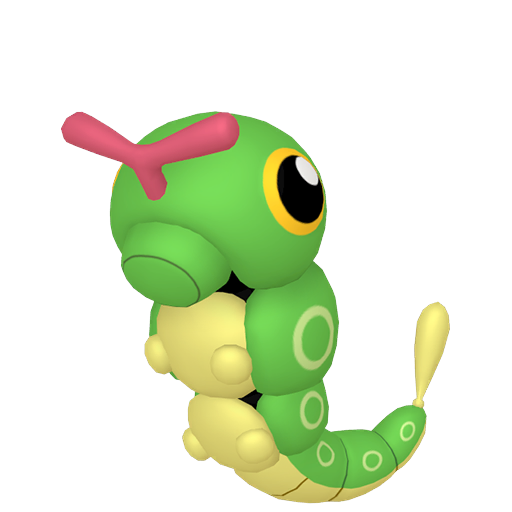
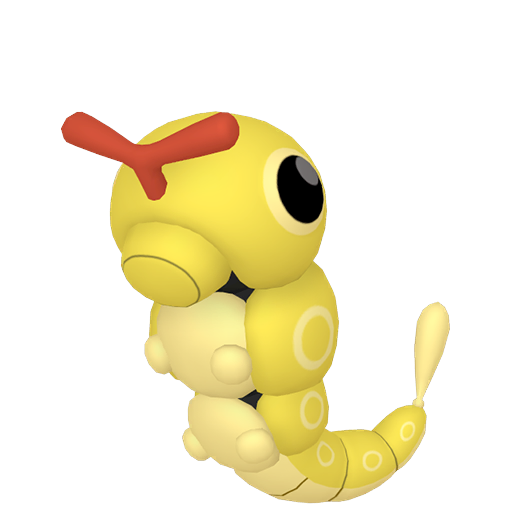
Caterpie is a insectoid creature that physically resembles a green caterpillar with distinctive anatomical features designed for both camouflage and defense. Its body is segmented and predominantly green, with a yellow underside that provides counter-shading to aid in concealment within foliage. The most striking feature of Caterpie's anatomy is the prominent red antenna, technically called an osmeterium, located atop its head, which serves as a potent chemical defense mechanism capable of releasing a horrible stench to repel potential predators. Along its sides, yellow ring-shaped markings resembling eyes run down the length of its body, functioning as eyespots to intimidate threats through false predator signals. Perhaps most remarkably, Caterpie possesses four stubby feet tipped with suction cups or adhesive pads, allowing it to cling tenaciously to nearly any surface regardless of angle or smoothness. These specialized feet enable the Pokémon to scale vertical slopes and walls with remarkable ease, demonstrating an adaptation that enables efficient foraging behavior in arboreal environments. The suction-cup feet represent an evolutionary marvel, as they provide the necessary grip strength to support the creature's body weight while climbing without requiring muscular limbs.
Pokedex Numbers
Training
Breeding
Caterpie Breeding, Gender Ratio & Egg Groups
Caterpie maintains a perfectly balanced gender ratio of exactly 50 percent male and 50 percent female, making it equally probable to encounter either sex in the wild or through breeding. This equal distribution reflects the game design philosophy that gender should not substantially impact gameplay mechanics or availability for most species, particularly early-route Pokémon intended to be caught multiple times. Caterpie is classified within the Bug egg group, a broad category encompassing most insectoid Pokémon that share similar reproductive characteristics and breeding compatibility. The species has a base happiness value of 70, which falls into the standard category and indicates that Caterpie does not require special care or affection to maintain contentment—it will bond naturally with trainers through normal gameplay. The egg cycle counter for Caterpie is set at 15 cycles, which translates to approximately 3,599 to 3,855 steps before a hatched Caterpie egg produces a new individual. This relatively modest hatch time makes breeding Caterpie practical for players seeking specific natures or individual values, though the species' ready availability in the wild typically eliminates the need for selective breeding in most playthroughs.
Sprites




TMs & HMs
tm182
scarlet violet
tm13
gold silver
tm13
crystal
tm211
scarlet violet
tm182
the teal mask
tm24
sword shield
tm211
the indigo disk
tm82
sword shield
Caterpie's Evolution Chain


Caterpie Evolution, Mega Evolution & Special Forms
Caterpie exists as the first stage in a classic three-stage evolutionary line, progressing to Metapod at level 7 and ultimately reaching its final form, Butterfree, upon reaching level 10. This rapid evolution sequence was intentional in the game's design, allowing new players to experience multiple evolutions relatively quickly and teaching the fundamental mechanic without excessive grinding. The evolutionary transformations represent a complete metamorphosis from a simple worm-like creature into a fully realized insect, with Metapod serving as the intermediate chrysalis stage where the Pokémon consolidates its defenses before the dramatic transformation. The evolution into Butterfree marks a fundamental shift in Caterpie's capabilities, granting it a secondary Flying-type classification, substantially increased stats, and access to entirely different move pools including crucial attacks like Confusion and Butterfree's signature move, Compound Eyes. This evolutionary journey symbolizes the core theme of the Pokémon franchise—growth through battling and bonding with trainers—making it the quintessential early-game evolution sequence. The relatively fast evolution rate (medium growth classification with quick level progression) ensures that trainers remain invested in their Caterpie despite its weak base stats, as the promise of transformation into a more capable form remains perpetually near.
Where to Find
Kanto Route 25
kanto
+5 more
Viridian Forest
kanto
+21 more
Kanto Route 2
kanto
+27 more
Kanto Route 24
kanto
+5 more
Azalea Town
johto
+2 more
Johto Route 31
johto
+13 more
Kanto Route 27
kanto
+2 more
Ilex Forest
johto
+17 more
Johto Route 30
johto
+13 more
Kanto Route 26
kanto
+2 more
Lake of Rage
johto
+2 more
Johto Route 34
johto
+2 more
Johto Route 35
johto
+2 more
National Park
johto
+8 more
Johto Route 39
johto
+2 more
Johto Route 38
johto
+2 more
Johto Route 37
johto
+2 more
Johto Route 36
johto
+2 more
Pattern Bush
kanto
Sinnoh Route 204
sinnoh
+5 more
+8 more locations in other games
Caterpie Behaviour and Natural Habitat
Caterpie exhibits the voracious appetite characteristic of lepidopteran larvae, consuming vegetation with remarkable efficiency despite its small size. According to Pokédex entries, Caterpie can devour leaves significantly larger than its own body, demonstrating an eating capacity that seems disproportionate to its frame. The species exhibits strong behavioral camouflage, deliberately crawling into foliage where its green coloration blends seamlessly with similarly-colored leaves in its environment, allowing it to feed while minimizing predation risk. Despite these adaptive defenses, Caterpie remains vulnerable to Flying-type Pokémon, which hunt it from above with relative ease. When threatened and camouflage fails, Caterpie relies on its chemical defense system, releasing a terrifically strong odor from its antenna that drives away enemies effectively. The creature exhibits a nomadic foraging lifestyle, tenaciously climbing trees to seek out fresh foliage rather than remaining in a fixed location. Its growth is remarkably rapid for such a small creature, as it sheds its skin multiple times during development before eventually pupating within a thick silk cocoon—a silk that Caterpie can also expel defensively to entangle potential threats.
Pokedex Entries
Its short feet are tipped with suction pads that enable it to tirelessly climb slopes and walls.
If you touch the feeler on top of its head, it will release a horrible stink to protect itself.
For protection, it releases a horri ble stench from the antenna on its head to drive away enemies.
Its feet have suction cups designed to stick to any surface. It tenaciously climbs trees to forage.
It crawls into foliage where it camouflages itself among leaves that are the same color as its body.
CATERPIE has a voracious appetite. It can devour leaves bigger than its body right before your eyes. From its antenna, this POKéMON releases a terrifically strong odor.
Its voracious appetite compels it to devour leaves bigger than itself without hesitation. It releases a terribly strong odor from its antennae.
It is covered with a green skin. When it grows, it sheds the skin, covers itself with silk, and becomes a cocoon.
Its short feet are tipped with suction pads that enable it to tirelessly climb slopes and walls.
It releases a stench from its red antenna to repel enemies. It grows by molting repeatedly.
For protection, it releases a horrible stench from the antennae on its head to drive away enemies.
Its feet have suction cups designed to stick to any surface. It tenaciously climbs trees to forage.
It releases a stench from its red antenna to repel enemies. It grows by molting repeatedly.
It releases a stench from its red antenna to repel enemies. It grows by molting repeatedly.
For protection, it releases a horrible stench from the antennae on its head to drive away enemies.
Its feet have suction cups designed to stick to any surface. It tenaciously climbs trees to forage.
Caterpie has a voracious appetite. It can devour leaves bigger than its body right before your eyes. From its antenna, this Pokémon releases a terrifically strong odor.
Caterpie has a voracious appetite. It can devour leaves bigger than its body right before your eyes. From its antenna, this Pokémon releases a terrifically strong odor.
When attacked by bird Pokémon, it resists by releasing a terrifically strong odor from its antennae, but it often becomes their prey.
Perhaps because it would like to grow up quickly, it has a voracious appetite, eating a hundred leaves a day.
It’s easy to catch, and it grows quickly, making it one of the top recommendations for novice Pokémon Trainers.
Its body is soft and weak. In nature, its perpetual fate is to be seen by others as food.
If you touch the feeler on top of its head, it will release a horrible stink to protect itself.
For protection, it releases a horrible stench from the antenna on its head to drive away enemies.
Its short feet are tipped with suction pads that enable it to tirelessly climb slopes and walls.
Caterpie Name Origin & Design Inspiration
Caterpie's name represents a straightforward portmanteau combining the words 'caterpillar' and 'pixie,' reflecting the whimsical nature of Pokémon nomenclature in the early generations. In Japanese, Caterpie is known as キャタピー (Kyatapī), which similarly derives from the English word 'caterpillar,' demonstrating how the original design intent translated across language barriers. The creature's visual design draws obvious inspiration from real-world caterpillars, particularly the larval forms of butterflies and moths, with the distinctive red antenna clearly referencing the osmeterium structure found in swallowtail butterfly caterpillars. These osmeterium structures in nature are forked, chemical-emitting organs used defensively, and Caterpie's single antenna represents a simplified, aesthetically appealing adaptation of this biological feature. The yellow ring-shaped markings adorning Caterpie's body serve multiple design purposes simultaneously: they provide visual interest to a creature that could otherwise appear monotonously green, they function narratively as false eyes to frighten predators, and they subtly break up the creature's silhouette for better camouflage in dappled forest light. The overall color scheme—green with yellow accents and red antenna—creates a pleasing, primary-colored palette that immediately communicates 'nature' and 'growth' to players, reinforcing its role as an entry-point Pokémon that teaches game mechanics.
Learnable Moves
Caterpie Competitive Battle Guide
Despite Caterpie's minuscule competitive viability at higher levels of play, its base stats total of only 195 places it firmly in the category of Pokémon designed explicitly for early-game encounters rather than endgame strategies. Its individual stat distribution reveals glaring weaknesses: the attack and special attack statistics are particularly poor at 30 and 20 respectively, while its defensive capabilities are equally underwhelming with defense and special defense each sitting at merely 35. The only statistics approaching acceptability are its hit points at 45 and speed at 45, though even these prove insufficient to enable meaningful competitive performance against even modestly trained opponents. Caterpie's ability options—Shield Dust or the hidden ability Run Away—provide situational utility but cannot compensate for its fundamental stat deficiencies. Shield Dust prevents the application of secondary move effects from opponent moves, while Run Away enables guaranteed escape from wild battles, neither of which proves relevant in competitive format battles. Most competitive players immediately transition caught Caterpie into their stronger evolutions, as the investment of even modest battle experience rapidly levels the creature toward evolution thresholds where its stats improve substantially, most notably upon evolution into Butterfree where the secondary Flying typing grants valuable defensive resistances and an expanded move pool.
Commonly Asked Questions About Caterpie
What type is Caterpie?
Caterpie is a bug type Pokemon.
What does Caterpie evolve into?
Caterpie evolves into metapod, then into butterfree.
What are Caterpie's weaknesses?
Caterpie is weak to flying, rock and fire type moves.
Does Caterpie evolve by trading?
No — Caterpie evolves entirely through leveling up, with no trade required at any stage.
Where can I find Caterpie?
Caterpie can be found in kanto route 25 (kanto), viridian forest (kanto) and kanto route 2 (kanto) and 25 other locations.
Caterpie Cultural Impact & Franchise History
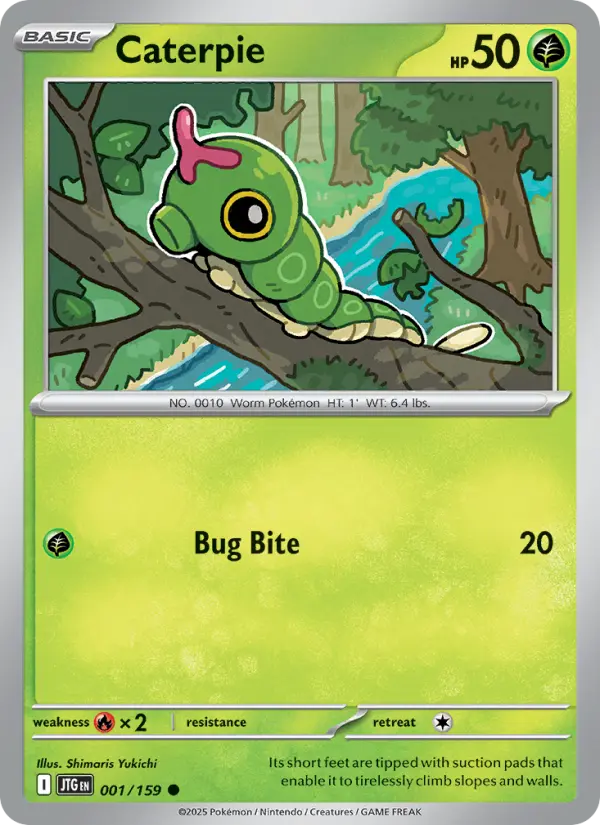
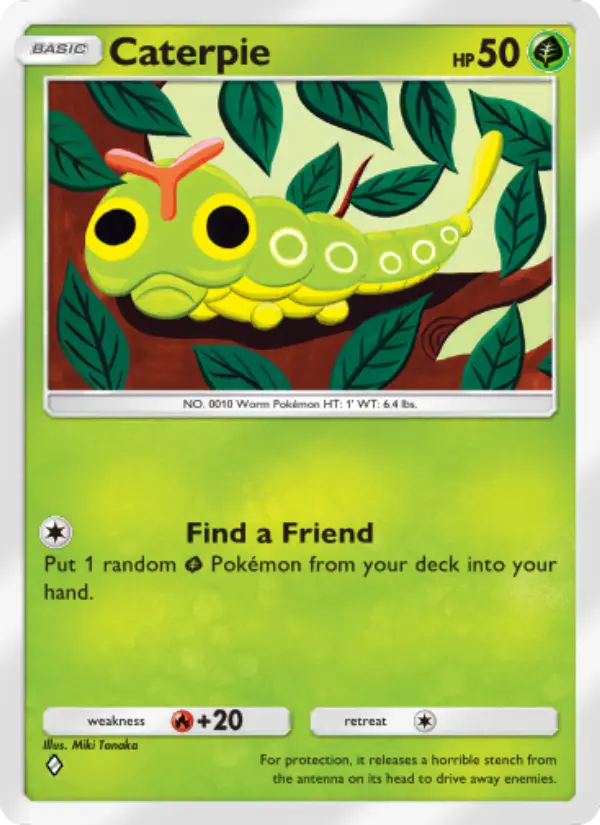
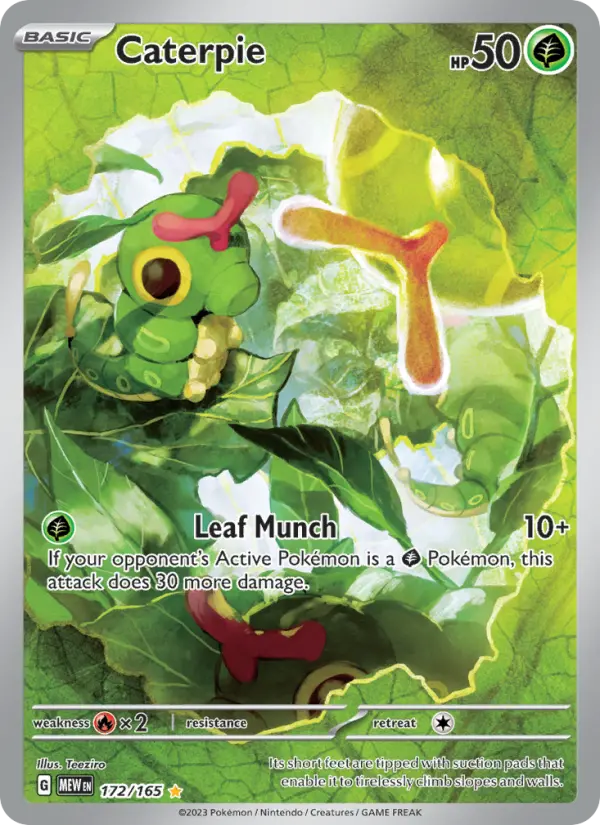
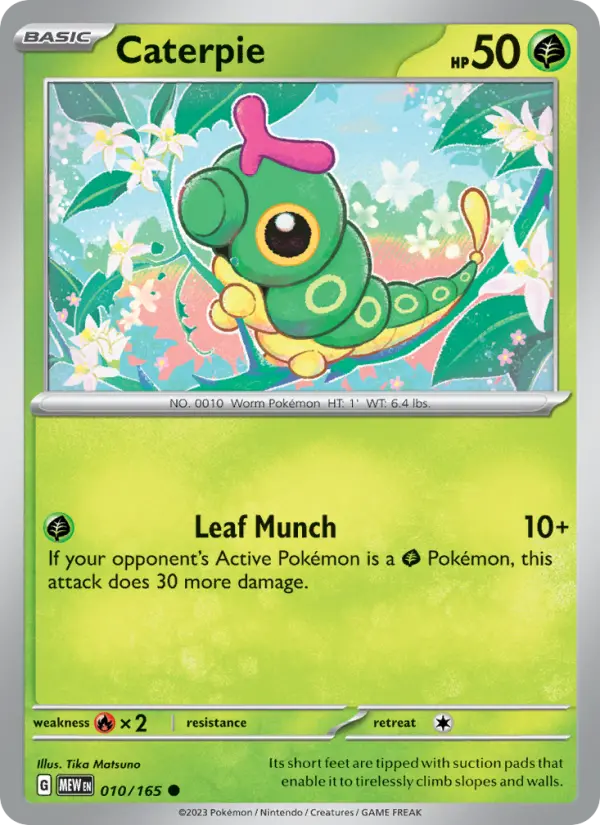
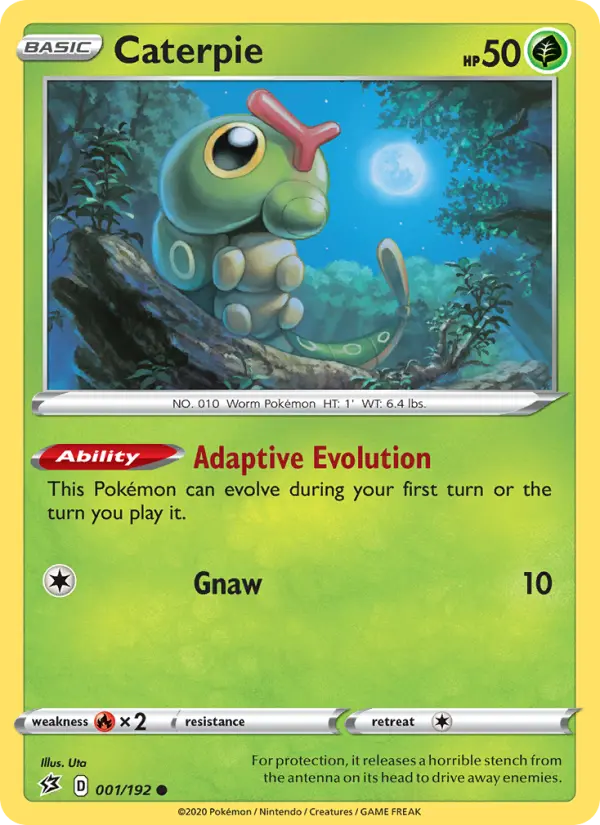
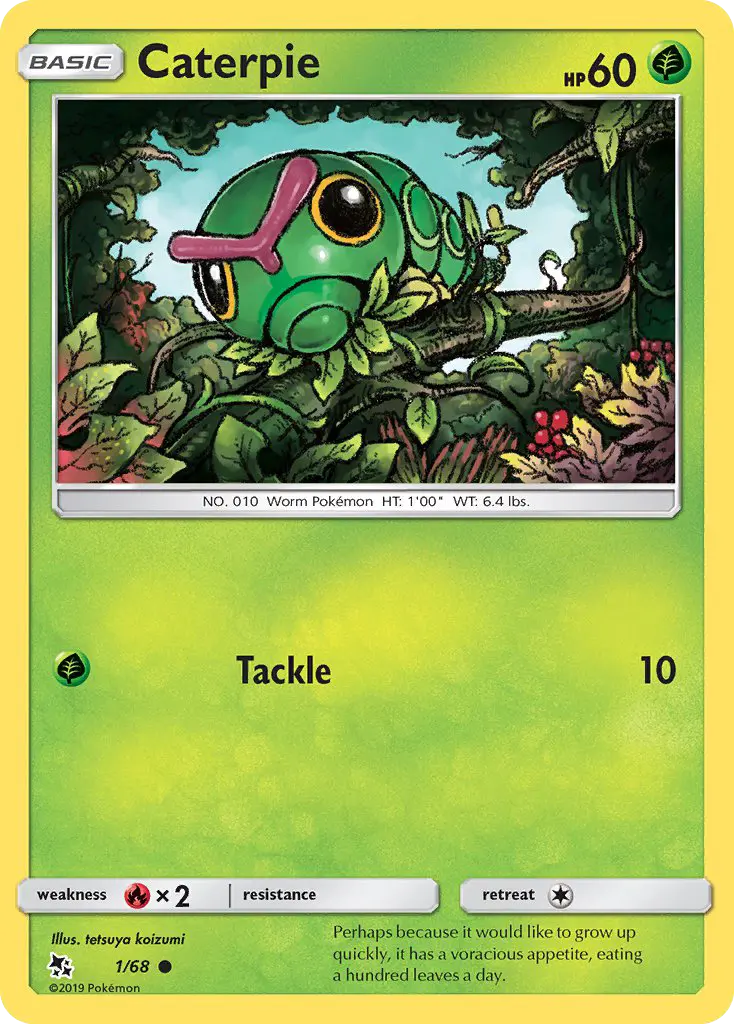
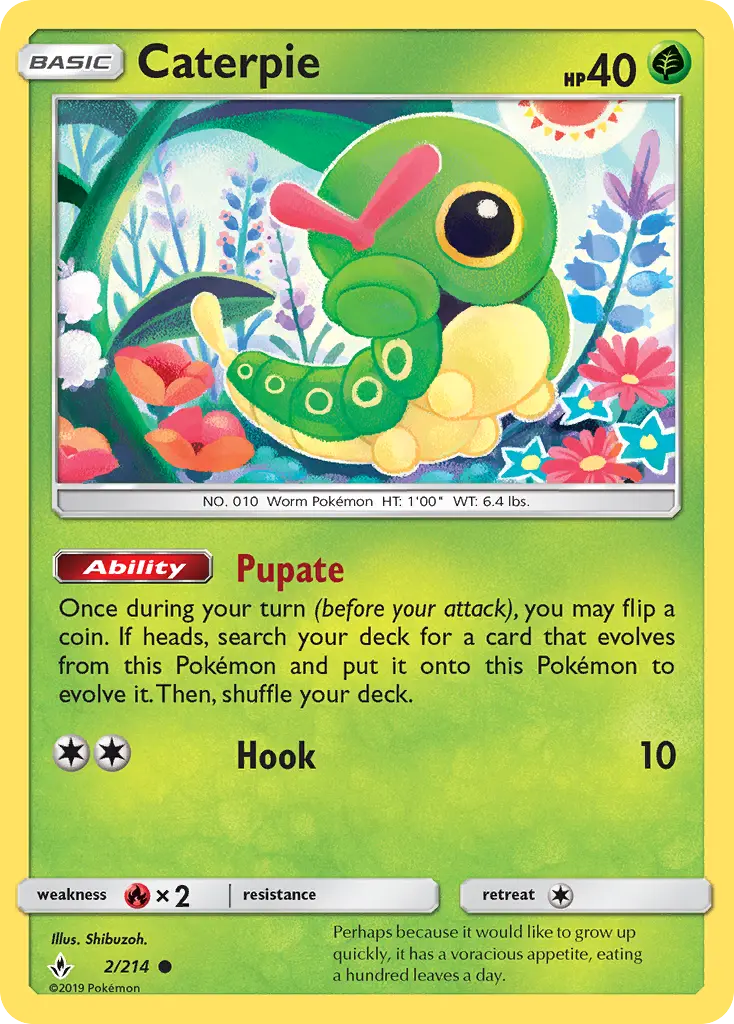
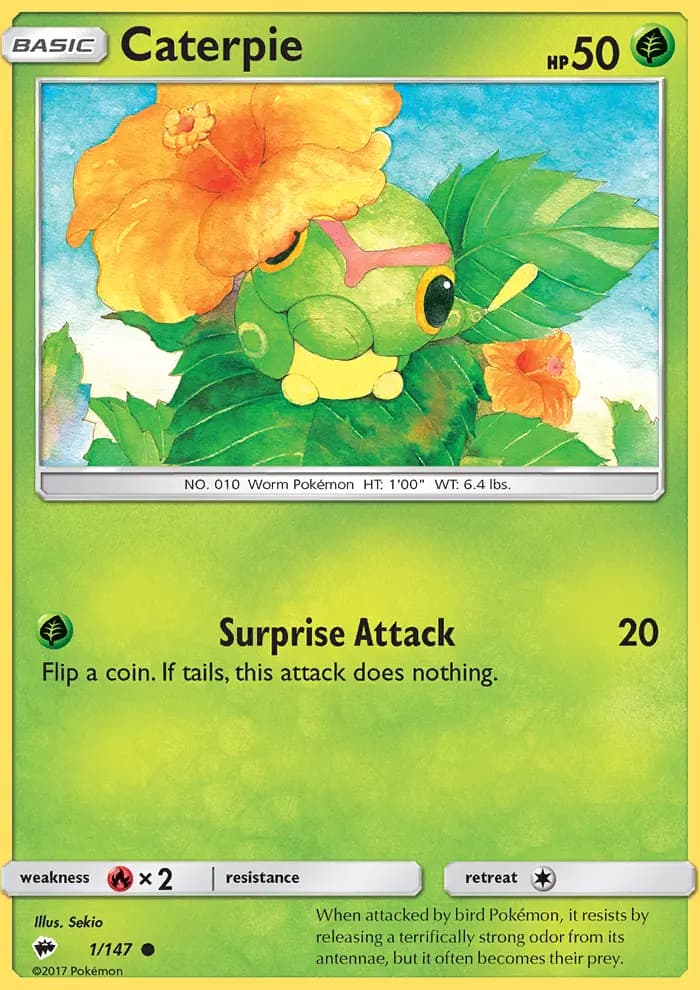
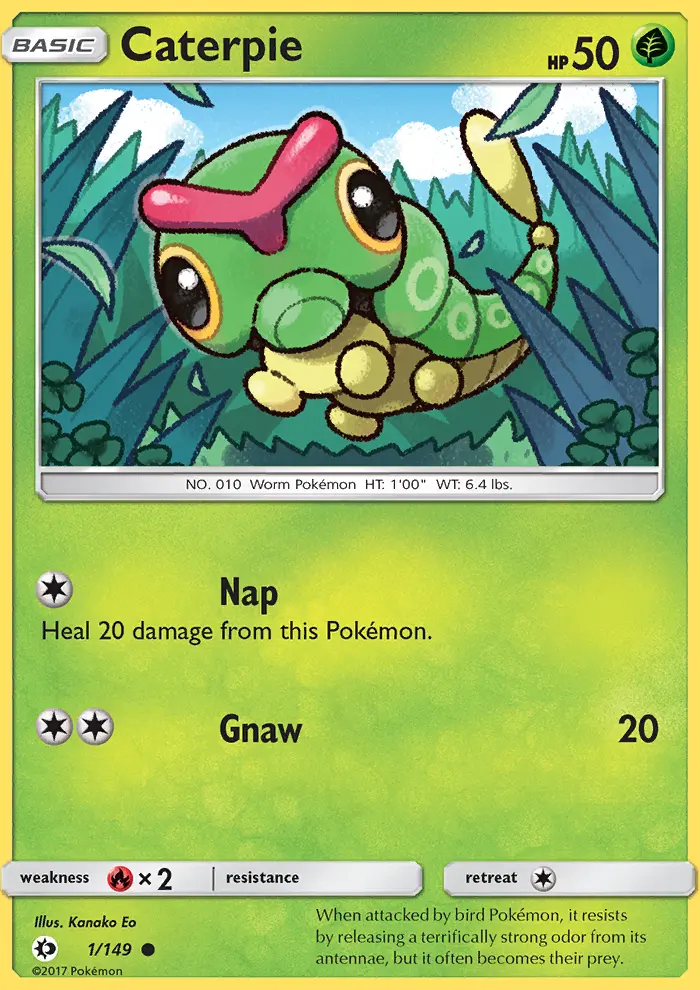
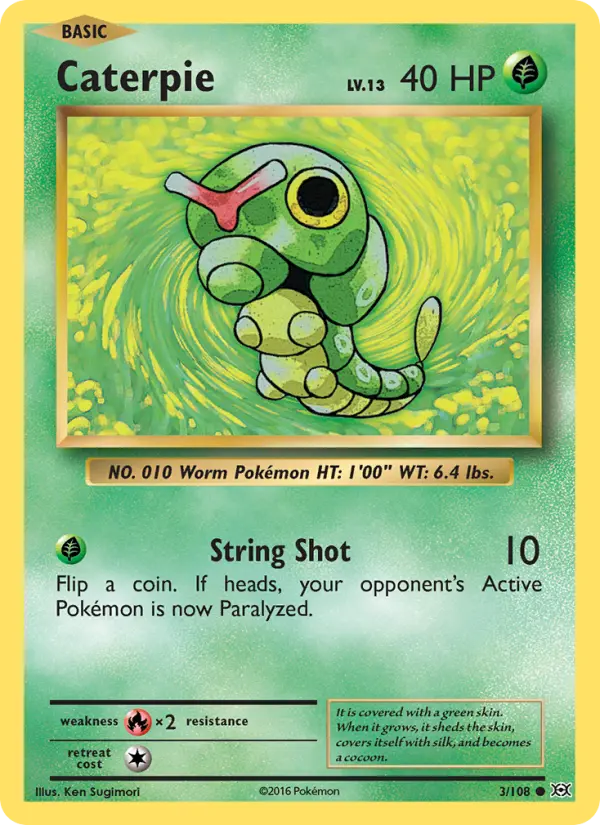
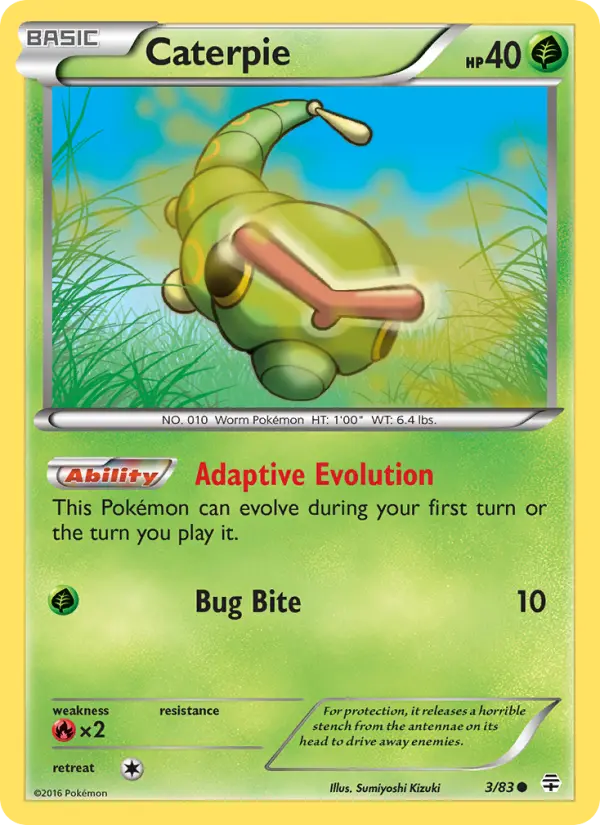
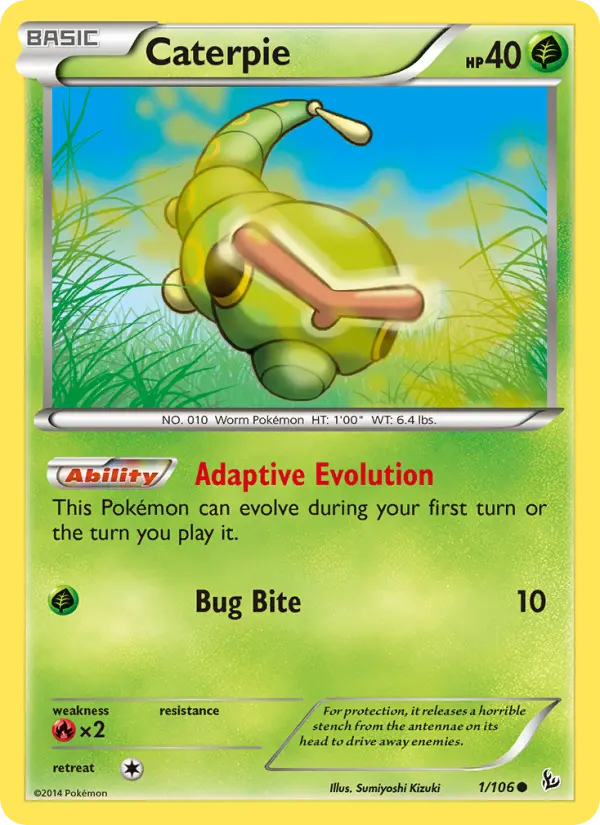
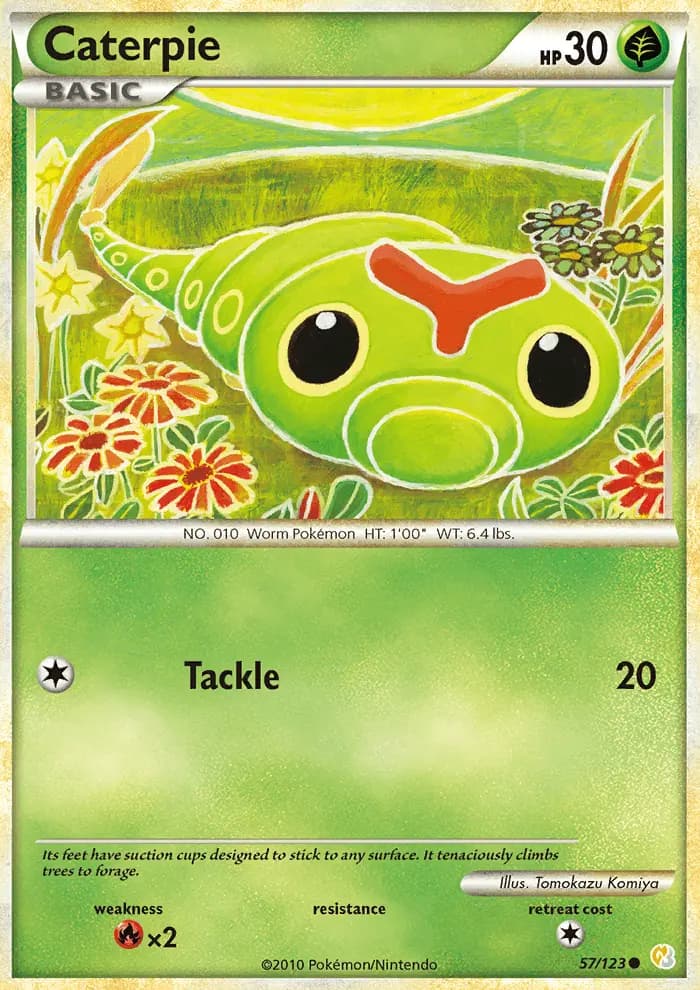
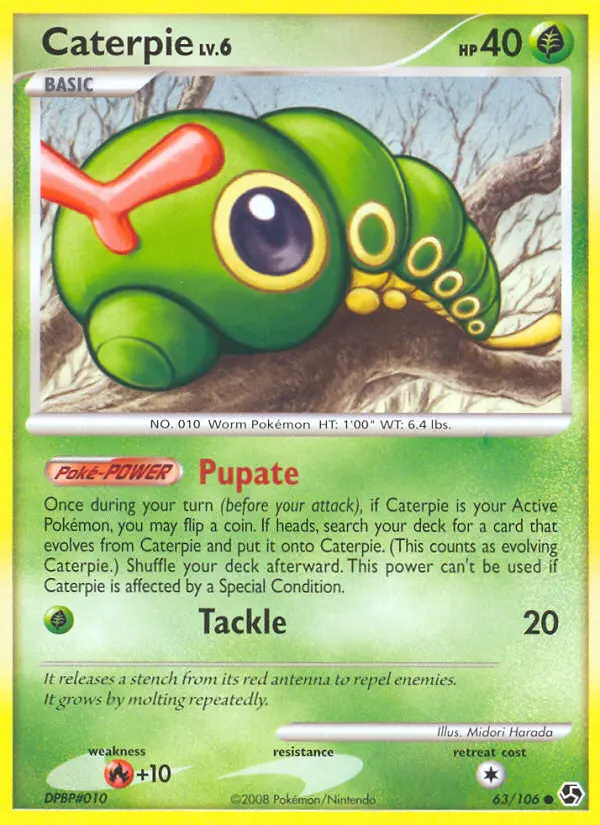
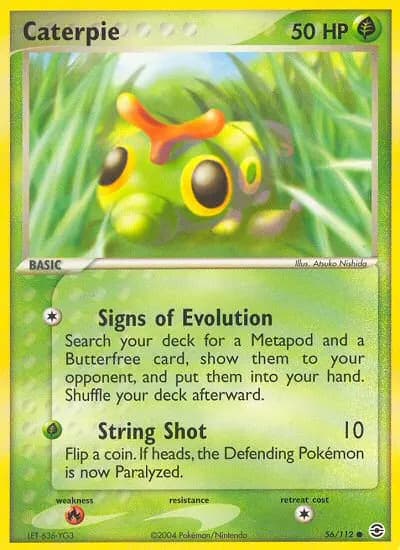
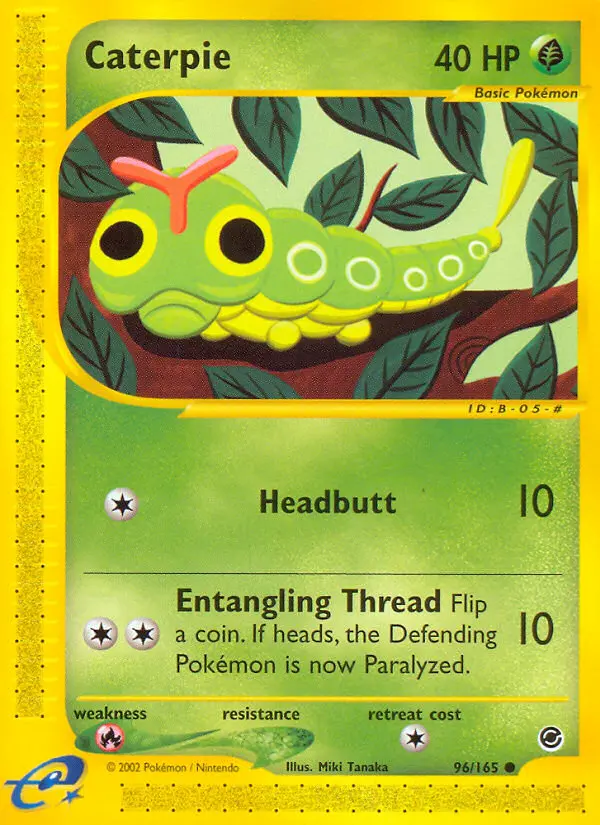
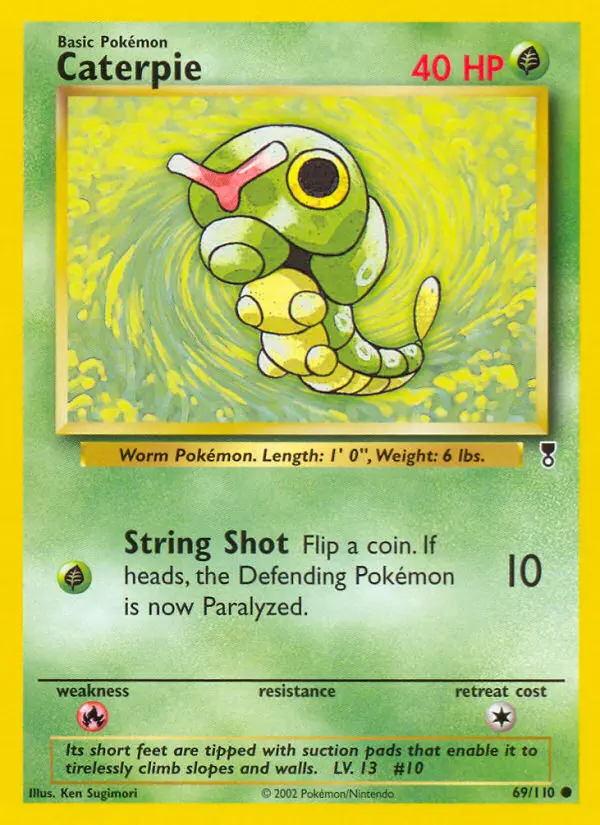
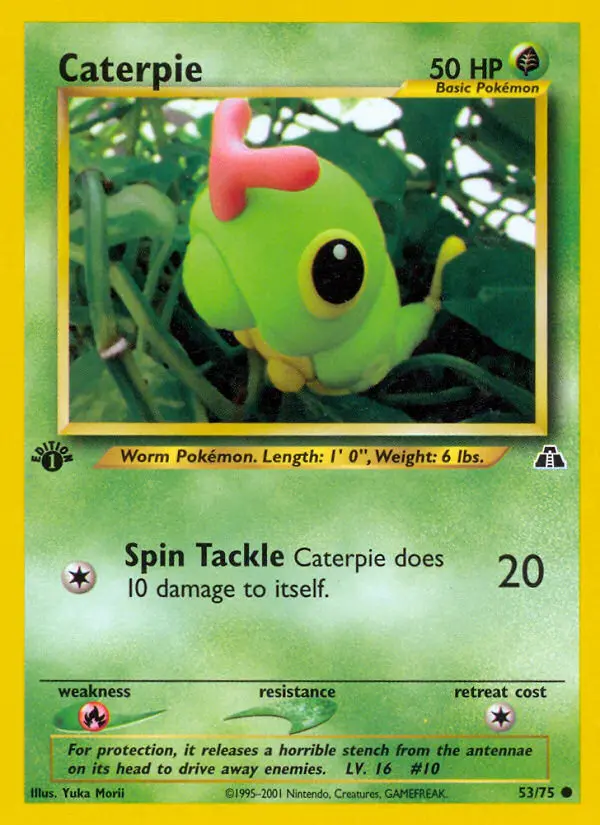
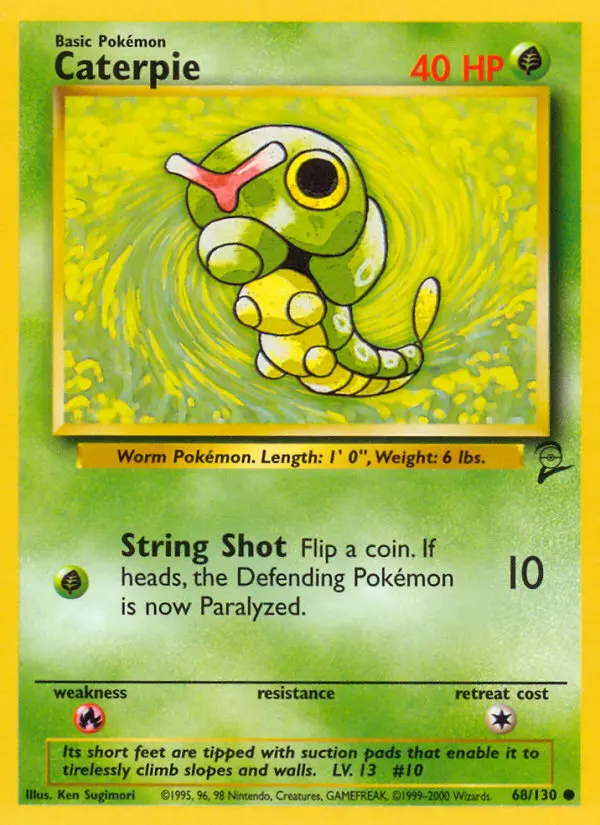
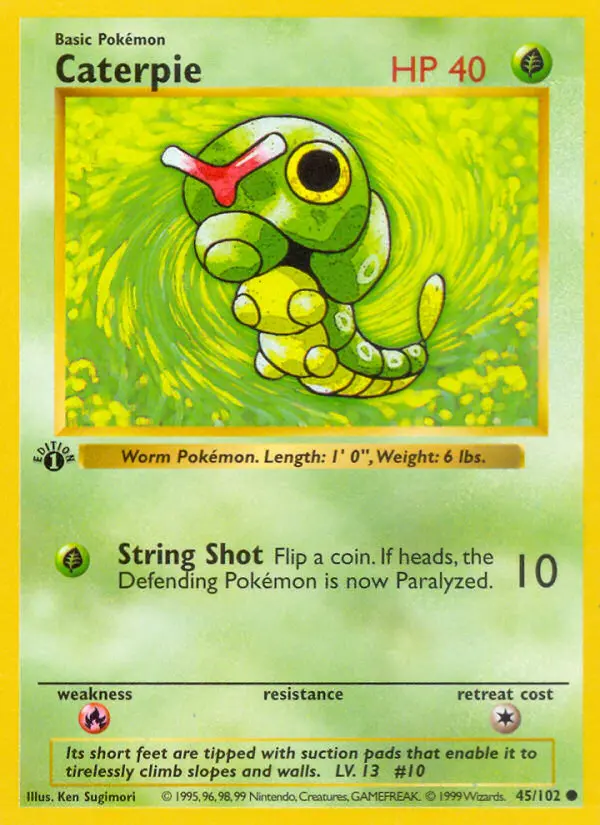
Caterpie holds an irreplaceable position as one of the most recognizable early-game Pokémon and serves as the literal face of beginner trainers' first evolution experience across the franchise. In the original Pokémon anime, Ash Ketchum's early capture and training of Caterpie—later evolved into Metapod and finally Butterfree—remains one of the series' most memorable arcs, establishing narrative precedent for countless subsequent trainers experiencing their first evolution. This anime prominence vastly amplified Caterpie's cultural footprint beyond what its competitive statistics would suggest, making it a nostalgic touchstone for millions of players who encountered it during their introduction to the franchise. The simplicity and charm of Caterpie's design made it an ideal subject for the Trading Card Game, with numerous Caterpie cards released throughout TCG history, some becoming valuable collector's items despite the creature's apparent simplicity. Caterpie's role as an accessible entry point into the Pokémon world cannot be understated—generations of new players began their journey by catching this very creature, making it emblematic of the franchise's welcoming approach to newcomers. The creature represents a deliberate design choice to include an unchallenging early-game Pokémon that evolves quickly and visibly, providing immediate gratification and teaching game mechanics to novice players before encounters with legitimately threatening opponents.
Where to Find Caterpie in Every Pokémon Game
Caterpie is extraordinarily abundant and easy to find throughout the early routes of virtually every main-series Pokémon game where it appears, reflecting its intentional design as an early-game capture opportunity. In the original Red and Blue versions and their remakes FireRed and LeafGreen, Caterpie can be encountered on Route 1 immediately after obtaining a Pokédex, making it often the very first wild Pokémon most players battle and catch. Its extraordinarily high catch rate of 255—the maximum possible value—ensures that even inexperienced trainers with basic Poké Balls succeed in capturing it on the first attempt, eliminating frustration at the game's earliest moments. Across subsequent generations, Caterpie has been reintroduced in numerous regional Pokédexes, appearing in Generation II's Johto region, Generation III's Hoenn region, and many subsequent games including the modern Pokémon Sword and Shield games where it appears in the Galar Pokédex. This consistent availability across game generations reflects the creature's status as a foundational element of the Pokémon experience—so fundamental that its absence would notably change the new-player experience. The species also appears in Pokémon GO, where its high spawn rate and three-stage evolution line make it valuable for players seeking to obtain an evolved form through candy accumulation, ensuring that Caterpie remains accessible to modern casual players even outside traditional handheld games.