Metapod
Generation I · #0011 — Cocoon Pokémon
Metapod's shed skin ability is the first thing worth knowing about it — everything else, from its bug typing to its build, follows from how that ability gets used. It measures 0.7 m and 9.9 kg, dimensions that pair with that stat lean in noticeable ways. Introduced in Generation I, Metapod has remained a staple of early-game encounters across numerous Pokémon regions, serving as players' first introduction to the concept of multi-stage evolution. With a Pokédex number of #011 in the National Pokédex, Metapod has maintained consistent presence throughout the franchise's evolution, appearing in numerous games, trading card sets, and animated media.
Editor's Take
Metapod knows Harden and nothing else, which makes it the clearest illustration of what a cocoon stage is for — the games ask you to invest levels in something that literally cannot fight back.
Base Stats
Height
0.7m
Weight
9.9kg
Category
Cocoon Pokémon
Gender
Male 50% / Female 50%
Color
green
Shape
squiggle
Habitat
forest
Abilities
Has a 33% chance of curing any major status ailment after each turn.

Metapod Biology & Physical Characteristics
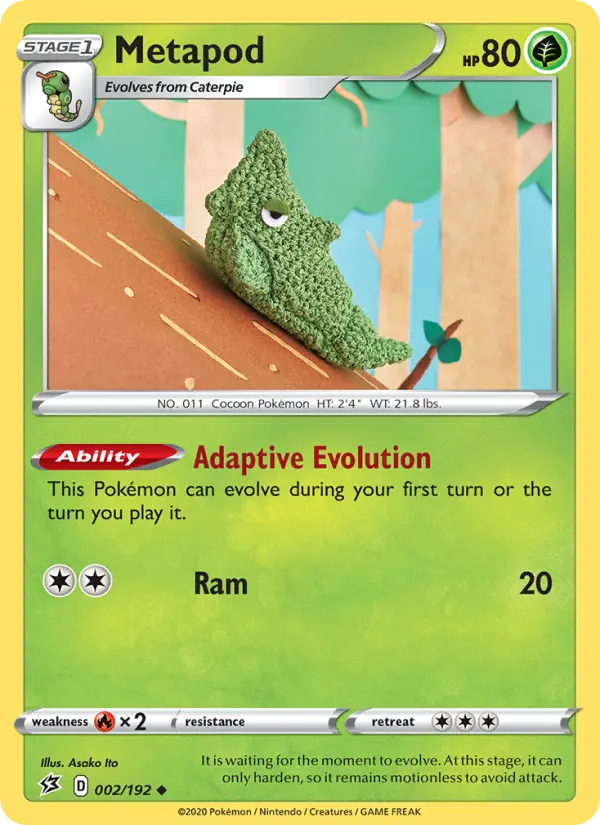
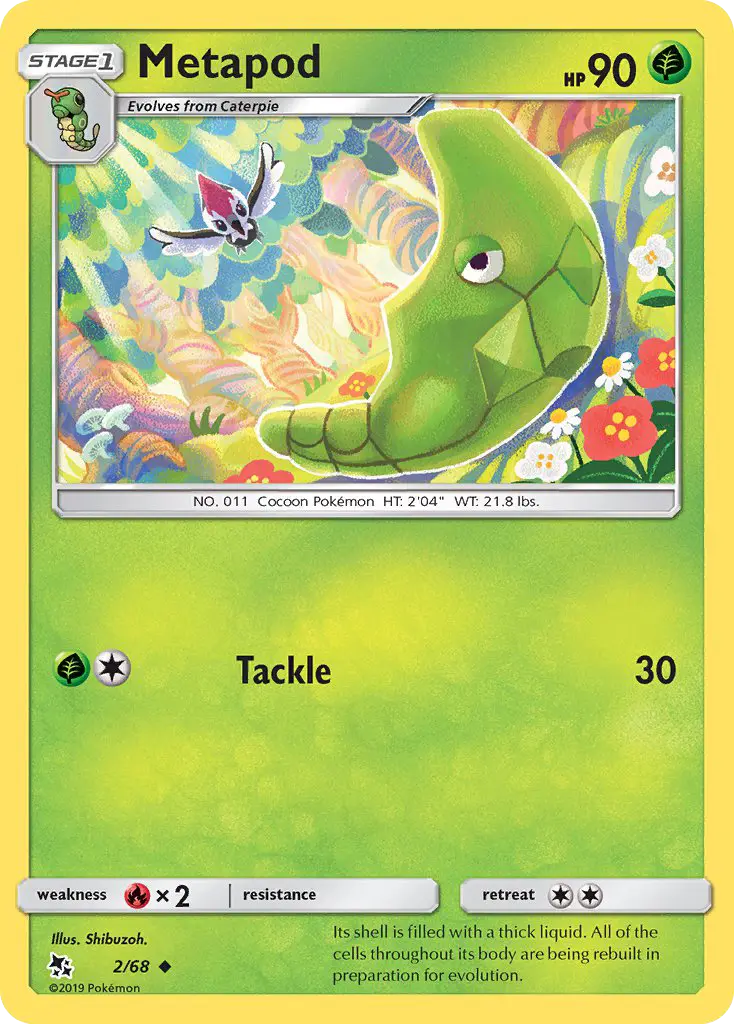
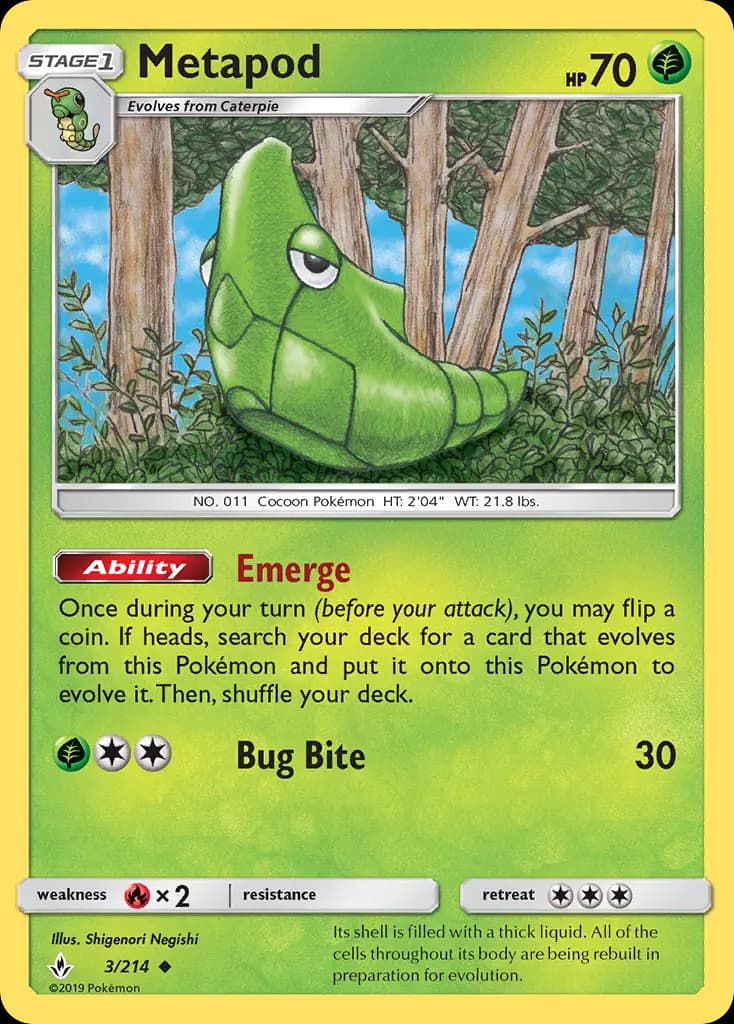
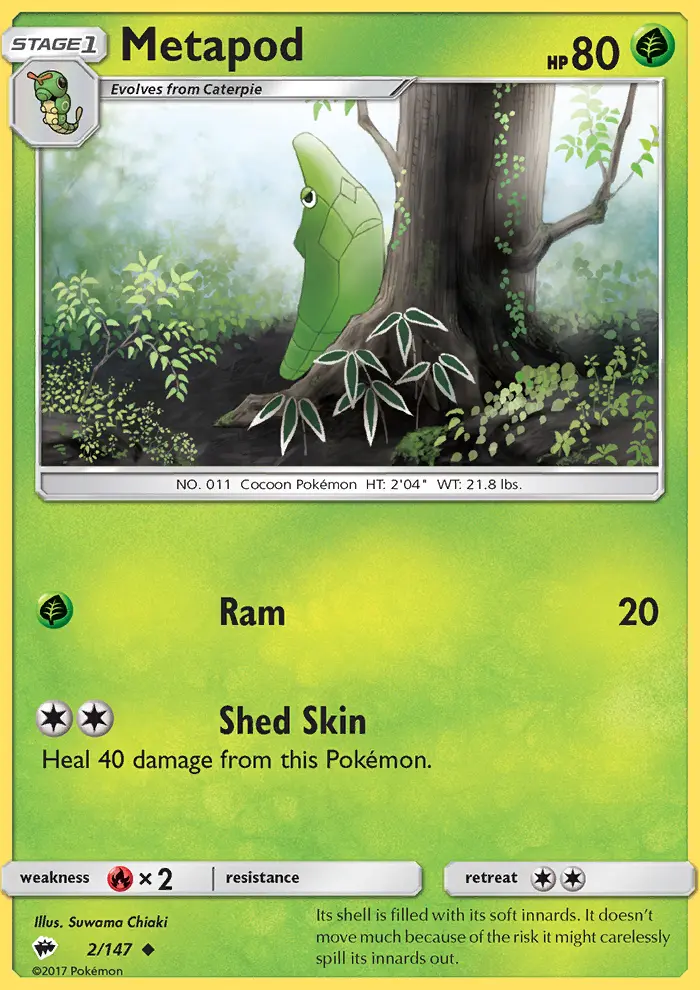
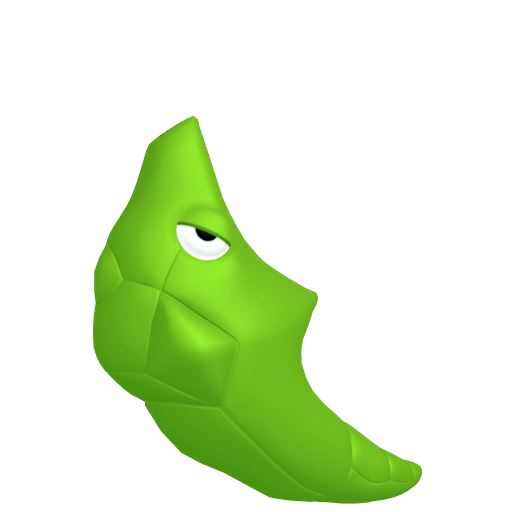
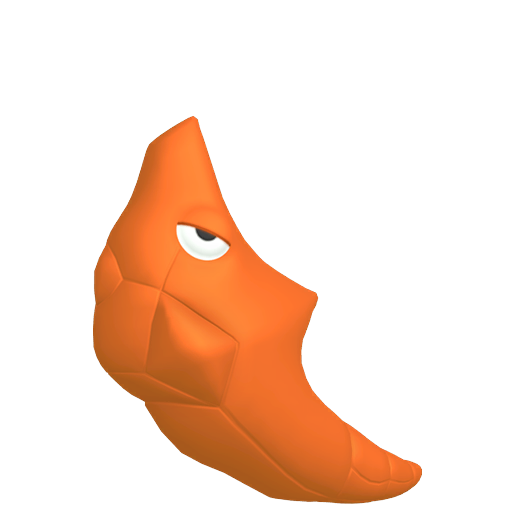
Metapod is an insect Pokémon that physically resembles a verdant green chrysalis, featuring a distinctive crescent-shaped body composed of several segmented portions that taper toward a pointed lower section. The creature's design includes two heavy-lidded eyes positioned on the lateral sides of its shell, while the front face displays geometrically shaped portions and projections characteristic of a protective cocoon. The posterior of Metapod's body features three pointed protrusions—two angling toward the sides and one jutting centrally—which from certain angles create the illusion of a secondary face when viewed alongside the primary lateral eyes. Standing at just 0.7 meters tall and weighing 9.9 kilograms, Metapod's relatively diminutive stature reflects its transitional biological status. The shell enveloping Metapod's body is described as being as hard as an iron slab or steel, providing exceptional protective coverage for the soft, vulnerable innards beneath. However, this paradox of protection conceals a critical vulnerability: the creature's interior remains tender and fragile, and a sudden powerful impact can rupture the shell and expose the liquid-filled body within, leaving it completely defenseless.
Pokedex Numbers
Training
Breeding
Metapod Breeding, Gender Ratio & Egg Groups
Metapod's population splits evenly by gender, 50% each way, allowing for straightforward breeding without the complications that plague some Pokémon species with skewed gender distributions. The species belongs to the Bug Egg Group, meaning it can breed with other Bug-type Pokémon and creatures sharing this classification to produce compatible offspring. Breeding Metapod pairs requires 15 egg cycles to hatch, translating to approximately 3,599 to 3,855 steps before a Caterpie egg produces its offspring—a relatively modest breeding investment that makes Metapod practical for players interested in breeding Bug-type Pokémon. The creature's base happiness value of 70 (adjusted to 50 in later generations) indicates a moderately friendly disposition that influences breeding success rates and the happiness-dependent evolution mechanics of certain Pokémon. The species exhibits no gender-specific variations in appearance or statistics, making breeding choices purely dependent on desired nature, ability, and individual value inheritance. This accessibility in breeding mechanics has made Metapod a popular choice for players beginning their journey into competitive breeding and intraspecies training optimization.
Sprites




TMs & HMs
tm104
scarlet violet
tm182
scarlet violet
tr46
sword shield
tm211
scarlet violet
tm182
the teal mask
tm104
the indigo disk
tm211
the indigo disk
tm82
sword shield
Metapod's Evolution Chain


Metapod Evolution, Mega Evolution & Special Forms
Metapod represents the crucial middle stage of a three-part evolutionary line beginning with Caterpie and culminating in Butterfree, demonstrating one of the franchise's most recognizable evolutionary progressions. The species evolves from Caterpie upon reaching level 7, making it an early and accessible evolution for trainers in the initial stages of their journey. The transformation from the slower, crawling Caterpie into the armored Metapod represents a significant defensive upgrade, with the creature's Defense stat increasing substantially from Caterpie's base 35 to Metapod's respectable 55—nearly a 60% improvement that reflects the protective properties of the hardened shell. Metapod itself evolves into the fully-formed Butterfree upon reaching level 10, a relatively quick advancement that transforms the stationary cocoon into an agile, winged creature with dramatically enhanced offensive and Speed capabilities. This three-stage line has been praised for its faithful representation of real-world insect metamorphosis, translating biological reality into engaging gameplay mechanics that reward player progression and patience. The evolutionary stages form a logical progression of power and capability, with each stage appropriately balanced for its position within early-game content.
Where to Find
Kanto Route 25
kanto
+5 more
Viridian Forest
kanto
+19 more
Kanto Route 24
kanto
+2 more
Johto Route 30
johto
+7 more
Kanto Route 27
kanto
Kanto Route 2
kanto
+5 more
Johto Route 36
johto
Johto Route 37
johto
National Park
johto
+3 more
Kanto Route 26
kanto
Johto Route 31
johto
+11 more
Johto Route 35
johto
Johto Route 38
johto
Johto Route 39
johto
Lake of Rage
johto
Johto Route 34
johto
Ilex Forest
johto
+11 more
Azalea Town
johto
Pattern Bush
kanto
Eterna Forest
sinnoh
+2 more
+6 more locations in other games
Metapod Behaviour and Natural Habitat
Metapod exhibits remarkably sedentary behavior, remaining almost motionless as it undergoes the cellular reorganization necessary for its impending evolution into Butterfree. Multiple Pokédex entries consistently emphasize that Metapod stays still by necessity rather than choice, as movement poses a significant risk of accidentally spilling its delicate inner contents out through its shell. This immobility serves a dual purpose: it conserves energy for the metabolic processes occurring within the chrysalis while simultaneously reducing the likelihood of accidental self-injury. The creature's behavioral patterns reflect a creature wholly dedicated to preparation for metamorphosis, spending its time hardening its shell as much as possible to better protect the soft tissues undergoing transformation inside. Metapod inhabits environments similar to those preferred by its pre-evolution, typically found in grassy fields, forests, and vegetation-rich areas where it can remain relatively undisturbed during its vulnerable developmental stage. The species shows a notable preference for remaining camouflaged among foliage, where its green coloration provides effective concealment from potential predators.
Pokedex Entries
This POKéMON is vulnerable to attack while its shell is soft, exposing its weak and tender body.
Hardens its shell to protect itself. However, a large impact may cause it to pop out of its shell.
Inside the shell, it is soft and weak as it pre pares to evolve. It stays motion less in the shell.
It prepares for evolution by har dening its shell as much as possi ble to protect its soft body.
This is its pre- evolved form. At this stage, it can only harden, so it remains motionless to avoid attack.
The shell covering this POKéMON’s body is as hard as an iron slab. METAPOD does not move very much. It stays still because it is preparing its soft innards for evolution inside the hard shell.
Its shell is as hard as an iron slab. A METAPOD does not move very much because it is preparing its soft innards for evolution inside the shell.
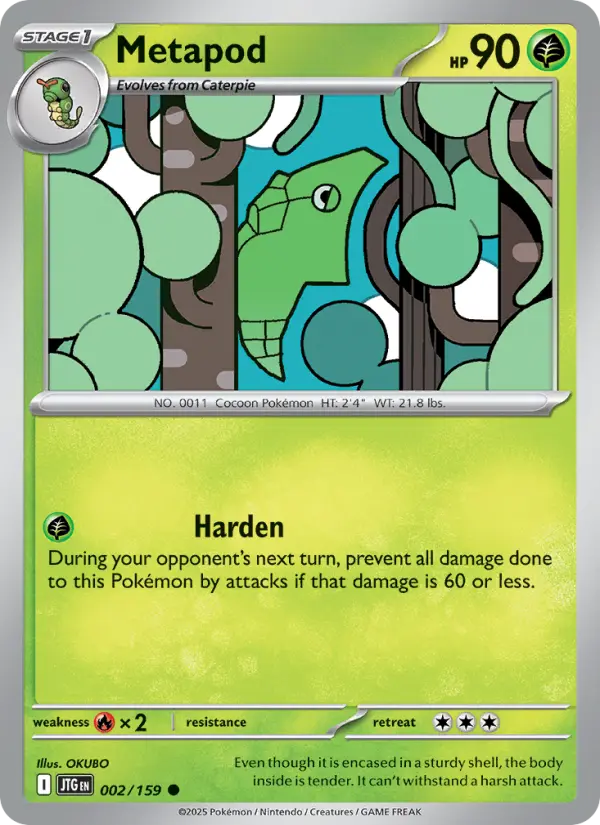
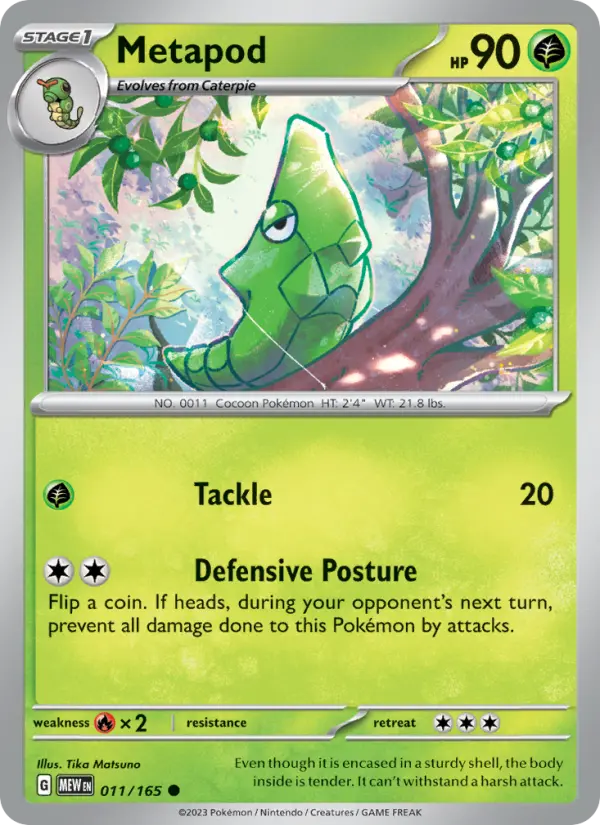
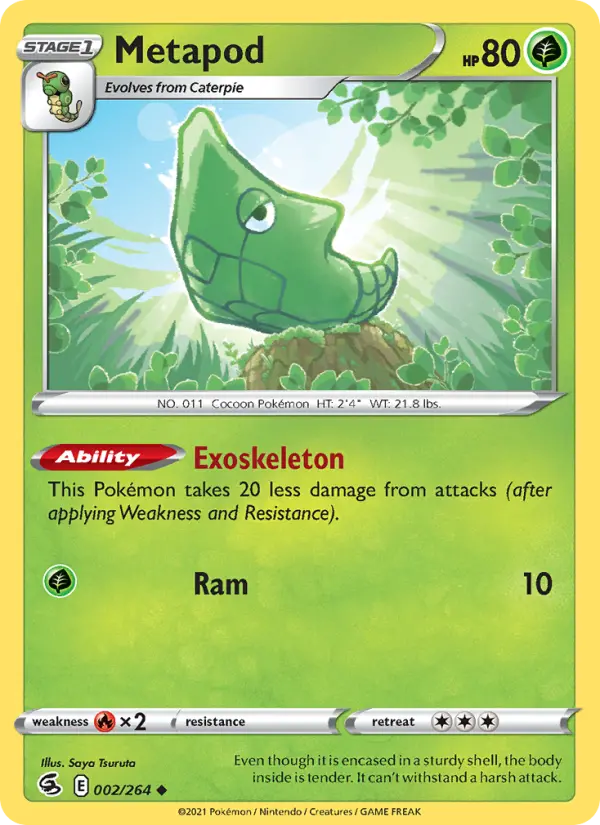
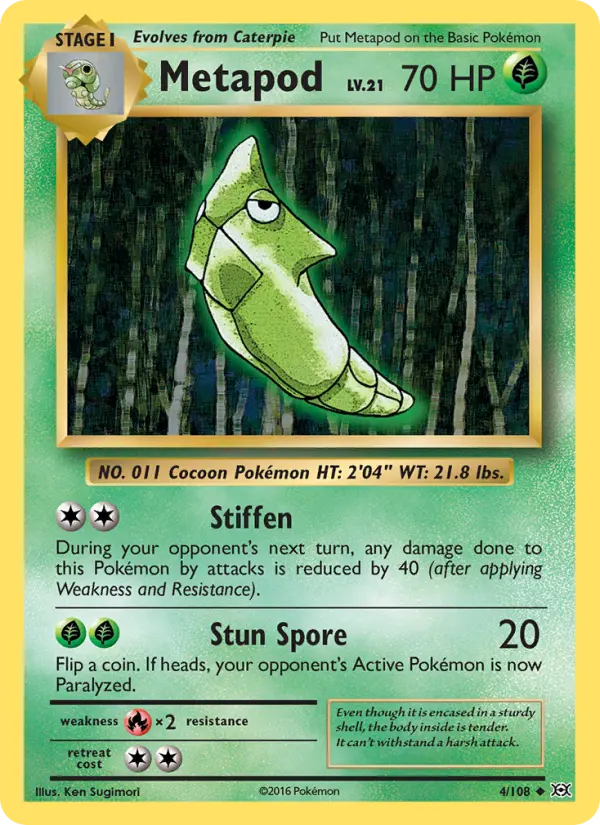
Even though it is encased in a sturdy shell, the body inside is tender. It can’t withstand a harsh attack.
This POKéMON is vulnerable to attack while its shell is soft, exposing its weak and tender body.
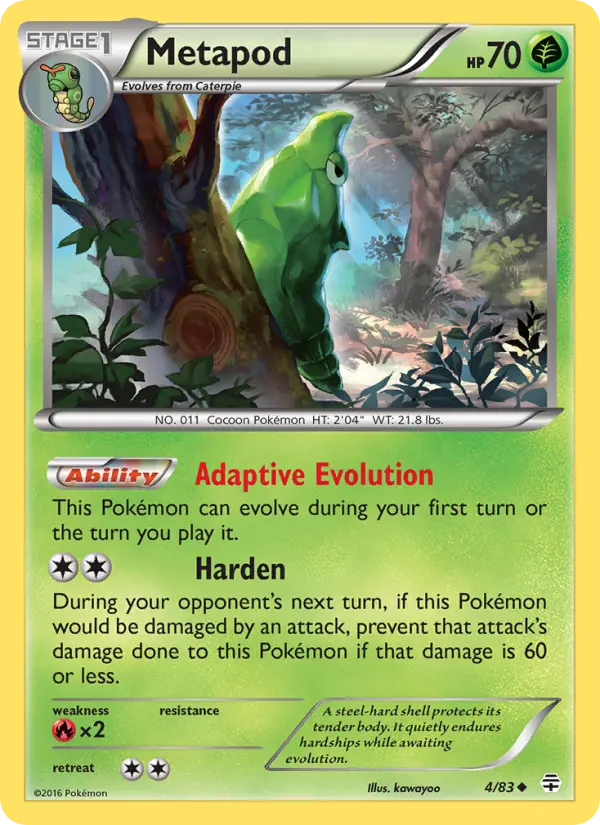
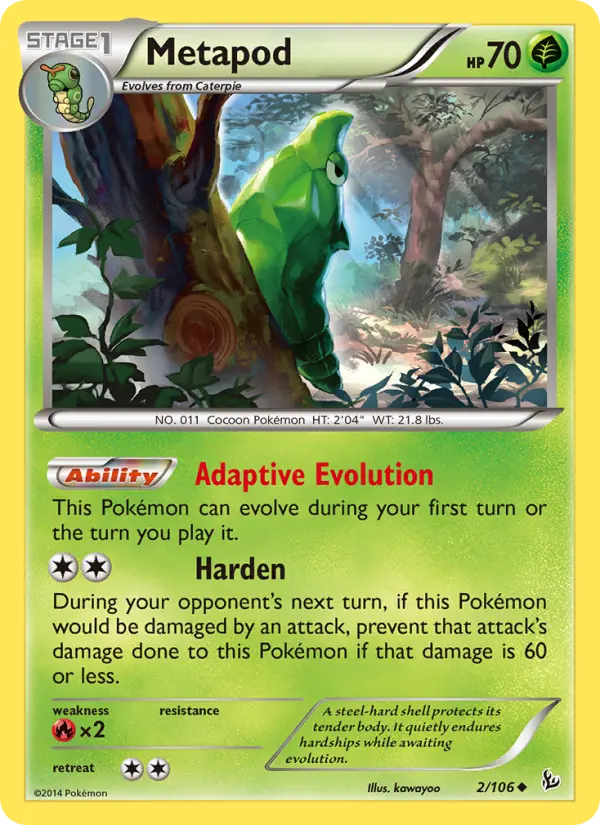
A steel-hard shell protects its tender body. It quietly endures hardships while awaiting evolution.
Inside the shell, it is soft and weak as it prepares to evolve. It stays motionless in the shell.
It prepares for evolution by hardening its shell as much as possible to protect its soft body.
A steel-hard shell protects its tender body. It quietly endures hardships while awaiting evolution.
A steel-hard shell protects its tender body. It quietly endures hardships while awaiting evolution.
A steel-hard shell protects its tender body. It quietly endures hardships while awaiting evolution.
This Pokémon is vulnerable to attack while its shell is soft, exposing its weak and tender body.
The shell covering this Pokémon’s body is as hard as an iron slab. Metapod does not move very much. It stays still because it is preparing its soft innards for evolution inside the hard shell.
The shell covering this Pokémon’s body is as hard as an iron slab. Metapod does not move very much. It stays still because it is preparing its soft innards for evolution inside the hard shell.
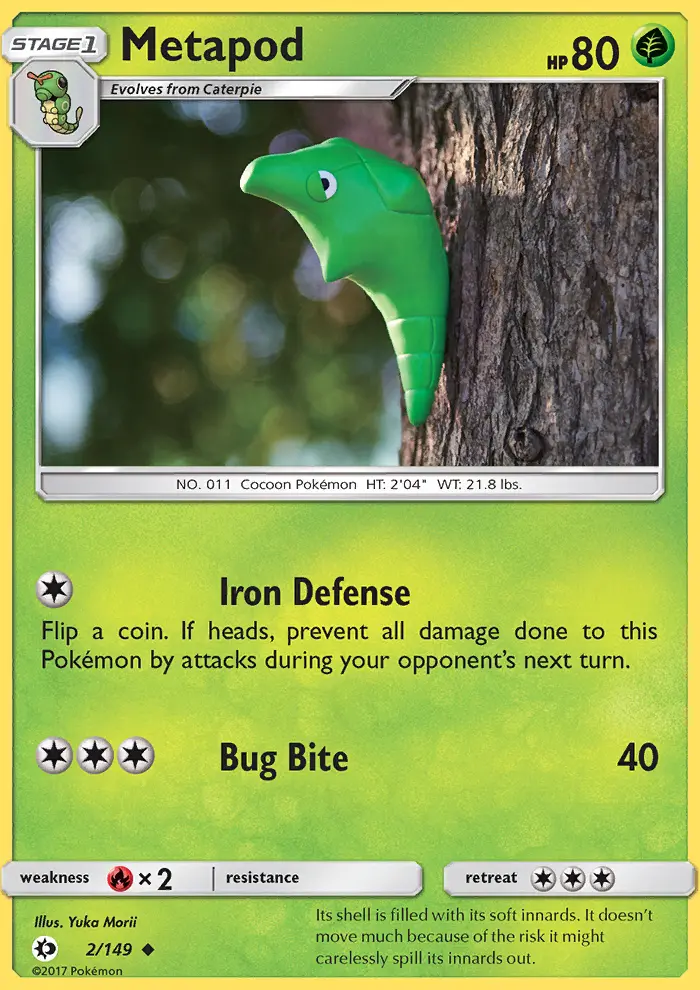
Its shell is filled with its soft innards. It doesn’t move much because of the risk it might carelessly spill its innards out.
Its shell is filled with a thick liquid. All of the cells throughout its body are being rebuilt in preparation for evolution.
Its shell is hard, but it’s still just a bug shell. It’s been known to break, so intense battles with it should be avoided.
Its hard shell doesn’t crack a bit even if Pikipek pecks at it, but it will tip over, spilling out its insides.
Hardens its shell to protect itself. However, a large impact may cause it to pop out of its shell.
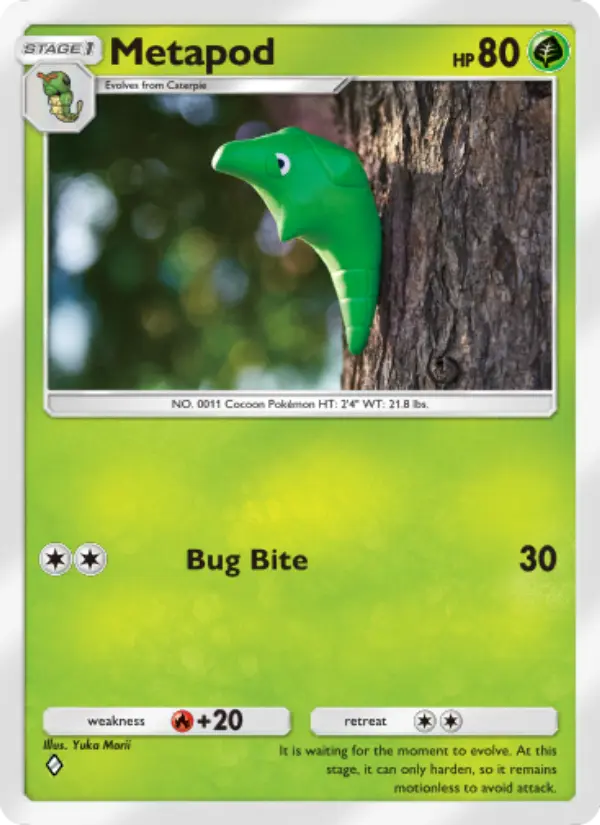
It is waiting for the moment to evolve. At this stage, it can only harden, so it remains motionless to avoid attack.
Even though it is encased in a sturdy shell, the body inside is tender. It can’t withstand a harsh attack.
Metapod Name Origin & Design Inspiration
Metapod's name origin lies in the Greek word 'meta,' meaning transformation or change, combined with 'pod,' referencing the pod-like or chrysalis structure of its physical form. The Japanese designation Transel similarly suggests the concept of transition, emphasizing the creature's role as a transitional form between juvenile and adult stages. The visual design draws explicit inspiration from real-world chrysalises and pupae of butterfly species, translating natural insect biology into a Pokémon form with remarkable accuracy. The geometric patterns adorning Metapod's shell reference the actual segmentation and aesthetic patterns found on genuine chrysalises, while the pointed protrusions echo the irregular formations common in nature. The color scheme of deep green provides both visual appeal and logical connection to vegetation, environments where chrysalises naturally occur in the wild. Unlike many Pokémon designs that prioritize fantastical elements, Metapod's aesthetic grounds itself firmly in biological realism, making it an exceptionally faithful artistic interpretation of insect metamorphosis translated into the Pokémon medium.
Learnable Moves
Metapod Competitive Battle Guide
Metapod's competitive viability is severely limited by its extraordinarily poor offensive statistics and middling defensive capabilities, making it unsuitable for serious competitive battling despite its iconic status in the franchise. The species boasts a base Attack of merely 20 and Special Attack of 25, rendering it virtually incapable of dealing meaningful damage to opponents even with super-effective moves. Its Defense of 55 and Special Defense of 25 provide minimal protection, especially considering its moderate base HP of 50, which translates to just 210 hit points at level 100 without investment. The Speed stat of 30 ensures that Metapod will move last in almost every exchange, compounding its offensive impotence with guaranteed initiative disadvantage. The Shed Skin ability, granting a 33% chance to cure status ailments after each turn, represents the species' sole noteworthy attribute, though this provides marginal benefit without the offensive presence to capitalize on status immunity. Metapod's primary role in competitive contexts exists purely as a nostalgic reference or novelty choice rather than a viable strategic option, relegated to Nuzlocke challenges, casual format play, or humorous team compositions. The species' statistical distribution clearly positions it as an early-game developmental stage rather than a combat-viable independent creature.
Commonly Asked Questions About Metapod
What type is Metapod?
Metapod is a bug type Pokemon.
What does Metapod evolve into?
Metapod evolves into butterfree.
What are Metapod's weaknesses?
Metapod is weak to flying, rock and fire type moves.
Does Metapod evolve by trading?
No — Metapod evolves entirely through leveling up, with no trade required at any stage.
Where can I find Metapod?
Metapod can be found in kanto route 25 (kanto), viridian forest (kanto) and kanto route 24 (kanto) and 23 other locations.
Metapod Cultural Impact & Franchise History
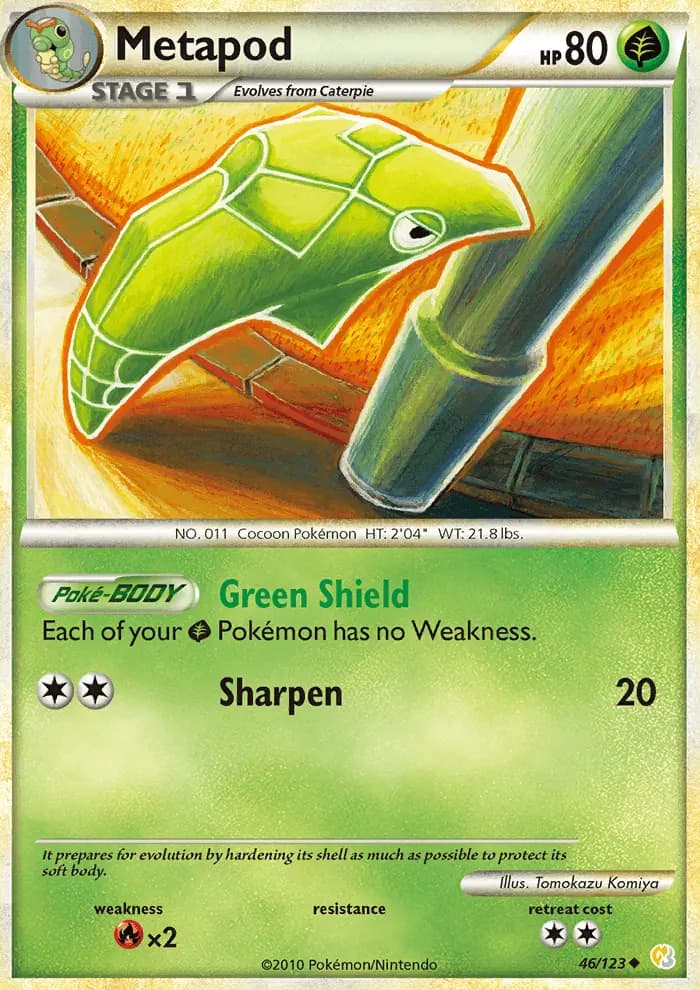
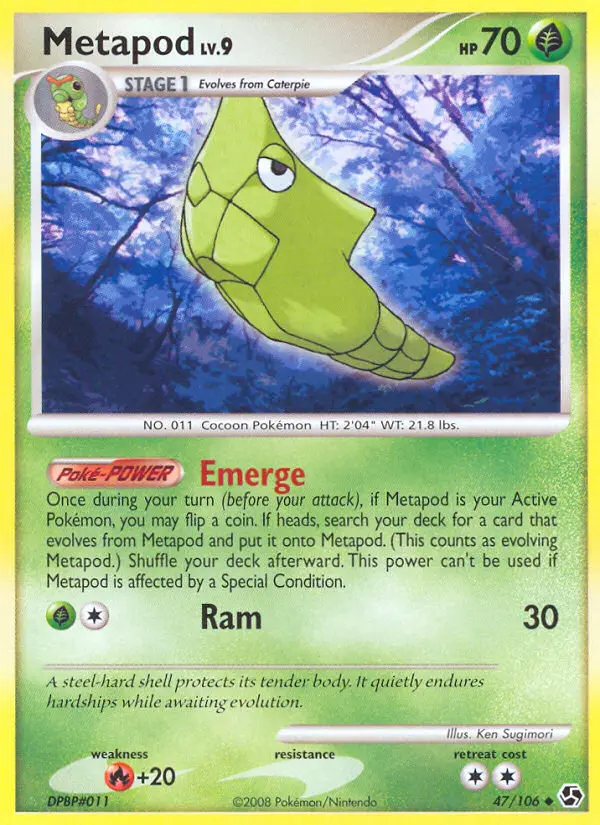
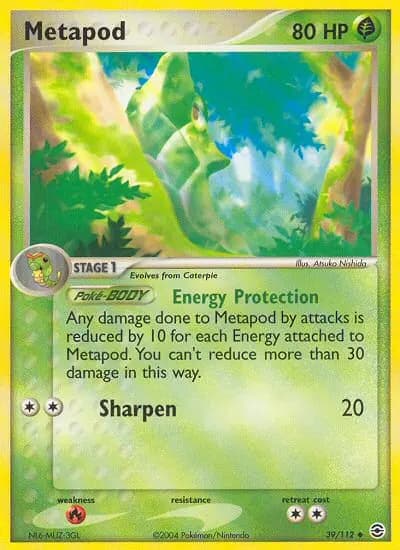
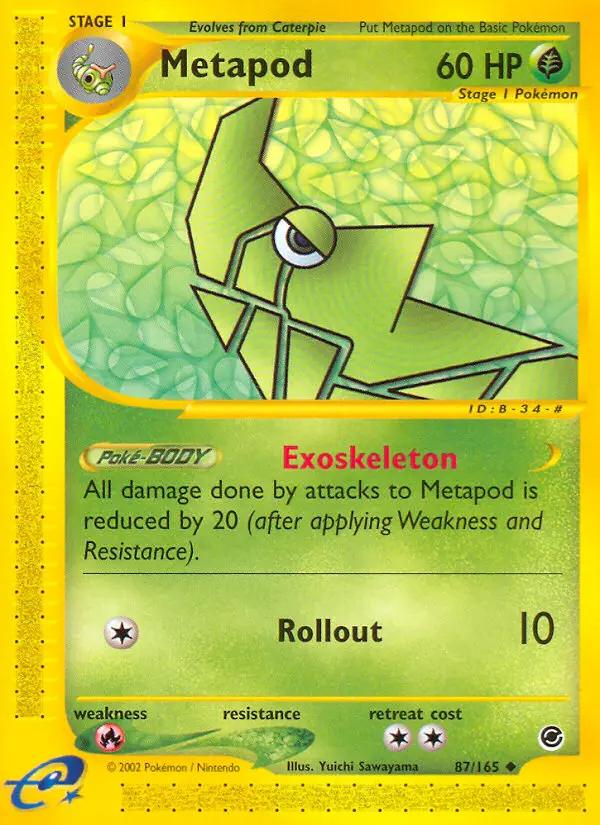
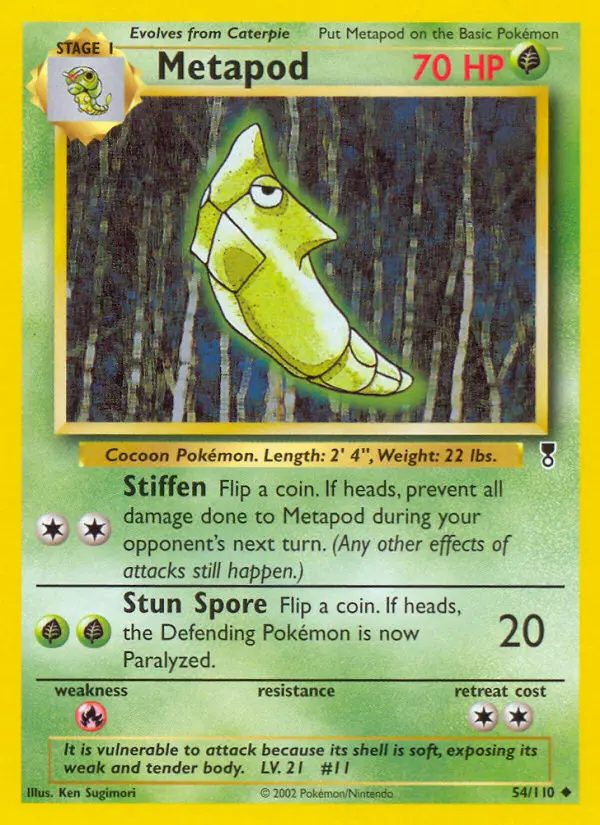
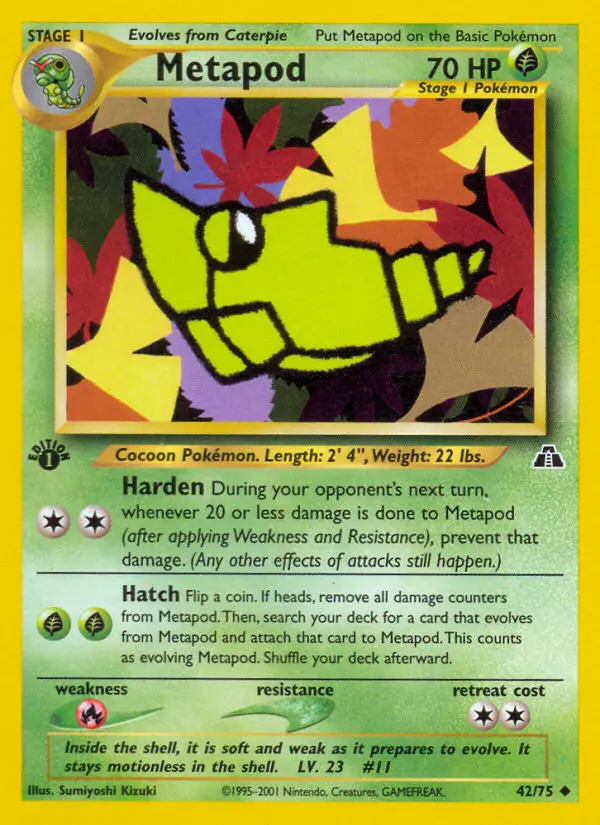
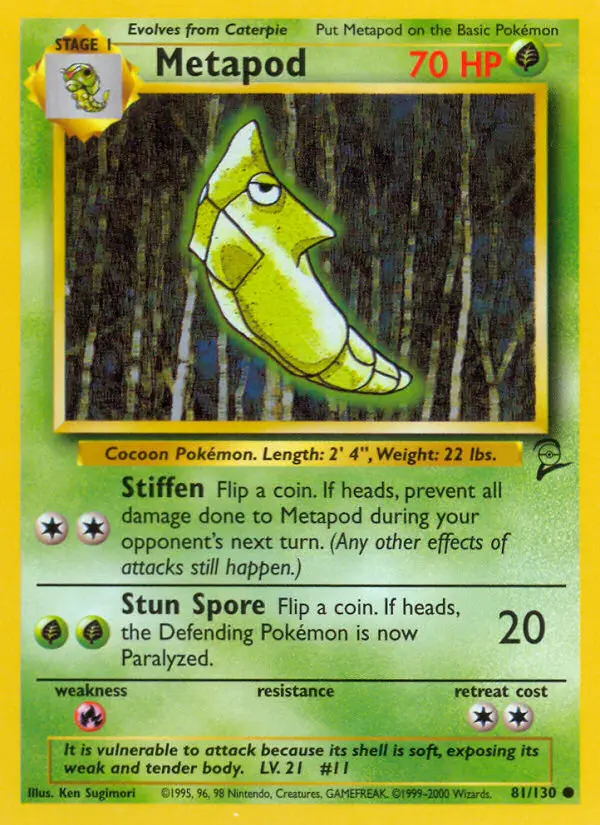
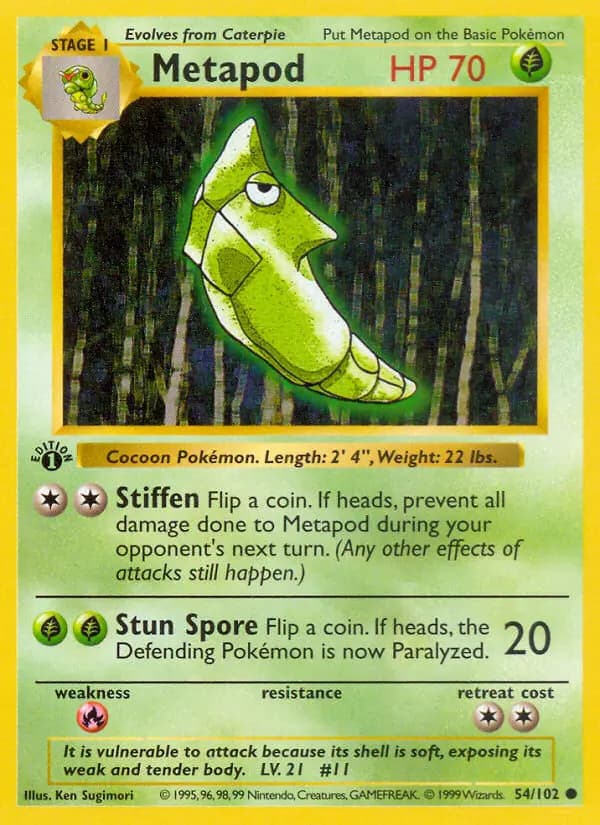
Metapod has secured a permanent position within Pokémon cultural consciousness as an iconic early-game creature inextricably linked to the franchise's origins and foundational appeal. The species achieved particular prominence through its appearance in the original Pokémon animated series, where Ash's Metapod became a memorable character whose evolution into Butterfree marked a significant milestone in the show's early narrative. The creature's status as Caterpie's evolved form made it an almost universal experience for players and viewers of the original generation, creating widespread nostalgic recognition that persists across generations of fans. Metapod's design inspired countless discussions about the franchise's commitment to biological accuracy, with the chrysalis-like form earning particular praise for faithfully translating real-world insect metamorphosis into an interactive gaming experience. The species has appeared extensively in trading card game collections since the base set, often depicted in artwork that emphasizes the shell's protective qualities and the transformation motif central to its identity. Its combination of iconic status, accessibility, and role in the evolutionary line alongside the beloved Butterfree has ensured Metapod's enduring relevance within fan communities, merchandise collections, and broader Pokémon cultural discourse.
Where to Find Metapod in Every Pokémon Game
Metapod appears throughout numerous Pokémon games with exceptional consistency, reflecting its status as an early-game staple within the franchise's core experience. In the original Red and Blue versions and their remakes FireRed and LeafGreen, Metapod appears naturally in early-game routes as the evolved form of the readily available Caterpie, with Caterpie serving as the primary encounter and Metapod appearing through trainer battles and wild encounters. Subsequent generations have maintained this pattern, with Metapod consistently available in the opening regions of nearly every main series installment, though its specific location and availability varies between versions. The species appears in Gold, Silver, and Crystal in the Johto region, as well as in Ruby and Sapphire, HeartGold and SoulSilver, Black and White, X and Y, Sun and Moon, Sword and Shield, and Let's Go Pikachu and Eevee. Metapod's catch rate of 120 indicates relatively easy capture, making it practical for players seeking to obtain the species without excessive resource expenditure. The creature's consistent availability across generations, combined with its early-game accessibility and rapid evolution line, has made Metapod one of the most frequently encountered Pokémon species among casual and competitive players alike, establishing it as a foundational element of the Pokémon experience across multiple decades of franchise expansion.