Cacnea
Generation III · #0331 — Cactus Pokémon
Cacnea's profile is easy to undersell: 0.4 m, 51.3 kg, and a grass typing that doesn't scream power — until you look at its HP of 50. Standing at just 0.4 meters tall and weighing 51.3 kilograms, Cacnea may appear diminutive, but it compensates for its modest stature with a deceptive combat prowess featuring balanced Attack and Special Attack stats of 85 each. Its overall stat sum of 335 reflects the specialized nature of a desert dweller, with particular strengths in offensive capabilities while maintaining lower defensive and speed metrics. The relatively high catch rate of 190 makes Cacnea an accessible Pokémon for trainers seeking to build a desert-themed team or those simply appreciating its unique charm.
Editor's Take
Cacnea's line ends in Cacturne with Water Absorb, which on a Grass/Dark type is a genuinely awkward Pokémon to plan around despite never being strong.
Base Stats
Height
0.4m
Weight
51.3kg
Category
Cactus Pokémon
Gender
Male 50% / Female 50%
Color
green
Shape
humanoid
Habitat
rough-terrain
Abilities
Increases evasion to 1.25× during a sandstorm. Protects against sandstorm damage.
Absorbs water moves, healing for 1/4 max HP.

Cacnea Biology & Physical Characteristics
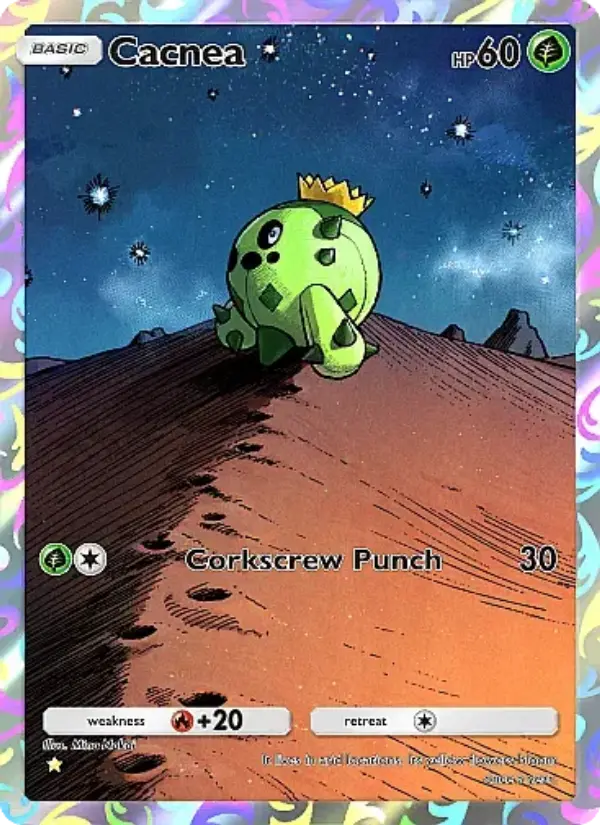
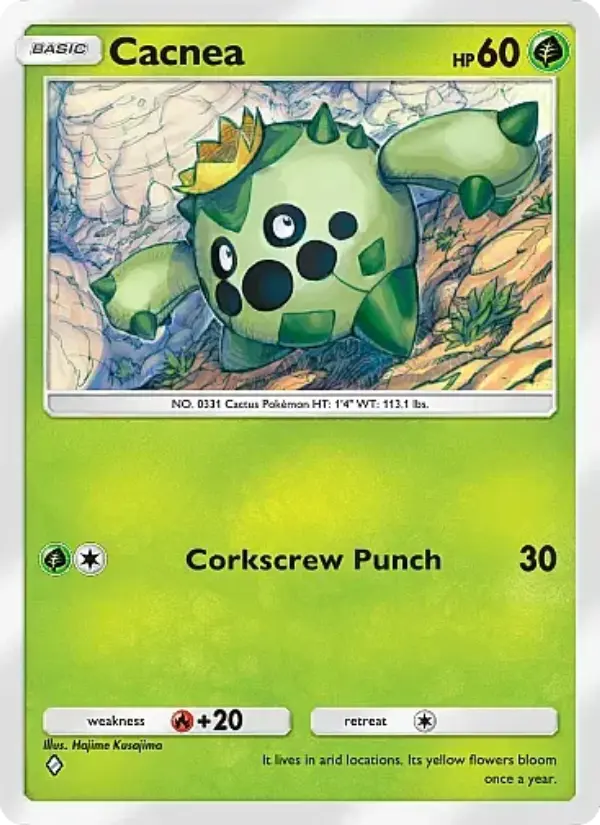
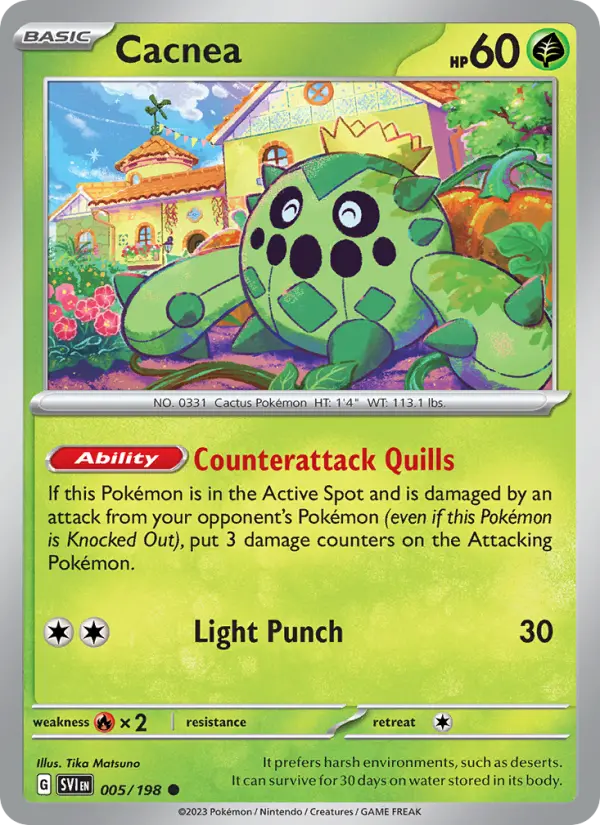
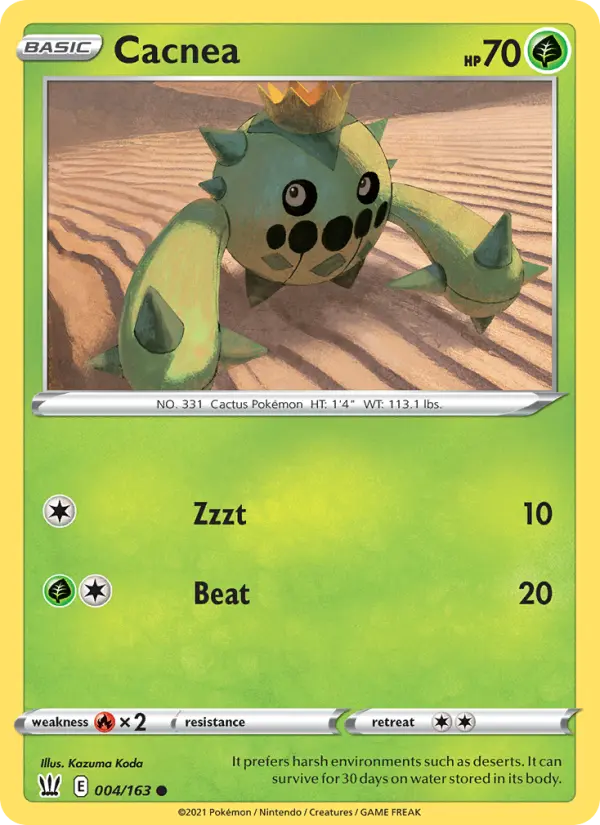
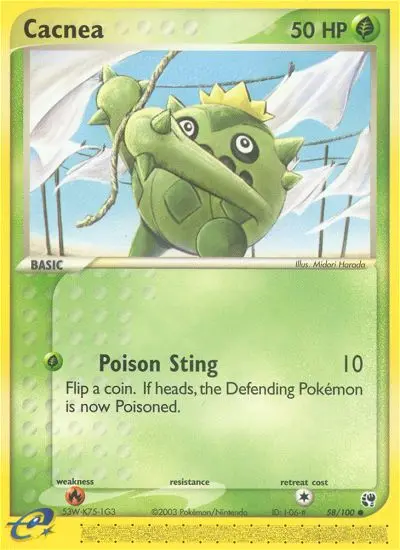
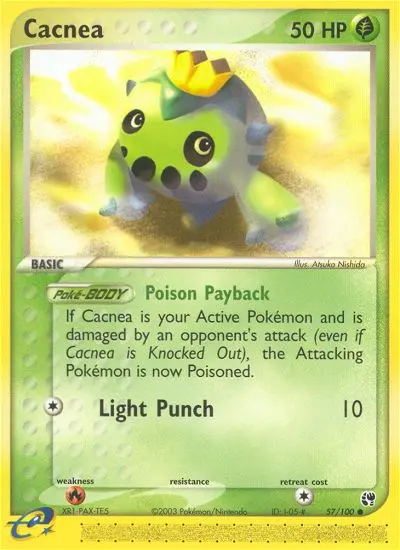
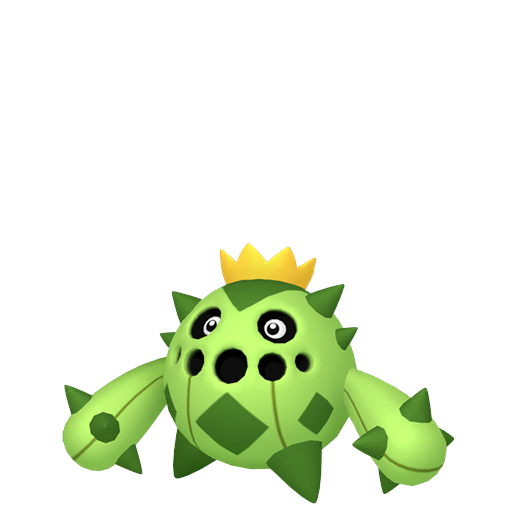
Cacnea presents a striking green physiology that immediately identifies it as a cactus-inspired Pokémon, with a round, bipedal body adorned with distinctive dark green rhombus patterns that ring its waist and frame its face. Its most notable feature is the bright yellow flower bud crowning its head, which blooms once yearly and whose beauty and fragrance intensify proportionally with the aridity of its environment—a fascinating biological adaptation that reflects the Pokémon's environmental integration. The creature sports two club-like arms ringed with dark green spikes, which it wields as primary melee weapons, and conical dark green legs that provide stable footing on sandy terrain. Most remarkably, Cacnea's biology includes a sophisticated water storage system within its body, enabling it to survive for a full thirty days without consuming any water, a critical adaptation for desert survival. Its dark circular eye markings and mouth composed of similar circles give it an almost comical expression that belies the danger posed by its thorny appendages. Prior to Generation V, Needle Arm served as Cacnea's signature move, a fitting representation of its spiky nature and combat philosophy.
Pokedex Numbers
Training
Breeding
Cacnea Breeding, Gender Ratio & Egg Groups
Gender-wise, Cacnea is an even 50/50 split between males and females, ensuring equal breeding opportunities regardless of the trainer's gender preferences. The species belongs to the Grass and Human-Like egg groups, a combination that provides interesting breeding possibilities and allows for genetic exchange with diverse Pokémon families. With a relatively expedient hatch counter of 20 cycles, Cacnea eggs develop comparatively quickly compared to many other Pokémon species, translating to approximately 4,884 to 5,140 steps required for incubation—a manageable breeding timeline for dedicated trainers. Base happiness for Cacnea stands at 35, notably lower than the standard 70-point baseline, suggesting that the species begins life with somewhat independent or aloof dispositions that require patient relationship-building. This lower base happiness creates an interesting gameplay dynamic in titles where happiness mechanics influence evolution, move learning, or combat effectiveness, encouraging trainers to invest time and care in their Cacnea to maximize its potential and develop stronger bonds. The species' placement in both Grass and Human-Like groups reflects its bipedal posture and humanoid characteristics despite its botanical nature, widening its breeding compatibility and allowing skilled breeders to create diverse movesets through strategic crossing.
Sprites




Held Items
Poison Barb
type-enhancement
Held: Poison-Type moves from holder do 20% more damage.
Cost: 1000
Poison Barb
type-enhancement
Held: Poison-Type moves from holder do 20% more damage.
Cost: 1000
Poison Barb
type-enhancement
Held: Poison-Type moves from holder do 20% more damage.
Cost: 1000
Poison Barb
type-enhancement
Held: Poison-Type moves from holder do 20% more damage.
Cost: 1000
Poison Barb
type-enhancement
Held: Poison-Type moves from holder do 20% more damage.
Cost: 1000
Sticky Barb
bad-held-items
Held: Holder takes 1/8 (12.5%) its max HP at the end of each turn. When the holder is hit by a contact move, the attacking Pokémon takes 1/8 its max HP in damage and receive the item if not holding one.
Cost: 4000
Sticky Barb
bad-held-items
Held: Holder takes 1/8 (12.5%) its max HP at the end of each turn. When the holder is hit by a contact move, the attacking Pokémon takes 1/8 its max HP in damage and receive the item if not holding one.
Cost: 4000
Sticky Barb
bad-held-items
Held: Holder takes 1/8 (12.5%) its max HP at the end of each turn. When the holder is hit by a contact move, the attacking Pokémon takes 1/8 its max HP in damage and receive the item if not holding one.
Cost: 4000
Sticky Barb
bad-held-items
Held: Holder takes 1/8 (12.5%) its max HP at the end of each turn. When the holder is hit by a contact move, the attacking Pokémon takes 1/8 its max HP in damage and receive the item if not holding one.
Cost: 4000
Sticky Barb
bad-held-items
Held: Holder takes 1/8 (12.5%) its max HP at the end of each turn. When the holder is hit by a contact move, the attacking Pokémon takes 1/8 its max HP in damage and receive the item if not holding one.
Cost: 4000
Sticky Barb
bad-held-items
Held: Holder takes 1/8 (12.5%) its max HP at the end of each turn. When the holder is hit by a contact move, the attacking Pokémon takes 1/8 its max HP in damage and receive the item if not holding one.
Cost: 4000
Sticky Barb
bad-held-items
Held: Holder takes 1/8 (12.5%) its max HP at the end of each turn. When the holder is hit by a contact move, the attacking Pokémon takes 1/8 its max HP in damage and receive the item if not holding one.
Cost: 4000
Sticky Barb
bad-held-items
Held: Holder takes 1/8 (12.5%) its max HP at the end of each turn. When the holder is hit by a contact move, the attacking Pokémon takes 1/8 its max HP in damage and receive the item if not holding one.
Cost: 4000
Sticky Barb
bad-held-items
Held: Holder takes 1/8 (12.5%) its max HP at the end of each turn. When the holder is hit by a contact move, the attacking Pokémon takes 1/8 its max HP in damage and receive the item if not holding one.
Cost: 4000
Sticky Barb
bad-held-items
Held: Holder takes 1/8 (12.5%) its max HP at the end of each turn. When the holder is hit by a contact move, the attacking Pokémon takes 1/8 its max HP in damage and receive the item if not holding one.
Cost: 4000
Sticky Barb
bad-held-items
Held: Holder takes 1/8 (12.5%) its max HP at the end of each turn. When the holder is hit by a contact move, the attacking Pokémon takes 1/8 its max HP in damage and receive the item if not holding one.
Cost: 4000
Sticky Barb
bad-held-items
Held: Holder takes 1/8 (12.5%) its max HP at the end of each turn. When the holder is hit by a contact move, the attacking Pokémon takes 1/8 its max HP in damage and receive the item if not holding one.
Cost: 4000
Sticky Barb
bad-held-items
Held: Holder takes 1/8 (12.5%) its max HP at the end of each turn. When the holder is hit by a contact move, the attacking Pokémon takes 1/8 its max HP in damage and receive the item if not holding one.
Cost: 4000
Sticky Barb
bad-held-items
Held: Holder takes 1/8 (12.5%) its max HP at the end of each turn. When the holder is hit by a contact move, the attacking Pokémon takes 1/8 its max HP in damage and receive the item if not holding one.
Cost: 4000
Sticky Barb
bad-held-items
Held: Holder takes 1/8 (12.5%) its max HP at the end of each turn. When the holder is hit by a contact move, the attacking Pokémon takes 1/8 its max HP in damage and receive the item if not holding one.
Cost: 4000
Sticky Barb
bad-held-items
Held: Holder takes 1/8 (12.5%) its max HP at the end of each turn. When the holder is hit by a contact move, the attacking Pokémon takes 1/8 its max HP in damage and receive the item if not holding one.
Cost: 4000
Sticky Barb
bad-held-items
Held: Holder takes 1/8 (12.5%) its max HP at the end of each turn. When the holder is hit by a contact move, the attacking Pokémon takes 1/8 its max HP in damage and receive the item if not holding one.
Cost: 4000
TMs & HMs
tm00
sword shield
tm01
yellow
tm01
gold silver
tm01
crystal
tm01
red blue
tm01
platinum
tm01
emerald
tm01
diamond pearl
tm01
firered leafgreen
tm01
ruby sapphire
tm01
xd
tm01
colosseum
tm01
heartgold soulsilver
tm01
lets go pikachu lets go eevee
tm01
blue japan
tm01
red green japan
tm02
crystal
tm02
gold silver
tm03
yellow
tm03
crystal
+655 more TMs/HMs
Cacnea's Evolution Chain


Cacnea Evolution, Mega Evolution & Special Forms
Cacnea evolves into Cacturne upon reaching level 32, a transformation that represents a dramatic shift in combat capability and typing. The evolution introduces a Dark-type component to Cacnea's Grass typing, fundamentally altering its type matchups and strategic applications in battle. Cacturne retains and significantly amplifies the offensive principles established by Cacnea, inheriting its attacking philosophy while adding new dimensions through Dark-type moves and abilities. The evolution process itself mirrors typical desert plant growth cycles, suggesting that reaching level 32 represents a biological maturation threshold where Cacnea's body undergoes significant morphological changes. This evolution chain, while straightforward in its mechanical requirements, reflects a natural progression from a smaller, more basic desert cactus Pokémon to a more formidable and specialized form capable of greater offensive output. Trainers should consider the timing of evolution carefully, as Cacnea learns distinct moves at different levels prior to evolution, potentially requiring strategic decisions about move tutelage and stat development.
Where to Find
Hoenn Route 111
hoenn
+4 more
Sinnoh Route 228
sinnoh
+15 more
Cacnea Behaviour and Natural Habitat
Cacnea inhabits arid desert regions with virtually no rainfall, where it has evolved a sophisticated predatory strategy centered around deception and attraction. The Pokémon releases a potent, sweet-smelling aroma from its yellow flower to lure unsuspecting prey into striking range, at which point it unleashes volleys of sharp thorns from its body to incapacitate its victims. In combat, Cacnea adopts an aggressive stance, wildly swinging its thick, spiked arms in devastating arcs that capitalize on its respectable Attack stat of 85. The harsh desert environment appears to paradoxically strengthen Cacnea's resolve; as noted in various Pokédex entries, the more severe and inhospitable the desert conditions, the more beautiful and fragrant its flower becomes. This suggests an inverse relationship between environmental hardship and the Pokémon's biological flourishing, positioning Cacnea as a creature that thrives under extreme conditions. Trainers who encounter Cacnea in the wild should prepare for a determined opponent that compensates for limited defensive capabilities with raw offensive pressure and tactical flower-based luring behavior.
Pokedex Entries
CACNEA lives in arid locations such as deserts. It releases a strong aroma from its flower to attract prey. When prey comes near, this POKéMON shoots sharp thorns from its body to bring the victim down.
The more arid and harsh the environment, the more pretty and fragrant a flower CACNEA grows. This POKéMON battles by wildly swinging its thorny arms.
CACNEA live in deserts with virtually no rainfall. It battles by swinging its thick, spiked arms. Once a year, a yellow flower blooms.
It prefers harsh environments such as deserts. It can survive for 30 days on water stored in its body.
By storing water in its body, this desert dweller can survive for 30 days without water.
It lives in arid locations. Its yellow flowers bloom once a year.
By storing water in its body, this desert dweller can survive for 30 days without water.
By storing water in its body, this desert dweller can survive for 30 days without water.
It lives in arid locations. Its yellow flowers bloom once a year.
It prefers harsh environments such as deserts. It can survive for 30 days on water stored in its body.
Cacnea lives in arid locations such as deserts. It releases a strong aroma from its flower to attract prey. When prey comes near, this Pokémon shoots sharp thorns from its body to bring the victim down.
The more arid and harsh the environment, the more pretty and fragrant a flower Cacnea grows. This Pokémon battles by wildly swinging its thorny arms.
Cacnea Name Origin & Design Inspiration
Cacnea's name comes from a straightforward portmanteau of 'cactus' and 'nea,' the latter a suffix common in Grass-type Pokémon nomenclature seen in species like Bulbasaur's evolution Ivysaur. The Japanese name Sabonea (サボネア) employs 'saboten,' meaning cactus in Japanese, combined with the feminine-coded suffix that creates a melodic quality to the designation. Visually, Cacnea's design captures the essential characteristics of real-world cacti—the round, succulent body shape, the prominent spines, and the distinctive flower that serves both biological and aesthetic purposes. The yellow flower particularly evokes real desert cacti that bloom brilliantly in harsh conditions, providing visual contrast against the green body and symbolizing hope and beauty amidst adversity. Its round, almost cheerful appearance despite its hazardous nature reflects a common Pokémon design philosophy that juxtaposes cute or innocent aesthetics with dangerous capabilities, making it approachable to younger players while providing meaningful combat challenge. The dark rhombus patterns and circular eyes give Cacnea a somewhat whimsical expression that softens its otherwise menacing spike-covered frame, creating an appealing balance between threat and charm.
Learnable Moves
Cacnea can learn 104 moves:
Move | Type | Cat. | Power | Acc. | PP |
|---|---|---|---|---|---|
| absorb | grass | Special | 20 | 100 | 25 |
| acid | poison | Special | 40 | 100 | 30 |
| assurance | dark | Physical | 60 | 100 | 10 |
| attract | normal | Status | — | 100 | 15 |
| belch | poison | Special | 120 | 90 | 10 |
| block | normal | Status | — | — | 5 |
| body slam | normal | Physical | 85 | 100 | 15 |
| brick break | fighting | Physical | 75 | 100 | 15 |
| bulldoze | ground | Physical | 60 | 100 | 20 |
| bullet seed | grass | Physical | 25 | 100 | 30 |
| captivate | normal | Status | — | 100 | 20 |
| confide | normal | Status | — | — | 20 |
| cotton spore | grass | Status | — | 100 | 40 |
| counter | fighting | Physical | — | 100 | 20 |
| curse | ghost | Status | — | — | 10 |
| cut | normal | Physical | 50 | 95 | 30 |
| dark pulse | dark | Special | 80 | 100 | 15 |
| destiny bond | ghost | Status | — | — | 5 |
| dig | ground | Physical | 80 | 100 | 10 |
| disable | normal | Status | — | 100 | 20 |
| double team | normal | Status | — | — | 15 |
| double edge | normal | Physical | 120 | 100 | 15 |
| drain punch | fighting | Physical | 75 | 100 | 10 |
| dynamic punch | fighting | Physical | 100 | 50 | 5 |
| encore | normal | Status | — | 100 | 5 |
| endeavor | normal | Physical | — | 100 | 5 |
| endure | normal | Status | — | — | 10 |
| energy ball | grass | Special | 90 | 100 | 10 |
| facade | normal | Physical | 70 | 100 | 20 |
| feint attack | dark | Physical | 60 | — | 20 |
| fell stinger | bug | Physical | 50 | 100 | 25 |
| flash | normal | Status | — | 100 | 20 |
| fling | dark | Physical | — | 100 | 10 |
| focus punch | fighting | Physical | 150 | 100 | 20 |
| foul play | dark | Physical | 95 | 100 | 15 |
| frustration | normal | Physical | — | 100 | 20 |
| fury cutter | bug | Physical | 40 | 95 | 20 |
| giga drain | grass | Special | 75 | 100 | 10 |
| grass knot | grass | Special | — | 100 | 20 |
| grass whistle | grass | Status | — | 55 | 15 |
| grassy glide | grass | Physical | 55 | 100 | 20 |
| grassy terrain | grass | Status | — | — | 10 |
| growth | normal | Status | — | — | 20 |
| headbutt | normal | Physical | 70 | 100 | 15 |
| helping hand | normal | Status | — | — | 20 |
| hidden power | normal | Special | 60 | 100 | 15 |
| ingrain | grass | Status | — | — | 20 |
| leaf storm | grass | Special | 130 | 90 | 5 |
| leech seed | grass | Status | — | 90 | 10 |
| leer | normal | Status | — | 100 | 30 |
| low kick | fighting | Physical | — | 100 | 20 |
| magical leaf | grass | Special | 60 | — | 20 |
| mega punch | normal | Physical | 80 | 85 | 20 |
| mimic | normal | Status | — | — | 10 |
| mud slap | ground | Special | 20 | 100 | 10 |
| nasty plot | dark | Status | — | — | 20 |
| natural gift | normal | Physical | — | 100 | 15 |
| nature power | normal | Status | — | — | 20 |
| needle arm | grass | Physical | 60 | 100 | 15 |
| payback | dark | Physical | 50 | 100 | 10 |
| pin missile | bug | Physical | 25 | 95 | 20 |
| poison jab | poison | Physical | 80 | 100 | 20 |
| poison sting | poison | Physical | 15 | 100 | 35 |
| power trip | dark | Physical | 20 | 100 | 10 |
| power up punch | fighting | Physical | 40 | 100 | 20 |
| protect | normal | Status | — | — | 10 |
| rain dance | water | Status | — | — | 5 |
| rest | psychic | Status | — | — | 5 |
| return | normal | Physical | — | 100 | 20 |
| role play | psychic | Status | — | — | 10 |
| rototiller | ground | Status | — | — | 10 |
| round | normal | Special | 60 | 100 | 15 |
| sand attack | ground | Status | — | 100 | 15 |
| sandstorm | rock | Status | — | — | 10 |
| scary face | normal | Status | — | 100 | 10 |
| secret power | normal | Physical | 70 | 100 | 20 |
| seed bomb | grass | Physical | 80 | 100 | 15 |
| seismic toss | fighting | Physical | — | 100 | 20 |
| skitter smack | bug | Physical | 70 | 90 | 10 |
| sleep talk | normal | Status | — | — | 10 |
| smelling salts | normal | Physical | 70 | 100 | 10 |
| snore | normal | Special | 50 | 100 | 15 |
| solar beam | grass | Special | 120 | 100 | 10 |
| spikes | ground | Status | — | — | 20 |
| spite | ghost | Status | — | 100 | 10 |
| substitute | normal | Status | — | — | 10 |
| sucker punch | dark | Physical | 70 | 100 | 5 |
| sunny day | fire | Status | — | — | 5 |
| swagger | normal | Status | — | 85 | 15 |
| swift | normal | Special | 60 | — | 20 |
| switcheroo | dark | Status | — | 100 | 10 |
| swords dance | normal | Status | — | — | 20 |
| synthesis | grass | Status | — | — | 5 |
| take down | normal | Physical | 90 | 85 | 20 |
| teeter dance | normal | Status | — | 100 | 20 |
| tera blast | normal | Special | 80 | 100 | 10 |
| thief | dark | Physical | 60 | 100 | 25 |
| throat chop | dark | Physical | 80 | 100 | 15 |
| thunder punch | electric | Physical | 75 | 100 | 15 |
| toxic | poison | Status | — | 90 | 10 |
| toxic spikes | poison | Status | — | — | 20 |
| trailblaze | grass | Physical | 50 | 100 | 20 |
| venoshock | poison | Special | 65 | 100 | 10 |
| worry seed | grass | Status | — | 100 | 10 |
Cacnea Competitive Battle Guide
In competitive Pokémon contexts, Cacnea occupies a niche role as an early-game Grass-type specialist with surprising offensive muscle, featuring equally distributed Attack and Special Attack stats of 85 that provide flexibility in move selection. Its signature ability Sand Veil provides a evasion boost during sandstorm weather, increasing evasion to 1.25 times normal while simultaneously protecting the user from sandstorm damage—a valuable defensive utility for weather-based team strategies. The hidden ability Water Absorb offers an alternative playstyle, healing Cacnea for one-quarter of its maximum HP whenever it's struck by a Water-type move, effectively turning a would-be disadvantage into a recovery mechanism. However, Cacnea's competitive viability is significantly constrained by its low defensive stats across both Defense and Special Defense—both standing at 40—and its critically low Speed stat of merely 35, making it vulnerable to faster opponents and limiting its ability to control the pace of battle. Most serious trainers graduate from Cacnea to its evolution Cacturne as quickly as possible, though dedicated specialists occasionally experiment with Cacnea in Little Cup formats where its lower level cap and balanced offensive stats become more relevant. The Grass typing itself carries modest advantages and disadvantages, with resistance to Water, Ground, and Grass attacks offset by vulnerabilities to Fire, Ice, Poison, Flying, and Bug moves.
Commonly Asked Questions About Cacnea
What type is Cacnea?
Cacnea is a grass type Pokemon.
What does Cacnea evolve into?
Cacnea evolves into cacturne.
What are Cacnea's weaknesses?
Cacnea is weak to flying, poison, bug, fire and ice type moves.
Does Cacnea evolve by trading?
No — Cacnea evolves entirely through leveling up, with no trade required at any stage.
Where can I find Cacnea?
Cacnea can be found in hoenn route 111 (hoenn) and sinnoh route 228 (sinnoh).
Cacnea Cultural Impact & Franchise History
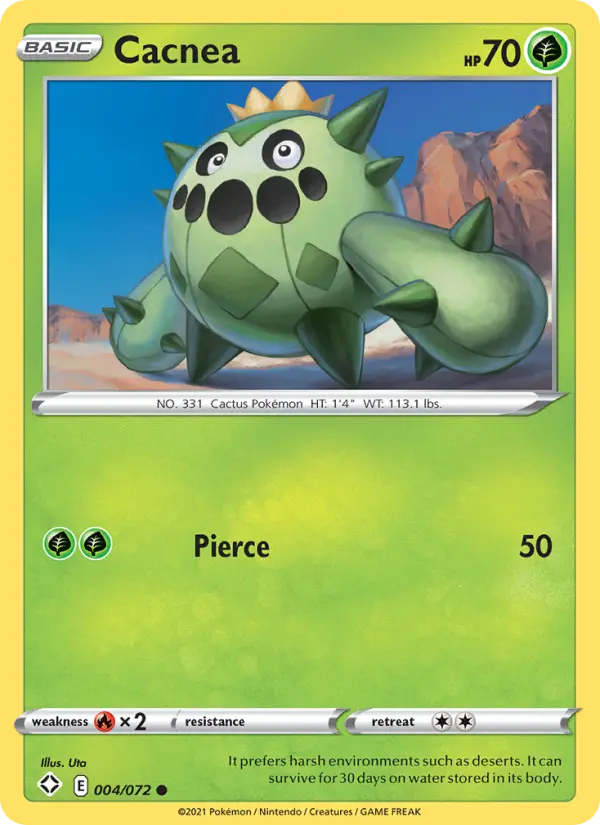
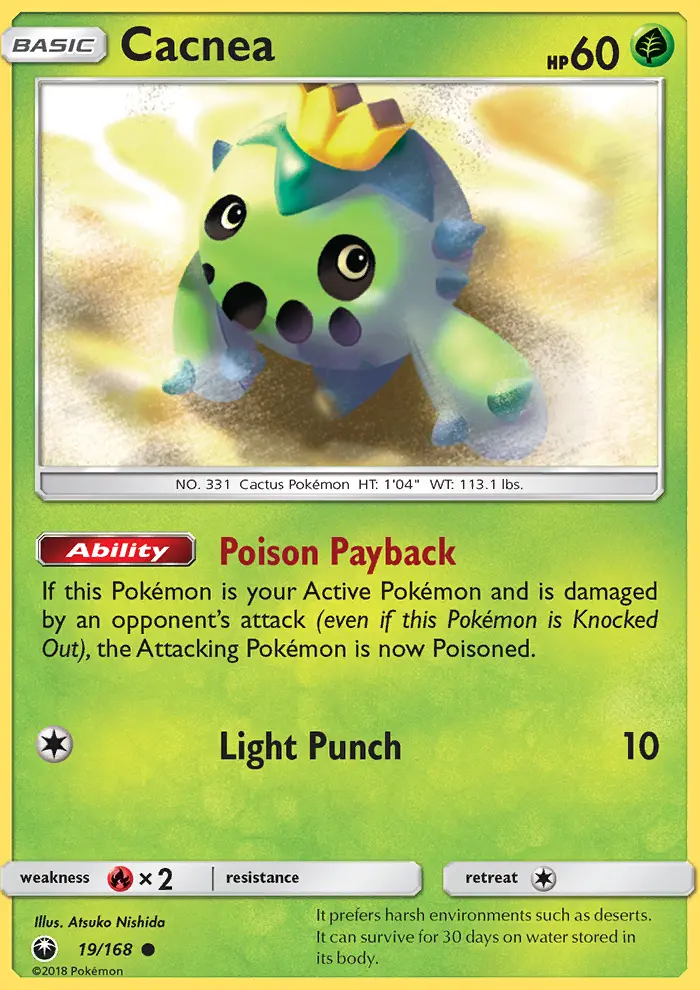
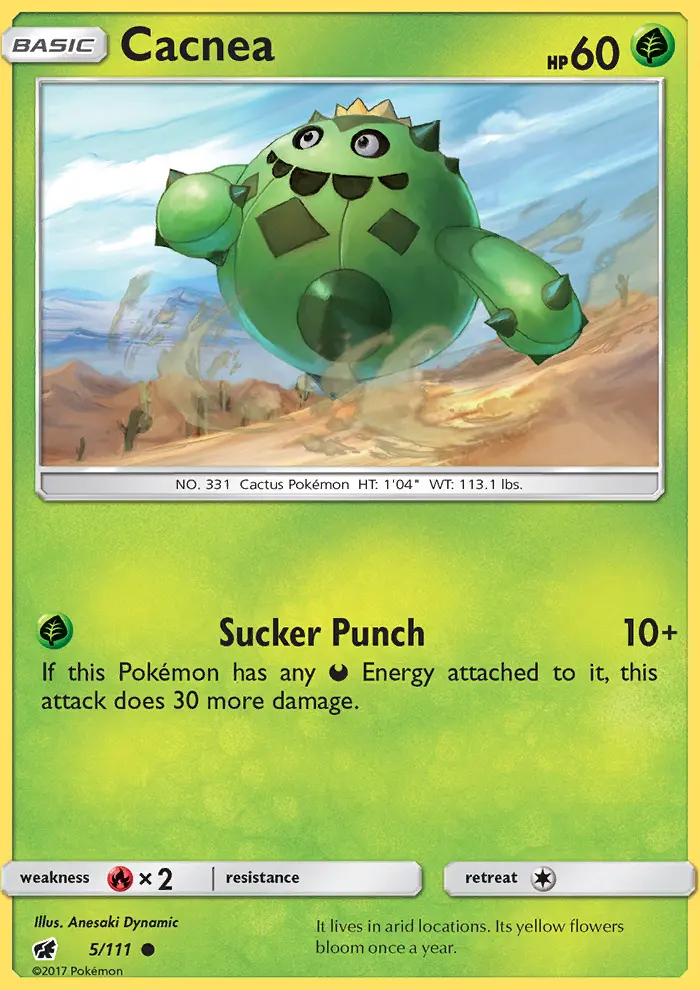
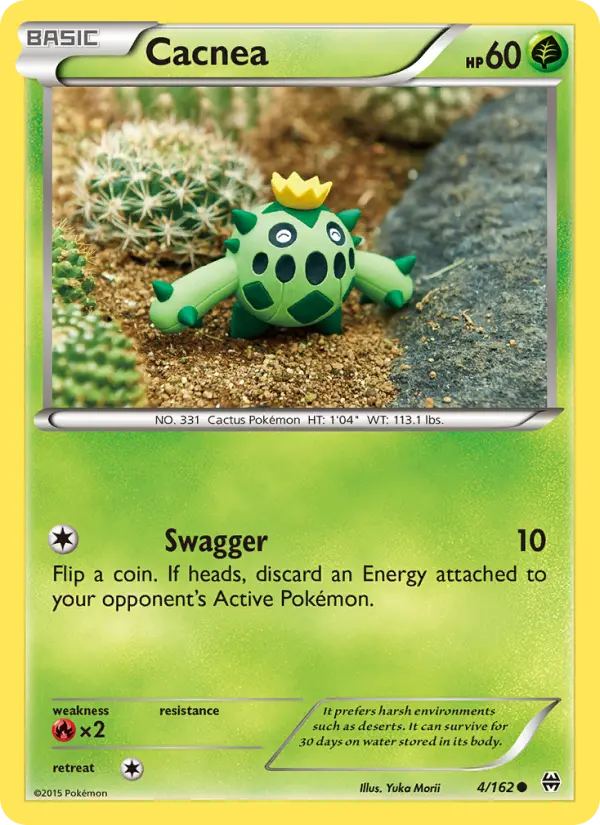
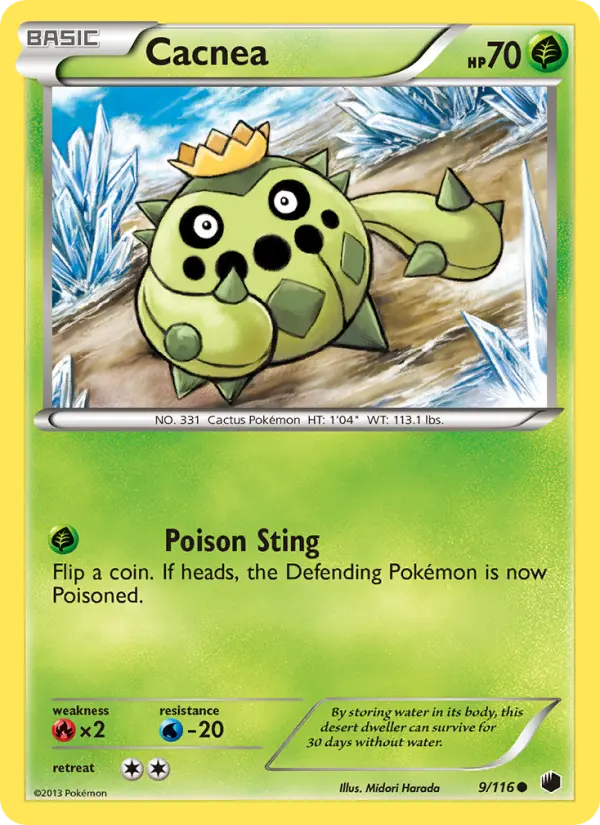
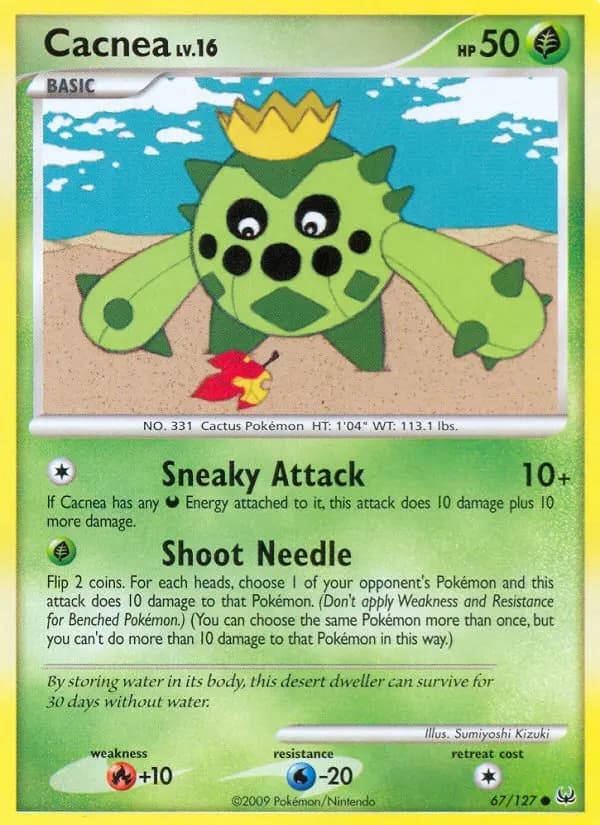
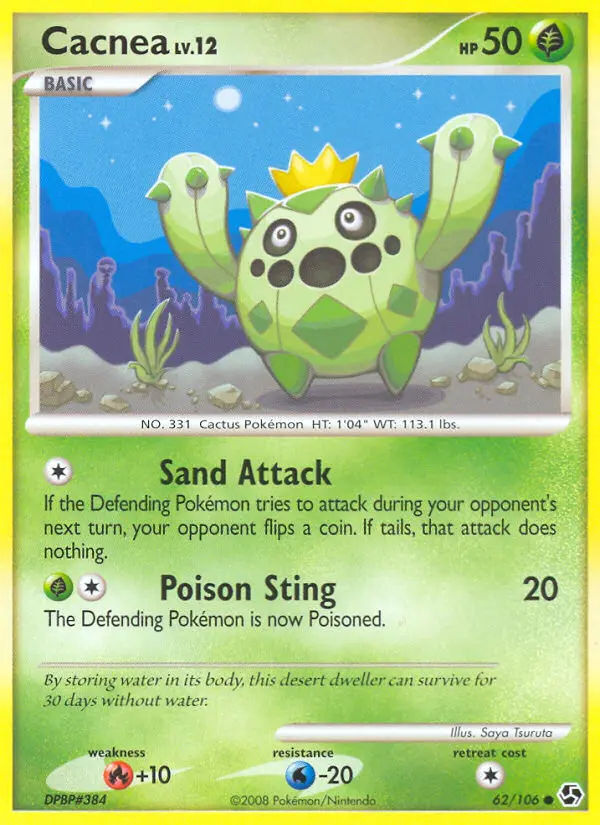
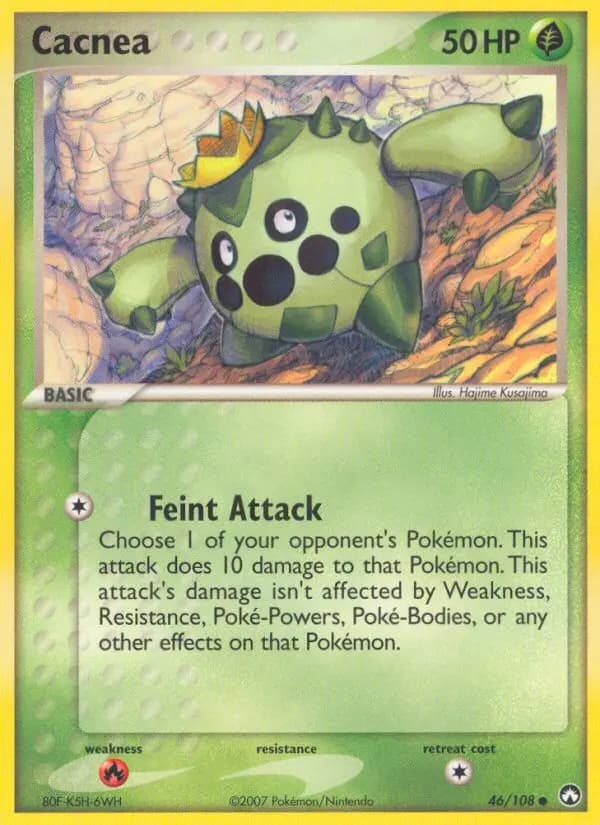
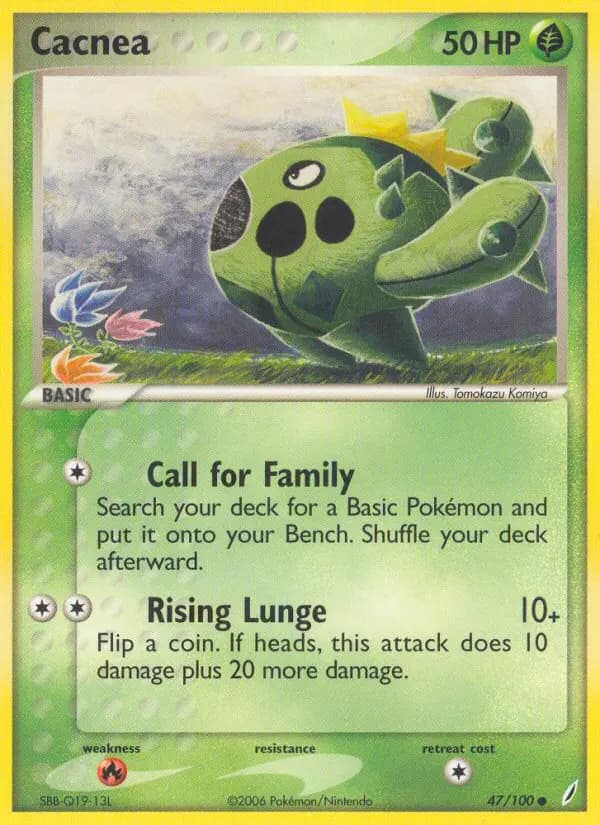
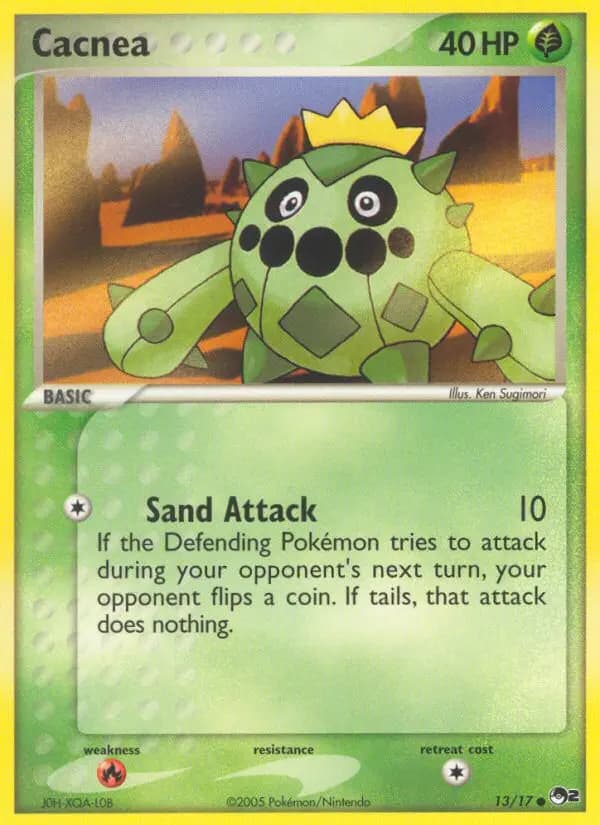
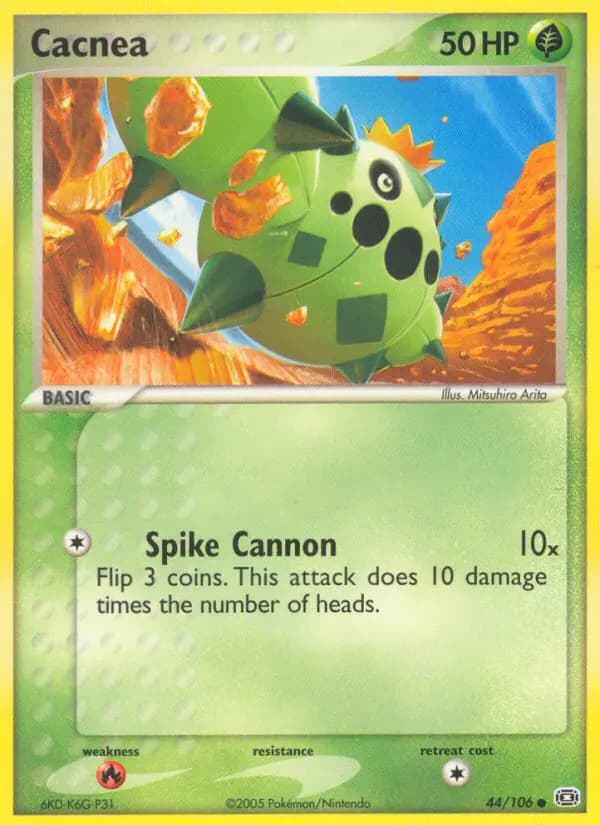
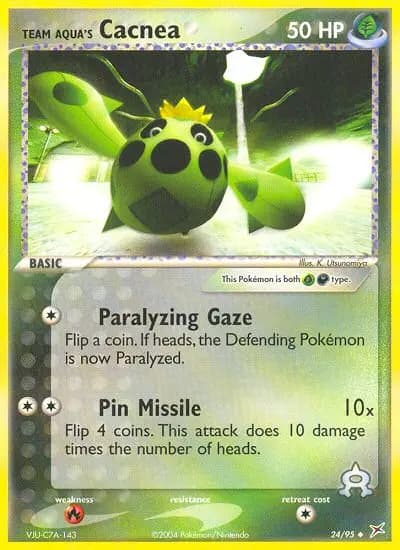
Cacnea achieved significant cultural prominence through its memorable appearance in the Pokémon anime series, particularly through James's beloved Cacnea, which became one of the most iconic Pokémon owned by Team Rocket members throughout the show's extensive run. This exposure introduced Cacnea to millions of viewers and created a lasting association between the species and themes of unlikely friendship and caring for difficult or prickly personalities—reinforced by the Pokémon's own low base happiness stat and prickly demeanor. The species has maintained consistent representation in Pokémon trading card games, where its visual distinctiveness makes it a recognizable and collectible card subject. Cacnea's design has resonated with players seeking representation of desert ecosystems in their teams, and its status as an early-game Pokémon in multiple Generation III titles ensured that many trainers encountered it during their first Hoenn region adventures. The appealing contrast between Cacnea's cute, nearly innocent appearance and its genuinely dangerous spike-covered body created a memorable duality that has ensured its place in fan communities and among casual players who appreciate its unique aesthetic. Fan communities regularly celebrate Cacnea's design and mechanics, with artists and creators frequently producing derivative works that explore its character, ecology, and potential.
Where to Find Cacnea in Every Pokémon Game
Cacnea was introduced in Generation III and made its debut appearance in the Hoenn region, where it appeared in Pokémon Ruby, Sapphire, and Emerald as Pokédex #119 in the regional classification. The species has maintained consistent availability throughout subsequent generations, typically appearing in desert-themed areas and arid locations mirroring its natural habitat preferences. In the original Hoenn games, Cacnea could be encountered in the Route 111 desert region, a fitting placement that encouraged players to engage with its natural environment. The species reappeared in remakes including Omega Ruby and Alpha Sapphire, where it retained its desert habitat association and regional number of 124. More recent entries in the franchise, particularly Scarlet and Violet, feature Cacnea with a regional Pokédex number of 252, indicating its inclusion in contemporary Pokémon rosters. The relatively high catch rate of 190 means that aspiring trainers can successfully capture wild Cacnea using basic Poké Balls without excessive difficulty, making it an accessible choice for team composition. Additionally, Cacnea's presence in multiple games and its breeding accessibility through the Grass and Human-Like egg groups ensure that players can readily obtain the species through various methods, whether through direct capture, breeding chains, or trades with other trainers.