Cacturne
Generation III · #0332 — Scarecrow Pokémon
Cacturne is a grass/dark-type Pokémon whose hp — 50 at base — does more to define its role than its overall spread does. At 1.3 m and 77.4 kg, its build reflects a specialist role rather than a generalist one. Its typing grants it a unique combination of strengths and weaknesses, giving it access to an interesting movepool that leverages both its offensive stats, which sit at an impressive 115 for Attack and 115 for Special Attack against more modest defenses of 60 in both categories. The Scarecrow Pokémon has earned its place in trainers' teams through its balanced offensive capabilities and intriguing abilities that allow it to thrive in specific environmental conditions.
Editor's Take
Cacturne's Grass/Dark typing gives it a quad Bug weakness and very little else to worry about, and 55 base Speed is why none of that ever mattered.
Base Stats
Height
1.3m
Weight
77.4kg
Category
Scarecrow Pokémon
Gender
Male 50% / Female 50%
Color
green
Shape
humanoid
Habitat
rough-terrain
Abilities
Increases evasion to 1.25× during a sandstorm. Protects against sandstorm damage.
Absorbs water moves, healing for 1/4 max HP.

Cacturne Biology & Physical Characteristics
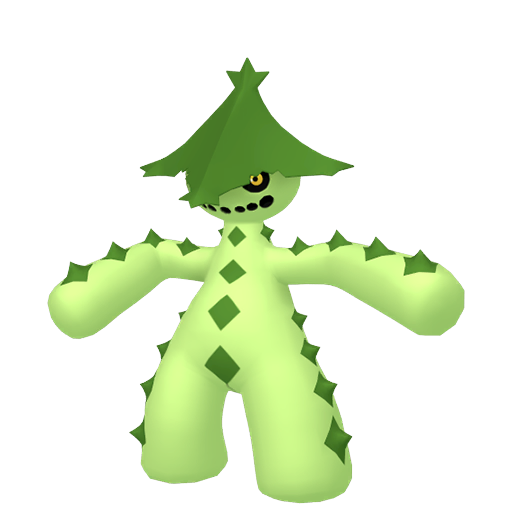
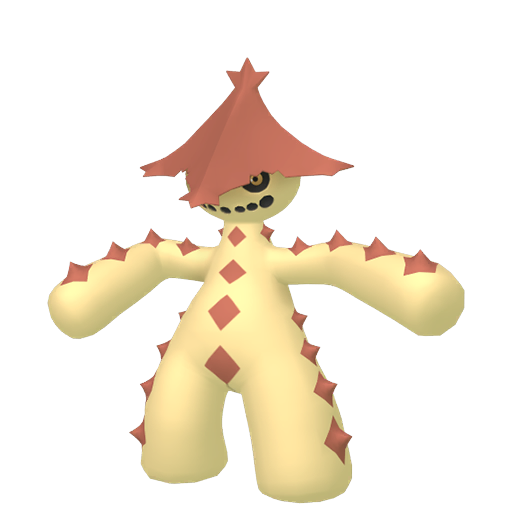
Cacturne is a visually striking humanoid Pokémon constructed entirely of cactus material, resembling a sentient scarecrow woven from succulent spikes and thorns. Its body features a green coloration with a complex pattern of darker green rhombi adorning its front, with the arrangement differing between genders—females display a large rhombus above a smaller one, while males exhibit three small rhombi in vertical alignment. The Pokémon's face is particularly distinctive, featuring two prominent yellow eye-holes and six smaller holes that form a perpetual grin across its face, all framed by a triangular hat-like structure on its head. Numerous spikes protrude along its arms, legs, and neck, serving both as a defensive mechanism and as tools for its nocturnal hunting practices. According to the Emerald Pokédex entry, after spending thousands of years inhabiting the harshest deserts, Cacturne's blood has undergone a remarkable transformation, converting into substances chemically similar to sand itself, allowing it to survive in conditions that would be lethal to other Pokémon.
Pokedex Numbers
Training
Breeding
Cacturne Breeding, Gender Ratio & Egg Groups
Cacturne maintains a perfectly balanced gender distribution with exactly 50% male and 50% female individuals, allowing for straightforward breeding in both directions. The species belongs to the Grass and Human-Like egg groups, making it compatible with a diverse range of breeding partners across multiple evolutionary lines. Sexual dimorphism is visible in Cacturne's design through the pattern of dark green rhombi on its body—males display three small rhombi arranged vertically, while females showcase a larger rhombus positioned above a smaller one, making gender identification possible by visual inspection alone. The Pokémon has a relatively low base happiness of 35, which is lower than the standard baseline, suggesting that Cacturne is naturally aloof and difficult to bond with, reflecting its predatory, nocturnal nature. Breeding Cacturne requires 20 egg cycles to produce offspring, translating to approximately 4,884 to 5,140 steps for eggs to hatch, placing it within a moderate timeframe for breeding endeavors. With a capture rate of 60, wild Cacturne individuals are reasonably obtainable, making breeding programs accessible to most trainers.
Sprites




Held Items
Poison Barb
type-enhancement
Held: Poison-Type moves from holder do 20% more damage.
Cost: 1000
Poison Barb
type-enhancement
Held: Poison-Type moves from holder do 20% more damage.
Cost: 1000
Poison Barb
type-enhancement
Held: Poison-Type moves from holder do 20% more damage.
Cost: 1000
Poison Barb
type-enhancement
Held: Poison-Type moves from holder do 20% more damage.
Cost: 1000
Poison Barb
type-enhancement
Held: Poison-Type moves from holder do 20% more damage.
Cost: 1000
Sticky Barb
bad-held-items
Held: Holder takes 1/8 (12.5%) its max HP at the end of each turn. When the holder is hit by a contact move, the attacking Pokémon takes 1/8 its max HP in damage and receive the item if not holding one.
Cost: 4000
Sticky Barb
bad-held-items
Held: Holder takes 1/8 (12.5%) its max HP at the end of each turn. When the holder is hit by a contact move, the attacking Pokémon takes 1/8 its max HP in damage and receive the item if not holding one.
Cost: 4000
Sticky Barb
bad-held-items
Held: Holder takes 1/8 (12.5%) its max HP at the end of each turn. When the holder is hit by a contact move, the attacking Pokémon takes 1/8 its max HP in damage and receive the item if not holding one.
Cost: 4000
Sticky Barb
bad-held-items
Held: Holder takes 1/8 (12.5%) its max HP at the end of each turn. When the holder is hit by a contact move, the attacking Pokémon takes 1/8 its max HP in damage and receive the item if not holding one.
Cost: 4000
Sticky Barb
bad-held-items
Held: Holder takes 1/8 (12.5%) its max HP at the end of each turn. When the holder is hit by a contact move, the attacking Pokémon takes 1/8 its max HP in damage and receive the item if not holding one.
Cost: 4000
Sticky Barb
bad-held-items
Held: Holder takes 1/8 (12.5%) its max HP at the end of each turn. When the holder is hit by a contact move, the attacking Pokémon takes 1/8 its max HP in damage and receive the item if not holding one.
Cost: 4000
Sticky Barb
bad-held-items
Held: Holder takes 1/8 (12.5%) its max HP at the end of each turn. When the holder is hit by a contact move, the attacking Pokémon takes 1/8 its max HP in damage and receive the item if not holding one.
Cost: 4000
Sticky Barb
bad-held-items
Held: Holder takes 1/8 (12.5%) its max HP at the end of each turn. When the holder is hit by a contact move, the attacking Pokémon takes 1/8 its max HP in damage and receive the item if not holding one.
Cost: 4000
Sticky Barb
bad-held-items
Held: Holder takes 1/8 (12.5%) its max HP at the end of each turn. When the holder is hit by a contact move, the attacking Pokémon takes 1/8 its max HP in damage and receive the item if not holding one.
Cost: 4000
Sticky Barb
bad-held-items
Held: Holder takes 1/8 (12.5%) its max HP at the end of each turn. When the holder is hit by a contact move, the attacking Pokémon takes 1/8 its max HP in damage and receive the item if not holding one.
Cost: 4000
Sticky Barb
bad-held-items
Held: Holder takes 1/8 (12.5%) its max HP at the end of each turn. When the holder is hit by a contact move, the attacking Pokémon takes 1/8 its max HP in damage and receive the item if not holding one.
Cost: 4000
Sticky Barb
bad-held-items
Held: Holder takes 1/8 (12.5%) its max HP at the end of each turn. When the holder is hit by a contact move, the attacking Pokémon takes 1/8 its max HP in damage and receive the item if not holding one.
Cost: 4000
Sticky Barb
bad-held-items
Held: Holder takes 1/8 (12.5%) its max HP at the end of each turn. When the holder is hit by a contact move, the attacking Pokémon takes 1/8 its max HP in damage and receive the item if not holding one.
Cost: 4000
Sticky Barb
bad-held-items
Held: Holder takes 1/8 (12.5%) its max HP at the end of each turn. When the holder is hit by a contact move, the attacking Pokémon takes 1/8 its max HP in damage and receive the item if not holding one.
Cost: 4000
Sticky Barb
bad-held-items
Held: Holder takes 1/8 (12.5%) its max HP at the end of each turn. When the holder is hit by a contact move, the attacking Pokémon takes 1/8 its max HP in damage and receive the item if not holding one.
Cost: 4000
Sticky Barb
bad-held-items
Held: Holder takes 1/8 (12.5%) its max HP at the end of each turn. When the holder is hit by a contact move, the attacking Pokémon takes 1/8 its max HP in damage and receive the item if not holding one.
Cost: 4000
Sticky Barb
bad-held-items
Held: Holder takes 1/8 (12.5%) its max HP at the end of each turn. When the holder is hit by a contact move, the attacking Pokémon takes 1/8 its max HP in damage and receive the item if not holding one.
Cost: 4000
TMs & HMs
tm00
sword shield
tm01
yellow
tm01
gold silver
tm01
crystal
tm01
red blue
tm01
platinum
tm01
emerald
tm01
diamond pearl
tm01
firered leafgreen
tm01
ruby sapphire
tm01
xd
tm01
colosseum
tm01
heartgold soulsilver
tm01
lets go pikachu lets go eevee
tm01
blue japan
tm01
red green japan
tm01
sword shield
tm02
crystal
tm02
gold silver
tm02
lets go pikachu lets go eevee
+793 more TMs/HMs
Gender Differences
This Pokémon has visible differences between male and female forms.
Cacturne's Evolution Chain


Cacturne Evolution, Mega Evolution & Special Forms
Cacturne evolves from Cacnea starting at level 32, a transformation that significantly alters the Pokémon's appearance and power. The evolution from the round, simplistic Cacnea into the angular, scarecrow-like Cacturne represents a dramatic shift from a herbivorous defensive form into a predatory, offensive-oriented creature. Upon evolution, Cacturne gains its Dark typing alongside its Grass typing, fundamentally changing its type matchups and enabling access to a broader range of offensive moves. The stat distribution also shifts to emphasize attack power, with both Attack and Special Attack reaching 115 base points while maintaining relatively low defensive and Speed values, indicating a glass cannon archetype. This evolutionary jump from level 32 represents a significant power spike for trainers, as Cacturne gains access to substantially improved movepool options, including powerful moves like Needle Arm, which was Cacturne's signature move prior to Generation V. The evolution also grants potential access to different abilities—while Sand Veil remains a viable option that increases evasion during sandstorms and grants sandstorm immunity, the hidden ability Water Absorb opens alternative strategic possibilities by allowing Cacturne to absorb water-type moves to recover 25% of its maximum HP.
Where to Find
Sinnoh Route 228
sinnoh
+6 more
Cacturne Behaviour and Natural Habitat
Cacturne is a strictly nocturnal Pokémon that demonstrates remarkable behavioral adaptations to desert survival. During daylight hours, it remains virtually motionless, a strategic behavior that minimizes moisture loss to the intense desert sun—this energy conservation approach is critical to its survival in arid environments where water is scarce. As darkness falls and temperatures drop, Cacturne becomes an active and purposeful hunter, seeking prey that has been exhausted by the day's heat. More unsettlingly, the Sapphire Pokédex entry reveals that Cacturne exhibits pack hunting behavior, with multiple individuals following travelers through deserts in coordinated groups, patiently waiting for their quarry to become too fatigued to continue moving before striking. This predatory patience and organized social structure make Cacturne a formidable presence in desert ecosystems, where it occupies an apex predator role, targeting weakened prey and exhausted travelers. Its habitat is exclusively desert terrain, where its unique physiological adaptations give it overwhelming advantages.
Pokedex Entries
During the daytime, CACTURNE remains unmoving so that it does not lose any moisture to the harsh desert sun. This POKéMON becomes active at night when the temperature drops.
If a traveler is going through a desert in the thick of night, CACTURNE will follow in a ragtag group. The POKéMON are biding their time, waiting for the traveler to tire and become incapable of moving.
After spending thousands of years in harsh deserts, its blood transformed into the same substances as sand. It is nocturnal, so it hunts at night.
It lives in deserts. It becomes active at night when it hunts for prey exhausted from the desert’s heat.
It becomes active at night, seeking prey that is exhausted from the day’s desert heat.
Packs of them follow travelers through the desert until the travelers can no longer move.
It becomes active at night, seeking prey that is exhausted from the day’s desert heat.
It becomes active at night, seeking prey that is exhausted from the day’s desert heat.
It becomes active at night, seeking prey that is exhausted from the day’s desert heat.
Packs of them follow travelers through the desert until the travelers can no longer move.
During the daytime, Cacturne remains unmoving so that it does not lose any moisture to the harsh desert sun. This Pokémon becomes active at night when the temperature drops.
If a traveler is going through a desert in the thick of night, Cacturne will follow in a ragtag group. The Pokémon are biding their time, waiting for the traveler to tire and become incapable of moving.
Cacturne Name Origin & Design Inspiration
The name Cacturne combines 'cactus' with 'nocturne,' a musical composition meant to evoke the night, perfectly encapsulating the Pokémon's dual nature as a cactus-based creature with distinctly nocturnal habits. The Japanese name Noctus similarly emphasizes its nighttime activity patterns, derived from the Latin word for night. Visually, Cacturne's design takes heavy inspiration from scarecrows, agricultural figures traditionally used to frighten away birds from crops, which explains its official classification as the Scarecrow Pokémon. The humanoid bipedal structure, the hat-like feature on its head, and the menacing grin-like mouth all reinforce this scarecrow aesthetic, while the cactus spikes maintain the plant-based nature essential to the Grass typing. The design philosophy deliberately contrasts a traditionally harmless, inanimate object—the scarecrow—with a living, predatory creature, creating an unsettling duality that's reinforced by the Dark typing. This juxtaposition of the innocuous and the sinister, combined with its desert scarecrow appearance, makes Cacturne one of Generation III's most memorable and thematically cohesive designs.
Learnable Moves
Cacturne can learn 112 moves:
Move | Type | Cat. | Power | Acc. | PP |
|---|---|---|---|---|---|
| absorb | grass | Special | 20 | 100 | 25 |
| assurance | dark | Physical | 60 | 100 | 10 |
| attract | normal | Status | — | 100 | 15 |
| block | normal | Status | — | — | 5 |
| body slam | normal | Physical | 85 | 100 | 15 |
| brick break | fighting | Physical | 75 | 100 | 15 |
| bulldoze | ground | Physical | 60 | 100 | 20 |
| bullet seed | grass | Physical | 25 | 100 | 30 |
| captivate | normal | Status | — | 100 | 20 |
| confide | normal | Status | — | — | 20 |
| cotton spore | grass | Status | — | 100 | 40 |
| counter | fighting | Physical | — | 100 | 20 |
| curse | ghost | Status | — | — | 10 |
| cut | normal | Physical | 50 | 95 | 30 |
| dark pulse | dark | Special | 80 | 100 | 15 |
| destiny bond | ghost | Status | — | — | 5 |
| dig | ground | Physical | 80 | 100 | 10 |
| double team | normal | Status | — | — | 15 |
| double edge | normal | Physical | 120 | 100 | 15 |
| drain punch | fighting | Physical | 75 | 100 | 10 |
| dynamic punch | fighting | Physical | 100 | 50 | 5 |
| embargo | dark | Status | — | 100 | 15 |
| encore | normal | Status | — | 100 | 5 |
| endeavor | normal | Physical | — | 100 | 5 |
| endure | normal | Status | — | — | 10 |
| energy ball | grass | Special | 90 | 100 | 10 |
| facade | normal | Physical | 70 | 100 | 20 |
| feint attack | dark | Physical | 60 | — | 20 |
| flash | normal | Status | — | 100 | 20 |
| fling | dark | Physical | — | 100 | 10 |
| focus blast | fighting | Special | 120 | 70 | 5 |
| focus punch | fighting | Physical | 150 | 100 | 20 |
| foul play | dark | Physical | 95 | 100 | 15 |
| frustration | normal | Physical | — | 100 | 20 |
| fury cutter | bug | Physical | 40 | 95 | 20 |
| giga drain | grass | Special | 75 | 100 | 10 |
| giga impact | normal | Physical | 150 | 90 | 5 |
| grass knot | grass | Special | — | 100 | 20 |
| grassy glide | grass | Physical | 55 | 100 | 20 |
| grassy terrain | grass | Status | — | — | 10 |
| growth | normal | Status | — | — | 20 |
| headbutt | normal | Physical | 70 | 100 | 15 |
| helping hand | normal | Status | — | — | 20 |
| hidden power | normal | Special | 60 | 100 | 15 |
| hyper beam | normal | Special | 150 | 90 | 5 |
| ingrain | grass | Status | — | — | 20 |
| knock off | dark | Physical | 65 | 100 | 20 |
| lash out | dark | Physical | 75 | 100 | 5 |
| leaf storm | grass | Special | 130 | 90 | 5 |
| leech seed | grass | Status | — | 90 | 10 |
| leer | normal | Status | — | 100 | 30 |
| low kick | fighting | Physical | — | 100 | 20 |
| lunge | bug | Physical | 80 | 100 | 15 |
| magical leaf | grass | Special | 60 | — | 20 |
| mega kick | normal | Physical | 120 | 75 | 5 |
| mega punch | normal | Physical | 80 | 85 | 20 |
| mimic | normal | Status | — | — | 10 |
| mud slap | ground | Special | 20 | 100 | 10 |
| nasty plot | dark | Status | — | — | 20 |
| natural gift | normal | Physical | — | 100 | 15 |
| nature power | normal | Status | — | — | 20 |
| needle arm | grass | Physical | 60 | 100 | 15 |
| payback | dark | Physical | 50 | 100 | 10 |
| pin missile | bug | Physical | 25 | 95 | 20 |
| poison jab | poison | Physical | 80 | 100 | 20 |
| poison sting | poison | Physical | 15 | 100 | 35 |
| power trip | dark | Physical | 20 | 100 | 10 |
| power up punch | fighting | Physical | 40 | 100 | 20 |
| protect | normal | Status | — | — | 10 |
| rain dance | water | Status | — | — | 5 |
| rest | psychic | Status | — | — | 5 |
| retaliate | normal | Physical | 70 | 100 | 5 |
| return | normal | Physical | — | 100 | 20 |
| revenge | fighting | Physical | 60 | 100 | 10 |
| role play | psychic | Status | — | — | 10 |
| round | normal | Special | 60 | 100 | 15 |
| sand attack | ground | Status | — | 100 | 15 |
| sandstorm | rock | Status | — | — | 10 |
| scary face | normal | Status | — | 100 | 10 |
| secret power | normal | Physical | 70 | 100 | 20 |
| seed bomb | grass | Physical | 80 | 100 | 15 |
| seismic toss | fighting | Physical | — | 100 | 20 |
| shadow ball | ghost | Special | 80 | 100 | 15 |
| skitter smack | bug | Physical | 70 | 90 | 10 |
| sleep talk | normal | Status | — | — | 10 |
| snore | normal | Special | 50 | 100 | 15 |
| solar beam | grass | Special | 120 | 100 | 10 |
| spikes | ground | Status | — | — | 20 |
| spiky shield | grass | Status | — | — | 10 |
| spite | ghost | Status | — | 100 | 10 |
| stomping tantrum | ground | Physical | 75 | 100 | 10 |
| strength | normal | Physical | 80 | 100 | 15 |
| substitute | normal | Status | — | — | 10 |
| sucker punch | dark | Physical | 70 | 100 | 5 |
| sunny day | fire | Status | — | — | 5 |
| superpower | fighting | Physical | 120 | 100 | 5 |
| swagger | normal | Status | — | 85 | 15 |
| swift | normal | Special | 60 | — | 20 |
| swords dance | normal | Status | — | — | 20 |
| synthesis | grass | Status | — | — | 5 |
| take down | normal | Physical | 90 | 85 | 20 |
| taunt | dark | Status | — | 100 | 20 |
| tera blast | normal | Special | 80 | 100 | 10 |
| thief | dark | Physical | 60 | 100 | 25 |
| throat chop | dark | Physical | 80 | 100 | 15 |
| thunder punch | electric | Physical | 75 | 100 | 15 |
| toxic | poison | Status | — | 90 | 10 |
| toxic spikes | poison | Status | — | — | 20 |
| trailblaze | grass | Physical | 50 | 100 | 20 |
| venoshock | poison | Special | 65 | 100 | 10 |
| worry seed | grass | Status | — | 100 | 10 |
| zen headbutt | psychic | Physical | 80 | 90 | 15 |
Cacturne Competitive Battle Guide
From a competitive standpoint, Cacturne occupies a niche role as a physical or special attacker with equal investment potential in either stat, given its identical 115 base values in Attack and Special Attack. Its offensive typing provides excellent coverage, with Grass-type moves targeting Water, Rock, and Ground-type opponents while Dark-type moves neutralize Psychic and Ghost-types, creating natural synergy. However, Cacturne's competitive viability is significantly hampered by its extremely poor Speed stat of only 55, forcing it to rely on priority moves or trick room strategies to outpace opponents. Its defensive stats of 60 across Defense and Special Defense are similarly underwhelming, making it difficult to switch in safely or withstand neutral hits. The Sand Veil ability provides utility in sandstorm teams, increasing evasion to 1.25 times normal while granting immunity to sandstorm damage, though this is considered a gimmicky strategy in competitive play. Its hidden ability Water Absorb offers more consistent utility, allowing Cacturne to switch into Water-type moves and recover health, making it a reasonable counter to water-based threats. Movepool access includes coverage options like Focus Blast, Stone Edge, and Sucker Punch, enabling it to threaten common threats, but its low Speed and middling defenses prevent it from achieving consistent success in higher-tier competitive formats.
Commonly Asked Questions About Cacturne
What type is Cacturne?
Cacturne is a grass and dark type Pokemon.
What does Cacturne evolve from?
Cacturne evolved from cacnea.
What are Cacturne's weaknesses?
Cacturne is weak to fighting, flying, poison, bug, fire, ice and fairy type moves.
Where can I find Cacturne?
Cacturne can be found in sinnoh route 228 (sinnoh).
Cacturne Cultural Impact & Franchise History
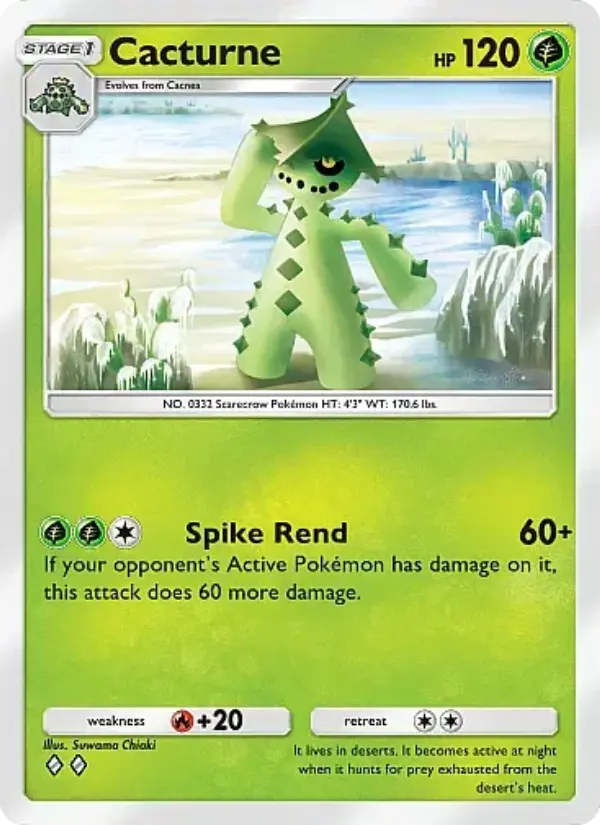
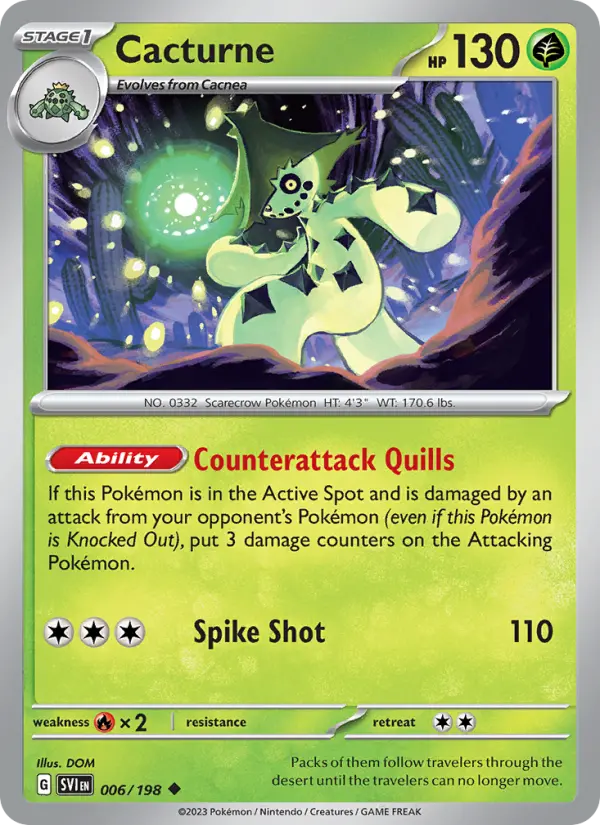
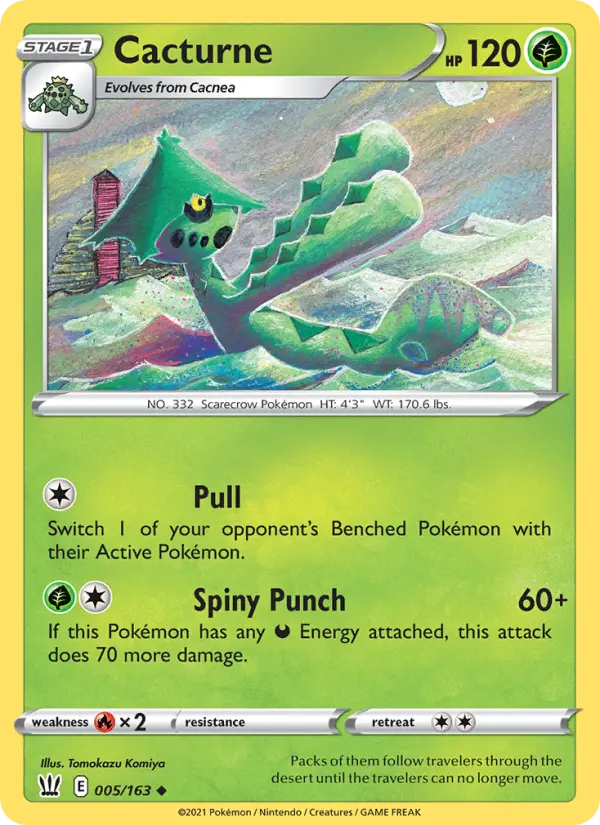
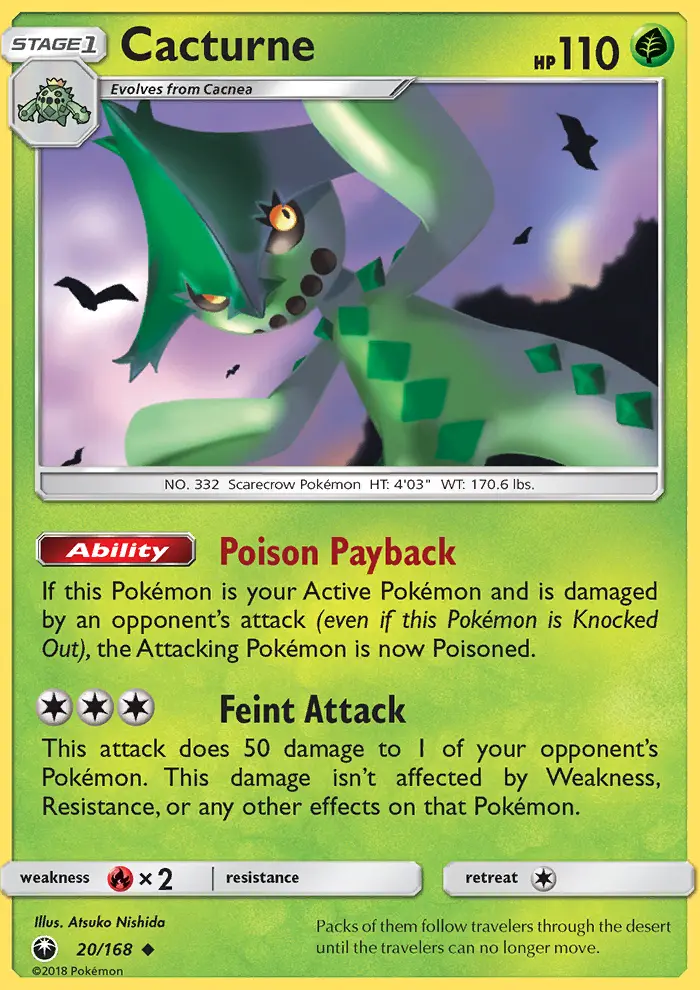
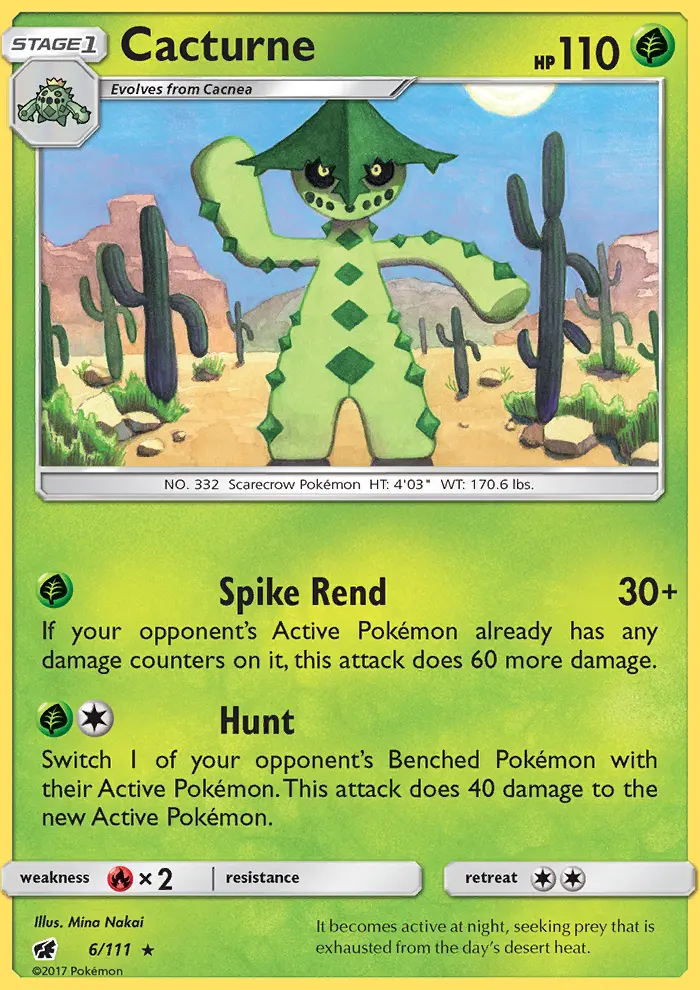
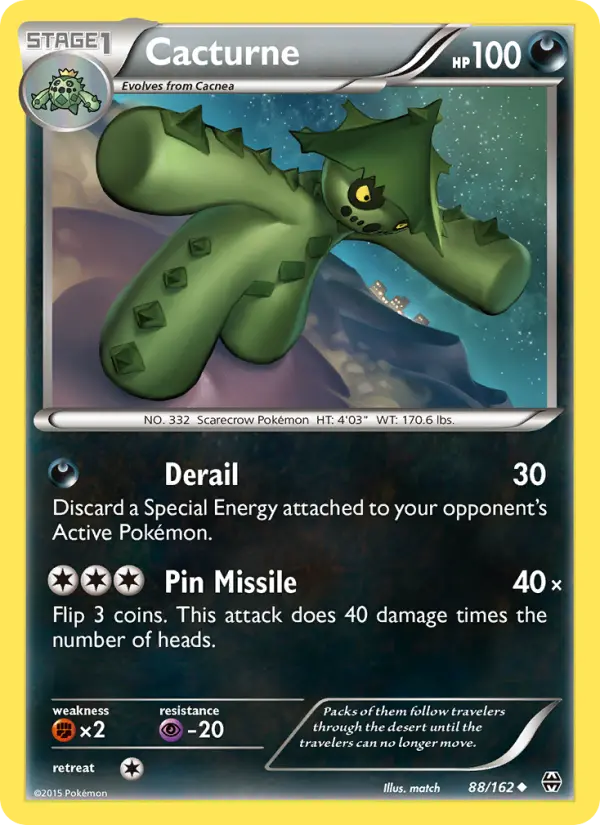
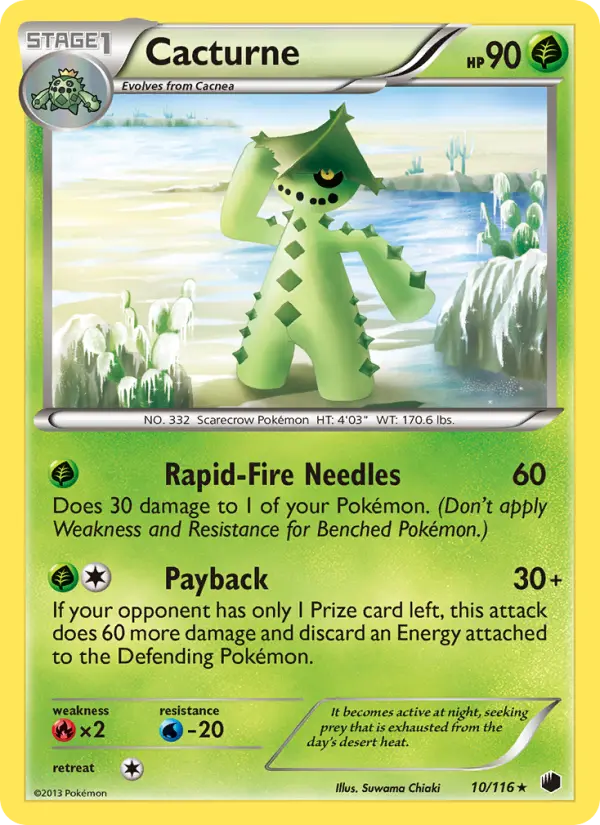
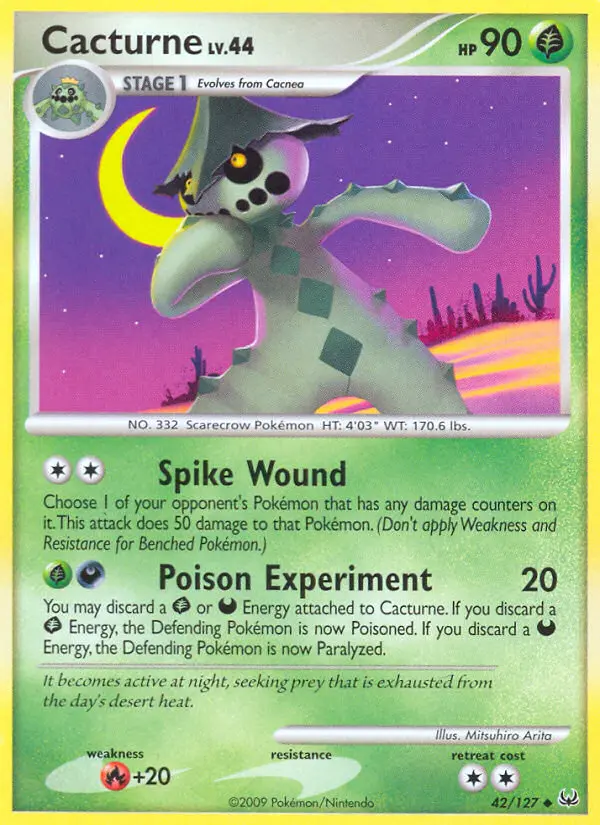
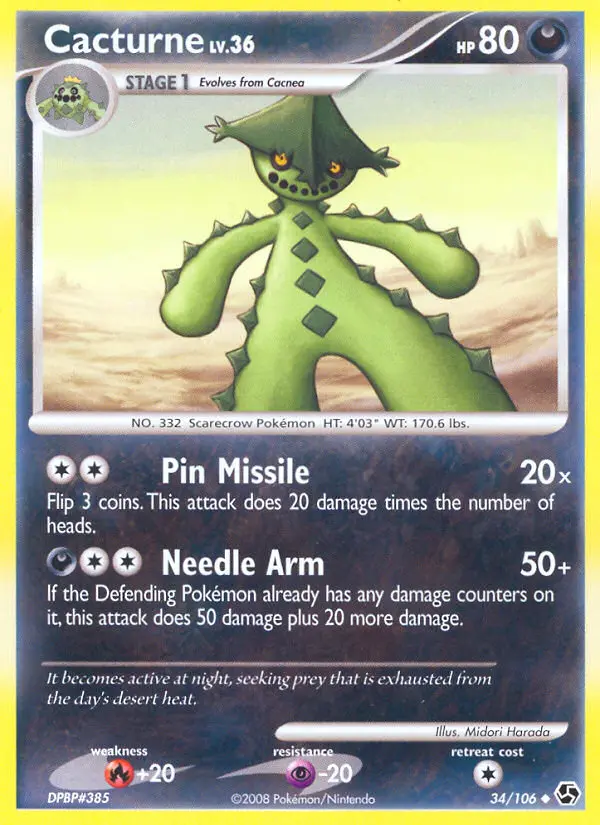
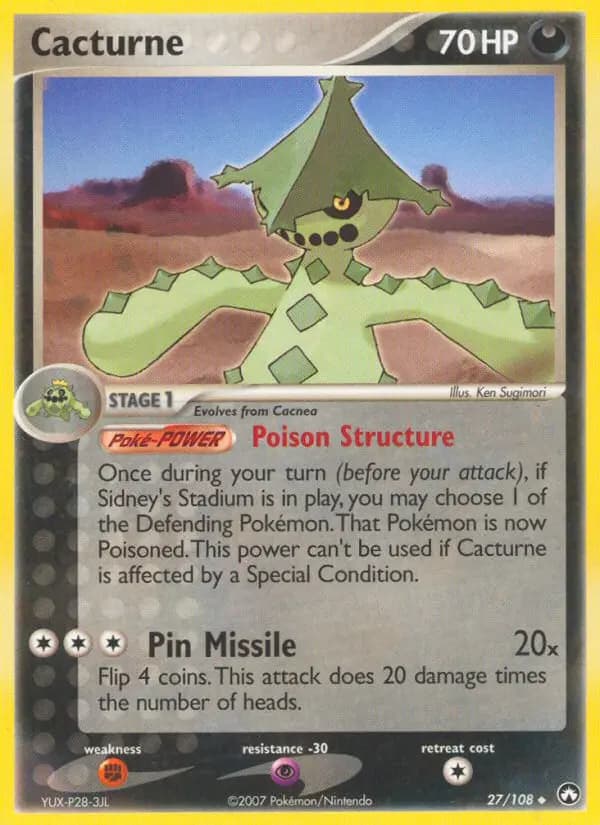
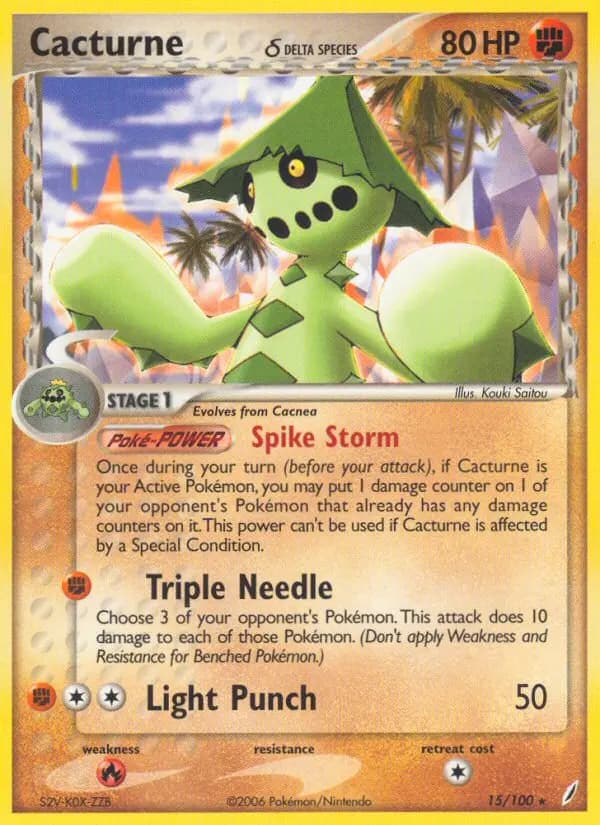
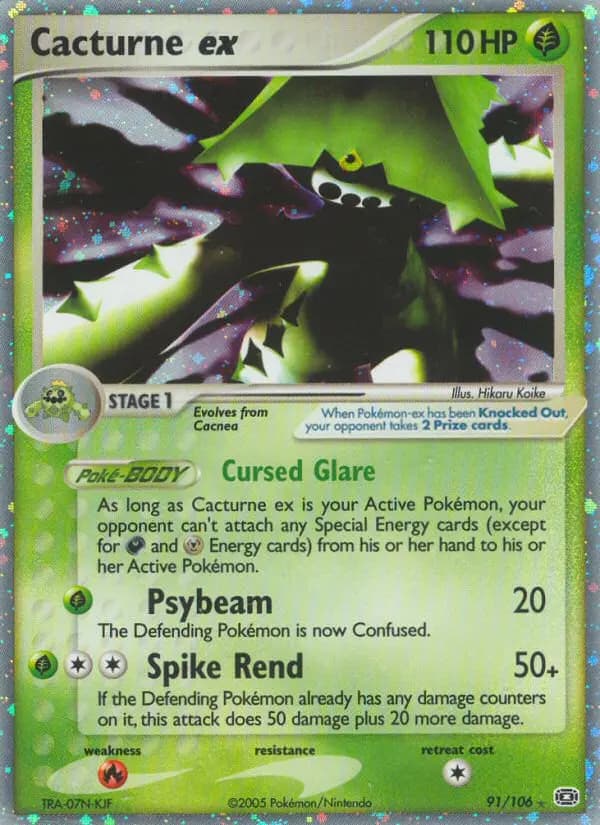
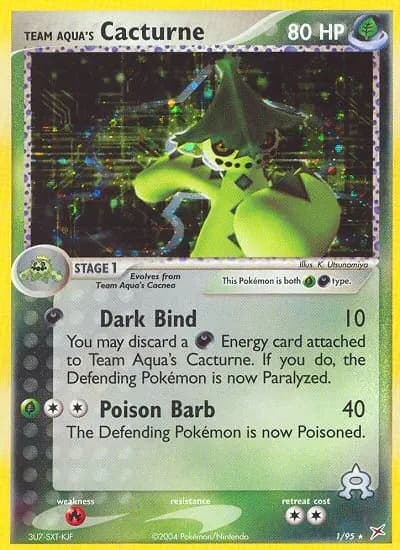
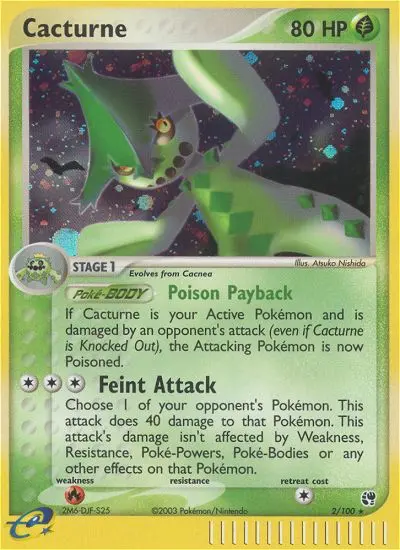
Cacturne has maintained a notable presence in Pokémon media since its introduction in Generation III, particularly through its notable appearance in the anime series where it was featured as a signature Pokémon of Harley, a memorable rival character. The character association elevated Cacturne's profile among fans, contributing to its recognition beyond its competitive viability. The Pokémon has appeared consistently throughout the Trading Card Game, receiving multiple card iterations across various sets and maintaining relevance in TCG strategies over more than two decades. Its striking scarecrow design and predatory nocturnal nature have made it a favorite among players who appreciate Pokémon designs that subvert traditional expectations, combining cute plant-like features with genuinely unsettling predatory behavior patterns. The creature's concept as a packhunting desert predator has influenced fan fiction and creative interpretations, with many trainers drawn to the psychological appeal of a Pokémon that appears docile but conceals a patient, calculating hunting strategy. Cacturne's representation in later generations, including appearances in Pokémon Scarlet and Violet, demonstrates lasting appeal and relevance within the franchise's expanding universe.
Where to Find Cacturne in Every Pokémon Game
Cacturne's availability varies significantly across different Pokémon games, primarily being obtainable in desert regions or through evolution. In Generation III games (Ruby, Sapphire, and Emerald), it appears in the Hoenn region as Pokédex #120, found in desert habitats where trainers can encounter Cacnea and raise them to level 32 for evolution. In later generations, availability shifted, with Cacturne appearing in various regional Pokédexes including Sinnoh, Unova, and Kalos regions, allowing trainers multiple opportunities to add the species to their teams. Pokémon Omega Ruby and Alpha Sapphire, the Generation III remakes, featured Cacturne prominently in desert areas of the Hoenn region. More recently, Pokémon Scarlet and Violet included Cacturne in their Pokédex as #253 in the regional listing, making it accessible to modern players. The species has consistently maintained reasonable catch rates of 60, making wild encounters relatively straightforward, though the prerequisite level 32 evolution requirement from Cacnea means planning ahead is necessary. Breeding populations can also be established in most games featuring the Pokémon, allowing players to obtain multiple individuals through the breeding system if they possess compatible parents.