Capsakid
Generation IX · #0951 — Spicy Pepper Pokémon
Capsakid, known as the Spicy Pepper Pokémon, is a Grass-type Pokémon introduced in Generation IX that embodies the fiery culinary traditions of the Paldea region. Classified with National Pokédex number #951, this small but spirited creature stands just 0.3 meters tall and weighs a mere 3.0 kilograms, making it one of the more diminutive Grass-type Pokémon. Despite its unassuming size, Capsakid possesses a distinctive personality marked by volatile mood swings, a temperament that reflects the potent spicy chemicals coursing through its biological systems. The Pokémon's integration into Paldean culture extends beyond battle prowess, as its naturally shed front teeth have become a prized ingredient in traditional regional cuisine, earning it a unique place in both the ecosystem and the hearts of local trainers.
Editor's Take
Capsakid's line ends in Scovillain, the only Grass/Fire type in the series, which is a remarkable gap for such an obvious combination.
Base Stats
Height
0.3m
Weight
3.0kg
Category
Spicy Pepper Pokémon
Gender
Male 50% / Female 50%
Color
green
Shape
upright
Abilities
Doubles Speed during strong sunlight.
Prevents sleep.
Prevents the Pokémon from using its held item in battle.

Capsakid Biology & Physical Characteristics
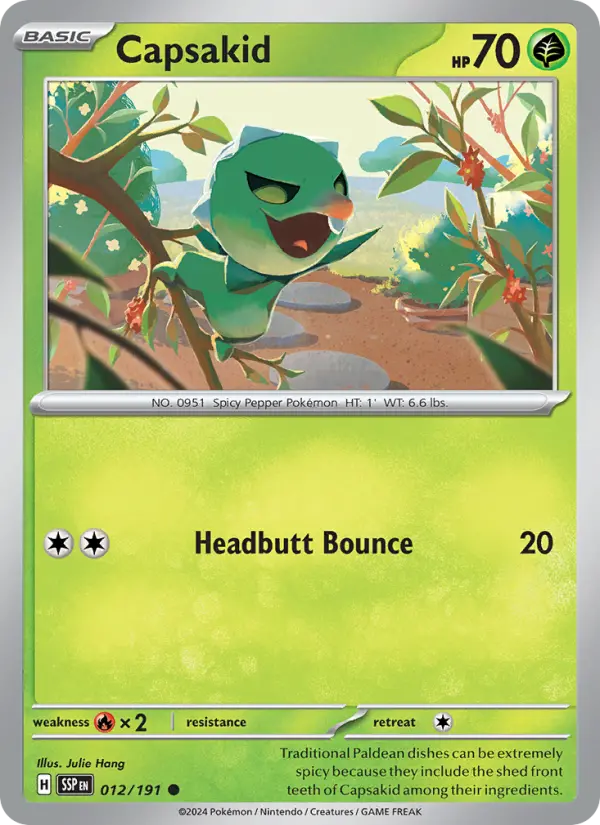
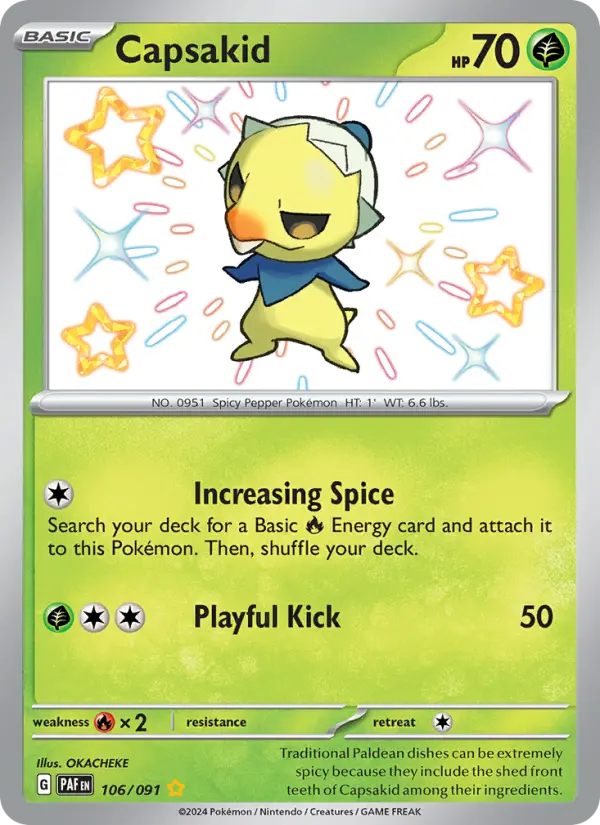
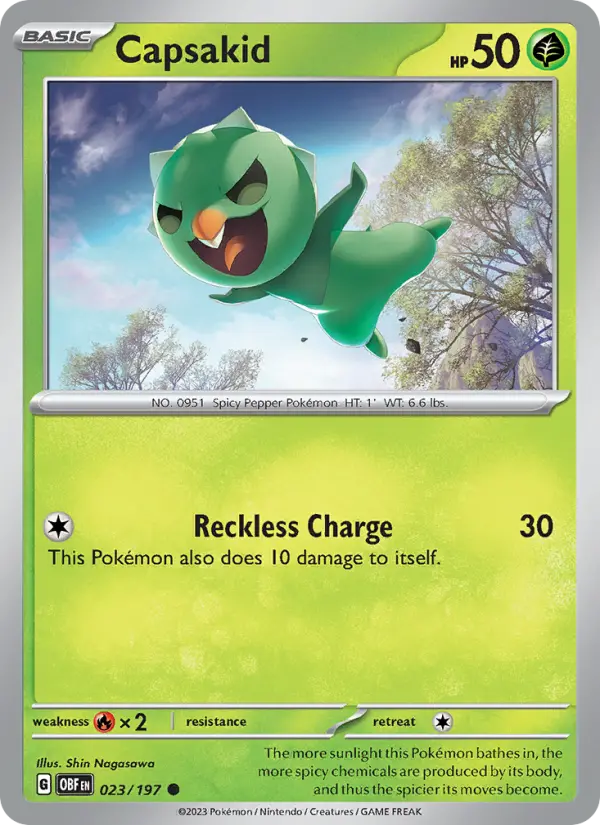
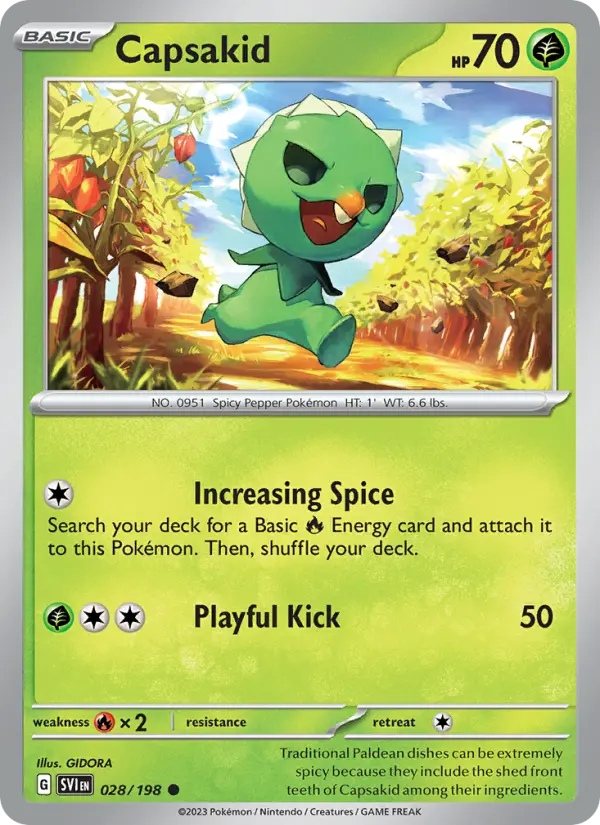
Capsakid presents a uniquely charming design that immediately evokes its pepper-based nature, featuring a compact, bipedal form covered in vibrant green coloration. The Pokémon's most distinctive feature is its head, crowned with a white, rounded cap that radiates outward in six distinct segments, resembling both an eggshell and the natural calyx of a flowering pepper plant. Beneath this protective cap sits a small bulbous green apex, while its face features distinctive black eyes and an orange-tinged beak-like mouth that houses a single prominent front tooth on its upper jaw. Notably, Capsakid possesses no arms, instead sporting a four-leaved dark green collar around its neck and a diminutive stubby tail. The most remarkable aspect of Capsakid's biology is its capacity to synthesize capsaicinoid compounds—the chemical responsible for spiciness—through photosynthesis. The more sunlight this Pokémon absorbs, the greater the concentration of spicy chemicals produced within its body, directly enhancing the potency of its offensive moves. This biological adaptation represents a fascinating example of evolutionary specialization within the Pokédex.
Pokedex Numbers
Training
Breeding
Capsakid Breeding, Gender Ratio & Egg Groups
Capsakid exhibits a perfectly balanced gender distribution, with exactly 50% of individuals being male and 50% female, reflecting the species' reproductive flexibility and suitability for widespread breeding programs across the Paldea region. Both males and females possess identical base statistics and movepool accessibility, ensuring no inherent advantage or disadvantage based on gender when considering competitive breeding strategies or casual team building. The species belongs to the Grass egg group, a classification that opens numerous breeding possibilities with other plant-type Pokémon and enables the passing of egg moves from compatible parents. With a base friendship value of 50, Capsakid represents a moderately receptive breeding candidate that responds reasonably well to trainer care, though it requires consistent positive interactions to develop stronger bonds. The hatching cycle for Capsakid eggs spans 20 cycles, translating to approximately 4,884 to 5,140 steps of travel, making it a relatively accessible breeding timeline for players seeking to raise multiple individuals or cultivate optimized competitive specimens. The species' medium-paced growth rate ensures that bred Capsakid develop at a steady, predictable rate, neither frustratingly slow nor so rapid as to bypass important move-learning opportunities during the leveling process.
Sprites






TMs & HMs
tm01
lets go pikachu lets go eevee
tm02
crystal
tm02
gold silver
tm03
lets go pikachu lets go eevee
tm04
gold silver
tm04
crystal
tm05
lets go pikachu lets go eevee
tm07
lets go pikachu lets go eevee
tm08
lets go pikachu lets go eevee
tm09
yellow
tm09
red blue
tm09
ruby sapphire
tm09
firered leafgreen
tm09
emerald
tm09
diamond pearl
tm09
xd
tm11
platinum
tm11
xd
tr65
sword shield
tm84
scarlet violet
+244 more TMs/HMs
Capsakid's Evolution Chain


Capsakid Evolution, Mega Evolution & Special Forms
Capsakid undergoes a singular evolutionary transformation into Scovillain when exposed to a Fire Stone, marking a dramatic transition that reflects the Pokémon's inherent connection to heat and spice. This evolution represents more than a simple growth in power; it embodies a fundamental shift in Capsakid's elemental nature, as the application of concentrated fire energy catalyzes a chemical metamorphosis within the Pokémon's body. Upon evolution, Capsakid develops into a dual-type Grass and Fire-type Pokémon, gaining substantially increased base stats across multiple categories while acquiring new moves and enhanced special attack capabilities that leverage its newfound Fire-type affinity. The evolution process itself showcases the fascinating relationship between Pokémon growth and elemental exposure—a core mechanic that defines many evolutionary lines throughout the series. Trainers seeking to evolve their Capsakid must acquire a Fire Stone, a valuable resource that has led to interesting trading communities and quest chains within the game's ecosystem, making the evolution process a meaningful milestone rather than an automatic progression.
Where to Find
Location data not available for this Pokémon in the database.
Capsakid Behaviour and Natural Habitat
Capsakid is renowned throughout the Paldea region for its unpredictable and volatile temperament, with behavioral scientists attributing its mood swings to the influence of the spicy chemicals accumulating within its diminutive frame. The Pokémon is notoriously quick to bite anything it takes a disliking to, making it a potentially challenging creature to handle without proper experience and respect. This aggressive disposition, while requiring careful management, contributes to Capsakid's resilience in battle, as its combative nature aligns well with its practical movepool emphasizing offensive capabilities. Capsakid thrives in sun-drenched environments throughout Paldea, where abundant sunlight directly correlates with the intensity of the spicy compounds it produces. The Pokémon can be encountered in various outdoor locations across the region, preferring areas with consistent exposure to direct solar radiation. In its natural habitat, Capsakid plays an ecological role in plant communities, and its seasonal shedding of front teeth creates a unique resource that has been harvested by Paldean populations for centuries, representing one of the most unusual symbiotic relationships between humans and Pokémon in the documented regions.
Pokedex Entries
The more sunlight this Pokémon bathes in, the more spicy chemicals are produced by its body, and thus the spicier its moves become.
Traditional Paldean dishes can be extremely spicy because they include the shed front teeth of Capsakid among their ingredients.
Capsakid Name Origin & Design Inspiration
Capsakid's name can be traced to a straightforward fusion of 'capsaicin,' the chemical compound responsible for the pungent heat in peppers, and 'kid,' emphasizing this Pokémon's position as the youthful, pre-evolved form within its evolutionary line. The Japanese designation, Capsaiji (カプサイジ), follows a similar etymological pattern, maintaining the capsaicin reference while adapting it to phonetic conventions of the Japanese language. Capsakid's visual design draws obvious inspiration from chili peppers and similar capsicum plants, with its distinctive white cap resembling the natural calyx structure found atop peppers. The designer's choice to incorporate a prominent front tooth as a defining characteristic serves dual narrative purposes: it grounds the Pokémon in Paldean culture by referencing the actual use of these teeth as culinary ingredients, while simultaneously providing a visually distinctive marker that separates Capsakid from other plant-based Pokémon. The four-leaved collar element may reference four-leaf clovers or the traditional leaf structure of certain pepper plant varieties, creating a cohesive design that balances biological realism with fantastical Pokémon aesthetics. This thoughtful design work ensures Capsakid remains instantly recognizable while embedding cultural significance throughout its physical form.
Learnable Moves
Capsakid can learn 39 moves:
Move | Type | Cat. | Power | Acc. | PP |
|---|---|---|---|---|---|
| bite | dark | Physical | 60 | 100 | 25 |
| bullet seed | grass | Physical | 25 | 100 | 30 |
| crunch | dark | Physical | 80 | 100 | 15 |
| endeavor | normal | Physical | — | 100 | 5 |
| endure | normal | Status | — | — | 10 |
| energy ball | grass | Special | 90 | 100 | 10 |
| facade | normal | Physical | 70 | 100 | 20 |
| giga drain | grass | Special | 75 | 100 | 10 |
| grass knot | grass | Special | — | 100 | 20 |
| grassy glide | grass | Physical | 55 | 100 | 20 |
| grassy terrain | grass | Status | — | — | 10 |
| growth | normal | Status | — | — | 20 |
| headbutt | normal | Physical | 70 | 100 | 15 |
| helping hand | normal | Status | — | — | 20 |
| ingrain | grass | Status | — | — | 20 |
| leaf storm | grass | Special | 130 | 90 | 5 |
| leafage | grass | Physical | 40 | 100 | 40 |
| leech seed | grass | Status | — | 90 | 10 |
| leer | normal | Status | — | 100 | 30 |
| magical leaf | grass | Special | 60 | — | 20 |
| protect | normal | Status | — | — | 10 |
| rage powder | bug | Status | — | — | 20 |
| razor leaf | grass | Physical | 55 | 95 | 25 |
| rest | psychic | Status | — | — | 5 |
| rollout | rock | Physical | 30 | 90 | 20 |
| sandstorm | rock | Status | — | — | 10 |
| seed bomb | grass | Physical | 80 | 100 | 15 |
| sleep talk | normal | Status | — | — | 10 |
| solar beam | grass | Special | 120 | 100 | 10 |
| stomping tantrum | ground | Physical | 75 | 100 | 10 |
| substitute | normal | Status | — | — | 10 |
| sunny day | fire | Status | — | — | 5 |
| super fang | normal | Physical | — | 90 | 10 |
| take down | normal | Physical | 90 | 85 | 20 |
| tera blast | normal | Special | 80 | 100 | 10 |
| thief | dark | Physical | 60 | 100 | 25 |
| trailblaze | grass | Physical | 50 | 100 | 20 |
| worry seed | grass | Status | — | 100 | 10 |
| zen headbutt | psychic | Physical | 80 | 90 | 15 |
Capsakid Competitive Battle Guide
In competitive Pokémon battle formats, Capsakid occupies an interesting niche as a compact yet offensively-oriented Grass-type with surprising utility despite its modest overall stat sum of 304. The species' attack and special attack statistics both rest at 62 base points, granting it equivalent offensive capability through physical and special move categories, a rarity that provides flexibility in competitive building. Capsakid's signature advantage emerges through its ability Chlorophyll, which doubles its Speed stat during sunlight, transforming a creature with otherwise mediocre base 50 Speed into a potential sweeper capable of outpacing numerous common competitive threats when paired with Sunny Day or compatible teammates in doubles formats. The alternative ability Insomnia provides defensive utility by preventing sleep-based status conditions, offering viability in specific metagames where sleep strategies prevail. Capsakid's movepool, including Razor Leaf, Bullet Seed, Seed Bomb, and Solar Beam for STAB coverage, combined with Dark-type moves like Bite and Crunch for broader type coverage, provides adequate offensive repertoire despite its modest offensive statistics. The hidden ability Klutz, while unconventional, prevents item-dependent strategies and creates niche opportunities in specific competitive formats. Capsakid's relatively high catch rate of 190 and accessibility in Pokémon Scarlet and Violet facilitate easy team building for competitive newcomers seeking accessible Grass-type options.
Commonly Asked Questions About Capsakid
What type is Capsakid?
Capsakid is a grass type Pokemon.
What does Capsakid evolve into?
Capsakid evolves into scovillain.
What are Capsakid's weaknesses?
Capsakid is weak to flying, poison, bug, fire and ice type moves.
Does Capsakid evolve by trading?
No — Capsakid evolves entirely through leveling up, with no trade required at any stage.
Capsakid Cultural Impact & Franchise History
Capsakid holds profound cultural significance within the Paldea region, transcending its status as a mere Pokémon to become an integral component of local identity and culinary tradition. The most striking manifestation of this cultural importance lies in the harvesting of Capsakid's naturally shed front teeth, which have become essential ingredients in traditional Paldean cooking for generations. According to regional Pokédex entries, the extreme spiciness characteristic of authentic Paldean cuisine directly results from the incorporation of these shed teeth into traditional recipes, establishing a unique symbiotic relationship between human culture and Pokémon biology that appears unparalleled in other documented regions. This practice demonstrates a sophisticated understanding of sustainable resource harvesting, as trainers and chefs benefit from Capsakid's natural biological processes without requiring capture or harm to the species. The Pokémon has become so emblematic of regional identity that it serves as an unofficial cultural ambassador for Paldea, featuring prominently in local restaurants, culinary traditions, and the region's broader gastronomic reputation. Additionally, Capsakid's presence in Pokédex entries discussing mood swings and aggressive behavior has created a complex cultural narrative that romanticizes the untamed nature of wild Pokémon, resonating with trainers who appreciate the challenge of working with temperamental but ultimately rewarding creatures.
Where to Find Capsakid in Every Pokémon Game
Capsakid's availability in Pokémon games remains restricted to Generation IX titles, specifically Pokémon Scarlet and Violet, where it is classified as entry #250 in the Paldea regional Pokédex and #014 in the Mega Dimension regional listings. The species was unavailable in all prior generations, making it a contemporary addition to the Pokédex that represents the fresh evolutionary designs and regional specificity introduced in the Scarlet and Violet generation. Within Pokémon Scarlet and Violet, Capsakid can be encountered in various outdoor environments throughout Paldea where consistent sunlight availability creates favorable habitat conditions, with specific locations varying based on the player's progression and regional exploration. The relatively high catch rate of 190 ensures that trainers encounter manageable difficulty when attempting to capture Capsakid in the wild, making it an accessible option for team building without requiring extensive grinding or specialized capture techniques. For players unable to locate Capsakid through standard wild encounters, breeding chains utilizing compatible Grass egg group Pokémon provide an alternative route to obtaining multiple specimens. The upcoming Pokémon Legends: Z-A is confirmed to feature Capsakid, expanding its availability and suggesting the species has established sufficient cultural foothold to maintain presence in future Generation IX-adjacent titles. Notably, the species appears exclusively in these modern titles, emphasizing its role as a contemporary Pokémon design rather than a returning or retroactively introduced species.