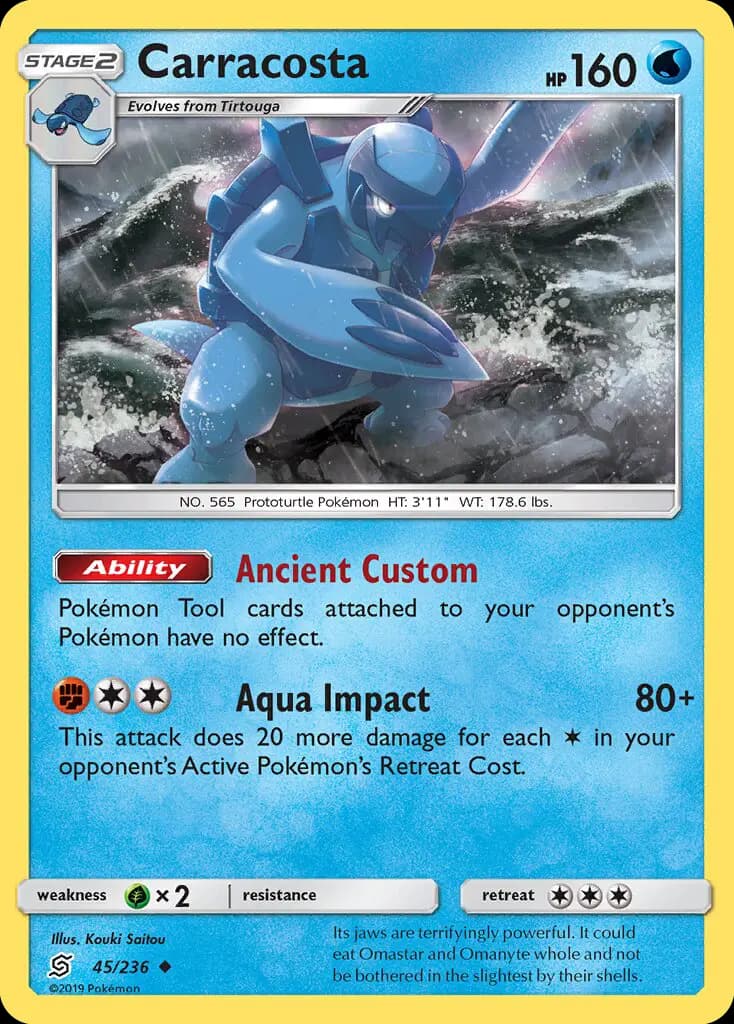
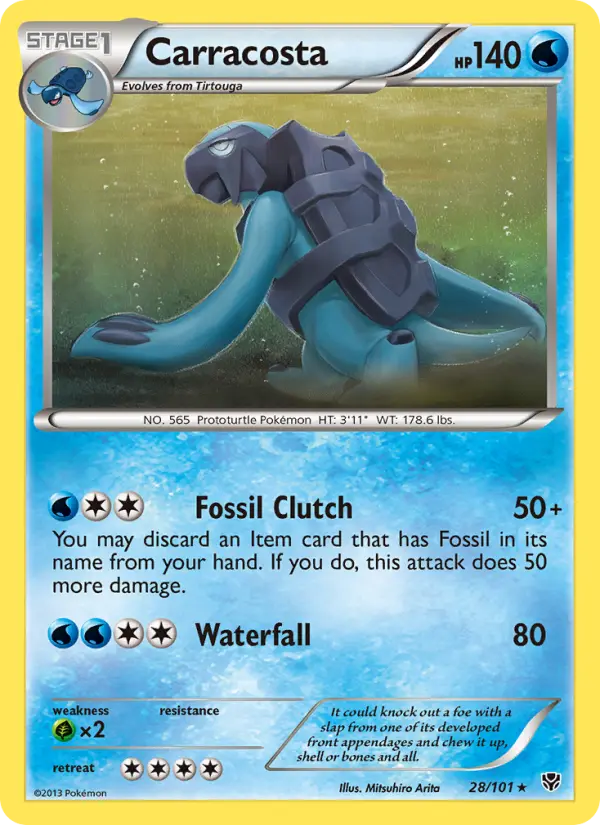
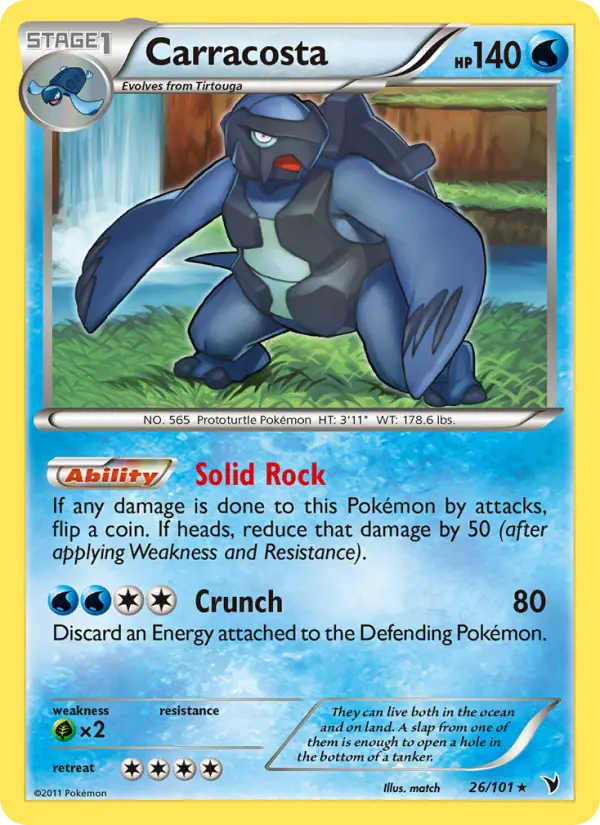
Carracosta
Generation V · #0565 — Prototurtle Pokémon
Carracosta's profile is easy to undersell: 1.2 m, 81 kg, and a water/rock typing that doesn't scream power — until you look at its Defense of 133. As a dual-type Water/Rock Pokémon, Carracosta embodies the characteristics of ancient sea creatures that roamed the oceans millions of years ago, making it extinct in the modern Pokémon world. With a combined stat total of 495, Carracosta is built primarily around physical prowess, boasting an impressive Attack stat of 108 and a remarkable Defense stat of 133. Its abilities—Solid Rock, Sturdy, and the hidden ability Swift Swim—make it a versatile battler capable of filling various roles in competitive play. Standing at 1.2 meters tall and weighing 81 kilograms, Carracosta is a moderately-sized Pokémon that commands respect both in battle and in the lore of the Unova region.
Editor's Take
Carracosta's Shell Smash plus Solid Rock is a genuinely reasonable sweeper setup, and Water/Rock giving it a quad Grass weakness is the flaw that caps it.
Base Stats
Height
1.2m
Weight
81.0kg
Category
Prototurtle Pokémon
Gender
Male 87.5% / Female 12.5%
Color
blue
Shape
upright
Abilities
Decreases damage taken from super-effective moves by 1/4.
Prevents being KOed from full HP, leaving 1 HP instead. Protects against the one-hit KO moves regardless of HP.
Doubles Speed during rain.

Carracosta Biology & Physical Characteristics
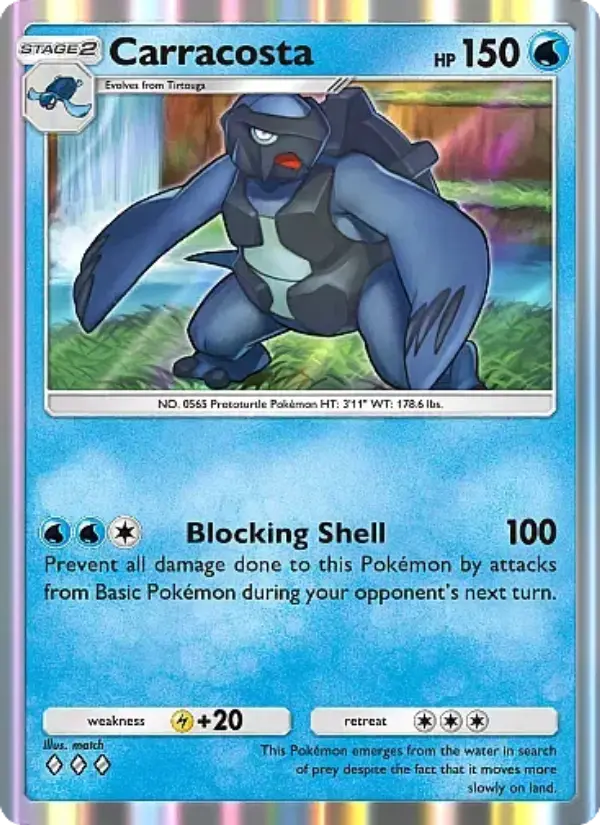
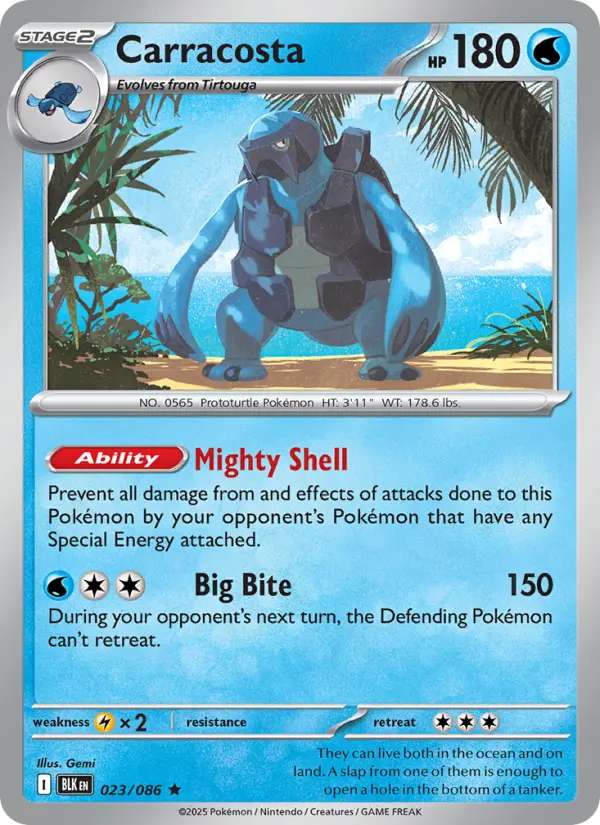
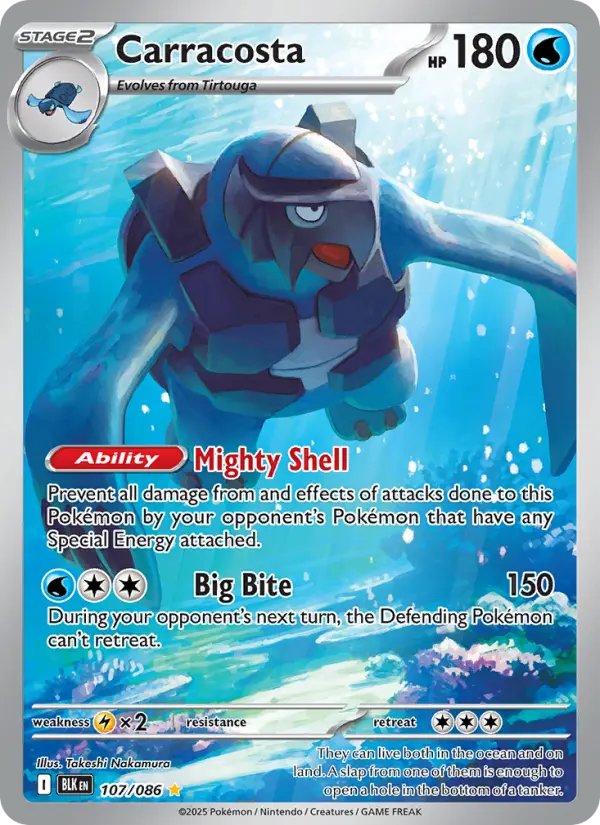
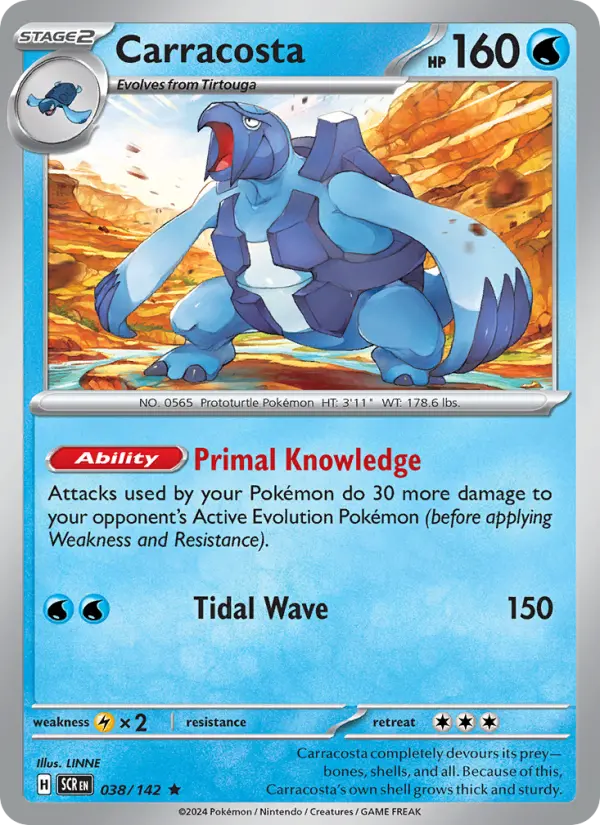
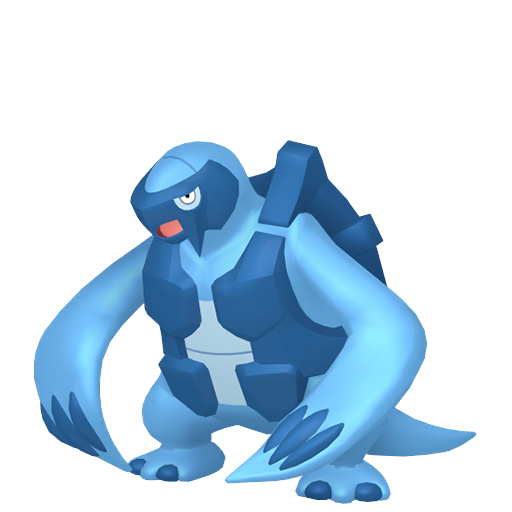
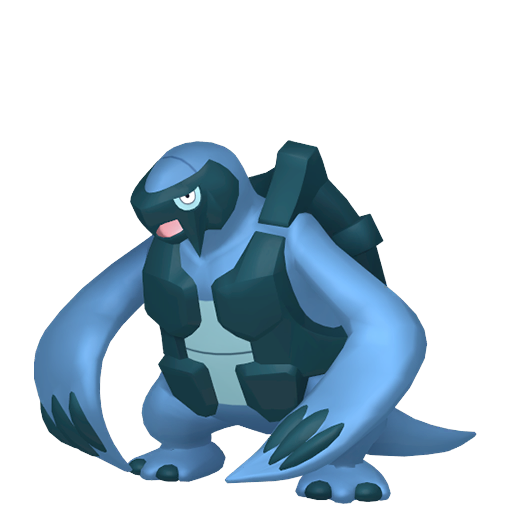
Carracosta is a reptilian Pokémon displaying a striking bipedal, blue-colored form reminiscent of a prehistoric sea turtle. Its body features a pale blue stomach contrasting sharply with deep blue rocky structures that encrust its face, back, and chest sides, forming a distinctive mask-like pattern and protective shell. These rocky formations are not merely aesthetic—they represent years of dietary reinforcement that has made Carracosta's shell extraordinarily durable. The Pokémon's long flippers are equipped with black, finger-like protrusions at the tips, providing both mobility and remarkable striking power. Its thick tail and short, two-toed legs complete a physiology perfectly adapted for both aquatic and terrestrial environments. What truly sets Carracosta apart is the incredible strength of its jaws, which according to Pokédex entries can chew through steel beams and rocks as easily as softer prey. This exceptional jaw strength allows it to consume every last bit of its catch—bones, shells, and all—which directly contributes to the development of its famously thick and sturdy shell through a process of dietary calcium and mineral accumulation.
Pokedex Numbers
Training
Breeding
Carracosta Breeding, Gender Ratio & Egg Groups
Carracosta exhibits a significant sexual dimorphism in terms of gender distribution, with males comprising approximately 87.5% of the population while females account for only 12.5%. This heavily male-skewed ratio is consistent across most of its appearances and generations, creating unique breeding dynamics for trainers seeking to raise Carracosta. The Pokémon belongs to the Water 1 and Water 3 egg groups, making it compatible with numerous other aquatic Pokémon for breeding purposes. A Carracosta egg requires 30 cycles to hatch, translating to approximately 7,454 to 7,710 steps of travel, making it a moderately time-intensive fossil Pokémon to breed. The base happiness value of 70 indicates that Carracosta develops a moderately friendly bond with its trainer, though it may require extra effort to achieve maximum happiness and unlock affection-based battle bonuses. The combination of limited female availability and dual egg group membership means that breeding Carracosta requires strategic planning, particularly for trainers attempting to produce offspring with specific movesets or natures. Despite these breeding challenges, the effort is worthwhile for competitive players seeking a well-trained specimen with optimal individual values and move coverage.
Sprites




TMs & HMs
tm03
crystal
tm03
gold silver
tm03
ruby sapphire
tm03
platinum
tm03
firered leafgreen
tm03
heartgold soulsilver
tm03
diamond pearl
tm03
emerald
tm03
xd
tm03
colosseum
tm04
gold silver
tm04
crystal
tm05
lets go pikachu lets go eevee
tm06
yellow
tm06
gold silver
tm06
red blue
tm06
crystal
tm06
emerald
tm06
firered leafgreen
tm06
diamond pearl
+666 more TMs/HMs
Carracosta's Evolution Chain


Carracosta Evolution, Mega Evolution & Special Forms
Carracosta evolves from Tirtouga when the fossil Pokémon reaches level 37, marking the completion of its growth into a fully-realized aquatic predator. The evolution represents a significant transformation, with Carracosta developing the enhanced musculature and reinforced shell structure that define its adult form. While Carracosta does not possess a Mega Evolution, its base form is already optimized for competitive battle and survival. The level 37 evolution threshold ensures that trainers capturing Tirtouga as a fossil have sufficient time to level it up and learn key moves before triggering its transformation. Upon evolution, Carracosta gains access to a wider movepool and the potential to utilize abilities more effectively in battle scenarios. The evolutionary line's fossil origin ties it to the ancient history of the Unova region, with the revival process being the only method to obtain these prehistoric Pokémon in modern gameplay. Unlike some Pokémon that receive regional variants or alternative evolution methods, Carracosta maintains a straightforward evolutionary path, emphasizing its role as a classic representation of prehistoric aquatic life.
Where to Find
Location data not available for this Pokémon in the database.
Carracosta Behaviour and Natural Habitat
Carracosta is an active predator equally comfortable hunting in ocean waters and on dry land, though it displays a distinct tactical preference when hunting terrestrial prey. When it encounters food sources on land, Carracosta employs an efficient hunting strategy: it drags its prey into the water where it can finish the kill with significantly greater advantage. This behavioral adaptation reflects its evolutionary specialization as an amphibious apex predator of its era. The Pokémon is known to hide within its shell, using its rocky exterior to effectively camouflage itself as an ordinary boulder, allowing it to ambush unsuspecting prey passing nearby. Its reputation as a fearsome hunter is well-earned—according to Pokédex entries, Carracosta is capable of preying on Omanyte and Omastar, consuming them whole regardless of their protective shells. The sheer power of Carracosta's physical form is demonstrated by the widely-documented claim that a single slap from one of its developed front appendages is sufficient to open a hole in the bottom of a steel tanker. This predatory nature and aquatic dominance suggest that Carracosta inhabited shallow to moderate ocean depths during its pre-extinction era, likely serving as an apex predator in its ecosystem.
Pokedex Entries
They can live both in the ocean and on land. A slap from one of them is enough to open a hole in the bottom of a tanker.
It could knock out a foe with a slap from one of its developed front appendages and chew it up, shell or bones and all.
Incredible jaw strength enables them to chew up steel beams and rocks along with their prey.
They can live both in the ocean and on land. A slap from one of them is enough to open a hole in the bottom of a tanker.
It could knock out a foe with a slap from one of its developed front appendages and chew it up, shell or bones and all.
They can live both in the ocean and on land. A slap from one of them is enough to open a hole in the bottom of a tanker.
It could knock out a foe with a slap from one of its developed front appendages and chew it up, shell or bones and all.
It constructed its sturdy shell by crunching and swallowing the hard shells or bones of its prey.
Its jaws are terrifyingly powerful. It could eat Omastar and Omanyte whole and not be bothered in the slightest by their shells.
Active both on land and in the sea, this Pokémon drags its land-based prey into the water to finish it off.
Carracosta eats every last bit of the prey it catches, even the shells and bones, to further strengthen its sturdy shell.
Carracosta completely devours its prey—bones, shells, and all. Because of this, Carracosta’s own shell grows thick and sturdy.
This Pokémon emerges from the water in search of prey despite the fact that it moves more slowly on land.
Carracosta Name Origin & Design Inspiration
Carracosta's name comes from 'carapace,' referring to the protective shell structure found on turtles and other reptiles, combined with 'costa,' which means rib or coastal region, emphasizing its marine heritage. In Japanese, it is called Abagoura, a name that evokes the ancient and mysterious nature of this fossilized creature. The design itself draws heavy inspiration from Archelon, an extinct Cretaceous sea turtle that could reach enormous sizes and possessed powerful flippers and jaws. Carracosta's blue coloration and rocky shell protrusions reference the mineralized processes that occur during fossilization, where organic material is replaced by stone and mineral deposits over millions of years. The bipedal stance distinguishes it from modern sea turtles, giving it a more aggressive, predatory appearance that emphasizes its role as an apex hunter rather than a passive marine dweller. The aggressive facial features, including the prominent jaw structure and the mask-like patterns on its face, convey the predatory nature described in the Pokédex entries. The overall design successfully balances biological plausibility with fantastical elements, creating a Pokémon that feels both scientifically grounded in paleontology and distinctly part of the Pokémon universe.
Learnable Moves
Carracosta can learn 73 moves:
Move | Type | Cat. | Power | Acc. | PP |
|---|---|---|---|---|---|
| ancient power | rock | Special | 60 | 100 | 5 |
| aqua jet | water | Physical | 40 | 100 | 20 |
| aqua tail | water | Physical | 90 | 90 | 10 |
| attract | normal | Status | — | 100 | 15 |
| bide | normal | Physical | — | — | 10 |
| bite | dark | Physical | 60 | 100 | 25 |
| blizzard | ice | Special | 110 | 70 | 5 |
| block | normal | Status | — | — | 5 |
| body slam | normal | Physical | 85 | 100 | 15 |
| brine | water | Special | 65 | 100 | 10 |
| bulldoze | ground | Physical | 60 | 100 | 20 |
| confide | normal | Status | — | — | 20 |
| crunch | dark | Physical | 80 | 100 | 15 |
| curse | ghost | Status | — | — | 10 |
| dig | ground | Physical | 80 | 100 | 10 |
| dive | water | Physical | 80 | 100 | 10 |
| double team | normal | Status | — | — | 15 |
| earth power | ground | Special | 90 | 100 | 10 |
| earthquake | ground | Physical | 100 | 100 | 10 |
| endure | normal | Status | — | — | 10 |
| facade | normal | Physical | 70 | 100 | 20 |
| focus blast | fighting | Special | 120 | 70 | 5 |
| frustration | normal | Physical | — | 100 | 20 |
| giga impact | normal | Physical | 150 | 90 | 5 |
| guard swap | psychic | Status | — | — | 10 |
| hidden power | normal | Special | 60 | 100 | 15 |
| hydro pump | water | Special | 110 | 80 | 5 |
| hyper beam | normal | Special | 150 | 90 | 5 |
| ice beam | ice | Special | 90 | 100 | 10 |
| icy wind | ice | Special | 55 | 95 | 15 |
| iron defense | steel | Status | — | — | 15 |
| iron head | steel | Physical | 80 | 100 | 15 |
| iron tail | steel | Physical | 100 | 75 | 15 |
| knock off | dark | Physical | 65 | 100 | 20 |
| liquidation | water | Physical | 85 | 100 | 10 |
| low kick | fighting | Physical | — | 100 | 20 |
| meteor beam | rock | Special | 120 | 90 | 10 |
| mud shot | ground | Special | 55 | 95 | 15 |
| muddy water | water | Special | 90 | 85 | 10 |
| protect | normal | Status | — | — | 10 |
| rain dance | water | Status | — | — | 5 |
| razor shell | water | Physical | 75 | 95 | 10 |
| rest | psychic | Status | — | — | 5 |
| return | normal | Physical | — | 100 | 20 |
| rock blast | rock | Physical | 25 | 90 | 10 |
| rock polish | rock | Status | — | — | 20 |
| rock slide | rock | Physical | 75 | 90 | 10 |
| rock smash | fighting | Physical | 40 | 100 | 15 |
| rock tomb | rock | Physical | 60 | 95 | 15 |
| rollout | rock | Physical | 30 | 90 | 20 |
| round | normal | Special | 60 | 100 | 15 |
| sandstorm | rock | Status | — | — | 10 |
| scald | water | Special | 80 | 100 | 15 |
| secret power | normal | Physical | 70 | 100 | 20 |
| shell smash | normal | Status | — | — | 15 |
| sleep talk | normal | Status | — | — | 10 |
| smack down | rock | Physical | 50 | 100 | 15 |
| snore | normal | Special | 50 | 100 | 15 |
| stealth rock | rock | Status | — | — | 20 |
| stone edge | rock | Physical | 100 | 80 | 5 |
| strength | normal | Physical | 80 | 100 | 15 |
| substitute | normal | Status | — | — | 10 |
| superpower | fighting | Physical | 120 | 100 | 5 |
| surf | water | Special | 90 | 100 | 15 |
| swagger | normal | Status | — | 85 | 15 |
| toxic | poison | Status | — | 90 | 10 |
| water gun | water | Special | 40 | 100 | 25 |
| water pulse | water | Special | 60 | 100 | 20 |
| waterfall | water | Physical | 80 | 100 | 15 |
| whirlpool | water | Special | 35 | 85 | 15 |
| wide guard | rock | Status | — | — | 10 |
| withdraw | water | Status | — | — | 40 |
| zen headbutt | psychic | Physical | 80 | 90 | 15 |
Carracosta Competitive Battle Guide
Carracosta occupies a specialized niche in competitive Pokémon battles, functioning primarily as a physical-oriented wall and secondary attacker. Its Defense stat of 133 stands as one of its most valuable assets, allowing it to absorb substantial physical damage and serve as a reliable physical wall when properly trained and EV-invested. The Attack stat of 108 provides respectable offensive capability, enabling Carracosta to deal meaningful damage while maintaining its defensive focus. The Solid Rock ability, which reduces super-effective damage by 25%, is particularly valuable given Carracosta's Water/Rock typing, which creates weaknesses to Grass, Fighting, and Ground-type moves—all common attacking types in competitive formats. Swift Swim, the hidden ability, transforms Carracosta into a rain-dependent sweeper by doubling its Speed in rain conditions, though the base Speed of 32 means it requires weather support to become threatening. Sturdy, the standard second ability, provides protection against one-hit knockout moves and prevents being knocked out from full health, effectively guaranteeing a minimum of one hit to survive incoming attacks. Carracosta can learn a diverse movepool including Waterfall, Stone Edge, Earthquake, and Crunch, providing excellent coverage against most defensive threats. However, its relatively low Special Attack of 83 and Special Defense of 65 limit its effectiveness against special attackers, making team composition and support crucial for competitive success. The modest Speed tier requires careful prediction and team support to succeed in faster-paced competitive formats.
Commonly Asked Questions About Carracosta
What type is Carracosta?
Carracosta is a water and rock type Pokemon.
What does Carracosta evolve from?
Carracosta evolved from tirtouga.
What are Carracosta's weaknesses?
Carracosta is weak to fighting, ground, grass and electric type moves.
Carracosta Cultural Impact & Franchise History
Carracosta has established itself as a memorable fossil Pokémon within the broader Pokémon franchise, representing the fascination with prehistoric life that appeals to many trainers and Pokémon enthusiasts. Its design captures the imagination by presenting what an ancient apex predator might have looked like, combining elements of paleontological accuracy with fantastical enhancements that make it distinctly Pokémon. In the anime and manga series, Carracosta has appeared in various contexts, most notably in Pokémon Super Mystery Dungeon, where it serves as the adoptive father figure to the partner Pokémon, demonstrating a softer, more paternal side beneath its fearsome exterior. This characterization adds emotional depth to the species, contrasting its fierce predatory nature with capacity for familial care and mentorship. The Pokémon appeals strongly to paleontology enthusiasts and those interested in prehistoric marine life, bridging the gap between scientific education and entertainment. Carracosta's status as an extinct Pokémon available only through fossil revival adds to its mystique and collectibility, making it a sought-after addition to many trainers' teams. Its representation in competitive play and tournament scenes has solidified its position as more than merely a nostalgic nod to prehistoric times—it serves as a viable competitive option that rewards strategic team-building and careful play.
Where to Find Carracosta in Every Pokémon Game
Carracosta is exclusively available to trainers through the fossil revival mechanic, making it inaccessible through standard wild Pokémon encounters. The primary method of obtaining Carracosta involves collecting Tirtouga fossils from specific locations within games and utilizing NPCs with fossil revival capabilities, typically found in Pokémon Centers or specialized laboratories. In Generation V games (Black, White, Black 2, and White 2), Tirtouga fossils can be obtained in the Nacrene Museum or through other specific in-game locations, with the Pokémon subsequently evolved to Carracosta through leveling. The species has appeared in various regional Pokédexes including the Alola dex in Sun/Moon and Ultra Sun/Ultra Moon, and the Crown Tundra dex in Pokémon Sword/Shield, expanding its accessibility across different game versions. In Pokémon Sword and Shield, Carracosta can be encountered directly in the Pokédex via revivals in the Crown Tundra, streamlining the process for modern players. The base happiness of 70 (adjusted to 50 in certain games) means that newly revived or traded Carracosta may require additional bonding time to reach maximum friendship. Trading with other trainers represents an alternative method for obtaining Carracosta without completing the fossil revival process, making it moderately accessible to players willing to engage in the trading community. Its relatively straightforward evolution from Tirtouga at level 37 means that accessibility is primarily gated by fossil availability rather than complex evolution requirements, making it a reasonable addition to competitive teams and Pokédex completion efforts.