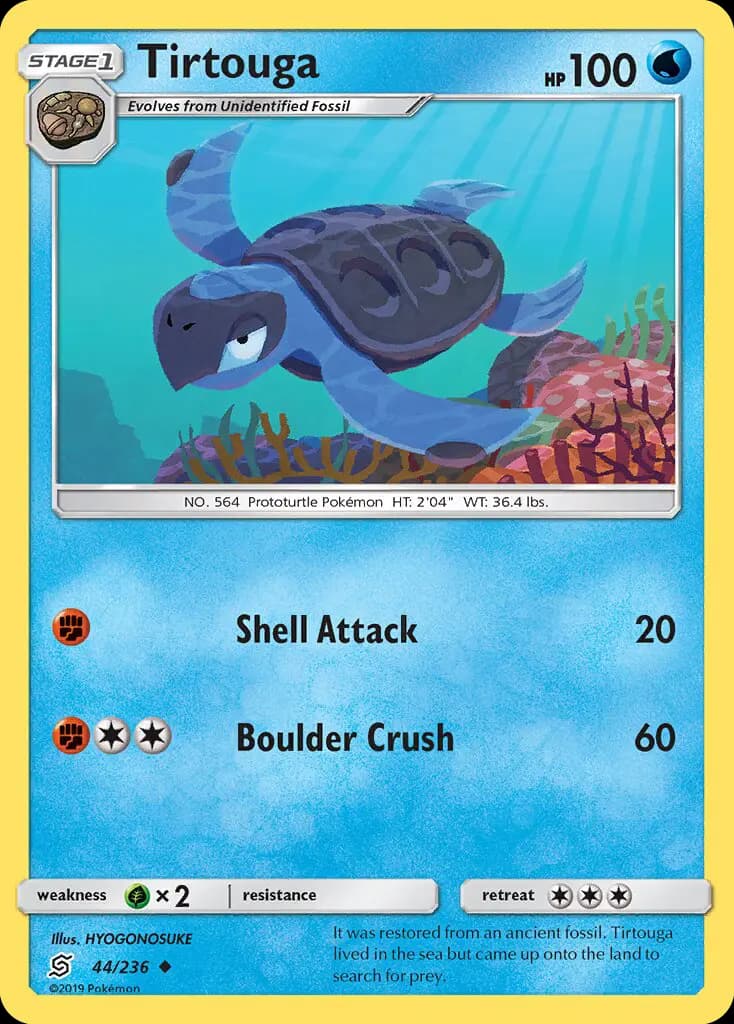
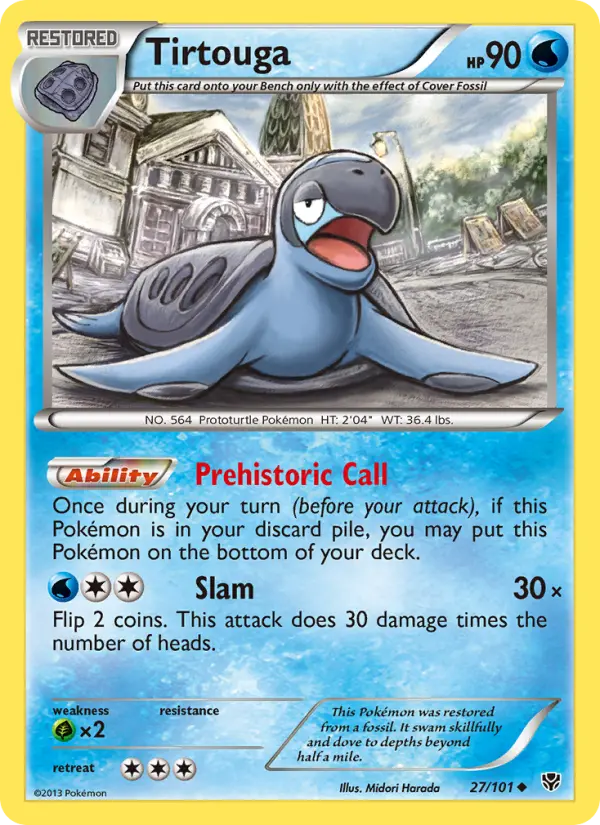
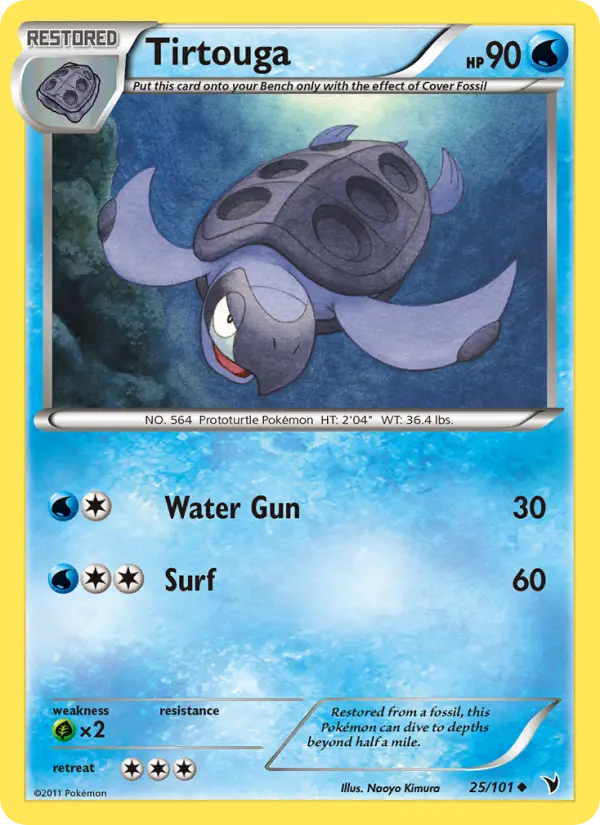
Tirtouga
Generation V · #0564 — Prototurtle Pokémon
Tirtouga is a water/rock-type Pokémon whose defense — 103 at base — does more to define its role than its overall spread does. Standing 0.7 m tall and weighing 16.5 kg, it's built around a distinct combination of water traits that shapes how it performs both in the wild and in battle. With a aggregate stat total of 355, Tirtouga excels particularly in Defense with a respectable 103, while its Attack stands at 78, making it a surprisingly sturdy physical attacker for its size. Its most notable weakness lies in its abysmal Speed stat of 22, the slowest among most trainable Pokémon, which significantly impacts its competitive viability. Despite these limitations, Tirtouga possesses a 45% catch rate and maintains a neutral base happiness of 70, making it a reasonable choice for trainers seeking a defensive Water-type option during their journey through Unova.
Editor's Take
Tirtouga's line ends in Carracosta with Solid Rock and Shell Smash, which is the most survivable Shell Smash user in the game and still not very survivable.
Base Stats
Height
0.7m
Weight
16.5kg
Category
Prototurtle Pokémon
Gender
Male 87.5% / Female 12.5%
Color
blue
Shape
quadruped
Abilities
Decreases damage taken from super-effective moves by 1/4.
Prevents being KOed from full HP, leaving 1 HP instead. Protects against the one-hit KO moves regardless of HP.
Doubles Speed during rain.

Tirtouga Biology & Physical Characteristics
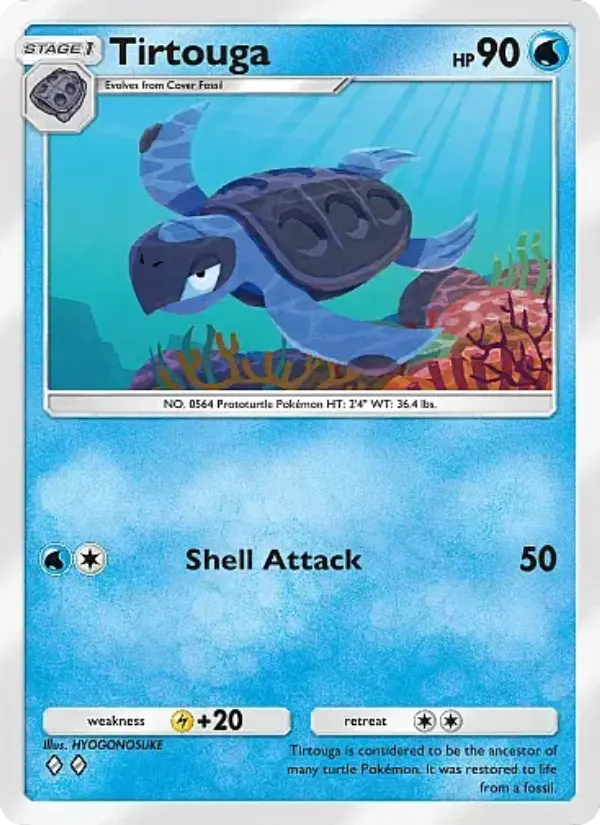
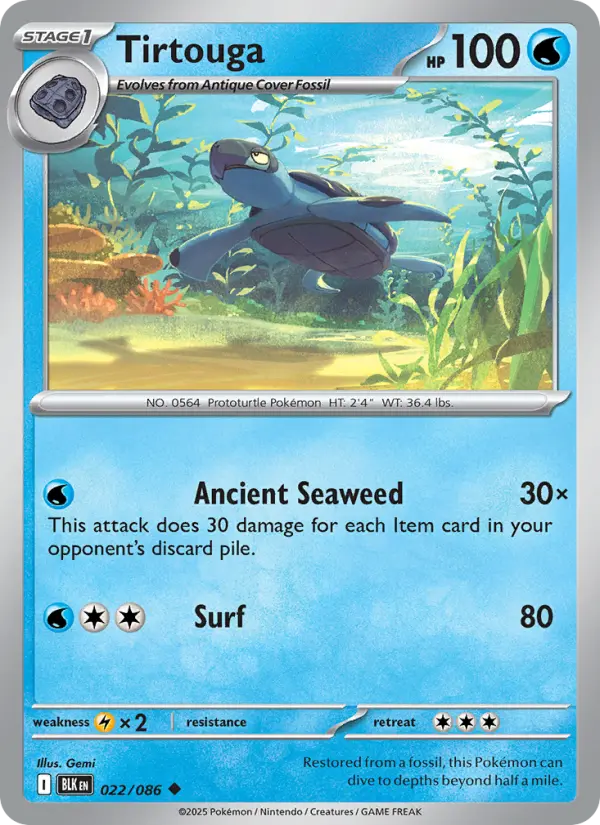
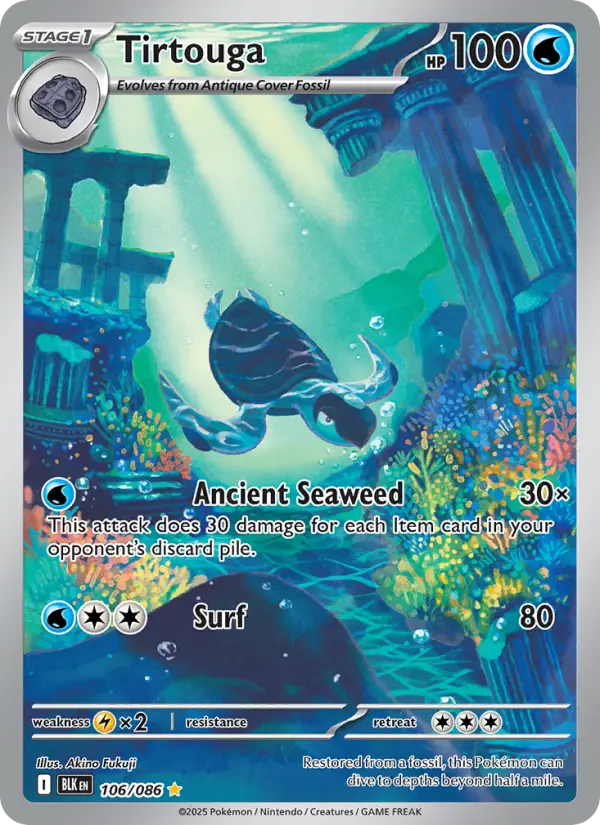
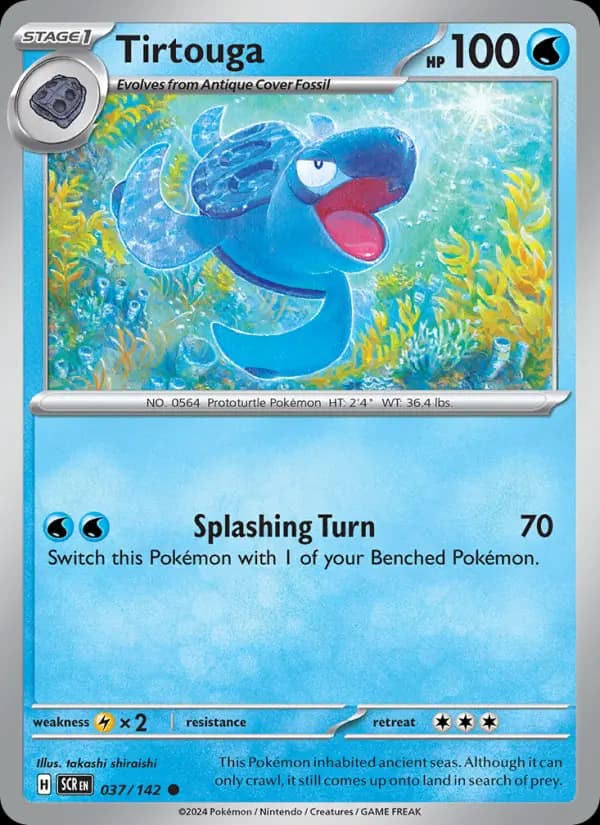
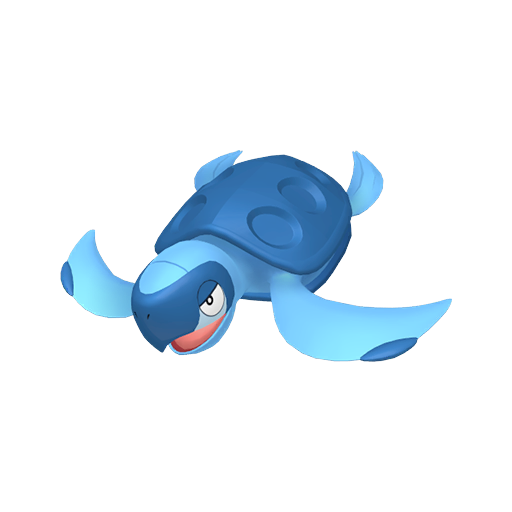
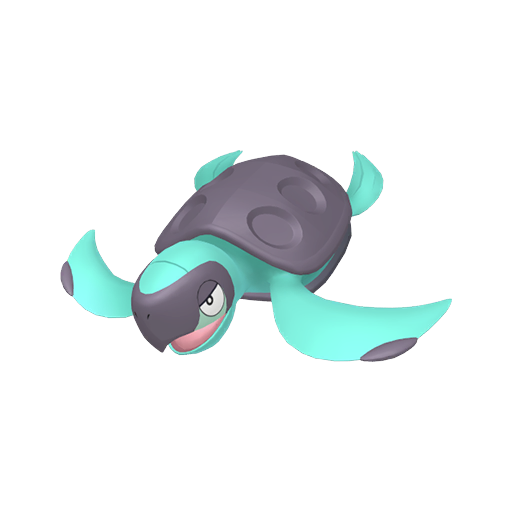
Tirtouga is a reptilian Pokémon that bears striking resemblance to a juvenile leatherback sea turtle, featuring a predominantly blue coloration with distinctive black spots adorning the edges of its flippers and shell. Its shell, characterized by six circular indentations arranged across its back, is remarkably tough and provides substantial protection—a trait reflected in its high Defense stat of 103. The Pokémon's face bears a distinctive mask-like pattern created by its black upper beak and facial markings, with light blue patches appearing beneath its eyes that give it an almost endearing appearance. Scientific evidence preserved in skeletal structures suggests that Tirtouga possessed the remarkable ability to dive to ocean depths exceeding 800 meters (half a mile), making it one of the most accomplished deep-diving creatures of its era approximately 100 million years ago. This exceptional diving capability, combined with its tough carapace, perfectly adapted Tirtouga for survival in the harsh pressures of ancient oceans, and modern paleontologists believe it to be the evolutionary ancestor of most modern turtle-type Pokémon.
Pokedex Numbers
Training
Breeding
Tirtouga Breeding, Gender Ratio & Egg Groups
Tirtouga exhibits a notably male-skewed gender distribution of approximately 87.5% male to 12.5% female, making female specimens considerably rarer and more challenging to obtain through natural breeding methods. This gender ratio, consistent across all Generation V and later games, means trainers seeking to breed Tirtouga for competitive purposes or collection must often search extensively for female individuals, though males can breed with female Pokémon from the Water 1 and Water 3 egg groups. The species belongs to both the Water 1 and Water 3 egg groups simultaneously, providing significant breeding flexibility and allowing it to produce eggs when paired with compatible partners such as Squirtle line members, Poliwag line members, Slowpoke line members, and many other water-dwelling Pokémon. With a hatch counter of 30 cycles (approximately 7,454 to 7,710 steps), eggs produced from Tirtouga pairings require moderate incubation time relative to other fossil Pokémon, making it a reasonable choice for dedicated breeders. The species maintains a base happiness of 70 in early generations, indicating a relatively straightforward temperament that facilitates breeding endeavors, though this value decreased in later generations as Game Freak standardized baseline friendships.
Sprites




TMs & HMs
tm03
crystal
tm03
gold silver
tm03
ruby sapphire
tm03
platinum
tm03
firered leafgreen
tm03
heartgold soulsilver
tm03
diamond pearl
tm03
emerald
tm03
xd
tm03
colosseum
tm04
gold silver
tm04
crystal
tm05
lets go pikachu lets go eevee
tm06
yellow
tm06
gold silver
tm06
red blue
tm06
crystal
tm06
emerald
tm06
firered leafgreen
tm06
diamond pearl
+611 more TMs/HMs
Tirtouga's Evolution Chain


Tirtouga Evolution, Mega Evolution & Special Forms
Tirtouga undergoes a single, straightforward evolution into Carracosta upon reaching level 37, shedding its juvenile characteristics in favor of a significantly larger and more formidable form. The evolution represents a dramatic transformation in both physical stature and combat capability, with Carracosta retaining the Water/Rock typing while gaining considerable increases across most statistical categories. This evolution is exclusively level-based, requiring no special items, held objects, or environmental conditions, making it one of the most accessible fossil Pokémon evolutions available to trainers. The transition from Tirtouga to Carracosta marks the creature's maturation from a defensive specialist into a far more well-rounded combatant, with substantially improved Attack and Speed stats that address Tirtouga's primary competitive limitations. The evolution line contains no alternate forms, Mega Evolutions, Gigantamax forms, or regional variants, maintaining a consistent design philosophy throughout both stages of development.
Where to Find
Alola Route 8
alola
+1 more
Tirtouga Behaviour and Natural Habitat
Tirtouga is documented as an active predator that inhabited warm seas during the Cretaceous period, with fossil evidence and Pokédex records suggesting it was equally comfortable hunting both aquatic and terrestrial prey. The Pokémon's hunting grounds were remarkably expansive, ranging from shallow coastal waters where it could venture onto land in pursuit of sustenance, to the deepest ocean trenches where few other creatures dared venture. Its aggressive feeding behavior and willingness to leave its aquatic habitat in search of meals distinguished Tirtouga as a particularly successful apex predator of its time, with hunting grounds that encompassed both marine and terrestrial environments. Modern observations of revived specimens indicate they retain these ancestral instincts, demonstrating both aquatic prowess and surprisingly effective land-based mobility despite their somewhat ungainly appearance. The species' broad ecological range and adaptability to multiple environments suggests Tirtouga was a keystone species in its ancient ecosystem, playing a crucial role in maintaining the balance of Cretaceous marine life.
Pokedex Entries
Restored from a fossil, this Pokémon can dive to depths beyond half a mile.
This Pokémon was restored from a fossil. It swam skillfully and dove to depths beyond half a mile.
About 100 million years ago, these Pokémon swam in oceans. It is thought they also went on land to attack prey.
About 100 million years ago, these Pokémon swam in oceans. It is thought they also went on land to attack prey.
Restored from a fossil, this Pokémon can dive to depths beyond half a mile.
About 100 million years ago, these Pokémon swam in oceans. It is thought they also went on land to attack prey.
Restored from a fossil, this Pokémon can dive to depths beyond half a mile.
Based on studies of its skeletal structure, it can apparently dive to ocean depths of over half a mile.
It was restored from an ancient fossil. Tirtouga lived in the sea but came up onto the land to search for prey.
Reputed to be the ancestor of most turtle Pokémon, it lived in warm seas approximately a hundred million years ago.
Its hunting grounds encompassed a broad area, from the land to more than half a mile deep in the ocean.
This Pokémon inhabited ancient seas. Although it can only crawl, it still comes up onto land in search of prey.
Tirtouga is considered to be the ancestor of many turtle Pokémon. It was restored to life from a fossil.
Tirtouga Name Origin & Design Inspiration
Tirtouga's name derives from the combination of 'turtle' and 'tort' (related to tortoises), with the Japanese designation 'Protoga' clearly referencing 'proto' (first or primitive) and 'toga' (turtle), emphasizing its role as an ancient, ancestral turtle species. The Pokémon's design philosophy centers on representing what paleontologists believe to be the evolutionary ancestor of modern turtle Pokémon, incorporating realistic prehistoric elements such as the leatherback-turtle body plan with its distinctive shell indentations that mirror actual fossilized specimens. The mask-like facial markings and spotted flipper patterns serve both aesthetic and functional purposes, creating a visually distinctive silhouette while suggesting the ancient and somewhat alien nature of this revived creature. The Water/Rock typing itself communicates the dual nature of Tirtouga's existence—the Water element reflecting its oceanic origins and prowess as a deep-diving predator, while the Rock element symbolizes its fossil nature and the ancient stone from which it has been restored. Every design element, from the robust shell structure to the somewhat compact proportions, reinforces the concept of a small but incredibly hardy prehistoric survivor whose descendants would eventually diversify into the numerous turtle Pokémon recognized in modern times.
Learnable Moves
Tirtouga can learn 69 moves:
Move | Type | Cat. | Power | Acc. | PP |
|---|---|---|---|---|---|
| ancient power | rock | Special | 60 | 100 | 5 |
| aqua jet | water | Physical | 40 | 100 | 20 |
| aqua tail | water | Physical | 90 | 90 | 10 |
| attract | normal | Status | — | 100 | 15 |
| bide | normal | Physical | — | — | 10 |
| bite | dark | Physical | 60 | 100 | 25 |
| blizzard | ice | Special | 110 | 70 | 5 |
| block | normal | Status | — | — | 5 |
| body slam | normal | Physical | 85 | 100 | 15 |
| brine | water | Special | 65 | 100 | 10 |
| bulldoze | ground | Physical | 60 | 100 | 20 |
| confide | normal | Status | — | — | 20 |
| crunch | dark | Physical | 80 | 100 | 15 |
| curse | ghost | Status | — | — | 10 |
| dig | ground | Physical | 80 | 100 | 10 |
| dive | water | Physical | 80 | 100 | 10 |
| double team | normal | Status | — | — | 15 |
| earth power | ground | Special | 90 | 100 | 10 |
| earthquake | ground | Physical | 100 | 100 | 10 |
| endure | normal | Status | — | — | 10 |
| facade | normal | Physical | 70 | 100 | 20 |
| flail | normal | Physical | — | 100 | 15 |
| frustration | normal | Physical | — | 100 | 20 |
| guard swap | psychic | Status | — | — | 10 |
| hidden power | normal | Special | 60 | 100 | 15 |
| hydro pump | water | Special | 110 | 80 | 5 |
| ice beam | ice | Special | 90 | 100 | 10 |
| icy wind | ice | Special | 55 | 95 | 15 |
| iron defense | steel | Status | — | — | 15 |
| iron tail | steel | Physical | 100 | 75 | 15 |
| knock off | dark | Physical | 65 | 100 | 20 |
| liquidation | water | Physical | 85 | 100 | 10 |
| meteor beam | rock | Special | 120 | 90 | 10 |
| mud shot | ground | Special | 55 | 95 | 15 |
| muddy water | water | Special | 90 | 85 | 10 |
| protect | normal | Status | — | — | 10 |
| rain dance | water | Status | — | — | 5 |
| rest | psychic | Status | — | — | 5 |
| return | normal | Physical | — | 100 | 20 |
| rock blast | rock | Physical | 25 | 90 | 10 |
| rock polish | rock | Status | — | — | 20 |
| rock slide | rock | Physical | 75 | 90 | 10 |
| rock smash | fighting | Physical | 40 | 100 | 15 |
| rock throw | rock | Physical | 50 | 90 | 15 |
| rock tomb | rock | Physical | 60 | 95 | 15 |
| rollout | rock | Physical | 30 | 90 | 20 |
| round | normal | Special | 60 | 100 | 15 |
| sandstorm | rock | Status | — | — | 10 |
| scald | water | Special | 80 | 100 | 15 |
| secret power | normal | Physical | 70 | 100 | 20 |
| shell smash | normal | Status | — | — | 15 |
| slam | normal | Physical | 80 | 75 | 20 |
| sleep talk | normal | Status | — | — | 10 |
| smack down | rock | Physical | 50 | 100 | 15 |
| snore | normal | Special | 50 | 100 | 15 |
| stealth rock | rock | Status | — | — | 20 |
| stone edge | rock | Physical | 100 | 80 | 5 |
| strength | normal | Physical | 80 | 100 | 15 |
| substitute | normal | Status | — | — | 10 |
| surf | water | Special | 90 | 100 | 15 |
| swagger | normal | Status | — | 85 | 15 |
| toxic | poison | Status | — | 90 | 10 |
| water gun | water | Special | 40 | 100 | 25 |
| water pulse | water | Special | 60 | 100 | 20 |
| waterfall | water | Physical | 80 | 100 | 15 |
| whirlpool | water | Special | 35 | 85 | 15 |
| wide guard | rock | Status | — | — | 10 |
| withdraw | water | Status | — | — | 40 |
| zen headbutt | psychic | Physical | 80 | 90 | 15 |
Tirtouga Competitive Battle Guide
Tirtouga's competitive viability is severely hampered by its abysmal Speed stat of 22, which represents one of the lowest speed statistics among all trainable Pokémon and ensures it almost always moves last in competitive battles regardless of held items or stat modifications. Its impressive Defense of 103 and respectable Attack of 78 create an intriguing defensive wall archetype, yet the low Speed stat undermines any meaningful tactical applications in competitive play where faster threats dominate the metagame. The Solid Rock ability, which reduces damage from super-effective moves by 25%, provides some additional survivability against its numerous weaknesses to Grass, Water, Ground, and Steel-type attacks, though this advantage is often negated by faster opponents who can KO before defensive walls establish control. Its hidden ability Swift Swim offers potential in rain-based team compositions, doubling Tirtouga's Speed during rain and providing a niche avenue for competitive deployment alongside rain-setting Pokémon such as Kyogre or weather-changing supporters. However, even with Swift Swim active, Tirtouga's limited special attack (53) and marginal special defense (45) create significant vulnerabilities, and evolution into Carracosta is almost universally preferable for serious competitive players seeking a Water/Rock defensive option.
Commonly Asked Questions About Tirtouga
What type is Tirtouga?
Tirtouga is a water and rock type Pokemon.
What does Tirtouga evolve into?
Tirtouga evolves into carracosta.
What are Tirtouga's weaknesses?
Tirtouga is weak to fighting, ground, grass and electric type moves.
Does Tirtouga evolve by trading?
No — Tirtouga evolves entirely through leveling up, with no trade required at any stage.
Where can I find Tirtouga?
Tirtouga can be found in alola route 8 (alola).
Tirtouga Cultural Impact & Franchise History
Tirtouga represents an important addition to the fossil Pokémon roster introduced in Generation V, standing alongside creatures like Archen and Druddigon as examples of Game Freak's continued creative expansion of prehistoric creature designs inspired by paleontological discoveries. The Pokémon has achieved moderate recognition within the fan community, particularly among collectors interested in fossil species and those who appreciate its design philosophy as an ancestral ancestor to modern turtle-type Pokémon like Blastoise and Torterra. While Tirtouga itself has never achieved mainstream popularity comparable to iconic water-types such as Blastoise or Gyarados, its evolutionary descendant Carracosta has garnered greater competitive and casual attention, leading to retrospective appreciation for Tirtouga as the foundation of that line. The species has appeared consistently across animated series and trading card game releases, though rarely as a focal point, instead serving as a supporting creature within broader narratives about ancient ecosystems and fossil revival technology. Tirtouga's portrayal in media has reinforced its role as a scientifically interesting creature rather than a fan-favorite powerhouse, appealing primarily to players with genuine interest in paleontology and prehistoric life forms rather than those seeking optimal competitive performance.
Where to Find Tirtouga in Every Pokémon Game
Tirtouga is exclusively available to trainers through the revival of Cover Fossils, making it inaccessible through traditional wild encounter or breeding methods and requiring interaction with fossil restoration facilities present in most Pokémon games. In Pokémon Black and White, Tirtouga appears as local Pokédex number 070 in the Unova regional dex, obtainable by reviving Cover Fossils at the Nacrene City Museum's restoration service. In Black 2 and White 2, its local number increases to 126, maintaining similar fossil restoration mechanics while appearing in expanded areas accessible post-game. The species is available in subsequent generations through various means including fossils found in Kalos, Alola, and Galar regions, consistently maintaining its accessibility to dedicated collectors willing to invest time in fossil acquisition and restoration. Pokémon Sun and Moon lists Tirtouga as Alola dex number 194, while Ultra Sun and Ultra Moon place it at 241, reflecting the expanded fossil availability in later generation Alola expeditions and archaeological discoveries. The Pokémon remains available in Pokémon Sword and Shield through the Crown Tundra DLC, positioned at Crown Tundra dex number 147, ensuring modern trainers can still obtain this ancient creature despite the progression away from traditional fossil mechanics in recent titles.