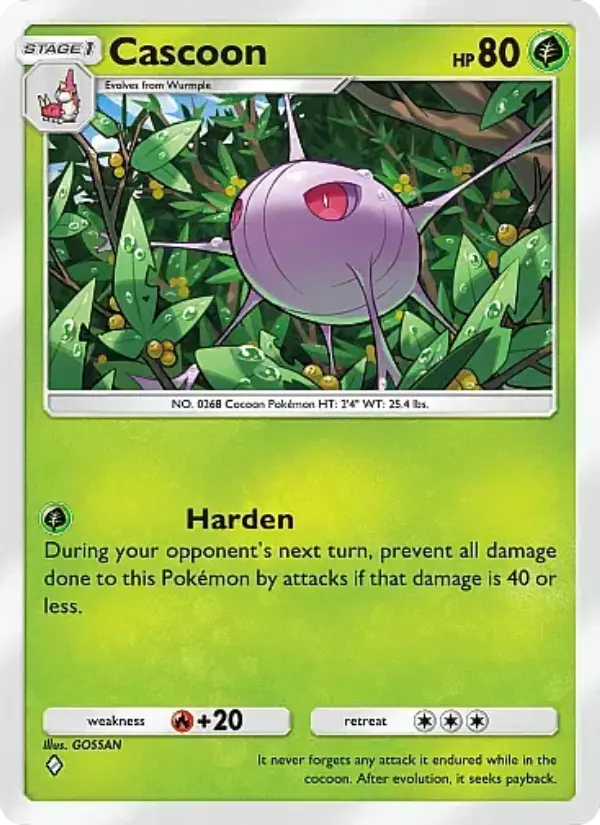
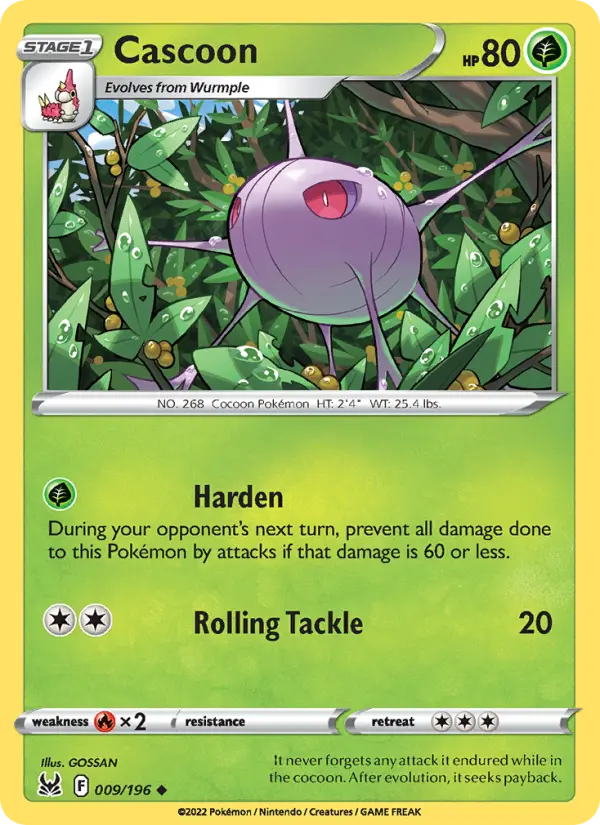
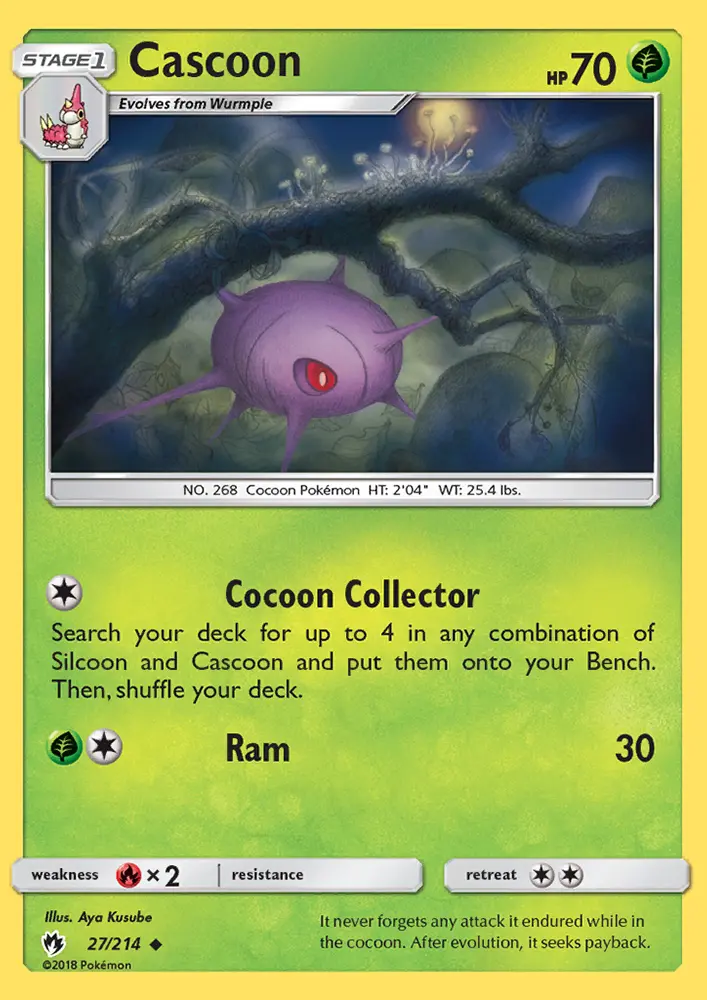
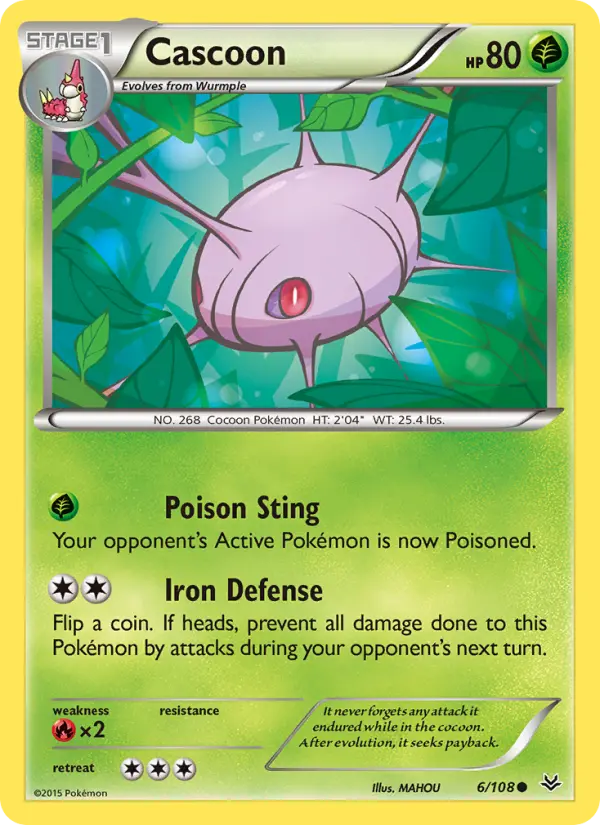
Cascoon
Generation III · #0268 — Cocoon Pokémon
Cascoon debuted in Generation III, and its bug typing has aged into one of its more defining traits, especially paired with shed skin.
Editor's Take
Cascoon is the losing half of the Wurmple coin flip, and Dustox being a defensive Bug/Poison type in a generation full of them is why nobody celebrates this outcome.
Base Stats
Height
0.7m
Weight
11.5kg
Category
Cocoon Pokémon
Gender
Male 50% / Female 50%
Color
purple
Shape
ball
Habitat
forest
Abilities
Has a 33% chance of curing any major status ailment after each turn.

Cascoon Biology & Physical Characteristics
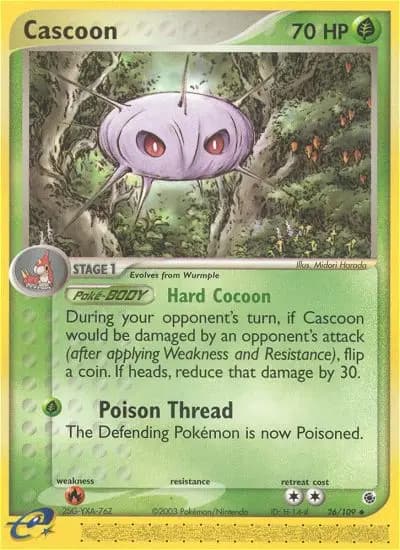
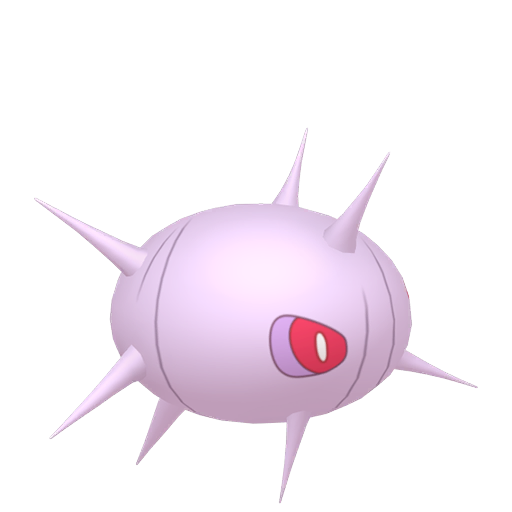
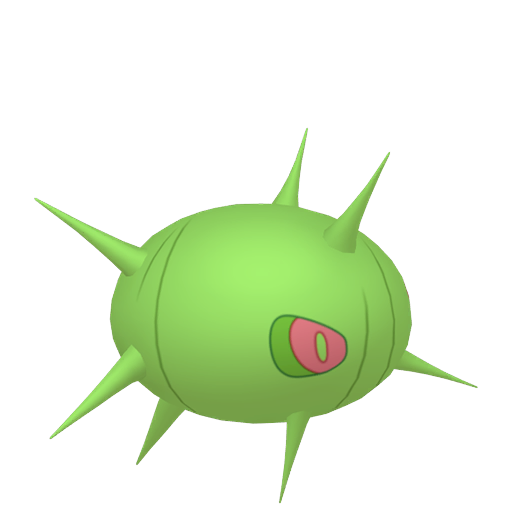
Cascoon is fundamentally defined by its remarkable silken cocoon, which the Pokémon constructs by wrapping its body entirely with fine silk secreted from its mouth. The cocoon begins as soft material but gradually hardens over time through a physiological process driven by cellular energy production. According to its Pokédex entries, the inside of the cocoon becomes notably hot as all the cells in Cascoon's body work to generate the energy necessary for evolution, with visible cracks beginning to form in the hardened casing as the transformation draws near. The cocoon's exterior is predominantly purple in coloration, featuring two distinctive holes through which Cascoon's bright red eyes remain visible, allowing the Pokémon to observe its surroundings without exposing its vulnerable body. The silk comprising Cascoon's cocoon is remarkably thin yet possesses superior strength and lustrous texture compared to that of its parallel evolution, Silcoon, making Cascoon's silk particularly valuable for crafting high-quality clothing and textiles in the Pokémon world.
Pokedex Numbers
Training
Breeding
Cascoon Breeding, Gender Ratio & Egg Groups
Half of all Cascoon are male, half are female — no skew to plan around. As a Bug-type Pokémon, Cascoon belongs exclusively to the Bug Egg Group, meaning it can only breed with other Pokémon sharing this egg classification, limiting its breeding partnerships to fellow Bug-type species and a select number of Pokémon from other types that happen to share this breeding group. The species maintains a moderate base happiness value of 70, indicating that Cascoon, while not extraordinarily difficult to bond with, does not immediately form deep attachments and requires effort to develop stronger trainer relationships. Cascoon's egg hatch counter is set to 15 cycles, translating to approximately 3,599 to 3,855 steps of traversal required to hatch a Cascoon egg, placing it in the lower-to-moderate range of hatch times within the Pokédex. The catch rate of 120 reflects the species' relative abundance and docile nature, making Cascoon significantly easier to capture than legendary or aggressive Pokémon, though not quite as trivial as common early-route variants.
Sprites




TMs & HMs
tm104
scarlet violet
tm182
scarlet violet
tr46
sword shield
tm211
scarlet violet
tm182
the teal mask
tm104
the indigo disk
tm211
the indigo disk
tm82
sword shield
Cascoon's Evolution Chain


Cascoon Evolution, Mega Evolution & Special Forms
Cascoon represents the midpoint in a branching evolutionary pathway unique among early-route Pokémon. It evolves from Wurmple at level 7, though this evolution is determined by Wurmple's hidden personality value rather than level alone, making Cascoon the result of a specific random outcome during Wurmple's development. After reaching level 10 as a Cascoon, the Pokémon undergoes its final evolution into Dustox, acquiring a secondary Poison-type and gaining significantly enhanced stats, particularly in Special Attack, Special Defense, and Speed—transforming from a defensive intermediate form into a mixed-attacker with genuine competitive viability. Cascoon's parallel evolutionary counterpart is Silcoon, Wurmple's other possible second-stage evolution, which follows an identical level-based progression but evolves into the speedy Flying-type Beautifly instead. The evolutionary split between Cascoon and Silcoon creates meaningful gameplay decisions in Generation III titles, as trainers cannot control which evolution they receive, encouraging multiple playthroughs or strategic team planning around the predetermined evolution outcome.
Where to Find
Petalburg Woods
hoenn
Eterna Forest
sinnoh
Sinnoh Route 205
sinnoh
Cascoon Behaviour and Natural Habitat
Cascoon exhibits remarkable patience and restraint despite its vulnerable cocoon state, as it remains motionless even when attacked, enduring pain rather than moving in a way that would weaken its body before evolution. This passive resistance strategy serves a crucial biological function, as movement during the developmental cocoon stage would compromise the structural integrity and readiness of the evolving Pokémon. The species possesses an unusually vindictive psychological characteristic—it never forgets the pain inflicted upon it while encased and explicitly seeks revenge upon its aggressors after evolution into Dustox. In terms of habitat preference, Cascoon resides in forested environments where it conceals itself beneath large leaves and within the gaps of tree branches, employing effective camouflage by attaching dead leaves directly to its cocoon body to avoid detection by predators and rivals. The species demonstrates remarkable behavioral consistency across various Pokédex entries, all emphasizing its patient endurance, memory retention of threats, and calculated preparation for metamorphosis.
Pokedex Entries
CASCOON makes its protective cocoon by wrapping its body entirely with a fine silk from its mouth. Once the silk goes around its body, it hardens. This POKéMON prepares for its evolution inside the cocoon.
If it is attacked, CASCOON remains motionless however badly it may be hurt. It does so because if it were to move, its body would be weak upon evolution. This POKéMON will also not forget the pain it endured.
To avoid detection by its enemies, it hides motionlessly beneath large leaves and in the gaps of branches. It also attaches dead leaves to its body for camouflage.
Its body, which is made of soft silk, hardens over time. When cracks appear, evolution is near.
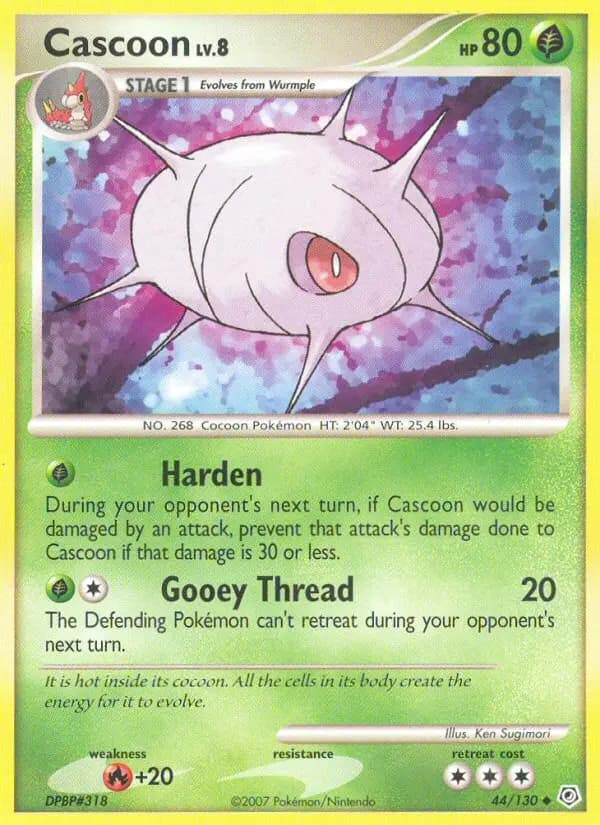
It is hot inside its cocoon. All the cells in its body create the energy for it to evolve.
Encased within its tough cocoon, it endures attacks. It never forgets the appearance of its foes.
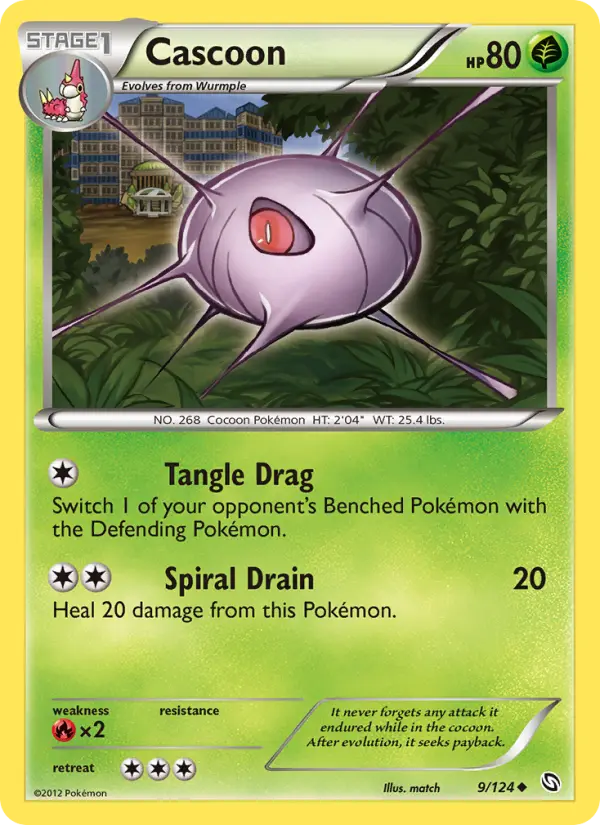
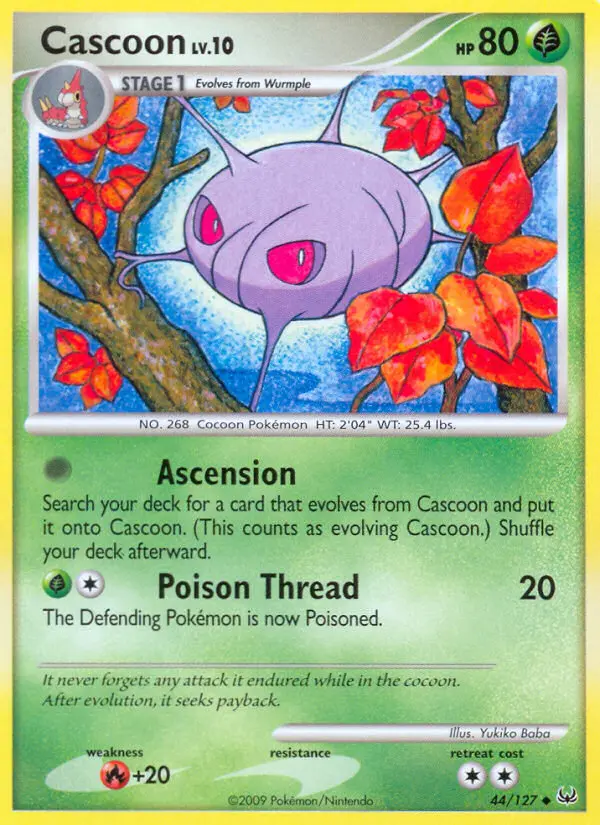
It never forgets any attack it endured while in the cocoon. After evolution, it seeks payback.
It endures attacks with patience, because the more pain before evolution, the sturdier it becomes.
It never forgets any attack it endured while in the cocoon. After evolution, it seeks payback.
It never forgets any attack it endured while in the cocoon. After evolution, it seeks payback.
Its body, which is made of soft silk, hardens over time. When cracks appear, evolution is near.
It never forgets any attack it endured while in the cocoon. After evolution, it seeks payback.
Cascoon makes its protective cocoon by wrapping its body entirely with a fine silk from its mouth. Once the silk goes around its body, it hardens. This Pokémon prepares for its evolution inside the cocoon.
If it is attacked, Cascoon remains motionless however badly it may be hurt. It does so because if it were to move, its body would be weak upon evolution. This Pokémon will also not forget the pain it endured.
The silk coating its body is thin but sufficiently strong. Cascoon's silk has a luster and texture superior to that of Silcoon's, and clothes made using Cascoon silk are regarded as top-notch.
Cascoon Name Origin & Design Inspiration
Cascoon's name traces to a combination of 'cocoon' and potentially 'cascade,' reflecting both its literal cocoon form and the transformative cascade of changes occurring within its protective shell. The Japanese name Mayuld appears to combine 'mayu' (繭), the Japanese word for cocoon, with an anglicized suffix, maintaining the same core concept across linguistic boundaries. Visually, Cascoon embodies the archetypal cocoon design—a rounded, egg-like silhouette rendered in purple with minimal features beyond its pair of distinctive red eyes peering through dedicated openings. This minimalist aesthetic deliberately contrasts with its more active, mobile counterpart Silcoon, emphasizing Cascoon's passive, patient nature through design language. The purple coloration and smooth, wrapped appearance evoke the aesthetic of natural silk cocoons produced by moths and butterflies, grounding the design in real-world biological inspiration while maintaining the fantastical proportions and vibrant color palette characteristic of Generation III Pokémon design.
Learnable Moves
Cascoon Competitive Battle Guide
From a competitive standpoint, Cascoon presents a fundamentally underwhelming proposition due to its deliberately limited stat distribution and early-game design philosophy. With a cumulative stat total of merely 205, distributed across dismal offensive capabilities (35 Attack, 25 Special Attack) and middling defenses (55 Defense, 25 Special Defense), Cascoon lacks the offensive pressure or defensive bulk necessary for competitive viability in any format. Its base 50 HP and critically low base 15 Speed ensure that Cascoon will almost certainly move last in any exchange, eliminating any offensive momentum potential and making it vulnerable to priority moves. The Shed Skin ability provides Cascoon with passive status ailment management, curing any major status condition with a 33% chance each turn, which represents the species' sole mechanically interesting feature, yet this utility cannot compensate for Cascoon's statistical deficiencies. Competitive players universally regard Cascoon as a strictly single-player, narrative-focused Pokémon designed to teach players about game mechanics through temporary team membership before evolving into the significantly more capable Dustox at level 10.
Commonly Asked Questions About Cascoon
What type is Cascoon?
Cascoon is a bug type Pokemon.
What does Cascoon evolve into?
Cascoon evolves into dustox.
What are Cascoon's weaknesses?
Cascoon is weak to flying, rock and fire type moves.
Does Cascoon evolve by trading?
No — Cascoon evolves entirely through leveling up, with no trade required at any stage.
Where can I find Cascoon?
Cascoon can be found in petalburg woods (hoenn), eterna forest (sinnoh) and sinnoh route 205 (sinnoh).
Cascoon Cultural Impact & Franchise History
While Cascoon has never achieved the mainstream recognition of iconic Pokémon like Pikachu or Charizard, it maintains a notable presence within the Generation III fanbase and holds particular significance in Pokémon anime history through Jessie's character arc. Jessie from Team Rocket famously catches a Wurmple and trains it into Cascoon, subsequently evolving it into Dustox—a storyline that provided rare character development and emotional depth for the recurring villain, culminating in Jessie's release of her beloved Dustox to protect its offspring. This storyline resonates with fans as a poignant example of sacrificial love and growth, elevating Cascoon's cultural significance beyond mere mechanics into the realm of narrative importance. The species also appears frequently in Pokédex-focused media and regional guides due to its visual distinctiveness and the intrigue surrounding Wurmple's branching evolution mechanic, making Cascoon a recognizable silhouette even to casual players. Additionally, the Hoenn region's emphasis on Bug-type Pokémon and double battles has maintained Cascoon's relevance within Generation III discussions and retrospective analyses.
Where to Find Cascoon in Every Pokémon Game
Cascoon is primarily available in the Hoenn region across Pokémon Ruby, Sapphire, and Emerald, where it appears as Local Pokédex entry #017, appearing relatively early in the game's progression. In these titles, Cascoon can be encountered as an evolution of Wurmple, which appears on Routes 101, 102, 103, and 110, making the evolutionary line easily accessible to early-game teams. The species maintains availability in subsequent generations through various mechanisms: it appears in Diamond and Pearl with Local Pokédex number 051, continues in Platinum with the same designation, and returns in the Sinnoh remakes Brilliant Diamond and Shining Pearl. Omega Ruby and Alpha Sapphire, the Generation III remakes, restore Cascoon to its original Local Pokédex position of #017 in the expanded Hoenn Pokédex. More recently, Cascoon appears in Pokémon Legends: Arceus as Local Pokédex entry #021, though with modified mechanics reflecting that game's real-time catching system. The relative ease of obtaining Cascoon through early-route Wurmple captures makes the species accessible to most players, though its limited competitive utility means most players naturally replace Cascoon with Dustox once evolution occurs at level 10.