Silcoon
Generation III · #0266 — Cocoon Pokémon
Silcoon debuted in Generation III, and its bug typing has aged into one of its more defining traits, especially paired with shed skin. At 0.6 m and 10.0 kg, its build reflects a specialist role rather than a generalist one. Standing at just 0.6 meters tall and weighing a mere 10 kilograms, Silcoon embodies the delicate nature of insectoid metamorphosis within the Pokémon world. Its primary ability, Shed Skin, grants it a 33% chance each turn to cure itself of any major status ailment, a passive defensive mechanism that reflects the biological resilience of real cocoons. With a overall stat sum of only 205, Silcoon is deliberately designed as a fragile intermediate evolution rather than a competitive Pokémon, emphasizing its role as a stepping stone in the broader evolutionary narrative.
Editor's Take
Silcoon is one half of a coin flip the game does not tell you about, and Beautifly being the better outcome makes the whole thing feel more unfair than it needs to.
Base Stats
Height
0.6m
Weight
10.0kg
Category
Cocoon Pokémon
Gender
Male 50% / Female 50%
Color
white
Shape
ball
Habitat
forest
Abilities
Has a 33% chance of curing any major status ailment after each turn.

Silcoon Biology & Physical Characteristics
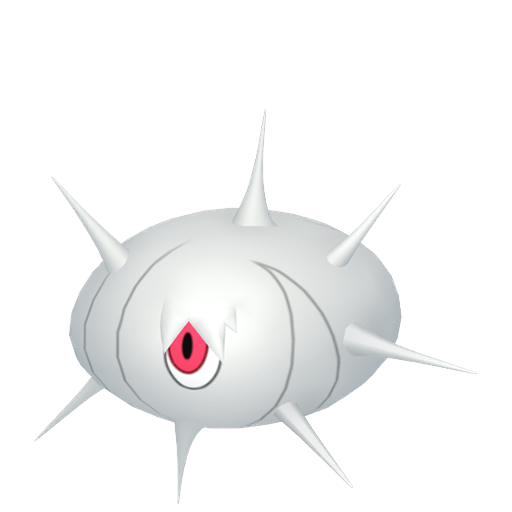
Silcoon presents a striking appearance as a small, cocoon-like creature almost entirely enveloped in dense white silk. The Pokémon's body is barely visible beneath this protective covering, with only two prominent red eyes peering out through small holes in the silk, partially obscured by a rough fringe of fibrous material. This distinctive design immediately communicates Silcoon's vulnerable state during metamorphosis. The silk that comprises most of Silcoon's body is remarkably durable, forming a hard cocoon capable of repelling physical attacks directed at the creature. Unlike many cocoon Pokémon, Silcoon possesses a practical adaptation that allows it to sustain itself during its dormant phase: rainwater and dew collect upon its silk exterior, providing essential hydration and nutrients. Early Pokédex entries suggested that Silcoon endured complete starvation before evolution, but modern scientific understanding within the Pokémon world has revealed that this creature sustains itself exclusively through the absorption of these collected water droplets, demonstrating an elegant biological efficiency.
Pokedex Numbers
Training
Breeding
Silcoon Breeding, Gender Ratio & Egg Groups
Silcoon exhibits an equal gender distribution, with precisely 50% of individuals appearing as male and 50% as female, allowing for unrestricted breeding opportunities regardless of captured specimen gender. The species belongs exclusively to the Bug egg group, meaning that Silcoon can only breed with other Pokémon within this classification, including other cocoon-stage Pokémon, caterpillar species, and fully evolved insects. As a mid-stage evolution, Silcoon possesses a base happiness value of 70, indicating a moderate predisposition toward friendship with its trainer—a characteristic that can be enhanced through consistent positive interaction and careful handling. When bred, Silcoon eggs require 15 cycles to hatch, equivalent to approximately 3,599 to 3,855 steps of travel, positioning it within the moderate incubation timeframe. The relatively generous hatch counter reflects the species' gentle nature and lack of aggressive tendencies. Trainers seeking to breed Silcoon deliberately would need to ensure they possess one Silcoon from the Wurmple line alongside a compatible Bug-type partner, though the most efficient breeding strategy involves evolving captured Wurmple specimens with appropriate personality values. The straightforward breeding mechanics make Silcoon accessible to players interested in mastering the capture mechanics required to encounter both Silcoon and Cascoon, essential for completing the full evolutionary documentation of the Wurmple family.
Sprites




TMs & HMs
tm104
scarlet violet
tm182
scarlet violet
tr46
sword shield
tm211
scarlet violet
tm182
the teal mask
tm104
the indigo disk
tm211
the indigo disk
tm82
sword shield
Silcoon's Evolution Chain


Silcoon Evolution, Mega Evolution & Special Forms
Silcoon occupies a unique position within the Wurmple evolutionary line, serving as one of two possible first-stage evolutions from Wurmple, the other being Cascoon. The evolutionary divergence is determined by Wurmple's personality value, which is randomly assigned at the moment of capture or birth. Upon reaching level 7, a Wurmple with the appropriate personality value will evolve into Silcoon rather than Cascoon. Once Silcoon reaches level 10, it undergoes its final metamorphosis, evolving into Beautifly, a graceful Bug and Flying-type Pokémon. This two-stage evolutionary pathway stands in direct parallel to the Wurmple-Cascoon-Dustox line, creating an elegant branching mechanism that encourages players to capture multiple Wurmple to experience both evolutionary chains. The transformation from Silcoon to Beautifly represents the completion of a remarkable biological journey, as the delicate cocoon-bound creature emerges as a powerful, winged insect capable of flight. This evolutionary arc exemplifies the series' commitment to depicting authentic insect metamorphosis, where the intermediate cocoon stage serves as an essential bridge between the caterpillar and butterfly forms.
Where to Find
Petalburg Woods
hoenn
Eterna Forest
sinnoh
Sinnoh Route 205
sinnoh
Silcoon Behaviour and Natural Habitat
Silcoon inhabits the verdant forests of various regions, particularly the lush woodlands of Hoenn where it was first documented. Once Wurmple completes its transformation into Silcoon, the creature immediately seeks out suitable tree branches where it can tether itself using its silk production. This behavior is not merely instinctive but represents a critical survival mechanism, as the Pokédex notes that Silcoon wraps silk around twigs and branches to prevent itself from falling—a precaution essential for a creature so physically diminished. Upon securing itself, Silcoon adopts an exceptionally sedentary lifestyle, conserving every ounce of metabolic energy accumulated during its Wurmple stage. The creature remains virtually motionless, relying on minimal muscular activity, though it maintains constant vigilance through its pair of watchful eyes. Despite its apparent passivity, Silcoon demonstrates remarkable awareness of its surroundings, using its visual acuity to detect potential threats even while maintaining its cocooned state. This combination of absolute stillness and acute sensory awareness represents an optimal survival strategy for a vulnerable intermediate evolutionary form.
Pokedex Entries
SILCOON tethers itself to a tree branch using silk to keep from falling. There, this POKéMON hangs quietly while it awaits evolution. It peers out of the silk cocoon through a small hole.
SILCOON was thought to endure hunger and not consume anything before its evolution. However, it is now thought that this POKéMON slakes its thirst by drinking rainwater that collects on its silk.
It prepares for evolution using the energy it stored while it was a WURMPLE. It keeps watch over the surroundings with its two eyes.
It conserves its energy by moving as little as possible. It awaits evolution while drinking only a little rainwater.
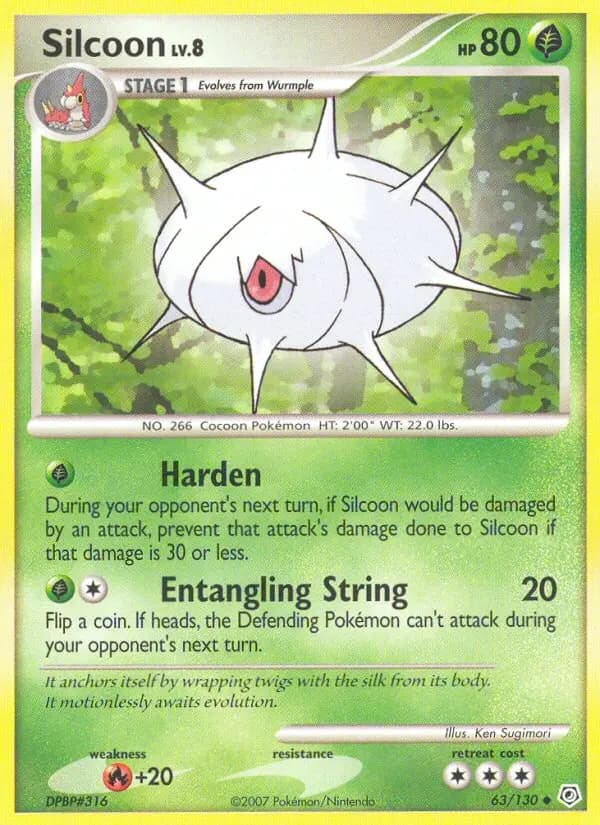
It anchors itself by wrapping twigs with the silk from its body. It motionlessly awaits evolution.
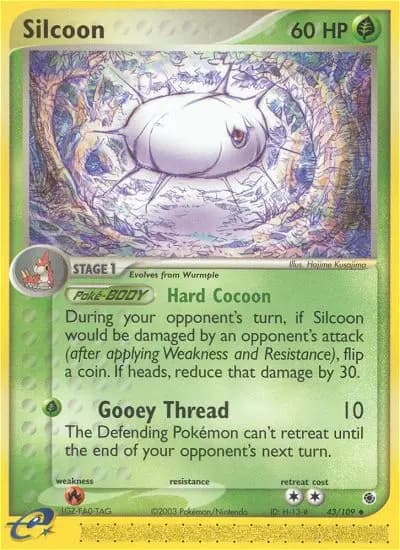
It drinks dew that collects on its silk and waits for evolution. Its hard cocoon repels attacks.
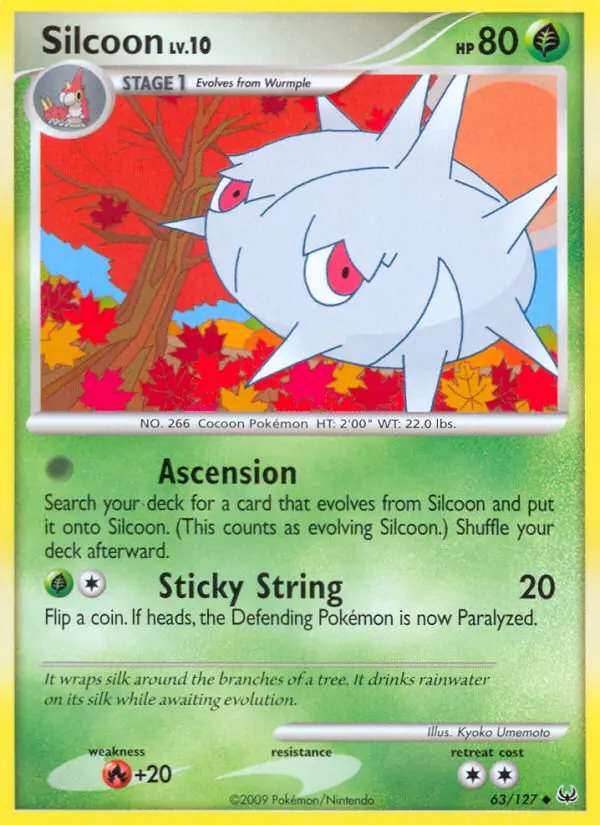
It wraps silk around the branches of a tree. It drinks rainwater on its silk while awaiting evolution.
Having wrapped silk around the branches of a tree, it quiescently awaits evolution.
It wraps silk around the branches of a tree. It drinks rainwater on its silk while awaiting evolution.
It wraps silk around the branches of a tree. It drinks rainwater on its silk while awaiting evolution.
It wraps silk around the branches of a tree. It drinks rainwater on its silk while awaiting evolution.
It drinks dew that collects on its silk and waits for evolution. Its hard cocoon repels attacks.
Silcoon tethers itself to a tree branch using silk to keep from falling. There, this Pokémon hangs quietly while it awaits evolution. It peers out of the silk cocoon through a small hole.
Silcoon was thought to endure hunger and not consume anything before its evolution. However, it is now thought that this Pokémon slakes its thirst by drinking rainwater that collects on its silk.
Wraps itself in thin strings of silk while it stores energy for evolution. It can't extend its limbs and its movement is slow, but its eyes keep a sharp lookout—Silcoon is always on guard.
Silcoon Name Origin & Design Inspiration
Silcoon's name traces back to a elegant linguistic fusion of 'silk' and 'cocoon,' directly referencing the creature's primary biological characteristic and ecological role. The Japanese designation, Karasalis, follows a similar etymological pattern, with roots connecting to traditional Japanese terms for cocoons and silk-producing insects. The design philosophy emphasizes visual simplicity and biological accuracy: Silcoon appears as a nearly featureless white ovoid with minimal distinguishing features save for its striking red eyes and the textured silk fringe surrounding its ocular openings. This minimalist approach effectively communicates the creature's vulnerable, transitional state, presenting a stark contrast to both its caterpillar predecessor and its butterfly successor. The predominantly white coloration, contrasted against the more vividly colored Beautifly it will become, reinforces the notion that Silcoon represents a blank canvas—a neutral form awaiting transformation. The decision to depict Silcoon as bound and immobilized within its silk represents a creative interpretation of the biological cocoon stage, where creatures are temporarily helpless yet protected, embodying the duality of vulnerability and security that characterizes genuine insect metamorphosis.
Learnable Moves
Silcoon Competitive Battle Guide
Within competitive Pokémon battling, Silcoon occupies a negligible position, reserved almost exclusively for novelty teams or thematic regional playthroughs. With a overall stat sum of merely 205, distributed as 50 HP, 35 Attack, 55 Defense, 25 Special Attack, 25 Special Defense, and 15 Speed, Silcoon lacks the statistical foundation necessary for meaningful contribution to serious competitive engagements. The creature's 15 base Speed is particularly crippling, guaranteeing that Silcoon will move last in virtually every turn, while its pitiful offensive stats of 35 Attack and 25 Special Attack prevent it from inflicting meaningful damage even against defensively frail opponents. The only marginally valuable aspect of Silcoon's competitive profile is its Shed Skin ability, which provides passive status immunity, yet this advantage is rendered largely irrelevant given the Pokémon's inability to survive long enough to exploit it. The modest 55 base Defense and 25 base Special Defense leave Silcoon extremely vulnerable to any attacking move, ensuring it will be defeated in a single hit by almost any opponent. Trainers seeking to use Bug-type Pokémon competitively would be infinitely better served by directly training Beautifly, to which Silcoon evolves at level 10, effectively rendering the intermediate form obsolete for any serious battling aspirations.
Commonly Asked Questions About Silcoon
What type is Silcoon?
Silcoon is a bug type Pokemon.
What does Silcoon evolve into?
Silcoon evolves into beautifly, then into cascoon, then into dustox.
What are Silcoon's weaknesses?
Silcoon is weak to flying, rock and fire type moves.
Does Silcoon evolve by trading?
No — Silcoon evolves entirely through leveling up, with no trade required at any stage.
Where can I find Silcoon?
Silcoon can be found in petalburg woods (hoenn), eterna forest (sinnoh) and sinnoh route 205 (sinnoh).
Silcoon Cultural Impact & Franchise History
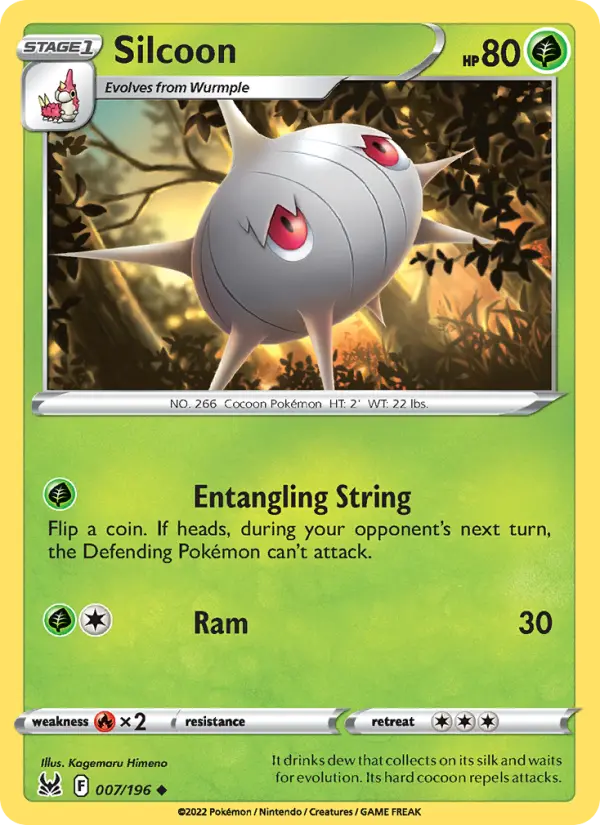
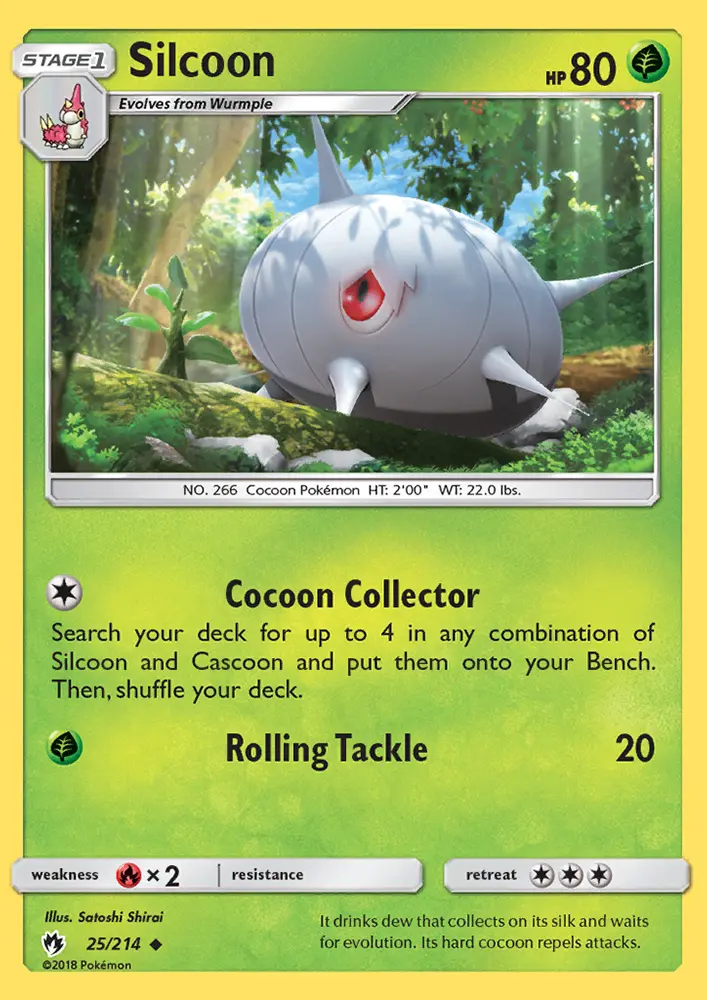
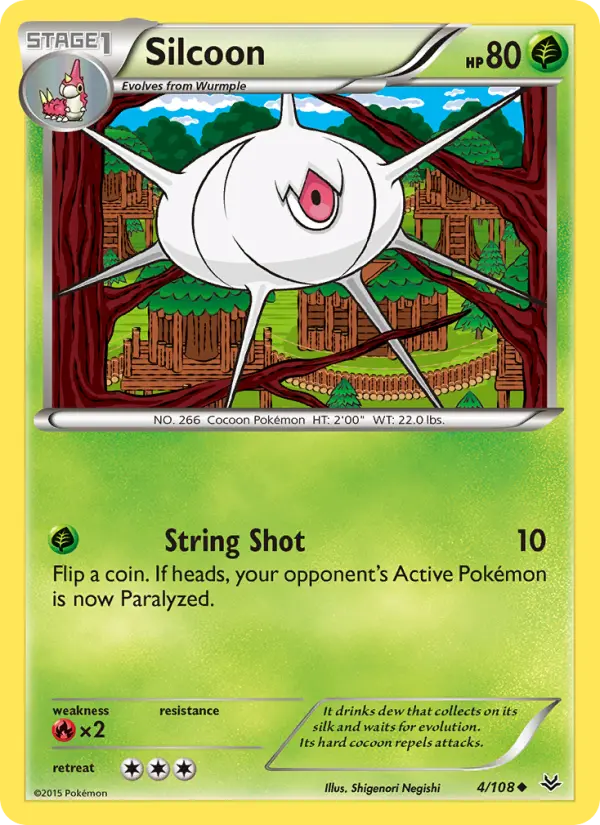
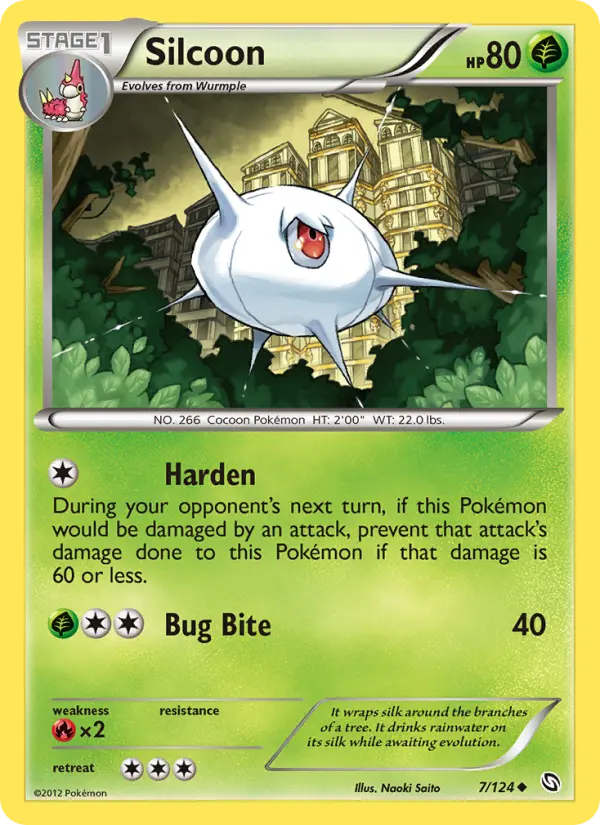
Silcoon achieved modest prominence within Pokémon media, most notably through May's capture and training of a Silcoon in the anime's advanced generation. May's Silcoon featured prominently in several episodes, serving as a key team member and enabling character development through the training and eventual evolution into Beautifly. This significant anime appearance introduced the species to a generation of viewers and elevated its cultural recognition beyond the game community. The creature's serene, meditative nature has resonated with players seeking a more contemplative interpretation of Pokémon design, contrasting sharply with the action-oriented aesthetics dominating much of the franchise. Silcoon's appearance in trading card games, merchandise, and various Pokémon media has maintained its presence within fan consciousness, though it remains perpetually overshadowed by its more dynamic evolutionary forms. The species' design has inspired considerable fan art celebrating insect metamorphosis and the philosophical implications of transformation, with artistic communities frequently exploring the introspective qualities suggested by Silcoon's immobile, cocoon-bound existence. Despite lacking the iconic status of legendary Pokémon or top-tier competitive threats, Silcoon maintains affectionate recognition among dedicated enthusiasts and represents a foundational element of Generation III's Bug-type diversity.
Where to Find Silcoon in Every Pokémon Game
Silcoon's availability varies significantly across different Pokémon games and generations, reflecting its regional exclusivity within the primary game narratives. In Pokémon Ruby, Sapphire, and Emerald, Silcoon appears in the Hoenn Pokédex as entry number 015, accessible through the capture of Wurmple specimens found in grassy areas throughout the region's early routes and forests. The species received Pokédex entries in the Ruby and Sapphire games specifically, with additional documentation provided in Emerald, FireRed, LeafGreen, and subsequent generation games. In Diamond, Pearl, and Platinum versions, Silcoon receives Pokédex number 049, maintaining availability through standard Wurmple encounters and evolution mechanics. The species returns to prominence in Omega Ruby and Alpha Sapphire, where it again appears as Pokédex number 015, allowing modern players to experience the Hoenn region's original Bug-type offerings. In more recent games including Sword and Shield, Brilliant Diamond and Shining Pearl, and Legends: Arceus, Silcoon availability varies, with Legends: Arceus providing regional classification number 019. The creature's relatively common availability across multiple game generations reflects its designation as a catch rate of 120, making Silcoon one of the more readily obtainable Pokémon species, accessible to players of virtually all skill levels without requiring specialized capture techniques or rare encounter conditions.