Chewtle
Generation VIII · #0833 — Snapping Pokémon
Chewtle's profile is easy to undersell: 0.3 m, 8.5 kg, and a water typing that doesn't scream power — until you look at its HP of 50. Its easy-to-obtain nature, reflected in its exceptional capture rate of 255, makes it an accessible starter Pokémon for trainers beginning their journey through the Galar region.
Editor's Take
Chewtle's line ends in Drednaw, whose Strong Jaw and Shell Smash on a Water/Rock frame make it a genuinely explosive sweeper.
Base Stats
Height
0.3m
Weight
8.5kg
Category
Snapping Pokémon
Gender
Male 50% / Female 50%
Color
green
Shape
quadruped
Abilities
Strengthens biting moves to 1.5× their power.
Protects against critical hits.
Doubles Speed during rain.

Chewtle Biology & Physical Characteristics
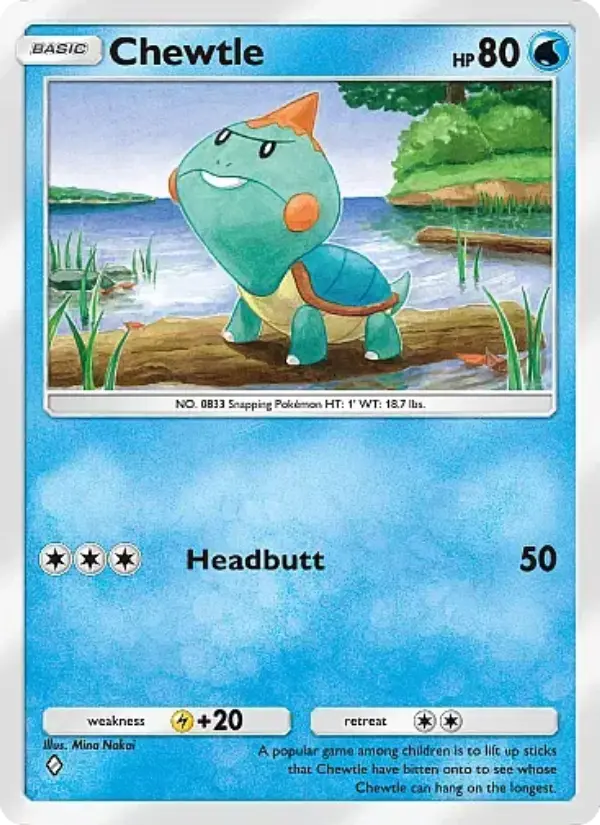
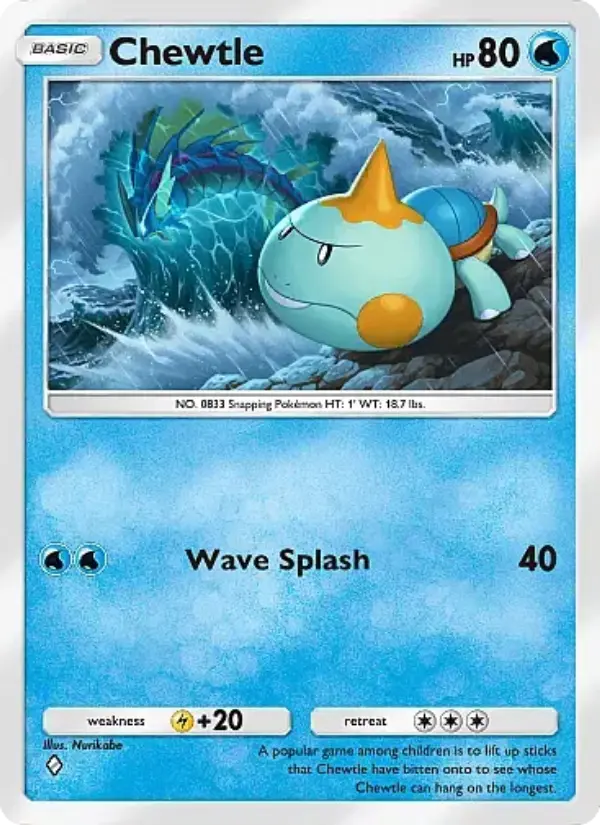
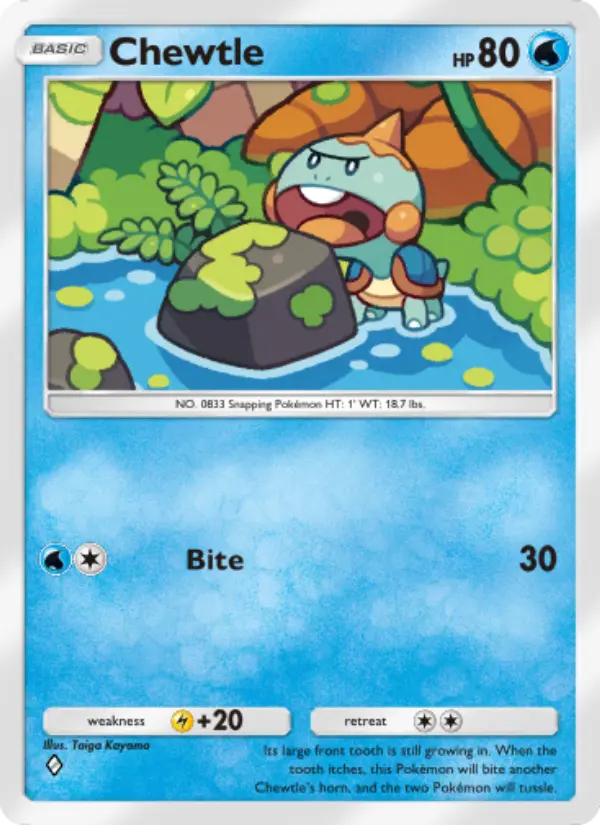
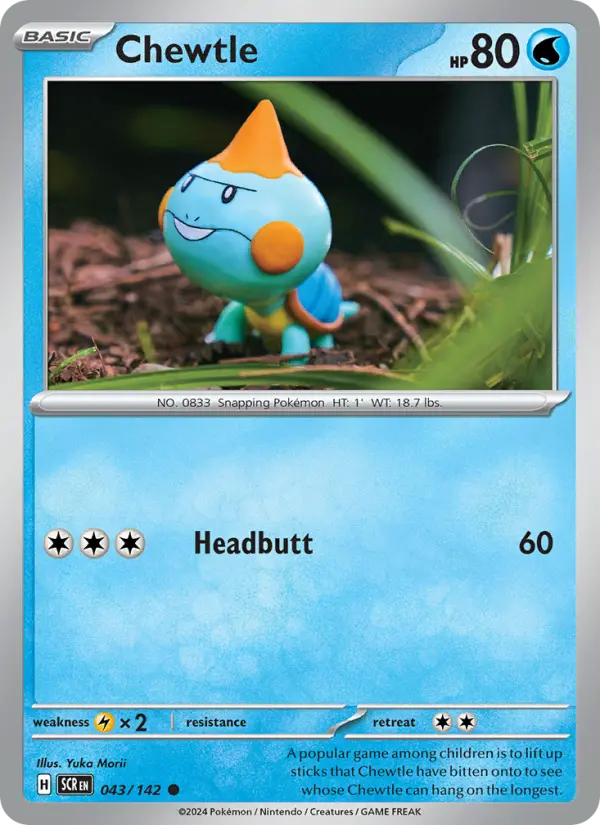
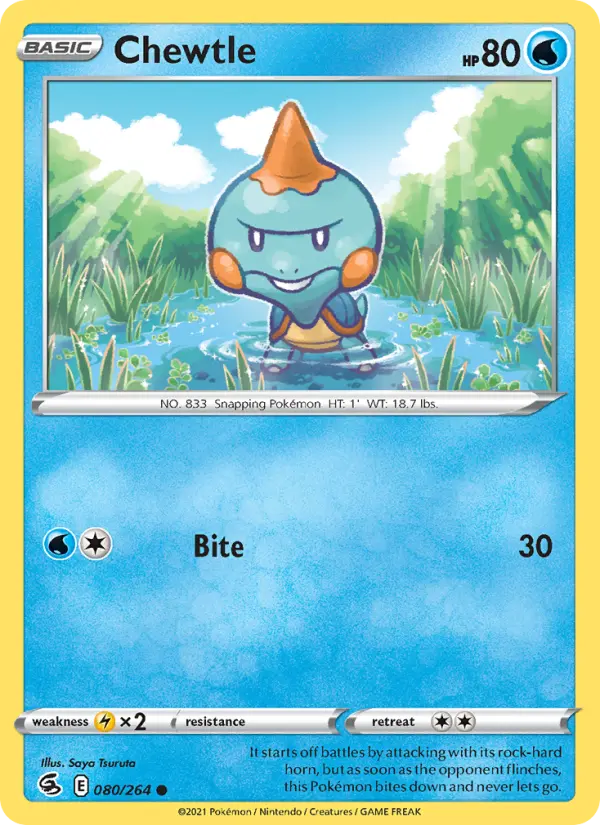
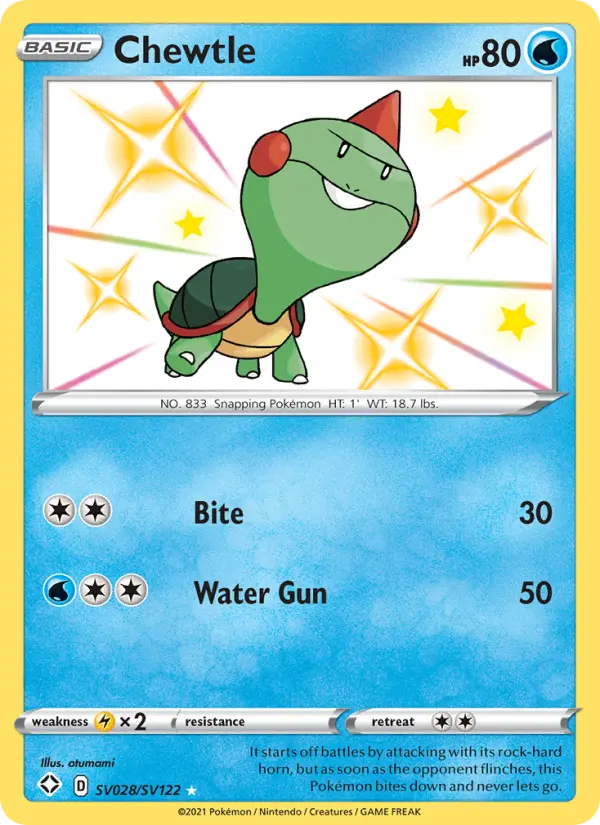
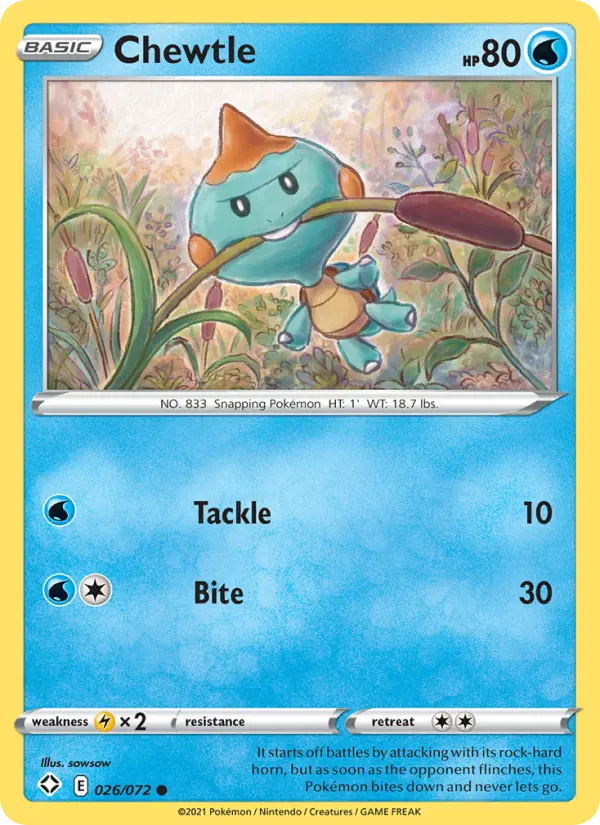
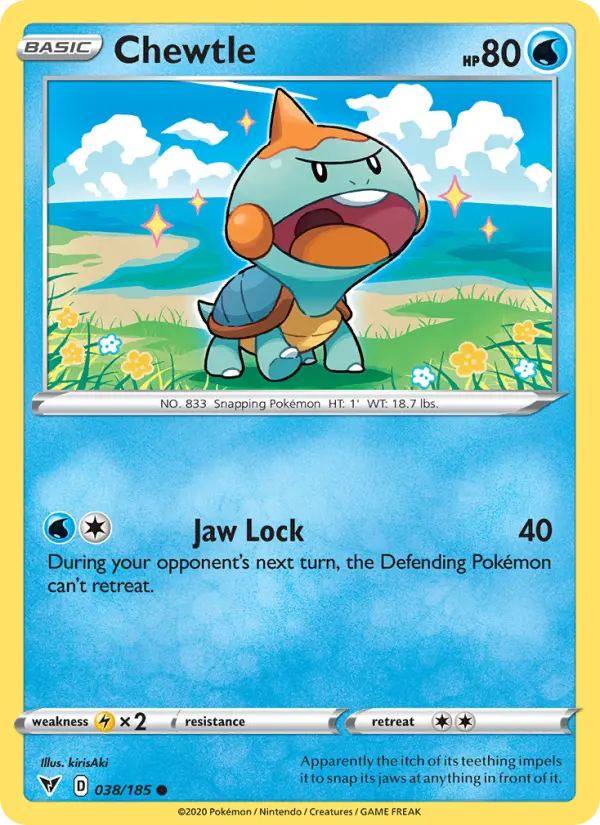
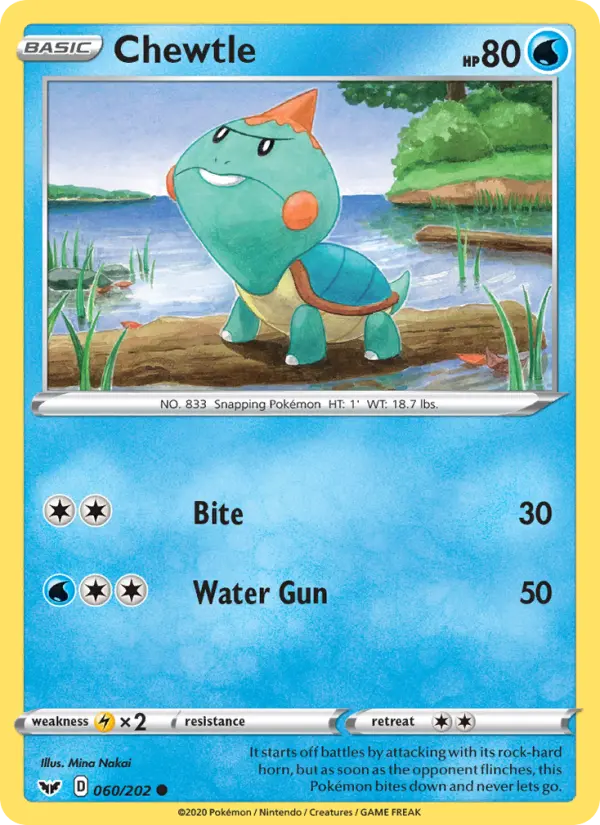
Chewtle is a quadrupedal, turtle-like Pokémon with a distinctly oversized head that dominates its compact body. Its shell displays a darker blue coloration with brown trim along the edges, while its underbelly mirrors the lighter tan hue characteristic of its evolutionary relatives like Squirtle. The most striking feature of Chewtle's anatomy is its prominent rock-hard horn protruding from the crown of its head in an orange coloration, paired with a matching pair of orange bulbs adorning its cheeks. A single large brow ridge gives Chewtle's face an almost perpetually angry expression, accentuated by its pair of small, dark-rimmed eyes positioned above two nostril openings. Within its powerful jaws lies a single prominent large tooth—a defining feature that enables Chewtle's notorious biting ability. The Pokémon possesses what appears to be a single claw or toe at the terminus of each foot, adapted for gripping surfaces and prey alike.
Pokedex Numbers
Training
Breeding
Chewtle Breeding, Gender Ratio & Egg Groups
Chewtle's population splits evenly by gender, 50% each way, ensuring equal breeding potential regardless of the trainer's specific gender preferences. This Pokémon belongs to two egg groups—Monster and Water 1—providing substantial flexibility in breeding programs and allowing trainers to produce Chewtle through diverse parental combinations. With a hatch counter of 20 cycles, Chewtle eggs require between 4,884 and 5,140 steps to hatch depending on specific conditions, placing it in the relatively quick-hatching category that rewards dedicated breeders without demanding excessive time investment. The base friendship value of 50 indicates a neutral starting relationship with newly hatched or caught specimens, meaning trainers must invest time and care to build stronger bonds with their Chewtle. When breeding, Chewtle can pass down several egg moves including Dragon Tail, Gastro Acid, and Shell Smash, providing bred individuals with significantly enhanced moveset options compared to those acquired in the wild.
Sprites






TMs & HMs
tm01
lets go pikachu lets go eevee
tm02
crystal
tm02
gold silver
tm03
ruby sapphire
tm03
platinum
tm03
firered leafgreen
tm03
heartgold soulsilver
tm03
diamond pearl
tm03
emerald
tm03
xd
tm03
colosseum
tm05
lets go pikachu lets go eevee
tm07
lets go pikachu lets go eevee
tm08
red blue
tm08
yellow
tm08
lets go pikachu lets go eevee
tm09
yellow
tm08
red green japan
tm08
blue japan
tm09
red blue
+286 more TMs/HMs
Chewtle's Evolution Chain


Chewtle Evolution, Mega Evolution & Special Forms
Chewtle undergoes a straightforward evolutionary transformation into Drednaw upon reaching level 22, a relatively early point in the evolutionary cycle that allows trainers to access this powerful form quickly during their campaign through Galar. This evolution represents a dramatic shift in size, power, and type composition—while Chewtle remains a pure Water-type, Drednaw gains a secondary Rock typing that dramatically influences its competitive viability and type matchups. The evolution is accompanied by substantial improvements across its stat line, with Drednaw's Attack stat rising to 120, making it one of the more threatening physical attackers among early-available Water-types. Additionally, Drednaw gains access to the signature move Jaw Lock, a powerful Dark-type attack with 80 base power that traps opponents and prevents them from switching out—a move that Chewtle cannot learn until it evolves, making the transformation functionally necessary to access this unique strategic option.
Where to Find
Location data not available for this Pokémon in the database.
Chewtle Behaviour and Natural Habitat
Chewtle's behavior is almost entirely defined by the relentless itch of its teething cycle, driving it to snap aggressively at nearly anything unfortunate enough to cross its path. The Pokédex entries from Pokémon Sword and Shield reveal that this impulse is so overwhelming that Chewtle will even bite at the horns of other Chewtle, initiating territorial conflicts over simple irritation. Beyond competitive snapping, Chewtle employs a fascinating tactical approach to combat: it initiates attacks by striking with its rock-hard horn to stun opponents, and the moment they flinch, it clamps down with its formidable jaws and refuses to release its grip. This behavior has become so culturally significant in the Galar region that children have developed a popular game involving lifting sticks that Chewtle have bitten onto, competing to see which individual Pokémon can maintain its grip the longest. Chewtle inhabits aquatic and semi-aquatic environments throughout the Galar region, from the relatively accessible waters near Motostoke to the more challenging terrain of the Crown Tundra.
Pokedex Entries
Apparently the itch of its teething impels it to snap its jaws at anything in front of it.
It starts off battles by attacking with its rock-hard horn, but as soon as the opponent flinches, this Pokémon bites down and never lets go.
Chewtle Name Origin & Design Inspiration
Chewtle's name origin lies in a straightforward portmanteau of 'chew' and 'turtle,' directly referencing the Pokémon's defining characteristic of aggressive jaw snapping and its shell-bearing reptilian form. The Japanese designation, Kamukame, combines 'kamu' (to bite) with 'kame' (turtle), maintaining the same conceptual framework across language barriers. Chewtle's design draws inspiration from traditional snapping turtles, particularly those found in North America, which are notorious for their powerful bite force and aggressive territorial behavior. The distinctive rock-hard horn and the overall aesthetic lean heavily into a prehistoric or primordial appearance, suggesting the aggressive, primal nature of this Pokémon species. The orange coloration of the horn and cheek bulbs provides visual contrast against Chewtle's primarily teal body, making these bite-related features immediately visually salient. The disproportionately large head relative to body size accentuates the focus on its biting apparatus, while the perpetually angry expression reinforces the combative nature embedded within the species' biology.
Learnable Moves
Chewtle can learn 43 moves:
Move | Type | Cat. | Power | Acc. | PP |
|---|---|---|---|---|---|
| assurance | dark | Physical | 60 | 100 | 10 |
| attract | normal | Status | — | 100 | 15 |
| bite | dark | Physical | 60 | 100 | 25 |
| body slam | normal | Physical | 85 | 100 | 15 |
| chilling water | water | Special | 50 | 100 | 20 |
| counter | fighting | Physical | — | 100 | 20 |
| crunch | dark | Physical | 80 | 100 | 15 |
| dive | water | Physical | 80 | 100 | 10 |
| dragon tail | dragon | Physical | 60 | 90 | 10 |
| endure | normal | Status | — | — | 10 |
| facade | normal | Physical | 70 | 100 | 20 |
| false swipe | normal | Physical | 40 | 100 | 40 |
| gastro acid | poison | Status | — | 100 | 10 |
| headbutt | normal | Physical | 70 | 100 | 15 |
| hydro pump | water | Special | 110 | 80 | 5 |
| ice fang | ice | Physical | 65 | 95 | 15 |
| jaw lock | dark | Physical | 80 | 100 | 10 |
| liquidation | water | Physical | 85 | 100 | 10 |
| mud shot | ground | Special | 55 | 95 | 15 |
| payback | dark | Physical | 50 | 100 | 10 |
| poison jab | poison | Physical | 80 | 100 | 20 |
| protect | normal | Status | — | — | 10 |
| rain dance | water | Status | — | — | 5 |
| rest | psychic | Status | — | — | 5 |
| revenge | fighting | Physical | 60 | 100 | 10 |
| round | normal | Special | 60 | 100 | 15 |
| scale shot | dragon | Physical | 25 | 90 | 20 |
| scary face | normal | Status | — | 100 | 10 |
| shell smash | normal | Status | — | — | 15 |
| skitter smack | bug | Physical | 70 | 90 | 10 |
| skull bash | normal | Physical | 130 | 100 | 10 |
| sleep talk | normal | Status | — | — | 10 |
| snore | normal | Special | 50 | 100 | 15 |
| stomping tantrum | ground | Physical | 75 | 100 | 10 |
| substitute | normal | Status | — | — | 10 |
| surf | water | Special | 90 | 100 | 15 |
| tackle | normal | Physical | 40 | 100 | 35 |
| take down | normal | Physical | 90 | 85 | 20 |
| tera blast | normal | Special | 80 | 100 | 10 |
| water gun | water | Special | 40 | 100 | 25 |
| water pulse | water | Special | 60 | 100 | 20 |
| waterfall | water | Physical | 80 | 100 | 15 |
| whirlpool | water | Special | 35 | 85 | 15 |
Chewtle Competitive Battle Guide
In terms of competitive use, Chewtle itself sees minimal usage due to its limited stat distribution and relatively shallow movepool, with the aggressive Attack stat of 64 insufficient to threaten established threats. However, Chewtle serves as an important stepping stone to Drednaw, which occupies a legitimate niche in various competitive formats. Chewtle's available abilities offer strategic significance: Strong Jaw increases the power of all biting moves by 50 percent, making moves like Bite and the later-accessible Jaw Lock considerably more threatening; Shell Armor provides consistent protection against critical hit mechanics that could otherwise bypass defensive investment; the hidden ability Swift Swim doubles Speed during rain weather, potentially enabling priority-like advantages in rain-dependent teams. In the early game or casual competitive formats where Chewtle might actually see play, trainers should capitalize on its Attack stat by utilizing physical moves like Tackle, Water Gun, Bite, Headbutt, and Counter. The moveset combination of Jaw Lock upon evolution, Liquidation from leveling, and Body Slam provides Chewtle's evolved form with exceptional offensive coverage that explains why Drednaw gained competitive relevance across multiple generations.
Commonly Asked Questions About Chewtle
What type is Chewtle?
Chewtle is a water type Pokemon.
What does Chewtle evolve into?
Chewtle evolves into drednaw.
What are Chewtle's weaknesses?
Chewtle is weak to grass and electric type moves.
Does Chewtle evolve by trading?
No — Chewtle evolves entirely through leveling up, with no trade required at any stage.
Chewtle Cultural Impact & Franchise History
Chewtle has established itself within Pokémon culture as an iconic representation of Galar's water-type Pokédex, appearing prominently in promotional materials and early generation VIII marketing campaigns. The children's game depicted in the Violet Pokédex entry—wherein youths lift sticks bitten by Chewtle to test endurance—has resonated with players as a uniquely charming cultural element that grounds the Pokémon species within a believable world with its own traditions and recreational activities. This detail demonstrates the design philosophy of Generation VIII, which emphasized worldbuilding and cultural authenticity. Chewtle's accessibility as an early-game Water-type captures and its evolution into the formidable Drednaw made it a natural choice for many players' core competitive teams, resulting in significant fan attachment. The species has appeared in various Pokémon animations, with notable appearances in the Pokémon: Sword & Shield animated series, where its behavioral quirks and aggressive temperament have been explored in narrative contexts. Online communities have embraced Chewtle's personality, frequently creating humorous content centered around its uncontrollable biting impulse and angry expression.
Where to Find Chewtle in Every Pokémon Game
Chewtle's availability varies significantly across Pokémon games depending on the region and release generation. In Pokémon Sword and Shield, where it was introduced, Chewtle appears in Galar with National Pokédex number 833 and local Pokédex number 042 in the main game, number 056 in the Isle of Armor DLC, and number 183 in the Crown Tundra DLC. The species can be encountered in various water-based areas throughout Galar, with encounters becoming possible relatively early in the game, making it an accessible choice for team building. In subsequent generations, Chewtle has maintained availability through Pokémon Scarlet and Violet, where it retains National Pokédex number 833 and appears with local Pokédex number 057, ensuring continuity across the most recent generation of mainline games. Its exceptionally high capture rate of 255 means that trainers have virtually guaranteed success when attempting to capture wild Chewtle specimens, requiring only a standard Poké Ball to secure one reliably. Additionally, Chewtle eggs can be obtained through breeding programs, allowing trainers to produce individuals with specific natures, abilities, and egg move combinations to suit their particular strategic needs and preferences.