Chinchou
Generation II · #0170 — Angler Pokémon
The numbers on Chinchou tell you where to look first: HP at 75, well above what its water/electric typing alone would predict. At 0.5 m and 12.0 kg, its build reflects a specialist role rather than a generalist one. With a National Pokédex number of 170, Chinchou represents one of the first successful attempts to combine aquatic and electrical properties in a single creature, establishing itself as a foundational member of the Water/Electric typing that would inspire future generations of Pokémon design. Its combined stat total of 330 is distributed carefully across its attributes, with a notable emphasis on Special Attack and Special Defense at 56 each, alongside a respectable HP of 75, making it a surprisingly well-rounded starter Pokémon despite its later evolution into the more powerful Lanturn.
Editor's Take
Chinchou's Water/Electric typing is still rare and gives Lanturn a Volt Absorb immunity most Water-types would envy, which is a smarter design than the line's low profile suggests.
Base Stats
Height
0.5m
Weight
12.0kg
Category
Angler Pokémon
Gender
Male 50% / Female 50%
Color
blue
Shape
fish
Habitat
sea
Abilities
Absorbs electric moves, healing for 1/4 max HP.
Doubles the wild encounter rate.
Absorbs water moves, healing for 1/4 max HP.
Chinchou Biology & Physical Characteristics
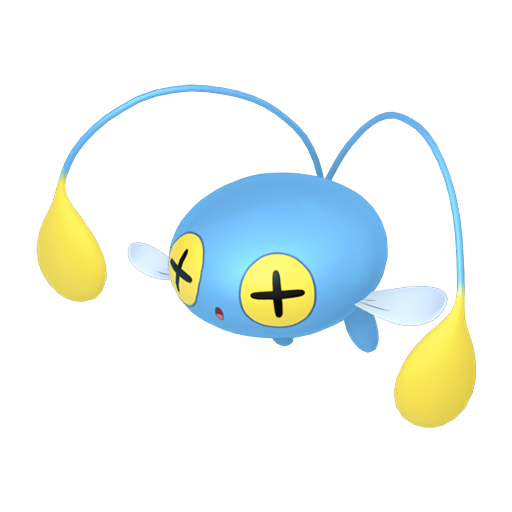
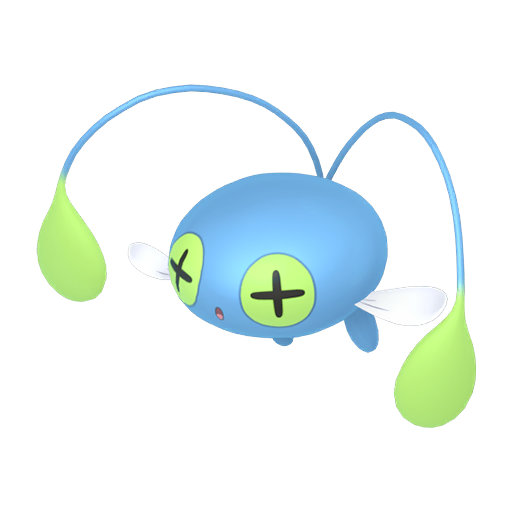
Chinchou's most distinctive biological feature is its pair of antennae that curve upward from its rear, evolved from what were once finned structures millions of years ago. These antennae are far more than mere appendages; they contain specialized cells capable of generating immense electrical power, filled with both positive and negative charges that flow constantly through the structures. The teardrop-shaped yellow orbs at the tips of these antennae serve as light-producing organs, glowing with bioluminescent intensity powered by the internal electrical cells. The Pokémon's body itself is remarkably compact and rounded, with a predominantly blue coloration, large yellow eyes marked by distinctive plus-shaped pupils, semi-transparent light blue pectoral fins, and stubby feet designed for both aquatic and terrestrial locomotion. According to Pokédex entries from Alpha Sapphire, the electrical cells within Chinchou create such tremendous power that the Pokémon makes itself tingle slightly from its own electrical generation, a testament to the intensity of the internal bioelectric systems.
Pokedex Numbers
Training
Breeding
Chinchou Breeding, Gender Ratio & Egg Groups
There's no gender skew here: Chinchou breeds at an even 50% male / 50% female rate, allowing trainers equal opportunity to breed either gender for competitive purposes or personal preference. This species belongs to the Water 2 egg group, which it shares with many other aquatic and semi-aquatic Pokémon, providing diverse breeding options for those seeking to create offspring with specific move pools or natures. The breeding cycle requires 20 egg cycles to complete, equivalent to approximately 4,884 to 5,140 steps in-game, making Chinchou a moderately quick breeder compared to many other species. The base friendship value of 70 indicates that wild-caught Chinchou begin their relationship with trainers on reasonably positive terms, though not as naturally affectionate as some friendlier species. Trainers seeking to breed Chinchou competitively should note that the species' relatively low base Attack and Defense stats may limit its breeding value for physical move sets, though its Special Attack and Special Defense output makes it valuable for breeding special-focused offspring with egg moves like Aqua Jet or Discharge.
Sprites




Held Items
Yellow Shard
collectibles
No effect. Can be traded for items or moves.
Cost: 1000
Yellow Shard
collectibles
No effect. Can be traded for items or moves.
Cost: 1000
Yellow Shard
collectibles
No effect. Can be traded for items or moves.
Cost: 1000
Yellow Shard
collectibles
No effect. Can be traded for items or moves.
Cost: 1000
Yellow Shard
collectibles
No effect. Can be traded for items or moves.
Cost: 1000
Deep Sea Scale
species-specific
Doubles Clamperl’s Special Defense. Traded on a Clamperl: Holder evolves into Gorebyss.
Cost: 2000
Deep Sea Scale
species-specific
Doubles Clamperl’s Special Defense. Traded on a Clamperl: Holder evolves into Gorebyss.
Cost: 2000
Deep Sea Scale
species-specific
Doubles Clamperl’s Special Defense. Traded on a Clamperl: Holder evolves into Gorebyss.
Cost: 2000
Deep Sea Scale
species-specific
Doubles Clamperl’s Special Defense. Traded on a Clamperl: Holder evolves into Gorebyss.
Cost: 2000
Deep Sea Scale
species-specific
Doubles Clamperl’s Special Defense. Traded on a Clamperl: Holder evolves into Gorebyss.
Cost: 2000
Deep Sea Scale
species-specific
Doubles Clamperl’s Special Defense. Traded on a Clamperl: Holder evolves into Gorebyss.
Cost: 2000
Deep Sea Scale
species-specific
Doubles Clamperl’s Special Defense. Traded on a Clamperl: Holder evolves into Gorebyss.
Cost: 2000
Deep Sea Scale
species-specific
Doubles Clamperl’s Special Defense. Traded on a Clamperl: Holder evolves into Gorebyss.
Cost: 2000
Deep Sea Scale
species-specific
Doubles Clamperl’s Special Defense. Traded on a Clamperl: Holder evolves into Gorebyss.
Cost: 2000
Deep Sea Scale
species-specific
Doubles Clamperl’s Special Defense. Traded on a Clamperl: Holder evolves into Gorebyss.
Cost: 2000
Deep Sea Scale
species-specific
Doubles Clamperl’s Special Defense. Traded on a Clamperl: Holder evolves into Gorebyss.
Cost: 2000
Deep Sea Scale
species-specific
Doubles Clamperl’s Special Defense. Traded on a Clamperl: Holder evolves into Gorebyss.
Cost: 2000
Deep Sea Scale
species-specific
Doubles Clamperl’s Special Defense. Traded on a Clamperl: Holder evolves into Gorebyss.
Cost: 2000
Deep Sea Scale
species-specific
Doubles Clamperl’s Special Defense. Traded on a Clamperl: Holder evolves into Gorebyss.
Cost: 2000
Deep Sea Scale
species-specific
Doubles Clamperl’s Special Defense. Traded on a Clamperl: Holder evolves into Gorebyss.
Cost: 2000
Deep Sea Scale
species-specific
Doubles Clamperl’s Special Defense. Traded on a Clamperl: Holder evolves into Gorebyss.
Cost: 2000
Deep Sea Scale
species-specific
Doubles Clamperl’s Special Defense. Traded on a Clamperl: Holder evolves into Gorebyss.
Cost: 2000
TMs & HMs
tm03
crystal
tm03
gold silver
tm03
ruby sapphire
tm03
platinum
tm03
firered leafgreen
tm03
heartgold soulsilver
tm03
diamond pearl
tm03
emerald
tm03
xd
tm03
colosseum
tm05
lets go pikachu lets go eevee
tm06
yellow
tm06
gold silver
tm06
red blue
tm06
crystal
tm06
emerald
tm06
firered leafgreen
tm06
diamond pearl
tm06
platinum
tm06
ruby sapphire
+582 more TMs/HMs
Chinchou's Evolution Chain


Chinchou Evolution, Mega Evolution & Special Forms
Chinchou's evolutionary progression is straightforward yet transformative. Upon reaching level 27, it undergoes evolution into Lanturn, a substantially larger and more powerful Water/Electric-type Pokémon that maintains the dual typing while significantly boosting all base statistics. Where Chinchou serves as an excellent introductory Water/Electric specimen for new trainers, Lanturn represents the fully realized potential of this typing combination, with considerably higher offensive and defensive capabilities. The evolutionary line does not feature any Mega Evolution forms or regional variants, keeping the progression clean and direct. This relatively simple evolution path makes Chinchou an ideal choice for trainers seeking a reliable Water/Electric Pokémon without requiring obscure evolution methods, trade-based evolutions, or held items. The ten-level gap between Chinchou's introduction and its evolution point allows trainers ample time to familiarize themselves with the species' move pool and battling mechanics before transitioning to its more competitive evolved form.
Where to Find
Vermilion City
kanto
+21 more
Johto Sea Route 41
johto
+9 more
Kanto Sea Route 21
kanto
+9 more
Kanto Route 26
kanto
+9 more
Kanto Sea Route 20
kanto
+9 more
Kanto Route 27
kanto
+9 more
New Bark Town
johto
+9 more
Pallet Town
kanto
+9 more
Cinnabar Island
kanto
+9 more
Hoenn Route 126
hoenn
Hoenn Route 124
hoenn
Sinnoh Sea Route 220
sinnoh
Johto Route 47
johto
+3 more
Driftveil City
unova
+1 more
Unova Route 18
unova
Undella Bay
unova
+7 more
Azure Bay
kalos
Shalour City
kalos
Alola Route 8
alola
+5 more
Akala Outskirts
alola
+1 more
Chinchou Behaviour and Natural Habitat
Chinchou is an exclusively deep-sea dweller that inhabits the dark ocean floors beyond the reach of sunlight, where it has adapted to an environment of perpetual darkness with remarkable sensory modifications. In these abyssal depths, the flashing lights of its antennae serve as its primary communication method with other Chinchou, allowing members of this species to claim territorial boundaries and exchange vital information in the lightless waters where vision is useless. The Pokémon uses its electrical discharge in a calculated hunting strategy, shooting both positive and negative charges from its antennae to stun prey before attacking, making it an efficient apex predator in its ecological niche. While primarily aquatic, Chinchou has demonstrated the capacity to walk on land, as documented in the anime episode "Takin' It on the Chinchou," suggesting some degree of adaptability beyond its typical deep-water habitat. Its relatively high base Speed of 67 allows it to navigate its underwater environment with surprising agility despite its small size, and its dual typing provides it with natural resistance to several common environmental hazards.
Pokedex Entries
It shoots positive and negative elec tricity between the tips of its two antennae and zaps its enemies.
On the dark ocean floor, its only means of communi cation is its constantly flash ing lights.
Its antennae, whi ch evolved from a fin, have both po sitive and neg ative charges flo wing through them.
CHINCHOU lets loose positive and negative electrical charges from its two antennas to make its prey faint. This POKéMON flashes its electric lights to exchange signals with others.
CHINCHOU’s two antennas are filled with cells that generate strong electricity. This POKéMON’s cells create so much electrical power, it even makes itself tingle slightly.
When it senses danger, it discharges positive and negative electricity from its two antennae. It lives in depths beyond sunlight’s reach.
On the dark ocean floor, its only means of communication is its constantly flashing lights.
It shoots positive and negative electricity between the tips of its two antennae and zaps its enemies.
It discharges positive and negative electricity from its antenna tips to shock its foes.
It shoots positive and negative electricity between the tips of its two antennae and zaps its enemies.
On the dark ocean floor, its only means of communication is its constantly flashing lights.
It discharges positive and negative electricity from its antenna tips to shock its foes.
It discharges positive and negative electricity from its antenna tips to shock its foes.
On the dark ocean floor, its only means of communication is its constantly flashing lights.
It shoots positive and negative electricity between the tips of its two antennae and zaps its enemies.
Chinchou lets loose positive and negative electrical charges from its two antennas to make its prey faint. This Pokémon flashes its electric lights to exchange signals with others.
Chinchou’s two antennas are filled with cells that generate strong electricity. This Pokémon’s cells create so much electrical power, it even makes itself tingle slightly.
Its two antennae were originally fins. It discharges electricity to stun its prey before attacking.
Its two antennae glow softly to lure in prey, making it a useful Pokémon for night fishing.
It lives in the depths beyond the reach of sunlight. It flashes lights on its antennae to communicate with others of its kind.
Chinchou blink their shining antennae at one another to claim their respective turf.
Its antennae, which evolved from a fin, have both positive and negative charges flowing through them.
On the dark ocean floor, its only means of communication is its constantly flashing lights.
Chinchou Name Origin & Design Inspiration
The name "Chinchou" derives from the Japanese "Chonchie" (チョンチー), which itself comes from "chinchiro," a traditional Japanese gambling dice game that reflects the Pokémon's round, compact shape and gambling-like nature of its electrical discharges. The English localization softened the name while maintaining phonetic similarity, creating an accessible moniker for international audiences. The design draws explicit inspiration from anglerfish, particularly in the bioluminescent antennae that serve dual purposes of communication and prey attraction, justifying its Genus classification as the Angler Pokémon. The evolutionary origin of the antennae from fin structures, as explicitly mentioned in Pokédex entries, represents a creative biological explanation for how a deep-sea fish might develop electrical organs. The plus-shaped pupils of Chinchou's eyes cleverly reference electrical symbols and properties, while the blue coloration with yellow accents creates a visual shorthand for electricity combined with aquatic themes. The overall aesthetic succeeds in conveying both the creature's aquatic nature and its electrical capabilities without sacrificing biological believability or aesthetic appeal.
Learnable Moves
Chinchou can learn 77 moves:
Move | Type | Cat. | Power | Acc. | PP |
|---|---|---|---|---|---|
| agility | psychic | Status | — | — | 30 |
| amnesia | psychic | Status | — | — | 20 |
| aqua ring | water | Status | — | — | 20 |
| attract | normal | Status | — | 100 | 15 |
| blizzard | ice | Special | 110 | 70 | 5 |
| bounce | flying | Physical | 85 | 85 | 5 |
| brine | water | Special | 65 | 100 | 10 |
| bubble | water | Special | 40 | 100 | 30 |
| bubble beam | water | Special | 65 | 100 | 20 |
| captivate | normal | Status | — | 100 | 20 |
| charge | electric | Status | — | — | 20 |
| charge beam | electric | Special | 50 | 90 | 10 |
| chilling water | water | Special | 50 | 100 | 20 |
| confide | normal | Status | — | — | 20 |
| confuse ray | ghost | Status | — | 100 | 10 |
| curse | ghost | Status | — | — | 10 |
| dazzling gleam | fairy | Special | 80 | 100 | 10 |
| discharge | electric | Special | 80 | 100 | 15 |
| dive | water | Physical | 80 | 100 | 10 |
| double team | normal | Status | — | — | 15 |
| double edge | normal | Physical | 120 | 100 | 15 |
| eerie impulse | electric | Status | — | 100 | 15 |
| electric terrain | electric | Status | — | — | 10 |
| electro ball | electric | Special | — | 100 | 10 |
| electroweb | electric | Special | 55 | 95 | 15 |
| endure | normal | Status | — | — | 10 |
| facade | normal | Physical | 70 | 100 | 20 |
| flail | normal | Physical | — | 100 | 15 |
| flash | normal | Status | — | 100 | 20 |
| flip turn | water | Physical | 60 | 100 | 20 |
| frustration | normal | Physical | — | 100 | 20 |
| hail | ice | Status | — | — | 10 |
| heal bell | normal | Status | — | — | 5 |
| hidden power | normal | Special | 60 | 100 | 15 |
| hydro pump | water | Special | 110 | 80 | 5 |
| ice beam | ice | Special | 90 | 100 | 10 |
| icy wind | ice | Special | 55 | 95 | 15 |
| ion deluge | electric | Status | — | — | 25 |
| liquidation | water | Physical | 85 | 100 | 10 |
| mimic | normal | Status | — | — | 10 |
| mist | ice | Status | — | — | 30 |
| muddy water | water | Special | 90 | 85 | 10 |
| natural gift | normal | Physical | — | 100 | 15 |
| protect | normal | Status | — | — | 10 |
| psybeam | psychic | Special | 65 | 100 | 20 |
| rain dance | water | Status | — | — | 5 |
| rest | psychic | Status | — | — | 5 |
| return | normal | Physical | — | 100 | 20 |
| rising voltage | electric | Special | 70 | 100 | 20 |
| round | normal | Special | 60 | 100 | 15 |
| scald | water | Special | 80 | 100 | 15 |
| screech | normal | Status | — | 85 | 40 |
| secret power | normal | Physical | 70 | 100 | 20 |
| shock wave | electric | Special | 60 | — | 20 |
| signal beam | bug | Special | 75 | 100 | 15 |
| sleep talk | normal | Status | — | — | 10 |
| snore | normal | Special | 50 | 100 | 15 |
| soak | water | Status | — | 100 | 20 |
| spark | electric | Physical | 65 | 100 | 20 |
| substitute | normal | Status | — | — | 10 |
| sucker punch | dark | Physical | 70 | 100 | 5 |
| supersonic | normal | Status | — | 55 | 20 |
| surf | water | Special | 90 | 100 | 15 |
| swagger | normal | Status | — | 85 | 15 |
| take down | normal | Physical | 90 | 85 | 20 |
| tera blast | normal | Special | 80 | 100 | 10 |
| thunder | electric | Special | 110 | 70 | 10 |
| thunder wave | electric | Status | — | 90 | 20 |
| thunderbolt | electric | Special | 90 | 100 | 15 |
| toxic | poison | Status | — | 90 | 10 |
| volt switch | electric | Special | 70 | 100 | 20 |
| water gun | water | Special | 40 | 100 | 25 |
| water pulse | water | Special | 60 | 100 | 20 |
| waterfall | water | Physical | 80 | 100 | 15 |
| whirlpool | water | Special | 35 | 85 | 15 |
| wild charge | electric | Physical | 90 | 100 | 15 |
| zap cannon | electric | Special | 120 | 50 | 5 |
Chinchou Competitive Battle Guide
Chinchou's competitive viability is heavily restricted by its modest base stats, with an Attack of merely 38 and Defense of 38 making it virtually unplayable in competitive environments where its unevolved form is permitted. However, the species gains considerable utility from its ability access, particularly Volt Absorb, which allows it to heal for 25% of its maximum HP when hit by Electric-type moves, effectively countering electric opponents and turning their attacks into recovery opportunities. The Hidden Ability Water Absorb provides similar functionality against Water-type attacks, making Chinchou surprisingly durable against its own type when equipped with the right ability. In competitive play, trainers rarely utilize Chinchou directly, instead preferring to evolve it immediately into Lanturn, which boasts significantly superior stats across all categories and a considerably more impressive move pool. However, Chinchou's access to moves like Discharge, Aqua Jet, Signal Beam, and Thunderbolt provides it with respectable offensive coverage despite low base Special Attack, making it a viable choice in limited formats like Little Cup where only unevolved Pokémon are permitted to compete.
Commonly Asked Questions About Chinchou
What type is Chinchou?
Chinchou is a water and electric type Pokemon.
What does Chinchou evolve into?
Chinchou evolves into lanturn.
What are Chinchou's weaknesses?
Chinchou is weak to ground and grass type moves.
Does Chinchou evolve by trading?
No — Chinchou evolves entirely through leveling up, with no trade required at any stage.
Where can I find Chinchou?
Chinchou can be found in vermilion city (kanto), johto sea route 41 (johto) and kanto sea route 21 (kanto) and 17 other locations.
Chinchou Cultural Impact & Franchise History
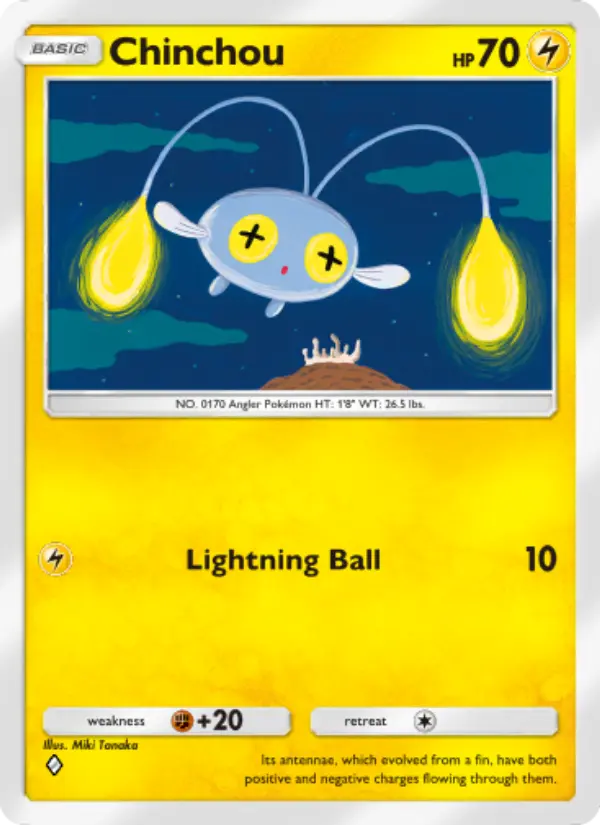
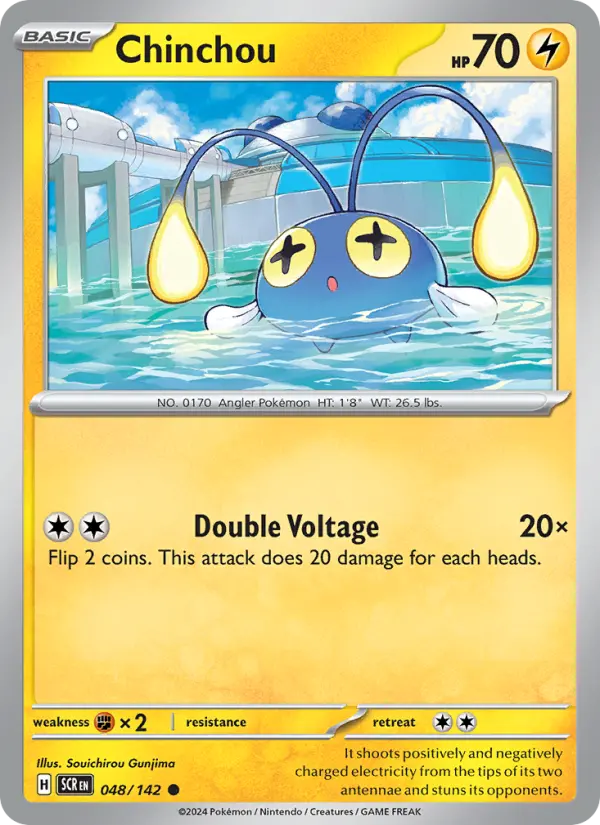
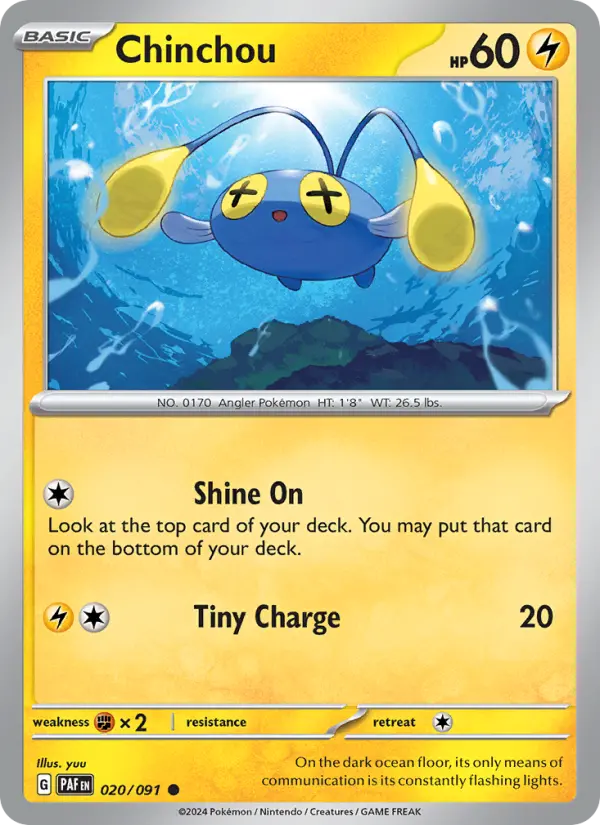
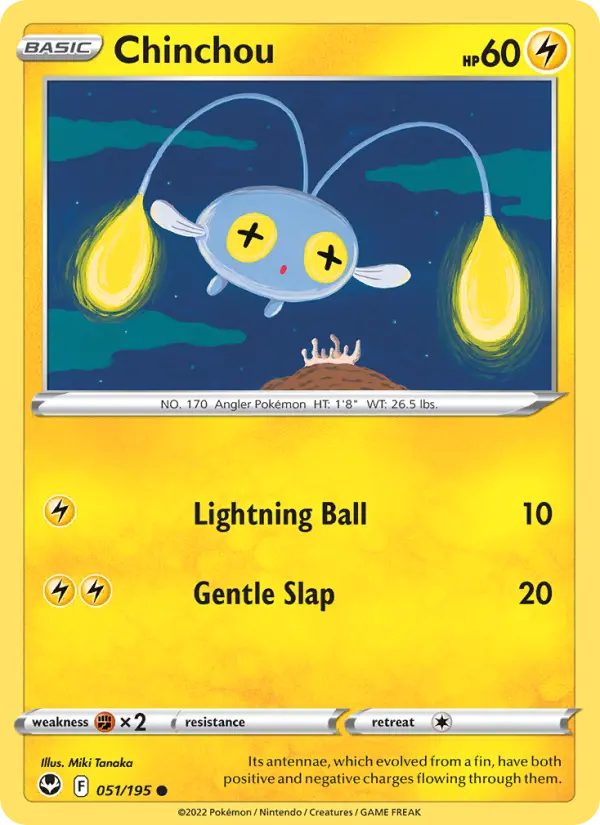
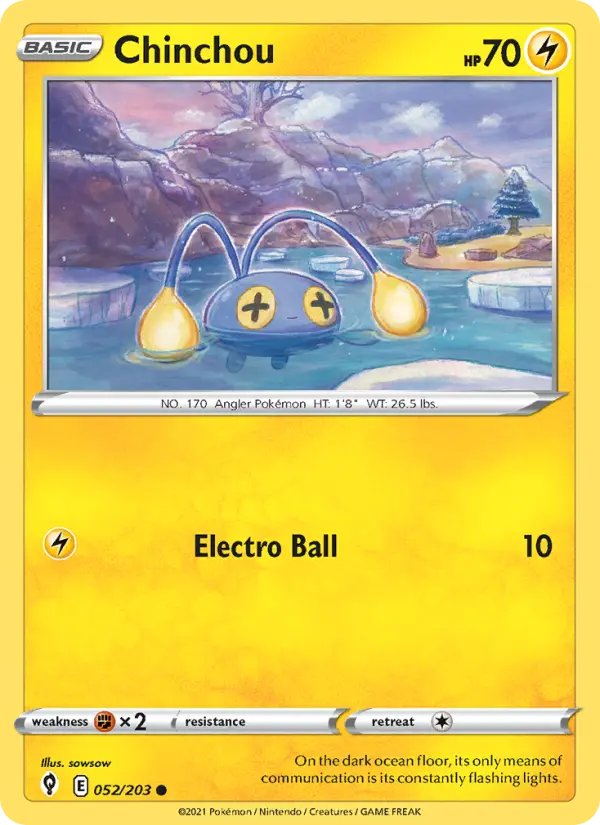
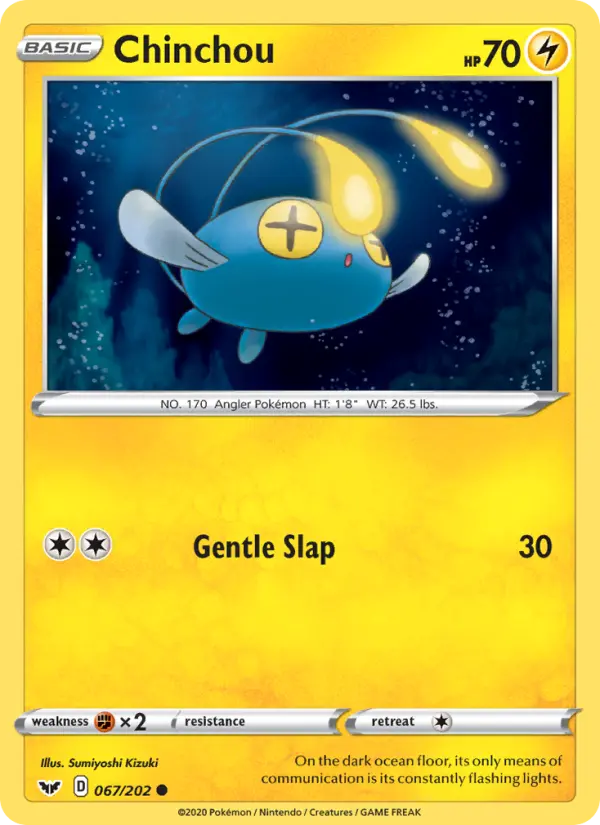
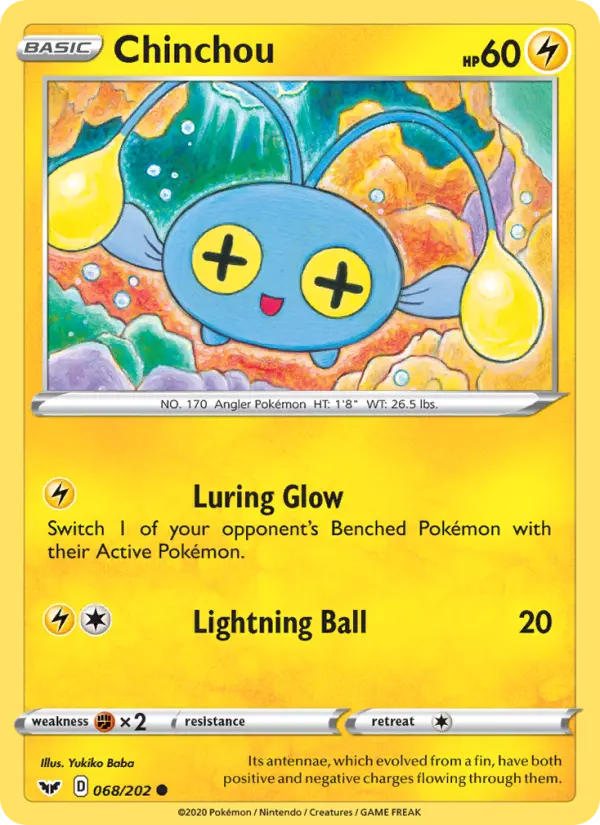
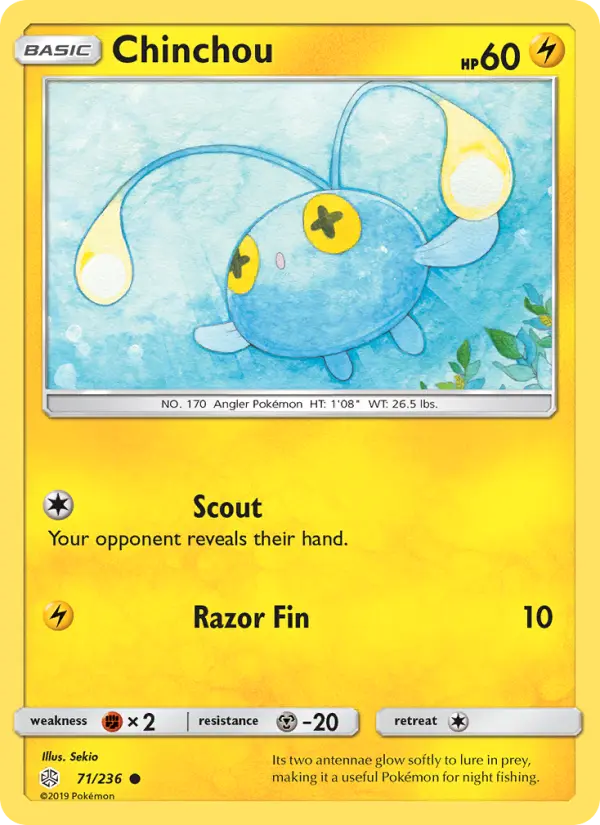
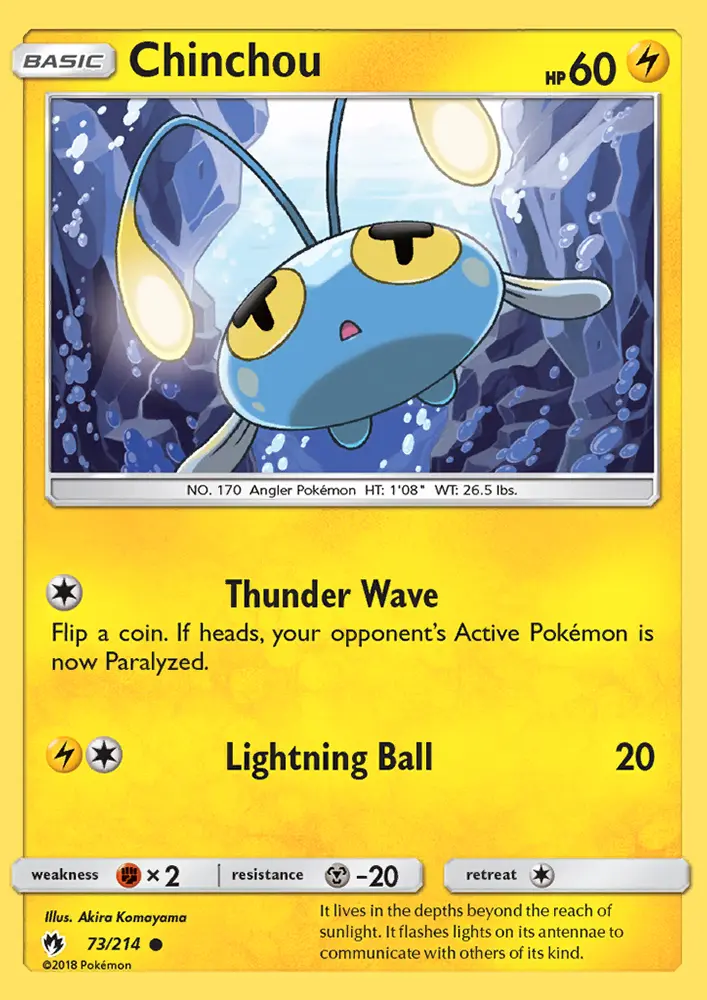
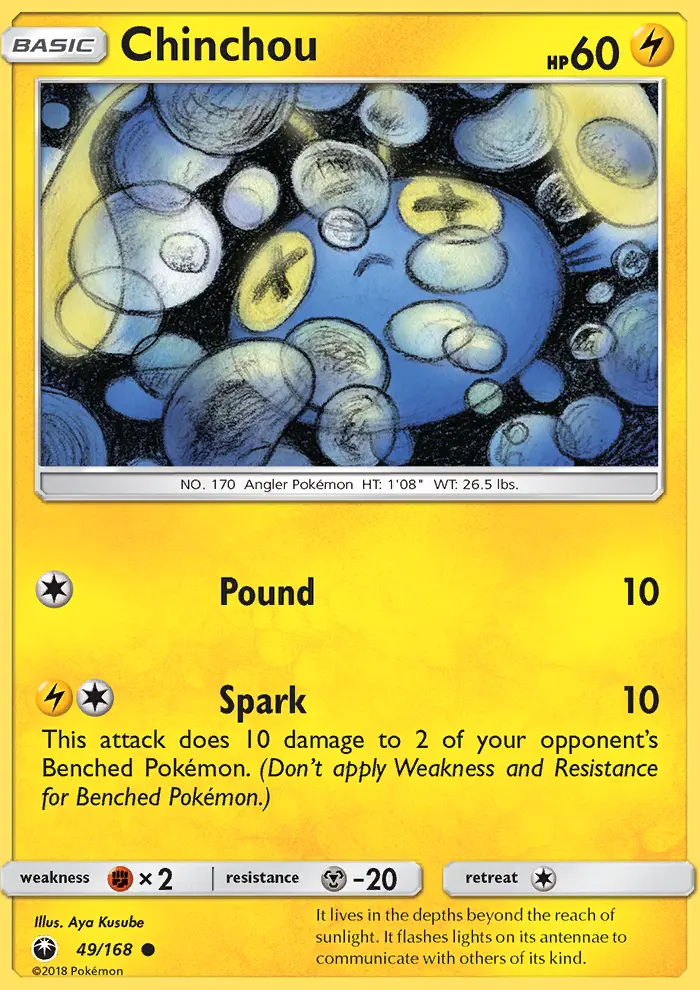
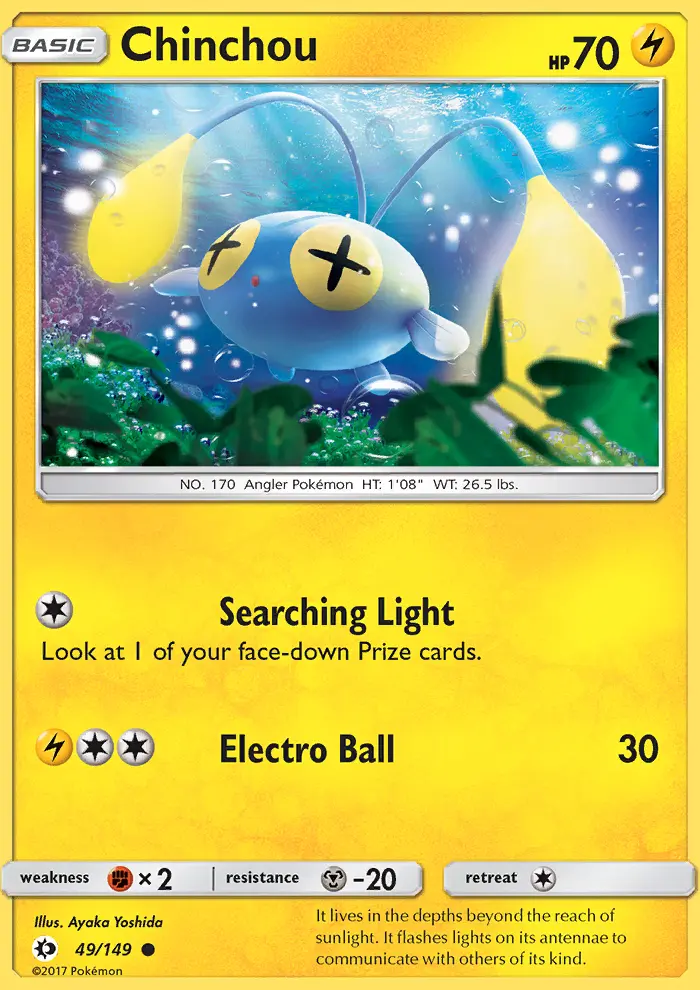
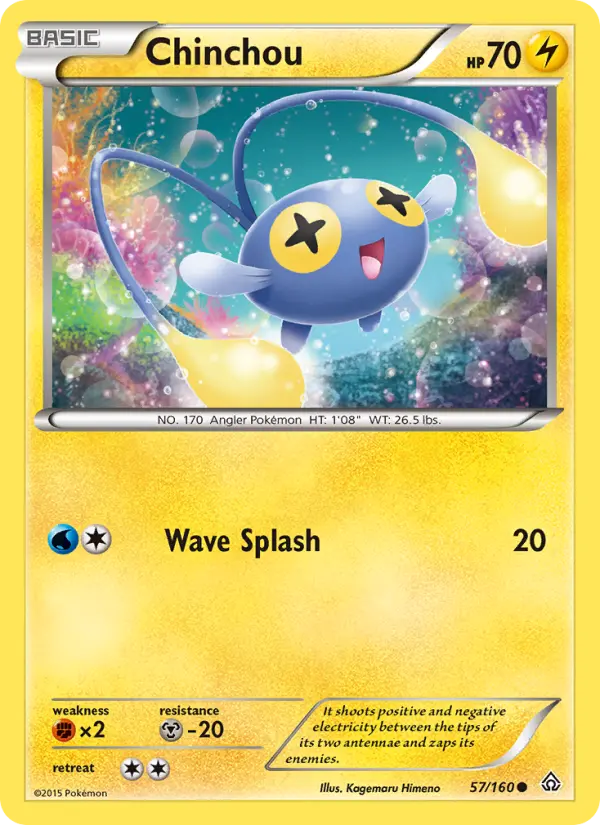
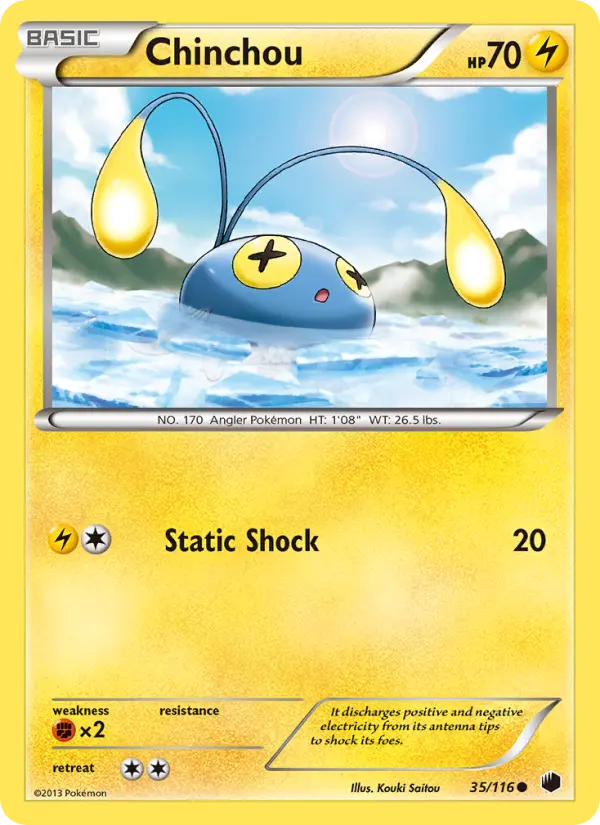
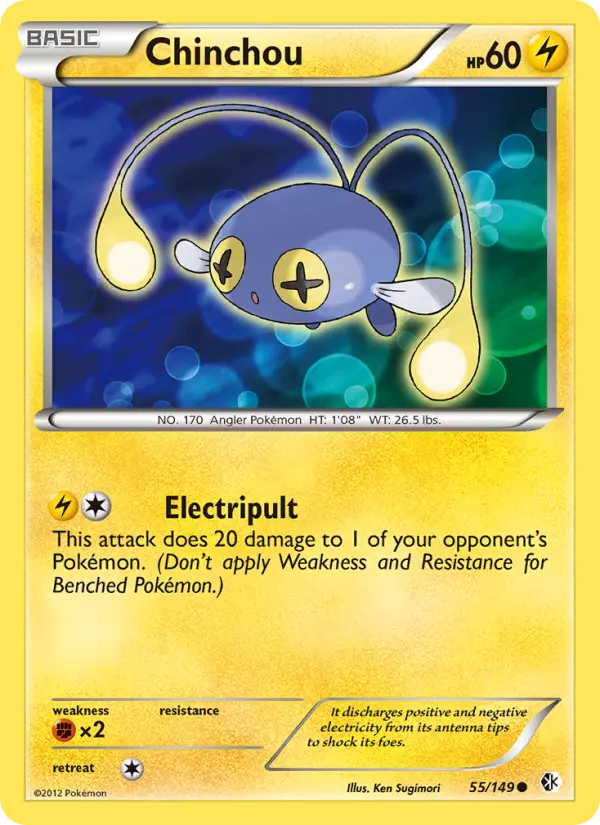
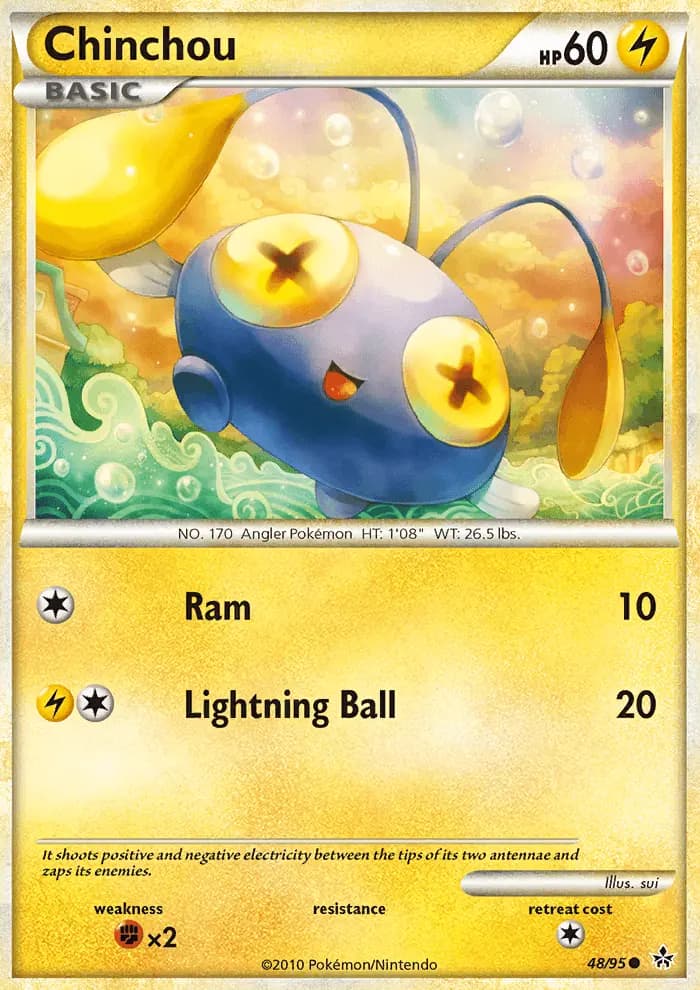
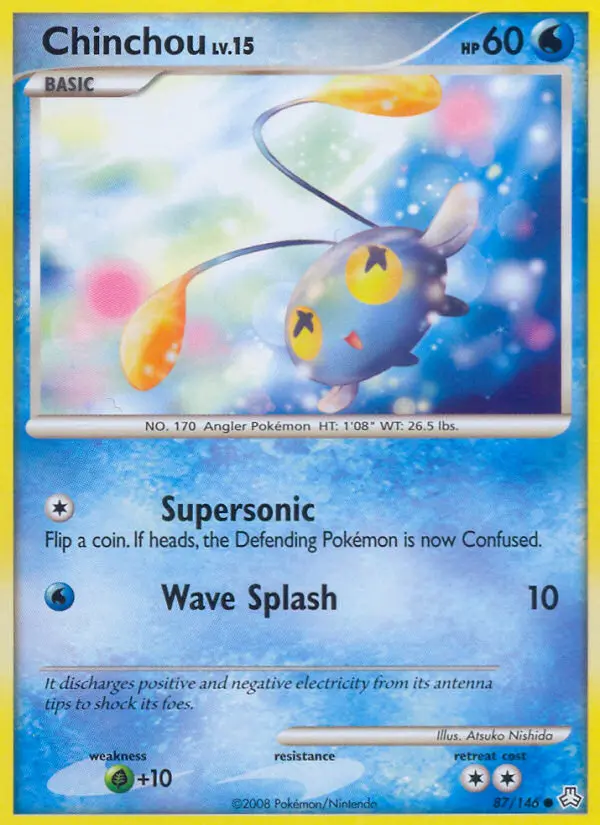
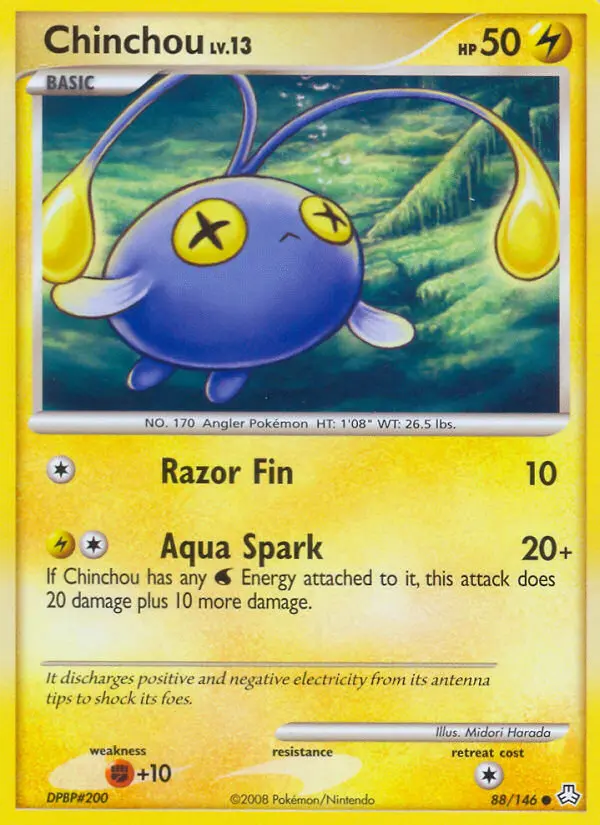
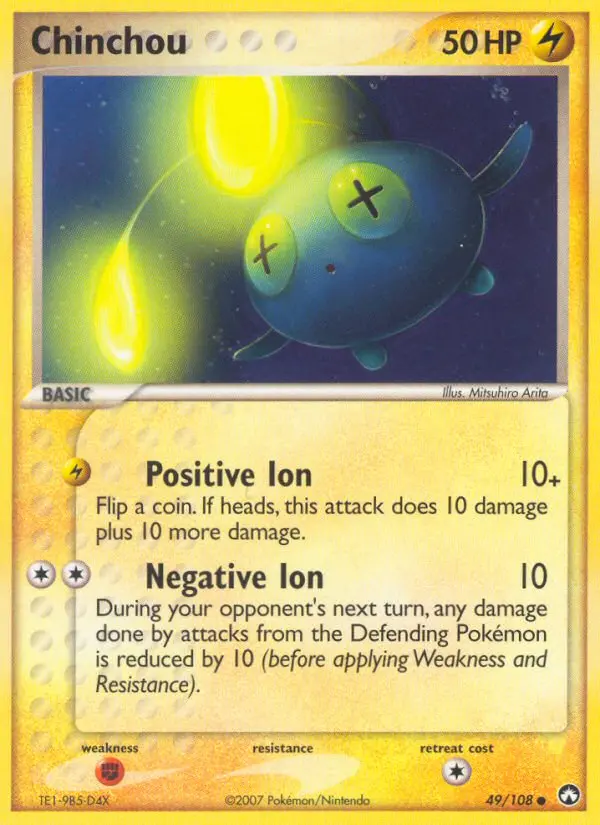
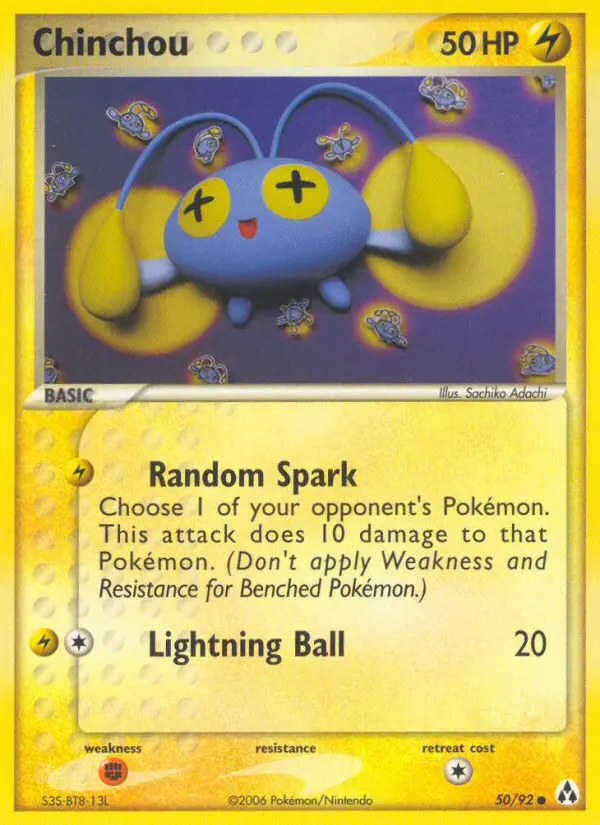
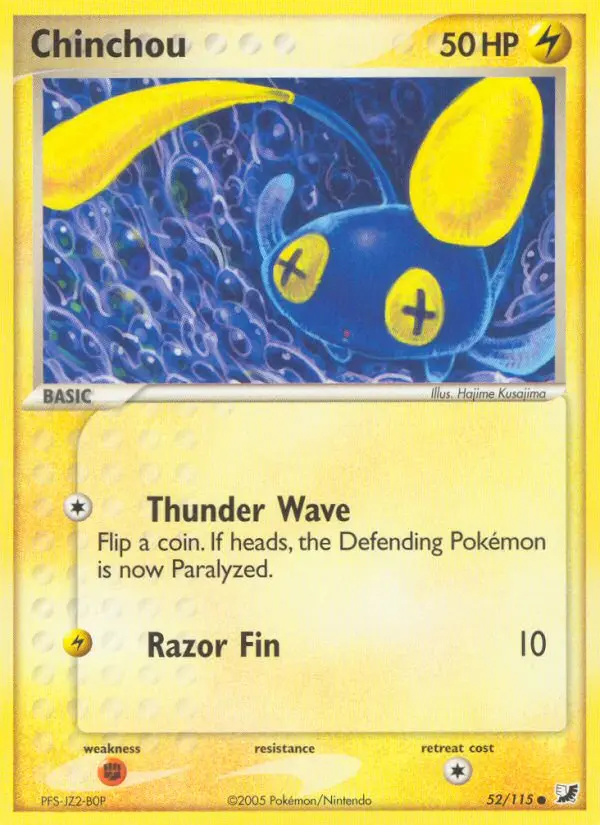
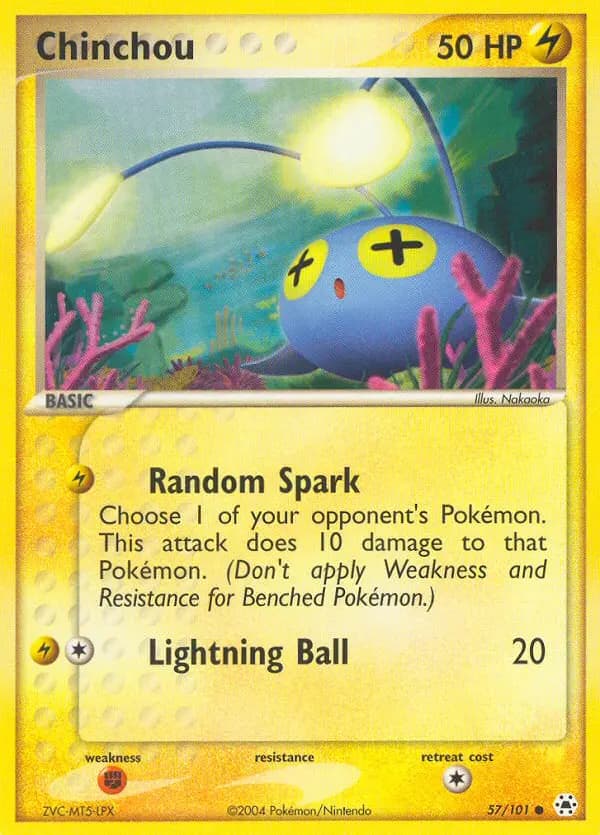
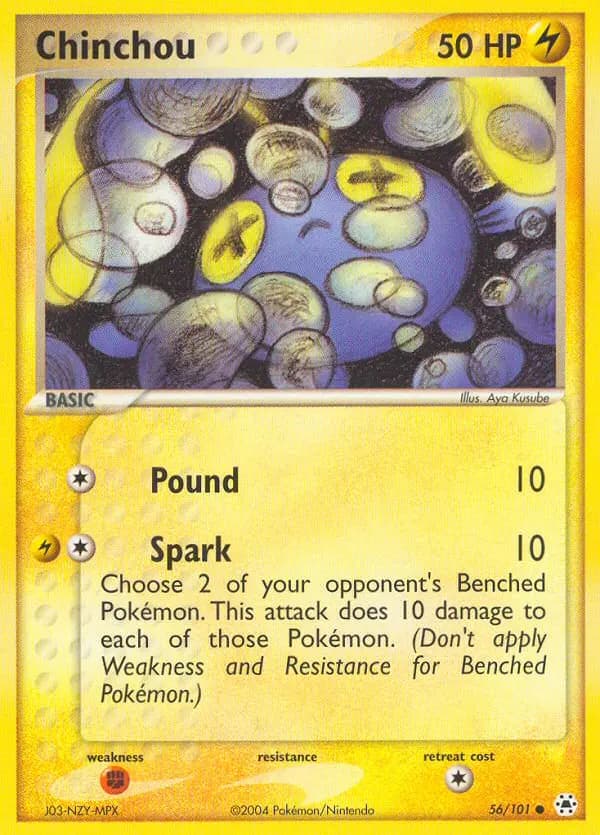
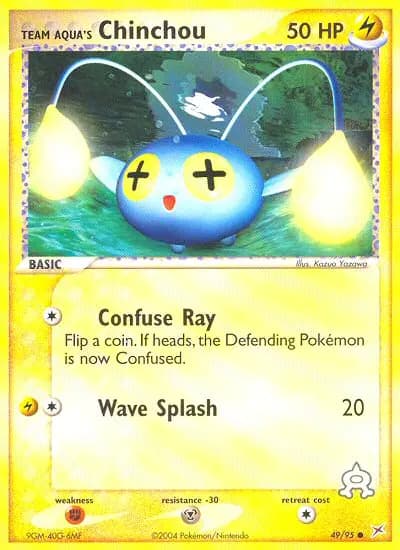
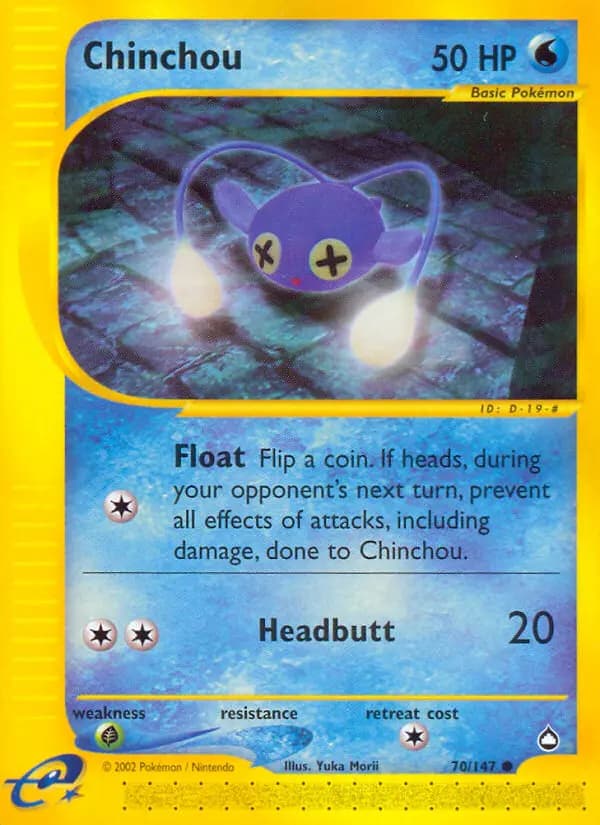
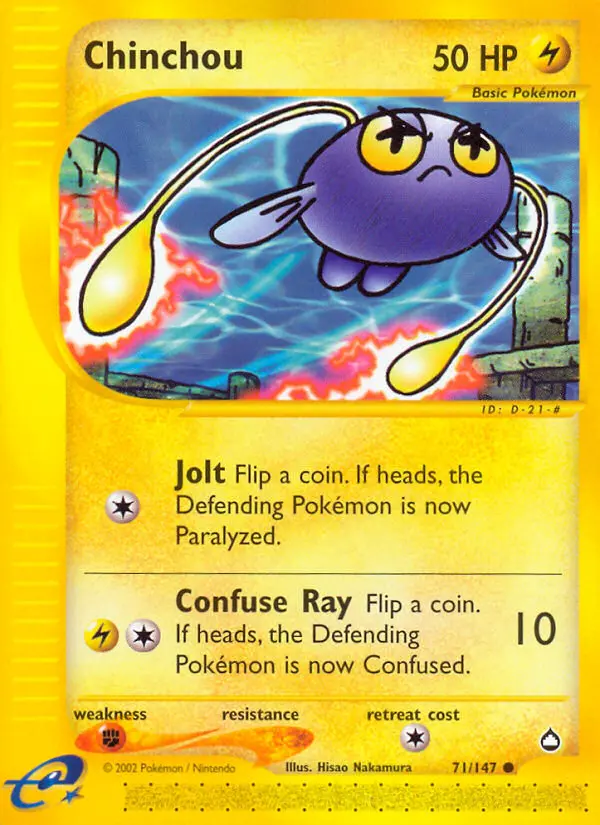
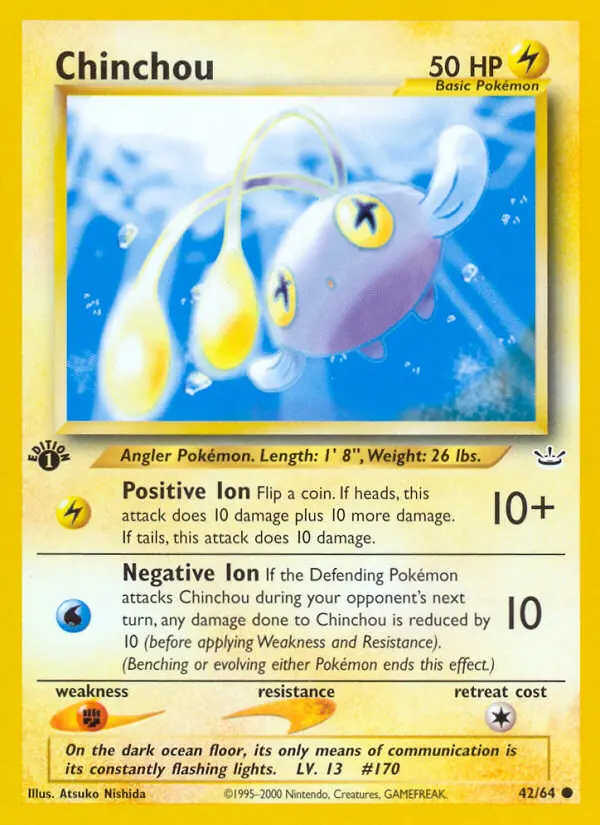
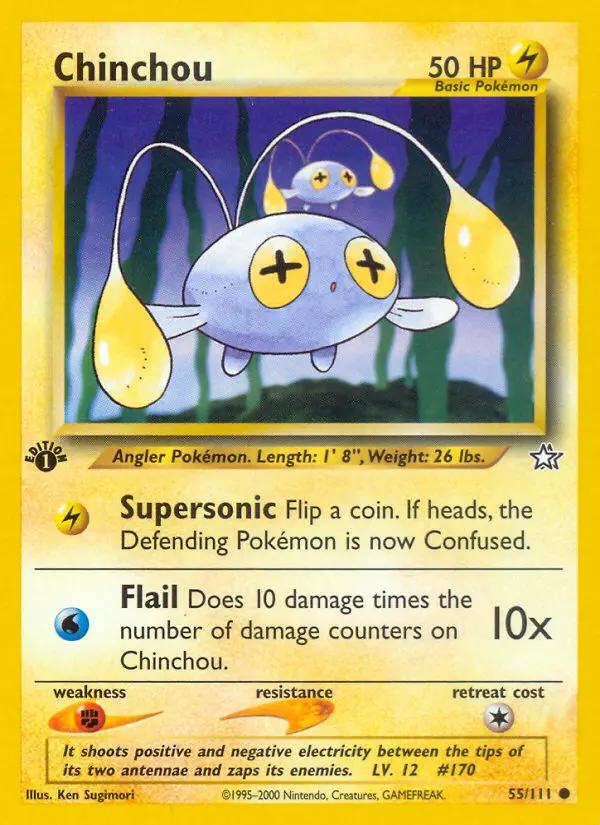
Chinchou has maintained a consistent presence throughout the Pokémon franchise despite its relatively modest statistics, appearing in numerous anime episodes and manga adaptations that have solidified its place in popular culture. The species has been featured in multiple animated appearances, including the aforementioned "Takin' It on the Chinchou" episode, where it demonstrated unexpected behavioral complexity and charm to international audiences. Its design has proven influential in establishing the archetype for bioluminescent Pokémon, inspiring subsequent generations to explore similar themes of deep-sea creatures with electrical or light-based abilities. In trading card games, Chinchou has received numerous printings across multiple sets, with various artwork interpretations showcasing different aspects of its character and ecological niche. The species' iconic status as one of the original Generation II additions has granted it lasting recognition among longtime fans, who frequently cite Chinchou as a memorable introduction to dual-type Water/Electric Pokémon, despite Lanturn ultimately becoming the more competitive and widely-used evolution.
Where to Find Chinchou in Every Pokémon Game
Chinchou's availability has varied significantly across different game generations and regions, though it consistently appears in games featuring Johto and other water-rich environments. The species was introduced in Gold/Silver/Crystal where it occupied local Pokédex number 174, becoming available in the wild during specific encounters in deep water areas. In subsequent generations, Chinchou maintained presence in remakes and subsequent titles, including HeartGold/SoulSilver, the Hoenn region games, and later releases in the Kalos, Alola, and Galar regions with varying local dex numbers reflecting regional ordering. Its relatively high catch rate of 190 makes it considerably easier to capture compared to many other Pokémon, requiring minimal effort even with basic Poké Balls when encountered at full health. Modern titles like Pokémon Sword/Shield and their DLC expansions have continued to provide access to Chinchou, ensuring that new generations of trainers can readily obtain this species without requiring extensive searching or complex breeding procedures. The species' consistent availability across multiple generations has made it one of the more accessible Water/Electric-type Pokémon, particularly for players seeking an early-game option for their teams.