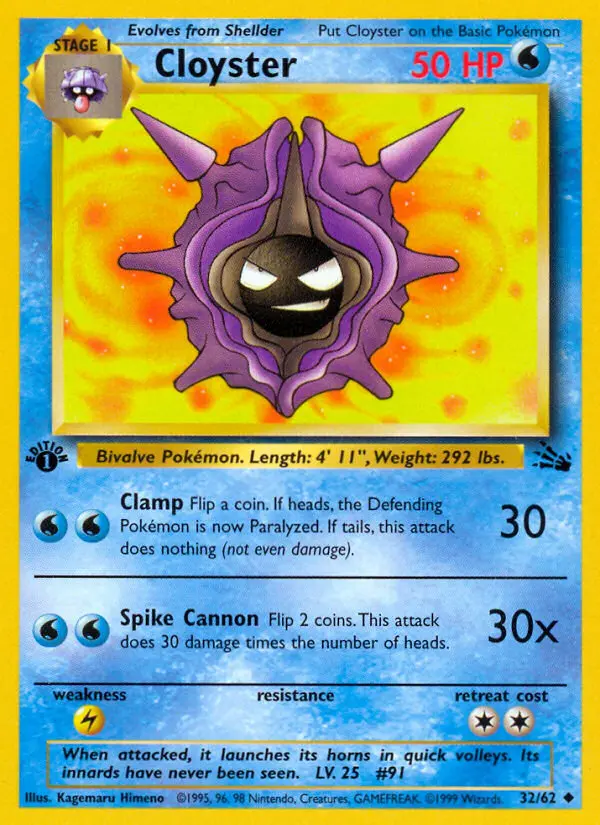
Cloyster
Generation I · #0091 — Bivalve Pokémon
The numbers on Cloyster tell you where to look first: Defense at 180, well above what its water/ice typing alone would predict. Cloyster boasts a remarkable base Defense stat of 180, making it one of the highest defensive values in the entire Pokédex and a cornerstone of defensive team compositions across competitive play. Despite its relatively modest base stats total of 525, the distribution heavily favors survivability, with a base Attack of 95 providing adequate offensive pressure. Its three possible abilities—Shell Armor, Skill Link, and the hidden ability Overcoat—each provide distinct strategic advantages, allowing trainers to customize their Cloyster for various battle scenarios. From its mysterious sealed interior to its diamond-hard exterior, Cloyster embodies the concept of an impenetrable fortress wrapped in spikes of crystalline perfection.
Editor's Take
Cloyster's Shell Smash plus Skill Link Icicle Spear is one of the most explosive setups in the game — 180 base Defense and one of the lowest Special Defense stats is a genuinely strange pairing to build around.
Base Stats
Height
1.5m
Weight
132.5kg
Category
Bivalve Pokémon
Gender
Male 50% / Female 50%
Color
purple
Shape
ball
Habitat
sea
Abilities
Protects against critical hits.
Extends two-to-five-hit moves and triple kick to their full length every time.
Protects against damage from weather.
Cloyster Biology & Physical Characteristics
Cloyster presents a striking visual design centered around its distinctive bivalve shell structure. The Pokémon features a black mollusk body encased within a light-gray inner shell, surrounded by a more prominent jagged blue-violet outer shell casing studded with multiple conical horns and a single prominent barb-like spike protruding above its head. Its pearl-like face displays two white eyes and a distinct mouth, serving as the only visible organic feature aside from the spike protrusions. The shell itself possesses extraordinary hardness, surpassing even diamonds in durability, with spikes that are even harder than the shell itself—a remarkable adaptation that allows Cloyster to withstand everything from bomb blasts to direct missile strikes without sustaining damage. Interestingly, the internal anatomy of Cloyster has never been observed or documented, as the creature maintains its shell sealed with such force that it becomes physically impossible to open from any external pressure. The spikes covering its shell grow larger and sharper in response to harsh tidal currents, suggesting that Cloyster's physiology adapts dynamically to environmental pressures. This remarkable biological engineering makes Cloyster not merely a defensive creature, but an evolutionary masterpiece of protection.
Pokedex Numbers
Training
Breeding
Cloyster Breeding, Gender Ratio & Egg Groups
Gender-wise, Cloyster is an even 50/50 split between males and females, with no physiological distinctions between genders in terms of appearance or base statistics. Both male and female specimens possess identical stat distributions and capability sets, ensuring equal viability in breeding programs regardless of parent gender. Cloyster belongs to the Water 3 egg group, making it compatible with various other aquatic and semi-aquatic Pokémon species for breeding purposes. This egg group classification connects Cloyster to other sophisticated Water-type Pokémon, expanding breeding possibilities for move inheritance and stat optimization through careful genetic selection. The species exhibits a relatively moderate base friendship value of 70, making Cloyster neither particularly difficult nor exceptionally easy to bond with during early training stages. The egg cycle count of 20 cycles (representing approximately 4,884 to 5,140 steps) places Cloyster in the moderate range for hatch times, neither among the fastest nor slowest breeding timelines. Breeding Cloyster strategically allows trainers to transfer move pools through parental inheritance, potentially combining Cloyster's naturally learned moves with techniques inherited from Water 3 group compatibility partners. The slow growth rate characteristic of the Shellder evolutionary line means that bred Cloyster specimens require considerable experience investment to reach competitive levels, but this investment yields a powerfully defensive final product.
Sprites






Held Items
Pearl
loot
Sell for 700 Pokédollars, or to Ore Collector for 1400 Pokédollars.
Cost: 2000
Pearl
loot
Sell for 700 Pokédollars, or to Ore Collector for 1400 Pokédollars.
Cost: 2000
Pearl
loot
Sell for 700 Pokédollars, or to Ore Collector for 1400 Pokédollars.
Cost: 2000
Pearl
loot
Sell for 700 Pokédollars, or to Ore Collector for 1400 Pokédollars.
Cost: 2000
Pearl
loot
Sell for 700 Pokédollars, or to Ore Collector for 1400 Pokédollars.
Cost: 2000
Pearl
loot
Sell for 700 Pokédollars, or to Ore Collector for 1400 Pokédollars.
Cost: 2000
Pearl
loot
Sell for 700 Pokédollars, or to Ore Collector for 1400 Pokédollars.
Cost: 2000
Pearl
loot
Sell for 700 Pokédollars, or to Ore Collector for 1400 Pokédollars.
Cost: 2000
Pearl
loot
Sell for 700 Pokédollars, or to Ore Collector for 1400 Pokédollars.
Cost: 2000
Pearl
loot
Sell for 700 Pokédollars, or to Ore Collector for 1400 Pokédollars.
Cost: 2000
Pearl
loot
Sell for 700 Pokédollars, or to Ore Collector for 1400 Pokédollars.
Cost: 2000
Pearl
loot
Sell for 700 Pokédollars, or to Ore Collector for 1400 Pokédollars.
Cost: 2000
Pearl
loot
Sell for 700 Pokédollars, or to Ore Collector for 1400 Pokédollars.
Cost: 2000
Pearl
loot
Sell for 700 Pokédollars, or to Ore Collector for 1400 Pokédollars.
Cost: 2000
Pearl
loot
Sell for 700 Pokédollars, or to Ore Collector for 1400 Pokédollars.
Cost: 2000
Pearl
loot
Sell for 700 Pokédollars, or to Ore Collector for 1400 Pokédollars.
Cost: 2000
Pearl
loot
Sell for 700 Pokédollars, or to Ore Collector for 1400 Pokédollars.
Cost: 2000
Pearl
loot
Sell for 700 Pokédollars, or to Ore Collector for 1400 Pokédollars.
Cost: 2000
Pearl
loot
Sell for 700 Pokédollars, or to Ore Collector for 1400 Pokédollars.
Cost: 2000
Pearl
loot
Sell for 700 Pokédollars, or to Ore Collector for 1400 Pokédollars.
Cost: 2000
Pearl
loot
Sell for 700 Pokédollars, or to Ore Collector for 1400 Pokédollars.
Cost: 2000
Pearl
loot
Sell for 700 Pokédollars, or to Ore Collector for 1400 Pokédollars.
Cost: 2000
Big Pearl
loot
Sell for 3750 Pokédollars, or to Ore Collector for 7500 Pokédollars.
Cost: 8000
Big Pearl
loot
Sell for 3750 Pokédollars, or to Ore Collector for 7500 Pokédollars.
Cost: 8000
Big Pearl
loot
Sell for 3750 Pokédollars, or to Ore Collector for 7500 Pokédollars.
Cost: 8000
Big Pearl
loot
Sell for 3750 Pokédollars, or to Ore Collector for 7500 Pokédollars.
Cost: 8000
Big Pearl
loot
Sell for 3750 Pokédollars, or to Ore Collector for 7500 Pokédollars.
Cost: 8000
Big Pearl
loot
Sell for 3750 Pokédollars, or to Ore Collector for 7500 Pokédollars.
Cost: 8000
Big Pearl
loot
Sell for 3750 Pokédollars, or to Ore Collector for 7500 Pokédollars.
Cost: 8000
Big Pearl
loot
Sell for 3750 Pokédollars, or to Ore Collector for 7500 Pokédollars.
Cost: 8000
Big Pearl
loot
Sell for 3750 Pokédollars, or to Ore Collector for 7500 Pokédollars.
Cost: 8000
Big Pearl
loot
Sell for 3750 Pokédollars, or to Ore Collector for 7500 Pokédollars.
Cost: 8000
Big Pearl
loot
Sell for 3750 Pokédollars, or to Ore Collector for 7500 Pokédollars.
Cost: 8000
Big Pearl
loot
Sell for 3750 Pokédollars, or to Ore Collector for 7500 Pokédollars.
Cost: 8000
Big Pearl
loot
Sell for 3750 Pokédollars, or to Ore Collector for 7500 Pokédollars.
Cost: 8000
Big Pearl
loot
Sell for 3750 Pokédollars, or to Ore Collector for 7500 Pokédollars.
Cost: 8000
Big Pearl
loot
Sell for 3750 Pokédollars, or to Ore Collector for 7500 Pokédollars.
Cost: 8000
Big Pearl
loot
Sell for 3750 Pokédollars, or to Ore Collector for 7500 Pokédollars.
Cost: 8000
Big Pearl
loot
Sell for 3750 Pokédollars, or to Ore Collector for 7500 Pokédollars.
Cost: 8000
Big Pearl
loot
Sell for 3750 Pokédollars, or to Ore Collector for 7500 Pokédollars.
Cost: 8000
Big Pearl
loot
Sell for 3750 Pokédollars, or to Ore Collector for 7500 Pokédollars.
Cost: 8000
Big Pearl
loot
Sell for 3750 Pokédollars, or to Ore Collector for 7500 Pokédollars.
Cost: 8000
Big Pearl
loot
Sell for 3750 Pokédollars, or to Ore Collector for 7500 Pokédollars.
Cost: 8000
Big Pearl
loot
Sell for 3750 Pokédollars, or to Ore Collector for 7500 Pokédollars.
Cost: 8000
Pearl
loot
Sell for 700 Pokédollars, or to Ore Collector for 1400 Pokédollars.
Cost: 2000
Pearl
loot
Sell for 700 Pokédollars, or to Ore Collector for 1400 Pokédollars.
Cost: 2000
Pearl
loot
Sell for 700 Pokédollars, or to Ore Collector for 1400 Pokédollars.
Cost: 2000
Pearl
loot
Sell for 700 Pokédollars, or to Ore Collector for 1400 Pokédollars.
Cost: 2000
Pearl
loot
Sell for 700 Pokédollars, or to Ore Collector for 1400 Pokédollars.
Cost: 2000
Pearl
loot
Sell for 700 Pokédollars, or to Ore Collector for 1400 Pokédollars.
Cost: 2000
Pearl
loot
Sell for 700 Pokédollars, or to Ore Collector for 1400 Pokédollars.
Cost: 2000
Pearl
loot
Sell for 700 Pokédollars, or to Ore Collector for 1400 Pokédollars.
Cost: 2000
Pearl
loot
Sell for 700 Pokédollars, or to Ore Collector for 1400 Pokédollars.
Cost: 2000
Pearl
loot
Sell for 700 Pokédollars, or to Ore Collector for 1400 Pokédollars.
Cost: 2000
Pearl
loot
Sell for 700 Pokédollars, or to Ore Collector for 1400 Pokédollars.
Cost: 2000
Pearl
loot
Sell for 700 Pokédollars, or to Ore Collector for 1400 Pokédollars.
Cost: 2000
Pearl
loot
Sell for 700 Pokédollars, or to Ore Collector for 1400 Pokédollars.
Cost: 2000
Pearl
loot
Sell for 700 Pokédollars, or to Ore Collector for 1400 Pokédollars.
Cost: 2000
Pearl
loot
Sell for 700 Pokédollars, or to Ore Collector for 1400 Pokédollars.
Cost: 2000
Pearl
loot
Sell for 700 Pokédollars, or to Ore Collector for 1400 Pokédollars.
Cost: 2000
Pearl
loot
Sell for 700 Pokédollars, or to Ore Collector for 1400 Pokédollars.
Cost: 2000
Pearl
loot
Sell for 700 Pokédollars, or to Ore Collector for 1400 Pokédollars.
Cost: 2000
Pearl
loot
Sell for 700 Pokédollars, or to Ore Collector for 1400 Pokédollars.
Cost: 2000
Pearl
loot
Sell for 700 Pokédollars, or to Ore Collector for 1400 Pokédollars.
Cost: 2000
Pearl
loot
Sell for 700 Pokédollars, or to Ore Collector for 1400 Pokédollars.
Cost: 2000
Pearl
loot
Sell for 700 Pokédollars, or to Ore Collector for 1400 Pokédollars.
Cost: 2000
Big Pearl
loot
Sell for 3750 Pokédollars, or to Ore Collector for 7500 Pokédollars.
Cost: 8000
Big Pearl
loot
Sell for 3750 Pokédollars, or to Ore Collector for 7500 Pokédollars.
Cost: 8000
Big Pearl
loot
Sell for 3750 Pokédollars, or to Ore Collector for 7500 Pokédollars.
Cost: 8000
Big Pearl
loot
Sell for 3750 Pokédollars, or to Ore Collector for 7500 Pokédollars.
Cost: 8000
Big Pearl
loot
Sell for 3750 Pokédollars, or to Ore Collector for 7500 Pokédollars.
Cost: 8000
Big Pearl
loot
Sell for 3750 Pokédollars, or to Ore Collector for 7500 Pokédollars.
Cost: 8000
Big Pearl
loot
Sell for 3750 Pokédollars, or to Ore Collector for 7500 Pokédollars.
Cost: 8000
Big Pearl
loot
Sell for 3750 Pokédollars, or to Ore Collector for 7500 Pokédollars.
Cost: 8000
Big Pearl
loot
Sell for 3750 Pokédollars, or to Ore Collector for 7500 Pokédollars.
Cost: 8000
Big Pearl
loot
Sell for 3750 Pokédollars, or to Ore Collector for 7500 Pokédollars.
Cost: 8000
Big Pearl
loot
Sell for 3750 Pokédollars, or to Ore Collector for 7500 Pokédollars.
Cost: 8000
Big Pearl
loot
Sell for 3750 Pokédollars, or to Ore Collector for 7500 Pokédollars.
Cost: 8000
Big Pearl
loot
Sell for 3750 Pokédollars, or to Ore Collector for 7500 Pokédollars.
Cost: 8000
Big Pearl
loot
Sell for 3750 Pokédollars, or to Ore Collector for 7500 Pokédollars.
Cost: 8000
Big Pearl
loot
Sell for 3750 Pokédollars, or to Ore Collector for 7500 Pokédollars.
Cost: 8000
Big Pearl
loot
Sell for 3750 Pokédollars, or to Ore Collector for 7500 Pokédollars.
Cost: 8000
Big Pearl
loot
Sell for 3750 Pokédollars, or to Ore Collector for 7500 Pokédollars.
Cost: 8000
Big Pearl
loot
Sell for 3750 Pokédollars, or to Ore Collector for 7500 Pokédollars.
Cost: 8000
Big Pearl
loot
Sell for 3750 Pokédollars, or to Ore Collector for 7500 Pokédollars.
Cost: 8000
Big Pearl
loot
Sell for 3750 Pokédollars, or to Ore Collector for 7500 Pokédollars.
Cost: 8000
Big Pearl
loot
Sell for 3750 Pokédollars, or to Ore Collector for 7500 Pokédollars.
Cost: 8000
Big Pearl
loot
Sell for 3750 Pokédollars, or to Ore Collector for 7500 Pokédollars.
Cost: 8000
TMs & HMs
tm01
lets go pikachu lets go eevee
tm02
crystal
tm02
gold silver
tm03
crystal
tm03
gold silver
tm03
ruby sapphire
tm03
platinum
tm03
firered leafgreen
tm03
heartgold soulsilver
tm03
diamond pearl
tm03
emerald
tm03
xd
tm03
colosseum
tm03
lets go pikachu lets go eevee
tm04
lets go pikachu lets go eevee
tm05
lets go pikachu lets go eevee
tm06
yellow
tm06
gold silver
tm06
red blue
tm06
crystal
+637 more TMs/HMs
Cloyster's Evolution Chain


Cloyster Evolution, Mega Evolution & Special Forms
Cloyster evolves from Shellder through exposure to a Water Stone, a relatively simple evolutionary mechanism compared to the complex conditions required for many other Pokémon. This evolution represents a dramatic transformation in both appearance and capability, with Shellder's modest form developing into Cloyster's heavily armored and spike-laden configuration. The evolution introduces the Ice typing to complement Shellder's Water typing, fundamentally altering the creature's type matchups and strategic applications. Upon evolution, Cloyster's Defense stat increases dramatically from Shellder's base 65 to an impressive 180, one of the highest single-stat values in the entire franchise. This transformation also grants access to new moves and abilities, with the possibility of obtaining the rare Skill Link ability, which extends multi-hit move mechanics like Icicle Spear to always strike the maximum number of times. The evolution takes place relatively quickly in terms of friendship and experience metrics, with Cloyster maintaining a slow growth rate characteristic of its evolutionary line. No Mega Evolution form has been introduced for Cloyster in subsequent generations, keeping it in its singular evolved form across all modern Pokémon titles.
Where to Find
Undella Bay
unova
+1 more
Unova Route 13
unova
+5 more
Undella Town
unova
+5 more
Seaside Cave
unova
+1 more
Humilau City
unova
+1 more
Kalos Route 8
kalos
Seafoam Islands
kanto
+1 more
Cloyster Behaviour and Natural Habitat
Cloyster inhabits coastal ocean environments and seafloors, where it typically remains submerged in marine waters. This species demonstrates remarkable aquatic mobility despite its heavily armored appearance, utilizing a sophisticated siphon-jet propulsion system to navigate through water. The creature swallows seawater and then forcefully ejects it toward the rear, propelling itself through the ocean with surprising efficiency. This same hydro-jet mechanism serves a dual purpose, as Cloyster employs it to launch its shell spikes at high velocity during combat encounters. According to Pokédex entries, Cloyster that inhabit seas with particularly harsh tidal currents develop exceptionally large and sharp spikes, indicating that environmental pressure directly influences spike development and morphology. In terms of combat behavior, Cloyster exhibits a defensive-first strategy, launching its horns and spikes in rapid succession to keep opponents at bay. The species typically only opens its shell when launching attacks, otherwise maintaining a permanently sealed posture that renders it virtually impervious to external threats. This behavior pattern suggests that Cloyster evolved specifically to minimize vulnerability windows during combat, maintaining aggressive capability even while maintaining maximum defensive posture.
Pokedex Entries
When attacked, it launches its horns in quick volleys. Its innards have never been seen.
For protection, it uses its harder- than-diamonds shell. It also shoots spikes from the shell.
Once it slams its shell shut, it is impossible to open, even by those with superi or strength.
CLOYSTER that live in seas with harsh tidal currents grow large, sharp spikes on their shells.
Even a missile can't break the spikes it uses to stab opponents. They're even hard er than its shell.
CLOYSTER is capable of swimming in the sea. It does so by swallowing water, then jetting it out toward the rear. This POKéMON shoots spikes from its shell using the same system.
It swims in the sea by swallowing water, then jetting it out toward the rear. The CLOYSTER shoots spikes from its shell using the same system.
Its shell is extremely hard. It cannot be shattered, even with a bomb. The shell opens only when it is attacking.
When attacked, it launches its horns in quick volleys. Its innards have never been seen.
It fights by keeping its shell tightly shut for protection and by shooting spikes to repel foes.
Once it slams its shell shut, it is impossible to open, even by those with superior strength.
CLOYSTER that live in seas with harsh tidal currents grow large, sharp spikes on their shells.
It fights by keeping its shell tightly shut for protection and by shooting spikes to repel foes.
It fights by keeping its shell tightly shut for protection and by shooting spikes to repel foes.
Cloyster that live in seas with harsh tidal currents grow large, sharp spikes on their shells.
Its shell is extremely hard. It cannot be shattered, even with a bomb. The shell opens only when it is attacking.
Cloyster is capable of swimming in the sea. It does so by swallowing water, then jetting it out toward the rear. This Pokémon shoots spikes from its shell using the same system.
Cloyster is capable of swimming in the sea. It does so by swallowing water, then jetting it out toward the rear. This Pokémon shoots spikes from its shell using the same system.
Its hard shell cannot be shattered—not even by a bomb. The contents of the shell remain unknown.
If areas of Cloyster’s very hard shell get damaged, those areas swell, gradually growing into large sharp spikes.
Excavation of the tombs of ancient hunting tribes has turned up many spears tipped with spikes that had fallen off this Pokémon’s shell.
Slowpoke tails are its favorite food. It has even been known to come up on land to look for Slowpoke from time to time.
For protection, it uses its harder-than-diamond shell. It also shoots spikes from the shell.
Its shell is extremely hard. It cannot be shattered, even with a bomb. The shell opens only when it is attacking.
Once it slams its shell shut, it is impossible to open, even by those with superior strength.
Cloyster Name Origin & Design Inspiration
Cloyster's name comes from a straightforward combination of 'clam' and 'oyster,' both bivalve mollusk creatures known for their protective shells and pearl production. The Japanese designation 'Parshen' similarly references shell-based terminology, creating a linguistically consistent design philosophy across language versions. The creature's visual design draws obvious inspiration from real-world oysters and clams, particularly in its dual-shell structure and pearl-like facial features positioned within the inner shell chamber. The dramatic transformation from Shellder to Cloyster parallels the concept of a mollusk developing more pronounced shell characteristics and defensive adaptations as it matures, similar to how certain bivalves develop increasingly robust shells throughout their lifespan. The spike-laden blue-violet outer shell distinctly separates Cloyster visually from its pre-evolution form, emphasizing the dramatic growth and hardening of protective structures. The crystalline quality attributed to both the shell and spikes reflects real-world phenomena where certain mollusk shells develop mineral crystalline structures for enhanced durability. The overall aesthetic presents Cloyster as nature's perfect defensive organism—a creature so thoroughly encased in protective barriers that vulnerability becomes virtually nonexistent, a theme that resonates throughout its Pokédex entries and biological descriptions.
Learnable Moves
Cloyster can learn 88 moves:
Move | Type | Cat. | Power | Acc. | PP |
|---|---|---|---|---|---|
| attract | normal | Status | — | 100 | 15 |
| aurora beam | ice | Special | 65 | 100 | 20 |
| avalanche | ice | Physical | 60 | 100 | 10 |
| barrier | psychic | Status | — | — | 20 |
| bide | normal | Physical | — | — | 10 |
| blizzard | ice | Special | 110 | 70 | 5 |
| body slam | normal | Physical | 85 | 100 | 15 |
| brine | water | Special | 65 | 100 | 10 |
| bubble beam | water | Special | 65 | 100 | 20 |
| captivate | normal | Status | — | 100 | 20 |
| chilling water | water | Special | 50 | 100 | 20 |
| clamp | water | Physical | 35 | 85 | 15 |
| confide | normal | Status | — | — | 20 |
| curse | ghost | Status | — | — | 10 |
| dive | water | Physical | 80 | 100 | 10 |
| double team | normal | Status | — | — | 15 |
| double edge | normal | Physical | 120 | 100 | 15 |
| drill run | ground | Physical | 80 | 95 | 10 |
| endure | normal | Status | — | — | 10 |
| explosion | normal | Physical | 250 | 100 | 5 |
| facade | normal | Physical | 70 | 100 | 20 |
| frost breath | ice | Special | 60 | 90 | 10 |
| frustration | normal | Physical | — | 100 | 20 |
| giga impact | normal | Physical | 150 | 90 | 5 |
| hail | ice | Status | — | — | 10 |
| headbutt | normal | Physical | 70 | 100 | 15 |
| helping hand | normal | Status | — | — | 20 |
| hidden power | normal | Special | 60 | 100 | 15 |
| hydro pump | water | Special | 110 | 80 | 5 |
| hyper beam | normal | Special | 150 | 90 | 5 |
| ice beam | ice | Special | 90 | 100 | 10 |
| ice shard | ice | Physical | 40 | 100 | 30 |
| ice spinner | ice | Physical | 80 | 100 | 15 |
| icicle crash | ice | Physical | 85 | 90 | 10 |
| icicle spear | ice | Physical | 25 | 100 | 30 |
| icy wind | ice | Special | 55 | 95 | 15 |
| iron defense | steel | Status | — | — | 15 |
| leer | normal | Status | — | 100 | 30 |
| light screen | psychic | Status | — | — | 30 |
| liquidation | water | Physical | 85 | 100 | 10 |
| mimic | normal | Status | — | — | 10 |
| mud shot | ground | Special | 55 | 95 | 15 |
| natural gift | normal | Physical | — | 100 | 15 |
| payback | dark | Physical | 50 | 100 | 10 |
| pin missile | bug | Physical | 25 | 95 | 20 |
| poison jab | poison | Physical | 80 | 100 | 20 |
| protect | normal | Status | — | — | 10 |
| rage | normal | Physical | 20 | 100 | 20 |
| rain dance | water | Status | — | — | 5 |
| razor shell | water | Physical | 75 | 95 | 10 |
| reflect | psychic | Status | — | — | 20 |
| rest | psychic | Status | — | — | 5 |
| return | normal | Physical | — | 100 | 20 |
| rock blast | rock | Physical | 25 | 90 | 10 |
| round | normal | Special | 60 | 100 | 15 |
| scary face | normal | Status | — | 100 | 10 |
| screech | normal | Status | — | 85 | 40 |
| secret power | normal | Physical | 70 | 100 | 20 |
| self destruct | normal | Physical | 200 | 100 | 5 |
| shell smash | normal | Status | — | — | 15 |
| signal beam | bug | Special | 75 | 100 | 15 |
| sleep talk | normal | Status | — | — | 10 |
| smart strike | steel | Physical | 70 | — | 10 |
| snore | normal | Special | 50 | 100 | 15 |
| snowscape | ice | Status | 0 | — | 10 |
| spike cannon | normal | Physical | 20 | 100 | 15 |
| spikes | ground | Status | — | — | 20 |
| steel roller | steel | Physical | 130 | 100 | 5 |
| substitute | normal | Status | — | — | 10 |
| supersonic | normal | Status | — | 55 | 20 |
| surf | water | Special | 90 | 100 | 15 |
| swagger | normal | Status | — | 85 | 15 |
| swift | normal | Special | 60 | — | 20 |
| tackle | normal | Physical | 40 | 100 | 35 |
| take down | normal | Physical | 90 | 85 | 20 |
| teleport | psychic | Status | — | — | 20 |
| tera blast | normal | Special | 80 | 100 | 10 |
| torment | dark | Status | — | 100 | 15 |
| toxic | poison | Status | — | 90 | 10 |
| toxic spikes | poison | Status | — | — | 20 |
| tri attack | normal | Special | 80 | 100 | 10 |
| twineedle | bug | Physical | 25 | 100 | 20 |
| water gun | water | Special | 40 | 100 | 25 |
| water pulse | water | Special | 60 | 100 | 20 |
| waterfall | water | Physical | 80 | 100 | 15 |
| weather ball | normal | Special | 50 | 100 | 10 |
| whirlpool | water | Special | 35 | 85 | 15 |
| withdraw | water | Status | — | — | 40 |
Cloyster Competitive Battle Guide
Cloyster's competitive viability centers entirely on its exceptional 180 base Defense stat, making it an unparalleled physical wall in team compositions that prioritize damage mitigation. In competitive formats, players typically employ Cloyster with either Shell Armor or Skill Link abilities, each providing distinct strategic value depending on the metagame and teammate composition. Shell Armor eliminates the possibility of critical hits from opponents, allowing Cloyster to reliably predict damage calculations without worrying about catastrophic high-variance outcomes. Skill Link, conversely, transforms multi-hit moves like Icicle Spear and Rock Blast into guaranteed five-hit attacks, converting Cloyster from a purely defensive asset into a legitimate offensive threat. The hidden ability Overcoat provides weather immunity, protecting Cloyster from weather-induced damage effects like sandstorm and hail damage, valuable in weather-focused team architectures. Despite low base Speed (70) and Special Defense (45) stats, Cloyster's physical bulk makes it an excellent switch-in candidate against physical attackers, particularly those relying on critical hit mechanics or weather-based damage. Competitive movesets typically incorporate Icicle Spear for guaranteed damage output with Skill Link, Rapid Spin for hazard removal utility, and defensive coverage moves like Protect or Iron Defense for augmented stalling. The 95 base Attack stat provides adequate offensive pressure without requiring offensive investment, allowing trainers to allocate EVs toward maximizing Defense, HP, and occasionally Speed for competitive viability.
Commonly Asked Questions About Cloyster
What type is Cloyster?
Cloyster is a water and ice type Pokemon.
What does Cloyster evolve from?
Cloyster evolved from shellder.
What are Cloyster's weaknesses?
Cloyster is weak to fighting, rock, grass and electric type moves.
Where can I find Cloyster?
Cloyster can be found in undella bay (unova), unova route 13 (unova) and undella town (unova) and 4 other locations.
Cloyster Cultural Impact & Franchise History
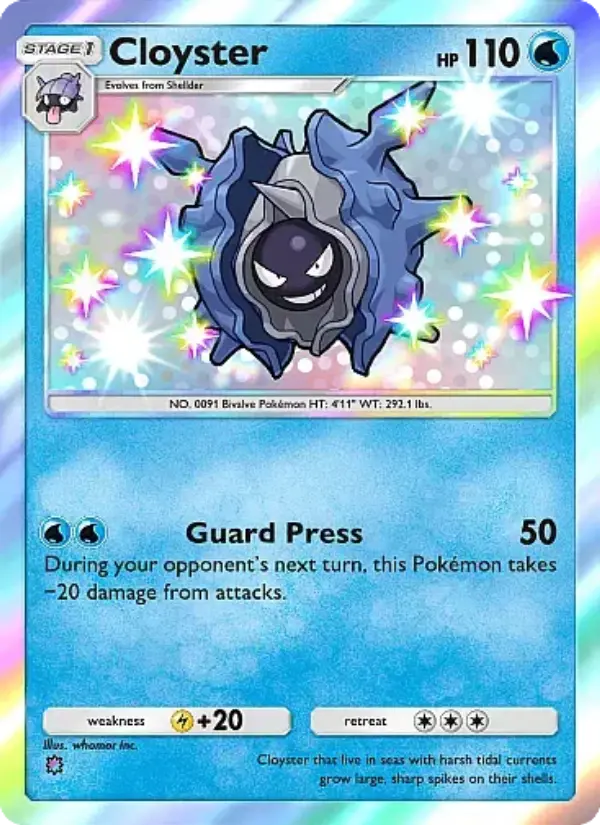
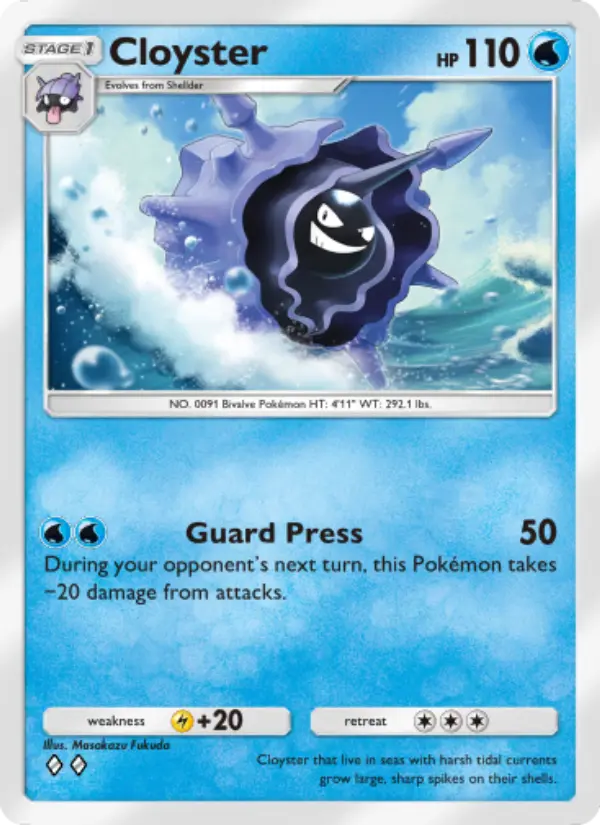
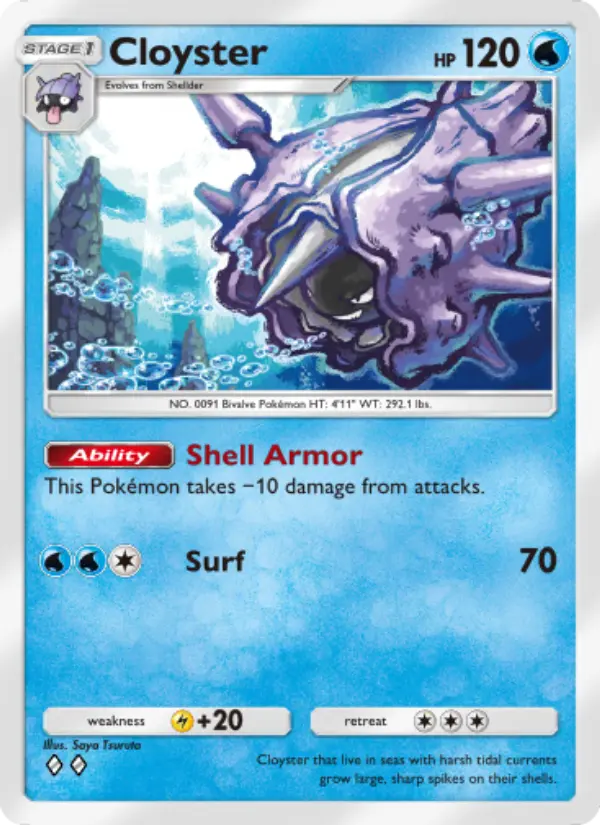
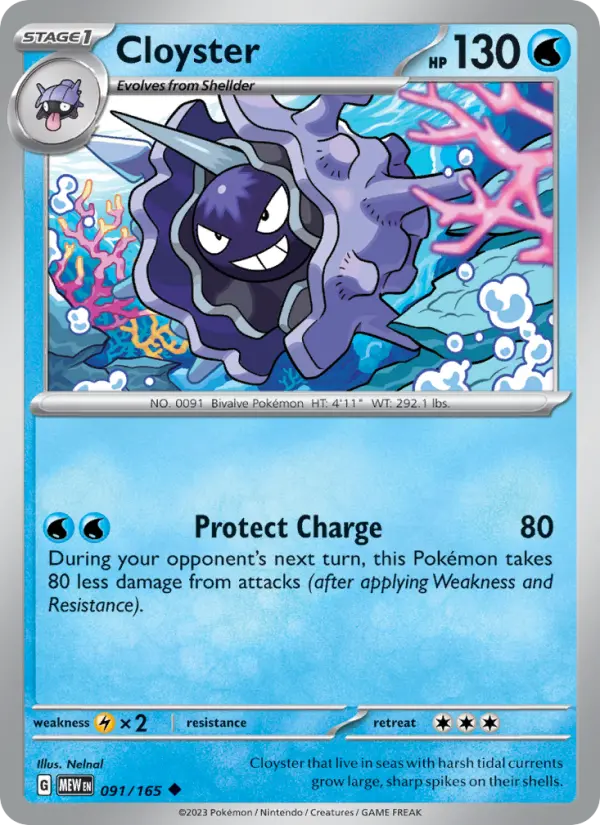
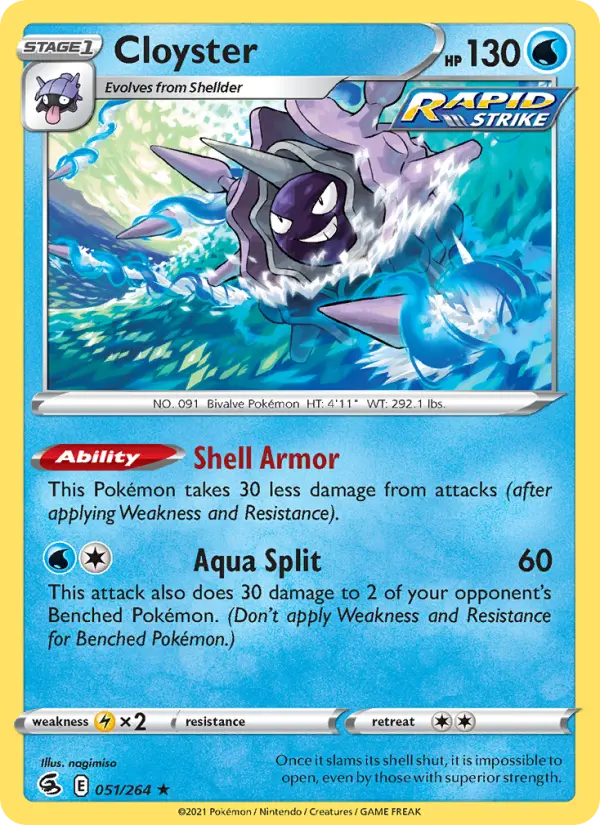
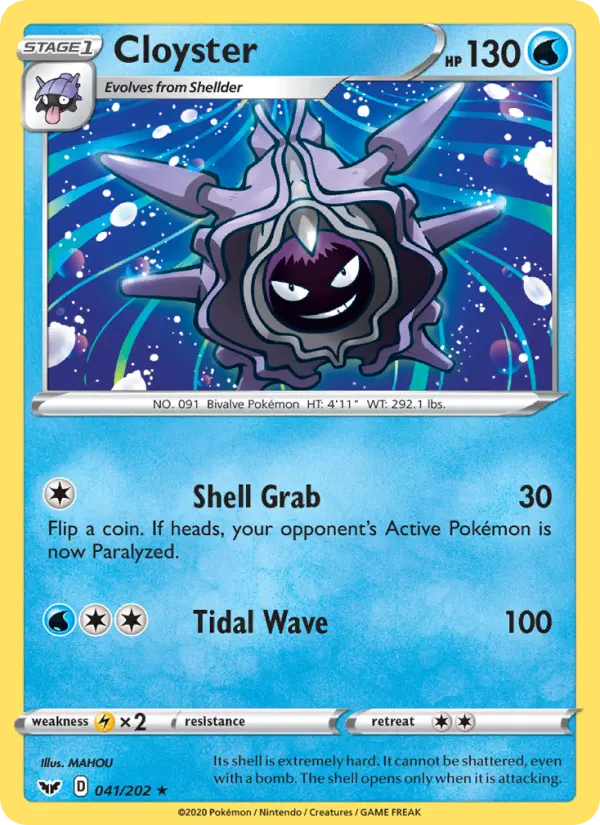
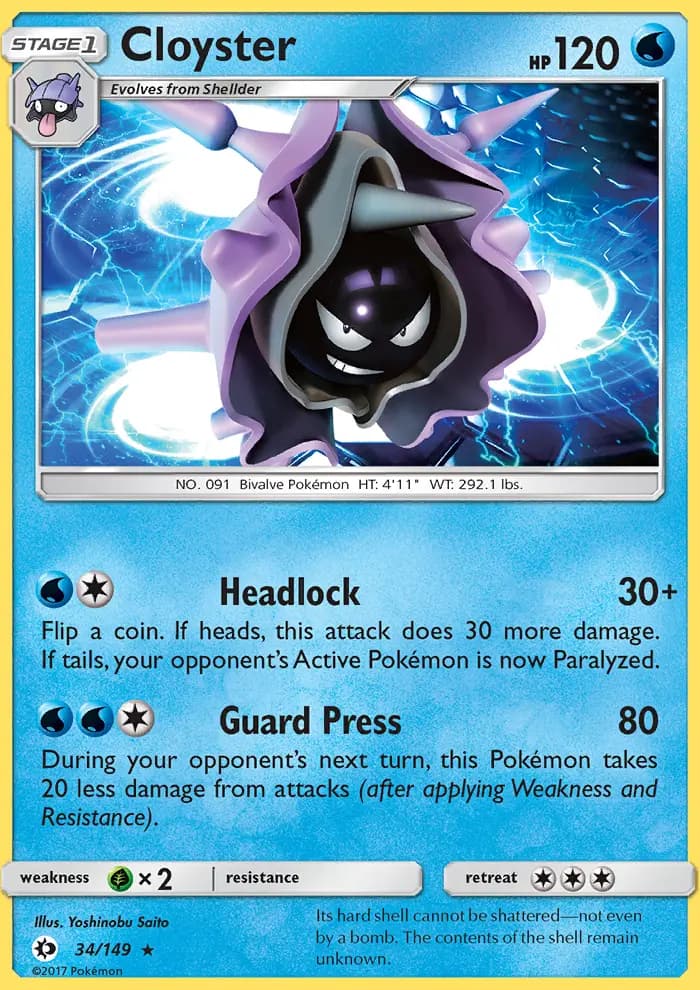
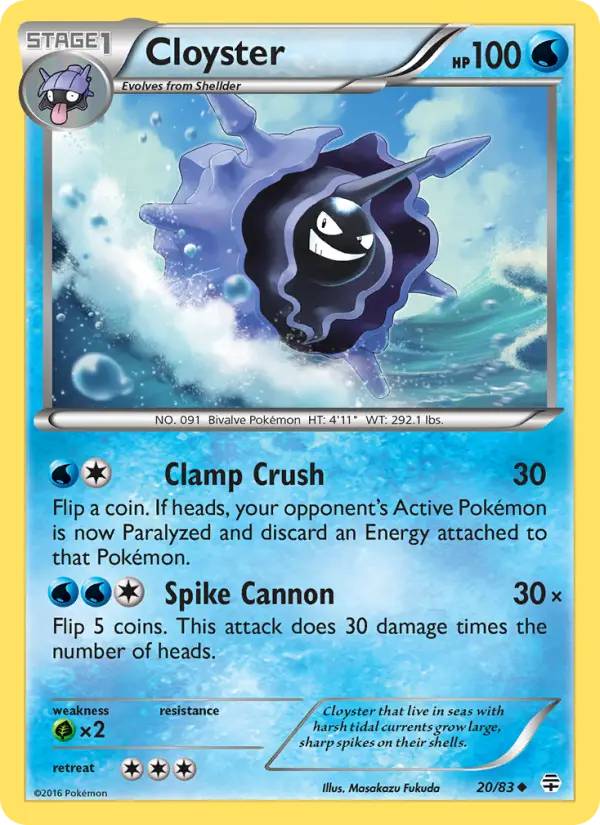
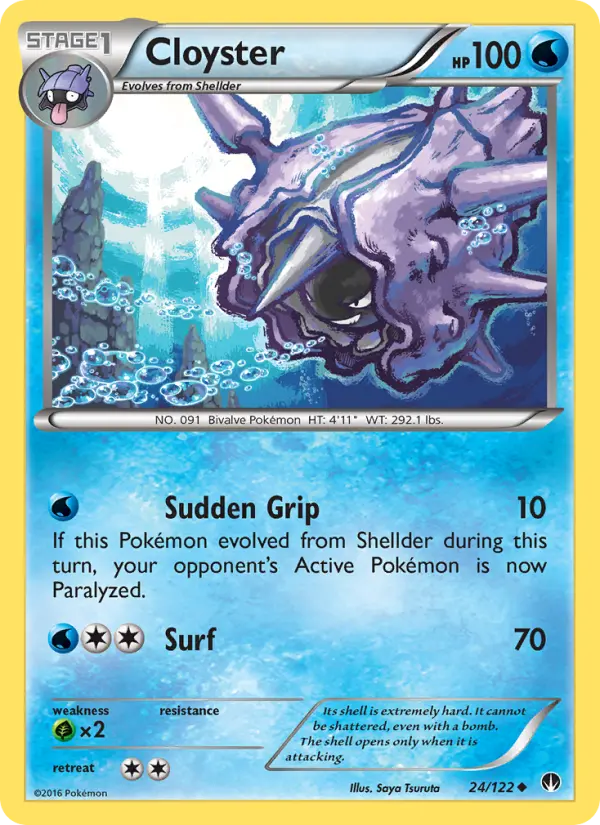
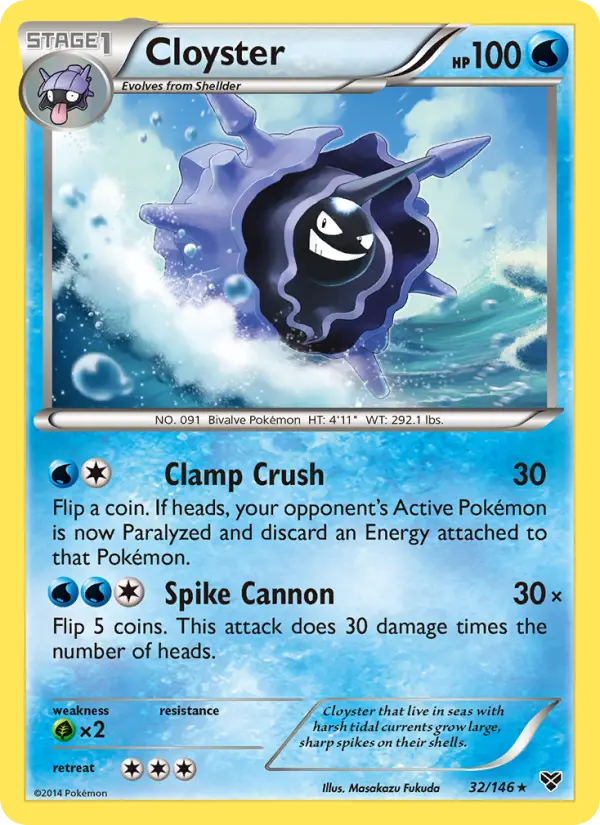
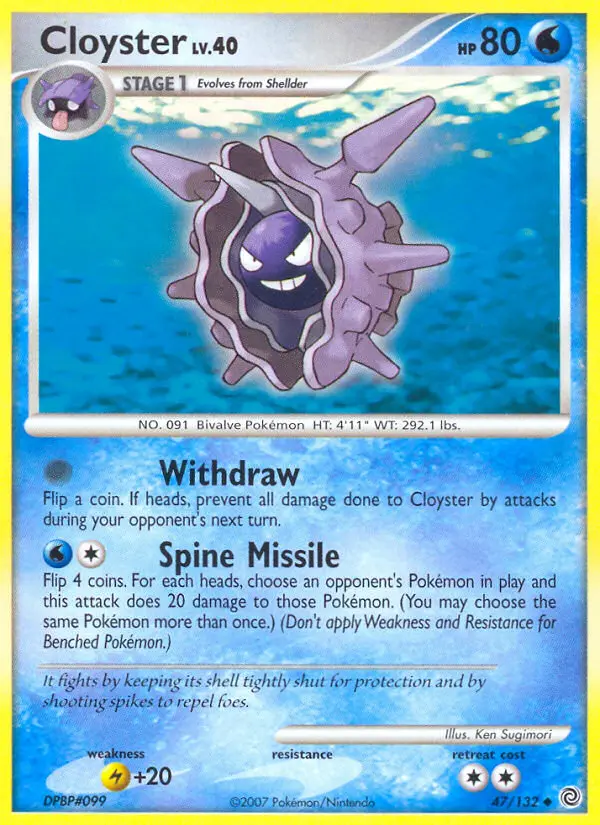
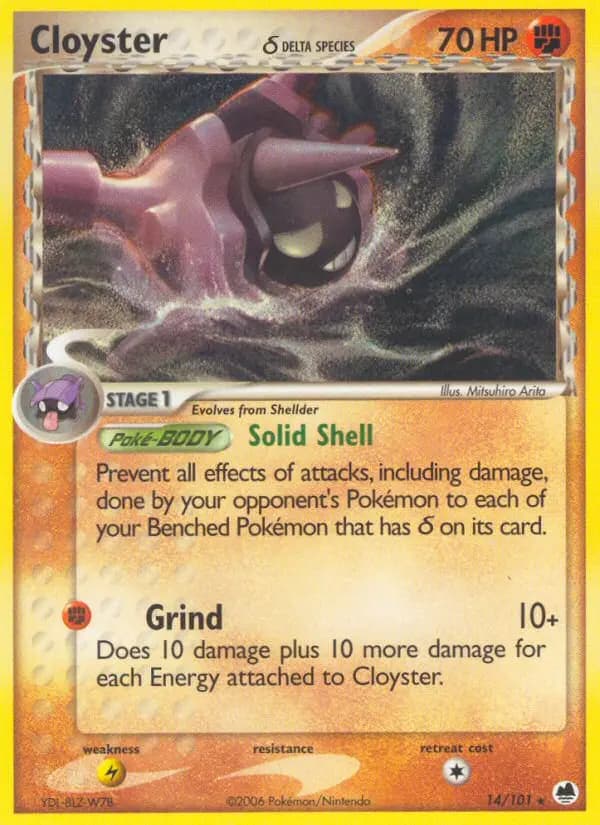
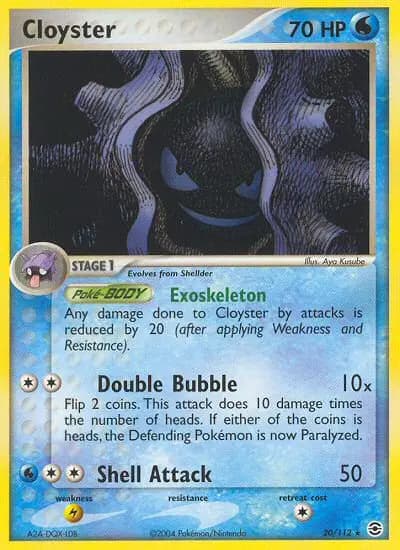
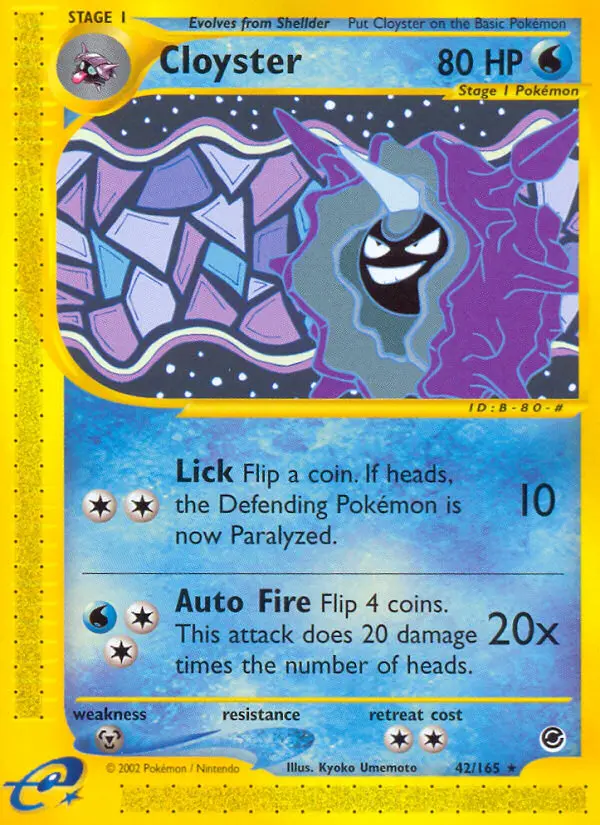
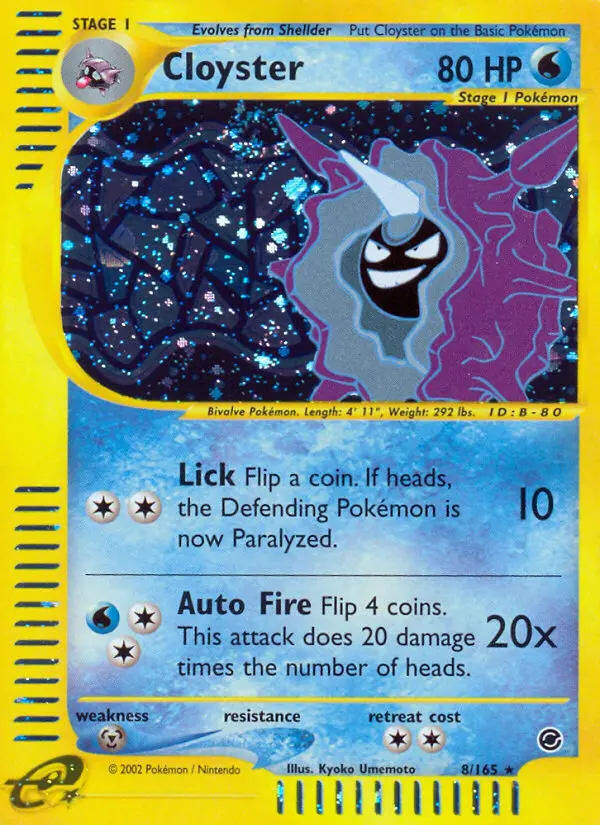
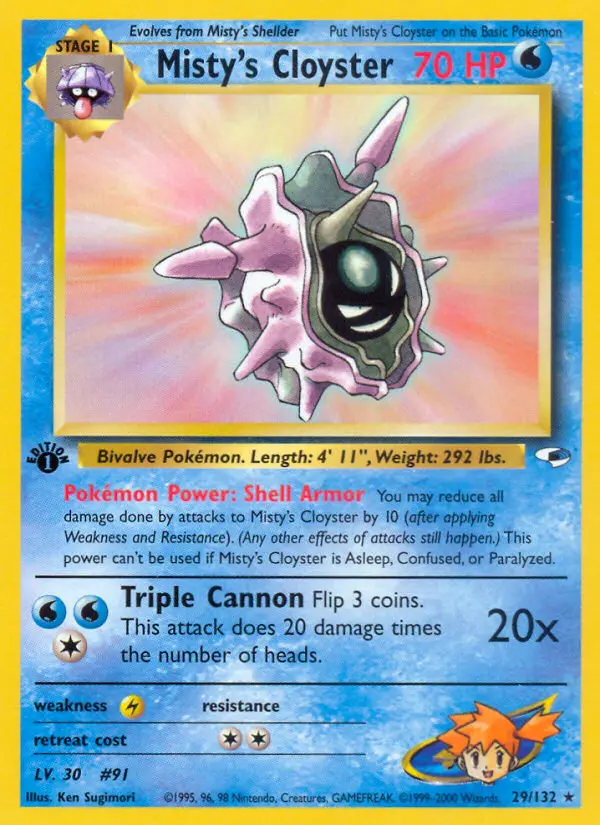
Cloyster has maintained consistent presence throughout Pokémon media and competitive culture since its Generation I introduction, establishing itself as a iconic defensive specialist recognized across the franchise's diverse audiences. The character's appearances in the animated series include a notable partnership with Gym Leader and Pokémon Master contender Prima, whose Cloyster served as a formidable defensive anchor during her battles. The Pokémon's distinctive visual design—with its crystalline spikes and impenetrable shell—has made it a popular subject for fan artwork, merchandise, and competitive discussion forums across multiple decades. Trading card game representations of Cloyster have consistently featured its defensive characteristics and spike-launching mechanics as central mechanical themes, creating consistent characterization across multiple media formats. The species' role as an accessible yet powerful defensive Pokémon has endeared it to both casual players seeking durable team members and competitive specialists requiring specialized defensive coverage. Cloyster's design philosophy influenced numerous subsequent Water-type and defensive-focused Pokémon designs, establishing a template for mollusk-based protective creatures. The creature's mysterious sealed interior and diamond-hard exterior created significant lore curiosity, with players and fans speculating about Cloyster's internal anatomy and the mechanisms behind its extraordinary defensive capabilities throughout the franchise's history.
Where to Find Cloyster in Every Pokémon Game
Cloyster's availability varies significantly across different Pokémon game generations, though the creature remains accessible through its Shellder pre-evolution in most titles. In Generation I (Red, Blue, Yellow), Cloyster can be obtained by catching Shellder and using a Water Stone for immediate evolution, with Shellder appearing in coastal areas throughout Kanto. Subsequent generations maintain similar acquisition patterns, requiring players to locate Shellder in aquatic habitats and initiate evolution through Water Stone usage. In later generations including X/Y, Sun/Moon, and Sword/Shield, Cloyster appears in specialized coastal Pokédex sections with reduced encounter rates compared to Shellder, reflecting its status as a relatively rare evolved form. Let's Go Pikachu/Eevee reintroduced Cloyster with updated mechanics aligned with modern gameplay systems while maintaining traditional evolution methodology. Scarlet and Violet considerably expanded Cloyster's availability and integration into Paldean waters, making the species more accessible to contemporary players. The creature can also be obtained through breeding Shellder specimens, though the slow growth rate requires significant time investment before reaching competitive levels. Water Stone availability has expanded throughout franchise history, making Cloyster evolution increasingly accessible as new game generations introduce expanded item distribution systems. Trading between players remains a primary method for obtaining fully-trained Cloyster specimens in competitive contexts, particularly when specific ability distributions or move pools are required for specialized team compositions.