Cranidos
Generation IV · #0408 — Head Butt Pokémon
Cranidos measures in at 0.9 m and 31.5 kg, a build that matches its mold breaker ability better than it matches raw offense or defense. Standing 0.9 m tall and weighing 31.5 kg, it's built around a distinct combination of rock traits that shapes how it performs both in the wild and in battle. Revived from the Skull Fossil, Cranidos embodies the raw power of ancient jungle predators that roamed the earth approximately 100 million years ago. Despite its relatively modest cumulative stat total of 350, Cranidos boasts an impressive Attack stat of 125, making it a formidable physical attacker even before it evolves into the devastating Rampardos. Its base happiness of 70 and slow-then-very-fast growth rate reflect a creature that is both independent and prone to explosive development once it reaches higher levels.
Editor's Take
Cranidos has 125 base Attack and 30 base Defense as an unevolved Pokémon, which is one of the most lopsided stat spreads in the series before evolution makes it worse.
Base Stats
Height
0.9m
Weight
31.5kg
Category
Head Butt Pokémon
Gender
Male 87.5% / Female 12.5%
Color
blue
Shape
upright
Abilities
Bypasses targets' abilities if they could hinder or prevent a move.
Strengthens moves with extra effects to 1.3× their power, but prevents their extra effects.
Cranidos Biology & Physical Characteristics
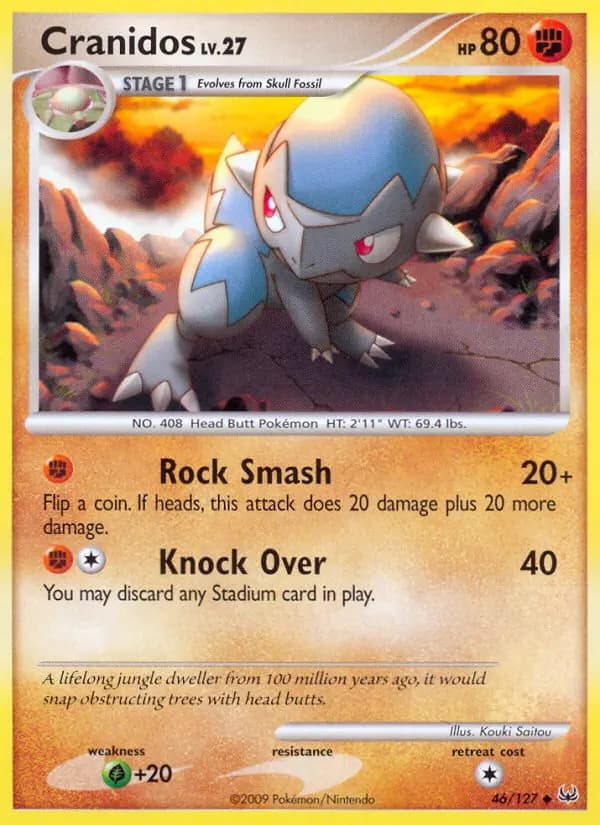
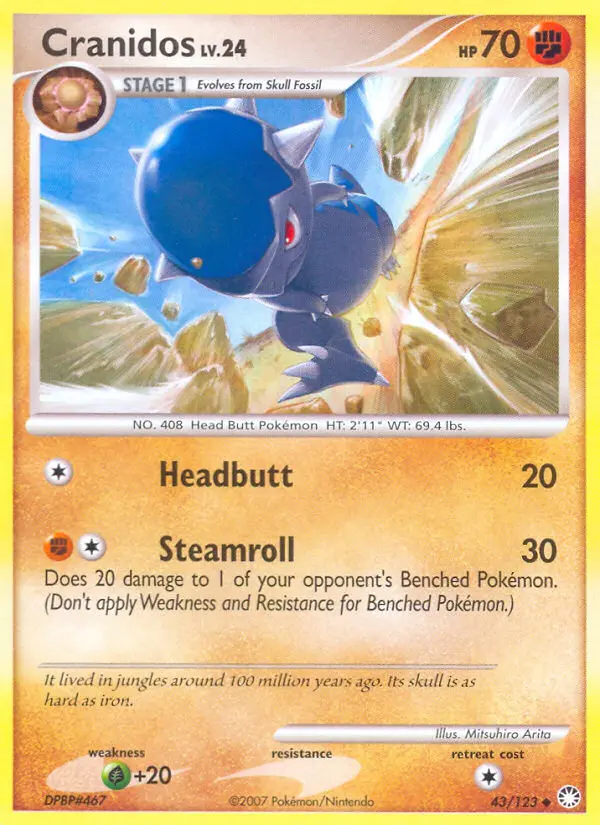
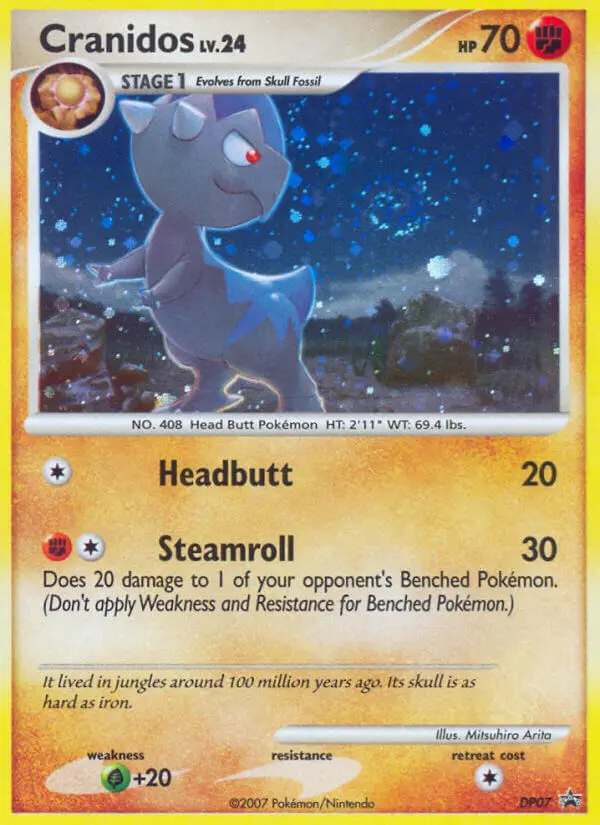
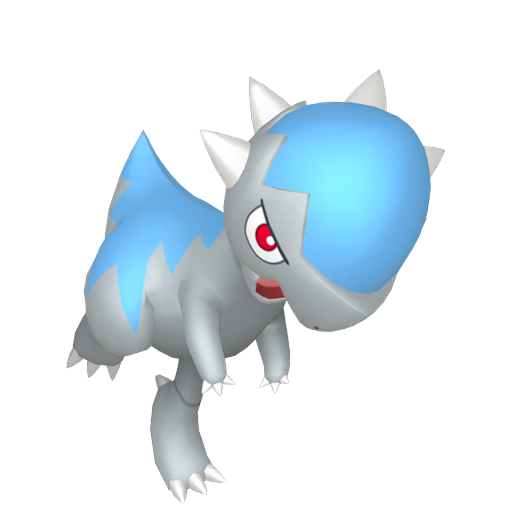
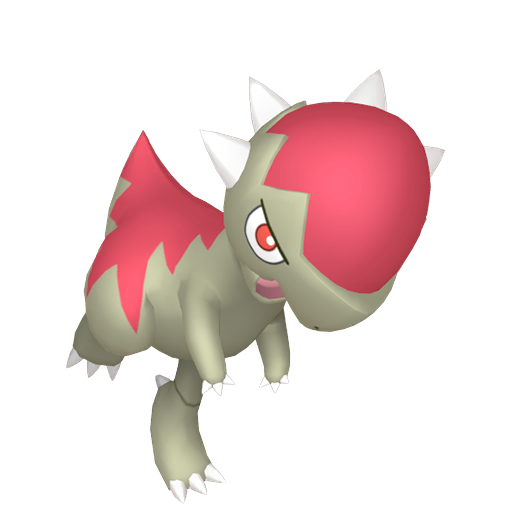
Cranidos presents a distinctly dinosaurian appearance, closely resembling the Pachycephalosaurus with its signature dome-shaped, blue head crowned by four prominent spikes running down its back. Its coloration is primarily gray, with striking red irises that convey an almost primal intensity. The most notable biological feature is undoubtedly its skull, which the Pokédex describes as being as hard as iron—a characteristic that has proven so effective that fossilized tree trunks snapped cleanly in half by Cranidos headbutts are frequently discovered in the same rock layers as Cranidos fossils themselves. Despite its relatively short and stubby arms, Cranidos retains three sharp claws on each limb that prove surprisingly functional in combat. Its body transitions from the hard, spiked upper structure to a more flexible lower half, culminating in a short tail and feet equipped with three forward-facing claws and one backward-facing claw, providing excellent grip for traversing ancient jungle terrain. Notably, the Pokédex entries consistently emphasize that Cranidos notably lacks any significant intelligence, compensating entirely for this mental deficiency with sheer physical prowess and an unyielding will to battle.
Pokedex Numbers
Training
Breeding
Cranidos Breeding, Gender Ratio & Egg Groups
Cranidos exhibits a heavily skewed gender ratio, with approximately 88 percent of the population being male and only 12.5 percent being female, reflecting a common pattern among fossil and prehistoric-themed Pokémon that emphasizes masculine aggression and combat. This dramatic gender disparity means that female Cranidos are considerably rarer and more challenging to obtain through conventional breeding methods, often requiring patience or targeted hunting in specific game locations. Cranidos belongs to the Monster egg group, meaning it can only breed with other Pokémon in that same group, which includes various dinosaur-like, reptilian, and bulky creatures throughout the Pokédex. The breeding process requires a relatively lengthy gestation period of 30 egg cycles, equivalent to 7,454 to 7,710 steps, reflecting the substantial biological investment required to produce offspring of such a robust and heavily-built species. Despite its wild, aggressive temperament, Cranidos maintains a base happiness of 70, suggesting that while it is inherently somewhat ornery, it is not entirely untamable or impossible to bond with through patient training and proper care. Trainers seeking to breed Cranidos for competitive purposes or shiny variants should prepare for an extended commitment, as the combination of gender rarity and lengthy egg cycles makes large-scale breeding operations particularly time-consuming.
Sprites




TMs & HMs
tm01
lets go pikachu lets go eevee
tm02
crystal
tm02
gold silver
tm03
yellow
tm03
crystal
tm03
gold silver
tm03
red blue
tm03
sword shield
tm04
yellow
tm03
blue japan
tm04
red blue
tm03
red green japan
tm04
red green japan
tm04
blue japan
tm05
ruby sapphire
tm05
emerald
tm05
gold silver
tm05
crystal
tm05
diamond pearl
tm05
black white
+761 more TMs/HMs


Cranidos Evolution, Mega Evolution & Special Forms
Cranidos undergoes its evolution into Rampardos at level 30, a transformation that dramatically amplifies its already impressive offensive capabilities while maintaining its fundamental Rock-type classification. This evolution represents a substantial power spike, with Rampardos receiving significant boosts to its Attack, Defense, and Special Attack statistics, transforming Cranidos from a competent physical attacker into one of the most devastating pure physical sweepers available in competitive play. The evolution is straightforward and level-based, requiring no held items, special conditions, or additional mechanics—simply reaching level 30 triggers the automatic transformation. Remarkably, Cranidos and its evolutionary line have no Mega Evolution or alternate forms in any generation, remaining in their original dual configuration throughout all available games and remakes. The transition from Cranidos to Rampardos represents a natural maturation process where the young fossil Pokémon fully realizes its predatory potential, with its skull becoming even more imposing and its overall body structure shifting to accommodate its massively enhanced offensive power.
Where to Find
Alola Route 8
alola
+1 more
Cranidos Behaviour and Natural Habitat
Cranidos was exclusively a jungle dweller during its prehistoric era, approximately 100 million years ago, where it would navigate dense forests by using its legendary headbutting ability to clear obstructing vegetation and topple trees in search of sustenance. The thunderous sound produced when two Cranidos engage in headbutting contests echoes throughout their environment like pealing bells, creating a distinctive acoustic signature of prehistoric territorial disputes. Modern descriptions reveal that Cranidos toughens up their already rock-hard skulls by repeatedly headbutting one another, suggesting that combat and physical competition are intrinsic to their social structure and development. When hunting, Cranidos would downs its prey with devastating headbutts, establishing itself as an apex predator capable of competing with formidable contemporary creatures such as Aerodactyl. In modern times, Cranidos has become a rarely encountered Pokémon, accessible primarily through fossil resurrection or specialized locations such as the Canyon Biome at the Terarium. The aggressive and confrontational nature of Cranidos appears deeply ingrained in its behavior, with few recorded instances of the species displaying docility or cooperation beyond the ritualistic headbutting matches that served to establish dominance hierarchies.
Pokedex Entries
It lived in jungles around 100 million years ago. Its skull is as hard as iron.
It was resurrected from an iron ball-like fossil. It downs prey with its head butts.
A lifelong jungle dweller from 100 million years ago, it would snap obstructing trees with head butts.
CRANIDOS toughen up their already rock-hard heads by headbutting one another.
A lifelong jungle dweller from 100 million years ago, it would snap obstructing trees with head butts.
A lifelong jungle dweller from 100 million years ago, it would snap obstructing trees with head butts.
It was resurrected from an iron ball-like fossil. It downs prey with its headbutts.
A lifelong jungle dweller from 100 million years ago, it would snap obstructing trees with headbutts.
It was resurrected from an iron ball-like fossil. It downs prey with its headbutts.
A lifelong jungle dweller from 100 million years ago, it would snap obstructing trees with headbutts.
It lived in jungles around a hundred million years ago. It used its skillful headbutts to combat Aerodactyl.
A primeval Pokémon, it possesses a hard and sturdy skull, lacking any intelligence within.
In rock layers where Cranidos fossils are found, the fossilized trunks of trees snapped in two are also often found.
Its hard skull is its distinguishing feature. It snapped trees by headbutting them, and then it fed on their ripe berries.
An incredibly rare sight. They duel each other by ramming their heads together, and the resulting sound echoes throughout the area like the pealing of a bell.
Cranidos Name Origin & Design Inspiration
The Japanese name Zugaidos (ズガイドス) combines elements referencing skull structure with the concept of a prehistoric creature, while the English name Cranidos derives from "cranium," the scientific term for the skull, emphasizing the Pokémon's most defining characteristic. The design draws clear inspiration from Pachycephalosaurus, the real-world dinosaur famous for its thick, dome-shaped skull used in intraspecific combat and territorial displays. The four prominent spikes adorning Cranidos's back evoke the dermal ossifications found on various theropod dinosaurs, while its hooked beak mirrors the feeding apparatus of many herbivorous and omnivorous prehistoric reptiles. The blue coloration of its dome and spike pattern contrasts with its primarily gray body, creating visual distinction that emphasizes the hardened, almost gem-like quality of its skull. The stubby arm design reflects the proportions of bipedal dinosaurs while maintaining the Pokémon's quadrupedal stance, creating an interesting anatomical compromise that underscores its position as a physical attacker reliant on cranial impact rather than limb manipulation. Overall, Cranidos represents a successful synthesis of paleontological accuracy with fantastical Pokémon design principles, creating a creature that feels authentically prehistoric while remaining distinctly imaginary.
Learnable Moves
Cranidos can learn 87 moves:
Move | Type | Cat. | Power | Acc. | PP |
|---|---|---|---|---|---|
| ancient power | rock | Special | 60 | 100 | 5 |
| assurance | dark | Physical | 60 | 100 | 10 |
| attract | normal | Status | — | 100 | 15 |
| bite | dark | Physical | 60 | 100 | 25 |
| blizzard | ice | Special | 110 | 70 | 5 |
| body slam | normal | Physical | 85 | 100 | 15 |
| bulldoze | ground | Physical | 60 | 100 | 20 |
| captivate | normal | Status | — | 100 | 20 |
| chip away | normal | Physical | 70 | 100 | 20 |
| confide | normal | Status | — | — | 20 |
| crunch | dark | Physical | 80 | 100 | 15 |
| curse | ghost | Status | — | — | 10 |
| dig | ground | Physical | 80 | 100 | 10 |
| double team | normal | Status | — | — | 15 |
| double edge | normal | Physical | 120 | 100 | 15 |
| dragon cheer | dragon | Status | 0 | 0 | 15 |
| dragon pulse | dragon | Special | 85 | 100 | 10 |
| earth power | ground | Special | 90 | 100 | 10 |
| earthquake | ground | Physical | 100 | 100 | 10 |
| endeavor | normal | Physical | — | 100 | 5 |
| endure | normal | Status | — | — | 10 |
| facade | normal | Physical | 70 | 100 | 20 |
| fire blast | fire | Special | 110 | 85 | 5 |
| fire punch | fire | Physical | 75 | 100 | 15 |
| flamethrower | fire | Special | 90 | 100 | 15 |
| fling | dark | Physical | — | 100 | 10 |
| focus energy | normal | Status | — | — | 30 |
| frustration | normal | Physical | — | 100 | 20 |
| hammer arm | fighting | Physical | 100 | 90 | 10 |
| head smash | rock | Physical | 150 | 80 | 5 |
| headbutt | normal | Physical | 70 | 100 | 15 |
| hidden power | normal | Special | 60 | 100 | 15 |
| ice beam | ice | Special | 90 | 100 | 10 |
| incinerate | fire | Special | 60 | 100 | 15 |
| iron head | steel | Physical | 80 | 100 | 15 |
| iron tail | steel | Physical | 100 | 75 | 15 |
| leer | normal | Status | — | 100 | 30 |
| mud slap | ground | Special | 20 | 100 | 10 |
| natural gift | normal | Physical | — | 100 | 15 |
| payback | dark | Physical | 50 | 100 | 10 |
| power up punch | fighting | Physical | 40 | 100 | 20 |
| protect | normal | Status | — | — | 10 |
| pursuit | dark | Physical | 40 | 100 | 20 |
| rain dance | water | Status | — | — | 5 |
| rest | psychic | Status | — | — | 5 |
| return | normal | Physical | — | 100 | 20 |
| roar | normal | Status | — | — | 20 |
| rock blast | rock | Physical | 25 | 90 | 10 |
| rock climb | normal | Physical | 90 | 85 | 20 |
| rock polish | rock | Status | — | — | 20 |
| rock slide | rock | Physical | 75 | 90 | 10 |
| rock smash | fighting | Physical | 40 | 100 | 15 |
| rock tomb | rock | Physical | 60 | 95 | 15 |
| round | normal | Special | 60 | 100 | 15 |
| sandstorm | rock | Status | — | — | 10 |
| scary face | normal | Status | — | 100 | 10 |
| screech | normal | Status | — | 85 | 40 |
| secret power | normal | Physical | 70 | 100 | 20 |
| shock wave | electric | Special | 60 | — | 20 |
| slam | normal | Physical | 80 | 75 | 20 |
| sleep talk | normal | Status | — | — | 10 |
| smack down | rock | Physical | 50 | 100 | 15 |
| snore | normal | Special | 50 | 100 | 15 |
| spite | ghost | Status | — | 100 | 10 |
| stealth rock | rock | Status | — | — | 20 |
| stomp | normal | Physical | 65 | 100 | 20 |
| stomping tantrum | ground | Physical | 75 | 100 | 10 |
| stone edge | rock | Physical | 100 | 80 | 5 |
| strength | normal | Physical | 80 | 100 | 15 |
| substitute | normal | Status | — | — | 10 |
| sunny day | fire | Status | — | — | 5 |
| superpower | fighting | Physical | 120 | 100 | 5 |
| swagger | normal | Status | — | 85 | 15 |
| swords dance | normal | Status | — | — | 20 |
| tackle | normal | Physical | 40 | 100 | 35 |
| take down | normal | Physical | 90 | 85 | 20 |
| tera blast | normal | Special | 80 | 100 | 10 |
| thief | dark | Physical | 60 | 100 | 25 |
| thrash | normal | Physical | 120 | 100 | 10 |
| thunder | electric | Special | 110 | 70 | 10 |
| thunder punch | electric | Physical | 75 | 100 | 15 |
| thunderbolt | electric | Special | 90 | 100 | 15 |
| toxic | poison | Status | — | 90 | 10 |
| trailblaze | grass | Physical | 50 | 100 | 20 |
| uproar | normal | Special | 90 | 100 | 10 |
| whirlwind | normal | Status | — | — | 20 |
| zen headbutt | psychic | Physical | 80 | 90 | 15 |
Cranidos Competitive Battle Guide
In competitive Pokémon play, Cranidos occupies a niche role as a physical attacker with respectable offensive capabilities but significant defensive limitations that restrict its viability to specific strategic contexts. Its outstanding Attack stat of 125 is its primary asset, allowing it to deal substantial damage with Rock-type moves such as Stone Edge and Head Smash, as well as coverage moves including Earthquake and Crunch. However, its abysmal Defense and Special Defense statistics, both sitting at just 30, mean that Cranidos is exceptionally vulnerable to any attack that connects, forcing players to adopt an aggressive offensive strategy that attempts to knock out opponents before taking damage. Cranidos's movepool is functional but not exceptional, with reliable physical STAB moves and solid coverage options, though its limited Speed stat of 58 means it frequently requires priority moves or strategic entry hazards to function effectively. Its two abilities present distinct strategic options: Mold Breaker bypasses abilities that would normally block or hinder moves, allowing Cranidos to attack through defensive abilities such as Levitate or Filter, while its hidden ability Sheer Force amplifies moves with secondary effects by 30 percent at the cost of eliminating those effects entirely. In practice, most trainers prefer Mold Breaker for its reliability and flexibility, though Sheer Force provides interesting niche applications when paired with moves like Stone Edge that gain substantial damage boosts. Cranidos's primary limitation remains its extreme fragility and low Speed, which relegates it to specialized roles rather than mainstream competitive viability, making it far less common in serious competitive environments than its evolved form Rampardos.
Commonly Asked Questions About Cranidos
What type is Cranidos?
Cranidos is a rock type Pokemon.
What does Cranidos evolve into?
Cranidos evolves into rampardos.
What are Cranidos's weaknesses?
Cranidos is weak to fighting, ground, steel, water and grass type moves.
Does Cranidos evolve by trading?
No — Cranidos evolves entirely through leveling up, with no trade required at any stage.
Where can I find Cranidos?
Cranidos can be found in alola route 8 (alola).
Cranidos Cultural Impact & Franchise History
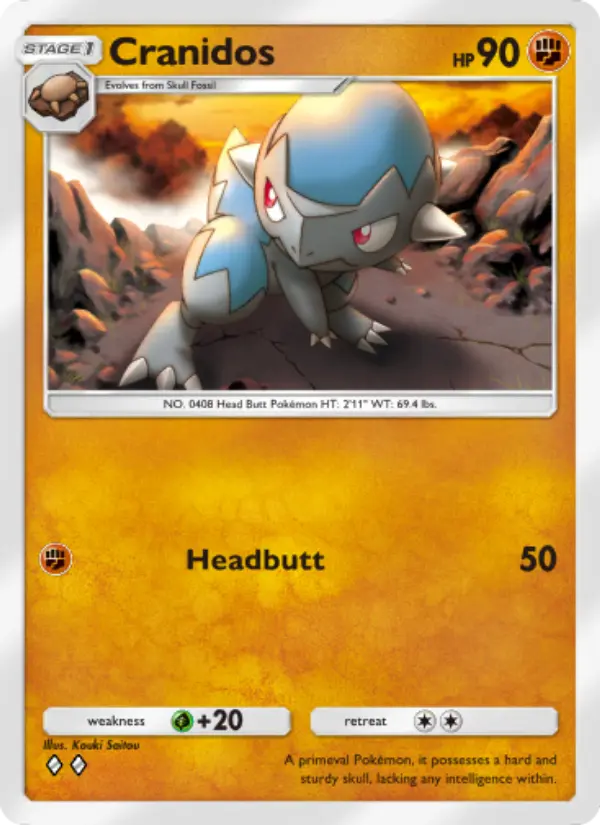
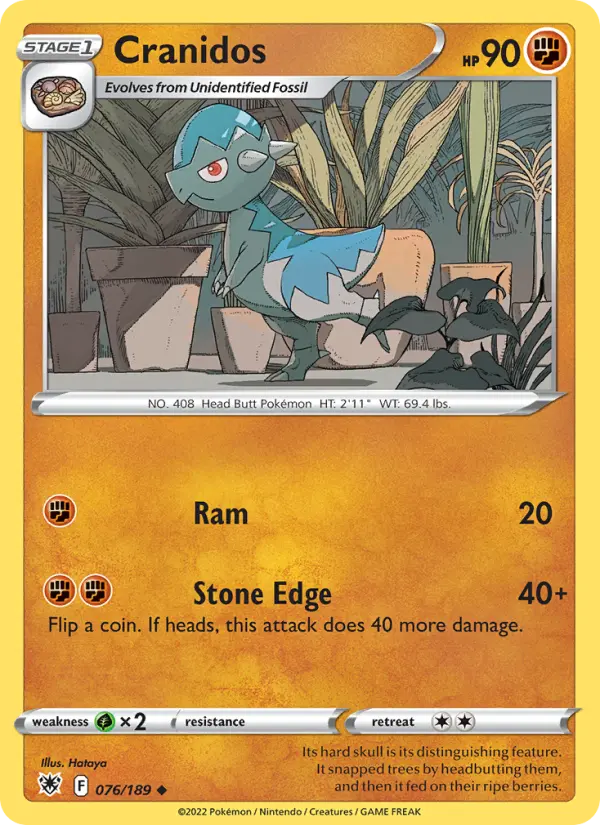
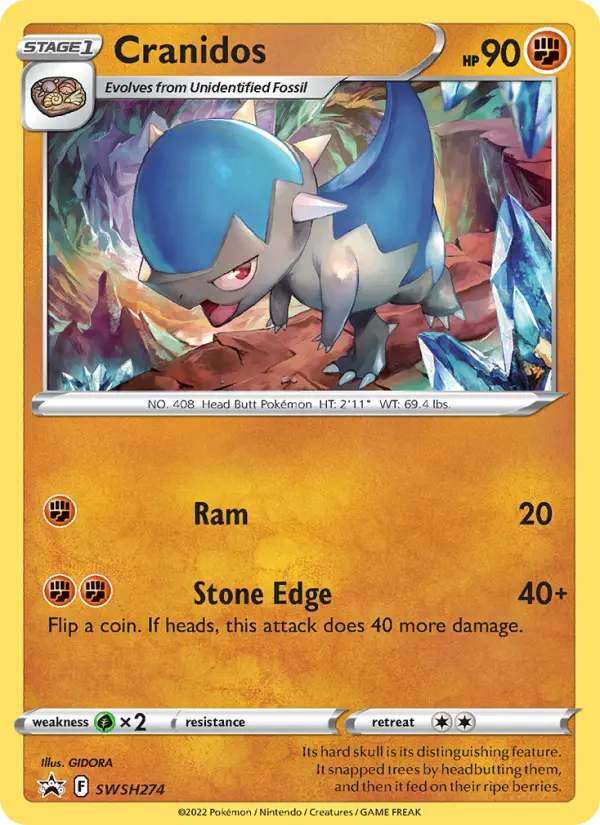
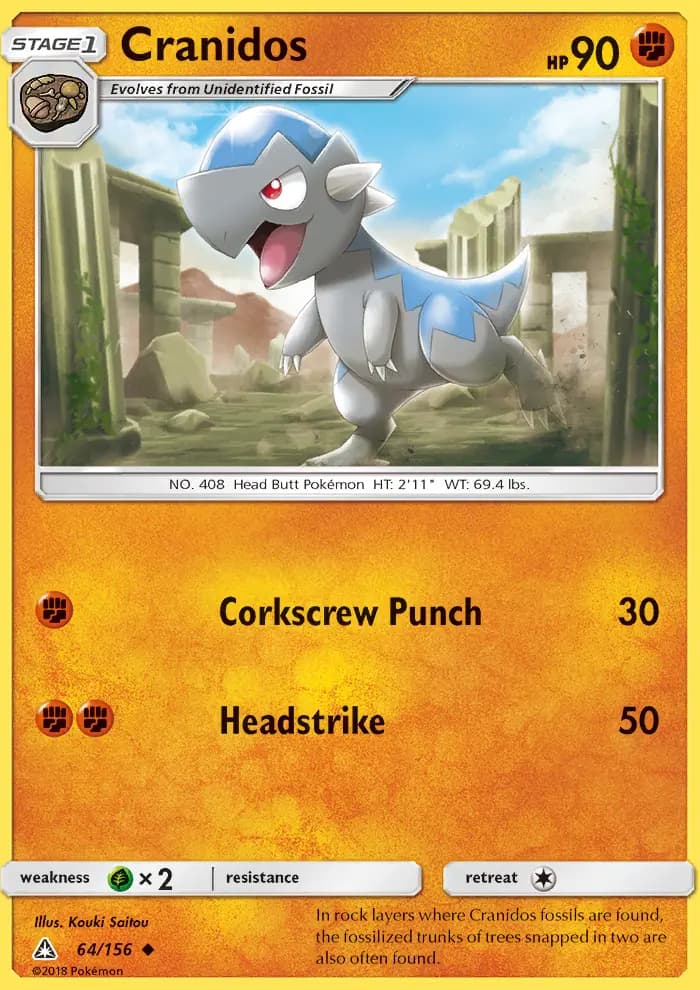
Cranidos achieved significant cultural prominence in the Pokémon anime through Roark, the Rock-type specialist gym leader of Oreburgh City in the Sinnoh region, whose Cranidos served as a major character Pokémon and memorable opponent in the early episodes of the Diamond and Pearl series. The species's prominence in the anime introduced the concept of fossil resurrection to many viewers and established Cranidos as an iconic representation of prehistoric power and aggression. Beyond the anime, Cranidos has appeared consistently across the trading card game throughout multiple generations, with various card iterations exploring its fossil origins and its raw physical power. The design resonates with players and audiences who appreciate prehistoric themes and dinosaur-inspired Pokémon, contributing to enduring popularity among fans of Generation IV content. Cranidos's distinctive silhouette and memorable headbutting mechanics have made it recognizable across the broader Pokémon community, even among casual players who may not use it competitively. The fossil mechanics introduced in Generation IV, of which Cranidos is a prominent example, influenced subsequent generations' approaches to extinct Pokémon, establishing a template for blending scientific plausibility with Pokémon design aesthetics. In the broader context of Pokémon lore, Cranidos represents the bridge between ancient natural history and modern Pokémon science, embodying questions about extinction, resurrection, and the nature of creatures that existed in geological eras before human civilization.
Where to Find Cranidos in Every Pokémon Game
Cranidos availability varies significantly across different Pokémon games, with the most direct method of obtaining one being the revival of a Skull Fossil, a mechanic available in Diamond, Pearl, Platinum, and their later remakes Brilliant Diamond and Shining Pearl. In the original Diamond and Pearl versions, players can obtain the Skull Fossil early in the game and have it revived at the Oreburgh Mining Museum, with the fossil available as either the exclusive choice in Diamond or through trading, as Pearl players receive the Root Fossil instead. Platinum maintains this availability, providing players with a choice between fossils but allowing Skull Fossil possession for Cranidos acquisition. In subsequent generations including Black, White, X, Y, and their sequel versions, Cranidos becomes less directly accessible, typically requiring trading or other indirect methods rather than fossil revival. The Terarium's Canyon Biome in modern games provides an alternative encounter location, allowing players to encounter wild Cranidos without requiring fossil resurrection. In Pokémon Legends: Arceus and the recent Indigo Disk DLC for Sword and Shield, Cranidos receives updated availability that reflects the game's mechanics and regional Pokédex restrictions. The capture rate of 45 makes Cranidos moderately challenging to catch in the wild, requiring standard-strength Poké Balls and some patience, though fossil-resurrected specimens are automatically obtained without capture mechanics. Availability remains somewhat restricted compared to common Pokémon, emphasizing Cranidos's status as a relatively rare and special encounter that rewards players for exploring caves, investing in fossil revival systems, or accessing specialized biomes.