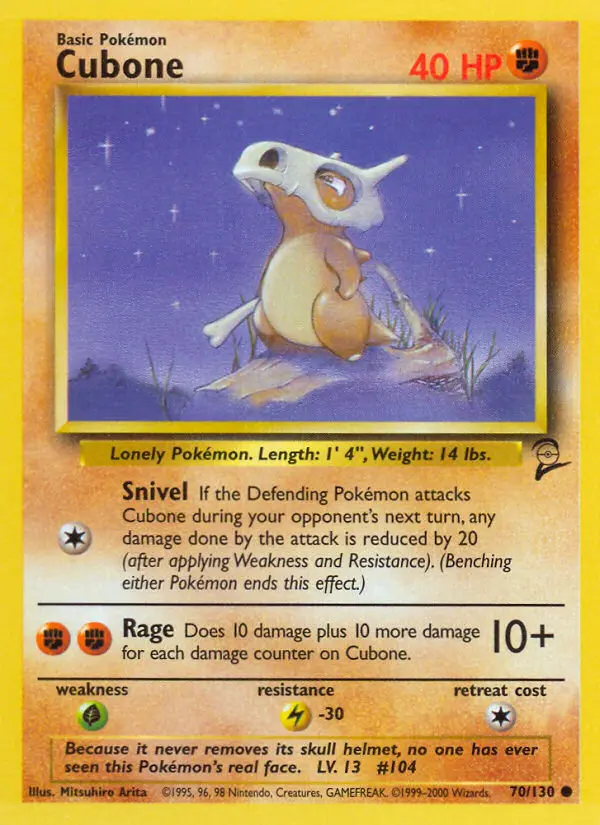
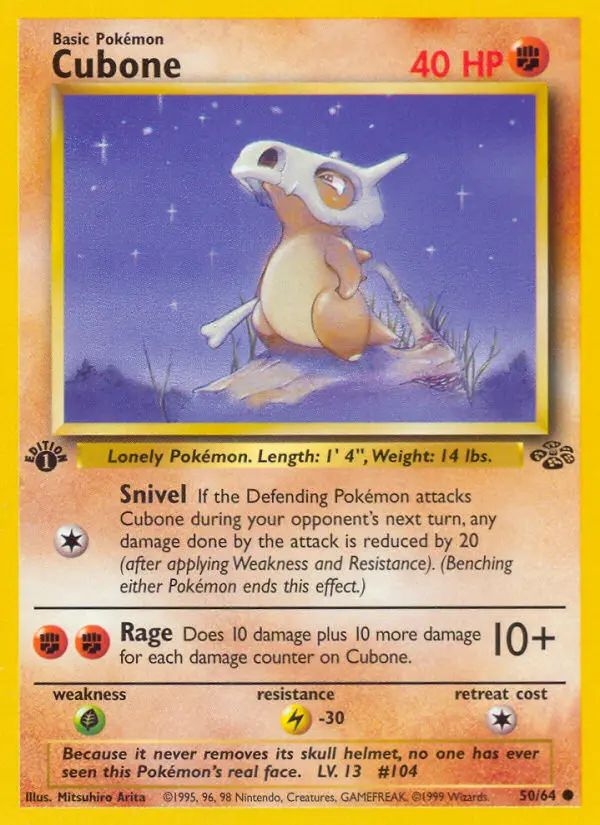
Cubone
Generation I · #0104 — Lonely Pokémon
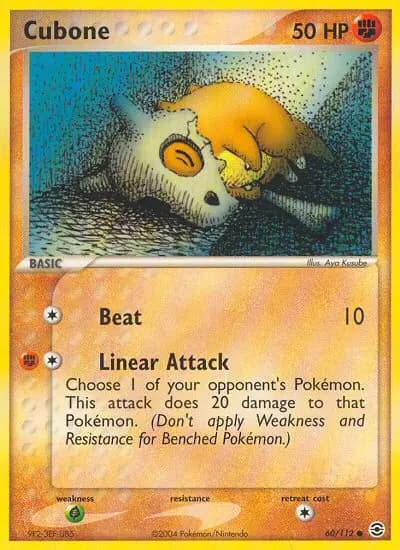
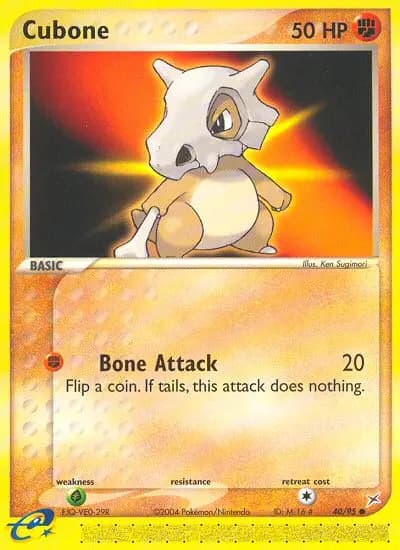
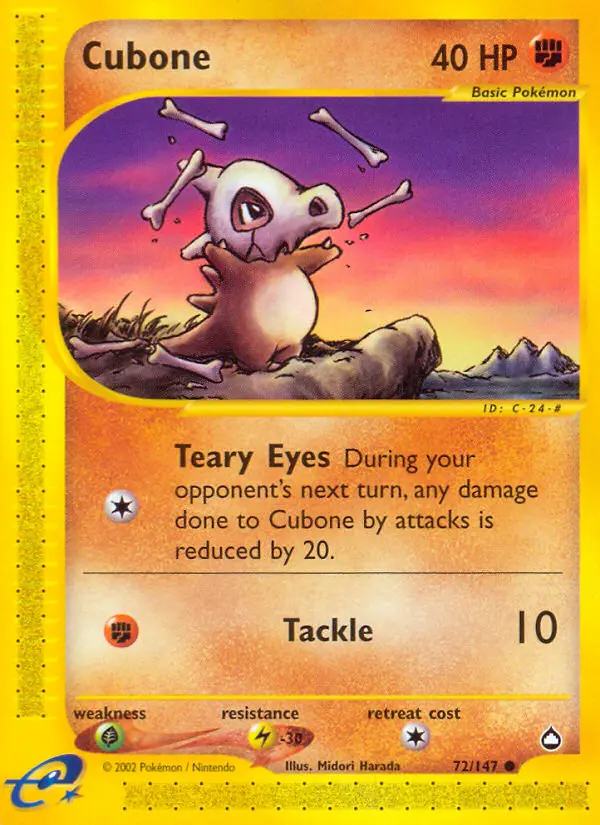
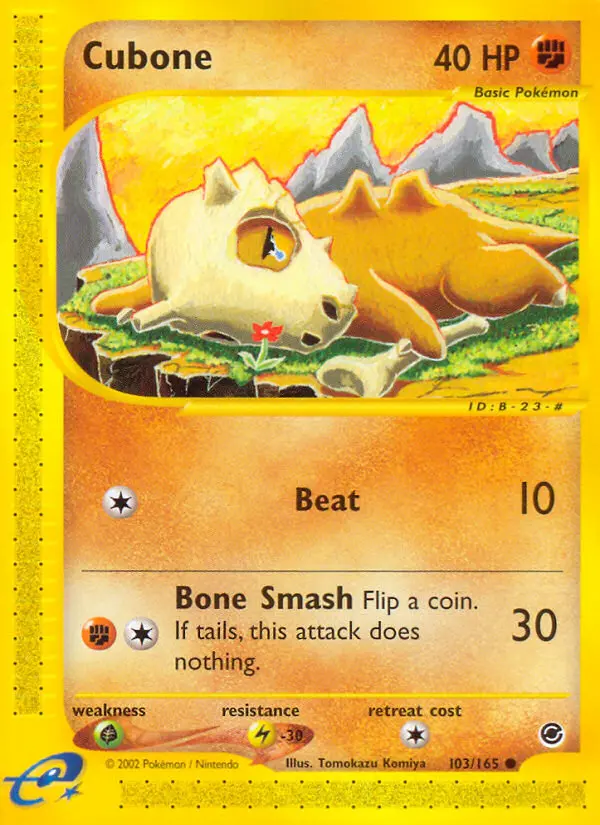
Cubone is a ground-type Pokémon whose defense — 95 at base — does more to define its role than its overall spread does. At 0.4 m and 6.5 kg, its build reflects a specialist role rather than a generalist one. Despite its modest size, Cubone possesses a distinctive and emotionally evocative design centered around the skull helmet it wears—the skull of its deceased mother. This tragic backstory, combined with its Pokédex number of #104, has made Cubone one of the most memorable and poignant creatures in the franchise, often serving as an emotional anchor in narratives exploring themes of loss, mourning, and resilience. The species evolves into Marowak at level 28, and in the Alola region specifically, it can evolve into the Fire/Ghost-type Alolan Marowak when leveled up during nighttime hours.
Editor's Take
Cubone wearing its mother's skull is the darkest piece of Pokédex lore in Gen 1, and Marowak's Thick Club doubling Attack is the item that made the line competitively real.
Base Stats
Height
0.4m
Weight
6.5kg
Category
Lonely Pokémon
Gender
Male 50% / Female 50%
Color
brown
Shape
upright
Habitat
mountain
Abilities
Protects against recoil damage.
Redirects single-target electric moves to this Pokémon where possible. Absorbs Electric moves, raising Special Attack one stage.
Protects against critical hits.
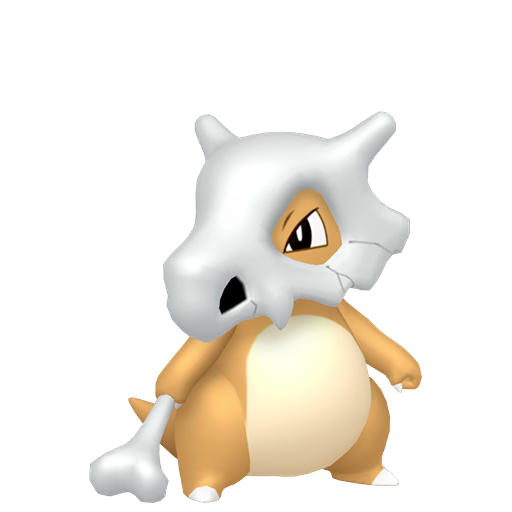
Cubone Biology & Physical Characteristics
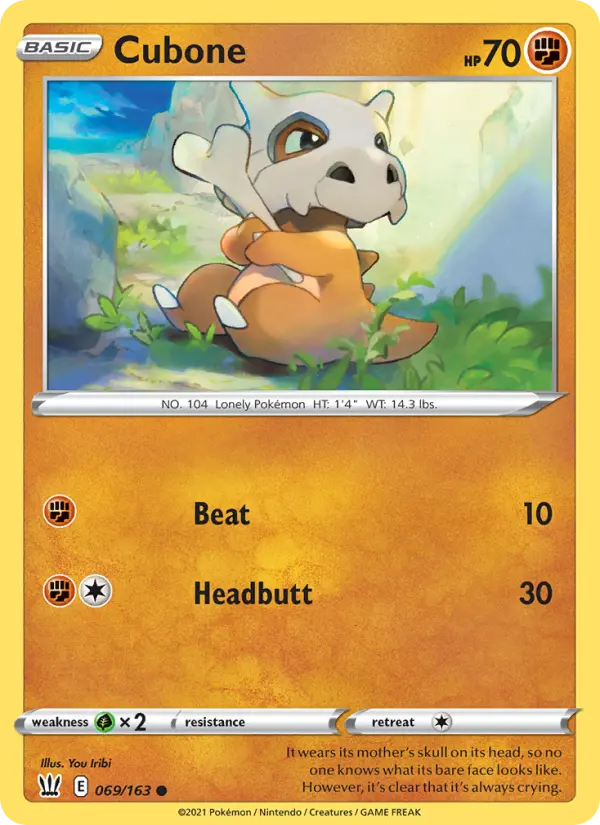
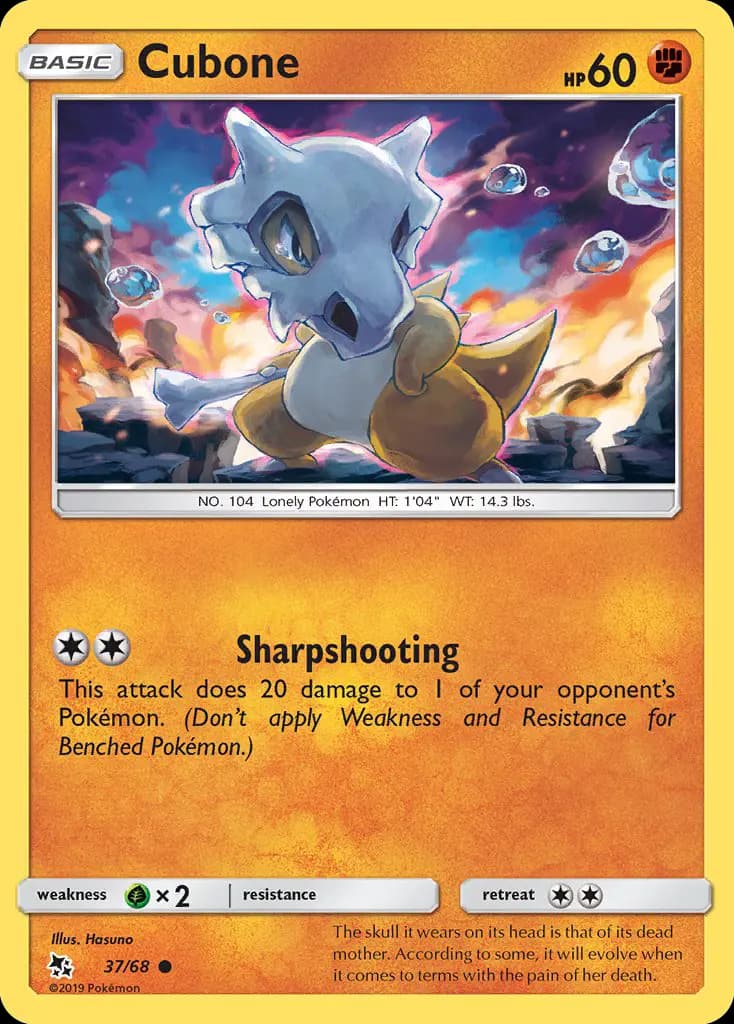
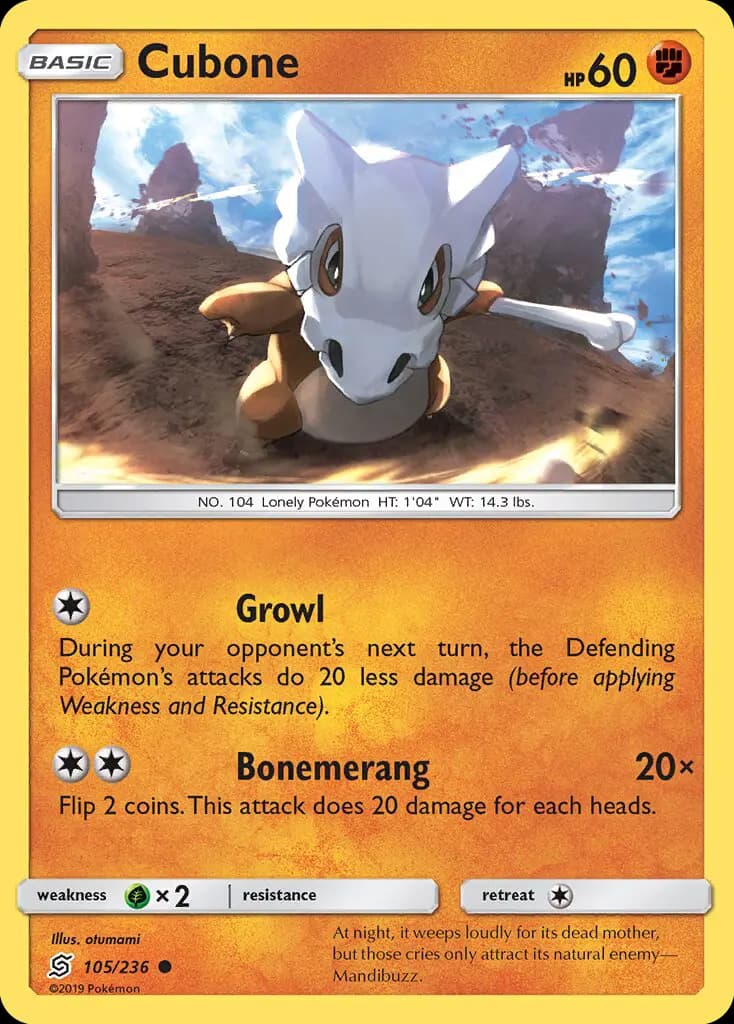
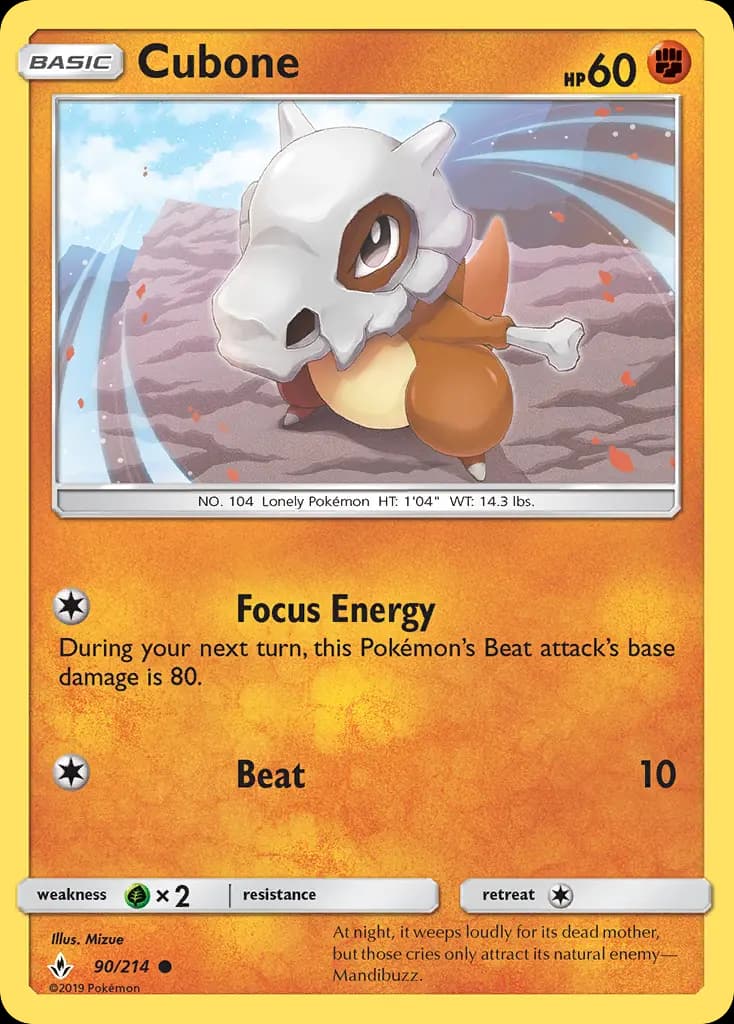
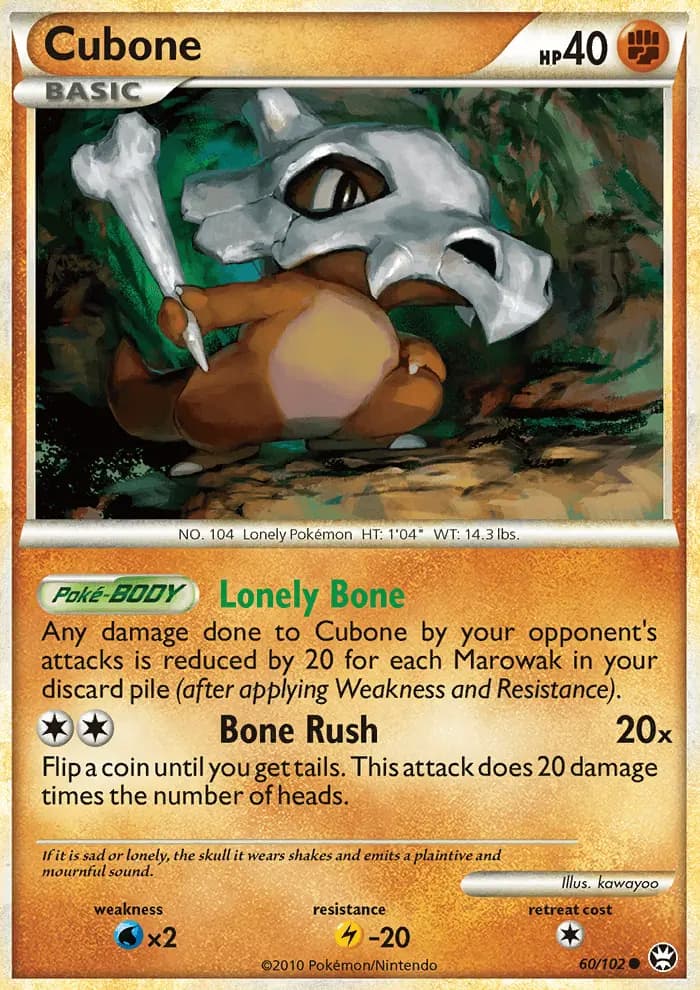
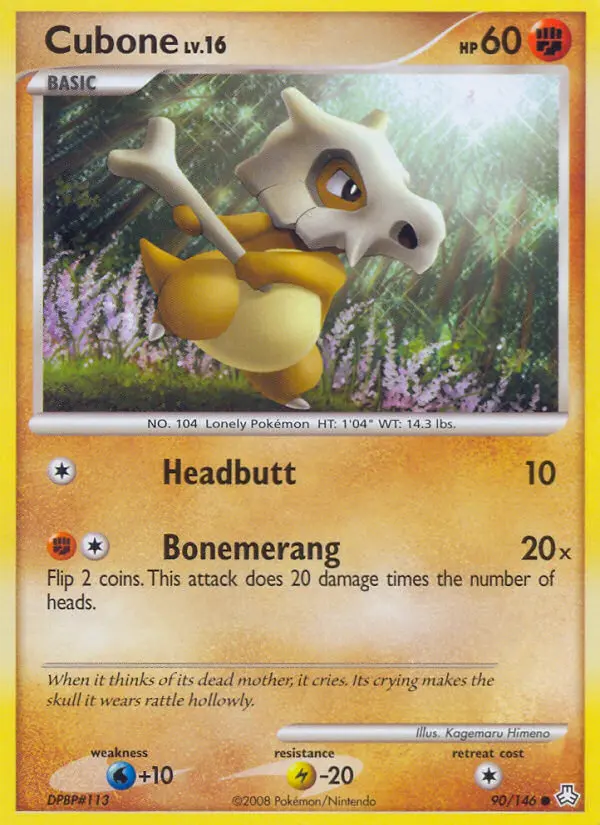
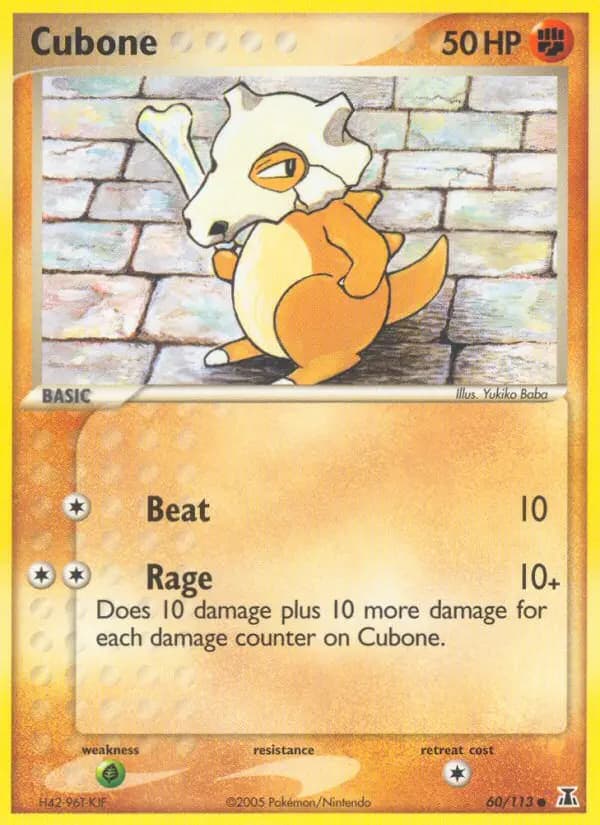
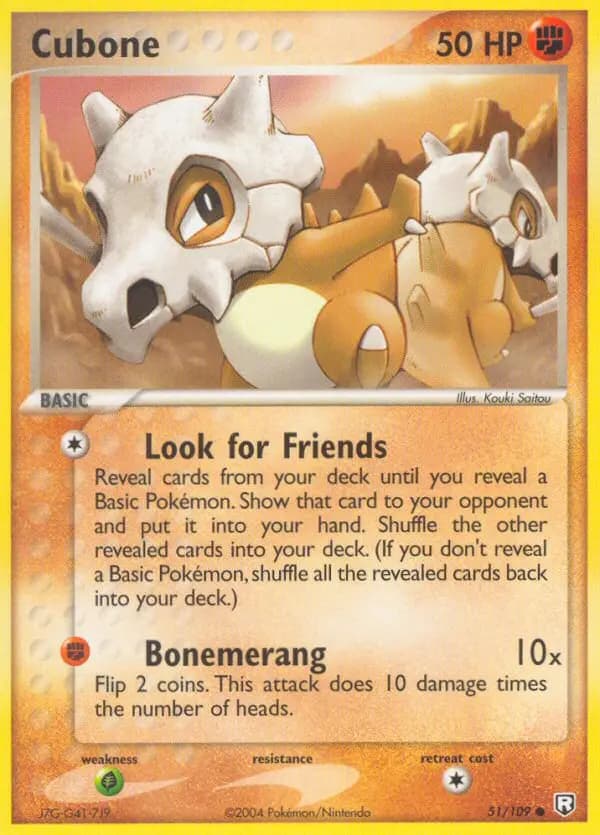
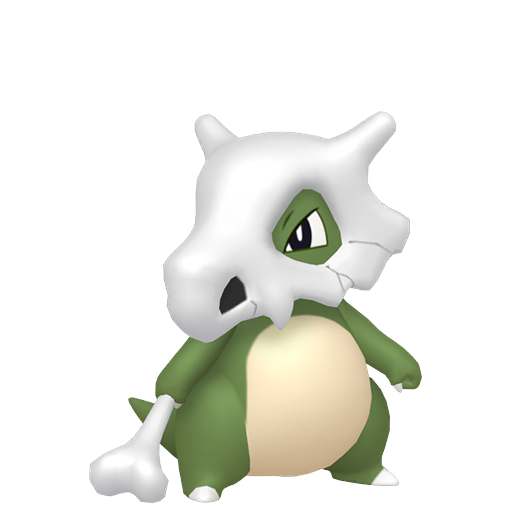
Cubone is a small, dinosaur-like reptilian Pokémon with a light brown hide covering most of its body, contrasting with a cream-colored belly that provides visual balance to its design. The creature possesses two small claws that serve as thumbs on each hand and one large nail on each foot functioning as a toe, giving it a primitive yet functional anatomy well-suited to its ground-dwelling nature. Two small spikes protrude from its back, and a short tail extends from its posterior. Most notably, Cubone's head is completely covered by the skull of its deceased mother, which features two rounded horns atop its crown and tooth-like points along the lower sides. The only visible portions of Cubone's actual face are its triangular black eyes and the immediate area surrounding them, along with a small brown snout visible beneath the skull. Within the skull lies Cubone's true face, which remains an enigma—no one has ever seen it removed, though glimpses in official artwork reveal sharp teeth and a long pink tongue. This constant concealment creates an air of mystery that defines much of Cubone's character and appeal.
Pokedex Numbers
Training
Breeding
Cubone Breeding, Gender Ratio & Egg Groups
Cubone maintains a balanced gender ratio of 50% male to 50% female, allowing equal breeding potential regardless of the player's starter choice or encountered specimens. The species belongs to the Monster Egg Group, which includes various reptilian and dinosaur-like Pokémon such as Charmander, Bulbasaur, Rhyhorn, and others, providing diverse breeding compatibility options for trainers seeking to produce eggs. With a base friendship value of 70, Cubone is moderately receptive to being raised and bonded with by its trainer, though it requires some effort to maximize affection and loyalty. The species has a hatch counter of 20 cycles, meaning eggs containing Cubone require approximately 4,884 to 5,140 steps to hatch depending on the trainer's walking speed and any egg-hatching acceleration items or abilities they employ. Breeding Cubone can yield interesting results when paired with compatible Pokémon from the Monster group, and the offspring inherits the emotional and physical characteristics that define the species. The relatively high catch rate of 190 makes Cubone reasonably accessible to trainers in the wild, reducing reliance on breeding for obtaining the species, though deliberately breeding for favorable nature and individual values remains a viable strategy for competitive players.
Sprites




Held Items
Thick Club
species-specific
Doubles Cubone or Marowak’s Attack.
Cost: 1000
Thick Club
species-specific
Doubles Cubone or Marowak’s Attack.
Cost: 1000
Thick Club
species-specific
Doubles Cubone or Marowak’s Attack.
Cost: 1000
Thick Club
species-specific
Doubles Cubone or Marowak’s Attack.
Cost: 1000
Thick Club
species-specific
Doubles Cubone or Marowak’s Attack.
Cost: 1000
Thick Club
species-specific
Doubles Cubone or Marowak’s Attack.
Cost: 1000
Thick Club
species-specific
Doubles Cubone or Marowak’s Attack.
Cost: 1000
Thick Club
species-specific
Doubles Cubone or Marowak’s Attack.
Cost: 1000
Thick Club
species-specific
Doubles Cubone or Marowak’s Attack.
Cost: 1000
Thick Club
species-specific
Doubles Cubone or Marowak’s Attack.
Cost: 1000
Thick Club
species-specific
Doubles Cubone or Marowak’s Attack.
Cost: 1000
Thick Club
species-specific
Doubles Cubone or Marowak’s Attack.
Cost: 1000
Thick Club
species-specific
Doubles Cubone or Marowak’s Attack.
Cost: 1000
Thick Club
species-specific
Doubles Cubone or Marowak’s Attack.
Cost: 1000
Thick Club
species-specific
Doubles Cubone or Marowak’s Attack.
Cost: 1000
Thick Club
species-specific
Doubles Cubone or Marowak’s Attack.
Cost: 1000
Thick Club
species-specific
Doubles Cubone or Marowak’s Attack.
Cost: 1000
Thick Club
species-specific
Doubles Cubone or Marowak’s Attack.
Cost: 1000
Thick Club
species-specific
Doubles Cubone or Marowak’s Attack.
Cost: 1000
Thick Club
species-specific
Doubles Cubone or Marowak’s Attack.
Cost: 1000
Thick Club
species-specific
Doubles Cubone or Marowak’s Attack.
Cost: 1000
Thick Club
species-specific
Doubles Cubone or Marowak’s Attack.
Cost: 1000
Thick Club
species-specific
Doubles Cubone or Marowak’s Attack.
Cost: 1000
Thick Club
species-specific
Doubles Cubone or Marowak’s Attack.
Cost: 1000
Thick Club
species-specific
Doubles Cubone or Marowak’s Attack.
Cost: 1000
Thick Club
species-specific
Doubles Cubone or Marowak’s Attack.
Cost: 1000
Thick Club
species-specific
Doubles Cubone or Marowak’s Attack.
Cost: 1000
Thick Club
species-specific
Doubles Cubone or Marowak’s Attack.
Cost: 1000
Thick Club
species-specific
Doubles Cubone or Marowak’s Attack.
Cost: 1000
Thick Club
species-specific
Doubles Cubone or Marowak’s Attack.
Cost: 1000
Thick Club
species-specific
Doubles Cubone or Marowak’s Attack.
Cost: 1000
Thick Club
species-specific
Doubles Cubone or Marowak’s Attack.
Cost: 1000
Thick Club
species-specific
Doubles Cubone or Marowak’s Attack.
Cost: 1000
Thick Club
species-specific
Doubles Cubone or Marowak’s Attack.
Cost: 1000
Thick Club
species-specific
Doubles Cubone or Marowak’s Attack.
Cost: 1000
Thick Club
species-specific
Doubles Cubone or Marowak’s Attack.
Cost: 1000
Thick Club
species-specific
Doubles Cubone or Marowak’s Attack.
Cost: 1000
Thick Club
species-specific
Doubles Cubone or Marowak’s Attack.
Cost: 1000
Thick Club
species-specific
Doubles Cubone or Marowak’s Attack.
Cost: 1000
Thick Club
species-specific
Doubles Cubone or Marowak’s Attack.
Cost: 1000
Thick Club
species-specific
Doubles Cubone or Marowak’s Attack.
Cost: 1000
Thick Club
species-specific
Doubles Cubone or Marowak’s Attack.
Cost: 1000
Thick Club
species-specific
Doubles Cubone or Marowak’s Attack.
Cost: 1000
Thick Club
species-specific
Doubles Cubone or Marowak’s Attack.
Cost: 1000
TMs & HMs
tm00
sword shield
tm01
yellow
tm01
gold silver
tm01
crystal
tm01
red blue
tm01
platinum
tm01
emerald
tm01
diamond pearl
tm01
firered leafgreen
tm01
ruby sapphire
tm01
xd
tm01
colosseum
tm01
heartgold soulsilver
tm01
lets go pikachu lets go eevee
tm01
blue japan
tm01
red green japan
tm01
sword shield
tm02
crystal
tm02
gold silver
tm03
yellow
+609 more TMs/HMs


Cubone Evolution, Mega Evolution & Special Forms
Cubone undergoes a transformation into Marowak upon reaching level 28, a standard evolution that sees the young Pokémon mature into a more powerful and confident form. The evolution process represents Cubone's growth from a grieving, lonely state into a more assertive creature, though the emotional weight of its mother's death remains part of its identity. In the Alola region, however, Cubone's evolution takes a dramatically different path when leveled up during nighttime hours—it becomes Alolan Marowak, a Fire/Ghost-type Pokémon that stands as a regional variant unique to Generation VII. This alternate evolution reflects the cultural and environmental influences of the Alola archipelago, transforming Cubone's mourning into a spiritual connection that manifests as ghostly Fire-type energy. The appearance and typing of Alolan Marowak are so drastically different from the standard Marowak that it represents one of the most significant regional transformations in the franchise, suggesting that Cubone's journey toward acceptance and transcendence of grief takes fundamentally different forms depending on its environment and circumstances.
Where to Find
Pokemon Tower
kanto
+68 more
Kanto Safari Zone
kanto
Rock Tunnel
kanto
+25 more
Sevault Canyon
kanto
Sinnoh Route 203
sinnoh
+3 more
Johto Safari Zone
johto
+5 more
Glittering Cave
kalos
+1 more
Wela Volcano Park
alola
+1 more
Cubone Behaviour and Natural Habitat
Cubone earns its designation as the Lonely Pokémon through its solitary and withdrawn nature, preferring to keep to itself rather than engage in social interaction with other Pokémon or humans. The creature's emotional depth is evident in the Pokédex entries describing how it pines for the mother it lost at birth, gazing at the full moon as a way of remembering her image. When sad or lonely, the skull Cubone wears trembles and produces mournful, plaintive sounds—the creature's cries echo within the hollow skull, creating a haunting melody that echoes its inner sorrow. The stains visible on the skull are tear marks, physical evidence of Cubone's grief accumulated over time. Despite its melancholic disposition, Cubone demonstrates remarkable survival skills and possesses exceptional prowess in wielding the bone it carries as a weapon, suggesting that beneath its sorrowful exterior lies a determined spirit. These Pokémon are typically found in rocky caves and mountainous terrain where they can remain undisturbed, though specific habitat locations vary by region and game generation.
Pokedex Entries
Because it never removes its skull helmet, no one has ever seen this POKéMON's real face.
Wears the skull of its deceased mother. Its cries echo inside the skull and come out as a sad melody.
If it is sad or lonely, the skull it wears shakes, and emits a plain tive and mournful sound.
It always wears the skull of its dead mother, so no one has any idea what its hidden face looks like.
It lost its mother after its birth. It wears its mother's skull, never revealing its true face.
CUBONE pines for the mother it will never see again. Seeing a likeness of its mother in the full moon, it cries. The stains on the skull the POKéMON wears are made by the tears it sheds.
It pines for the mother it will never see again. Seeing a likeness of its mother in the full moon, it cries. The stains on the skull it wears are from its tears.
It wears the skull of its dead mother on its head. When it becomes lonesome, it is said to cry loudly.
Because it never removes its skull helmet, no one has ever seen this POKéMON’s real face.
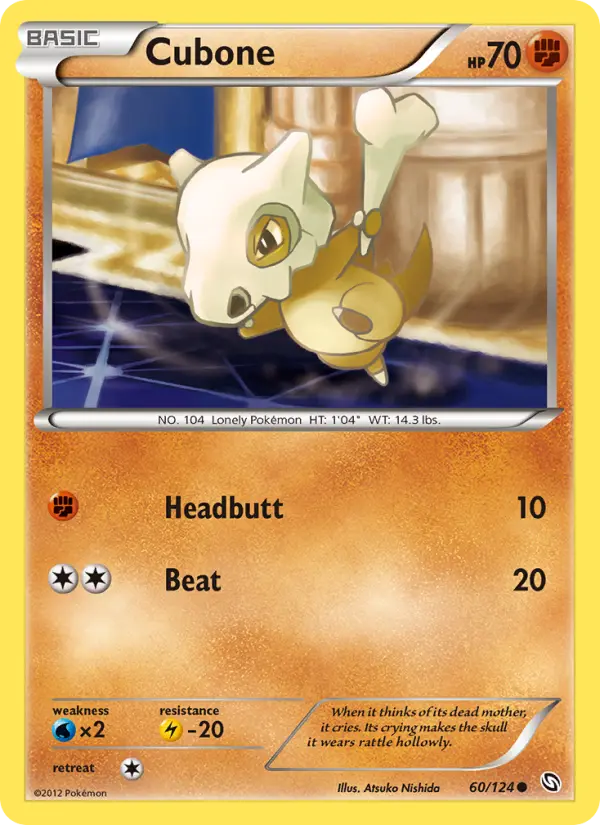
When it thinks of its dead mother, it cries. Its crying makes the skull it wears rattle hollowly.
If it is sad or lonely, the skull it wears shakes and emits a plaintive and mournful sound.
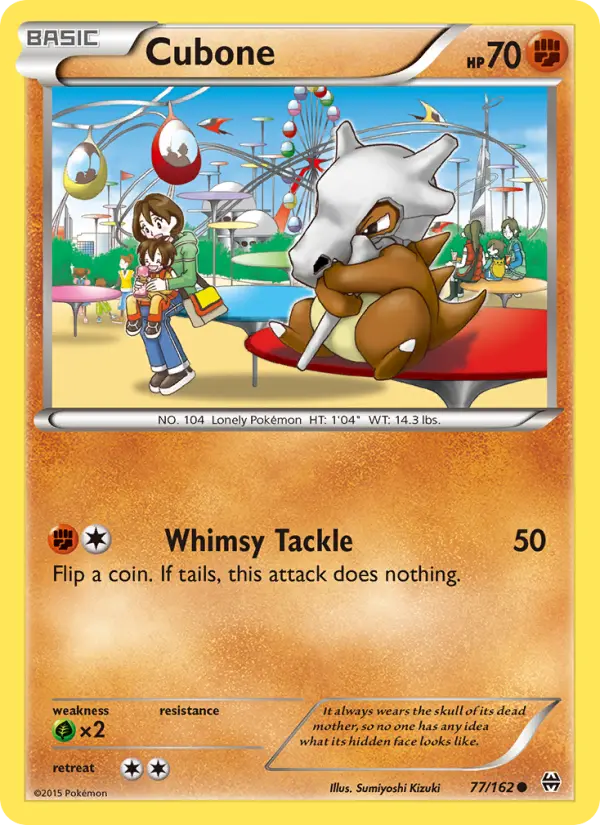
It always wears the skull of its dead mother, so no one has any idea what its hidden face looks like.
When it thinks of its dead mother, it cries. Its crying makes the skull it wears rattle hollowly.
When it thinks of its dead mother, it cries. Its crying makes the skull it wears rattle hollowly.
It wears the skull of its dead mother on its head. When it becomes lonesome, it is said to cry loudly.
It always wears the skull of its dead mother, so no one has any idea what its hidden face looks like.
Cubone pines for the mother it will never see again. Seeing a likeness of its mother in the full moon, it cries. The stains on the skull the Pokémon wears are made by the tears it sheds.
Cubone pines for the mother it will never see again. Seeing a likeness of its mother in the full moon, it cries. The stains on the skull the Pokémon wears are made by the tears it sheds.
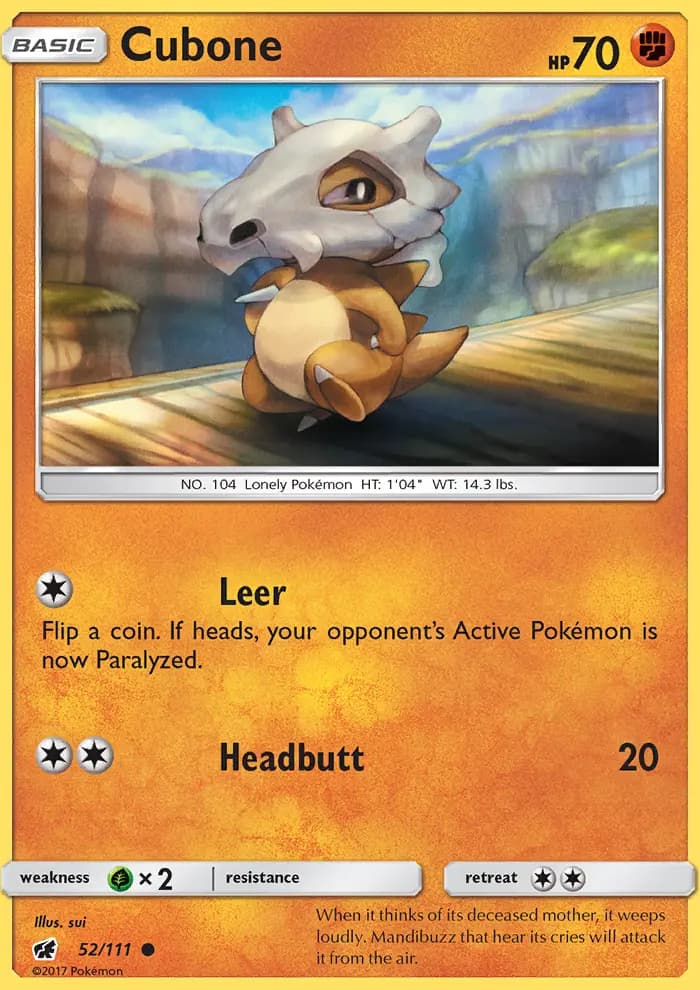
When it thinks of its deceased mother, it weeps loudly. Mandibuzz that hear its cries will attack it from the air.
At night, it weeps loudly for its dead mother, but those cries only attract its natural enemy—Mandibuzz.
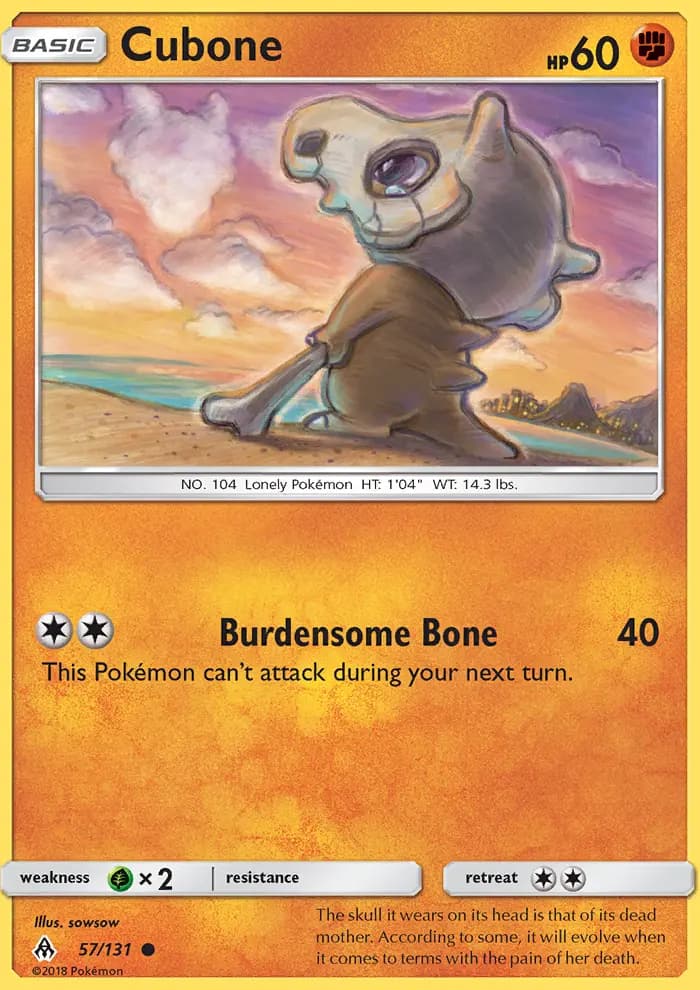
The skull it wears on its head is that of its dead mother. According to some, it will evolve when it comes to terms with the pain of her death.
It wears its mother’s skull on its head, so no one knows what its bare face looks like. However, it’s clear that it’s always crying.
Wears the skull of its deceased mother. Its cries echo inside the skull and come out as a sad melody.
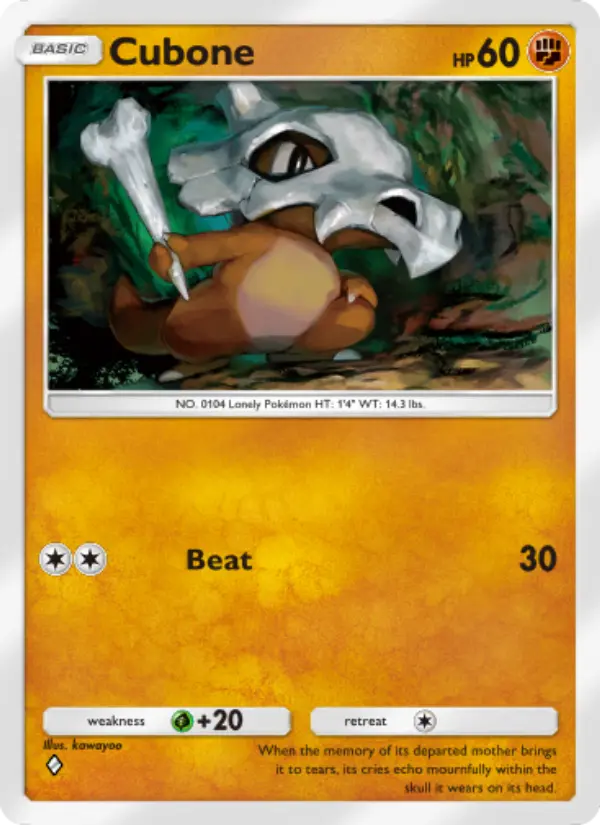
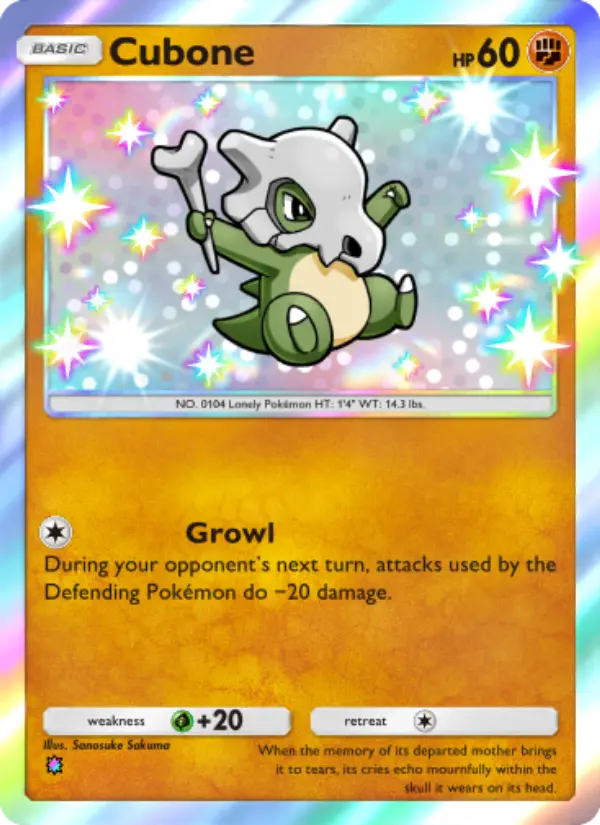
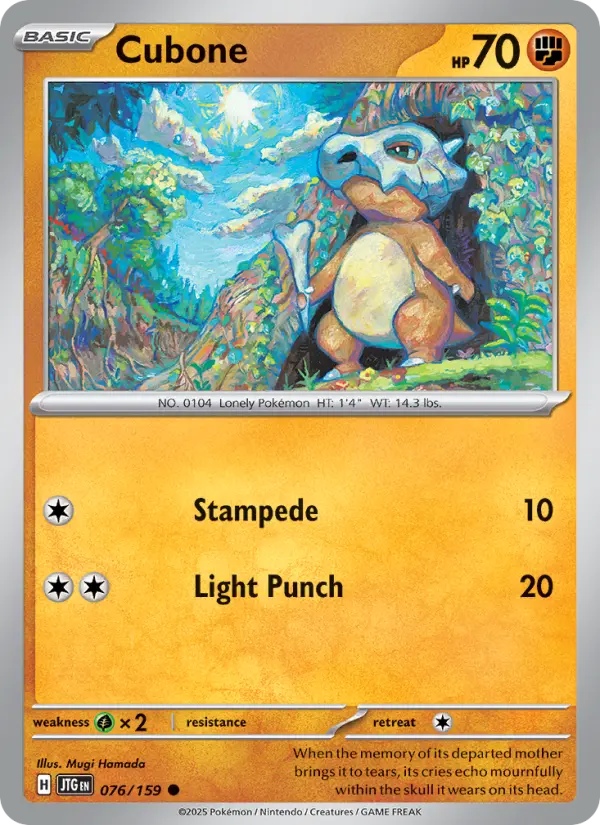
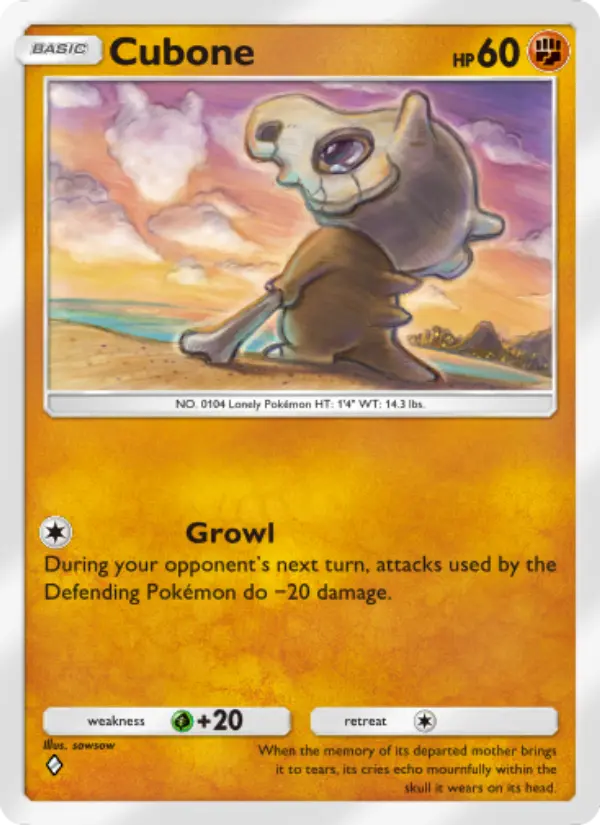
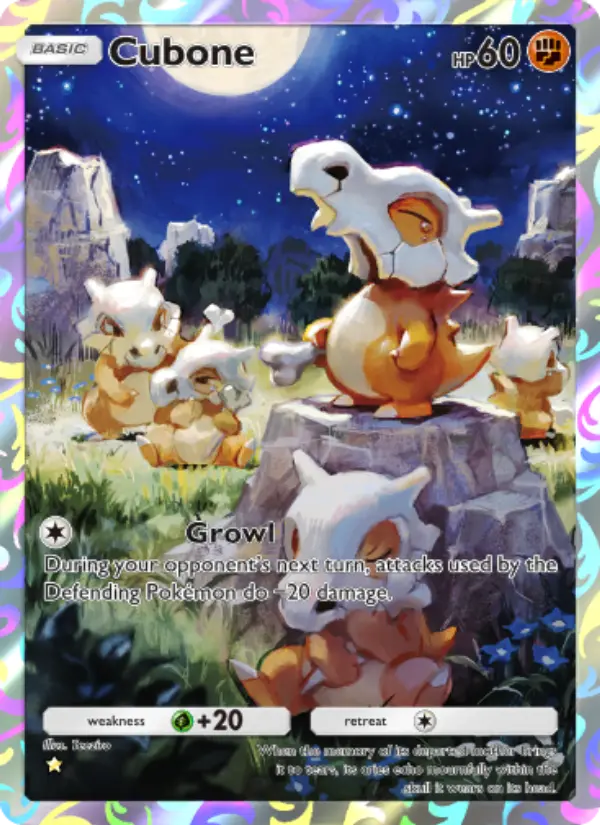
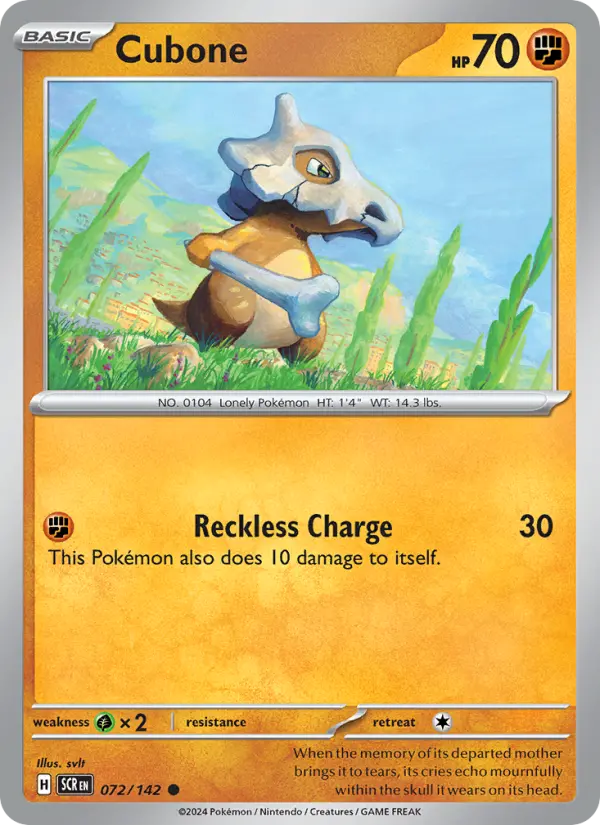
When the memory of its departed mother brings it to tears, its cries echo mournfully within the skull it wears on its head.
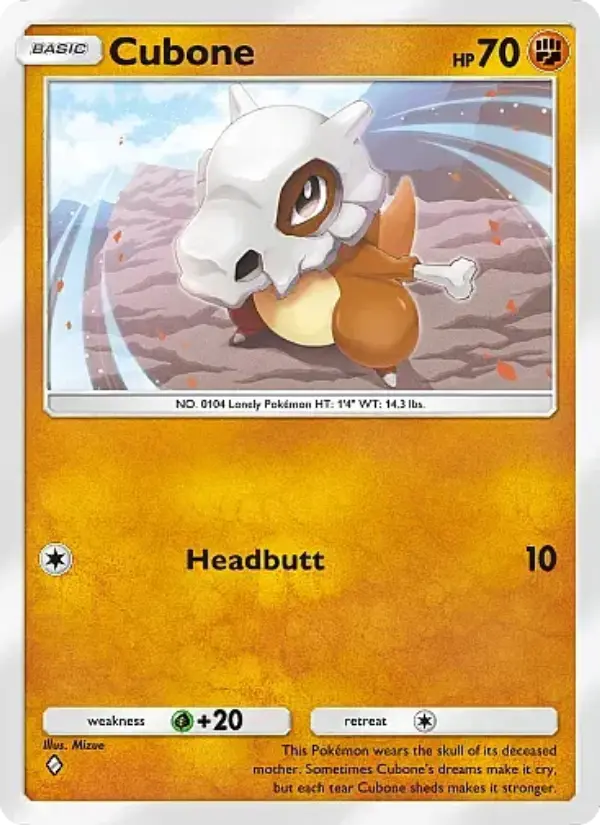
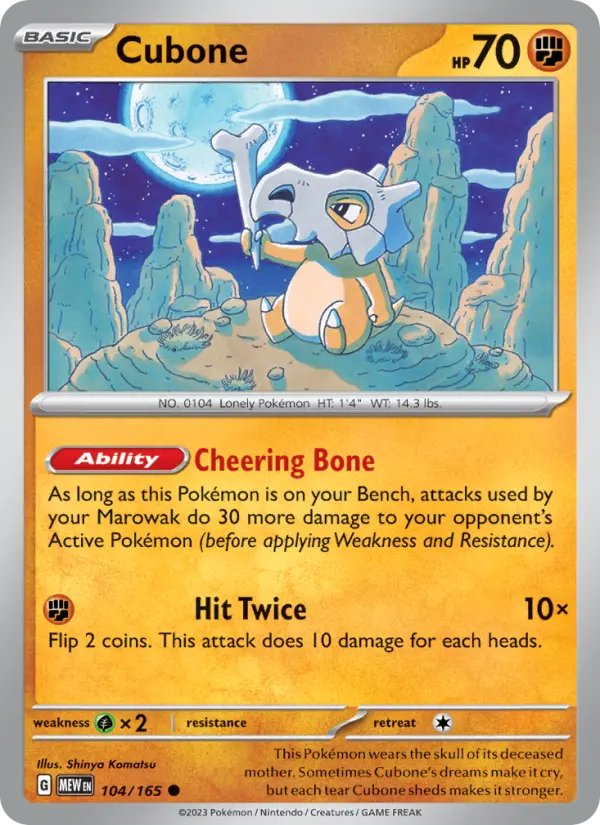
This Pokémon wears the skull of its deceased mother. Sometimes Cubone’s dreams make it cry, but each tear Cubone sheds makes it stronger.
Cubone Name Origin & Design Inspiration
The name Cubone likely derives from the Japanese word 'karakara,' which in the game's original language conveys a sense of something dry and hollow—perfectly encapsulating the essence of a Pokémon defined by the skull it carries. The design itself is deeply rooted in themes of anthropomorphic mortality and childhood trauma, drawing inspiration from real-world animal behavior where young creatures become attached to objects associated with lost caregivers. The dinosaur-like appearance references prehistoric creatures, giving Cubone an ancient, almost primordial quality that contrasts poignantly with its juvenile vulnerability. The decision to make the creature wear its mother's skull as a defining characteristic is remarkably bold for a franchise designed primarily for children, yet it serves as a powerful visual metaphor for how we carry our grief and our connections to those we've lost. The brown coloration and bone weapon create an earthy, primitive aesthetic that grounds the Pokémon in a tangible physical reality, while the mysterious hidden face beneath the skull invites speculation and empathy. This design philosophy has made Cubone one of the franchise's most emotionally resonant creatures, simultaneously tragic and strangely hopeful in its implications about memory, identity, and moving forward.
Learnable Moves
Cubone can learn 70 moves:
Move | Type | Cat. | Power | Acc. | PP |
|---|---|---|---|---|---|
| attract | normal | Status | — | 100 | 15 |
| belly drum | normal | Status | — | — | 10 |
| bide | normal | Physical | — | — | 10 |
| blizzard | ice | Special | 110 | 70 | 5 |
| body slam | normal | Physical | 85 | 100 | 15 |
| bone club | ground | Physical | 65 | 85 | 20 |
| bone rush | ground | Physical | 25 | 90 | 10 |
| bonemerang | ground | Physical | 50 | 90 | 10 |
| brick break | fighting | Physical | 75 | 100 | 15 |
| bubble beam | water | Special | 65 | 100 | 20 |
| counter | fighting | Physical | — | 100 | 20 |
| curse | ghost | Status | — | — | 10 |
| detect | fighting | Status | — | — | 5 |
| dig | ground | Physical | 80 | 100 | 10 |
| double kick | fighting | Physical | 30 | 100 | 30 |
| double team | normal | Status | — | — | 15 |
| double edge | normal | Physical | 120 | 100 | 15 |
| dynamic punch | fighting | Physical | 100 | 50 | 5 |
| earthquake | ground | Physical | 100 | 100 | 10 |
| endure | normal | Status | — | — | 10 |
| facade | normal | Physical | 70 | 100 | 20 |
| false swipe | normal | Physical | 40 | 100 | 40 |
| fire blast | fire | Special | 110 | 85 | 5 |
| fire punch | fire | Physical | 75 | 100 | 15 |
| fissure | ground | Physical | — | 30 | 5 |
| flamethrower | fire | Special | 90 | 100 | 15 |
| focus energy | normal | Status | — | — | 30 |
| focus punch | fighting | Physical | 150 | 100 | 20 |
| frustration | normal | Physical | — | 100 | 20 |
| fury cutter | bug | Physical | 40 | 95 | 20 |
| growl | normal | Status | — | 100 | 40 |
| headbutt | normal | Physical | 70 | 100 | 15 |
| hidden power | normal | Special | 60 | 100 | 15 |
| ice beam | ice | Special | 90 | 100 | 10 |
| icy wind | ice | Special | 55 | 95 | 15 |
| iron tail | steel | Physical | 100 | 75 | 15 |
| knock off | dark | Physical | 65 | 100 | 20 |
| leer | normal | Status | — | 100 | 30 |
| low kick | fighting | Physical | — | 100 | 20 |
| mega kick | normal | Physical | 120 | 75 | 5 |
| mega punch | normal | Physical | 80 | 85 | 20 |
| mimic | normal | Status | — | — | 10 |
| mud slap | ground | Special | 20 | 100 | 10 |
| perish song | normal | Status | — | — | 5 |
| protect | normal | Status | — | — | 10 |
| rage | normal | Physical | 20 | 100 | 20 |
| rest | psychic | Status | — | — | 5 |
| return | normal | Physical | — | 100 | 20 |
| rock slide | rock | Physical | 75 | 90 | 10 |
| sandstorm | rock | Status | — | — | 10 |
| screech | normal | Status | — | 85 | 40 |
| seismic toss | fighting | Physical | — | 100 | 20 |
| skull bash | normal | Physical | 130 | 100 | 10 |
| sleep talk | normal | Status | — | — | 10 |
| snore | normal | Special | 50 | 100 | 15 |
| strength | normal | Physical | 80 | 100 | 15 |
| submission | fighting | Physical | 80 | 80 | 20 |
| substitute | normal | Status | — | — | 10 |
| sunny day | fire | Status | — | — | 5 |
| swagger | normal | Status | — | 85 | 15 |
| swift | normal | Special | 60 | — | 20 |
| swords dance | normal | Status | — | — | 20 |
| tail whip | normal | Status | — | 100 | 30 |
| take down | normal | Physical | 90 | 85 | 20 |
| thief | dark | Physical | 60 | 100 | 25 |
| thrash | normal | Physical | 120 | 100 | 10 |
| thunder punch | electric | Physical | 75 | 100 | 15 |
| toxic | poison | Status | — | 90 | 10 |
| uproar | normal | Special | 90 | 100 | 10 |
| water gun | water | Special | 40 | 100 | 25 |
Cubone Competitive Battle Guide
Cubone's competitive viability is significantly limited by its modest base stats, with a total of only 320 distributed across its six stat categories. While its Defense stat of 95 stands out as notably higher than its other attributes, providing useful bulk for a small Pokémon, its Attack, HP, Speed, and Special Attack stats are all quite low, ranging between 35 and 50. This defensive skew suggests Cubone functions best as a specially defensive wall or physical tank in casual matches, though its evolution into Marowak provides substantially better competitive tools with improved stats across the board. Its Ground typing grants useful resistances to Electric, Poison, and Rock moves, while immunity to Electric-type moves through the Lightning Rod ability makes it a potential switch-in to electric attackers—though this leaves it vulnerable to other common offensive types. Cubone's movepool includes useful ground-type moves like Earthquake and Bone Club when evolved, but as a pre-evolution, its move options are limited. The hidden ability Battle Armor prevents critical hits, which provides utility against certain strategies, while Rock Head prevents recoil damage—making it viable for moves like Double-Edge if Cubone were to learn them through breeding. For competitive play, most trainers evolve Cubone into Marowak as quickly as possible to access better stats and a deeper movepool, making the pre-evolution form primarily valuable for casual play or thematic team building centered on emotional narratives.
Commonly Asked Questions About Cubone
What type is Cubone?
Cubone is a ground type Pokemon.
What does Cubone evolve into?
Cubone evolves into marowak.
What are Cubone's weaknesses?
Cubone is weak to water, grass and ice type moves.
Does Cubone evolve by trading?
No — Cubone evolves entirely through leveling up, with no trade required at any stage.
Where can I find Cubone?
Cubone can be found in pokemon tower (kanto), kanto safari zone (kanto) and rock tunnel (kanto) and 5 other locations.
Cubone Cultural Impact & Franchise History
Cubone has become one of the most iconic and emotionally significant Pokémon in the franchise's history, frequently appearing in anime episodes and manga chapters that explore themes of loss, mourning, and emotional resilience. The character of Goh's Cubone in the Pokémon Sword and Shield anime series provided a modern exploration of the species' sorrowful nature, resonating with audiences through its depiction of a lonely creature finding companionship and purpose. Multiple Pokédex entries across generations have reinforced Cubone's tragic backstory, making it a Pokémon that resonates with players on an emotional level beyond typical creature collecting gameplay. The species has appeared in numerous spin-off media, including references in Super Smash Bros. games and merchandise, cementing its status as a culturally significant entry in the Pokédex. Cubone's design has inspired fan art, fiction, and creative interpretations exploring the philosophical implications of carrying the literal remains of a loved one, making it a touchstone for more mature and emotionally sophisticated discussions within the Pokémon fan community. Teachers and counselors have even used Cubone as an entry point for conversations about grief and loss with younger audiences, transforming the Pokémon into a therapeutic tool for emotional education and understanding.
Where to Find Cubone in Every Pokémon Game
Cubone's availability has varied significantly across different Pokémon games and regions, reflecting its status as a foundational Generation I Pokémon that Game Freak has consistently included in regional Pokédexes. In the original Red, Blue, and Yellow versions, Cubone could be caught in the Pokémon Tower in Lavender Town, establishing the species' association with ghost-themed locations and melancholic atmospheres. Throughout the Johto region games (Gold, Silver, Crystal, HeartGold, and SoulSilver), Cubone remained available in rock-type habitats and caves. In more recent generations, the creature has maintained consistent availability through various wild encounter locations, breeding, and in some cases, trading with NPCs or gift Pokémon scenarios. The Alola region introduced the possibility of obtaining Cubone specifically for the regional variant evolution into Alolan Marowak, changing how trainers needed to plan their catches in Pokémon Sun and Moon. Cubone's high catch rate of 190 makes it relatively easy to obtain compared to many other Pokémon, particularly when encountered in the early game. In Pokémon Let's Go Pikachu and Eevee, Cubone maintained availability in traditional locations, and subsequent Sword and Shield titles continued including the species in their Pokédexes, ensuring that players across multiple game generations have had opportunities to obtain and train this emotionally resonant creature.