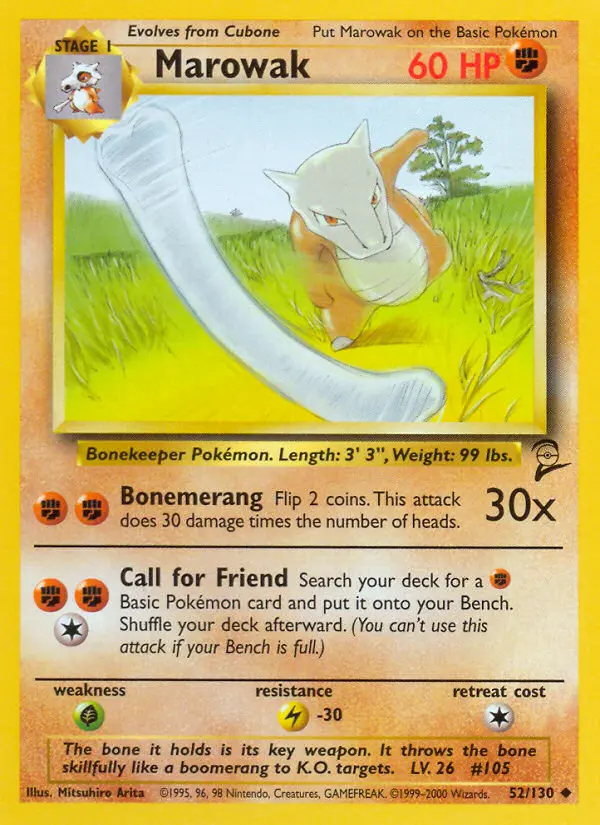
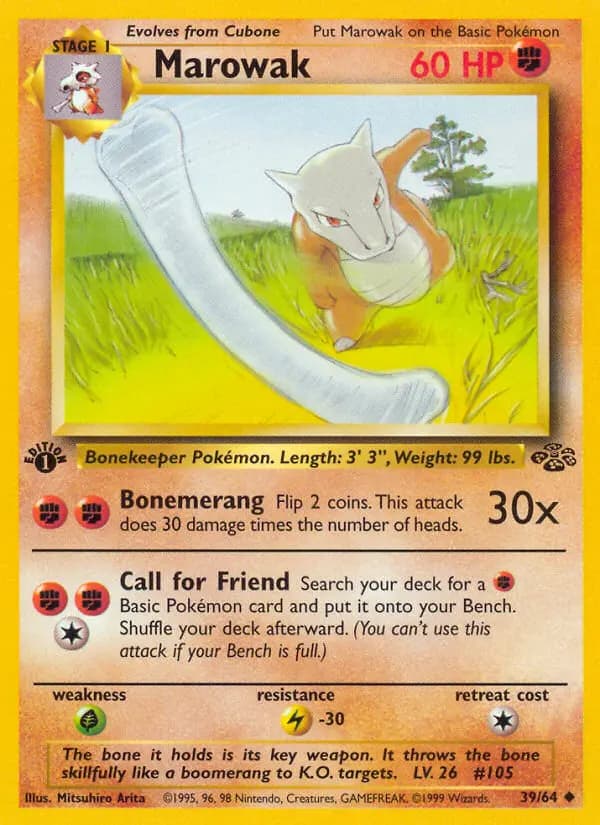
Marowak
Generation I · #0105 — Bone Keeper Pokémon
Marowak's profile is easy to undersell: 1 m, 45 kg, and a ground typing that doesn't scream power — until you look at its Defense of 110. Introduced in Generation I, Marowak has maintained its position as a stalwart Ground-type option throughout the Pokémon franchise, with a combined stat total of 425 distributed strategically toward defense and attack. The Pokédex entries paint a vivid picture of this Pokémon's mastery of its signature bone weapon, describing how it throws the bone with boomerang-like precision and has even been observed pounding boulders to communicate with others. Marowak's existence is inexorably tied to the mystery of a hidden Marowak graveyard somewhere in the world, from which it is said to collect the very bones that serve as its primary tools and weapons.
Editor's Take
Marowak with a Thick Club has effectively 200 base Attack, which makes an item the single most important thing about a Pokémon — and the Alolan variant's Lightning Rod is nearly as significant.
Base Stats
Height
1.0m
Weight
45.0kg
Category
Bone Keeper Pokémon
Gender
Male 50% / Female 50%
Color
brown
Shape
upright
Habitat
mountain
Abilities
Protects against recoil damage.
Redirects single-target electric moves to this Pokémon where possible. Absorbs Electric moves, raising Special Attack one stage.
Protects against critical hits.

Marowak Biology & Physical Characteristics
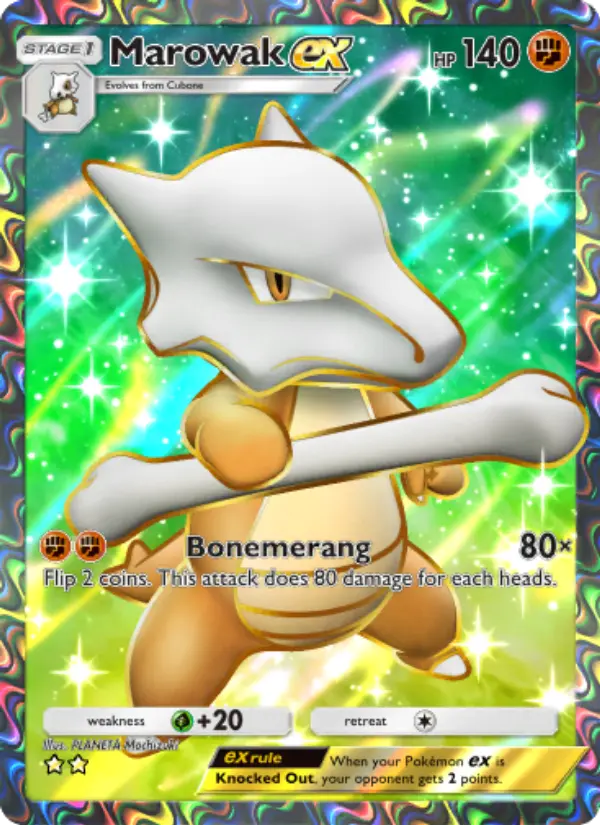
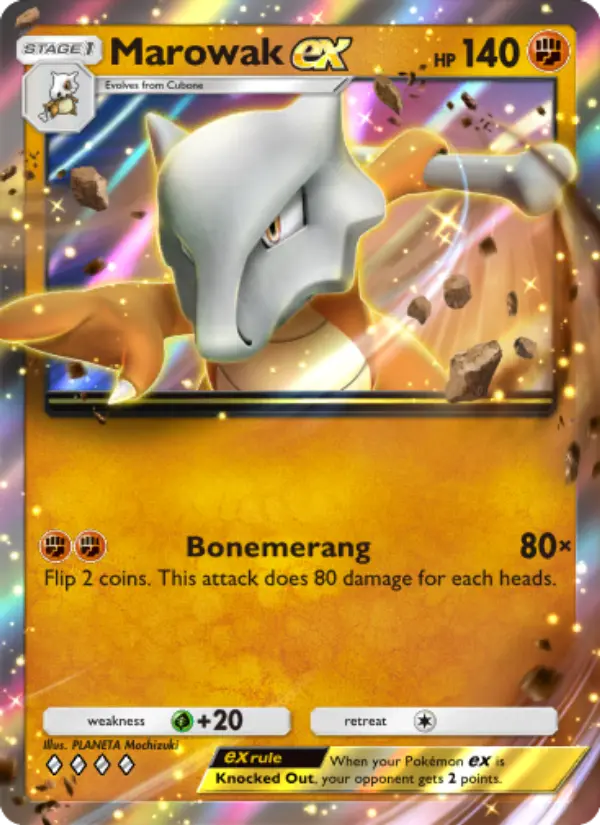
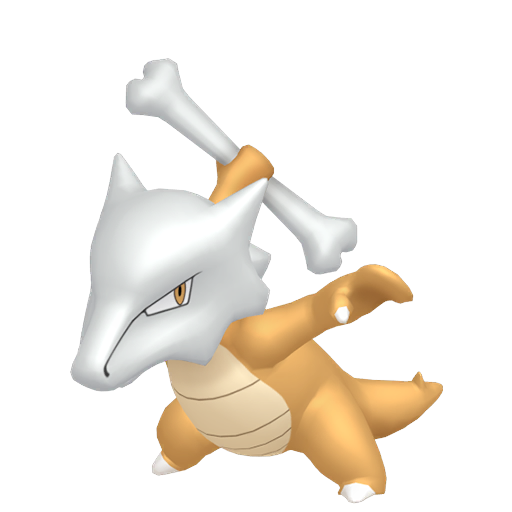
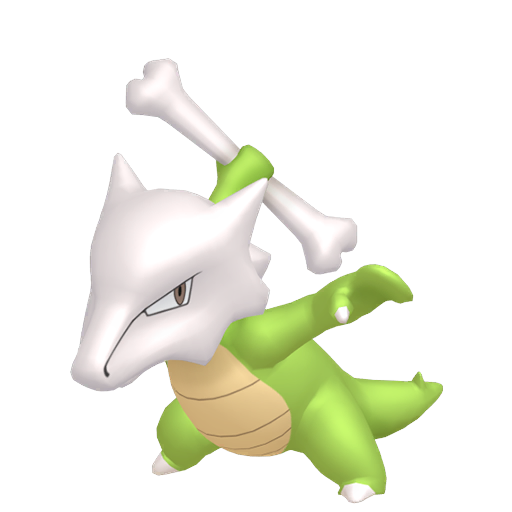
Marowak is a bipedal Pokémon standing at 1.0 meter in height and weighing 45.0 kilograms, with a sturdy, compact build that belies its incredible defensive capabilities. Its body is covered in light brown skin with a cream-colored underside, featuring small claws on each hand that serve as thumbs and a single large nail on each foot forming its toes. The most distinctive feature of Marowak's anatomy is that the skull it wore as a young Cubone has become permanently fused to its head during evolution, forming what now appears to be its natural cranium complete with two pointed horns on the back and small nostrils on the snout. Its triangular brown eyes are set within this permanent skull mask, giving Marowak a perpetually intense expression. A short tail with a small spike near its tip completes the Pokémon's form. Despite its relatively small size, Marowak's entire body possesses an armor-like durability, with a defense stat of 110 that ranks among the highest for non-legendary Pokémon of its generation, making it an exceptionally durable combatant on the battlefield.
Pokedex Numbers
Training
Breeding
Marowak Breeding, Gender Ratio & Egg Groups
Marowak maintains a balanced gender distribution of 50% male to 50% female, allowing for equal breeding opportunities regardless of gender pairing. The species belongs to the Monster egg group, which includes a diverse array of primarily terrestrial and quadrupedal creatures, limiting the Pokémon it can breed with in the traditional sense. With a base happiness of 70, Marowak shows a moderate natural affinity for trainers, suggesting that while they are not innately standoffish, they require a certain level of care and attention to reach their full potential as companions. The relatively high catch rate of 75 means that capturing wild Marowak encounters is a reasonably achievable task, though the Pokémon's combat prowess means trainers should still approach battle cautiously. Eggs of Marowak require 20 cycles to hatch, translating to approximately 4,884 to 5,140 steps of travel, which is a moderate incubation period that allows trainers time to prepare for the young Cubone's arrival. The growth rate is listed as Medium Fast, indicating that Marowak reaches its full statistical potential at a moderate pace, neither requiring excessive training nor advancing so quickly that trainers cannot properly bond with the creature during its developmental phases.
Sprites




Held Items
Thick Club
species-specific
Doubles Cubone or Marowak’s Attack.
Cost: 1000
Thick Club
species-specific
Doubles Cubone or Marowak’s Attack.
Cost: 1000
Thick Club
species-specific
Doubles Cubone or Marowak’s Attack.
Cost: 1000
Thick Club
species-specific
Doubles Cubone or Marowak’s Attack.
Cost: 1000
Thick Club
species-specific
Doubles Cubone or Marowak’s Attack.
Cost: 1000
Thick Club
species-specific
Doubles Cubone or Marowak’s Attack.
Cost: 1000
Thick Club
species-specific
Doubles Cubone or Marowak’s Attack.
Cost: 1000
Thick Club
species-specific
Doubles Cubone or Marowak’s Attack.
Cost: 1000
Thick Club
species-specific
Doubles Cubone or Marowak’s Attack.
Cost: 1000
Thick Club
species-specific
Doubles Cubone or Marowak’s Attack.
Cost: 1000
Thick Club
species-specific
Doubles Cubone or Marowak’s Attack.
Cost: 1000
Thick Club
species-specific
Doubles Cubone or Marowak’s Attack.
Cost: 1000
Thick Club
species-specific
Doubles Cubone or Marowak’s Attack.
Cost: 1000
Thick Club
species-specific
Doubles Cubone or Marowak’s Attack.
Cost: 1000
Thick Club
species-specific
Doubles Cubone or Marowak’s Attack.
Cost: 1000
Thick Club
species-specific
Doubles Cubone or Marowak’s Attack.
Cost: 1000
Thick Club
species-specific
Doubles Cubone or Marowak’s Attack.
Cost: 1000
Thick Club
species-specific
Doubles Cubone or Marowak’s Attack.
Cost: 1000
Thick Club
species-specific
Doubles Cubone or Marowak’s Attack.
Cost: 1000
Thick Club
species-specific
Doubles Cubone or Marowak’s Attack.
Cost: 1000
Thick Club
species-specific
Doubles Cubone or Marowak’s Attack.
Cost: 1000
Thick Club
species-specific
Doubles Cubone or Marowak’s Attack.
Cost: 1000
Thick Club
species-specific
Doubles Cubone or Marowak’s Attack.
Cost: 1000
Thick Club
species-specific
Doubles Cubone or Marowak’s Attack.
Cost: 1000
Thick Club
species-specific
Doubles Cubone or Marowak’s Attack.
Cost: 1000
Thick Club
species-specific
Doubles Cubone or Marowak’s Attack.
Cost: 1000
Thick Club
species-specific
Doubles Cubone or Marowak’s Attack.
Cost: 1000
Thick Club
species-specific
Doubles Cubone or Marowak’s Attack.
Cost: 1000
Thick Club
species-specific
Doubles Cubone or Marowak’s Attack.
Cost: 1000
Thick Club
species-specific
Doubles Cubone or Marowak’s Attack.
Cost: 1000
Thick Club
species-specific
Doubles Cubone or Marowak’s Attack.
Cost: 1000
Thick Club
species-specific
Doubles Cubone or Marowak’s Attack.
Cost: 1000
Thick Club
species-specific
Doubles Cubone or Marowak’s Attack.
Cost: 1000
Thick Club
species-specific
Doubles Cubone or Marowak’s Attack.
Cost: 1000
Thick Club
species-specific
Doubles Cubone or Marowak’s Attack.
Cost: 1000
Thick Club
species-specific
Doubles Cubone or Marowak’s Attack.
Cost: 1000
Thick Club
species-specific
Doubles Cubone or Marowak’s Attack.
Cost: 1000
Thick Club
species-specific
Doubles Cubone or Marowak’s Attack.
Cost: 1000
Thick Club
species-specific
Doubles Cubone or Marowak’s Attack.
Cost: 1000
Thick Club
species-specific
Doubles Cubone or Marowak’s Attack.
Cost: 1000
Thick Club
species-specific
Doubles Cubone or Marowak’s Attack.
Cost: 1000
Thick Club
species-specific
Doubles Cubone or Marowak’s Attack.
Cost: 1000
Thick Club
species-specific
Doubles Cubone or Marowak’s Attack.
Cost: 1000
Thick Club
species-specific
Doubles Cubone or Marowak’s Attack.
Cost: 1000
TMs & HMs
tm00
sword shield
tm01
yellow
tm01
gold silver
tm01
crystal
tm01
red blue
tm01
lets go pikachu lets go eevee
tm01
blue japan
tm01
red green japan
tm01
sword shield
tm02
crystal
tm02
gold silver
tm03
yellow
tm03
crystal
tm03
gold silver
tm03
red blue
tm03
sword shield
tm03
blue japan
tm03
red green japan
tm05
red blue
tm05
yellow
+666 more TMs/HMs
Regional & Special Forms
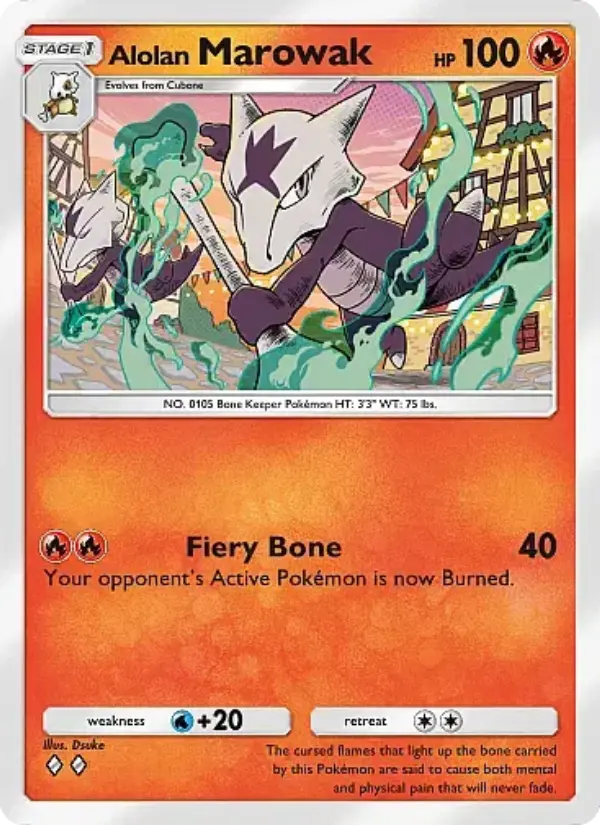
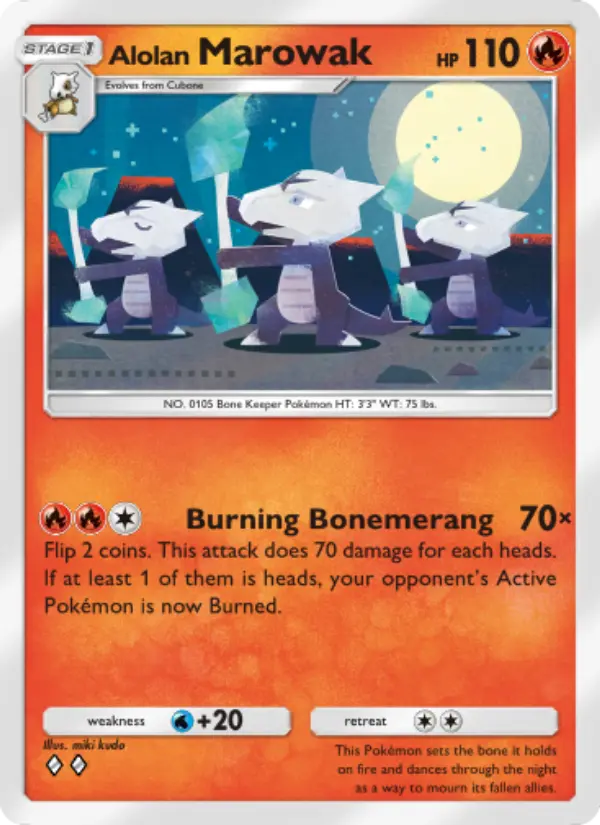
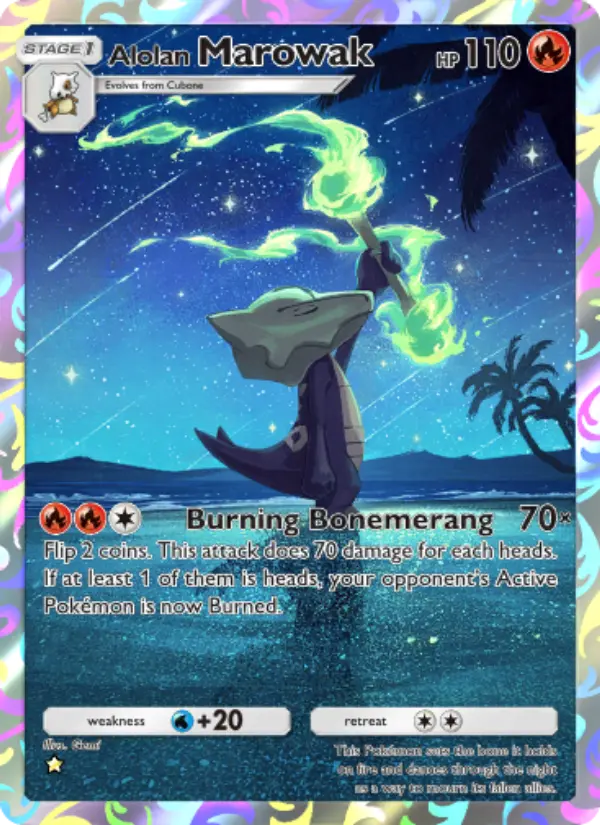
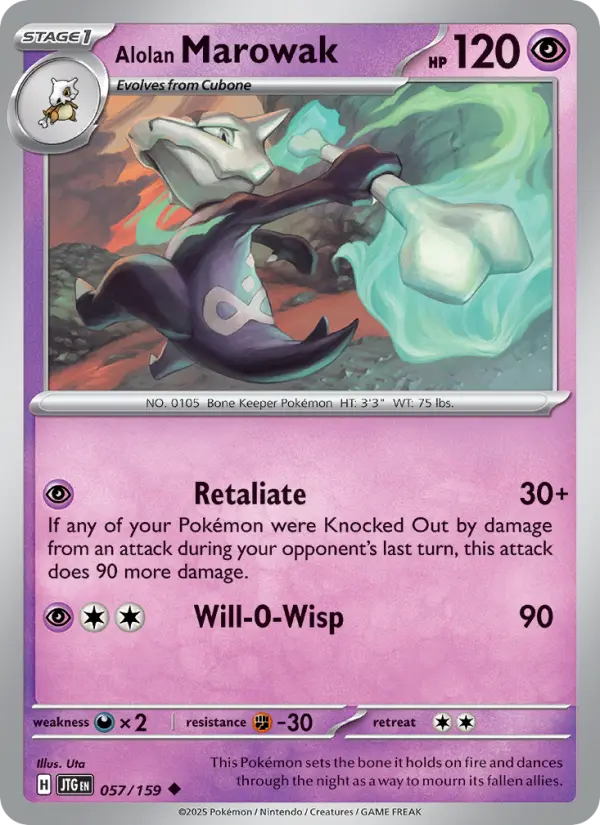
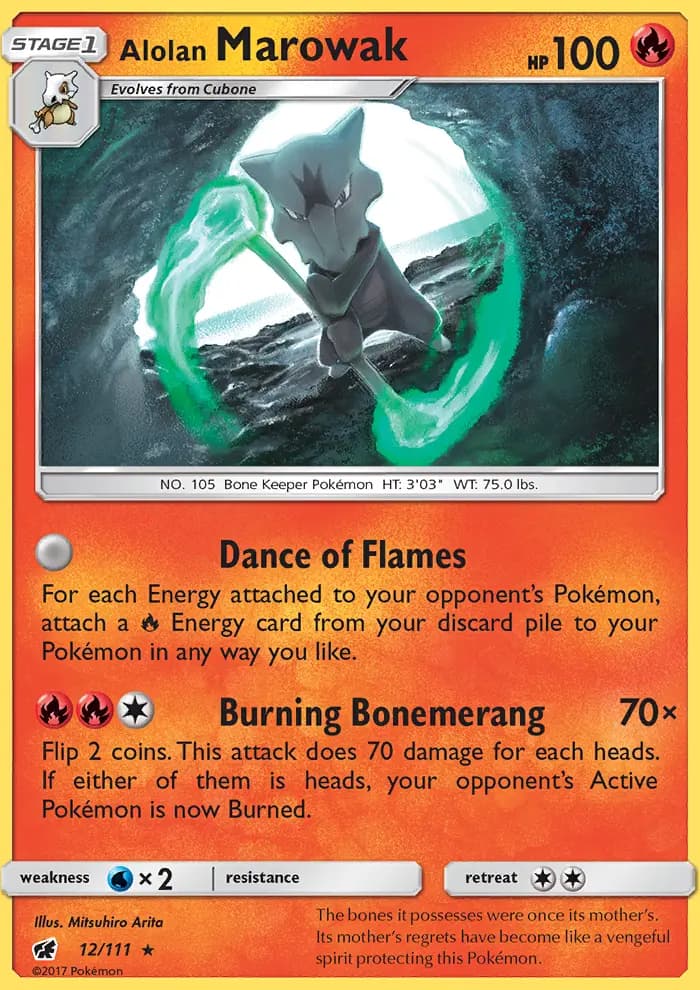
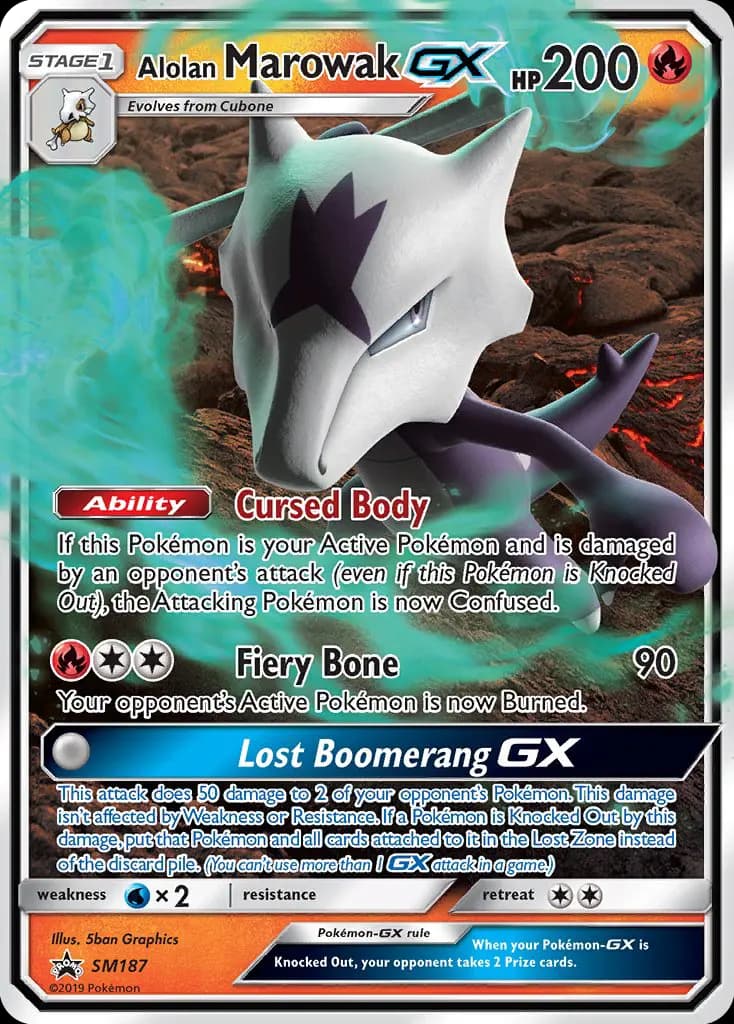
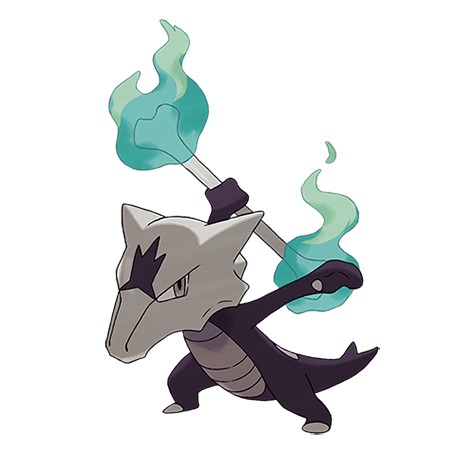
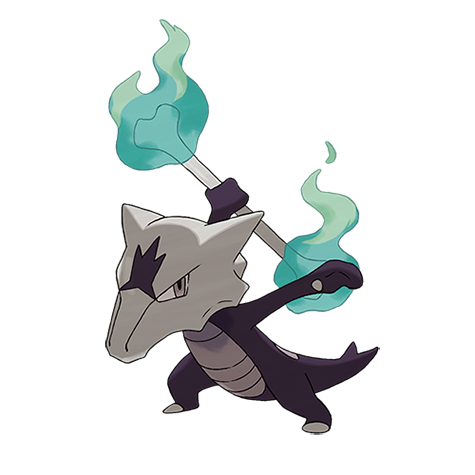
Marowak also has 2 related forms: Alolan Marowak and Totem Marowak.


Marowak Evolution, Mega Evolution & Special Forms
Marowak evolves from Cubone at level 28, marking a critical moment in the Pokémon's journey where it finally comes to terms with the loss of its mother and transcends its juvenile vulnerability. The evolution represents not merely a physical transformation but a psychological metamorphosis—the young Cubone, which wore its mother's skull as a mask and a source of comfort, becomes Marowak, whose skull has permanently fused with its body, symbolizing the internalization of its past grief into strength and resilience. This evolution is one of the most emotionally significant in the Pokémon franchise, as Marowak's hardened spirit and tempered disposition stand as testament to the trials it has overcome. In the Alola region, Marowak has developed a regional variant with Fire and Ghost typing, which evolves from Cubone when leveled up at night starting at level 28, and all Cubone in Alola evolve into this Fire/Ghost form regardless of their origin. The Alolan form represents an interesting divergence in evolutionary pathways, where the harsh volcanic environment of the Alola archipelago has influenced Marowak's development differently, imbuing it with spectral and pyromantic properties that mark a significant departure from its standard Ground-type classification while maintaining its iconic bone-wielding combat style.
Where to Find
Cerulean Cave
kanto
+5 more
Kanto Victory Road 2
kanto
+17 more
Kanto Safari Zone
kanto
Rock Tunnel
kanto
+9 more
Kanto Route 9
kanto
+1 more
Kanto Route 10
kanto
Sevault Canyon
kanto
Johto Safari Zone
johto
+1 more
Unova Route 15
unova
+1 more
Heahea Beach
alola
Marowak Behaviour and Natural Habitat
Marowak is known for its ferocity and territorial nature, having transformed from the grief-stricken Cubone into a hardened warrior with an indomitable spirit that is not easily broken. The Pokédex entries suggest that Marowak frequents areas where it can forage for bones, which it uses both as weapons and apparently as a means of communication with other members of its kind. The mysterious Marowak graveyard, rumored to exist somewhere in the world according to Silver version Pokédex entries, serves as a place where Marowak collect bones from graves—a haunting detail that suggests a ritualistic or spiritual connection to these artifacts. In its natural habitat, Marowak demonstrates remarkable skill and precision with its bone club, wielding it skillfully like a boomerang and with such accuracy that it can target distant opponents with deadly effectiveness. The species shows signs of intelligence and social behavior, particularly in their use of bones as a communication method, tapping out messages to other Marowak across distances. Despite its small and unassuming appearance, Marowak has developed into a formidable hunter and warrior, having overcome the hardships of its youth to become a respected member of the Ground-type Pokémon community.
Pokedex Entries
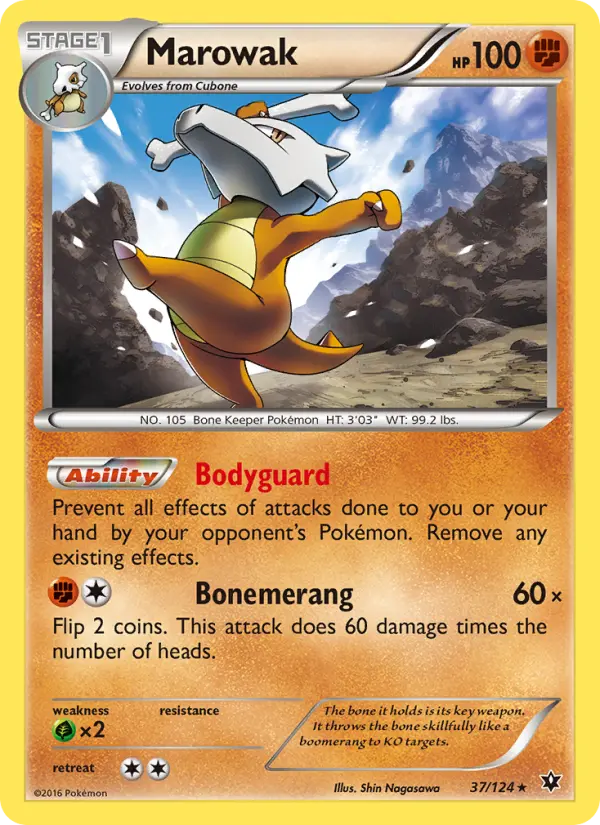
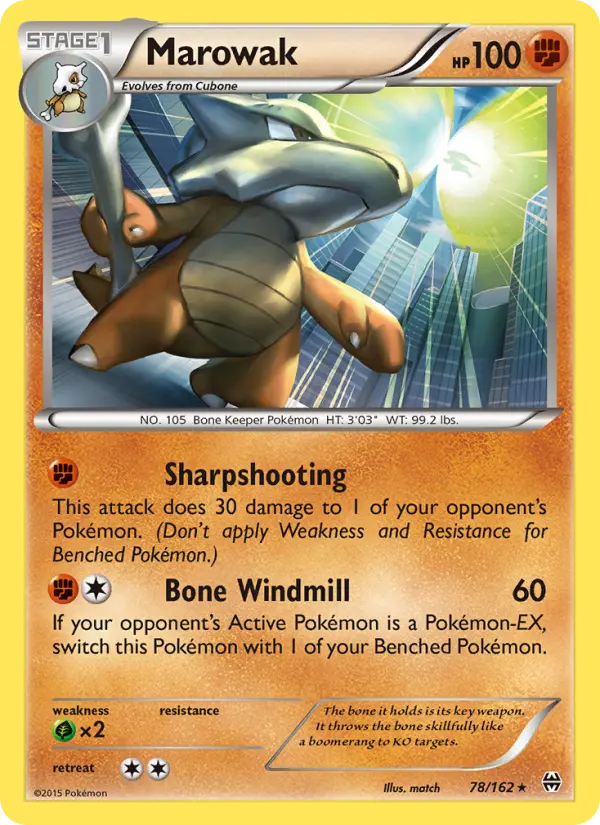
The bone it holds is its key weapon. It throws the bone skillfully like a boomerang to KO targets.
Small and weak, this POKéMON is adept with its bone club. It has grown more vicious over the ages.
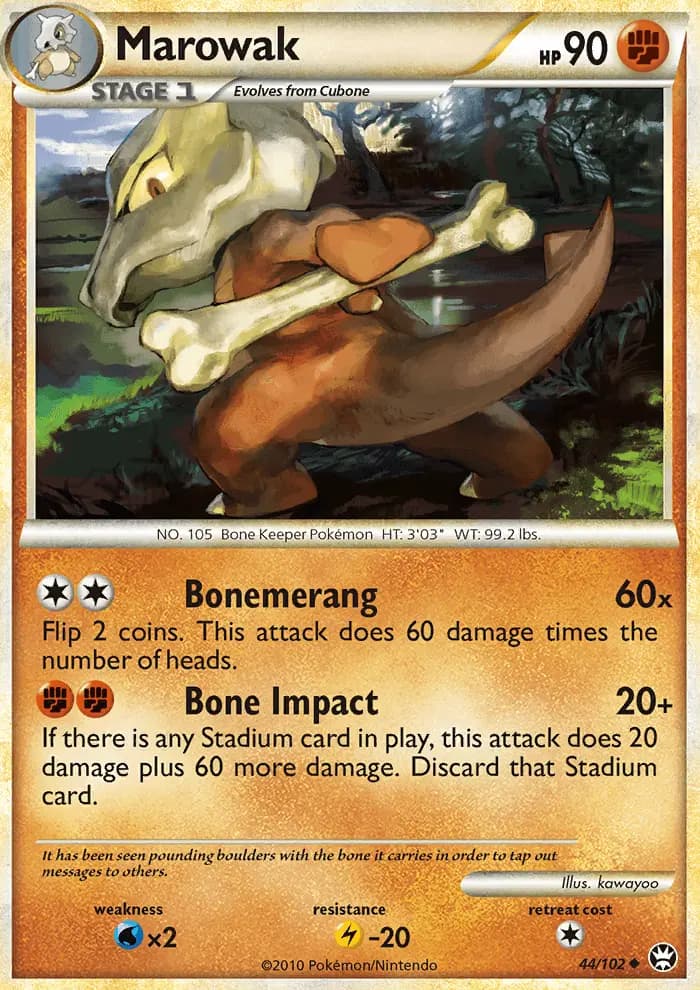
It has been seen pounding boulders with the bone it carries in order to tap out mes sages to others.
It collects bones from an unknown place. A MAROWAK graveyard exists somewhere in the world, rumors say.
Somewhere in the world is a ceme tery just for MAROWAK. It gets its bones from those graves.
MAROWAK is the evolved form of a CUBONE that has overcome its sadness at the loss of its mother and grown tough. This POKéMON’s tempered and hardened spirit is not easily broken.
A MAROWAK is the evolved form of a CUBONE that has grown tough by overcoming the grief of losing its mother. Its tempered and hardened spirit is not easily broken.
It is small and was originally very weak. Its temperament turned ferocious when it began using bones.
The bone it holds is its key weapon. It throws the bone skillfully like a boomerang to KO targets.
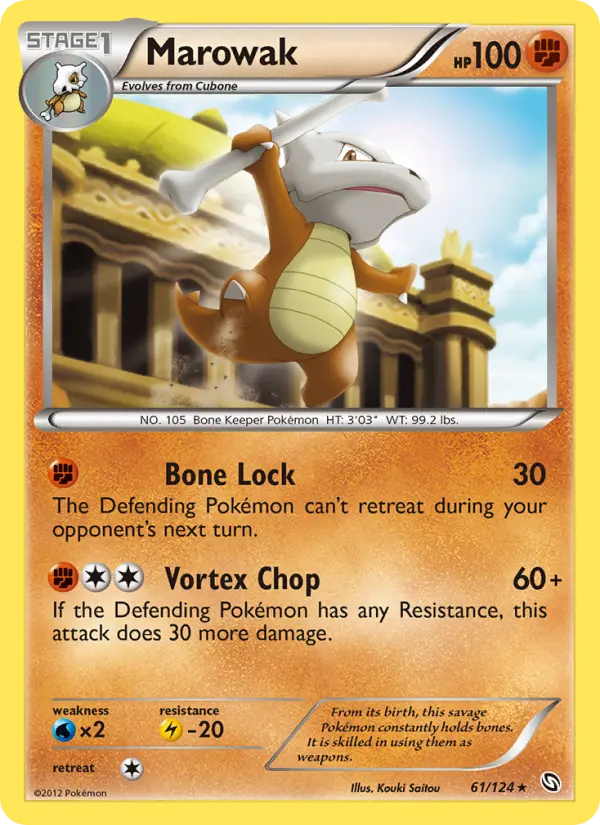
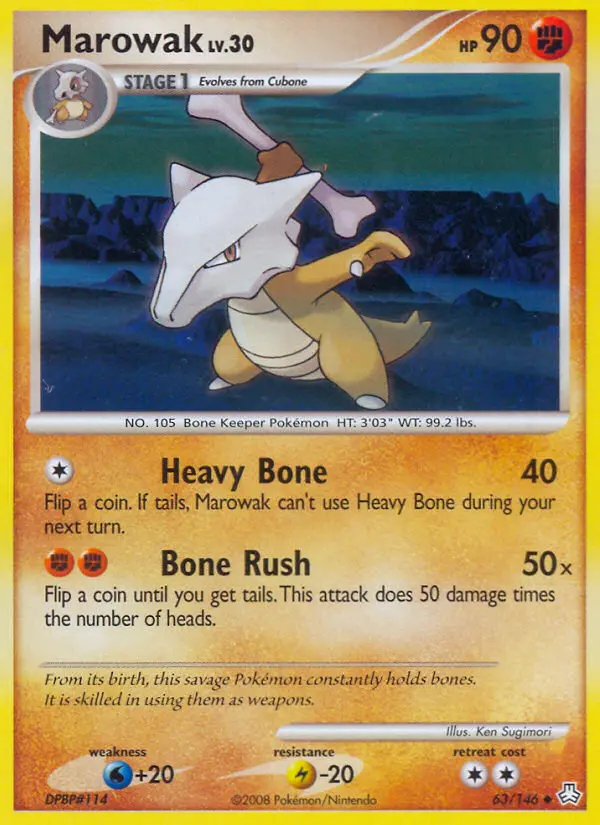
From its birth, this savage Pokémon constantly holds bones. It is skilled in using them as weapons.
It has been seen pounding boulders with the bone it carries in order to tap out messages to others.
It collects bones from an unknown place. Some whisper that a MAROWAK graveyard exists somewhere in the world.
From its birth, this savage Pokémon constantly holds bones. It is skilled in using them as weapons.
From its birth, this savage Pokémon constantly holds bones. It is skilled in using them as weapons.
It is small and was originally very weak. Its temperament turned ferocious when it began using bones.
The bone it holds is its key weapon. It throws the bone skillfully like a boomerang to KO targets.
Marowak is the evolved form of a Cubone that has overcome its sadness at the loss of its mother and grown tough. This Pokémon’s tempered and hardened spirit is not easily broken.
Marowak is the evolved form of a Cubone that has overcome its sadness at the loss of its mother and grown tough. This Pokémon’s tempered and hardened spirit is not easily broken.
Originally, it was weak and timid. After evolution, its temperament becomes violent, and it begins to wield bones as weapons.
It throws bones at Mandibuzz to knock it down. It’s thought that Marowak is trying to avenge its parent.
This Pokémon is out for vengeance on its natural enemy, Mandibuzz. It throws bones like boomerangs to try to take it down.
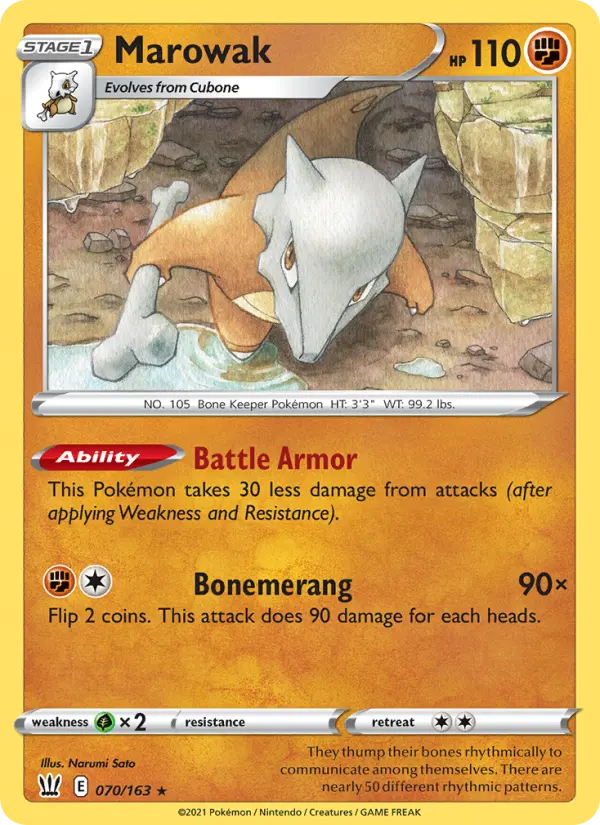
They thump their bones rhythmically to communicate among themselves. There are nearly 50 different rhythmic patterns.
Small and weak, this Pokémon is adept with its bone club. It has grown more vicious over the ages.
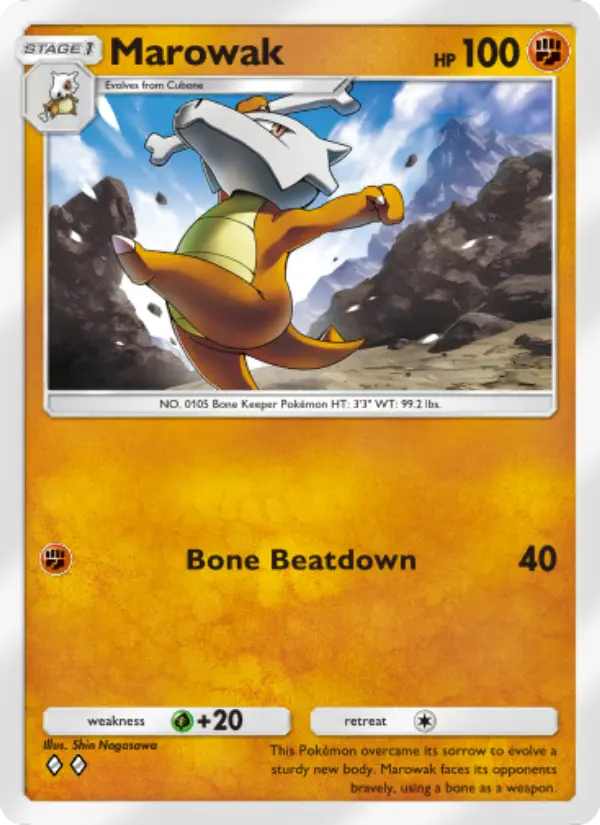
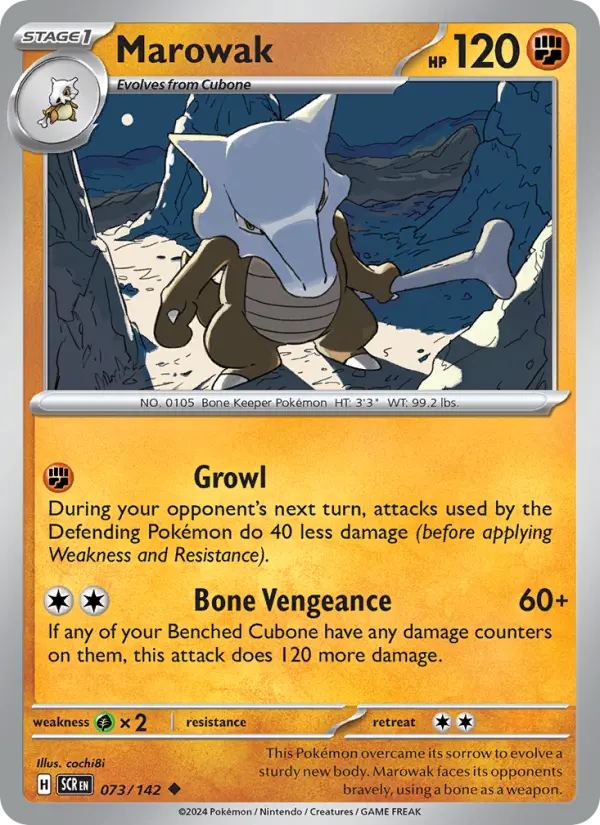
This Pokémon overcame its sorrow to evolve a sturdy new body. Marowak faces its opponents bravely, using a bone as a weapon.
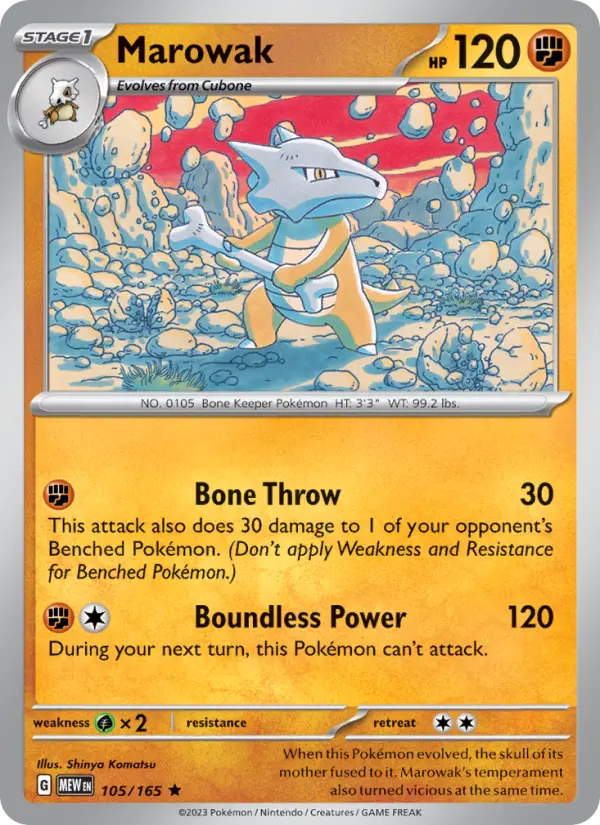
When this Pokémon evolved, the skull of its mother fused to it. Marowak’s temperament also turned vicious at the same time.
Marowak Name Origin & Design Inspiration
Marowak's design is rooted in primal warrior imagery, drawing inspiration from prehistoric humans who wielded bone clubs as primary weapons and tools. The name itself is derived from "marrow," the substance found within bones, combined with "wack," referring to striking or hitting—an apt description for a Pokémon whose entire combat strategy revolves around bone weaponry. The Japanese name "Garagara" (ガラガラ) is onomatopoetic, mimicking the rattling sound of bones clinking together, which perfectly captures the auditory essence of a creature constantly handling and wielding skeletal remains. The design philosophy emphasizes the contrast between Marowak's small, unassuming frame and the incredible destructive power it wields with its bone club, teaching the lesson that strength is not always apparent in physical size but rather in determination and skill. The permanent fusion of the skull to Marowak's body serves as a visual metaphor for the integration of trauma into identity—what was once an external symbol of loss has become an internal part of the Pokémon itself. Every aspect of Marowak's appearance, from the pointed horns to the clutching posture it assumes when holding its weapon, reinforces its identity as a hardened bone warrior and skilled combatant.
Learnable Moves
Marowak can learn 76 moves:
Move | Type | Cat. | Power | Acc. | PP |
|---|---|---|---|---|---|
| attract | normal | Status | — | 100 | 15 |
| bide | normal | Physical | — | — | 10 |
| blizzard | ice | Special | 110 | 70 | 5 |
| body slam | normal | Physical | 85 | 100 | 15 |
| bone club | ground | Physical | 65 | 85 | 20 |
| bone rush | ground | Physical | 25 | 90 | 10 |
| bonemerang | ground | Physical | 50 | 90 | 10 |
| bubble beam | water | Special | 65 | 100 | 20 |
| bulldoze | ground | Physical | 60 | 100 | 20 |
| confide | normal | Status | — | — | 20 |
| counter | fighting | Physical | — | 100 | 20 |
| curse | ghost | Status | — | — | 10 |
| detect | fighting | Status | — | — | 5 |
| dig | ground | Physical | 80 | 100 | 10 |
| double team | normal | Status | — | — | 15 |
| double edge | normal | Physical | 120 | 100 | 15 |
| dynamic punch | fighting | Physical | 100 | 50 | 5 |
| earth power | ground | Special | 90 | 100 | 10 |
| earthquake | ground | Physical | 100 | 100 | 10 |
| endure | normal | Status | — | — | 10 |
| false swipe | normal | Physical | 40 | 100 | 40 |
| fire blast | fire | Special | 110 | 85 | 5 |
| fire punch | fire | Physical | 75 | 100 | 15 |
| fissure | ground | Physical | — | 30 | 5 |
| flamethrower | fire | Special | 90 | 100 | 15 |
| fling | dark | Physical | — | 100 | 10 |
| focus blast | fighting | Special | 120 | 70 | 5 |
| focus energy | normal | Status | — | — | 30 |
| frustration | normal | Physical | — | 100 | 20 |
| fury cutter | bug | Physical | 40 | 95 | 20 |
| giga impact | normal | Physical | 150 | 90 | 5 |
| growl | normal | Status | — | 100 | 40 |
| headbutt | normal | Physical | 70 | 100 | 15 |
| hidden power | normal | Special | 60 | 100 | 15 |
| hyper beam | normal | Special | 150 | 90 | 5 |
| ice beam | ice | Special | 90 | 100 | 10 |
| icy wind | ice | Special | 55 | 95 | 15 |
| iron tail | steel | Physical | 100 | 75 | 15 |
| laser focus | normal | Status | — | — | 30 |
| leer | normal | Status | — | 100 | 30 |
| low kick | fighting | Physical | — | 100 | 20 |
| mega kick | normal | Physical | 120 | 75 | 5 |
| mega punch | normal | Physical | 80 | 85 | 20 |
| mimic | normal | Status | — | — | 10 |
| mud slap | ground | Special | 20 | 100 | 10 |
| outrage | dragon | Physical | 120 | 100 | 10 |
| power up punch | fighting | Physical | 40 | 100 | 20 |
| protect | normal | Status | — | — | 10 |
| rage | normal | Physical | 20 | 100 | 20 |
| rest | psychic | Status | — | — | 5 |
| retaliate | normal | Physical | 70 | 100 | 5 |
| return | normal | Physical | — | 100 | 20 |
| rock climb | normal | Physical | 90 | 85 | 20 |
| rock slide | rock | Physical | 75 | 90 | 10 |
| rock smash | fighting | Physical | 40 | 100 | 15 |
| sandstorm | rock | Status | — | — | 10 |
| screech | normal | Status | — | 85 | 40 |
| seismic toss | fighting | Physical | — | 100 | 20 |
| skull bash | normal | Physical | 130 | 100 | 10 |
| sleep talk | normal | Status | — | — | 10 |
| snore | normal | Special | 50 | 100 | 15 |
| strength | normal | Physical | 80 | 100 | 15 |
| submission | fighting | Physical | 80 | 80 | 20 |
| substitute | normal | Status | — | — | 10 |
| sunny day | fire | Status | — | — | 5 |
| swagger | normal | Status | — | 85 | 15 |
| swift | normal | Special | 60 | — | 20 |
| swords dance | normal | Status | — | — | 20 |
| tail whip | normal | Status | — | 100 | 30 |
| take down | normal | Physical | 90 | 85 | 20 |
| thief | dark | Physical | 60 | 100 | 25 |
| thrash | normal | Physical | 120 | 100 | 10 |
| throat chop | dark | Physical | 80 | 100 | 15 |
| thunder punch | electric | Physical | 75 | 100 | 15 |
| toxic | poison | Status | — | 90 | 10 |
| water gun | water | Special | 40 | 100 | 25 |
Marowak Competitive Battle Guide
Marowak's competitive viability is anchored by its exceptional defense stat of 110, which allows it to function effectively as a physical wall against many common threats. With an attack stat of 80 and access to powerful Ground-type moves such as Earthquake and Bone Club, Marowak can deal respectable damage while maintaining defensive integrity. Its ability options provide valuable utility: Rock Head prevents recoil damage from moves like Double-Edge, allowing for more aggressive play; Lightning Rod redirects Electric-type moves and boosts Special Attack upon absorption, making Marowak a potential counter to Electric-type threats; and the hidden ability Battle Armor protects against critical hits, preventing surprise knockout blows. However, Marowak's speed stat of 45 is notably low, requiring careful play and often necessitating investment in priority moves or strategic positioning to circumvent faster opponents. In competitive formats, Marowak struggles against Water, Grass, and Ice-type moves due to its Ground typing, and its Special Attack stat of 50 is far too low to justify special move coverage. Modern competitive players often utilize Marowak in specific team archetypes where its defensive bulk can be leveraged, such as balanced or bulky offensive teams that appreciate its ability to wall physical attackers. The Alolan Marowak variant, with its Fire and Ghost typing, offers different competitive properties but requires evaluation in its respective regional formats.
Commonly Asked Questions About Marowak
What type is Marowak?
Marowak is a ground type Pokemon.
What does Marowak evolve from?
Marowak evolved from cubone.
What are Marowak's weaknesses?
Marowak is weak to water, grass and ice type moves.
Where can I find Marowak?
Marowak can be found in cerulean cave (kanto), kanto victory road 2 (kanto) and kanto safari zone (kanto) and 7 other locations.
Marowak Cultural Impact & Franchise History
Marowak has secured a memorable place in Pokémon culture as the embodiment of perseverance and emotional growth, with its evolution story resonating deeply with fans across generations. The narrative arc from grief-stricken Cubone to the hardened warrior Marowak explores themes of loss, resilience, and transformation that elevate the species beyond typical monster-catching mechanics. In the Pokémon anime, Kiawe's Marowak has become a signature Pokémon character, demonstrating the bond between trainer and Pokémon while showcasing Marowak's combat prowess and fiery spirit in narrative-significant battles. The mysterious Marowak graveyard referenced in multiple Pokédex entries has captured the imagination of fans for decades, spawning countless theories and creative interpretations about this hidden location and its significance to the Pokémon world. Marowak's image as a bone warrior has made it a popular subject for fan art and merchandise, and its iconic bone club has become one of the most recognizable weapons in the Pokémon franchise. The introduction of Alolan Marowak in Generation VII brought renewed interest to the species, with its Fire and Ghost typing opening new competitive possibilities and narrative discussions about regional adaptation. The Pokémon's journey from vulnerable to formidable serves as an inspirational narrative that appeals particularly to trainers navigating their own personal growth.
Where to Find Marowak in Every Pokémon Game
Marowak's availability has been consistent throughout the Pokémon franchise, with the species accessible in numerous games across multiple generations. In the original Red, Blue, and Yellow versions, Marowak could be encountered in the wild or obtained by raising Cubone to level 28, establishing a pattern that continues throughout most mainline titles. In Generation II games Gold, Silver, and Crystal, Marowak maintained availability in Kanto's post-game areas, and this trend continued through FireRed and LeafGreen remakes. In later generations, Marowak appeared in the Coastal Kalos region of X and Y, while Sun and Moon introduced the Alolan variant with its distinct Fire and Ghost typing. The Isle of Armor DLC for Pokémon Sword and Shield included Marowak in its Pokédex, allowing modern trainers continued access to the species. Additionally, Pokémon Let's Go Pikachu and Eevee featured both classic and Alolan forms of Marowak, recognizing the species' importance to the Kanto region's legacy. The relatively high catch rate of 75 ensures that trainers encountering wild Marowak have a reasonable probability of successful capture with standard Poké Balls, assuming the Pokémon has been adequately weakened during battle. Breeding from existing Marowak or Cubone provides an alternative avenue for obtaining the species, though trainers must ensure they have compatible breeding partners from the Monster egg group available.