Fletchinder
Generation VI · #0662 — Ember Pokémon
Fletchinder's profile is easy to undersell: 0.7 m, 16 kg, and a fire/flying typing that doesn't scream power — until you look at its Speed of 84. At 0.7 m and 16.0 kg, its build reflects a specialist role rather than a generalist one. With a total stat allocation of 382, Fletchinder begins to showcase the increased prowess that characterizes its evolution line, particularly emphasizing its superior speed with a base Speed stat of 84. Known by the species epithet "Ember Pokémon," Fletchinder embodies the growing mastery of fire that distinguishes it from its pre-evolution, having evolved from Fletchling at level 17 and possessing the potential to evolve further into Talonflame upon reaching level 35. Its dual Fire/Flying typing grants it a unique niche in competitive play and exploration, combining the offensive pressure of fire-based moves with the mobility advantages of a flying-type Pokémon.
Editor's Take
Fletchinder gains Fire typing at the middle stage, which is the point the line stops being another regional bird and starts being a genuine problem.
Base Stats
Height
0.7m
Weight
16.0kg
Category
Ember Pokémon
Gender
Male 50% / Female 50%
Color
red
Shape
wings
Abilities
Has a 30% chance of burning attacking Pokémon on contact.
Raises flying moves' priority by one stage.

Fletchinder Biology & Physical Characteristics
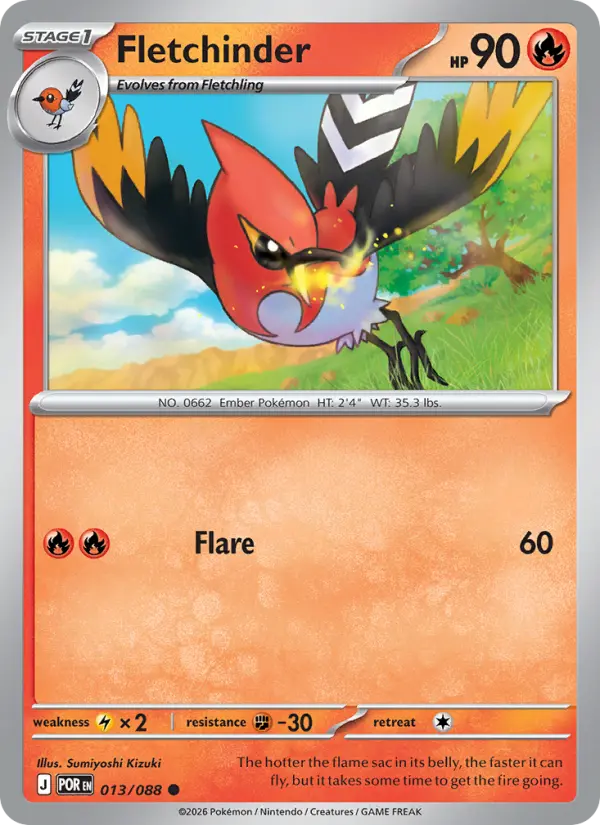
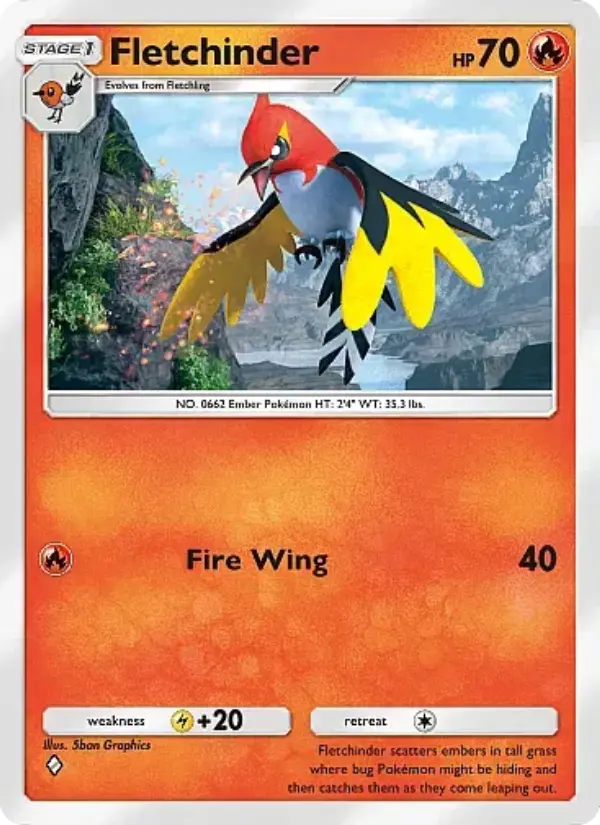
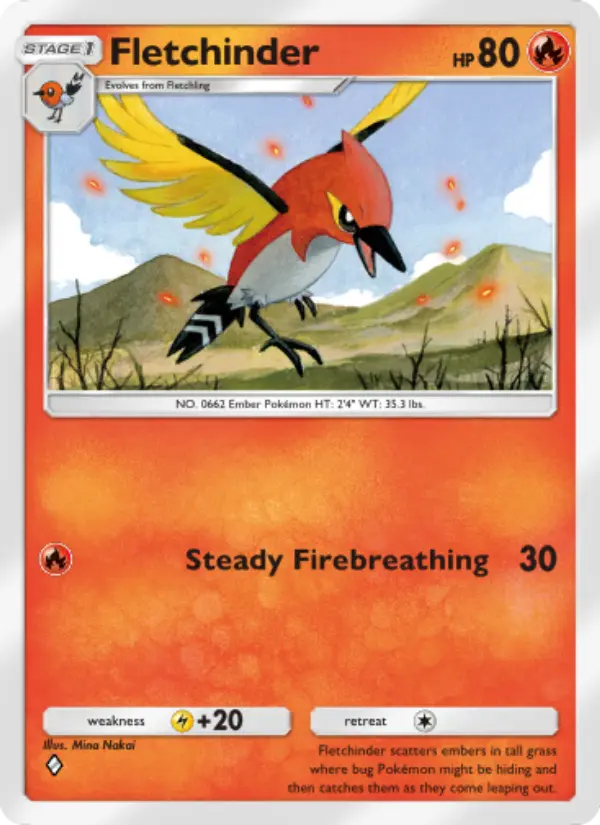
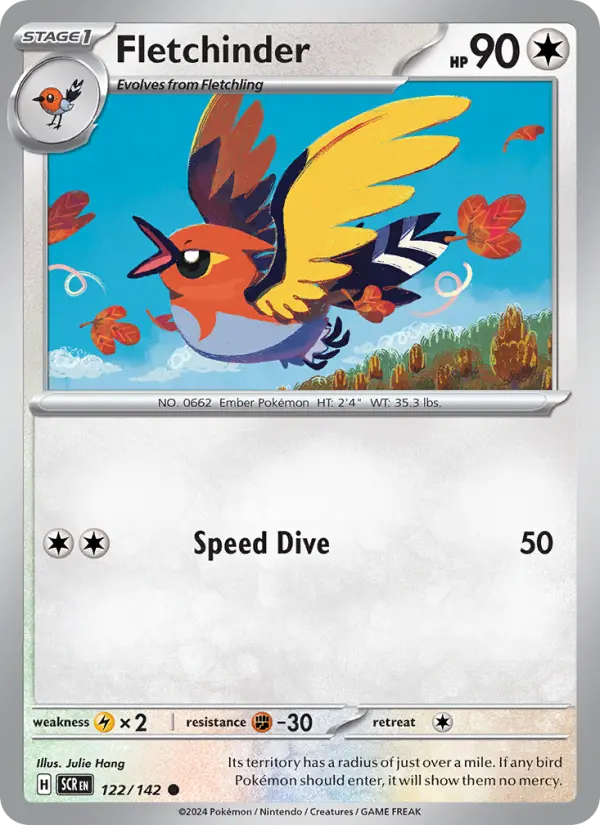
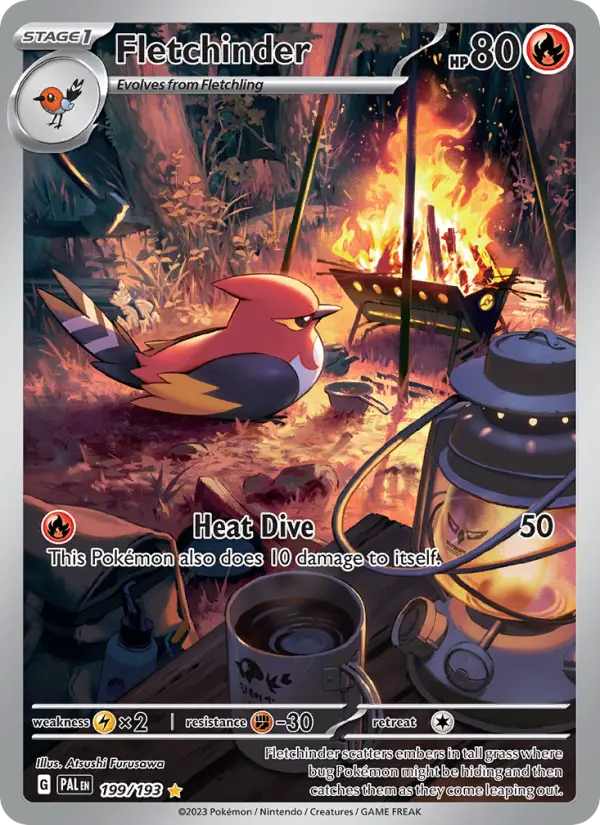
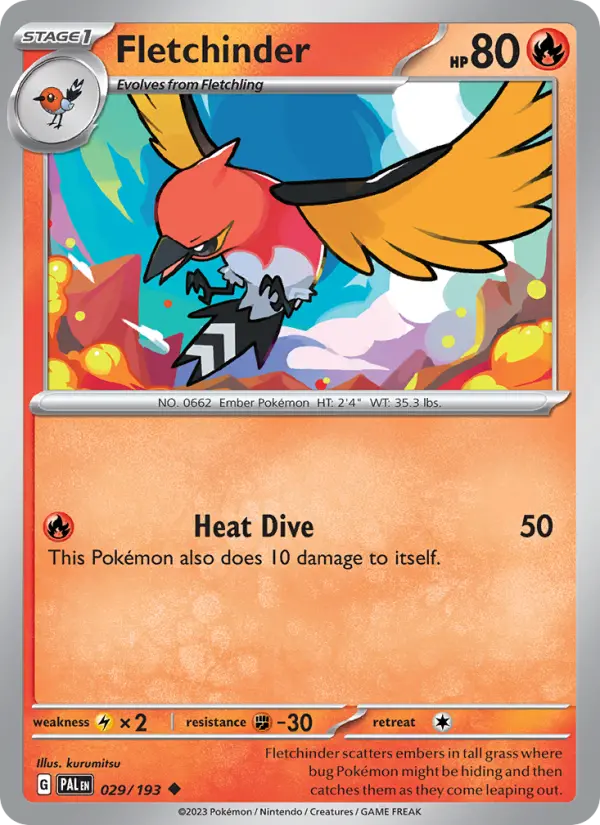
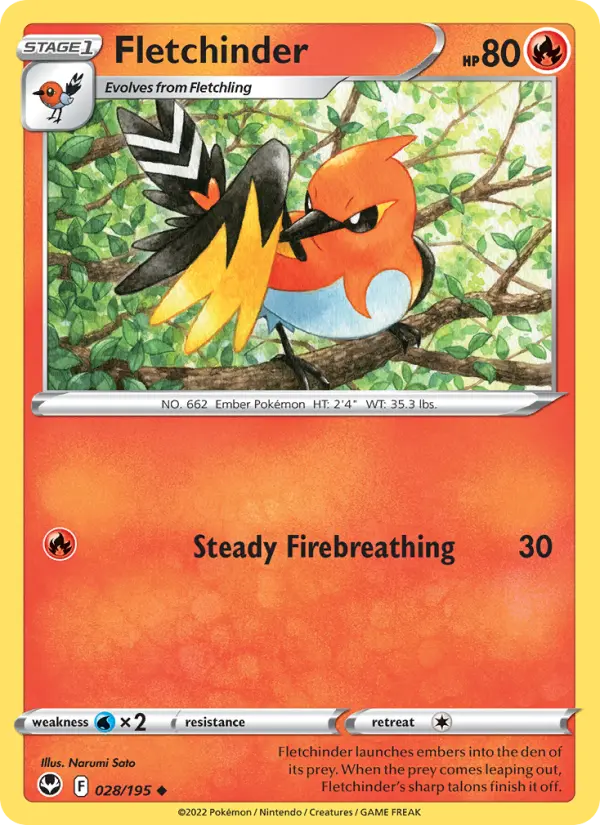
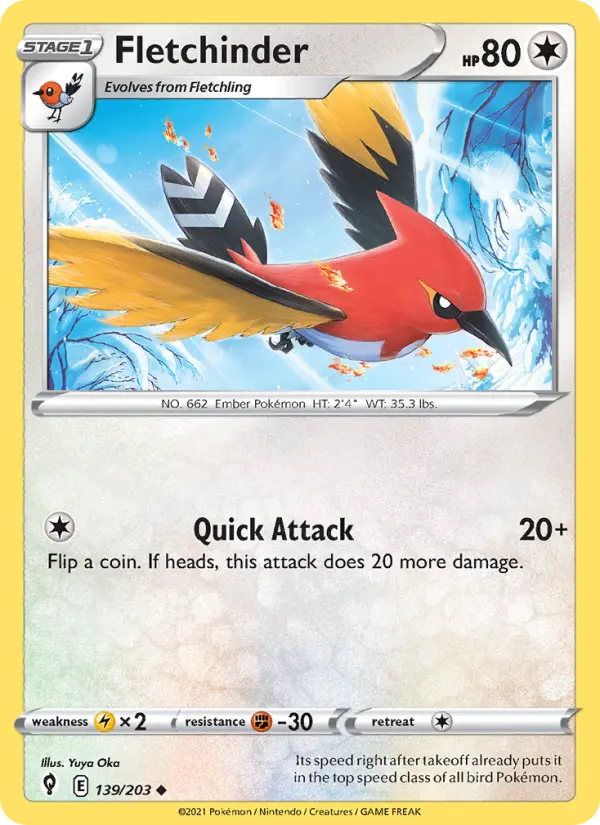
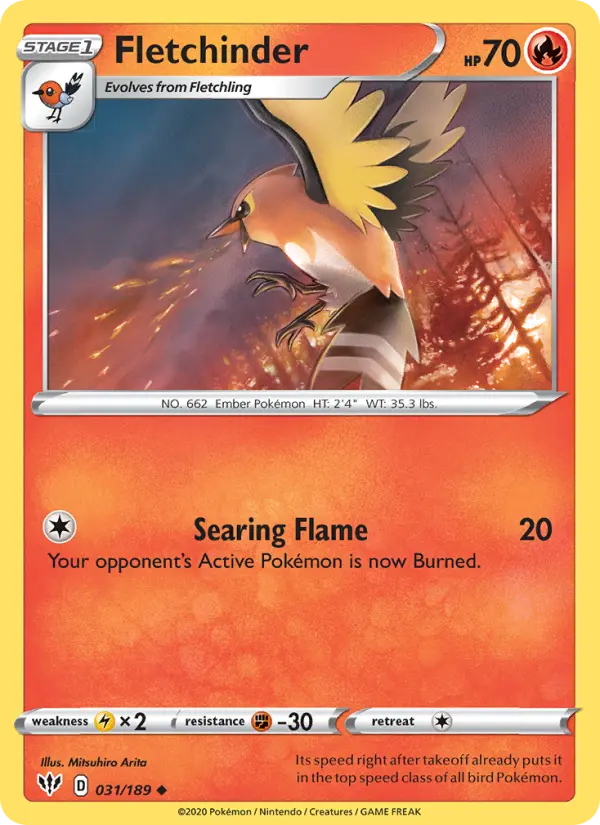
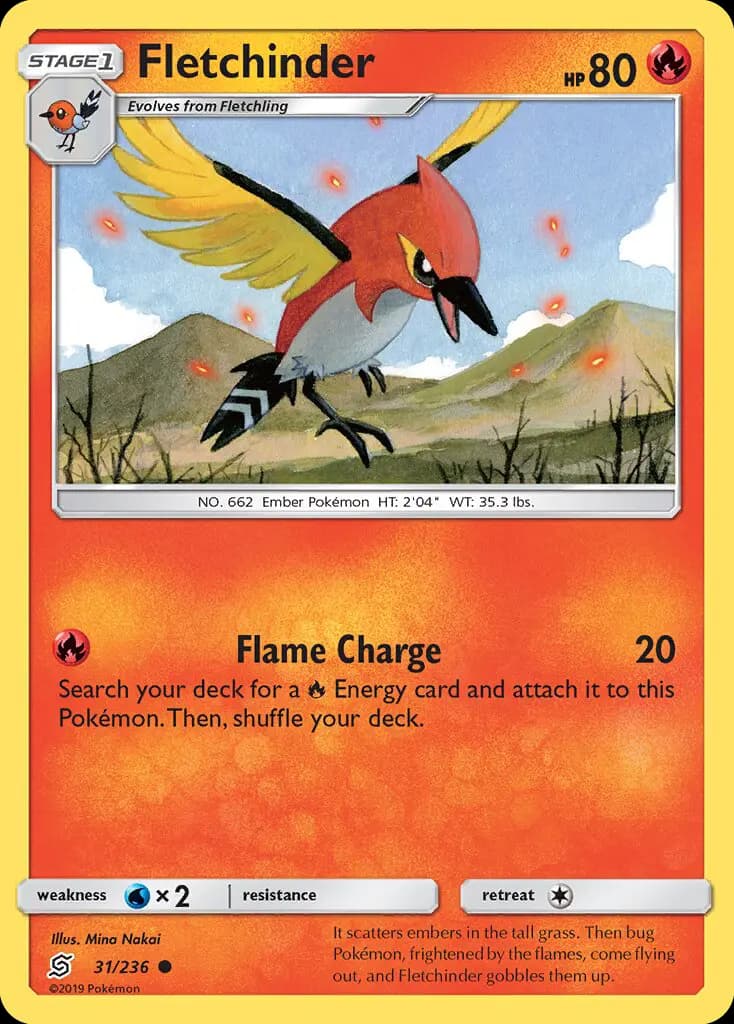
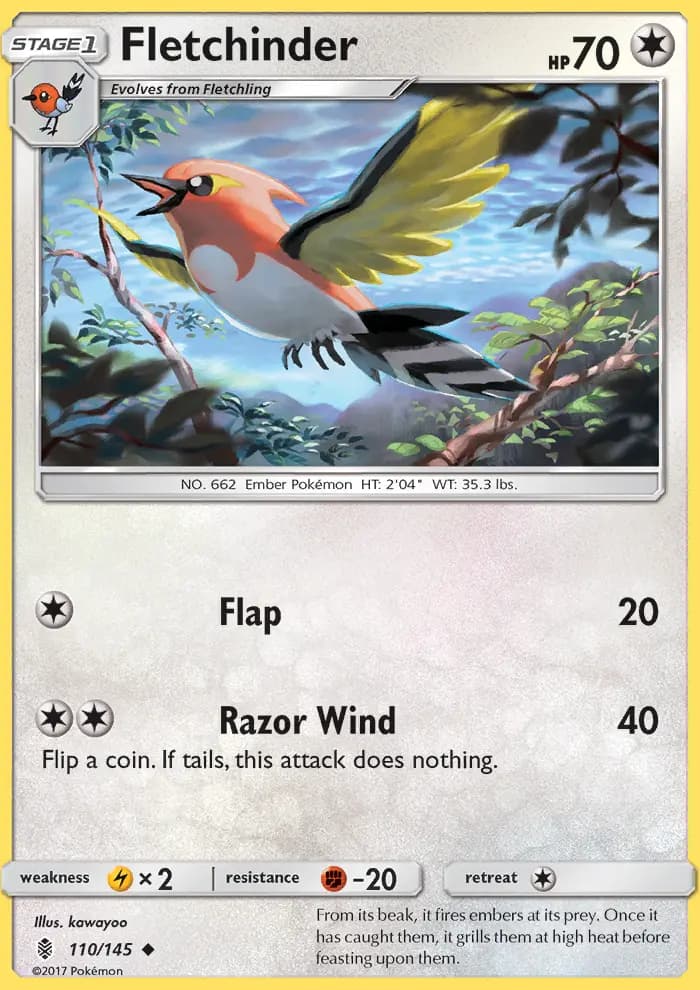
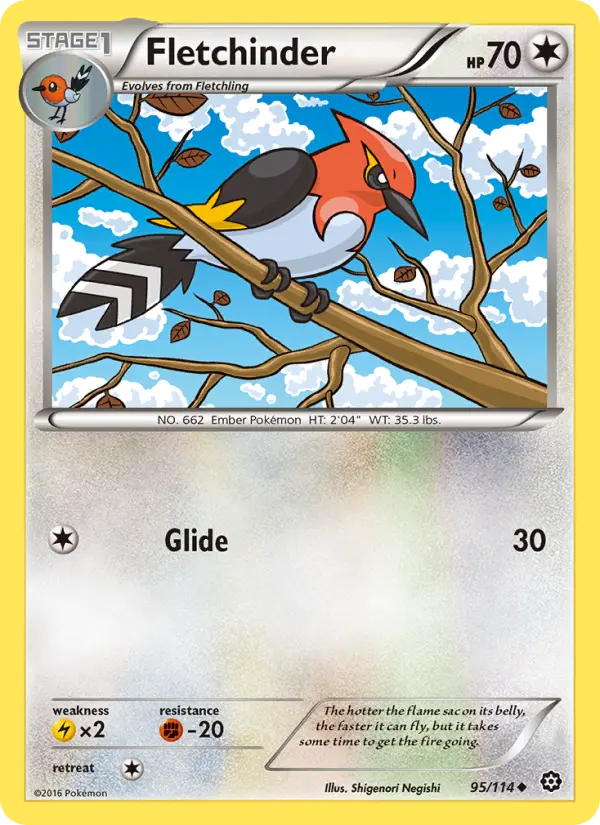
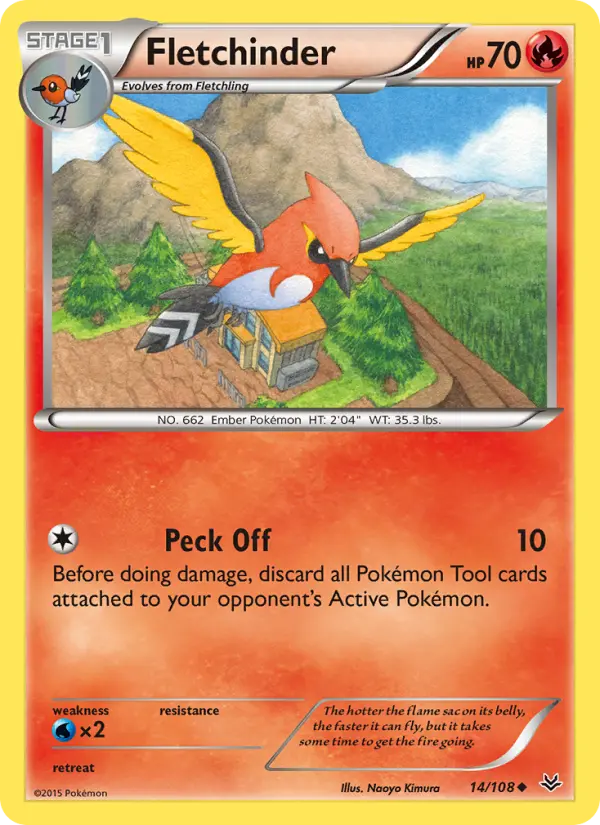
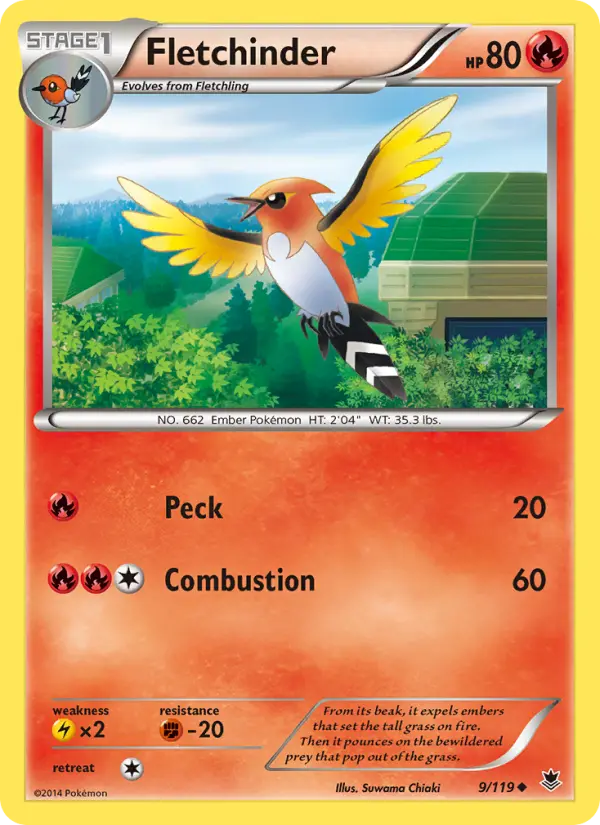
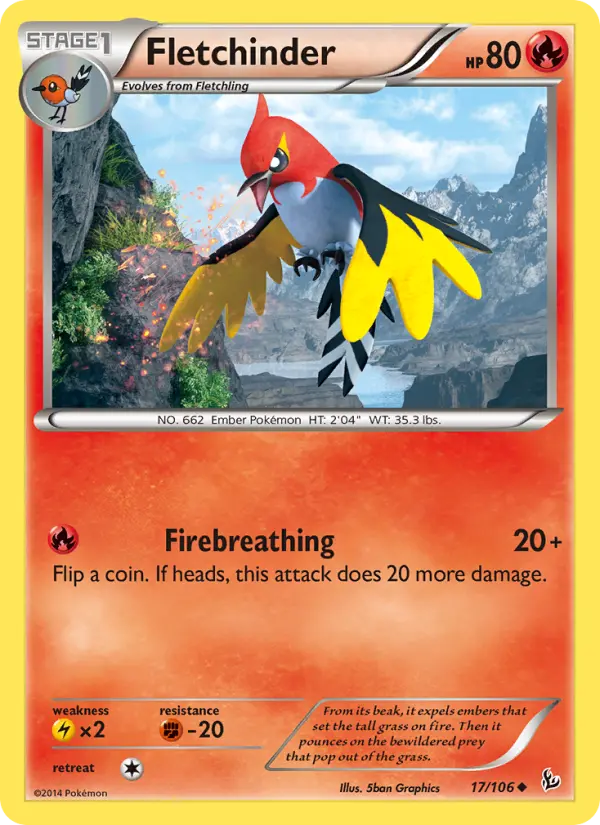
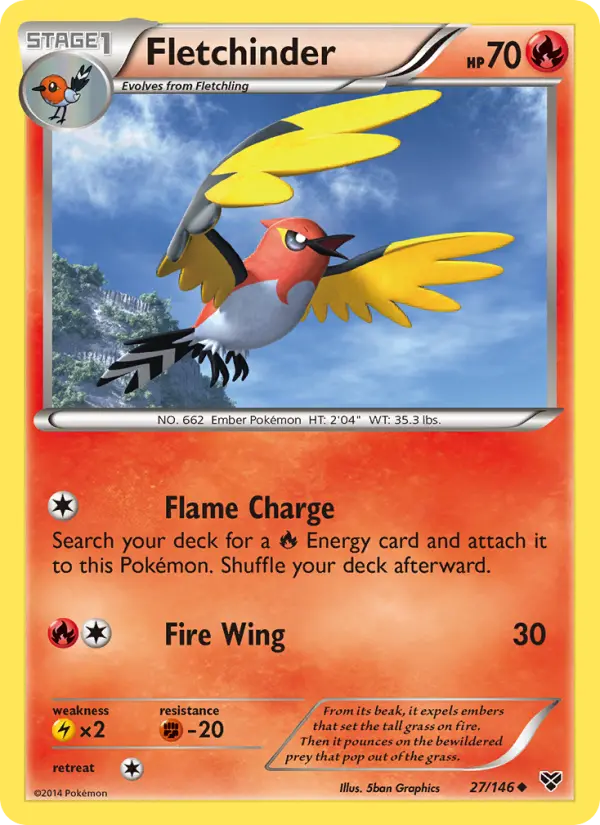
Fletchinder is a sleek avian Pokémon dominated by striking reddish-orange and black plumage, with distinctive yellow accents that create a visually appealing contrast. The Pokémon features a sharp, black beak, piercing black eyes framed by yellow, mask-like markings that give it a focused appearance, and a small pointed crest adorning the back of its head. Its upper body displays the characteristic reddish-orange coloration, while its underbelly transitions to a cool gray tone, with a flame-pattern marking where the two colors converge across its breast. The wings are pointed and black with yellow tips and undersides, providing both aesthetic appeal and functional advantages for aerial combat. Fletchinder possesses black talons arranged with two toes facing forward and one back, enabling precise grasping of prey, and its long black tail-feathers are adorned with white V-shaped markings near their tips, with the tail itself ending in two distinct points and featuring additional feathers at its base that resemble arrow fletching—a design element that reflects the evolutionary line's thematic naming convention. The most remarkable internal feature is Fletchinder's flame sac located within its belly, a specialized organ that generates and stores heat, directly correlating with its flight speed and combat capabilities.
Pokedex Numbers
Training
Breeding
Fletchinder Breeding, Gender Ratio & Egg Groups
Fletchinder exhibits a perfectly balanced gender distribution, with a 50% probability of encountering either male or female specimens in the wild or during breeding endeavors. The species belongs to the Flying egg group, which encompasses numerous avian and reptilian Pokémon, restricting breeding compatibility to other members of this group or Pokémon in the Human-Like egg group when breeding with Ditto. With a base friendship value of 70 during Generations VI and VII (later adjusted in subsequent games), Fletchinder begins its journey with a moderately positive disposition toward its trainer, responding well to kind treatment and gradually increasing its affection through positive interactions. The species requires fifteen egg cycles to hatch, translating to approximately 3,599 to 3,855 steps of travel in-game, placing it in the moderate range of hatching times that encourages player engagement without excessive grinding. Its capture rate of 120 reflects a relatively high susceptibility to being caught in Poké Balls, with approximately a 24.9% success rate when using a standard Poké Ball against a healthy specimen, making it readily available for trainers eager to recruit this species into their team early in their journey through Kalos.
Sprites




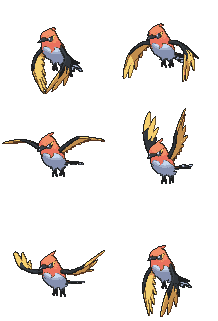
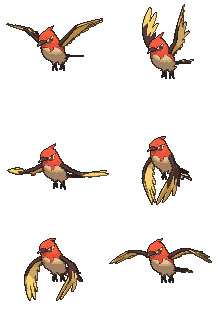
TMs & HMs
tm01
ultra sun ultra moon
tm01
sun moon
tm02
yellow
tm02
red blue
tm02
lets go pikachu lets go eevee
tm02
blue japan
tm02
red green japan
tm03
yellow
tm03
red blue
tm03
blue japan
tm03
red green japan
tm05
lets go pikachu lets go eevee
tm06
yellow
tm06
gold silver
tm06
red blue
tm06
crystal
tm06
emerald
tm06
firered leafgreen
tm06
diamond pearl
tm06
platinum
+546 more TMs/HMs
Fletchinder's Evolution Chain


Fletchinder Evolution, Mega Evolution & Special Forms
Fletchinder occupies a pivotal position within the Fletchling evolutionary line, serving as the essential bridge between the humble Normal/Flying-type Fletchling and the formidable Fire/Flying-type Talonflame. The evolution from Fletchling to Fletchinder occurs at level 17, marking a significant transformation in the Pokémon's capabilities and physical appearance. At this stage, Fletchinder gains its Fire-type designation alongside its Flying-type heritage, acquiring a flame sac and demonstrating notably enhanced stats compared to its pre-evolution. The subsequent evolution to Talonflame occurs upon reaching level 35, at which point Fletchinder undergoes a further dramatic transformation, gaining increased bulk, offensive power, and the devastating hidden ability Gale Wings, which grants priority to Flying-type moves. This three-stage evolutionary line represents one of Generation VI's most balanced progressions, with each stage feeling meaningfully distinct both statistically and thematically. The evolutionary timeline allows trainers ample opportunity to bond with their Fletchinder before pursuing the final, powerful form, making it an excellent choice for players seeking a Fire/Flying-type companion without immediately committing to the ultimate evolution.
Where to Find
Alola Route 8
alola
+1 more
Wela Volcano Park
alola
Fletchinder Behaviour and Natural Habitat
Fletchinder exhibits aggressive and highly territorial behavior, both toward potential prey and rival members of its own species. According to multiple Pokédex entries, this Pokémon maintains an expansive territory with a radius spanning several miles, defending this domain fiercely against any encroaching Fletchinder. The Pokémon's hunting strategy is remarkably sophisticated, involving the deliberate expulsion of embers from its beak to ignite tall grass, thereby flushing out concealed bug-type Pokémon in a panic. Once prey emerges from the flames, Fletchinder demonstrates exceptional coordination, swooping down swiftly to capture the bewildered creatures with its sharp talons. Following capture, the Pokémon grills its prey at high heat before consumption, a behavior that underscores both its mastery of fire and its predatory efficiency. The relationship between Fletchinder's internal flame sac and its aerial performance is particularly noteworthy—as the internal fire gradually heats up over time, the Pokémon achieves progressively faster flight speeds, though this heating requires considerable time to fully activate. This gradual acceleration contrasts sharply with its explosive takeoff speed, which Pokédex entries note already places it within the top speed class of all avian Pokémon immediately upon leaving the ground.
Pokedex Entries
From its beak, it expels embers that set the tall grass on fire. Then it pounces on the bewildered prey that pop out of the grass.
The hotter the flame sac on its belly, the faster it can fly, but it takes some time to get the fire going.
From its beak, it expels embers that set the tall grass on fire. Then it pounces on the bewildered prey that pop out of the grass.
The hotter the flame sac on its belly, the faster it can fly, but it takes some time to get the fire going.
From its beak, it fires embers at its prey. Once it has caught them, it grills them at high heat before feasting upon them.
It scatters embers in the tall grass. Then bug Pokémon, frightened by the flames, come flying out, and Fletchinder gobbles them up.
It will not tolerate other Fletchinder entering its territory, which has a radius of several miles.
Its speed right after takeoff already puts it in the top speed class of all bird Pokémon.
Fletchinder launches embers into the den of its prey. When the prey comes leaping out, Fletchinder’s sharp talons finish it off.
Fletchinder are exceedingly territorial and aggressive. These Pokémon fight among themselves over feeding grounds.
Fletchinder Name Origin & Design Inspiration
The name Fletchinder elegantly combines "fletch," referring to the feathers attached to arrows for stability and direction, with "cinder," evoking glowing embers and fire—a nomenclature that perfectly encapsulates the Pokémon's dual Fire/Flying nature and evolutionary journey. In Japanese, it is known as Hinoyakoma (ヒノヤコマ), where "hino" translates to fire, and the name structure mirrors other bird Pokémon in the Kalos region. The design itself draws inspiration from small swift birds like swallows, particularly the red-rumped swallow, while the flame patterning and color scheme echo the Japanese aesthetic of capturing natural fire elements within living creatures. The arrow-fletching-inspired tail design serves both a visual and symbolic purpose, representing the Pokémon's progression from the initial spark of flame in Fletchling toward the soaring inferno of Talonflame. The yellow wing tips and markings suggest aerodynamic efficiency, while the mask-like eye markings provide the fierce expression befitting a territorial hunter. Every design element collaborates to suggest a Pokémon in transition—more refined and powerful than its pre-evolution, yet still harboring the potential for dramatic advancement, creating a cohesive visual narrative across the evolutionary line.
Learnable Moves
Fletchinder can learn 63 moves:
Move | Type | Cat. | Power | Acc. | PP |
|---|---|---|---|---|---|
| acrobatics | flying | Physical | 55 | 100 | 15 |
| aerial ace | flying | Physical | 60 | — | 20 |
| agility | psychic | Status | — | — | 30 |
| air cutter | flying | Special | 60 | 95 | 25 |
| air slash | flying | Special | 75 | 95 | 15 |
| attract | normal | Status | — | 100 | 15 |
| brave bird | flying | Physical | 120 | 100 | 15 |
| confide | normal | Status | — | — | 20 |
| defog | flying | Status | — | — | 15 |
| double team | normal | Status | — | — | 15 |
| double edge | normal | Physical | 120 | 100 | 15 |
| dual wingbeat | flying | Physical | 40 | 90 | 10 |
| ember | fire | Special | 40 | 100 | 25 |
| endure | normal | Status | — | — | 10 |
| facade | normal | Physical | 70 | 100 | 20 |
| feather dance | flying | Status | — | 100 | 15 |
| feint | normal | Physical | 30 | 100 | 10 |
| fire blast | fire | Special | 110 | 85 | 5 |
| fire spin | fire | Special | 35 | 85 | 15 |
| flail | normal | Physical | — | 100 | 15 |
| flame charge | fire | Physical | 50 | 100 | 20 |
| flamethrower | fire | Special | 90 | 100 | 15 |
| flare blitz | fire | Physical | 120 | 100 | 15 |
| fly | flying | Physical | 90 | 95 | 15 |
| frustration | normal | Physical | — | 100 | 20 |
| growl | normal | Status | — | 100 | 40 |
| heat wave | fire | Special | 95 | 90 | 10 |
| hidden power | normal | Special | 60 | 100 | 15 |
| hurricane | flying | Special | 110 | 70 | 10 |
| incinerate | fire | Special | 60 | 100 | 15 |
| me first | normal | Status | — | — | 20 |
| natural gift | normal | Physical | — | 100 | 15 |
| overheat | fire | Special | 130 | 90 | 5 |
| peck | flying | Physical | 35 | 100 | 35 |
| protect | normal | Status | — | — | 10 |
| quick attack | normal | Physical | 40 | 100 | 30 |
| rain dance | water | Status | — | — | 5 |
| razor wind | normal | Special | 80 | 100 | 10 |
| rest | psychic | Status | — | — | 5 |
| return | normal | Physical | — | 100 | 20 |
| roost | flying | Status | — | — | 5 |
| round | normal | Special | 60 | 100 | 15 |
| secret power | normal | Physical | 70 | 100 | 20 |
| sleep talk | normal | Status | — | — | 10 |
| snatch | dark | Status | — | — | 10 |
| snore | normal | Special | 50 | 100 | 15 |
| steel wing | steel | Physical | 70 | 90 | 25 |
| substitute | normal | Status | — | — | 10 |
| sunny day | fire | Status | — | — | 5 |
| swagger | normal | Status | — | 85 | 15 |
| swift | normal | Special | 60 | — | 20 |
| swords dance | normal | Status | — | — | 20 |
| tackle | normal | Physical | 40 | 100 | 35 |
| tailwind | flying | Status | — | — | 15 |
| take down | normal | Physical | 90 | 85 | 20 |
| taunt | dark | Status | — | 100 | 20 |
| temper flare | fire | Physical | 75 | 100 | 10 |
| tera blast | normal | Special | 80 | 100 | 10 |
| thief | dark | Physical | 60 | 100 | 25 |
| toxic | poison | Status | — | 90 | 10 |
| u turn | bug | Physical | 70 | 100 | 20 |
| will o wisp | fire | Status | — | 85 | 15 |
| work up | normal | Status | — | — | 30 |
Fletchinder Competitive Battle Guide
In tournament-level play, Fletchinder occupies an interesting but ultimately transitional niche, serving primarily as a stepping stone toward the significantly more viable Talonflame rather than as an end-stage competitive choice itself. With modest base stats distributed across 382 total, Fletchinder struggles to maintain relevance against similarly-leveled competitive threats, though its Speed stat of 84 provides respectable mobility in lower-tier formats. The species' primary advantage lies in its access to Gale Wings as a hidden ability, an exclusive ability shared only with its evolutionary relatives that grants priority to all Flying-type moves—a capability that becomes devastating once Fletchinder evolves into Talonflame. Its standard ability, Flame Body, offers utility through a 30% chance of burning opposing Pokémon upon contact, providing passive damage and potential strategy disruption but lacking the aggressive potency of Gale Wings. Fletchinder's movepool, while serviceable, emphasizes Fire and Flying-type coverage alongside some utility options, but without the bulk or special attack to fully capitalize on special attacking opportunities. Most competitive players utilize Fletchinder exclusively as a bridge to evolution rather than fielding it in competitive play, making it a consideration primarily in Little Cup or lower-tier competitive formats where its intermediate stats and access to Gale Wings provide legitimate strategic value.
Commonly Asked Questions About Fletchinder
What type is Fletchinder?
Fletchinder is a fire and flying type Pokemon.
What does Fletchinder evolve into?
Fletchinder evolves into talonflame.
What are Fletchinder's weaknesses?
Fletchinder is weak to ground, rock, water and electric type moves.
Does Fletchinder evolve by trading?
No — Fletchinder evolves entirely through leveling up, with no trade required at any stage.
Where can I find Fletchinder?
Fletchinder can be found in alola route 8 (alola) and wela volcano park (alola).
Fletchinder Cultural Impact & Franchise History
Fletchinder gained significant cultural prominence through its appearance as Ash Ketchum's primary Fire-type companion in the Kalos region episodes of the Pokémon anime, a starring role that dramatically increased the species' recognition and popularity among viewers worldwide. The dynamic between Ash and Fletchinder, culminating in its eventual evolution into Talonflame, provided one of the anime series' most compelling character arcs for the season, resonating particularly with fans who appreciated the gradual development and earned power progression. The Pokémon's sleek design and impressive aerial capabilities captured the imagination of players and fans alike, establishing it as an iconic representation of Generation VI's modernized aesthetic and the Kalos region's particular charm. Beyond the anime, Fletchinder has secured its place in competitive communities and casual gaming circles as a popular mid-stage evolution choice, frequently featured in player teams and possessing dedicated fan artwork celebrating its elegant design. The species' thematic connection to fire and flight, combined with its strategic viability in intermediate-level play, has elevated it beyond mere evolutionary stepping stone to become a Pokémon worthy of appreciation in its own right, though it remains perpetually overshadowed by the superior capabilities of Talonflame.
Where to Find Fletchinder in Every Pokémon Game
Fletchinder's availability varies considerably across different Pokémon games and regions, though it remains consistently accessible to players pursuing the Fletchling evolutionary line. In Pokémon X and Y, its native Generation VI debut games, Fletchinder can be readily encountered and captured throughout the Kalos region's various routes and forests, making it an early-game option for trainers seeking a Fire/Flying-type companion. The species appears in the Central Kalos Pokédex as entry #0015, ensuring prominent visibility during the main campaign. In subsequent generations, including Sun and Moon, Ultra Sun and Ultra Moon, Sword and Shield, and the more recent Scarlet and Violet, Fletchinder maintains availability either through wild encounters or as an obtainable mid-stage evolution via the Fletchling line. Its presence in multiple game generations and regions speaks to its fundamental importance within the modern Pokédex, ensuring that trainers across different play-throughs and game versions can relatively easily access this species. However, the most practical method for most players involves capturing Fletchling early in their respective games and naturally evolving it into Fletchinder through leveling, a process that feels organically integrated into the typical progression timeline and rewards players for maintaining their fire-type companion throughout their journey.