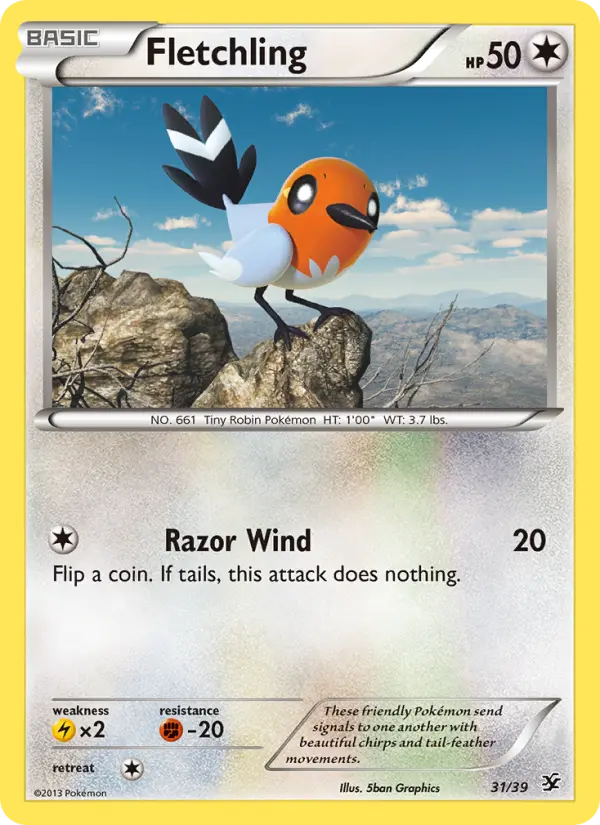
Fletchling
Generation VI · #0661 — Tiny Robin Pokémon
Fletchling is a normal/flying-type Pokémon whose speed — 62 at base — does more to define its role than its overall spread does. Despite its diminutive stature, Fletchling possesses an interesting dual nature—it presents itself as an amiable and friendly companion, yet transforms into a fierce and relentless combatant when battle commences. The species evolves into Fletchinder at level 17, which subsequently evolves into the powerful Talonflame at level 35, forming a complete three-stage evolutionary line that gains a Fire typing upon first evolution. With a overall stat sum of 278 and a catch rate of 255, Fletchling serves as an accessible and commonly encountered Pokémon for trainers beginning their adventure in the Kalos region.
Editor's Take
Fletchling's line ends in Talonflame, whose Gale Wings gave priority to all Flying moves and was so oppressive it had to be nerfed to only work at full health.
Base Stats
Height
0.3m
Weight
1.7kg
Category
Tiny Robin Pokémon
Gender
Male 50% / Female 50%
Color
red
Shape
wings
Abilities
Protects against Defense drops.
Raises flying moves' priority by one stage.

Fletchling Biology & Physical Characteristics
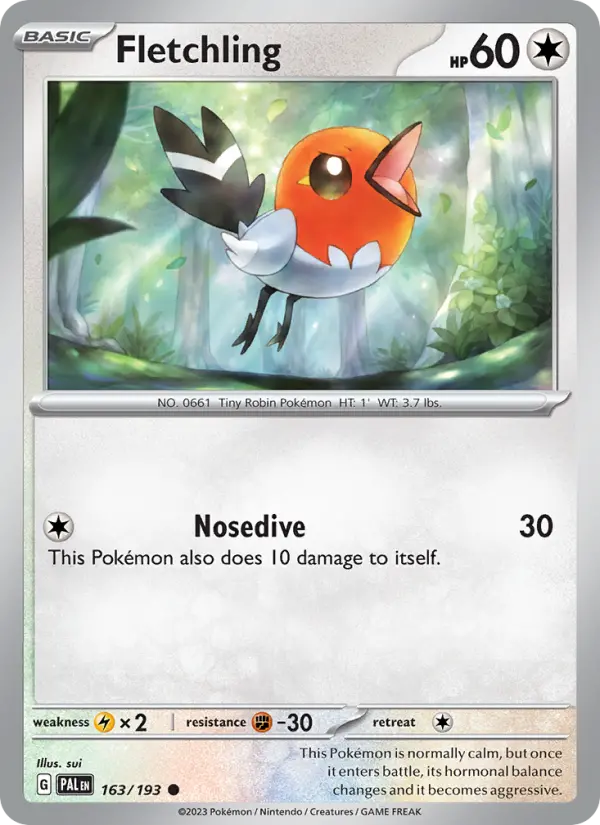
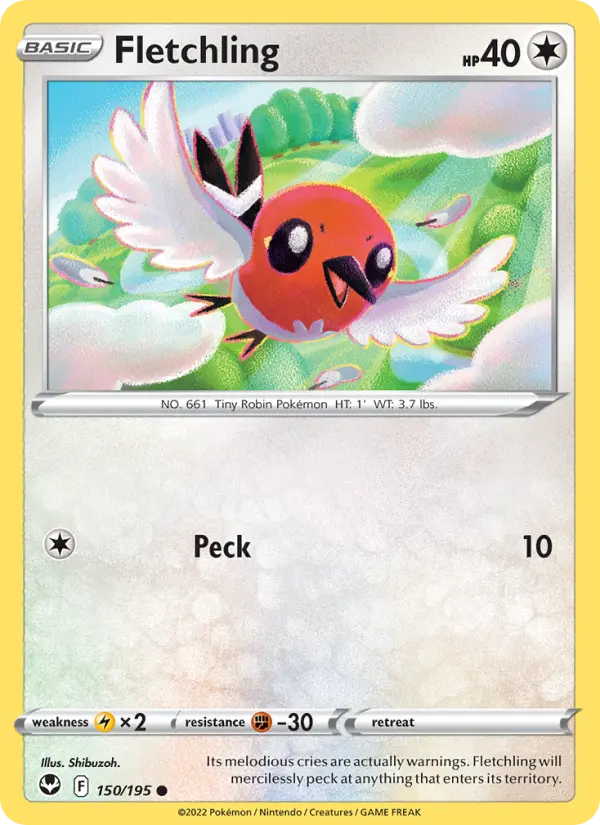
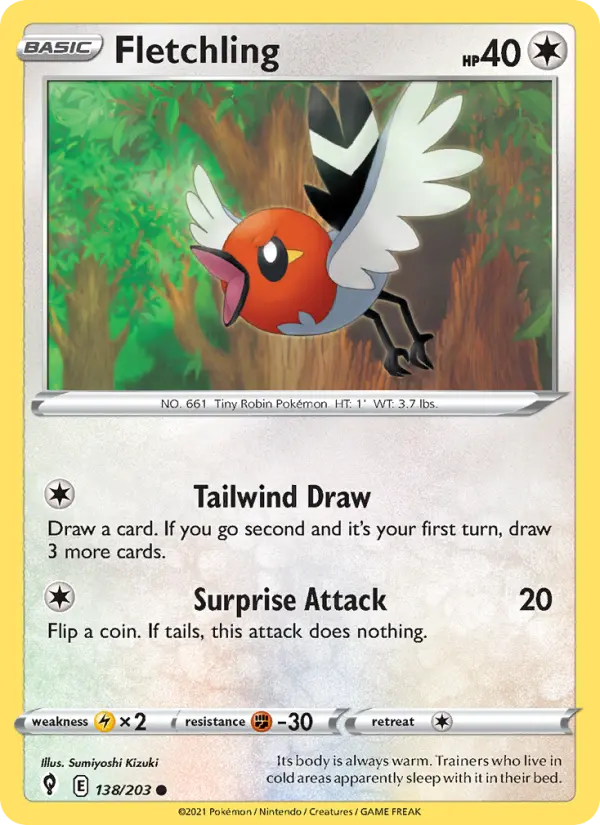
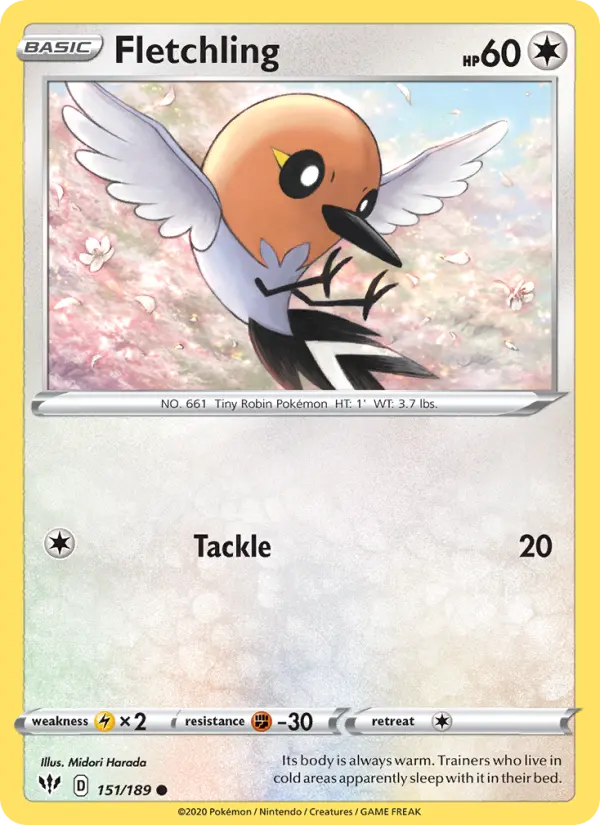
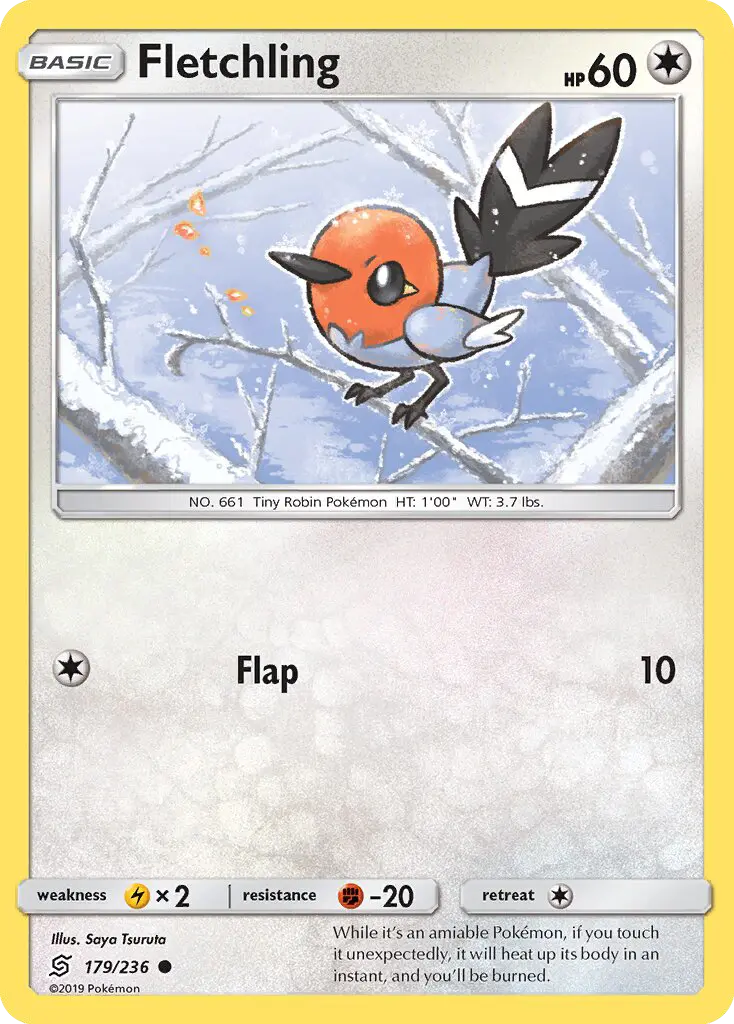
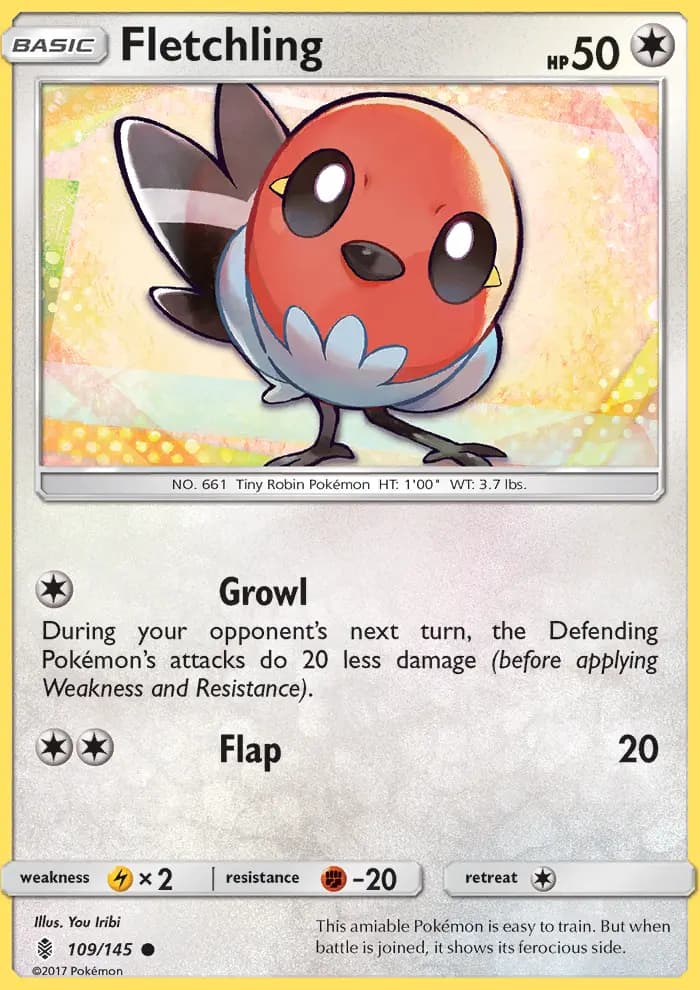
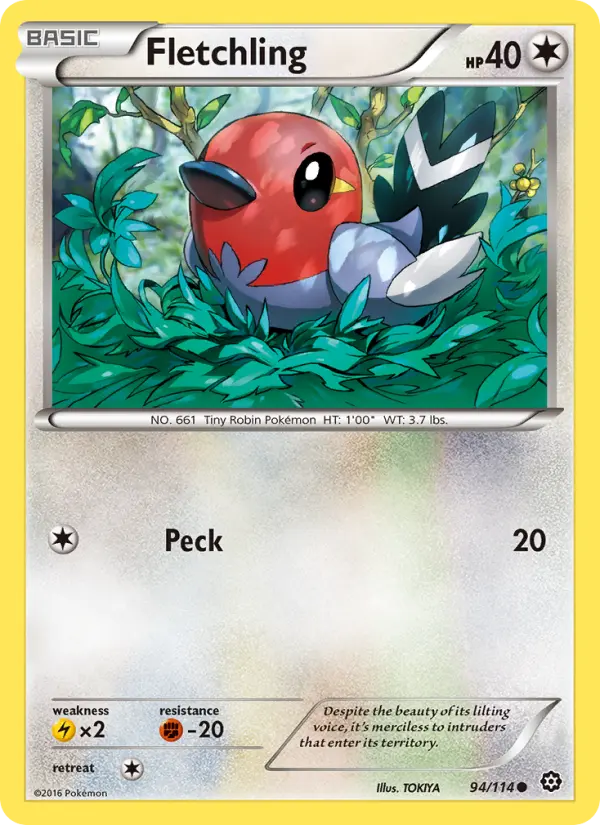
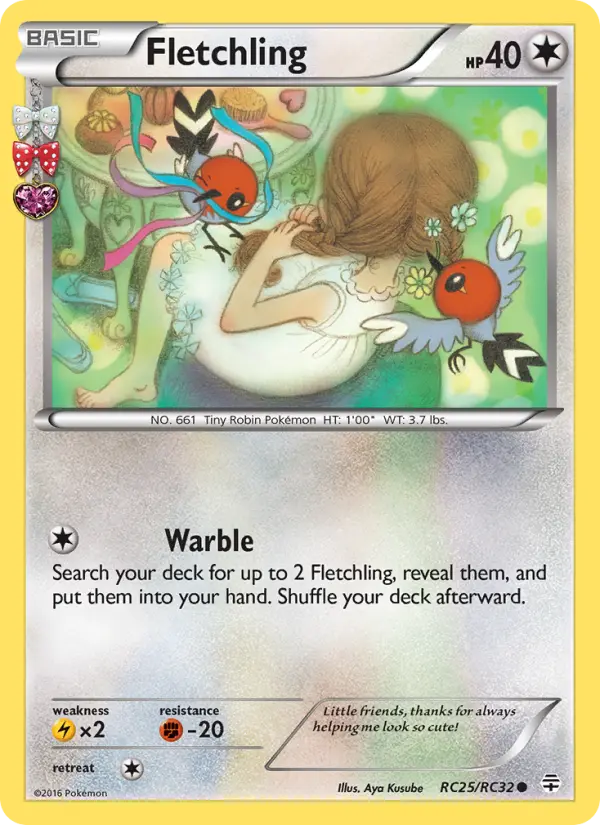
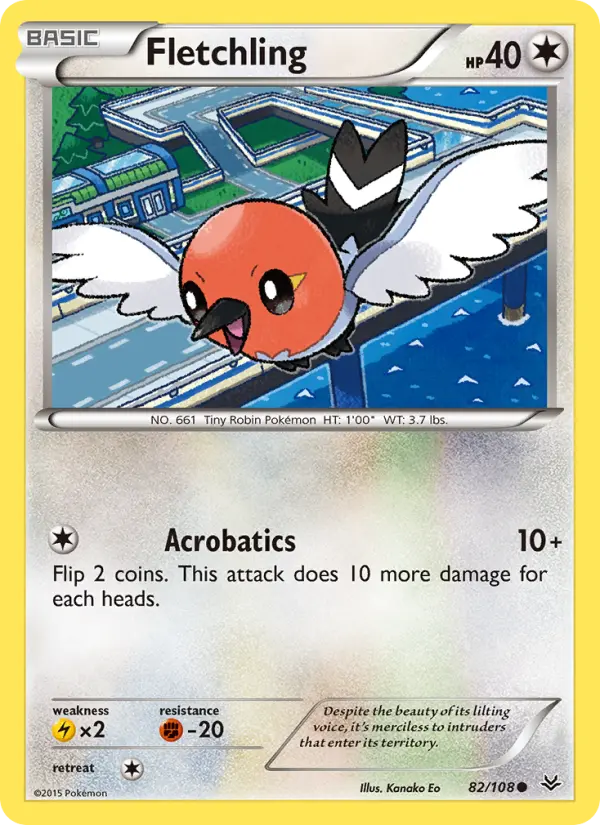
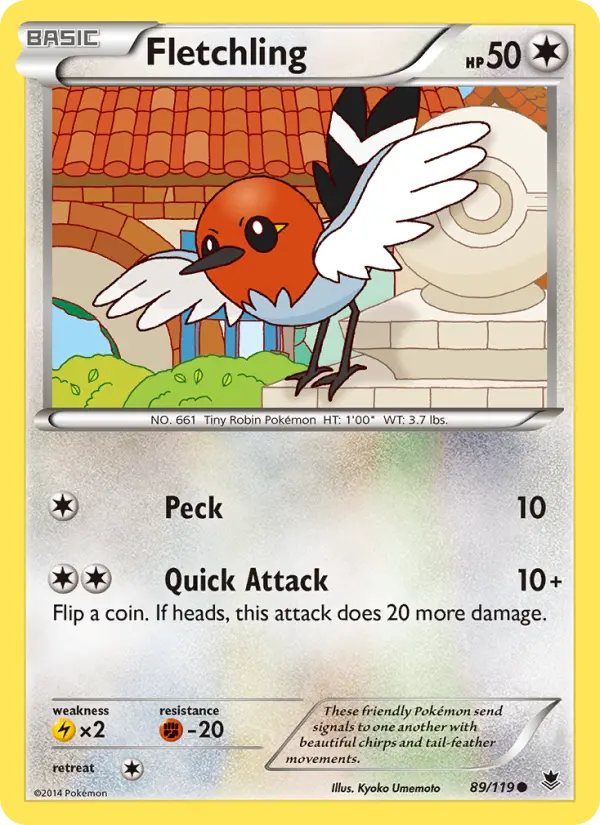
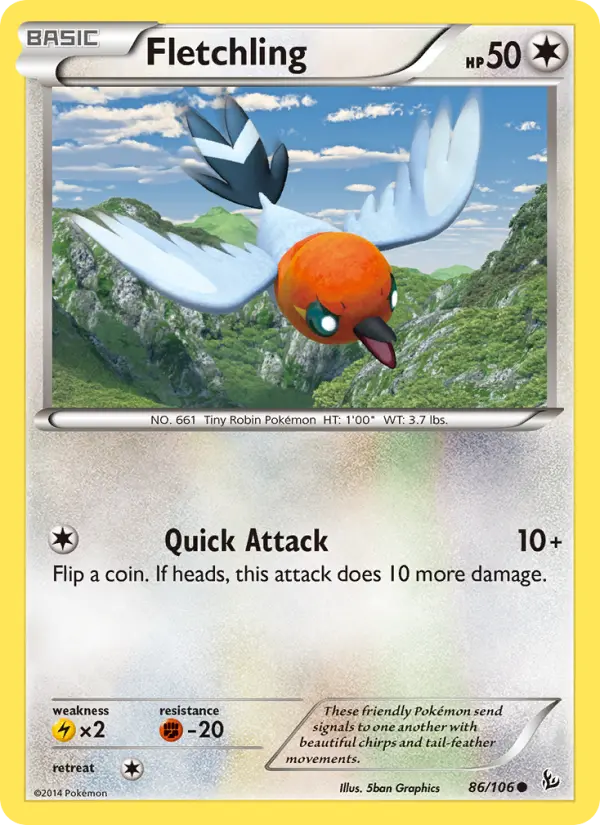
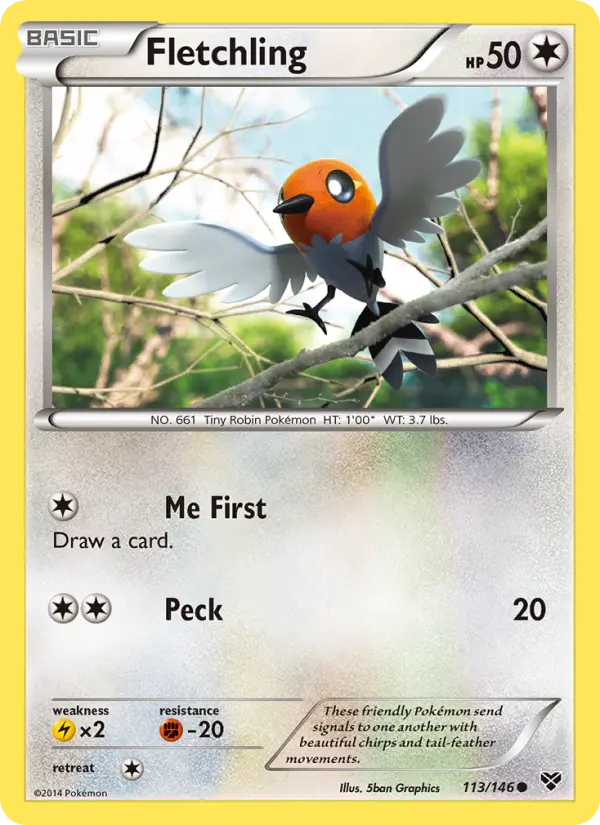
Fletchling's appearance closely mirrors that of a robin, featuring a distinctive reddish-orange head adorned with triangular yellow markings positioned behind each eye. The body and wings display a gray coloration, with white tips on the wings providing visual contrast, while the long black tail is marked with a characteristic white V-shaped pattern near its tip. The tail itself ends in two distinct points with two feathers jutting out at the base, resembling the fletching found on arrows—a design element that directly influenced its nomenclature. Its slender black legs, small pointed beak, and dark eyes complete the charming avian aesthetic. The species possesses an innately warm body temperature that serves as a biological defense mechanism; when startled or excited, this temperature can double in intensity, spiking hormone production throughout its body and potentially causing burns to anyone touching it with bare skin. Trainers in cold climates have reportedly utilized Fletchling's natural warmth as a sleeping companion during harsh winters, a testament to the Pokémon's constant thermoregulatory activity.
Pokedex Numbers
Training
Breeding
Fletchling Breeding, Gender Ratio & Egg Groups
Gender-wise, Fletchling is an even 50/50 split between males and females. The species belongs to the Flying egg group, allowing it to breed with other Pokémon sharing this classification and potentially producing eggs containing Fletchling offspring. With a hatch counter value of 15, eggs require approximately 3,599 to 3,855 steps to hatch, placing Fletchling in the moderate hatching timeframe. The species follows a medium-slow growth rate, meaning it reaches level 100 at a pace slower than medium-growth Pokémon but faster than slow-growth species, creating a balanced training timeline for competitive and casual players alike. Fletchling's base friendship value of 70 in Generations VI and VII indicates its innate tendency toward bonding with trainers, though this was adjusted in later generations. The balanced gender ratio and accessible breeding mechanics make Fletchling an excellent choice for trainers interested in breeding projects, particularly those seeking to produce competitive Fletchinder or Talonflame with optimal individual values and egg move combinations. The species' friendly nature extends to breeding mechanics, as it readily forms bonds necessary for successful reproduction in trainer care.
Sprites






TMs & HMs
tm01
ultra sun ultra moon
tm01
sun moon
tm02
yellow
tm02
red blue
tm02
lets go pikachu lets go eevee
tm02
blue japan
tm02
red green japan
tm03
yellow
tm03
red blue
tm03
blue japan
tm03
red green japan
tm05
lets go pikachu lets go eevee
tm06
yellow
tm06
gold silver
tm06
red blue
tm06
crystal
tm06
emerald
tm06
firered leafgreen
tm06
diamond pearl
tm06
platinum
+496 more TMs/HMs
Fletchling's Evolution Chain


Fletchling Evolution, Mega Evolution & Special Forms
Fletchling begins a remarkable evolutionary journey that fundamentally transforms its typing and combat capabilities. At level 17, the Tiny Robin Pokémon evolves into Fletchinder, acquiring a Fire typing alongside its existing Flying type and gaining substantially increased stats across all categories. This first evolution marks the point at which Fletchling's innate warmth becomes externally visible through flames, reflecting its internal temperature regulation mechanism. The second evolution occurs at level 35 when Fletchinder undergoes metamorphosis into Talonflame, completing the three-stage line with further stat increases and improved movepool access. Talonflame becomes a formidable Fire/Flying-type Pokémon significantly more powerful than its diminutive predecessor. The evolutionary line does not possess any Mega Evolution forms, distinguishing it from some of Generation VI's other starter-adjacent Pokémon lines. This linear progression from humble Normal/Flying beginnings to elite Fire/Flying status represents one of the most dramatic type transformations available in Pokémon evolution, fundamentally altering the species' role in competitive and casual gameplay from a defensive, utility-focused creature to an offensive powerhouse.
Where to Find
Kalos Route 3
kalos
+1 more
Kalos Route 2
kalos
+1 more
Santalune Forest
kalos
Poke Pelago
alola
+3 more
Wela Volcano Park
alola
+1 more
Alola Route 8
alola
Fletchling Behaviour and Natural Habitat
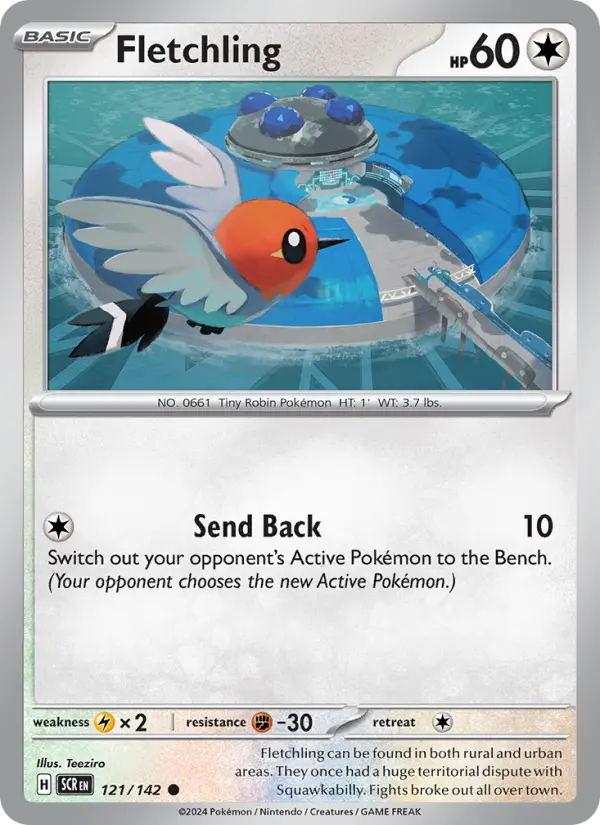
Despite its beautiful and melodious chirps, Fletchling's vocalizations are actually sophisticated warning calls rather than mere songs of contentment. The species communicates with other Fletchling through a combination of these chirps and deliberate tail-feather movements, establishing a complex non-verbal communication system among colony members. Fletchling displays a remarkably contrasting personality—under normal circumstances, it is exceptionally friendly and easy to train, with a base happiness value of 70 indicating its natural affinity for human companionship. However, this peaceful demeanor masks an aggressive territorial nature that emerges instantly upon the commencement of battle. The Pokédex entries emphasize that Fletchling becomes merciless to intruders entering its territory, suggesting a biphasic personality state triggered by competitive stimuli. The species inhabits both rural and urban environments across the Kalos region, thriving in varied ecological niches. Notably, Fletchling populations in the Paldea region once engaged in massive territorial conflicts with Squawkabilly, indicating inter-species competition for environmental resources and nesting territories.
Pokedex Entries
These friendly Pokémon send signals to one another with beautiful chirps and tail-feather movements.
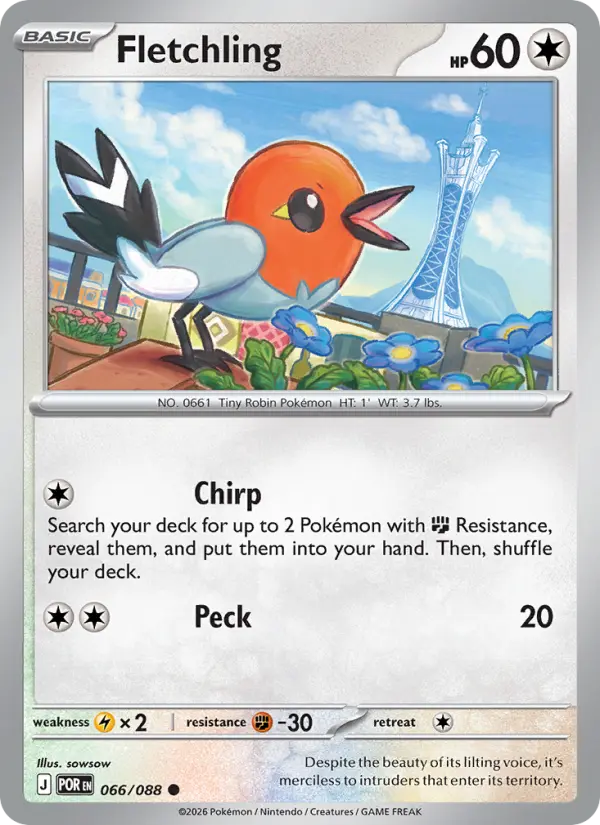
Despite the beauty of its lilting voice, it’s merciless to intruders that enter its territory.
These friendly Pokémon send signals to one another with beautiful chirps and tail-feather movements.
Despite the beauty of its lilting voice, it’s merciless to intruders that enter its territory.
This amiable Pokémon is easy to train. But when battle is joined, it shows its ferocious side.
While it’s an amiable Pokémon, if you touch it unexpectedly, it will heat up its body in an instant, and you’ll be burned.
When it’s excited, its temperature can double, spiking hormone production in its body.
Its body is always warm. Trainers who live in cold areas apparently sleep with it in their bed.
Its melodious cries are actually warnings. Fletchling will mercilessly peck at anything that enters its territory.
When this Pokémon gets excited, its body temperature increases sharply. If you touch a Fletchling with bare hands, you might get burned.
Fletchling Name Origin & Design Inspiration
Fletchling's name comes from the word 'fletch,' referring to the feathers of an arrow that provide stability during flight, directly referencing the distinctive tail feathers protruding from the base of the species' tail. In Japanese, the species is called 'Yayakoma,' with 'yaya' potentially referring to the early or small stage of development, while 'koma' relates to small birds or the robin specifically. The design philosophy centers on creating a robin-inspired Pokémon that emphasizes the fletching concept, with the two tail feathers explicitly resembling arrow flights. The reddish-orange head coloration draws direct inspiration from the red breast characteristic of European robins, a design choice that grounds the Pokémon in real-world avian biology while maintaining distinctive Pokémon aesthetics. The triangular yellow eye markings serve as identifying features that differentiate Fletchling from standard robin species, giving it recognizable silhouette even at small sizes. The gray body coloring contrasts with the vibrant head, creating visual balance and suggesting the species' calm demeanor before battle transforms its appearance through flame.
Learnable Moves
Fletchling can learn 58 moves:
Move | Type | Cat. | Power | Acc. | PP |
|---|---|---|---|---|---|
| acrobatics | flying | Physical | 55 | 100 | 15 |
| aerial ace | flying | Physical | 60 | — | 20 |
| agility | psychic | Status | — | — | 30 |
| air cutter | flying | Special | 60 | 95 | 25 |
| air slash | flying | Special | 75 | 95 | 15 |
| attract | normal | Status | — | 100 | 15 |
| brave bird | flying | Physical | 120 | 100 | 15 |
| confide | normal | Status | — | — | 20 |
| defog | flying | Status | — | — | 15 |
| double team | normal | Status | — | — | 15 |
| double edge | normal | Physical | 120 | 100 | 15 |
| dual wingbeat | flying | Physical | 40 | 90 | 10 |
| ember | fire | Special | 40 | 100 | 25 |
| endure | normal | Status | — | — | 10 |
| facade | normal | Physical | 70 | 100 | 20 |
| feather dance | flying | Status | — | 100 | 15 |
| flail | normal | Physical | — | 100 | 15 |
| flame charge | fire | Physical | 50 | 100 | 20 |
| flare blitz | fire | Physical | 120 | 100 | 15 |
| fly | flying | Physical | 90 | 95 | 15 |
| frustration | normal | Physical | — | 100 | 20 |
| growl | normal | Status | — | 100 | 40 |
| heat wave | fire | Special | 95 | 90 | 10 |
| hidden power | normal | Special | 60 | 100 | 15 |
| hurricane | flying | Special | 110 | 70 | 10 |
| me first | normal | Status | — | — | 20 |
| natural gift | normal | Physical | — | 100 | 15 |
| overheat | fire | Special | 130 | 90 | 5 |
| peck | flying | Physical | 35 | 100 | 35 |
| protect | normal | Status | — | — | 10 |
| quick attack | normal | Physical | 40 | 100 | 30 |
| quick guard | fighting | Status | — | — | 15 |
| rain dance | water | Status | — | — | 5 |
| razor wind | normal | Special | 80 | 100 | 10 |
| rest | psychic | Status | — | — | 5 |
| return | normal | Physical | — | 100 | 20 |
| roost | flying | Status | — | — | 5 |
| round | normal | Special | 60 | 100 | 15 |
| secret power | normal | Physical | 70 | 100 | 20 |
| sleep talk | normal | Status | — | — | 10 |
| snatch | dark | Status | — | — | 10 |
| snore | normal | Special | 50 | 100 | 15 |
| steel wing | steel | Physical | 70 | 90 | 25 |
| substitute | normal | Status | — | — | 10 |
| sunny day | fire | Status | — | — | 5 |
| swagger | normal | Status | — | 85 | 15 |
| swift | normal | Special | 60 | — | 20 |
| swords dance | normal | Status | — | — | 20 |
| tackle | normal | Physical | 40 | 100 | 35 |
| tailwind | flying | Status | — | — | 15 |
| take down | normal | Physical | 90 | 85 | 20 |
| taunt | dark | Status | — | 100 | 20 |
| tera blast | normal | Special | 80 | 100 | 10 |
| thief | dark | Physical | 60 | 100 | 25 |
| toxic | poison | Status | — | 90 | 10 |
| u turn | bug | Physical | 70 | 100 | 20 |
| will o wisp | fire | Status | — | 85 | 15 |
| work up | normal | Status | — | — | 30 |
Fletchling Competitive Battle Guide
Fletchling occupies a unique niche in competitive Pokémon battling as an early-game bird Pokémon with interesting potential through its hidden ability Gale Wings. Its base stats total 278, with a notable speed stat of 62 providing moderate velocity, while attack and special attack lag significantly at 50 and 40 respectively. The species' primary ability Big Pecks protects against Defense reductions, offering passive defensive utility, while the hidden ability Gale Wings elevates Flying-type moves' priority by one stage once evolution occurs. Fletchling itself learns limited competitive moves, with access to basic Normal and Flying attacks that scale poorly with its modest offensive stats. However, its true competitive value emerges upon evolution into Fletchinder and especially Talonflame, which gains the Fire typing and substantially higher stats that capitalize on priority move access from Gale Wings. Early trainers utilizing Fletchling for competitive purposes typically focus on its evolution potential rather than its base form capabilities. The species functions most effectively as a training stepping stone, with experienced players recognizing that Fletchling's value increases exponentially upon reaching level 17. In the early game of X and Y, Fletchling serves as a powerful team member alongside its rapid evolution and improved movepool access.
Commonly Asked Questions About Fletchling
What type is Fletchling?
Fletchling is a normal and flying type Pokemon.
What does Fletchling evolve into?
Fletchling evolves into fletchinder, then into talonflame.
What are Fletchling's weaknesses?
Fletchling is weak to rock, electric and ice type moves.
Does Fletchling evolve by trading?
No — Fletchling evolves entirely through leveling up, with no trade required at any stage.
Where can I find Fletchling?
Fletchling can be found in kalos route 3 (kalos), kalos route 2 (kalos) and santalune forest (kalos) and 3 other locations.
Fletchling Cultural Impact & Franchise History
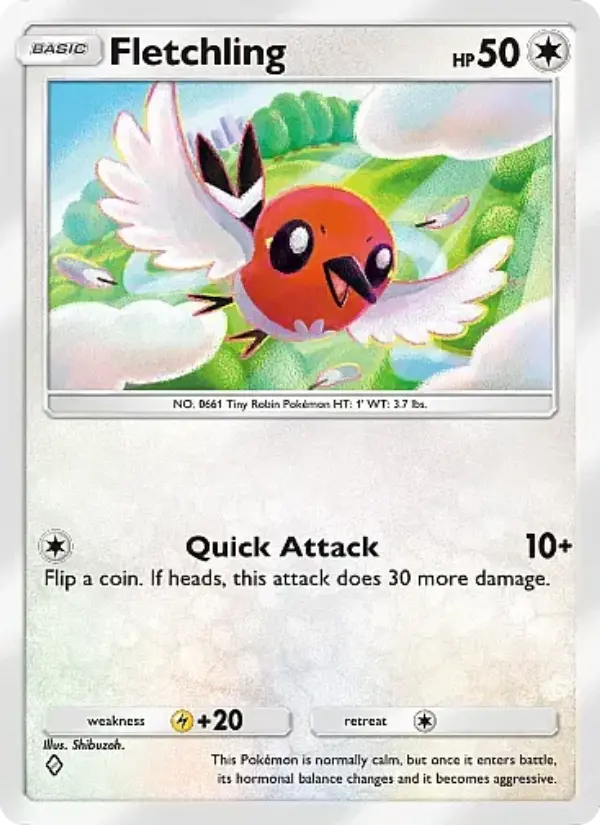
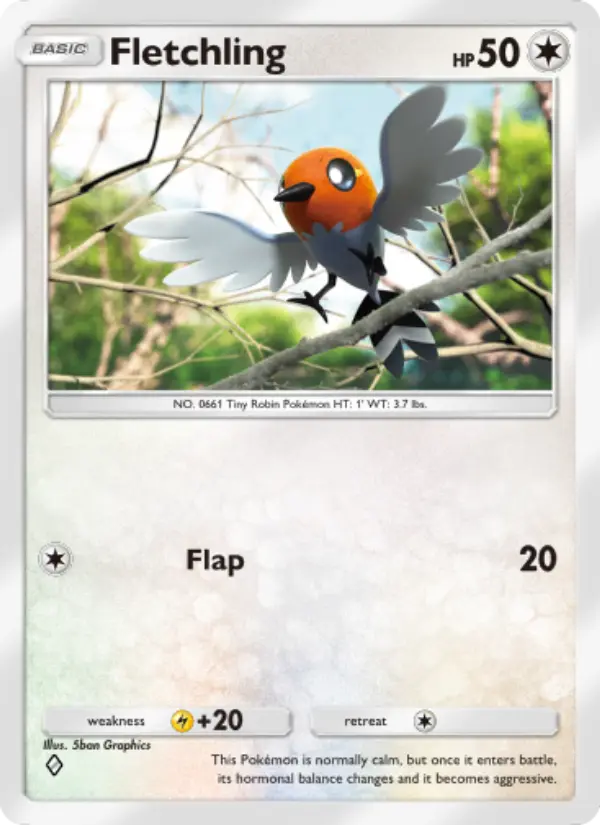
Fletchling achieved significant cultural prominence as one of the first Generation VI Pokémon revealed to the public, generating substantial excitement within the community due to its charming robin-inspired design and promising evolutionary line. The species received particular emphasis in the X and Y games as an early-available team member, leading many trainers to include Fletchling on their primary playthrough teams. Ash Ketchum's capture and training of a Fletchling in the anime series provided a major appearance and helped solidify the species' position in Pokémon's cultural consciousness. The transition from cute, small bird to powerful Fire/Flying Talonflame created a satisfying narrative arc that resonated with trainers who experienced the full evolutionary journey. Fletchling has appeared in various Pokémon media, including the trading card game, where it represents early-game advantages and rapid evolution mechanics. The species' design has been referenced in Super Smash Bros. iterations, contributing to its recognition beyond traditional Pokémon games. In competitive communities, Fletchling functions as a gateway introduction to bird Pokémon team building, with many trainers developing lasting attachments to their evolved Talonflame partners developed from humble Fletchling beginnings. The species exemplifies successful early-generation design that maintains relevance through multiple game iterations and media adaptations.
Where to Find Fletchling in Every Pokémon Game
Fletchling's availability spans numerous Pokémon games and regions, beginning with its introduction in Generation VI's Pokémon X and Y where it appears as Pokédex #0014 in the Central Kalos dex. The species remains readily accessible throughout the Kalos region's early routes, typically encountered in grass or forest areas where trainers can capture it with minimal difficulty due to its 255 catch rate. In subsequent generations, Fletchling appears in the Alola dex as #0158 in Sun/Moon and #0192 in Ultra Sun/Ultra Moon, allowing players in those games to utilize the evolutionary line. The species is available in the Galar region through The Isle of Armor DLC and The Indigo Disk DLC content, expanding its accessibility to Sword and Shield players. Scarlet and Violet include Fletchling in the regional dex as #0019, maintaining its position as an accessible early-game bird Pokémon with significant availability across multiple routes and environments. Legends: Arceus features Fletchling as Pokédex #0010, incorporating it into that game's unique mechanics and aesthetic. The consistent inclusion of Fletchling across generation-spanning releases demonstrates its importance to Game Freak's design philosophy, ensuring trainers consistently encounter the species early in their journeys. Its perpetual availability across regions and games solidifies Fletchling as a staple of the modern Pokémon experience.