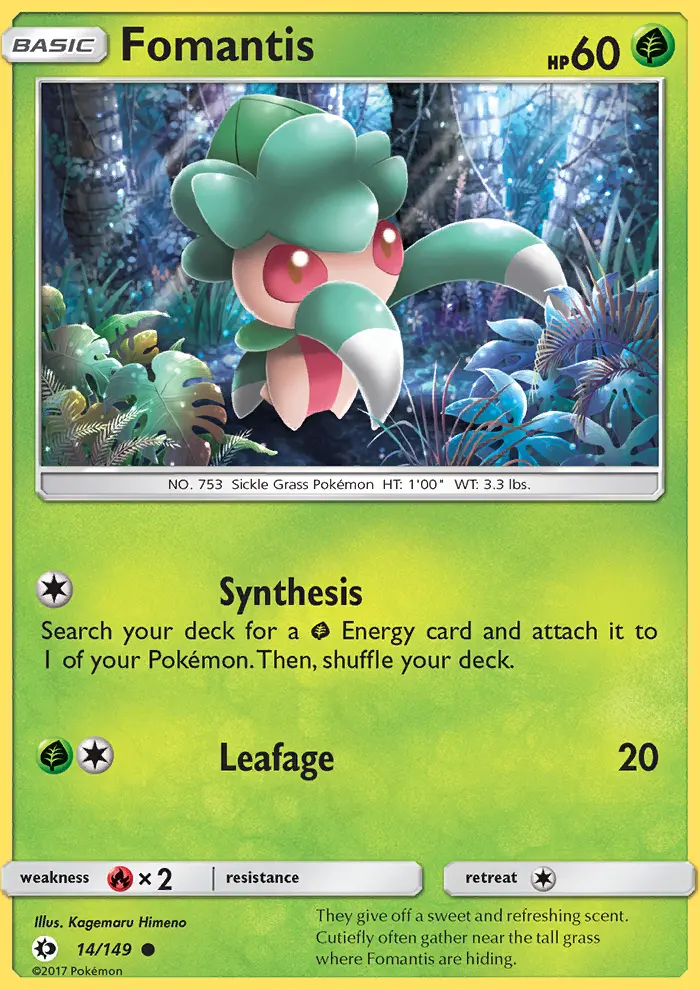
Fomantis
Generation VII · #0753 — Sickle Grass Pokémon
Few grass-type Pokémon pair leaf guard with a stat lean toward hp quite like Fomantis does. Despite its modest stature and cumulative stat total of just 250, Fomantis possesses a unique ecological niche defined by its nocturnal nature and its remarkable ability to thrive through solar energy absorption. The species exhibits a gender ratio of 50% male to 50% female and belongs to the Grass egg group, with a notably high capture rate of 190, making it relatively easy to encounter and catch in the wild.
Editor's Take
Fomantis's line ends in Lurantis, which evolves only during the day and gets Contrary as a hidden ability — a genuinely strong option on a Pokémon nobody uses.
Base Stats
Height
0.3m
Weight
1.5kg
Category
Sickle Grass Pokémon
Gender
Male 50% / Female 50%
Color
pink
Shape
upright
Abilities
Protects against major status ailments during strong sunlight.
Inverts stat changes.

Fomantis Biology & Physical Characteristics
Fomantis presents a striking botanical appearance centered around its four prominent leaves that function as both its primary arms and defensive tools. Its main body is pale pink with a distinctive thick dark pink stripe running vertically down its front and back, while its large, dark pink eyes with slightly darker pupils give it an endearing yet alert expression. Surrounding its head is a crown of light green leaves, with a particularly large tuft overhanging its face, and from the center of its head sprouts a small dark green bulb that emits a pleasant, sweet aroma capable of attracting bug-type Pokémon such as Cutiefly. The four scythe-like leaves extending from its neck collar—two in front and two in back—are lighter green with white tips, and these appendages serve as the primary means through which it interacts with its environment. Its most remarkable biological adaptation is its ability to perform photosynthesis while sleeping during daylight hours, storing energy that will eventually fuel its evolution into the formidable Lurantis. The species maintains relatively balanced offensive capabilities distributed between physical attack at base 55 and special attack at base 50, though its defensive stats of 35 in both defense and special defense reflect its fragile constitution as a juvenile stage.
Pokedex Numbers
Training
Breeding
Fomantis Breeding, Gender Ratio & Egg Groups
Fomantis has one of the simplest gender ratios in the game — a flat 50/50, ensuring equal representation across populations and providing Trainers with equal opportunity to breed either gender. As a member of the Grass egg group, Fomantis can breed with other Pokémon in that classification, though few pairings produce Fomantis offspring directly—most Fomantis are encountered in the wild rather than through breeding efforts. The species maintains a base friendship value of 70, indicating moderate bonding potential with Trainers, though it has a relatively gentle disposition compared to many grass-types. Eggs containing Fomantis require 20 cycles to hatch, translating to approximately 4,884 to 5,140 steps in gameplay terms, making it a relatively standard hatching period that fits comfortably within typical breeding timelines. Young Fomantis will inherit movesets and abilities from their parents according to standard breeding mechanics, though the high capture rate in the wild and specific evolution requirements make wild-caught specimens generally preferable to bred ones for most Trainers. The growth rate is classified as Medium Fast, meaning Fomantis requires moderate experience accumulation to reach higher levels, neither particularly slow nor exceptionally swift in its progression toward evolution.
Sprites






Held Items
Miracle Seed
type-enhancement
Held: Grass-Type moves from holder do 20% more damage.
Cost: 1000
Miracle Seed
type-enhancement
Held: Grass-Type moves from holder do 20% more damage.
Cost: 1000
Miracle Seed
type-enhancement
Held: Grass-Type moves from holder do 20% more damage.
Cost: 1000
Miracle Seed
type-enhancement
Held: Grass-Type moves from holder do 20% more damage.
Cost: 1000
TMs & HMs
tm03
yellow
tm03
red blue
tm03
blue japan
tm03
red green japan
tm05
lets go pikachu lets go eevee
tm06
yellow
tm06
gold silver
tm06
red blue
tm06
crystal
tm06
emerald
tm06
firered leafgreen
tm06
diamond pearl
tm06
platinum
tm06
ruby sapphire
tm06
colosseum
tm06
black 2 white 2
tm06
xd
tm06
black white
tm06
heartgold soulsilver
tm06
omega ruby alpha sapphire
+433 more TMs/HMs


Fomantis Evolution, Mega Evolution & Special Forms
Fomantis evolves into Lurantis exclusively when leveled up during daylight hours at level 34 or higher, representing one of the most specific evolution conditions in the entire Pokédex. This time-based evolution mechanic emphasizes Fomantis's intrinsic relationship with solar energy and daylight cycles, creating a meaningful gameplay mechanic that requires Trainers to actively engage with the game's day-night system. The evolution process itself appears to be triggered by the accumulated photosynthetic energy that Fomantis stores during its daily basking sessions, with the species requiring sufficient sunlight exposure to trigger the necessary biological transformation into its more powerful form. Upon evolution, Fomantis undergoes a dramatic increase in base stats, particularly in attack and special attack, transforming from a fragile collector of solar energy into a capable grass-type combatant. The specific requirement of daytime evolution creates a thematic connection between Fomantis and the sun that extends into Lurantis's design and capabilities, establishing a clear evolutionary narrative where preparation and patience directly lead to transformation.
Where to Find
Lush Jungle
alola
+11 more
Alola Route 5
alola
+1 more
Fomantis Behaviour and Natural Habitat
Fomantis exhibits distinctly nocturnal behavior patterns that define its daily cycle and habitat preferences, making it fundamentally different from most other Grass-type Pokémon. During the day, it spreads its four leaves wide to maximize photosynthetic absorption, basking peacefully in sunlight while remaining dormant and vulnerable. This stationary daytime state represents a critical vulnerability period, which drives Fomantis's evening behavior—as soon as the sun sets, it immediately begins searching for a new location to sleep during the following day, never remaining in the same spot for more than twenty-four hours due to the inherent dangers of predictability in the wild. When anything disturbs its sunbathing sessions, Fomantis will fiercely attack the intruder, demonstrating that despite its diminutive size, it possesses a surprisingly aggressive temperament when its rest or photosynthesis is interrupted. Its sweet, refreshing scent serves both as an attraction mechanism that draws bug Pokémon and as an adaptation to the ecosystems it inhabits. Many Trainers who capture Fomantis provide it with flowerpots to allow it to sunbathe in peace and security, acknowledging both the Pokémon's preferences and its need for uninterrupted solar exposure to develop properly. Fomantis inhabits areas with reliable sunlight and tall grass, preferring locations where it can integrate seamlessly into dense vegetation during its nocturnal wandering phases.
Pokedex Entries
During the day, it sleeps and soaks up light. When night falls, it walks around looking for a safer place to sleep.
When the sun rises, Fomantis spreads its four leaves and bathes in the sunlight. The tip of its head has a pleasant aroma.
They give off a sweet and refreshing scent. Cutiefly often gather near the tall grass where Fomantis are hiding.
It loves the sunshine. When it basks in the sunlight regularly, it grows up with vivid coloration.
When bathed in sunlight, this Pokémon emits a pleasantly sweet scent, which causes bug Pokémon to gather around it.
During the day, Fomantis basks in sunlight and sleeps peacefully. It wakes and moves around at night.
Fomantis Name Origin & Design Inspiration
Fomantis's name can be traced to a combination of 'foliage' and 'mantis,' explicitly referencing the praying mantis insect while emphasizing its botanical nature as a grass-type Pokémon. The Japanese name, Karikiri (カリキリ), similarly combines elements suggesting cutting or shearing motions with a sound-based onomatopoeia, evoking the scythe-like appearance of its leaf-arms. The design philosophy centers on creating a diminutive grass-type that bridges insect and plant aesthetics, with the mantis reference evident in its posture, its two front leaf-arms that function like mantis forelegs, and its predatory hunting potential despite its status as a plant Pokémon. The pale pink coloration of its body contrasts beautifully with the various shades of green in its foliage, creating a visually distinctive silhouette that immediately identifies it as a Generation VII species. The sweet scent that serves as its signature trait aligns with real flower biology, where fragrance typically serves dual purposes of attraction and defense, lending the design a grounding in actual botanical principles while maintaining its fantastical character. The small dark green bulb atop its head represents an undeveloped flowering structure, symbolizing Fomantis's juvenile status and potential for growth toward the more elaborate Lurantis form.
Learnable Moves
Fomantis can learn 57 moves:
Move | Type | Cat. | Power | Acc. | PP |
|---|---|---|---|---|---|
| aromatherapy | grass | Status | — | — | 5 |
| attract | normal | Status | — | 100 | 15 |
| bug bite | bug | Physical | 60 | 100 | 20 |
| bullet seed | grass | Physical | 25 | 100 | 30 |
| confide | normal | Status | — | — | 20 |
| defog | flying | Status | — | — | 15 |
| double team | normal | Status | — | — | 15 |
| dual chop | dragon | Physical | 40 | 90 | 15 |
| endure | normal | Status | — | — | 10 |
| energy ball | grass | Special | 90 | 100 | 10 |
| facade | normal | Physical | 70 | 100 | 20 |
| false swipe | normal | Physical | 40 | 100 | 40 |
| fling | dark | Physical | — | 100 | 10 |
| frustration | normal | Physical | — | 100 | 20 |
| fury cutter | bug | Physical | 40 | 95 | 20 |
| giga drain | grass | Special | 75 | 100 | 10 |
| grass knot | grass | Special | — | 100 | 20 |
| grassy glide | grass | Physical | 55 | 100 | 20 |
| grassy terrain | grass | Status | — | — | 10 |
| growth | normal | Status | — | — | 20 |
| hidden power | normal | Special | 60 | 100 | 15 |
| ingrain | grass | Status | — | — | 20 |
| leaf blade | grass | Physical | 90 | 100 | 15 |
| leaf storm | grass | Special | 130 | 90 | 5 |
| leafage | grass | Physical | 40 | 100 | 40 |
| leech life | bug | Physical | 80 | 100 | 10 |
| magical leaf | grass | Special | 60 | — | 20 |
| nature power | normal | Status | — | — | 20 |
| payback | dark | Physical | 50 | 100 | 10 |
| petal blizzard | grass | Physical | 90 | 100 | 15 |
| poison jab | poison | Physical | 80 | 100 | 20 |
| protect | normal | Status | — | — | 10 |
| razor leaf | grass | Physical | 55 | 95 | 25 |
| rest | psychic | Status | — | — | 5 |
| return | normal | Physical | — | 100 | 20 |
| round | normal | Special | 60 | 100 | 15 |
| safeguard | normal | Status | — | — | 25 |
| seed bomb | grass | Physical | 80 | 100 | 15 |
| signal beam | bug | Special | 75 | 100 | 15 |
| skitter smack | bug | Physical | 70 | 90 | 10 |
| slash | normal | Physical | 70 | 100 | 20 |
| sleep talk | normal | Status | — | — | 10 |
| snore | normal | Special | 50 | 100 | 15 |
| solar beam | grass | Special | 120 | 100 | 10 |
| substitute | normal | Status | — | — | 10 |
| sunny day | fire | Status | — | — | 5 |
| swagger | normal | Status | — | 85 | 15 |
| sweet scent | normal | Status | — | 100 | 20 |
| swords dance | normal | Status | — | — | 20 |
| synthesis | grass | Status | — | — | 5 |
| take down | normal | Physical | 90 | 85 | 20 |
| tera blast | normal | Special | 80 | 100 | 10 |
| toxic | poison | Status | — | 90 | 10 |
| trailblaze | grass | Physical | 50 | 100 | 20 |
| weather ball | normal | Special | 50 | 100 | 10 |
| worry seed | grass | Status | — | 100 | 10 |
| x scissor | bug | Physical | 80 | 100 | 15 |
Fomantis Competitive Battle Guide
Fomantis occupies an interesting position in competitive Pokémon battling as a deliberately underpowered pre-evolutionary form with limited practical application in standard tournaments due to its cumulative stat total of 250 and distributed but underwhelming individual stats. In base form competitions or limited-format battles, Fomantis's Leaf Guard ability can provide marginal utility in sun-based teams by preventing major status ailments during strong sunlight, offering defensive utility that justifies its inclusion in specialized builds. Its hidden ability, Contrary, presents a more interesting competitive prospect, inverting stat changes so that moves that lower Fomantis's stats actually boost them, though the extremely limited move pool and low base stats prevent this from being practically valuable. Offensively, Fomantis's base attack of 55 and special attack of 50 provide minimal damage output, making it reliant on status moves and support strategies rather than direct damage dealing. Speed of 35 ensures that Fomantis will move after most opponents, making offensive strategy nearly impossible and forcing it into a purely defensive or support-oriented role if used at all. Most competitive players immediately evolve Fomantis into Lurantis, which receives substantial stat improvements that make it significantly more viable in organized play. The primary competitive application for Fomantis itself remains limited to casual formats, nuzlocke challenges, or intentional underdog team building where the psychological value of an unconventional strategy outweighs raw statistical value.
Commonly Asked Questions About Fomantis
What type is Fomantis?
Fomantis is a grass type Pokemon.
What does Fomantis evolve into?
Fomantis evolves into lurantis.
What are Fomantis's weaknesses?
Fomantis is weak to flying, poison, bug, fire and ice type moves.
Does Fomantis evolve by trading?
No — Fomantis evolves entirely through leveling up, with no trade required at any stage.
Where can I find Fomantis?
Fomantis can be found in lush jungle (alola) and alola route 5 (alola).
Fomantis Cultural Impact & Franchise History
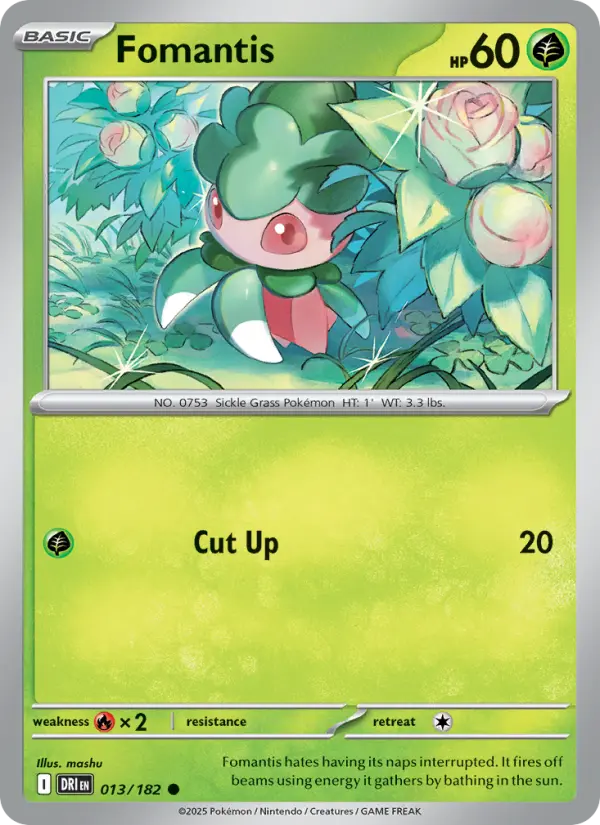
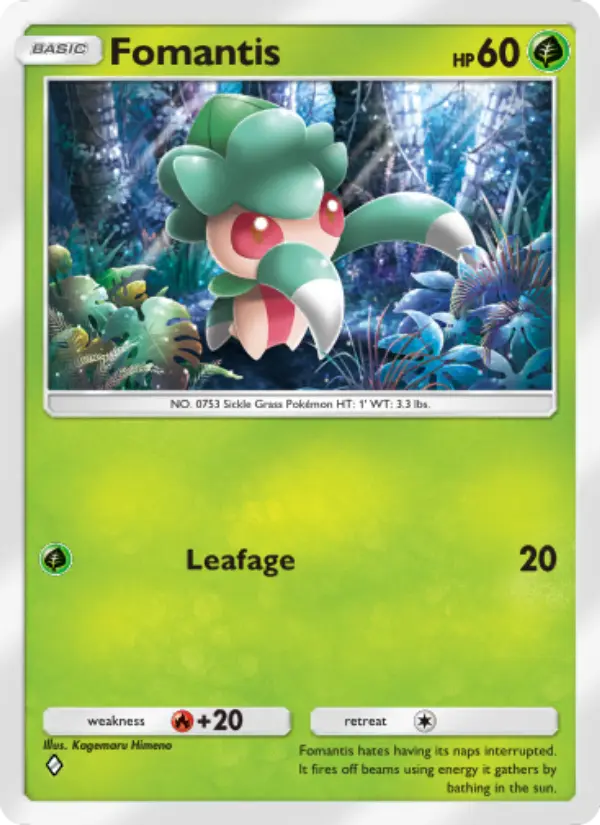
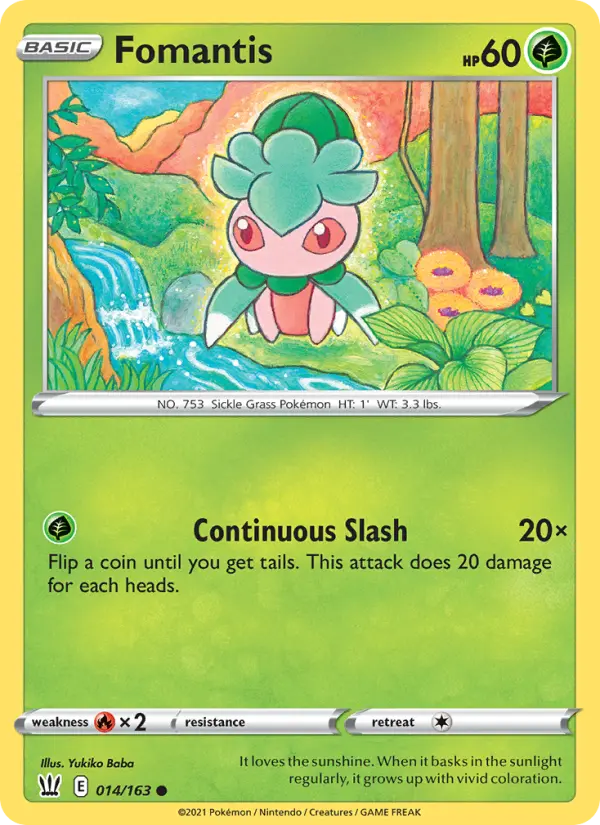
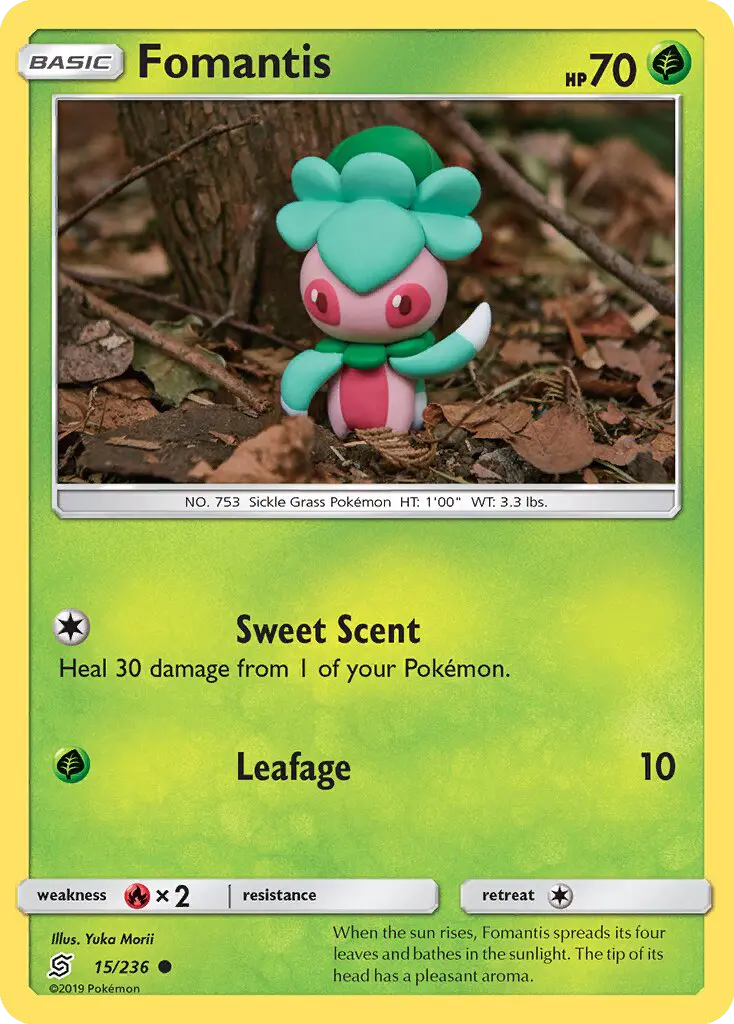
Fomantis has developed a modest but dedicated following within the Pokémon community, appreciated for its unique design philosophy that successfully blends mantis aesthetics with genuine botanical characteristics in a way few Pokémon achieve. Its nocturnal lifestyle and daily ritual of searching for new resting locations resonated with players who appreciated the lore depth provided by Generation VII's Pokédex entries, which painted vivid pictures of Fomantis's actual daily existence. The species gained particular recognition among players who engaged deeply with sun-based team building strategies, where Leaf Guard provided synergistic value alongside other sun-dependent Pokémon. Within fan art communities, Fomantis's adorable appearance and relatively unique design philosophy generated consistent appreciation, with many artists drawn to its combination of vulnerability and defensive capability. The species appeared in anime and trading card game contexts with moderate frequency, though never achieving the prominence of more iconic grass-types like Bulbasaur or Exeggcute. Among dedicated Pokédex enthusiasts, Fomantis is often highlighted as a successful example of Generation VII's design innovation—creating functional and thematic new Pokémon rather than simply refining established concepts. The practice of Trainers providing Fomantis with flowerpots mentioned in the Scarlet and Violet Pokédex entries has spawned considerable fan discussion about Pokémon care and the trainer-Pokémon relationship dynamic, elevating Fomantis beyond mere battle unit into a character worthy of narrative exploration.
Where to Find Fomantis in Every Pokémon Game
Fomantis was first available in Pokémon Sun and Moon as part of Generation VII's Alola regional Pokédex, where it occupied position 143 and could be encountered in grassy areas throughout the islands. The species remained available in Ultra Sun and Ultra Moon at position 176 in the Alola Pokédex, with similar habitat distributions across the region's grasslands and groves. Following the release of Sword and Shield, Fomantis became available in the base game before appearing in the Isle of Armor DLC expansion at position 17 in that specific Pokédex. In Pokémon Legends: Arceus, Fomantis was made available, though the exact encounter rates and locations reflected the significantly different gameplay mechanics of that title. The subsequent release of Pokémon Scarlet and Violet included Fomantis at position 247 in the National Pokédex and position 31 in the Teal Mask DLC's new Pokédex, providing continued accessibility to new players while maintaining the species' availability across multiple generations. With a capture rate of 190, Fomantis is relatively common in areas where it naturally spawns, making it a straightforward Pokémon to obtain early in most games where it appears. The high capture rate combined with its early availability in most titles has made Fomantis a popular choice for casual players building through-game teams, and its accessibility ensures that players who wish to evolve it into Lurantis can do so without excessive grinding or complicated event requirements.