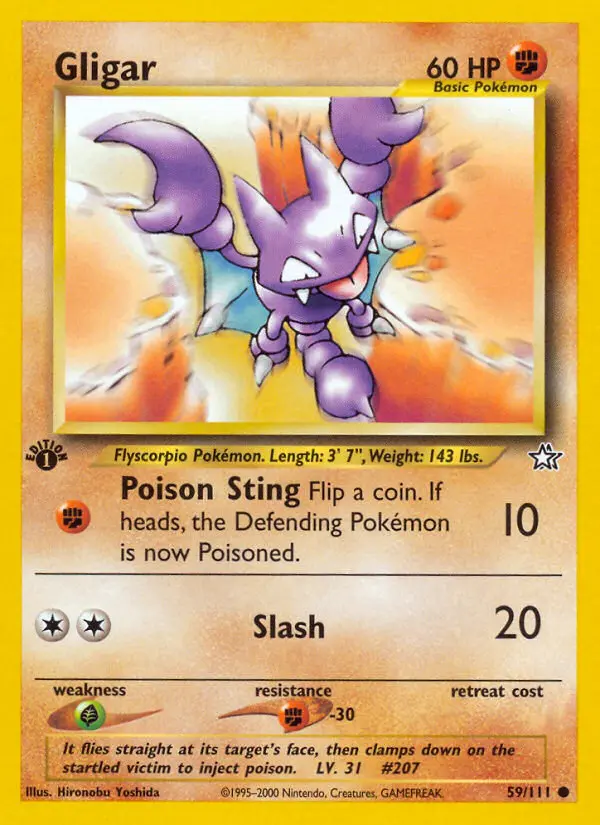
Gligar
Generation II · #0207 — Fly Scorpion Pokémon
Since its Generation II debut, Gligar has carried a stat spread built around defense — 105 at base, its clearest strength. Standing at 1.1 meters tall and weighing 64.8 kilograms, this medium-sized Pokémon possesses a total stat allocation of 430, with particularly notable defensive capabilities and respectable speed. Gligar is not a legendary or mythical Pokémon, nor is it classified as a baby Pokémon, making it accessible to trainers throughout their journey. Its evolution into the more powerful Gliscor represents a significant transformation that requires specific conditions, marking an important milestone for those who train this species.
Editor's Take
Gligar's Eviolite set is bulkier than Gliscor's and almost nobody runs it, which is the third time in this Pokédex the item has outperformed the evolution.
Base Stats
Height
1.1m
Weight
64.8kg
Category
Fly Scorpion Pokémon
Gender
Male 50% / Female 50%
Color
purple
Shape
wings
Habitat
mountain
Abilities
Prevents Attack from being lowered by other Pokémon.
Increases evasion to 1.25× during a sandstorm. Protects against sandstorm damage.
Prevents poison.

Gligar Biology & Physical Characteristics
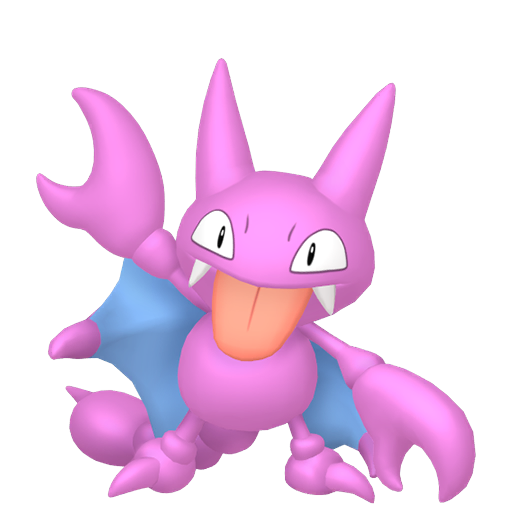
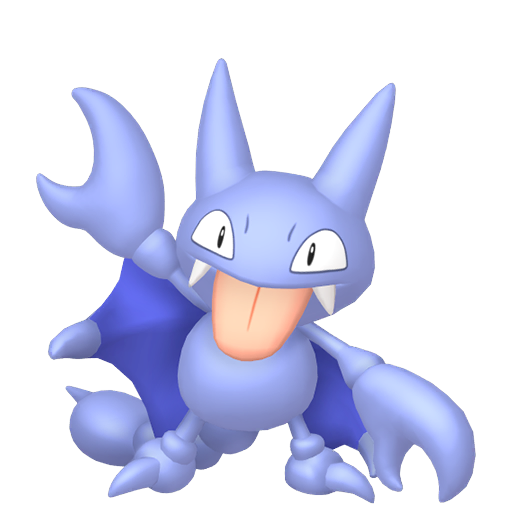
Gligar presents a distinctive purple coloration with a body structure that combines round, nearly equal-sized head and body segments characteristic of arachnids. The Pokémon features notably long, triangular ears and similarly shaped eyes with small pupils, alongside two prominent pointed teeth protruding from its upper jaw and a frequently visible pink tongue. Its four limbs are segmented at the joints—wrists on the forelimbs and ankles on the hindlimbs—with the front pair ending in large, powerful pincers capable of gripping opponents, while the hind legs terminate in single claws. Between its arms stretch two blue wing membranes, each tipped with a distinctive purple claw that aids in aerial maneuverability. The most striking feature is Gligar's long tail, divided into spherical segments and culminating in a large, round stinger containing poison, with sexual dimorphism evident in females possessing smaller stingers than their male counterparts. This anatomical arrangement enables the species to glide through the air with remarkable silence and precision, using its extended limbs to maintain aerodynamic stability.
Pokedex Numbers
Training
Breeding
Gligar Breeding, Gender Ratio & Egg Groups
Gligar exhibits a standard 50/50 gender ratio, with males and females occurring with equal probability in the wild and among bred populations. Sexual dimorphism is evident in the species, with females noticeably possessing smaller stingers than their male counterparts, allowing players to visually distinguish between genders without consulting game menus. When breeding Gligar, the offspring belongs to the Bug egg group, a classification that reflects the creature's scorpion-like heritage and arachnid characteristics. Gligar has a base friendship value of 70, indicating a moderate predisposition toward bonding with trainers, making it a reasonably cooperative companion from the outset though not exceptionally affectionate by nature. The species hatches from eggs after 20 cycles, translating to approximately 4,884 to 5,140 steps depending on in-game variables and mechanics. With a capture rate of 60 and a medium-slow growth rate, Gligar represents a Pokémon that requires patience and commitment to train from early stages but rewards dedicated trainers with steady development. The moderate base happiness suggests that Gligar responds well to standard care and training methods without requiring exceptional effort to maintain good relations with its trainer.
Sprites




TMs & HMs
tm01
lets go pikachu lets go eevee
tm02
yellow
tm02
red blue
tm02
crystal
tm02
gold silver
tm02
lets go pikachu lets go eevee
tm02
blue japan
tm02
red green japan
tm03
yellow
tm03
crystal
tm03
gold silver
tm03
red blue
tm03
blue japan
tm03
red green japan
tm05
lets go pikachu lets go eevee
tm06
yellow
tm06
gold silver
tm06
red blue
tm06
crystal
tm06
emerald
+755 more TMs/HMs
Gender Differences
This Pokémon has visible differences between male and female forms.
Gligar's Evolution Chain


Gligar Evolution, Mega Evolution & Special Forms
Gligar evolves into Gliscor when leveled up while holding a Razor Fang item during nighttime conditions, a specialized evolution mechanic introduced in Generation IV that requires specific timing and held item conditions. This evolution represents a significant power increase across multiple stat categories, particularly enhancing Gligar's already impressive Defense stat of 105 and boosting its offensive and speed capabilities. The evolution requirement—holding a Razor Fang during the night—adds an element of strategy to team building, as trainers must plan when and how to evolve their Gligar rather than relying on simple level thresholds. Gliscor maintains the Ground/Flying typing but gains considerably more intimidating stats and access to improved movepool options, making it a substantially more competitive choice for battles. The nighttime evolution condition adds thematic depth, as scorpions and many bats are nocturnal creatures, creating a narrative consistency with the species' biological inspiration. This evolution is not the final stage in Gligar's line, establishing a clear progression path for dedicated trainers who wish to maximize their Pokémon's potential.
Where to Find
Johto Route 45
johto
+3 more
Hoenn Safari Zone
hoenn
Sinnoh Route 214
sinnoh
+1 more
Sinnoh Route 207
sinnoh
+1 more
Stark Mountain
sinnoh
+1 more
Sinnoh Route 206
sinnoh
+4 more
Sinnoh Route 227
sinnoh
+1 more
Sinnoh Route 215
sinnoh
+1 more
Unova Route 11
unova
+21 more
Unova Route 15
unova
+17 more
Unova Route 23
unova
+1 more
Gligar Behaviour and Natural Habitat
Gligar typically makes its habitat on steep cliffsides, where it constructs its nests and spends much of its time clinging to rock faces. The species exhibits a fascinating behavioral pattern where it feeds on Berries and uses echolocation-like sound waves to detect obstacles while navigating through the air, demonstrating sophisticated sensory adaptations. When hunting, Gligar employs a distinctive attacking strategy: it glides silently through the air and flies straight at its target's face, startling the prey before clamping down using its clawed hind legs and large forelimb pincers simultaneously. Once secured, the Pokémon injects its victim with poison through its barbed stinger, incapacitating the prey for consumption. According to various Pokédex accounts, after completing its aerial maneuvers and attacks, Gligar hops along the ground back to its nest, suggesting a mixed locomotion lifestyle between flight and terrestrial movement. This behavioral adaptation makes Gligar a formidable aerial predator perfectly suited to mountainous cliff environments where it can utilize both gravity and wind currents to its advantage.
Pokedex Entries
It flies straight at its target's face then clamps down on the star tled victim to inject poison.
It usually clings to cliffs. When it spots its prey, it spreads its wings and glides down to attack.
It builds its nest on a steep cliff. When it is done gliding, it hops along the ground back to its nest.
GLIGAR glides through the air without a sound as if it were sliding. This POKéMON hangs on to the face of its foe using its clawed hind legs and the large pincers on its forelegs, then injects the prey with its poison barb.
It glides without making a single sound. It grasps the face of its foe using its hind and large front claws, then stabs with its poison barb.
It usually clings to cliffs. When it spots its prey, it spreads its wings and glides down to attack.
It flies straight at its target’s face, then clamps down on the startled victim to inject poison.
It sails on the winds with its limbs extended to strike from the sky. It aims for the prey’s face.
It glides as if sliding. It startles foes by clamping on to their faces, then jabs with its poison stinger.
It flies straight at its target’s face, then clamps down on the startled victim to inject poison.
It usually clings to cliffs. When it spots its prey, it spreads its wings and glides down to attack.
It glides as if sliding. It startles foes by clamping on to their faces, then jabs with its poison stinger.
It clamps on to its chosen prey then jabs the stinger on its tail into the prey while it’s stunned with surprise.
It usually clings to cliffs. When it spots its prey, it spreads its wings and glides down to attack.
It flies straight at its target’s face, then clamps down on the startled victim to inject poison.
Gligar glides through the air without a sound as if it were sliding. This Pokémon hangs on to the face of its foe using its clawed hind legs and the large pincers on its forelegs, then injects the prey with its poison barb.
Its tail is tipped by a thick, horrible stinger. To bring down prey, it will first obscure their vision by covering their faces with its body, and then it will use the stinger to inject them with venom.
Gligar Name Origin & Design Inspiration
Gligar's name can be traced to a portmanteau of 'glide' and 'gargoyle' or 'alligator,' capturing the essential mechanics of the Pokémon's aerial prowess and reptilian-arachnid appearance. The Japanese name, グライガー (Gliger), follows a similar pattern, emphasizing the gliding aspect that defines the species' locomotion. Visually, Gligar draws heavily from multiple sources: the overall chiropteran body structure, membranous wings, and ear shape evoke bats, while the segmented limbs, stinger, and pincers directly reference scorpions. The coloration scheme—predominantly purple with blue wing membranes and contrasting claw tips—provides visual appeal while making the creature easily recognizable despite its hybrid nature. The round, somewhat cartoonish facial features soften what might otherwise be an intimidating predator design, making Gligar appealing to a wider audience while maintaining its threatening characteristics. The design successfully bridges the gap between flying creatures and ground-based arachnids, physically representing its unusual Ground/Flying dual typing in a way that feels organic rather than forced. This thoughtful design has made Gligar instantly memorable since its introduction in Generation II.
Learnable Moves
Gligar can learn 93 moves:
Move | Type | Cat. | Power | Acc. | PP |
|---|---|---|---|---|---|
| aerial ace | flying | Physical | 60 | — | 20 |
| agility | psychic | Status | — | — | 30 |
| aqua tail | water | Physical | 90 | 90 | 10 |
| attract | normal | Status | — | 100 | 15 |
| baton pass | normal | Status | — | — | 40 |
| breaking swipe | dragon | Physical | 60 | 100 | 15 |
| brick break | fighting | Physical | 75 | 100 | 15 |
| bulldoze | ground | Physical | 60 | 100 | 20 |
| confide | normal | Status | — | — | 20 |
| counter | fighting | Physical | — | 100 | 20 |
| crabhammer | water | Physical | 100 | 90 | 10 |
| crunch | dark | Physical | 80 | 100 | 15 |
| curse | ghost | Status | — | — | 10 |
| cut | normal | Physical | 50 | 95 | 30 |
| dark pulse | dark | Special | 80 | 100 | 15 |
| detect | fighting | Status | — | — | 5 |
| dig | ground | Physical | 80 | 100 | 10 |
| double team | normal | Status | — | — | 15 |
| double edge | normal | Physical | 120 | 100 | 15 |
| dream eater | psychic | Special | 100 | 100 | 15 |
| dual wingbeat | flying | Physical | 40 | 90 | 10 |
| earthquake | ground | Physical | 100 | 100 | 10 |
| endure | normal | Status | — | — | 10 |
| facade | normal | Physical | 70 | 100 | 20 |
| false swipe | normal | Physical | 40 | 100 | 40 |
| feint | normal | Physical | 30 | 100 | 10 |
| feint attack | dark | Physical | 60 | — | 20 |
| fling | dark | Physical | — | 100 | 10 |
| frustration | normal | Physical | — | 100 | 20 |
| fury cutter | bug | Physical | 40 | 95 | 20 |
| guillotine | normal | Physical | — | 30 | 5 |
| harden | normal | Status | — | — | 30 |
| headbutt | normal | Physical | 70 | 100 | 15 |
| hidden power | normal | Special | 60 | 100 | 15 |
| high horsepower | ground | Physical | 95 | 95 | 10 |
| iron tail | steel | Physical | 100 | 75 | 15 |
| knock off | dark | Physical | 65 | 100 | 20 |
| lunge | bug | Physical | 80 | 100 | 15 |
| metal claw | steel | Physical | 50 | 95 | 35 |
| mimic | normal | Status | — | — | 10 |
| mud shot | ground | Special | 55 | 95 | 15 |
| mud slap | ground | Special | 20 | 100 | 10 |
| natural gift | normal | Physical | — | 100 | 15 |
| night slash | dark | Physical | 70 | 100 | 15 |
| payback | dark | Physical | 50 | 100 | 10 |
| poison jab | poison | Physical | 80 | 100 | 20 |
| poison sting | poison | Physical | 15 | 100 | 35 |
| poison tail | poison | Physical | 50 | 100 | 25 |
| power trick | psychic | Status | — | — | 10 |
| protect | normal | Status | — | — | 10 |
| psychic fangs | psychic | Physical | 85 | 100 | 10 |
| quick attack | normal | Physical | 40 | 100 | 30 |
| rain dance | water | Status | — | — | 5 |
| razor wind | normal | Special | 80 | 100 | 10 |
| rest | psychic | Status | — | — | 5 |
| return | normal | Physical | — | 100 | 20 |
| rock polish | rock | Status | — | — | 20 |
| rock slide | rock | Physical | 75 | 90 | 10 |
| rock smash | fighting | Physical | 40 | 100 | 15 |
| rock tomb | rock | Physical | 60 | 95 | 15 |
| roost | flying | Status | — | — | 5 |
| sand attack | ground | Status | — | 100 | 15 |
| sand tomb | ground | Physical | 35 | 85 | 15 |
| sandstorm | rock | Status | — | — | 10 |
| scale shot | dragon | Physical | 25 | 90 | 20 |
| scary face | normal | Status | — | 100 | 10 |
| screech | normal | Status | — | 85 | 40 |
| secret power | normal | Physical | 70 | 100 | 20 |
| skitter smack | bug | Physical | 70 | 90 | 10 |
| sky uppercut | fighting | Physical | 85 | 90 | 15 |
| slash | normal | Physical | 70 | 100 | 20 |
| sleep talk | normal | Status | — | — | 10 |
| sludge bomb | poison | Special | 90 | 100 | 10 |
| snore | normal | Special | 50 | 100 | 15 |
| spikes | ground | Status | — | — | 20 |
| steel wing | steel | Physical | 70 | 90 | 25 |
| strength | normal | Physical | 80 | 100 | 15 |
| substitute | normal | Status | — | — | 10 |
| sunny day | fire | Status | — | — | 5 |
| swagger | normal | Status | — | 85 | 15 |
| swift | normal | Special | 60 | — | 20 |
| swords dance | normal | Status | — | — | 20 |
| tailwind | flying | Status | — | — | 15 |
| take down | normal | Physical | 90 | 85 | 20 |
| taunt | dark | Status | — | 100 | 20 |
| tera blast | normal | Special | 80 | 100 | 10 |
| thief | dark | Physical | 60 | 100 | 25 |
| throat chop | dark | Physical | 80 | 100 | 15 |
| torment | dark | Status | — | 100 | 15 |
| toxic | poison | Status | — | 90 | 10 |
| toxic spikes | poison | Status | — | — | 20 |
| u turn | bug | Physical | 70 | 100 | 20 |
| wing attack | flying | Physical | 60 | 100 | 35 |
Gligar Competitive Battle Guide
Competitively, Gligar functions as a dependable physical wall and defensive pivot, leveraging its exceptional base Defense stat of 105 to absorb incoming attacks. Its bulk is further enhanced by access to the Sand Veil ability, which provides a 25 percent evasion boost during sandstorm conditions, making it a natural partner for sandstorm-based team compositions featuring weather setters like Tyranitar or Hippowdon. The Hyper Cutter ability offers an alternative, preventing opponents from lowering Gligar's Attack stat, which enables the species to function more effectively in physical offense roles. Its hidden ability, Immunity, provides complete protection against poison, negating threats from status-inflicting opponents and toxin-based strategies. With a respectable Speed stat of 85, Gligar can outpace many defensive threats, though it often functions better in a defensive or utility-oriented role given its mediocre Special Attack of 35. The moveset accessibility includes priority moves, utility options, and coverage moves, allowing for varied strategic implementations depending on team needs. However, Gligar's pre-evolved state is generally considered inferior to its evolution Gliscor, which possesses superior stats and more comprehensive battle capabilities. In lower-tier competitive formats, Gligar can find success as a defensive backbone or stall component, particularly in sandstorm-enabled environments where Sand Veil becomes a genuine competitive advantage.
Commonly Asked Questions About Gligar
What type is Gligar?
Gligar is a ground and flying type Pokemon.
What does Gligar evolve into?
Gligar evolves into gliscor.
What are Gligar's weaknesses?
Gligar is weak to water, electric and ice type moves.
Does Gligar evolve by trading?
No — Gligar evolves entirely through leveling up, with no trade required at any stage.
Where can I find Gligar?
Gligar can be found in johto route 45 (johto), hoenn safari zone (hoenn) and sinnoh route 214 (sinnoh) and 8 other locations.
Gligar Cultural Impact & Franchise History
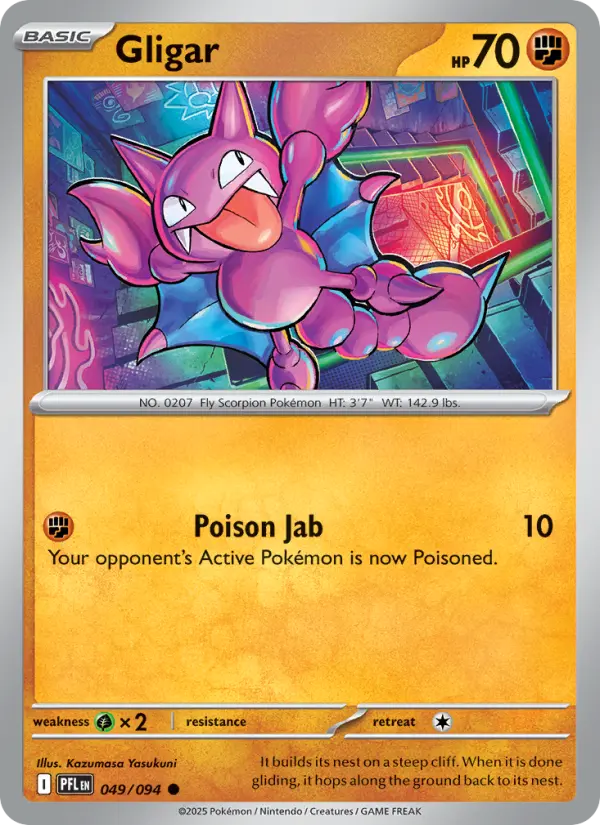
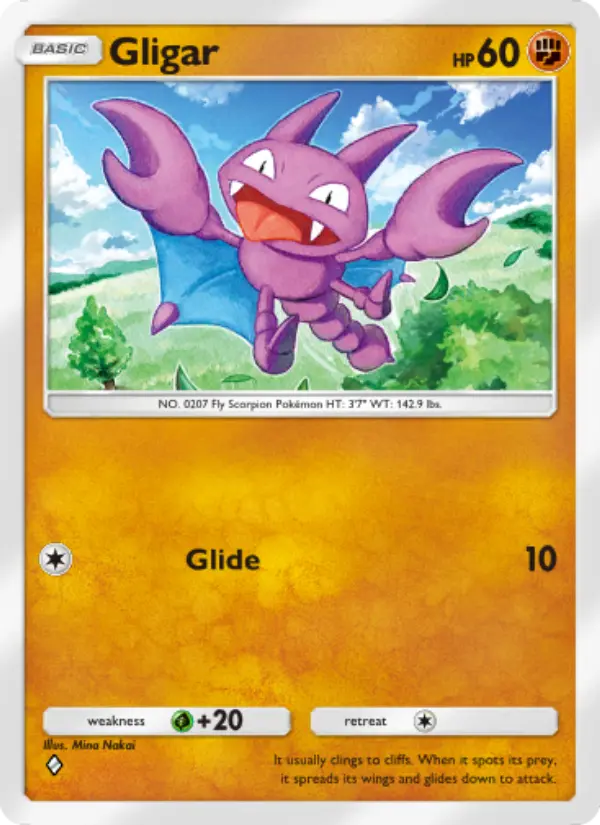
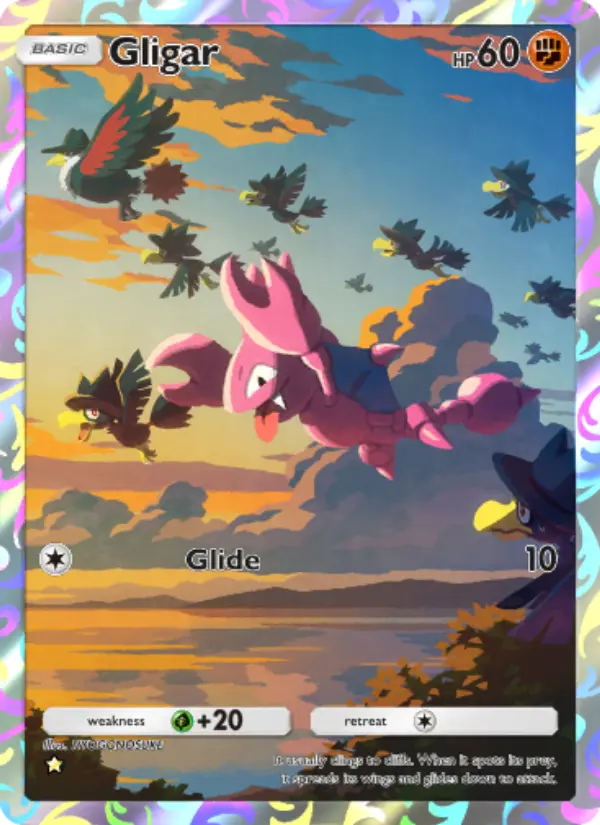
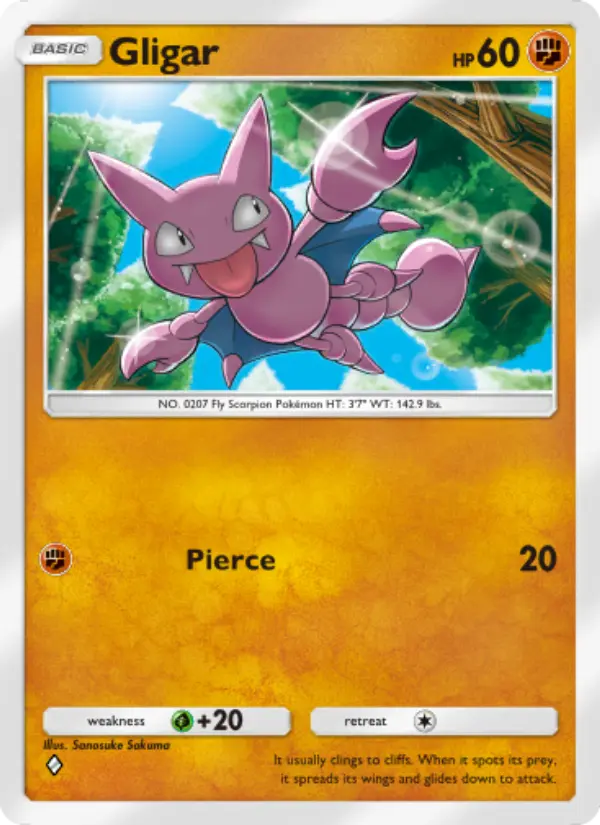
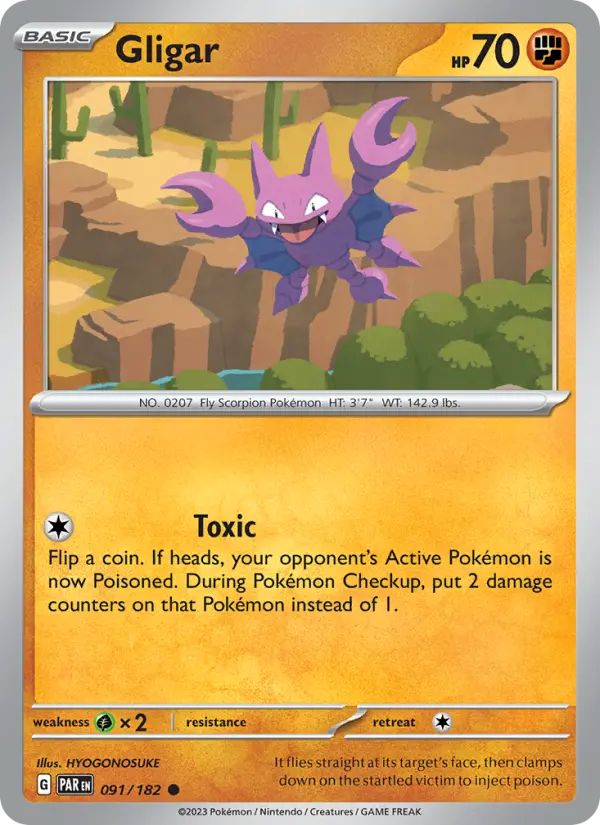
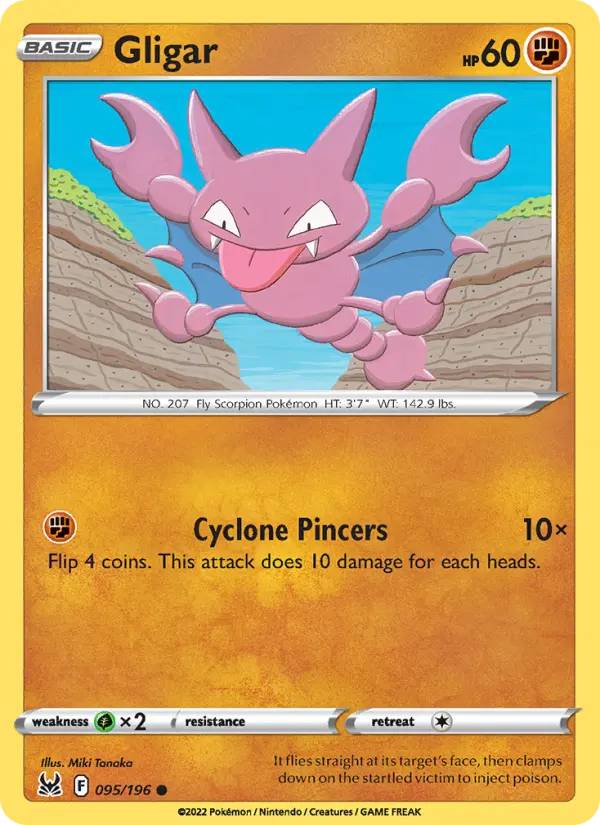
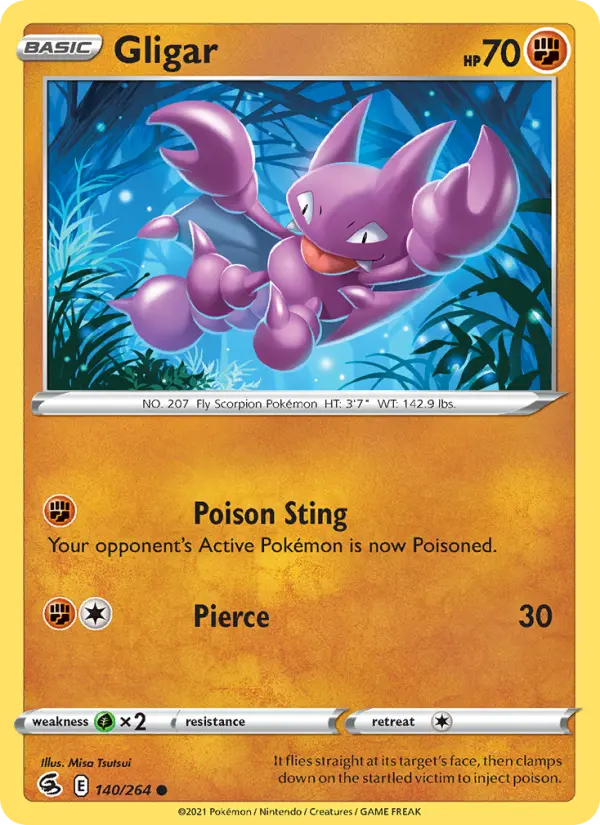
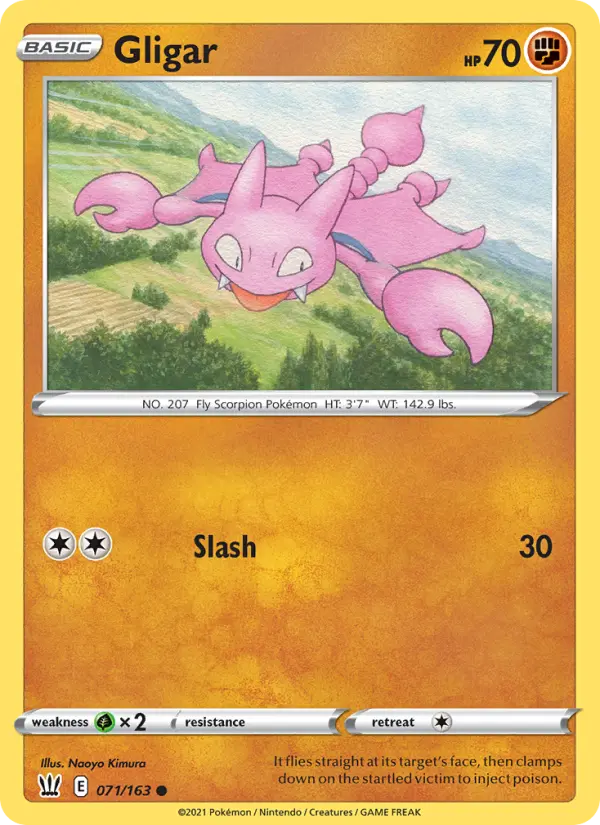
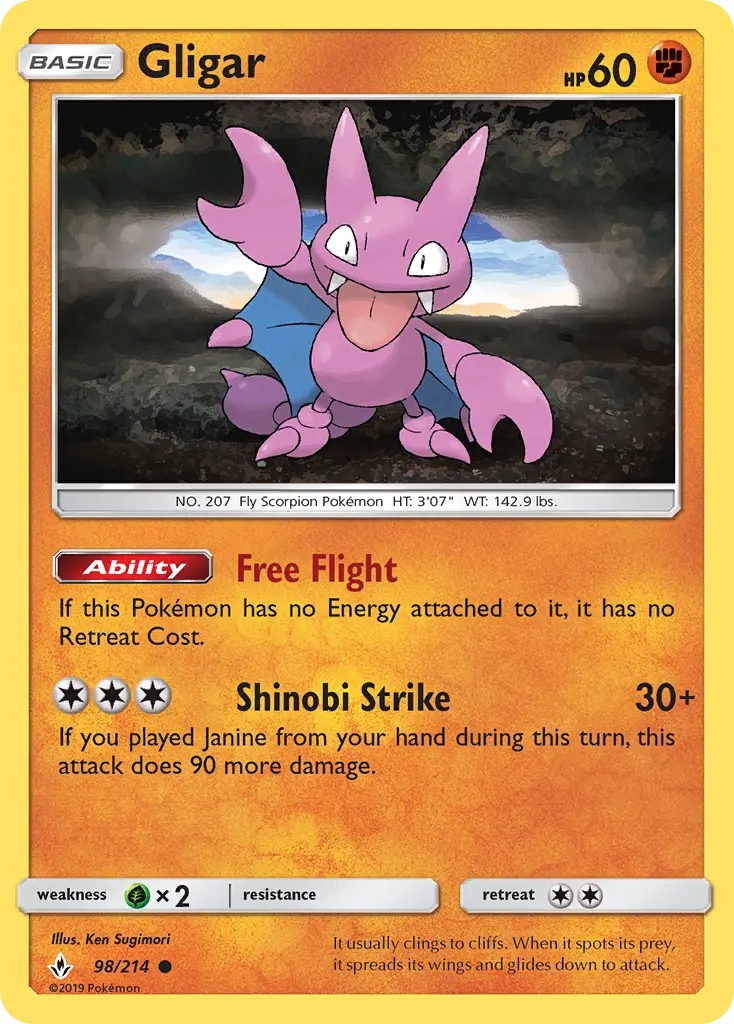
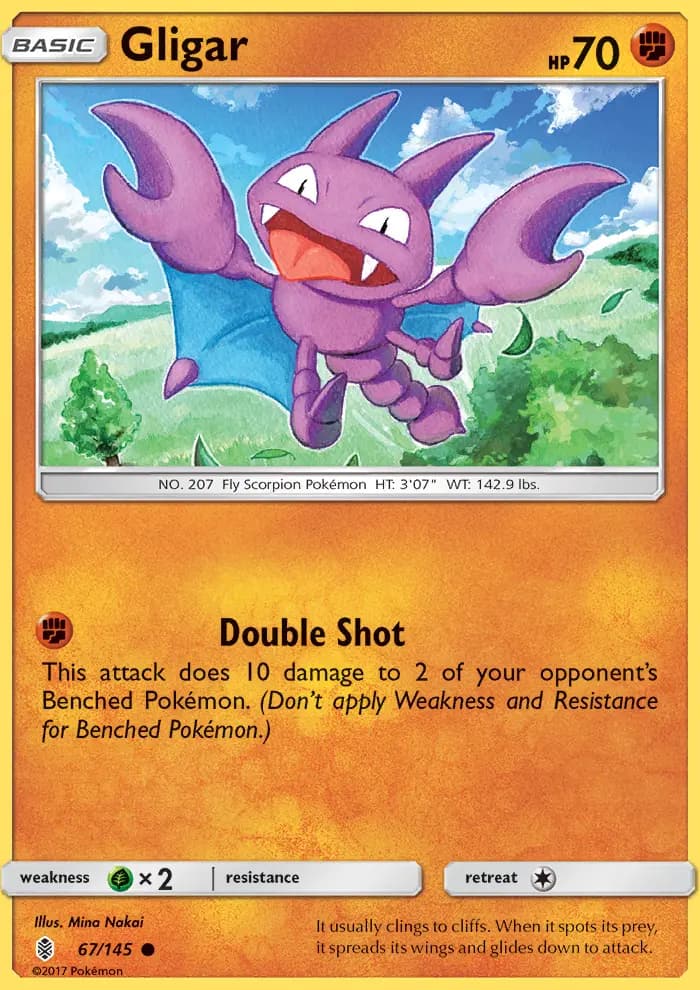
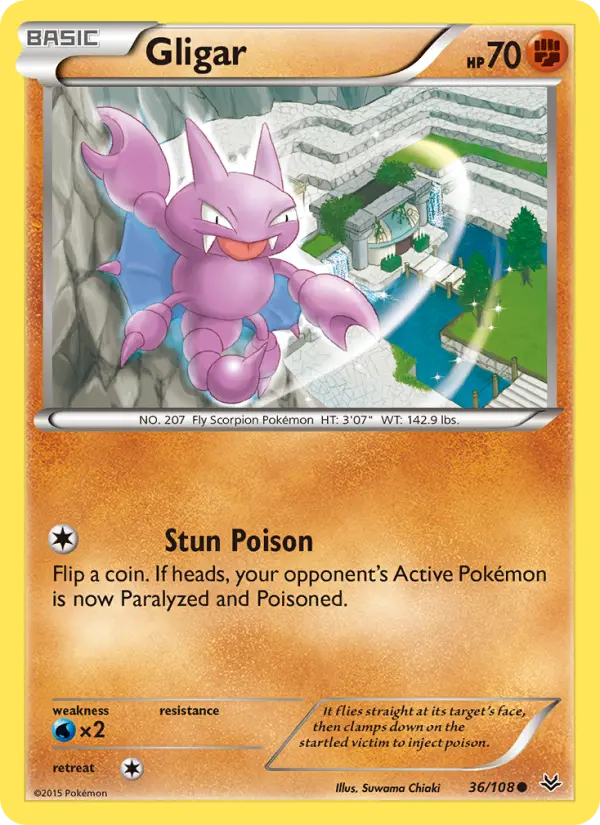
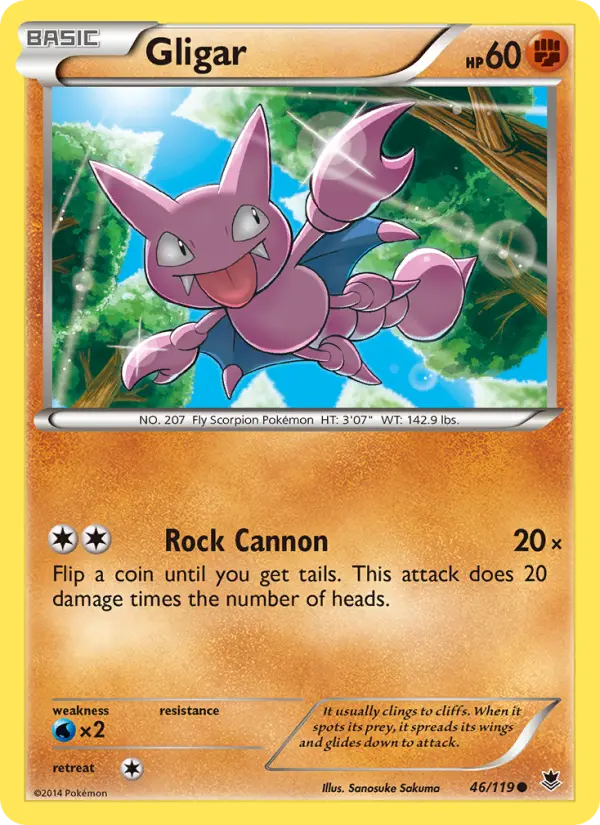
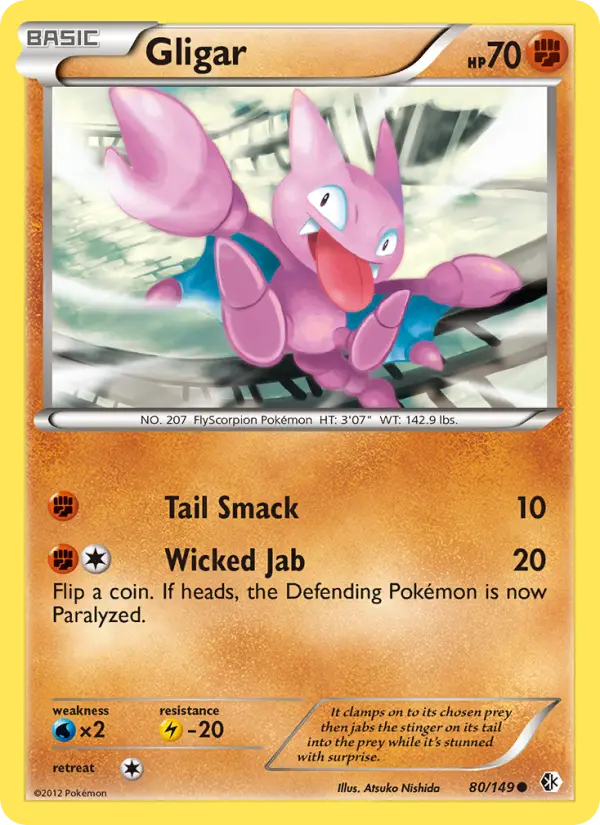
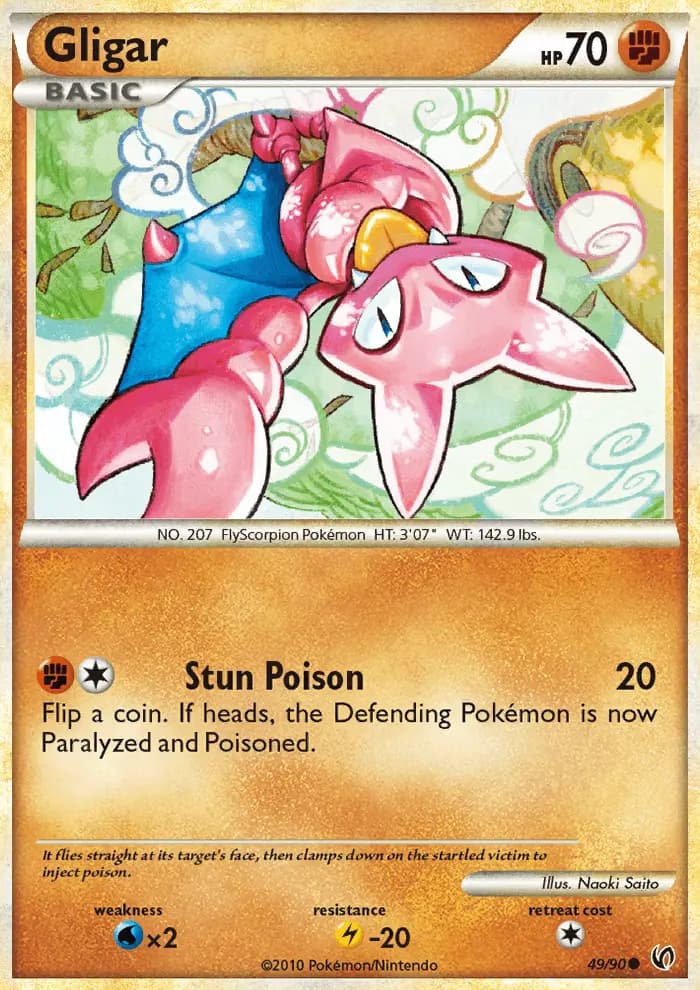
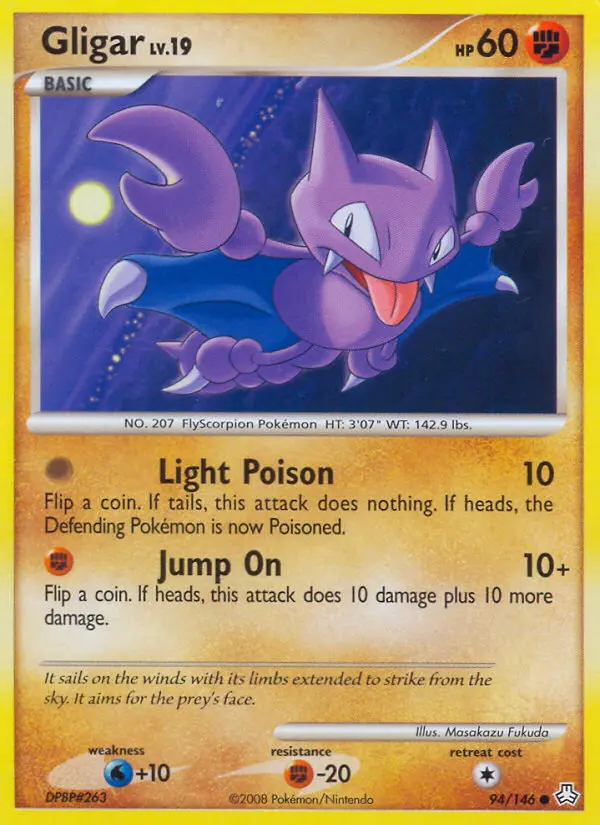
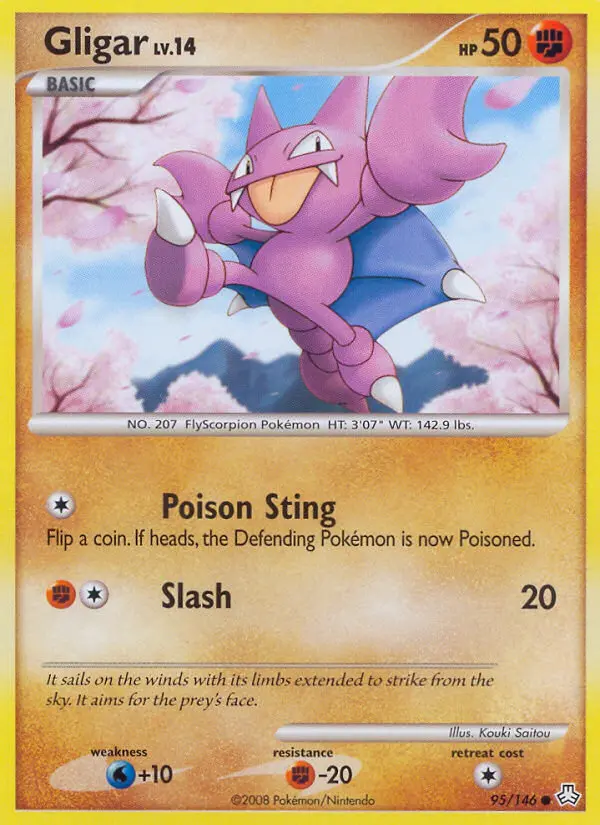
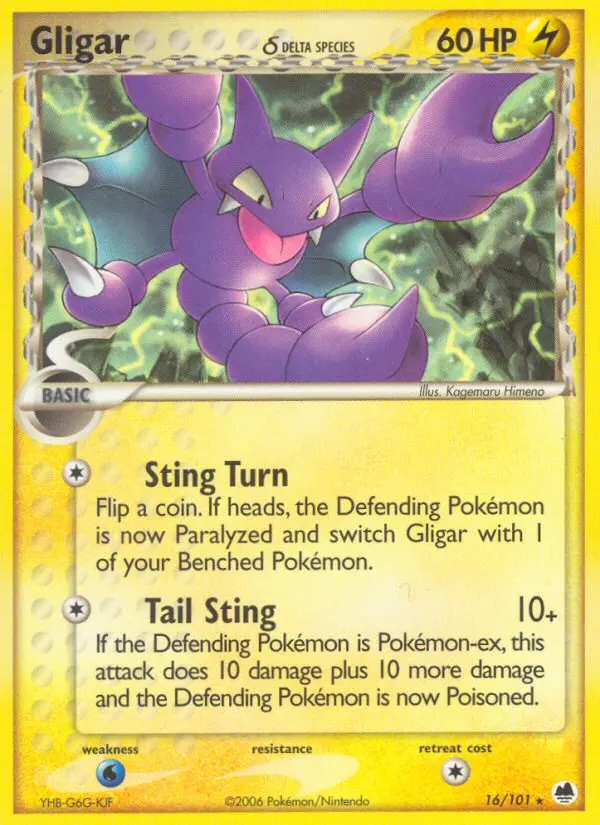
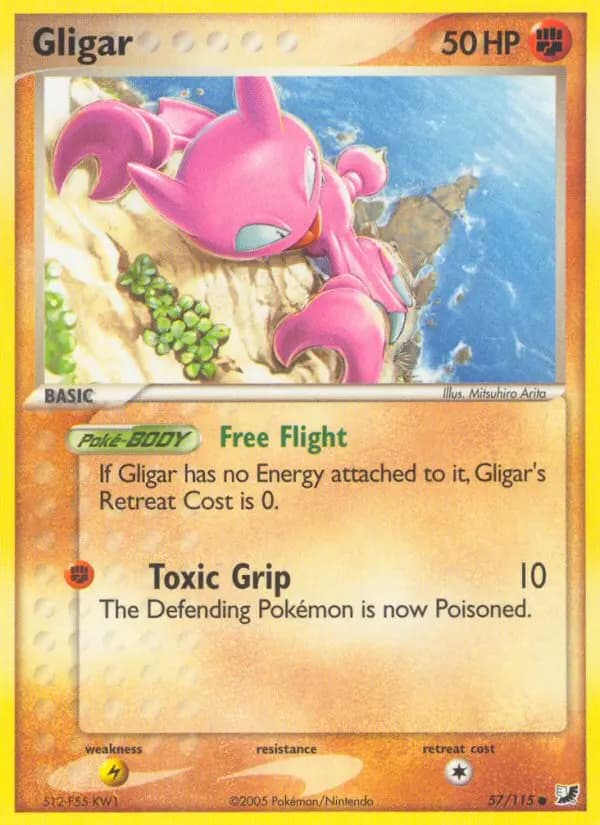
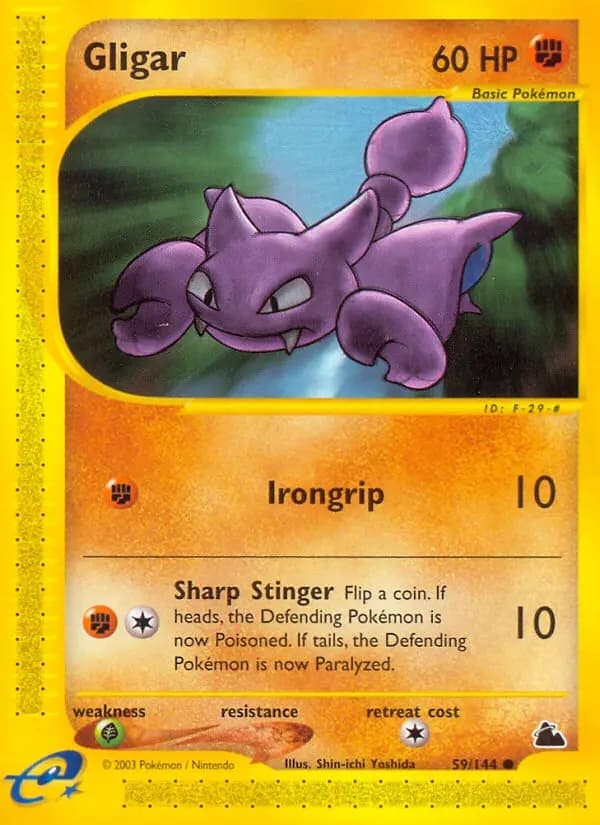
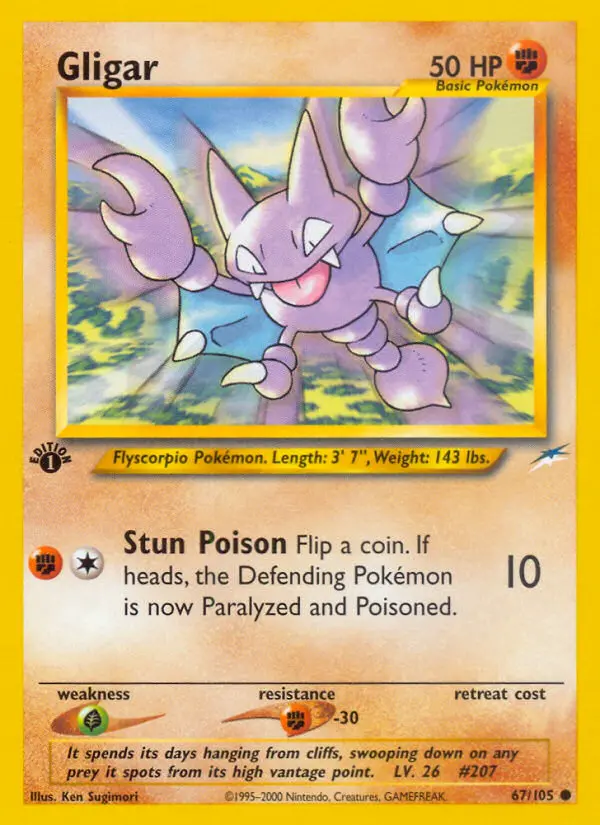
Gligar has maintained a notable presence in Pokémon media since its Generation II introduction, with the most significant cultural touchstone being Ash's Gligar from the anime series. Ash's Gligar showcased the species' personality and abilities through multiple episodes and battles, contributing substantially to the character's recognition among anime viewers and establishing it as a memorable member of Ash's roster. The Pokémon Trading Card Game has featured Gligar in numerous sets and variations, with card artwork consistently highlighting the creature's striking purple coloration and dynamic aerial posture. Gligar's unique design—blending scorpion and bat characteristics—has made it a popular subject for fan art and community discussions, with many trainers drawn to its distinctive silhouette and the narrative potential of its clifftop habitat. The species' evolution line has been referenced in various Pokémon games and media, reinforcing Gligar's position as a recognizable member of the broader Pokédex. While not achieving the iconic status of Pokémon like Charizard or Gyarados, Gligar occupies a comfortable niche as a fan-favorite Pokémon appreciated for its design creativity and battle functionality. The introduction of Gliscor elevated the entire line's cultural relevance, allowing retrospective appreciation of Gligar as the foundation for a more powerful evolution.
Where to Find Gligar in Every Pokémon Game
Gligar's availability varies significantly across different Pokémon games, with the species making its first appearance in the Generation II games Pokémon Gold and Silver where it occupied National Pokédex number 207 and local number 189. The creature has appeared in subsequent generations with varying rarity levels and capture conditions; in Pokémon Platinum, Gligar can be found as a catchable species but remains moderately uncommon. HeartGold and SoulSilver provided Generation IV remakes of the original Johto region games, maintaining Gligar's availability in its native habitat with local number 193. In later generations including Black 2/White 2, X/Y, and Legends: Arceus, Gligar has been distributed across different regional locations, sometimes requiring specific conditions or areas within those games to encounter. The species has also been featured in side games including Pokémon GO, where it can be captured through standard gameplay mechanics and field research tasks. Trading with other players remains a viable method for obtaining Gligar in games where it may not be readily encountered, leveraging the trading infrastructure between compatible game versions. The availability of Gligar's evolution stone, Razor Fang, varies by game but is typically obtainable through gameplay progression, ensuring that dedicated trainers can complete the evolutionary line with sufficient effort and exploration.