Grotle
Generation IV · #0388 — Grove Pokémon
Among grass-type Pokémon, Grotle stands out for a stat line that pushes hardest into hp. With a cumulative stat total of 405, Grotle demonstrates a notable increase in offensive and defensive capabilities compared to its pre-evolution, particularly excelling in Attack with a base of 89 and Defense with a solid 85. The species carries the Overgrow ability, which amplifies its Grass-type moves to 1.5× their normal damage when its HP drops to one-third or less, providing valuable survivability in critical battles. Those fortunate enough to encounter Grotle with its hidden ability Shell Armor gain access to immunity against critical hits, a defensive trait that becomes increasingly valuable in competitive play.
Editor's Take
Grotle drops Speed on evolution, which is unusual and telegraphs exactly what Torterra is going to be — a slow, heavy Pokémon in a generation that punished slow.
Base Stats
Height
1.1m
Weight
97.0kg
Category
Grove Pokémon
Gender
Male 87.5% / Female 12.5%
Color
green
Shape
quadruped
Abilities
Strengthens grass moves to inflict 1.5× damage at 1/3 max HP or less.
Protects against critical hits.
Grotle Biology & Physical Characteristics
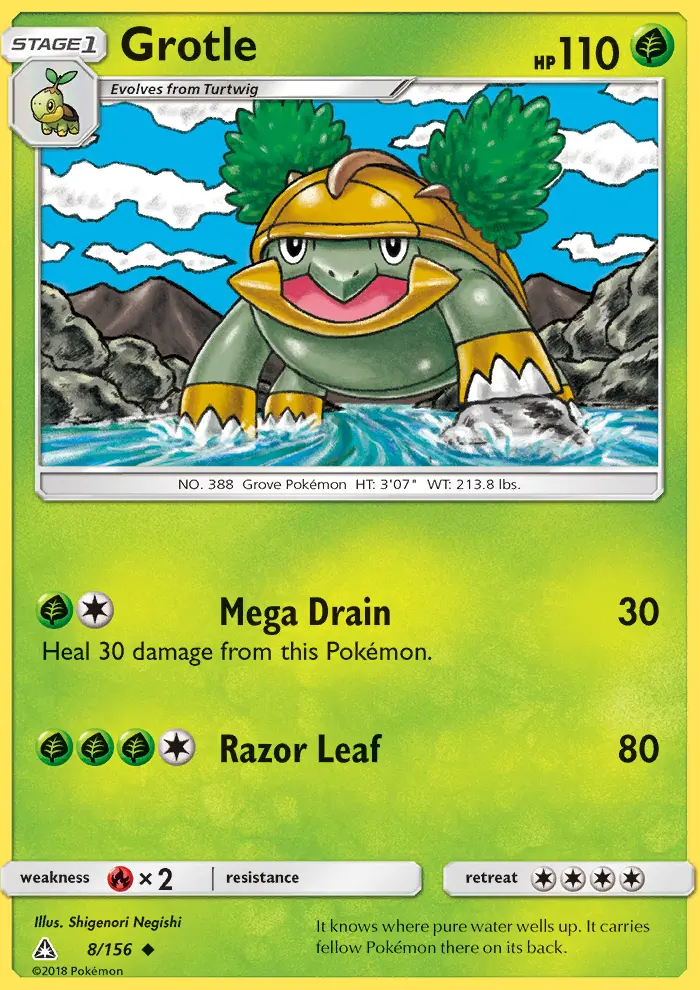
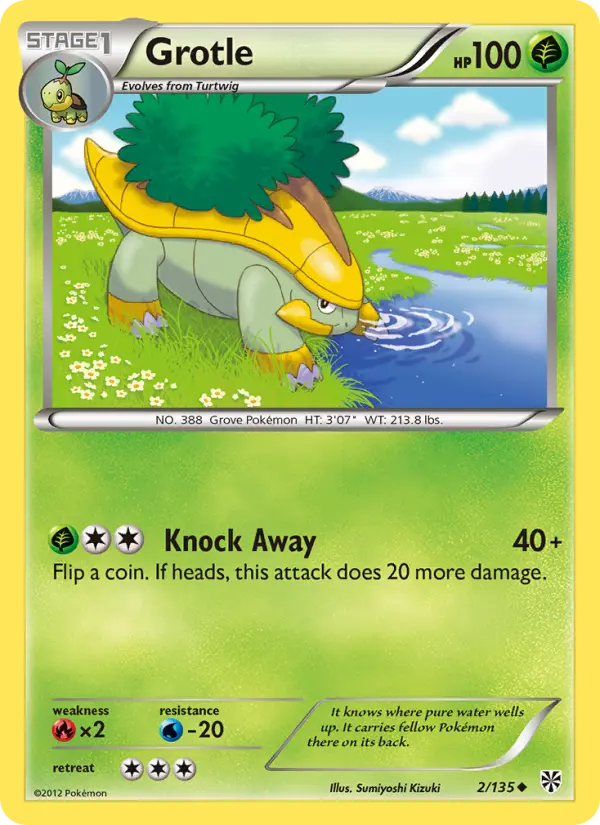
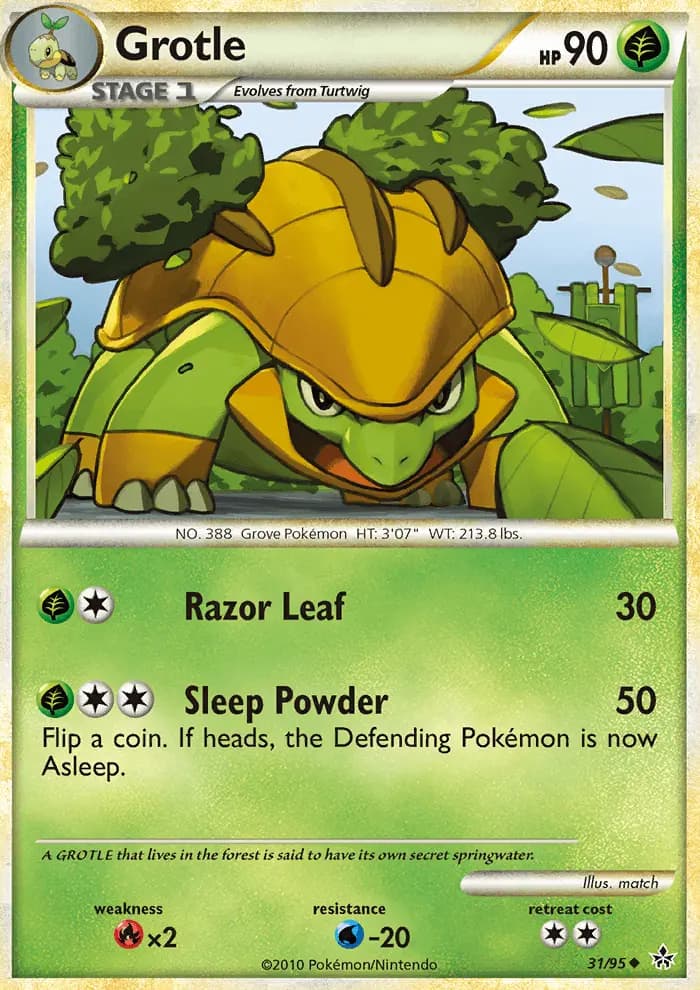
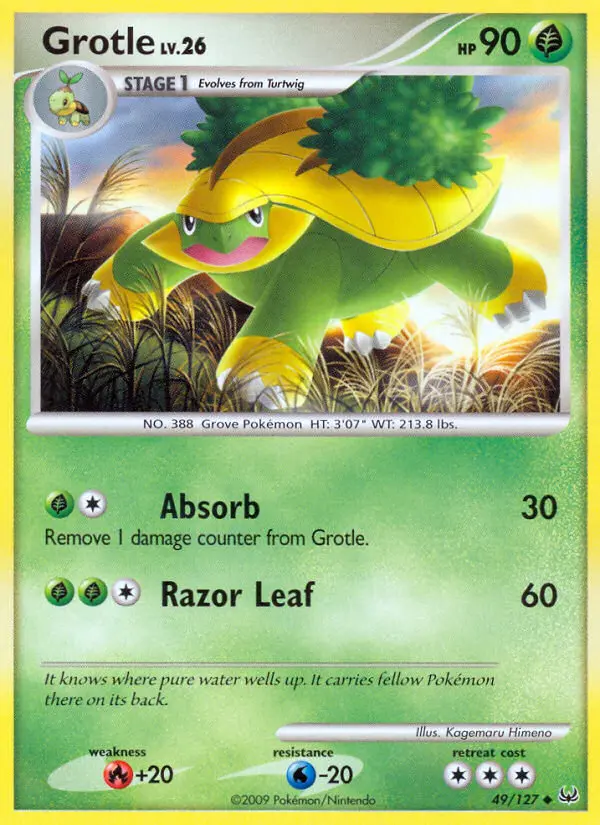
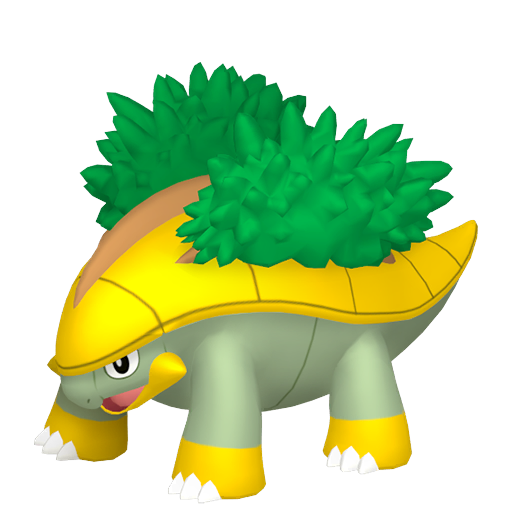
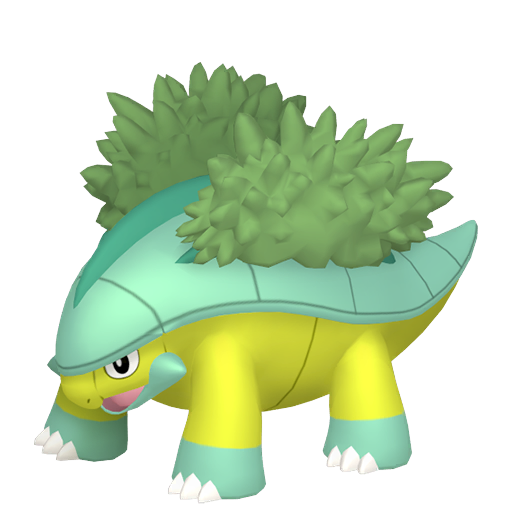
Grotle is a quadrupedal turtle Pokémon characterized by its light green skin and distinctive large shell composed of hardened soil that extends from its forehead to the tip of its short tail. The shell itself is segmented and predominantly yellow, featuring three prominent brown ridges across its surface upon which two bush-like trees actively grow, creating a miniature ecosystem on the Pokémon's back. Its physical design shows clear growth from Turtwig, with more pronounced proportions and increased bulk reflected in its 1.1-meter height and substantial 97-kilogram weight. The Pokémon's lower jaw is distinctly yellow with triangular cheek extensions, while its upper jaw features a characteristic hooked tip. Each foot is equipped with three yellow claws that provide stability and traction in its forest environment. The trees growing on Grotle's shell are living organisms that produce berries throughout the year; according to Pokédex entries, these berries are remarkably sweet and nutritious, attracting numerous Pokémon species that come to feed on them. This symbiotic relationship demonstrates the remarkable adaptability of Grotle's biology, as it provides sustenance to other Pokémon while maintaining its own survival needs through photosynthesis and nutrient absorption.
Pokedex Numbers
Training
Breeding
Grotle Breeding, Gender Ratio & Egg Groups
Grotle exhibits a heavily male-skewed gender ratio of approximately 87.5% male to 12.5% female, a distribution shared across the entire Turtwig evolutionary line and typical of many starter Pokémon. This significant gender imbalance creates interesting breeding dynamics, as female Grotle become valuable breeding stock due to their scarcity, particularly for trainers seeking to pass down egg moves or hidden abilities to offspring. Both male and female Grotle belong to the Monster and Grass egg groups, allowing them to breed with a diverse range of Pokémon species and produce offspring across both their own evolutionary lines and compatible partner species. The base happiness value of 70 in most generations indicates that Grotle can form strong bonds with its trainer relatively quickly, though it requires consistent positive interaction and care to maximize affection. Female Grotle are especially prized by competitive breeders and collectors, as their rarity in wild encounters and eggs means that obtaining one with optimal individual values and desired moves represents a significant achievement. Trainers who manage to breed female Grotle often obtain Turtwig eggs that hatch into powerful Sinnoh starters with carefully selected movesets and abilities, making the breeding process particularly rewarding. The 20-egg cycle hatch time means that dedicated breeders can cultivate competitive teams relatively efficiently, though the effort required to obtain optimal specimens with desirable characteristics remains substantial.
Sprites




TMs & HMs
tm01
lets go pikachu lets go eevee
tm01
ultra sun ultra moon
tm01
sun moon
tm02
crystal
tm02
gold silver
tm03
yellow
tm03
crystal
tm03
gold silver
tm03
red blue
tm03
blue japan
tm03
red green japan
tm05
ruby sapphire
tm05
emerald
tm05
gold silver
tm05
crystal
tm05
diamond pearl
tm05
black white
tm05
platinum
tm05
heartgold soulsilver
tm05
firered leafgreen
+598 more TMs/HMs
Grotle's Evolution Chain


Grotle Evolution, Mega Evolution & Special Forms
Grotle occupies a critical evolutionary position within the Turtwig line, representing the bridge between the small, vulnerable Turtwig and the formidable Torterra. The evolution from Turtwig to Grotle at level 18 marks a significant power increase, with Grotle gaining 13 additional points in both Attack and Defense stats, allowing it to transition from a fragile special attacker into a competent mixed attacker capable of handling physical threats. This mid-stage evolution introduces players to more complex movepool options and strategic possibilities that wouldn't be available at Turtwig's earlier development stages. The eventual evolution into Torterra at level 32 represents a dramatic transformation, as Grotle loses its pure Grass typing and gains a Ground type alongside it, fundamentally altering its role in team compositions and competitive strategies. This transformation adds significant bulk and strategic complexity, with Torterra's base stats reaching 525 total compared to Grotle's 405, making the progression feel genuine and rewarding. Many players develop strong attachments to Grotle specifically, as its intermediate design bridges the adorable simplicity of Turtwig with the imposing presence of Torterra, and its movepool at this stage includes crucial options like Synthesis for recovery and Earthquake preparation moves that become essential once evolution occurs.
Where to Find
Ulaula Meadow
alola
Grotle Behaviour and Natural Habitat
Grotle demonstrates remarkable ecological awareness, possessing an innate ability to sense where pure water wells up from underground sources. The species is known to carry fellow Pokémon on its sturdy back to these water sources, establishing itself as a helpful and communal member of forest ecosystems. Each individual Grotle is said to have discovered its own secret springwater location, which it may guard or share depending on the individual Pokémon's temperament and social bonds. The species lives predominantly along clean water sources within forests, though it exhibits the fascinating behavior of leaving its shaded forest habitat during daytime hours to allow sunlight to reach the trees growing on its shell, ensuring their continued growth and berry production. This daily migration pattern reveals a sophisticated understanding of photosynthesis and plant care despite Grotle's animal classification. The Pokémon's preferred habitat near clear, unpolluted water indicates its reliance on pristine environmental conditions, making it something of an indicator species for healthy forest ecosystems. In Diamond and Pearl versions, Grotle occupies the early Pokédex slots, suggesting their prevalence throughout Sinnoh's diverse water-adjacent regions.
Pokedex Entries
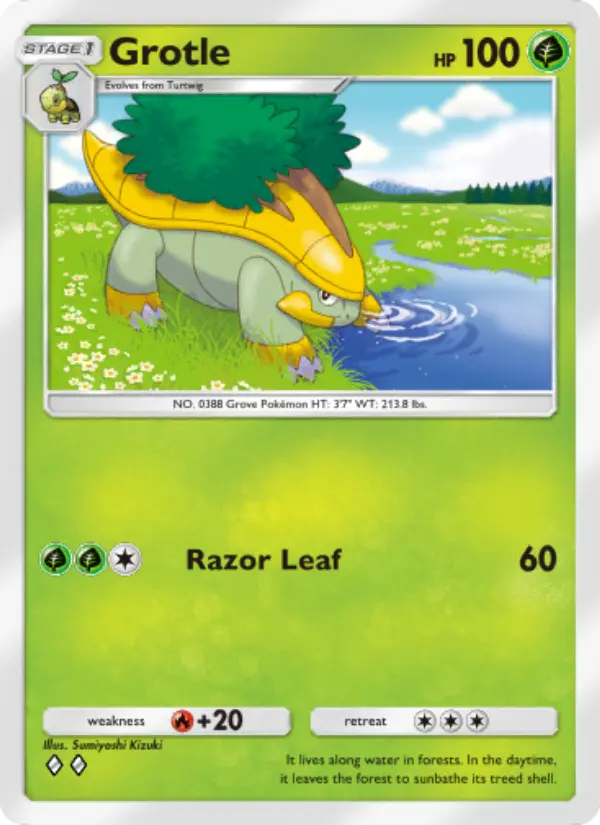
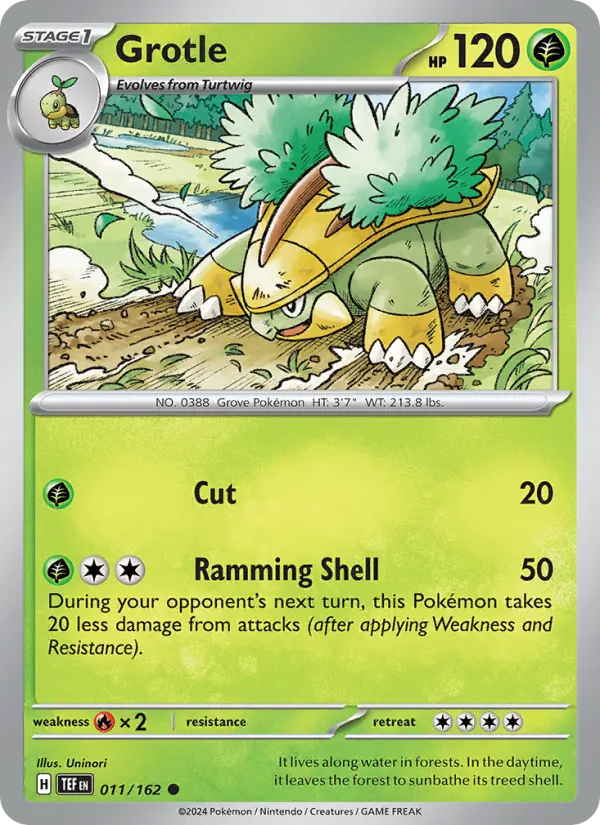
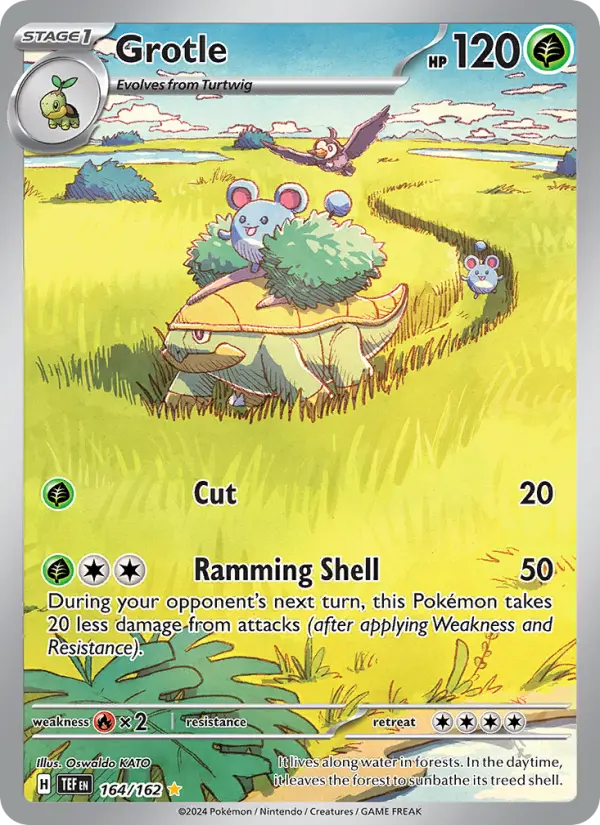
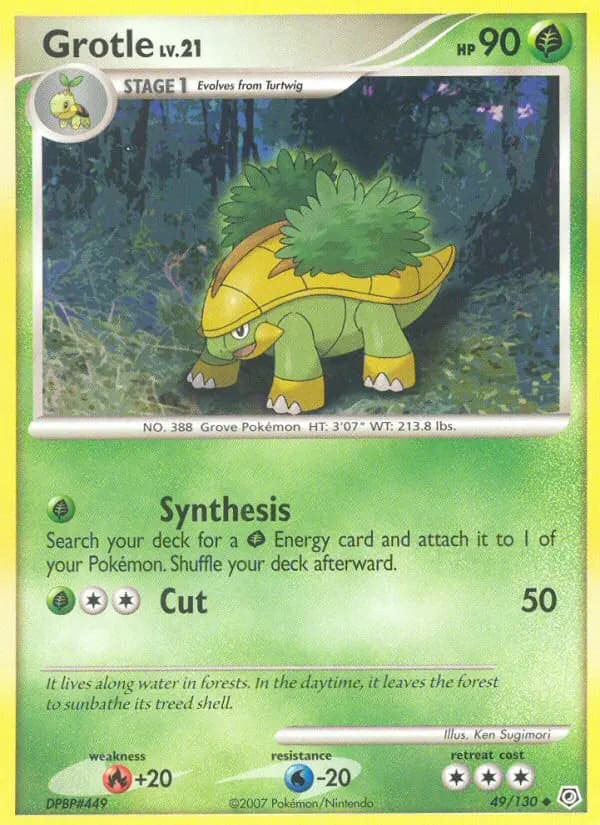
It lives along water in forests. In the daytime, it leaves the forest to sunbathe its treed shell.
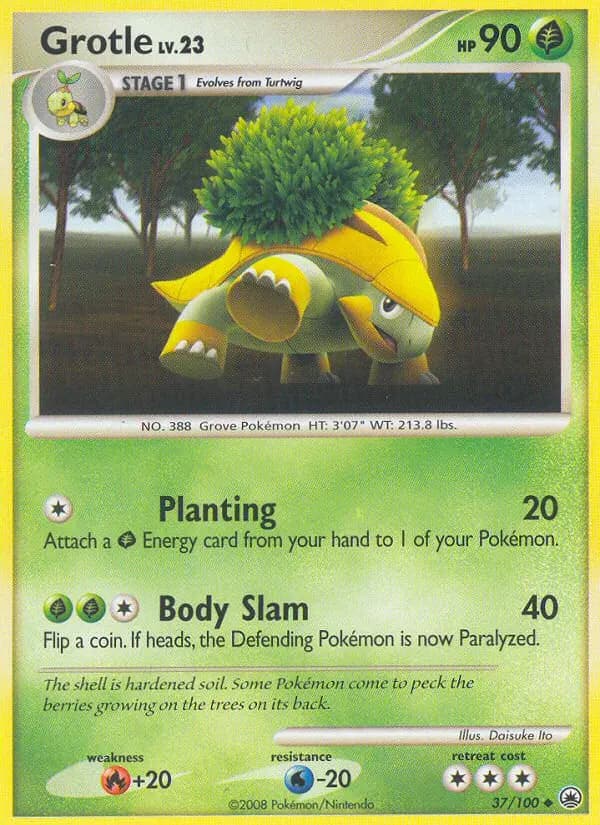
The shell is hardened soil. Some Pokémon come to peck the berries growing on the trees on its back.
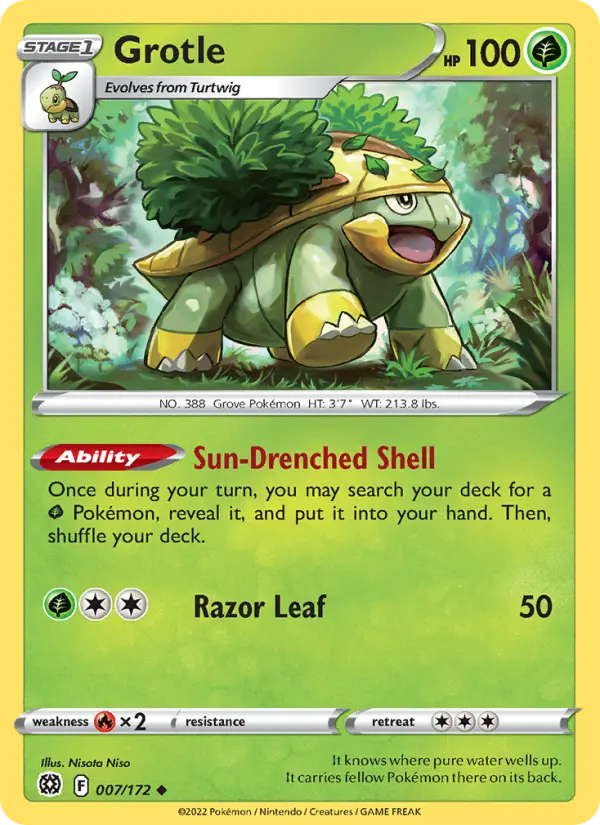
It knows where pure water wells up. It carries fellow Pokémon there on its back.
A GROTLE that lives in the forest is said to have its own secret springwater.
It knows where pure water wells up. It carries fellow Pokémon there on its back.
It knows where pure water wells up. It carries fellow Pokémon there on its back.
It lives along water in forests. In the daytime, it leaves the forest to sunbathe its treed shell.
It knows where pure water wells up. It carries fellow Pokémon there on its back.
It lives along water in forests. In the daytime, it leaves the forest to sunbathe its treed shell.
It knows where pure water wells up. It carries fellow Pokémon there on its back.
Appears where there is clean spring water. The fruit that grows on the shrubs on its shell is sweet, nutritious, and truly delicious.
Grotle Name Origin & Design Inspiration
Grotle's name traces to the Japanese "Hayashigame" (林亀), which combines "hayashi" (林, forest) and "gamera" (亀, turtle), directly referencing the species' woodland habitat and turtle-based anatomy. The English name "Grotle" appears to be a portmanteau of "grove" and "turtle," emphasizing the miniature grove of trees that defines its visual identity. The design philosophy behind Grotle represents a natural progression in the Turtwig line's conceptual development, expanding upon the seedling concept with an established small ecosystem. The hardened soil composition of its shell connects to earth-based themes that would eventually culminate in Torterra's Ground typing, creating a cohesive evolutionary narrative grounded in ecological concepts. The presence of living trees on Grotle's shell symbolizes growth, maturation, and the increasing complexity of life that accompanies the transition from youth to adolescence. The yellow coloration on its shell and facial features provides visual continuity with Turtwig while distinguishing it as a separate evolutionary stage through increased prominence of these yellow elements. This design elegantly balances the cute appeal necessary for a Pokémon that serves as a possible starter choice with the hint of the powerful creature it will become, making it visually and thematically satisfying to trainers progressing through their journey.
Learnable Moves
Grotle can learn 84 moves:
Move | Type | Cat. | Power | Acc. | PP |
|---|---|---|---|---|---|
| absorb | grass | Special | 20 | 100 | 25 |
| amnesia | psychic | Status | — | — | 20 |
| attract | normal | Status | — | 100 | 15 |
| bite | dark | Physical | 60 | 100 | 25 |
| body slam | normal | Physical | 85 | 100 | 15 |
| bulldoze | ground | Physical | 60 | 100 | 20 |
| bullet seed | grass | Physical | 25 | 100 | 30 |
| captivate | normal | Status | — | 100 | 20 |
| confide | normal | Status | — | — | 20 |
| crunch | dark | Physical | 80 | 100 | 15 |
| curse | ghost | Status | — | — | 10 |
| cut | normal | Physical | 50 | 95 | 30 |
| double team | normal | Status | — | — | 15 |
| double edge | normal | Physical | 120 | 100 | 15 |
| earth power | ground | Special | 90 | 100 | 10 |
| endure | normal | Status | — | — | 10 |
| energy ball | grass | Special | 90 | 100 | 10 |
| facade | normal | Physical | 70 | 100 | 20 |
| flash | normal | Status | — | 100 | 20 |
| frustration | normal | Physical | — | 100 | 20 |
| giga drain | grass | Special | 75 | 100 | 10 |
| grass knot | grass | Special | — | 100 | 20 |
| grass pledge | grass | Special | 80 | 100 | 10 |
| grassy glide | grass | Physical | 55 | 100 | 20 |
| grassy terrain | grass | Status | — | — | 10 |
| growth | normal | Status | — | — | 20 |
| headbutt | normal | Physical | 70 | 100 | 15 |
| heavy slam | steel | Physical | — | 100 | 10 |
| hidden power | normal | Special | 60 | 100 | 15 |
| iron head | steel | Physical | 80 | 100 | 15 |
| iron tail | steel | Physical | 100 | 75 | 15 |
| leaf blade | grass | Physical | 90 | 100 | 15 |
| leaf storm | grass | Special | 130 | 90 | 5 |
| leafage | grass | Physical | 40 | 100 | 40 |
| leech seed | grass | Status | — | 90 | 10 |
| light screen | psychic | Status | — | — | 30 |
| magical leaf | grass | Special | 60 | — | 20 |
| mega drain | grass | Special | 40 | 100 | 15 |
| mud shot | ground | Special | 55 | 95 | 15 |
| mud slap | ground | Special | 20 | 100 | 10 |
| natural gift | normal | Physical | — | 100 | 15 |
| nature power | normal | Status | — | — | 20 |
| protect | normal | Status | — | — | 10 |
| razor leaf | grass | Physical | 55 | 95 | 25 |
| reflect | psychic | Status | — | — | 20 |
| rest | psychic | Status | — | — | 5 |
| return | normal | Physical | — | 100 | 20 |
| roar | normal | Status | — | — | 20 |
| rock climb | normal | Physical | 90 | 85 | 20 |
| rock smash | fighting | Physical | 40 | 100 | 15 |
| round | normal | Special | 60 | 100 | 15 |
| safeguard | normal | Status | — | — | 25 |
| sand tomb | ground | Physical | 35 | 85 | 15 |
| secret power | normal | Physical | 70 | 100 | 20 |
| seed bomb | grass | Physical | 80 | 100 | 15 |
| shell smash | normal | Status | — | — | 15 |
| sleep powder | grass | Status | — | 75 | 15 |
| sleep talk | normal | Status | — | — | 10 |
| smack down | rock | Physical | 50 | 100 | 15 |
| snore | normal | Special | 50 | 100 | 15 |
| solar beam | grass | Special | 120 | 100 | 10 |
| spit up | normal | Special | — | 100 | 10 |
| stealth rock | rock | Status | — | — | 20 |
| stockpile | normal | Status | — | — | 20 |
| strength | normal | Physical | 80 | 100 | 15 |
| substitute | normal | Status | — | — | 10 |
| sunny day | fire | Status | — | — | 5 |
| superpower | fighting | Physical | 120 | 100 | 5 |
| swagger | normal | Status | — | 85 | 15 |
| swallow | normal | Status | — | — | 10 |
| swords dance | normal | Status | — | — | 20 |
| synthesis | grass | Status | — | — | 5 |
| tackle | normal | Physical | 40 | 100 | 35 |
| take down | normal | Physical | 90 | 85 | 20 |
| tera blast | normal | Special | 80 | 100 | 10 |
| thrash | normal | Physical | 120 | 100 | 10 |
| tickle | normal | Status | — | 100 | 20 |
| toxic | poison | Status | — | 90 | 10 |
| trailblaze | grass | Physical | 50 | 100 | 20 |
| wide guard | rock | Status | — | — | 10 |
| withdraw | water | Status | — | — | 40 |
| work up | normal | Status | — | — | 30 |
| worry seed | grass | Status | — | 100 | 10 |
| zen headbutt | psychic | Physical | 80 | 90 | 15 |
Grotle Competitive Battle Guide
In competitive Pokémon, Grotle occupies a niche role primarily in lower-tier formats and early-game competitive scenarios, where its balanced offensive and defensive stats provide genuine utility despite not reaching the power levels of its final evolution. Its base 89 Attack and 85 Defense allow Grotle to function as a competent physical wall and attacker simultaneously, though its abysmal base 36 Speed stat severely limits its effectiveness in faster-paced competitive environments where speed often determines battle outcomes. The Overgrow ability provides situational advantage by amplifying Grass-type moves during critical health situations, potentially allowing Grotle to surprise opponents or achieve comebacks in close matches. Shell Armor, available as a hidden ability, offers superior defensive utility by preventing critical hits, making Grotle more predictable in its damage calculations and reducing variance-based losses in professional competitive play. Grotle's movepool includes essential options like Synthesis for reliable recovery, Earthquake for Ground-type coverage, Stone Edge for Flying-type threats, and various Grass moves to capitalize on its improved Attack stat. However, most competitive players evolve Grotle to Torterra as quickly as possible, recognizing that the final evolution's superior stats and Ground typing provide dramatically better coverage and bulk. In formats that restrict evolution or enforce lower-tier restrictions, Grotle occasionally sees play as a cost-effective alternative to Torterra, though even in these contexts it generally underperforms compared to purpose-built tank or attacker designs.
Commonly Asked Questions About Grotle
What type is Grotle?
Grotle is a grass type Pokemon.
What does Grotle evolve into?
Grotle evolves into torterra.
What are Grotle's weaknesses?
Grotle is weak to flying, poison, bug, fire and ice type moves.
Does Grotle evolve by trading?
No — Grotle evolves entirely through leveling up, with no trade required at any stage.
Where can I find Grotle?
Grotle can be found in ulaula meadow (alola).
Grotle Cultural Impact & Franchise History
Grotle holds a special place in the hearts of Generation IV enthusiasts and Pokémon Sinnoh region fans, representing one of the defining Pokémon of that era alongside Dialga, Palkia, and other iconic Sinnoh species. The Pokémon anime featured Ash capturing a Grotle during his Sinnoh adventures, with the Pokémon featuring prominently in numerous episodes and developing meaningful bonds with Ash that demonstrated Grotle's capability for emotional connection and growth. This televised appearance significantly increased Grotle's cultural relevance and introduced millions of viewers to the species' unique characteristics and charm. Among starter Pokémon communities, Grotle maintains dedicated fan bases who appreciate its intermediate design as a perfect balance between cuteness and power, with considerable fan art and community discussion celebrating the species. The presence of Grotle in multiple remakes and enhanced versions of Generation IV games, including Brilliant Diamond and Shining Pearl, has ensured that new generations of players continue to encounter and bond with this species. Trading communities value Grotle eggs and Turtwig starters specifically because many players seek to experience the full evolutionary line, creating consistent demand for the species across all Pokémon games. In competitive tournament history and player discussions, Grotle frequently appears as a nostalgic reference point, with players reminiscing about their experiences training Grotle during their first Sinnoh playthroughs.
Where to Find Grotle in Every Pokémon Game
Grotle appears in the Pokédex of virtually every mainline Pokémon game released since Generation IV, though its availability method varies significantly depending on the specific game. In Diamond, Pearl, and Platinum, Grotle is obtained naturally by evolving the Turtwig starter at level 18, making it an inevitable encounter for any player who selects Turtwig as their starter Pokémon. Brilliant Diamond and Shining Pearl similarly feature Grotle as part of the Turtwig evolution line, with the Pokémon becoming available early in the game through this straightforward evolutionary pathway. In Pokémon Legends: Arceus, Grotle appears in areas with clean spring water, continuing the species' thematic association with pure water sources and forest environments. HeartGold and SoulSilver included Grotle through breeding or trading mechanisms, allowing players in those games to obtain the species despite Turtwig not being available as a catchable Pokémon in the wild. The 45 catch rate indicates moderate difficulty in capturing wild Grotle when encountered, requiring several Poké Balls or status condition support to secure successfully. Modern games including Pokémon Scarlet and Violet feature Grotle in their expanded Pokédex through various encounters and transferable methods, ensuring the species remains accessible to contemporary players. Trading between compatible games and utilizing Pokémon Home services has made Grotle effectively available across all modern platforms, allowing trainers to experience the complete Turtwig evolutionary line regardless of which specific games they own.