Torterra
Generation IV · #0389 — Continent Pokémon
Weighing 310 kg and standing 2.2 m, Torterra carries its grass/ground typing into battle with a stat spread that leans hardest into HP. It measures 2.2 m and 310.0 kg, dimensions that pair with that stat lean in noticeable ways. With a aggregate stat total of 525, Torterra excels in physical prowess, boasting an Attack stat of 109 and a respectable Defense of 105, though its Speed of 56 leaves much to be desired. The species possesses two notable abilities: Overgrow, which boosts grass-type moves to 1.5× damage when its health drops to one-third or below, and the hidden ability Shell Armor, which grants protection against critical hits. Torterra's design draws inspiration from ancient myths and geological formations, embodying the concept of a living continent that ancient civilizations believed lay beneath the ground.
Editor's Take
Torterra's Grass/Ground typing means a quad weakness to Ice on a Pokémon with 56 base Speed, and that single line explains why the best-designed Sinnoh starter is also the least used.
Base Stats
Height
2.2m
Weight
310.0kg
Category
Continent Pokémon
Gender
Male 87.5% / Female 12.5%
Color
green
Shape
quadruped
Abilities
Strengthens grass moves to inflict 1.5× damage at 1/3 max HP or less.
Protects against critical hits.

Torterra Biology & Physical Characteristics
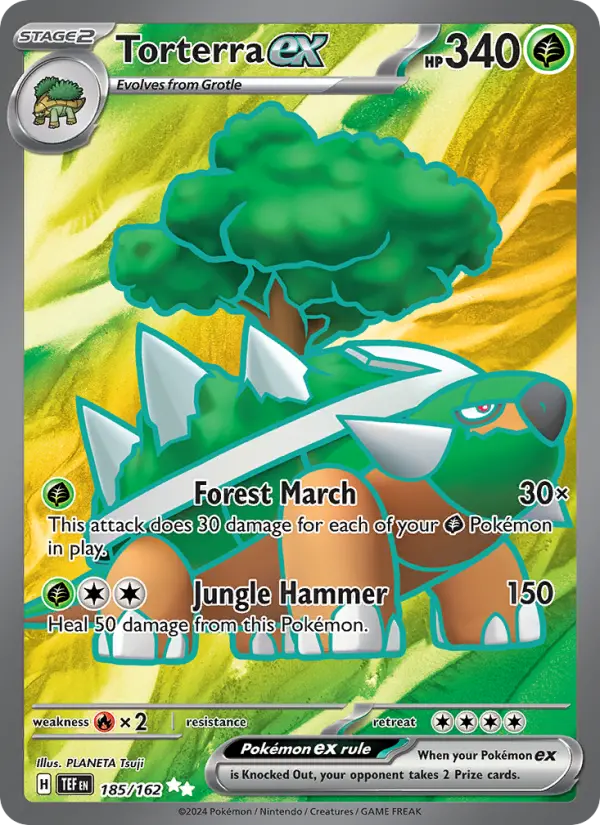
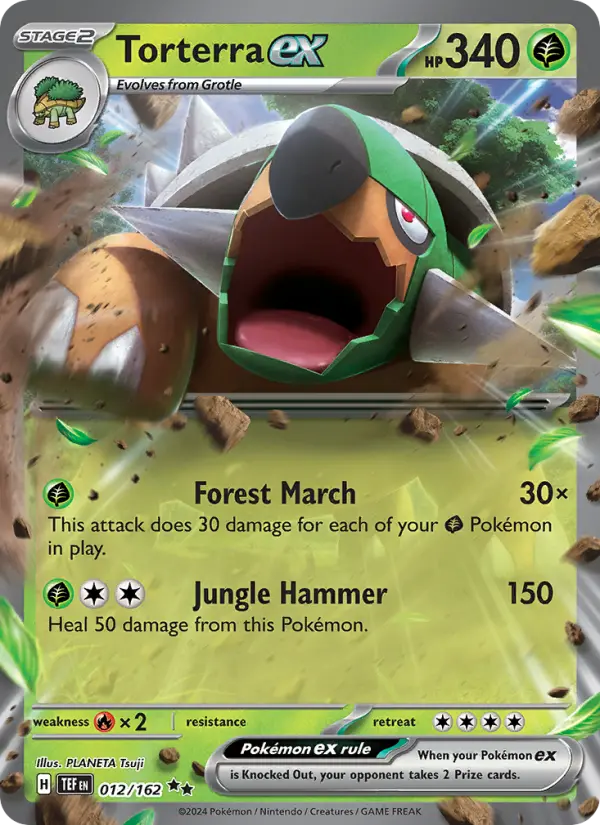
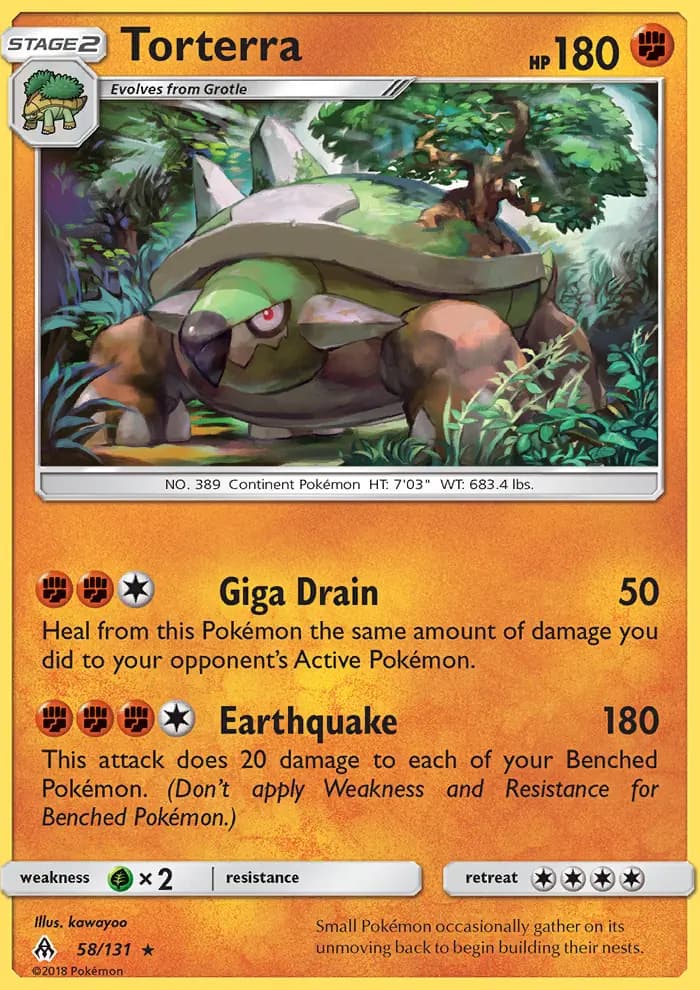
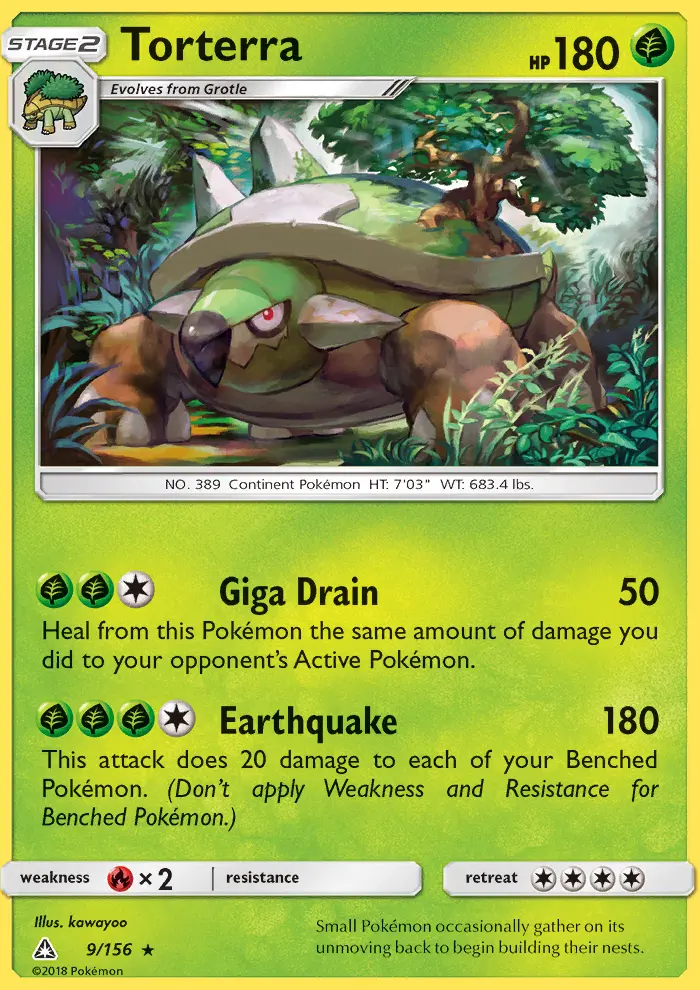
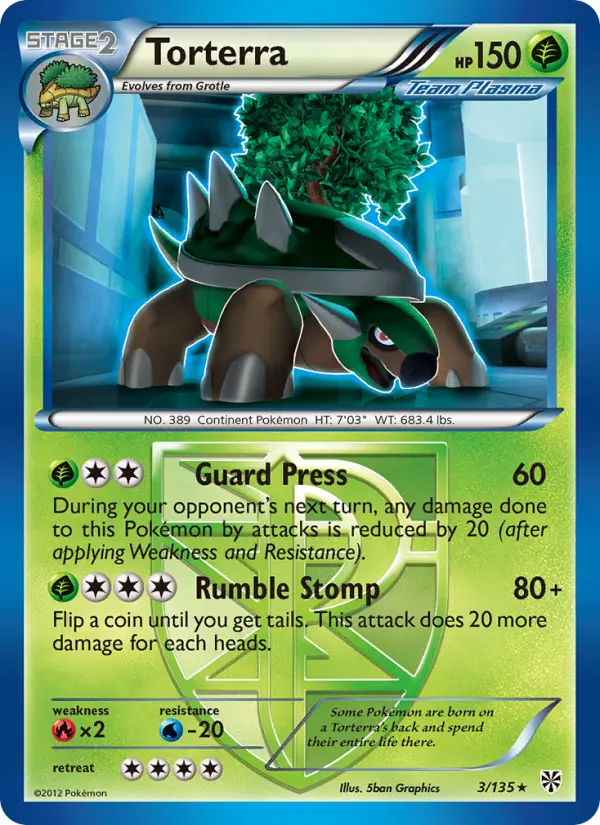
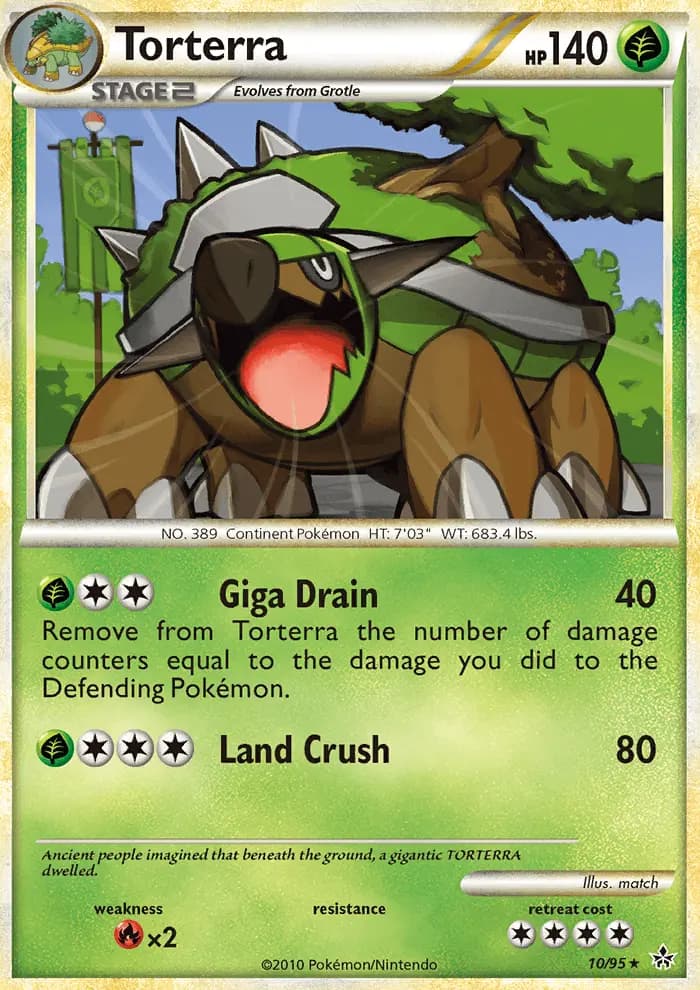
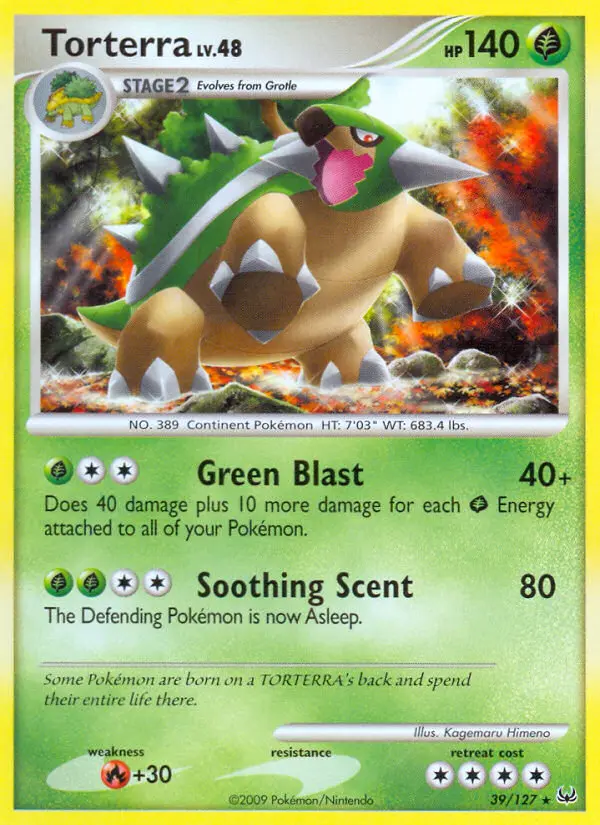
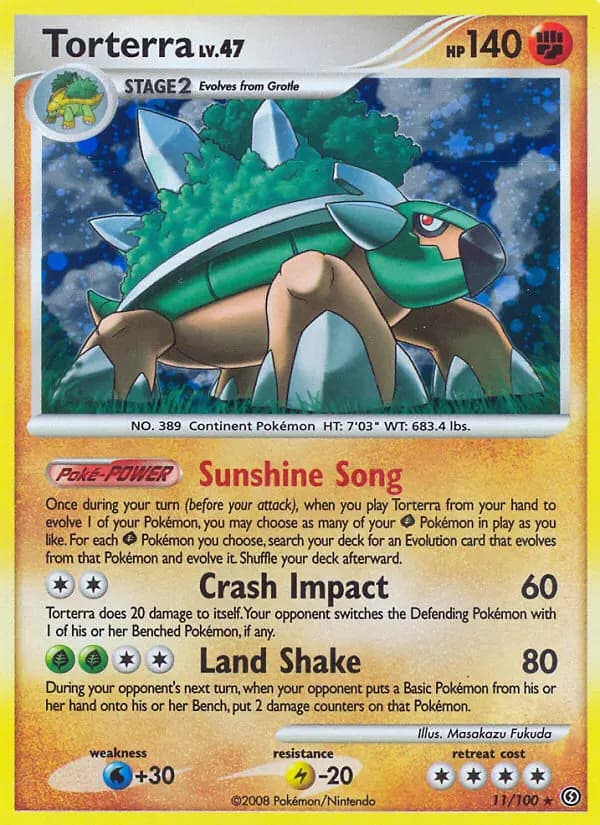
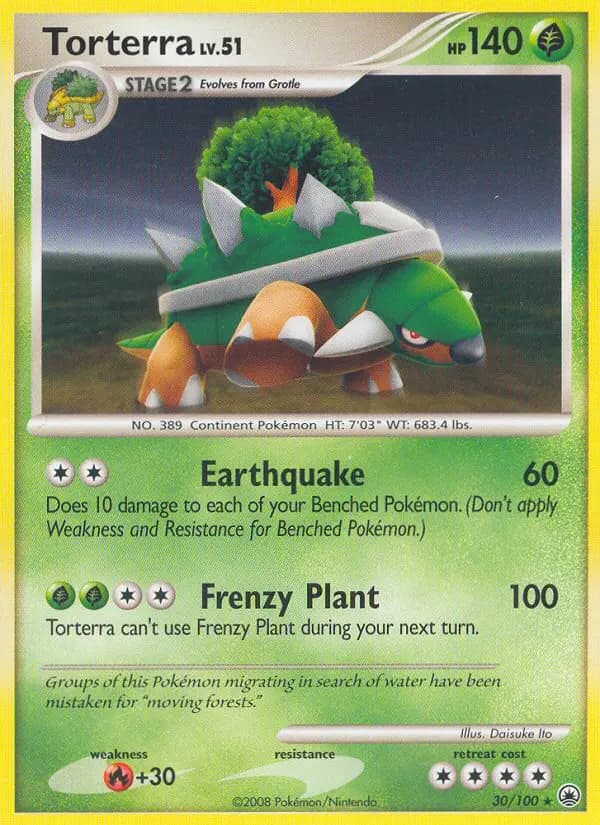
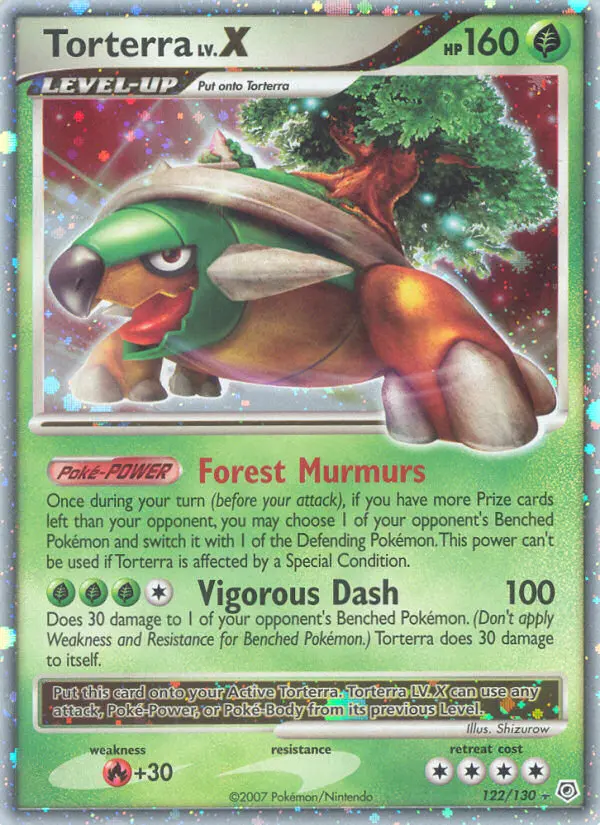
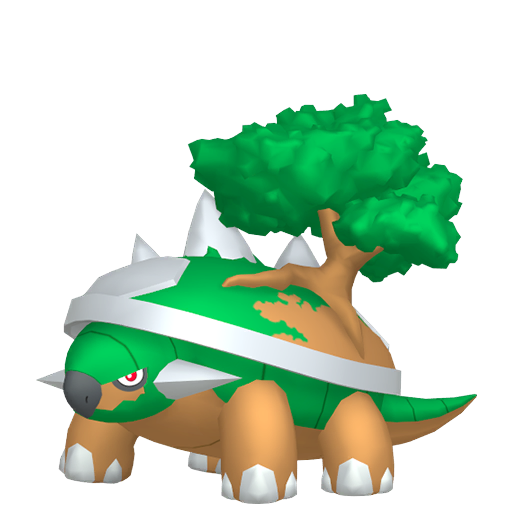
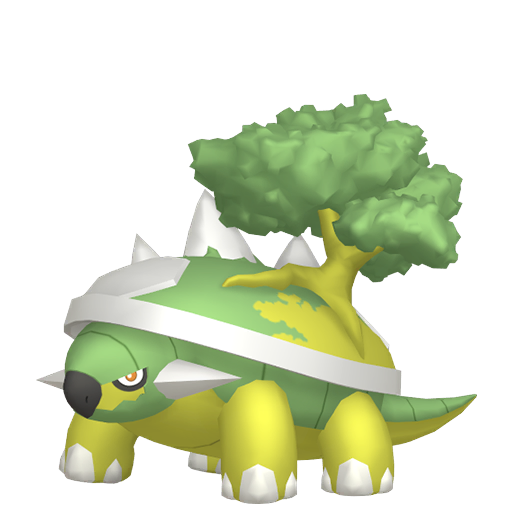
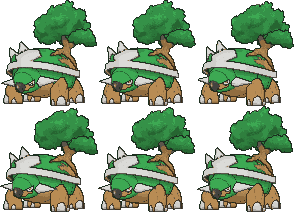
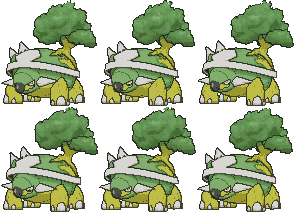
Torterra is a quadrupedal Pokémon with a distinctly tortoise-like appearance, characterized by its massive, hardened shell that dominates its physical form. The most striking feature of Torterra is the ecosystem that thrives upon its back—a single oak-like tree sprouts from the shell's surface alongside three rocky, triangular extensions resembling mountain peaks, with patches of brown soil completing the landscape. This shell is surrounded by a white rim that extends downward in a diamond-shaped formation across the front of its body. The creature's physiology reflects its dual typing, with the upper half of its body displaying vibrant green coloration reminiscent of vegetation, while the lower half is brown like earth and stone. Torterra possesses a jagged mouth similar to a snapping turtle, small red eyes ringed with black markings, and two large spikes protruding from its cheeks. Its legs are thick and powerful, each bearing four toes that resemble jagged stones, with three toes on the front of each foot and one positioned on the heel, providing the stability needed to support its massive 310-kilogram frame.
Pokedex Numbers
Training
Breeding
Torterra Breeding, Gender Ratio & Egg Groups
Torterra exhibits a heavily skewed gender ratio, with approximately 88% of the species being male and only 12% female, a trait shared across its entire evolutionary line since its earliest form as Turtwig. This significant gender disparity makes female Torterra considerably rarer in the wild and more difficult to obtain for breeding purposes. Both male and female Torterra are classified in the Monster and Grass egg groups, allowing for breeding with a diverse range of compatible Pokémon species. The base friendship value for the species is 70, indicating a moderate initial bond with newly-caught specimens that can be further developed through care and interaction. The egg cycle for Torterra is relatively lengthy at 20 cycles, translating to approximately 4,884 to 5,140 steps before an egg hatches, reflecting the significant incubation period required to develop such a large and imposing Pokémon. Trainers seeking to breed Torterra will find that the high male-to-female ratio necessitates either obtaining a female through considerable effort or utilizing a male Torterra with a compatible female Pokémon from either the Monster or Grass egg group.
Sprites


TMs & HMs
tm01
lets go pikachu lets go eevee
tm01
ultra sun ultra moon
tm01
sun moon
tm02
crystal
tm02
gold silver
tm03
yellow
tm03
crystal
tm03
gold silver
tm03
red blue
tm03
blue japan
tm03
red green japan
tm05
ruby sapphire
tm05
emerald
tm05
gold silver
tm05
crystal
tm05
diamond pearl
tm05
black white
tm05
platinum
tm05
heartgold soulsilver
tm05
firered leafgreen
+760 more TMs/HMs
Torterra's Evolution Chain


Torterra Evolution, Mega Evolution & Special Forms
Torterra evolves from Grotle starting at level 32, completing a three-stage evolutionary line that begins with Turtwig. The evolution from Grotle to Torterra represents a dramatic transformation, as the Pokémon develops from a smaller, more agile creature into a massive, continent-like behemoth. This evolution grants Torterra its Ground-type secondary typing, fundamentally altering its elemental properties and battle capabilities compared to its pure Grass-type predecessors. The evolutionary process sees the development of the characteristic tree and rocky peaks atop its shell, transforming what were previously simple shell formations into a fully-fledged ecosystem. While Torterra does not possess a Mega Evolution form, its base stats upon reaching its final form are substantially superior to Grotle's, particularly in Attack and Defense, establishing it as a formidable physical tank in competitive play. The medium-slow growth rate shared across the entire evolutionary line means that trainers must invest considerable time and experience to bring their Turtwig to full Torterra potential, but the reward is a Pokémon of legendary durability and offensive capability.
Where to Find
Location data not available for this Pokémon in the database.
Torterra Behaviour and Natural Habitat
Torterra exhibits a remarkably unique ecological relationship with other Pokémon species, as smaller creatures regularly gather upon its back to build their nests, with some Pokémon even being born and spending their entire lives on the massive shell. The Pokédex notes that groups of Torterra migrating in search of clean water have historically been mistaken for moving forests, a testament to the density of vegetation that thrives upon their backs. Despite its capacity for migration and the illusion of movement it creates, Torterra is typically immobile, preferring to remain stationary while serving as a living ecosystem for countless smaller Pokémon. Ancient human civilizations mythologized the species, imagining that a gigantic Torterra dwelled beneath the ground itself, suggesting that the creature held significant cultural importance in prehistoric times. Torterra roams the wilderness specifically in search of clean water sources, and its legendary physical strength is believed to be unmatched among terrestrial Pokémon, making it a formidable presence in any environment it inhabits.
Pokedex Entries
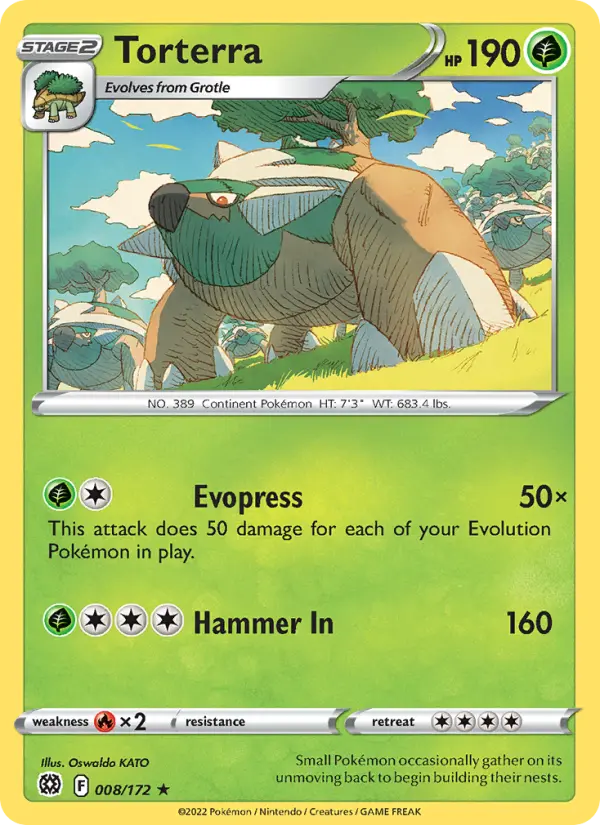
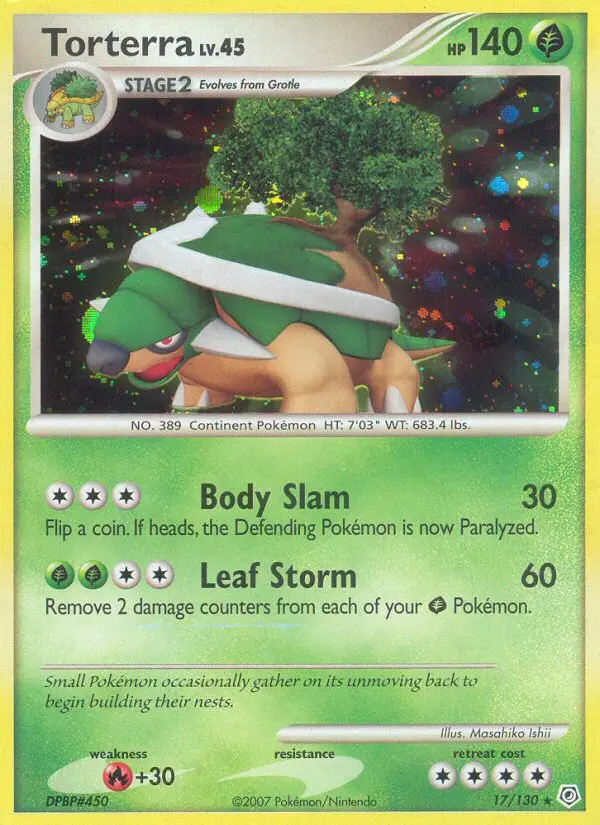
Small Pokémon occasionally gather on its unmoving back to begin building their nests.
Groups of this Pokémon migrating in search of water have been mistaken for “moving forests.”
Some Pokémon are born on a TORTERRA’s back and spend their entire life there.
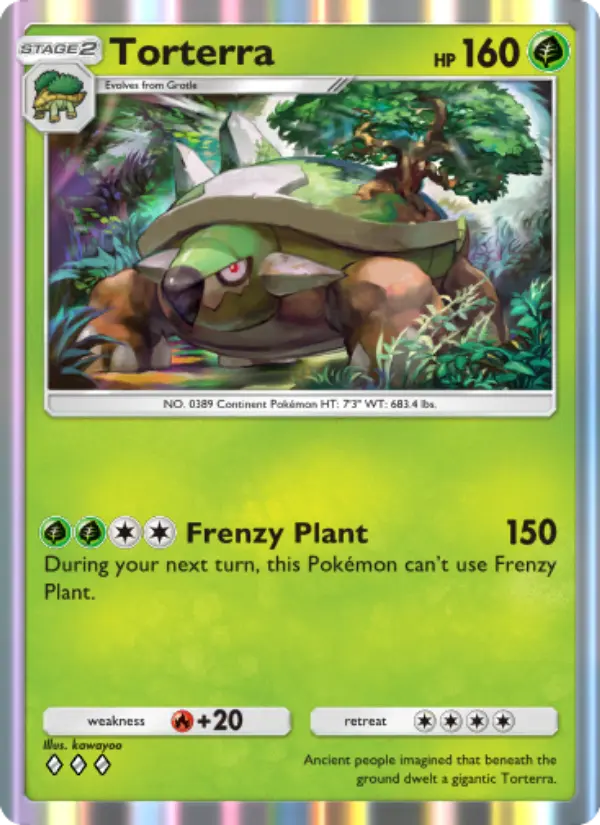
Ancient people imagined that beneath the ground, a gigantic TORTERRA dwelled.
Some Pokémon are born on a Torterra’s back and spend their entire life there.
Some Pokémon are born on a Torterra’s back and spend their entire life there.
Ancient people imagined that beneath the ground, a gigantic Torterra dwelled.
Small Pokémon occasionally gather on its unmoving back to begin building their nests.
Ancient people imagined that beneath the ground, a gigantic Torterra dwelled.
Small Pokémon occasionally gather on its unmoving back to begin building their nests.
This remarkable, large-bodied Pokémon would serve beautifully as borrowed scenery for a garden, and its strength is peerless. Torterra roams the wilderness in search of clean water.
Torterra Name Origin & Design Inspiration
The name Torterra is a straightforward portmanteau of 'tortoise' and 'terra,' the Latin word for earth or land, perfectly encapsulating the Pokémon's nature as a terrestrial, continent-like creature. The Japanese name Dodaitose similarly derives from 'dōdai,' meaning foundation or base, combined with 'tortoise,' reflecting its role as a foundational, earth-based ecosystem. Torterra's design draws inspiration from multiple sources: primarily a snapping turtle for its general morphology and jagged mouth, but also from the mythological concept of a world turtle or earth turtle found in various world cultures. The addition of vegetation sprouting from its shell—particularly the oak tree—references the geological formation of mountains and the ancient belief that the earth itself could be a living creature supporting entire forests and ecosystems. The rocky peaks protruding from its shell evoke mountain ranges, while the brown soil patches suggest fertile earth. This multifaceted design brilliantly synthesizes the concepts of geology, botany, and zoology, creating a Pokémon that literally embodies the terrestrial world in its physical form.
Learnable Moves
Torterra can learn 106 moves:
Move | Type | Cat. | Power | Acc. | PP |
|---|---|---|---|---|---|
| absorb | grass | Special | 20 | 100 | 25 |
| amnesia | psychic | Status | — | — | 20 |
| attract | normal | Status | — | 100 | 15 |
| bite | dark | Physical | 60 | 100 | 25 |
| block | normal | Status | — | — | 5 |
| body press | fighting | Physical | 80 | 100 | 10 |
| body slam | normal | Physical | 85 | 100 | 15 |
| bulldoze | ground | Physical | 60 | 100 | 20 |
| bullet seed | grass | Physical | 25 | 100 | 30 |
| captivate | normal | Status | — | 100 | 20 |
| confide | normal | Status | — | — | 20 |
| crunch | dark | Physical | 80 | 100 | 15 |
| curse | ghost | Status | — | — | 10 |
| cut | normal | Physical | 50 | 95 | 30 |
| double team | normal | Status | — | — | 15 |
| double edge | normal | Physical | 120 | 100 | 15 |
| earth power | ground | Special | 90 | 100 | 10 |
| earthquake | ground | Physical | 100 | 100 | 10 |
| endure | normal | Status | — | — | 10 |
| energy ball | grass | Special | 90 | 100 | 10 |
| facade | normal | Physical | 70 | 100 | 20 |
| flash | normal | Status | — | 100 | 20 |
| frenzy plant | grass | Special | 150 | 90 | 5 |
| frustration | normal | Physical | — | 100 | 20 |
| giga drain | grass | Special | 75 | 100 | 10 |
| giga impact | normal | Physical | 150 | 90 | 5 |
| grass knot | grass | Special | — | 100 | 20 |
| grass pledge | grass | Special | 80 | 100 | 10 |
| grassy glide | grass | Physical | 55 | 100 | 20 |
| grassy terrain | grass | Status | — | — | 10 |
| growth | normal | Status | — | — | 20 |
| hard press | steel | Physical | 0 | 100 | 10 |
| headbutt | normal | Physical | 70 | 100 | 15 |
| headlong rush | ground | Physical | 120 | 100 | 5 |
| heavy slam | steel | Physical | — | 100 | 10 |
| hidden power | normal | Special | 60 | 100 | 15 |
| high horsepower | ground | Physical | 95 | 95 | 10 |
| hyper beam | normal | Special | 150 | 90 | 5 |
| hyper voice | normal | Special | 90 | 100 | 10 |
| iron defense | steel | Status | — | — | 15 |
| iron head | steel | Physical | 80 | 100 | 15 |
| iron tail | steel | Physical | 100 | 75 | 15 |
| leaf blade | grass | Physical | 90 | 100 | 15 |
| leaf storm | grass | Special | 130 | 90 | 5 |
| leafage | grass | Physical | 40 | 100 | 40 |
| leech seed | grass | Status | — | 90 | 10 |
| light screen | psychic | Status | — | — | 30 |
| magical leaf | grass | Special | 60 | — | 20 |
| mega drain | grass | Special | 40 | 100 | 15 |
| mud shot | ground | Special | 55 | 95 | 15 |
| mud slap | ground | Special | 20 | 100 | 10 |
| natural gift | normal | Physical | — | 100 | 15 |
| nature power | normal | Status | — | — | 20 |
| outrage | dragon | Physical | 120 | 100 | 10 |
| protect | normal | Status | — | — | 10 |
| razor leaf | grass | Physical | 55 | 95 | 25 |
| reflect | psychic | Status | — | — | 20 |
| rest | psychic | Status | — | — | 5 |
| return | normal | Physical | — | 100 | 20 |
| roar | normal | Status | — | — | 20 |
| rock blast | rock | Physical | 25 | 90 | 10 |
| rock climb | normal | Physical | 90 | 85 | 20 |
| rock polish | rock | Status | — | — | 20 |
| rock slide | rock | Physical | 75 | 90 | 10 |
| rock smash | fighting | Physical | 40 | 100 | 15 |
| rock tomb | rock | Physical | 60 | 95 | 15 |
| round | normal | Special | 60 | 100 | 15 |
| safeguard | normal | Status | — | — | 25 |
| sand tomb | ground | Physical | 35 | 85 | 15 |
| sandstorm | rock | Status | — | — | 10 |
| scary face | normal | Status | — | 100 | 10 |
| scorching sands | ground | Special | 70 | 100 | 10 |
| secret power | normal | Physical | 70 | 100 | 20 |
| seed bomb | grass | Physical | 80 | 100 | 15 |
| shell smash | normal | Status | — | — | 15 |
| sleep powder | grass | Status | — | 75 | 15 |
| sleep talk | normal | Status | — | — | 10 |
| smack down | rock | Physical | 50 | 100 | 15 |
| snore | normal | Special | 50 | 100 | 15 |
| solar beam | grass | Special | 120 | 100 | 10 |
| spit up | normal | Special | — | 100 | 10 |
| stealth rock | rock | Status | — | — | 20 |
| stockpile | normal | Status | — | — | 20 |
| stomping tantrum | ground | Physical | 75 | 100 | 10 |
| stone edge | rock | Physical | 100 | 80 | 5 |
| strength | normal | Physical | 80 | 100 | 15 |
| substitute | normal | Status | — | — | 10 |
| sunny day | fire | Status | — | — | 5 |
| superpower | fighting | Physical | 120 | 100 | 5 |
| swagger | normal | Status | — | 85 | 15 |
| swallow | normal | Status | — | — | 10 |
| swords dance | normal | Status | — | — | 20 |
| synthesis | grass | Status | — | — | 5 |
| tackle | normal | Physical | 40 | 100 | 35 |
| take down | normal | Physical | 90 | 85 | 20 |
| tera blast | normal | Special | 80 | 100 | 10 |
| thrash | normal | Physical | 120 | 100 | 10 |
| tickle | normal | Status | — | 100 | 20 |
| toxic | poison | Status | — | 90 | 10 |
| trailblaze | grass | Physical | 50 | 100 | 20 |
| wide guard | rock | Status | — | — | 10 |
| withdraw | water | Status | — | — | 40 |
| wood hammer | grass | Physical | 120 | 100 | 15 |
| work up | normal | Status | — | — | 30 |
| worry seed | grass | Status | — | 100 | 10 |
| zen headbutt | psychic | Physical | 80 | 90 | 15 |
Torterra Competitive Battle Guide
Torterra occupies an interesting niche in competitive Pokémon battling, functioning as a physical tank with respectable offensive capabilities backed by solid defensive statistics. With Attack and Defense stats of 109 and 105 respectively, Torterra can reliably withstand physical assaults while dealing considerable damage in return, making it an excellent choice for physically-oriented movesets. The critical flaw in Torterra's competitive viability is its notably poor Speed stat of only 56, positioning it as one of the slowest fully-evolved Pokémon and forcing it to rely on priority moves or defensive strategies to function effectively in fast-paced competitive formats. Its Grass/Ground typing grants it exceptional defensive coverage against common threats, with resistances to Electric, Rock, and Poison-type moves, though it suffers from a 4× weakness to Ice-type moves that can prove catastrophic. The Overgrow ability provides a damage boost when Torterra is critically low on health, potentially turning desperate situations into comebacks, while the hidden ability Shell Armor prevents opposing Pokémon from landing critical hits. Competitive trainers typically utilize Torterra in bulkier, defensive teams that capitalize on its physical bulk and access to utility moves like Stealth Rock, Earthquake, and Stone Edge, rather than attempting to leverage its modest Special Attack of 75 in special-based strategies.
Commonly Asked Questions About Torterra
What type is Torterra?
Torterra is a grass and ground type Pokemon.
What does Torterra evolve from?
Torterra evolved from grotle that evolved from turtwig.
What are Torterra's weaknesses?
Torterra is weak to flying, bug, fire and ice type moves.
Torterra Cultural Impact & Franchise History
Torterra holds significant cultural importance within the Pokémon franchise, particularly as the grass-type starter Pokémon for the Diamond and Pearl generation, one of the most beloved entries in the Pokémon series. The species achieved notable prominence through the anime series, where it appeared as a major evolution within Ash Ketchum's roster, earning substantial screen time and demonstrating its combat prowess in memorable battles. Paul's Torterra in the anime became an iconic representation of the Pokémon's formidable power and the dedication required to fully train such a creature, establishing it as a fan-favorite among viewers. The concept of Torterra as a living ecosystem—a mobile habitat for countless other Pokémon—resonated deeply with players and fans, contributing to its lasting legacy as one of the most conceptually interesting starter Pokémon designs. The species' mythological underpinnings, drawing from world-turtle legends present in numerous cultures, elevated it beyond a simple reptilian creature to something approaching legendary status in the fictional world. This cultural significance has ensured Torterra's continued presence throughout subsequent Pokémon generations and media, maintaining its status as an iconic representative of Generation IV's contribution to the franchise.
Where to Find Torterra in Every Pokémon Game
Torterra is primarily obtainable as the final evolution of Turtwig, the grass-type starter Pokémon in Pokémon Diamond, Pearl, and their remakes Brilliant Diamond and Shining Pearl. In the original Generation IV titles, trainers receive Turtwig from Professor Rowan at the beginning of their journey, necessitating two evolutions to reach Torterra at level 32. The species is classified with a catch rate of 45, meaning that wild encounters with Torterra are moderately challenging to capture, though this is largely irrelevant since the primary method of obtaining one is through starter evolution. Torterra has maintained availability throughout subsequent generations, appearing in various Pokédex entries in titles such as Black and White, where it could be obtained through transfer mechanics or in-game encounters. In more recent titles such as Pokémon Legends: Arceus, Torterra became available as a wild encounter or through evolution, accommodating trainers who wished to utilize the species without having begun their journey with Turtwig as a starter. The species can also be obtained through breeding compatible Pokémon with Torterra parents, provided trainers secure a female of the species despite their relative rarity. Across all modern Pokémon games featuring National Pokédex integration, Torterra remains accessible to dedicated trainers willing to invest the effort required to either evolve it from Turtwig or breed for it from existing populations.