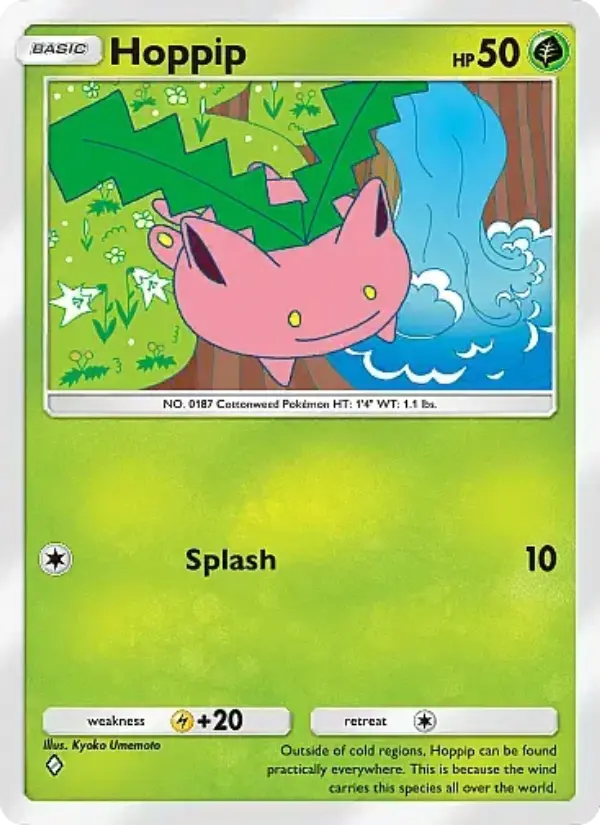
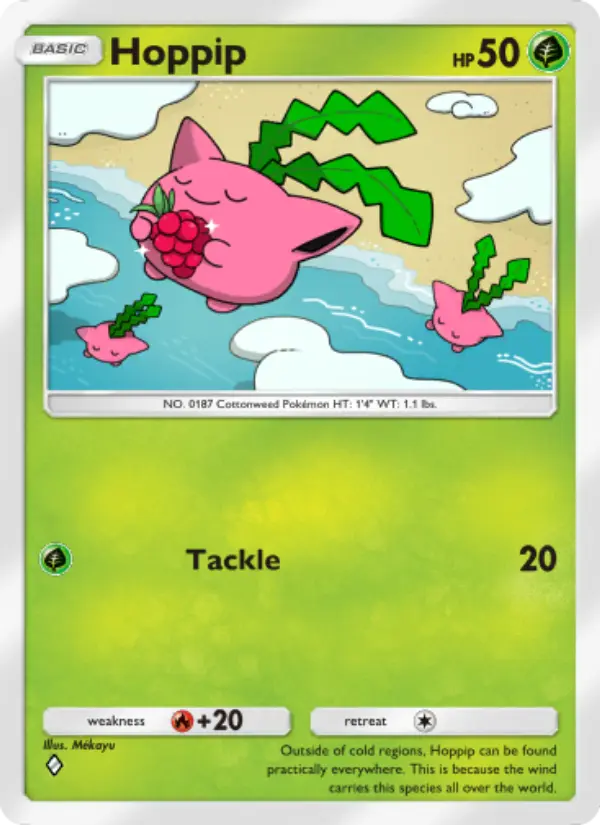
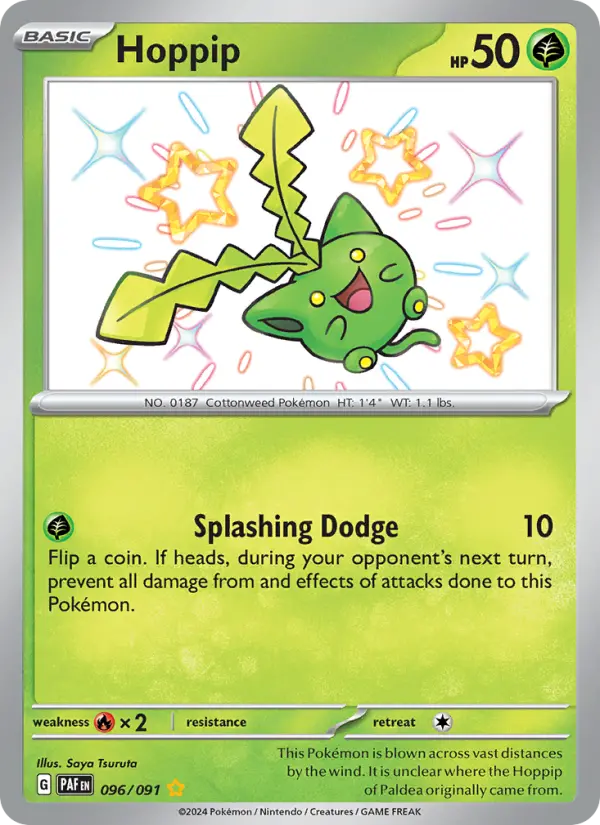
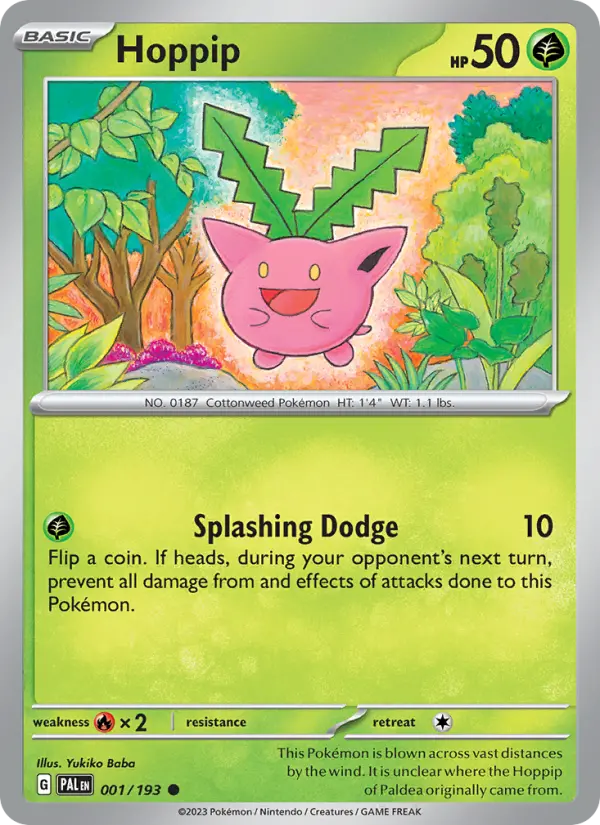
Hoppip
Generation II · #0187 — Cottonweed Pokémon
At 0.4 m and 0.5 kg, Hoppip doesn't look like much on paper, but its chlorophyll ability shapes how it actually plays more than its size suggests. Despite its fragile appearance, this dual-type possesses remarkable survival instincts adapted to its life as an airborne wanderer. Hoppip's ease of capture—reflected in its exceptionally high catch rate of 255—belies its complex behavioral patterns and ecological significance in temperate grasslands worldwide.
Editor's Take
Hoppip's line has the lowest stat total progression of any three-stage evolution, and Jumpluff's Sleep Powder plus Leech Seed is a genuinely annoying strategy on a Pokémon with nothing else.
Base Stats
Height
0.4m
Weight
0.5kg
Category
Cottonweed Pokémon
Gender
Male 50% / Female 50%
Color
pink
Shape
upright
Habitat
grassland
Abilities
Doubles Speed during strong sunlight.
Protects against major status ailments during strong sunlight.
Bypasses light screen, reflect, and safeguard.

Hoppip Biology & Physical Characteristics
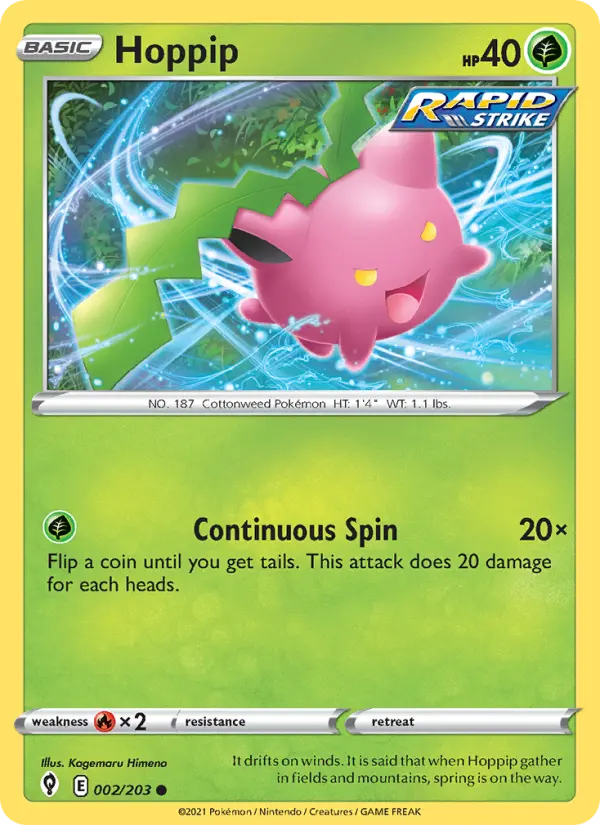
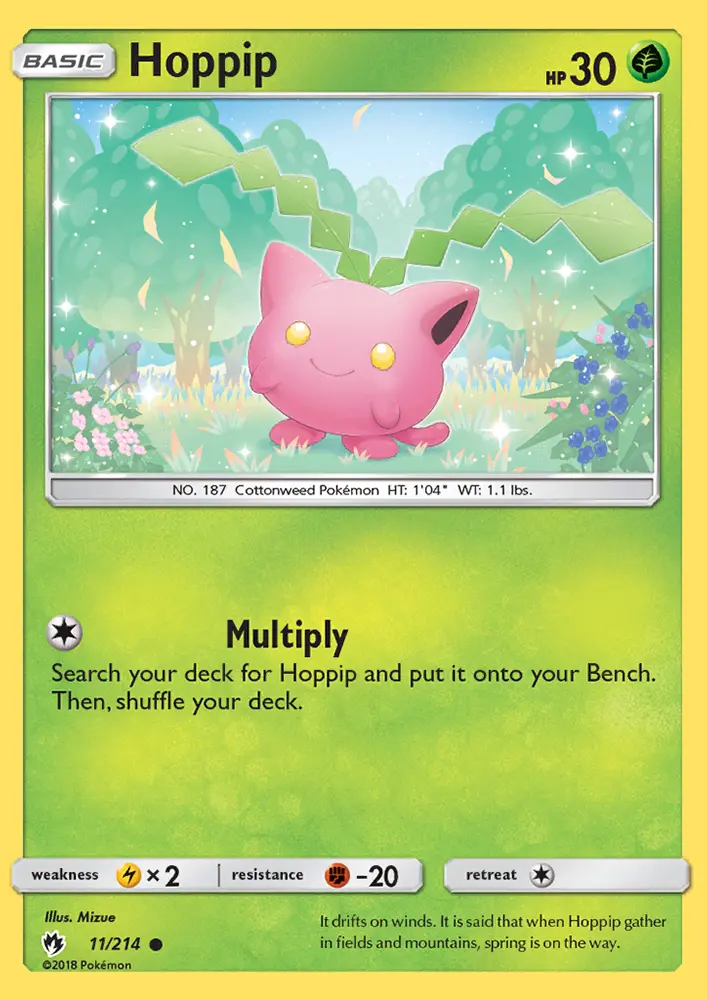
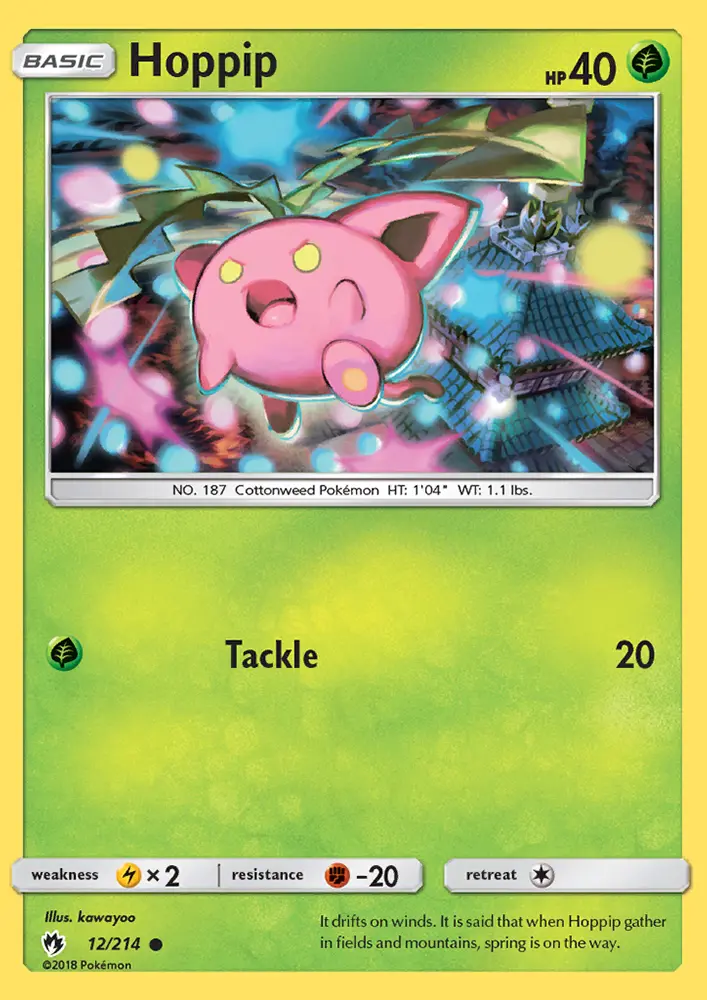
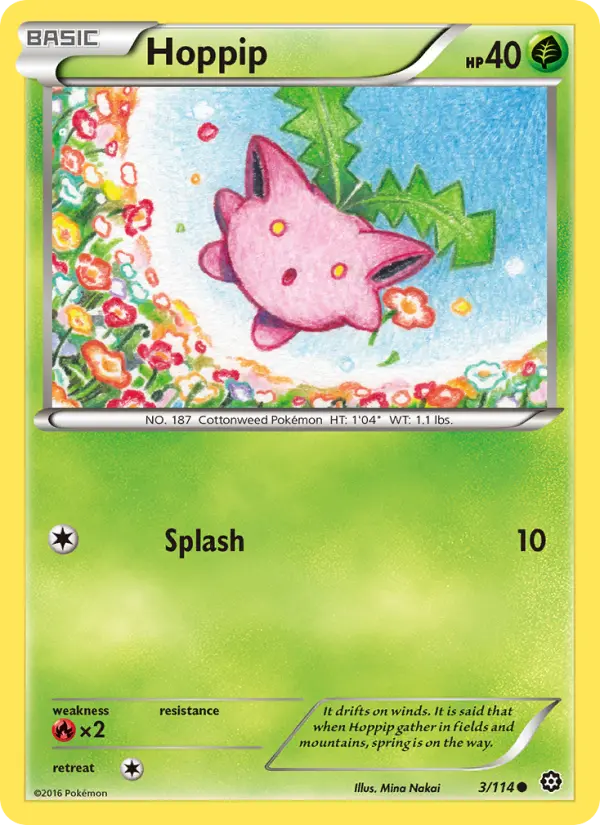
Hoppip's physiology is distinctly adapted for an aerial lifestyle, featuring an extraordinarily light body composed largely of fluffy, cotton-like tissue. Its rounded, pink form is crowned with long green leaves that sprout from the top of its head, resembling dandelion fronds with their characteristic ragged edges. The Pokémon possesses large, triangular ears with dark interiors and small, beady yellow eyes that contribute to its perpetually innocent expression. Its stubby arms and legs terminate in circular yellow pads that provide crucial grip against the ground, while a short, rounded tail completes its cherubic silhouette. Internally, Hoppip's cellular structure is remarkably porous, enabling it to achieve near-weightlessness—a biological marvel that comes with significant vulnerability to environmental forces. The species demonstrates a specialized defense mechanism wherein its leaves can physically link with those of nearby Hoppip, creating unified clusters that resist strong winds. This botanical interconnection suggests a form of chemical or tactile communication between individuals.
Pokedex Numbers
Training
Breeding
Hoppip Breeding, Gender Ratio & Egg Groups
Hoppip demonstrates a perfectly balanced gender distribution, with exactly 50% of the species being male and 50% female, allowing for straightforward breeding without complications. The species belongs to the Fairy and Plant egg groups, making it compatible with a diverse range of breeding partners across these categories. With a base friendship value of 70, Hoppip shows moderate initial affection toward trainers, suggesting a naturally cautious but not hostile temperament. The egg hatching cycle requires 20 egg cycles to complete, equivalent to approximately 4,884 to 5,140 steps of player movement, making Hoppip relatively quick to breed compared to many other Pokémon. Its medium-slow growth rate means that Hoppip and its evolutionary line reach their full potential gradually rather than explosively, rewarding patient trainers with steady, predictable development.
Sprites






TMs & HMs
tm01
lets go pikachu lets go eevee
tm02
crystal
tm02
gold silver
tm02
sword shield
tm03
yellow
tm03
crystal
tm03
gold silver
tm03
red blue
tm03
lets go pikachu lets go eevee
tm03
blue japan
tm03
red green japan
tm05
lets go pikachu lets go eevee
tm06
yellow
tm06
gold silver
tm06
red blue
tm06
crystal
tm06
emerald
tm06
firered leafgreen
tm06
diamond pearl
tm06
platinum
+573 more TMs/HMs
Hoppip's Evolution Chain


Hoppip Evolution, Mega Evolution & Special Forms
Hoppip occupies the first position in a three-stage evolutionary line culminating in the much bulkier Jumpluff. At level 18, Hoppip evolves into Skiploom, a more agile intermediate form that retains the Grass/Flying typing while gaining modest stat improvements and a more defined appearance with a single large leaf crown. The secondary evolution occurs at level 27, when Skiploom transforms into Jumpluff, achieving substantially greater size and weight while maintaining the dual typing. The progression mirrors the species' maturation from a weightless seedling to a mature dispersal unit, with each evolutionary stage representing increased structural complexity and defensive capability. Unlike many evolutionary lines, Hoppip's family does not receive form variations or mega evolutions, remaining consistent across all generations since its introduction.
Where to Find
Kanto Route 15
kanto
+33 more
Kanto Route 13
kanto
+33 more
Johto Route 33
johto
+27 more
Kanto Route 14
kanto
+11 more
Johto Route 32
johto
+15 more
Kanto Route 11
kanto
+3 more
Johto Route 29
johto
+1 more
Johto Route 30
johto
+1 more
Johto Route 31
johto
+1 more
Five Isle Meadow
kanto
+3 more
Water Labyrinth
kanto
Resort Gorgeous
kanto
Memorial Pillar
kanto
+23 more
Five Island
kanto
Sinnoh Route 205
sinnoh
+11 more
Fuego Ironworks
sinnoh
Johto Safari Zone
johto
+11 more
Johto Route 48
johto
+1 more
Hoppip Behaviour and Natural Habitat
Hoppip exhibits a fascinating dichotomy in its relationship with air currents: while it will deliberately cluster with other members of its species to withstand gale-force winds, it genuinely enjoys gentle breezes and freely drifts on favorable air movements. Its capacity for long-distance dispersal means individual Hoppip can travel vast distances, eventually settling in new territories across temperate zones. The Pokédex notes that Hoppip can be carried away on even the gentlest breeze and may float all the way to the next town—a testament to its aerodynamic design and minimal mass. This species is found exclusively in temperate regions, avoiding cold climates entirely, and thrives in diverse environments including grasslands, fields, mountains, and even urban areas. Hoppip's arrival in spring marks seasonal transitions in ecosystems, making it a reliable indicator of warming weather. The species demonstrates sophisticated sensory abilities, detecting approaching strong winds with enough advance warning to allow for defensive clustering behavior. Its clusters in fields and mountains are said to herald spring's approach, establishing Hoppip as a culturally significant seasonal marker across multiple regions.
Pokedex Entries
To keep from being blown away by the wind, they gather in clusters. They do enjoy gentle breezes, though.
Its body is so light, it must grip the ground firmly with its feet to keep from being blown away.
It can be carried away on even the gentlest breeze. It may even float all the way to the next town.
This POKéMON drifts and floats with the wind. If it senses the approach of strong winds, HOPPIP links its leaves with other HOPPIP to prepare against being blown away.
This POKéMON drifts and floats with the wind. If it senses the approach of strong winds, a HOPPIP links leaves with others to prepare against being blown away.
Its body is so light, it must grip the ground firmly with its feet to keep from being blown away.
To keep from being blown away by the wind, they gather in clusters. They do enjoy gentle breezes, though.
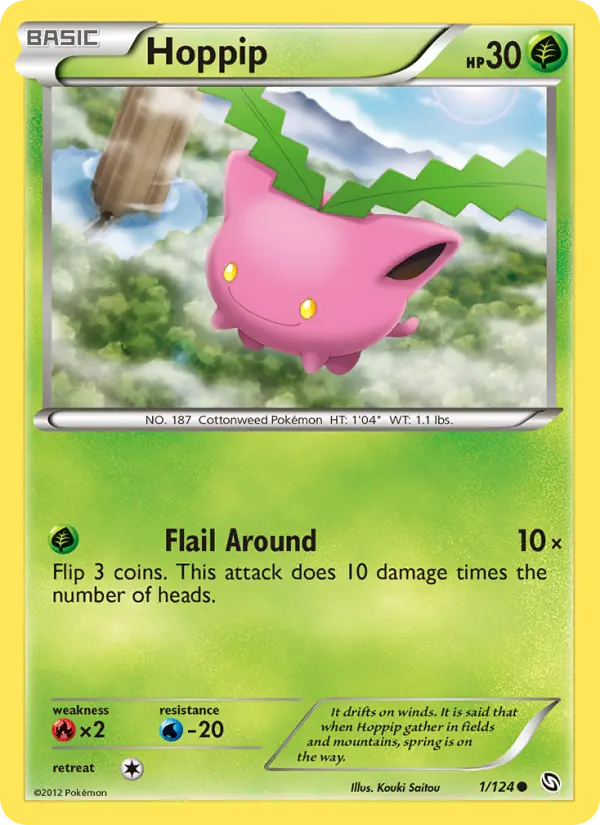
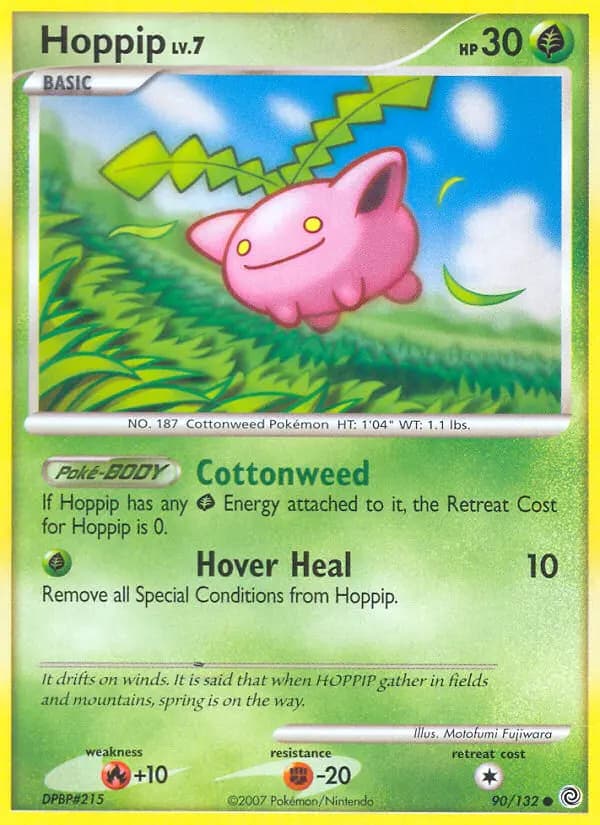
It drifts on winds. It is said that when HOPPIP gather in fields and mountains, spring is on the way.
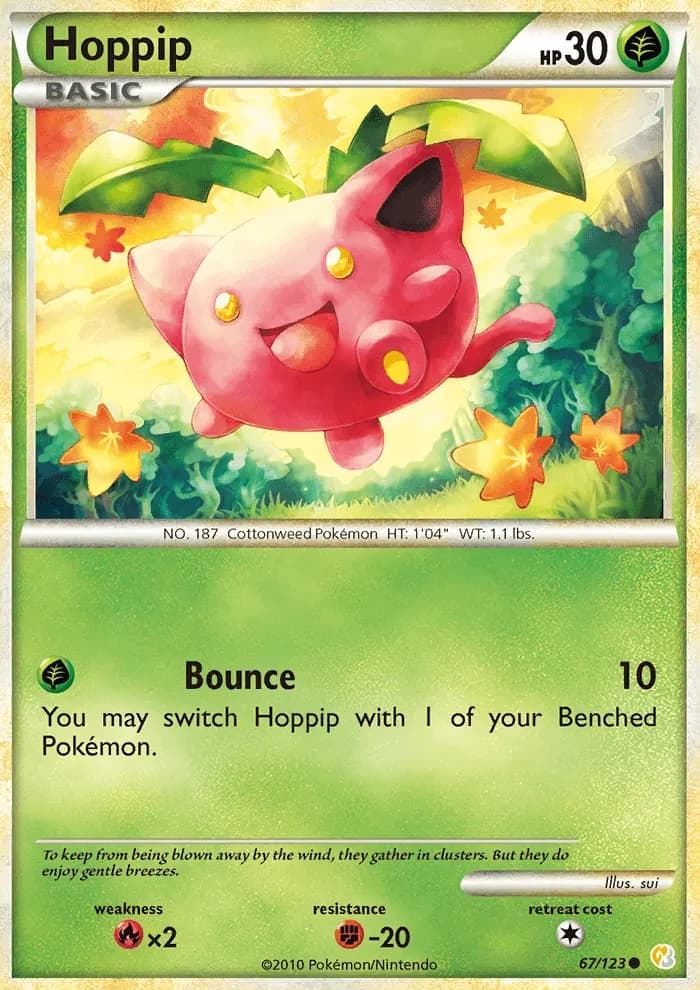
To keep from being blown away by the wind, they gather in clusters. But they do enjoy gentle breezes.
Its body is so light, it must grip the ground firmly with its feet to keep from being blown away.
It drifts on winds. It is said that when Hoppip gather in fields and mountains, spring is on the way.
It drifts on winds. It is said that when Hoppip gather in fields and mountains, spring is on the way.
Its body is so light, it must grip the ground firmly with its feet to keep from being blown away.
It drifts on winds. It is said that when Hoppip gather in fields and mountains, spring is on the way.
This Pokémon drifts and floats with the wind. If it senses the approach of strong winds, Hoppip links its leaves with other Hoppip to prepare against being blown away.
Hoppip Name Origin & Design Inspiration
Hoppip's name comes from a combination of 'hop,' referencing its bouncing movement and the hops plant, and 'pip,' commonly used for seeds or small objects. Its Japanese designation, Hanecco (ハネッコ), combines 'hane' meaning wing or feather with 'ecco,' an onomatopoeia for small, fluffy sounds. The design itself was inspired by the dandelion, specifically the delicate seed head that disperses via wind currents—a botanical parallel that explains Hoppip's aerodynamic form and leaf-crown design. The pink coloration, unusual for most grass-types, was chosen to emphasize the species' softness and approachability, distinguishing it visually from the green-dominated grass-type aesthetic. The circular yellow pads on its feet represent the adhesive properties necessary for grip, while the triangular ears enhance its cute factor while potentially serving as wind-sensitive organs in its biological design.
Learnable Moves
Hoppip can learn 83 moves:
Move | Type | Cat. | Power | Acc. | PP |
|---|---|---|---|---|---|
| absorb | grass | Special | 20 | 100 | 25 |
| acrobatics | flying | Physical | 55 | 100 | 15 |
| aerial ace | flying | Physical | 60 | — | 20 |
| amnesia | psychic | Status | — | — | 20 |
| aromatherapy | grass | Status | — | — | 5 |
| attract | normal | Status | — | 100 | 15 |
| baton pass | normal | Status | — | — | 40 |
| bounce | flying | Physical | 85 | 85 | 5 |
| bullet seed | grass | Physical | 25 | 100 | 30 |
| captivate | normal | Status | — | 100 | 20 |
| charm | fairy | Status | — | 100 | 20 |
| confide | normal | Status | — | — | 20 |
| confusion | psychic | Special | 50 | 100 | 25 |
| cotton guard | grass | Status | — | — | 10 |
| cotton spore | grass | Status | — | 100 | 40 |
| curse | ghost | Status | — | — | 10 |
| dazzling gleam | fairy | Special | 80 | 100 | 10 |
| defense curl | normal | Status | — | — | 40 |
| double team | normal | Status | — | — | 15 |
| double edge | normal | Physical | 120 | 100 | 15 |
| encore | normal | Status | — | 100 | 5 |
| endure | normal | Status | — | — | 10 |
| energy ball | grass | Special | 90 | 100 | 10 |
| facade | normal | Physical | 70 | 100 | 20 |
| fairy wind | fairy | Special | 40 | 100 | 30 |
| flash | normal | Status | — | 100 | 20 |
| fling | dark | Physical | — | 100 | 10 |
| frustration | normal | Physical | — | 100 | 20 |
| giga drain | grass | Special | 75 | 100 | 10 |
| grass knot | grass | Special | — | 100 | 20 |
| grassy terrain | grass | Status | — | — | 10 |
| growl | normal | Status | — | 100 | 40 |
| headbutt | normal | Physical | 70 | 100 | 15 |
| helping hand | normal | Status | — | — | 20 |
| hidden power | normal | Special | 60 | 100 | 15 |
| infestation | bug | Special | 20 | 100 | 20 |
| leaf storm | grass | Special | 130 | 90 | 5 |
| leech seed | grass | Status | — | 90 | 10 |
| light screen | psychic | Status | — | — | 30 |
| lunge | bug | Physical | 80 | 100 | 15 |
| magical leaf | grass | Special | 60 | — | 20 |
| mega drain | grass | Special | 40 | 100 | 15 |
| memento | dark | Status | — | 100 | 10 |
| mimic | normal | Status | — | — | 10 |
| natural gift | normal | Physical | — | 100 | 15 |
| pay day | normal | Physical | 40 | 100 | 20 |
| poison powder | poison | Status | — | 75 | 35 |
| pollen puff | bug | Special | 90 | 100 | 15 |
| protect | normal | Status | — | — | 10 |
| psych up | normal | Status | — | — | 10 |
| rage powder | bug | Status | — | — | 20 |
| rain dance | water | Status | — | — | 5 |
| reflect | psychic | Status | — | — | 20 |
| rest | psychic | Status | — | — | 5 |
| return | normal | Physical | — | 100 | 20 |
| round | normal | Special | 60 | 100 | 15 |
| secret power | normal | Physical | 70 | 100 | 20 |
| seed bomb | grass | Physical | 80 | 100 | 15 |
| silver wind | bug | Special | 60 | 100 | 5 |
| sleep powder | grass | Status | — | 75 | 15 |
| sleep talk | normal | Status | — | — | 10 |
| snore | normal | Special | 50 | 100 | 15 |
| solar beam | grass | Special | 120 | 100 | 10 |
| splash | normal | Status | — | — | 40 |
| strength sap | grass | Status | — | 100 | 10 |
| stun spore | grass | Status | — | 75 | 30 |
| substitute | normal | Status | — | — | 10 |
| sunny day | fire | Status | — | — | 5 |
| swagger | normal | Status | — | 85 | 15 |
| sweet scent | normal | Status | — | 100 | 20 |
| switcheroo | dark | Status | — | 100 | 10 |
| swords dance | normal | Status | — | — | 20 |
| synthesis | grass | Status | — | — | 5 |
| tackle | normal | Physical | 40 | 100 | 35 |
| tail whip | normal | Status | — | 100 | 30 |
| tailwind | flying | Status | — | — | 15 |
| take down | normal | Physical | 90 | 85 | 20 |
| tera blast | normal | Special | 80 | 100 | 10 |
| thief | dark | Physical | 60 | 100 | 25 |
| toxic | poison | Status | — | 90 | 10 |
| trailblaze | grass | Physical | 50 | 100 | 20 |
| u turn | bug | Physical | 70 | 100 | 20 |
| worry seed | grass | Status | — | 100 | 10 |
Hoppip Competitive Battle Guide
Hoppip's competitive viability is severely limited by its diminutive base stats, with a meager total of 250 distributed across six stats that rarely exceed 55 points. The highest stat, Special Defense at 55, provides minimal competitive advantage, while Attack and Special Attack both languish at 35, making offensive coverage virtually impossible. Its Speed stat of 50 prevents it from outspeeding most relevant threats, though its Chlorophyll ability theoretically doubles its speed in sun-based teams, raising it to 100—still mediocre by competitive standards. The Hidden Ability, Infiltrator, bypasses screens and Safeguard but provides little utility given Hoppip's inability to capitalize on such advantages offensively. Competitive trainers must evolve Hoppip to Jumpluff or use it exclusively in Little Cup formats where base stats are equalized. In Little Cup, Hoppip's dual-typing and access to Synthesis, Sleep Powder, and U-turn provide marginal utility, though faster, bulkier alternatives typically outperform it. The species serves primarily as a Pokédex entry rather than a viable competitive participant.
Commonly Asked Questions About Hoppip
What type is Hoppip?
Hoppip is a grass and flying type Pokemon.
What does Hoppip evolve into?
Hoppip evolves into skiploom, then into jumpluff.
What are Hoppip's weaknesses?
Hoppip is weak to flying, poison, rock, fire and ice type moves.
Does Hoppip evolve by trading?
No — Hoppip evolves entirely through leveling up, with no trade required at any stage.
Where can I find Hoppip?
Hoppip can be found in kanto route 15 (kanto), kanto route 13 (kanto) and johto route 33 (johto) and 15 other locations.
Hoppip Cultural Impact & Franchise History
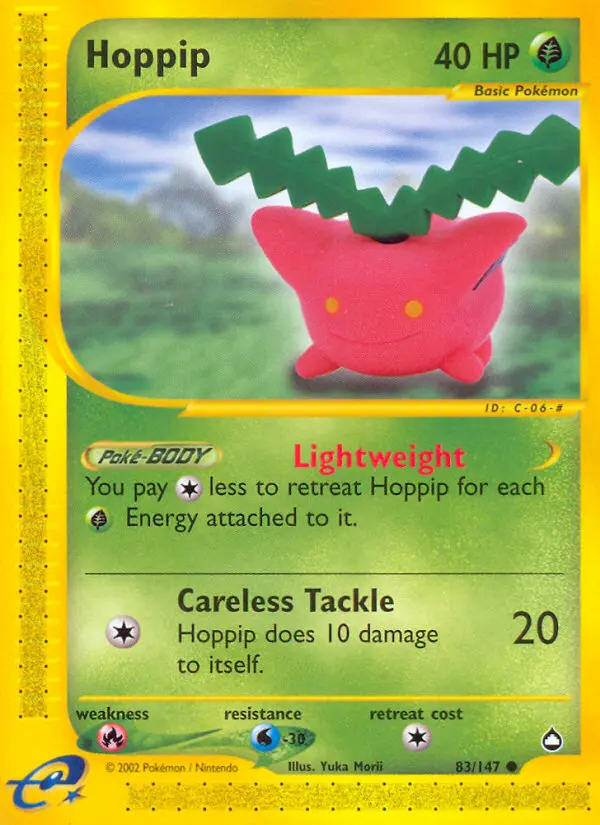
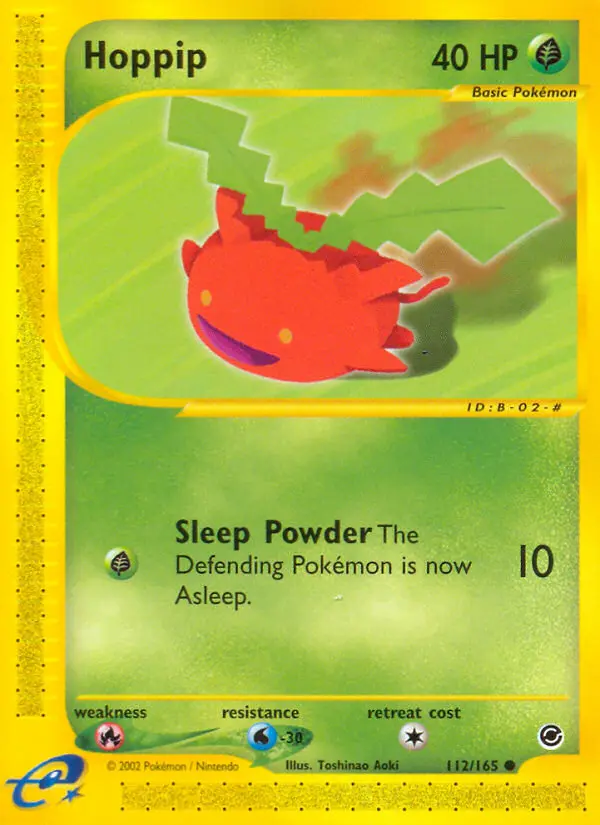
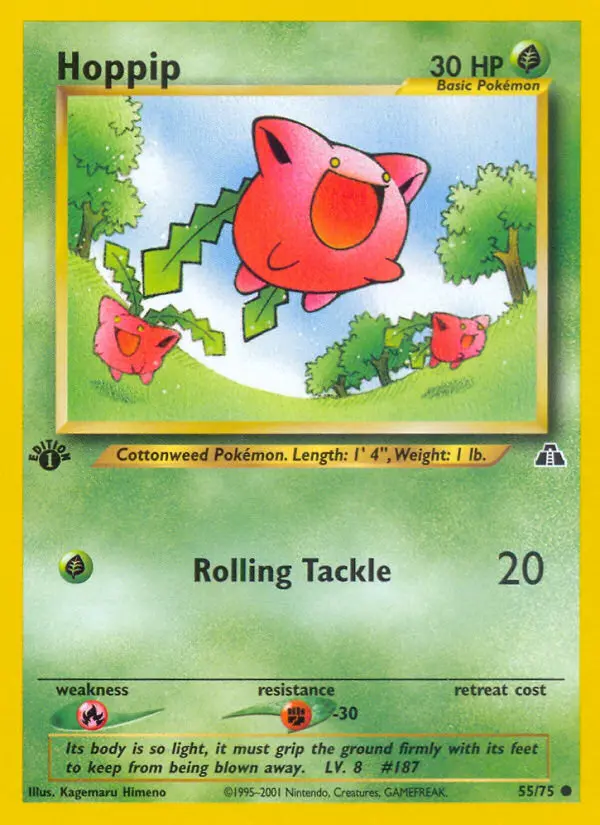
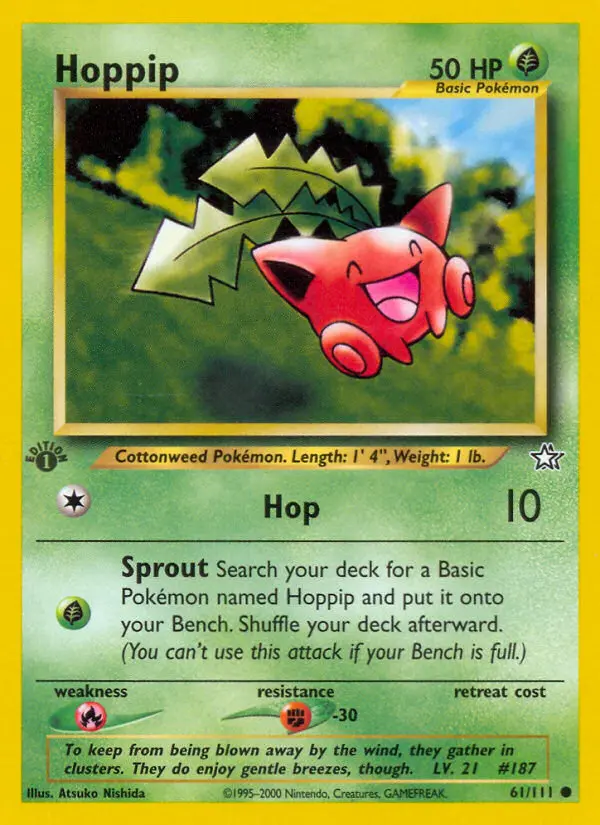
Despite its minimal competitive presence, Hoppip occupies a cherished position in Pokémon culture as an iconic early-game Johto region encounter. Its appearance in Pokémon Gold and Silver versions established it as a generational ambassador for the Grass/Flying dual-type, preceding the more prominent Jumpluff. The species has maintained consistent presence across anime adaptations, appearing in multiple episodes of the Pokémon animated series and trading card game releases. Its design has influenced subsequent grass-type Pokémon aesthetics, particularly regarding the use of botanical elements combined with wind-based mechanics. The Pokédex's poetic descriptions of Hoppip's seasonal arrival have elevated it to symbolic status in fan communities, where it represents renewal and spring transitions. Gaming communities frequently discuss Hoppip as a prime example of deliberate power scaling within evolutionary lines, where the base form is intentionally weak to incentivize progression. Fan art communities celebrate Hoppip's adorable design, generating consistent creative output across decades.
Where to Find Hoppip in Every Pokémon Game
Hoppip enjoys remarkably broad availability across Pokémon game titles, appearing in virtually every mainline generation since Generation II. It can be encountered in the wild throughout Johto in Gold/Silver/Crystal and HeartGold/SoulSilver versions, typically in early-game grass areas where trainers first assemble their teams. The species appears in various routes across Kanto, Hoenn, Sinnoh, and other regions, ensuring accessibility for players seeking to complete their Pokédex entries. In more recent generations, including Scarlet and Violet, Hoppip maintains availability, though often as a lower-level encounter in specific biomes. Its exceptionally high catch rate of 255 means that even standard Poké Balls capture it with near-guaranteed success, eliminating the frustration often associated with early-game catching. Additionally, Hoppip is available through breeding if players already possess Skiploom or Jumpluff, providing an alternative acquisition method for completionists. Its universal compatibility with Fairy and Plant egg groups further facilitates breeding-based acquisition strategies across diverse trainer teams.