Jumpluff
Generation II · #0189 — Cottonweed Pokémon
At 0.8 m and 3 kg, Jumpluff doesn't look like much on paper, but its chlorophyll ability shapes how it actually plays more than its size suggests. Its National Pokédex number is #189, and it weighs just 3.0 kilograms while standing 0.8 meters tall, making it one of the lighter flying Pokémon available. Jumpluff represents the culmination of a three-stage evolution that begins with the humble Hoppip, with Skiploom serving as the intermediate stage.
Editor's Take
Jumpluff has 110 base Speed, no offensive stats worth mentioning, and a status movepool that has kept it usable in lower tiers for two decades — a Pokémon that wins by being irritating.
Base Stats
Height
0.8m
Weight
3.0kg
Category
Cottonweed Pokémon
Gender
Male 50% / Female 50%
Color
blue
Shape
upright
Habitat
grassland
Abilities
Doubles Speed during strong sunlight.
Protects against major status ailments during strong sunlight.
Bypasses light screen, reflect, and safeguard.

Jumpluff Biology & Physical Characteristics
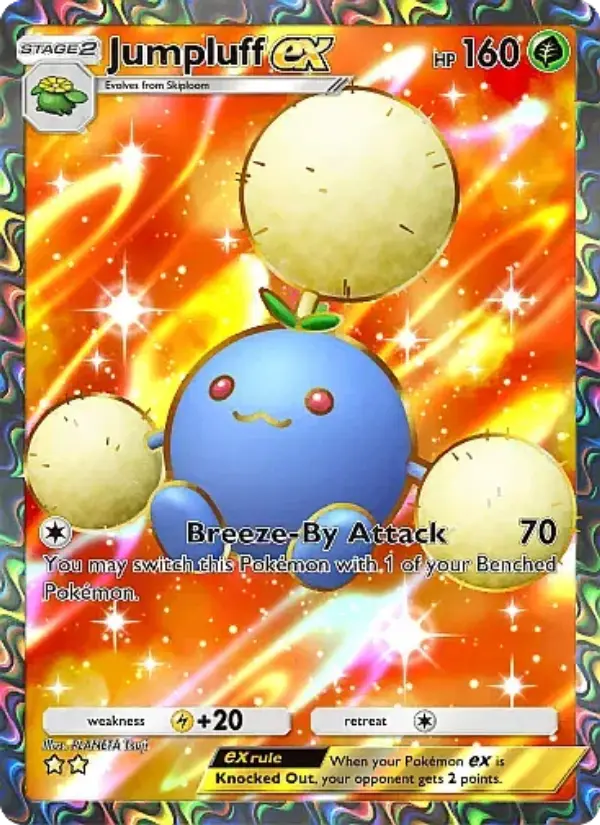
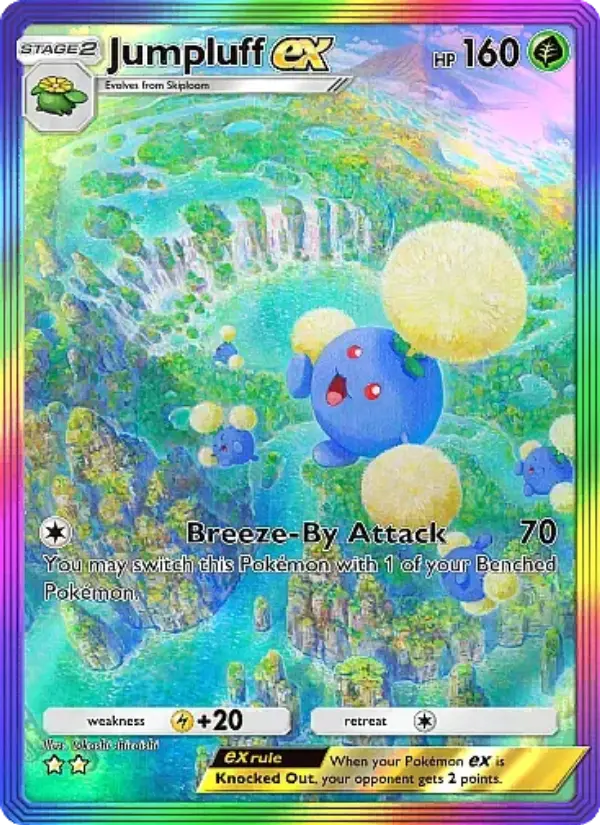
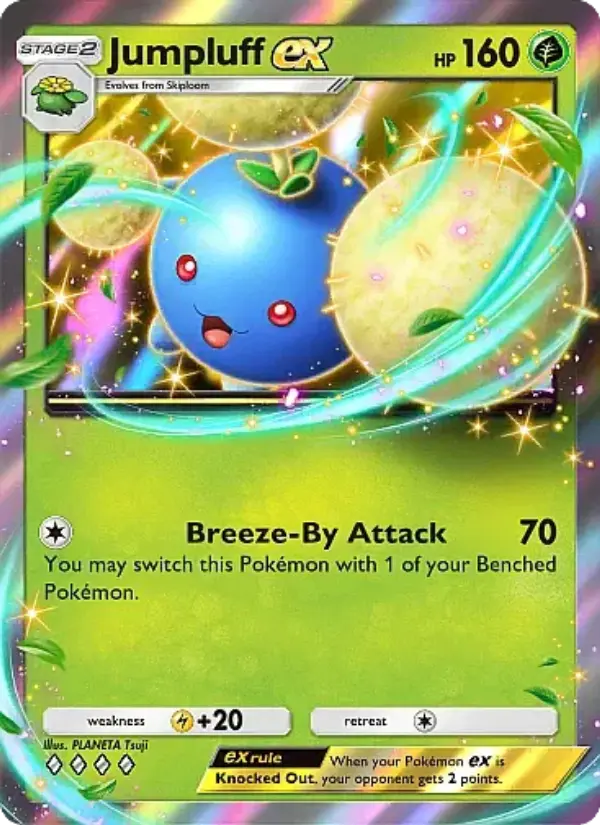
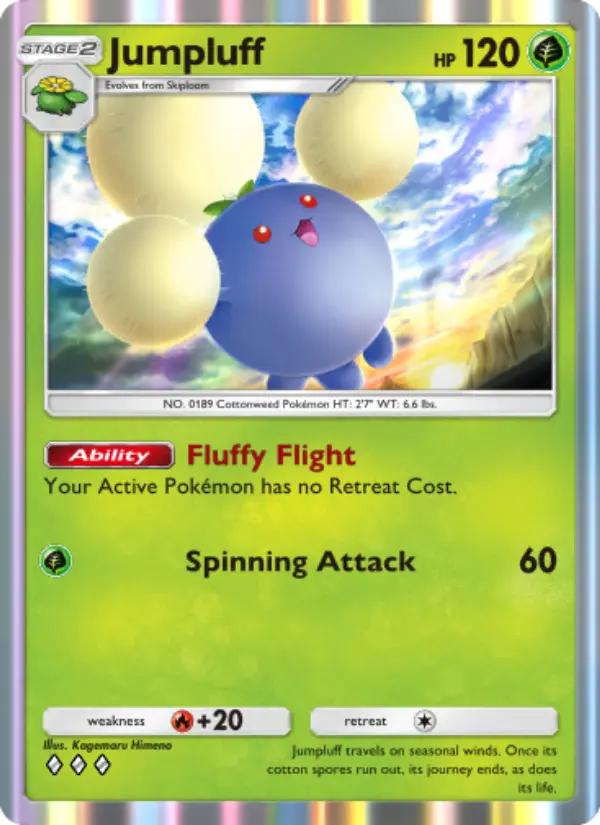
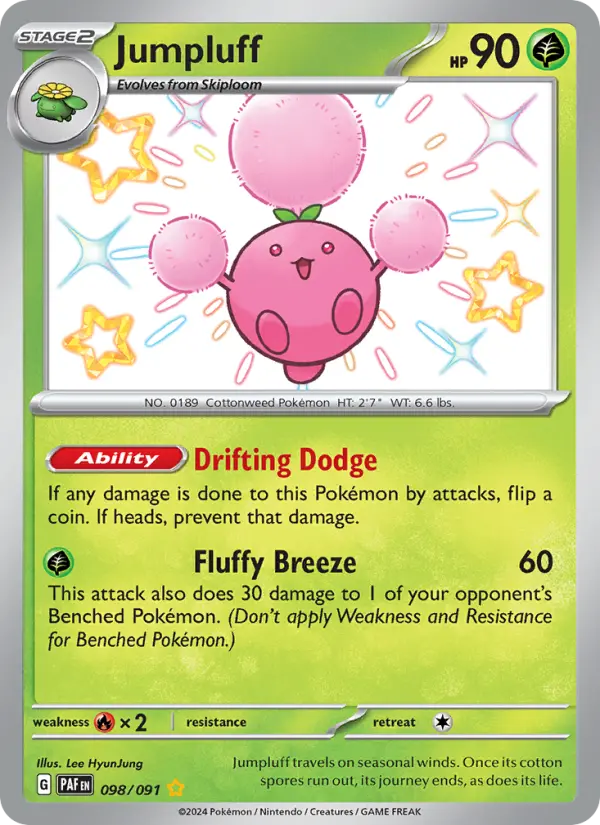
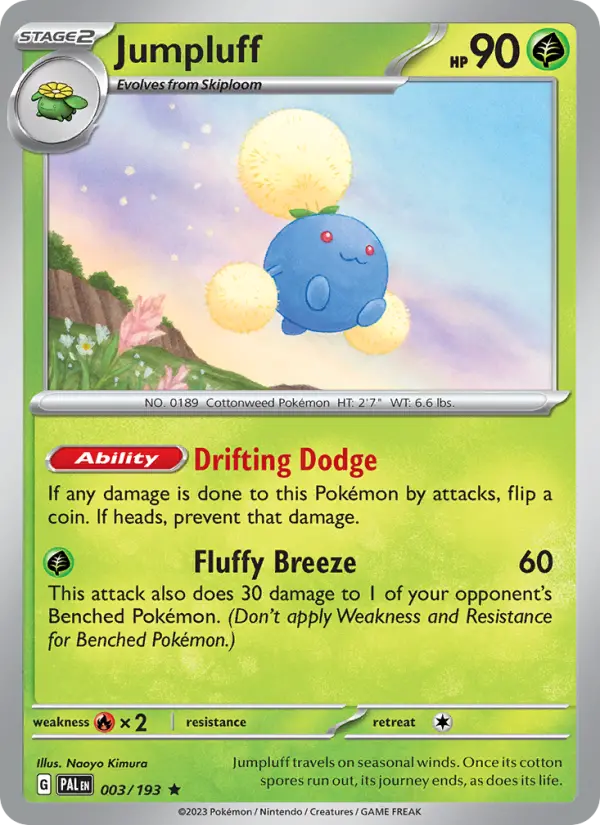
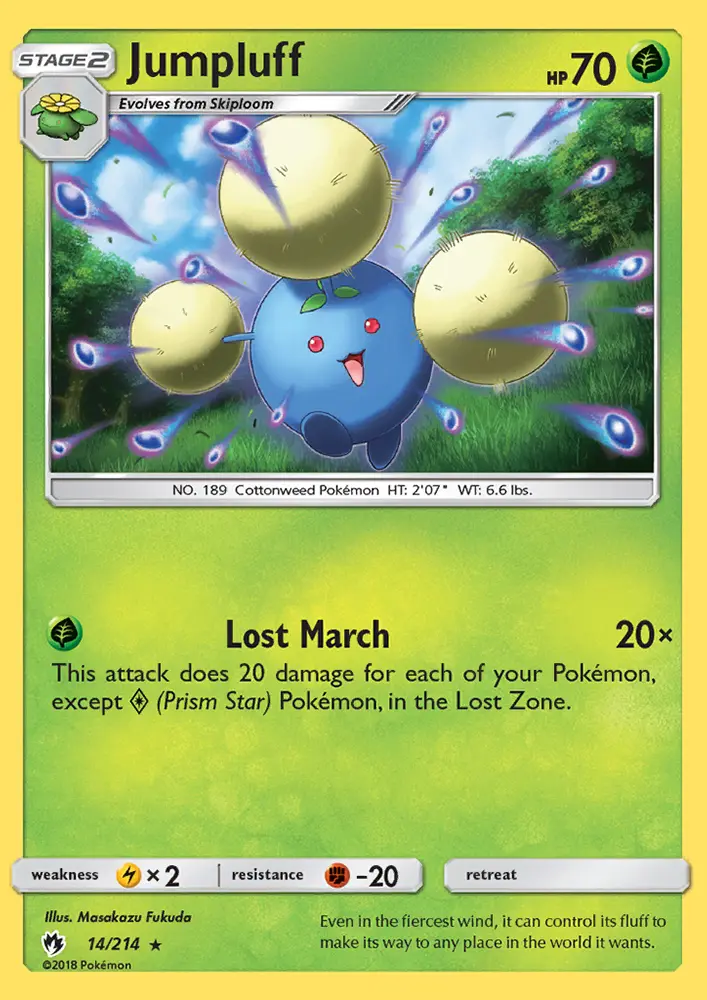
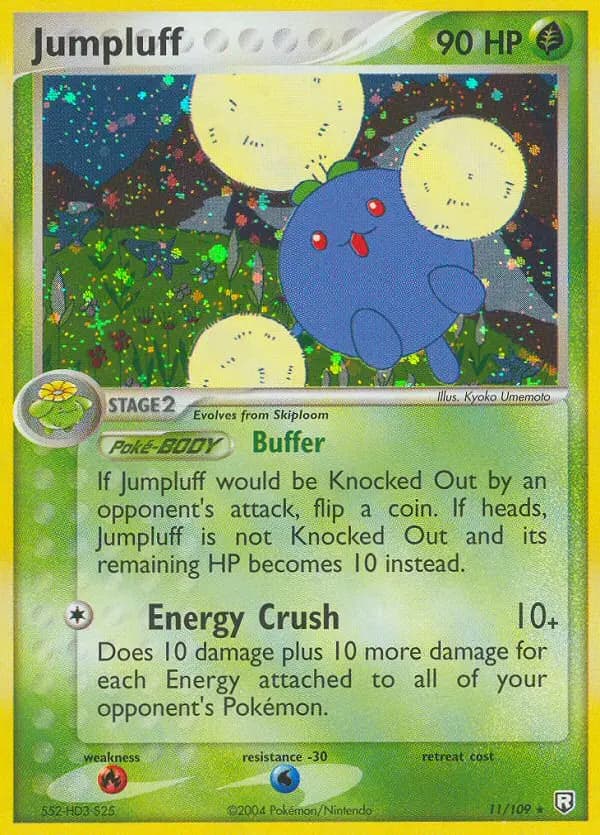
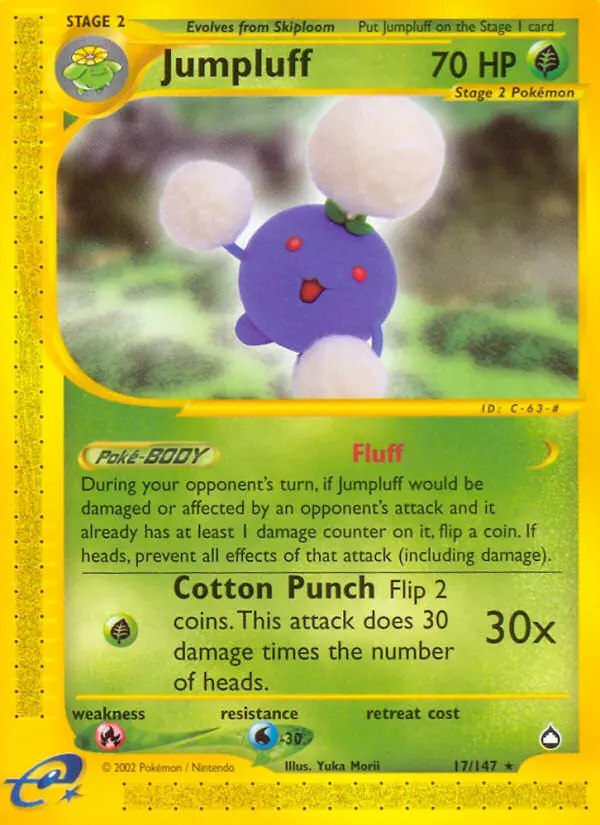
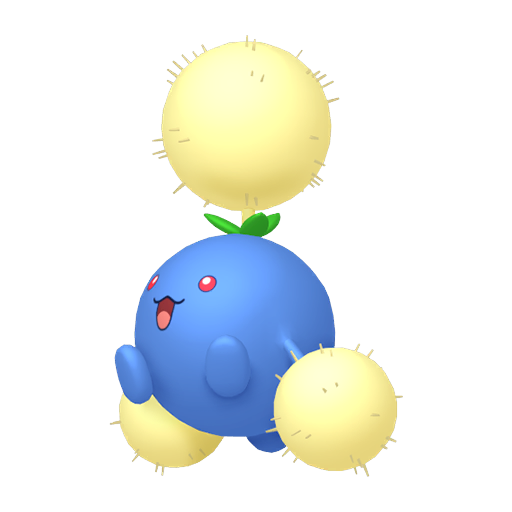
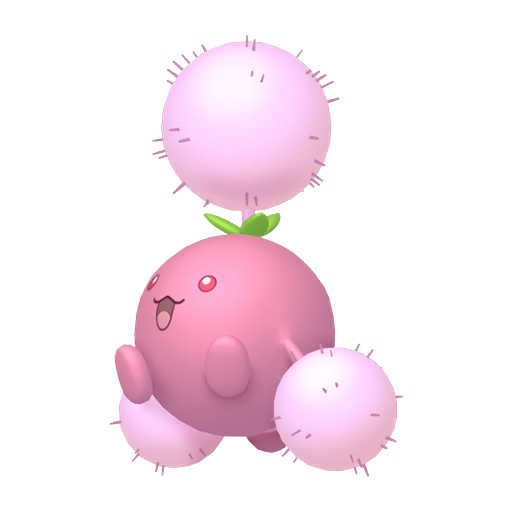
Jumpluff is a round, blue plant Pokémon characterized by its distinctive cotton puff structures—one crowning its head and one attached to each arm, nearly as large as its entire body. These three fluffy appendages are the source of Jumpluff's most defining biological feature: cotton spores that it uses for both locomotion and reproduction. The Pokémon possesses small, round feet, a tail, and red, pupilless beady eyes that give it an endearing appearance. At the base of the top cotton puff, three to four leaves naturally emerge, reinforcing its plant-based nature. These cotton puffs aren't merely decorative; they represent Jumpluff's primary means of survival and propagation. The spores themselves can induce coughing and itchiness in those who inhale them, suggesting they contain potent biological compounds. Once Jumpluff depletes its cotton spore reserves, ancient Pokédex entries suggest its life journey effectively reaches its conclusion, making spore production essential to the species' existence.
Pokedex Numbers
Training
Breeding
Jumpluff Breeding, Gender Ratio & Egg Groups
Jumpluff has one of the simplest gender ratios in the game — a flat 50/50, ensuring equal breeding opportunities regardless of the captured specimen's gender. The species belongs to both the Fairy and Grass egg groups, making it compatible with a wide range of Pokémon for breeding purposes. This dual egg group membership is unusual for Grass-type Pokémon and expands the genetic diversity possible within breeding chains. With a base happiness value of 70, Jumpluff shows moderate friendliness to trainers from capture, though it doesn't achieve the higher friendship values of some companion-focused Pokémon. The species follows a medium-slow growth rate, meaning it requires a moderate amount of experience points to reach higher levels compared to fast-growing species. Eggs take 20 cycles to hatch, translating to approximately 4,884 to 5,140 steps of travel while carrying the egg. The breeding mechanics for Jumpluff make it an accessible option for breeders seeking Grass-type Pokémon with Fairy-type compatibility, opening interesting movepool possibilities through cross-generational breeding combinations.
Sprites




TMs & HMs
tm01
lets go pikachu lets go eevee
tm02
crystal
tm02
gold silver
tm03
yellow
tm03
crystal
tm03
gold silver
tm03
red blue
tm03
lets go pikachu lets go eevee
tm03
blue japan
tm03
red green japan
tm05
lets go pikachu lets go eevee
tm06
yellow
tm06
gold silver
tm06
red blue
tm06
crystal
tm06
emerald
tm06
firered leafgreen
tm06
diamond pearl
tm06
platinum
tm06
ruby sapphire
+601 more TMs/HMs
Jumpluff's Evolution Chain


Jumpluff Evolution, Mega Evolution & Special Forms
Jumpluff is the final evolutionary form of Hoppip, a three-stage Grass and Flying-type evolutionary line that occurs through leveling. The evolution begins when Hoppip reaches level 18 and transforms into Skiploom, gaining slight increases to its stats and physical development. When Skiploom reaches level 27, it evolves into Jumpluff, the fully mature form that best represents the species' aerial capabilities and botanical nature. This evolution marks significant increases in Special Defense and Speed, the two statistics that define Jumpluff's competitive identity. The transition from Skiploom to Jumpluff involves the full development of its characteristic cotton puffs and represents the Pokémon's transformation from a young flyer into a capable global wanderer. Unlike many evolutionary lines, Jumpluff gains minimal changes in base stat distribution upon evolution, with most of the line's power stemming from its dual Grass and Flying typing rather than dramatic numerical improvements. Jumpluff does not have a Mega Evolution or Gigantamax form, keeping it grounded as a classic Generation II Pokémon without modern evolutionary gimmicks.
Where to Find
Location data not available for this Pokémon in the database.
Jumpluff Behaviour and Natural Habitat
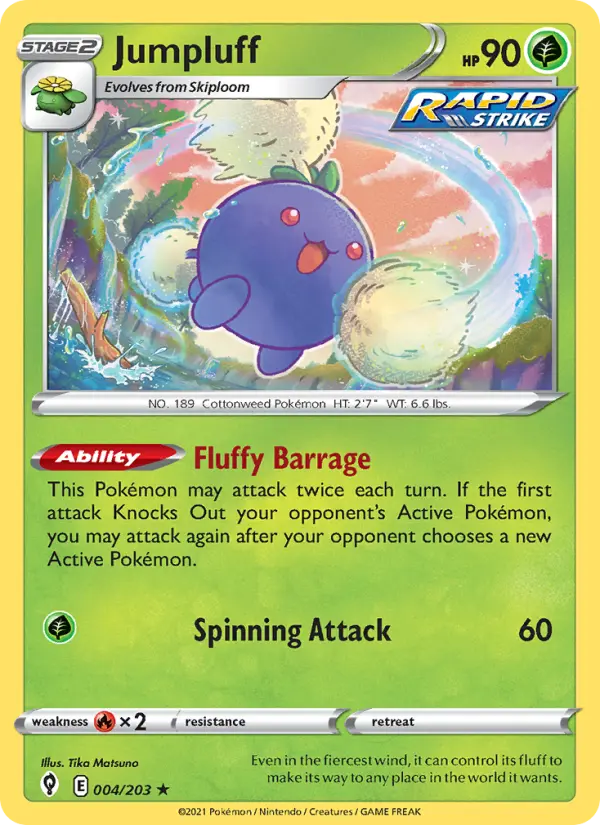
Jumpluff displays remarkable behavioral adaptability, demonstrating the ability to control its flight with precision that defies logic. According to multiple Pokédex entries, even in the fiercest winds, it can manipulate its cotton-puff spores to navigate precisely to any desired location in the world. The Pokémon rides warm southern winds to cross vast oceans and journey to foreign lands, yet it possesses the intelligence to descend when encountering cold air currents during flight. This seasonal migration pattern allows Jumpluff to spread its cotton-like spores across the globe, functioning simultaneously as a means of reproduction and colonization. The species is commonly sighted above open temperate grasslands, where it drifts leisurely on seasonal breezes. Jumpluff's behavior reflects an elegant balance between passive wind-riding and active directional control, making it one of nature's most efficient dispersal mechanisms. Its spore-spreading serves a dual ecological purpose: ensuring the continuation of its own species while potentially creating new Hoppip populations across diverse geographical regions.
Pokedex Entries
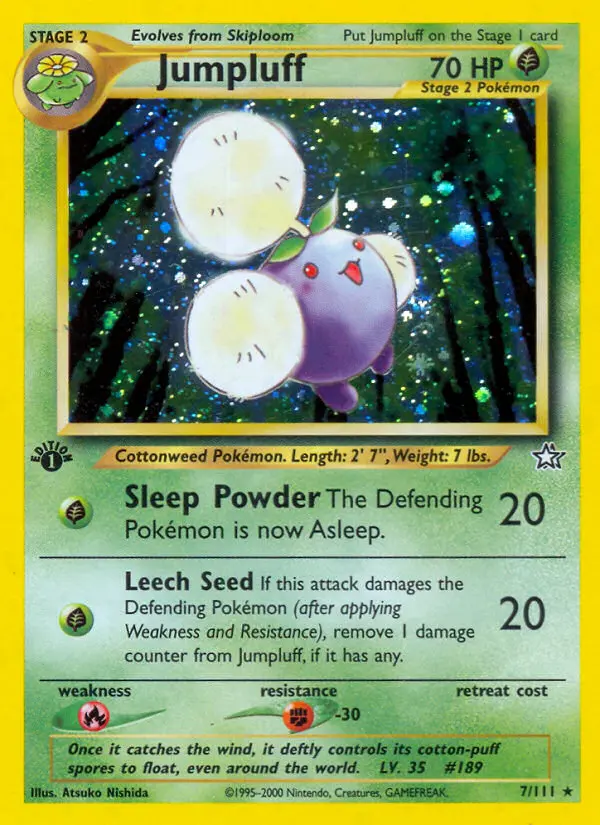
Once it catches the wind, it deft ly controls its cotton-puff spores to float, even around the world.
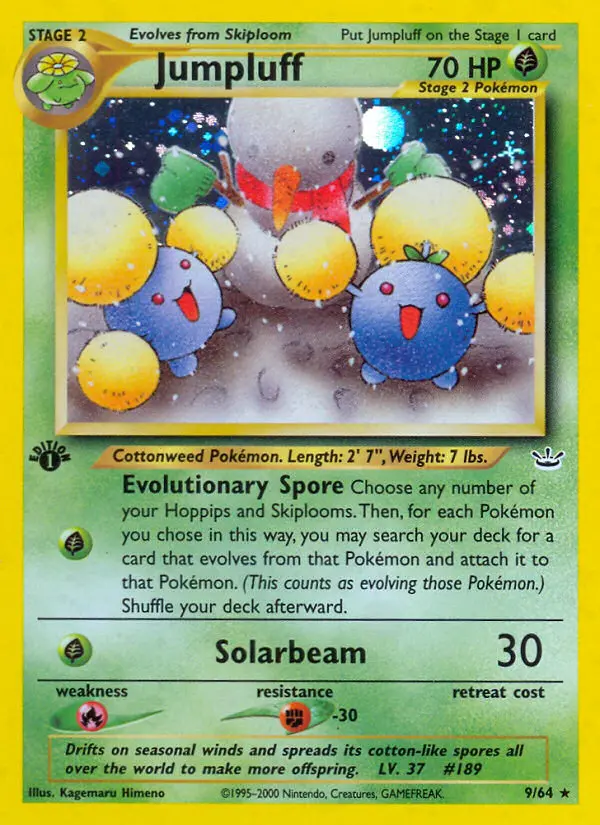
Drifts on seasonal winds and spreads its cotton-like spores all over the world to make more offspring.
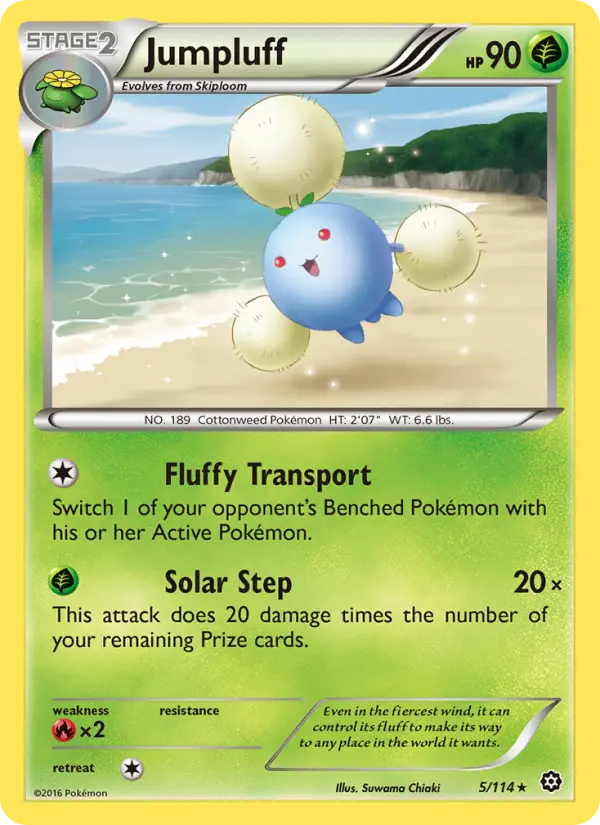
Even in the fierc est wind, it can control its fluff to make its way to any place in the world it wants.
JUMPLUFF rides warm southern winds to cross the sea and fly to foreign lands. The POKéMON descends to the ground when it encounters cold air while it is floating.
JUMPLUFF ride warm southern winds to cross the sea and fly to foreign lands. This POKéMON lands when it encounters cold air while it is floating.
It drifts on seasonal winds and spreads its cotton-like spores all over the world to make more offspring.
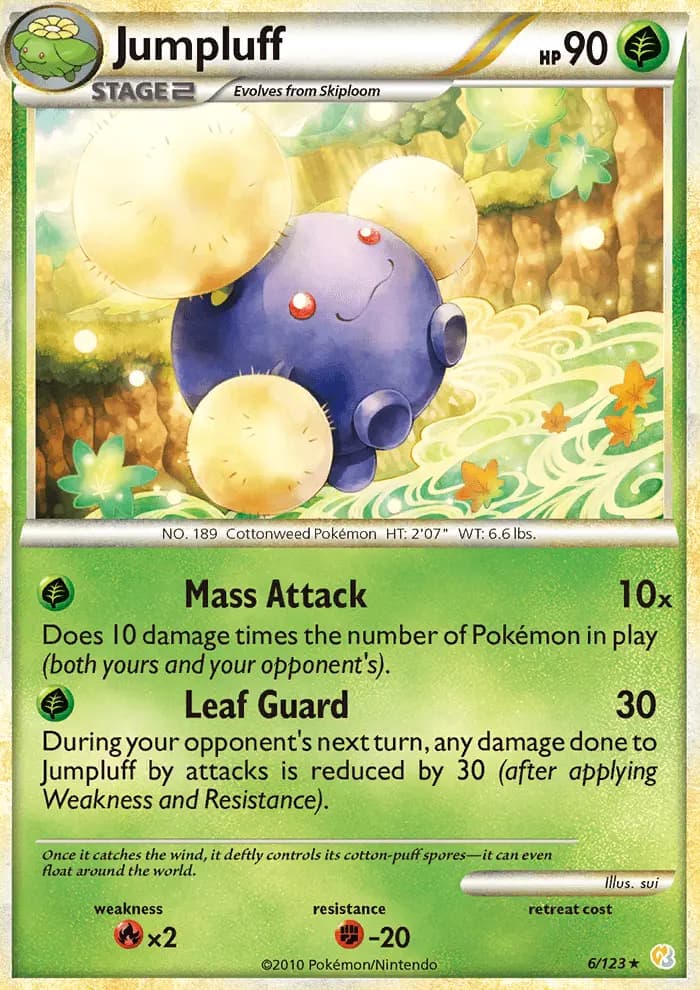
Once it catches the wind, it deftly controls its cotton-puff spores to float, even around the world.
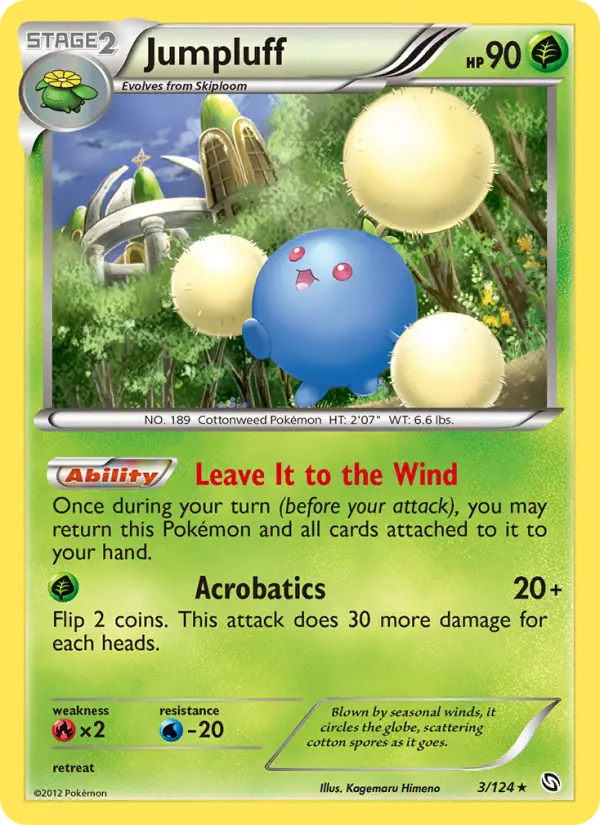
Blown by seasonal winds, it circles the globe, scattering cotton spores as it goes.
Once it catches the wind, it deftly controls its cotton-puff spores-- it can even float around the world.
Drifts on seasonal winds and spreads its cotton-like spores all over the world to make more offspring.
Blown by seasonal winds, it circles the globe, scattering cotton spores as it goes.
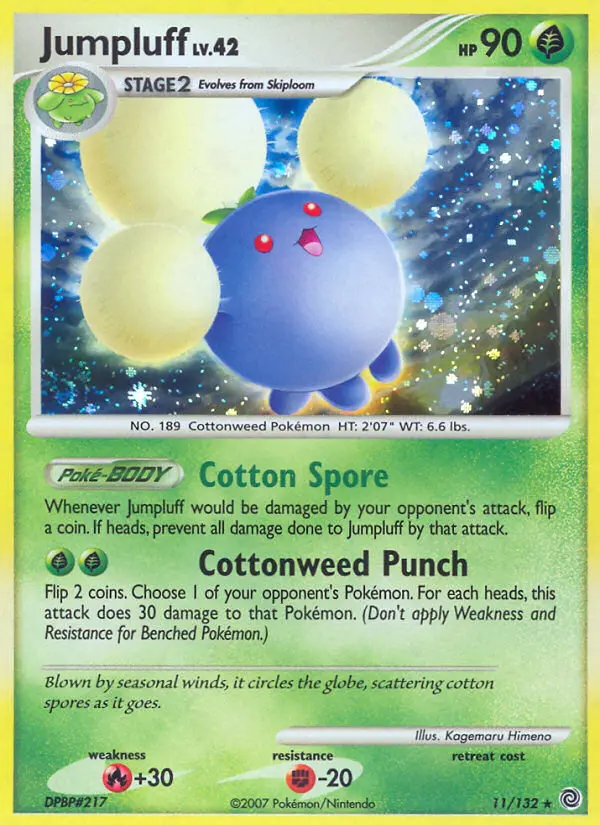
Blown by seasonal winds, it circles the globe, scattering cotton spores as it goes.
Blown by seasonal winds, it circles the globe, scattering cotton spores as it goes.
Even in the fiercest wind, it can control its fluff to make its way to any place in the world it wants.
Jumpluff rides warm southern winds to cross the sea and fly to foreign lands. The Pokémon descends to the ground when it encounters cold air while it is floating.
Jumpluff Name Origin & Design Inspiration
Jumpluff's name can be traced to a combination of 'jump' and 'fluff,' emphasizing both its lightweight, fluffy appearance and its bouncing motion as it floats through the air. The Japanese name, Watacco, comes from 'wata' meaning cotton and 'tako' meaning octopus, referencing the cotton puff appendages that resemble tentacles. The Pokémon's design draws clear inspiration from dandelion seeds and milkweed pods, natural plant structures that utilize wind dispersal for propagation. This botanical inspiration manifests perfectly in Jumpluff's three cotton puffs and its behavior of riding seasonal winds across continents. The color scheme—a predominantly blue body contrasted with the white cotton puffs—creates striking visual contrast while maintaining the friendly, approachable aesthetic established by Hoppip. The small round feet and beady eyes enhance its cuteness factor despite its status as a mature evolutionary form. Its genus as the Cottonweed Pokémon directly references the cotton-like spores it produces, grounding its design in real-world botanical terminology and making its ecological role immediately apparent to trainers encountering it.
Learnable Moves
Jumpluff can learn 78 moves:
Move | Type | Cat. | Power | Acc. | PP |
|---|---|---|---|---|---|
| absorb | grass | Special | 20 | 100 | 25 |
| acrobatics | flying | Physical | 55 | 100 | 15 |
| aerial ace | flying | Physical | 60 | — | 20 |
| attract | normal | Status | — | 100 | 15 |
| baton pass | normal | Status | — | — | 40 |
| bounce | flying | Physical | 85 | 85 | 5 |
| bullet seed | grass | Physical | 25 | 100 | 30 |
| captivate | normal | Status | — | 100 | 20 |
| charm | fairy | Status | — | 100 | 20 |
| confide | normal | Status | — | — | 20 |
| cotton spore | grass | Status | — | 100 | 40 |
| curse | ghost | Status | — | — | 10 |
| dazzling gleam | fairy | Special | 80 | 100 | 10 |
| defense curl | normal | Status | — | — | 40 |
| double team | normal | Status | — | — | 15 |
| double edge | normal | Physical | 120 | 100 | 15 |
| encore | normal | Status | — | 100 | 5 |
| endeavor | normal | Physical | — | 100 | 5 |
| endure | normal | Status | — | — | 10 |
| energy ball | grass | Special | 90 | 100 | 10 |
| facade | normal | Physical | 70 | 100 | 20 |
| fairy wind | fairy | Special | 40 | 100 | 30 |
| flash | normal | Status | — | 100 | 20 |
| fling | dark | Physical | — | 100 | 10 |
| frustration | normal | Physical | — | 100 | 20 |
| giga drain | grass | Special | 75 | 100 | 10 |
| giga impact | normal | Physical | 150 | 90 | 5 |
| grass knot | grass | Special | — | 100 | 20 |
| grassy terrain | grass | Status | — | — | 10 |
| headbutt | normal | Physical | 70 | 100 | 15 |
| helping hand | normal | Status | — | — | 20 |
| hidden power | normal | Special | 60 | 100 | 15 |
| hyper beam | normal | Special | 150 | 90 | 5 |
| infestation | bug | Special | 20 | 100 | 20 |
| leaf storm | grass | Special | 130 | 90 | 5 |
| leech seed | grass | Status | — | 90 | 10 |
| light screen | psychic | Status | — | — | 30 |
| lunge | bug | Physical | 80 | 100 | 15 |
| magical leaf | grass | Special | 60 | — | 20 |
| mega drain | grass | Special | 40 | 100 | 15 |
| memento | dark | Status | — | 100 | 10 |
| mimic | normal | Status | — | — | 10 |
| natural gift | normal | Physical | — | 100 | 15 |
| poison powder | poison | Status | — | 75 | 35 |
| pollen puff | bug | Special | 90 | 100 | 15 |
| protect | normal | Status | — | — | 10 |
| psych up | normal | Status | — | — | 10 |
| rage powder | bug | Status | — | — | 20 |
| rain dance | water | Status | — | — | 5 |
| reflect | psychic | Status | — | — | 20 |
| rest | psychic | Status | — | — | 5 |
| return | normal | Physical | — | 100 | 20 |
| round | normal | Special | 60 | 100 | 15 |
| secret power | normal | Physical | 70 | 100 | 20 |
| seed bomb | grass | Physical | 80 | 100 | 15 |
| silver wind | bug | Special | 60 | 100 | 5 |
| sleep powder | grass | Status | — | 75 | 15 |
| sleep talk | normal | Status | — | — | 10 |
| snore | normal | Special | 50 | 100 | 15 |
| solar beam | grass | Special | 120 | 100 | 10 |
| splash | normal | Status | — | — | 40 |
| stun spore | grass | Status | — | 75 | 30 |
| substitute | normal | Status | — | — | 10 |
| sunny day | fire | Status | — | — | 5 |
| swagger | normal | Status | — | 85 | 15 |
| sweet scent | normal | Status | — | 100 | 20 |
| swords dance | normal | Status | — | — | 20 |
| synthesis | grass | Status | — | — | 5 |
| tackle | normal | Physical | 40 | 100 | 35 |
| tail whip | normal | Status | — | 100 | 30 |
| tailwind | flying | Status | — | — | 15 |
| take down | normal | Physical | 90 | 85 | 20 |
| tera blast | normal | Special | 80 | 100 | 10 |
| thief | dark | Physical | 60 | 100 | 25 |
| toxic | poison | Status | — | 90 | 10 |
| trailblaze | grass | Physical | 50 | 100 | 20 |
| u turn | bug | Physical | 70 | 100 | 20 |
| worry seed | grass | Status | — | 100 | 10 |
Jumpluff Competitive Battle Guide
Assessing its battle viability, Jumpluff serves as a niche Grass-type option that capitalizes on its exceptional Speed stat of 110 and special defensive capabilities with a base Special Defense of 95. Its ability Chlorophyll provides tremendous utility in sun-based team compositions, doubling its Speed during sunny weather and transforming it into a formidable physical threat on sun teams. Leaf Guard serves as an alternative ability, protecting Jumpluff from major status ailments during strong sunlight, offering defensive utility for stall-based strategies. The hidden ability Infiltrator bypasses defensive screens like Light Screen, Reflect, and Safeguard, allowing it to pressure defensive teams that would otherwise wall traditional Grass-types. With relatively modest offensive stats of 55 in both Attack and Special Attack, Jumpluff relies heavily on its speed advantage to function rather than raw damage output. It learns a respectable movepool including Grass-type moves, Flying-type coverage, and utility options through leveling and TM tuition. Jumpluff's success in competitive formats depends entirely on team support—specifically weather setters and synergistic teammates that benefit from its speed control and ability to break defensive walls. While it never reaches the competitive tiers of stronger Grass-types, dedicated players appreciate its role as a fast, special-defense-oriented team member that functions optimally in specialized sun-based team architectures.
Commonly Asked Questions About Jumpluff
What type is Jumpluff?
Jumpluff is a grass and flying type Pokemon.
What does Jumpluff evolve from?
Jumpluff evolved from skiploom that evolved from hoppip.
What are Jumpluff's weaknesses?
Jumpluff is weak to flying, poison, rock, fire and ice type moves.
Jumpluff Cultural Impact & Franchise History
Jumpluff occupies a cherished but understated position in Pokémon culture as a beloved Generation II Pokémon that represents the franchise's commitment to diverse creature designs inspired by nature. The species gained particular recognition through its appearance in the Pokémon anime, where it often appears in episodes focusing on nature and ecology, reinforcing its real-world botanical inspiration. Trainers frequently cite Jumpluff as a personal favorite for its adorable design and endearing personality, despite its competitive limitations. The Pokémon has maintained consistent popularity across multiple generations, appearing in spin-off games, merchandise, and collectible card games. Its design has inspired fan art and creative interpretations that celebrate its cotton-puff aesthetic and global traveling nature. The species represents an important milestone for players progressing through Johto-region games, serving as both a viable team member during gameplay and a nostalgic touchstone for long-time fans. While Jumpluff never achieved the mainstream recognition of iconic Pokémon like Pikachu or Charizard, it maintains a dedicated fanbase that appreciates its unique niche as a charming, nature-inspired creature that embodies the wonder of biological dispersal mechanisms.
Where to Find Jumpluff in Every Pokémon Game
Jumpluff can be obtained primarily by evolving Skiploom at level 27, requiring players to first capture a Hoppip and raise it through its evolutionary line. In the original Generation II games (Gold, Silver, and Crystal), Hoppip appears in early-game routes, making the entire line readily available to players in Johto. The remakes HeartGold and SoulSilver maintained this availability, allowing modern players to experience the traditional Johto breeding of Jumpluff. In Generation III's Ruby and Sapphire, Hoppip can be found in specific routes, continuing the line's accessibility across regions. Subsequent generations have included Jumpluff in regional Pokédexes and wild encounters, though availability varies by game. Pokémon X and Y feature Jumpluff in the Central Kalos Pokédex as entry #0137, accessible to players seeking Grass-type coverage during their adventure. More recently, Scarlet and Violet include Jumpluff with a local Pokédex number of #0018, incorporating it into modern gameplay experiences. Players can also obtain Jumpluff through breeding mechanics, trading with other trainers, or in some cases through special in-game distributions and events. The species' consistent availability across generations demonstrates Pokémon's commitment to maintaining classic Pokédex entries, ensuring new players can always experience the Hoppip evolution line regardless of their preferred game title.