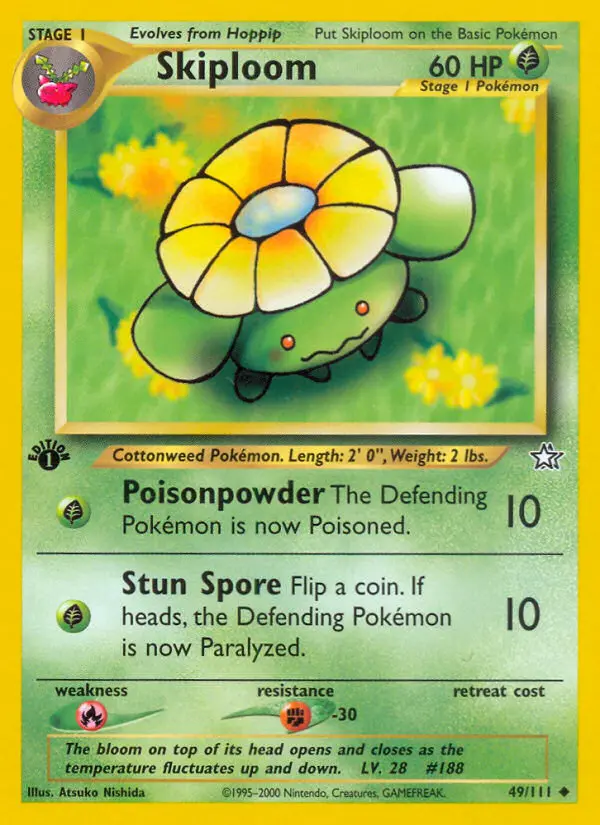
Skiploom
Generation II · #0188 — Cottonweed Pokémon
Few grass/flying-type Pokémon pair chlorophyll with a stat lean toward speed quite like Skiploom does. At 0.6 m and 1.0 kg, its build reflects a specialist role rather than a generalist one. With a cumulative stat total of 340 and a respectable Speed stat of 80, Skiploom is considerably more mobile than its predecessor, making it a practical choice for trainers seeking a nimble, sun-loving companion. The species is characterized by its temperature-sensitive flower bloom, which has made it famous enough to serve as a makeshift thermometer in some regions, a unique ecological role among Pokémon that demonstrates the deep integration between Pokémon species and human society.
Editor's Take
Skiploom is a stage that exists for four levels, which makes the Hoppip line one of the fastest three-stage evolutions in the series and one of the least rewarding.
Base Stats
Height
0.6m
Weight
1.0kg
Category
Cottonweed Pokémon
Gender
Male 50% / Female 50%
Color
green
Shape
upright
Habitat
grassland
Abilities
Doubles Speed during strong sunlight.
Protects against major status ailments during strong sunlight.
Bypasses light screen, reflect, and safeguard.

Skiploom Biology & Physical Characteristics
Skiploom possesses a distinctly rounded green body that stands approximately 0.6 meters tall and weighs just 1.0 kilogram, making it one of the lighter Pokémon in existence despite its sturdy appearance. The most striking feature of Skiploom's anatomy is the prominent yellow flower bloom with a white center that crowns its head, an organ that serves both photosynthetic and thermoregulatory functions. According to Pokédex entries, this bloom opens and closes dynamically as temperature fluctuates, with the flower blossoming most fully when the temperature rises above 64 degrees Fahrenheit (18 degrees Celsius). Skiploom possesses short stubby arms and feet, large flat ears positioned on the sides of its round head, and distinctive oval orange eyes without pupils that give it a perpetually cheerful expression. The species demonstrates remarkable adaptability to its environment, floating in the air to position itself closer to sunlight while simultaneously possessing the ability to rapidly seek shelter by closing its flower and hiding beneath trees when rain threatens, a behavioral adaptation that protects the delicate bloom from water damage.
Pokedex Numbers
Training
Breeding
Skiploom Breeding, Gender Ratio & Egg Groups
Skiploom maintains an equal gender ratio of exactly 50% male and 50% female, ensuring balanced breeding opportunities regardless of trainer preference or specific genetic goals. The species belongs to both the Fairy and Grass egg groups, a dual classification that provides breeding flexibility and allows Skiploom to receive moves from a relatively diverse pool of compatible Pokémon parents. With a base happiness value of 70 out of a maximum of 255, Skiploom shows moderate friendliness to its trainers, suggesting that it forms bonds readily but requires consistent care and attention to maximize affection and cooperation in battle. The species hatches from eggs after 20 cycles, which translates to approximately 4,884 to 5,140 steps of travel, placing it in the moderate range for incubation periods and making it accessible for breeders without requiring excessive time investment. The combination of balanced gender distribution and dual egg group membership makes Skiploom a practical breeding choice for trainers seeking to produce diverse offspring or maintain breeding lines with complementary move pools. Skiploom's breeding characteristics reflect the Generation II design philosophy of creating species that were genuinely usable in competitive breeding programs while maintaining accessibility for casual players.
Sprites






TMs & HMs
tm01
lets go pikachu lets go eevee
tm02
crystal
tm02
gold silver
tm03
yellow
tm03
crystal
tm03
gold silver
tm03
red blue
tm03
lets go pikachu lets go eevee
tm03
blue japan
tm03
red green japan
tm05
lets go pikachu lets go eevee
tm06
yellow
tm06
gold silver
tm06
red blue
tm06
crystal
tm06
emerald
tm06
firered leafgreen
tm06
diamond pearl
tm06
platinum
tm06
ruby sapphire
+547 more TMs/HMs
Skiploom's Evolution Chain


Skiploom Evolution, Mega Evolution & Special Forms
Skiploom occupies a crucial intermediate position in a linear three-stage evolutionary line, evolving from Hoppip at level 18 and subsequently evolving into Jumpluff at level 27. The evolution from Hoppip to Skiploom represents a meaningful development in the species' capabilities, particularly in the Speed and Special Defense statistics, with Speed increasing from 50 to 80 and Special Defense rising from 50 to 65. This intermediate evolution serves as a transition point where Skiploom gains the mobility necessary to more effectively pursue sunlight and avoid predators, while still retaining the relatively modest offensive capabilities of its pre-evolved form. The progression from Skiploom to Jumpluff continues this trend, adding further bulk and Speed while introducing the iconic cotton puffs that characterize the final evolution. Unlike many Pokémon that receive Mega Evolution forms, Skiploom and its evolutionary line have never received Mega Evolutions or regional variants, remaining consistent in their design philosophy since their introduction in Generation II. The evolutionary chain represents a deliberate design progression that aligns with the species' botanical inspiration, with each stage becoming progressively more adapted to aerial dispersal and solar energy utilization.
Where to Find
Kanto Route 14
kanto
+19 more
Sinnoh Route 205
sinnoh
Fuego Ironworks
sinnoh
Johto Safari Zone
johto
+1 more
Skiploom Behaviour and Natural Habitat
Skiploom thrives in temperate grasslands where consistent sunlight and moderate temperatures allow its flower to bloom and photosynthesize efficiently. The species displays a pronounced preference for warmth and sunlight, actively floating through the air in pursuit of optimal sun exposure and migrating to warmer regions when temperatures drop too low for comfortable photosynthesis. One fascinating aspect of Skiploom's ecology is the belief among some observers that a Skiploom's birth location can be determined by the unique scent emanating from its flower, suggesting that regional variations in soil composition and flora create distinctive olfactory signatures in the species. When rain approaches, Skiploom exhibits immediate defensive behavior by closing its flower and seeking shelter beneath trees, demonstrating a sophisticated understanding of weather patterns and moisture risks. The species' temperature sensitivity makes it an indicator species for climate conditions, and trainers familiar with the region often use Skiploom populations as a crude but effective early warning system for unexpected temperature fluctuations. Skiploom's ability to leverage its Grass/Flying typing allows it to occupy ecological niches unavailable to purely ground-dwelling or purely aerial Pokémon.
Pokedex Entries
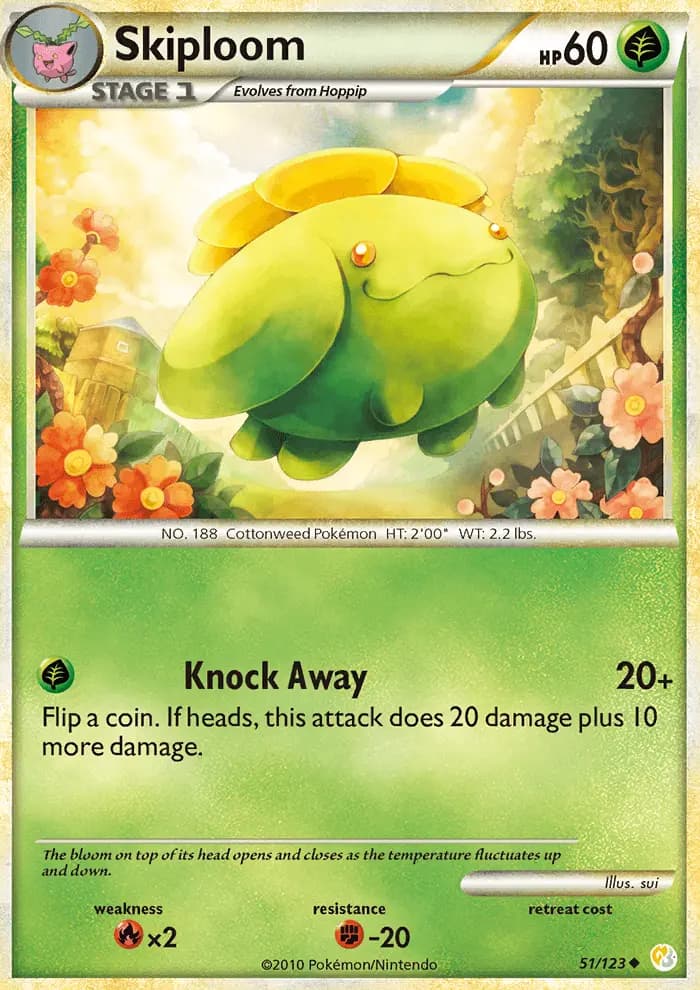
The bloom on top of its head opens and closes as the temperature fluc tuates up and down.
It spreads its petals to absorb sunlight. It also floats in the air to get closer to the sun.
As soon as it rains, it closes its flower and hides in the shade of a tree to avoid getting wet.
SKIPLOOM’s flower blossoms when the temperature rises above 64 degrees F. How much the flower opens depends on the temperature. For that reason, this POKéMON is sometimes used as a thermometer.
It blossoms when the temperature rises above 64 degrees F. Because its flower’s blooming changes with the temperature, it is sometimes used as a thermometer.
It spreads its petals to absorb sunlight. It also floats in the air to get closer to the sun.
The bloom on top of its head opens and closes as the temperature fluctuates up and down.
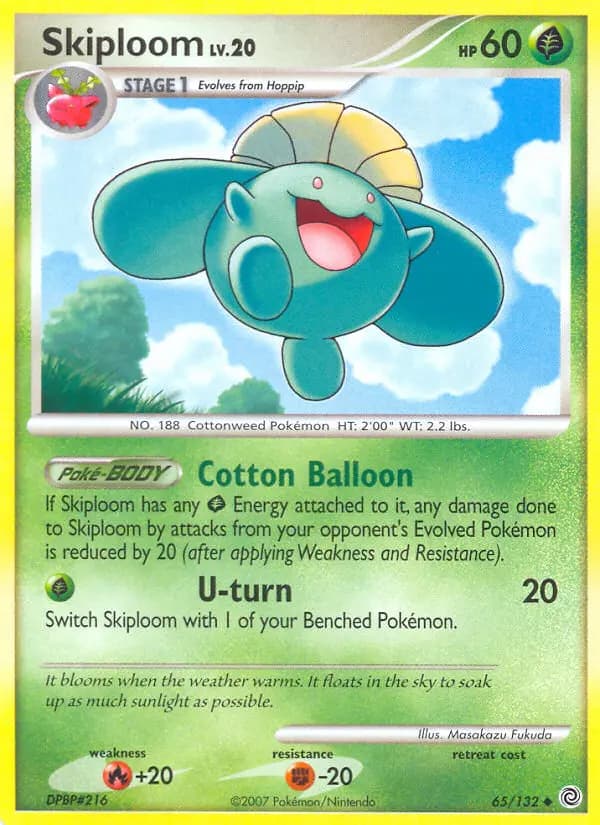
It blooms when the weather warms. It floats in the sky to soak up as much sunlight as possible.
The bloom on top of its head opens and closes as the temperature fluctuates up and down.
It spreads its petals to absorb sunlight. It also floats in the air to get closer to the sun.
It blooms when the weather warms. It floats in the sky to soak up as much sunlight as possible.
It blooms when the weather warms. It floats in the sky to soak up as much sunlight as possible.
The bloom on top of its head opens and closes as the temperature fluctuates up and down.
It spreads its petals to absorb sunlight. It also floats in the air to get closer to the sun.
Skiploom’s flower blossoms when the temperature rises above 64 degrees Fahrenheit. How much the flower opens depends on the temperature. For that reason, this Pokémon is sometimes used as a thermometer.
Skiploom Name Origin & Design Inspiration
Skiploom's name traces back to the combination of 'skip,' referencing the hopping, bouncing movement characteristic of the species and its evolutionary relatives, and 'bloom,' directly referencing the prominent flower that crowns its head. The Japanese name Popocco similarly references the species' bouncing nature and small stature, with 'popo' suggesting a soft, gentle movement. The Cottonweed designation as its genus name accurately captures the dual nature of the species' design, as it combines cottonlike structures with botanical elements, though the flower bloom is far more prominent than any cottony puffs at this stage of evolution. Skiploom's design philosophy reflects the generation's increased sophistication in depicting Pokémon with genuine ecological roles and behavioral characteristics, moving beyond purely fantastical concepts to create species that could plausibly exist within natural ecosystems. The flower bloom was inspired by real plant structures like dandelions and clovers, which exhibit similar temperature-sensitive opening and closing mechanisms in response to weather conditions. The species' round, gentle aesthetic design makes it visually distinctive while remaining coherent with the later evolutionary stages, creating a satisfying visual progression across the entire line.
Learnable Moves
Skiploom can learn 75 moves:
Move | Type | Cat. | Power | Acc. | PP |
|---|---|---|---|---|---|
| absorb | grass | Special | 20 | 100 | 25 |
| acrobatics | flying | Physical | 55 | 100 | 15 |
| aerial ace | flying | Physical | 60 | — | 20 |
| attract | normal | Status | — | 100 | 15 |
| baton pass | normal | Status | — | — | 40 |
| bounce | flying | Physical | 85 | 85 | 5 |
| bullet seed | grass | Physical | 25 | 100 | 30 |
| captivate | normal | Status | — | 100 | 20 |
| charm | fairy | Status | — | 100 | 20 |
| confide | normal | Status | — | — | 20 |
| cotton spore | grass | Status | — | 100 | 40 |
| curse | ghost | Status | — | — | 10 |
| dazzling gleam | fairy | Special | 80 | 100 | 10 |
| defense curl | normal | Status | — | — | 40 |
| double team | normal | Status | — | — | 15 |
| double edge | normal | Physical | 120 | 100 | 15 |
| encore | normal | Status | — | 100 | 5 |
| endeavor | normal | Physical | — | 100 | 5 |
| endure | normal | Status | — | — | 10 |
| energy ball | grass | Special | 90 | 100 | 10 |
| facade | normal | Physical | 70 | 100 | 20 |
| fairy wind | fairy | Special | 40 | 100 | 30 |
| flash | normal | Status | — | 100 | 20 |
| fling | dark | Physical | — | 100 | 10 |
| frustration | normal | Physical | — | 100 | 20 |
| giga drain | grass | Special | 75 | 100 | 10 |
| grass knot | grass | Special | — | 100 | 20 |
| grassy terrain | grass | Status | — | — | 10 |
| headbutt | normal | Physical | 70 | 100 | 15 |
| helping hand | normal | Status | — | — | 20 |
| hidden power | normal | Special | 60 | 100 | 15 |
| infestation | bug | Special | 20 | 100 | 20 |
| leaf storm | grass | Special | 130 | 90 | 5 |
| leech seed | grass | Status | — | 90 | 10 |
| light screen | psychic | Status | — | — | 30 |
| lunge | bug | Physical | 80 | 100 | 15 |
| magical leaf | grass | Special | 60 | — | 20 |
| mega drain | grass | Special | 40 | 100 | 15 |
| memento | dark | Status | — | 100 | 10 |
| mimic | normal | Status | — | — | 10 |
| natural gift | normal | Physical | — | 100 | 15 |
| poison powder | poison | Status | — | 75 | 35 |
| pollen puff | bug | Special | 90 | 100 | 15 |
| protect | normal | Status | — | — | 10 |
| psych up | normal | Status | — | — | 10 |
| rage powder | bug | Status | — | — | 20 |
| reflect | psychic | Status | — | — | 20 |
| rest | psychic | Status | — | — | 5 |
| return | normal | Physical | — | 100 | 20 |
| round | normal | Special | 60 | 100 | 15 |
| secret power | normal | Physical | 70 | 100 | 20 |
| seed bomb | grass | Physical | 80 | 100 | 15 |
| silver wind | bug | Special | 60 | 100 | 5 |
| sleep powder | grass | Status | — | 75 | 15 |
| sleep talk | normal | Status | — | — | 10 |
| snore | normal | Special | 50 | 100 | 15 |
| solar beam | grass | Special | 120 | 100 | 10 |
| splash | normal | Status | — | — | 40 |
| stun spore | grass | Status | — | 75 | 30 |
| substitute | normal | Status | — | — | 10 |
| sunny day | fire | Status | — | — | 5 |
| swagger | normal | Status | — | 85 | 15 |
| sweet scent | normal | Status | — | 100 | 20 |
| swords dance | normal | Status | — | — | 20 |
| synthesis | grass | Status | — | — | 5 |
| tackle | normal | Physical | 40 | 100 | 35 |
| tail whip | normal | Status | — | 100 | 30 |
| tailwind | flying | Status | — | — | 15 |
| take down | normal | Physical | 90 | 85 | 20 |
| tera blast | normal | Special | 80 | 100 | 10 |
| thief | dark | Physical | 60 | 100 | 25 |
| toxic | poison | Status | — | 90 | 10 |
| trailblaze | grass | Physical | 50 | 100 | 20 |
| u turn | bug | Physical | 70 | 100 | 20 |
| worry seed | grass | Status | — | 100 | 10 |
Skiploom Competitive Battle Guide
Skiploom's competitive viability is substantially bolstered by its signature ability Chlorophyll, which doubles its Speed during strong sunlight, transforming the species from a moderately fast Pokémon with 80 base Speed into an extremely threatening sweeper with 160 effective Speed under sun. This ability makes Skiploom a practical component of sun-based offensive teams, particularly when paired with Pokémon capable of setting up Sunny Day or with Pokémon possessing the Drought ability. The alternative ability Leaf Guard provides utility by protecting Skiploom from major status ailments like paralysis, burn, and poison during sunny weather, offering defensive applications for trainers prioritizing longevity. The hidden ability Infiltrator bypasses defensive screens such as Light Screen and Reflect, allowing Skiploom to maintain offensive pressure even when opponents attempt to mitigate its damage output through traditional defensive support. Skiploom's base stat distribution emphasizes Speed and Special Defense over offensive capabilities, with Attack and Special Attack both languishing at 45 base points, limiting its ability to deal significant damage despite potentially doubling its Speed. In modern competitive formats, Skiploom typically functions as a support or utility Pokémon rather than a primary threat, often used to enable faster sweepers through Sunny Day support or to disrupt opponent strategies through move pools that include options like Synthesis for recovery and various Grass-type coverage moves. The species' 340 aggregate stat total places it decidedly in lower-tier competitive formats, though its niche applications in sun-based strategies ensure it maintains some relevance in specialized team compositions.
Commonly Asked Questions About Skiploom
What type is Skiploom?
Skiploom is a grass and flying type Pokemon.
What does Skiploom evolve into?
Skiploom evolves into jumpluff.
What are Skiploom's weaknesses?
Skiploom is weak to flying, poison, rock, fire and ice type moves.
Does Skiploom evolve by trading?
No — Skiploom evolves entirely through leveling up, with no trade required at any stage.
Where can I find Skiploom?
Skiploom can be found in kanto route 14 (kanto), sinnoh route 205 (sinnoh) and fuego ironworks (sinnoh) and 1 other locations.
Skiploom Cultural Impact & Franchise History
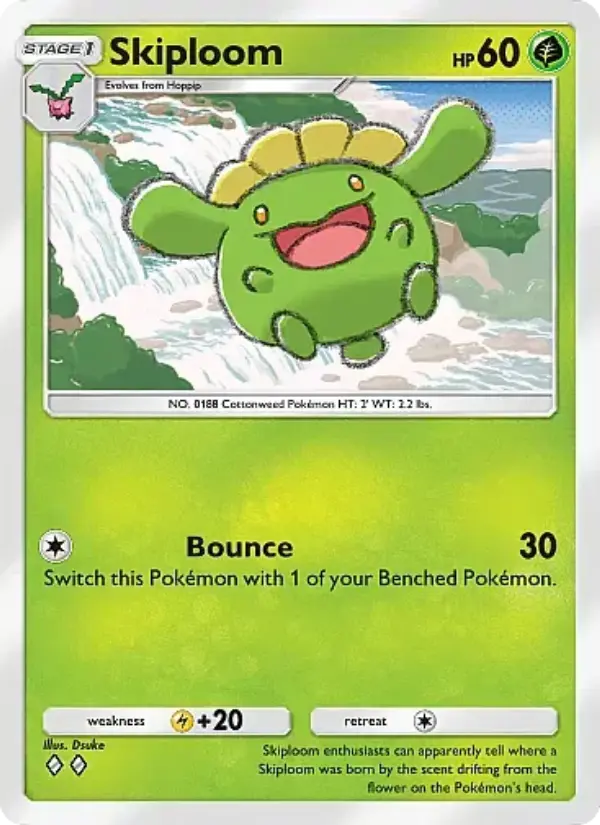
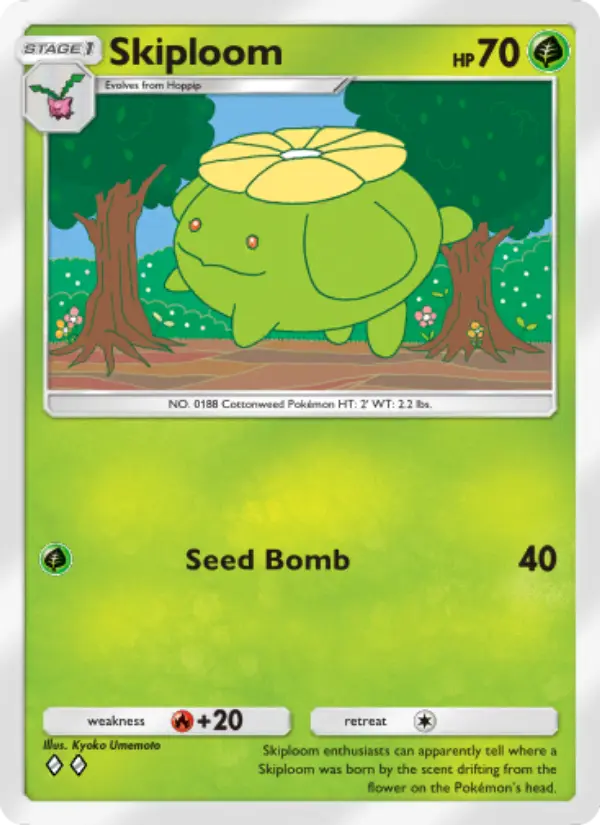
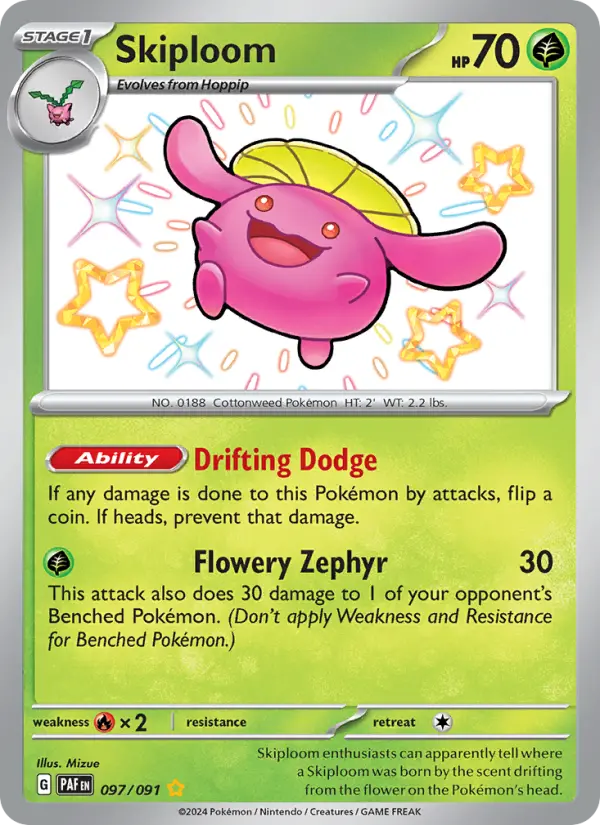
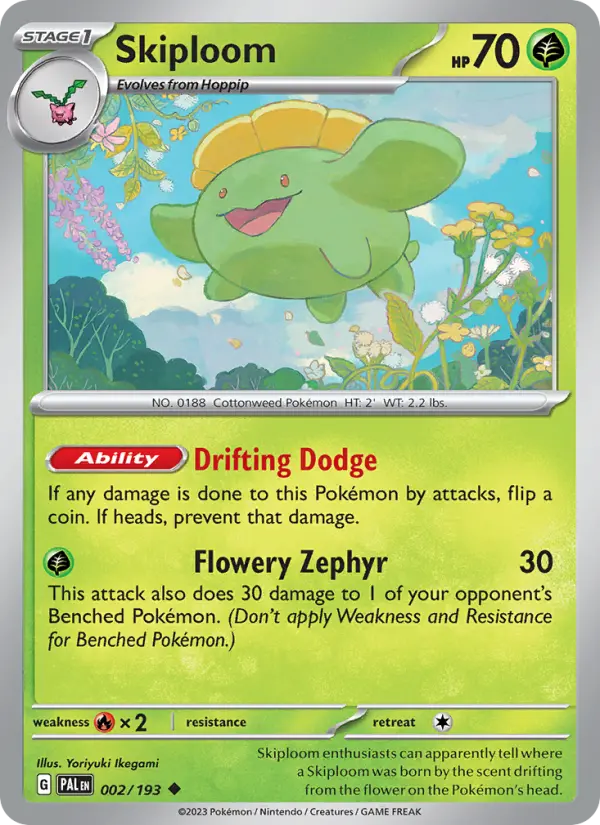
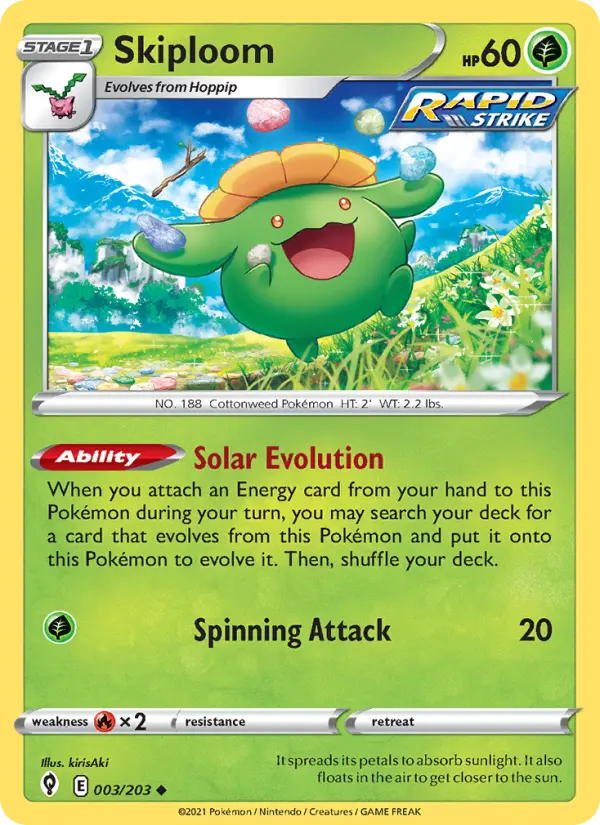
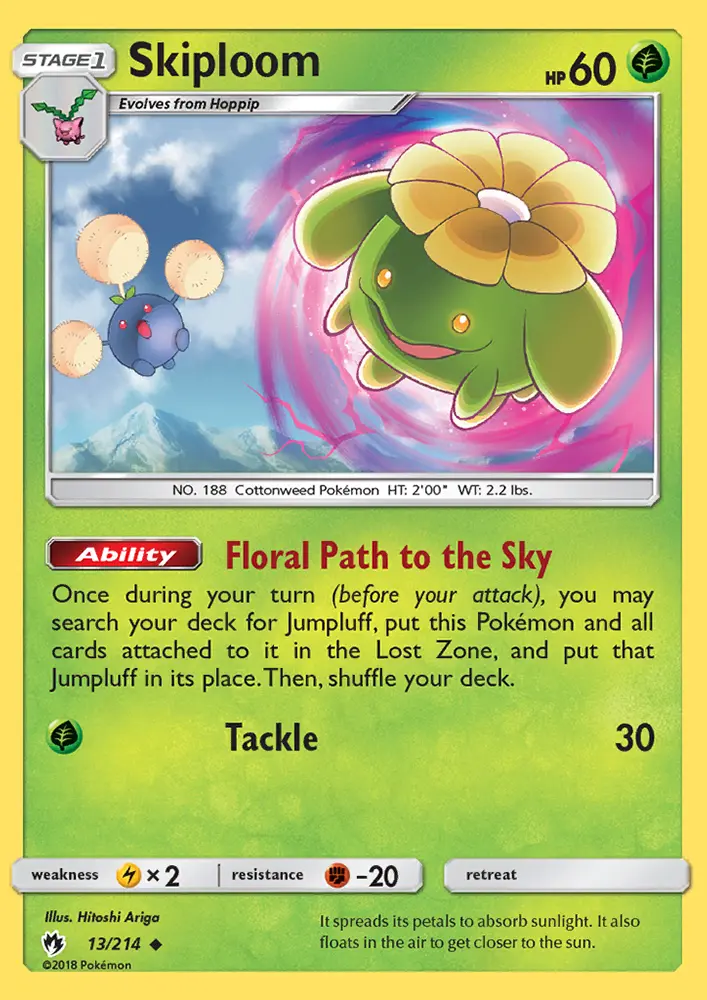
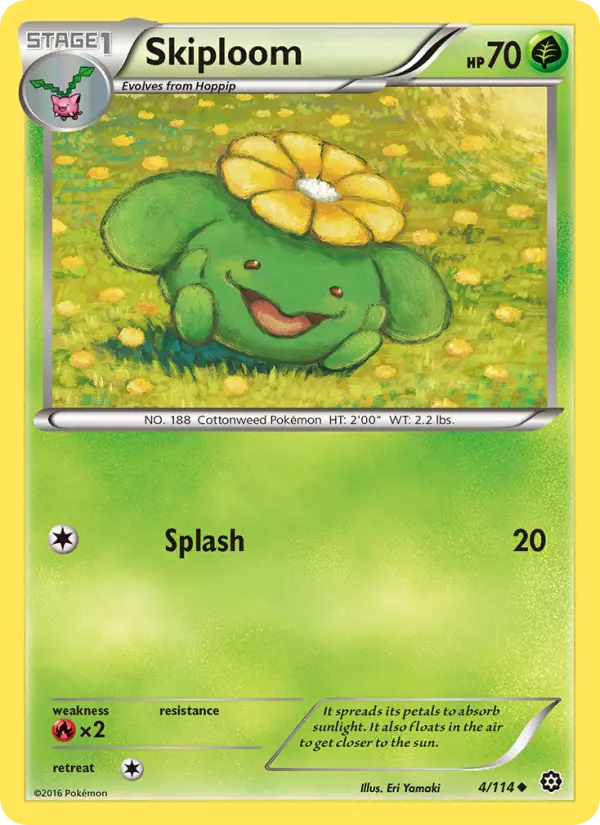
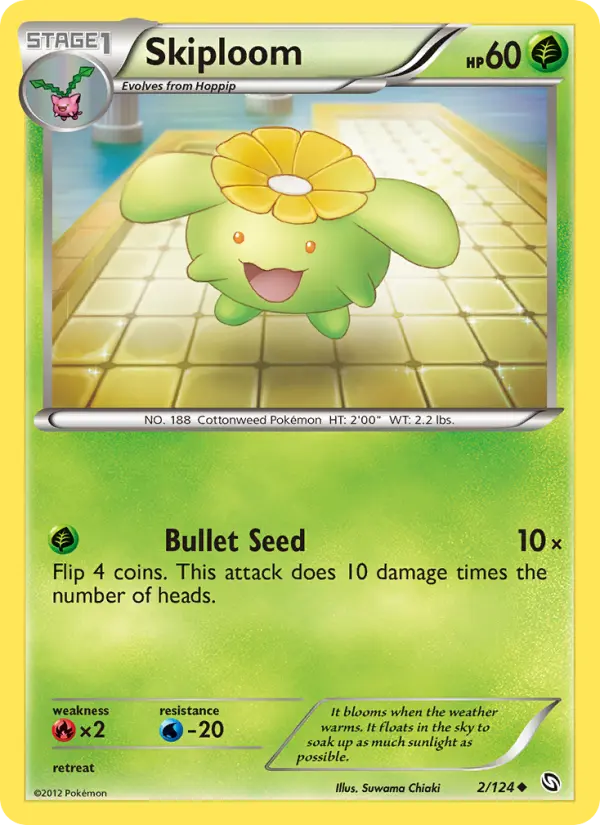
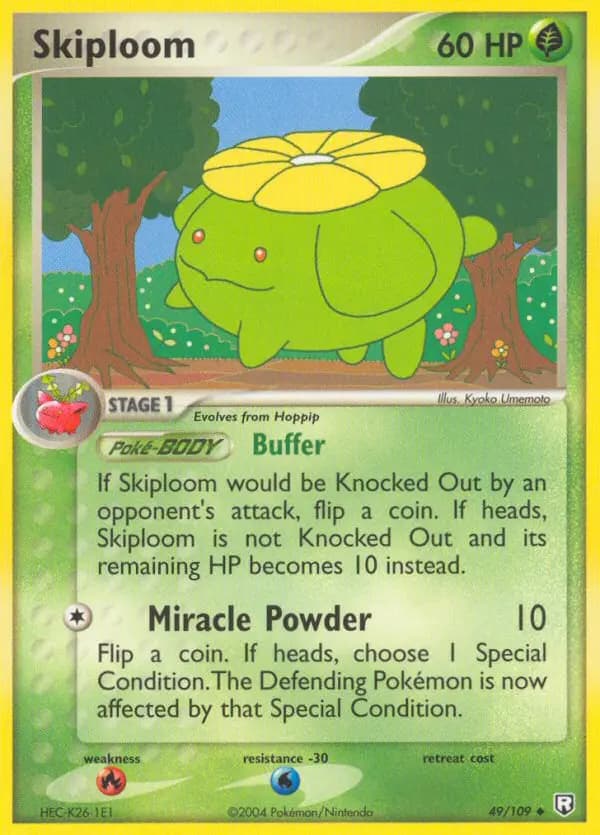
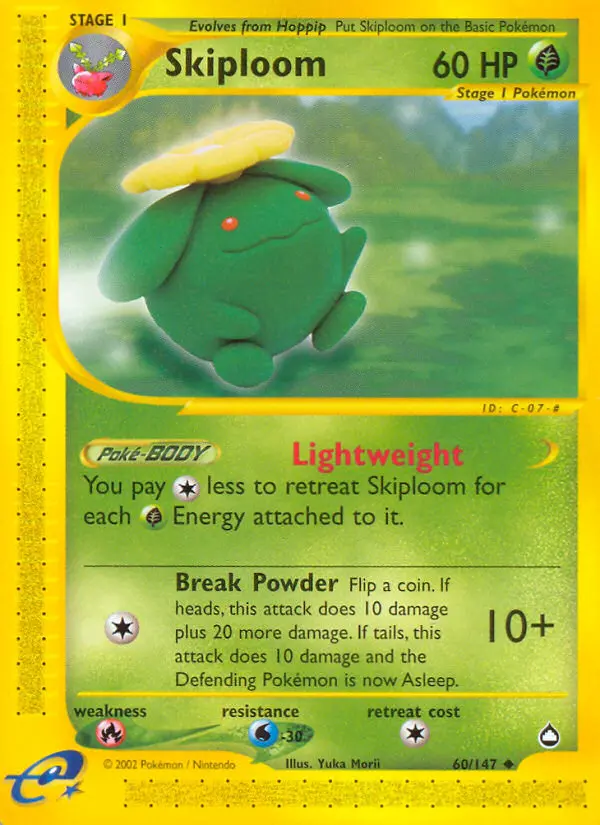
Skiploom has achieved a notable cultural presence as one of the most recognizable second-generation Pokémon, benefiting from its prominent appearance in the Pokémon anime series and multiple trading card game expansions. The species' unique characteristic as a living thermometer has captured popular imagination, leading to numerous references in Pokémon literature and expanded universe content where trainers and researchers explicitly use Skiploom populations to monitor environmental conditions. In the Pokémon anime, Skiploom has appeared in several memorable episodes, contributing to its status as a culturally significant species among viewers who grew up during the Gold and Silver era. The trading card game has featured Skiploom in multiple sets across different generations, with various card designs highlighting different aspects of its ecology and capabilities, ensuring that the species maintains visibility among the competitive TCG community. Skiploom's design has influenced subsequent generations of Pokémon design, establishing templates for sun-loving, flower-based creatures that continue to appear in newer games and media. The species represents a successful example of Generation II's philosophy of creating Pokémon with genuine ecological roles and functional abilities that extend beyond pure combat utility, contributing to broader discussions about Pokémon world-building and environmental integration. Among casual players and collectors, Skiploom maintains a beloved status as a gentle, approachable Pokémon that represents the accessibility and charm of the early Pokémon games.
Where to Find Skiploom in Every Pokémon Game
Skiploom's availability varies significantly across the extensive Pokémon game library, reflecting its status as a Generation II native species with consistent inclusion across most modern titles. In the original Gold, Silver, and Crystal versions, Skiploom can be encountered in the wild throughout Johto after evolving Hoppip at level 18, or trainers can encounter it directly in various grassland locations. The species maintains consistent availability in HeartGold and SoulSilver remakes, allowing modern players to experience the original Gen II gameplay with access to Skiploom through traditional leveling methods or by purchasing it from in-game locations. In the Kalos region (X and Y), Skiploom is available as Pokédex #0136, appearing in specific grassland routes and available relatively early in a trainer's journey through the region. Scarlet and Violet include Skiploom as Pokédex #0017, making it accessible to contemporary players through modern games, though the specific availability windows and encounter rates vary based on game progression and current in-game conditions. Previous generation games including Diamond, Pearl, Platinum, Black, White, Black 2, and White 2 all featured Skiploom in their regional Pokédexes, ensuring that the species has enjoyed nearly continuous availability since its original introduction. The relative ease of capturing or breeding Skiploom across most games, combined with its presence in popular competitive team-building applications, ensures that trainers seeking to add this Grass/Flying-type to their rosters can do so through multiple avenues regardless of which generation they prefer.